Renewable Resource : Al Gore told us that politics is a renewable resource. I think it’s important to realise that our future Energy will be Renewable, and our vision should therefore be sustained for Sustainable Energy.
Solar photovoltaic cells based on semiconductor transistor junctions are becoming cheaper, more efficient and more widely relied upon. Mankind can thrive, drinking in the sunshine.
Yet, the solar power technology of today could still become a minor footnote if there is a revolution in Physics or Chemistry :-
“Solar Power Discovery Dims Future of Photovoltaic Cells : Posted by Francis Rey on April 18, 2011 : University of Michigan researchers made a breakthrough discovery on the behavior of light, which could alter solar technology from now on. Professor Stephen Rand, Departments of Electrical Engineering and Computer Science, Physics and Applied Physics, and William Fisher, an Applied Physics doctoral student, found out that light, when traveling [sic] through a nonconductive material, such as glass, at the right intensity can produce magnetic fields 100 million times stronger than previously deemed possible. During these conditions, the magnetic field has enough strength to equal a strong electric effect, producing an “optical battery” that leads to “a new kind of solar cell without semiconductors and without absorption to produce charge separation”, Rand said…”
When did Colonel Muammar Gaddafi learn of threats from the world’s major oil consumer countries against his rule ? Was it in early 2011 ? Or was it several years earlier ? On the public stage, he has been deliberately reduced to a figure of fun, and his message advising non-aggression and protection from aggression is being lost. He is now a desperate man :-
Outside the usual political and media circles, questions are being asked. Why has the United Nations sanctioned military engagement in Libya in the form of UN Security Council Resolution 1973 ? Why the heavy firepower here, in Libya, when the ostensible rationale for intervention was only to implement a No-Fly Zone ? Why not gloibal military action elsewhere in the Middle East North Africa (MENA) arena where there are other despots making life unpleasant or endable for their citizens ?
I present to you two possible futures for Libya, both of which will require extensive cooperation with foreign corporate and political players, something that Muammar Abu Minyar al-Gaddafi (or Qaddafi) threatens, or rather, depending on various news reports, “threatened”.
1. The Dash for African and Arabic Natural Gas (and Oil)
In a carbon-constrained world Natural Gas is a boon – it has roughly half the carbon dioxide emissions of coal when burned to produce steam to generate electricity. Any country that’s got Natural Gas, especially good quality Natural Gas that doesn’t have to be hydraulically “fractured” from rock strata, is a country we will learn to love and trade on significantly generous terms with.
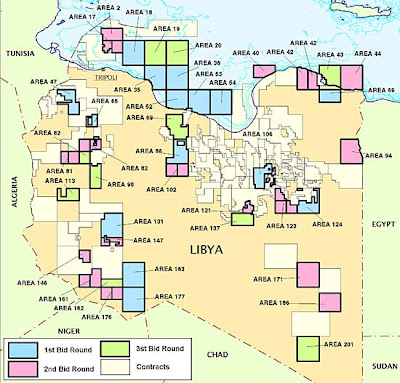
There has been extensive surveying of Libya, and the whole of North Africa’s Maghreb region, including the type of offshore seismic surveying that found extensive gas fields in the Eastern Mediterranean that Israel is now laying claim to (and preventing Gaza from exploiting). This has led to quite a lot of excitement in the fossil fuel energy industry, so, reading between the lines of the conference agendas, there is high dollar value under Libya’s maritime territory :-
In addition to Natural Gas there may well be high levels of top quality oil – and keeping up the flow of crude oil, as we all know, is crucial to the health of the world’s economy. Threats of re-nationalising the Libyan fossil fuel resources therefore caused corporate shock :-
“Oil companies fear nationalisation in Libya : By Sylvia Pfeifer and Javier Blas in London : Published: March 20 2011 : Western oil companies operating in Libya have privately warned that their operations in the country may be nationalised if Colonel Muammer Gaddafi’s regime prevails. Executives, speaking on condition of anonymity because of the rapidly moving situation, believe their companies could be targeted, especially if their home countries are taking part in air strikes against Mr Gaddafi. Allied forces from France, the UK and the US on Saturday unleashed a series of strikes against military targets in Libya. “It is certainly a concern. There are good reserves there,” said one executive at a western oil company with operations in Libya. “We have lost some of our production [because all operations have stopped] but our bigger concern is what will happen to the exploratory work as that gives you a future rather than the immediate impact,” he added. Most of the world’s large international oil companies have producing assets in Libya, including Spain’s Repsol, France’s Total, and Italy’s Eni, which is the largest single investor there. Germany’s Winstershall – a unit of BASF – and OMV of Austria are also present. The country is the world’s 12th largest oil exporter, and the escalating violence there has triggered a jump in prices to nearly $120 a barrel. More than half of Libya’s oil was exported to Italy, Germany and France last year…”
Production in the country has taken a hit due to the fighting, but order should soon be restored. Clearly, long-term stability in Libya, with unhindered, inexpensive access to the country’s oil and gas resources is an important part of the national security interests of many Western democracies.
The DESERTEC project of the European Union seeks to roll out solar power in the desert sands of North Africa, and makes the promise of economic and social development of the countries that take part, although that dream has been questioned :-
Let’s face the facts here – massive new energy projects in North Africa will be financed and developed through large multinational, transnational corporations, companies who have contributed to the economic slavery of Africa for, let’s approximate here, centuries.
What guarantees can the Maghreb have that this is not a further land grab on Africa’s potential ?
In addition, the recent social and political volatility in the Middle East North Africa region could jeopardise the noble plans of the European Union to reach out in energy partnership.
Hang on. Wait a minute. Is the wave of uprisings across the Middle East and North Africa connected in any way to the interests of oil and gas companies who want Future #1 to prevail for the whole region, not just Libya ?
American companies have been so keen to sell nuclear electricity projects to Saudi Arabia and others around the Arabian Gulf – but has this been encouraged from the high-ups to keep the Arabs off the scent of Renewable Energy ? Forget nuclear power – it’s expensive and awkward. Iran only pursues civilian nuclear power to irritate the United States Government. A solar Arabia could give the Middle East and North Africa a second generation of being the energy princes of the world. I suspect they will go for this in a big way very shortly, uprisings or no uprisings. Why ? Two little words – Fukushima Daiichi.
So there we have it – two entirely probable, slightly competing, futures being mapped out for Libya by the big guns of NATO (a euphemism for the USA). If Libya is split into two countries, the fossil fuel Future #1 will be likely applied to East Libya, and the desert solar Future #2 will be foisted on West Libya.
Continued interference in the country is a certainty.
Ambient, sustainable energy is all around us, and sooner or
later we will find the ways to make use of it for the good of all.
The following is an appropriately edited transcript of a
conversation on the Claverton Energy Research Group
forum online, and was written by Nick Balmer, a consultant
in renewable energy.
__________________________________________________________
…The huge scale of the possible changes for all concerned is
causing all of the current Titans in the [energy] industry to deploy
the full force of the media [and their] PR [public relations] in an
attempt to manipulate the public and policy towards their own way
of thinking, or in such a way as to protect their own vested interests.
The great thing is that these issues are being aired out in the open,
and groups like [Claverton Energy Research Group forum] allow
people with knowledge of these affairs to debate these issues openly.
The big problem is that each of us has only a very detailed
understanding of some small fraction of the total issue.
Most of the public and government only has a very slight knowledge
of the total issue, and has had only limited access to ways to find out
in detail what is going on.
As Egypt is demonstrating today, everybody now has a voice and as
Wikileaks shows, sooner or later everything will come out into the
open.
All of us are struggling to come to terms with this explosion of
access to knowledge.
It is quite clear that lots of bubbles are being burst as a result of
the Global Financial implosion and the huge expansion in available
knowledge.
Just as banking and property has been shown to be an unaffordable
Ponzi scheme and to be vastly over-inflated, UK energy policy is now
coming under huge scrutiny.
We can now compare our energy systems with other countries.
Due to the huge geological accident of fate, since the 1700’s in coal,
and 1970’s in oil and gas, we have been extremely fortunate in being
able to live way beyond the lifestyle standards of most of the World.
We have not had to adapt.
Other countries that didn’t have this advantage had to change over
recent decades.
Places like Denmark, Austria, Germany [and so on] have made huge
changes because they had less energy from fossil resources.
Now we have reached the peak or crunch point, we find ourselves well
behind those countries that had to adapt earlier.
Everybody is concentrating on the Capital cost of deploying per
MW [megawatt] and overlooks the cost of fuels.
The cost of fuels over time is massively more important than the
CAPEX [capital expenditure on investment].
So even if windfarms cost 20 times per MW or GW [gigawatt] more to
build than nuclear or coal or gas, in the scheme of things,
[wind power] is always going to win, because the fuel is free and
unlimited for centuries to come.
Similarly [solar power technologies], or even more effective,
household insulation and cutting energy use.
And yet the media and government are blinded by the barrage of PR
and media from the energy vested interests who are working with
every muscle to stop this coming out into the open.
I often meet financiers in my work trying to promote and support AD
[anaerobic digestion of biological waste for the production of
renewable methane], biomass, solar and wind projects.
I am always struggling to prove to them that I have an offtake [return
on investment] and the fuel supply. This is often really hard to do
[but] I only have to do this for seven to 12 years to make my business
cases stack up.
I was really depressed at the end of one such presentation and
discussion, when one broadly sympathetic banker who had turned me
down said that he was having even worse problems with largescale
energy projects.
How do you predict the price and supply of coal forward for 25 years
or more ?
It has jumped 17% in recent months.
How do you prove that you are going to have offtake for huge power
stations in future years ?
Demand dropped 8% in 2009.
How do you raise the equity or debt for a billion [pound] project when
banks don’t want to lend more than £30 million each ? Imagine how
many banks that would take ?
We have reached a tipping point in our economy, sustainability and
future outlook.
Yes, the existing mega-power companies are fighting as hard as
Mubarak today to hold onto power, but they represent the past just
as surely as he does.
Those companies can rejuvenate themselves, unlike the Egyptian
President.
If they don’t, there are an increasingly large number of smaller and
more active players coming into the market.
The average household pays somewhere around £1,300 a year for
its heating and lighting.
The companies that come forward with a way to do that for £1,000 is
going to capture the market very quickly.
I have friends in Austria who only pay 65 Euros for services that I
pay £1,400 for.
They do this through insulation, triple glazing, solar and biomass energy.
Most [UK] households have less than £400 per year discretionary
disposable income. This prevents them making changes to their houses
they desperately want and know they need to make. This can
drop their energy demands hugely.
If somebody can unlock that Gordian Knot the benefits would be
enormous as there are something like 27 million households.
At a time when household debt is at an all-time high, incomes are
shrinking, and 40% live on ether government salaries, state
pensions or benefits.
Energy is a very high part of these households’ outgoings – if you
pay £1,300 a year and your house only brings in £11,000 to £20,000
per year.
A 50% increase in the £1,300 could bring great distress, and
possibly even civil unrest here.
The increases fossil power [companies] need to make their systems
bankable will increase energy bills. This will feed straight through into
government liabilities because 40% of us live on government payouts.
If government can drop the cost of heating and lighting quite easily
by £100 to £500 per household per year while at the same time
provide employment for hundreds of thousands of White Van men
cutting energy uses, doesn’t this make far more sense than building
unsustainable power stations that will have to be [bankrolled] by the
government, who will then have to buy back electricity at a price our
communities cannot stand ?
Project a similar calculation onto transport fuels and you get even
greater problems.
At $80 a barrel [of oil] industry is shrinking and relatively few
renewable fuel business cases work. At $100 a barrel most renewable
fuels can compete.
At $120 a barrel almost any alternative beats oil, and that is before
you start to look at issues like fuel security and the environment.
Although the battle is one of David and Goliath, or the Dinosaur and
those early mammals, between the new energy industries and the
existing vested energy industries, [it] has only one outcome.
It is only a matter of the co-lateral damage along the way.
Like Mubarak, it is clear they must go. Are they going to go
gracefully, or are they going to smash the place up first ?
Creating a level playing field for Renewable Energy by removing Fossil Fuel subsidies is an excellent idea, as mooted by the International Energy Agency :-
“IEA reveals fossil fuel subsidies top $550bn : Report warns kick-backs for fossil fuels are skewing energy markets and holding back renewables investment : By Andrew Donoghue 08 June 2010 : The global fossil fuel industry currently enjoys subsidies worth more than $550bn (£382bn) a year, according to a major new report from the International Energy Agency (IEA) that will increase pressure on world leaders to phase out fossil fuel subsidies ahead of a crucial meeting of the G20 group of nations later this month. The research, which was released at a meeting of G20 finance ministers in Busan, South Korea over the weekend, reveals fossil fuel subsidies amounted to $557bn in 2008 – up from $342bn in 2007. Enormous subsidies are skewing energy markets and inhibiting the uptake of more sustainable energy sources, the IEA warned. “The IEA analysis highlights that the price signal from subsidy phase-out would provide an incentive to use energy more efficiently, and trigger switching from fossil fuels to other fuels that emit fewer GHGs,” the report said…”
“Fossil Fuel Subsidies Are 12 Times Support for Renewables, Study Shows : By Alex Morales – 29 July 2010 : Global subsidies for fossil fuels dwarf support given to renewable energy sources such as wind and solar power and biofuels, Bloomberg New Energy Finance said. Governments last year gave $43 billion to $46 billion of support to renewable energy through tax credits, guaranteed electricity prices known as feed-in tariffs and alternative energy credits, the London-based research group said today in a statement. That compares with the $557 billion that the International Energy Agency last month said was spent to subsidize fossil fuels in 2008. “One of the reasons the clean energy sector is starved of funding is because mainstream investors worry that renewable energy only works with direct government support,” said Michael Liebreich, chief executive of New Energy Finance. “This analysis shows that the global direct subsidy for fossil fuels is around ten times the subsidy for renewables.”…”
“G20 agrees on phase-out of fossil fuel subsidies : 25 September 2009 : The world’s largest economies agreed on Friday to phase out subsidies for oil and other carbon dioxide-spewing fossil fuels in the “medium term” as part of efforts to combat global warming. But Group of 20 leaders at a two-day summit meeting here did not advance discussions about financial aid for developing nations dealing with climate change, exacerbating concerns that U.N. talks to form a new climate pact are in peril. Some $300 billion a year is spent worldwide to subsidize fuel prices, boosting demand in many nations by keeping prices artificially low and, thus, leading to more emissions. The agreement — backed by all of the G20 including Russia, India and China — was a victory for U.S. President Barack Obama, whose credentials for fighting climate change have been marred by dimming prospects that the U.S. Senate will pass a bill to reduce emissions before the December U.N. meeting…”
Seems like it’s a done deal…apart from an issue that should never be forgotten in all global negotiations : economic development.
India, for example, has a policy to keep down the price of diesel fuel – a strategy to promote economic development. They won’t be ready to cut subsidies :-
“Diesel subsidy withdrawal unaffordable, says minister : 04 February 2011 : New Delhi: India cannot afford to withdraw the subsidy on diesel and it has to continue till poverty disappears from the country, union Minister for New and Renewable Energy Farooq Abdullah said on Friday. Speaking at the Delhi Sustainable Development Summit here, Abdullah said India gives a lot of subsidy on diesel and, if withdrawn, it will only increase inflation. ‘Diesel subsidy has to continue till poverty disappears from the country,’ he said while reacting to Canadian parliamentarian Stephane Dion’s appeal to phase out diesel subsidy…”
The Americans and the Europeans calling for an end to fossil fuel subsidies could be interpreted as a lever to block the economic development of the Global South – as much of the price-fixing is conducted by developing nations.
It could be argued that the United States and “her allies” want to retain economic dominance – what better way than blocking economic progress in the Global South and making it appear to be a Climate Change measure ?
In addition, much of the financial support for energy projects in the Global South is indirectly awarded to the fossil fuel industry via the international aid cash coming from developed nations and the international agencies. And the fossil fuel producers and engineering companies are not going to be willing to let that source of revenue dry up.
If international aid for energy projects gets stopped, so does a lot of economic development until “technology transfer” of Renewable Energy can be ramped up :-
Before they came to power in the United Kingdom, the Conservative Party were strongly behind the proposals to stop international development loans going on dirty energy projects :-
“23 November 2009 : Andrew Mitchell: Ending Labour’s support for polluting energy projects : …we must end the use of the Export Credit Guarantee Department to promote ‘dirty’ fossil fuel power stations around the world, and instead make it a champion of green technology…”
“Lord Green told: Britain’s exports must stop harming people and planet : 24 January 2011 : New report details string of ‘dodgy deals’ at export support body : As new Trade Minister Stephen Green embarks on a national tour to promote British exports, Jubilee Debt Campaign warns that Britain’s export support body is not up to the job : A report released by the organisation today exposes a history of backing projects by large corporations in a handful of controversial sectors. The projects have led to human rights abuses, environmental destruction and corruption in the developing world, and often failed to deliver even on their stated aims. Britain’s export promotion body, the Export Credits Guarantee Department (ECGD), has also undermined Britain’s international development goals by leaving countries like Kenya, Vietnam, Indonesia and Pakistan with £2 billion of debts from failed export deals – 96% of Third World Debt ‘owed’ to the UK today…The Coalition government has failed to act on its pledge to end fossil fuel subsidies through the ECGD, despite taking action to beef up the Department’s role…”
The key global development question remains – is cutting fossil fuel subsidies yet another (underhand) way of reducing international aid budgets ?
To deflect criticism, the spotlight will probably be turned on countries like Iran :-
“Getting the Prices Right – Cutting Subsidies Could Save Billions : 8 June 2010 : Global fossil fuel consumption subsidies in 2008 were much higher than previously estimated and totalled USD557 billion, according to IEA analysis…The IEA has undertaken an extensive survey to identify countries that offer subsidies that reduce prices of fossil fuels below levels that would prevail in an undistorted market, thus leading to higher levels of consumption than would occur in their absence. The survey identified 37 countries and it is estimated that these represent over 95% of global subsidized fossil‐fuel consumption…The IEA analysis has revealed that fossil fuel consumption subsidies amounted to $557 bn in 2008. This represents a big increase from $342 bn in 2007…Since 2008, a number of countries – including China, Russia, India and Indonesia – have made notable reforms to bring their domestic energy prices in line with world prices…The country with the highest subsidies in 2008 was Iran at $101 billion, or around a third of the country’s annual central budget. Chronic under‐pricing of domestic energy in Iran has resulted in enormous subsidies and a major burden on the economy that is forcing reliance on imports of refined products. Iran’s leadership came to agreement in 2010 on a sweeping plan for energy subsidy reform; however, steep economic, political and social hurdles will need to be overcome if Iran is to realize lasting reform…”
Obama says we have to drop fossil fuel subsidies. The next thing you know, the inaccuracies start flying :-
“Manchin claims coal “doesn’t get a penny of subsidies” : In fact, the industry gets trillions of pennies : 4 February 2011 : Senator Joe Manchin (D-WV), the newest member of the Senate Energy and Natural Resources Committee, claimed today that the coal industry doesn’t receive any government subsidies, unlike every other form of energy. Brad Johnson debunks this absurd claim…”
The Conservative and Liberal Democrat Coalition Government in the United Kingdom have several competing interests to juggle when it comes to the electricity generation industry.
Any proposed tinkering in the electricity market will need to show it still promotes competition (even though new entrants will probably complain they can’t compete in auctions), even as it guarantees safe and stable power supplies, even as it needs to make sure consumers don’t get ripped off.
The Department of Energy and Climate Change have published a clearly-written consultation document on their proposals for an Electricity Market Reform (EMR), detailing various methods of intervening to ensure long-term objectives on carbon emissions and energy security :-
So far, my conclusion is that the net effect of these proposals will be to make the electricity generators feel secure about future earnings.
I’m not convinced that anything I’ve read so far will help energy supply companies feel willing to leap the expensive investment hurdle to ensure the UK gets new low carbon power plants.
I’m not even sure if the carbon and power pricing described will deter companies from dirty power generation and direct them towards new low carbon investment.
When I happened on the levelised cost of power in the main DECC analysis document, I came to a very pragmatic conclusion :-
Figure 2 (see top) shows that FOAK (first of a kind) new nuclear reactor plant designs (which is what we are told we will be getting in the UK) are probably going to yield similar unit electricity price values to Onshore Wind Power and Combined Cycle Gas Turbine (CCGT) plant using Natural Gas feedstock.
My question is : why do we need to intervene with the electricity market to incentivise low carbon generation if the cheapest technologies are the low carbon options anyway ? (Yes, I’ve deliberately forgotten to discuss Carbon Capture and Storage).
My second question is : are the financial instruments proposed for the electricity market simply a sop to the electricity generators to leverage investment in new and efficient low carbon power stations ? Come and invest in new power generation in Great Britain and see your earnings stable (or rising) !
And my third question is this : don’t the NIMBY campaigns against Onshore Wind Power realise their success means that the overall cost of electricity to the consumers will rise significantly as wind power has to move offshore ?
My conclusion is : it would be far cheaper simply to instruct the largely publicly owned banks to make investment finance available, but only for low carbon technologies and forget about trying to maintain the facade of a free market.
Power supply is virtually a monopoly – and the State is bound to maintain supply – DECC have even got proposals on the table in their main Energy Bill to buy up any power companies that fail…yet another bailout !
I learned about various views on social and positive impact investment, and about elements of the Coalition Government’s “Big Society” and the proposed Green Investment Bank.
Ethical Investment appears to have come a long way since I put some money into a Fair Trade company many moons ago, where I knew I would never see a dividend, or even be able to sell the shares at some point.
Grown up people in sharp suits and big name frocks now do moral banking, and often reap a healthy return on their investment – “doing well” as well as “doing good”, as Adam Ognall of UK Sustainable Investment and Finance says.
I was challenged to think about what faith communities do with their money around a month ago, all precipitated by a conversation I had with Martin Palmer of the Alliance of Conservation and Religions, and then I heard something at a recent meeting that caused me to investigate a little…
Well, it would seem the wheels have definitely come off the Climate Change sceptic-denier trolley bus, and the passengers are raving, and metaphorically drowning in their own pus-riddled intellectual bile, judging by the spluttered, splattered comments I am receiving on this web log.
Wegman is going down (the anti-science, anti-Hockey Stick Wegman Report, you understand, not the man himself) – and I mean down; down to the depths of dissmissal and reproach, and scorn mountains will be heaped, and his “strange scholarship” will be ribbed and ridiculed and his assertions and claims fobbed off for ever more, it seems, by those whose opinions really count :-
“Turns out climate skeptics’ favorite report (the Wegman Report) might not be as scientific as Congressman Joe Barton claims…”
We’re talking pit-wise plumbing here, the nether reaches of the pile of tried-and-rejected hypotheses. We’re talking dearie-dearie-me, what a mess have we got here, then ? :-
Michael Mann was right. You, dear sceptic-deniers, are wrong. Even the Daily Mail newspaper says so, and don’t retort that, of course, the Daily Maelstrom is not exactly the Source of All Validity, and testily question why I trust the Daily Maul when it agrees with me, and not otherwise :-
“Influential climate change report ‘was copied from Wikipedia’ : By DAILY MAIL REPORTER : 23rd November 2010 : Research questioning the validity of global warming was copied from Wikipedia and textbooks, it has been claimed. A report by statistician Edward Wegman criticised earlier research led by scientist Michael Mann that said global temperatures were highest in the last century than the previous 1,000 years. But according to plagiarism experts, ‘significant’ sections of the 91-page report were lifted from ‘textbooks, Wikipedia and the writings of one of the scientists criticised in the report’…”
You can take or leave your truth universe, and the Daily Mall certainly does that, but I’ll stick with the data, thanks, the hard-won, carefully-kept, un-fudged, un-compromised actual measurements…
Forget Nigel Lawson and his struggle to keep the British energy system in the privatised 1980s by denying the realities of Climate Change.
The lords (and sadly, some of the ladies) of this land want to stay rich from their shares in fossil fuels and mining. They’ll say anything to protect the value of their holdings.
But where’s your new North Sea Oil and Gas, Nigel ? Do you want to bankrupt this country by forcing us to ramp up our imports of energy as the North Sea production falls away ?
The chief executives of the “traditional” energy companies of these islands are just trying to keep themselves in a job when they decry wind power, biogas, marine energy projects.
No, Vincent de Rivaz of EdF, we don’t want expensive, inflexible and toxic Nuclear Power. No, Dorothy Thompson of Drax, we don’t want dirty coal continuing to heat up the world, poison fish and raise coughing kids. No, Rupert Soames of Aggreko, we must maintain the Renewable Energy obligations we have agreed at the European level, and raise the bar even higher, to protect the economy going into an uncertain future, by having homegrown energy.
We need an energy evolution in this country.
And so, what is needed is a social movement – involving ordinary, working people, unions, communities, academics, trained professionals from the engineering trades, local political activists and faith communities.
“Global warming ‘unquestionably’ due to humans: France : Global warming exists and is unquestionably due to human activity, France’s Academy of Science said in a report published Thursday and written by 120 scientists from France and abroad. “Several independent indicators show an increase in global warming from 1975 to 2003. This increase is mainly due to the increase in the concentration of carbon dioxide,” the academy said in conclusion to the report. “The increase in carbon dioxide, and to a lesser degree other greenhouse gases, is unquestionably due to human activity,” said the report, adopted unanimously by academy members. The report contradicts France’s former education minister Claude Allegre, a geochemist, who published a book called “The Climatic Deception” which claimed that carbon dioxide was not linked to climate change. The report was commissioned in April by Minister for Research Valerie Pecresse in response to hundreds of environmental scientists who complained that Allegre in particular was disparaging their work. Allegre is a member of the Academy of Sciences and also signed off on the report. “He has the right to evolve,” the academy’s president Jean Salencon said. Pecresse said: “The debate is over.”…”
To my Climate Change sceptical readers, you, too have the “right to evolve”.
Come on over from the dark side to the side of light, life and understanding.
Stop the blame game, the game of suspicion, nitpicking, paranoia and irrationality, and reflect on the path of right dealing, factual research, and true and cooperative human endeavour.
Human beings are genetically encoded for pragmatic policies and practical decisionmaking; yet sometimes the fastest route to a solution is the least successful in the longer term.
Digging high calorie substances out of the ground and burning them in very large quantities is having a negative effect on the ability of the Earth to sustain Life. Ponder that for a while.
Eventually virtually all mining activities will be curtailed. As an elderly relative commented to me when discussing recycling – if we recycled all materials then people wouldn’t have to risk their lives going deep underground for new resources – like those poor miners in Chile and China.
The mines are getting deeper and more dangerous – something the Gulf of Mexico ecosystem encountered to its irrecoverable loss earlier this year.
We can live without mining. We can garner energy without mining. We can live having all our wants and needs provided for by the power of sunlight and the winds and waves it drives, and by the gravitational pull of the Moon turning the tides restlessly.
That kind of productivity will keep us in industrial development for as long as we survive as a species, whilst preventing destruction of our habitat, which would finish us off as a species altogether, along with millions of others.
An incomplete recording of the BBC Horizon programme “The Death of the Oceans ?” narrated by David Attenborough is below.
It’s about Global Warming, of course (and overfishing, and sonar making whales deaf – which is the bit that’s missing at the end). But it’s also about Global Warming’s evil twin – Ocean Acidification.
Believe what you will about the Anthropogenic component of Global Warming, and I know some of you resist the Science as if it were a hairy, sweaty, alcoholic dentist threatening to pull your teeth without Novocaine, but there’s no way you can deny that the increasing concentration of Carbon Dioxide in the atmosphere, most of it a direct result of humankind’s burning of Fossil Fuels, is turning the Oceans into a giant bucket of fizzy soda, and is threatening marine life, which is a huge risk to the whole of Life on Earth.
The only solution is to stop burning so much Coal, Oil and Gas. Really, that’s the only way.
Oh, you can fight this inevitability with every brain circuit you have, trying to force others to believe that everything’s still OK, that the Earth is not dangerously heating up, that Life on Land and in the Oceans is not on the cusp of mass extinction, and that Progress is just fine, and Economic Recovery, or Shiny New Technology, or Geoengineering will save us, but one day you will understand. You will accept. The global systems of production, transport and agriculture have to change. The Carbon-based Industrial Age will be gone in only a few decades, only a couple of hundred years after it started.
You can relax. Everything will be fine – eventually. When we have Wind Farms on every ridge top, Solar Power plants in every desert, Geothermal stations in our Town Halls, Combined Heat and Power running on Biomass in every street, Marine Power-gathering machines, Organic food, small electric cars, useful 24 hours-in-a-day networks of electricity-powered public transportation. The time is coming for the new human world to be born – and it will be green, clean and less energy-hungry than before.
It’s going to be a bit of a traumatic birth and the Climate Medics are working hard in the delivery suite, but soon, very soon, Green Investment will see the light of day – those who are wealthy will, as one, put their finances towards Renewable Energy and Energy-efficient machines and Energy Demand Management, real assets, with real returns on investment, and the future will be secured.
The Earth keeps turning, the Sun keeps burning, and the future will look a lot different than today as we drag down Carbon Dioxide emissions “by hook or by crook”.
We have to be wary of possible “crooks”. There are still technology “snake oil salesmen” out there, trying to impose Genetically Modified crops on us, or Nuclear Power, or Carbon Capture and Storage (to justify the continued use of Coal), and using the vehicle of science to push their wares :-
“Climate change threatens UK harvest : Climate change could push up food prices by causing large-scale crop failures in Britain, the Met Office has warned. : By Louise Gray, Environment Correspondent : Published: 08 Oct 2010 : Rising temperatures could mean events such as the drought in Russia this summer, which pushed up grain prices, hit countries like the UK. But they said the worst effects of climate change could be limited by investment in better farming and the development of new drought resistant or heat tolerant crops. This could be done by aid money, breeding and new technologies like genetic modification (GM)…”
But, as everybody can probably guess, most farmers in the world will not be able to afford Genetically Modified crops, and anyway, nobody really yet knows if GM crops confer the benefits claimed – there is some evidence that “life scientists” don’t know the full range of effects on organisms from gene splicing.
I can’t decide whether I’m inspired or concerned by this little film from Ellen MacArthur.
It seems to focus quite heavily on cars, and one of the collaborators is Renault.
It also talks a lot about electricity, and another one of the corporate names shown is National Grid.
And then it also talks a lot about waste, and the company that sponsored Ellen’s sail around the world was B&Q, the chain that spawned a thousand home makeovers.
None of these companies appear to want to follow the sustainability principles spelled out in the movie.
Is it just a little bit too high-brow to be talking of “closing the loop”, when most people in the world are simply concerned with finding their next meal or coasting towards their next pay cheque ?
Who is this video designed for ? What’s the intended audience and how are they being asked to respond to it ?
Tell me I’m wrong to be ever-so-slightly sceptical.
“The White House Blog : The First Large-Scale Solar Energy Plants on Public Lands : Posted by Secretary Ken Salazar on October 05, 2010 : Today, we took a big step on our nation’s path to clean energy future with the approval of the first large-scale solar energy plants ever to be built on public lands. The Tessera Solar Imperial Valley Solar Project and the Chevron Energy Solutions Lucerne Valley Solar Project will both be built in the sunny California desert. Together, the projects could produce up to 754 megawatts of renewable energy, power 226,000 – 566,000 American homes, and support almost 1,000 new jobs. These two projects reflect the priority President Obama has placed on growing America’s clean energy economy. From spurring the deployment of energy-saving windows and advanced batteries for cars to installing solar panels on the White House roof, the Administration is incentivizing and promoting clean energy technology on a historic scale. At the Department of the Interior, we have a special responsibility to help lead this effort. As stewards of our nation’s public lands, we oversee deserts, plains, and oceans that can make significant contributions to our nation’s renewable energy portfolio…”
“Here comes the sun: White House to go solar : By DINA CAPPIELLO : 05 October 2010 : WASHINGTON — Solar power is coming to President Barack Obama’s house. : The most famous residence in America, which has already boosted its green credentials by planting a garden, plans to install solar panels atop the White House’s living quarters. The solar panels are to be installed by spring 2011, and will heat water for the first family and supply some electricity. The plans will be formally announced later Tuesday by White House Council on Environmental Quality Chairwoman Nancy Sutley and Energy Secretary Steven Chu. Former Presidents Jimmy Carter and George W. Bush both tapped the sun during their days in the White House. Carter in the late 1970s spent $30,000 on a solar water-heating system for West Wing offices. Bush’s solar systems powered a maintenance building and some of the mansion, and heated water for the pool. Obama, who has championed renewable energy, has been under increasing pressure to lead by example by installing solar at 1600 Pennsylvania Avenue, something White House officials said has been under consideration since he first took office. The decision perhaps has more import now after legislation to reduce global warming pollution died in the Senate, despite the White House’s support. Obama has vowed to try again on a smaller scale…”
“Solar System tops off efficient NREL building : October 4, 2010 – Solar panels are being installed on roof of Research Support Facility to help building generate as much electricity as it uses. While RSF adds 222,000 square feet of office space to NREL campus, building’s energy use only increases NREL’s overall consumption by 6%. The 1.6 MW photovoltaic system comprises more than 1,800 panels soaking in 240 W of sun each. Additional PV will be installed on RSF expansion and on nearby garage and parking lot to help zero out energy equation.”
James Delingpole follows in a long line of commentators with zero engineering experience in pouring scorn on a technology that could quite possibly save our skins :-
I don’t know what he harbours in his heart against wonderful wind turbines, but he seems to be part of a movement who delight in their failure. Just ask the Internet to show you “exploding wind turbines”.
Clearly, you need to be in full protective fatigues when battling this kind of bad press…in fact “fatigue” is exactly the right word to come back at Mr Delingpole’s cracked warning (of cracks in wind turbine bases).
I don’t know about you, but I’m missing David Miliband from the political fish-eat-fish top table already.
If he were to ask me, which he won’t, but anyway, if he did, I would recommend that he starts reading up about Energy production and supply, over the next 18 months or so before he gets invited, acceptingly, back into the Shadow Cabinet of the UK Government.
If he were to spend his time on the train between South Shields and Westminster looking into energy security matters, into crustal petrogeology, the Middle East oil fields, Wind Power, solar and marine options, he could make a strong comeback into the limelight – as opposed to the “lemon” light he’s been cast into, thrust into, so far.
If he becomes acquainted with the ways and wiles of engineering and fossil fuels over the next few years, the viability of Renewable Energy solutions, the transport explosion phenomenon and how to control it, then he will be able to offer solid assistance to his younger brother Teddy – who appears to be mistakenly sold on the idea of new nuclear power.
And if Ed Miliband were to ask, (again, which he won’t), I’d say – atomic energy cannot save us; carbon capture technology cannot save us; algae biodiesel can only trickle, even Frankenstein GM algae biodiesel; Peak Oil is almost definitely here; efficiency of use alone cannot save us. We have to go right out for a non-combustion, Renewable Energy future.
Everywhere in the world that Renewable Energy subsidies, grants or guaranteed unit price contracts have been set, there has been a gradual, or sometimes even rapid, development of new Renewable Energy assets. Which seems like quite a good reason for the State to partly finance the development of Renewable Energy systems, if you take the long view. (Note : I’m using the word “asset” in its proper, original sense here – something that has value long after it has been created, and long after it has been paid for.)
By the end of the lifetime of German roof-top solar panels, or British wind turbines, the economic signal to assist the deployment of these technologies will have long since vapourised, leaving behind a functioning electricity supply that runs without the use of expensive fuel and doesn’t run the risk of major failures and huge drops in power output – unlike large centralised power stations.
The need to invest in long-term non-fuel widely-distrubuted generation assets plugged into the electricity network is essential for its future stability – the more reliable Renewable resources of all scales the National Grid can call on, the cheaper it will be to guarantee a solid supply for all.
The large energy companies most likely consider investment in small- and medium-scale Renewable Energy by individuals and communities as a threat to their monopoly on electrical generation. And so they should. It is time for big changes in the way energy is supplied and managed in this country.
New, large, centralised power plants that the large energy companies want to build will cost their customers dearly in the form of higher energy prices – and there have been continual battles over the planning for and the financing of large new energy plants.
This is why the Feed-in Tariff (FIT) scheme in the UK is so important to keep – a stimulus to create small-scale Low Carbon power resources that will still have value in 20 or even 30 years time with very low maintenance schedules.
The threshold level of the economic stimulus for small-scale Renewables is comparatively low when compared to other forms of investment. The incentive scheme to install principally solar resources can work with funds much lower than those required to underwrite a new fleet of Nuclear Power stations, for example, and yet create a resource that could rival the new reactors without all that cost of nasty radioactive clean-up at the end of a nuke plant’s life.
But, being Great Britain, the Government have had their heads turned by the large energy companies yet again, it seems, as there are rumours that the FIT will be scrapped :-
“Solar power subsidy under review : By Fiona Harvey, Environment Correspondents : Published: September 23 2010 : The recent mini-boom in solar power could be in jeopardy, as the government has privately indicated that new feed-in tariffs that have fuelled the industry could be slashed. If such cuts are adopted, renewable energy experts fear that it will scare off investors – with repercussions throughout the industry. “To change the subsidy system just when you can see the success it has had beggars belief,” said one. “Renewable energy investors . . . will lose faith in this government.” Industry insiders also accused the government of hypocrisy. They say that while Chris Huhne, the energy and climate change secretary, was promising the Liberal Democrat conference 250,000 green jobs as part of a “revolutionary” deal to cut emissions, government advisers were holding meetings in back rooms at which they flagged up potential cuts to the feed-in tariffs (FITs)…”
Don’t blame me or anybody in the Green Party or Greenpeace or Friends of the Earth or a number of other Non-Governmental Organisations or independents if in 15 years time there is still not a significant Renewable Energy resource in the United Kingdom. We have expended a lot of personal energy calling for sensible levels of sustainable funding for the renewables revolution. We can do without the limitations of a stop-start regime.
If you want new energy systems, you need to pay for them. It’s called investment, and we need to do it because our current energy systems are decrepit and high carbon. The large energy companies are not prepared to put their own capital into small-scale Renewables, so it falls to the taxpayer to fill the gap. Why not pay the least for the most by directly incentivising small-scale Renewable Energy with a long-term Feed In Tariff scheme ?
What happened to all that deepwater crude gusher oil, so visible from space, spreading like a magical sheen on the surface of the waters in the Gulf of Mexico ?
It’s now lying as a 5cm layer of gunk on the sea floor, that’s what. That’s where you’ll find Ground Zero for BP’s careless “blame the cement” spill mess-tastrophe :-
Unlike the United Kingdom, where political sensibility can quash the most logical enactment of energy policy, plans for progress voiced so tentatively you can bearly feel a ripple, or hear it over the whispering swoosh of a new wind turbine blade, over in Deutschland, what they say, they intend to happen, and they’re making serious proposals about how that’s going to be done :-
“09/07/2010 : Green Visions : Merkel’s Masterplan for a German Energy Revolution : By Stefan Schultz : Giant windparks, insulated buildings, electric cars and a European supergrid: the German government on Monday unveiled an ambitious but vague blueprint to launch a new era of green energy for Europe’s largest economy. SPIEGEL ONLINE has analyzed the plans…”
It appears to be time to wave bye-bye to German coal, incidentally, even as a strong commitment to renewable, sustainable energy is put on the table.
I wish the British Government could take a long hard look at themselves in the mirror of the future and realise what a bunch of dithering duffers they appear to be.
What we need is a proper Energy Policy, chaps, and since you’re in the hot seat you better come up with it. Elected or not, our ministers and officials need to get up out of their deep leather chairs, extinguish their pipes, don their working breeches and get digging for Britain, and I don’t mean Shale Gas or Old Coal.
An e-mail trail with a certain amount of political content…
from: Kate Shepherd
date: Tue, Aug 10, 2010
subject: Climate Week
Hello Jo
It was lovely to speak with you today about Climate Week and I’d be grateful if you could pass on the information to the rest of your team.
Climate Week, 21st – 27th March 2011, is a new national occasion on climate change, backed by the Prime Minister, Al Gore and Kofi Annan. During Climate Week, thousands of events will be run by organisations from every part of society to highlight the positive steps being taken to help prevent climate change.
I have attached a document for further information, the document includes a list of supporters of Climate Week, which range from every part of society: from the Chief Fire Officers Association to the Women’s Institute, the Girl Guiding UK to several Regional Development Agencies.
Even only semi-regular perusers of this little web log will be astonished, galled and maybe even venomously upset to discover that for once, and probably only the once going on past evidence, I actually agree with Christopher Booker :-
“The Clean Development Mechanism delivers the greatest green scam of all : Even the UN and the EU are wising up to the greenhouse gas scam, “the biggest environmental scandal in history”, says Christopher Booker. : By Christopher Booker : Published: 28 Aug 2010 : …The way the racket works is that Chinese and Indian firms are permitted to carry on producing a refrigerant gas known as HCF-22 until 2030. But a by-product of this process is HCF-23, which is supposed to be 11,700 times more potent as a greenhouse gas than CO2. By destroying the HCF-23, the firms can claim Certified Emission Reduction credits worth billions of dollars when sold to the West (while much of the useful HCF-22 is sold onto the international black market). Last year, destruction of CFCs accounted for more than half the CDM credits issued, in a market that will eventually, it is estimated, be worth $17 billion. Of the 1,390 CDM projects so far approved, less than 1 per cent accounts for 36 per cent of the total value. Even greenies have become so outraged by this ridiculous racket that the Environmental Investigation Agency has described it as the “biggest environment scandal in history”…”
I would commend Mr Booker to get his chemical acronyms sorted out, by substituting “HCF” with “HFC”, or “HCFC”, but apart from that, which was fairly easy to unpick, it is quite an honourable description of the problem.
None of the money-based “flexible mechanisms” sewn into the Kyoto Protocol appear to be working, and that’s because they are (a) money-based and (b) not economy-wide.
We all love the inputs, but what about the outputs ?
Fossil Fuels have been providing an easy life and easy pickings for the citizens and enterprises of the industrialised world for some time.
People love their jet-fuelled lives. One man will move one kilometre from his home to a restaurant in two and a half metric tonnes of steel and glass believing he is admired for his larger-than-car-sized car. He will wear sunshades, and oil-slicked hair (if he has any) and sport a tan from his recent holiday over the ocean. A life of glory and feeling good about himself.
But what about the emissions ? What, indeed, about the environmental devastation at the places the Fossil Fuels (and metal and glass) were mined and refined and manufactured ?
Shock ! Horror ! Major Climate Change Scientist spotted at Climate Camp…ah, but which one… ? How to distinguish one dressed-down, unwashed individual with dishevelled locks from any another ?
Any sign of Climate Change sceptic-denier Andrew Montford, as affectionately known as “Bishop Hill” ? Can’t make him out, but he might have responded to the banner appeal to “Come On Over for Lunch”. You never know. That might be him chopping potatoes, right in the thick of it.