Category: Peak Energy
Ed Miliband : Squeezed Middle
Camp Frack : Who’s afraid of hydraulic fracturing ?
When do micro-seismic events add up to earthquakes ? Landslips ? Tsunamis ? Who really knows ? These are just a few questions amongst many about underground mining techniques that will probably never be properly answered. Several mini-quakes were suggested to be responsible for the shutdown of Cuadrilla’s activities in Blackpool, north west England early in 2011, and there have been unconfirmed links between tremors and fracking in the United States of America, where unconventional gas is heavily mined.
It is perhaps too easy to sow doubt about the disbenefits of exploding rock formations by pressure injection to release valuable energy gases – many legislative and public consultation hurdles have been knocked down by the merest flick of the public relations wrist of the unconventional fossil gas industry (and its academic and consultancy friends).
The potential to damage the structure of the Earth’s crust may be the least attributable and least accountable of hydraulic fracturing’s suspected disadvantages, but it could be the most significant in the long run. Science being conducted into the impact on crust stability from fracking and other well injection techniques could rule out a wide range of geoengineering on safety grounds, such as Carbon Capture and Storage proposals. If we can’t safely pump carbon dioxide underground, we should really revise our projections on emissions reductions from carbon capture.
[ Camp Frack is under canvas in Lancashire protesting about the imposition of hydraulic fracturing on the United Kingdom. ]
Energy Poll #7 : Unconventional Fossil Fuels
Mark Lynas : Oxford Ragwort
Image Credit : Mark Holderness
Mark Lynas betrayed more of his intellectual influences this week, when he tweeted as @mark_lynas “Colony collapse disorder – honeybees – not quite the environmental story it seemed:
https://breakthroughjournal.org/content/authors/hannah-nordhaus/an-environmental-journalists-l.shtml”
Hmmm. That’s a piece from a new generation of Nordhaus-es, Hannah, writing for the Breakthrough Institute, founded by Ted Nordhaus and Michael Shellenberger, authors of “The Death of Environmentalism“, a document I truly regret wasting the paper to print. As I read it, I started scratching hot red comments in the margins, so many, that in the end the pages were more red than black-and-white.
Hannah’s piece, like her book, “The Beekeeper’s Lament“, is more delicate and considered, I think, but still shreds decades of environmental thought and much science, without any justification in my view.
She writes, “…very quickly, many journalists settled on neonicotinoids — pesticides that are applied to more than 140 different crops — as the likely culprit. It seemed a familiar story of human greed and
shortsightedness. With their callous disregard for nature, big chemical companies and big agriculture were killing the bees — and threatening our own survival. The honey bee’s recent problems have occasioned a similar rush to judgment. Before any studies had been conducted on the causes of CCD, three books and countless articles came out touting pesticides as the malady’s cause. Had I been able to turn a book around quickly, I might have leapt to the same conclusions. But I was late to the party, and as more studies came out and I came to better understand the science, I became less and less convinced that pesticides provided a convincing explanation for beekeepers’ losses…”
Her argument appears to be that pesticides are bad for other pollinators, not bees; but that this makes life harder for the bees, who then have to do all that pollination instead :-
https://naturebeebookclub.wordpress.com/2011/05/02/the-beekeepers-lament-nordhaus-hannah/
“In steps John Miller, a boundingly energetic and charismatic beekeeper, who tasks himself with the care and the sustainable keeping of honeybees. He is descended from America’s first migratory beekeeper, N.E. Miller, who, at the beginning of the 20th century, transported thousands of hives from one crop to another, working the Idahoan clover in summer and the Californian almonds in winter. Back then beekeepers used to pay farmers to keep a few dozen hives on their land. But now farmers pay beekeepers millions of dollars to have their crops pollinated by upwards of ten thousand hives. With the rise of the monocrop and increasingly efficient pesticides, there are simply not enough natural pollinators to complete the massive task of sexing-up millions of acres of almond groves.”
This kind of writing seems to me like a lot of anti-green writing, where a straw man is set up, only to bow down and worship it. The central framework of fallacy appears to be :-
a. Environmentalists are zealous, and therefore crazy.
b. They believe pesticides are dangerous to bees.
c. They must be wrong, and pesticides can’t be all that bad for bees.
Let’s just read a little around that idea, shall we ? Let’s start with Wikipedia, just to make it easy :-
https://en.wikipedia.org/wiki/Pesticide_toxicity_to_bees
“For the majority of pesticides that are registered in the United States, EPA only requires a short-term contact toxicity test on adult honeybees. In some cases, the agency also receives short-term oral toxicity tests, which are required in Europe. EPA’s testing requirements do not account for sub-lethal effects to bees or effects on brood or larvae. Their testing requirements are also not designed to determine effects in bees from exposure to systemic pesticides. With Colony Collapse Disorder, whole hive tests in the field are needed in order to determine the effects of a pesticide on bee colonies. To date, there are very few scientifically valid whole hive studies that can be used to determine the effects of pesticides on bee colonies.”
Actually, it’s not just “mad environmentalists” who are concerned about the effect of pesticides on honeybees. Here’s just one scholarly paper :-
https://www.plosone.org/article/info%3Adoi%2F10.1371%2Fjournal.pone.0009754
“High Levels of Miticides and Agrochemicals in North American Apiaries: Implications for Honey Bee Health”, Mullin et el., 2010.
What has this got to do with Climate Change. I can hear you asking ?
Well, it’s like this – in order to do intensive farming, agricultural chemicals are used on crops. Specialised herbicides, pesticides and fungicides are used on genetically modified crops, along with chemical fertilisers.
In order to convince people to accept Genetically Modified food, they’ve got to be encouraged to believe that pesticides, herbicides and fungicides are really alright.
Hence, pesticides cannot be fingered as a problem for bees, otherwise people might not accept GM crops…
Yes, it’s coming back round to tampering with our food genes. And it’s being sold to us as a cure for Climate Change.
At the bottom of this page there’s a transcript of a snippet from a television programme I was unlucky and incensed enough to have viewed yesterday. Called “The Wonder of Weeds”, it took us through the basic logic of modern-day plant breeding, including the role for genetic modification of plants – without once mentioning the words “life sciences”, “bioengineering”, “biotechnology” or even “genetic modification”.
The GM crops are presented as being the saviour of humanity, without once mentioning why conditions in the world may be damaging crops in new ways in the future, a lot of which will be due to climate change.
There was the usual category error – of confusing science with technology. Let’s repeat that one again. Technology is when you play with the genes of a crucial staple crop like wheat. Science is when you discover, maybe 25 years later, that it has had knock-on effects in the food chain. Oh dear. Too late for remorse – the genetically modified genome is now globally distributed.
The presenter of the programme, Chris Collins, didn’t even spot the cognitive dissonance of his own script. In the first part of the programme he talks about common weeds that are foreign invaders in the UK and cause untold trouble. In the second part of the programme he doesn’t even blink when he talks about modifying crops at the genetic level – not questioning that introducing foreign genes into vital crops might have detrimental, unforeseen impacts – rather like a microscopic version of the imported “plant pariahs”, Buddleia davidii, Rhododendron ponticum and Japanese knotweed. Oh yes, Oxford Ragwort, another introduction to the UK, is not such a hazard, but you can’t guarantee what happens when you get plant invaders.
I find it astonishing that such obvious propaganda on behalf of corporate plans to modify crops for their own private market profit is allowed into BBC television programming.
Climate Change is being used as the Trojan Horse rationale in which to bring GM crops to the UK, and elsewhere, as part of international agricultural development programmes. This is the ideological equivalent of a rogue gene inserted into the DNA of science. I find this an outrage.
I recommend you check the work of GM Freeze to counter this braintwisting manipulation.
And if you want a little bit more of an insider on what Dr Alison Smith, featured in the BBC show, is actually doing with her amazing knowledge of plants – it seems her work encompasses improving the production of alcoholic beverages, not feeding the world. I kid you not :-
https://www.foodsecurity.ac.uk/news-events/news/2011/110615-pr-improved-crops-food-security.html
“Glucosidase inhibitors: new approaches to malting efficiency : Alison Smith, John Innes Centre : Improving the efficiency with which barley grain is converted into beer and whisky would reduce waste and energy consumption in the brewing industry, as well as ensuring profitability. This project aims to improve the efficiency of malting, the first stage in beer and whisky production, by building on new discoveries about how barley grains convert starch to sugars when they germinate.”
What is the BBSRC ? This is a research programme that’s “infested” with corporate people – whose agenda is money-making, not philanthropy.
And what’s genetic modification of crops got to do with Mark Lynas ? Well, just read his new book, “The God Species“, and you’ll find out.
The plain fact in my view is that we do not need genetically modified crops in Europe. In Africa, they’re too poor to afford the chemicals to use with the GM seeds. And in the not-too-distant future, the price of the chemicals will shoot up because of Peak Oil and Peak Natural Gas, making GM crops inaccessible to those North Americans who currently use it. So this particular technology takes us nowhere forward at all. We need to manage water and the root causes of poverty rather than tamper with genes.
https://www.bbc.co.uk/iplayer/episode/b01224kv/hd/The_Wonder_of_Weeds/
BBC 4 TV
Saturday 25 June 2011
“The Wonder of Weeds”
“Travelling around the UK and meeting experts in botanical history, genetics, pharmaceuticals and wild food, Chris Collins tells the story behind the plants most people call weeds.”
45 minutes 20 seconds
…And the massive irony of all this is that the very crop that has become a monoculture at the expense of weeds, wheat, was once a weed itself…
Plant scientist Professor Nick Harberd of Oxford University has researched the moment a weed became wheat.
Nick : “About half a million years ago, there was spontaneously, in the wild, nothing to do with human beings, a cross-hybridisation, a cross-pollination if you like, between two wild grass species…”
“…So one can imagine that humans were cultivating this wheat [10,000 to 12,000 years ago] in a field and then by chance a weed was growing within that field. And there was again a spontaneous hydridisation event beteen the cultivated wheat and this wild grass that was growing in that imaginary field.”
“The whole process made a plant that was bigger and more vigorous. And as a result of this we ended up with the wheat crop we all grow and feed off today.”
Nick can exactly recreate exactly how wheat and weeds crossbred in a lab today…
47 minutes 40 seconds
Weeds helped us out millenia ago and now scientists in the 21st Century have turned to weeds once again for one of the most important discoveries in plant biology ever.
It could save lives by creating a super wheat.
It all took place here, at the John Innes Institute in Norwich.
Alison : “So come on in Chris. You need to sterilise your feet here…”
Chris : “So this means we’re not bringing in anything nasty from outside…”
Alison : “That’s right. No thrips or viruses or anything else that might come in.”
Dr Alison Smith is head of Metabolic Biology here.
Chris : “This is the first time I’ve ever dressed up to go and see a weed.”
Alison : “We look after our weeds very carefully here.”
Alison’s team have been studying a small common weed called Arabidopsis [thaliana] or Thale Cress, which is now used as the model to map the DNA of all plants on the planet.
Alison : “Well this weed is incredibly easy for us to work on. And all plant scientists almost in the world take information from this weed. And many plant scientists only work on this little weed.”
“The reason why it’s really useful is that like a lot of weeds it goes from seed to seed really quickly, so we can get through lots and lots of generations, and that makes it easy for us to do genetic studies to understand how the weed behaves and what all of its genes are doing.”
“But also, about 20 years ago, plant scientists got together. And at that time they were working on lots and lots of different plants. And they decided, let’s work on one plant together that can become the model from which we can develop our understanding of plants.”
“So about the same time as we were sequencing the human genome, we started to sequence the genome of this little weed. So in 2000 we got the entire gene sequence of this weed, all of the genes are known, the same time as we understood the human genome.”
Chris : “So really then, this small weed is a blueprint for all plants ?”
Alison : “This is the model for all plant life, that’s right.”
But the sequencing of the Arabidopsis genome is not just for the sake of it. Alison and her 600 colleagues are unlocking the secrets of the plant’s success, like its speedy growth rate and its hardiness, and are transfering those abilities to the crops that matter to us, like wheat.
This is one of the most important discoveries in plant biology ever, where one of the humblest weeds could save millions of lives around the world.
Chris : “Now we’ve seen our magic weed and you’ve got this genetic blueprint. How do you take that blueprint and apply it to arable crops like this wheat ?”
Alison : “Well we can start to tackle, using this blueprint, some of the real problems that we have with our crops like disease, for example. Our crops are quite susceptible to some diseases. We’ve been able to breed for that, but we haven’t known what genes we’re breeding for.”
“In Arabidopsis, Arabidopsis gets diseases as well, we can understand exactly how it’s resistant to those diseases. We know what genes it needs. And we can say right, where are those genes in wheat ? Can we make sure that our new wheats have the genes that make them resistant to disease ?”
“Another example would be how the wheat exactly makes its seeds. Obviously, this is the really important bit of wheat. This is what we eat. This is human food. We understand a bit about the process of about how these little seeds are formed, but in Arabidopsis we understand in absolute molecular detail how those seeds are made, and that helps us to understand how we make to make better seeds, bigger seeds, more nutritious seeds in wheat. We can apply that knowlege in wheat.”
Well, I know scientists don’t like to be too dramatic, but I’m going to be, because of simply what I’ve found out. Weeds can play a big role in arable crops like wheat, or even maybe the future of humanity.
Alison : “I think it was the starting point for what has to be a revolution in our crops, a revolution in understanding how they work and making them work better and doing that fast.”
“It’s taken our ancestors, you know, millenia, to get to this point. We can’t afford to take the next step in millenia. We have to take it in tens of years or less. And in order to do that, you’re absolutely right, the information from Arabidopsis has been the key to pushing us forward.”
It’s the resilience of weeds and the insights they give us into helping crops survive that makes them amongst the most useful plants on the planet…
Flashback 2008 : Who Pays for the Re-Powering ?
2nd November 2008
Browsing at a newsagent on a mainline railway station…
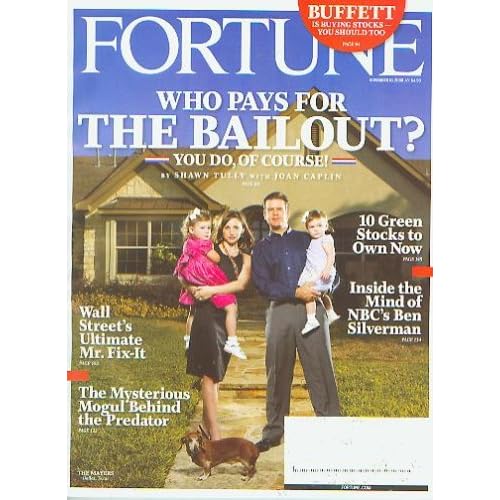
The question on the front cover of Fortune magazine, Europe edition Number 20, November 2008, already on the stands is “Who Pays for The Bailout ? You do, of course”. Of course, as this Credit Crunch means Bailout argument plays out, the issue of Energy and Climate Change is lost. But the question should be all about how to create a new green economy. Who pays for the re-powering ?
A sign of the greening times – another story teaser on the Fortune magazine advises “10 Green Stocks to Own Now”, and the front of the Independent on Sunday quotes Obama claiming that Energy is his “number one priority” in his bid for presidential election, with his “Apollo” project :-
“Obama’s green jobs revolution : Democrat will lead effort to curb world’s dependence on oil; Plans to create five million new posts in clean energy projects : By Geoffrey Lean in San Francisco and Leonard Doyle in Washington : Sunday, 2 November 2008 : Obama has pledged to create five million new ‘green collar jobs’ if elected : Barack Obama is promising a $150 billion “Apollo project” to bring jobs and energy security to the US through a new alternative energy economy, if his final push for votes brings victory in the presidential election on Tuesday. “That’s going to be my number one priority when I get into office,” Mr Obama has said of his “green recovery” plans. Making his arguments in a radio address yesterday, the Democratic favourite promised: “If you give me your vote on Tuesday, we won’t just win this election. Together, we will change this country and change the world.”…”
Meanwhile…Gordon Brown and Ed Miliband (and Peter Mandelson) get off the plane in Saudi and beg for investment into green energy in the UK :-
“Gulf petrodollars help UK go green : Brown calls for Saudis to give more cash to IMF : Gaby Hinsliff, political editor : The Observer, Sunday 2 November 2008 : The fight against climate change will get an unexpected boost today from oil-rich Gulf states which will pledge to invest some of their petrodollar profits in British green energy projects. The surging oil price over the past year has left parts of the Middle East awash with cash as the rest of the world is squeezed by the credit crunch, making Arab royals some of the few active investors worldwide. The Gulf states have enjoyed a $1.4 trillion windfall from higher oil prices since 2003. Ed Miliband, the Climate Change Secretary, arrived in Saudi Arabia yesterday with Gordon Brown at the start of a tour of the region. He said some of that cash would now ‘help our firms reap the rewards from going low carbon and providing green energy to thousands of families’ under a so-called ‘green Gulf deal’ to be announced today…”
But that’s not the real reason why they are there. Ostensibly, the delegation’s serious business is about asking Saudi and other Arab oil states to contribute more towards the International Monetary Fund :-
“Gordon Brown in the Middle East : Brown hopeful of Saudi cash for IMF : Allegra Stratton in Riyadh, guardian.co.uk, Sunday 2 November 2008 15.30 GMT : Gordon Brown said today he was hopeful of success in his attempts to persuade dollar-rich Gulf states to prop up ailing national economies through a massive injection of capital into the International Monetary Fund (IMF). The prime minister spent three hours in one-to-one talks with Saudi Arabia’s King Abdullah, trying to persuade the monarch to invest in a revamped IMF. On the first leg of a four-day visit to the Middle East, and aiming to secure hundreds of billions of dollars for the fund, Brown called off a planned dinner with business leaders accompanying him so as to allow maximum negotiating time with the Saudi king. The IMF currently has around $250 billion in its emergency reserves but there are fears that, with Hungary, Iceland and Ukraine having already sought assistance and more nations expected to follow, the sum might not be sufficient. Brown hopes to persuade Gulf leaders to use some of the estimated $1 trillion they have made from high oil prices in the last few years to boost the reserves, indicating that he would like to see the current sum increased by “hundreds of billions” of dollars. The prime minister said following the talks that he was hopeful of having secured Saudi backing…”
But hang on, what’s this ? :-
“…Brown, who is accompanied by a high-level trade delegation seeking Gulf investment, including the CEOs of BP and Shell…”
What on earth are BP (formerly British Petroleum) and (Royal Dutch) Shell doing in a delegation to the Arab states begging for the IMF charity fund and green energy investment ? Is it that BP and Shell won’t pay for green energy and it’s too hard to ask the British people to pay extra tax, so they’re coming to the Arab countries for a green energy bail-in ? What is going on here ? If OPEC countries are all in the “Axis of Evil”, and no foreign oil and gas companies can get a toehold, why are BP and Shell in the government delegation to Saudi ?
Paying for new energy systems can be expensive. The European Union Emisssions Trading Scheme is saying they want 100% of carbon emissions auctioned by 2013 to pay for larger projects – Carbon Capture and Storage and new Nuclear Power. However, the costly deadweight “white elephant in the room” is not nuclear power, but dead wells.
Are they all talking about Peak Oil in the OPEC Gulf, and proposing business opportunities to the King of the House of Saud to offset the Middle East’s future total loss of business as the wells empty – offering them compensation in the form of green investment deals ? Asking the Saudis to join the green energy race now and get ahead ?
BP and Shell have benefited from the recent rise in the price of oil, profiting even as the oil price has hit millions and created impoverishment. But they’re going to have to spend a very large amount on exploration for new oil and gas from now on. So why is there still resistance to spending more on renewables ? Can BP and Shell ever be convinced to go green ? Would a barrel load of toxic news work ? No. BP and Shell can’t pay for green energy because they have to maintain the profits of their shareholders. Pensions are going to be bad enough without forcing major “British” oil companies to pay for such things as bioethanol, algae biodiesel, solar panels and wind farms.
Action to tackle climate change must be a “tight shadow” on Peak Oil and its fall – tighter than the 9.1% depletion of the largest wells projected by the International Energy Agency (IEA) To reverse the oil decline, and more so to take action on climate change, investment is required. Banks are becoming owned by oil-rich nations, but this is simply a natural outcome of poor financial regulation that led to the Credit Crunch. However, it doesn’t mean that the future will be oil and gas necessarily. This new layer of ownership of financial bodies is not significant, as it will not seriously impact the greening of energy, if people are serious about it.
What is of value here is not banking but energy itself, which underpins the entire economy. The scenario is this : Saudi Arabia will not admit in public that it’s going down because of “Peak Oil”. They would prefer to keep up the revenue, but they’re not “engineering” a reduction of supply. It’s reducing anyway.
From their perspective, allowing supplies to weaken, by not doing any new investment into raising production, would be protecting their reserves to sell in future. A good strategy – even more so as prices rise against losses of supply but strong demand (even despite the blooming recession).
I figure that what BP and Shell are doing in the Middle East is making the case to the major oil-producing states to keep on pumping.
I guess that what Gordon Brown is doing is making the Saudis an offer they can’t refuse – either the major western states will implement measures to control oil prices which would make OPEC lose revenue, or the Saudis can underwrite the global bailout.
This mission is not about green energy investment. It’s about keeping the oil flowing.
Selling Thorium to China
Kirk Sorensen, formerly of Teledyne Brown Engineering, now of Flibe Energy
To: Claverton Energy Research Group
From: Jo Abbess
Date: 24 June 2011
Subject: “Don’t believe the spin on thorium being a ‘greener’ nuclear option”
Hi Clavertonians,
As you are, I’m sure, aware, context is everything.
I was so sure we’d escaped the clutches of the “Thorium Activist Trolls” a few years ago, but no, here they are in resurgence again, and this time they’ve sucked in George Monbiot, Mark Lynas and Stephen Tinsdale, all apparently gullible enough to believe the newly resurrected Generation IV hype campaign.
They should have first done their research on the old Gen IV hype campaign that withered alongside the “Hemp will Save the World, No Really” campaign and the “Biodiesel will Save the World, AND You Can Make it at Home” brigade. Oh, and the Zero Point Energy people.
I was, I admit, quite encouraged by both the Hemp and Biodiesel drives, until I realised they were a deliberate distraction from the Big Picture – how to cope with the necessity of creating an integrated system of truly sustainable energy for the future.
Hemp and Biodiesel became Internet virally transmitted memes around the same time as the Thorium concept, but where did they come from ?
Where does the Thorium meme originate from this time round ? I found some people took to it at The Register, where they spin against Climate Change science a lot – watch the clipped video :-
https://www.theregister.co.uk/2011/02/01/china_thorium_bet/
I would suggest that there are connections between the Thorium campaign and the anti-Climate Change science campaign, and I have some evidence, but I’m too busy to research more in-depth just now, so I’m not going to write it all up yet.
The key issues with all energy options is TIME TO DELIVERY and SCALEABILITY, and I think the option presented by the Thorium fuel cycle fails on both counts.
Yeah, sure, some rich people can devote their life savings to it, and some Departments of Defense (yes, Americans) and their corporate hangers-on can try selling ANOTHER dud technology to China (which is the basis of some Internet energy memes in my view).
Remember Carbon Capture and Storage ? The British Government were very keen on making a Big Thing about CCS – in order to sell it to the miscreant Chinese because (WARNING : CHINA MYTH) China builds 2 !! coal-fired !! power stations a week/day/month !!
THORIUM – A Brief Analysis
TIME TO DELIVERY – 20 to 50 years
SCALEABILITY – unknown
USEFULNESS ASSESSMENT – virtually zero, although it could keep some people on the gravy train, and suck in some Chinese dough
The Tyndall Centre say that global emissions of greenhouse gases have to peak AT THE LATEST by 2020. We should be thinking about rolling out the technology WE ALREADY HAVE to meet that end.
Don’t believe the hype,
jo.
PS What other evidence do we have that the Thorium meme is most likely just a propaganda campaign ? Nick Griffin of the British National Party backs it, and the BNP are widely alleged to promote divisiveness…
Mark Lynas : Mutant Ninja
Mark Lynas may call himself a “green”, and be a clean-shaven, respectable, politely-spoken Oxford academic type but he appears to be mutating into something very unappealing indeed. He’s written some good books on climate change – every schoolroom and university module should have one – but on energy, he is deep in the political woods, without even a wind-up flashlight.
His latest stunt is to join in with accusations from Steve McIntyre of Climate Audit that the IPCC’s report on Renewable Energy has been partly crafted by people without appropriate independence or expertise. Here, from Andrew Revkin :-
“The IPCC must urgently review its policies for hiring lead authors – and I would have thought that not only should biased ‘grey literature’ be rejected, but campaigners from NGOs should not be allowed to join the lead author group and thereby review their own work.”
And who is this nefarious untalented Non-Governmental Organisation ? Greenpeace, it appears, according to Mark Lynas, is not capable of writing about the future of energy (or even the current situation).
Daniel Kammen has weighed in and The Revkin has updated his post :-
“There is no Himalaya-gate here at all. While there are some issues with individual chapters, there is no ‘Greenpeace Scenario.’ The 77% carbon free by 2050 is actually more conservative than some cases. The European Climate Foundation, for example has a 100% carbon neutral scenario and Price Waterhouse has a very low carbon one for North Africa. Further, while the IPCC works from published cases, the scenarios are evaluated and assessed by a team.”
There have been a number of reports written in the last year that back the viability of Renewable Energy technologies in replacing the world’s fossil fuel and nuclear energy systems. Not all of them were crafted by Greenpeace researchers. In fact, virtually none of them. Nuclear…yes…maybe it’s that little word “nuclear” that’s the root cause of Mark Lynas’ problem with Greenpeace.
In the Guardian, he is quoted as saying :-
https://www.guardian.co.uk/environment/blog/2011/jun/15/italy-nuclear-referendum
https://www.guardian.co.uk/environment/2011/jun/13/greenpeace-foe-charles-secrett-criticism
“Many ‘green’ campaigns, like those against nuclear power and GM crops, are not actually scientifically defensible…”
And that’s where you are so wrong, Mark Lynas with the book coming out soon that you seem so desperate to publicise by saying things you know people will find annoying. Nuclear power is a TECHNOLOGY, not a SCIENCE. This is the same basic category error made by Dick Taverne and a number of other public commentators who don’t appear to have an engineering background.
TECHNOLOGY is where people decide that their designs to make something look like they’ll work, build them and don’t foresee flaws with them. SCIENCE is where people study the technology that they’ve built and research the flaws that appear and report on them. Science is what has shown the limitations with the original boasts about genetically modified crops. It turns out that GMOs are a ruse to sell chemicals. And on nuclear fission – the science is in and on the front of your daily newspaper : nuclear power plants pose a number of risks. The advice of the reputable scientists and engineers – old fission nuclear power plants should be withdrawn.
But returning to Renewable Energy, a number of organisations now believe that the demise of fossil fuels needn’t stop humanity from accessing abundant energy. Here is just a very short compilation :-
The Two Marks : Mark A. Delucchi and Mark Z. Jacobson :-
https://www.peopleandplace.net/on_the_wire/2011/2/5/mark_jacobson_and_mark_delucchi_wind_water_and_solar
PriceWaterhouseCooper :-
https://www.pwc.co.uk/eng/publications/100_percent_renewable_electricity.html
CAT Zero Carbon Britain 2030 :-
https://www.zerocarbonbritain.com/
Roadmap 2050 :-
https://www.roadmap2050.eu/
European Renewable Energy Council R[e]volution :-
https://www.erec.org/media/publications/energy-revolution-2010.html
But oh, no, we can’t quote the last one because Greenpeace researchers were involved, and Mark Lynas wouldn’t approve of that. Mark Lynas appears to be living in a world where Greenpeace people can’t have engineering research skills because they have ideals, working for a world that uses safe, clean energy.
The IPCC report on Renewable Energy is here :-
https://srren.ipcc-wg3.de/
Much as I respect turtles, I have to say it – Mark Lynas, you’re a turtle – slow-moving and easy to catch out and turn into soup. You should know by now not to get sucked in by spurious non-arguments from Steve McIntyre. The “cleantech” industry that’s ramping up to provide the world with green energy is worth billions, soon to be trillions of dollars worldwide, and this fact appears to have completely passed you by. The only future for energy is sustainable, renewable, non-nuclear, clean, quiet and safe. There is no other viable, liveable, option.
[ UPDATE : In the Independent newspaper, Mark Lynas is quoted as remarking “Campaigners should not be employed as lead authors in IPCC reports”. So, Mark, it’s really fine for employees of the major oil, gas and mining companies to take a leading role on major IPCC reports; but it’s not fine, according to you, that somebody working for much less money and much higher principles than mere corporate profit should contribute ? Denigrating somebody for being a “campaigner” is a stereotypical insult. Everybody’s got an agenda, campaigners included. What’s your agenda, Mark ? Selling your new book ? Don’t be dismissive about Greenpeace researchers. They may have ideals, but they’re not naive – they also have brains – and with their declared position on getting at the truth they can be trusted to be direct, decent and honest. Where’s your ethical compass, Mark ? ]
Viva Italia !
The toxic legacy of mined energy
We are stardust ? Well, not quite. As carbon-based lifeforms we’re actually the offspring of a young sun, composed of the lighter elements, with a low concentration of a few transition metals essential for our health and vitality. Irn Bru, anyone ?
The actual products of exploding old stars that got lodged in the crusty skin of the accreting Earth are often quite toxic to us. Over millions of years, heavy and radioactive elements, being of no use to the ecosystem, have been deposited at the bottom of lakes, seabeds, and ended up lodged in seams of coal, and caverns of petroleum oil and Natural Gas. Uranium ores and other nasties have been overlain by forests and deserts, and only rarely vent, like radon, from Vulcan’s infernal lairs.
And what do humans do ? We dig this stuff up to burn or fission for energy, and when we do it creates toxic waste, that hurts us, and the life around us. Why are we surprised that mercury from the coal power industry is killing fish and harming children ? Why is it a shock that the tailing ponds from mining tar and oil sands are devastating pristine wilderness and waterways ?
BP : Politely Requesting an Interview
[ 02 JUNE 2011 : THIS POST HAS ALWAYS AND WILL ALWAYS FULLY RESPECT BP COMPANY CONFIDENTIALITY, AND HAS NOT AND WILL NOT INCLUDE THE REPRODUCED TEXT CONTENT OF E-MAILS FROM BP, ARISING FROM AN E-MAIL EXCHANGE WTIH JOABBESS.COM. NOTWITHSTANDING THIS CLEAR ATTEMPT ON THE PART OF JOABBESS.COM TO CONSERVE THE FULNESS AND THE ESSENCE OF COMPANY CONDIENTIALITY, IT HAS BEEN DRAWN TO THE ATTENTION OF JOABBESS.COM THAT EVEN JUST MENTIONING THE NAME OF THE CORRESPONDENT AND THE DATES OF THE EXCHANGE MAY TECHNICALLY CONSTITUTE A BREACH OF BP COMPANY CONFIDENTIALITY. SO, TO ENSURE THAT NO ACCUSATION OR COMPLAINT OF BREACH OF COMPANY CONFIDENTIALITY COULD EVER BE MADE, AND TO ENSURE THE PROTECTION OF THE CORRESPONDENT, THE NAME OF THE CORRESPONDENT AND THE DATES OF THE EXCHANGE HAVE BEEN REDACTED AND REMOVED AS OF TODAY. IT CAN STILL BE DEDUCED FROM THIS POST THAT AN E-MAIL EXCHANGE TOOK PLACE. THAT FACT, I THINK, IS NOT COMPANY CONFIDENTIAL, ALTHOUGH I EXPECT BP ARE WITHIN THEIR RIGHTS TO TELL ME IF THEY BELIEVE OTHERWISE, AND OPEN UP A PERSON TO PERSON CONVERSATION ABOUT THE BEST COURSE OF ACTION. THEY KNOW MY TELEPHONE NUMBER. IT’S AT THE TOP OF THE POST. WHERE IT’S ALWAYS BEEN. ]
From: jo abbess
To: XXXXXXXXXXXXXXXXXXXXXXXXXX, BP
Date: XXXXXXXXXXXXXXXXXXXXXXX
Dear XXXXXXXXXXXXXXXXXXXXXXX,
Thank you for your time on the phone earlier this week.
Last year in February, I was part of a small group of students that were grateful to have the benefit of an interview with XXXXXXXXXXXXXXXXXXXXX at BP, then XXXXXXXXXXXXXXXXXXXXXXXXXXXX.
I am taking my research into the energy sector further for my MSc dissertation, and I would be grateful if I could have an interview with somebody in an engineering department who has an overview of the energy sector.
It doesn’t need to be a face to face interview, as I am quite willing to telephone people. It only needs to be 20 minutes in duration.
I have prepared a short list of open questions that I am considering would be suitable for my enquiry into the future of energy resources and technologies (see below).
I hope that you can point me in the direction of somebody within BP who would like to offer their thoughts.
Thank you.
…
Questions with a UK focus
1. What do you think have been the best developments in the energy sector in the last 20 years ?
(What do you think are the most significant developments in the energy sector in the last 20 years ?)
2. What positive or negative changes in energy production and supply will take place over the next 2 decades ?
(What do you think will be the most important developments in the energy sector in the next 20 years ?)
3. Which energy resources and technologies look the most troubled ?
4. Which energy resources and technologies look the most promising ?
5. Does the UK face an energy supply gap ? Can we keep the lights on ?
From: jo abbess
To: XXXXXXXXXXXXXXXXXXXXXXXXXXXXXXX
Date: XXXXXXXXXXXXXXXXXXXXXx
Hi XXXXXXXXXXXXXXXXXXXXXXXXXXXXXX,
Thank you for your helpful reply.
What I am trying to achieve is a real conversation with somebody within BP who has a general overview of the energy industry – sadly, the annual Statistical Review and company report do not answer the scoping questions I have.
I am offering an opportunity for BP to voice a vision, on record, of how the company intend to navigate future change, using parameters that are not generally the basis of shareholder reports.
I am sure that somebody in the organisation has a view on the onset of Peak Oil and Peak Natural Gas – from conventional resources, and that there must be aims and objectives for BP to manage this issue.
I am convinced that BP has planned for a range of policy scenarios concerning climate change – both mitigation and adaptation measures.
I am also sure that somebody in BP has a plan for navigating political problems, such as the probability of continued unrest in the Middle East, with the accompanying likelihood of compromised oil and gas production.
In addition, I am sure that somebody from BP can speak on the company’s behalf about how it will deal with the threats of economic turbulence and still be able to meet the needs of shareholders.
Some sample questions that could take in part of this landscape :-
1. Do you think that we are heading for a period of global energy insecurity ? What are the factors that could cause this ? What are the timelines ? Who are the key players ?
2. What is aiding or blocking the transition from fossil fuels to clean energy ? What technologies look promising ? What technologies are stuck in the lab ?
3.. How do you think we will manage the transition to clean energy ? How will the economic actors be able to diversify out of fossil fuels and still retain balance in the world markets – and not disappoint their investors ?
4. Do you think that people generally are aware of the issues of energy security ?
It would be excellent if you could find somebody to speak to these or similar questions in a short interview with me. I can do interviews by telephone at very low cost, and I would e-mail the transcript for verification before using in my research report.
My central question is “are we ready for energy change ?” – major transition in the resourcing and use of energy – and I am seeking a full range of opinion on that question.
If you could point me towards somebody who is willing and able to speak for 20 minutes on the phone on energy security issues, I would be highly grateful.
Thank you.
…
The spoils of war
See the rest of Gaddafi’s speech to the United Nations here
When did Colonel Muammar Gaddafi learn of threats from the world’s major oil consumer countries against his rule ? Was it in early 2011 ? Or was it several years earlier ? On the public stage, he has been deliberately reduced to a figure of fun, and his message advising non-aggression and protection from aggression is being lost. He is now a desperate man :-
America’s hooked on oil, but more drilling in the Gulf of Mexico won’t drive fuel prices back down, as Republican political activists try to claim :-
https://thehill.com/blogs/e2-wire/677-e2-wire/150003-top-house-republican-to-introduce-drilling-bill
https://moratorium.offshoremarine.org/omsa/
US production is only a small percentage of world supplies – and this won’t increase significantly even with more homeland drilling.
Gasoline prices are going to remain vulnerable to global events, global markets and global nerves.
The oil production companies that operate in the American market are quite happy to maintain higher prices for fuels. Think about it.
If the Americans want to fill up their tanks less expensively, what’s really needed is to consume less oil – and that means using smaller, lighter cars with higher fuel efficiency.
Outside the usual political and media circles, questions are being asked. Why has the United Nations sanctioned military engagement in Libya in the form of UN Security Council Resolution 1973 ? Why the heavy firepower here, in Libya, when the ostensible rationale for intervention was only to implement a No-Fly Zone ? Why not gloibal military action elsewhere in the Middle East North Africa (MENA) arena where there are other despots making life unpleasant or endable for their citizens ?
I present to you two possible futures for Libya, both of which will require extensive cooperation with foreign corporate and political players, something that Muammar Abu Minyar al-Gaddafi (or Qaddafi) threatens, or rather, depending on various news reports, “threatened”.
1. The Dash for African and Arabic Natural Gas (and Oil)
In a carbon-constrained world Natural Gas is a boon – it has roughly half the carbon dioxide emissions of coal when burned to produce steam to generate electricity. Any country that’s got Natural Gas, especially good quality Natural Gas that doesn’t have to be hydraulically “fractured” from rock strata, is a country we will learn to love and trade on significantly generous terms with.
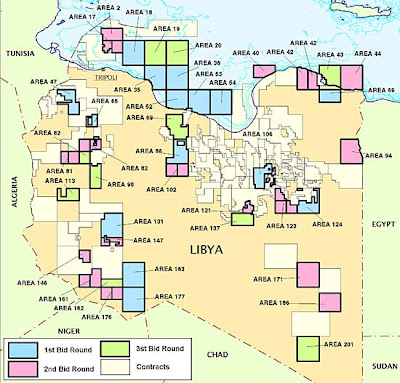
There has been extensive surveying of Libya, and the whole of North Africa’s Maghreb region, including the type of offshore seismic surveying that found extensive gas fields in the Eastern Mediterranean that Israel is now laying claim to (and preventing Gaza from exploiting). This has led to quite a lot of excitement in the fossil fuel energy industry, so, reading between the lines of the conference agendas, there is high dollar value under Libya’s maritime territory :-
https://www.geolsoc.org.uk/gsl/site/GSL/lang/en/page7792.html
https://www.geolibya.org/evdetails.asp?Myval=36
In addition to Natural Gas there may well be high levels of top quality oil – and keeping up the flow of crude oil, as we all know, is crucial to the health of the world’s economy. Threats of re-nationalising the Libyan fossil fuel resources therefore caused corporate shock :-
https://www.ft.com/cms/s/0/67d1d02a-5314-11e0-86e6-00144feab49a.html#axzz1HKdP1z5V
“Oil companies fear nationalisation in Libya : By Sylvia Pfeifer and Javier Blas in London : Published: March 20 2011 : Western oil companies operating in Libya have privately warned that their operations in the country may be nationalised if Colonel Muammer Gaddafi’s regime prevails. Executives, speaking on condition of anonymity because of the rapidly moving situation, believe their companies could be targeted, especially if their home countries are taking part in air strikes against Mr Gaddafi. Allied forces from France, the UK and the US on Saturday unleashed a series of strikes against military targets in Libya. “It is certainly a concern. There are good reserves there,” said one executive at a western oil company with operations in Libya. “We have lost some of our production [because all operations have stopped] but our bigger concern is what will happen to the exploratory work as that gives you a future rather than the immediate impact,” he added. Most of the world’s large international oil companies have producing assets in Libya, including Spain’s Repsol, France’s Total, and Italy’s Eni, which is the largest single investor there. Germany’s Winstershall – a unit of BASF – and OMV of Austria are also present. The country is the world’s 12th largest oil exporter, and the escalating violence there has triggered a jump in prices to nearly $120 a barrel. More than half of Libya’s oil was exported to Italy, Germany and France last year…”
BP had to evacuate its staff, and extend a favour to some British citizens, during the recent uprising :-
https://www.telegraph.co.uk/news/worldnews/africaandindianocean/libya/8344391/Libya-Britain-borrows-BP-jet-to-evacuate-citizens.html
Production in the country has taken a hit due to the fighting, but order should soon be restored. Clearly, long-term stability in Libya, with unhindered, inexpensive access to the country’s oil and gas resources is an important part of the national security interests of many Western democracies.
2. Solar Libya
https://www.desertec.org/en/global-mission/milestones/
The DESERTEC project of the European Union seeks to roll out solar power in the desert sands of North Africa, and makes the promise of economic and social development of the countries that take part, although that dream has been questioned :-
Let’s face the facts here – massive new energy projects in North Africa will be financed and developed through large multinational, transnational corporations, companies who have contributed to the economic slavery of Africa for, let’s approximate here, centuries.
What guarantees can the Maghreb have that this is not a further land grab on Africa’s potential ?
In addition, the recent social and political volatility in the Middle East North Africa region could jeopardise the noble plans of the European Union to reach out in energy partnership.
Hang on. Wait a minute. Is the wave of uprisings across the Middle East and North Africa connected in any way to the interests of oil and gas companies who want Future #1 to prevail for the whole region, not just Libya ?
American companies have been so keen to sell nuclear electricity projects to Saudi Arabia and others around the Arabian Gulf – but has this been encouraged from the high-ups to keep the Arabs off the scent of Renewable Energy ? Forget nuclear power – it’s expensive and awkward. Iran only pursues civilian nuclear power to irritate the United States Government. A solar Arabia could give the Middle East and North Africa a second generation of being the energy princes of the world. I suspect they will go for this in a big way very shortly, uprisings or no uprisings. Why ? Two little words – Fukushima Daiichi.
So there we have it – two entirely probable, slightly competing, futures being mapped out for Libya by the big guns of NATO (a euphemism for the USA). If Libya is split into two countries, the fossil fuel Future #1 will be likely applied to East Libya, and the desert solar Future #2 will be foisted on West Libya.
Continued interference in the country is a certainty.
Glimpsing the Future
Can we glimpse the future of energy ?
Ambient, sustainable energy is all around us, and sooner or
later we will find the ways to make use of it for the good of all.
The following is an appropriately edited transcript of a
conversation on the Claverton Energy Research Group
forum online, and was written by Nick Balmer, a consultant
in renewable energy.
__________________________________________________________
…The huge scale of the possible changes for all concerned is
causing all of the current Titans in the [energy] industry to deploy
the full force of the media [and their] PR [public relations] in an
attempt to manipulate the public and policy towards their own way
of thinking, or in such a way as to protect their own vested interests.
The great thing is that these issues are being aired out in the open,
and groups like [Claverton Energy Research Group forum] allow
people with knowledge of these affairs to debate these issues openly.
The big problem is that each of us has only a very detailed
understanding of some small fraction of the total issue.
Most of the public and government only has a very slight knowledge
of the total issue, and has had only limited access to ways to find out
in detail what is going on.
As Egypt is demonstrating today, everybody now has a voice and as
Wikileaks shows, sooner or later everything will come out into the
open.
All of us are struggling to come to terms with this explosion of
access to knowledge.
It is quite clear that lots of bubbles are being burst as a result of
the Global Financial implosion and the huge expansion in available
knowledge.
Just as banking and property has been shown to be an unaffordable
Ponzi scheme and to be vastly over-inflated, UK energy policy is now
coming under huge scrutiny.
We can now compare our energy systems with other countries.
Due to the huge geological accident of fate, since the 1700’s in coal,
and 1970’s in oil and gas, we have been extremely fortunate in being
able to live way beyond the lifestyle standards of most of the World.
We have not had to adapt.
Other countries that didn’t have this advantage had to change over
recent decades.
Places like Denmark, Austria, Germany [and so on] have made huge
changes because they had less energy from fossil resources.
Now we have reached the peak or crunch point, we find ourselves well
behind those countries that had to adapt earlier.
Everybody is concentrating on the Capital cost of deploying per
MW [megawatt] and overlooks the cost of fuels.
The cost of fuels over time is massively more important than the
CAPEX [capital expenditure on investment].
So even if windfarms cost 20 times per MW or GW [gigawatt] more to
build than nuclear or coal or gas, in the scheme of things,
[wind power] is always going to win, because the fuel is free and
unlimited for centuries to come.
Similarly [solar power technologies], or even more effective,
household insulation and cutting energy use.
And yet the media and government are blinded by the barrage of PR
and media from the energy vested interests who are working with
every muscle to stop this coming out into the open.
I often meet financiers in my work trying to promote and support AD
[anaerobic digestion of biological waste for the production of
renewable methane], biomass, solar and wind projects.
I am always struggling to prove to them that I have an offtake [return
on investment] and the fuel supply. This is often really hard to do
[but] I only have to do this for seven to 12 years to make my business
cases stack up.
I was really depressed at the end of one such presentation and
discussion, when one broadly sympathetic banker who had turned me
down said that he was having even worse problems with largescale
energy projects.
How do you predict the price and supply of coal forward for 25 years
or more ?
It has jumped 17% in recent months.
How do you prove that you are going to have offtake for huge power
stations in future years ?
Demand dropped 8% in 2009.
How do you raise the equity or debt for a billion [pound] project when
banks don’t want to lend more than £30 million each ? Imagine how
many banks that would take ?
We have reached a tipping point in our economy, sustainability and
future outlook.
Yes, the existing mega-power companies are fighting as hard as
Mubarak today to hold onto power, but they represent the past just
as surely as he does.
Those companies can rejuvenate themselves, unlike the Egyptian
President.
If they don’t, there are an increasingly large number of smaller and
more active players coming into the market.
The average household pays somewhere around £1,300 a year for
its heating and lighting.
The companies that come forward with a way to do that for £1,000 is
going to capture the market very quickly.
I have friends in Austria who only pay 65 Euros for services that I
pay £1,400 for.
They do this through insulation, triple glazing, solar and biomass energy.
Most [UK] households have less than £400 per year discretionary
disposable income. This prevents them making changes to their houses
they desperately want and know they need to make. This can
drop their energy demands hugely.
If somebody can unlock that Gordian Knot the benefits would be
enormous as there are something like 27 million households.
At a time when household debt is at an all-time high, incomes are
shrinking, and 40% live on ether government salaries, state
pensions or benefits.
Energy is a very high part of these households’ outgoings – if you
pay £1,300 a year and your house only brings in £11,000 to £20,000
per year.
A 50% increase in the £1,300 could bring great distress, and
possibly even civil unrest here.
The increases fossil power [companies] need to make their systems
bankable will increase energy bills. This will feed straight through into
government liabilities because 40% of us live on government payouts.
If government can drop the cost of heating and lighting quite easily
by £100 to £500 per household per year while at the same time
provide employment for hundreds of thousands of White Van men
cutting energy uses, doesn’t this make far more sense than building
unsustainable power stations that will have to be [bankrolled] by the
government, who will then have to buy back electricity at a price our
communities cannot stand ?
Project a similar calculation onto transport fuels and you get even
greater problems.
At $80 a barrel [of oil] industry is shrinking and relatively few
renewable fuel business cases work. At $100 a barrel most renewable
fuels can compete.
At $120 a barrel almost any alternative beats oil, and that is before
you start to look at issues like fuel security and the environment.
Although the battle is one of David and Goliath, or the Dinosaur and
those early mammals, between the new energy industries and the
existing vested energy industries, [it] has only one outcome.
It is only a matter of the co-lateral damage along the way.
Like Mubarak, it is clear they must go. Are they going to go
gracefully, or are they going to smash the place up first ?
Nick Balmer
Renewable Energy Consultant
American Full Spectrum Dominance
The documentary evidence shows that America’s business interests often outweigh its political progress. Yet it’s perhaps more concerning that, increasingly, corporate America is at risk of damaging good environmental governance.
With all the talk of free markets in international trade, the Coalition Government in the United Kingdom has felt the pressure to open up the back door to American energy businesses, whose highly-paid sales representatives in slick suits want us to buy their dirty energy projects – just take a look at the upcoming UK Energy Bill and its proposals for Electricity Market Reform.
American companies seem poised to sweep in and take all our public non-subsidy “support” for building new nuclear power plants. Viewers of a sensitive political disposition should look away now as this is a Wikileak :-
The country that brought you the engineering industry that brought you the giant Gulf of Mexico giant oil spill now wants to bring you unsafe deepwater drilling in Britain’s Continental Shelf – and the UK’s new Energy Bill would let them do that without demonstrating any learning from the BP April 2010 fiasco :-
https://act.greenpeace.org.uk/ea-campaign/…
There’s lots of talk in the energy sector and the financial markets about the American shale gas miracle “gamechanger” and how it can be replicated in Europe and across the world, and not enough discussion about the environmental dangers :-
https://www.tyndall.ac.uk/shalegasreport
https://www.bbc.co.uk/news/science-environment-12190810
It’s good to talk about local environmental damage from “unconventional” gas, but what’s not being discussed so widely is that these “new” resources of Natural Gas aren’t really very green, and neither are the “traditional” resources – in some cases they’re not much better than coal :-
https://www.scientificamerican.com/article.cfm?id=climate-benefits-natural-gas-overstated
https://www.propublica.org/article/natural-gas-and-coal-pollution-gap-in-doubt
https://www.huffingtonpost.com/2011/01/25/natural-gas-clean_n_813750.html
We know that the Americans always seek to protect the interests of American-owned businesses – and we know they do that for the best of intentions – to keep America wealthy (except it’s really only a few people in America that have any wealth, but anyway…)
Yet I think there should be a limit to how far we have to bend over backwards to accommodate their needs for economic recovery.
To export all their dirty energy technology to Europe is just not helpful, and I think we should say no, no, no.
Ethical Investment
I met several people in the finance-with-conscience crowd the other week, when I went for a spot of champers and Marmite soldiers at the House of Commons for National Ethical Investment Week.
I learned about various views on social and positive impact investment, and about elements of the Coalition Government’s “Big Society” and the proposed Green Investment Bank.
Ethical Investment appears to have come a long way since I put some money into a Fair Trade company many moons ago, where I knew I would never see a dividend, or even be able to sell the shares at some point.
Grown up people in sharp suits and big name frocks now do moral banking, and often reap a healthy return on their investment – “doing well” as well as “doing good”, as Adam Ognall of UK Sustainable Investment and Finance says.
I was challenged to think about what faith communities do with their money around a month ago, all precipitated by a conversation I had with Martin Palmer of the Alliance of Conservation and Religions, and then I heard something at a recent meeting that caused me to investigate a little…
The New Climate Alliance
Green jobs, green energy, greening communities.
Forget Nigel Lawson and his struggle to keep the British energy system in the privatised 1980s by denying the realities of Climate Change.
The lords (and sadly, some of the ladies) of this land want to stay rich from their shares in fossil fuels and mining. They’ll say anything to protect the value of their holdings.
But where’s your new North Sea Oil and Gas, Nigel ? Do you want to bankrupt this country by forcing us to ramp up our imports of energy as the North Sea production falls away ?
The chief executives of the “traditional” energy companies of these islands are just trying to keep themselves in a job when they decry wind power, biogas, marine energy projects.
No, Vincent de Rivaz of EdF, we don’t want expensive, inflexible and toxic Nuclear Power. No, Dorothy Thompson of Drax, we don’t want dirty coal continuing to heat up the world, poison fish and raise coughing kids. No, Rupert Soames of Aggreko, we must maintain the Renewable Energy obligations we have agreed at the European level, and raise the bar even higher, to protect the economy going into an uncertain future, by having homegrown energy.
We need an energy evolution in this country.
And so, what is needed is a social movement – involving ordinary, working people, unions, communities, academics, trained professionals from the engineering trades, local political activists and faith communities.
This is the emergence of Green Power.
We Will Get To You
Video Credit : Brooklyn Space Program
Eventually we will reach you.
Scientists are proverbially poor at communication, but we will eventually be able to explain to you what is happening to the Earth in a way that you will understand.
You need to give some time to the data, to the arguments. You need to read the significant research papers, learn how to read graphs, learn the acronyms, abbreviations, technical terms.
You will need to be able to weigh in your mind the significance of probabilities, the risks of extremes, the trends, the changing patterns.
After a while, you will start to reappraise the evidence, and start looking into the data and see the conclusions for yourself.
You will begin to appreciate the strong line of reasoning, and come to be in awe of the minds of many who work on Climate Change.
I’ve become impressed by the body of scientific evidence, that’s why I will always be aligned with the Climate Change science community.
We’re not going anywhere. We’re here, and we’re right. There has already been significant change in the Earth’s climate due to humankind’s mining-to-burn activities, and the projections are for further, possibly very dangerous change.
The scientists know what the problems are, and what the engineering solutions are. Some companies/corporations, economists and politicans and sadly even some compromised “environmentalists” promote non-solutions like carbon pricing, Carbon Taxation, Carbon Trading, Carbon Capture (and Storage), GM Crops, Nuclear Power, geoengineering – but the academies of scientists are telling you they won’t work, or won’t solve all the problems.
What is needed is wholesale removal of Fossil Fuels from the global economy in order to prevent further deterioration and disruption in the global climatic conditions. Either BP, Shell, Chevron and ExxonMobil hang up their boots forever, or they need to embrace new clean energies (not Nuclear Power) to stay in business.
Oil, gas and coal depletion in the production facilities of those countries that are national players will mean that they will go bust, because a consistently high price for Fossil Fuels is not supportable, because the global economy is so Fossil Fuel-dependent currently. This is both a buyer’s market and a seller’s market, so the price will be governed by the operation of this two-sided cartel, not by the theories of “scarcity economics”.
Either Saudi Arabia, Iraq, Iran, China, Venezuela and so on are on their way to extreme poverty, or they will embrace new clean energies (not Nuclear Power) to stay economically developed.
Meanwhile, the project of empirical scientific enquiry continues apace, and even though rich fossil fuel businesses are financing doubt, even though people with pension funds in mining pour scorn on Climate Change science, and even though the mainstream media can’t recognise uneducated propaganda when they meet it; you need to trust the intellectual community of Climate Change science researchers.
Stop listening to accusations of malpractice, dodgy data, weak methods, poor models. Do you really know what you are talking about when you pass judgement on the scientific community ? Who told you that scientists were wrong ? Can you really trust the people who tell you not to trust the scientific community ? Do you have the right or the authority to lay somebody else’s fabricated blame at the door of those whose whole lives are devoted to discovering the truth ?
Why don’t you do an integrity check on your sources, before replicating myths ?
Read the science journals and not the newspapers, is my advice.
And when it comes to the Internet, search wisely. You can’t believe every website you come across – there are some web loggers who are misled, and there are others seeking to mislead.
If you want to filter out the nonsense, try this :-
Ride the Future
Video Found At : Energy Bulletin
The Earth keeps turning, the Sun keeps burning, and the future will look a lot different than today as we drag down Carbon Dioxide emissions “by hook or by crook”.
We have to be wary of possible “crooks”. There are still technology “snake oil salesmen” out there, trying to impose Genetically Modified crops on us, or Nuclear Power, or Carbon Capture and Storage (to justify the continued use of Coal), and using the vehicle of science to push their wares :-
https://www.telegraph.co.uk/earth/agriculture/8048917/Climate-change-threatens-UK-harvest.html
“Climate change threatens UK harvest : Climate change could push up food prices by causing large-scale crop failures in Britain, the Met Office has warned. : By Louise Gray, Environment Correspondent : Published: 08 Oct 2010 : Rising temperatures could mean events such as the drought in Russia this summer, which pushed up grain prices, hit countries like the UK. But they said the worst effects of climate change could be limited by investment in better farming and the development of new drought resistant or heat tolerant crops. This could be done by aid money, breeding and new technologies like genetic modification (GM)…”
https://www.leeds.ac.uk/news/article/908/crop_failures_set_to_increase_under_climate_change
Look out for terms like “new crops”, “crop development” or “modified crops” :-
https://www.sciencedaily.com/releases/2010/10/101007092817.htm
https://iopscience.iop.org/1748-9326/5/3/034012/
See the use of the word “biotechnology” in the actual research paper :-
https://iopscience.iop.org/1748-9326/5/3/034012/pdf/1748-9326_5_3_034012.pdf
But, as everybody can probably guess, most farmers in the world will not be able to afford Genetically Modified crops, and anyway, nobody really yet knows if GM crops confer the benefits claimed – there is some evidence that “life scientists” don’t know the full range of effects on organisms from gene splicing.
Ellen’s Collaboration
Video Credit : Ellen MacArthur Foundation
I can’t decide whether I’m inspired or concerned by this little film from Ellen MacArthur.
It seems to focus quite heavily on cars, and one of the collaborators is Renault.
It also talks a lot about electricity, and another one of the corporate names shown is National Grid.
And then it also talks a lot about waste, and the company that sponsored Ellen’s sail around the world was B&Q, the chain that spawned a thousand home makeovers.
None of these companies appear to want to follow the sustainability principles spelled out in the movie.
Is it just a little bit too high-brow to be talking of “closing the loop”, when most people in the world are simply concerned with finding their next meal or coasting towards their next pay cheque ?
Who is this video designed for ? What’s the intended audience and how are they being asked to respond to it ?
Tell me I’m wrong to be ever-so-slightly sceptical.
Modern civilisation has brought us electricity, electronic games, electronic music and the future looks very bright with solar electricity.
Look how far we’ve come !
https://www.whitehouse.gov/blog/2010/10/05/first-large-scale-solar-energy-plants-public-lands
“The White House Blog : The First Large-Scale Solar Energy Plants on Public Lands : Posted by Secretary Ken Salazar on October 05, 2010 : Today, we took a big step on our nation’s path to clean energy future with the approval of the first large-scale solar energy plants ever to be built on public lands. The Tessera Solar Imperial Valley Solar Project and the Chevron Energy Solutions Lucerne Valley Solar Project will both be built in the sunny California desert. Together, the projects could produce up to 754 megawatts of renewable energy, power 226,000 – 566,000 American homes, and support almost 1,000 new jobs. These two projects reflect the priority President Obama has placed on growing America’s clean energy economy. From spurring the deployment of energy-saving windows and advanced batteries for cars to installing solar panels on the White House roof, the Administration is incentivizing and promoting clean energy technology on a historic scale. At the Department of the Interior, we have a special responsibility to help lead this effort. As stewards of our nation’s public lands, we oversee deserts, plains, and oceans that can make significant contributions to our nation’s renewable energy portfolio…”
“Here comes the sun: White House to go solar : By DINA CAPPIELLO : 05 October 2010 : WASHINGTON — Solar power is coming to President Barack Obama’s house. : The most famous residence in America, which has already boosted its green credentials by planting a garden, plans to install solar panels atop the White House’s living quarters. The solar panels are to be installed by spring 2011, and will heat water for the first family and supply some electricity. The plans will be formally announced later Tuesday by White House Council on Environmental Quality Chairwoman Nancy Sutley and Energy Secretary Steven Chu. Former Presidents Jimmy Carter and George W. Bush both tapped the sun during their days in the White House. Carter in the late 1970s spent $30,000 on a solar water-heating system for West Wing offices. Bush’s solar systems powered a maintenance building and some of the mansion, and heated water for the pool. Obama, who has championed renewable energy, has been under increasing pressure to lead by example by installing solar at 1600 Pennsylvania Avenue, something White House officials said has been under consideration since he first took office. The decision perhaps has more import now after legislation to reduce global warming pollution died in the Senate, despite the White House’s support. Obama has vowed to try again on a smaller scale…”
https://news.thomasnet.com/companystory/Solar-System-tops-off-efficient-NREL-building-584926
“Solar System tops off efficient NREL building : October 4, 2010 – Solar panels are being installed on roof of Research Support Facility to help building generate as much electricity as it uses. While RSF adds 222,000 square feet of office space to NREL campus, building’s energy use only increases NREL’s overall consumption by 6%. The 1.6 MW photovoltaic system comprises more than 1,800 panels soaking in 240 W of sun each. Additional PV will be installed on RSF expansion and on nearby garage and parking lot to help zero out energy equation.”
https://content.usatoday.com/communities/greenhouse/post/2010/10/white-house-solar-panels/1
“Obama will soon put solar panels atop the White House”
“SOLAR POWER INTERNATIONAL, 12 – 14 October 2010, Los Angeles, California, USA”
“Germany Adds Nearly 1% of Electricity Supply with Solar in Eight Months : by Paul Gipe, Contributor : Published: 04 October 2010…”
https://power-shift.org/solar-panel-mirror-booster-30-increase-in-power-output-with-mirrors
https://www.solarbuzz.com/fastfactsindustry.htm
George Marshall : The Dying of the Light
In the orange light-filled advertising corner : the oil and gas companies proclaiming new, untold riches beneath the melting Arctic. Technology will make us stronger, less polluting and improve the lives of the countless poor.
In the blue chain-smoking activist corner : Climate Change and Peak Oil are really, really serious, destabilising and horrible and we should all get depressed and go and lie down in a darkened room for a while.
On the other hand, most people don’t fall in one camp or the other. We worry about Climate Change some days, but we’re too pre-occupied with trivia on other days.
We have a natural in-built “happy button”, according to recent research mentioned in New Scientist magazine, so we can’t sustain feelings of doom and gloom for too long unless we’re clinically unwell :-
https://www.newscientist.com/article/mg20727791.000-how-to-be-happy-but-not-too-much.html
We’re born to be sunny, optimistic (Teddy Miliband’s favourite word) and relaxed, only reserving adrenalin and noradrenalin for times of stress.
So why does George Marshall try to convince us that everyone is dangerously susceptible to “apocalyptic” language ?
https://climatedenial.org/2010/09/29/collapse-porn/
People can cope with being given bad news as long as they have some strategy with which to combat the problem.
It’s not wrong to tell people the truth about Climate Change just in case they get scared and worried.
Alarm is a good thing – I’d rather a fellow pedestrian shouted at me to “look out !” if I’m about to be mown down by a car as I cross the street, rather than just watching on and wincing at the crunch moment.