In the long view, some things are inevitable, and I don’t just mean death and taxes. Within the lifetime of children born today, there must be a complete transformation in energy. The future is renewable, and carefully deployed renewable energy systems can be reliable, sustainable and low cost, besides being low in carbon dioxide emissions to air. This climate safety response is also the answer to a degradation and decline in high quality mineral hydrocarbons – the so-called “fossil” fuels. Over the course of 2014 I shall be writing about Renewable Gas – sustainable, low emissions gas fuels made on the surface of the earth without recourse to mining for energy. Renewable Gas can store the energy from currently underused Renewable Electricity from major producers such as wind and solar farms, and help to balance out power we capture from the variable wind and sun. Key chemical players in these fuels : hydrogen, methane, carbon monoxide and carbon dioxide. Key chemistry : how to use hydrogen to recycle the carbon oxides to methane. How we get from here to there is incredibly important, and interestingly, methods and techniques for increasing the production volumes of Renewable Gas will be useful for the gradually fading fossil fuel industry. Much of the world’s remaining easily accessible Natural Gas is “sour” – laced with high concentrations of hydrogen sulfide and carbon dioxide. Hydrogen sulfide needs to be removed from the gas, but carbon dioxide can be recycled into methane, raising the quality of the gas. We can preserve the Arctic from fossil gas exploitation, and save ourselves from this economic burden and ecological risk, by employing relatively cheap ways to upgrade sour Natural Gas, from Iran, for example, while we are on the decades-long road of transitioning to Renewable Gas. The new burn is coming.
Category: Energy Change
Champagne with Michael Caine
It was like a very bad sitcom from 1983 at the House of Commons this afternoon. “You saw Ed Balls running around in full Santa outfit ?” “Yeah ! The proper job.” “You know what we should do ? Put a piece of misteltoe above that door that everyone has to go through.” “You do it. I’ve heard you’re very good with sticky-backed plastic…”
Once again Alan Whitehead MP has put on a marvellous Christmas reception of the All Party Parliamentary Renewable And Sustainable Energy Group, or PRASEG. The one flute of champagne in the desert-like heat of the Terrace Pavilion at the Houses of Parliament was enough to turn me the colour of beetroot and tomato soup, so when Alan despaired of getting anything altered, I took on the role of asking the lovely Pavilion staff to turn the heating down, what with Climate Change and everything, which they nobly obliged to do.
In the meantime, I was invited onto the terrace overlooking the Thames by Christopher Maltin of Organic Power, to refresh myself. The winter night had fallen like a grey duvet, and what with the lingering fog and the lighting schemes for famous buildings, and the purple-blue sky behind it all, it was quite romantic out there. But very, very cold, so we didn’t discuss biogas and biosyngas for long.
Back in the Pavilion, we were addressed by the fabulously debonair Lord Deben, John Gummer, sporting a cheery red pocket kerchief in his dark suit. During his talk, announcing the Committee on Climate Change confirmation of the Fourth Carbon Budget, and urging us to be “missionary” in influencing others over Climate Change mitigation, across the room I espied a younger gentleman who had, shall I say, a rather keen appearance. Was he a journalist, I asked myself, paying so much attention ? In fact, wasn’t he Leo Hickman, formerly of The Guardian ? No, he was not, but it was a bit shadowed at that end of the room, so I can’t blame myself for this mistake.
When he had finally worked the room and ended up talking with me, he turned out to be Jack Tinley, Relationship Manager for Utilities at Lloyds Bank, in other words, in Big Finance, and currently seconded to the UK Government Department of Energy and Climate Change (DECC), so that was what explained his preppiness. I explained my continuing research into Renewable Gas, and he recommended Climate Change Capital for all questions of financing renewable energy, should I encounter any project that needed investment. Very helpful. Although he didn’t know who Leo Hickman is. Talking with him, and the guy from TEQs (Tradable Energy Quotas) was so interesting, I absentmindedly ate some…no… loads of party snacks. I need to make a strong mental note not to eat too many party snacks in future.
After the illuminating and encouraging speeches from Lord Deben and Alan Whitehead MP, we were delightfully surprised by the attendance of, and an address by, Greg Barker MP, a “drive by speech” according to Alan. I was struck, that with his new specs, “Curly” Greg looks astonishingly like a young Michael Caine. During his speech he said that we ought to put the damaging controversy about energy behind us and move on into a year of great opportunity, now that the House of Lords had approved the Energy Bill. And then he pushed his glasses back up his nose in a way that was so Michael Caine, I nearly laughed out loud. Greg expressed the wish that the energy industry would become a “sexy sector”, at which point I corpsed and had to turn away silently laughing with a hand clamped over my mouth.
Afterwards, I shook Greg by the hand, and asked if he would please unblock me on Twitter. He asked if I had been posting streams and streams of Tweets, and I said I don’t do that these days. When I suggested that he reminded me of Michael Caine, he was rather amused, but he did check I meant the Michael Caine of the 1960s, not the actor of today.
Other people I spent time talking to at the PRASEG reception were Professor Dave Elliott of the Open University, and author on renewable energy; Steven English who installs ground source heat pumps; and Steve Browning, formerly of the National Grid; all in the Claverton Energy Research Group forum.
I explained the foundations of my research into Renewable Gas to a number of people, and used the rhetorical question, “Germany’s doing it, so why can’t we ?” several times. I bet the Chinese are doing it too. I mean they’re doing everything else in renewable energy. In copious quantities, now they’ve seen the light about air pollution.
I ended the event by having a serious chat with a guy from AMEC, the international engineering firm. He commented that the “Big Six” energy production and supply companies are being joined by smaller companies with new sources of investment capital in delivering new energy infrastructure.
I said it was clear that “the flight of international capital” had become so bad, it had gone into geostationary orbit, not coming down to land very often, and that funding real projects could be hard.
I suggested to him that the “Big Six” might need to be broken up, in the light of their edge-of-break-even, being locked into the use of fossil fuels, and the emergence of some of these smaller, more liquid players, such as Infinis.
I also suggested that large companies such as AMEC should really concentrate on investing in new energy infrastructure projects, as some things, like the wind power development of the North Sea are creating genuine energy assets, easily shown if you consider the price of Natural Gas, which the UK is having to increasingly import.
My Generation

Each of us, be we wise or distracted, are in some way invested in the future, in how the future is for ourselves, and those that come after us. What we do now, we do for the present, because of the past, in anticipation of what is to come, building a foundation, a support, a frame, for the future that will emerge. We save money; we learn new skills; we invest in friendships. And since the medium is the message, we enact the future, making a silhouette, a pattern, of how the future will appear. We lead by doing. We challenge by creating. We teach by learning. We take the step forward that others will in their turn take. And so it is that I have caught the sunshine and made it work for me, because that is one important way in which tomorrow’s power will be made. Today a significant milestone was reached in my rooftop solar photovoltaic electricity generation – 4MWh – four megawatt hours, from a 3kW capacity system, installed on 18 November 2011, just over two years ago. Here are my recent readings :-
17 November 2013 17:30 3996.5 kWh
20 November 2013 10:10 3998.5 kWh
20 November 2013 16:45 3999.0 kWh
21 November 2013 10:10 3999.1 kWh
21 November 2013 11:50 3999.4 kWh
21 November 2013 15:25 4000.2 kWh
21 November 2013 18:30 4000.2 kWh
Economic Ecology
Managing the balance between, on the one hand, extraction of natural resources from the environment, and on the other hand, economic production, shouldn’t have to be either, or. We shouldn’t value higher throughput and consumption at the expense of exhausting what the Earth can supply. We shouldn’t be “economic” in our ecology, we shouldn’t be penny-pinching and miserly and short-change the Earth. The Earth, after all, is the biosystem that nourishes us. What we should be aiming for is an ecology of economy – a balance in the systems of manufacture, agriculture, industry, mining and trade that doesn’t empty the Earth’s store cupboard. This, at its root, is a conservation strategy, maintaining humanity through a conservative economy. Political conservatives have lost their way. These days they espouse the profligate use of the Earth’s resources by preaching the pursuit of “economic growth”, by sponsoring and promoting free trade, and reversing environmental protection. Some in a neoliberal or capitalist economy may get rich, but they do so at the expense of everybody and everything else. It is time for an ecology in economics.
Over the course of the next couple of years, in between doing other things, I shall be taking part in a new project called “Joy in Enough”, which seeks to promote economic ecology. One of the key texts of this multi-workstream group is “Enough is Enough”, a book written by Rob Dietz and Dan O’Neill. In their Preface they write :-
“But how do we share this one planet and provide a high quality of life for all ? The economic orthodoxy in use around the world is not up to the challenge. […] That strategy, the pursuit of never-ending economic growth has become dysfunctional. With each passing day, we are witnessing more and more uneconomic growth – growth that costs more than it is worth. An economy that chases perpetually increasing production and consumption, always in search of more, stands no chance of achieving a lasting prosperity. […] Now is the time to change the goal from the madness of more to the ethic of enough, to accept the limits to growth and build an economy that meets our needs without undermining the life-support systems of the planet.”
One of the outcomes of global capitalism is huge disparities, inequalities between rich and poor, between haves and have-nots. Concern about this is not just esoteric morality – it has consequences on the whole system. Take, for example, a field of grass. No pastoral herder with a flock of goats is going to permit the animals to graze in just one corner of this field, for if they do, part of the grassland will over-grow, and part will become dust or mud, and this will destroy the value of the field for the purposes of grazing. And take another example – wealth distribution in the United Kingdom. Since most people do not have enough capital to live on the proceeds of investment, most people need to earn money for their wealth through working. The recent economic contraction has persuaded companies and the public sector to squeeze more productivity out of a smaller number of employees, or abandon services along with their employees. A simple map of unemployment shows how parts of the British population have been over-grazed to prop up the economic order. This is already having impacts – increasing levels of poverty, and the consequent social breakdown that accompanies it. Poverty and the consequent worsening social environment make people less able to look after themselves, their families, and their communities, and this has a direct impact on the national economy. We are all poorer because some of our fellow citizens need to use food banks, or have to make the choice in winter to Heat or Eat.
And let’s look more closely at energy. Whilst the large energy producers and energy suppliers continue to make significant profits – or put their prices up to make sure they do so – families in the lower income brackets are experiencing unffordability issues with energy. Yes, of course, the energy companies would fail if they cannot keep their shareholders and investors happy. Private concerns need to make a profit to survive. But in the grand scheme of things, the economic temperature is low, so they should not expect major returns. The energy companies are complaining that they fear for their abilities to invest in new resources and infrastructure, but many of their customers cannot afford their products. What have we come to, when a “trophy project” such as the Hinkley Point C nuclear power station gets signed off, with billions in concomitant subsidy support, and yet people in Scotland and the North East and North West of England are failing to keep their homes at a comfortable temperature ?
There is a basic conflict at the centre of all of this – energy companies make money by selling energy. Their strategy for survival is to make profit. This means they either have to sell more energy, or they have to charge more for the same amount of energy. Purchasing energy for most people is not a choice – it is a mandatory part of their spending. You could say that charging people for energy is akin to charging people for air to breathe. Energy is a essential utility, not an option. Some of the energy services we all need could be provided without purchasing the products of the energy companies. From the point of view of government budgets, it would be better to insulate the homes of lower income families than to offer them social benefit payments to pay their energy bills, but this would reduce the profits to the energy companies. Insulation is not a priority activity, because it lowers economic production – unless insulation itself is counted somehow as productivity. The ECO, the Energy Company Obligation – an obligation on energy companies to provide insulation for lower income family homes, could well become part of UK Prime Minister David Cameron’s “Bonfire of the Green Tax Vanities”. The ECO was set up as a subsidy payment, since energy companies will not provide energy services without charging somebody for them. The model of an ESCO – an Energy Services Company – an energy company that sells both energy and energy efficiency services is what is needed – but this means that energy companies need to diversify. They need to sell energy, and also sell people the means to avoid having to buy energy.
Selling energy demand reduction services alongside energy is the only way that privatised energy companies can evolve – or the energy sector could have to be taken back into public ownership because the energy companies are not being socially responsible. A combination of economic adjustment measures, essential climate change policy and wholesale price rises for fossil fuel energy mean that energy demand reduction is essential to keep the economy stable. This cannot be achieved by merely increasing end consumer bills, in an effort to change behaviour. There is only so much reduction in energy use that a family can make, and it is a one-time change, it cannot be repeated. You can nudge people to turn their lights off and their thermostats down by one degree, but they won’t do it again. The people need to be provided with energy control. Smart meters may or may not provide an extra tranche of energy demand reduction. Smart fridges and freezers will almost certainly offer the potential for further domestic energy reduction. Mandatory energy efficiency in all electrical appliances sold is essential. But so is insulation. If we don’t get higher rates of insulation in buildings, we cannot win the energy challenge. In the UK, one style of Government policies for insulation were dropped – and their replacements are simply not working. The mistake was to assume that the energy companies would play the energy conservation game without proper incentives – and by incentive, I don’t mean subsidy.
An obligation on energy companies to deploy insulation as well as other energy control measures shouldn’t need to be subsidised. What ? An obligation without a subsidy ? How refreshing ! If it is made the responsibility of the energy companies to provide energy services, and they are rated, and major energy procurement contracts are based on how well the energy companies perform on providing energy reduction services, then this could have an influence. If shareholders begin to understand the value of energy conservation and energy efficiency and begin to value their energy company holdings by their energy services portfolio, this could have an influence. If an energy utility’s licence to operate is based on their ESCO performance, this could have an influence : an energy utility could face being disbarred through the National Grid’s management of the electricity and gas networks – if an energy company does not provide policy-compliant levels of insulation and other demand control measures, it will not get preferential access for its products to supply the grids. If this sounds like the socialising of free trade, that’s not the case. Responsible companies are already beginning to respond to the unfolding crisis in energy. Companies that use large amounts of energy are seeking ways to cut their consumption – for reasons related to economic contraction, carbon emissions control and energy price rises – their bottom line – their profits – rely on energy management.
It’s flawed reasoning to claim that taxing bad behaviour promotes good behaviour. It’s unlikely that the UK’s Carbon Floor Price will do much apart from making energy more unaffordable for consumers – it’s not going to make energy companies change the resources that they use. To really beat carbon emissions, low carbon energy needs to be mandated. Mandated, but not subsidised. The only reason subsidies are required for renewable electricity is because the initial investment is entirely new development – the subsidies don’t need to remain in place forever. Insulation is another one-off cost, so short-term subsidies should be in place to promote it. As Nick Clegg MP proposes, subsidies for energy conservation should come from the Treasury, through a progressive tax, not via energy companies, who will pass costs on to energy consumers, where it stands a chance of penalising lower-income households. Wind power and solar power, after their initial investment costs, provide almost free electricity – wind turbines and solar panels are in effect providing energy services. Energy companies should be mandated to provide more renewable electricity as part of their commitment to energy services.
In a carbon-constrained world, we must use less carbon dioxide emitting fossil fuel energy. Since the industrialised economies use fossil fuels for more than abut 80% of their energy, lowering carbon emissions means using less energy, and having less building comfort, unless renewables and insulation can be rapidly increased. This is one part of the economy that should be growing, even as the rest is shrinking.
Energy companies can claim that they don’t want to provide insulation as an energy service, because insulation is a one-off cost, it’s not a continuing source of profit. Well, when the Big Six have finished insulating all the roofs, walls and windows, they can move on to building all the wind turbines and solar farms we need. They’ll make a margin on that.
![]() | |
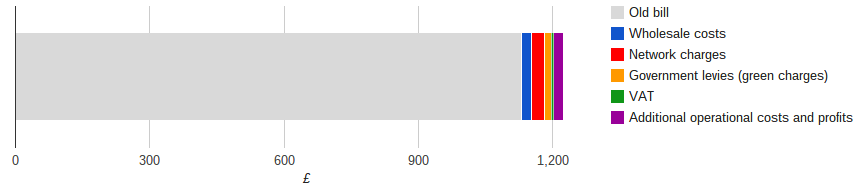
I generally avoid reading The Economist magazine – apart from the Science and Technology section – as it tends to make my blood boil. The writing style frequently includes such things that I would describe as casual generalisation, unquestioned third party claims, suppositions used in place of factual account, and the selective use of statistics to construct meaning – all of which have the power to annoy. Sometimes an article has so many trigger points, that I simply cannot finish reading it. This week I risked reading an article recommended to me about power generation in Europe, and I was pretty soon gnashing my teeth and wailing. I was indignant because the arguments being used ignored vital parts of European energy policy, and just parroted the complaints of utility companies, without challenging them, whilst at the same time ignoring the energy sector blackmail and brinkmanship. The article contradicted itself about energy investment and energy prices, and failed to make the case for utilities to diversify in order to survive. First of all – the contradictions. In The Economist magazine of 12th October 2013, the article entitled “How to lose half a trillion euros”, contains these two sections :- “[…] During the 2000s, European utilities overinvested in generating capacity from fossil fuels, boosting it by 16% in Europe as a whole and by more in some countries […] The market for electricity did not grow by nearly that amount, even in good times; then the financial crisis hit demand. According to the International Energy Agency, total energy demand in Europe will decline by 2% between 2010 and 2015.” “[…] the old-fashioned utilities […] So far, it is true, they have managed to provide backup capacity and the grid has not failed, even in solar- and wind-mad Germany. […] But […] it is getting harder to maintain grid stability. […] The role of utilities as investors is […] being threatened. […]” How can the privatised power utilities on the one hand have “overinvested”, and at the same time not invested enough to protect the grid in future ? The article writer misses several key points. The underlying reasons for investment in Europe in fossil fuel-fired generation during the 2000s was not in anticipation of higher power demand. The vast majority of new investment in the period 2000 to 2010 in the European Union was in Natural Gas-fired power plants, in anticipation of carbon emissions control and other environmental policy, and in anticipation of the retirement of a number of power plants reaching the ends of their lives. It was also viewed as a no-regrets option given there were plans to diversify the unified European power market to increase competitiveness – incorporating new, smaller players, and new, variable renewable power resources. Flexible gas generation would therefore always be in demand – the ability to turn off and on as required. Requiring gas plants to operate flexibly divorces generation capacity from generation demand, and so invalidates The Economist writer’s statement. And on to the problem of a contradiction over prices :- “[…] Renewable, low-carbon energy accounts for an ever-greater share of production. It is helping push wholesale electricity prices down, and could one day lead to big reductions in greenhouse-gas emissions. For established utilities, though, this is a disaster. […] In short, they argue, the growth of renewable energy is undermining established utilities and replacing them with something less reliable and much more expensive. […]” How can renewable electricity be lowering the prices of wholesale power, and yet also be replacing established utilities with something “much more expensive” ? I think the clue for this poor reasoning lies with a faulty interpretation of Germany’s Renewable Energy Surcharge – the EEG-Umlage, which is held up as the proof that green power costs more than fossil fuel power. The article says :- “[…] Electricity prices have fallen from over €80 per MWh at peak hours in Germany in 2008 to just €38 per MWh now […] These are wholesale prices; residential prices are €285 per MWh, some of the highest in the world, partly because they include subsidies for renewables that are one-and-a-half times, per unit of energy, the power price itself). […]” The Economist’s calculation of the green power subsidies at “one-and-a-half times” the wholesale power price is €57/MWh, so that’s only 20% of the total price of power to the consumer. Other costs besides the actual wholesale cost of the electricity, add up to €190, 67% of the cost of power to the household – far more of an impact than the renewable energy subsidies. I found the data from the BDEW to confirm these figures – from the “Power prices for households” presentation for May 2013, the price of electricity for consumers (for a standard three person house) is at €287.3/MWh, and the combination of Renewable Energy surcharges – including the VAT and the Offshore Wind surcharge – come to €59.82/MWh. So the numbers aren’t wrong, but the way The Economist article paragraph is written it gives the impression that asking end consumers to pay the costs of transitioning to green power is a huge burden. It’s not. These charges to households would be less if all energy users were to participate in paying for the renewable energy subsidies – but some companies do not, using the argument of anti-competitiveness. If they have to pay the surcharge, they reason, they will lose business to other countries. Quite effective blackmail, burdening the end consumer with higher power bills. In addition the electricity supply companies are trying to maintain their profit margins so may not be passing all the reductions in power costs to their consumers. One calculation suggests the total cost of Germany’s power will reduce by over €5.5 billion in 2014, and yet household electricity costs are expected to rise. The heightening effect of the Renewable Energy Act (EEG) surcharge on power prices is not going to last forever, however, as it’s promoting cheaper wholesale prices, and building in protection from the risks of sharply-rising prices for fossil fuels. Electricity supply companies are going to be able to sell progressively cheaper energy, and this differential will eventually reach the consumers, even if that needs to be legislatively enforced. Next, on to the assertion that increasing renewable electricity is pushing flexible gas-fired power generation out of the frame :- “[…] Renewables have “grid priority”, meaning the grid must take their electricity first. This is a legal requirement, to encourage renewable energy in Europe. But it is also logical: since the marginal cost of wind and solar power is zero, grids would take their power first anyway. […] But unlike the baseload providers already in place (nuclear and coal), solar and wind power are intermittent, surging with the weather. […] Now, when demand fluctuates, it may not be enough just to lower the output of gas-fired generators. Some plants may have to be switched off altogether and some coal-fired ones turned down. […] It is costly because scaling back coal-fired plants is hard. It makes electricity prices more volatile. And it is having a devastating effect on profits. […] Gérard Mestrallet, chief executive of GDF Suez, the world’s largest electricity producer, says 30GW of gas-fired capacity has been mothballed in Europe since the peak, including brand-new plants. The increase in coal-burning pushed German carbon emissions up in 2012-13, the opposite of what was supposed to happen.” The real core of this issue is that baseload is history – or it should be – and it will be for Germany in the near future – as some coal-fired power plants will need to close or be transitioned under the Large Combustion Plants Directive, and it’s successor, the Industrial Emissions Directive (9,000 coal-fired installations will be affected by the IED); and the nuclear power plants are all scheduled to close. It is very unlikely that much in the way of new European nuclear power will come on-stream within the next 15 years. The price of coal fuel might stay reasonable, due to a number of factors, but the cost of burning it is likely to become higher, so the baseload paradigm should be well and truly broken. That gas-fired power plants would be finding profit margins slim is something that has been anticipated widely, so it’s not exactly a shock, although it’s being used as a bargaining chip by utilities in ongoing negotations to launch an EU-wide “Capacity Market” for flexible power generation (principally gas, of course, since neither nuclear nor coal are flexible, and coal is practically on the edge of extinction in policy terms). CapGemini has recently published a scaremongering projection :- “[…] Gas plant closures : One of the biggest impacts of the disturbed gas and electricity markets is the rapid closure of numerous gas plants in the region. A recent study by IHS estimates that about 130,000 MW (130 GW) of gas plants across Europe (around 60% of the total installed gas fired generation in the Region) are currently not recovering their fixed costs and are at a risk of closure by 2016. These plants – essential to safeguarding security of supply during peak hours – are being replaced by volatile and unforecastable renewable energy installations that are heavily subsidised. […]” And other sources are also pushing the doom and gloom :- “[…] The pain being suffered by owners of European gas-fired power plant has escalated over the last 12 months. Weak power demand, subsidised renewable build and relatively high gas prices have conspired to crush gas fired generation margins […] It is difficult to imagine how market sentiment around gas-fired plant could get much worse. About a year ago we questioned the prospect of a European gas plant bust in the form of plant mothballing, closures and the distressed sale of assets. There is clear evidence of a bust gathering steam in 2013, with a number of utilities pursuing exactly these actions. […]” Instead of complaining and game-playing, electricity utilities should accept the need to adapt. In line with EU Directives, they can expect to be able to make a good profit by diversifying into energy services – so they end up not simply selling energy, but selling energy demand control. They would move from being E. Co.’s to ESCOs. If they accept the challenge to diversify, they can keep their shareholders happy, and they will be able to survive the slim margins they can make from gas-fired electricity generation during periods of peak demand, or to load balance grids increasingly dependent on renewable electricity generation. If the power utilities fail to adapt, they’re not too big to fail. I would suggest that European Governments renationalise them, as we’re going to have to fork out gazillions of euros to keep the Capacity Market running the way the utilities would like, so we might as well own the assets, too. | |
High Stakes Energy Chutzpah
![]() | |
Image Credit : Carbon Brief After Gordon Brown MP, the UK’s former Prime Minister, was involved in several diplomatic missions around the time of the oil price spike crisis in 2008, and the G20 group of countries went after fossil fuel subsidies (causing easily predictable civil disturbances in several parts of the world), it seemed to me to be obvious that energy price control would be a defining aspect of near-term global policy. With the economy still in a contracted state (with perhaps further contraction to follow on), national interest for industrialised countries rests in maintaining domestic production and money flows – meaning that citizens should not face sharply-rising utility bills, so that they can remain active in the economy. In the UK, those at the fringe of financial sustainability are notoriously having to face the decision about whether to Eat or Heat, and Food Banks are in the ascendance. Various charity campaigns have emphasised the importance of affordable energy at home, and the leader of the Labour Party, Ed Miliband MP has made an energy price freeze a potential plank of his policy ahead of the push for the next General Election. The current Prime Minister, David Cameron MP has called this commitment a “con”, as his political counterpart cannot determine the wholesale price of gas (or power) in the future. This debate comes at a crucial time in the passage of the UK Energy Bill, as the Electricity Market Reform (EMR), a key component of this legislation has weighty subsidies embedded in it for new nuclear power and renewable energy, and also backup plants (mostly Natural Gas-fired) for periods of high power demand, in what is called the “Capacity Market“. These subsidies will largely be paid for by increases in electricity bills, in one way or another. The EMR hasn’t yet passed into the statute books, so the majority of “green energy taxes” haven’t yet coming into being – although letters of “comfort” may have been sent to to (one or more) companies seeking to invest in new nuclear power facilities, making clear the UK Government’s monetary commitment to fully supporting the atomic “renaissance”. With a bucketload of chutzpah, Scottish and Southern Energy (SSE) and Electricite de France’s Vincent de Rivaz blamed green energy policies for contributing to past, current and future power price rises. Both of these companies stand to gain quite a lot from the EMR, so their blame-passing sounds rather hollow. The Daily Mail and the Daily Telegraph have seemed to me to be incendiary regarding green energy subsidies, omitting to mention that whilst the trajectory of the cost of state support for renewable energy is easily calculated, volatility in global energy markets for gas and oil – and even coal – are indeterminable. Although “scandal-hugging” (sensation equals sales) columnists and editors at the newspapers don’t seem to have an appreciation of what’s really behind energy price rises, the Prime Minister – and Ed Davey MP – have got it – and squarely placed the responsibility for energy price rises on fossil fuels. The price tag for “green energy policies” – even those being offered to (low carbon, but not “green”) nuclear power – should be considerably less than the total bill burden for energy, and hold out the promise of energy price stabilisation or even suppression in the medium- to long-term, which is why most political parties back them. The agenda for new nuclear power appears to be floundering – it has been suggested by some that European and American nuclear power companies are not solvent enough to finance a new “fleet” of reactors. In the UK, the Government and its friends in the nuclear industry are planning to pull in east Asian investment (in exchange for large amounts of green energy subsidies, in effect). I suspect a legal challenge will be put forward should a trade agreement of this nature be signed, as soon as its contents are public knowledge. The anger stirred up about green energy subsidies has had a reaction from David Cameron who has not dispensed with green energy policy, but declared that subsidies should not last longer than they are needed – probably pointing at the Germany experience of degressing the solar power Feed-in Tariff – although he hasn’t mentioned how nuclear subsidies could be ratcheted down, since the new nuclear programme will probably have to rely on state support for the whole of its lifecycle. Meanwhile, in the Press, it seems that green energy doesn’t work, that green energy subsidies are the only reason for energy bill rises, we should drop the Climate Change Act, and John Prescott MP, and strangely, a woman called Susan Thomas, are pushing coal-fired power claiming it as the cheaper, surer – even cleaner – solution, and there is much scaremongering about blackouts. https://www.mirror.co.uk/news/uk-news/john-prescott-its-coal-power-2366172 John Prescott on why it’s coal power to the people 12 Oct 2013 We can’t just stand back and give these energy companies money to burn. It’s only 72 days until Christmas. But the greedy big six energy companies are giving themselves an early present. SSE has just announced an inflation-beating 8.2 per cent price rise on gas and electricity. The other five will soon follow suit, no doubt doing their best to beat their combined profit from last year of £10billion. Their excuse now is to blame climate change. SSE says it could cut bills by £110 if Government, not the Big Six, paid for green energy subsidies and other environmental costs, such as free loft insulation. So your bill would look smaller but you’d pay for it with higher taxes. Talk about smoke and mirrors. But Tory-led governments have always been hopeless at protecting the energy security of this country. It’s almost 40 years since Britain was hit by blackouts when the Tories forced the UK into a three-day week to conserve energy supplies. But Ofgem says the margin of security between energy demand and supply will drop from 14 per cent to 4 per cent by 2016. That’s because we’ve committed to closing nine oil and coal power stations to meet EU environmental law and emissions targets. These targets were meant to encourage the UK to move to cleaner sources of energy. But this government drastically reduced subsidies for renewable energy such as wind and solar, let Tory energy ministers say “enough is enough” to onshore wind and failed to get agreement on replacing old On top of that, if we experience a particularly cold winter, we only have a reserve of 5 per cent. But the Government is committed to hundreds of millions pounds of subsidies to pay the energy companies to mothball these oil and coal power stations. As someone who negotiated the first Kyoto agreement in 1997 and is involved in its replacement by 2015, it is clear European emissions targets will not be met in the short term by 2020. So we have to be realistic and do what we can to keep the lights on, our people warm and our country running. We should keep these oil and coal power stations open to reduce the risk of blackouts – not on stand-by or mothballed but working now. The former Tory Energy minister John Hayes hinted at this but knew he couldn’t get it past his Lib Dem Energy Secretary boss Ed Davey. He bragged he’d put the coal in coalition. Instead he put the fire in fired. We can’t just stand back and give these energy companies money to burn. The only energy security they’re interested in is securing profit and maximising taxpayer subsidies. That’s why Ed Miliband’s right to say he’d freeze bills for 20 months and to call for more transparency. We also need an integrated mixed energy policy – gas, oil, wind, nuclear and, yes, coal. Letters Bills have risen to pay for policy changes Tuesday 8th October 2013 in Letters THE recent Labour Party pledge to freeze energy bills demonstrated how to have a political cake and eat it. The pledge is an attempt to rectify a heinous political mistake caused by political hubris and vanity. In 2008, the then energy minister, Ed Miliband, vowed to enact the most stringent cuts in power emissions in the entire world to achieve an unrealistic 80 per cent cut in carbon emissions by closing down fully functioning coal power stations. He was playing the role of climate saint to win popularity and votes. I was a member when Ed Miliband spoke in Oxford Town Hall to loud cheers from numerous low-carbon businesses, who stood to profit from his legislation. I was concerned at the impact on the consumer, since it is widely known that coal power stations offer the cheapest energy to consumers compared to nuclear and wind. So I wrote to Andrew Smith MP at great length and he passed on my concerns to the newly-formed Department of Energy and Climate Change that had replaced the previous Department of Energy and Business. This new department sent me a lengthy reply, mapping out their plans for wind turbines at a projected cost to the consumer of £100bn to include new infrastructure and amendments to the National Grid. This cost would be added to consumer electricity bills via a hidden green policy tariff. Some consumers are confused and wrongly believe that energy companies are ‘ripping them off’. It was clearly stated on Channel 4 recently that energy bills have risen to pay for new policy changes. These policy changes were enacted by Ed Miliband in his popularity bid to play climate saviour in 2008. Energy bills have now rocketed. So Ed has cost every single consumer in the land several hundred pounds extra on their bills each year. SUSAN THOMAS, Magdalen Road, Oxford LETTERS [ Turned off: Didcot power station’s closure could lead to power cuts. ] Labour’s power failures will cost us all dear THE Labour Party’s pledge to freeze energy bills is an attempt to rectify a horrible political mistake. But it might be too late to dig us out of the financial black hole caused by political vanity. In 2008, then Energy Minister Ed Miliband vowed to enact the most stringent cuts in power emissions in the world to achieve an unrealistic 80 per cent cut in carbon emissions by closing down coal power stations. He was playing the role of climate saint to win votes. I was in the audience in Oxford Town Hall that day and recall the loud cheers from numerous representatives of low-carbon businesses as his policies stood to make them all rather wealthy, albeit at the expense of every electricity consumer in the land. I thought Ed had become entangled in a spider’s web. I was concerned at the impact on the consumer as it’s widely known that coal power stations offer the cheapest energy to consumers. I contacted the Department of Energy and Climate Change and it sent me a lengthy reply mapping out its plans for energy projects and wind turbines – at a projected cost to the consumer of £100 billion – including new infrastructure and national grid amendments. It explained the cost would be added to consumer electricity bills via a ‘green policy’ tariff. This has now happened and explains the rise in utility bills. Some consumers wrongly believe the energy companies are ripping them off. In fact, energy bills have risen to pay for policy changes. The people to benefit from this are low-carbon venture capitalists and rich landowners who reap subsidy money (which ultimately comes from the hard-hit consumer) for having wind farms on their land. Since Didcot power station closed I’ve suffered five power cuts in my Oxford home. If we have a cold winter, we now have a one-in-four chance of a power cut. The 2008 legislation was a huge mistake. When power cuts happen, people will be forced to burn filthy coal and wood in their grates to keep warm, emitting cancer-causing particulates. Didcot had already got rid of these asthma-causing particulates and smoke. It emitted mainly steam and carbon dioxide which aren’t harmful to our lungs. But the clean, non-toxic carbon dioxide emitted by Didcot was classified by Mr Miliband as a pollutant. We are heading into a public health and financial disaster. SUSAN THOMAS, Oxford CEOs demand reform of EU renewable subsidies Companies ask the EU to stop subsidising the renewable energy sector. The CEOs of Europe’s ten biggest energy companies called for the European Union and member states to stop subsidising the renewable energy sector on Friday (11 October), saying that the priority access given to the sector could cause widespread blackouts in Europe over the winter. At a press conference in Brussels, Paolo Scaroni, CEO of Italian oil and gas company ENI, said: “In the EU, companies pay three times the price of gas in America, twice the price of power. How can we dream of an industrial renaissance with such a differential?” The CEOs said the low price of renewable energy as a result of government subsidies is causing it to flood the market. They called for an EU capacity mechanism that would pay utilities for keeping electric power-generating capacity on standby to remedy this problem. They also complained that the low price of carbon in the EU’s emissions trading scheme (ETS) is exacerbating the problem… Well said, Sir Tim Days after David Cameron orders a review of green taxes, which add £132 to power bills, the Lib Dem Energy Secretary vows to block any attempt to cut them. Reaffirming his commitment to the levies, which will subsidise record numbers of inefficient wind farms approved this year, Ed Davey adds: ‘I think we will see more price rises.’ The Mail can do no better than quote lyricist Sir Tim Rice, who has declined more than £1million to allow a wind farm on his Scottish estate. ‘I don’t see why rich twits like me should be paid to put up everybody else’s bills,’ he says. ‘Especially for something that doesn’t work.’ | |
There’s no doubt about it – wind power is saving the grid. Since the economic deflation (otherwise more sensitively termed a “recession” or a “slowdown”), and the consequent drop in confidence about the growth in electricity demand, and the problem of “missing money” to finance new infrastructure projects, there has not been much investor appetite for commissioning new power plants running on “conventional” fossil fuels. But wind is raging away with 12 gigawatts of wind power capacity added in the European Union in 2012.
But can wind be relied on ? Well, there’s lots of wind, and so lots of wind power – in the UK, for example, wind turbines generated 16,884 gigawatt hours of power in 2012, more than double the amount in 2008 (DUKES Digest of UK Energy Statistics, Table 5.1).
But what if the wind dies down when a high pressure weather system sits tight over the UK in the depths of winter ? What “Equivalent Firm Capacity” (EFC) can we expect from wind power ? Ofgem models 17% of the total in their 2013 Electricity Capacity Assessment Report. National Grid modelled 8% in their Winter Outlook Report of 2011/2012, which went up to 10% in the Winter Outlook for 2012/2013, and 10% in the 2013/2014 Winter Consultation Report (but noted that actual availability of wind during the previous year winter high demand conditions had been 9%)
Views and evidence differ about whether wind power availability is destined to be so low in winter cold highs – whether calm conditions are bound to be experienced at the same time as high power demand. Both the National Grid and Ofgem, the UK Government’s energy market regulator, have modelled this from data, but just as the time series is relatively short, the number of wind generators is rapidly increasing, so the richness of the data has yet to improve.
The problem with concentrating on the winter is that the excellent contribution from wind power to indigenous electricity generation is obscured. Clearly that’s the intention of the wind power deniers, who dismiss wind power’s valuable contribution because of the risk of some still days in December or January.
For any time of the year apart from the deepest cold of winter, wind power is a healthy generation resource. In some cases, wind power is embedded into industrial, military and transport facilities and isn’t metered by National Grid, and at times of high wind generation, National Grid experiences a “negative demand” effect on the main power grid.
And here are just some of the reasons why the contribution of wind power to national energy security is going to improve :-
1. A wider geographical spread of wind farms
More wind power will almost certainly be built. And built fast. Wind turbines have a good Net Present Value, so are assets, as opposed to nuclear reactors which start depreciating in return value the moment you start pouring concrete. Wind turbines are also quick to deploy, compared to the interminable struggle to commit to building other sorts of generation. The reason why wind power is fast to grid is because of slight tilts in market conditions caused by government subsidies and other measures to favour their low carbon generation. The only other contender (besides solar electric) for speed to grid generation from first groundworks is new efficient Natural Gas-fired plant. While people are still debating whether or not to deploy other forms of low carbon generation, wind power and gas (and solar electric) will be ripping up the projection spreadsheets. As more wind power comes online, there will naturally be a wider geographical dispersion of resources. If wind power generation capacity is spread over distances wider than the average anti-cyclonic high pressure system, then higher capacity values can be guaranteed. The more wind power there is, the firmer the promise of power will be.
2. The development of wind power hubs serving a number of regions
Already we see wind power “hubs” emerging, centres of build and connection of wind farms where conditions, financing and planning are more favourable. Some of these projects are international, such as in the North Sea area. With the plans for growing the integrated wind power market over a larger number of territories comes the flexibility to use wind power where it’s most needed at any one time, almost certainly raising the levels of wind energy that can be supplied to consumers from the same quantity of generation equipment. If “spare” wind capacity can flow through beefed up European power networks to serve regional demand, then there will be more reason to count on wind.
3. Size of wind turbines – and height
Data modelling of wind power will need to adjust to new realities – larger and higher wind turbines – capturing more of the wind for power generation. Wind flow is more regular the higher you are from the surface of the land or sea, so stronger dependency on wind power will be possible in future.
4. The synergy between low carbon generation technologies
So you’ve hit a rough patch with low wind speeds today – but solar power is doing fine. Or tidal energy. The more renewable energy technologies we develop, the more they can support each other in their respective weaknesses, so firming up renewable energy capacity as a whole.
5. The development of hybrid wind systems
Already, levels of installed wind generation capacity mean that there are periods of unused wind. Part of this will be improved by strengthening transmission networks, and this will improve wind’s reliability by getting “stranded” wind power to market. If the spare or surplus, or even “constrained” or “curtailed” wind power could be put to use as part of a Power to Gas hybrid system, more of the wind energy could be captured for a more reliable source of electrical power. This is just one angle of the Renewable Gas story – there are already several wind-to-hydrogen projects testing the concept of using electrolysis of water by spare wind power to produce hydrogen gas that can be stored and burned later on for power generation.
Keith MacLean : Big Choices
At last week’s 2013 Annual Conference for PRASEG, the UK parliamentary sustainable energy group, Keith MacLean from Scottish and Southern Energy outlined (see below) the major pathways for domestic (residential) energy, currently dependent on both a gas grid and a power grid.
He said that decarbonising heat requires significant, strategic infrastructure decisions on the various proposals and technology choices put forward, as “these options are incompatible”. He said that the UK “need to facilitate more towards ONE of those scenarios/configurations [for provision for heating at home] as they are mutually exclusive”.
There has been a commitment from Central Government in the UK to the concept of electrification of the energy requirements of both the transport and heat sectors, and Keith MacLean painted a scenario that could see the nation’s households ditching their gas central heating boilers for heat pumps in accord with that vision. Next, “the District Heating (DH) movement could take off, [where you stop using your heat pump and take local piped heat from a Combined Heat and Power (CHP) plant] until there is no spare market capacity. Then [big utilities] could start pumping biogas and hydrogen into the gas grid, and you get your boiler back !”
Since I view gas grid injection of Renewable Gas feedstocks as a potential way to easily decarbonise the gas supply, and as Keith MacLean said in his panel presentation, “The real opportunity to make a difference in our domestic [residential] energy consumption is in heat rather than power”, I sought him out during the drinks reception after the event, to compare notes.
I explained that I appreciate the awkward problem he posed, and that my continuing research interest is in Renewable Gas, which includes Renewable Hydrogen, BioHydrogen and BioMethane. I said I had been reading up on and speaking with some of those doing Hydrogen injection into the gas grid, and it looks like a useful way to decarbonise gas.
I said that if we could get 5% of the gas grid supply replaced with hydrogen…”Yes”, said Keith, “we wouldn’t even need to change appliances at those levels”… and then top up with biogas and other industrial gas streams, we could decarbonise the grid by around 20% without breaking into a sweat. At this point, Keith MacLean started nodding healhily, and a woman from a communications company standing near us started to zone out, so I figured this was getting really interesting. “And that would be significant”, I accented, but by this time she was almost asleep on her feet.
With such important decisions ahead of us, it seems that people could be paying a bit more attention to these questions. These are, after all, big choices.
What did Keith mean by “The District Heating movement” ? Well, Dave Andrews of Clean Power (Finning Power Systems), had offered to give a very short presentation at the event. Here was his proposed title :-
https://uk.groups.yahoo.com/group/Claverton/message/12361
“Indicative costs of decarbonizing European city heating with electrical distribution compared to district heating pipe distribution of large scale wind energy and with particular attention to transition to the above methods and energy storage costs to address intermittency and variability of wind power.”
This would have been an assessment of the relative costs of decarbonising European city heating with either :-
Strategy 1)
“Gas-fired Combined Cycle Gas Turbine (CCGT) generation plant plus domestic (residential sector) electric heat pumps as the transition solution; and in the long term, large scale wind energy replacing the CCGT – which is retained as back up for low wind situations; and with pumped hydro electrical storage to deal with intermittency /variability of wind energy and to reduce back up fuel usage.”
or
Strategy 2)
“CCGT Combined Heat and Power (CHP) plus district heat (DH) as the transition solution; and in the long term, large scale wind energy replacing the CCGT CHP heat but with the CCGT retained as back up for low wind situations and with hot water energy storage to deal with intermittency / variability and to reduce back up fuel usage.”
With “the impact of [a programme of building retrofits for] insulation on each strategy is also assessed.”
Dave’s European research background is of relevance here, as co-author of a 215-pager SETIS programme paper complete with pretty diagrams :-
https://setis.ec.europa.eu/system/files/1.DHCpotentials.pdf
Although Dave Andrews was also at the PRASEG drinks reception, he didn’t get the opportunity to address the conference. Which was a shame as his shirt was electric.
PRASEG 2013
10 July 2013
“Keeping the Lights on: At What Cost?”
Parliamentary Renewable and Sustainable Energy Group
Annual Conference
Second Panel Discussion
Chaired by Baroness Maddock
“Negawatts: Decentralising and reducing demand – essential or ephemeral ?”
[Note : The term “negawatt” denotes a negative watt hour – produced by a reduction in power or gas demand. ]
[…]
Keith MacLean, Scottish and Southern Energy
Decentralisation and Demand Reduction [should only be done where] it makes sense. Answers [to the question of negawatts] are very different if looking at Heat and Power. Heat is something far more readily stored that electricity is. Can be used to help balance [the electricity demand profile]. And heat is already very localised [therefore adding to optimising local response]. Some are going in the other direction – looking at district [scale] heating (DH) [using the more efficient system of Combined Heat and Power (CHP)]. Never forget the option to convert from electricity to heat and back to electricity to balance [the grid]. Average household uses 3 MWh (megawatt hours) of electricity [per year] and 15 MWh of heat. The real opportunity is heat. New homes reduce this to about 1 [MWh]. Those built to the new 2016 housing regulations on Zero Carbon Homes, should use around zero. The real opportunity to make a difference in our domestic [residential] energy consumption is in heat rather than power. Reducing consumption not always the right solution. With intermittents [renewable energy] want to switch ON at some times [to soak up cheap wind power in windy conditions]. [A lot of talk about National Grid having to do load] balancing [on the scale of] seconds, minutes and hours. Far more fundamental is the overall system adequacy – a bigger challenge – the long-term needs of the consumer. Keeping the lights from going out by telling people to turn off the lights is not a good way of doing it. There is justifiable demand [for a range of energy services]. […] I don’t think we’re politically brave enough to vary the [electricity] prices enough to make changes. We need to look at ways of aggregating and automating Demand Side Response. Need to be prepared to legislate and regulate if that is the right solution.
[…]
Questions from the Floor
Question from John Gibbons of the University of Edinburgh
The decarbonisation of heat. Will we be successful any time soon ?
Answer from Keith MacLean
[…] Decarbonising heat – [strategic] infrastructure decisions. For example, [we could go down the route of ditching Natural Gas central heating] boilers for heat pumps [as the UK Government and National Grid have modelled and projected]. Then the District Heating (DH) movement could take off [and you ditch your heat pump at home], until there is no spare market capacity. Then [big utilities] could start pumping biogas and hydrogen into the gas grid, and you get your boiler back ! Need to facilitate more towards ONE of those scenarios/configurations [for provision for heating at home] as mutually exclusive. Need to address in terms of infrastructure since these options are incompatible.
Answer from Dave Openshaw, Future Networks, UK Power Network
Lifestyle decision – scope for [action on] heat more than for electricity. Demand Management – managing that Demand Side Reduction and Demand Reduction when need it. Bringing forward use of electricity [in variety of new applications] when know over-supply [from renewable energy, supplied at negative cost].
[…]
James Delingpole : Worsely Wronger
I wonder to myself – how wrong can James Delingpole get ? He, and Christopher Booker and Richard North, have recently attempted to describe something very, very simple in the National Grid’s plans to keep the lights on. And have failed, in my view. Utterly. In my humble opinion, it’s a crying shame that they appear to influence others.
“Dellingpole” (sic) in the Daily Mail, claims that the STOR – the Short Term Operating Reserve (not “Operational” as “Dellingpole” writes) is “secret”, for “that significant period when the wind turbines are not working”, and that “benefits of the supposedly ‘clean’ energy produced by wind turbines are likely to be more than offset by the dirty and inefficient energy produced by their essential diesel back-up”, all of which are outrageously deliberate misinterpretations of the facts :-
https://www.dailymail.co.uk/news/article-2362762/The-dirty-secret-Britains-power-madness-Polluting-diesel-generators-built-secret-foreign-companies-kick-theres-wind-turbines–insane-true-eco-scandals.html
“The dirty secret of Britain’s power madness: Polluting diesel generators built in secret by foreign companies to kick in when there’s no wind for turbines – and other insane but true eco-scandals : By James Dellingpole : PUBLISHED: 00:27, 14 July 2013”
If “Dellingpole” and his compadre in what appear to be slurs, Richard North, were to ever do any proper research into the workings of the National Grid, they would easily uncover that the STOR is a very much transparent, publicly-declared utility :-
https://www.nationalgrid.com/uk/Electricity/Balancing/services/balanceserv/reserve_serv/stor/
STOR is not news. Neither is the need for it to be beefed up. The National Grid will lose a number of electricity generation facilities over the next few years, and because of the general state of the economy (and resistance to wind power and solar power from unhelpful folk like “Dellingpole”) investment in true renewables will not entirely cover this shortfall.
Renewable energy is intermittent and variable. If an anticyclone high pressure weather system sits over Britain, there could be little wind. And if the sky is cloudy, there could be much less sun than normal. More renewable power feeding the grid means more opportunities when these breaks in service amount to something serious.
Plus, the age of other electricity generation plants means that the risk of “unplanned outage”, from a nuclear reactor, say, is getting higher. There is a higher probability of sudden step changes in power available from any generator.
The gap between maximum power demand and guaranteed maximum power generation is narrowing. In addition, the threat of sudden changes in output supply is increasing.
With more generation being directly dependent on weather conditions and the time of day, and with fears about the reliability of ageing infrastructure, there is a need for more very short term immediate generation backup to take up the slack. This is where STOR comes in.
Why does STOR need to exist ? The answer’s in the name – for short term balancing issues in the grid. Diesel generation is certainly not intended for use for long periods. Because of air quality issues. Because of climate change issues. Because of cost.
If the Meteorological Office were to forecast a period of low wind and low incident solar radiation, or a nuclear reactor started to dip in power output, then the National Grid could take an old gas plant (or even an old coal plant) out of mothballs, pull off the dust sheets and crank it into action for a couple of days. That wouldn’t happen very often, and there would be time to notify and react.
But if a windfarm suddenly went into the doldrums, or a nuclear reactor had to do an emergency shutdown, there would be few power stations on standby that could respond immediately, because it takes a lot of money to keep a power plant “spinning”, ready to use at a moment’s notice.
So, Delingpole, there’s no conspiracy. There’s engagement with generators to set up a “first responder” network of extra generation capacity for the grid. This is an entirely public process. It’s intended for short bursts of immediately-required power because you can’t seem to turn your air conditioner off. The cost and emissions will be kept to a minimum. You’re wrong. You’re just full of a lot of hot air.
Ed Davey : Polish Barbecue
![]() | This week, both Caroline Flint MP and Ed Balls MP have publicly repeated the commitment by the UK’s Labour Party to a total decarbonisation of the power sector by 2030, should they become the governing political party. At PRASEG’s Annual Conference, Caroline Flint said “In around ten years time, a quarter of our power supply will be shut down. Decisions made in the next few years […] consequences will last for decades […] keeping the lights on, and [ensuring reasonably priced] energy bills, and preventing dangerous climate change. […] Labour will have as an election [promise] a legally binding target for 2030. […] This Government has no vision.” |
|
And when I was in an informal conversation group with Ed Davey MP and Professor Mayer Hillman of the Policy Studies Institute at a drinks reception after the event hosted by PRASEG, the Secretary of State for Energy and Climate Change seemed to me to also be clear on his personal position backing the 2030 “decarb” target. Ed Davey showed concern about the work necessary to get a Europe-wide commitment on Energy and Climate Change. He took Professor Hillman’s point that carbon dioxide emissions from the burning of fossil fuels are already causing dangerous climate change, and that the risks are increasing. However, he doubted that immediate responses can be made. He gave the impression that he singled out Poland of all the countries in the European Union to be an annoyance, standing in the way of success. He suggested that if Professor Hillman wanted to do something helpful, he could fly to Poland…at this point Professor Hillman interjected to say he hasn’t taken a flight in 70 years and doesn’t intend to now…and Ed Davey continued that if the Professor wanted to make a valuable contribution, he could travel to Poland, taking a train, or…”I don’t care how you get there”, but go to Poland and persuade the Poles to sign up to the 2030 ambition. Clearly, machinations are already afoot. At the PRASEG Annual Conference were a number of communications professionals, tightly linked to the debate on the progress of national energy policy. Plus, one rather exceedingly highly-networked individual, David Andrews, the key driver behind the Claverton Energy Research Group forum, of which I am an occasional participant. He had ditched the normal navy blue polyester necktie and sombre suit for a shiveringly sharp and open-necked striped shirt, and was doing his best to look dapper, yet zoned. I found him talking to a communications professional, which didn’t surprise me. He asked how I was. JA : “I think I need to find a new job.” What I really should have said was :- JA : “Absolutely and seriously not ! Who’d want to keep State Secrets ? Too much travel and being nice to people who are nasty. And making unbelievable compromises. The excitement of privilege and access would wear off after about six minutes. Plus there’s the risk of ending up decomposing in something like a locked sports holdall in some strange bathroom in the semblance of a hostelry in a godforsaken infested hellhole in a desolate backwater like Cheltenham or Gloucester. Plus, I’d never keep track of all the narratives. Or the sliding door parallel lives. Besides, I’m a bit of a Marmite personality – you either like me or you really don’t : I respond poorly to orders, I’m not an arch-persuader and I’m not very diplomatic or patient (except with the genuinely unfortunate), and I’m well-known for leaping into spats. Call me awkward (and some do), but I think national security and genuine Zero Carbon prosperity can be assured by other means than dark arts and high stakes threats. I like the responsibility of deciding for myself what information should be broadcast in the better interests of the common good, and which held back for some time (for the truth will invariably out). And over and above all that, I’m a technologist, which means I prefer details over giving vague impressions. And I like genuine democratic processes, and am averse to social engineering. I am entirely unsuited to the work of a secret propaganda and diplomatic unit.” I would be prepared to work for a UK or EU Parliamentary delegation to Poland, I guess, if I could be useful in assisting with dialogue, perhaps in the technical area. I do after all have several academic degrees pertinent to the questions of Energy and Climate Change. But in a room full of politicians and communications experts, I felt a little like a fished fish. Here, then, is a demonstration. I was talking with Rhys Williams, the Coordinator of PRASEG, and telling him I’d met the wonderful Professor Geoff Williams, of Durham Univeristy, who has put together a system of organic light emitting diode (LED) lighting and a 3-D printed control unit, and, and, and Rhys actually yawned. He couldn’t contain it, it just kind of spilled out. I told myself : “It’s not me. It’s the subject matter”, and I promptly forgave him. Proof, though, of the threshold for things technical amongst Westminster fixers and shakers. Poland. I mean, I know James Delingpole has been to Poland, and I thought at the time he was possibly going to interfere with the political process on climate change, or drum up support for shale gas. But I’m a Zero Carbon kind of actor. I don’t need to go far to start a dialogue with Poland by going to Poland – I have Poles living in my street, and I’m invited to all their barbecues. Maybe I should invite Professor Mayer Hillman to cycle over to Waltham Forest and address my near neighbours and their extended friendship circle on the importance of renewable energy and energy efficiency targets, and ask them to communicate with the folks back home with any form of influence. | |
Birdcage Walk : Cheesestick Rationing
Closer up, Ed Davey MP doesn’t look anything like Wayne Rooney, the soccer star, which is a good thing really, as that impression, drawn from paparazzi photographs mostly, made me fear I could get overwhelmed by alcohol-fuelled footballer charisma or overpowering aftershave, of which Ed Davey appeared to have neither. He did keep flashing an annoying gold signet ring, but he seems to have his sideburns well under control, and my attention was really drawn to the fact that he looks a lot slimmer than last year when he spoke at last year’s Parliamentary Renewable and Sustainable Energy Group or “PRASEG” do, doing a very passable Rooney impression, somehow. As we spoke this evening, in the basement of One Birdcage Walk, I don’t know what he thought I was thinking, but I was wondering : has Ed Davey MP got a “podge coach” ? Or is he indulging in a spot of extra-curricular skin-on-skin activity ? Or is he merely in competition with Ed Balls MP ? It can be so hard to differentiate between one upwardly-mobile and upwardly-weighted political Ed and another these days, and find yourself a Unique Selling Point in Generation Ed.
I asked the Minister, the Secretary of State for Energy and Climate Change, over some very garlicky olive nibbles, and some evil wasabi peanuts, and some OK OJ, whether I could possibly have heard aright in his comments about Community Energy. Somewhere in the building, a masonry drill had started to rumble, and Ed D had made a reference to “drilling” as he opined on the meaning of “local energy”. I thought he meant shale gas development, and I was hoping to clarify if he really did mean that or not. No. I was wrong. It was a joke.
Well, OK then. Onwards and outwards. “…So, Ed, I read recently that you would be prepared to consider a bid to build new nuclear reactors from GE Hitachi, who have purchased the company Horizon, which already have planning options in the UK at approved sites. You said you would be prepared to consider them instead of Electricite de France. You’ve said you have a level of strike price in mind, and you’re not prepared to go above it, despite EdF proposals. So, Ed, did you know that in February 2011, you know, just before the Multiple Nuclear Reactor Accident at Fukushima Dai-ichi in Japan, that 24 (actually, it turns out it’s 35) of GE Hitachi’s nuclear reactors in the USA had been warned that they were out of safety compliance owing to buckled control rods ? And that the Nuclear Regulatory Commission had issued a fix notice ? Would reactors in the UK built by GE Hitachi going to be of the same design ?” Ed Davey, wiser than his seemingly youthful football-short wearing years would allow, advised me to address my concerns to the Office for Nuclear Regulation, who would, of course, vet each design thoroughly.
After which helpful direction, I observed Mayer Hillman, Emeritus Professor of the Policy Studies Institute, regale the slimline Ed D with the news that the Climate Change Act is remiss as it does not include climate change feedbacks in its calculations for the necessary UK carbon emissions reductions. He is right, actually, but it’s a tough argument to push. The IPCC’s Fourth Assessment Report couldn’t include climate change feedback effects, because there were no reliable numbers. In the Fifth Assessment Report, there will be numbers, as Ed Davey noted. I noticed that Ed Davey was as calm as a sleeping dolphin, one eye watchfully open, but he was actually awake and listening, and not being dismissive. I thought to myself, actually, he’s rather polite, and I rather warmed to him. Not too much, of course, because otherwise the climate could have risked significant change.
Hadeo- and Archaeo-Geobiology
![]() | What can deep time teach us ? Whilst doing a little background research into biological routes to hydrogen production, I came across a scientific journal paper, I can’t recall which, that suggested that the geological evidence indicates that Earth’s second atmosphere not only had a high concentration of methane, but also high levels of hydrogen gas. |
|
Previously, my understanding was that the development of microbiological life included a good number of methanogens (micro-life that produces methane as a waste product) and methanotrophs (those that “trough” on methane), but that hydrogenogen (“respiring” hydrogen gas) and hydrogenotroph (metabolising hydrogen) species were a minority, and that this was reflected in modern-day decomposition, such as the cultures used in biogas plants for anaerobic digestion. If there were high densities of hydrogen cycle lifeforms in the early Earth, maybe there are remnants, descendants of this branch of the tree of life, optimal at producing hydrogen gas as a by-product, which could be employed for biohydrogen production, but which haven’t yet been scoped. After all, it has only been very recently that psychrophiles have been added to the range of microorganisms that have been found useful in biogas production – cold-loving, permafrost-living bugs to complement the thermophile and mesophile species. Since hydrogen and methane are both ideal gas fuels, for a variety of reasons, including gas storage, combustion profiles and simple chemistry, I decided I needed to learn a little more. I have now read a plethora of new theories and several books about the formation of the Earth (and the Moon) in the Hadean Eon, the development of Earth’s atmosphere, the development of life in the Archaean Eon, and the evolution of life caused by climate change, and these developments in living beings causing climate change in their turn. Most of this knowledge is mediated to us by geology, and geobiology. But right at its heart is catalytic chemistry, once again. Here’s Robert Hazen (Robert M. Hazen) from page 138 of “The Story of Earth” :- “Amino acids, sugars, and the components of DNA and RNA adsorb onto all of Earth’s most common rock-forming minerals […] We concluded that wherever the prebiotic ocean contacted minerals, highly concentrated arrangements of life’s molecules are likely to have emerged from the formless broth […] Many other researchers have also settled on such a conclusion – indeed, more than a few prominent biologists have also gravitated to minerals, because origins-of-life scenarios that involve only oceans and atmosphere face insurmountable problems in accounting for efficient mechanisms of molecular selection and concentration. Solid minerals have an unmatched potential to select, concentrate, and organize molecules. So minerals much have played a central role in life’s origins. Biochemistry is complex, with interwoven cycles and networks of molecular reactions. For those intricately layered processes to work, molecules have to have just the right sizes and shapes. Molecular selection is the task of finding the best molecule for each biochemical job, and template-directed selection on mineral surfaces is now the leading candidate for how nature did it […] left- and right-handed molecules […] It turns out that life is incredibly picky : cells almost exclusively employ left-handed amino acids and right-handed sugars. Chirality matters […] Our recent experiments have explored the possibility that chiral mineral surfaces played the starring role in selecting handed molecules, and perhaps the origins of life as well. […] Our experiments showed that certain left-handed molecules can aggregate on one set of crystal surfaces, while the mirror image […] on other sets […] As handed molecules are separated and concentrated, each surface becomes a tiny experiment in molecular selection and organization. On its own, no such natural experiment with minerals and molecules is likely to have generated life. But take countless trillions of trillions of trillions of mineral surfaces, each bathed in molecule-rich organic broth […] The tiny fraction of all those molecular combinations that wound up displaying easier self-assembly, or developed a stronger binding to mineral surfaces […] survived […] possibly to learn new tricks.” | |
London : Array, Invest, Divest
Showcasing the London Array offshore wind farm in the last week at its official launch, the UK’s Prime Minister David Cameron said “[…] We are making this country incredibly attractive to invest in […] When it comes to green energy, I think we have one of the clearest, most predictable investment climates. And we’re going to add to that by completing the Energy Bill this year. So, we will have a fantastic market for investors to come and build in. […]” (see below).
I think developers of solar energy in Britain would disagree quite extensively with his claim that there is a stable regime for green energy. The most effective stimulus tool, the Feed-in Tariff, was applauded and then mauled in short succession by the Conservative-Liberal-Democrat Coalition Government. Installation rates have simply not recovered from chewings from the Treasury attack dog. It’s been boom and then bust, bust, bust, with flurries of activity in summer, but not much more :-
And this despite the yappy enthusiasm (perhaps “big, hairy”, or “big, sexy” ambition) that Greg Barker MP and his Dachshund, Otto, have for sun-fired electricity generation :-
https://www.solarpowerportal.co.uk/news/barker_once_more_quotes_22gw_by_2020_solar_ambition_2356
The Energy Bill should have been finished a long time ago, and I’m pretty sure it would have been, apart from the insane obsession with new nuclear power, which all along was predicted to consist of several kinds of big, chunky subsidy, and shows no signs of being anything other than a bankrolling exercise, even now (and too late to bridge Alistair Buchanan‘s “Crunch Winter” of 2015/2016).
https://www.bloomberg.com/news/2013-07-02/edf-nuclear-deal-in-u-k-may-take-a-few-months-.html
“EDF Nuclear Deal in U.K. May Take ‘A Few Months’ : By Alex Morales – Jul 2, 2013 : The U.K. may take “a few months” to agree the price that Electricite de France SA (EDF) will get for power from Britain’s first new nuclear power station in two decades, Energy Secretary Ed Davey suggested. The government has been in talks for months with EDF to agree a so-called strike price the French utility will get for power from a planned plant at Hinkley Point in southwest England. Davey told Parliament’s multi-party Energy and Climate Change Committee he won’t sign a contract with EDF unless it represents “value for money” for consumers. “Even if we agree in the next few months, a nuclear reactor at Hinkley point won’t be producing until the end of this decade at best,” Davey said today. “They have been very constructive negotiations. They are taking some time, and that’s because they are very complicated.”
https://www.telegraph.co.uk/finance/newsbysector/energy/10164435/Rival-nuclear-companies-cheaper-than-EDF-Ed-Davey-suggests.html
“[…] Mr Davey told The Guardian that EDF was aware of the strike price that he would agree to and that he was “not going to budge an inch”. He said: “Sometimes people said it is EDF or bust. I would like to do a deal with EDF but we don’t have to. I was in Korea and Japan recently talking to other investors and vendors. Their interest in the UK market was massive. I got the very strong impression that the sort of price I was happy to agree with EDF, they could match.” In the same interview he said: “We have other nuclear options. Hitachi are very live options. They bought Horizon only last year and their pace of progress is truly impressive.” He noted that Hitachi had delivered four reactors “on time and on budget”. […]”
But the most serious contention that I have with David Cameron’s remarks is his painting a picture that the UK needs international capital to reach down from geostationary orbit, or where it is a bit lower, in transcontinential flight at 35,000 feet, to touch and bless the UK with its gilded finger of providence.
Don’t we have any investors in Britain ? We may have only a few, small British companies that can build green energy for us, but we do have a lot of wealth lurking within these very shores, or representatives of a lot of wealth. Could we not demand that those who shore their cash in Britain, and take advantage of cheap corporate tax deals, invest in British green energy ? Could we not make green energy investment a sine qua non of the residence or passsage of wealth in and through the City of London ?
Many people in Great Britain have pensions, and those pensions have funds, and those funds have fund managers. There’s a lot of money, right there. What are the criteria that govern pension pot investment ?
And then there’s the banks. Almost everyone in the UK has a bank account. Are the banks held to policies to direct finance and investment towards green energy and clean tech ? Do their customers demand it ?
Why does the UK Government not stipulate that “best value for money” as a criteria on all contracts of procurement – and investment – has to be matched by “best carbon emissions reduction potential” ?
Or are we in such an austere position that we need to offer huge, fattened sweeteners from the Treasury tax honeypot, and permission to raise already high power prices for customers, to any international engineering firm prepared to pour concrete here, so that they can arrange for the finance this guarantees ? Why are we in a position where we are being forced to throw public money and billpayer burdens at private companies to guarantee new energy build ?
This looks like a worse deal than PFI. In fact, it is much, much worse that the Private Finance Inititative, or the revamped new acronyms that replaced it. This is the wholesale gifting of large amounts of annual tax revenue and fingerlicking kilowatt hour prices to large, transnational corporations. If the economy gets worse, which it probably will, these big new construction projects may never get completed. And the new national energy infrastructure that does manage to get built won’t even be ours. Unless they go wrong, in which case the country will have to pay to mop them up. Or at the end of life, when the taxpayers and billpayers will need to pay to decommission nuclear reactors and dispose of radioactive waste.
And while we’re on the subject of investment, I need to point out that not all big infrastructure projects are alike. Some development is good, some bad. I don’t really see how the Olympic building spree can be compared in any way to what’s necessary for creating a decarbonised energy system. And building larger ports, and roads, and airports, anticipates higher levels of traded goods – the kind of economic growth that caused climate change in the first place.
If David Cameron wants to crow about big projects and be praised for it, he needs to de-select examples that are unsustainable.
There really needs to be more focus on what we really need for the future, and that requires discernment in investment. It requires moving away from high consumption models of economy, of divesting from stocks and shares in waste, pollution, carbon emissions and unnecessary trade.
Invest, yes, but divest, also.
https://www.operationnoah.org/PR_southwark_resolution
“4 July 2013: The Diocese of Southwark passed a resolution yesterday (3 July 2013) calling on the General Synod of the Church of England to consider disinvestment from fossil fuels.”
https://www.guardian.co.uk/environment/video/2013/jul/04/david-cameron-windfarm-thames-estuary-video
The UK’s Prime Minister David Cameron speaking outside at the London Array site :-
“Well let’s be clear this is the biggest offshore wind farm anywhere in the world.
And what it shows is Britain is a great country to come and invest in. And it’s meant
jobs for local people. And it means clean, green energy for half a million homes in
our country. It’s part of what we need to have secure, reliable supplies of electricity
and to get investment and jobs for our people, so it’s a good day for Britain.”
David Cameron speaking at the Press Launch indoors :-
“Well of course, when I chaired the G8, I had to arrange everything, starting with
the dress code. There was some criticism. Why wasn’t I wearing a tie ? What people
didn’t realise of course was that President Putin wanted to do the whole thing
barechested on horseback, and I of course had to negotiate him down to smart casual.
We haven’t had that problem today.
Sometimes people wonder, can we in the West, can we do big projects any more ? Can we
do the big investments ? Isn’t that all happening somewhere else in the East and the
South of our world ?
And I think if you look at the United Kingdom right now you can see WE CAN do big
projects. Not only did we do a superb Olympics last year, but underneath London,
CrossRail is the biggest construction project anywhere in Europe.
Not far away from here is Dubai Ports World London Gateway, which is the biggest port
contruction taking place anywhere in Europe.
And here you have the biggest offshore wind farm anywhere in the world.
I think it demonstrates Britain is a great place to invest.
I don’t want to have too much Schadenfreude, but it’s actually a fact that last year,
foreign direct investment into Europe as a whole went down by something like 40%, but in
the UK it went up by 24%.
We are making this country incredibly attractive to invest in, and and that’s part of what
this project is about.
When it comes to green energy, I think we have one of the clearest, most predictable
investment climates. And we’re going to add to that by completing the Energy Bill this year.
So, we will have a fantastic market for investors to come and build in.
So, a great win for Kent, a great win for renewable energy and a great win for Britain.”
Carbon Bubble : Unburnable Assets
![]() [ Image Credit : anonymous ] | Yet again, the fossil fuel companies think they can get away with uncommented public relations in my London neighbourhood. Previously, it was BP, touting its green credentials in selling biofuels, at the train station, ahead of the Olympic Games. For some reason, after I made some scathing remarks about it, the advertisement disappeared, and there was a white blank board there for weeks. |
This time, it’s Esso, and they probably think they have more spine, as they’ve taken multiple billboard spots. In fact, the place is saturated with this advertisement. And my answer is – yes, fuel economy is important to me – that’s why I don’t have a car. And if this district is anything to go by, Esso must be pouring money into this advertising campaign, and so my question is : why ? Why aren’t they pouring this money into biofuels research ? Answer : because that’s not working. So, why aren’t they putting this public relations money into renewable gas fuels instead, sustainable above-surface gas fuels that can be used in compressed gas cars or fuel cell vehicles ? Are Esso retreating into their “core business” like BP, and Shell, concentrating on petroleum oil and Natural Gas, and thereby exposing all their shareholders to the risk of an implosion of the Carbon Bubble ? Or another Deepwater Horizon, Macondo-style blowout ? Meanwhile, the movement for portfolio investors to divest from fossil fuel assets continues apace… | |
Renewable Gas : Research Parameters
“So what do you do ?” is a question I quite frequently have to answer, as I meet a lot of new people, in a lot of new audiences and settings, on a regular basis, as an integral part of my personal process of discovery.
My internal autocue answer has modified, evolved, over the years, but currently sounds a lot like this, “I have a couple of part-time jobs, office administration, really. I do a spot of weblogging in my spare time. But I’m also doing some research into the potential for Renewable Gas.” I then pause for roughly two seconds. “Renewable Gas ?” comes back the question.
“Yes,” I affirm in the positive, “Industrial-scale chemistry to produce gas fuels not dug up out of the ground. It is useful to plug the gaps in Renewable Electricity when the sun isn’t shining and the wind isn’t blowing.”
It’s not exactly an elevator pitch – I’m not really selling anything except a slight shift in the paradigm here. Renewable Energy. Renewable Electricity. Renewable Gas. Power and gas. Gas and power. It’s logical to want both to be as renewable and sustainable and as low carbon as possible.
Wait another two seconds. “…What, you mean, like Biogas ?” comes the question. “Well, yes, and also high volumes of non-biological gas that’s produced above the ground instead of from fossil fuels.”
The introductory chat normally fades after this exchange, as my respondent usually doesn’t have the necessary knowledge architecture to be able to make any sense of what my words represent. I think it’s fair to say I don’t win many chummy friends paradigm-bumping in this way, and some probably think I’m off the deep end psychologically, but hey, evolutionaries don’t ever have it easy.
And I also find that it’s not easy to find a place in the hierarchy of established learning for my particular “research problem”. Which school could I possibly join ? Which research council would adopt me ?
The first barrier to academic inclusion is that my research interest is clearly motivated by my concern about the risks of Climate Change – the degradation in the Earth’s life support systems from pumping unnaturally high volumes of carbon dioxide into the air – and Peak Fossil Fuels – the risks to humanity from a failure to grow subsurface energy production.
My research is therefore “applied” research, according to the OECD definition (OECD, 2002). It’s not motivated simply by the desire to know new things – it is not “pure” research – it has an end game in mind. My research is being done in order to answer a practical problem – how to decarbonise gaseous, gas phase, energy fuel production.
The second barrier to the ivory tower world that I have is that I do not have a technological contribution to make with this research. I am not inventing a chemical process that can “revolutionise” low carbon energy production. (I don’t believe in “revolutions” anyway. Nothing good ever happens by violent overthrow.) My research is not at the workbench end of engineering, so I am not going to work amongst a team of industrial technicians, so I am not going to produce a patent for clean energy that could save the world (or the economy).
My research is more about observing and reporting the advances of others, and how these pieces add up to a journey of significant change in the energy sector. I want to join the dots from studies at the leading edge of research, showing how this demonstrates widespread aspiration for clean energy, and document instances of new energy technology, systems and infrastructure. I want to witness to the internal motivation of thousands of people working with the goal of clean energy across a very wide range of disciplines.
This is positively positive; positivity, but it’s not positivism – it’s not pure, basic research. This piece of research could well influence people and events – it’s certainly already influencing me. It’s not hands-off neutral science. It interacts with its subjects. It intentionally intervenes.
Since I don’t have an actual physical contribution or product to offer, and since I fully expect it to “interfere” with current dogma and political realities, what I am doing will be hard to acknowledge.
This is not a PhD. But it is still a piece of philosophy, the love of wisdom that comes from the acquisition of knowledge.
I have been clear for some time about what I should be studying. Call it “internal drive” if you like. The aim is to support the development of universal renewable energy as a response to the risks of climate change and peak fossil fuel energy production. That makes me automatically biased. I view my research subject through the prism of hope. But I would contend that this is a perfectly valid belief, as I already know some of what is possible. I’m not starting from a foundational blank slate – many Renewable Gas processes are already in use throughout industry and the energy sector. The fascinating part is watching these functions coalesce into a coherent alternative to the mining of fossil fuels. For the internal industry energy production conversation is changing its track, its tune.
For a while now, “alternative” energy has been a minor vibration, a harmonic, accentuating the fossil fuel melody. As soon as the mid-noughties economic difficulties began to bite, greenwash activities were ditched, as oil and gas companies resorted to their core business. But the “green shoots” of green energy are still there, and every now and then, it is possible to see them poking up above the oilspill-desecrated soil. My role is to count blades and project bushes. Therefore my research is interpretivist or constructivist, although it is documenting positivist engineering progress. That’s quite hard for me to agree with, even though I reasoned it myself. I can still resist being labelled “post-positivist”, though, because I’m still interpreting reality not relativisms.
So now, on from research paradigm to research methodologies. I was trained to be an experimentalist scientist, so this is a departure for me. In this case, I am not going to seek to make a physical contribution to the field by being actively involved as an engineer in a research programme, partly because from what I’ve read so far, most of the potential is already documented and scoped.
I am going to use sociological methods, combining observation and rapportage, to and from various organisations through various media. Since I am involved in the narrative through my interactions with others, and I influence the outcomes of my research, this is partly auto-narrative, autoethnographic, ethnographic. An apt form for the research documentation is a weblog, as it is a longitudinal study, so discrete reports at time intervals are appropriate. Social media will be useful for joining the research to a potential audience, and Twitter has the kind of immediacy I prefer.
My observation will therefore be akin to journalism – engineering journalism, where the term “engineering” covers both technological and sociological aspects of change. A kind of energy futures “travelogue”, an observer of an emerging reality.
My research methods will include reading the science and interacting with engineers. I hope to do a study trip (or two) as a way of embedding myself into the new energy sector, with the explicit intention of ensuring I am not purely a commentator-observer. My research documentation will include a slow collation of my sources and references – a literature review that evolves over time.
My personal contribution will be slight, but hopefully set archaic and inefficient proposals for energy development based on “traditional” answers (such as nuclear power, “unconventional” fossil fuel production and Carbon Capture and Storage for coal) in high relief.
My research choices as they currently stand :-
1. I do not think I want to join an academic group.
2. I do not think I want to work for an energy engineering company.
3. I do not want to claim a discovery in an experimental sense. Indeed, I do not need to, as I am documenting discoveries and experiments.
4. I want to be clear about my bias towards promoting 100% renewable energy, as a desirable ambition, in response to the risks posed by climate change and peak fossil fuel production.
5. I need to admit that my research may influence outcomes, and so is applied rather than basic (Roll-Hansen, 2009).
References
OECD, 2002. “Proposed Standard Practice for Surveys on Research and Experimental Development”, Frascati Manual :-
https://browse.oecdbookshop.org/oecd/pdfs/free/9202081e.pdf
Roll-Hansen, 2009. “Why the distinction between basic (theoretical) and applied (practical) research is important in the politics of science”, Nils Roll-Hansen, Centre for the Philosophy of Natural and Social Science Contingency and Dissent in Science, Technical Report 04/09 :-
https://www2.lse.ac.uk/CPNSS/projects/CoreResearchProjects/ContingencyDissentInScience/DP/DPRoll-HansenOnline0409.pdf
Energy Change : Germany’s Energiewende #1
I recently attended an event entitled “The Energiewende: A close look at Germany’s renewable energy revolution”. This was hosted by PRASEG, the Associate UK Parliamentary Renewable and Sustainable Energy Group, and supported by the German Embassy, and held at the Boothroyd Room of Portcullis House, Westminster, 6th March 2013 between 2pm and 4pm.
The main speakers were Rainer Baake, State Secretary at the Federal Environment Ministry in Germany between 1998 and 2005, and Andreas Kramer, Director and CEO of the Ecologic Institute in Berlin – a well-regarded think tank. Alan Whitehead MP also gave comments, and Simon Hughes MP also attended and shared some points.
Tom Heap, the well-known Radio 4 presenter, was on hand to chair.
What follows is not verbatim, but is transcribed from scribbled notes.
[Tom Heap] “Germany is a live pilot experiment [in transitioning out of fossil fuels to renewable energy]. That’s not meant to be patronising. [Whilst recording a programme there before Christmas I was] hearing comments from right-of-centre government I wouldn’t hear in the UK. On wind turbines, German and British conservatives are poles apart. There wind power is not seen as an imposition. We heard “our energy, our village”. The technologies are similar, but the politics are different…”
[Rainer Baake] “In Germany, energy policy holds past and future challenges. In June 2011, we ended a long and very controversial debate on energy policy. We ended up with very ambitious goals. The almost unanimous vote was historical. It was almost impossible to believe. We had always had a very diverse debate since Chernobyl [the catastrophic nuclear power accident in Ukraine in 1986 that necessitated the total evacuation of the city of Pripyat and the surrounding districts]. With the major change in government in 2008, with a Green and Social Democrat [SPD https://www.spiegel.de/international/germany/where-do-they-stand-a-quick-guide-to-germany-s-political-parties-a-651388.html ] majority, we got Phase 1, then the Renewable Energy Act (EEG, Erneuerbare-Energien-Gesetz https://www.bmu.de/en/service/publications/downloads/details/artikel/renewable-energy-sources-act-eeg-2009/) – which was also controversial at that time.”
“[We] created the Feed-In Tariff [FIT] – an incredible success story. Over roughly ten years, the Renewable Energy share stands at 25% of power generation as of today. And of that 25%, 50% of that is in the hands of private people and farmers. This is why it has received political support. The owners of the windmills, biomass generators […] are not only producers, they are also voters. At the start, there was opposition from Conservatives [German conservative right-of-centre politicians – CDU https://www.spiegel.de/international/germany/where-do-they-stand-a-quick-guide-to-germany-s-political-parties-a-651388.html], but companies in their own constituencies said, “We can earn money with this” […] Renewable Energy receives very wide support. This is very different from nuclear power.”
“The Conservatives and Liberals [German free market neoliberal politicians – FDP https://www.spiegel.de/international/germany/where-do-they-stand-a-quick-guide-to-germany-s-political-parties-a-651388.html ] promised that after the 2009 elections if the coalition won there would be lifetime extensions [on existing nuclear reactors – allowing them to continue operating after their originally designed safe lives]. But they didn’t have a plan ready. They made [announcements] in December 2010 [extending reactor lives out to 2045 https://www.world-nuclear-news.org/IT-German_plant_life_extension_law_passed-2911107.html ] but this was against the public [opinion]. It only lasted for a few weeks, because Fukushima happened [ https://www.bloomberg.com/news/2011-03-14/germany-suspends-plan-to-extend-life-of-nuclear-power-plants-merkel-says.html ]. Our Government realised what it meant for their own policy. They were able to explain Chernobyl [the meltdown accident at Pripyat in the Ukraine in 1986] as Communist [regime] mismanagement, but the meltdown of three reactors at Fukushima, in a technologically advance country…the Government immediately changed position, and it led to a very big [wide] consensus. In June 2011, the opposition and the Government [decided for] Renewable Energy.”
“In the original [Energiewende] plan of 2000, phaseout of nuclear was to be by 2022, and in the next decades, the fossil generators would convert to Renewable Energy. When created the FIT in 2000 – all Renewable Energy [technologies] had the same starting line [the same levels of subsidy]. The FIT is not a permanent subsidy – it helps these technologies to be introduced to markets. The winners are clearly wind power and solar power – others maybe [remain] too expensive. Biomass is now reaching a sustainability limit [not enough feedstocks for expansion]. It is not going to be posssible to increase biomass or hydropower much over today. Geothermal energy – never came up. Wind and solar power prices decreased dramatically. We have enough of that. The features – have to deal with […] weather-dependent and solar power is not flexible to demand. Second – also very variable. Very capital-intensive [for investment phase] but marginal costs [of operation] are negligible. One you’ve invested, put all the money you need on the table, there are no costs over the following decades.”
“These features [of Renewable Energies] mean it is going to be a complete change in energy systems over the next decades. 25% of demand – happened much faster than anticipated in 2000. The first 25% is one story. The next 25% is another story. 25% is easy to integrate. Very robust. The next 25% – as you can imagine – 50% of the system – this is the real challenge of the Energiewende – synchronising production of solar and wind with demand of customers. How to balance demand and supply ? How to minimise the costs [of that] – [reduce] in a free European Union energy market ? There’s the technology – and on the other hand, the market. On the technology side need much more flexible supply. With FIT […] Baseload is not a word that describes supply – it describes demand. With marginal costs of zero, they [utilising power from renewable energies] come first – they are pushing traditional fossil fuels out of baseload. The operating hours of traditional baseload generators are decreasing. [We will need] not only adjustments to demand, but also the variable sources. Ten years ahead we will not have any baseload. We will still need 6,000 hours a year generators. They’re there – that’s gas. [We also need] a market design to enable [this].”
“Second – we need [new/larger] transmission lines. That’s something that really needs to happen. The bigger [wider] the area you connect, the bigger [better, more even] the balance. Not only talking about Germany – also Denmark, the Netherlands, Scandinavia – the better we’re connected, the better to balance. [The history of] the market in almost all countries – generators [power stations] were built under state regulation on the basis of monopolies. After the deregulation in the 1990s, the [power sector changed to work] on the basis of least operating costs. [The power was supplied] always by those generators of least operation cost – makes sense. All these have marginal costs – that is, fuel. When you introduce lots of Renewable Energy with a marginal cost of zero, the prices on the wholesale market have come down significantly, from 95 to 50 Euro per MWh. This has been caused not only by Renewable Energy – but it has been mainly Renewable Energy – pushing out the more expensive generators.”
“This creates a problem, as you need backup capacity – when the sun isn’t shining and the wind isn’t blowing. There have been arguments/debates about the capacity market we need – an intelligent system – not very expensive – to make sure to backup when wind and solar are not available. We also need a system to support the Energiewende over the next decades. FIT was good for 15 years, but answers of the past are not necessarily correct for the future. It is always argued very strongly that for Germany this is not to renationalise energy policy. This Energiewende is much less costly if we do it with our neighbours. It’s too controversial at the European Union [EU] – but [we are/having] encouraging discussions with neighbouring countries – to the benefit of everybody – to put into reality the EU energy market. We need flexibility of generators, but also flexibility of demand side. [We have asked the German] States [Länder] – are you able to shift your peak [demand] by six hours – a real part of the solution. [We need to] move away from switch [on] and forget. [To those detractors of the Energiewende] if look at the opposition [views] there is no reasonable balance of money in and out. One day we will be using all our renewable electricity generation – for example, using electricity for transport, but for now [we need to export].”
…TO BE CONTINUED
![]() | The (Associate) Parliamentary Renewable and Sustainable Energy Energy Group (PRASEG) held a wonderfully low-key seminar on Germany’s “Energiewende“, or energy transition, this afternoon in the Boothroyd Room at Portcullis House in Westminster. The main speakers included Rainer Baake, a former Secretary of State for the German Federal Environment Ministry. |
|
Tom Heap, the main presenter of Radio 4’s “flagship environment programme” “Costing the Earth” was on hand to chair the session, and ask provocative questions. During the question time after the main speakers had outlined the progress and future of Germany’s energy transition, Tom Heap posed the nagging question about carbon emissions. The story goes, according to the likes of George Monbiot and Mark Lynas, that since Germany has decided to do away with their nuclear power generation capacity, that the country will be using more coal in future to generate electricity. [Tom Heap] “…Is more coal [lignite] being burned because of the nuclear power phase out [in Germany] ?” [Andreas Kramer] “There has been a small uptick. First, coal is dirt cheap, and the European Emissions Trading Scheme [carbon] rights are dirt cheap. The second reason is that [we have made a decision to abandon nuclear power] in the middle of the changeover from coal [to renewable energy, as we have to close the plants under the European] Large Combustion Plant Directive [LCPD] – so there will be a window of slightly higher capacity of coal plant [to cope with the phase out of nuclear power] until the coal plant is retired. Coal use is projected to go down. [Rainer Baake] “We have a Cap and Trade system for carbon dioxide emissions in the European Union. Whatever we do emissions of carbon dioxide will always be capped. The price [of emissions rights] only determines what is happening where. There will always be a balance between gas and coal, depending on the price. The answer to the problem is – decrease the cap, then you will see less emissions. Nothing we do with the Energiewende… No one is investing in new coal and lignite plants…” At this point Tom Heap began to look rather bemused, confused, perhaps a touch mystified. He started to look towards the ceiling in a rather vacant, media way. [Rainer Baake] “…[The current surge in the use of coal is owing to] decisions made in 2005, 2006. Nobody is investing [now] in lignite or coal. This is a very serious problem because of backup capacity [to back up new renewable electricity generation]…” Huh ? Well, it takes time to finance and commission a new coal-fired power station. So there you have it – another myth busted. Nuclear power phase out in Germany is not going to lead to permanently higher coal-burning for power generation. | |
Natural Gas in the UK
![]() | The contribution of coal-fired power generation to the UK’s domestic electrical energy supply appears to have increased recently, according to the December 2012 “Energy Trends” released by the Department of Energy and Climate Change. This is most likely due to coal plants using up their remaining allotted operational hours until they need to retire. |
| It could also be due to a quirk of the international markets – coal availability has increased because of gas glut conditions in the USA leading to higher coal exports. Combatting the use of coal in power generation is a global struggle that still needs to be won, but in the UK, it is planned that low carbon generation will begin to gain ascendance.
The transition to lower carbon energy in Britain relies on getting the Natural Gas strategy right. With the imminent closure of coal-fired power plant, the probable decommissioning of several nuclear reactors, and the small tranche of overall supply coming from renewable resources, Natural Gas needs to be providing a greater overall percentage of electricity in the grid. But an increasing amount of this will be imported, since indigenous production is dropping, and this is putting the UK’s economy at risk of high prices and gas scarcity. Demand for electricity for the most part changes by a few percentage points a year, but the overall trend is to creep upwards (see Chart 4, here). People have made changes to their lighting power consumption, but this has been compensated for by an increase in power used by “gadgets” (see Chart 4, here). There is not much that can be done to suppress power consumption. Since power generation must increasingly coming from renewable resources and Natural Gas combustion, this implies strong competition between the demand for gas for heating and the demand gas for electricity. Electricity generation is key to the economy, so the power sector will win any competition for gas supplies. If competition for Natural Gas is strong, and since we don’t have much national gas storage, we can expect higher seasonal imports and therefore, higher prices. It is clear that improving building insulation across the board is critical in avoiding energy insecurity. I shall be checking the winter heat demand figures assiduously from now on, to determine if the Green Deal and related measures are working. If they don’t, the UK is in for heightened energy security risks, higher carbon emissions, and possibly much higher energy prices. The Green Deal simply has to work. | |
New Nuclear : Credibility Strained
![]() | As rumours and genuine information leak from central sources about the policy instruments and fiscal measures that will be signed into the United Kingdom’s Energy Bill, the subsidy support likely to be made available to new nuclear power is really straining credibility from my point of view. I am even more on the “incredulous” end of the spectrum of faith in the UK Government’s Energy Policy than I ever was before. |
The national demand for electrical power is pretty constant, with annual variations of only a few percent. It was therefore easy to project that there could be a “power cliff” when supply would be curtailed from coal-fired generation under European legislation :- https://www.gov.uk/government/organisations/department-of-energy-climate-change/series/energy-trends https://www.bbc.co.uk/news/business-21501878 The pat answer to how we should “Keep the Lights On” has been to wave the new nuclear fission reactor card. Look ! Shiny new toys. Keep us in power for yonks ! And hidden a little behind this fan of aces and jokers, a get-out-of-jail free card from the Coal monopoly – Carbon Capture and Storage or CCS. Buy into this, and we could have hundreds more years of clean power from coal, by pumping nasty carbon dioxide under the sea bed. Now, here’s where the answers are just plain wrong : new nuclear power cannot be brought into the National Grid before the early 2020s at the very earliest. And options for CCS are still in the balance, being weighed and vetted, and very unlikely to clean up much of the black stuff until well past 2025. When put through my best onboard guesstimiser, I came up with the above little graph in answer to the question : how soon can the UK build new power generation ? Since our “energy cliff” is likely to be in one of the winters of 2015 or 2016, and we’re not sure other countries we import from will have spare capacity, we have little option but to increase Natural Gas-fired power generation and go hell-for-leather with the wind and solar power deployment. So no – it’s of no use promising to pay the new nuclear reactor bearer the sum of 40 or more years of subsidy in the form of guaranteed price for power under the scheme known as Contracts for Difference – they still won’t be delivering anything to cope with the “power drain” of the next few years. If this is written into the Electricity Market Reform, we could justifiably say this would destroy competition, and destroy any market, too, and be “central planning” by any other name – this level of subsidy is not exactly “technology-neutral” ! https://www.guardian.co.uk/business/2013/feb/19/edf-40-year-contract-nuclear-plant And offering the so-called Capacity Mechanism – a kind of top-up payment to keep old nuclear reactors running, warts and all – when really they should be decommissioned as they are reaching the end of their safe lives, is not a good option, in my book. Offering the Capacity Mechanism to those who build new gas-fired power plant does make sense, however. If offshore wind power continues with its current trajectory and hits the big time in the next few years, and people want the cheap wind power instead of the gas, and the gas stations will be feeling they can’t run all the time, then the Capacity Mechanism will be vital to make sure the gas plant does get built to back up the wind power, and stays available to use on cold, still nights in February. https://www.gov.uk/government/uploads/system/uploads/attachment_data/file/66039/7103-energy-bill-capacity-market-impact-assessment.pdf Oh, people may complain about the idea of new “unabated” gas power plants, and insist they should be fitted with carbon capture, but new gas plants won’t run all the time in future, because renewable electricity generation will be cheaper, so forcing gas plant owners to pay for CCS seems like overkill to me. And, anyway, we will be decarbonising the gas supply, as we develop supplies of Renewable Gas. I say forget the nuclear option – build the gas ! | |
Gas Strategy “Dangerous Gamble”
I had a most refreshing evening at Portcullis House in Westminster this evening – apart from the fact that the Macmillan Room was overheated, so you couldn’t possibly deduce that energy conservation is intended to be part of the UK Government’s strategy, making an example with the public sector.
Tonight was the launch of the Greenpeace and WWF-UK report “A Study into the Economics of Gas and Offshore Wind“, which was commissioned from Cambridge Econometrics.
Professor Paul Ekins got up to speak and actually had the gall to declare the Government’s “Gas Strategy” to be a “dangerous gamble”. It was at this point that I took heart again – there are still some sane, rational people in the “national energy conversation”, even though Ekins did admit that he wasn’t sure that the “Gas Strategy” was an actual thing. Oh, but it is. All eighty pages of it.
Today was not the first time Professor Paul Ekins called out the Government on this, apparently, although I didn’t have a recollection of seeing the the mention in New Scientist before today.
Other highlights of the evening were provided by Laura Sandys MP naming her political opposition Alan Whitehead MP as the leader of a “parliamentary roadshow” on Energy and Climate Change, and questioning the use of the term “energy efficiency”. “It’s energy waste, guys”, she corrected and said we should be using that term instead of the “effete word efficiency”, and encouraged the energy waste prevention industry to get the rest of us engaged with their products.
A chap from Scottish and Southern Energy (SSE) – I think it might have been Kevin MacLean – got up during questions from the floor, and almost begged for a long-term framework – a plan for renewable energy – a “binding framework” to encourage investment and “get costs down”.
It was pointed out during the evening, that, logically enough, that policy is important to energy futures, “if you have more certainty, you get more investment”. And there was encouragement to get Government Departments to think about this more. Yes, some subsidies and other forms of support are going to be needed to get the renewable energy revolution kickstarted, but “if [we] get benefits – isn’t that a price worth paying ?” The benefits outlined included potential for some small growth in the economy, around about 0.8% GDP, but good prospects for high value employment in depressed coastal towns where much of the offshore wind industry will host engineers, both for construction and ongoing operations and maintenance.
Laura Sandys MP was ashamed to say that she may no longer be able to claim she has the two largest offshore wind farms in her constituency – as progress is being made elsewhere.
Sarah Merrick from Vestas, the wind power engineering firm, emphasised that the economics of wind power stacks up and that it’s important to communicate this – despite the current dismissive media agenda – where she said it is important to defend the industry against certain media claims.
Lord Alan Haworth brought up the inevitable question of renewable energy intermittency – “days of dead calm and dark nights”. He raised the statistic that weather systems in Europe can cover 1,500 kilometres, so if wind power is down in the UK, it’s going to be down elsewhere in the EU electricity networks – the countries we have interconnectors with. What he didn’t elaborate on was this – just as the UK is beefing (and I don’t mean “up to 100% horsing about”) up its connections with the European electricity networks, so too, Europe as a whole is beginning to reach out with its networks to satellite countries. What that could mean is that even if wind-powered electrons in the UK take a dive, electrons could still appear in the power network from very far afield, and shunt power to the UK.
The speaker from the Crown Estate said that it was “sensible” to push for a good quantity of wind power – and that the report was a compelling argument. He regretted that it could not be guaranteed that the wind power-ed economy would necessarily have more of its supply chain in the UK – as various bodies have to comply with EU trade rules – but that there was a commitment in one part of the industry to 50% indigenous resourcing and employment (if I noted that down correctly).
Long-term policy clarity was espoused. Disappointment was expressed in the Coalition Government’s flip-flop about gas – emphasising the development of gas-powered electricity generation at the expense of projecting high levels of renewables (65%, says the report, is perfectly feasible) – and that it gave mixed messages – which weren’t helping investment decisions. Sarah Merrick repeated the E.On line that UK electricity should be “balanced by gas, not based on gas”, although she didn’t explain that they weren’t necessarily talking about wind power being the mainstay of new generation capacity.
It was generally agreed that David Cameron should lead and adopt the EU 2030 renewable energy targets – to enable billions of new confidence in the UK energy sector.
Not having a strong lead on renewable energy and energy waste reduction would be an “abdication of responsibility on the part of the policy-creating machine”. And, “even if shale gas does materialise”, it would not provide much stimulus.
How is your Australia ?
[ PLEASE NOTE : This post is not written by JOABBESS.COM, but by a contact in Australia, who was recently asked if they could send an update of the situation there, and contributed this piece. ]
John and Jono: Resistance to coal in heat-afflicted Australia
By Miriam Pepper, 24/1/13
It was predicted to be a hot summer in eastern Australia, with a return to dry El Nino conditions after two back-to-back wet La Nina years. And hot it has been indeed. Temperature records have tumbled across the country – including the hottest day, the longest heatwave, and the hottest four month period.
With heavy fuel loads heightening fire risks, bushfires have blazed across Tasmania, Victoria, NSW, South Australia and Queensland. The fires have wreaked devastation on communities, with homes, farmland and forest destroyed. Thankfully few human lives have been lost (unlike the Black Saturday bushfires of 2009), though many non-human neighbours were not so fortunate. Some 110,000 hectares burned and 130 houses were lost in the Tasmanian bushfires earlier this month, and fires still rage in Gippsland Victoria where over 60,000 hectares have burned so far. And we are only just over halfway through summer.
On January 12, the Australian Government-established Climate Commission released a short report entitled “Off the charts: Extreme Australian Summer heat”. The document concluded that:
“The length, extent and severity of this heatwave are unprecedented in the measurement record. Although Australia has always had heatwaves, hot days and bushfires, climate change has increased the risk of more intense heatwaves and extreme hot days, as well as exacerbated bushfire conditions. Scientists have concluded that climate change is making extreme hot days, heatwaves and bushfire weather worse.”
The Australian continent is one of climate change’s frontlines, and also a major source of its primary cause – fossil fuels.
While the mercury soared and the fires roared, a young translator from Newcastle called Jonathan Moylan issued a fake press release claiming that the ANZ bank, which is bankrolling a massive new coal project at Maules Creek in north western NSW, had withdrawn its loan. Whitehaven Coal’s share price plummeted temporarily before the hoax was uncovered, making national news.
This action did not come out of the blue, neither for Moylan personally nor for the various communities and groups that have for years been confronting (and been confronted by) the rapid expansion of coal and coal seam gas mining at sites across Australia.
The scale of fossil fuel expansion in Australia is astonishing. Already the world’s biggest coal exporter, planned mine expansion could see Australia double its output. The world’s largest coal port of Newcastle NSW has already doubled its capacity in the last 15 years and may now double it again. Mega-mines that are on the cards in the Galilee Basin in central Queensland would quintuple ship movements across the Great Barrier Reef, to 10,000 coal ships per year. If the proposed Galilee Basin mines were fully developed today, the annual carbon dioxide emissions caused by burning their coal alone would exceed those of the United Kingdom or of Canada. The implications of such unfettered expansion locally for farmland, forests, human health and aquatic life as well as globally for the climate are severe.
I have twice had the privilege of participating in a Christian affinity group with Moylan at coal protests. And at around the time of his ANZ stunt, John the Baptist’s ministry and the baptism of Jesus in the gospel of Luke were on the lectionary. For me, there have been some striking parallels between John and Jonathan (Jono).
John the Baptist lived in the wilderness. Jono the Activist has been camping for some time in Leard State Forest near Maules Creek, at a Front Line Action on Coal mine blockade.
John got himself locked up by criticising the behavior of Herod, the then ruler of Galilee (in what is now northern Israel). For making the announcement that ANZ should have made, Jono could now face a potential 10-year jail sentence or a fine of up to $500,000.
When followers suggested that John the Baptist might be the Messiah, he pointed away from himself and towards the Christ that was yet to come. When the spotlight has been shone onto Moylan, by the media and activists alike, he has repeatedly deflected the attention away from himself and towards the resistance of the Maules Creek community to the project and towards the impacts if the project goes ahead – the loss of farmland and critically endangered forest, the drawdown and potential contamination of the aquifer, the coal dust, the impacts on the global climate. And indeed, the way that Moylan has conducted himself in media interviews has I believe resulted in exposure about the Maules Creek project itself (which is currently under review by the federal Environment Minister) as well as some mainstream discussion about broader issues such as responding to the urgency of climate change, government planning laws and the rights of communities, and ethical investment.
In an opinion piece published today, Jono Moylan finishes by urging us to act:
“We are living in a dream world if we think that politicians and the business world are going to sort out the problem of coal expansion on their own. History shows us that when power relations are unevenly matched, change always comes from below. Every right we have has come from ordinary people doing extraordinary things and the time to act is rapidly running out.”
Whatever our age, ability or infirmity we can all play a part in such change from below.
Links
Climate Commission: https://climatecommission.gov.au
Frontline Action on Coal: https://frontlineaction.wordpress.com
Maules Creek Community Council: https://maulescreek.org
“Potential jailing not as scary as threat of Maules Creek mine”, opinion piece by Jonathan Moylan, 24/1/13: https://www.smh.com.au/opinion/politics/potential-jailing-not-as-scary-as-threat-of-maules-creek-mine-20130123-2d78s.html
Greenpeace climate change campaigns: https://www.greenpeace.org/australia/en/what-we-do/climate/
Australian Religious Response to Climate Change: https://www.arrcc.org.au
Uniting Earthweb: https://www.unitingearthweb.org.au