Oh dear. It appears that the Edinburgh Chapter of the Peoples Golfing Association, formed in 2005 ahead of the G8 Gleneagles Summit, has got the band back together at the Climate Camp, and played a round just a tad too close to the buildings of the Headquarters of the Royal Bank of Scotland :-
“22 August 2010 : Climate change protesters arrested at RBS office : Two women have been arrested after climate change protesters attacked the Royal Bank of Scotland’s (RBS) Edinburgh headquarters on Sunday. More than 100 protesters took part in the action, which also involved an oil-like substance being thrown at the building and windows being smashed. The protest comes in response to RBS’s investment in oil industry developments around the world…Shaun Caulfield, who took part in the attempted raid, said: “RBS is one of the biggest climate criminals in the UK. People are angry that bankers are ploughing the billions that they got in the bail out into incredibly destructive fossil fuel projects around the world.” Golf balls were also apparently thrown at the building, the Press Association reported…”
I wouldn’t call it an “attack”. It was more like a good walk spoiled.
And as for “attempted raid”…well…there are plenty enough doors to sneak through, nobody needs to break anything to get inside. They probably didn’t.
Who chipped the first ball into the panes of expensive coated glass, eh ? Lady golfers or police chappies ?
Shock ! Horror ! Major Climate Change Scientist spotted at Climate Camp…ah, but which one… ? How to distinguish one dressed-down, unwashed individual with dishevelled locks from any another ?
Any sign of Climate Change sceptic-denier Andrew Montford, as affectionately known as “Bishop Hill” ? Can’t make him out, but he might have responded to the banner appeal to “Come On Over for Lunch”. You never know. That might be him chopping potatoes, right in the thick of it.
“The report confirms that our scientific understanding of the climate system and its sensitivity to greenhouse gas emissions is now richer and deeper than ever before.”
Who is meant by the ownership word “our” ?
It cannot mean the whole of humanity, since there are still a large number of people who have no idea about the Science of Climate Change, or who deny it.
I suspect that most Climate Change deniers would stop reading this report right there – as they don’t want to be included in the group of people who accept that Climate Change is real, happening and serious, too.
Notice that there’s no question that the Climate is sensitive to Greenhouse Gas Emissions accumulating in the Atmosphere. There’s no “likelihood” associated with that statement.
I never met my maternal grandmother, and family history has not been stitched well enough for me to understand what kind of person she was, until today.
Sorting through some of her keepsakes with an older relative, I found a piece of lace knotting, a small irregular sampler in a larger collection of much more accurate work.
Nobody ever saw its pattern before, but I saw it, and I show it here : the Cross of St George of England on a light background juxtaposed with a Swastika on a dark background.
It is a statement from the heart. A demonstration of the overshadowing, constant, brooding threat of its time – the War with Germany.
If reflects the war being waged in the body and soul of the person who laced it – as she neared the end of her life, losing her fight against tuberculosis.
If there’s one thing about Climate Change nobody could be able to disagree on, it’s that there’s a huge amount of literature on the subject.
I figure it would be impossible for any one person to have a good grounding in the totality of the Science, spanning, as it does, most of humankind’s discoveries about the physical world.
It would be hard too to have an exceptionally well-rooted understanding even of the Synthesis of the conclusions of the Intergovernmental Panel on Climate Change (IPCC) reports.
A human mind is surely not capable of remembering all the facts and figures and how everything relates. My personal forgettery is quite active in selecting what to drop after not using it for a while, and I’m sure others experience the same thing.
For example, I’m sure Dr Judith Curry, accomplished as she is in Earth Sciences, does not remember the entire field, and does not have the tools to look everything up quickly. Which is why she gives shorthand vague, answers on web logs which annoy other people so much :-
I reckon, though, people should give her a break for a while to let her compose herself, and get over the shock of the Anthony Watts “tribe” eating her heart out with steak knives after she published a proper piece of Science.
Most people over the age of 35 years old will probably be able to agree with the statement that “you learn a lot of things in life, and you also forget a lot too”.
Things get replaced in your active memory as you move from phase to phase of your life, meet and lose people, as you change careers, take up new hobbies and interests.
For instance, I used to be able to speak German passably well, but this got replaced by Dutch, and now I don’t practice speaking Dutch at all, it’s faded from my skillset.
A lot of experiences cast shadows and are best totally forgotten. Others, which we consider valuable, we tend to summarise for ourselves and retain at least the outline of what we have known.
Here follows an extract of a conversation I have had with members of the Claverton Energy Research Forum, which I have cut-and-paste into a more easy-to-read fashion below the fold :-
As you can see, there are Climate Change sceptic-deniers everywhere, even in the most knowledgeable and respectable circles.
Countering Climate Change denial from so-called “sceptics” takes a lot of time and energy, and is a bump-in-the-road nuisance/irritation distraction from the main priority for human civilisation, which is how to stop being addicted to Fossil Fuels.
The problem with several Climate Change denier arguments is that they are “meta” arguments – philosophical arguments about how people behave, what they intend and how things are done.
One such issue that they take is with the Intergovernmental Panel on Climate Change (IPCC) “consensus” method of operation. They seem to view the IPCC consensus as “blurred lines” – their conclusion is that the IPCC’s unified interpretation of the evidence is suspect.
When the Police want to interview eye-witnesses, and when a judge wants to hear witness evidence, the standard practice is to keep the witnesses apart, so that the lines of evidence can be as independent as possible.
By contrast, in Climate Change Science, there is a certain amount of collaboration between researchers during the course of their work, so you could say that no observations are made independently. However, this should not be labelled as “malicious collusion”, although many Climate Change deniers do do that.
People won’t be moved. There’s no use hoping for an outpouring of charitable giving and energetic aid organisation – the world is suffering too many ongoing parallel disasters to be able to scramble effectively for this – the biggest ever (probably).
A similar situation exists with Climate Change policy, or rather the incredible inertia against taking the obvious first steps towards meaningful Carbon Dioxide emissions reductions.
People are too busy with their Facebook, their Twitter, their own personal financial nemeses (is that the plural of “nemesis”, really ?) to be able to form a coherent “movement”, as Bill McKibben, Al Gore and others wish us to mobilise into :-
“Why has extreme weather failed to heat up climate debate? The world is experiencing the hottest weather on record but politicians have failed to respond. They need a wake-up call…”
How paranoid is Andrew Montford of Edinburgh, Scotland ? Does he have any reason to be afeard now that the Climate Camp has parked up on his doorstep ?
Don’t worry. This isn’t a threat, Andrew. It’s a invitation. When the rocket stoves have been lit and the canvas staked out, you’re invited to come and talk with real people about the realities of Climate Change instead of being cooped up with your hot laptop at home cooking up hurtful and inaccurate things to say about working Scientists and activists.
By the way, I rocked with laughter at this recent review of your book “The Hockey Stick Illusion” :-
[ UPDATE FROM JOABBESS.COM : ROYAL BANK OF SCOTLAND, EDINBURGH, CLIMATE CAMP SITE HAS BEEN TAKEN. ELECTRONIC COMMUNICATION FROM process@climatecamp.org.uk, Wed, Aug 18, 2010 at 9:59 PM : “Site taken! People needed NOW! At 9.15PM tonight Climate Camp took the site on RBS HQ. Get on site as fast as you can! Defence help urgently needed. Come to RBS Gogarburn Gardens, off Gogar Station Rd. More info later. x” ]
Al Gore has been telling all the young people, and well, all of us, really, to protest, in public, to make a downright law-unabiding nuisance of ourselves :-
“Gore calls for major protests on government’s climate change inaction…In a post on his personal blog headlined “The Movement We Need”…”
Well, it won’t work to call people out onto the street. Most people are too busy credit-crunching, wage-slaving or favour-scraping to be able to commit to a short-term, potentially self-defeating public display of annoyance, frustration and shrill demands.
And if people do come out to the big protests, it won’t achieve much. News reports can be swept into the trash. Activists can be swept into holding facilities. Politicians can conveniently ignore anything that isn’t violent.
Drop the loud-hailers and home-made placards, I say, and do something more…focussed.
The Climate Camp want to target the Royal Bank of Scotland for financing Coal power plants and Tar Sands oil projects, which are very bad things to be doing, and smacks of huge corporate irresponsibility, considering the bank is largely owned by the British taxpayer, and I say, if you can’t make the camp (and I can’t for reasons which I shall not go into just now), do something about money in other ways instead.
What’s your money doing ? Which oppressive regimes in oil-rich countries is it supporting ? Which Fossil Fuel companies trashing your Environment do your bank support ? Why not switch your money to an ethical financial organisation ? Why don’t we all try to do this at the same time ? “Crowd-banking” could have an impact, you never know until you try.
Let’s pick, say, Monday 23rd August 2010. And let’s all spend our way out of Climageddon together on that day. Transfer your money to an ethical bank, or pledge to do so. Phone your bank and tell them you’re leaving for a sustainable bank.
Other actions possibly useful :-
1. Refuse to buy Fossil Fuels for a day.
2. Refuse to use any hot water for one day (most hot water is produced by burning Fossil Fuels). It’s summer in the Northern Hemisphere – come on – a cool shower won’t hurt you.
3. Don’t spend any money on anything that had Petroleum-based plastic or Natural Gas-based chemicals in its production – which would rule out 85% of non-food purchases, I reckon.
4. If you’re working for a company or an organisation who have anything to do with the Energy industry, make a point of asking your boss, or their boss, or the Chief Executive or something what the company/organisation intends to do about moving the whole business to Renewable Energy.
5. One short telephone call could have you moving from burning Coal for your home electricity to a Green Energy account.
This is not a riot – but it is an emergency, and the response should match the scale of the problem.
Dr Judith Curry insists, quite correctly, that we should take uncertainties into account when deciding Climate Change policy.
Yet I think our respective positions probably strongly differ on which way we weight the uncertainties.
I strongly favour the Precautionary Principle, implemented Early, making it the “Early Precautionary Principle”.
One of the reasons I come down on this end of the spectrum of possible responses to uncertainties is that there are quite a spectrum of unknowns that form the pillars of those uncertainties.
After all, if we don’t know a term in an equation, how can we possibly calculate anything meaningful with any kind of confidence ?
How can anybody feel safe and secure not knowing for certain what the actual equilibrium Climate Sensitivity amounts to ? The response of the Earth’s Climate system to extra airborne Carbon Dioxide-forced temperature rise is a number that is becoming firmer, but there are error bars. Surely this points to conservatism in emissions ?
Moreover, we could be well advised to cut back on Fossil Fuel burning not just to protect the Climate, but to save the Economy. How can we pursue our normal everyday Carbon-emitting lives not knowing how much Fossil Fuel there is left in the ground that can be inexpensively mined ?
How can we know the order of magnitude of Fossil Fuels left to extract ? And how can we know what kind of impact this will have on the Climate ?
Yes, the Earth’s temperature is warming at a very fast pace. No, even though the statistical models here may be a little questionable, the graph still looks the same, more or less, to the sterling work of Michael Mann et al. (et al. = et alia = “and the others”).
Quelle surprise…pas !
(I included a little French in here because Steve McIntyre, the most infamous Global Warming septic…oops, sorry, “sceptic”…nooo, “skeptic”… is Canadian, a famously bilingual country, or rather a country with a bilingual state, but I’m not implying that “bilingual” means “speaking with forked tongue”).
“…Decreasing CO2 was the main cause of a cooling trend that began 50 million years ago, large scale glaciation occurring when CO2 fell to 425 +/- 75 ppm…”
The sceptic-deniers laughed and scoffed and said things to the effect that clearly there’s nothing to worry about that the current concentration of Carbon Dioxide in the air is over 390 parts per million – it won’t melt the polar ice caps.
What the sceptic-deniers haven’t understood, or pretend not to have understood, is that it is a combination of factors that caused major lasting glaciation on Earth. Yes, the level of Carbon Dioxide in the air is important. But the rate of change of Carbon Dioxide in the atmosphere is a significant component.
If the levels of Carbon Dioxide in the atmosphere change rapidly, the heating or cooling effect is amplified, in effect. You have to take account of the relative change in levels of Carbon Dioxide, not just its level at any particular point in time.
As Dr Judith Curry has tried to communicate to me, the physical science of Climatology is full of deep complexity, with strong ranging on a number of processes.
Just to take a typical example – the Hurricane storm track in the Caribbean. Different years produce different levels of risk, and a constantly updated projection is needed as short-term relevant climatic factors shift.
But despite the likelihood of any particular Tropical Depression forming, the range of its strength and the eventual pathway, there is still a clearly identifiable track that storms take – that Stephen Schneider called “Hurricane Alley”.
This kind of “big picture” of regional and even global phenomena means that we can safely scale out from the inner workings of individual changes in air pressure, prevailing winds and humidity and take in the larger-scale, longer-term trends.
Despite her claims that she thinks there’s too much uncertainty in the Earth’s Climate system to be able to project significant Climate Change with confidence, Dr Judith Curry is still able to do Science, as I first read in Wired :-
“Accelerated warming of the Southern Ocean and its impacts on the hydrological cycle and sea ice : Jiping Liu and Judith A. Curry : School of Earth and Atmospheric Sciences, Georgia Institute of Technology, Atlanta, GA 30332 : Edited by Mark H. Thiemens, University of California at San Diego, La Jolla, CA, and approved July 13, 2010 (received for review March 15, 2010) : Abstract : The observed sea surface temperature in the Southern Ocean shows a substantial warming trend for the second half of the 20th century. Associated with the warming, there has been an enhanced atmospheric hydrological cycle in the Southern Ocean that results in an increase of the Antarctic sea ice for the past three decades through the reduced upward ocean heat transport and increased snowfall. The simulated sea surface temperature variability from two global coupled climate models for the second half of the 20th century is dominated by natural internal variability associated with the Antarctic Oscillation, suggesting that the models’ internal variability is too strong, leading to a response to anthropogenic forcing that is too weak. With increased loading of greenhouse gases in the atmosphere through the 21st century, the models show an accelerated warming in the Southern Ocean, and indicate that anthropogenic forcing exceeds natural internal variability. The increased heating from below (ocean) and above (atmosphere) and increased liquid precipitation associated with the enhanced hydrological cycle results in a projected decline of the Antarctic sea ice.”
This leads to a rather deep question : we know the Arctic sea ice is probably doomed, and that Greenland’s ice cap is melting, so the whole Northern Pole could be relatively ice free within decades. And then the Antarctic will most likely degrade as the added snowfall caused by Global Warming turns to rain. Does Judith Curry know how unstable the Earth’s Climate was when last the Earth didn’t have either Arctic or Antarctic ice caps ?
Judith Curry is probably also highly aware that melting both the Arctic and Antarctic ice caps away rolls back at least 3 million years of stabilisation at lower relative temperatures, in less than 400 years of Anthropogenic Global Warming !
Somewhat distressed by the denial position that Dr Judith Curry has taken, I have written to her trying to find out if there is any scope for future dialogue between us :-
“So exactly what is it that you are fighting for? A Waxman-Markey type bill that even Jim Hansen said wouldn’t do any good? Some sort of UNFCCC global treaty that has zero chance even if the U.S. were behind it? That wouldn’t have any impact on the climate until the latter half of the century? SOMETHING, but you don’t know what? In that case, exactly what is wrong with delay? Let us know what you are fighting for, something that MATTERS.”
I can only assume from your questions that you have not read any of my work, or you would know where I stand, and how I’ve moved.
Most of the things that you have written recently, on a variety of web logs, indicate to me that you are so firmly entrenched in your position that it would be of no use in attempting to respond to you, or engage with you in any way.
I could pull apart everything that you have written on Collide-a-scape, but that would serve no real purpose apart from indicating that, like many other Climate Change scientists and activists, I too feel that you have lost your way, both intellectually and philosophically.
Of course, Pat Michaels is “right-wing”, but that’s not what I meant.
Some folk will be surprised that I agree with anything that Patrick Michaels says, as he is consistently inaccurate about the Science of Global Warming.
However, he is right that a Carbon Tax is the wrong way to proceed.
Carbon pricing, whether by direct taxation or by a trading scheme, effectively creates a double disincentive for change.
We have a large number of companies and organisations that are highly dependent on the use of Fossil Fuels. Carbon pricing will make these companies and organisations less financially efficient, and they will try anything they can to pass on the costs of Carbon to their consumers and clients, in order to remain profitable.
Carbon Taxation will therefore stimulate cost offsetting, but not Carbon reductions.
Moreover, if companies that make and sell energy are forced to pay for Carbon, they will have less funds available to deCarbonise their businesses; less capital to invest in new lower Carbon technologies.
Carbon Pricing will not alter the patterns of emissions significantly, if at all.
We have to face facts : the economists are largely wrong about environmental taxation. Record fines and levies demanded of Fossil Fuel companies in the last ten years have not stopped the spills, the leaks, the poisonings of waterways; nor have they helped the companies change course and start to develop Renewable Energies.
The pricing of large scale environmental pollution is a failed disincentive.
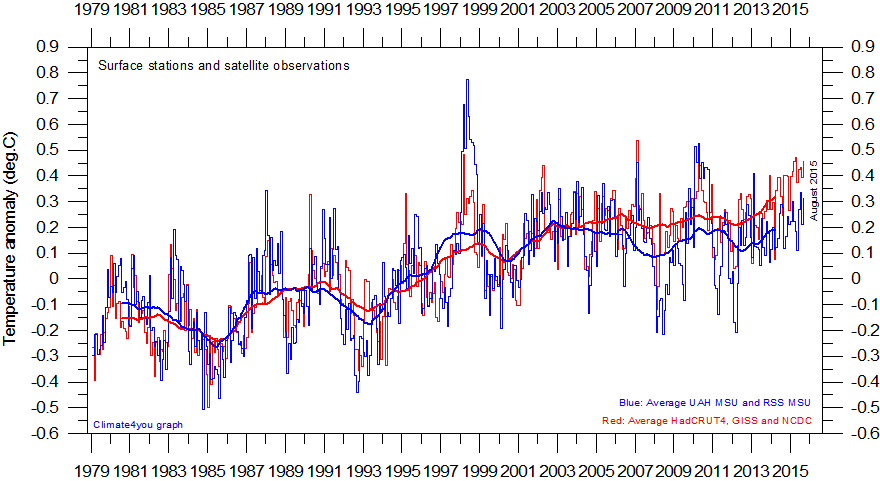
Statistical analysis of the raw data on Global Warming suffers from two major pitfalls :-
1. You are looking at the combined effects from several causative sources. Unless you have the means to distinguish the various factors, you cannot apply statistical techniques to the data and expect to get anything truly meaningful out. All that can be said, at best, is, “The Globe. Still Warming.”, as the warming trend over a long enough period of time has managed to stand out over the short-term variations.
2. Looking at the data purely by eye, some of the warming or cooling effects are clearly short-term, others longer-term; so picking a range of years/months/seasons at random, or according to some bias, is likely to distort the analysis. This is known as “cherry-picking”. The results of cherry-picking include the fallacious and discredited claim that, “Global Warming stopped in 1998”, or the much more crafty and misleading, “There has been no statistically significant Global Warming since 1998”.
Some researchers are content just to point to the overall effect of the raw data – global temperatures on land and at sea are rising sharply and the charts should be sufficient to understand the basic problem.
However, some people still contest that Global Warming is taking place, or that if it is, it isn’t serious. This then, is the cue to do an in-depth analysis into the known factors in global temperatures, and to attempt to “deduct” obvious short-term warming and cooling features in order to eyeball the underlying trends :-
Over at Science Mag, Richard A. Kerr is trying to tell us not to panic, everything’s going to be OK, really, with a “more balanced message”. The net effect on me, personally, is to be exceptionally, yet rationally, very concerned indeed :-
“Science 6 August 2010: Vol. 329. no. 5992, pp. 620 – 621 : DOI: 10.1126/science.329.5992.620 : NEWS FOCUS : CLIMATE CHANGE: ‘Arctic Armageddon’ Needs More Science, Less Hype : Richard A. Kerr : Methane is a powerful greenhouse gas 25 times [23 times, Richard] more potent than carbon dioxide, and the ongoing global warming driven by carbon dioxide will inevitably force it out of its frozen reservoirs and into the atmosphere to amplify the warming. Such an amplifying feedback may have operated in the past, with devastating effects. If the modern version is anything like past episodes, two scientists warned earlier this year, it could mean that “far from the Arctic, crops could fail and nations crumble.” Yet, with bubbles of methane streaming from the warming Arctic sea floor and deteriorating permafrost, many scientists are trying to send a more balanced message. The threat of global warming amplifying itself by triggering massive methane releases is real and may already be under way, providing plenty of fodder for scary headlines. But what researchers understand about the threat points to a less malevolent, more protracted process.”
Deliberately toning down a warning is something that piques my propaganda radar. This is a prime case of “hiding the incline”…
“Pakistan floods: Climate change experts say global warming could be the cause : The world weather crisis that is causing floods in Pakistan, wildfires in Russia and landslides in China is evidence that global warming predictions are correct, according to climate change experts. : By Louise Gray, Environment Correspondent : Published: 10 Aug 2010 : Almost 14 million people have been affected by the torrential rains in Pakistan, making it a more serious humanitarian disaster than the South Asian tsunami and recent earthquakes in Kashmir and Haiti combined. The disaster was driven by a ‘supercharged jet stream’ that has also caused floods in China and a prolonged heatwave in Russia. It comes after flash floods in France and Eastern Europe killed more than 30 people over the summer. Experts from the United Nations (UN) and universities around the world said the recent “extreme weather events” prove global warming is already happening. Jean-Pascal van Ypersele, vice-president of the body set up by the UN to monitor global warming, the Intergovernmental Panel on Climate Change (IPCC), said the ‘dramatic’ weather patterns are consistent with changes in the climate caused by mankind. “These are events which reproduce and intensify in a climate disturbed by greenhouse gas pollution,” he said. “Extreme events are one of the ways in which climatic changes become dramatically visible.”…”
[ YouTube Credit : The link to the video above comes thanks to the endeavours of that most fair and balanced individual James “no net global warming since 1998” Delingpole. “No net global warming since 1998” ? James ! You’re quoting Pat Michaels, but did he perhaps make that up ? Or was it something that Christopher Monckton might have made up ? ]
The BBC puts the blame on Climate Change – almost – in a report on the Russian heatwave-wildfire disaster.
But they just can’t bring themselves to admit it as an organisation – and put the claims into the mouths of others – using quotation marks in the headline (‘partly to blame’) and ascribing the opinion to “researchers”, the “UK Met Office” and “experts” :-
“10 August 2010 : Climate change ‘partly to blame’ for sweltering Moscow : By Katia Moskvitch : Science reporter, BBC News : Global climate change is partly to blame for the abnormally hot and dry weather in Moscow, cloaked in a haze of smoke from wildfires, say researchers. The UK Met Office said there are likely to be more extreme high temperatures in the future. Experts from the environmental group WWF Russia have also linked climate change and hot weather to raging wildfires around the Russian capital. Meteorologists say severe conditions may linger for several more days…”
Well, I’ve got a bit of a question to pose – it might not be possible to ascribe the current weather conditions in Russia (and Pakistan and China and and and…) to Climate Change, statistically. I mean no one weather event can be said to have been caused 100% by Climate Change. But would these extreme weather events have happened without Climate Change ?
That is by far the most important question to ask, and Michael Tobis does just that :-
“…Are the current events in Russia “because of” “global warming”? To put the question in slightly more formal terms, are we now looking at something that is no longer a “loading the dice” situation but is a “this would, practically certainly, not have happened without human interference” situation? Can we phrase it more formally? “Is the average time between persistent anomalies on this scale anywhere on earth in the undisturbed holocene climate much greater than a human lifetime?” In other words, is this so weird we would NEVER expect to see it at all?…”
One of the worst ideas that anybody has ever had is to pull heaps of toxic chemicals out of the ground and spread them over the surface of one of the few countries that will remain habitable after the onset of deep Climate Change.
If the Global Warming doesn’t get you, then the mercury from the Tars Sands tailing ponds sure will !
“Oil sands toxins growing rapidly : Nathan VanderKlippe : Published on Monday, Aug. 09, 2010 : Canada’s oil sands mining operations produce vast and fast-growing quantities of deadly substances, including mercury, heavy metals and arsenic, new data released by Environment Canada shows. The information on pollutants sheds new light on the environmental toll exacted by Canada’s bid to extract oil from bitumen, showing in stark relief how many nasty substances are being laid on the northern Alberta landscape in the process – and how quickly those are growing. In the past four years, the volume of arsenic and lead produced and deposited in tailings ponds by the country’s bitumen mines – run by Syncrude Canada Ltd., Suncor Energy Inc., Canadian Natural Resources Ltd. and Royal Dutch Shell PLC – has increased by 26 per cent. Quantities of some other substances have increased at even faster rates. The companies also released huge amounts of pollutants into the air last year, including 70,658 tonnes of volatile organic compounds, which can damage the function of human organs and nervous systems, and 111,661 tonnes of sulphur dioxide, a key contributor to acid rain…The numbers “are just ridiculously huge,” said Justin Duncan, a staff lawyer with Ecojustice…”
Unconventional fossil fuels are just such a liability – using up precious freshwater resources and depositing toxic waste just about everywhere.
Shale Gas (or Gas Shale) operations are reported to be polluting underground water tables. Now, that’s a clever thing !
“EPA moves NY drilling hearing, expecting crowds : By MARY ESCH : ALBANY, N.Y. : In anticipation of as many as 8,000 people at a public hearing on natural gas drilling, the Environmental Protection Agency announced Monday that it was moving it from Binghamton University to a Syracuse convention center 65 miles north. The hearing is the fourth and last by the EPA around the country to get public comment on its study of hydraulic fracturing of natural gas wells. Critics say the technology, which blasts chemical-laced water into the earth, could poison water supplies. The industry says it’s been used safely for decades. The EPA said 300 people have signed up to speak at Thursday’s sessions and 1,200 are expected to attend…Advancements in horizontal drilling and hydraulic fracturing, or fracking, significantly increased yield from shale gas wells and led to the current natural gas boom, starting with the Barnett Shale in Texas. The technology has drawn intense scrutiny since the focus of gas drilling companies has shifted in recent years to the Marcellus Shale, a massive rock formation underlying New York, Pennsylvania, Ohio and West Virginia. Environmental groups, residents and civic leaders fear potential contamination of watersheds in the densely populated region if fracking isn’t more tightly regulated. Fracking was exempted from the Safe Drinking Water Act in 2005 after an earlier EPA study declared fracking wasn’t a threat to water supplies. That study has since been criticized as flawed. The new EPA study, to be completed in 2013, could lead to new federal regulations. However, the industry says state regulation is sufficient and has worked well…”