Ed Miliband, leader of the British Labour Party, addressed the pre-party conference cameras in uncustomary casual attire, shelving his favourite suit, dazzlingly shiny tie and white shirt, you know, the one with the fat turned-over cuffs.
He sought to assure the nation that his one man mission is to relieve the financial pressure on the hardworking “squeezed middle” – fighting their corner against the profiteering railway companies and the moneygrabbing energy companies.
The little snippet of BBC TV News 24 that I saw cut to the correspondent raising doubts about whether this cost-of-living protection strategy would have any impact on the wider economy – whether measures to control transport fares and energy bills would create economic growth.
What does this little word “growth” mean to the BBC TV reporter, I asked myself. Does he think it means increasing employment, increasing incomes ? And how could employment be increased ? By increasing the “consumption” of goods, energy, water, transportation and knowledge economy services ? And how can this “aggregate demand” consumption be increased, if unemployment remains high and incomes remain stagnant ?
Allowing the utility and transportation companies to raise their prices allows them to remain profitable and build their businesses, presumably creating employment as well as giving a return to investors – those who have their savings in pension funds – where the fund managers invest in energy and transport. Why not allow energy and transport prices to rise ? People can learn to spend more on these valuable services, surely ? Pensioners will have their funds protected, and energy and transport businesses will stay profitable, paying tax into the state.
Browsing at a newsagent on a mainline railway station…
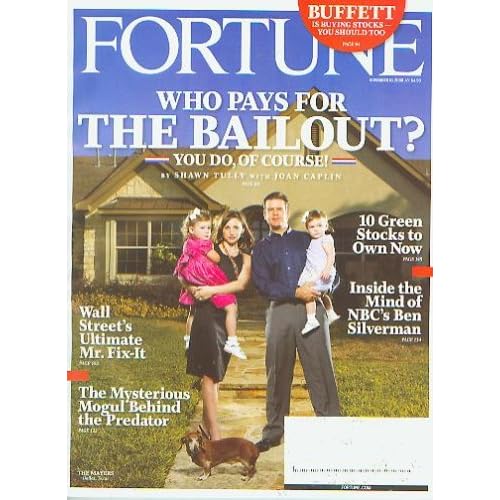
The question on the front cover of Fortune magazine, Europe edition Number 20, November 2008, already on the stands is “Who Pays for The Bailout ? You do, of course”. Of course, as this Credit Crunch means Bailout argument plays out, the issue of Energy and Climate Change is lost. But the question should be all about how to create a new green economy. Who pays for the re-powering ?
A sign of the greening times – another story teaser on the Fortune magazine advises “10 Green Stocks to Own Now”, and the front of the Independent on Sunday quotes Obama claiming that Energy is his “number one priority” in his bid for presidential election, with his “Apollo” project :-
“Obama’s green jobs revolution : Democrat will lead effort to curb world’s dependence on oil; Plans to create five million new posts in clean energy projects : By Geoffrey Lean in San Francisco and Leonard Doyle in Washington : Sunday, 2 November 2008 : Obama has pledged to create five million new ‘green collar jobs’ if elected : Barack Obama is promising a $150 billion “Apollo project” to bring jobs and energy security to the US through a new alternative energy economy, if his final push for votes brings victory in the presidential election on Tuesday. “That’s going to be my number one priority when I get into office,” Mr Obama has said of his “green recovery” plans. Making his arguments in a radio address yesterday, the Democratic favourite promised: “If you give me your vote on Tuesday, we won’t just win this election. Together, we will change this country and change the world.”…”
“Gulf petrodollars help UK go green : Brown calls for Saudis to give more cash to IMF : Gaby Hinsliff, political editor : The Observer, Sunday 2 November 2008 : The fight against climate change will get an unexpected boost today from oil-rich Gulf states which will pledge to invest some of their petrodollar profits in British green energy projects. The surging oil price over the past year has left parts of the Middle East awash with cash as the rest of the world is squeezed by the credit crunch, making Arab royals some of the few active investors worldwide. The Gulf states have enjoyed a $1.4 trillion windfall from higher oil prices since 2003. Ed Miliband, the Climate Change Secretary, arrived in Saudi Arabia yesterday with Gordon Brown at the start of a tour of the region. He said some of that cash would now ‘help our firms reap the rewards from going low carbon and providing green energy to thousands of families’ under a so-called ‘green Gulf deal’ to be announced today…”
“Gordon Brown in the Middle East : Brown hopeful of Saudi cash for IMF : Allegra Stratton in Riyadh, guardian.co.uk, Sunday 2 November 2008 15.30 GMT : Gordon Brown said today he was hopeful of success in his attempts to persuade dollar-rich Gulf states to prop up ailing national economies through a massive injection of capital into the International Monetary Fund (IMF). The prime minister spent three hours in one-to-one talks with Saudi Arabia’s King Abdullah, trying to persuade the monarch to invest in a revamped IMF. On the first leg of a four-day visit to the Middle East, and aiming to secure hundreds of billions of dollars for the fund, Brown called off a planned dinner with business leaders accompanying him so as to allow maximum negotiating time with the Saudi king. The IMF currently has around $250 billion in its emergency reserves but there are fears that, with Hungary, Iceland and Ukraine having already sought assistance and more nations expected to follow, the sum might not be sufficient. Brown hopes to persuade Gulf leaders to use some of the estimated $1 trillion they have made from high oil prices in the last few years to boost the reserves, indicating that he would like to see the current sum increased by “hundreds of billions” of dollars. The prime minister said following the talks that he was hopeful of having secured Saudi backing…”
“…Brown, who is accompanied by a high-level trade delegation seeking Gulf investment, including the CEOs of BP and Shell…”
What on earth are BP (formerly British Petroleum) and (Royal Dutch) Shell doing in a delegation to the Arab states begging for the IMF charity fund and green energy investment ? Is it that BP and Shell won’t pay for green energy and it’s too hard to ask the British people to pay extra tax, so they’re coming to the Arab countries for a green energy bail-in ? What is going on here ? If OPEC countries are all in the “Axis of Evil”, and no foreign oil and gas companies can get a toehold, why are BP and Shell in the government delegation to Saudi ?
Paying for new energy systems can be expensive. The European Union Emisssions Trading Scheme is saying they want 100% of carbon emissions auctioned by 2013 to pay for larger projects – Carbon Capture and Storage and new Nuclear Power. However, the costly deadweight “white elephant in the room” is not nuclear power, but dead wells.
Are they all talking about Peak Oil in the OPEC Gulf, and proposing business opportunities to the King of the House of Saud to offset the Middle East’s future total loss of business as the wells empty – offering them compensation in the form of green investment deals ? Asking the Saudis to join the green energy race now and get ahead ?
BP and Shell have benefited from the recent rise in the price of oil, profiting even as the oil price has hit millions and created impoverishment. But they’re going to have to spend a very large amount on exploration for new oil and gas from now on. So why is there still resistance to spending more on renewables ? Can BP and Shell ever be convinced to go green ? Would a barrel load of toxic news work ? No. BP and Shell can’t pay for green energy because they have to maintain the profits of their shareholders. Pensions are going to be bad enough without forcing major “British” oil companies to pay for such things as bioethanol, algae biodiesel, solar panels and wind farms.
Action to tackle climate change must be a “tight shadow” on Peak Oil and its fall – tighter than the 9.1% depletion of the largest wells projected by the International Energy Agency (IEA) To reverse the oil decline, and more so to take action on climate change, investment is required. Banks are becoming owned by oil-rich nations, but this is simply a natural outcome of poor financial regulation that led to the Credit Crunch. However, it doesn’t mean that the future will be oil and gas necessarily. This new layer of ownership of financial bodies is not significant, as it will not seriously impact the greening of energy, if people are serious about it.
What is of value here is not banking but energy itself, which underpins the entire economy. The scenario is this : Saudi Arabia will not admit in public that it’s going down because of “Peak Oil”. They would prefer to keep up the revenue, but they’re not “engineering” a reduction of supply. It’s reducing anyway.
From their perspective, allowing supplies to weaken, by not doing any new investment into raising production, would be protecting their reserves to sell in future. A good strategy – even more so as prices rise against losses of supply but strong demand (even despite the blooming recession).
I figure that what BP and Shell are doing in the Middle East is making the case to the major oil-producing states to keep on pumping.
I guess that what Gordon Brown is doing is making the Saudis an offer they can’t refuse – either the major western states will implement measures to control oil prices which would make OPEC lose revenue, or the Saudis can underwrite the global bailout.
This mission is not about green energy investment. It’s about keeping the oil flowing.
Intelligent commentators, authors and policy people are often suspicious of campaign groups. At the back of their minds they are drawing on a cultural discourse, primarily conducted in the media, that equates campaigners with mini-Hitlers – spreading disinformation and cult behaviour.
It is true that – as Mein Kampf reveals – the National Socialists in Germany used the latest communications tools to coerce and channel the energy of democracy towards their goals.
Some of the Nazi ambition was for democratic engagement, involvement in the process of rebuilding the country. Yet some of the methods were perverse, and caused an inexorable descent into the abuse of power.
When people like Mark Lynas accuse Greenpeace and other green campaign organisations of failings, there is any underlying theme – accusations of manipulation – both of facts and people. The sub-text harks back to the combat against fascism and Nazism in Europe.
We’re never going to make any progress on climate change if those advocating for energy change are equated to early 20th Century dictators and totalitarians.
Energy is a Social Good
I recently wrote an essay called “Energy for Democracy” making a first attempt at connecting the dots on grassroots democratic mobilisation and energy change. The subject set was in the field of “Environmental Communication”, and so I went back and looked at the development of mass media, advertising and public persuasion. I then went on to think about how propaganda and governance are interrelated. And I also looked at philosophy, and politics. I looked at the early 20th Century ideological splits in Europe, and the part that industrial development played. I looked at how democratic and other forms of socialism dealt with the problem of energy.
I posited that, since energy is produced for the Common Good, it should be subject to democratic management. I found myself “channelling” the spirit of Ramsay Macdonald, and going back to the questions of society and the integration of new industries that were pervasive before the two so-called “World Wars”.
Energy Of A Similar Wavelength
And today I find this very theme picked up by Ulrich Beck in The Guardian newspaper, along with the expression “energy change”, which is a term I am using increasingly to encapsulate the pivotal and essential response to climate change :-
“Germany is right to opt out of nuclear”, he headlines, “The rejection of nuclear power is a result not of German angst but of economic thinking. We must invest in renewable energy”.
I was gladdened when he stepped from economics to democratics :-
“…Ultimately, the rejection of nuclear is not a result of German angst but of economic thinking. In the long run, nuclear power will become more expensive, while renewable energy will become cheaper. But the key point is that those who continue to leave all options open will not invest…People everywhere are proclaiming and mourning the death of politics. Paradoxically, the cultural perception of the danger may well usher in the very opposite: the end of the end of politics…what is denounced by many as a hysterical over-reaction to the “risks” of nuclear energy is in fact a vital step towards ensuring that a turning point in energy generation becomes a step towards greater democracy…The novel coalition between the state and social movements of the kind we currently see at work in Germany now has a historic opportunity. Even in terms of power politics, this change of policy makes sense…”
The British are stumbling towards democracy, too, but they keep tripping over old divisiveness, and create new divisions too, just to complicate matters.
People Power – Not Potty Nor Puny
The Climate Camp has just been a baby step on the pathway to democratic movement on energy. Camping in coal trucks and dropping banners from power station cooling stacks has been a sign that democracy has been ailing – if there were genuine engagement between the governments, private enterprises and “campaign” groups over the future scenarios for energy, then people wouldn’t need to camp outside banks and coal-fired power plants.
As a consumer of mainstream media, all you see is the blockade of a Biofuel refinery, or people gluing themselves to the entrance of the Royal Bank of Scotland, or the occupation of a plant nursery at the site of a proposed runway. If you think “what a ramshackle bunch of unwashed hippies, straining the last of their voices, railing at the State, in a vain attempt to roll back the tide of industry, progress and Thorium reactors”, then you haven’t understood the bigger picture.
People want to be engaged in the decisions made about energy in this country – properly engaged. People want to use their knowledge to influence decisions. If the only means they have of expressing their democratic will and their opposition to hydraulic fracturing is to D-lock themselves to Shale Gas drilling equipment, then perhaps they might just do that. This might happen in Poland too. The alternative would be a proper discussion between the people groups and the governments. Where’s the European Union environmental legislature while all of this is happening ? Shale Gas could destroy Poland.
Energy Collectives – Expressing Collective Democratic Will
Groups like Fair Pensions are building momentum between people groups and investing institutions – raising the flag for clean energy. This isn’t about fighting – let’s drop the battlefield language, including that word “campaign”, which is so often used in a derogatory, dismissive, belittling way. This is about getting people working together on a new, sustainable future, and it requires all the righteous anger rising up to be channelled into a positive, productive movement, fully expressing the will of the people.
Consultations and placard-waving demonstration protests are not the way forward – we need energy change, and that’s going to require a whole lot more democratic energy. People don’t want dirty energy, and they don’t want nuclear power. Dirty energy should be asked to leave the building, nicely, politely. Firm but fair.
Group Thinking – Democratic Intelligence
Investment in renewable and sustainable energy is creating long-lasting assets for the UK and other countries. We don’t need and we don’t want dirty, radioactive energy any more. A thousand cheers for German democracy !
I was encouraged to take in the audiovisual presentation of “All Watched Over by Machines of Loving Grace”, wherein Adam Curtis demonstrates what appears to be a lack of understanding regarding failure in the financial markets. Most foundational year ecologists can tell you that systems are self-correcting, that virtual bubbles get popped, that hubris gets torn down, that over-population gets underfed. Rabbits and foxes. Owls and mice. George Monbiot’s “War On Slugs” because of missing hedgehogs and thrushes. It all depends on the natural resources available to feed the participants in the game. The global economy can only accelerate growth so much before it implodes. There are Limits to Growth. Curtis could be said to be expressing his suspicions that the fake “Knowledge Economy”, the Asian “Shock Doctrine” and the Property Crash were an artefact of a secret evil cabal formed from the vaguely impressed followers of Ayn Rand – but the rest of us all know that’s silly. She was a lovely, sensitive, principled woman, although she could have done with a little more kindness in her life to inspire altruism in her worldview.
I found this excellent little CATO Institute debate somewhere in my Twitter stream, and I watched the whole of it, despite the annoying accents and speaking styles of the speakers, and the insider economics references to Pigou and Coase (they’re only theorems, you know).
I thought that Kate Gordon made some excellent rebuttals to Andrew Morriss’ whining, pedantic free marketeering, and I was with her right up until the last few frames when she said that the Center for American Progress, of course, supports a carbon tax, as this is, of course, the best way to prevent Carbon Dioxide emissions.
Such disappointment ! To find that somebody so intelligent cannot see the limitations of carbon pricing is a real let down. I tend to find that American “progressives” on the whole are rather wedded to this notion of environmental taxation, “internalising the externalities” – adding the damages from industrial activities into the cost of the industrial products. I do not see any analysis of the serious flaws in this idea. Just what are they drinking ? What’s in the Kool-Aid ?
[ 02 JUNE 2011 : THIS POST HAS ALWAYS AND WILL ALWAYS FULLY RESPECT BP COMPANY CONFIDENTIALITY, AND HAS NOT AND WILL NOT INCLUDE THE REPRODUCED TEXT CONTENT OF E-MAILS FROM BP, ARISING FROM AN E-MAIL EXCHANGE WTIH JOABBESS.COM. NOTWITHSTANDING THIS CLEAR ATTEMPT ON THE PART OF JOABBESS.COM TO CONSERVE THE FULNESS AND THE ESSENCE OF COMPANY CONDIENTIALITY, IT HAS BEEN DRAWN TO THE ATTENTION OF JOABBESS.COM THAT EVEN JUST MENTIONING THE NAME OF THE CORRESPONDENT AND THE DATES OF THE EXCHANGE MAY TECHNICALLY CONSTITUTE A BREACH OF BP COMPANY CONFIDENTIALITY. SO, TO ENSURE THAT NO ACCUSATION OR COMPLAINT OF BREACH OF COMPANY CONFIDENTIALITY COULD EVER BE MADE, AND TO ENSURE THE PROTECTION OF THE CORRESPONDENT, THE NAME OF THE CORRESPONDENT AND THE DATES OF THE EXCHANGE HAVE BEEN REDACTED AND REMOVED AS OF TODAY. IT CAN STILL BE DEDUCED FROM THIS POST THAT AN E-MAIL EXCHANGE TOOK PLACE. THAT FACT, I THINK, IS NOT COMPANY CONFIDENTIAL, ALTHOUGH I EXPECT BP ARE WITHIN THEIR RIGHTS TO TELL ME IF THEY BELIEVE OTHERWISE, AND OPEN UP A PERSON TO PERSON CONVERSATION ABOUT THE BEST COURSE OF ACTION. THEY KNOW MY TELEPHONE NUMBER. IT’S AT THE TOP OF THE POST. WHERE IT’S ALWAYS BEEN. ]
From: jo abbess
To: XXXXXXXXXXXXXXXXXXXXXXXXXX, BP
Date: XXXXXXXXXXXXXXXXXXXXXXX
Dear XXXXXXXXXXXXXXXXXXXXXXX,
Thank you for your time on the phone earlier this week.
Last year in February, I was part of a small group of students that were grateful to have the benefit of an interview with XXXXXXXXXXXXXXXXXXXXX at BP, then XXXXXXXXXXXXXXXXXXXXXXXXXXXX.
I am taking my research into the energy sector further for my MSc dissertation, and I would be grateful if I could have an interview with somebody in an engineering department who has an overview of the energy sector.
It doesn’t need to be a face to face interview, as I am quite willing to telephone people. It only needs to be 20 minutes in duration.
I have prepared a short list of open questions that I am considering would be suitable for my enquiry into the future of energy resources and technologies (see below).
I hope that you can point me in the direction of somebody within BP who would like to offer their thoughts.
Thank you.
…
Questions with a UK focus
1. What do you think have been the best developments in the energy sector in the last 20 years ?
(What do you think are the most significant developments in the energy sector in the last 20 years ?)
2. What positive or negative changes in energy production and supply will take place over the next 2 decades ?
(What do you think will be the most important developments in the energy sector in the next 20 years ?)
3. Which energy resources and technologies look the most troubled ?
4. Which energy resources and technologies look the most promising ?
5. Does the UK face an energy supply gap ? Can we keep the lights on ?
From: jo abbess
To: XXXXXXXXXXXXXXXXXXXXXXXXXXXXXXX
Date: XXXXXXXXXXXXXXXXXXXXXx
Hi XXXXXXXXXXXXXXXXXXXXXXXXXXXXXX,
Thank you for your helpful reply.
What I am trying to achieve is a real conversation with somebody within BP who has a general overview of the energy industry – sadly, the annual Statistical Review and company report do not answer the scoping questions I have.
I am offering an opportunity for BP to voice a vision, on record, of how the company intend to navigate future change, using parameters that are not generally the basis of shareholder reports.
I am sure that somebody in the organisation has a view on the onset of Peak Oil and Peak Natural Gas – from conventional resources, and that there must be aims and objectives for BP to manage this issue.
I am convinced that BP has planned for a range of policy scenarios concerning climate change – both mitigation and adaptation measures.
I am also sure that somebody in BP has a plan for navigating political problems, such as the probability of continued unrest in the Middle East, with the accompanying likelihood of compromised oil and gas production.
In addition, I am sure that somebody from BP can speak on the company’s behalf about how it will deal with the threats of economic turbulence and still be able to meet the needs of shareholders.
Some sample questions that could take in part of this landscape :-
1. Do you think that we are heading for a period of global energy insecurity ? What are the factors that could cause this ? What are the timelines ? Who are the key players ?
2. What is aiding or blocking the transition from fossil fuels to clean energy ? What technologies look promising ? What technologies are stuck in the lab ?
3.. How do you think we will manage the transition to clean energy ? How will the economic actors be able to diversify out of fossil fuels and still retain balance in the world markets – and not disappoint their investors ?
4. Do you think that people generally are aware of the issues of energy security ?
It would be excellent if you could find somebody to speak to these or similar questions in a short interview with me. I can do interviews by telephone at very low cost, and I would e-mail the transcript for verification before using in my research report.
My central question is “are we ready for energy change ?” – major transition in the resourcing and use of energy – and I am seeking a full range of opinion on that question.
If you could point me towards somebody who is willing and able to speak for 20 minutes on the phone on energy security issues, I would be highly grateful.
So, I’m sitting in my local cafe at lunchtime talking to my local property developer-landlord. So, I ask him, do you think there will be worsening economic conditions this year ? And will there be more unemployment ?
He takes a pretty dismal line – things are becoming more and more squeezed – landlords are finding that their properties are unoccupied, or the rents are being forced downwards, and there is no spare finance capacity to do renovations, the banks won’t lend, and there’s no certainty of being able to sell properties if the business becomes uneconomic. He’s had to sack people he was formerly able to employ.
PRESS RELEASE : TV ECO CHAPLAIN TUMBLES HOUSE OF CREDIT CARDS
The Revd Peter Owen-Jones, the whole nation’s media chaplain, will be sharing from the heart at a Green Christian London conference ‘End of the Age of Thorns’ on 5th March 2011.
He will be opening up about a new relationship with money, and how we can survive the credit, jobs and services crunch by digging for our spiritual roots.
In his BBC TV odyssey, Britain’s favourite vicar tried living without his cheque book in the series ‘How to live a simple life’, and travelled the world to peer into the human soul in the fascinating ‘Around the World in 80 Faiths’.
Now he comes back down to Earth in central London, bringing his unique, accessible style of presentation, to share the good news of life after moneymaking, in an all-day conference organised by Christian Ecology Link.
The programme for the ‘End of the Age of Thorns’ features a wide range of talks and workshops asking questions about the ecology of money and life after mass marketing. What are the green shoots nurturing a new economics? Is there prosperity without growth? And can society grow up and leave consumerism behind?
“Christians ought to be distinctive as consumers. Our shopping bags should reflect our values.” (Professor Tim Cooper)
Sustainability expert Professor Tim Cooper will lead a group learning the fundamentals of Green Economics; Ashley Ralston will guide a process looking at shopping as if the planet mattered; and Ruth Jarman will host a workshop on greening up the day-to-day life of church communities.
“The church needs to consider why its members so readily succumb to high street temptations despite clear Biblical warnings about materialism. We cannot expect Christians to be immune from the psychological and socio-cultural pressures that lead to excessive consumption.” (Professor Tim Cooper)
___________________________________________________________
END OF THE AGE OF THORNS : SURVIVING CONSUMERISM
Christian Ecology Link Conference: Saturday 5 March 2011, 11am to 5pm, St John’s Church, Waterloo Road, London SE1 8TY (opposite the entrance to Waterloo station)
Come and explore spiritual roots for a new economics, for our own humanity and all life on Earth. Engage with Peter Owen-Jones on a new relationship with money and how we can challenge the consumerist age we live in.
“Christians are not prepared to tolerate economic injustice, and work hard to make the system better. But there is an elephant in the room. We take endless economic growth of the system for granted. And we wonder why we are failing to stem the extinction of fifty species every day, greenhouse gas emissions are out of control, and our children have becomes pawns of the market. Economic growth has become a cancer on the earth, and an abuse of the image of God in us.” (CEL Chairman, Paul Bodenham)
“God did not create a world with infinite resources for humankind to plunder. He created a world with finite resources for us to nurture. Some people argue that technological advance will enable consumerism to persist. We would do well to note that God also created people with finite minds. Perhaps people will not work out solutions in time. What then? We must address people’s values, not just their minds.” (Professor Tim Cooper)
Peter Owen-Jones is a long-time supporter of CEL and a popular speaker. You will probably have seen at least one of his fascinating BBC TV series: ‘How to live a simple life’, ‘Around the World in 80 Faiths’, and ‘Extreme Pilgrim’.
He is a Church of England vicar in a parish near Lewes in East Sussex; writer of several books including Letters from an Extreme Pilgrim (2010) and Psalm: The World’s Finest Soul Poetry in a Contemporary Idiom (2009); and founder of the Arbory Trust, the first Christian woodland burial site.
Tim Cooper is Professor of Sustainable Design and Consumption at Nottingham Trent University, a founder member of CEL and former CEL Chairman. He is author of “Longer lasting products; alternatives to the throwaway society” (2010) and “Green Christianity” (1990).
Workshop details
“Green Economics” : Tim Cooper will run two different sessions combining input and discussion. Both sessions will be self-contained so you can go to both, or just one.
“Shopping as if the planet mattered” : Bring your own ideas to share, led by Ashley Ralston, CEL trustee and a director of Better Tomorrows.
“Greening the church in daily life” : Eco-congregations are not just for Sundays. They should give every member the chance to change their life. Come and discuss ideas and experiences that can help people start on a journey of a lifetime, including CEL’s ecocell programme, led by Ruth Jarman, CEL trustee and climate change campaigner.
“We should be no less distinctive in our consumption ethics as in our sexual ethics. Christianity is as much about showing distinctive love to third world suppliers by insisting on ‘fair trade’ goods as it is about showing distinctive love to our husbands and wives by being faithful.” (Professor Tim Cooper)
“Jesus was forthright about the ‘deceit of wealth’, and yet we’ve fallen for this one big time. There is an alternative, but like any therapy, the treatment will be painful. A lot of people want to be the place where that healing makes a start, but don’t know how. That is why we have launched ‘ecocell’, to bring people together to make a journey in discipleship to find freedom, for themselves, for society and, we hope, for the earth.” (CEL Chairman, Paul Bodenham)
Well, Mubarak’s made an exit – and real Egyptian democracy can begin – as long as the army don’t get crowd control ideas above their station and the old elites don’t interfere with the process of free and fair elections.
But democracy is not going to solve the problem of the price of bread.
“Food Speculation : What is the problem? : Banks, hedge funds and pension funds are betting on food prices in the financial markets, causing drastic price swings in staple foods such as wheat, maize and soy…”
“By now, you probably think your opinion of Goldman Sachs and its swarm of Wall Street allies has rock-bottomed at raw loathing. You’re wrong. There’s more. It turns out that the most destructive of all their recent acts has barely been discussed at all. Here’s the rest. This is the story of how some of the richest people in the world – Goldman, Deutsche Bank, the traders at Merrill Lynch, and more – have caused the starvation of some of the poorest people in the world. It starts with an apparent mystery. At the end of 2006, food prices across the world started to rise, suddenly and stratospherically. Within a year, the price of wheat had shot up by 80 per cent, maize by 90 per cent, rice by 320 per cent. In a global jolt of hunger, 200 million people – mostly children – couldn’t afford to get food any more, and sank into malnutrition or starvation. There were riots in more than 30 countries, and at least one government was violently overthrown. Then, in spring 2008, prices just as mysteriously fell back to their previous level…”
“The hedge fund guy sitting beside me was asked about his next plan for global domination. He’d done houses and gold – what was the new new thing? “Food,” he said between mouthfuls of lobster. “We’re piling into food. Weather’s getting weird, so there’ll be crop failures. There won’t be enough to go around.”…”
Many blessings for your newly-born democracy, Egypt, and we hope you can win the fight to secure affordable food, too.
Ambient, sustainable energy is all around us, and sooner or
later we will find the ways to make use of it for the good of all.
The following is an appropriately edited transcript of a
conversation on the Claverton Energy Research Group
forum online, and was written by Nick Balmer, a consultant
in renewable energy.
__________________________________________________________
…The huge scale of the possible changes for all concerned is
causing all of the current Titans in the [energy] industry to deploy
the full force of the media [and their] PR [public relations] in an
attempt to manipulate the public and policy towards their own way
of thinking, or in such a way as to protect their own vested interests.
The great thing is that these issues are being aired out in the open,
and groups like [Claverton Energy Research Group forum] allow
people with knowledge of these affairs to debate these issues openly.
The big problem is that each of us has only a very detailed
understanding of some small fraction of the total issue.
Most of the public and government only has a very slight knowledge
of the total issue, and has had only limited access to ways to find out
in detail what is going on.
As Egypt is demonstrating today, everybody now has a voice and as
Wikileaks shows, sooner or later everything will come out into the
open.
All of us are struggling to come to terms with this explosion of
access to knowledge.
It is quite clear that lots of bubbles are being burst as a result of
the Global Financial implosion and the huge expansion in available
knowledge.
Just as banking and property has been shown to be an unaffordable
Ponzi scheme and to be vastly over-inflated, UK energy policy is now
coming under huge scrutiny.
We can now compare our energy systems with other countries.
Due to the huge geological accident of fate, since the 1700’s in coal,
and 1970’s in oil and gas, we have been extremely fortunate in being
able to live way beyond the lifestyle standards of most of the World.
We have not had to adapt.
Other countries that didn’t have this advantage had to change over
recent decades.
Places like Denmark, Austria, Germany [and so on] have made huge
changes because they had less energy from fossil resources.
Now we have reached the peak or crunch point, we find ourselves well
behind those countries that had to adapt earlier.
Everybody is concentrating on the Capital cost of deploying per
MW [megawatt] and overlooks the cost of fuels.
The cost of fuels over time is massively more important than the
CAPEX [capital expenditure on investment].
So even if windfarms cost 20 times per MW or GW [gigawatt] more to
build than nuclear or coal or gas, in the scheme of things,
[wind power] is always going to win, because the fuel is free and
unlimited for centuries to come.
Similarly [solar power technologies], or even more effective,
household insulation and cutting energy use.
And yet the media and government are blinded by the barrage of PR
and media from the energy vested interests who are working with
every muscle to stop this coming out into the open.
I often meet financiers in my work trying to promote and support AD
[anaerobic digestion of biological waste for the production of
renewable methane], biomass, solar and wind projects.
I am always struggling to prove to them that I have an offtake [return
on investment] and the fuel supply. This is often really hard to do
[but] I only have to do this for seven to 12 years to make my business
cases stack up.
I was really depressed at the end of one such presentation and
discussion, when one broadly sympathetic banker who had turned me
down said that he was having even worse problems with largescale
energy projects.
How do you predict the price and supply of coal forward for 25 years
or more ?
It has jumped 17% in recent months.
How do you prove that you are going to have offtake for huge power
stations in future years ?
Demand dropped 8% in 2009.
How do you raise the equity or debt for a billion [pound] project when
banks don’t want to lend more than £30 million each ? Imagine how
many banks that would take ?
We have reached a tipping point in our economy, sustainability and
future outlook.
Yes, the existing mega-power companies are fighting as hard as
Mubarak today to hold onto power, but they represent the past just
as surely as he does.
Those companies can rejuvenate themselves, unlike the Egyptian
President.
If they don’t, there are an increasingly large number of smaller and
more active players coming into the market.
The average household pays somewhere around £1,300 a year for
its heating and lighting.
The companies that come forward with a way to do that for £1,000 is
going to capture the market very quickly.
I have friends in Austria who only pay 65 Euros for services that I
pay £1,400 for.
They do this through insulation, triple glazing, solar and biomass energy.
Most [UK] households have less than £400 per year discretionary
disposable income. This prevents them making changes to their houses
they desperately want and know they need to make. This can
drop their energy demands hugely.
If somebody can unlock that Gordian Knot the benefits would be
enormous as there are something like 27 million households.
At a time when household debt is at an all-time high, incomes are
shrinking, and 40% live on ether government salaries, state
pensions or benefits.
Energy is a very high part of these households’ outgoings – if you
pay £1,300 a year and your house only brings in £11,000 to £20,000
per year.
A 50% increase in the £1,300 could bring great distress, and
possibly even civil unrest here.
The increases fossil power [companies] need to make their systems
bankable will increase energy bills. This will feed straight through into
government liabilities because 40% of us live on government payouts.
If government can drop the cost of heating and lighting quite easily
by £100 to £500 per household per year while at the same time
provide employment for hundreds of thousands of White Van men
cutting energy uses, doesn’t this make far more sense than building
unsustainable power stations that will have to be [bankrolled] by the
government, who will then have to buy back electricity at a price our
communities cannot stand ?
Project a similar calculation onto transport fuels and you get even
greater problems.
At $80 a barrel [of oil] industry is shrinking and relatively few
renewable fuel business cases work. At $100 a barrel most renewable
fuels can compete.
At $120 a barrel almost any alternative beats oil, and that is before
you start to look at issues like fuel security and the environment.
Although the battle is one of David and Goliath, or the Dinosaur and
those early mammals, between the new energy industries and the
existing vested energy industries, [it] has only one outcome.
It is only a matter of the co-lateral damage along the way.
Like Mubarak, it is clear they must go. Are they going to go
gracefully, or are they going to smash the place up first ?
The documentary evidence shows that America’s business interests often outweigh its political progress. Yet it’s perhaps more concerning that, increasingly, corporate America is at risk of damaging good environmental governance.
With all the talk of free markets in international trade, the Coalition Government in the United Kingdom has felt the pressure to open up the back door to American energy businesses, whose highly-paid sales representatives in slick suits want us to buy their dirty energy projects – just take a look at the upcoming UK Energy Bill and its proposals for Electricity Market Reform.
American companies seem poised to sweep in and take all our public non-subsidy “support” for building new nuclear power plants. Viewers of a sensitive political disposition should look away now as this is a Wikileak :-
The country that brought you the engineering industry that brought you the giant Gulf of Mexico giant oil spill now wants to bring you unsafe deepwater drilling in Britain’s Continental Shelf – and the UK’s new Energy Bill would let them do that without demonstrating any learning from the BP April 2010 fiasco :-
There’s lots of talk in the energy sector and the financial markets about the American shale gas miracle “gamechanger” and how it can be replicated in Europe and across the world, and not enough discussion about the environmental dangers :-
It’s good to talk about local environmental damage from “unconventional” gas, but what’s not being discussed so widely is that these “new” resources of Natural Gas aren’t really very green, and neither are the “traditional” resources – in some cases they’re not much better than coal :-
We know that the Americans always seek to protect the interests of American-owned businesses – and we know they do that for the best of intentions – to keep America wealthy (except it’s really only a few people in America that have any wealth, but anyway…)
Yet I think there should be a limit to how far we have to bend over backwards to accommodate their needs for economic recovery.
To export all their dirty energy technology to Europe is just not helpful, and I think we should say no, no, no.
An unidentified group has taken advantage of all the turmoil in Egypt, gone undercover, and attacked a gas pipeline, which means that supplies to politically moderate Jordan (and the more hardline Syria) will be cut off.
Who planned this ? It’s probably too early to say, but I can think of several possible answers to the question, and none of them are pretty.
“Gas pipeline to Jordan, Syria set ablaze in Egypt…Unless the pipe is repaired quickly, it could become a big problem for Jordan, a country already spending heavily in fuel subsidies, a Jordanian senior official said….”
Creating a level playing field for Renewable Energy by removing Fossil Fuel subsidies is an excellent idea, as mooted by the International Energy Agency :-
“IEA reveals fossil fuel subsidies top $550bn : Report warns kick-backs for fossil fuels are skewing energy markets and holding back renewables investment : By Andrew Donoghue 08 June 2010 : The global fossil fuel industry currently enjoys subsidies worth more than $550bn (£382bn) a year, according to a major new report from the International Energy Agency (IEA) that will increase pressure on world leaders to phase out fossil fuel subsidies ahead of a crucial meeting of the G20 group of nations later this month. The research, which was released at a meeting of G20 finance ministers in Busan, South Korea over the weekend, reveals fossil fuel subsidies amounted to $557bn in 2008 – up from $342bn in 2007. Enormous subsidies are skewing energy markets and inhibiting the uptake of more sustainable energy sources, the IEA warned. “The IEA analysis highlights that the price signal from subsidy phase-out would provide an incentive to use energy more efficiently, and trigger switching from fossil fuels to other fuels that emit fewer GHGs,” the report said…”
“Fossil Fuel Subsidies Are 12 Times Support for Renewables, Study Shows : By Alex Morales – 29 July 2010 : Global subsidies for fossil fuels dwarf support given to renewable energy sources such as wind and solar power and biofuels, Bloomberg New Energy Finance said. Governments last year gave $43 billion to $46 billion of support to renewable energy through tax credits, guaranteed electricity prices known as feed-in tariffs and alternative energy credits, the London-based research group said today in a statement. That compares with the $557 billion that the International Energy Agency last month said was spent to subsidize fossil fuels in 2008. “One of the reasons the clean energy sector is starved of funding is because mainstream investors worry that renewable energy only works with direct government support,” said Michael Liebreich, chief executive of New Energy Finance. “This analysis shows that the global direct subsidy for fossil fuels is around ten times the subsidy for renewables.”…”
“G20 agrees on phase-out of fossil fuel subsidies : 25 September 2009 : The world’s largest economies agreed on Friday to phase out subsidies for oil and other carbon dioxide-spewing fossil fuels in the “medium term” as part of efforts to combat global warming. But Group of 20 leaders at a two-day summit meeting here did not advance discussions about financial aid for developing nations dealing with climate change, exacerbating concerns that U.N. talks to form a new climate pact are in peril. Some $300 billion a year is spent worldwide to subsidize fuel prices, boosting demand in many nations by keeping prices artificially low and, thus, leading to more emissions. The agreement — backed by all of the G20 including Russia, India and China — was a victory for U.S. President Barack Obama, whose credentials for fighting climate change have been marred by dimming prospects that the U.S. Senate will pass a bill to reduce emissions before the December U.N. meeting…”
Seems like it’s a done deal…apart from an issue that should never be forgotten in all global negotiations : economic development.
India, for example, has a policy to keep down the price of diesel fuel – a strategy to promote economic development. They won’t be ready to cut subsidies :-
“Diesel subsidy withdrawal unaffordable, says minister : 04 February 2011 : New Delhi: India cannot afford to withdraw the subsidy on diesel and it has to continue till poverty disappears from the country, union Minister for New and Renewable Energy Farooq Abdullah said on Friday. Speaking at the Delhi Sustainable Development Summit here, Abdullah said India gives a lot of subsidy on diesel and, if withdrawn, it will only increase inflation. ‘Diesel subsidy has to continue till poverty disappears from the country,’ he said while reacting to Canadian parliamentarian Stephane Dion’s appeal to phase out diesel subsidy…”
The Americans and the Europeans calling for an end to fossil fuel subsidies could be interpreted as a lever to block the economic development of the Global South – as much of the price-fixing is conducted by developing nations.
It could be argued that the United States and “her allies” want to retain economic dominance – what better way than blocking economic progress in the Global South and making it appear to be a Climate Change measure ?
In addition, much of the financial support for energy projects in the Global South is indirectly awarded to the fossil fuel industry via the international aid cash coming from developed nations and the international agencies. And the fossil fuel producers and engineering companies are not going to be willing to let that source of revenue dry up.
If international aid for energy projects gets stopped, so does a lot of economic development until “technology transfer” of Renewable Energy can be ramped up :-
Before they came to power in the United Kingdom, the Conservative Party were strongly behind the proposals to stop international development loans going on dirty energy projects :-
“23 November 2009 : Andrew Mitchell: Ending Labour’s support for polluting energy projects : …we must end the use of the Export Credit Guarantee Department to promote ‘dirty’ fossil fuel power stations around the world, and instead make it a champion of green technology…”
“Lord Green told: Britain’s exports must stop harming people and planet : 24 January 2011 : New report details string of ‘dodgy deals’ at export support body : As new Trade Minister Stephen Green embarks on a national tour to promote British exports, Jubilee Debt Campaign warns that Britain’s export support body is not up to the job : A report released by the organisation today exposes a history of backing projects by large corporations in a handful of controversial sectors. The projects have led to human rights abuses, environmental destruction and corruption in the developing world, and often failed to deliver even on their stated aims. Britain’s export promotion body, the Export Credits Guarantee Department (ECGD), has also undermined Britain’s international development goals by leaving countries like Kenya, Vietnam, Indonesia and Pakistan with £2 billion of debts from failed export deals – 96% of Third World Debt ‘owed’ to the UK today…The Coalition government has failed to act on its pledge to end fossil fuel subsidies through the ECGD, despite taking action to beef up the Department’s role…”
The key global development question remains – is cutting fossil fuel subsidies yet another (underhand) way of reducing international aid budgets ?
To deflect criticism, the spotlight will probably be turned on countries like Iran :-
“Getting the Prices Right – Cutting Subsidies Could Save Billions : 8 June 2010 : Global fossil fuel consumption subsidies in 2008 were much higher than previously estimated and totalled USD557 billion, according to IEA analysis…The IEA has undertaken an extensive survey to identify countries that offer subsidies that reduce prices of fossil fuels below levels that would prevail in an undistorted market, thus leading to higher levels of consumption than would occur in their absence. The survey identified 37 countries and it is estimated that these represent over 95% of global subsidized fossil‐fuel consumption…The IEA analysis has revealed that fossil fuel consumption subsidies amounted to $557 bn in 2008. This represents a big increase from $342 bn in 2007…Since 2008, a number of countries – including China, Russia, India and Indonesia – have made notable reforms to bring their domestic energy prices in line with world prices…The country with the highest subsidies in 2008 was Iran at $101 billion, or around a third of the country’s annual central budget. Chronic under‐pricing of domestic energy in Iran has resulted in enormous subsidies and a major burden on the economy that is forcing reliance on imports of refined products. Iran’s leadership came to agreement in 2010 on a sweeping plan for energy subsidy reform; however, steep economic, political and social hurdles will need to be overcome if Iran is to realize lasting reform…”
Obama says we have to drop fossil fuel subsidies. The next thing you know, the inaccuracies start flying :-
“Manchin claims coal “doesn’t get a penny of subsidies” : In fact, the industry gets trillions of pennies : 4 February 2011 : Senator Joe Manchin (D-WV), the newest member of the Senate Energy and Natural Resources Committee, claimed today that the coal industry doesn’t receive any government subsidies, unlike every other form of energy. Brad Johnson debunks this absurd claim…”
It’s not that developing countries and emerging economies are being picky. The problem lies with the United States of America, desperate to cling on to its geopolitical leverage :-
“U.S. Call to Preserve Copenhagen Accord Puts Climate Conference on Edge : By Stacy Feldman at SolveClimate : Mon Nov 29, 2010 : Many poor countries want to scrap the three-page Copenhagen agreement that the U.S. wants to preserve : CANCUN, MEXICO — The United States said Monday it would not back down on its plan to turn the unpopular Copenhagen Accord into a final global warming deal, setting the first day of already fragile UN climate talks in Cancun on edge. “What we’re seeking here in Cancun is a balanced package of decisions that would build on this agreement … [and] preserve the balance of the accord,” Jonathan Pershing, lead U.S. climate negotiator in Cancun, told reporters at the talks…”
“Cancún climate change summit: America plays tough : US adopts all-or-nothing position in Cancún, fuelling speculation of a walk-out if developing countries do not meet its demands : Suzanne Goldenberg, US environment correspondent, guardian.co.uk, Tuesday 30 November 2010 : America has adopted a tough all-or-nothing position at the Cancún climate change summit, fuelling speculation of a walk-out if developing countries do not meet its demands. At the opening of the talks at Cancún, the US climate negotiator, Jonathan Pershing, made clear America wanted a “balanced package” from the summit. That’s diplomatic speak for a deal that would couple the core issues for the developing world – agreement on climate finance, technology, deforestation – with US demands for emissions actions from emerging economies and a verifiable system of accounting for those cuts. In a briefing with foreign journalists in Washington, the chief climate envoy, Todd Stern, was blunt. “We’re either going to see progress across the range of issues or we’re not going to see much progress,” said Stern. “We’re not going to race forward on three issues and take a first step on other important ones. We’re going to have to get them all moving at a similar pace.” In the run-up to the Cancún talks, Stern has said repeatedly that America will not budge from its insistence that fast-emerging economies such as India and China commit to reducing emissions and to an inspection process that will verify those actions. The hard line – which some in Washington have seen as ritual diplomatic posturing – has fuelled speculation that the Obama administration could be prepared to walk out of the Cancún talks…”
An “inspection process” ? Agreeing to the same use of satellite snooping and the threat of the penalties of economic sanctions as applied to the fabled Iraqi weapons of mass destruction, and the current pincer on Iran ?
I can’t quite see China agreeing to that.
If we’re thinking about paranoia, who should be monitoring whom ?
The Clean Development Mechanism should have been more closely monitored, but it wasn’t, and it’s collapsed in a big pile – fake credits, false accreditation, poor success rate. Where has the verification process been, there ?
New schemes for “climate finance” will essentially involve creating debt for Climate Change mitigation and adaptation projects in developing and emerging economies. Why more debt ? To prop up the ailing industrialised economies. And allow the Bank sharks to feed.
And “technology transfer” ? That’s all about intellectual property rights – America owning all the rights, and China and India and so on owning nothing, of course. What great technologies have parasitical American companies been keeping hidden away up their sleeves to sell to the Chinese under a Climate deal ? Or are they just rubbish deals, like expensive and untested Carbon Capture and Storage ?
“Deforestation” ? Virtually all proposed schemes under the REDD banner (Reduced Emissions from Deforestation and Forest Degradation) include an element of emissions trading – just the kind of offsetting that large, dirty American companies want to buy to justify carrying on with Business As Usual. Protecting the rainforests ? Nah – just finding another way to make money for the Carbon Traders, and protect the Oil, Gas and Coal industries of the industrialised regions.
What is needed is for the industrialised nations to commit to domestic emissions reductions, not continued attempts to coerce other countries to make cuts that can be traded.
Nobody has learned anything in the last year. The same ridiculous non-options are on the table, and nobody’s biting.
The United Nations have gathered in Cancun, Mexico, for the annual Climate Change negotiations. It’s only the first day, but already the talk is of compromise :-
“Cancún hears call for ‘tapestry of compromise’ : By Fiona Harvey in London : November 29 2010 : Governments meeting to negotiate an agreement on global warming this week must learn to compromise, the UN’s top official on climate change said. Christiana Figueres told the opening meeting of the talks, being held in Cancún, Mexico, that only through giving up entrenched positions could countries at the talks hope to find common ground. “A tapestry with holes will not work,” she told officials from more than 180 countries. “The holes can only be filled with compromise.” … For the UN, therefore, Cancún is a test of its ability to carry forward the negotiations, which have been taking place for two decades. Officials are also hoping to make progress on vital issues – such as financial assistance for poor countries to cut their emissions and adapt to the effects of global warming – and a possible deal on preserving the world’s forests…”
Hmm. Let’s take a quick look at what these two highlighted proposals are :-
1. “…financial assistance for poor countries to cut their emissions…”
This is being worked up in a bunch of vehicles, including the initiative that David Cameron writes so emotionally about, the Capital Markets Climate Initiative :-
“Use the profit motive to fight climate change : The prime minister argues that there are huge gains to be made from a green economy : David Cameron, The Observer, Sunday 28 November 2010 : …I passionately believe that by recasting the argument for action on climate change away from the language of threats and punishments and into positive, profit-making terms, we can have a much wider impact. That’s why this government has set up the Capital Markets Climate Initiative – to help trigger a new wave of green investment in emerging economies and make the City of London the global capital of the fast-growing green investment sector…”
So, it’s not donations, or even grants or other forms of aid – it’s debt – debt that’s no longer possible to create in the Credit Crunched developed nations.
It’s probably not quite what Nicholas Stern was thinking of when he said that $100 billion needs to be made available to the Global South in the next decade for Adaptation to Climate Change.
It’s certainly not the redistribution of global wealth that the rightwingers fear from the great “eco-socialist conspiracy”.
It’s an attempt to shore up the corroding economies of the Global North by putting the Global South into further debt.
Score : 0 out of 20.
2. “…a possible deal on preserving the world’s forests…”
This is the policy proposal known as REDD – Reducing Emissions from Deforestation and Forest Degradation, which most people translate as meaning (a) cut down some of the forest for economic purposes in order to (b) protect the rest.
“Oil companies and banks will profit from UN forest protection scheme : Redd scheme designed to prevent deforestation but critics call it ‘privatisation’ of natural resources : John Vidal, environment editor, in Cancun, guardian.co.uk, Sunday 28 November 2010 : Some of the world’s largest oil, mining, car and gas corporations will make hundreds of millions of dollars from a UN-backed forest protection scheme, according to a new report from the Friends of the Earth International…”
Score : -40 out of a possible 20
With these kind of compromises on the table, do you think the Global South will be any more willing to sign onto any “Accord” any more than they were at Copenhagen ?
Unless and until corporate interests are removed from the United Nations Climate Change treaty, the world’s poorest, their habitats are our futures are being betrayed.
I learned about various views on social and positive impact investment, and about elements of the Coalition Government’s “Big Society” and the proposed Green Investment Bank.
Ethical Investment appears to have come a long way since I put some money into a Fair Trade company many moons ago, where I knew I would never see a dividend, or even be able to sell the shares at some point.
Grown up people in sharp suits and big name frocks now do moral banking, and often reap a healthy return on their investment – “doing well” as well as “doing good”, as Adam Ognall of UK Sustainable Investment and Finance says.
I was challenged to think about what faith communities do with their money around a month ago, all precipitated by a conversation I had with Martin Palmer of the Alliance of Conservation and Religions, and then I heard something at a recent meeting that caused me to investigate a little…
it was hoped that the Church of England investment portfolio would continue to be “cleaned up”. But there appears to be a long way to travel.
The Anglican Communion worldwide includes environmental protection as its “Fifth Mark of Mission”, and the Church of England is part of the international interfaith “seven year plans” :-
but the Church Commissioners report in the last year has confirmed that the Church of England still holds shares in companies such as BP, responsible for ecological devastation of the Gulf of Mexico :-
Groups such as the Alliance of Religions and Conservation, the Ecumenical Council for Corporate Responsibility and National Ethical Investment Week are all active in encouraging communities to put their money where their mouth is – and the faith communities have a very large amount to play with :-
With the launch of the Green Investment Bank – even though severely under-capitalised – there is a chance to tie up the questions to the answers.
If every consumer choice were a green choice, there would be no environmental problem. The only way to reach that point is for every contract, every stock and share, every procurement order, every transport vehicle, every energy source and every material resource to be green.
The choices that companies make in the business they conduct is based on the premise that people want what they sell so much they are prepared to invest directly in them as well as buy their products.
There are several levers for change here. Investment, such as pension funds, if moved in bulk, can have a de-securitisation effect on unsustainable business models. Not so much a “boycott” as a “landslide” of change.
The faith communities have already proved that they can change international commerce with the Fair Trade movement. Now it’s time for the Green Investment movement.
Scientists are proverbially poor at communication, but we will eventually be able to explain to you what is happening to the Earth in a way that you will understand.
You need to give some time to the data, to the arguments. You need to read the significant research papers, learn how to read graphs, learn the acronyms, abbreviations, technical terms.
You will need to be able to weigh in your mind the significance of probabilities, the risks of extremes, the trends, the changing patterns.
After a while, you will start to reappraise the evidence, and start looking into the data and see the conclusions for yourself.
You will begin to appreciate the strong line of reasoning, and come to be in awe of the minds of many who work on Climate Change.
I’ve become impressed by the body of scientific evidence, that’s why I will always be aligned with the Climate Change science community.
We’re not going anywhere. We’re here, and we’re right. There has already been significant change in the Earth’s climate due to humankind’s mining-to-burn activities, and the projections are for further, possibly very dangerous change.
The scientists know what the problems are, and what the engineering solutions are. Some companies/corporations, economists and politicans and sadly even some compromised “environmentalists” promote non-solutions like carbon pricing, Carbon Taxation, Carbon Trading, Carbon Capture (and Storage), GM Crops, Nuclear Power, geoengineering – but the academies of scientists are telling you they won’t work, or won’t solve all the problems.
What is needed is wholesale removal of Fossil Fuels from the global economy in order to prevent further deterioration and disruption in the global climatic conditions. Either BP, Shell, Chevron and ExxonMobil hang up their boots forever, or they need to embrace new clean energies (not Nuclear Power) to stay in business.
Oil, gas and coal depletion in the production facilities of those countries that are national players will mean that they will go bust, because a consistently high price for Fossil Fuels is not supportable, because the global economy is so Fossil Fuel-dependent currently. This is both a buyer’s market and a seller’s market, so the price will be governed by the operation of this two-sided cartel, not by the theories of “scarcity economics”.
Either Saudi Arabia, Iraq, Iran, China, Venezuela and so on are on their way to extreme poverty, or they will embrace new clean energies (not Nuclear Power) to stay economically developed.
Meanwhile, the project of empirical scientific enquiry continues apace, and even though rich fossil fuel businesses are financing doubt, even though people with pension funds in mining pour scorn on Climate Change science, and even though the mainstream media can’t recognise uneducated propaganda when they meet it; you need to trust the intellectual community of Climate Change science researchers.
Stop listening to accusations of malpractice, dodgy data, weak methods, poor models. Do you really know what you are talking about when you pass judgement on the scientific community ? Who told you that scientists were wrong ? Can you really trust the people who tell you not to trust the scientific community ? Do you have the right or the authority to lay somebody else’s fabricated blame at the door of those whose whole lives are devoted to discovering the truth ?
Why don’t you do an integrity check on your sources, before replicating myths ?
Read the science journals and not the newspapers, is my advice.
And when it comes to the Internet, search wisely. You can’t believe every website you come across – there are some web loggers who are misled, and there are others seeking to mislead.
If you want to filter out the nonsense, try this :-
But you never reckoned a Conservative (if Coalition) Government would do it.
Everybody knew that the Carbon Reduction Commitment was going to reduce some people to tears. Something so labyrinthine was never going to work. But now it appears that this New Labour “challenge” is going to morph into a Carbon Tax.
The basic idea behind the New Labour Carbon Reduction Commitment or CRC was to encourage medium-sized businesses to lower their Carbon Dioxide emissions.
Everybody was to fully disclose their emissions the first year, and then make a report on their emissions in the following years.
At the start, they were told they would be judged on a “league table” of performance. At the start of a measuring period they would pay into a common pot according to their emissions levels, and then if they performed better than other companies in reducing emissions, they would get money back out of the pot.
But George Osborne has just waved the “league table” magically away, it seems. All revenues from the CRC will be considered as public money.
OK, OK, so all firms using more than 6000 megawatthours of power a year would be forced to take part, and maybe large companies do need a negative incentive to seriously consider how to keep their electricity use down – they seem to waste a lot, after all.
But what about those companies and organisations that don’t qualify for the CRC because they are already part of the European Emissions Trading Scheme (EU ETS) ?
Any player that’s large enough to be under the EU ETS scheme gets their Carbon permits for free, and can trade them for cash if they use less than their entitlement.
OK, so in 2013 EU ETS Carbon permits will be under an auction scheme, but between now and then there is a huge disparity in the way that medium- and large-sized companies will be treated.
In ETS ? Free permits until 2013.
In CRC ? Obliged to pay a Carbon Tax.
“…John Alker, director of policy and communications at the UK Green Business Council, spoke for many across the low carbon economy when he said he was surprised by the decision. “The announcement that government is keeping the money from Carbon Reduction Commitment allowance sales has come out of the blue,” he said. “It may make the scheme simpler but this is something you’ve got to consult with industry on before plunging into.” Speaking to BusinessGreen.com, Climate Minister Greg Barker said the decision had not been taken lightly and had been made as a result of the ” catastrophic” deficit inherited from the labour government. He admitted that the changes would increase costs for businesses, but argued that the structure of the CRC meant that “progressive businesses that act to improve energy efficiency will be able to minimise their exposure”. Harry Manisty, environmental tax specialist at PwC, said businesses would effectively view the change as an additional tax, which may cause carbon price discrepancies with the EU emissions trading scheme…”
My guess is that this ploy is the opening salvo in a game of political ping pong that will ultimately destroy implementation of the CRC.
Already there have been wars and rumours of wars that people won’t play this particular emissions cutting game. For example, the start date of various parts of the scheme have been set back, and there are reports that organisations have over-assessed their Carbon Dioxide emissions now so they can look good later when they “cut” them.
George Osborne has served the first (wrecking) ball. What will the response of business be ?
Please consider signing the ONE.org petition to the International Monetary Fund to freeze Pakistan’s national debt.
The country has been subject to a cataclysm, most likely made worse by Global Warming, which is most likely mostly caused by humankind’s fossil fuel burning, mostly caused by the actions of rich people in the West and North :-
“OVERVIEW : The sheer scale of the floods in Pakistan is staggering and the country will need all its available resources to help it recover from this crippling crisis and to fight long-term poverty. The International Monetary Fund (IMF) – the institution that oversees debt repayments – can play a key role in this. Ensuring all of Pakistan’s debt is frozen for 2 years would mean an extra $6 billion available to help those affected.”
This is how I signed :-
Dear Dominique Strauss-Kahn, IMF Managing Director,
Please help freeze Pakistan’s debt to ensure the country’s poorest people are able to recover from the devastating floods.
I believe it is an ethical and economic inevitability that, since global economic instability will continue, all debts to undeveloped nations will need to be permanently frozen or annulled.
The aid, development and emergency organisations are struggling to make their funds cover all the current needs and disasters, and the situation is being made worse by Climate Change, and will only deteriorate.
The poor are unable to pay back, and these debts therefore are becoming odious as well as untenable.
I think it would be appropriate to begin the process of recognition of this evolution by starting with Pakistan, whose people are suffering unimaginable catastrophe to their agricultural way of life, and are at high risk in the short-term of malaria, respiratory disease and water-related digestive system infections.
If you are in the United States of America, or Europe, you can afford to buy insurance against disaster. In Pakistan, you can’t, and anyway, in this case the disaster is so overwhelming, a normal risk-based financial product simply couldn’t restore the cropland, livestock, homes, public utilities and water sources for something like 20 million people.
Insurance is all about “all for one and one for all”. For Pakistan it’s too late, too impossible, for insurance.
Go on – show you’re an altruistic human and ask for Pakistan’s national debt to be frozen !
“Protesters condemn ‘dirty oil’ at World Energy Congress : (AFP) : 14 September 2010 : MONTREAL — Hundreds of protesters demonstrated in the streets of Montreal Sunday, calling for an end to “dirty, risky” oil exploration, ahead of a global gathering of energy experts. A dozen protesters covered in molasses staged a “Black Tide Beach Party,” while dozens of others carried banners that read “Too dirty, too risky, go beyond oil.” A blond baby boy smeared in brown sticky molasses wailed in his activist father’s arms, while protesters used megaphones to slam the provincial Quebec government of Jean Charest for inviting oil companies to the five-day World Energy Congress at the sprawling Palais de Congres. Some 5,000 participants from industry, government and academia, were expected to attend the conference, slated to officially open Sunday evening. The event is expected to tackle global energy issues, such as improving access to energy in the world’s poorer regions and the role of new technologies in ensuring a sustainable energy future. Many protesters directed their anger at BP over a devastating oil spill in the Gulf of Mexico earlier this year. But Julien Vincent, a campaigner for Greenpeace International, said BP was only part of the problem. “British Petroleum is one part of a big industry that’s got an abysmal safety record and an abysmal record in terms of its obligations toward protecting communities,” he told AFP. “You also have oil from Shell dripping out over Nigeria right now. You have oil spills that have taken place in China that have flooded ports,” he added. “The entire industry needs to be told to sit back and listen up.” …”
We have waited long enough for serious action States-side on Global Warming.
The bankers (apparently largely Goldman Sachs and JP Morgan with lashings of Tony Blair) had their chance to talk up the idea of Carbon Trading. What a dead duck that turned out to be !
Carbon Taxation looks like it’s a non-starter with the global economy being a whisker from utter, utter, collapse.
The Clean Development Mechanism isn’t.
(Plus, the CDM hasn’t helped those it was principally promoted to help – Africa).
The global Biofuels targets are reducing rainforest to logpiles.
The Coal Kings have been pushing the idea of Carbon Capture and Storage for well over fifteen years and persuaded…no one.
The nightwalkers from the dark, radioactive side are still scaring people and luring them at the same time. If Iran wanting Nuclear Power was tricky enough, now Saudi Arabia, UAE and Kuwait want it too, and I don’t expect the international dialogue tightrope act to get any easier.
The Congress and the Senate have seen filibuster and deal-breaking and lobbyist handshakes in dark corridors and reneging in bars.
But, at long last, it seems like Barack Obama is going to do what he hinted at, and regulate the bottom line out of Carbon Dioxide emissions, regardless of whether there’s any elected representatives passing bills :-
Unlike the United Kingdom, where political sensibility can quash the most logical enactment of energy policy, plans for progress voiced so tentatively you can bearly feel a ripple, or hear it over the whispering swoosh of a new wind turbine blade, over in Deutschland, what they say, they intend to happen, and they’re making serious proposals about how that’s going to be done :-
“09/07/2010 : Green Visions : Merkel’s Masterplan for a German Energy Revolution : By Stefan Schultz : Giant windparks, insulated buildings, electric cars and a European supergrid: the German government on Monday unveiled an ambitious but vague blueprint to launch a new era of green energy for Europe’s largest economy. SPIEGEL ONLINE has analyzed the plans…”
It appears to be time to wave bye-bye to German coal, incidentally, even as a strong commitment to renewable, sustainable energy is put on the table.
I wish the British Government could take a long hard look at themselves in the mirror of the future and realise what a bunch of dithering duffers they appear to be.
What we need is a proper Energy Policy, chaps, and since you’re in the hot seat you better come up with it. Elected or not, our ministers and officials need to get up out of their deep leather chairs, extinguish their pipes, don their working breeches and get digging for Britain, and I don’t mean Shale Gas or Old Coal.
The British Government is about to announce that the people be left to the ravages of Climate Change and cope by heaving-ho and a rolling-up of the sleeves and display war-time grittedness through voluntary “Big Society” :-
“Britain must adapt to ‘inevitable’ climate change, warns minister : As experts call for action now, the coalition withholds green funding and appeals to private enterprise : By Matt Chorley and Jonathan Owen : Sunday, 12 September 2010 : Britons must radically change the way they live and work to adapt to being “stuck with unavoidable climate change” the Government will caution this week, as it unveils a dramatic vision of how society will be altered by floods, droughts and rising temperatures. The coalition will signal a major switch towards adapting to the impact of existing climate change, away from Labour’s heavy emphasis on cutting carbon emissions to reverse global temperature rises. Caroline Spelman, the Tory Secretary of State for the Environment, will use her first major speech on climate change since taking office to admit that the inevitable severe weather conditions will present a “survival-of-the- fittest scenario”, with only those who have planned ahead able to thrive. Adapting to climate change will be “at the heart of our agenda”, she is expected to say…”
“Climate change is inevitable, says Caroline Spelman : Britain can no longer stop global warming and must instead focus on adapting to the ‘inevitable’ impacts of climate change such as floods, droughts and rising sea levels, Government ministers will warn this week. : By Louise Gray, Environment Correspondent : Published : 13 Sep 2010 : For the past few years Government policy has concentrated on trying to make people turn off lights and grow their own vegetables in an effort to bring down carbon emissions. But as global greenhouse gases continue to increase, with the growth of developing countries like China and India, and the public purse tightens, the focus will increasingly be on adapting to climate change. The Government will set out plans to protect power stations from flooding and ensure hospitals can cope with water shortages during dry summers….”