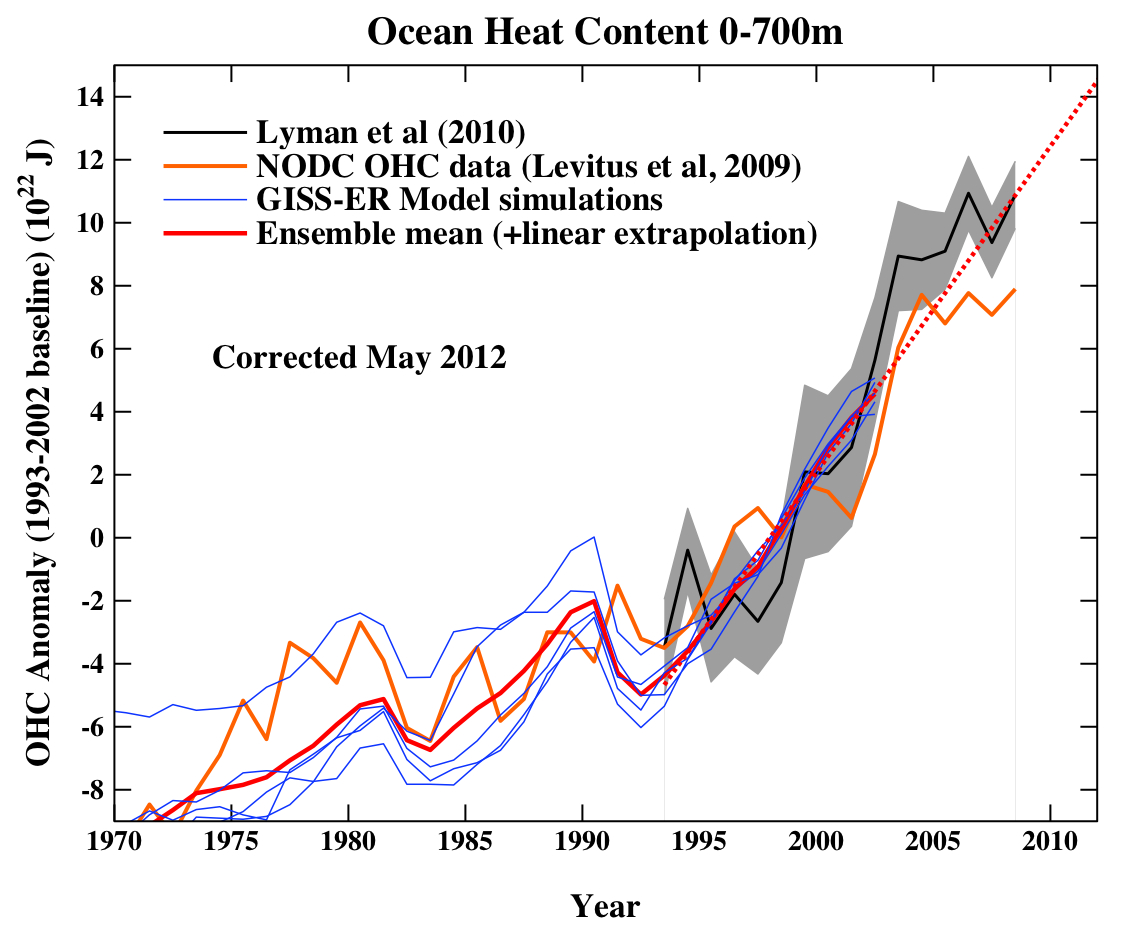
My summer reading includes a number of easy-read popular science volumes, including a thoughful, factful and scholarly work called “Merchants of Doubt” co-written by Naomi Oreskes, famous for her study of the contrast between Climate Change Science and the Media representation of it, startling figures that appear in Al Gore’s film “An Inconvenient Truth” :-
America and China are both “Carbon Intensity” first-movers – competing to make commitments that their economic production has falling associated Carbon Dioxide Emissions. The United States, China and Canada all continue to claim that their commitments on Climate Change amount to reductions in “carbon intensity”, rather than actual reductions in levels of emissions. This is a piece of policy propaganda, as proposed by linguistic strategists. A reduced carbon intensity of production would still allow countries to follow a path of economic growth, and increase carbon emissions overall. What is clear is that lower carbon intensities is not enough.
Behavioural economists, who look at both individual behaviour and collective social responses, have concluded a number of useful facts about humankind and its uses of resources. A good summary of what we know is provided by John Gowdy, writing in the Journal of Economic Behavior & Organization 68 in 2008, “Behavioral economics and climate change policy” :-
It’s time to stop thinking in terms of discrete events, and start looking at the synergy of these bouts of excessive precipitation.
Changes in the patterns of heavy rainfall are turning into a rolling disaster, on and on.
Newshounds look for survival stories, tales of recovery. But what if flooding comes repeatedly, year after year, season after season, every couple of years after every couple of years ? If there’s no “getting over it all”, or “getting back to normal”, will the mainstream media have to readjust their spectacles ?
The international community, in the form of the United Nations Framework Convention on Climate Change (UNFCCC) established the Kyoto Protocol back in 1997, a treaty that was ratified only as late as 2005 after compromises from the World Trade Organisation (WTO) for Russia. Global Climate Change negotiations, even before the Rio Earth Summit in 1992 have been beset by recurring problems.
The governments of the world are, by and large, well-informed about Climate Change by their trusted scientific advisers and the Intergovernmental Panel on Climate Change (IPCC). However, there is a disconnect between this knowledge and concrete policy action. The United Nations Framework Convention on Climate Change (UNFCCC) has not been successful in achieving control of Greenhouse Gas (GHG) emissions through the ratification of the Kyoto Protocol. Plus, annual negotiations have not reached a form of an agreement to succeed Kyoto, as evidenced by the inconclusive round of talks in December 2009 in Copenhagen. Suggestions of a way forward include a radical re-think about the formulation of the Kyoto Protocol, and the connection of Climate Change to other global concerns.
Kyoto Isn’t Working
For a period during the late 1980s and early 1990s, the world economy appeared to reach a stable point, whereby Carbon Dioxide emissions per person (per capita) levelled off. Many of the world’s major economies were switching fuels – from coal to Natural Gas. And some heavily industrialised countries were going through revolutionary change, and reducing their Greenhouse Gas (GHG) emissions as a result of the ensuing loss of industrial output.
“Already, this oil spill is the worst environmental disaster America has ever faced. And unlike an earthquake or a hurricane, it’s not a single event that does its damage in a matter of minutes or days. The millions of gallons of oil that have spilled into the Gulf of Mexico are more like an epidemic, one that we will be fighting for months and even years.”
“But make no mistake: We will fight this spill with everything we’ve got for as long as it takes. We will make BP pay for the damage their company has caused. And we will do whatever’s necessary to help the Gulf Coast and its people recover from this tragedy.”
I’m sure you’ll be interested to know that the second Zero Carbon Britain report from the Centre for Alternative Technology is now available for free download from this website :-
Phew ! That’s a relief ! The American President Barack Obama has personally spoken to British Prime Minister David Cameron apparently to reassure him he meant no harm to the reputation of Britain by blaming BP for the Gulf of Mexico oil spill :-
What’s wrong with this picture ? Although it has been amended in the online version (click the picture for the link), the latest United States Geological Survey of the Levant Basin in the East Mediterranean completely omitted to label Gaza :-
You may be familiar with the Christian theology of Trinity – God the Father, Jesus (Messiah or Christ) his Son and the Holy Spirit all somehow united, living together, one being together, different aspects of the same Goodly Godness.
And you may be also be familiar with Communion, the communal ritual of eating bread and drinking wine as a church community, the coming together of the Children of God. “Remain in me”, says Jesus, talking about grafting his followers into this new and universal church Vine :-
It should come as no surprise that the United Nations (under UNFCCC) commissioned a report from the Intergovernmental Panel on Climate Change (IPCC), way back in 2007.
The revelation is that very few people appear to have read any of it.
So I thought I would present just a little about the “robust findings” of Working Group 1 (WG1 or WGI) of the Fourth Assessment Report (AR4). I think the IPCC’s science needs a wider public readership, and so I hope that this post in some way enables that.
The unpacking of the Working Group 1 report “Climate Change 2007 : The Physical Science Basis” could begin by looking at the Technical Summary, or the overall AR4 Technical Summary, or the Synthesis Report, or their respective Summaries for Policymakers.
What’s the difference ? Why is Global Warming not the same as Climate Change ? And why do we call Global Warming “anthropogenic” ? How do we know recent Global Warming is caused by mankind’s activities ?
So, what is Global Warming ?
1. Carbon Dioxide is a Greenhouse Gas
Without Carbon Dioxide and other Greenhouse Gases in the Atmosphere (air), the temperature at the Earth’s surface would be something like 30 degrees Celsius colder than it is now.
This is a well-established fact, about which there there is no dispute. Well, OK, some people dispute it, but the fact that they dispute it does not alter the data.
It’s also a well-established old fact : the original science about the Greenhouse Effect was done over 100 years ago :-
Yes, why does the heat dip in the Stratosphere, when it bumps up in the Troposphere ?
And why has the temperature in the Stratosphere averaged downwards over the years as the temperature in the Troposphere has pushed upwards on average over the same period ?
Wouldn’t have anything to do with…Anthropogenic Global Warming, would it ?
Criticised by some as a blatant attempt to court public favour and tacit acceptance, BP have continued to financially support the Tate Britain gallery :-
It is a statement of the most culturally sensitive kind. Yet, the key question in my mind is : will they be able to continue to afford this, what with their excessive liabilities in the Gulf of Mexico ?
An assessment of BP plc’s performance in relation to their climate change impact, and their approach towards ensuring both environmental sustainability and corporate survival.
by Jo Abbess
29 April 2010
INTRODUCTION
The Research Question
This piece of research seeks to assess how BP plc is making adaptations in its corporate strategy, in view of the risks to its operations posed by Climate Change policy, and in the context of Peak Oil production and the subsequent inevitable Peak in Natural Gas.
Theories and Propositions
The author of this research has the view that over the course of the next 50 years, due to limits on supplies of good quality fossil fuels, and to avoid the risks of dangerous climate change from global warming, the world economy must de-carbonise, and entirely replace its sources of energy and fuel with low carbon alternatives.
According to this projection, any company that wishes to remain in business should begin their process of total decarbonisation immediately, and will be expected to show evidence for their intentions and procedures for change. This is likely to be particularly difficult for Oil and Gas companies, as their core business is based on energy and fuel resources that must be entirely replaced.
The 50 year timeframe may be beyond the thinking of most political analysts, but is relevant to pension funds, annuity providers and insurance companies. Investors are likely to become more interested in determining the carbon “liabilities” of fossil fuel stocks and shares, and take a risk-averse approach to future stakes in Oil, Gas, Coal and other high carbon fuels.
Policy strategy for controlling risky excess atmospheric greenhouse gas (Gowdy, 2008, Sect. 4; McKibben, 2007, Ch. 1, pp. 19-20; Solomon et al., 2009; Tickell, 2008, Ch. 6, pp. 205-208) mostly derives from the notion that carbon dioxide emissions should be charged for, in order to prevent future emissions; similar to treatment for environmental pollutants (Giddens, 2009, Ch. 6, pp. 149-155; Gore, 2009, Ch. 15 “The True Cost of Carbon”; Pigou, 1932; Tickell, 2008, Ch.4, Box 4.1, pp. 112-116). Underscoring this idea is the evidence that fines, taxes and fees modify behaviour, reigning in the marginal social cost of “externalities” through financial disincentive (Baumol, 1972; Sandmo, 2009; Tol, 2008). However this approach may not enable the high-value, long-term investment required for decarbonisation, which needs adjustments to the economy at scale (CAT, 2010; Hepburn and Stern, 2008, pp. 39-40, Sect. (ii) “The Consequences of Non-marginality”; MacKay, 2008, Ch. 19; Tickell, 2008, Ch. 2, pp. 40-41).
I sometimes read the Foreign Affairs magazine, as the articles are written by influential people, some of whom appear to be remarkably knowledgable and sane.
However, trying to read a recent piece by BP’s Chief Economist Christof Ruehl was a journey with little progress, so I’m sorry to admit I couldn’t bring myself to finish digesting it.
The man’s head appears to have been spun, or he might have had a mission to spin his readership. All the same, it’s worthy of a Koan award (see YouTube on this page).
“Global Energy After the Crisis : Prospects and Priorities” by Christof Ruehl, Chief Economist of BP plc, writing in Foreign Affairs Magazine, Volume 89, Number 2, March/April 2010 :-
Q. (from Christian Hunt, a plant in the audience from Greenpeace)
– You say it’s just the journalists who are the sceptics. What happens if another Government comes in and scepticism gets political footholds ? [ reference to Conservative Party Climate Change sceptics ]
A. (Phil Thornhill, Campaign against Climate Change)
– People shy away from the problem if they can’t find solutions. We propose a million Climate jobs – there are lots of ways of dealing with the crisis. That’s the kind of thing we should be emphasising.
Q. Andrew Neill interviewed Caroline Lucas and asked her about the Phil Jones interview with the BBC where he said there had been no “statistically significant” warming in the last 15 years. Has there been no statistically significant warming or not ? Why wouldn’t Caroline Lucas, head of the Green Party, say “you’re wrong” ?
A. (Phil)
– I wrote her a rather long e-mail. You can’t really debate Science in the popular Media. Most people don’t understand.
– The tip for answering this kind of question is – in 15 years, it’s hard to spot a trend against the background noise. It’s a difficult thing to explain.
– It’ a clear case of how once you start debating the Science it gets twisted. She should have said “this is a typical case of the misrepresentation of Science”.
If you’re reading this in the Southern Hemisphere, you will probably already know that the temperatures have been somewhat heated since the beginning of this year.
If you’re reading this in the Northern Hemisphere, and I know most of you are, because I’ve checked, you will probably not have the faintest idea that local cold does not mean global cold.
What’s been happening, to use colloquial, ordinary, everyday language, is that the Climate has been changing at the top of the world, the region near the North Pole. Winds have changed, patterns of heating and freezing have changed, rain and snowfall have changed.
This has had a knock-on effect – some of the areas further South have had a great deal of cooling over Winter. The Arctic has been acting like a giant air conditioner for parts of Northern Europe and Northern America.
You shiver in Paris (or London, or New York), but the Siberian and Canadian permafrost is melting.
Every now and again, some well-meaning, or even lightheartedly jokey relative or friend lets me know I should calm down with the story of the risk of Climate catastrophe as it’s (a) not effective; (b) not necessary or (c) way off the end of the scale. Apparently I’m crying wolf, but there’s not even a messy puppy in the neighbourhood.
There are two narratives at work here. One is that people don’t like being preached too (neither do I), and they feel that the sum total of Climate Change communications amounts to somebody high up the authority chain telling them to change their behaviour, somehow making the common man (and woman) responsible for a problem that should actually be fixed by the governments, who have the power (or large companies and international corporations, who have the financial resources).
The moral of nearly every cultural telling of the Climate Change story is “ten things you can do to make a difference”, and a lot of people feel it will mean shivering in the dark with no car and more tax. People are so not into self-sacrifice and abstention from consumerism, and they react badly, even to the extent of skin rashes, to the fear of micromanaged austerity being thrust upon them.
[ Nota Bene : The following was written for all those tragically lost to natural disasters aggravated by Climate Change since last Easter. May you rest in peace. We owe it to your memory to take courage, tell the truth and continue to strive to prevent further, increasing calamity from wild weather, failed rains and poor harvests. ]
Dying is hard work.
The arched back, the retching, the scrambling,
screaming in agony,
the gasp,
the panic
to keep body and soul together.
From first breath, first sore gum,
through grazed knees, peer humiliation,
learnings and forgettings,
broken bones and broken hearts.
The work of living,
pain, just a signpost on the road to flourishing.
The force for better things.