Categories
Change Management Energy Change Solar Sunrise

My Generation

Each of us, be we wise or distracted, are in some way invested in the future, in how the future is for ourselves, and those that come after us. What we do now, we do for the present, because of the past, in anticipation of what is to come, building a foundation, a support, a frame, for the future that will emerge. We save money; we learn new skills; we invest in friendships. And since the medium is the message, we enact the future, making a silhouette, a pattern, of how the future will appear. We lead by doing. We challenge by creating. We teach by learning. We take the step forward that others will in their turn take. And so it is that I have caught the sunshine and made it work for me, because that is one important way in which tomorrow’s power will be made. Today a significant milestone was reached in my rooftop solar photovoltaic electricity generation – 4MWh – four megawatt hours, from a 3kW capacity system, installed on 18 November 2011, just over two years ago. Here are my recent readings :-

17 November 2013 17:30 3996.5 kWh
20 November 2013 10:10 3998.5 kWh
20 November 2013 16:45 3999.0 kWh
21 November 2013 10:10 3999.1 kWh
21 November 2013 11:50 3999.4 kWh
21 November 2013 15:25 4000.2 kWh
21 November 2013 18:30 4000.2 kWh

Categories
Bioeffigy Biofools Biomess Breathe Easy Renewable Gas Renewable Resource

Biomass : Chainsaw of Destruction

This evening I was at a very interesting meeting hosted by BiofuelWatch in the fabulous Lumen Centre near King’s Cross, London.

The new report “Biomass : Chain of Destruction” was launched with public Skype interviews with colleagues in Brazil and the United States. All very 2013, but the biomass combustion technologies of concern are mostly all so last century.

Ordinary combustion of any biological material, whether ancient trees, such as coal, or modern trees, in the form of compressed wood pellets, is generally inefficient. But to burn biomass to create heat to vapourise water to make steam to turn electrical turbines to make power is scandalously wasteful.

In the Executive Summary of the report (downloaded from this website), these demands were made :-

“1. Large­scale industrial bioenergy to be removed
from definitions of “renewable energy”. The term
“renewable” must be formalized to reflect the real
costs to the environment and public health.”

“2. An end to subsidies, including targets and other
state incentives, for industrial bioenergy.”

“3. A major policy shift away from large­scale energy
generation through combustion, towards our energy
needs being satisfied through a combination of
genuinely climate­friendly renewable energy and a
substantial reduction in both energy generation and
use.”

A discussion arose in my corner of the room about where we should draw the line between “good” biomass applications, and “bad” biomass applications. It was generally agreed that burning local biomass for local heat in an efficient machine, would limit particulate emissions and be very energy efficient and sustainable.

And at the other end of the scale, I am looking at the potential for the highly-efficient gasification of biomass to make Renewable Gas – the higher temperatures mean that less carbon particulates, tars and poisons remain. For centralised Renewable Gas plants, air quality management would be necessary, through the capture and filtering of particulates and other unwanted by-products, but the cost of this is manageable at this scale.

If ordinary incineration or combustion is being done at the medium to large scale, this is likely to be the cause of major problems, in the event of sharply rising levels of biomass burning for electricity production. The inefficiency of the energy conversion will mean that full air quality protection may be too expensive to apply to the exhaust, and it will be simply vented to air.

Categories
Nuclear Nuisance Nuclear Shambles Wind of Fortune

St Jude 1 : Nuclear 0

As if to prove how inadequate nuclear power is as a reliable long-term energy investment strategy for the UK, one little gale forced the Dungeness B station to go offline. Aptly, this storm is now being referred to as “St Jude’s” – he the patron saint of lost causes. Here is a dialogue from one of the networked forums I read :-

From: Alexander
Date: Monday, 28 October 2013, 12:38
Subject: New UK wind energy record ?

Hi All,

While we are busy discussing Hinkley C and the Government’s atomic power plans, it looks as though wind energy may have hit a new record high of 5,254 MW [megawatts], courtesy of the storm, now named St Jude or something like that.

See BM Reports [Balancing Mechanism for the National Grid, Reports] settlement period 38 for 28-10-13.

The predicted output was 6,185 MW, so maybe there was curtailment [wind turbines turned off] due to excessive wind speeds or lack of grid connection capacity. However, I don’t think I have seen such a high total grid connected wind output before.

From: Fred
Date: Mon, Oct 28, 2013 at 2:04 PM

We hit 5,739 MW of grid connected wind on the 15th September this year (2013). This was from 7,136 MW of grid connected capacity.

I don’t think it was that windy in Scotland. The [National] Grid normally overestimates the power it gets from [wind power]. My impression is that the Irish, who have a much harder job in estimating wind are getting better at it. In our case there has been no real improvement in predictive power since I began monitoring wind [power] some five years ago.

There was also a sudden drop in nuclear output of about 900 MW, last night from over 8 GW [gigawatts] down to about 7.1 GW. Was this a power line failure or something like Hartlepool having to be taken back off line ?

From: Martin
Date: Mon, Oct 28, 2013 at 2:21 PM

Nuclear outage was Dungeness B :-

https://news.yahoo.com/uk-storm-causes-two-dungeness-nuclear-reactors-close-101227524.html

From: Bert
Date: Mon, Oct 28, 2013 at 2:27 PM

I wonder what the ‘wind backup fraternity’ (including Michael Portillo) make of the Dungeness outage ?

[This is a reference to those who say that wind power is not useful, since it is variable, and needs to be backed up by other generation sources when the wind is not blowing.]

From: Neil
Date: Mon, Oct 28, 2013 at 2:34 PM

Well spotted Fred, thanks Martin.

After all those years of public meetings and letters in the press about turbines turning off in high winds and large-scale intermittency due to storm fronts shutting down windfarms !

1.1 GW instantaneous [loss of power] – and smack on the morning [power demand] pick-up – that will be hard to beat !

Made my day.

PS North Wales is not even particularly windier than usual.

From: Fred
Date: Mon, Oct 28, 2013 at 3:34 PM

Dear Martin (and Neil),

Thanks

A pinch of observation is worth a ton of pontificating.

So Dungeness B is off-line owing to this lesser “Great Storm”.

However I do wonder what goes on at an AGR [Advanced Gas-cooled Reactor] in such circumstances. There is huge amount of heat within the reactor and CO2 [Carbon Dioxide] circuit, so steam production will continue for at least a few hours, even if the control rods are dropped in.

Presumably most of the steam has to be diverted into the condenser by-passing the turbines, but presumably some power will need to be generated to keep the CO2 circulating fans going.

For the staff this will be a very “active” time after the usual months of staring at dials which only change by microscopic amounts. It would be interesting to see how long it takes to get the plant back on line.

From: Alexander
Date: Mon, Oct 28, 2013 at 4:02 PM

Fred, Martin, Neil,

OK so no new wind record, but curtailment of atomic power Dungeness B by a storm which didn’t quite seem to equal 1987’s hurricane, presumably from the grid being brought down. As you state, this demonstrates the vulnerability of large generating units compared to the multiplicity of renewable sources. It seems that increased use of pumped storage and HEP [HydroElectric Power] together with some OCGT [Open Cycle Gas Turbine] was used to cover for the 800 MW loss.

As you say, observation of factual record is invaluable.

From: Dave A.
Date: Mon, Oct 28, 2013 at 4:08 PM

Hang on Alexander, this is EXACTLY the scenario that the STOR [National Grid’s Short-Term Operating Reserve] system introduced by [National] Grid was designed for, and this includes nearly 1 GW of diesels [power generation using diesel engines] which can start in less then 5 minutes (more complicated than that actually) with instantaneous load shedding used to deal with the 5 minutes. See : https://www.claverton-energy.com/download/131/.

Exactly the same system could be used, even with 4,000 MW of diesel to deal with the rare, sudden and unpredicted loss of wind output, whilst other firm plant are brought up.

From: Bert
Date: Mon, Oct 28, 2013 at 4:08 PM

> It would be interesting to see how long it takes to get the plant back on line.
> Fred

Quote from article posted by Martin earlier:

*****************************************************************
unit availability was expected to be zero for the next seven days.
*****************************************************************

From: Alexander
Date: Mon, Oct 28, 2013 at 4:17 PM

OK Dave,

Maybe STOR diesels could have been activated, but inspection of the BM Reports appeared to show that the shortfall was made up by increased use of pumped storage and HEP together with some OCGT. I believe their start up times are at least as short or shorter than the diesels.
Just interpreting what happened.

From: Martin
Date: Mon, Oct 28, 2013 at 4:19 PM

This sudden and substantial outage is not considered newsworthy by the BBC – a search on their website finds nothing. Curious considering the high profile media coverage of energy just now !

From: Dave A.
Date: Mon, Oct 28, 2013 at 4:27 PM

Yes – Dinorwic can go to full power if spinning in air in about 10 secs I think ? Something like. Diesels can start to full load in about 15 secs, but grid expects them to do it in 2, 5 or 20 minutes depending on band they bid into. OCGT are much longer something like 1/2 an hour, and don’t start reliably, and if they don’t start there is a very long purge period, whereas diesels can be repeatedly cranked.

From: Alexander
Date: Mon, Oct 28, 2013 at 4:39 PM

Martin,

I did hear mention of it on World at One Radio 4.

From: Dave A.
Date: Mon, Oct 28, 2013 at 5:46 PM

In the last big storm a lot of the outages on large power stations were caused by wind blowing debris such as wet plastic sheeting which became wrapped around the HV [High Voltage] lines.

From: Dave A.
Date: Mon, Oct 28, 2013 at 5:52 PM

Worth saying again, that the reason the UK has STOR of the size it is, – about 2 GWe, is ENTIRELY due to Sizewell B, which was originally planned to be 2 x 660 MW separate sets, but due to the high cost, Walter Marshall, the then CEGB chairman set up a task force to lower the price. (Think about it, it’s not possible to just lower the price of some engineering at the stroke of a pen, it has consequences) and the result was that the 2 660 [units] behaved as one, so if one shut down, so did the other.

Thus STOR is designed to meet the sudden failure of Sizewell two 660 MW sets.

From: David H.
Date: Mon, Oct 28, 2013 at 5:59 PM

It may be worth looking at any change in forward prices over the next week. The Reuters report said the reactors would be off-line for at least a week. A week is 176 hours. Assuming 1GW, that means the system is short some 176GWh and this will need to be purchased, probably by EDF. This should make the market move, but by how much ?

There is discrepancy between Reuters and “observation”. Fred’s reports are of 800 MW reductions, yet Reuters says 2 * 550 MW, and Neil says 1.1 GW (I assume from 2 * 550 MW). The 800 MW could represent the exports, with the further 300 MW being the parasitic load. EdF website says “Net electrical output” of 1,040 MW. To quote Wikipedia “consisting of two 615 MW reactors […] Like the “A” station, its turbines were built by C.A. Parsons & Company and it has two 600 MWe [megawatts of electrical power] turbo-alternator sets, producing a maximum output of 1.200 MWe, though net output is 1,090 MWe after the effects of house load, and downrating the reactor output due to corrosion and vibration concerns.”

The report says that the shutdown was caused because power to the site was shut off. Of course, I doubt it was “shut off”, but it could well have failed. Could this make NG [National Grid] liable for the no doubt substantial financial losses to Dungeness. And a grid failure of two double circuit tower lines (separately routed for all but the last mile or two) is cause for serious concern. I wonder where that failure arose.

From: Bert
Date: Mon, Oct 28, 2013 at 5:59 PM

Are the costs of extra STOR included in the cost calculations for Hinkley ?

From: David E.
Date: Mon, Oct 28, 2013 at 6:01 PM

As at Fukushima, without external power you are reliant on diesel [power generation] sets to maintain cooling of decay heat (they can’t self generate without risks – that was what Chernobyl was trying to test…) Maybe they were (wisely) nervous about the pumps not runnning, or even about inundation during the storm. Dungeness is at sea level and one of the UK sites most at risk of surge storm flooding. But in any case there was plenty of wind [power] coming in to the grid so we didn’t need Dungeness. It’s a textbook example of what we will see in the future. Inflexible nuclear caught out by climate change and renewables stepping in to take over – when they can. If demand had been very high (and there was no wind [power]) then the gas plants would have to take the extra strain. The small extra cost of running them more ought then I guess be paid by nuclear [power plant operators], since it was that which failed, though I can see why some would say it would be wind’s problem too.

From: Dave A.
Date: Mon, Oct 28, 2013 at 6:09 PM

[re: added STOR costs] actually they will be trivial…..but of course, because the plant sizes are bigger, [the total amount of] STOR [capacity] will have to increase 🙂

From: Dave A.
Date: Mon, Oct 28, 2013 at 8:23 PM

[re: the BBC not covering this nuclear outage] They are afraid of getting their knuckles rapped by that Grant Shapps. Who is demanding they are more transparent and open, in the ways that government ministers are with the jobs they will go on to in the nuclear industry when they leave office.

[…]

From: Dave A.
Date: Mon, Oct 28, 2013 at 9:04 PM

It doesn’t prove anything, we all know that nuclear power stations and other power stations suffer sudden unpredictable outages needing back up.

What is interesting is to see if the dumb media report this and contrast it with the exaggerated claims of anti-wind folk about wind’s unreliability.

From: Fred
Date: Mon, Oct 28, 2013 at 10:36 PM

From the Daily Telegraph

“A nuclear power station automatically shut down its reactors after debris blown by hurricane-strength winds fell onto its power lines and led to a loss of supply. It could be up to a week before the two units at Dungeness B plant in Kent – one of Britain’s nine nuclear power stations – are up and running again. But a spokeswoman for EDF Energy, which runs the site, said she hoped energy would be restored much sooner and that the public should “absolutely not” be concerned by the shut-down. The two units shut down safely and diesel generators within the site were providing power for essential systems to continue to operate, Sue Fletcher of EDF said. “This is an issue caused by the unusual weather, which led to a loss of power like many of the homes in the surrounding area,” Ms Fletcher said. “We share the discomfort of people locally.” The plant has the capacity to produce 1040 megawatts of energy, providing power for some 1.5 million homes. More than 200,000 homes across the country have experienced a loss of power because of what has been dubbed ‘St Jude’s’ storm. Martin Pearson, station director at Dungeness B, added: “This is a scenario we are well prepared for and we quickly responded calmly and professionally to the loss of supply. The reactors are safely shutdown and National Grid staff are now working to restore the supply and once that is done we’ll bring both units back on line.”

From: Neil

[…]

What does a small (20 kW ?) wind turbine blown over prove – very little – but it got shown on TV today and I bet it may provide some grist for the anti-wind lobby.

That fact that a 1 GW nuclear power station goes down in the same storm and its NOT deemed TV newsworthy (I have mainly monitored BBC) gives an insight to how the (BBC and other) journalists think…

The debate between wind / renewables and nuclear is visceral – ‘relating to deep inward feelings rather than to the intellect’.

Suppose I should write to the BBC Trust about content (they are suggesting that themselves at the moment for their review) !

The incident does show a vulnerability of nuclear power stations – they are only a few diesels away from multi-billion £ disasters

Categories
Assets not Liabilities Demoticratica Eating & Drinking Human Nurture

Applemania : Condiments of the Season

Meditation at the moment consists of imaging a gentle stroll through russet, red and gold leaf-carpeted woods; whilst in the real world away from Autumnal reverie, there is a lot of hard work to do to deal with an exuberant embarrassment of London pommes.

The Gift Economy is in full swing, with currency of jam jars, apple bags, crumble and chutney changing hands at speed in the valued transactions of the local non-moneyed market.

I’ve definitely improved my apple harvesting technique, using an almost robotic claw on a long pole.

Last year, there was barely a handful of fruit. This year has been exceptional for apples.

Some people simply don’t have the time to pick, preserve and store, so they leave this glorious fermenting bounty to feed the mycellium, the ants, the fox, the pigeons, and the magpies. Others beaver away, diverting apples temporarily from the carbon cycle for the purpose of human nourishment.

There’s juicing, pressing, coring, chopping, slicing, baking, cider racking, stewing, freezing and making a vast range of condiments. Today, I have eaten apples in four different formats. Apples are clearly going to feature a lot in my diet for the next few months, but I don’t think I can ever tire of eating apples, so that’s just peachy.

I made a batch of a super-spicy new recipe for making chutney in a hurry, and it’s very heart-warming – or heartburn-ing if you’re not used to Eastern seasoning. This year, for the first time, I’ve tried storing whole apples for winter, and making dried apple rings.

And because there is a river of produce, now we’re into the cooking apple phase, with huge green knobbly, waxy monsters, some weighing half a kilogramme raining down on our Newtonian heads, I have been able to re-invest in neighbourliness, offering apples to nine households directly around me, and leaving the more damaged fruit on the pavement in bags with a sign saying “FREE ! Fallers. Help Yourself.”

And still, we do not have enough time to take and use all the produce, and time has become critical if there’s going to be a wind storm in the next few days. Food security in a re-localised cultivation community relies so much on the weather conditions. We may lose the rest of the fruit, but we hope we’ve picked enough to save the garden orchard trees from being blown over.

We have tried to use as much as we can, but even if we cannot make optimal use of this year’s apple crop, we have already put enough away to meet all our dietary fruit needs until at least Christmas, if not beyond. And enough cidre de cru to warm the cockles of next year’s hearts.

Next job : the marrows.


Recipe

Apple and Ginger Chutney

Ingredients

All measures approximate – adjust to meet the goal of a product with the consistency of chunky dip, fairly dry.

2 kilogrammes of green cooking apples, quartered, cored and tidied and chopped into matchsticks
1/4 cup (4 tablespoons) of apple cider vinegar
1/4 cup (4 tablespoons) of sunflower oil
2 large red onions, peeled and chopped into matchsticks
2 fingers of fresh ginger root, peeled and chopped into matchsticks
cup (16 tablesppons) of sugar
4 pinches (1 teaspoon) of dried cayenne or chili pepper
8 pinches (2 teaspoons) of garam masala Indian spice mix
8 pinches (2 teaspoons) of cumin seed (jeera)
8 pinches (2 teaspoons) of cinnamon powder
4 pinches (1 teaspoon) of ground black pepper
8 pinches (2 teaspoons) of salt

Method

1. In the bottom of a large saucepan, fry the onion and cumin seed in the sunflower oil to sweat the onions until they are translucent. This should take around 7 to 12 minutes.

2. Add the garam masala, cayenne (or chili pepper) and cinnamon to the pan and stir for 1 minute.

3. Add the apples, ginger, sugar, apple cider vinegar, salt and black pepper. Stir it so that the sugar dissolves into the apple cider vinegar.

4. Keep the heat on, and keep stirring the mixture in the saucepan until the apples brown off and the sugar caramelises. This should take around 15 to 25 minutes.

5. Put the chutney in jars with metal lids for storage.

Spice Aware : to avoid heartburn, always eat this chutney in combination with other foods. Suggestions include : peanut butter and chutney on toast; chick pea houmouss and chutney on toast; chutney served as a relish alongside vork (vegan) sausages with apple-and-potato mash.


Categories
Academic Freedom Assets not Liabilities Behaviour Changeling Big Society Carbon Pricing Carbon Taxatious Climate Change Contraction & Convergence Cool Poverty Corporate Pressure Demoticratica Direction of Travel Disturbing Trends Dreamworld Economics Economic Implosion Efficiency is King Emissions Impossible Energy Change Energy Disenfranchisement Energy Revival Engineering Marvel Environmental Howzat Fair Balance Financiers of the Apocalypse Fossilised Fuels Freemarketeering Fuel Poverty Green Investment Green Power Growth Paradigm Human Nurture Hydrocarbon Hegemony Libertarian Liberalism Low Carbon Life Money Sings National Energy National Power National Socialism Nuclear Nuisance Nuclear Shambles Nudge & Budge Paradigm Shapeshifter Peak Emissions Peak Energy Policy Warfare Political Nightmare Price Control Regulatory Ultimatum Social Capital Social Change Social Chaos Social Democracy Solar Sunrise Solution City Sustainable Deferment The Power of Intention The Price of Gas The Price of Oil Ungreen Development Wasted Resource Wind of Fortune

Economic Ecology

Managing the balance between, on the one hand, extraction of natural resources from the environment, and on the other hand, economic production, shouldn’t have to be either, or. We shouldn’t value higher throughput and consumption at the expense of exhausting what the Earth can supply. We shouldn’t be “economic” in our ecology, we shouldn’t be penny-pinching and miserly and short-change the Earth. The Earth, after all, is the biosystem that nourishes us. What we should be aiming for is an ecology of economy – a balance in the systems of manufacture, agriculture, industry, mining and trade that doesn’t empty the Earth’s store cupboard. This, at its root, is a conservation strategy, maintaining humanity through a conservative economy. Political conservatives have lost their way. These days they espouse the profligate use of the Earth’s resources by preaching the pursuit of “economic growth”, by sponsoring and promoting free trade, and reversing environmental protection. Some in a neoliberal or capitalist economy may get rich, but they do so at the expense of everybody and everything else. It is time for an ecology in economics.

Over the course of the next couple of years, in between doing other things, I shall be taking part in a new project called “Joy in Enough”, which seeks to promote economic ecology. One of the key texts of this multi-workstream group is “Enough is Enough”, a book written by Rob Dietz and Dan O’Neill. In their Preface they write :-

“But how do we share this one planet and provide a high quality of life for all ? The economic orthodoxy in use around the world is not up to the challenge. […] That strategy, the pursuit of never-ending economic growth has become dysfunctional. With each passing day, we are witnessing more and more uneconomic growth – growth that costs more than it is worth. An economy that chases perpetually increasing production and consumption, always in search of more, stands no chance of achieving a lasting prosperity. […] Now is the time to change the goal from the madness of more to the ethic of enough, to accept the limits to growth and build an economy that meets our needs without undermining the life-support systems of the planet.”

One of the outcomes of global capitalism is huge disparities, inequalities between rich and poor, between haves and have-nots. Concern about this is not just esoteric morality – it has consequences on the whole system. Take, for example, a field of grass. No pastoral herder with a flock of goats is going to permit the animals to graze in just one corner of this field, for if they do, part of the grassland will over-grow, and part will become dust or mud, and this will destroy the value of the field for the purposes of grazing. And take another example – wealth distribution in the United Kingdom. Since most people do not have enough capital to live on the proceeds of investment, most people need to earn money for their wealth through working. The recent economic contraction has persuaded companies and the public sector to squeeze more productivity out of a smaller number of employees, or abandon services along with their employees. A simple map of unemployment shows how parts of the British population have been over-grazed to prop up the economic order. This is already having impacts – increasing levels of poverty, and the consequent social breakdown that accompanies it. Poverty and the consequent worsening social environment make people less able to look after themselves, their families, and their communities, and this has a direct impact on the national economy. We are all poorer because some of our fellow citizens need to use food banks, or have to make the choice in winter to Heat or Eat.

And let’s look more closely at energy. Whilst the large energy producers and energy suppliers continue to make significant profits – or put their prices up to make sure they do so – families in the lower income brackets are experiencing unffordability issues with energy. Yes, of course, the energy companies would fail if they cannot keep their shareholders and investors happy. Private concerns need to make a profit to survive. But in the grand scheme of things, the economic temperature is low, so they should not expect major returns. The energy companies are complaining that they fear for their abilities to invest in new resources and infrastructure, but many of their customers cannot afford their products. What have we come to, when a “trophy project” such as the Hinkley Point C nuclear power station gets signed off, with billions in concomitant subsidy support, and yet people in Scotland and the North East and North West of England are failing to keep their homes at a comfortable temperature ?

There is a basic conflict at the centre of all of this – energy companies make money by selling energy. Their strategy for survival is to make profit. This means they either have to sell more energy, or they have to charge more for the same amount of energy. Purchasing energy for most people is not a choice – it is a mandatory part of their spending. You could say that charging people for energy is akin to charging people for air to breathe. Energy is a essential utility, not an option. Some of the energy services we all need could be provided without purchasing the products of the energy companies. From the point of view of government budgets, it would be better to insulate the homes of lower income families than to offer them social benefit payments to pay their energy bills, but this would reduce the profits to the energy companies. Insulation is not a priority activity, because it lowers economic production – unless insulation itself is counted somehow as productivity. The ECO, the Energy Company Obligation – an obligation on energy companies to provide insulation for lower income family homes, could well become part of UK Prime Minister David Cameron’s “Bonfire of the Green Tax Vanities”. The ECO was set up as a subsidy payment, since energy companies will not provide energy services without charging somebody for them. The model of an ESCO – an Energy Services Company – an energy company that sells both energy and energy efficiency services is what is needed – but this means that energy companies need to diversify. They need to sell energy, and also sell people the means to avoid having to buy energy.

Selling energy demand reduction services alongside energy is the only way that privatised energy companies can evolve – or the energy sector could have to be taken back into public ownership because the energy companies are not being socially responsible. A combination of economic adjustment measures, essential climate change policy and wholesale price rises for fossil fuel energy mean that energy demand reduction is essential to keep the economy stable. This cannot be achieved by merely increasing end consumer bills, in an effort to change behaviour. There is only so much reduction in energy use that a family can make, and it is a one-time change, it cannot be repeated. You can nudge people to turn their lights off and their thermostats down by one degree, but they won’t do it again. The people need to be provided with energy control. Smart meters may or may not provide an extra tranche of energy demand reduction. Smart fridges and freezers will almost certainly offer the potential for further domestic energy reduction. Mandatory energy efficiency in all electrical appliances sold is essential. But so is insulation. If we don’t get higher rates of insulation in buildings, we cannot win the energy challenge. In the UK, one style of Government policies for insulation were dropped – and their replacements are simply not working. The mistake was to assume that the energy companies would play the energy conservation game without proper incentives – and by incentive, I don’t mean subsidy.

An obligation on energy companies to deploy insulation as well as other energy control measures shouldn’t need to be subsidised. What ? An obligation without a subsidy ? How refreshing ! If it is made the responsibility of the energy companies to provide energy services, and they are rated, and major energy procurement contracts are based on how well the energy companies perform on providing energy reduction services, then this could have an influence. If shareholders begin to understand the value of energy conservation and energy efficiency and begin to value their energy company holdings by their energy services portfolio, this could have an influence. If an energy utility’s licence to operate is based on their ESCO performance, this could have an influence : an energy utility could face being disbarred through the National Grid’s management of the electricity and gas networks – if an energy company does not provide policy-compliant levels of insulation and other demand control measures, it will not get preferential access for its products to supply the grids. If this sounds like the socialising of free trade, that’s not the case. Responsible companies are already beginning to respond to the unfolding crisis in energy. Companies that use large amounts of energy are seeking ways to cut their consumption – for reasons related to economic contraction, carbon emissions control and energy price rises – their bottom line – their profits – rely on energy management.

It’s flawed reasoning to claim that taxing bad behaviour promotes good behaviour. It’s unlikely that the UK’s Carbon Floor Price will do much apart from making energy more unaffordable for consumers – it’s not going to make energy companies change the resources that they use. To really beat carbon emissions, low carbon energy needs to be mandated. Mandated, but not subsidised. The only reason subsidies are required for renewable electricity is because the initial investment is entirely new development – the subsidies don’t need to remain in place forever. Insulation is another one-off cost, so short-term subsidies should be in place to promote it. As Nick Clegg MP proposes, subsidies for energy conservation should come from the Treasury, through a progressive tax, not via energy companies, who will pass costs on to energy consumers, where it stands a chance of penalising lower-income households. Wind power and solar power, after their initial investment costs, provide almost free electricity – wind turbines and solar panels are in effect providing energy services. Energy companies should be mandated to provide more renewable electricity as part of their commitment to energy services.

In a carbon-constrained world, we must use less carbon dioxide emitting fossil fuel energy. Since the industrialised economies use fossil fuels for more than abut 80% of their energy, lowering carbon emissions means using less energy, and having less building comfort, unless renewables and insulation can be rapidly increased. This is one part of the economy that should be growing, even as the rest is shrinking.

Energy companies can claim that they don’t want to provide insulation as an energy service, because insulation is a one-off cost, it’s not a continuing source of profit. Well, when the Big Six have finished insulating all the roofs, walls and windows, they can move on to building all the wind turbines and solar farms we need. They’ll make a margin on that.

Categories
Policy Warfare Political Nightmare

Nuclear 1 : Insulation 0

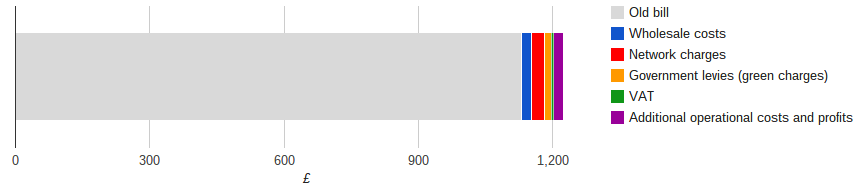
David Cameron PM, the “PM” allegedly standing for “Panic Mode”, has pledged to drop £112 from the annual household energy bill by cutting green “taxes”. Many of the green energy and energy efficiency support measures aren’t actually designed to be paid for by taxes, in fact, but through energy bills.

Nick Clegg was “stunned” by this announcement, and went on breakfast television to say so. Here’s what the Evening Standard said :-

“[…] David Cameron today risked a huge coalition split by announcing that he will “roll back” green taxes that add £112 to soaring energy bills. The bombshell announcement was dropped in a packed Commons while his deputy Nick Clegg, a huge supporter of green measures, sat in stony-faced silence. Battling to regain the political initiative on home energy bills, Mr Cameron told MPs: “We need to roll back the costs that have been imposed on people’s energy bills.” Sources said changes could be announced as early as the Chancellor’s autumn statement. [… ] Among the charges on domestic bills is ECO, which pays energy firms to help vulnerable people and adds £50 to the average bill; a renewables obligation, costing families £30; insulation schemes costing £11 and renewables subsidies costing £30. His announcement comes a week after Lib-Dem Energy Secetary Ed Davey dismissed Tory calls to scrap green levies to reduce bills as “silly”. […] Despite Lib-Dem ministers saying just weeks ago that green levies were needed, the Prime Minister told a packed Commons he was determined to reduce them “one way or another”. […] Measures are now expected in the autumn statement in December to reduce the impact of environmental levies on fuel bills. Labour MPs jeered the Prime Minister, believing that he has been pushed to act due to Mr Miliband’s conference pledge to freeze energy bills. It comes 24 hours after former Prime Minister Sir John Major called for a windfall tax on energy companies to fund support for low-income families. Mr Cameron told MPs: “We need to roll back some of the green regulations and charges that are putting up bills.” The Lib-Dems have previously vowed to prevent any fall in green levies during this Parliament. […]”

In an email from somebody I shall just refer to as General Mayhem, there was this startling news – “[…] has just come back from a conference where someone from DECC let slip that ECO is dead in the water.” ECO – the Energy Company Obligation – an instrument that is designed to use Government funds to pay for energy companies to make energy efficiency improvements to the homes of low-income families.

General Mayhem also had this to say :-

“Whilst Cameron is now desperately trying to con the public into believing that cuts to energy ‘taxes’ won’t affect support for fuel poverty and have nothing to do with ensuring we can pay EDF for Hinckley C.”

Ah yes, this is the same week that a massive UK Government announcement about nuclear power was made – with initial calculations suggesting that the guaranteed price for the electricity of the new Hinkley Point C nuclear power plant could give EdF a billion pounds of profit a year.

Hmm. We can afford to support expensive atomic energy, but we cannot seem to find the money to insulate the homes of poor people.

Nuclear 1 : Insulation 0.

Categories
Public Relations Shale Game Unconventional Foul

Bursting Shale Gas Bubbles

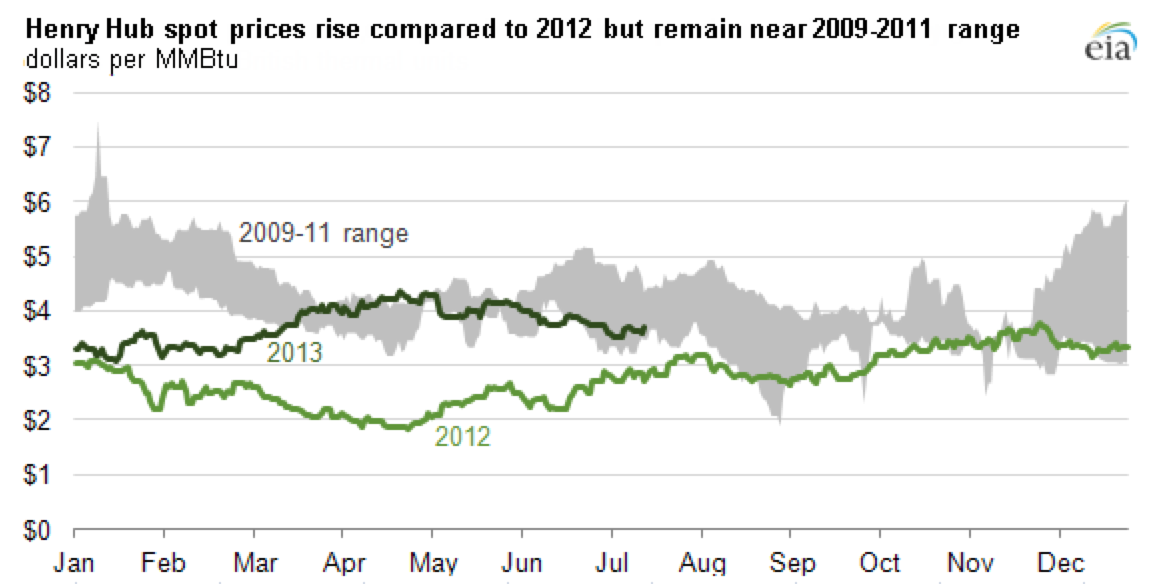
I am not confident that the American Shale Gas “boom” is as solid as energy analysts describe, so I set out to find some numbers, to try to check my suspicion.

You know how it is with government websites : lots of webpages with little intelligence to help you navigate them to find out exactly the answers to your questions.

I was trying to ascertain current American shale gas production data, and I kept finding myself at this webpage on the Energy Information Administration (EIA) website, and this one, too, which only have shale gas production data up until 2011 (just checked it again – still true).

The only other thing I could see immediately was a computer model of USA Natural Gas production until 2040, Figure 91 on Page 79 of the Annual Energy Outlook (AEO) for 2013, and also on the website, at this webpage, where I could download the data from the model run. On Page 118 of the downloadable AEO, it indicated that the most recent real data was from the year 2011 :-

“Figure 91. Natural gas production by source, 1990-2040: History: U.S. Energy Information Administration, Natural Gas Annual 2011, DOE/EIA-0131(2011) (Washington, DC, January 2013). Projections: AEO2013 National Energy Modeling System, run REF2013.D102312A.”

I was unable to find any more recent data, although I knew it had to be captured, so I emailed the EIA to ask for help, and they said that more recent data on Shale Gas production was to be found here, at the bottom of the page with the chart “Monthly dry shale gas production”.

The first thing of note is that only three shale gas regions or “plays” are still showing rising production – the Marcellus, Eagle Ford and a smidgen in the Bakken.

The second thing of note is that the actual production of shale gas is higher than the projection from the Annual Energy Outlook for 2013 (based on 2011 data) :-

Actual (average for the period 1st July 2012 to 30th June 2013) : 28.01 Bcf/d
AEO 2013 Figure 91 model (average for 2012 and 2013) : 22.92 Bcf/d

The third thing to note is the slowdown in the growth of shale gas production as a whole, tending to zero in maybe a few years time, whilst the AEO 2013 Figure 91 model projects continuing low figure percentages for growth in shale gas production. This model probably has an underlying assumption that new drilling for shale gas will take place.

The fourth thing to note is where the AEO 2013 Figure 91 model expects significant growth to occur in Natural Gas production – Tight Gas – starting around 2016, Alaska starting in around 2024, offshore around 2030 and 2040, and Coalbed Methane starting in 2035.


Conclusion : the EIA does not anticipate major growth trends in shale gas production in their projections – step change is expected from elsewhere.

Categories
Academic Freedom Climate Change

616 : The Number of the IPCC

I have been looking into an anomaly in the recently published IPCC Fifth Assessment Report.

No, I don’t think that global warming has paused, or that climate change is a hoax. We’re still on course for some very disturbing times, and the risks of rainfall change, sea level rise, and temperature and weather extremes are still gobsmackingly frightening.

However, I’d like to ask why one particular figure from the Summary for Policymakers for Working Group 1 differs from the Chapters that underly it.

Reference : Intergovernmental Panel on Climate Change, Fifth Assessment Report, Working Group 1

Summary for Policymakers, 27 September 2013

Section E.8
“Climate Stabilization, Climate Change Commitment and Irreversibility”

“Limiting the warming caused by anthropogenic CO2 emissions alone with a probability of >33%, >50%, and >66% to less than 2°C since the period 1861–1880 [22], will require cumulative CO2 emissions from all anthropogenic sources to stay between 0 and about 1560 GtC, 0 and about 1210 GtC, and 0 and about 1000 GtC since that period respectively [23]. These upper amounts are reduced to about 880 GtC, 840 GtC, and 800 GtC respectively, when accounting for non-CO2 forcings as in RCP2.6. An amount of 531 [446 to 616] GtC, was already emitted by 2011. {12.5}”

This refers to Chapter 12, Section 12.5, so I looked that up :-

Chapter 12

Executive Summary

“Climate Stabilization : The principal driver of long term warming is total emissions of CO2 and the two quantities are approximately linearly related. The global mean warming per 1000 PgC (transient climate response to cumulative carbon emissions, TCRE) is likely between 0.8°C–2.5°C per 1000 PgC, for cumulative emissions less than about 2000 PgC until the time at which temperatures peak. To limit the warming caused by anthropogenic CO2 emissions alone to be likely less than 2°C relative to preindustrial, total CO2 emissions from all anthropogenic sources would need to be limited to a cumulative budget of about 1000 PgC over the entire industrial era. About half [460–630 PgC] of this budget was already emitted by 2011.”

Section 12.5
“Climate Change Beyond 2100, Commitment, Stabilization and Irreversibility”

12.5.4

“Based on the evidence presented above, to limit warming caused by CO2 emissions alone to be likely less than 2°C, total CO2 emissions from all anthropogenic sources would need to be limited to a cumulative budget of about 1000 PgC over the entire industrial era, about half of which [460 to 630 PgC] (Section 6.3.1) have been emitted by 2011.”

This refers to Chapter 6, Section 6.3.1, so I looked that up :-

Chapter 6

Executive Summary

“Anthropogenic CO2 emissions to the atmosphere were 545 ± 85 PgC (1 PgC = 10^15 gC) between 1750 and 2011. Of this amount, fossil fuel combustion and cement production contributed 365 ± 30 PgC and land use change (including deforestation, afforestation and reforestation) contributed 180 ± 80 PgC. [6.3.1, Table 6.1]”

Section 6.3
“Evolution of Biogeochemical Cycles Since the Industrial Revolution”

Section 6.3.1
“CO2 Emissions and Their Fate Since 1750”

“Prior to the Industrial Era, that began in 1750, the concentration of atmospheric CO2 fluctuated roughly between 180 ppm and 290 ppm for at least 2.1 million years (see Chapter 5, Section 5.2.2 and Hönisch et al., 2009; Lüthi et al., 2008; Petit et al., 1999). Between 1750 and 2011, the combustion of fossil fuels (coal, gas, oil, and gas flaring) and the production of cement have released 365 ± 30 PgC (1 Pg C = 10^15 gC) to the atmosphere (Table 6. 1; Boden et al., 2011). Land use change activities, mainly deforestation, has released an additional 180 ± 80 PgC (Table 6.1). This carbon released by human activities is called anthropogenic carbon.”

Table 6.1 has :-

“Fossil fuel combustion and cement production (b) 365 ± 30 (f)”
“Net land use change (d) 180 ± 80 (f), (g)”
“(b) Estimated by the Carbon Dioxide Information Analysis Center (CDIAC) based on UN energy statistics for fossil fuel combustion (up to 2009) and US Geological Survey for cement production (Boden et al., 2011), and updated to
2011 using BP energy statistics.”
“(d) Based on the “bookkeeping” land use change flux accounting model of Houghton et al. (2012) until 2010, and assuming constant LUC emissions for 2011, consistent with satellite-based fire emissions (Le Quéré et al., 2013; see 6.3.2.2. and Table 6.2).”
“(f) “The 1750–2011 estimate and its uncertainty is rounded to the nearest 5 PgC.”
“(g) Estimated from the cumulative net land use change emissions of Houghton et al. (2012) during 1850–2011 and the average of four publications (Pongratz at al., 2009; van Minnen et al., 2009; Shevliakova et al., 2009; and Zaehle et al., 2011) during 1750–1850.”

So how come the Summary for Policymakers gives total carbon emissions as :-

“An amount of 531 [446 to 616] GtC, was already emitted by 2011

but Chapter 6 and Chapter 12 have :-

“Anthropogenic CO2 emissions to the atmosphere were 545 ± 85 PgC (1 PgC = 10^15 gC) between 1750 and 2011.” [ This equates to a range of 460 to 630 PgC. ]

About half [460–630 PgC] of this budget was already emitted by 2011.

With the help of Aubrey Meyer of the Global Commons Institute, I have tracked down the source of the 531 PgC figure from the Summary for Policymakers – it’s the sum total of columns B and C of the “Harmonized Emissions” spreadsheet for the RCP 2.6 (also known as RCP 3-PD) scenario between 1765 and 2011 :-

https://www.pik-potsdam.de/~mmalte/rcps/

Go to the link at the row :-
“RCP3-PD: Low RCP with Peak & Decline (2005-2500)”
in the column :-
“For information : Harmonized Emissions”

https://www.pik-potsdam.de/~mmalte/rcps/data/RCP3PD_EMISSIONS.xls

The 531 PgC (equivalent to GtC) comes from summing the Harmonized Emissions from the year 1765 to 2011 by applying the formula :-

=SUM(B39:B285)+SUM(C39:C285)

and you get :-

531.40626 GtC

This still doesn’t explain where the 616 PgC number comes from…but I’d guess they come from the run of the MAGICC programme.

What disturbs me is that this change from using the workbook methods to using the harmonized emissions from the CMIP5 computer modelling runs is not noted or explained (or defended) in the Summary for Policymakers.

They need to get more sleep at UNFCCC and IPCC conferences, clearly.

Categories
Nuclear Nuisance Nuclear Shambles Wind of Fortune

Cameron’s “Clowns” ? Nuclear Sums

[ YET ANOTHER UPDATE : Hinkley Point C, if it ever reaches the point of producing grid power, will only generate 2.2% of Britain’s total energy use (excluding transport fuel). SEE COMMENTS. ]

[ A FURTHER UPDATE AGAIN : Neil Crumpton of Planet Hydrogen calculates that for a typical mix of onshore and offshore wind turbines, a total of 2,400 wind turbines would be needed to match the power output from Hinkley C, not the 6,000 projected by DECC. SEE COMMENTS. ]

[ IN ANOTHER QUIRKY TURN OF FACTS : The UK’s subsidy commitment to Hinkley C could amount to sales for EdF of £2.59 billion a year – to provide just 2.2% of the nation’s total energy. Now that’s not a very good bargain, in my view. The money could be better used otherwise. ]

Can one ickle-biddy-teensy-weensy nuclear power plant displace the need for 30,000 wind turbines ? Really ?

David Cameron went LEGO ™ yesterday in full workman’s uniform and shiny building site safety helmet to announce the deal for the Hinkley Point C new nuclear reactor. He challenged Vlad’mir Putin in the manliness stakes, even. Much revere.

But some of the other people on his team made a good show of clowning around, in my view, including what looks like a miscalculation from the Department of Energy and Climate Change.

Pull out your big desk calculators, people, this one is surely up for the questioning of.

According to this :-

https://www.imeche.org/news/engineering/alstom-to-provide-turbines-for-hinkley-point-c

Hinkley Point C will have 2 of 1,750 MW steam turbines for the generation of electrical power, i.e. a total of 3.5 GW.

An average wind turbine capacity these days, onshore, is, well, increasing, but let’s take an average.

The UK currently has “4,998 wind turbines with a total installed capacity of over 10 gigawatts: 6,368 megawatts of onshore capacity and 3,653 megawatts of offshore capacity” according to Wikipedia.

Wikipedia also says there are 2,620 onshore wind turbines, so an average of 2.4 MW each.

How many turbines of a similar size would you need, at 30% of nameplate capacity (0.72 MW), to beat 3.5 GW ? 4,861 turbines. So, the Minister, or the Ministry, or perhaps the Daily Telegraph if they’ve misread the briefing, might be out by a factor of 6.

[ UPDATE : This is a case of the newspaper headline misquoting the official briefing. The article says “The government has disclosed that the new reactors at Hinkley B in Somerset alone will produce the same amount of energy as 6,000 wind turbines built on 250,000 acres of land.” Now, assuming they meant “Hinkley C”, at 3.2 GW and at 90% reliability, it would produce the equivalent power to displace 4,000 turbines of 2.4 MW each. Where does the 6,000 wind turbines idea come from ? ]

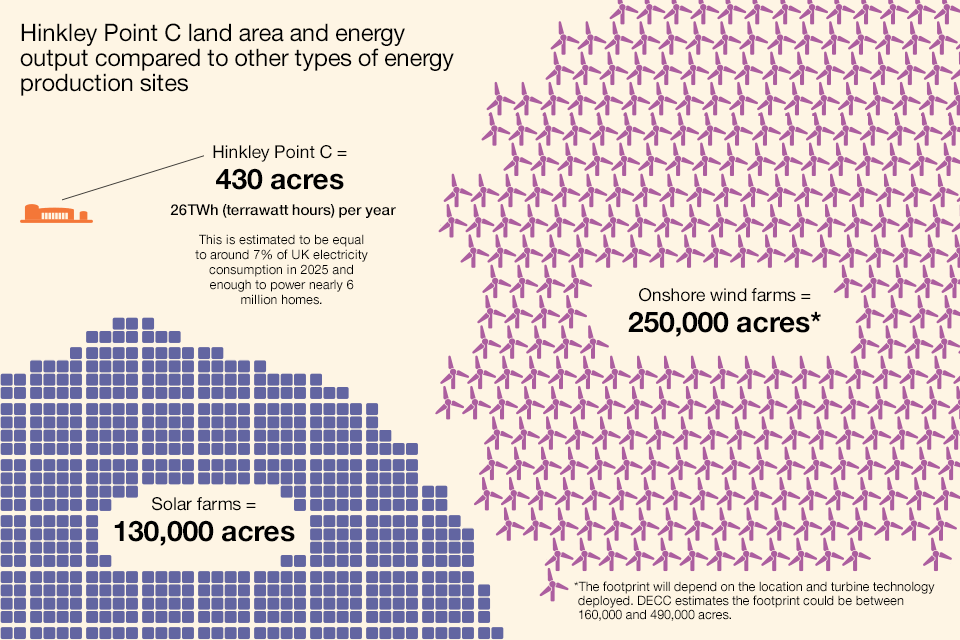
[ UPDATE 2 : Hinkley Point C may take up only 430 acres of space, but will have a much large land footprint in total. First off, there’s the land that will be required for the radioactive waste depository, wherever that turns out to be. Then there’s all the despoiled land from uranium mining. What ? It’s in other countries, so it doesn’t count ? Then there’s the land required for the uranium ore processing and refining facilities. And to cap it all, once a piece of land has been used for the nuclear power project and the mines and facilities it depends on, much of that land could be lost permanently. With wind power, if you want the land back, you can have it if you need it. No radioactive waste. No massive concrete edifices. No spent fuel ponds. No cancer-causing mine tailing ponds… ]

[ UPDATE 3 : The Government infographic issued with the press release suggests that the 6,000 wind turbines prevented by Hinkley C would take up 250,000 acreas. Does anybody really believe that each of the 6,000 wind turbines that Hinkley C might prevent each take up 42 acres of space ? That’s genuinely unbelievable. No, it’s ridiculous. ]

[ UPDATE 4 : I’ve worked out why DECC thinks that 6,000 wind turbines would be needed to match the output of a 3.2 GW nuclear power station – they are assuming that the wind turbines can only be counted on for around about 20% of the time. If all the turbines are rated as 2.4 MW, and they can only be counted on for 22% of that, each turbine would have an effective (de-rated) capacity of 0.528 MW, meaning that to make the equivalent of a 3.2 GW plant, you would need 6,060 wind turbines. ]


https://www.telegraph.co.uk/finance/personalfinance/consumertips/household-bills/10395104/Nuclear-power-station-will-avoid-blight-of-30000-wind-turbines-minister-says.html

Nuclear power station will avoid ‘blight’ of 30,000 wind turbines, minister says

A new generation of nuclear power stations will avoid the “blight” of
building tens of thousands of wind turbines in the countryside, a
minister has said.

Britain’s first new nuclear power station in a generation is to be
built under a £16 billion project which will create thousands of new
jobs.

By Steven Swinford, Senior Political Correspondent
21 Oct 2013

The government has defended a decision to hand a French company
billions of pounds in subsidies to build Britain’s first new nuclear
power plant for a generation.

Ministers said they want to build a new generation of 12 new nuclear
reactors to ensure that people can “turn on the kettle” and to help
“keep the lights on”.

The Department for Energy and Climate Change said that Britain would
need to build more than 30,000 onshore wind turbines to produce the
same amount of energy, seven times the number currently in operation.

Michael Fallon, the Conservative energy minister, said that nuclear
power stations will ultimately prove a cheaper and less controversial
alternative.

He told The Daily Telegraph: “This is the first in a wave of new
nuclear plants to replace the ageing fleet that Labour did nothing to
tackle.

“Without new nuclear local people would face many thousands more wind
farms blighting our landscape. By contrast, nuclear power is popular
in areas that have existing stations and will deliver significant jobs
and investment.”

The deal, which prompted warnings that household bills could rise to
cover the costs of building the plant, was announced by David Cameron
during a visit to Hinkley Point in Somerset.

Experts have warned that Britain is facing an energy crisis, with all
but one of the country’s nuclear power station stations due to close
by 2023.

The government has disclosed that the new reactors at Hinkley B in
Somerset alone will produce the same amount of energy as 6,000 wind
turbines built on 250,000 acres of land.

Ministers hope to meet Britain’s future energy needs by building 12
reactors across five sites.

However, despite agreement between Liberal Democrats and Conservatives
on the need for new nuclear power stations Mr Fallon’s comments are
still likely to provoke a Coalition split.

The Conservatives are opposed to building more onshore wind farms,
with David Cameron saying earlier this year that he “wouldn’t expect”
many more to be built in Britain.

The Liberal Democrats only accepted building nuclear power stations as
part of their party policy at their conference last month and highly
supportive of wind energy.

In contrast to Mr Fallon’s comments Ed Davey, the energy secretary,
said that onshore wind turbines remained “very competitive” and that
their costs were continuing to fall.

The deal to build the £14 billion Hinkley Point plant in Somerset with
French company EDF Energy has provoked a new row over rising energy
bills.

The government is guaranteeing the price for each megawatt hour of
power produced by the plant at £92.50, twice the present wholesale
price, ensuring billions of pounds of income for EDF Energy.

Analysts have suggested that the move could increase household energy
bills by £8 a year, but Mr Davey yesterday said it would be cheaper
than building wind turbines instead.

He claimed that a new generation of nuclear power stations will reduce
the average British energy bill by £77 a year from 2030. He admitted
however, that he could not “guarantee” that people’s household bills
would fall.

He said: “There’s huge amounts of uncertainties here. What’s the gas
price going to do, how quickly will the cost of wind power go down.
Will we get carbon capture and storage to be commercially viable?
These are inherent uncertainties.”

Mr Davey said that building the power station will create jobs for
25,000 people, although he was unable to confirm how many will be for
British workers.

The debate over the scale of the subsidy for EDF comes as the company
prepares to raise prices for its 5 million customers. On Monday Npower
became the latest energy company to raise prices, announcing that
customers will face a hike of 10.4 per cent.

Mr Davey confirmed he confronted EDF executives about price rises in
the back of a car on the way back from Hinkley Point yesterday. They
declined to tell him if they were raising prices.

Vincent de Rivaz, the chief executive of EDF Energy, claimed the
company had yet to make a decision but insisted that any price rise
would be at the “lowest possible level”.

Mr Davey yesterday insisted that consumers would be protected from any
hikes in costs and that EDF Energy would share in the “pain”.

He also dismissed security concerns over Chinese investment in British
nuclear power stations.

Under the deal, the China Nuclear Power Group and China National
Nuclear Corporation will investing in the scheme. However Bob Stewart,
a back-bench Tory MP, said: “I am really concerned. We are in a benign
environment at the moment but say things turn out quite differently,
we could be running risks with our infrastructure”.

Mr Davey said: “We are moving to a new era where we can work with the
Chinese and indeed other foreign states.”

During a visit to Hinkley Point, Mr Cameron said: “This government has
a long-term economic plan for Britain, and we’re delivering, including
this vital nuclear power station which we hope will be the first of
several other nuclear power stations, kick-starting again this
industry, providing thousands of jobs and providing long-term safe and
secure supplies of electricity far into the future.”

Danny Alexander, the Chief Secretary to the Treasury, will announce
that an offshore wind farm off the Scottish coast is among
infrastructure projects in line for Government financial guarantees.

The Neart Na Gaoithe wind farm in the Forth Estuary is one of a list
of 16 major projects that could get Treasury backing, Mr Alexander
will announce.

Categories
Baseload is History Efficiency is King Electrificandum Energy Change Energy Insecurity Energy Revival Solar Sunrise Solution City The Price of Gas Western Hedge Wind of Fortune

The Economist : Annoying Power


I generally avoid reading The Economist magazine – apart from the Science and Technology section – as it tends to make my blood boil. The writing style frequently includes such things that I would describe as casual generalisation, unquestioned third party claims, suppositions used in place of factual account, and the selective use of statistics to construct meaning – all of which have the power to annoy. Sometimes an article has so many trigger points, that I simply cannot finish reading it.

This week I risked reading an article recommended to me about power generation in Europe, and I was pretty soon gnashing my teeth and wailing. I was indignant because the arguments being used ignored vital parts of European energy policy, and just parroted the complaints of utility companies, without challenging them, whilst at the same time ignoring the energy sector blackmail and brinkmanship. The article contradicted itself about energy investment and energy prices, and failed to make the case for utilities to diversify in order to survive.

First of all – the contradictions. In The Economist magazine of 12th October 2013, the article entitled “How to lose half a trillion euros”, contains these two sections :-

“[…] During the 2000s, European utilities overinvested in generating capacity from fossil fuels, boosting it by 16% in Europe as a whole and by more in some countries […] The market for electricity did not grow by nearly that amount, even in good times; then the financial crisis hit demand. According to the International Energy Agency, total energy demand in Europe will decline by 2% between 2010 and 2015.”

“[…] the old-fashioned utilities […] So far, it is true, they have managed to provide backup capacity and the grid has not failed, even in solar- and wind-mad Germany. […] But […] it is getting harder to maintain grid stability. […] The role of utilities as investors is […] being threatened. […]”

How can the privatised power utilities on the one hand have “overinvested”, and at the same time not invested enough to protect the grid in future ?

The article writer misses several key points. The underlying reasons for investment in Europe in fossil fuel-fired generation during the 2000s was not in anticipation of higher power demand. The vast majority of new investment in the period 2000 to 2010 in the European Union was in Natural Gas-fired power plants, in anticipation of carbon emissions control and other environmental policy, and in anticipation of the retirement of a number of power plants reaching the ends of their lives. It was also viewed as a no-regrets option given there were plans to diversify the unified European power market to increase competitiveness – incorporating new, smaller players, and new, variable renewable power resources. Flexible gas generation would therefore always be in demand – the ability to turn off and on as required. Requiring gas plants to operate flexibly divorces generation capacity from generation demand, and so invalidates The Economist writer’s statement.

And on to the problem of a contradiction over prices :-

“[…] Renewable, low-carbon energy accounts for an ever-greater share of production. It is helping push wholesale electricity prices down, and could one day lead to big reductions in greenhouse-gas emissions. For established utilities, though, this is a disaster. […] In short, they argue, the growth of renewable energy is undermining established utilities and replacing them with something less reliable and much more expensive. […]”

How can renewable electricity be lowering the prices of wholesale power, and yet also be replacing established utilities with something “much more expensive” ?

I think the clue for this poor reasoning lies with a faulty interpretation of Germany’s Renewable Energy Surcharge – the EEG-Umlage, which is held up as the proof that green power costs more than fossil fuel power. The article says :-

“[…] Electricity prices have fallen from over €80 per MWh at peak hours in Germany in 2008 to just €38 per MWh now […] These are wholesale prices; residential prices are €285 per MWh, some of the highest in the world, partly because they include subsidies for renewables that are one-and-a-half times, per unit of energy, the power price itself). […]”


The Economist’s calculation of the green power subsidies at “one-and-a-half times” the wholesale power price is €57/MWh, so that’s only 20% of the total price of power to the consumer. Other costs besides the actual wholesale cost of the electricity, add up to €190, 67% of the cost of power to the household – far more of an impact than the renewable energy subsidies. I found the data from the BDEW to confirm these figures – from the “Power prices for households” presentation for May 2013, the price of electricity for consumers (for a standard three person house) is at €287.3/MWh, and the combination of Renewable Energy surcharges – including the VAT and the Offshore Wind surcharge – come to €59.82/MWh. So the numbers aren’t wrong, but the way The Economist article paragraph is written it gives the impression that asking end consumers to pay the costs of transitioning to green power is a huge burden. It’s not.

These charges to households would be less if all energy users were to participate in paying for the renewable energy subsidies – but some companies do not, using the argument of anti-competitiveness. If they have to pay the surcharge, they reason, they will lose business to other countries. Quite effective blackmail, burdening the end consumer with higher power bills. In addition the electricity supply companies are trying to maintain their profit margins so may not be passing all the reductions in power costs to their consumers. One calculation suggests the total cost of Germany’s power will reduce by over €5.5 billion in 2014, and yet household electricity costs are expected to rise. The heightening effect of the Renewable Energy Act (EEG) surcharge on power prices is not going to last forever, however, as it’s promoting cheaper wholesale prices, and building in protection from the risks of sharply-rising prices for fossil fuels. Electricity supply companies are going to be able to sell progressively cheaper energy, and this differential will eventually reach the consumers, even if that needs to be legislatively enforced.

Next, on to the assertion that increasing renewable electricity is pushing flexible gas-fired power generation out of the frame :-

“[…] Renewables have “grid priority”, meaning the grid must take their electricity first. This is a legal requirement, to encourage renewable energy in Europe. But it is also logical: since the marginal cost of wind and solar power is zero, grids would take their power first anyway. […] But unlike the baseload providers already in place (nuclear and coal), solar and wind power are intermittent, surging with the weather. […] Now, when demand fluctuates, it may not be enough just to lower the output of gas-fired generators. Some plants may have to be switched off altogether and some coal-fired ones turned down. […] It is costly because scaling back coal-fired plants is hard. It makes electricity prices more volatile. And it is having a devastating effect on profits. […] Gérard Mestrallet, chief executive of GDF Suez, the world’s largest electricity producer, says 30GW of gas-fired capacity has been mothballed in Europe since the peak, including brand-new plants. The increase in coal-burning pushed German carbon emissions up in 2012-13, the opposite of what was supposed to happen.”

The real core of this issue is that baseload is history – or it should be – and it will be for Germany in the near future – as some coal-fired power plants will need to close or be transitioned under the Large Combustion Plants Directive, and it’s successor, the Industrial Emissions Directive (9,000 coal-fired installations will be affected by the IED); and the nuclear power plants are all scheduled to close. It is very unlikely that much in the way of new European nuclear power will come on-stream within the next 15 years. The price of coal fuel might stay reasonable, due to a number of factors, but the cost of burning it is likely to become higher, so the baseload paradigm should be well and truly broken.

That gas-fired power plants would be finding profit margins slim is something that has been anticipated widely, so it’s not exactly a shock, although it’s being used as a bargaining chip by utilities in ongoing negotations to launch an EU-wide “Capacity Market” for flexible power generation (principally gas, of course, since neither nuclear nor coal are flexible, and coal is practically on the edge of extinction in policy terms).

CapGemini has recently published a scaremongering projection :-

“[…] Gas plant closures : One of the biggest impacts of the disturbed gas and electricity markets is the rapid closure of numerous gas plants in the region. A recent study by IHS estimates that about 130,000 MW (130 GW) of gas plants across Europe (around 60% of the total installed gas fired generation in the Region) are currently not recovering their fixed costs and are at a risk of closure by 2016. These plants – essential to safeguarding security of supply during peak hours – are being replaced by volatile and unforecastable renewable energy installations that are heavily subsidised. […]”

And other sources are also pushing the doom and gloom :-

“[…] The pain being suffered by owners of European gas-fired power plant has escalated over the last 12 months. Weak power demand, subsidised renewable build and relatively high gas prices have conspired to crush gas fired generation margins […] It is difficult to imagine how market sentiment around gas-fired plant could get much worse. About a year ago we questioned the prospect of a European gas plant bust in the form of plant mothballing, closures and the distressed sale of assets. There is clear evidence of a bust gathering steam in 2013, with a number of utilities pursuing exactly these actions. […]”

Instead of complaining and game-playing, electricity utilities should accept the need to adapt. In line with EU Directives, they can expect to be able to make a good profit by diversifying into energy services – so they end up not simply selling energy, but selling energy demand control. They would move from being E. Co.’s to ESCOs. If they accept the challenge to diversify, they can keep their shareholders happy, and they will be able to survive the slim margins they can make from gas-fired electricity generation during periods of peak demand, or to load balance grids increasingly dependent on renewable electricity generation.

If the power utilities fail to adapt, they’re not too big to fail. I would suggest that European Governments renationalise them, as we’re going to have to fork out gazillions of euros to keep the Capacity Market running the way the utilities would like, so we might as well own the assets, too.

Categories
Bioeffigy Biofools Biomess Forestkillers

Blink, and it’s logged


They took all the trees, and put ’em in a tree museum…“, or in this case – burned them in a biomass power plant.

Please read this very important report on global bioenergy strategy and ask yourself this question, “Who agreed to this ?”

And then, maybe consider coming to this meeting :-

“A Burning Issue – Biomass and its impacts on forests and communities”
29th October 2013
19:00 – 21:00
Lumen Centre, London

“At this event we are launching our new report “Biomass: the Chain of Destruction” which tracks the impacts of the rapidly growing industry using biomass for electricity generation – from the cleared forests of the Americas to the communities in the UK living in the shadow of it.”

“We will be hearing from speakers who will tell us about the thousands of hectares of eucalyptus plantations that have replaced diverse ecosystems and communities in the Brazillian state of Maranhão. We will also hear about the clear-felling of ancient wetland forests in the Southern US to fuel Drax and E-On’s switch to so-called “clean” biomass energy. Lastly we will hear about the struggles of communities in the UK fighting unfair planning, poor air quality and environmental injustice.”

“The event is free but please email us to let us know you are coming biofuelwatch@ymail.com

“For more details please see our website: https://www.biofuelwatch.org.uk/2013/burning_issue_public_event/

Categories
Climate Change Climate Chaos Climate Damages

This post has had 26,783 views

This Forbes “op/ed” or “opposite the editorial page” article entitled “The True Global Warming Crisis: The Fibs Underlying The Theory” posted on the Internet has had, at the last count, 26,783 views, despite the fact that it appears to me that it’s not dissimilar to a sackload of rotting spume.

I am so totally fed up with reading this kind of, what I read as, convoluted diatribe, written in a style that I consider to be cant, bile or just ill-informed and ill-intentioned sensationalist claptrap.

Professor of Meteorology at MIT, Dr Richard “Dick” Lindzen has totally let himself, and the whole of world, down, in my view, with this quotation in the article :-

“The latest IPCC report truly sank to the level of hilarious incoherence – it is quite amazing to see the contortions the IPCC has to go through in order to keep the international climate agenda going.”

The article claims, apparently in total ignorance, that “the IPCC actually admitted that its 2007 report estimate of greenhouse gas influence had been significantly exaggerated”, which would be a scandal if the article writer had any foundation for that claim, but is so patently untrue that I don’t really know how the Forbes editors didn’t wonder whether they should publish this or not.

And the following is, I feel, simply facetious, in a section claiming that global warming has stopped, essentially – “some beleaguered IPCC participants wasted no time latching onto a hail-Mary hypothesis advanced by New Zealander Kevin Trenberth that the oceans ate their recent global warming temperatures.”

To put the author, Larry Bell, in the picture, THERE IS NO PAUSE – global warming of the whole Earth system has carried on unabated – it’s just that the surface air temperatures (a small part of the picture) have hit a bit of a hiatus in their inexorable climb – due to cyclic variations in climate patterns.

It seems Larry Bell doesn’t know this, because it’s unlikely that he’s read the science, especially the latest IPCC report. So why should he expect you to read what he has written and accept it ? Why has he, indeed, bothered to write this piece, that gives to me a good impression of being useless waste and an insult to intelligence ?

I think it is really time for what looks like malicious nonsense to me – like this article – to be refused publication. It seems to be not based on fact, merely on ideologically-motivated and borrowed opinion. Would Larry Bell ever condescend to hold an original opinion, I ask myself ? And would he ever base an article about climate change on the science ?

Deep questions, I’m sure you’ll agree, when you’ve stopped chastising me for urging censorship of what I see as downright non-scientific and dubious verbiage dressed up badly as informed opinion.

Set phasers to stun.

Categories
Assets not Liabilities Big Number Big Picture Big Society Biofools Biomess British Sea Power Burning Money Carbon Army Carbon Capture Carbon Pricing Change Management Climate Change Climate Chaos Climate Damages Coal Hell Conflict of Interest Corporate Pressure Cost Effective Dead End Dead Zone Demoticratica Design Matters Direction of Travel Disturbing Trends Dreamworld Economics Efficiency is King Electrificandum Emissions Impossible Energy Autonomy Energy Change Energy Denial Energy Insecurity Energy Revival Energy Socialism Engineering Marvel Environmental Howzat Food Insecurity Forestkillers Fossilised Fuels Genetic Modification Geogingerneering Green Investment Green Power Growth Paradigm Health Impacts Hide the Incline Human Nurture Incalculable Disaster Insulation Major Shift Mass Propaganda Media Money Sings National Energy National Power Neverending Disaster No Pressure Nuclear Nuisance Nuclear Shambles Optimistic Generation Peak Coal Policy Warfare Political Nightmare Price Control Protest & Survive Public Relations Realistic Models Regulatory Ultimatum Renewable Resource Resource Curse Resource Wards Solution City Technofix Technological Fallacy Technological Sideshow Technomess The Price of Gas The Price of Oil The War on Error Tree Family Ungreen Development Western Hedge Wind of Fortune

Mind the Gap : BBC Costing the Earth

I listened to an interesting mix of myth, mystery and magic on BBC Radio 4.

Myths included the notion that long-term, nuclear power would be cheap; that “alternative” energy technologies are expensive (well, nuclear power is, but true renewables are most certainly not); and the idea that burning biomass to create heat to create steam to turn turbines to generate electricity is an acceptably efficient use of biomass (it is not).

Biofuelwatch are hosting a public meeting on this very subject :-
https://www.biofuelwatch.org.uk/2013/burning_issue_public_event/
“A Burning Issue – biomass and its impacts on forests and communities”
Tuesday, 29th October 2013, 7-9pm
Lumen Centre, London (close to St Pancras train station)
https://www.lumenurc.org.uk/lumencontact.htm
Lumen Centre, 88 Tavistock Place, London WC1H 9RS

Interesting hints in the interviews I thought pointed to the idea that maybe, just maybe, some electricity generation capacity should be wholly owned by the Government – since the country is paying for it one way or another. A socialist model for gas-fired generation capacity that’s used as backup to wind and solar power ? Now there’s an interesting idea…


https://www.bbc.co.uk/programmes/b03cn0rb

“Mind the Gap”
Channel: BBC Radio 4
Series: Costing the Earth
Presenter: Tom Heap
First broadcast: Tuesday 15th October 2013

Programme Notes :

“Our energy needs are growing as our energy supply dwindles.
Renewables have not come online quickly enough and we are increasingly
reliant on expensive imported gas or cheap but dirty coal. Last year
the UK burnt 50% more coal than in previous years but this helped
reverse years of steadily declining carbon dioxide emissions. By 2015
6 coal fired power stations will close and the cost of burning coal
will increase hugely due to the introduction of the carbon price
floor. Shale gas and biomass have been suggested as quick and easy
solutions but are they really sustainable, or cheap?”

“Carbon Capture and Storage could make coal or gas cleaner and a new
study suggests that with CCS bio energy could even decrease global
warming. Yet CCS has stalled in the UK and the rest of Europe and the
debate about the green credentials of biomass is intensifying. So what
is really the best answer to Britain’s energy needs? Tom Heap
investigates.”

00:44 – 00:48
[ Channel anchor ]
Britain’s energy needs are top of the agenda in “Costing the Earth”…

01:17
[ Channel anchor ]
…this week on “Costing the Earth”, Tom Heap is asking if our
ambitions to go green are being lost to the more immediate fear of
blackouts and brownouts.

01:27
[ Music : Arcade Fire – “Neighbourhood 3 (Power Out)” ]

[ Tom Heap ]

Energy is suddenly big news – central to politics and the economy. The
countdown has started towards the imminent shutdown of many coal-fired
power stations, but the timetable to build their replacements has
barely begun.

It’ll cost a lot, we’ll have to pay, and the politicians are reluctant
to lay out the bill. But both the official regulator and industry are
warning that a crunch is coming.

So in this week’s “Costing the Earth”, we ask if the goal of clean,
green and affordable energy is being lost to a much darker reality.

02:14
[ Historical recordings ]

“The lights have started going out in the West Country : Bristol,
Exeter and Plymouth have all had their first power cuts this
afternoon.”

“One of the biggest effects of the cuts was on traffic, because with
the traffic lights out of commission, major jams have built up,
particularly in the town centres. One of the oddest sights I saw is a
couple of ladies coming out of a hairdressers with towels around their
heads because the dryers weren’t working.”

“Television closes down at 10.30 [ pm ], and although the cinemas are
carrying on more or less normally, some London theatres have had to
close.”

“The various [ gas ] boards on both sides of the Pennines admit to
being taken by surprise with today’s cold spell which brought about
the cuts.”

“And now the major scandal sweeping the front pages of the papers this
morning, the advertisement by the South Eastern Gas Board recommending
that to save fuel, couples should share their bath.”

[ Caller ]
“I shall write to my local gas board and say don’t do it in
Birmingham. It might be alright for the trendy South, but we don’t
want it in Birmingham.”

03:13
[ Tom Heap ]

That was 1974.

Some things have changed today – maybe a more liberal attitude to
sharing the tub. But some things remain the same – an absence of
coal-fired electricity – threatening a blackout.

Back then it was strikes by miners. Now it’s old age of the power
plants, combined with an EU Directive obliging them to cut their
sulphur dioxide and nitrous oxide emissions by 2016, or close.

Some coal burners are avoiding the switch off by substituting wood;
and mothballed gas stations are also on standby.

But Dieter Helm, Professor of Energy Policy at the University of
Oxford, now believes power cuts are likely.

03:57
[ Dieter Helm ]

Well, if we take the numbers produced by the key responsible bodies,
they predict that there’s a chance that by the winter of 2-15 [sic,
meaning 2015] 2-16 [sic, meaning 2016], the gap between the demand for
electricity and the supply could be as low as 2%.

And it turns out that those forecasts are based on extremely
optimistic assumptions about how far demand will fall in that period
(that the “Green Deal” will work, and so on) and that we won’t have
much economic growth.

So basically we are on course for a very serious energy crunch by the
winter of 2-15 [sic, meaning 2015] 2-16 [sic, meaning 2016], almost
regardless of what happens now, because nobody can build any power
stations between now and then.

It’s sort of one of those slow motion car crashes – you see the whole
symptoms of it, and people have been messing around reforming markets
and so on, without addressing what’s immediately in front of them.

[ Tom Heap ]

And that’s where you think we are now ?

[ Dieter Helm ]

I think there’s every risk of doing so.

Fortunately, the [ General ] Election is a year and a half away, and
there’s many opportunities for all the political parties to get real
about two things : get real about the energy crunch in 2-15 [sic,
meaning 2015] 2-16 [sic, meaning 2016] and how they’re going to handle
it; and get real about creating the incentives to decarbonise our
electricity system, and deal with the serious environmental and
security and competitive issues which our electricity system faces.

And this is a massive investment requirement [ in ] electricity : all
those old stations retiring [ originally built ] back from the 1970s –
they’re all going to be gone.

Most of the nuclear power stations are coming to the end of their lives.

We need a really big investment programme. And if you really want an
investment programme, you have to sit down and work out how you’re
going to incentivise people to do that building.

[ Tom Heap ]

If we want a new energy infrastructure based on renewables and
carbon-free alternatives, then now is the time to put those incentives
on the table.

The problem is that no-one seems to want to make the necessary
investment, least of all the “Big Six” energy companies, who are
already under pressure about high bills.

[ “Big Six” are : British Gas / Centrica, EdF Energy (Electricite
de France), E.On UK, RWE npower, Scottish Power and SSE ]

Sam Peacock of the energy company SSE [ Scottish and Southern Energy ]
gives the commercial proof of Dieter’s prediction.

If energy generators can’t make money out of generating energy,
they’ll be reluctant to do it.

[ Sam Peacock ]

Ofgem, the energy regulator, has looked at this in a lot of detail,
and said that around 2015, 2016, things start to get tighter. The
reason for this is European Directives, [ is [ a ] ] closing down some
of the old coal plants. And also the current poor economics around [
or surround [ -ing ] ] both existing plant and potential new plant.

So, at the moment it’s very, very difficult to make money out of a gas
plant, or invest in a new one. So this leads to there being, you know,
something of a crunch point around 2015, 2016, and Ofgem’s analysis
looks pretty sensible to us.

[ Tom Heap ]

And Sam Peacock lays the blame for this crisis firmly at the Government’s door.

[ Sam Peacock ]

The trilemma, as they call it – of decarbonisation, security of supply
and affordability – is being stretched, because the Government’s
moving us more towards cleaner technologies, which…which are more
expensive.

However, if you were to take the costs of, you know, the extra costs
of developing these technologies off government [ sic, meaning
customer ] bills and into general taxation, you could knock about over
£100 off customer bills today, it’ll be bigger in the future, and you
can still get that much-needed investment going.

So, we think you can square the circle, but it’s going to take a
little bit of policy movement [ and ] it’s going to take shifting some
of those costs off customers and actually back where the policymakers
should be controlling them.

[ KLAXON ! Does he mean controlled energy prices ? That sounds a bit
centrally managed economy to me… ]

[ Tom Heap ]

No surprise that a power company would want to shift the pain of
rising energy costs from their bills to the tax bill.

But neither the Government nor the Opposition are actually proposing this.

Who pays the premium for expensve new energy sources is becoming like
a game of pass the toxic parcel.

[ Reference : https://en.wikipedia.org/wiki/Hot_potato_%28game%29 ]

I asked the [ UK Government Department of ] Energy and Climate Change
Secretary, Ed Davey, how much new money is required between now and
2020.

08:06

[ Ed Davey ]

About £110 billion – er, that’s critical to replace a lot of the coal
power stations that are closing, the nuclear power stations that are [
at the ] end of their lives, and replace a lot of the network which
has come to the end of its life, too.

So it’s a huge, massive investment task.

[ Tom Heap ]

So in the end we’re going to have to foot the bill for the £110 billion ?

[ Ed Davey ]

Yeah. Of course. That’s what happens now. People, in their bills that
they pay now, are paying for the network costs of investments made
several years, even several decades ago.

[ Yes – we’re still paying through our national nose to dispose of
radioactive waste and decommission old nuclear reactors. The liability
of it all weighs heavily on the country’s neck… ]

And there’s no escaping that – we’ve got to keep the lights on – we’ve
got to keep the country powered.

You have to look at both sides of the equation. If we’re helping
people make their homes more inefficient [ sic, meaning energy
efficient ], their product appliances more efficient, we’re doing
everything we possibly can to try to help the bills be kept down,

while we’re having to make these big investments to keep the lights
on, and to make sure that we don’t cook the planet, as you say.

[ Tom Heap ]

You mention the lights going out. There are predictions that we’re
headed towards just 2% of spare capacity in the system in a few years’
time.

Are you worried about the dangers of, I don’t know, maybe not lights
going out for some people, but perhaps big energy users being told
when and when [ sic, meaning where ] they can’t use power in the
winter ?

[ Ed Davey ]

Well, there’s no doubt that as the coal power stations come offline,
and the nuclear power plants, er, close, we’re going to have make sure
that new power plants are coming on to replace them.

And if we don’t, there will be a problem with energy security.

Now we’ve been working very hard over a long time now to make sure we
attract that investment. We’ve been working with Ofgem, the regulator;
with National Grid, and we’re…

[ Tom Heap ]

…Being [ or it’s being ] tough. I don’t see companies racing to come
and fill in the gap here and those coal power plants are going off
soon.

[ Ed Davey ]

…we’re actually having record levels of energy investment in the country.

The problem was for 13 years under the last Government
[ same old, same old Coalition argument ] we saw low levels of investment
in energy, and we’re having to race to catch up, but fortunately we’re
winning that race. And we’re seeing, you know, billions of pounds
invested but we’ve still got to do more. We’re not there. I’m not
pretending we’re there yet. [ Are we there, yet ? ] But we do have the
policies in place.

So, Ofgem is currently consulting on a set of proposals which will
enable it to have reserve power to switch on at the peak if it’s
needed.

We’re, we’ve, bringing forward proposals in the Energy Bill for what’s
called a Capacity Market, so we can auction to get that extra capacity
we need.

So we’ve got the policies in place.

[ Tom Heap ]

Some of Ed Davey’s policies, not least the LibDem [ Liberal Democrat
Party ] U-turn on nuclear, have been guided by DECC [ Department of
Energy and Climate Change ] Chief Scientist David MacKay, author of
the influential book “Renewable Energy without the Hot Air” [ sic,
actually “Sustainable Energy without the Hot Air” ].

Does he think the lights will dim in the second half of this decade ?

[ David MacKay ]

I don’t think there’s going to be any problem maintaining the capacity
that we need. We just need to make clear where Electricity Market
Reform [ EMR, part of the Energy Bill ] is going, and the way in which
we will be maintaining capacity.

[ Tom Heap ]

But I don’t quite understand that, because it seems to me, you know,
some of those big coal-fired power stations are going to be going off.
What’s going to be coming in their place ?

[ David MacKay ]

Well, the biggest number of power stations that’s been built in the
last few years are gas power stations, and we just need a few more gas
power stations like that, to replace the coal
, and hopefully some
nuclear power stations will be coming on the bars, as well as the wind
farms that are being built at the moment.

[ Tom Heap ]

And you’re happy with that increase in gas-fired power stations, are
you ? I mean, you do care deeply, personally, about reducing our
greenhouse gases, and yet you’re saying we’re going to have to build
more gas-fired power stations.

[ David MacKay ]

I do. Even in many of the pathways that reach the 2050 target, there’s
still a role for gas in the long-term, because some power sources like
wind and solar power are intermittent, so if you want to be keeping
the lights on in 2050 when there’s no wind and there’s no sun, you’re
going to need some gas power stations there
. Maybe not operating so
much of the time as they do today, but there’ll still be a role in
keeping the lights on.

[ KLAXON ! If gas plants are used only for peak periods or for backup to
renewables, then the carbon emissions will be much less than if they are
running all the time. ]

[ Tom Heap ]

Many energy experts though doubt that enough new wind power or nuclear
capacity could be built fast enough to affect the sums in a big way by
2020.

But that isn’t the only critical date looming over our energy system.
Even more challenging, though more distant, is the legally binding
objective of cutting greenhouse gas emissions in 2050.

David MacKay wants that certainty to provide the foundation for energy
decisions, and he showed me the effect of different choices with the
“Ultimate Future Energy App”. I was in his office, but anyone can try it online.

[ David MacKay ]

It’s a 2050 calculator. It computes energy demand and supply in
response to your choices, and it computes multiple consequences of
your choices. It computes carbon consequences. It also computes for
you estimates of air quality, consequences of different choices;
security of supply, consequences; and the costs of your choices.

So with this 2050 calculator, it’s an open source tool, and anyone can
go on the web and use the levers to imagine different futures in 2050
of how much action we’ve taken in different demand sectors and in
different supply sectors.

The calculator has many visualisations of the pathway that you’re choosing
and helps people understand all the trade-offs… There’s no silver
bullet for any of this. If I dial up a pathway someone made earlier,
we can visualise the implications in terms of the area occupied for
the onshore wind farms, and the area in the sea for the offshore wind
farms, and the length of the wave farms that you’ve built, and the
land area required for energy crops.

And many organisations have used this tool and some of them have given
us their preferred pathway. So you can see here the Friends of the
Earth have got their chosen pathway, the Campaign to Protect Rural
England, and various engineers like National Grid and Atkins have got
their pathways.

So you can see alternative ways of achieving our targets, of keeping
the lights on and taking climate change action. All of those pathways
all meet the 2050 target, but they do so with different mixes.

[ Tom Heap ]

And your view of this is you sort of can’t escape from the scientific
logic and rigour of it. You might wish things were different or you
could do it differently, but you’re sort of saying “Look, it’s either
one thing or the other”. That’s the point of this.

[ David MacKay ]

That’s true. You can’t be anti-everything. You can’t be anti-wind and
anti-nuclear and anti-home insulation. You won’t end up with a plan
that adds up.

[ KLAXON ! But you can be rationally against one or two things, like
expensive new nuclear power, and carbon and particulate emissions-heavy
biomass for the generation of electricity. ]

[ Tom Heap ]

But isn’t that exactly kind of the problem that we’ve had, without
pointing political fingers, that people rather have been
anti-everything, and that’s why we’re sort of not producing enough new
energy sources ?

[ David MacKay ]

Yeah. The majority of the British public I think are in favour of many
of these sources, but there are strong minorities who are vocally
opposed to every one of the major levers in this calculator. So one
aspiration I have for this tool is it may help those people come to a
position where they have a view that’s actually consistent with the
goal of keeping the lights on.

[ Tom Heap ]

Professor MacKay’s calculator also computes pounds and pence,
suggesting that both high and low carbon electricity work out pricey
in the end.

[ David MacKay ]

The total costs of all the pathways are pretty much the same.
“Business as Usual” is cheaper in the early years, and then pays more,
because on the “Business as Usual”, you carry on using fossil fuels,
and the prices of those fossil fuels are probably going to go up.

All of the pathways that take climate change action have a similar
total cost, but they pay more in the early years, ’cause you have to
pay for things like building insulation and power stations, like
nuclear power stations, or wind power, which cost up-front, but then
they’re very cheap to run in the future.

[ KLAXON ! Will the cost of decommissioning nuclear reactors and the
costs of the waste disposal be cheap ? I think not… ]

So the totals over the 40 or 50 year period here, are much the same for these.

[ Tom Heap ]

The cheapest immediate option of all is to keep shovelling the coal.
And last year coal overtook gas to be our biggest electricity
generation source, pushing up overall carbon emissions along the way
by 4.5%

[ KLAXON ! This is not very good for energy security – look where the
coal comes from… ]

As we heard earlier, most coal-fired power stations are scheduled for
termination, but some have won a reprieve, and trees are their
unlikely saviour.

Burning plenty of wood chip [ actually, Tom, it’s not wood “chip”, it’s
wood “pellets” – which often have other things mixed in with the wood,
like coal… ] allows coal furnaces to cut the sulphur dioxide and nitrous
oxide belching from their chimneys to below the level that requires their
closure under European law.

But some enthusiasts see wood being good for even more.

16:19

[ Outside ]

It’s one of those Autumn days that promises to be warm, but currently
is rather moist. I’m in a field surrounded by those dew-laden cobwebs
you get at this time of year.

But in the middle of this field is a plantation of willow. And I’m at
Rothamsted Research with Angela Karp who’s one of the directors here.

Angela, tell me about this willow I’m standing in front of here. I
mean, it’s about ten foot high or so, but what are you seeing ?

[ Angela Karp ]

Well, I’m seeing one of our better varieties that’s on display here.
We have a demonstration trial of about ten different varieties. This
is a good one, because it produces a lot of biomass, quite easily,
without a lot of additional fertilisers or anything. And as you can
see it’s got lovely straight stems. It’s got many stems, and at the
end of three years, we would harvest all those stems to get the
biomass from it. It’s nice and straight – it’s a lovely-looking, it’s
got no disease, no insects on it, very nice, clean willow.

[ Tom Heap ]

So, what you’ve been working on here as I understand it is trying to
create is the perfect willow – the most fuel for the least input – and
the easiest to harvest.

[ Angela Karp ]

That’s absolutely correct, because the whole reason for growing these
crops is to get the carbon from the atmosphere into the wood, and to
use that wood as a replacement for fossil fuels. Without putting a lot
of inputs in, because as soon as you add fertilisers you’re using
energy and carbon to make them, and that kind of defeats the whole
purpose of doing this.

[ KLAXON ! You don’t need to use fossil fuel energy or petrochemicals or
anything with carbon emissions to make fertiliser ! … Hang on, these
are GM trees, right ? So they will need inputs… ]

[ Tom Heap ]

And how much better do you think your new super-variety is, than say,
what was around, you know, 10 or 15 years ago. ‘Cause willow as an
idea for burning has been around for a bit. How much of an improvement
is this one here ?

[ Angela Karp ]

Quite a bit. So, these are actually are some of the, if you like,
middle-term varieties. So we started off yielding about 8 oven-dry
tonnes per hectare, and now we’ve almost doubled that.

[ Tom Heap ]

How big a place do you think biomass can have in the UK’s energy
picture in the future ?

[ Angela Karp ]

I think that it could contribute between 10% and 15% of our energy. If
we were to cultivate willows on 1 million hectares, we would probably
provide about 3% to 4% of energy in terms of electricity, and I think
that’s kind of a baseline figure. We could cultivate them on up to 3
million hectares, so you can multiply things up, and we could use them
in a much more energy-efficient way.

[ KLAXON ! Is that 4% of total energy or 4% of total electricity ?
Confused. ]

[ Tom Heap ]

Do we really have 3 million hectares going a-begging for planting willow in ?

[ Angela Karp ]

Actually, surprisingly we do. So, people have this kind of myth
there’s not enough land, but just look around you and you will find
there’s lots of land that’s not used for cultivating food crops.

We don’t see them taking over the whole country. We see them being
grown synergistically with food crops.

[ KLAXON ! This is a bit different than the statement made in 2009. ]

[ Tom Heap ]

But I’d just like to dig down a little bit more into the carbon cycle
of the combustion of these things, because that’s been the recent
criticism of burning a lot of biomass, is that you put an early spike
in the amount of carbon in the atmosphere, if you start burning a lot
of biomass, because this [ sounds of rustling ], this plant is going
to be turned into, well, partly, CO2 in the atmosphere.

[ Angela Karp ]

Yes, I think that’s probably a simple and not totally correct way of
looking at it. ‘Cause a lot depends on the actual conversion process
you are using.

So some conversion processes are much more efficient at taking
everything and converting it into what you want.

Heat for example is in excess of 80%, 90% conversion efficiency.

Electricity is a little bit more of the problem. And there, what
they’re looking at is capturing some of the carbon that you lose, and
converting that back in, in carbon storage processes, and that’s why
there’s a lot of talk now about carbon storage from these power
stations.

That I think is the future. It’s a question of connecting up all parts
of the process, and making sure that’s nothing wasted.

20:02

[ Tom Heap ]

So, is wood a desirable greener fuel ?

Not according to Almuth Ernsting of Biofuelwatch, who objects to the
current plans for large-scale wood burning, its use to prop up coal,
and even its low carbon claims.

[ Almuth Ernsting ]

The currently-announced industry plans, and by that I mean existing
power stations, but far more so, power stations which are in the
planning process [ and ] many of which have already been consented –
those [ biomass ] power stations, would, if they all go ahead,
require to burn around 82 million tonnes of biomass, primarily wood,
every year. Now by comparison, the UK in total only produces around
10 million tonnes, so one eighth of that amount, in wood, for all
industries and purposes, every year.

We are looking on the one hand at a significant number of proposed,
and in some cases, under-construction or operating new-build biomass
power stations, but the largest single investment so far going into
the conversion of coal power station units to biomass, the largest and
most advanced one of which at the moment is Drax, who are, have
started to move towards converting half their capacity to burning wood
pellets.

[ Tom Heap ]

Drax is that huge former, or still currently, coal-fired power station
in Yorkshire, isn’t it ?

[ Almuth Ernsting ]

Right, and they still want to keep burning coal as well. I mean, their
long-term vision, as they’ve announced, would be for 50:50 coal and
biomass.

[ Tom Heap ]

What do you think about that potential growth ?

[ Almuth Ernsting ]

Well, we’re seriously concerned. We believe it’s seriously bad news
for climate change, it’s seriously bad news for forests, and it’s
really bad news for communities, especially in the Global South, who
are at risk of losing their land for further expansion of monoculture
tree plantations, to in future supply new power stations in the UK.

A really large amount, increasingly so, of the wood being burned,
comes from slow-growing, whole trees that are cut down for that
purpose, especially at the moment in temperate forests in North
America. Now those trees will take many, many decades to grow back
and potentially re-absorb that carbon dioxide, that’s if they’re
allowed and able to ever grow back.

[ Tom Heap ]

There’s another technology desperate for investment, which is critical
to avoiding power failure, whilst still hitting our mid-century carbon
reduction goals – CCS – Carbon Capture and Storage, the ability to
take the greenhouse gases from the chimney and bury them underground.

It’s especially useful for biomass and coal, with their relatively
high carbon emissions, but would also help gas be greener.

The Chancellor has approved 30 new gas-fired power stations, so long
as they are CCS-ready [ sic, should be “capture ready”, or
“carbon capture ready” ].

Jon Gibbons is the boss of the UK CCS Research Centre, based in an
industrial estate in Sheffield.

[ Noise of processing plant ]

Jon’s just brought me up a sort of 3D maze of galvanized steel and
shiny metal pipes to the top of a tower that must be 20 or so metres
high.

Jon, what is this ?

[ Jon Gibbons ]

OK, so this is our capture unit, to take the CO2 out of the combustion
products from gas or coal. In the building behind us, in the test rigs
we’ve got, the gas turbine or the combustor rig, we’re burning coal or
gas, or oil, but mainly coal or gas.

We’re taking the combustion products through the green pipe over
there, bringing it into the bottom of the unit, and then you can see
these big tall columns we’ve got, about 18 inches diameter, half a
metre diameter, coming all the way up from the ground up to the level
we’re at.

It goes into one of those, it gets washed clean with water, and it
goes into this unit over here, and there it meets an amine solvent, a
chemical that will react reversibly with CO2, coming in the opposite
direction, over packing. So, it’s like sort of pebbles, if you can
imagine it, there’s a lot of surface area. The gas flows up, the
liquid flows down, and it picks up the CO2, just mainly the CO2.

[ Tom Heap ]

And that amine, that chemical as you call it, is stripping the CO2 out
of that exhaust gas. This will link to a storage facility.

What would then happen to the CO2 ?

[ Jon Gibbons ]

What would then happen is that the CO2 would be compressed up to
somewhere in excess of about 100 atmospheres. And it would turn from
being a gas into something that looks like a liquid, like water, about
the same density as water. And then it would be taken offshore in the
UK, probably tens or hundreds of kilometres offshore, and it would go
deep, deep down, over a kilometre down into the ground, and basically
get squeezed into stuff that looks like solid rock. If you go and look
at a sandstone building – looks solid, but actually, maybe a third of
it is little holes. And underground, where you’ve got cubic kilometres
of space, those little holes add up to an awful lot of free space. And
the CO2 gets squeezed into those, over time, and it spreads out, and
it just basically sits there forever, dissolves in the water, reacts
with the rocks, and will stay there for millions of years.

[ Tom Heap ]

Back in his office, I asked Jon why CCS seemed to be stuck in the lab.

[ Jon Gibbons ]

We’re doing enough I think on the research side, but what we really
need to do, is to do work on a full-scale deployment. Because you
can’t work on research in a vacuum. You need to get feedback –
learning by doing – from actual real projects.

And a lot of the problems we’ve got on delivering CCS, are to do with
how you handle the regulation for injecting CO2, and again, you can
only do that in real life.

So what we need to do is to see the commercialisation projects that
are being run by the Department of Energy and Climate Change actually
going through to real projects that can be delivered.

[ Tom Heap ]

Hmm. When I talk to engineers, they’re always very passionate and
actually quite optimistic about Carbon Capture and Storage. And when
I talk to people in industry, or indeed read the headlines, not least
a recent cancellation in Norway, it always seems like a very bleak picture.

[ Jon Gibbons ]

I think people are recognising that it’s getting quite hard to get
money for low carbon technologies.

So – recent presentation we had at one of our centre meetings, was
actually a professor from the United States, Howard Herzog. And he
said “You think you’re seeing a crisis in Carbon Capture and Storage.
But what you’re actually seeing is a crisis in climate change
mitigation.”

[ KLAXON ! Priming us for a scaling back of commitment to the
Climate Change Act ? I do hope not. ]

Now, Carbon Capture and Storage, you do for no other purpose than
cutting CO2 emissions to the atmosphere, and it does that extremely
effectively. It’s an essential technology for cutting emissions. But
until you’ve got a global process that says – actually we’re going to
get on top of this problem; we’re going to cut emissions – get them to
safe level before we actually see people dying in large numbers from
climate change effects – ’cause, certainly, if people start dying,
then we will see a response – but ideally, you’d like to do it before
then. But until you get that going, then actually persuading people to
spend money for no other benefit than sorting out the climate is
difficult.

There’s just no point, you know, no country can go it alone, so you
have to get accommodation. And there, we’re going through various
processes to debate that. Maybe people will come to an accommodation.
Maybe the USA and China will agree to tackle climate change. Maybe
they won’t.

What I am fairly confident is that you won’t see huge, you know,
really big cuts in CO2 emissions without that global agreement. But
I’m also confident that you won’t see big cuts in CO2 emissions
without CCS deployment.

And my guess is there’s about a 50:50 chance that we do CCS before we
need to, and about a 50:50 chance we do it after we have to. But I’m
pretty damn certain we’re going to do it.

[ Tom Heap ]

But we can’t wait for a global agreement that’s already been decades
in the making, with still no end in sight.

We need decisions now to provide more power with less pollution.

[ Music lyrics : “What’s the plan ? What’s the plan ?” ]

[ Tom Heap ]

Dieter Helm, Professor of Energy Policy at the University of Oxford
believes we can only deliver our plentiful green energy future if we
abandon our attitude of buy-now pay-later.

[ KLAXON ! Does he mean a kind of hire purchase energy economy ?
I mean, we’re still paying for nuclear electricity from decades ago,
in our bills, and through our taxes to the Department of Energy and
Climate Change. ]

[ Dieter Helm ]

There’s a short-term requirement and a long-term requirement. The
short-term requirement is that we’re now in a real pickle. We face
this energy crunch. We’ve got to try to make the best of what we’ve
got. And I think it’s really like, you know, trying to get the
Spitfires back up again during the Battle of Britain. You know, you
patch and mend. You need somebody in command. You need someone
in control. And you do the best with what you’ve got.

In that context, we then have to really stand back and say, “And this
is what we have to do to get a serious, long-term, continuous, stable
investment environment, going forward.” In which, you know, we pay the
costs, but of course, not any monopoly profits, not any excess
profits, but we have a world in which the price of electricity is
related to the cost.”

[ KLAXON ! Is Dieter Helm proposing state ownership of energy plant ? ]

29:04

[ Programme anchor ]

“Costing the Earth” was presented by Tom Heap, and made in Bristol by
Helen Lennard.

[ Next broadcast : 16th October 2013, 21:00, BBC Radio 4 ]

Categories
Assets not Liabilities Bait & Switch Be Prepared Behaviour Changeling Big Number Big Picture Big Society Breathe Easy Burning Money Change Management Coal Hell Conflict of Interest Corporate Pressure Dead End Dead Zone Deal Breakers Delay and Deny Demoticratica Design Matters Direction of Travel Divide & Rule Dreamworld Economics Economic Implosion Emissions Impossible Energy Change Energy Denial Energy Insecurity Energy Revival Energy Socialism Foreign Investment Fossilised Fuels Fuel Poverty Green Investment Green Power Hydrocarbon Hegemony Insulation Mass Propaganda Media National Energy National Power Nuclear Nuisance Nuclear Shambles Nudge & Budge Optimistic Generation Orwells Paradigm Shapeshifter Policy Warfare Political Nightmare Price Control Public Relations Regulatory Ultimatum Social Capital Social Change Social Chaos Social Democracy Stirring Stuff Sustainable Deferment The Power of Intention The Price of Gas The Science of Communitagion The War on Error Ungreen Development Vote Loser Wind of Fortune

High Stakes Energy Chutzpah


Image Credit : Carbon Brief


After Gordon Brown MP, the UK’s former Prime Minister, was involved in several diplomatic missions around the time of the oil price spike crisis in 2008, and the G20 group of countries went after fossil fuel subsidies (causing easily predictable civil disturbances in several parts of the world), it seemed to me to be obvious that energy price control would be a defining aspect of near-term global policy.

With the economy still in a contracted state (with perhaps further contraction to follow on), national interest for industrialised countries rests in maintaining domestic production and money flows – meaning that citizens should not face sharply-rising utility bills, so that they can remain active in the economy.

In the UK, those at the fringe of financial sustainability are notoriously having to face the decision about whether to Eat or Heat, and Food Banks are in the ascendance. Various charity campaigns have emphasised the importance of affordable energy at home, and the leader of the Labour Party, Ed Miliband MP has made an energy price freeze a potential plank of his policy ahead of the push for the next General Election.

The current Prime Minister, David Cameron MP has called this commitment a “con”, as his political counterpart cannot determine the wholesale price of gas (or power) in the future.

This debate comes at a crucial time in the passage of the UK Energy Bill, as the Electricity Market Reform (EMR), a key component of this legislation has weighty subsidies embedded in it for new nuclear power and renewable energy, and also backup plants (mostly Natural Gas-fired) for periods of high power demand, in what is called the “Capacity Market“. These subsidies will largely be paid for by increases in electricity bills, in one way or another.

The EMR hasn’t yet passed into the statute books, so the majority of “green energy taxes” haven’t yet coming into being – although letters of “comfort” may have been sent to to (one or more) companies seeking to invest in new nuclear power facilities, making clear the UK Government’s monetary commitment to fully supporting the atomic “renaissance”.

With a bucketload of chutzpah, Scottish and Southern Energy (SSE) and Electricite de France’s Vincent de Rivaz blamed green energy policies for contributing to past, current and future power price rises. Both of these companies stand to gain quite a lot from the EMR, so their blame-passing sounds rather hollow.

The Daily Mail and the Daily Telegraph have seemed to me to be incendiary regarding green energy subsidies, omitting to mention that whilst the trajectory of the cost of state support for renewable energy is easily calculated, volatility in global energy markets for gas and oil – and even coal – are indeterminable. Although “scandal-hugging” (sensation equals sales) columnists and editors at the newspapers don’t seem to have an appreciation of what’s really behind energy price rises, the Prime Minister – and Ed Davey MP – have got it – and squarely placed the responsibility for energy price rises on fossil fuels.

The price tag for “green energy policies” – even those being offered to (low carbon, but not “green”) nuclear power – should be considerably less than the total bill burden for energy, and hold out the promise of energy price stabilisation or even suppression in the medium- to long-term, which is why most political parties back them.

The agenda for new nuclear power appears to be floundering – it has been suggested by some that European and American nuclear power companies are not solvent enough to finance a new “fleet” of reactors. In the UK, the Government and its friends in the nuclear industry are planning to pull in east Asian investment (in exchange for large amounts of green energy subsidies, in effect). I suspect a legal challenge will be put forward should a trade agreement of this nature be signed, as soon as its contents are public knowledge.

The anger stirred up about green energy subsidies has had a reaction from David Cameron who has not dispensed with green energy policy, but declared that subsidies should not last longer than they are needed – probably pointing at the Germany experience of degressing the solar power Feed-in Tariff – although he hasn’t mentioned how nuclear subsidies could be ratcheted down, since the new nuclear programme will probably have to rely on state support for the whole of its lifecycle.

Meanwhile, in the Press, it seems that green energy doesn’t work, that green energy subsidies are the only reason for energy bill rises, we should drop the Climate Change Act, and John Prescott MP, and strangely, a woman called Susan Thomas, are pushing coal-fired power claiming it as the cheaper, surer – even cleaner – solution, and there is much scaremongering about blackouts.


https://www.mirror.co.uk/news/uk-news/john-prescott-its-coal-power-2366172

John Prescott on why it’s coal power to the people

12 Oct 2013

We can’t just stand back and give these energy companies money to burn.

It’s only 72 days until Christmas. But the greedy big six energy companies are giving themselves an early present. SSE has just announced an inflation-beating 8.2 per cent price rise on gas and electricity.

The other five will soon follow suit, no doubt doing their best to beat their combined profit from last year of £10billion.

Their excuse now is to blame climate change. SSE says it could cut bills by £110 if Government, not the Big Six, paid for green energy ­subsidies and other environmental costs, such as free loft insulation.

So your bill would look smaller but you’d pay for it with higher taxes. Talk about smoke and mirrors.

But Tory-led governments have always been hopeless at protecting the energy security of this country.

It’s almost 40 years since Britain was hit by blackouts when the Tories forced the UK into a three-day week to conserve energy supplies.

But Ofgem says the margin of ­security between energy demand and supply will drop from 14 per cent to 4 per cent by 2016. That’s because we’ve committed to closing nine oil and coal power stations to meet EU ­environmental law and emissions targets. These targets were meant to encourage the UK to move to cleaner sources of energy.

But this government drastically reduced subsidies for renewable energy such as wind and solar, let Tory energy ministers say “enough is enough” to onshore wind and failed to get agreement on replacing old
nuclear power stations.

On top of that, if we experience a particularly cold winter, we only have a reserve of 5 per cent.

But the Government is committed to hundreds of millions pounds of subsidies to pay the energy ­companies to mothball these oil and coal power stations. As someone who ­negotiated the first Kyoto agreement in 1997 and is involved in its replacement by 2015, it is clear European emissions targets will not be met in the short term by 2020.

So we have to be realistic and do what we can to keep the lights on, our people warm and our country running.

We should keep these oil and coal power stations open to reduce the risk of blackouts – not on stand-by or mothballed but working now.

The former Tory Energy minister John Hayes hinted at this but knew he couldn’t get it past his Lib Dem Energy Secretary boss Ed Davey. He bragged he’d put the coal in coalition. Instead he put the fire in fired.

We can’t just stand back and give these energy companies money to burn. The only energy security they’re interested in is securing profit and maximising taxpayer subsidies.

That’s why Ed Miliband’s right to say he’d freeze bills for 20 months and to call for more ­transparency.

We also need an integrated mixed energy policy – gas, oil, wind, nuclear and, yes, coal.


https://www.oxfordmail.co.uk/yoursay/letters/10722697.Bills_have_risen_to_pay_for_policy_changes/?ref=arc

Letters

Bills have risen to pay for policy changes

Tuesday 8th October 2013

in Letters

THE recent Labour Party pledge to freeze energy bills demonstrated how to have a political cake and eat it. The pledge is an attempt to rectify a heinous political mistake caused by political hubris and vanity.

In 2008, the then energy minister, Ed Miliband, vowed to enact the most stringent cuts in power emissions in the entire world to achieve an unrealistic 80 per cent cut in carbon emissions by closing down fully functioning coal power stations.

He was playing the role of climate saint to win popularity and votes.

I was a member when Ed Miliband spoke in Oxford Town Hall to loud cheers from numerous low-carbon businesses, who stood to profit from his legislation. I was concerned at the impact on the consumer, since it is widely known that coal power stations offer the cheapest energy to consumers compared to nuclear and wind.

So I wrote to Andrew Smith MP at great length and he passed on my concerns to the newly-formed Department of Energy and Climate Change that had replaced the previous Department of Energy and Business.

This new department sent me a lengthy reply, mapping out their plans for wind turbines at a projected cost to the consumer of £100bn to include new infrastructure and amendments to the National Grid. This cost would be added to consumer electricity bills via a hidden green policy tariff.
This has already happened and explains the rise in utility bills.

Some consumers are confused and wrongly believe that energy companies are ‘ripping them off’.

It was clearly stated on Channel 4 recently that energy bills have risen to pay for new policy changes. These policy changes were enacted by Ed Miliband in his popularity bid to play climate saviour in 2008. Energy bills have now rocketed. So Ed has cost every single consumer in the land several hundred pounds extra on their bills each year.

SUSAN THOMAS, Magdalen Road, Oxford


LETTERS
Daily Mail
14th October 2013

[ Turned off: Didcot power station’s closure could lead to power cuts. ]

Labour’s power failures will cost us all dear

THE Labour Party’s pledge to freeze energy bills is an attempt to rectify a horrible political mistake. But it might be too late to dig us out of the financial black hole caused by political vanity.

In 2008, then Energy Minister Ed Miliband vowed to enact the most stringent cuts in power emissions in the world to achieve an unrealistic 80 per cent cut in carbon emissions by closing down coal power stations. He was playing the role of climate saint to win votes.

I was in the audience in Oxford Town Hall that day and recall the loud cheers from numerous representatives of low-carbon businesses as his policies stood to make them all rather wealthy, albeit at the expense of every electricity consumer in the land.

I thought Ed had become entangled in a spider’s web.

I was concerned at the impact on the consumer as it’s widely known that coal power stations offer the cheapest energy to consumers.

I contacted the Department of Energy and Climate Change and it sent me a lengthy reply mapping out its plans for energy projects and wind turbines – at a projected cost to the consumer of £100 billion – including new infrastructure and national grid amendments.

It explained the cost would be added to consumer electricity bills via a ‘green policy’ tariff. This has now happened and explains the rise in utility bills.

Some consumers wrongly believe the energy companies are ripping them off. In fact, energy bills have risen to pay for policy changes.

The people to benefit from this are low-carbon venture capitalists and rich landowners who reap subsidy money (which ultimately comes from the hard-hit consumer) for having wind farms on their land.

Since Didcot power station closed I’ve suffered five power cuts in my Oxford home. If we have a cold winter, we now have a one-in-four chance of a power cut.

The 2008 legislation was a huge mistake. When power cuts happen, people will be forced to burn filthy coal and wood in their grates to keep warm, emitting cancer-causing particulates.

Didcot had already got rid of these asthma-causing particulates and smoke. It emitted mainly steam and carbon dioxide which aren’t harmful to our lungs. But the clean, non-toxic carbon dioxide emitted by Didcot was classified by Mr Miliband as a pollutant. We are heading into a public health and financial disaster.

SUSAN THOMAS, Oxford


https://www.europeanvoice.com/article/2013/october/ceos-demand-reform-of-eu-renewable-subsidies/78418.aspx

CEOs demand reform of EU renewable subsidies
By Dave Keating – 11.10.2013

Companies ask the EU to stop subsidising the renewable energy sector.

The CEOs of Europe’s ten biggest energy companies called for the European Union and member states to stop subsidising the renewable energy sector on Friday (11 October), saying that the priority access given to the sector could cause widespread blackouts in Europe over the winter.

At a press conference in Brussels, Paolo Scaroni, CEO of Italian oil and gas company ENI, said: “In the EU, companies pay three times the price of gas in America, twice the price of power. How can we dream of an industrial renaissance with such a differential?”

The CEOs said the low price of renewable energy as a result of government subsidies is causing it to flood the market. They called for an EU capacity mechanism that would pay utilities for keeping electric power-generating capacity on standby to remedy this problem.

They also complained that the low price of carbon in the EU’s emissions trading scheme (ETS) is exacerbating the problem…


https://www.dailymail.co.uk/debate/article-2458333/DAILY-MAIL-COMMENT-Press-freedom-life-death-matter.html

Well said, Sir Tim

Days after David Cameron orders a review of green taxes, which add £132 to power bills, the Lib Dem Energy Secretary vows to block any attempt to cut them.

Reaffirming his commitment to the levies, which will subsidise record numbers of inefficient wind farms approved this year, Ed Davey adds: ‘I think we will see more price rises.’

The Mail can do no better than quote lyricist Sir Tim Rice, who has declined more than £1million to allow a wind farm on his Scottish estate. ‘I don’t see why rich twits like me should be paid to put up everybody else’s bills,’ he says. ‘Especially for something that doesn’t work.’

Categories
Academic Freedom Advertise Freely Bad Science Bait & Switch Big Picture Big Society Climate Change Climate Chaos Climate Damages Conflict of Interest Delay and Deny Demoticratica Divide & Rule Fair Balance Freak Science Libertarian Liberalism Mad Mad World Mass Propaganda Media Meltdown Orwells Paradigm Shapeshifter Pet Peeves Protest & Survive Public Relations Science Rules Scientific Fallacy Social Capital Social Change Social Chaos Social Democracy Sustainable Deferment The Data The Power of Intention The Right Chemistry The Science of Communitagion The War on Error Unqualified Opinion

The BBC loses its perch


Image Credit : Sea Angling Staithes

In the matter of the BBC and balance in the reporting of Climate Change, I believe they might have lost their perch. Admittedly, it wasn’t a very large perch – and some were swaying in any breeze that came along. But to invite one of the fringiest of the fringe of science “sceptics” onto a Radio 4 broadcast on the day of the publication of the Intergovernmental Panel on Climate Change Fifth Assessment Report Working Group 1 demonstrates that the BBC policy on achieving a suitable, accurate and appropriate fulcrum in the balance of science reporting is an ex-policy, a former policy, gone and pushing up the Cleeseian daisies.

Citizens have been piqued, annoyed, needled, frustrated, despairing and, frankly, appalled, and some measures have been taken to remonstrate with the BBC. One such is below. Dear Reader, your comments on the subject of media balance are welcome, unless of course you haven’t read any Climate Change science and think it’s all a hoax, that the scientists are lying, and the Earth’s climate has always gone in similar cycles to the current warming, think that Global Warming is undergoing a “pause” etc etc – because you’re wrong. Plain and simple. If you don’t accept Climate Change science, if you haven’t read any of the relevant research papers, if you haven’t taken the trouble to understand what it’s all about, you are likely to be a clanging gong, a thorn in the side, and your views may well signify nothing, and certainly shouldn’t be aired in a public broadcast without challenge.

It is time for the BBC to stop inviting Climate Change science “sceptics” – no, “deniers” onto their programmes. Once and for all. I mean, to go all Godwin on you, the BBC wouldn’t invite Adolf Hitler onto their shows to comment about the contribution that Judaism has brought to humanity, or to deny the Holocaust ? And they wouldn’t invite the CEO of a cigarette manufacture company on to insist that smoking doesn’t cause lung cancer, would they ? There is a bar, a standard, to which the BBC should aspire, on science reporting, and I feel that in this case they slid disgracefully under it and landed in a stinky puddle of failure on the studio floor. The programme editors should be ashamed, in my honest opinion.


Open letter to Tony Hall, Lord Hall of Birkenhead and Director General of the BBC, on the platform given to Prof Bob Carter on the World at One programme (Fri 27th Sept 2013)

Dear Lord Hall,

We, the undersigned scientists and engineers, write to condemn the appearance of Prof Bob Carter on BBC Radio 4’s World at One programme, and to urge the BBC to seriously rethink the treatment given to climate change in its factual programming, and particularly its coverage of the Intergovernmental Panel on Climate Change’s Fifth Assessment Report.

The BBC, uniquely amongst broadcasters, has a public duty to provide a balanced coverage of news across its media channels, yet when it comes to its coverage of climate change it has frequently failed to do so. Furthermore, the BBC’s status as a trusted source of news means that damage done by its biased reporting of the overwhelming evidence of the certainty and significance of man-made climate change is inexorably greater. Not only does this damage public trust in climate science, but it also damages public trust in scientific evidence in general. This assertion is even supported by the BBC’s own surveys on public attitudes to climate change.

The IPPC’s Assessment Reports represent the consensus of evidence and opinion from thousands of scientists and engineers around the world, working in all of the many fields encompassed by climate change. That consensus is overwhelmingly of the view that the evidence that human activities are driving changes in our climate at an unprecedented rate and scale – there is no ‘climate debate’ in the scientific community.

The appearance of Prof Carter on the World at One, and that of climate change deniers on other BBC programmes, is the equivalent of giving a stork the right to reply on every appearance by Prof Robert Winston. Prof Carter is a geologist who speaks for the “Nongovernmental International Panel on Climate Change”, or NIPCC, a name which non-experts could be forgiven for confusing with the IPCC, however Prof Carter is not a climate scientist and the NIPCC is not the IPCC.

Indeed, had the editors of the World at One bothered to check the credentials of the NIPCC they would have realised that far from being an independent organisation, it is backed by the Heartland Institute, a US-based free-market thinktank that opposes urgent action on climate change, which is itself opaquely funded by ‘family foundations’ suspected of having significant vested interests in undermining climate science. To return to the analogy, that stork would be funded by the Discovery Institute.

For climate scientists, and those of us working in related fields, it is hard enough to accept that the BBC is required to give a platform to politicians whose lack of knowledge of climate science is matched only by their unwillingness to ‘use sound science responsibly’. When the Environment Secretary Owen Paterson describes climate change as “not all bad” he may be committing an abuse of the evidence and his position, but he at least does so with the rights and responsibilities of a democratically elected Member of Parliament. However when deniers such as Prof Carter use the media to argue that the scientific consensus on climate change is anything but overwhelming, the evidence on which they claim to be basing their arguments, and their sources of funding, are frequently left unrevealed and unquestioned.

It is therefore hardly surprising that the BBC and other media outlets sometimes struggle to find climate scientists willing to speak to them, and by providing a platform for Prof Cater and other deniers the BBC is also complicit in engendering the environment in which climate scientists are often reluctant to speak to the media.

The BBC should now issue an explanation for the appearance of Prof Carter and the treatment given to his opinions on a flagship news programme. Furthermore, it should urgently review the treatment of climate change across all of its outputs, and require full disclosures of any and all vested interests held by commentators on the subject. Finally, it should also ensure that the editorial boards covering all its scientific outputs include members with appropriate scientific backgrounds who are able to give independent advice on the subject matter, and that their advice is recorded and adhered to.

Yours sincerely,

Dr Keith Baker, School of Engineering and the Built Environment, Glasgow Caledonian University

Herbert Eppel CEng CEnv, HE Translations

Ms J. Abbess MSc, Independent Energy Research

Chris Jones CEnv IEng FEI MCIBSE MIET

Mark Boulton OBE

David Hirst, Hirst Solutions Ltd

David Andrews, Chair, Claverton Energy Research Group

Ruth Jarman MA (Oxon) Chemistry, Member of the Board of Christian Ecology Link

Gordon Blair, Distinguished Professor, School of Computing and Communications, Lancaster University

Susan Chapman

David Weight, Associate Director, Aecom

Sam Chapman, En-Count

Camilla Thomson, PhD candidate, University of Edinburgh

Dr Rachel Dunk

Prof Susan Roaf, Heriot-Watt University

Helen Woodall

Ian Stannage

Andy Chyba, BSc

Isabel Carter, Chair, Operation Noah

Ben Samuel, BSc

Dr Marion Hersh, University of Glasgow, MIET

Almuth Ernsting

Simon O’Connor

Martin Quick MA CEng MIMechE

Hugh Walding, MA PhD

Categories
Academic Freedom Renewable Gas

The Renewable Gas Mandate

All models are wrong – but there’s only so much that an energy technology can grow or shrink by each year.

I’ve started to look in detail at the numbers which suggested to me that Renewable Gas will become more important in 10 to 15 years time – and why we need to start developing a policy to mandate it now.

The chart above is based on the assumptions that :-

a. There is little in the way of significant extra unconventional fossil fuel production for the next 30 years.
b. There is a strong development in the provision of Renewable Electricity – principally solar and wind power.
c. There is no new gas conversion technology that industry wishes to exploit.
d. Global energy demand continues to grow by around 2% a year.
e. A plateau in global Natural Gas production is roughly 10 to 15 years behind the current plateau in crude oil production.
f. There is no significant improvement in energy efficiency or energy demand reduction.
g. A peak in coal consumption must occur before 2030.

I think this very experimental model demonstrates the need for Renewable Gas quite well.

The data in the model was a mix of BP’s Statistical Review of World Energy 2013, BP’s Energy Outlook to 2030, IIASA’s Global Energy Assessment 2012, and a couple of other reports on hydrogen and biomass production.

Next I’m going to draw on the United Nations data for a breakdown of classes of energy to get a closer look at historical and recent trends, and thereby look for patterns for future changes.

Categories
Climate Change

There Is No Pause


The Intergovernmental Panel on Climate Change (IPCC) have today released the Fifth Assessment Report’s (AR5) Summary for Policymakers (SPM) from their Working Group 1 (WG1), those who have reviewed the science basis.

The world is certainly warming, and it is virtually certain that mankind is the dominant cause since 1950.

Plus, there’s no apparent hiatus in global warming. There is no pause.

The report reads to me to say that although air temperatures near the surface of the Earth have not changed much in the last 15 years, the trends for temperature in the combined land and ocean data sets show a clear upwards movement overall, with the usual jiggledyness of natural system data, sometimes a little up here, sometimes a little down there, but overall rising.

Of note, word from the IPCC Press Conference and related commentary is that in some regards, there is simply not enough data to be 100% comprehensive in reporting on temperatures. And yet despite that, the picture on global warming is still remarkably sharper than in 2007.

There should no longer be any fence to sit on as regards climate change.

Categories
Energy Change Energy Denial Realistic Models Renewable Gas Solar Sunrise Solution City The Data Western Hedge Wind of Fortune

Wind Powers Energy Security #2

There’s no doubt about it – wind power is saving the grid. Since the economic deflation (otherwise more sensitively termed a “recession” or a “slowdown”), and the consequent drop in confidence about the growth in electricity demand, and the problem of “missing money” to finance new infrastructure projects, there has not been much investor appetite for commissioning new power plants running on “conventional” fossil fuels. But wind is raging away with 12 gigawatts of wind power capacity added in the European Union in 2012.

But can wind be relied on ? Well, there’s lots of wind, and so lots of wind power – in the UK, for example, wind turbines generated 16,884 gigawatt hours of power in 2012, more than double the amount in 2008 (DUKES Digest of UK Energy Statistics, Table 5.1).

But what if the wind dies down when a high pressure weather system sits tight over the UK in the depths of winter ? What “Equivalent Firm Capacity” (EFC) can we expect from wind power ? Ofgem models 17% of the total in their 2013 Electricity Capacity Assessment Report. National Grid modelled 8% in their Winter Outlook Report of 2011/2012, which went up to 10% in the Winter Outlook for 2012/2013, and 10% in the 2013/2014 Winter Consultation Report (but noted that actual availability of wind during the previous year winter high demand conditions had been 9%)

Views and evidence differ about whether wind power availability is destined to be so low in winter cold highs – whether calm conditions are bound to be experienced at the same time as high power demand. Both the National Grid and Ofgem, the UK Government’s energy market regulator, have modelled this from data, but just as the time series is relatively short, the number of wind generators is rapidly increasing, so the richness of the data has yet to improve.

The problem with concentrating on the winter is that the excellent contribution from wind power to indigenous electricity generation is obscured. Clearly that’s the intention of the wind power deniers, who dismiss wind power’s valuable contribution because of the risk of some still days in December or January.

For any time of the year apart from the deepest cold of winter, wind power is a healthy generation resource. In some cases, wind power is embedded into industrial, military and transport facilities and isn’t metered by National Grid, and at times of high wind generation, National Grid experiences a “negative demand” effect on the main power grid.

And here are just some of the reasons why the contribution of wind power to national energy security is going to improve :-

1. A wider geographical spread of wind farms

More wind power will almost certainly be built. And built fast. Wind turbines have a good Net Present Value, so are assets, as opposed to nuclear reactors which start depreciating in return value the moment you start pouring concrete. Wind turbines are also quick to deploy, compared to the interminable struggle to commit to building other sorts of generation. The reason why wind power is fast to grid is because of slight tilts in market conditions caused by government subsidies and other measures to favour their low carbon generation. The only other contender (besides solar electric) for speed to grid generation from first groundworks is new efficient Natural Gas-fired plant. While people are still debating whether or not to deploy other forms of low carbon generation, wind power and gas (and solar electric) will be ripping up the projection spreadsheets. As more wind power comes online, there will naturally be a wider geographical dispersion of resources. If wind power generation capacity is spread over distances wider than the average anti-cyclonic high pressure system, then higher capacity values can be guaranteed. The more wind power there is, the firmer the promise of power will be.

2. The development of wind power hubs serving a number of regions

Already we see wind power “hubs” emerging, centres of build and connection of wind farms where conditions, financing and planning are more favourable. Some of these projects are international, such as in the North Sea area. With the plans for growing the integrated wind power market over a larger number of territories comes the flexibility to use wind power where it’s most needed at any one time, almost certainly raising the levels of wind energy that can be supplied to consumers from the same quantity of generation equipment. If “spare” wind capacity can flow through beefed up European power networks to serve regional demand, then there will be more reason to count on wind.

3. Size of wind turbines – and height

Data modelling of wind power will need to adjust to new realities – larger and higher wind turbines – capturing more of the wind for power generation. Wind flow is more regular the higher you are from the surface of the land or sea, so stronger dependency on wind power will be possible in future.

4. The synergy between low carbon generation technologies

So you’ve hit a rough patch with low wind speeds today – but solar power is doing fine. Or tidal energy. The more renewable energy technologies we develop, the more they can support each other in their respective weaknesses, so firming up renewable energy capacity as a whole.

5. The development of hybrid wind systems

Already, levels of installed wind generation capacity mean that there are periods of unused wind. Part of this will be improved by strengthening transmission networks, and this will improve wind’s reliability by getting “stranded” wind power to market. If the spare or surplus, or even “constrained” or “curtailed” wind power could be put to use as part of a Power to Gas hybrid system, more of the wind energy could be captured for a more reliable source of electrical power. This is just one angle of the Renewable Gas story – there are already several wind-to-hydrogen projects testing the concept of using electrolysis of water by spare wind power to produce hydrogen gas that can be stored and burned later on for power generation.

Categories
Assets not Liabilities Bait & Switch Be Prepared Big Number Big Picture British Sea Power Change Management Delay and Deny Direction of Travel Disturbing Trends Divide & Rule Energy Autonomy Energy Change Energy Denial Energy Insecurity Energy Revival Extreme Weather Fossilised Fuels Green Power Growth Paradigm Hide the Incline Insulation National Energy National Power Optimistic Generation Policy Warfare Political Nightmare Realistic Models Renewable Resource The Data Unqualified Opinion Wind of Fortune

Wind Powers Electricity Security


Have the anti-wind power lobby struck again ? A seemingly turbulent researcher from Private Eye magazine rang me on Thursday evening to ask me to revise my interpretation of his “Keeping The Lights On” piece of a few weeks previously. His article seemed at first glance to be quite derogatory regarding the contribution of wind power to the UK’s electricity supply. If I were to look again, I would find out, he was sure, that I was wrong, and he was right.

So I have been re-reviewing the annual 2013 “Electricity Capacity Assessment Report” prepared by Ofgem, the UK Government’s Office of Gas and Electricity Markets, an independent National Regulatory Authority. I have tried to be as fair-minded and generous as possible to “Old Sparky” at Private Eye magazine, but a close re-reading of the Ofgem report suggests he is apparently mistaken – wind power is a boon, not a burden (as he seems to claim).

In the overview to the Ofgem report, they state, “our assessment suggests that the risks to electricity security of supply over the next six winters have increased since our last report in October 2012. This is due in particular to deterioration in the supply-side outlook. There is also uncertainty over projected reductions in demand.” Neither of these issues can be associated with wind power, which is being deployed at an accelerating rate and so is providing increasing amounts of electricity.

The report considers risks to security of the electricity supply, not an evaluation of the actual amounts of power that will be supplied. How are these risks to the security of supply quantified ? There are several metrics provided from Ofgem’s modelling, including :-

a. LOLE – Loss of Load Expectation – the average number of hours per year in which electricity supply does not meet electricity demand (if the grid System Operator does not take steps to balance it out).

(Note that Ofgem’s definition of LOLE is difference from other people’s “LOLE is often interpreted in the academic literature as representing the probability of disconnections after all mitigation actions available to the System Operator have been exhausted. We consider that a well functioning market should avoid using mitigation actions in [sic] regular basis and as such we interpret LOLE as the probability of having to implement mitigation actions.”)

b. EEU – Expected Energy Unserved (or “Un-served”) – the average amount of electricity demand that is not met in a year – a metric that combines both the likelihood and the size of any shortfall.

c. Frequency and Duration of Expected Outages – a measure of the risk that an electricity consumer faces of controlled disconnection because supply does not meet demand.

The first important thing to note is that the lights are very unlikely to go out. The highest value of LOLE, measured in hours per year is under 20. That’s 20 hours each year. Not 20 days. And this is not anticipated to be 20 days in a row, either. Section 1.11 says “LOLE, as interpreted in this report, is not a measure of the expected number of hours per year in which customers may be disconnected. For a given level of LOLE and EEU, results may come from a large number of small events where demand exceeds supply in principle but that can be managed by National Grid through a set of mitigation actions available to them as System Operator. […] Given the characteristics of the GB system, any shortfall is more likely to take the form of a large number of small events that would not have a direct impact on customers.”

Section 2.19 states, “The probabilistic measures of security of supply presented in this report are often misinterpreted. LOLE is the expected number of hours per year in which supply does not meet demand. This does not however mean that customers will be disconnected or that there will be blackouts for that number of hours a year. Most of the time, when available supply is not high enough to meet demand, National Grid may implement mitigation actions to solve the problem without disconnecting any customers. However, the system should be planned to avoid the use of mitigation actions and that is why we measure LOLE ahead of any mitigation actions being used”. And Section 2.20, “LOLE does not necessarily mean disconnections but they do remain a possibility. If the difference between available supply and demand is so large that the mitigation actions are not enough to meet demand then some customers have to be disconnected – this is the controlled disconnections step in Figure 14 above. In this case the [System Operator] SO will disconnect industrial demand before household demand.”

And in Section 2.21. “The model output numbers presented here refer to a loss of load of any kind. This could be the sum of several small events (controlled through mitigation actions) or a single large event. As a consequence of the mitigation actions available, the total period of disconnections for a customer will be lower than the value of LOLE.”

The report does anticipate that there are risks of large events where the lights could go out, even if only very briefly, for non-emergency customers : “The results may also come from a small number of large events (eg the supply deficit is more than 2 – 3 gigawatts (GW)) where controlled disconnections cannot be avoided.” But in this kind of scenario two very important things would happen. Those with electricity contracts with a clause permitting forced disconnection would lose power. And immediate backup power generation would be called upon to bridge the gap. There are many kinds of electricity generation that can be called on to start up in a supply crisis – some of them becoming operational in minutes, and others in hours.

As the report says in Section 2.24 “Each [Distribution Network Operator] DNO ensures it can provide a 20% reduction of its total system demand in four incremental stages (between 4% and 6%), which can be achieved at all times, with or without prior warning, and within 5 minutes of receipt of an instruction from the System Operator. The reduction of a further 20% (40% in total) can be achieved following issue of the appropriate GB System Warning by National Grid within agreed timescales”.

It’s all about the need for National Grid to balance the system. Section 2.9 says, “LOLE is not a measure of the expected number of hours per year in which customers may be disconnected. We define LOLE to indicate the number of hours in which the system may need to respond to tight conditions.”

The report also rules some potential sources of disruption of supply outside the remit of this particular analysis – see Section 3.17 “There are other reasons why electricity consumers might experience disruptions to supply, which are out of the scope of this assessment and thus not captured by this model, such as: Flexibility : The ability of generators to ramp up in response to rapid increases in demand or decreases in the output of other generators; Insufficient reserve : Unexpected increases in demand or decreases in available capacity in real time which must be managed by the System Operator through procurement and use of reserve capacity; Network outages : Failures on the electricity transmission or distribution networks; Fuel availability : The availability of the fuel used by generators. In particular the security of supplies of natural gas at times of peak electricity demand.”

Crucially, the report says there is much uncertainty in their modelling of LOLE and EEU. In Section 2.26, “The LOLE and EEU estimates are just an indication of risk. There is considerable uncertainty around the main variables in the calculation (eg demand, the behaviour of interconnectors etc.)”

(Note : interconnectors are electricity supply cables that join the UK to other countries such as Ireland and Holland).

Part of the reason for Ofgem’s caveat of uncertainty is the lack of appropriate data. Although they believe they have better modelling of wind power since their 2012 report (see Sections 3.39 to 3.50), there are data sets they believe should be improved. For example, data on Demand Side Response (DSR) – the ability of the National Grid and its larger or aggregated consumers to alter levels of demand on cue (see Sections 4.7 to 4.10 of the document detailing decisions about the methodology). A lack of data has led to certain assumptions being retained, for example, the assumption that there is no relationship between available wind power and periods of high demand – in the winter season (see Section 2.5 and Sections 4.11 to 4.17 of the methodology decisions document).

In addition to these uncertainties, the sensitivity cases used in the modelling are known to not accurately reflect the capability of management of the power grid. In the Executive Summary on page 4, the report says, “These sensitivities only illustrate changes in one variable at a time and so do not capture potential mitigating effects, for example of the supply side reacting to higher demand projections.” And in Section 2.16 it says, “Each sensitivity assumes a change in one variable from the Reference Scenario, with all other assumptions being held constant. The purpose of this is to assess the impact of the uncertainty related to each variable in isolation, on the risk measures. Our report is not using scenarios (ie a combination of changes in several variables to reflect alternative worlds or different futures), as this would not allow us to isolate the impact of each variable on the risk measures.”

Thus, the numbers that are output by the modelling are perforce illustrative, not definitive.

What “Old Sparky” at Private Eye was rattled by in his recent piece was the calculation of Equivalent Firm Capacity (EFC) in the Ofgem report.

On page 87, Section 3.55, the Ofgem report defines the “standard measure” EFC as “the amount of capacity that is required to replace the wind capacity to achieve the same level of LOLE”, meaning the amount of always-on generation capacity required to replace the wind capacity to achieve the same level of LOLE. Putting it another way on page 33, in the footnotes for Section 3.29, the report states, “The EFC is the quantity of firm capacity (ie always available) that can be replaced by a certain volume of wind generation to give the same level of security of supply, as measured by LOLE.”

Wind power is different from fossil fuel-powered generation as there is a lot of variability in output. Section 1.48 of the report says, “Wind generation capacity is analysed separately given that its outcome in terms of generation availability is much more variable and difficult to predict.” Several of the indicators calculated for the report are connected with the impact of wind on security of the power supply. However, variation in wind power is not the underlying reason for the necessity of this report. Other electricity generation plant has variation in output leading to questions of security of supply. In addition, besides planned plant closures and openings, there are as-yet-unknown factors that could impact overall generation capacity. Section 2.2 reads, “We use a probabilistic approach to assess the uncertainty related to short-term variations in demand and available conventional generation due to outages and wind generation. This is combined with sensitivity analysis to assess the uncertainty related to the evolution of electricity demand and supply due to investment and retirement decisions (ie mothballing, closures) and interconnector flows, among others.”

The report examines the possibility that wind power availability could be correlated to winter season peak demand, based on limited available data, and models a “Wind Generation Availability” sensitivity (see Section 3.94 to Section 3.98, especially Figure 64). In Section 3.42 the report says, “For the wind generation availability sensitivity we assume that wind availability decreases at time of high demand. In particular this sensitivity assumes a reduction in the available wind resource for demand levels higher than 92% of the ACS peak demand. The maximum reduction is assumed to be 50% for demand levels higher than 102% of ACS peak demand.” Bear in mind that this is only an assumption.

In Appendix 5 “Detailed results tables”, Table 34, Table 35 and Table 37 show how this modelling impacts the calculation of the indicative Equivalent Firm Capacity (EFC) of wind power.

In the 2018/2019 timeframe, when there is expected to be a combined wind power capacity of 8405 megawatts (MW) onshore plus 11705 MW offshore = 20110 MW, the EFC for wind power is calculated to be 2546 MW in the “Wind Generation Availability” sensitivity line, which works out at 12.66% of the nameplate capacity of the wind power. Note : 100 divided by 12.66 is 7.88, or a factor of roughly 8.

At the earlier 2013/2014 timeframe, when combined wind power capacity is expected to be 3970 + 6235 MW = 10205 MW, and the EFC is at 1624 MW or 15.91% for the “Wind Generation Sensitivity” line. Note : 100 divided by 15.91 = 6.285, or a factor of roughly 6.

“Old Sparky” is referring to these factor figures when he says in his piece (see below) :-

“[…] For every one megawatt of reliable capacity (eg a coal-fired power
station) that gets closed, Ofgem calculates Britain would need six to
eight
megawatts of windfarm capacity to achieve the original level of
reliability – and the multiple is rising all the time. Windfarms are
not of course being built at eight times the rate coal plants are
closing – hence the ever-increasing likelihood of blackouts. […]”

Yet he has ignored several caveats given in the report that place these factors in doubt. For example, the sensitivity analysis only varies one factor at a time and does not attempt to model correlated changes in other variables. He has also omitted to consider the relative impacts of change.

If he were to contrast his statement with the “Conventional Low Generation Availability” sensitivity line, where wind power EFC in the 2013/2014 timeframe is calculated as a healthy 26.59% or a factor of roughly 4; or 2018/2019 when wind EFC is 19.80% or a factor of roughly 5.

Note : The “Conventional Low Generation Availability” sensitivity is drawn from historical conventional generation operating data, as outlined in Sections 3.31 to 3.38. Section 3.36 states, “The Reference Scenario availability is defined as the mean availability of the seven winter estimates. The availability values used for the low (high) availability sensitivities are defined as the mean minus (plus) one standard deviation of the seven winter estimates.”

Table 30 and Table 31 show that low conventional generation availability will probably be the largest contribution to energy security uncertainty in the critical 2015/2016 timeframe.

The upshot of all of this modelling is that wind power is actually off the hook. Unforeseen alterations in conventional generation capacity are likely to have the largest impact. As the report says in Section 4.21 “The figures indicate that reasonably small changes in conventional generation availability have a material impact on the risk of supply shortfalls. This is most notable in 2015/16, where the estimated LOLE ranges from 0.2 hours per year in the high availability sensitivity to 16 hours per year in the low availability sensitivity, for the Reference Scenario is 2.9 hours per year.”

However, Section 1.19 is careful to remind us, “Wind generation, onshore and offshore, is expected to grow rapidly in the period of analysis and especially after 2015/16, rising from around 9GW of installed capacity now to more than 20GW by 2018/19. Given the variability of wind speeds, we estimate that only 17% of this capacity can be counted as firm (ie always available) for security of supply purposes by 2018/19.” This is in the Reference Scenario.

The sensitivities modelled in the report are a measure of risk, and do not provide absolute values for any of the output metrics, especially since the calculations are dependent on so many factors, including economic stimulus for the building of new generation plant.

Importantly, recent decisions by gas-fired power plant operators to “mothball”, or close down their generation capacity, are inevitably going to matter more than how much exactly we can rely on wind power.

Many commentators neglect to make the obvious point that wind power is not being used to replace conventional generation entirely, but to save fossil fuel by reducing the number of hours conventional generators have to run. This is contributing to energy security, by reducing the cost of fossil fuel that needs to be imported. However, the knock-on effect is this is having an impact on the economic viability of these plant because they are not always in use, and so the UK Government is putting in place the “Capacity Mechanism” to make sure that mothballed plant can be put back into use when required, during those becalmed, winter afternoons when power demand is at its peak.


Private Eye
Issue Number 1345
26th July 2013 – 8th August 2013

“Keeping the Lights On”
page 14
by “Old Sparky”

The report from energy regulator Ofgem that sparked headlines on
potential power cuts contains much new analysis highlighting the
uselessness of wind generation in contributing to security of
electricity supply, aka the problem of windfarm “intermittency”. But
the problem is being studiously ignored by the Department of Energy
and Climate Change (DECC).

As coal power stations shut down, windfarms are notionally replacing
them. If, say, only one windfarm were serving the grid, its inherent
unreliability could easily be compensated for. But if there were
[italics] only windfarms, and no reliable sources of electricity
available at all, security of supply would be hugely at risk. Thus the
more windfarms there are, the less they contribute to security.

For every one megawatt of reliable capacity (eg a coal-fired power
station) that gets closed, Ofgem calculates Britain would need six to
eight megawatts of windfarm capacity to achieve the original level of
reliability – and the multiple is rising all the time. Windfarms are
not of course being built at eight times the rate coal plants are
closing – hence the ever-increasing likelihood of blackouts.

[…]

In consequence windfarms are being featherbedded – not only with
lavish subsidies, but also by not being billed for the ever-increasing
trouble they cause. When the DECC was still operating Plan B, aka the
dash for gas ([Private] Eye [Issue] 1266), the cost of intermittency
was defined in terms of balancing the grid by using relatively clean
and cheap natural gas. Now that the department has been forced to
adopt emergency Plan C ([Private] Eye [Issue] 1344), backup for
intermittent windfarm output will increasingly be provided by dirty,
expensive diesel generators.


Private Eye
Issue 1344
12 – 25 July 2013

page 15
“Keeping the Lights On”

As pandemonium breaks out in newspapers at the prospect of electricity
blackouts, emergency measures are being cobbled together to ensure the
lights stay on. They will probably succeed – but at a cost.

Three years ago incoming coalition ministers were briefed that when
energy policy Plan A (windfarms, new nukes and pixie-dust) failed, Plan B
would be in place – a new dash for gas ([Private] Eye [Issue] 1266).

Civil servants then devised complex “energy market reforms” (EMR) to make
this happen. It is now clear that these, too, have failed. Coal-fired power
stations are closing quicker than new gas plants are being built. As energy
regulator Ofgem put it bluntly last week: “The EMR aims to incentivise
industry to address security of supply in the medium term, but is not able
to bring forward investment in new capacity in time.”

Practical people in the National Grid are now hatching emergency Plan C.
They will pay large electricity users to switch off when requested;
encourage industrial companies and even hospitals to generate their own
diesel-fired electricity (not a hard sell when the grid can’t be relied
on); hire diesel generators to make up for the intermittency of windfarms
([Private] Eye [Issue] 1322); and bribe electricity companies to bring
mothballed gas-fired plants back into service.

Some of these steps are based on techniques previously used in extreme
circumstances, and will probably keep most of the lights on. But this
should not obscure the fact that planning routine use of emergency
measures is an indictment of energy policy. And since diesel is much
more expensive and polluting than gas, electricity prices and CO2
emissions will be higher than if Plan B had worked.

[…]

‘Old Sparky’


Categories
Biomess

Chris Huhne : Chicken Litter

Proving that he is every centimetre the man, Chris Huhne “disgraced” former UK Member of Parliament, and “besmirched” former UK Government Minister, the Secretary of State for Energy and Climate Change, proves he’s no chicken by taking up an appointment with American firm Zilkha Biomass Energy :-

https://www.bbc.co.uk/news/uk-politics-23655994
https://www.publicservice.co.uk/news_story.asp?id=23672
https://uk.reuters.com/article/2013/08/12/uk-britain-huhne-idUKBRE97B0BL20130812

What is this company ? And what is it about ? On it’s website it says “BIOMASS is jobs”. Well it certainly is for Chris Huhne. To land such a role, he clearly has no chip on his shoulder, although now he’s got a wood chip as a permanent companion.

ZBE produce a water-proof, “safer” black pellet, for use in biomass power stations. What can give it such properties ? The Zilkha black pellets look really quite shiny and tough.

One thing we know for certain is that Zilkha black pellets do not contain chicken litter.

https://raw-torrefactiontechnology.blogspot.co.uk/2012/01/just-when-you-thought-you-had-it-all.html

“[…] I received a call from a very upset man – who was one of the principles of Zilkha Biomass. He was quite upset at the comment I made in a previous blog – where he indicated that he didn’t think it was right for me to compare his fuel to Chicken S**t. Well, I reviewed the blog, and in fact – I DID NOT say that Zilkha Black pellets were chicken s**t at all. What I said was – that they were no more torrefied pellets – than Chicken SOUP was Chicken S**T”. He reiterated to me that NO WHERE, at NO TIME, did they EVER say that their pellets were torrefied. That is blatantly obvious. Now – in discussion with him – he said that he was going to be very nice – and ASK me to print a retraction. IF I refused to do so – then the next people I would hear from were his Lawyers. (Apparently – in his view – I had Slandered them and Libelled them and was an all around not-nice person). Yet again – I offered to tell the WHOLE story of their product – and requested samples in order to undertake a peer review. The Risk of this, of course, was that as a scientist – it would be a very factual and un-compromised analysis – and that isn’t something that is always particularly flattering. For the record: Zilkha Black pellets are in NO WAY, SHAPE or FORM Torrefied fuel, and have never been promoted as such.”

Chicken litter in wood pellets ? Surely not ? Er, yes, sometimes :-

https://biomassmagazine.com/articles/2465/the-art-of-biomass-pelletizing

“Because wood pellets compete with fiberboard, particleboard and oriented strand board for raw materials, there have been recent reports of wood pellet shortages in the U.S. To satisfy demand for pellet fuels, agricultural residues and industrial food byproducts are being pelletized for fuel, although on a much smaller scale. According to Robert Hubener, sales manager for pelletizing equipment supplier Freedom Equipment LLC of Rockford, Ill., more customers are pelletizing products for fuel. “An interesting one is manure mixed in with wood pellets, basically [used] animal bedding,” Hubener says. “It’s a product that a lot of people [want] to get rid of.” ”

Commenters to the raw torrefaction weblog made the following contributions :-

[Anonymous7 February 2012 02:28] “IF Zilkha Black pellets are in NO WAY, SHAPE or FORM Torrefied fuel, What the h3ck are they promoting??”

[Unknown24 February 2012 05:05] “The Zilkha Black pellet web-site doesn’t describe their process. However, the US patent application contains the following description of a black pellet. “The term “black pellet” may refer to a pellet with a lignin binder and/or coating induced by processing the biomass feedstock prior to introducing the biomass into the pellet machine or press. Steam explosion may be used in manufacturing densified fuel as a means to free lignin from cellular structures of biomass, thereby allowing the lignin to commingle with the fiber portion of the biomass and, when compacted by the pellet machine or press, forming both a waterproof or water-resistant internal binder as well as a waterproof or water-resistant protective surface coating that enhances the durability of pellets and briquettes. As a result, pellets and briquettes may have improved abrasion properties and may be stored outdoors in a manner similar to outdoor storage of coal. Having physical characteristics similar to coal may facilitate the introduction of pellets into coal handling processes of conventional coal plants, resulting in both capital cost and operating cost savings as compared to the use of white pellets.”

And, it seems, some wood pellet manufacturers stoop as low as to include plastics in their products :-

https://www.mainewoodspelletco.com/
“We pre-screen our wood before processing it and we use no debris or additives of any kind. Many pellet manufacturers will use vegetable or soybean oil and some even use plastics. Our pellets are made with 100% wood – no additives, no oils, no plastics, no polystyrene. ”

This was kind of intriguing, so I looked up the patent :-

https://www.google.com/patents/EP2580307A2

“[…] SUMMARY OF THE INVENTION : [0015] The present invention relates to a method for producing fuel pellets and a pellet used as a fuel source prepared by a process. Lignocellulosic biomass having a moisture content of less than about 30% by weight is introduced into a reactor. The moisture content of the lignocellulosic biomass may be less than about 15% by weight. Less than about 50 weight% of a carbon source may be added to the biomass. The carbon sources is coal dust, coke powder, or unprocessed biomass. A vacuum of less than 500 torr, preferably less than 200 torr, is applied to the reactor. Steam having a temperature of between about 180°C and about 235°C is injected into the reactor. The biomass is maintained in the reactor between about 1 and about 12 minutes. The treated biomass having a moisture content less than about 30% by weight is removed from the reactor. The treated biomass is formed into a pellet or briquette such that forming may be pelletizing, extruding, briquetting, or the like. [0016] Optionally, a catalyst is introduced into the reactor. The catalyst is a fatty acid, ester, or triglyceride. The catalyst is introduced prior to or together with the steam into the reactor. […]”

We’re told that black pellets are wood, but if I’ve found the correct patent, it would suggest they could have coal or coke in them, plus some kind of oil. In fact, from this brief outline, they could be less than 50% wood, and up to 50% fossil fuel. But how could we know ? It all arrives with much heavy public relations. Even the pellets are glossy.

Why does this matter ? Because the UK is in the throes of investing in new biomass power plant – and subsidising it.

https://www.northblythproject.co.uk/about-the-project/fuel-supply.aspx
https://www.northblythproject.co.uk/about-the-project/planning-process.aspx
https://www.northblythproject.co.uk/about-the-project/faqs.aspx#burned

“[…] For the purpose of calculating how much CO2 the North Blyth Biomass Power Station will displace, we have taken a very conservative approach of assuming that all of the fuel for the project is imported woodchip that is delivered to site using large ocean going vessels from sources that are over 8,000km away. In reality, and given the strong commercial incentive to minimise shipping distances, the fuel supply to the project is much more likely to be a mix of UK sourced fuel, some fuel sourced from within Europe (within, say, 2000km) and other fuel that is sourced from elsewhere (for example, the eastern seaboard of North America would have an estimated shipping distance of approximately 5,000-6,000km). This more realistic scenario would have a lower greenhouse gas impact than that presented here. : WILL THIS BE A COMBINED HEAT AND POWER (CHP) PROJECT? : We are keen to maximise the overall efficiency of our North Blyth Biomass Power Station, and recognise that the use of heat, as well as the generation of renewable electricity, will help us achieve this goal. We are actively exploring ways to use the heat generated from the project in nearby domestic or industrial applications, and will design the process plant to be able to provide heat to such users wherever practicable. A study has been conducted (which formed part of our application to the Planning Inspectorate) which examined the opportunities for district heating in the Blyth Estuary area, but unfortunately at this stage it is not seen as a viable option. RES also contributed and participated in a further district heating study with Northumberland County Council and other key stakeholders in the area. The study came to a similar conclusion. RES proposes to continue exploring the CHP opportunities in the Blyth Estuary area by the inclusion of a requirement in the DCO to update the CHP study every 5 years for the lifetime of the project. […]”

https://processengineering.theengineer.co.uk/power-and-water/100mw-biomass-project-approved/1016796.article

https://biofuelsandbiomass.energy-business-review.com/news/stobart-biomass-secures-75m-fuel-supply-contract-for-evermore-renewable-energy-310713

“Biofuels & Biomass News : Stobart Biomass secures £75m fuel supply contract for Evermore Renewable Energy : EBR Staff Writer Published 31 July 2013 : UK-based biomass fuels supplier Stobart Biomass has secured a £75m long-term contract to supply fuel to the Evermore Renewable Energy project planned to be constructed in Derry/Londonderry. As per the contract, Stobart will supply over 115,000 tons of recycled wood every year for nearly 15 years to fuel the combined heat and power (CHP) station, which has an estimated power generation capacity of 5.8MWe. […]”

https://www.businessgreen.com/bg/analysis/2286031/decc-scientist-takes-green-groups-to-task-over-biomass-claims

“DECC scientist takes green groups to task over biomass claims : Greenpeace, Friends of the Earth and RSPB under fire from government for using unfinished research to campaign against carbon impact of biomass power : By Jessica Shankleman : 01 Aug 2013 : Tension between the government and green groups over the environmental impact of biomass has cranked up a notch, after it emerged DECC’s chief scientist has written to three of the UK’s leading NGOs to criticise their publication of unfinished research as part of their campaign against biomass subsidies. Earlier this year, Greenpeace, RSBP, and Friends of the Earth (FoE) unveiled a factsheet claiming biomass generation in some instances produces more emissions than burning coal. Under the government’s current plans biomass energy will have to show lifecycle reduction in emissions of at least 60 per cent compared to emissions of the EU fossil fuel grid average, such as cutting down trees and transporting fuel. The government is expected to confirm the new sustainability standards for biomass this month, with the rules likely to come into effect next year. But green groups fear the new standard will not fully take account of the full lifecycle emissions associated with growing, harvesting and distributing biomass for fuel and have been lobbying for stricter sustainability standards on generators. They believe rising subsidies could cause a huge surge in demand for the UK’s forestry harvest over the next four years, potentially having an adverse impact on biodiversity and leading to greater reliance on imported biomass. The RSPB, Greenpeace and FoE factsheet Burning Wood for Power Generation, revealed preliminary findings of a nine-month research project by David Mackay, DECC’s chief scientific adviser, that was presented to them at a stakeholder meeting in March. […]”

https://www.businessgreen.com/bg/news/2288386/tilbury-power-station-powers-down-as-biomass-row-rumbles-on
“Tilbury Power Station powers down as biomass row rumbles on : Npower confirms coal plant converted to burn biomass is to close today : By BusinessGreen staff : 13 Aug 2013 : Npower has announced today will be the last day of generation at its Tilbury B biomass power station, after its controversial decision to halt plans to develop a new biomass power plant at the site. Since 2011, the original coal-fired power station has been converted to run solely on sustainable certified biomass, making it one of the largest sources of renewable energy in the UK providing up to 10 per cent of the country’s renewable power. However, the 750MW plant, which was originally came online in 1967, is still scheduled to close today under the EU’s Large Combustion Plant (LCPD) Directive, which under air pollution rules limits the number of hours of operation for older coal-fired power plants. Npower’s parent company, RWE, had been pursuing plans to redevelop the site as a dedicated biomass plant capable of meeting the relevant EU environmental standards. But it announced recently that it was shelving the plans, after the government confirmed the project would not be viable for support through the contracts for difference regime enabled by the new Energy Bill. “In light of this, RWE has taken the difficult decision not to proceed with the project as it is no longer economically viable under the existing Renewable Obligation (RO) mechanism,” the company said in a statement. […]”

A few more links…

https://www.zilkha.com/our-waterproof-pellet/

https://www.woodbioenergymagazine.com/magazine/2013/0213/article-state%20of%20pellets.php

“UK Decision : In 2012, a big impact on North America’s industrial pellet industry came from the United Kingdom’s Dept. of Energy and Climate Change (DECC), which published a “consultation” decision on the direction of British renewable energy policy for the near future. Concerning the growth of the UK’s renewable energy utilization and the role of biomass as fuel, the decision was long-awaited and added to uncertainty on both sides of the Atlantic for pellet and power producers alike. Ultimately, the DECC decision cut both ways: halting some projects in the UK, but providing the certainty to allow multiple pellet mill projects in the U.S. to go forward. In essence, the DECC’s decision going forward favors the continued growth of biomass co-firing and biomass conversion at existing UK coal-burning power plants, while placing a cap on generating capacity coming on line for new, dedicated biomass power plants. The non-legislative cap, which covers the next five years, is set at 400 MW for new, dedicated biomass generating capacity that will be supported under the country’s Renewable Obligation Certificate (ROC) system. […] After the DECC proposals were published, Drax officials (see interview page 8) announced the company was shelving plans to build three new dedicated biomass generating plants in the UK and would instead go with a project to convert half of its existing massive 4,000 MW plant at Selby (Western Europe’s largest coal-burning plant) to burn wood pellets. First of the three-phase conversion project will go on line this year, and will be completed by 2017. Afterward, the company plans to make a decision on converting the remainder of the plant to wood pellets. Meanwhile, on this side of the Atlantic in December, Drax Biomass International announced projects to build large pellet plants at Gloster, Miss. (Amite BioEnergy) and Morehouse Parish, La. (Morehouse BioEnergy), with a combined annual production of 900,000 metric tons. Drax Biomass is beginning construction on the two plants the first half of this year, and both are scheduled to come on line in 2014. Drax Biomass is also developing a pellet storage and loading facility on property leased from the Port of Greater Baton Rouge that can store up to 80,000 metric tons of pellets. […]”

https://www.greenpowerconferences.com/EF/?sEventCode=BP1305NL&sSessionID=285viqlhoui8fmmvs1dsrnpm40-896144&sDocument=Spex

https://www.forestbusinessnetwork.com/29681/pellet-plant-project-to-create-175-jobs-in-selma-al/

https://www.al.com/business/index.ssf/2013/08/pellet_plant_project_to_create.html

https://www.zilkha.com/wp3/wp-content/uploads/2012/09/LW_Argus-London_20120419.pdf

“[…] Unloading Black Pellets in Europe : Full-scale combustion tests in five power plants : One complete in The Netherlands, second in-progress : Three more full scale tests scheduled in next 60 days […]”

https://www.zilkha.com/wp3/wp-content/uploads/2012/09/Zilkha_Seoul-2012Sep-12-13_v2-On-Website.pdf
“[…] Several full scale tests complete in European coal units […]”

https://www.vattenfall.com/en/biomass-renewable-energy.htm

“R&D: Biomass energy : Thermally treated wood in pellet form, or “black pellets”, is a promising type of biomass which can be used for cost effective co-firing in existing coal power stations. The fuel handling properties alone are enough to make black pellets one of the main contributors to increased future volumes of renewable fuels for Vattenfall. Vattenfall’s new strategic direction is to replace more than half of the hard coal used today with biomass by 2020. Therefore, finding answers to the most critical questions that remain about the utilisation of black pellets is a major R&D focus. Small-scale tests indicate that black pellets offer similar properties to hard coal, and using them as a fuel would therefore require a fraction of the investment that wood pellets would necessitate. First large-scale tests in the world : The summer of 2011, the first large-scale storage and combustion tests ever, are performed in the Reuter West CHP hard-coal-fired plant in Berlin, using several thousand tonnes of black pellets.”

https://pennwell.websds.net/2013/vienna/rewe/papers/T2S6O3-paper.pdf

https://www.apsaf.org/meetings/2013/ppt/2013-02-01-0915-Sontag-Slides.pdf

https://forestindustries.eu/content/swedes-look-black-pellet-production-bc

“Swedes look into black pellet production in B.C. : Issue date: Oct 7, 2010”

https://foresttalk.com/index.php/2010/10/07/swedes-look-into-biomass-production-in-b-c

“Vattenfall, a company owned by the government of Sweden, is exploring the idea of turning wood from British Columbia’s northwest, into pellets to burn in European power plants. Officials from Vattenfall toured the Terrace area with a Finnish consulting and engineering company called Pöyry. Rather than making the traditional wood pellet, Vattenfall is interested in making black pellets. Black pellets are made of wood that has been heated until it is more of a charcoal-like substance. Sweden is looking to reduce the amount of coal it is burning in its power generating plants by replace the coal with an underutilized wood, or waste wood, source. Vattenfall aims to identify a fibre source, then build pellet plants in the area with the goal of producing 250,000 tonnes of black pellets, per plant, per year. Approximately 600,000 cubic metres of fibre is required to produce that amount of pellets, employing at least 30-40 people in the plant, with additional employment for harvesters and drivers. Vattenfall does not want to get into the logging business to obtain its fibre source. It would rather use the waste that is left behind, or that is under utilized. British Columbia is not the only place Vattenfall is investigating for its source of fibre. The company is also looking at the fibre potential in Russia, the U.S., South America, and in West Africa. Other areas in eastern Canada are also being considered. It is likely that more than one area will be used to fill Sweden’s need for 10 million tonnes of black pellets by 2010. This goal would require 24 million cubic metres of fibre.”

https://news.yahoo.com/east-texas-plant-create-wood-pellet-fuel-european-191023222.html
“A Houston based company called Zilkha Biomass Fuels in manufacturing a product called black pellets. Black pellets are produced by compressing the wood and drying out the moisture content as much as possible. The process increases energy density and decreases transportation costs. Black pellets are also impervious to dust and rain, unlike conventional wood pellets, and thus can even be store outdoors. Black pellets can also be burned in former coal fired plants with a minimum of modifications […]”

https://www.expobioenergia.com/en/noticias/wood-pellet-instead-coal

Categories
Academic Freedom Shale Game Unconventional Foul

Shale Gas Snake Oil


Annoyances. The New Scientist magazine for 10th August 2013 carries what at first glance appears to be a propaganda puff piece for the wonders of planet-saving, economy-boosting shale gas, and sadly, it appears that UK Prime Minister David Cameron MP has swallowed the shale gas snake oil

“Britain must not miss out on fracking: Cameron says drilling for shale gas should take place at more sites : PM said it would be ‘big mistake if Government did not encourage fracking : Wants to dispel ‘myths’ that drilling for gas leads to earthquakes : By Tim Shipman and Nazia Parveen : PUBLISHED: 00:45, 9 August 2013 : David Cameron warned last night that Britain was ‘missing out big time’ on the benefits of fracking by not drilling at enough sites in the search for shale gas. In his most outspoken comments about the technology, the Prime Minister said it would be a ‘big mistake’ if the Government did not encourage fracking across Britain. Mr Cameron said the Government would dispel ‘myths’ from green groups that drilling for gas would lead to earthquakes, and he dismissed fears that it could lead to water taps catching fire. But campaigners last night accused him of lying about the dangers, as he suggested the UK should copy the US, where thousands of wells have been bored […]”

What are these purported benefits of shale gas, then ? Apparently, drilling for shale gas may bring gas prices down, by comparison with the American experience :-

https://www.telegraph.co.uk/finance/newsbysector/energy/10186007/Gas-prices-could-fall-by-a-quarter-with-shale-drilling-Government-advisers-say.html

“Gas prices could fall by a quarter with shale drilling, Government advisers say : Gas prices could fall by a quarter and help bring down household energy bills if Britain exploits its shale gas reserves, a report commissioned by Ed Davey, the Energy Secretary, suggests. : By Rowena Mason, Political Correspondent : 5:08PM BST 17 Jul 2013 : The study by Navigant Consulting backs up David Cameron’s claim that shale gas drilling could help cut the cost of living for families struggling with average bills of more than £1,300 per year. However, it contrasts with the claims of Ed Davey, the Energy Secretary, that shale gas is “unlikely” to bring down household bills. He has said higher gas prices are probable regardless of the discovery of Britain’s shale reserves and used this argument to justify spending billions on wind farms and nuclear power stations. […]”

OK, let’s do a propaganda scan and a fact check.

Meme #1 : American Natural Gas prices have dropped because of shale gas drilling.

Fact #1 : American Natural Gas prices have risen during 2013.
https://www.eia.gov/todayinenergy/detail.cfm?id=12191

Fact #2 : American Natural Gas prices have been tied to oil prices. Take away the oil-price related spikes of the last 20 years, and Natural Gas prices have stayed fairly constant :-
https://www.eia.gov/dnav/ng/hist/rngwhhdm.htm

Fact #3 : The cost of drilling natural gas wells has risen sharply :-
https://www.eia.gov/dnav/ng/hist/e_ertwg_xwwn_nus_mdwa.htm

Fact #4 : A boom in Natural Gas well drilling has come to an end :-
https://www.eia.gov/dnav/ng/hist/e_ertwg_xwwn_nus_mdwa.htm
https://www.eia.gov/dnav/ng/hist/e_ertrrg_xr0_nus_cm.htm

Conclusion : It appears that the rise in shale gas production and the lowering of American Natural Gas prices are strongly correlated to the well-drilling boom that ended around about 2008.

Meme #2 : Natural Gas is displacing coal

Fact #1 : It did while the drilling boom was in full swing. Not now :-
https://www.eia.gov/todayinenergy/detail.cfm?id=11391

Meme #3 : Shale Gas production is going to contribute significantly more to overall Natural Gas production in the next decades.

Question #1 : Not necessarily :-
https://www.indianagasification.com/benefits/energy-benefits/shift-in-drilling-activity/
https://www.roperld.com/science/minerals/shalegas.htm
https://www.silverbearcafe.com/private/09.12/shalegas.html


https://www.newscientist.com/article/dn23968-frack-on-or-frack-off-can-shale-gas-save-the-planet.html

The Future of Fracking

Frack on or frack off: Can shale gas save the planet?

08 August 2013 by Michael Brooks
Magazine issue 2929.

Optimists see the new resource as a cheap, clean “bridging fuel” to a low-carbon future.

The true picture might not be so simple

IT’S all right. Everything’s going to be OK. If there’s a problem, we’ll fix it.

Such reassuring words are the hallmark of a certain way of thinking, sometimes known as rational optimism. Things will always turn out fine because we humans are almost infinitely creative and adaptable. Confronted with a problem, our technological ingenuity will provide a solution.

In few places is this idea more powerful than among those planning our future energy supply. Yes, demand is rising. Yes, there are issues with greenhouse gas emissions. Yes, renewable technologies aren’t quite ready for prime time. But a technological miracle will fill the gap until solar, wind and tidal power come fully on stream. It’s called shale gas.

At first glance, it is a strange claim. Shale gas is methane trapped in tiny pockets in shale rock formations, sometimes in vast quantities. Forcibly extracted by the process of hydraulic fracturing, or fracking, it is still a fossil fuel; burning methane produces greenhouse gases that contribute to global warming.

But to see the optimists’ point, look to what has happened in the US, traditionally the global climate bogeyman. Between 1981 and 2005, US carbon emissions increased by 33 per cent, from 4.5 billion to 6 billion tonnes a year. Since 2005, they have fallen by 9 per cent (see graph). There are many factors, not least economic recession, but according to figures from the US Energy Information Administration (EIA) just under half of that reduction is down to one thing: shale gas. Replicate that success globally, and we might begin to solve the emissions problem without rushing into an ill-thought-out renewables revolution, say the enthusiasts. Shale gas is technology’s answer to the climate problem, a “bridging fuel” to a cleaner, greener future. The burning question is: are the optimists right?

There is no doubt that we need to clean up our ways of generating energy, and fast. In the West, we think of coal as a fuel in terminal decline. Globally, we have never burned more. According to the International Energy Agency (IEA), coal provides 40 per cent of the world’s electricity, and could surpass oil as the world’s primary source of energy by 2017. As we exploit the cheapest sources we can find, coal is also getting dirtier. It now produces more than twice the carbon dioxide emissions of natural gas – and a lot more soot, radioactive ash, oxides of nitrogen, sulphur dioxide and other pollutants besides. Not least because of our appetite for coal, global emissions of greenhouse gases continue to rise relentlessly.

Shale gas represents a new source of natural methane gas perfectly placed to displace coal in power stations. Shale rocks are found throughout the world, formed when mud is slowly crushed so that particles of clay, quartz, calcite and other minerals end up loosely held together. The Canadian Rockies have the Burgess shale, laid down in the Cambrian era some 500 million years ago and famed for the insights into evolution given by the fossils preserved there. The UK has the 315-million-year-old Bowland shale in the north of England, and other formations dotted around. The US is riddled with different formations, among them the Barnett shale in Texas, which dates back some 350 million years, and the 400-million-year-old Marcellus shales of the Appalachians (see map).

All of these shales have one thing in common: the tiny gaps between their particles provide pockets where both oil and methane gas can happily sit undisturbed for millions of years. Fracking involves drilling into these pockets and pumping a liquid down at high pressure to break up the shale and release the stored hydrocarbons. Oil and gas escape via a central pipe to the surface where they are collected and shipped off, the methane to be burned just like conventional natural gas in homes and power stations.

Fracking has been used to extract “tight” gas trapped in highly impermeable rock formations in the US for a couple of decades now. Shale-gas extraction has been slower to get going. “The US shale gas sector took 25 to 30 years to get to where it is now,” says Joseph Dutton, who researches energy policy at the University of Leicester, UK. The first big field to be exploited was the Texan Barnett shale starting in the late 1990s. More followed, including the vast Marcellus shale that stretches from New York state through Pennsylvania and West Virginia into Ohio.

But it is only in the past five years, with innovations such as horizontal drilling, that fracking has really taken off. Here the initial vertical shaft into the shale becomes a hub for radiating spokes, sometimes kilometres long, running parallel to the surface. This allows vast volumes of shale to be exploited while causing minimal disruption at the surface. “You can have an area the size of a small parking lot, and drill 16 wells all splaying out from the same location,” says Richard Davies of the Durham Energy Institute in the UK. Thanks to such techniques, the US now has the most productive shale gas fields in the world, contributing over a third of its natural gas supply (see diagram).

As a result, shale gas is now cheaper than coal in the US, and is rapidly displacing it for electricity generation. With its vast supplies of shale gas and oil, the US could become self-sufficient in energy by 2035, according to the EIA. With labour costs in China set to rise over the same time, for many ambitious US politicians this cheap energy is nothing less than a chance for the US to regain its status as the world’s manufacturing and economic powerhouse – while getting greener too.

Small wonder other countries around the world would like to pull off a similar trick. China is one. The world’s largest producer and consumer of coal, in 2010 it covered 70 per cent of its energy needs with well over 3 billion tonnes of the stuff – almost as much as the rest of the world combined. It is now the world’s top CO2 emitter. By happy coincidence, it is also thought to be sitting on the world’s largest reserves of shale gas – over 30 trillion cubic metres. That’s 50 per cent more than the US and 12 times greater than China’s conventional gas resources. Using even a fraction of that to displace coal would make a huge difference to global emissions.

So keen is China that it is even breaking with precedent and calling on Western expertise to help kick-start production, says Julio Friedmann, an energy expert at the Lawrence Livermore National Laboratory in California. An agreement between Shell and the state-controlled PetroChina, for example, will see Shell spending $1 billion a year to help recover shale gas from 3500 square kilometres in the Sichuan basin in central China.

In the UK, a couple of exploratory fracking sites are up and running, and the government recently announced generous subsidies for would-be frackers. In its World Energy Outlook, the IEA predicts that more than a million shale gas wells could be drilled worldwide by 2035.

Not everyone is happy. Opponents across the world point out that fracking destabilises the ground (see “Earth movers”), and that the chemicals pumped into the ground during fracking can leak out, perhaps contaminating groundwater (see “Water worries”).

Supporters argue that such concerns are overblown. And in global terms, given the urgency of the climate situation, the size of shale gas reserves and the slow pace of development on renewables, it is understandable why so many people are keen to override objections. Even some green groups say shale gas makes sense as a “coal killer” – a cheaper, greener electricity generating solution. Perhaps it obviates the need to develop alternative energies entirely. “For some people, gas is not only the bridge to the future – it is the future,” says Jim Watson of the UK Energy Research Centre in London. But are things that simple?

A complex space

Let’s start with the economics. Shale gas is very cheap right now, so heady predictions are being made when its price and cost are in “disequilibrium”, says energy economist Francis O’Sullivan of the Massachusetts Institute of Technology. Shale gas was developed in the US when conventional sources of oil and gas were drying up, so shale gas could command a decent price. As fracking technology matured, productivity rose and the price fell. In fact, it has fallen so low that many companies are only continuing with production to keep a stake in the market. The productivity of the wells also falls over time: the more gas you get out of a well, the more pressure you have to apply to keep the flow coming, and there are limits to the pressure you can generate. All this means that higher prices will make a comeback once the first wave of exploitation is over, says O’Sullivan. The EIA projects that the price of natural gas, including shale gas, will double over the next 20 years. “People need to look beyond what the price has been for the last six months. This is a very complex space,” says O’Sullivan.

And even if the US shale-gas revolution is more than a flash in the pan, there is no guarantee that its success can be replicated elsewhere. There are the poorly understood vagaries of geology, for a start. Every shale in the world is different. The Barnett shale is a flat, solid expanse, whereas shales in the UK and China tend to be more fragmented, existing as a peppering between other types of rock. Hitting such a shale with a fracking drill is not straightforward. And different shales have different origins: marine-deposited rock, which is the predominant form in the Texan Barnett shale, contains almost twice as much organic material as deposits that come from land-based plants and organisms, so should be richer in gas.

In the case of the UK, it is not yet clear whether or not the shales are likely to yield much worth burning. The government-sponsored British Geological Survey (BGS) and others are currently working to assess the size of the national reserves. Last month they released a report estimating that the Bowland shale contains something between 23 and 65 trillion cubic metres of “gas in place”, doubling previous estimates. Most of that gas will never see the light of day: not all shales are brittle enough to fracture under pressure, and not all gas can be extracted using feasible pressures. Usually less than 10 per cent of gas in place is a recoverable reserve of the sort that the EIA and others base their figures on. Different layers of shale will contain different amounts of recoverable gas. “The key question is which layers in our thick shales will yield good gas,” says Michael Stephenson of the BGS. In particular it would be good to know which, if any, contain evidence of bacterial or algal matter likely to make them a good source of hydrocarbons. “We need a way of predicting where these sweet spots will be, but at the moment we don’t have that nailed down,” says Stephenson. Until that happens, any shale-gas revolution in the UK remains a pipe dream.

In Poland, things have proved particularly frustrating. The country has perhaps the largest shale gas reserves in Europe, but for reasons no one quite understands, fracking there has released negligible amounts of methane, leaving even Texan experts scratching their heads. “Some companies have left already,” Stephenson says. “But it wasn’t easy in Texas either, at the beginning.”

Not so rosy

So no one should bank on shale gas coming at all, and certainly not on it coming cheap. “It’s dangerous when people try to build policy based on low pricing that is not going to be sustainable,” says O’Sullivan. The head of the IEA, Maria van der Hoeven, has recently warned that geology and economics mean that other countries are unlikely to replicate the US’s shale-gas boom.

Leaving local environmental concerns aside, the global environmental picture of shale gas may well not be so rosy, either. One hotly debated issue is the amount of methane, a potent greenhouse gas, that escapes into the atmosphere during fracking. Such escapes are generally not included in point-of-use emissions comparisons with coal (see “Gas alert”).

More insidious, though, are the knock-on effects of shale gas on world energy markets. The US shale-gas revolution has not stopped coal being burned, but merely shifted where it is burned. Cheap gas has led to a surfeit of US coal that is now being greedily consumed elsewhere. In 2012, US coal exports reached a record 104 million tonnes, 70 per cent to Europe. Contrary to perceptions of a “dash for gas”, the UK’s consumption of coal increased by over 30 per cent in 2012, according to government figures, with gas generation falling by a comparable amount (see graph). Despite near-zero economic growth, the UK’s total carbon emissions rose by 3.5 per cent in 2012, “primarily from lower use of gas and greater use of coal for electricity generation at power stations”, a government report made plain.

Having decided to abandon nuclear power, Germany needs to generate more electricity in the short term from fossil-fuel sources, and has similarly been liberally helping itself to US coal. Where coal is cheaper than gas, energy companies will always choose the dirty option. With the jury out on whether any European country has any economically or technologically viable shale gas reserves, this impact on emissions is likely to continue in the short to medium term. If and when shale gas does come on stream, its depressing effect on the price of coal will probably lead to more coal being burned elsewhere.

But it is in China that the global emissions trajectory will be decided over the coming decades. Here, it seems unlikely that shale gas will have much impact, either. “Coal will still be much cheaper than the estimates of how much [Chinese] shale gas is going to cost,” says Sergey Paltsev, an energy economist at MIT. A significant factor is that China’s shale-gas reserves are in precisely the wrong place: in mountainous, earthquake-prone Sichuan and the water-starved desert of Xinjiang in the north-west of the country, far away from big population centres. “Transport costs and infrastructure requirements are likely to add at least another 50 per cent to the cost of gas to consumers in major urban areas,” says Paltsev.

“There isn’t going to be a wholesale swap of coal for gas,” says Friedmann. China still plans to build another 400,000 megawatts of coal-powered electricity generation over the next decade or so. Given coal’s cheapness, Friedmann doubts that China will use shale gas for power generation at all, predicting that it will instead be used to provide “high value” products such as fertiliser, district heating and transport fuel. The impact on the country’s environmental balance is likely to be limited. “I believe it’s possible to reduce Chinese emissions by 100 to 150 million tonnes a year by 2020 or 2025,” says Friedmann. “In a country that’s emitting 8 billion tonnes of CO2 per year, that’s not quite what we’d like.”

So, frack on or frack off, in both local and global terms, environmentally and economically, shale gas is unlikely to be a magic bullet. Used wisely, it could be part of the climate solution. But in the real world, economics and energy policies being what they are, its emissions will come in addition to coal’s, not instead of them. In the crucial coming decades when we need to begin reducing emissions fast, that is no help at all. “All these issues mean the urgency around climate change persists,” says Friedmann.

For Paltsev, the worry is that, seduced by a false promise of cheap, plentiful energy from shale gas, we will cut back on investment in truly green, renewable alternatives. If so, as the costs and emissions associated with shale gas rise in the future, as they inevitably will, we will end up on a costly bridge to nowhere. To see shale gas as a solution is certainly optimistic; whether it is entirely rational is quite another question.

Earth movers

To opponents of fracking, nothing symbolises its dangers and uncertainties more than its seismic potential. The issue hit the headlines in the UK in 2011 following tremors of magnitude 1.5 and 2.3 that were felt around an exploratory fracking site near Blackpool in the north-west of the country.

There is little doubt fracking caused the quakes, as reports commissioned by Cuadrilla Resources, the company involved, and the UK government concluded. Anything else would be a surprise, says Joseph Dutton of the University of Leicester, UK. “You’re taking something out of the ground so something’s going to shift – that’s basic geology.”

Should we be worried? Richard Davies of the Durham Energy Institute in the UK and his colleagues have analysed 198 instances of seismic activity of over magnitude 1.0 induced by human activity since 1929. Causes are varied: mining, oil-field depletion, filling reservoirs with water, injecting water into the ground for geothermal power, waste disposal, atomic bomb tests.

Fracking is directly implicated in two instances, one of them being the Blackpool events, and another three resulted from fracking wastewater disposal. The largest of these, in the Horn river basin in Canada in 2011, was of magnitude 3.8, but it was barely detectable by people on the surface.

By comparison, the impoundment of water in reservoirs has caused 39 earthquakes of magnitude up to 7.8. Even if fracking is a relatively new technology, the evidence suggests that seismicity is not a prime concern. “Earthquake is a wonderful word: it induces visions of a disaster movie,” says Dutton. “But the debate about seismic activity has got out of control.”
Water worries

The water used in fracking contains sand to prop open cracks, lubricants to get the sand into those cracks, biocide to make sure bugs do not clog up the pipes, and hydrochloric acid to dissolve excess cement in the pipe bore and parts of the fracked rock. About 20 per cent of this chemical cocktail does not remain in the ground, but flows back to the surface carrying heavy metals and radioactive elements flushed out of the rock. In most US states this water can be treated in standard wastewater plants, but the safety of this practice has been questioned. The state government of Pennsylvania, which sits on the large Marcellus shale formation, has banned it.

But could toxic chemicals from fracking leach into groundwater and reach reservoirs and drinking water supplies underground? So far, the indications from studies by Robert Jackson and colleagues at Duke University in Durham, North Carolina, are that the risks are low. “We have not found evidence of the fracking chemicals that people are most concerned about, such as benzene, and we have not found evidence for metal salts from deep underground,” he says.

Their studies have, however, found an issue with methane contamination in water drawn from within a kilometre or two of some wells. “It may be that the high volumes and high pressures used in fracking make leaky wells more likely,” says Jackson. He suggests a variety of regulatory measures to avoid this problem, such as stricter building codes for wells and increased minimum distances between wells and groundwater sources. The US Environmental Protection Agency is carrying out an investigation of the effect of fracking on drinking water, due out next year. The arguments will continue at least until then.

Gas alert

One problem with shale gas is very much up in the air: leaks of the potent greenhouse gas methane. “It’s much more powerful than carbon dioxide – 25 to 30 times more, molecule for molecule,” says Robert Jackson of Duke University in Durham, North Carolina.

While he and his colleagues have found evidence of direct methane leaks from a small proportion of hundreds of wells they investigated, Jackson sees them as symptoms of poor construction and ineffective regulation, and therefore potentially curable.

Not everyone is so bullish. Robert Howarth of Cornell University in Ithaca, New York, points out that methane is also released from the “flowback” water that returns to the surface during the fracking process. Working with figures from the US Environmental Protection Agency and General Accountability Office, Howarth and his colleagues have calculated that between 4 and 8 per cent of a well’s total production of methane goes straight into the atmosphere. Such a methane release creates an increased greenhouse gas burden of between 20 and 100 per cent over coal for the first 20 years of a field’s exploitation. “Shale gas is not a suitable bridge fuel for the 21st century,” they conclude.

That analysis is highly controversial. Lawrence Cathles, also at Cornell, points out that the 20-year timescale biases things against shale gas because methane has a much shorter lifetime in the atmosphere than CO2. Emissions from coal will have longer effect. Francis O’Sullivan and Sergey Paltsev of MIT have calculated that the practice of “flaring” – burning off methane for a few weeks while a well is established – brings the greenhouse-gas footprint of shale gas back down in line with that of natural gas, and much better than coal’s.

Jackson’s analysis suggests that, rather than worrying about emissions from fracking itself, we should concentrate on leakages downstream in the supply chain. “In Boston alone we found 3000 methane leaks from pipelines,” he says. Fixing those problems is more easy than fixing the emission problems of coal.

Michael Brooks is a New Scientist consultant. His latest book is The Secret Anarchy of Science (Profile/Overlook)

This article appeared in print under the headline “Frack to the future”

Issue 2929 of New Scientist magazine

From issue 2929 of New Scientist magazine, page 36-41.


EDITORIAL

https://www.newscientist.com/article/mg21929291.700-the-fracking-debate-needs-more-light-less-heat.html

The fracking debate needs more light, less heat

07 August 2013
Magazine issue 2929.

DEBATES over fracking tend to generate more heat than light.

Nowhere is that more true than in the UK, where the past week has seen a former government energy adviser suggest that the practice should be confined to the “desolate” north-east, even as vociferous protests erupted near a normally tranquil village in the prosperous Home Counties.

Safety concerns over fracking are overblown – but so are the boosterish claims made for its environmental and economic benefits (see “Fracking could accelerate global warming” and “Frack on or frack off: Can shale gas really save the planet?”). The British Geological Survey has so far assessed only the Bowland shale in the north of England, concluding that there is perhaps twice as much “gas in place” as previously thought. But it remains to be seen if this gas is recoverable or good for burning.

So drill and find out, say advocates. Not in my backyard, say protesters. Enough. Neither nimbyism nor bravado is appropriate given what we know about the risks and rewards of fracking. Better to bring that vigour to bear on a wider debate aimed at shedding light on the nature of a truly sustainable energy policy for the UK – and, for that matter, the world.

This article appeared in print under the headline “More light, less heat”
Issue 2929 of New Scientist magazine

From issue 2929 of New Scientist magazine, page 5.


https://www.newscientist.com/article/mg21929292.000-fracking-could-accelerate-global-warming.html

Fracking could accelerate global warming

07 August 2013
Magazine issue 2929. Subscribe and save

Editorial: “The fracking debate needs more light, less heat”

THE row over fracking for natural gas has hit the UK, with protests over plans in the village of Balcombe. Could they have a point? Studies are suggesting fracking could accelerate climate change, rather than slow it.

The case for fracking rests on its reputed ability to stem global warming. Burning gas emits half as much planet-warming carbon dioxide as an equivalent amount of coal. That is why, after embracing fracking, CO2 emissions have fallen in the US.

But leading climate scientists are warning that this benefit is illusory. Tom Wigley of the National Center for Atmospheric Research in Boulder, Colorado, concluded in a recent study that substituting gas for coal increases rather than decreases the rate of warming for many decades (Climatic Change, doi.org/dv4kbp).

Firstly, burning coal releases a lot of sulphur dioxide and black carbon. These cool the climate, offsetting up to 40 per cent of the warming effect of burning coal, Wigley told a recent conference of the Breakthrough Institute think tank in Sausalito, California.

Fracking technology, which involves pumping water at high pressure into shale beds to release trapped gas, also leaks methane into the atmosphere. Methane is a much more potent greenhouse gas than CO2 and Wigley says that switching from coal to gas could only bring benefits this century if leakage rates get below 2 per cent. If rates are at 10 per cent – the top end of current US estimates – the gas would deliver extra warming until the mid-22nd century.

A recent review by the UN Environment Programme agreed that emissions from fracking and other unconventional sources of natural gas could boost warming initially, and would only be comparable to coal over a 100-year timescale.

This article appeared in print under the headline “Frack for warming”
Issue 2929 of New Scientist magazine

From issue 2929 of New Scientist magazine, page 6.

Categories
Academic Freedom Alchemical Assets not Liabilities Be Prepared Big Number Big Picture British Biogas Change Management Conflict of Interest Demoticratica Design Matters Direction of Travel Drive Train Electrificandum Energy Autonomy Energy Change Energy Insecurity Energy Revival Engineering Marvel Green Power Growth Paradigm Hydrogen Economy Insulation Low Carbon Life Major Shift Money Sings National Energy National Power Optimistic Generation Paradigm Shapeshifter Peak Natural Gas Price Control Realistic Models Regulatory Ultimatum Renewable Gas Social Democracy Solution City The Power of Intention The Price of Gas The Right Chemistry Transport of Delight Western Hedge Wind of Fortune Zero Net

Keith MacLean : Big Choices

At last week’s 2013 Annual Conference for PRASEG, the UK parliamentary sustainable energy group, Keith MacLean from Scottish and Southern Energy outlined (see below) the major pathways for domestic (residential) energy, currently dependent on both a gas grid and a power grid.

He said that decarbonising heat requires significant, strategic infrastructure decisions on the various proposals and technology choices put forward, as “these options are incompatible”. He said that the UK “need to facilitate more towards ONE of those scenarios/configurations [for provision for heating at home] as they are mutually exclusive”.

There has been a commitment from Central Government in the UK to the concept of electrification of the energy requirements of both the transport and heat sectors, and Keith MacLean painted a scenario that could see the nation’s households ditching their gas central heating boilers for heat pumps in accord with that vision. Next, “the District Heating (DH) movement could take off, [where you stop using your heat pump and take local piped heat from a Combined Heat and Power (CHP) plant] until there is no spare market capacity. Then [big utilities] could start pumping biogas and hydrogen into the gas grid, and you get your boiler back !”

Since I view gas grid injection of Renewable Gas feedstocks as a potential way to easily decarbonise the gas supply, and as Keith MacLean said in his panel presentation, “The real opportunity to make a difference in our domestic [residential] energy consumption is in heat rather than power”, I sought him out during the drinks reception after the event, to compare notes.

I explained that I appreciate the awkward problem he posed, and that my continuing research interest is in Renewable Gas, which includes Renewable Hydrogen, BioHydrogen and BioMethane. I said I had been reading up on and speaking with some of those doing Hydrogen injection into the gas grid, and it looks like a useful way to decarbonise gas.

I said that if we could get 5% of the gas grid supply replaced with hydrogen…”Yes”, said Keith, “we wouldn’t even need to change appliances at those levels”… and then top up with biogas and other industrial gas streams, we could decarbonise the grid by around 20% without breaking into a sweat. At this point, Keith MacLean started nodding healhily, and a woman from a communications company standing near us started to zone out, so I figured this was getting really interesting. “And that would be significant”, I accented, but by this time she was almost asleep on her feet.

With such important decisions ahead of us, it seems that people could be paying a bit more attention to these questions. These are, after all, big choices.

What did Keith mean by “The District Heating movement” ? Well, Dave Andrews of Clean Power (Finning Power Systems), had offered to give a very short presentation at the event. Here was his proposed title :-

https://uk.groups.yahoo.com/group/Claverton/message/12361
“Indicative costs of decarbonizing European city heating with electrical distribution compared to district heating pipe distribution of large scale wind energy and with particular attention to transition to the above methods and energy storage costs to address intermittency and variability of wind power.”

This would have been an assessment of the relative costs of decarbonising European city heating with either :-

Strategy 1)

“Gas-fired Combined Cycle Gas Turbine (CCGT) generation plant plus domestic (residential sector) electric heat pumps as the transition solution; and in the long term, large scale wind energy replacing the CCGT – which is retained as back up for low wind situations; and with pumped hydro electrical storage to deal with intermittency /variability of wind energy and to reduce back up fuel usage.”

or

Strategy 2)

“CCGT Combined Heat and Power (CHP) plus district heat (DH) as the transition solution; and in the long term, large scale wind energy replacing the CCGT CHP heat but with the CCGT retained as back up for low wind situations and with hot water energy storage to deal with intermittency / variability and to reduce back up fuel usage.”

With “the impact of [a programme of building retrofits for] insulation on each strategy is also assessed.”

Dave’s European research background is of relevance here, as co-author of a 215-pager SETIS programme paper complete with pretty diagrams :-

https://setis.ec.europa.eu/system/files/1.DHCpotentials.pdf

Although Dave Andrews was also at the PRASEG drinks reception, he didn’t get the opportunity to address the conference. Which was a shame as his shirt was electric.


PRASEG 2013
10 July 2013
“Keeping the Lights on: At What Cost?”
Parliamentary Renewable and Sustainable Energy Group
Annual Conference

Second Panel Discussion
Chaired by Baroness Maddock
“Negawatts: Decentralising and reducing demand – essential or ephemeral ?”

[Note : The term “negawatt” denotes a negative watt hour – produced by a reduction in power or gas demand. ]

[…]

Keith MacLean, Scottish and Southern Energy

Decentralisation and Demand Reduction [should only be done where] it makes sense. Answers [to the question of negawatts] are very different if looking at Heat and Power. Heat is something far more readily stored that electricity is. Can be used to help balance [the electricity demand profile]. And heat is already very localised [therefore adding to optimising local response]. Some are going in the other direction – looking at district [scale] heating (DH) [using the more efficient system of Combined Heat and Power (CHP)]. Never forget the option to convert from electricity to heat and back to electricity to balance [the grid]. Average household uses 3 MWh (megawatt hours) of electricity [per year] and 15 MWh of heat. The real opportunity is heat. New homes reduce this to about 1 [MWh]. Those built to the new 2016 housing regulations on Zero Carbon Homes, should use around zero. The real opportunity to make a difference in our domestic [residential] energy consumption is in heat rather than power. Reducing consumption not always the right solution. With intermittents [renewable energy] want to switch ON at some times [to soak up cheap wind power in windy conditions]. [A lot of talk about National Grid having to do load] balancing [on the scale of] seconds, minutes and hours. Far more fundamental is the overall system adequacy – a bigger challenge – the long-term needs of the consumer. Keeping the lights from going out by telling people to turn off the lights is not a good way of doing it. There is justifiable demand [for a range of energy services]. […] I don’t think we’re politically brave enough to vary the [electricity] prices enough to make changes. We need to look at ways of aggregating and automating Demand Side Response. Need to be prepared to legislate and regulate if that is the right solution.

[…]

Questions from the Floor

Question from John Gibbons of the University of Edinburgh

The decarbonisation of heat. Will we be successful any time soon ?

Answer from Keith MacLean

[…] Decarbonising heat – [strategic] infrastructure decisions. For example, [we could go down the route of ditching Natural Gas central heating] boilers for heat pumps [as the UK Government and National Grid have modelled and projected]. Then the District Heating (DH) movement could take off [and you ditch your heat pump at home], until there is no spare market capacity. Then [big utilities] could start pumping biogas and hydrogen into the gas grid, and you get your boiler back ! Need to facilitate more towards ONE of those scenarios/configurations [for provision for heating at home] as mutually exclusive. Need to address in terms of infrastructure since these options are incompatible.

Answer from Dave Openshaw, Future Networks, UK Power Network

Lifestyle decision – scope for [action on] heat more than for electricity. Demand Management – managing that Demand Side Reduction and Demand Reduction when need it. Bringing forward use of electricity [in variety of new applications] when know over-supply [from renewable energy, supplied at negative cost].

[…]

Categories
Assets not Liabilities Be Prepared Big Number Big Picture Burning Money Change Management Coal Hell Corporate Pressure Cost Effective Design Matters Disturbing Trends Energy Change Energy Insecurity Energy Revival Extreme Energy Extreme Weather Insulation Money Sings National Energy National Power Optimistic Generation Orwells Paradigm Shapeshifter Peak Coal Peak Emissions Peak Energy Price Control Realistic Models Regulatory Ultimatum Solution City Stirring Stuff Technofix The Price of Gas The Price of Oil The War on Error Unutterably Useless Utter Futility Vain Hope Western Hedge Wind of Fortune

James Delingpole : Worsely Wronger

I wonder to myself – how wrong can James Delingpole get ? He, and Christopher Booker and Richard North, have recently attempted to describe something very, very simple in the National Grid’s plans to keep the lights on. And have failed, in my view. Utterly. In my humble opinion, it’s a crying shame that they appear to influence others.

“Dellingpole” (sic) in the Daily Mail, claims that the STOR – the Short Term Operating Reserve (not “Operational” as “Dellingpole” writes) is “secret”, for “that significant period when the wind turbines are not working”, and that “benefits of the supposedly ‘clean’ energy produced by wind turbines are likely to be more than offset by the dirty and inefficient energy produced by their essential diesel back-up”, all of which are outrageously deliberate misinterpretations of the facts :-

https://www.dailymail.co.uk/news/article-2362762/The-dirty-secret-Britains-power-madness-Polluting-diesel-generators-built-secret-foreign-companies-kick-theres-wind-turbines–insane-true-eco-scandals.html
“The dirty secret of Britain’s power madness: Polluting diesel generators built in secret by foreign companies to kick in when there’s no wind for turbines – and other insane but true eco-scandals : By James Dellingpole : PUBLISHED: 00:27, 14 July 2013”

If “Dellingpole” and his compadre in what appear to be slurs, Richard North, were to ever do any proper research into the workings of the National Grid, they would easily uncover that the STOR is a very much transparent, publicly-declared utility :-

https://www.nationalgrid.com/uk/Electricity/Balancing/services/balanceserv/reserve_serv/stor/

STOR is not news. Neither is the need for it to be beefed up. The National Grid will lose a number of electricity generation facilities over the next few years, and because of the general state of the economy (and resistance to wind power and solar power from unhelpful folk like “Dellingpole”) investment in true renewables will not entirely cover this shortfall.

Renewable energy is intermittent and variable. If an anticyclone high pressure weather system sits over Britain, there could be little wind. And if the sky is cloudy, there could be much less sun than normal. More renewable power feeding the grid means more opportunities when these breaks in service amount to something serious.

Plus, the age of other electricity generation plants means that the risk of “unplanned outage”, from a nuclear reactor, say, is getting higher. There is a higher probability of sudden step changes in power available from any generator.

The gap between maximum power demand and guaranteed maximum power generation is narrowing. In addition, the threat of sudden changes in output supply is increasing.

With more generation being directly dependent on weather conditions and the time of day, and with fears about the reliability of ageing infrastructure, there is a need for more very short term immediate generation backup to take up the slack. This is where STOR comes in.

Why does STOR need to exist ? The answer’s in the name – for short term balancing issues in the grid. Diesel generation is certainly not intended for use for long periods. Because of air quality issues. Because of climate change issues. Because of cost.

If the Meteorological Office were to forecast a period of low wind and low incident solar radiation, or a nuclear reactor started to dip in power output, then the National Grid could take an old gas plant (or even an old coal plant) out of mothballs, pull off the dust sheets and crank it into action for a couple of days. That wouldn’t happen very often, and there would be time to notify and react.

But if a windfarm suddenly went into the doldrums, or a nuclear reactor had to do an emergency shutdown, there would be few power stations on standby that could respond immediately, because it takes a lot of money to keep a power plant “spinning”, ready to use at a moment’s notice.

So, Delingpole, there’s no conspiracy. There’s engagement with generators to set up a “first responder” network of extra generation capacity for the grid. This is an entirely public process. It’s intended for short bursts of immediately-required power because you can’t seem to turn your air conditioner off. The cost and emissions will be kept to a minimum. You’re wrong. You’re just full of a lot of hot air.

Categories
Academic Freedom Alchemical Bait & Switch Be Prepared Big Picture Big Society Carbon Pricing Change Management Climate Change Climate Chaos Contraction & Convergence Deal Breakers Delay and Deny Demoticratica Design Matters Divide & Rule Energy Change Energy Denial Energy Insecurity Energy Revival Energy Socialism Evil Opposition Fair Balance Foreign Interference Fossilised Fuels Gamechanger Geogingerneering Green Investment Green Power Growth Paradigm Human Nurture Insulation Libertarian Liberalism Low Carbon Life Mass Propaganda Media Meltdown Methane Management Military Invention National Energy National Power Nudge & Budge Paradigm Shapeshifter Peace not War Peak Emissions Policy Warfare Political Nightmare Public Relations Regulatory Ultimatum Renewable Resource Revolving Door Science Rules Screaming Panic Social Capital Social Change Social Democracy Solution City Technological Sideshow The Power of Intention The Right Chemistry The War on Error Transport of Delight Unnatural Gas Western Hedge Zero Net

Ed Davey : Polish Barbecue


This week, both Caroline Flint MP and Ed Balls MP have publicly repeated the commitment by the UK’s Labour Party to a total decarbonisation of the power sector by 2030, should they become the governing political party. At PRASEG’s Annual Conference, Caroline Flint said “In around ten years time, a quarter of our power supply will be shut down. Decisions made in the next few years […] consequences will last for decades […] keeping the lights on, and [ensuring reasonably priced] energy bills, and preventing dangerous climate change. […] Labour will have as an election [promise] a legally binding target for 2030. […] This Government has no vision.”

And when I was in an informal conversation group with Ed Davey MP and Professor Mayer Hillman of the Policy Studies Institute at a drinks reception after the event hosted by PRASEG, the Secretary of State for Energy and Climate Change seemed to me to also be clear on his personal position backing the 2030 “decarb” target.

Ed Davey showed concern about the work necessary to get a Europe-wide commitment on Energy and Climate Change. He took Professor Hillman’s point that carbon dioxide emissions from the burning of fossil fuels are already causing dangerous climate change, and that the risks are increasing. However, he doubted that immediate responses can be made. He gave the impression that he singled out Poland of all the countries in the European Union to be an annoyance, standing in the way of success. He suggested that if Professor Hillman wanted to do something helpful, he could fly to Poland…at this point Professor Hillman interjected to say he hasn’t taken a flight in 70 years and doesn’t intend to now…and Ed Davey continued that if the Professor wanted to make a valuable contribution, he could travel to Poland, taking a train, or…”I don’t care how you get there”, but go to Poland and persuade the Poles to sign up to the 2030 ambition.

Clearly, machinations are already afoot. At the PRASEG Annual Conference were a number of communications professionals, tightly linked to the debate on the progress of national energy policy. Plus, one rather exceedingly highly-networked individual, David Andrews, the key driver behind the Claverton Energy Research Group forum, of which I am an occasional participant. He had ditched the normal navy blue polyester necktie and sombre suit for a shiveringly sharp and open-necked striped shirt, and was doing his best to look dapper, yet zoned. I found him talking to a communications professional, which didn’t surprise me. He asked how I was.

JA : “I think I need to find a new job.”
DA : “MI6 ?”
JA : “Too boring !”

What I really should have said was :-

JA : “Absolutely and seriously not ! Who’d want to keep State Secrets ? Too much travel and being nice to people who are nasty. And making unbelievable compromises. The excitement of privilege and access would wear off after about six minutes. Plus there’s the risk of ending up decomposing in something like a locked sports holdall in some strange bathroom in the semblance of a hostelry in a godforsaken infested hellhole in a desolate backwater like Cheltenham or Gloucester. Plus, I’d never keep track of all the narratives. Or the sliding door parallel lives. Besides, I’m a bit of a Marmite personality – you either like me or you really don’t : I respond poorly to orders, I’m not an arch-persuader and I’m not very diplomatic or patient (except with the genuinely unfortunate), and I’m well-known for leaping into spats. Call me awkward (and some do), but I think national security and genuine Zero Carbon prosperity can be assured by other means than dark arts and high stakes threats. I like the responsibility of deciding for myself what information should be broadcast in the better interests of the common good, and which held back for some time (for the truth will invariably out). And over and above all that, I’m a technologist, which means I prefer details over giving vague impressions. And I like genuine democratic processes, and am averse to social engineering. I am entirely unsuited to the work of a secret propaganda and diplomatic unit.”

I would be prepared to work for a UK or EU Parliamentary delegation to Poland, I guess, if I could be useful in assisting with dialogue, perhaps in the technical area. I do after all have several academic degrees pertinent to the questions of Energy and Climate Change.

But in a room full of politicians and communications experts, I felt a little like a fished fish. Here, then, is a demonstration. I was talking with Rhys Williams, the Coordinator of PRASEG, and telling him I’d met the wonderful Professor Geoff Williams, of Durham Univeristy, who has put together a system of organic light emitting diode (LED) lighting and a 3-D printed control unit, and, and, and Rhys actually yawned. He couldn’t contain it, it just kind of spilled out. I told myself : “It’s not me. It’s the subject matter”, and I promptly forgave him. Proof, though, of the threshold for things technical amongst Westminster fixers and shakers.

Poland. I mean, I know James Delingpole has been to Poland, and I thought at the time he was possibly going to interfere with the political process on climate change, or drum up support for shale gas. But I’m a Zero Carbon kind of actor. I don’t need to go far to start a dialogue with Poland by going to Poland – I have Poles living in my street, and I’m invited to all their barbecues. Maybe I should invite Professor Mayer Hillman to cycle over to Waltham Forest and address my near neighbours and their extended friendship circle on the importance of renewable energy and energy efficiency targets, and ask them to communicate with the folks back home with any form of influence.

Categories
Alchemical Assets not Liabilities Bad Science Be Prepared Change Management Climate Change Climate Chaos Climate Damages Conflict of Interest Cost Effective Deal Breakers Delay and Deny Demoticratica Divide & Rule Efficiency is King Emissions Impossible Evil Opposition Fair Balance Fossilised Fuels Freak Science Freemarketeering Green Investment Green Power Growth Paradigm Human Nurture Hydrocarbon Hegemony Insulation Low Carbon Life Mad Mad World Mass Propaganda Media Money Sings National Energy National Power Non-Science Nudge & Budge Orwells Paradigm Shapeshifter Pet Peeves Political Nightmare Public Relations Realistic Models Regulatory Ultimatum Revolving Door Science Rules Scientific Fallacy Social Change Social Chaos Social Democracy Stirring Stuff Sustainable Deferment The Data The Science of Communitagion Toxic Hazard Ungreen Development Unqualified Opinion

Battle of the Lords

I don’t quite know what powers Lord Deben, John Gummer, but he looks remarkably wired on it. At this week’s PRASEG Annual Conference, he positively glowed with fervour and gumption. He regaled us with tales of debate in the House of Lords, the UK’s parliamentary “senior” chamber. He is a known climate change science adherent, and in speaking to PRASEG, he was preaching to the choir, but boy, did he give a bone-rattling homily !

As Chairman of the Committee on Climate Change, he is fighting the good fight for carbon targets to be established in all areas of legislation, especially the in-progress Energy Bill. He makes the case that emissions restraint and constraint is now an international business value, and of importance to infrastructure investment :-

“The trouble with energy efficiency is that it’s not “boys’ toys” – there’s no “sex” in it. It is many small things put together to make a big thing. We won’t get to a point of decarbonisation unless we [continuously] make [the case for] [continuous] investment. […] GLOBE [of which I am a member] in a report – 33 major countries – doing so much. […] Look at what China is doing. Now a competitive world. If we want people to come here and invest, we need to have a carbon intensity target in 2030 [which will impact] [manufacturing] and the supply chain. [With the current strategy, the carbon targets are] put down in 2020 and picked up again in 2050. Too long a gap for business. They don’t know what happens in between. This is not all about climate change. It is about UK plc.”

To supplement this diet of upbeat encouragement, he added a good dose of scorn for fellow Lords of the House, the Lords Lawson (Nigel Lawson) and Lord Ridley (Matt Ridley) who, he seemed to be suggesting, clearly have not mastered the science of climate change, and who, I believe he imputed, have lost their marbles :-

“Apart from one or two necessary sideswipes, I agree with the previous speaker. There is no need for disagreement except for those who dismiss climate change. [I call them “dismissers” as we should not] dignify their position by calling them “sceptics”. We are the sceptics. We come to a conclusion based on science and we revisit it every time new science comes our way. They rifle through every [paper] to find every little bit that suppports their argument. I’ve listened to the interventions [in the House of Lords reading of and debate on the Energy Bill] of that group. Their line is the Earth is not [really] warming, so, it’s too expensive to do anything. This conflicts with today’s World Meteorological Organization measurements – that the last decade has been the warmest ever. I bet you that none of them [Lords] will stand up [in the House of Lords] and say “Sorry. We got it wrong.” They pick one set of statistics and ignore the rest. It is a concentrated effort to undermine by creating doubt. Our job is constantly to make it clear they we don’t need to argue the case – the very best science makes it certain [but never absolute]. You would be very foolish to ignore the consensus of view. […] In a serious grown-up world, we accept the best advice – always keeping an eye out for new information. Otherwise, [you would] make decisions on worst information – no sane person does that.”

He encouraged us to encourage the dissenters on climate change science to view the green economy as an insurance policy :-

“Is there a householder here who does not insure their houses against fire ? You have a 98% change of not having a fire. Yet you spend on average £140 a year on insurance. Because of the size of the disaster – the enormity of the [potential] loss. Basic life-supporting insurance. I’m asking for half of that. If only Lord Lawson would listen to the facts instead of that Doctor of Sports Science, Benny Peiser. Or Matt Ridley – an expert in the sexual habits of pheasants. If I want to know about pheasants, I will first ask Lord Ridley. Can he understand why I go to a climatologist first ? [To accept his view of the] risks effects of climate change means relying on the infallibility of Lord Lawson […]”

He spoke of cross-party unity over the signing into law of the Climate Change Act, and the strength of purpose within Parliament to do the right thing on carbon. He admitted that there were elements of the media and establishment who were belligerently or obfuscatingly opposing the right thing to do :-

“[We] can only win if the world outside has certainty about institutional government. This is a battle we have taken on and won’t stop till we win it. [The Lord Lawson and Lord Ridley and their position is] contrary to science, contrary to sense and contrary to the principle of insurance. They will not be listened to, not now, until UK has reduced level of carbon emissions, and we have [promised] our grandchildren they they are safe from climate change.”

Phew ! That was a war cry, if ever there was one ! We are clearly in the Salvation Army ! I noted the attendance list, that showed several Gentlemen and Ladies of the Press should have been present, and hope to read good reports, but know that in some parts of the Gutter, anti-science faecal detritus still swirls. We in One Birdcage Walk were the assembly of believers, but the general public conversation on carbon is poisoned with sulphurous intent.