Yesterday evening, I was caught by the intensity of the London Sky – there was little air movement in most of the lower summer-heat space above the city, and virtually no cloud except very high strands and sprurls and bones and smears.
Most of the cloud was clearly the result of aeroplane contrails – numerable to small children and their educational grandparents on various buses.
As the sun began to set, or rather, as the Earth rolled to curve away from facing the sun, the sky took on the colour of bright duck egg blue with a hint of pale green, and the sprays of high contrail-cloud took on a glorious orange-fuchsia colour with flashes of gold, bronze and vanadium reds, fading slowly to chromium reds as twilight approached.
At a certain moment, I understood something – as I watched an aeroplane high up, make its way west to Heathrow, the angle of the sunset showed its contrail as a murky ink, messing up the rest of the clouds as it brushstroked its way along, with its slate and muddy hues. As I watched, other parts of the clouds began to appear brown and grey, and since I knew that most of the cloud was jet engine exhaust that hadn’t moved because of the lack of high winds, I finally realised I was watching dirt, high up in the troposphere – careless, unthinking toxic waste.
The world is on course for two degrees, but I already have two degrees – yes, you can from henceforward refer to me as Ms J. Abbess MSc. And here is a carefully edited part of my dissertation “Are We Ready for Energy Change ?”. My conclusion ? In summary : “No, we’re not.” Next steps ? More focus.
You would have thought that people would be pulling together to get something done about Climate Change, but no. For example, whilst the UK Government Treasury and its Chancellor continue to fight a running battle with their Climate Change Department, the Prime Minister has just replaced a knowledgable Energy Minister (albeit with a Public Relations rather than an Engineering background) with somebody who seems to be against wind power – one of the only successfully deploying electricity technologies currently. And hired a relative of a rich and powerful Climate Change denier as Environment Minister.
[ I know, I know, this song is actually about gasoline… ]
For the delight and edification of my dedicated followers, I present some more evidence to back up my claims that the future will be… Renewable Gas.
Of course the story starts with the old guard : Natural Gas, and the comfort that various governments are offering to the oil and gas industry in general over the securing of their future business.
As usual. As expected. In fact, as it should be. The developed world is still highly dependent on hydrocarbon fuels, and fossil gas is a good option, for the meantime.
Here’s the UK Government working on their “Gas Strategy” consultation :-
I did ask some colleagues if they wanted to join me in responding to this consultation, but there was no serious energy for it in my networks, so I didn’t do anything, because I prefer collaboration on this kind of thing, otherwise I work too hard and fail to make an impact too often.
The human race – we have to solve energy together. And to do that, we need to harness all our personal, purposeful, positive energies, and let me tell you, personally, I feel electric – and I’m only just getting warmed up.
So let’s hear less of the nonsense from authoritatively-accredited people who want to put a dampener on green energy, who say that saving energy cannot, simply cannot be done, sigh, sigh, sigh, collective groan. We have so much energy together, we can do this.
We have the will power, the staying power, the investment power, and we will navigate the obstacles in our path.
Let’s not waste any more time on expensive trinkets, and iddy-biddy fancies with high unit costs and low compatibility to the future. Yes, I’m talking nuclear power. I’m talking the nobody-really-wants-to-do-it-and-nobody-thinks-it-can-be-cheap-enough-to-work-at-scale Carbon Capture and Storage. And yes, I’m talking carbon markets – tell me again, where are they now ? Oh yes, still in the starting blocks.
And don’t even start to talk about pricing carbon to me – in this world of rollercoaster, highly volatile energy prices, what on Earth could costing or taxing carbon actually achieve ? And fusion power ? Nah, mate, forget it. It’s been 50 years away for the last 50 years.
Shale gas, oil from shales, tar sands, coal bed methane collection and underground coal gasification are once-abandoned messy ideas from way back. They’re still messy, and they’re still retro, and they’re not going to get us anywhere. If the United States of America want to completely ruin their lithosphere, well, that’s up to them, but don’t come around here toxifying our aquifers and poisoning our European trees !
What we need is marine energy, geothermal energy, hydropower, solar power, wind power, and Renewable Gas, because gaseous fuels are so flexible and store-able and can come from many, many processes. And we need the next optimistic generation of leaders to push through the administration ceiling and get green energy policy really rolling, attracting all the green investment will.
If I were a power plant, I would be cranking out the current and making everything shine very, very brightly just now.
Whatever it is, it starts with attention, paying attention.
Attention to numbers, faces, needs, consideration of the rights and wrongs and probables.
Thinking things through, looking vulnerable children and aggressive control freaks directly in the eye, being truly brave enough to face both radiant beauty and unbelievable evil with equanimity.
To study. To look, and then look again.
To adopt a manner of seeing, and if you cannot see, to learn to truly absorb the soundscape of your world – to pick up the detail, to fully engage.
It is a way of filling up your soul with the new, the good, the amazing; and also the way to empty worthless vanity from your life.
Simone Weil expressed this truth in these words : “Toutes les fois qu’on fait vraiment attention, on détruit du mal en soi.” If you pay close attention, you learn what is truly of value, and you jettison incongruities and waywardness. She also pronounced that “L’attention est la forme la plus rare et la plus pure de la générosité.” And she is right. People feel truly valued if you gaze at them, and properly listen to them.
Those of us who have researched climate change and the limits to natural resources, those of us who have looked beyond the public relations of energy companies whose shares are traded on the stock markets – we are paying attention. We have been working hard to raise the issues for the attention of others, and sometimes this has depleted our personal energies, caused us sleepless nights, given us depression, fatalism, made us listless, aimless, frustrated.
Some of us turn to prayer or other forms of meditation. We are enabled to listen, to learn, to try again to communicate, to bridge divides, to empathise.
A transformation can take place. The person who pays close attention to others becomes trusted, attractive in a pure, transparent way. People know our hearts, they have confidence in us, when we give them our time and an open door.
[ NOTE : You may find you need to enlarge the page on clicking through to the slideshow. ]
All the world’s petrogeologists agree – there’s plenty of gas in them there rocks, sands and shales (and muds !) But is it worth digging for, when we could be producing Renewable Gas on the Earth’s surface instead ? Questions, questions. The answer still includes energy mining – as we need somewhere to store Renewable Gas – a much better use for emptied sub-sea hydrocarbon caverns than locking away very useful Carbon Dioxide…What ? Carbon Dioxide is “useful”, you say ? Yes, I do say. Very important in balancing gas composition and the combustion properties of Renewable Gas. Click on the slide for an outline…
For some time I have not felt a keen sense of “mission” – a direction for my climate change and energy activities. However, I am beginning to formulate a plan – or rather – I have one important item on my agenda. I am aware that perception can be fatal – and that people in many “camps” are going to dismiss me because of this.
Suddenly I don’t fit into anybody’s pigeonhole – so the needle on the dial will probably swing over to “dismiss”. However, I think it’s necessary to pursue this. I think I have to try.
I am prepared to hold several conflicting ideas in the balance at one time, and let the data add mass to one version of the truth or another.
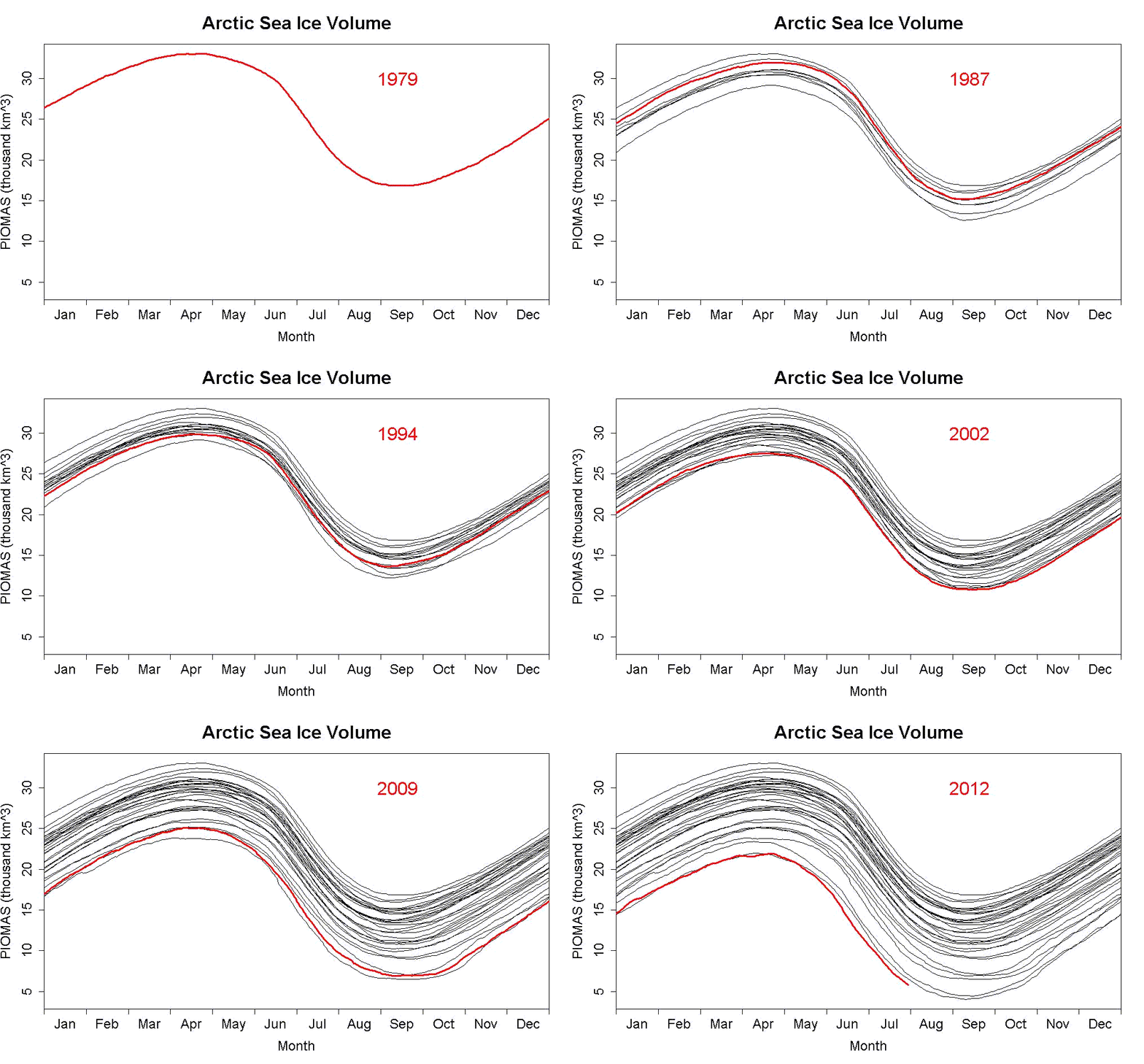
I’m prepared to accept the possibility of low climate change sensitivity (the reaction of the Earth biosystem to global warming) – apart from the fact that the evidence is accumulating – pointing heavily towards rapid instabilities emerging on short timescales. I don’t think I ever really left behind the hope – and I’m crossing my fingers here – that some massive negative carbon feedback will arise, heroically, and stem the full vigour of climate chaos. But as time slips by, and the Arctic cryosphere continues to de-materialise before our very eyes, that hope is worn down to the barest of threads.
And on energy security, I am prepared to accept the reasoning behind the IEA, BP, Shell and other projections of increasing overall energy demand between now and 2035, and the percentage of fossil fuel use that will inevitably require – apart from the fact that some evidence points towards increasing uncertainties in energy provision – if we are relying on more complex and inaccessible resources, within the framework of an increasingly patchy global economy.
If access to energy becomes threatened for more people globally, and also if climate change becomes highly aggressive in terms of freshwater stress, then I doubt that human population growth can carry on the way it has been – and in addition the global economy may never recover – which means that overall energy demand will not grow in the way that oil and gas companies would like their shareholders to accept.
My impression is that energy producing companies and countries are not openly admitting the risks. If energy supply chaos sets in, then the political and governance ramifications will be enormous, especially since the energy industry is so embedded in administrations. It is time, in my view, that projections of world energy use to 2035 included error bars based on economic failure due to energy chaos.
What do I need to do – given these pragmatic positions ? I need to include realists in the crisis talks – pragmatic, flexible thinkers from the energy industry. Just as we are not going to solve climate change without addressing energy provision, we are not going to solve energy insecurity without addressing climate change impacts on energy infrastructure. And so I need to find the energy industry people, meet them and invite them to the discussions on the risks of chaos. I need people to take in the data. I need people to understand the problems with slipping back into “thinking as usual”.
As to the setting – whether I should be an employee or an independent advisor/adviser, consultant or a researcher, I don’t have any idea what would be best. Collaborators would be useful – as I am but one person with a track record of being rather awkward – despite trying to engage my best behaviour. But then, nobody’s perfect. In a sense it doesn’t matter who does the job, but we have to break the public relations-guided psychology of denial. People are not generally stupid, and many are snapping out of their drip-fed propaganda delusions. I wonder exactly how many other imperfect people are out there who are coming to the same conclusions ? And what will be the game changer ?
A child has to learn to walk. It trips up many times before it can run. How can the human race be ready to run a Marathon when it is still growing up ?
The human race has not had to manage global climate change before, so it will take us some time to learn what works and what does not.
And if we put our faith in one person, or an elite group, or engineers, or statesmen, they will inevitably fail us. There are no individual heroes – although some people can inspire us – like the man you discovered. We all need to excel. We can only overcome our limitations with the encouragement and praise of the people around us.
Yes, the human world collectively is stupid. But within this mass of billions of minds, there are teams working together to move forward, in any way that they can. Yes, the Mars mission was useless, but the teamwork was amazing !
Let’s look at what we’ve got. We have the IPCC – a global body working together. We have the network of research institutions. We have business forums. We have Civil Society movements. We have Renewable Energy. We have writers, speakers, thinkers. We have film makers. We have media. We have government administrations, standards, engineering. No one of these things is enough, but there are so many people working on climate change and energy that I can see that a transformation is possible.
Because we cannot move fast enough, yes, some forests will die, some rivers will dry up, some countries become uninhabitable. People will suffer and die. We cannot prevent that now. But you know, the rest of us will still be able to live in Siberia, Greenland and Canada, or possibly Antarctica. We still have time to prevent the human race completely destroying itself and the planet.
We have to mourn the oak trees, but my view is that it is better to act in hope, rather than be passive in despair.
Disobedience only gets you so far. Resistance can be fertile, but intellectual ghettos can be futile. The human tendency to generalise creates too much negativity and prevents us from being constructive. We complain about the “evil” oil and gas companies; the “greedy” coal merchants and their “lying” bankster financiers; but refuse to see the diamonds in the mud.
We should obey the future. In the future, all people will respect each other. There will no longer be war propaganda carried by the media, demonising leaders of foreign countries, or scorn for opposing political parties. In the future, human beings will respect and have regard for other human beings. So we should live that future, live that value, have care for one another. I don’t mean we are obliged to give money to charity to help needy people in poor countries. I don’t mean we should campaign for our government to commit funds to the Climate Finance initiatives, whose aim is to support adaptation to climate chaos in developing countries. No, charity is not enough, and never matches the need. Philanthropy will not answer climate change, and so solutions need to be built into the infrastructure of the global economy, sewn into the design, woven into the fabric. There should be no manufacture, no trade, no form of consumption that does not take account of the climate change impacts on the poor, and on the rich, on ecosystems, on ourselves.
Yes, it’s true that corporations are destroying the biosphere, but we cannot take a step back, grimace and point fingers of blame, for we are all involved in the eco-destructive economy. We are all hooked on dirty energy and polluting trade, and it’s hard to change this. It’s especially hard for oil, gas and coal companies to change track – they have investors and shareholders, and they are obliged to maintain the value in their business, and keep making profits. Yes, they should stop avoiding their responsibilities to the future. Yes, they should stop telling the rest of us to implement carbon taxation or carbon trading. They know that a comprehensive carbon price can never be established, that’s why they tell us to do it. It’s a technique of avoidance. But gathering climate storms, and accumulating unsolved climate damages, are leading the world’s energy corporations to think carefully of the risks of business as usual. How can the governments and society of the world help the energy companies to evolve ? Is more regulation needed ? And if so, what kind of political energy would be required to bring this about ? The United Nations climate change process is broken, there is no framework or treaty at hand, and the climate change social movement has stopped growing, so there is no longer any democratic pressure on the energy production companies and countries to change.
Many climate change activists talk of fear and frustration – the futility of their efforts. They are trapped into the analysis that teaches that greed and deceit are all around them. Yet change is inevitable, and the future is coming to us today, and all is quite possibly full of light. Where is this river of hope, this conduit of shining progress ? Where, this organised intention of good ?
We have to celebrate the dull. Change is frequently not very exciting. Behind the scenes, policy people, democratic leaders, social engineers, corporate managers, are pushing towards the Zero Carbon future reality. They push and pull in the areas open to them, appropriate to their roles, their paid functions. Whole rafts of national and regional policy is wedded to making better use of energy, using less energy overall, displacing carbon energy from all economic sectors.
And then there’s the progressive politics. Every leader who knows the shape of the future should strive to be a Van Jones, or a Jenny Jones, any green-tinged Jones you can think of. We should enquire of our political leaders and our public activists what flavour of environmental ecology they espouse. We should demand green policies in every party, expect clean energy support from every faction. We should not only vote progressive, we should promote future-thinking authority in all spheres of social management – a future of deeper mutual respect, of leaner economy, of cleaner energy.
The future will be tough. In fact, the future is flowing to us faster than ever, and we need resilience in the face of assured destructive change – in environment and in economy. To develop resilience we need to forgo negativity and embrace positivity. So I ask you – don’t just be anti-coal, be pro-wind, pro-solar and pro-energy conservation. Where leaders emerge from the companies and organisations that do so much harm, celebrate them and their vision of a brighter, better, lower carbon future. Where administrations take the trouble to manage their energy use, and improve their efficiency in the use of resources, applaud them, and load them with accolades. Awards may be trite, but praise can encourage better behaviour, create exemplars, inspire goodly competition. Let us encourage the people with good influence in every organisation, institution and corporation. Change is afoot, and people with genuine power are walking confidently to a more wholesome future.
Protect your soul. Don’t get locked into the rejection of evil, but hold fast to what is good. Do not conform to the patterns of this world, but be transformed by the renewing of your minds. Be strong for goodness, even as you turn your back on a life of grime.
Live the Zero Carbon future, and make it come as soon as it can.
Kofi Annan has thrown up his hands and backed away from his role as UN-Arab League special envoy to Syria tasked with a peace mission. In one sense it is all too predictable. The United Nations Security Council is divided, reflecting deep faultlines in the policy positions of the main body of the UN.
It is probably too early in the evolution of global human governance to expect military violence to be declared illegal, but at least there are voices starting to speak up demanding that there be no armed foreign intervention in Syria. The trouble is that although warfare by foreign parties in Syria has not been publicly declared, there are, by many accounts, military and security operatives of a number of external country administrations already in play inside its borders. Foreign ministers in several major countries have pledged support to either the Syrian “regime” – you know – its “ruling government”, or to the “opposition” “rebels” – otherwise known as gangs of armed thugs. Or quite possibly people from a nebulous ill-defined shadowy organisation known as “Al-Qaeda”.
There are some reports that foreign involvement was behind the bombing of members of President Bashar al-Assad’s government in July, a near “decapitation” – as Assad himself could have been easily killed in the incident, and that a reprisal attack took place several days later – possibly severely injuring or even killing Prince Bandar, newly recruited chief of intelligence in the Kingdom of Saudi Arabia – recently drafted in – apparently with a mission to topple Syria’s “regime” – you know, Syria’s “legitimate administration” – a former ambassador to the United States of America. Although this is not yet confirmed. Or denied.
Despite conciliatory moves, countries of stern influence in the United Nations continue to call for Assad to quit, for reasons that nobody really delves into. Oh yes, as a mild-mannered London-trained ex-ophthalmologist, he’s supposed to be some kind of Hitler character, killing thousands of “his own people”. This story clearly doesn’t stick very well to the man, particularly since this narrative was also recently falsely used against the former leader of Libya. Another story that hasn’t been washing is that the Syrian “regime”, you know, the “proper authorities of administration”, has been responsible for starting all the violence in Syria – but there is now plenty of evidence to the contrary. So why has it been necessary to demonise Assad ? Why has it been that – allegedly – various governments have decided to get dirty hands and stir up violence in Syria in means overt and covert ?
And with the risks to global oil supply, why has it been necessary for the United States of America and the European Union to implement and enforce an oil embargo on Syria ? I mean, you would have thought it would be in everybody’s best interests to keep the oil flowing from every source possible. But no, sanctions it is, and Syria’s had to give up a considerable amount of their production. I know, I know, before the embargo Syria’s output was only 10% of Iran’s current production (see below), but it has meant a lot for Syria’s trade balance. According to the CIA Factbook on Syria (under “Economy”), nearly three quarters of all oil produced has been for export (although it was consuming more Natural Gas than it could produce – presumably for power generation). Plus, it’s national debt put it in the bottom ranks of the world’s countries meaning it can ill-afford to become more impoverished.
So remind me again, what was the oil embargo for ? To depose Assad by making him unpopular because of a nosediving economy ? And why does Assad need to go, actually ? Nobody’s saying that the country has been run perfectly. Gruesome tales have been told of what can happen in Syria – but then, horrible things happen in every country, including in the United States of America, and yet the United Nations is not insisting that Barack Obama stand aside.
The more I think about it, the more I come circling back to the same theory – that the economic attack on Syria, and the now almost indisputable accounts of outside meddling that is provoking the conflict (and may have even instigated it in the first place), is simply part of a plan to make the oil and gas resources of all Middle Eastern countries available to global markets at reasonable prices. I mean, look at Iraq, whose oil production was severely hit as a result of military destruction by the international warfare community, but which is now making a splendid recovery (see below) and most of the profits are pouring into the coffers of the multinational oil and gas companies, and diesel and petrol stay relatively inexpensive. Or not, as the case may be. The plan for countries across the Middle East is probably the along the same general line – first accuse the country’s government of heinous crimes, then apply economic sanctions or energy sanctions of some kind, then apply diplomatic and media pressure, (and then, these days, send in the spooks to kick up an “Arab Spring”) and then send in the gunships or gunchoppers – attack helicopters. This narrative has been successfully applied to bring Iraq to heel, and then Libya, and now it seems Syria is being talked down the same blood-paved road, and Iran is being pushed along a parallel track.
Iran. Now there’s an interesting case. Iran is not a pushover. It has taken nearly seven years of manoeuvring to make the completely unfounded case that Iran is building (or planning to build) nuclear weapons. Iran has been enriching uranium for its stated aim of developing a civilian nuclear power program, and this has been used as the justification to impose sanctions against Iran, including an oil embargo, which is having an impact on their production (see below). Besides painting the leader of Iran as an evil dictator, the propagandists of this world also seem to be trying to wield a new stick to beat Iran with – in the form of the call to end fossil fuel subsidies. Billed as a climate change policy by the G20, it is more a punitive measure against developing countries who have been using fossil fuel subsidies to make sure their citizens can get cheap energy. If Iran is no longer permitted to subsidise energy for citizens it will be forced to sell the oil and gas abroad – a buyer’s market only too pleased to suck dry the world’s second largest oil and Natural Gas producer. That volume of oil and gas being made available on the world’s markets would definitely keep global prices of oil and gas as low as possible.
Anyway, back to Syria. Clearly, there are problems, although reports of enormous and desperate increases in violence are probably not accurate. Painting the story as increasingly agitated is a common media device to engage the readers with the situation – but if it gets too sensationalised the narrative could start to affect decisionmakers, and may lead to illegitimate and inappropriate influence being exerted from abroad. Instead of William Hague MP, British Foreign Secretary for the United Kingdom, offering tactical support to the Syrian “rebels”, he should announce an immediate diplomatic mission to the Syrian government, and the various rebel groups, offering the undoubted skills of his secret service personnel in mediating a ceasefire between the authorities and the opposition. Otherwise we could end up with NATO committing to tens of thousands of weaponised air sorties over Syria and destroying a large part of this ancient culture, just as they did with Libya. All economic and energy sanctions and embargoes against Syria should be dropped, as they are aggravating the conflict. If the international community uses the language and action of peace, then perhaps Syria can be encouraged back to the ways of peace.
This is just a snippet from a long email trail about climate change…
=x=x=x=x=x=x=x=x=x=x=
From: Jo Abbess
Dear KC,
You are a human being. What you think is important. What you know is useful.
What I want to ask you is : who do you read ? Whose opinions do you value ? Whose information do you choose to accept ? And are you as sceptical about these authors as you are about the IPCC [Intergovernmental Panel on Climate Change] community of scientists ? If not, why not ? Do you discredit climate change science because of the views of others, or because you have read the IPCC science for yourself and you have a dispute with their conclusions ?
The question of authority is important here – not the authority of power or influence, but the authority of expertise. Who do you think has more expertise and authority to make claims about the state of the world’s climate and the causes of the obvious perturbations in it ? If you think that discernment should be a matter for yourself, then I would ask you to actually review the IPCC science reports and give me (us) a summary from your point of view. If you think that people other than the IPCC have the right and authority and expertise to pronounce on climate change, who are they ? And what science have they done to support their views ?
With my full respect, as one human being to another,
=x=x=x=x=x=x=x=x=x=x=
From: KC
Thanks, thanks, and thanks. 😉
There is an enormous body of information on all aspects of the issue, and obviously, I have not read all of it. I am not a Climate Scientist, so I have to go with the views of others. On the one hand, we have the IPCC, and its supporters, and on the other hand, we have those who disagree with the IPCC. There are many, but for the sake of simplicity, I think WUWT [Watts Up With That] is a fair, reasonable and credible “disbeliever/skeptic site” that presents teh alternative views in a reasonable and competent manner. I started off supporting the IPCC view, and on the surface, it seemed to make sense.. I was a “Believer”. As I read more, I found a lot of loose ends starting to show up, and I became a skeptic. At the moment, I am neither a “Believer” or a “Dis-believer.” There are points pro and con for each side. My position is in the “muddy water in the middle” There are always “two sides to every story.” I find the best way to read IPCC and “believer” sites, to get their views on the points of the Disbelievers/Skeptics”, and vice-versa. I presently remain in the “muddy water in the middle”, simply because neither side has presented what I feel is a “slam/dunk case” to support their position.
The Authority/Expertise issue is an important one. I started off as an IPCC Believer, and went with the flow of their “Experts”. Then the “Disbelievers/Skeptics” started to present disturbing points. I think the first was the BBC Program that suggested that “Temperature Change came first, and CO2 rise followed.. [ Channel 4’s “The Great Global Warming Swindle” perhaps ? ] Then there was the revelation about the quality of US Weather Station Data. Then there was the issue of “non-transparency of data and computer models”. Then there was the issue of ‘Carbon Credits”, which are useless as a mechanism for reducing Atmospheric CO2. Then there was the issue of Terra Preta/Biochar being promoted by ardent “Believers” whose major thrust of effort was promoting Biochar based on future carbon credit payments, rather than on its merits as an agricultural tool. Then there was the issue of the change in direction from “Global Warming” to “Global Climate Change”. Then there was the Stern Report which over-emphasises threats, and under-estimates benefits of climate change, and the cost to implement remediation measures. Then there was the extreme intolerance of the views of “Dis-believers or Skeptics.” Then there was the issue of the IPCC claiming that “Consensus Science” was science, when it is not. Etc, etc. All these “loose ends” and many more detract from the credibility of the IPCC Camp, to the point that I cannot personally accept their views blindly, and go with their flow.
I do like your concept of “… discernment should be a matter for yourself.” That is EXACTLY where I stand. I am confused about the IPCC Position, and as a “confused mind”, I say “No!” to blind and complete acceptance of their views. I neither accept nor reject the “authority” of either side. What I am looking for is “clear water”, and few enough “loose ends” that I can comfortably “go with the flow” of one side or the other. Hence, I remain a skeptic. Given that the IPCC has “staked out a position”, I feel the “burden of proof” rests with them to show that their position is correct. I feel it is only necessary for the dis-believers and skeptics to raise “reasonable doubts” for the IPCC case to collapse. I feel the IPCC position is basically “We have staked out our position, and we are right unless you prove us wrong.” Thats not the way it works in the Courts… the Prosecution must prove its case “beyond all reasonable doubts” in order to win. The Defence only has to present “reasonable doubt” to win.
I personally “have no dog in the fight”, and it is not necessary for me, at this stage, to move firmly into the “Believer or Disbeliever” camp. Many are like me…. simply wanting to know enough to feel comfortable supporting one side or another. Others are in the difficult position of having to “take a stand” even though they may not be confident in taking a position. Or, in the case of Policy Makers, if unsure, “The Confused Mind says “No””, and they base their policy decisions on considerations other than Climatge Change. For example, while the Politicians mouth support for Climate Change amelioriation, the outcome of the Durban Meeting was basically “Yes, we support climate change controls, and we will implement them after 2020, but we can’t say what we will do, or how long after 2020 we wil do it.”
Thanks also, for your open-ness and understanding.
=x=x=x=x=x=x=x=x=x=x=x=x=
From: Jo Abbess
I understand where you are.
The problem with the discourse on climate change is that a lot of it is very shallow, and people are prone to emotional reactions such as hand-waving dismissiveness, angry retorts and sadly, even personal insults. It’s easy to get submerged in this and not find solid ground.
When I first encountered the Internet wranglings of Steve McIntyre and the ramblings of Anthony Watts, it took me some time to realise that they were guilty of the behaviour they accuse others of. As I researched what they were claiming, I realised it was all vapourware.
We find we are wading into an academic dispute, with people trying to protect the shreds of their careers and reputations as it becomes clear that they are in error. But who exactly is in error, here ? And who is producing the smoke and mirrors fluff to try to hide the fact that they are losing ground ?
As in law, it is almost impossible to come to a clear understanding of what the actual situation is by just relying on confusing “circumstantial evidence” or hearsay from second- or third-hand witnesses.
A number of “sceptical” scientists and deeply involved people such as Anthony Watts have contributed to the body of knowledge on climate change. The IPCC and leading research agencies and universities have taken note of their contributions – and have even included them in literature reviews, research analysis and invited the “sceptics” to take part in report review and writing teams.
However, if you look carefully, behind the web log waffle, you will find that the conclusions of Richard S. Lindzen, John R. Christy, Anthony Watts, Roger Pielke Sr and so on have been successfully challenged by other climate change experts.
Although they may claim they have been ignored, they have been included. And although they may claim they have uncovered flaws or deliberate science misconduct, they have not, and the mainstream climate change scientists have been repeatedly vindicated.
I invite you, as I do everyone, to read the IPCC science reports as a first step to learning about the foundation of the issue of climate change. In the Fourth Assessment Report, you will find the work of the climate change “sceptics” discussed, and some of the climate change “sceptics” listed in the co-author lists. You will also find that the overwhelming conclusion from the body of evidence is as outlined in the IPCC synthesis on the state of the science.
The recent pre-paper by Anthony Watts, which was released in a flurry of Internet wreckage in response to the “conversion” of Richard Muller of the BEST project, is merely an update of work Watts released before, which was duly noted by the American science agencies, and taken note of in later data analysis. The current Watts paper is possibly not going to be published because of flaws already discovered :-
whose “conclusion is not supported by the analysis in the paper itself”.
Because Americans appear to believe in free speech above truth telling, we can expect more hate speech and false claims to come from the climate change “sceptic” echo chamber, unfortunately, before it becomes clear that Anthony Watts latest contribution is interesting, but not a “gamechanger”.
Regards,
=x=x=x=x=x=x=x=x=x=
From: FH
Jo,
You have hit the nail on the head. Very few read the IPCC science reports, maybe the exec summary, but not the detail. And therein lies the problem, a few hot head deniers pick one little point and build a huge conspiracy theory out of it.
Sad, because whether we like it or not we ARE all in this mess together, climate does not recognise national boundaries, wealth, status or anything else, we will all suffer.
I sometimes wonder whether James Delingpole writes just to wind people up, or whether he really believes what he is saying. For sure his “opinion pieces” if one may call validly them that, are full of shock ! And awe ! And blame ! And scandalous notions ! But if one strips away the outrage, is there anything really of substance there ? I suppose, on balance, that he puts way too much effort into his anti-science outpourings, so I guess he is serious about his stance, even if he’s way too crazed in his emotive language. Here he is falling once again for the Anthony Watts’ school of thought. Sensation gets the punters in, (at the last count over 2,800 comments), so I assume that his affronted manner is deliberate.
I’m sorry, it’s really tiring to read, but I think it’s instructive – about the state of climate change “scepticism” – or rather in this case “outright denial” – today. As a climate change denier, James Delingpole imitates his leaders in archetypal fashion. He focuses on a small proportion of all the reams and reams of global warming data, and ignores the bigger picture. Typical. He name calls and blames without any solid foundational evidence. And he gets to entirely the wrong conclusion without realising he’s gone badly wrong.
So, here’s a lesson for James Delingpole about global warming :-
1. The continential/contiguous states of the USA are not the whole world.
The temperature record of the continental/contiguous states of the United States of America (CONUS) in no way equates to overall global warming. There are other places in the world. You cannot extrapolate from the USA to the globe.
2. The surface station global warming data is not the only temperature data in the world.
There are records of ocean warming, for example, and measurements of temperature derived from satellite observations. Everything needs to have context to be seen in true relief.
3. Surface temperatures are not the most consistent measurement of global warming.
You have to go up a couple of kilometres to avoid surface wind effects, and localised heating from buildings and other infrastructure, before you can safely say you have overall consistency in your temperature readings. Surface station data needs treatment, or adjustment, or homogenisation.
[ Or as David Appell in his Quark Soup puts it, “Then there are the inconvenient facts that : (1) USA48 is 1.6% of the Earth’s surface area, and : (2) the trend of the USA48 lower troposphere, as measured by satellites as calculated by UAH, is 0.23 ± 0.08 °C from 1979 to present (95% confidence limit, no correction for autocorrelation). Satellite measurements almost completely avoid the urban heat island problem.” ]
James Delingpole claims, without any foundation whatsoever, “the National Oceanic and Atmospheric Administration (NOAA) – the US government body in charge of America’s temperature record, has systematically exaggerated the extent of late 20th century global warming. In fact, it has doubled it.”
By contrast to NOAA’s integrity, let’s look a moment at what Anthony Watts has done, according to Tamino :-
https://tamino.wordpress.com/2012/08/01/much-ado-about-nothing/
“What Watts has shown is that he can get a lower warming trend for the continental USA than others get. All you have to do is systematically eliminate the data you don’t like, while ignoring things like station moves, instrument changes, and recording data at different times of day. Don’t you dare correct for known biases (unless of course doing so would make the estimate of global warming smaller)! And if the satellite data should be in better agreement with others than with yourself, don’t breathe a word about that.”
Ah. Cherrypicking. Where have we seen climate change deniers do that before ?
Yet more from James Delingpole, “But I think more likely it is a case of confirmation bias. The Warmists who comprise the climate scientist establishment spend so much time communicating with other warmists and so little time paying attention to the views of dissenting scientists such as Henrik Svensmark – or Fred Singer or Richard Lindzen or indeed Anthony Watts – that it simply hasn’t occurred to them that their temperature records need adjusting downwards not upwards.”
Actually, James, you’re wrong again. In fact the output of Henrik Svensmark, Richard Lindzen, Anthony Watts, Roger Pielke Sr, John Christy and a number of other climate change “sceptics” have indeed been paid attention to by the IPCC, the Intergovernmental Panel on Climate Change. For example, Svensmark in Chapter 2 of Working Group 1 of the Fourth Assessment Report, and Lindzen in Chapters 8 and 9 :-
In fact, some of these scientists have been contributing authors or even editors of the IPCC reports. Surprised ? You shouldn’t be, James. This is an academic spat you’ve waded into, with no intellectual equipment to help you comprehend what is going on.
So, Anthony Watts’ new paper is not yet peer-reviewed, and not published (and does not even have a fixed, agreed list of authors), and some have already started to pick it apart. Apparently, he has ignored certain crucial information about surface station temperature measurements :-
“Thus we now have three reasons, why the technical problems may cause a difference in the trends of the raw data: 1. Time of observation bias stronger in rural stations. 2. More problems due to the UHI [Urban Heat Island effect] in the bad stations. 3. Selection bias (bad/good stations at the end of the period may have been better/worse before). Sounds like the first two problems can be solved by homogenization. And the third problem is only a problem for this study, but not for the global temperature trend. Time for the Team Watts to start analyzing their data a bit more.”
“The new improved assessment, for the years 1979 to 2008, yields a trend of +0.155C per decade from the high quality sites, a +0.248 C per decade trend for poorly sited locations, and a trend of +0.309 C per decade after NOAA adjusts the data. ”
“In his press release, Anthony Watts does not explicitly state that these trends are for raw data. The manuscript does state this important “detail”…” He lifts a table from Figure 17 of the Anthony Watts paper – and, correct me if I’m wrong, but the more “trustworthy” results are almost exactly that same as those from NOAA !
dana1981 and Kevin C on Skeptical Science, go so far as to say “Ultimately the paper concludes “that reported 1979-2008 U.S. temperature trends are spuriously doubled.” However, this conclusion is not supported by the analysis in the paper itself.” ! :-
To those who watch the development of climate change science closely, Anthony Watts’ revelations about surface station data problems are not exactly new :-
https://www.livescience.com/22019-weather-records-climate-change-skeptics.html
“In a previous survey, Watts found numerous problems with the placement of the monitoring stations, and a U.S. Government Accountability Report, published a year ago, found 42 percent of stations did not meet at least one standard regarding their location, such as being too close to extensive paved surfaces or obstructions such as buildings or trees. However, a study published in 2010 by NCDC researchers in response to these concerns, found no evidence that the temperature trend was inflated as a result, and other work has come to similar to conclusions, Gavin Schmidt, a climate scientists at NASA’s Goddard Institute for Space Studies, told LiveScience in an email. This is of course not the answer that Watts et al want to hear, and so they keep talking about it as if this work doesn’t exist,” Schmidt wrote. The controversy extends to a statistical process, called homogenization, which climate scientists use to correct for bias in the data, which Watts’ analysis says further inflates the warming trend. However, the homogenization methods used by NCDC have been heavily reviewed and ranked among the best internationally, according to Peterson. “There is no network in the world that does not have this problem, so scientists all over the world are working on this,” [NCDC Dr Thomas C.] Peterson said.”
And people appear to be used to unpicking and rebutting his claims. As @caerbannog666 tweeted, “How many lines of code does it take to prove Anthony Watts wrong? 65, if it’s python: https://skepticalscience.com/watts_new_paper_critique.html … (scroll down a bit for the code)”
Other self-styled climate change “sceptics”, such as Steve McIntyre and Roger Pielke Sr appear to be sliding away and distancing themselves from the Anthony Watts “pre-paper” – so why is James Delingpole so excited about it ? :-
“Given the now extensive documentation by surfacestations.org [Watts, 2009] that the exposure characteristics of many USHCN stations are far from ideal, it is reasonable to question the role that poor exposure may have played in biasing CONUS temperature trends. However, our analysis and the earlier study by Peterson [2006] illustrate the need for data analysis in establishing the role of station exposure characteristics on temperature trends no matter how compelling the circumstantial evidence of bias may be. In other words, photos and site surveys do not preclude the need for data analysis, and concerns over exposure must be evaluated in light of other changes in observation practice such as new instrumentation. Indeed, our analysis does provide evidence of bias in poor exposure sites relative to good exposure sites; however, given the evidence provided by surfacestations.org that poor exposure sites are predominantly MMTS sites, this bias is consistent with previously documented changes associated with the widespread conversion to MMTS-type sensors in the USHCN. Moreover, the bias in unadjusted maximum temperature data from poor exposure sites relative to good exposure sites is, on average, negative while the bias in minimum temperatures is positive (though smaller in magnitude than the negative bias in maximum temperatures). The adjustments for instrument changes and station moves provided in version 2 of the USHCN monthly temperature data largely account for the impact of the MMTS transition, although an overall residual negative bias remains in the adjusted maximum temperature series. Still, the USHCN adjusted data averaged over the CONUS are well aligned with the averages derived from the USCRN for the past five years. The reason why station exposure does not play an obvious role in temperature trends probably warrants further investigation. It is possible that, in general, once a changeover to bad exposure has occurred, the magnitude of background trend parallels that at well exposed sites albeit with an offset. Such a phenomenon has been observed at urban stations whereby once a site has become fully urbanized, its trend is similar to those at surrounding rural sites [e.g., Boehm, 1998; Easterling et al., 2005]. This is not to say that exposure is irrelevant in all contexts or that adherence to siting standards is unimportant. Apart from potentially altering the degree to which a station’s mean value is representative of a region, poor siting in the USHCN may have altered the nature of the impact of the MMTS transition from what it would have been had good siting been maintained at all stations. Moreover, there may be more subtle artifacts associated with siting characteristics such as alterations to the seasonal cycle. Classification of USHCN exposure characteristics as well as observations from the very well sited USCRN stations should prove valuable in such studies. Nevertheless, we find no evidence that the CONUS average temperature trends are inflated due to poor station siting. Acknowledgments. The authors wish to thank Anthony Watts and the many volunteers at surfacestations.org for their considerable efforts in documenting the current site characteristics of USHCN stations.”
Wind power is magic. Wind power is almost infinitely scalable. Wind power is for everyone. Wind power is incredibly successful and growing almost exponentially. Yet some recalcitrant intransigents, such as Christopher Booker, persist, like sea hawks, in clinging onto the fossil fuel guano in their ossified little niche perches, high above the wind-power blown cliffs of reality. Wind power is here, and it’s working, and it’s displacing carbon emissions, but to read Christopher Booker you’d think it were the height of folly to deploy it.
He cannot purvey his argument on the basis of the facts, and so he resorts to repeating outdated and confused information, thinking that mere repetition of erroneous statistics counts for the truth.
His position has been trounced, locked in the floodlight beam and stamped on by several intelligent parties, but meanwhile, people are arguing about his weekend article. They’re not arguing about whether he’s right (he clearly isn’t) or wrong, but about excactly how wrong he is. All I know without doing in-depth calculations is that he’s at least 30% way out – although others argue he’s up to around 70% out. And what are the numbers he’s so misguided about ? The number of wind turbines UK policy dictates should be installed.
Here’s Booker :-
“…in 2010, the last year for which we have figures, we used 378 TWh of electricity, of which only 10 TWh, or 2.6 per cent, came from wind….If 3,000-odd turbines produced 2.6 per cent in 2010, then to meet the EU target would require something like the “32,000 turbines” mentioned by Davey’s predecessor Chris Huhne just before he resigned. This would require us to build about 10 giant turbines every day for the next eight years. Regardless of how many billions of pounds of subsidy might be thrown at this, in practical terms it is quite out of the question…”
“…Booker is taking figures from DECC’s 2011 Digest of UK Energy Statistics (DUKES) report, which provides UK energy statistics for 2010. But although he says these are the most recent figures available, the new edition of DUKES was published last week, providing information on what happened in 2011. These new figures show the year saw fairly significant growth in the amount of electricity coming from renewable sources. The amount of electricity generated by wind power rose from 10.2 terawatt hours in 2010 to 15.75 TWh in 2011 – a rise of 5.53 TWh. This made up much of a wider growth in renewable power – renewables generated 34.4 TWh of electricity in 2011, a rise of about 8.6 TWh compared to 2010…”
And here is what he summarises about how to count wind turbines :-
“…According to Renewable UK, the generating capacity of wind turbines currently being installed is about 2 MW for onshore and 3.6 MW for offshore. Plugging those numbers in, an extra 73.6 TWh would take either another 15,600 onshore turbines, or 6,300 offshore. In practice, the numbers are likely to be smaller. Offshore turbines will continue to increase in size, meaning it will take less to produce more power. Turbines will probably become more effective – increasing their load factor. And other sources of renewables will produce more power, reducing the amount of wind turbines needed to hit a particular amount of renewably-generated power. So the 32,000 figure looks pretty overinflated…”
And here’s the online Claverton Energy Research Group forum picking their way through various alternative answers :-
=x=x=x=x=x=x=x=x=x=x=x=x=
From: Eric Payne
Subject: Article in The Daily Telegraph about Britain’s energy policy
Hi
As experts in this area, I would be very interested to hear people’s views on this piece in The Daily Telegraph.
How accurate is the information quoted and what is its significance for Britain’s energy policy?
Best regards
Eric Payne
Deputy Editor – Euroasia Industry Magazine
=x=x=x=x=x=x=x=x=x=
From: David Hirst
A fraudulent article. It does not mention that the change was forced by Osborne and the Treasury, who insisted that gas should continue to receive the subsidies it already gets. But likely true in the sense that UK energy policy is now undeniably incompatible with climate change objectives, and the legal carbon budget.
The nuclear industry is undoubtedly looking on with glee, and doing some of the stirring and distortion. But they cannot deny climate change, as it is the only shred of opaque clothing on that emperor.
What I find even more shocking through, is the huge barrage of comments, most of which seem to deny any role for wind, and deny the science of climate change. Although always deeply biased towards the middle class and the rich, the Telegraph has become a mouthpiece of denial, and this is very dangerous.
I suppose we ought to form all sorts of aliases, and spend our days balancing the lunatic comments with occasional sensible ones. Who knows, Osborne might take notice.
Horrible.
David Hirst
Hirst Solutions Limited
=x=x=x=x=x=x=x=x=x=x=
From: Herbert Eppel
Hi
Mr Booker who, according to Wikipedia, “has taken a stance which runs counter to the scientific consensus on a number of issues, including global warming”, would be well advised to have a look at this: .
I’m sure Britain’s energy policy would be in a better shape if it didn’t keep getting side-tracked by such maverick interventions.
Herbert Eppel
www.HETranslation.co.uk
=x=x=x=x=x=x=x=x=x=x=
From: Eric Payne
So, is the need to ‘keep the lights on’ compatible with present renewable electricity and carbon emissions targets?
Is a large build out of new wind turbines the best way to address those needs? Is it preferable to preserve the wind turbine subsidy at its present level in order to achieve the same?
What other options/policies (if any) might be more effective?
Best,
Eric
=x=x=x=x=x=x=x=x=x=x=
From: Herbert Eppel
As I keep saying, we need to fire on all renewables cylinders.
Wind should, without a doubt, play a key part.
Check out the numerous pertinent links I sent over the last few months (not sure whether you read the Claverton messages regularly) – see .
Best
Herbert Eppel
=x=x=x=x=x=x=x=x=x=
From: Jo Abbess
Dear Eric,
Christopher Booker uses emotive language. Before reading his article
properly to investigate anything he is claiming as fact, I would
suggest that you remove all traces of language that tugs on your
emotions, or guides your opinion – for example :-
“The Government plans to break its own climate change law” – the use
of the word “break” is a direction for you to consider that the
Government are acting in an illegal (“plans”) or incompetent manner
(“its own”).
“Politicians are finally admitting that our ‘carbon’ targets and our
energy needs are incompatible” – the use of the phrase “finally
admiting” is intended to make you consider that politicians have been
hiding some unrevealed facts. The use of the word “incompatible” is an
assertion that runs counter to the facts.
Other examples “serious breach of the law”, “opaque”, “catastrophic
shambles”, “spin doctors”, “victory”, “dutifully echoed”, “risible
claim”, “betrayed”, “two wholly irreconcilable hooks”, “Hidden”,
“obscurely phrased”, “in practical terms it is quite out of the
question”, “revealing”, “economic suicide”…
Strip these things out of the opinion piece and then you have some
claims and numbers that can be investigated.
Note : this is an opinion piece, and is not expected to be taken as a
factual report. Newspapers are fond of opinion pieces as they are
often scandalous and generate a lot of discussion. The Daily Telegraph
has another famous opinionated writer – James Delingpole, who with
Christopher Booker were largely responsible for blowing “Climategate”
into the puffery of nonsense that people thought was serious but was
all a cloud of nothing. The Climategate accusations were that climate
change scientists have been manipulating data, lying and hiding – but
all the enquiries into this have vindicated the scientists. Strangely,
James Delingpole and Christopher Booker are still employed to write
for the Daily Telegraph, despite this “shenanigans”.
Note how Christopher Booker puts a halo round the head of shale gas
development, “And not the least telling feature of last week’s
statement was that it made no reference to the shale gas revolution
which has already halved US gas prices in five years, and which could
solve our own energy problems by providing cheap gas for centuries.”
Err, no, not according to the experts who are saying that even though
there may be significant shale gas resources under the UK, that
production volumes might not get very high. And the total resource is
currently estimated at around 50 years, not several centuries, of
current gas demand. You have to remember that the United States is a
unique case as regards shale gas – they have done everything to permit
and encourage its development – including ripping up their
environmental standards. And although shale gas in the USA could reach
something like 25% of total gas production by 2030 (others use higher
numbers), you have to bear in mind that non-shale gas could start to
decline significantly, so the total of US gas could peak in 2035 –
check the diagrams from the EIA.
Christopher Booker shows himself to be a “wind-up merchant” with this :- https://www.telegraph.co.uk/comment/columnists/christopherbooker/9434114/The-Government-plans-to-break-its-own-climate-change-law.html#disqus_thread
“…Greenland’s ice cap was on the brink of melting… for a few hours :
Nothing could have better demonstrated the desperate straits to which
global warmists have been driven as they try to keep their scare going
than two satellite pictures in last Tuesday’s Guardian, showing a
change that had come over the Greenland ice cap. One showed, in white,
the second-largest mass of land ice on the planet, seemingly intact.
The other, taken a few days later, showed in pink a seemingly
ubiquitous melting. These Nasa pictures, we were told, showed
alarmingly that, for the first time in history, the surface ice was
melting right across Greenland. It took only hours for this scare
story to be blown apart. A tiny rise in air temperatures had
momentarily taken them just above freezing, enough to melt a few
inches of surface ice. But the ice below it, up to two miles deep, had
been unaffected. This had happened before, in 1889. Ice cores show
that it happens every 150 years or so. Within hours, as even the BBC
admitted, the ice had frozen again. The shortest scare in history was
over.”
Again he uses emotive language and he should not be relied upon in my
view. See instead here – the first from an actual working climate
scientist :-
I’m sorry I don’t have time to debunk this piece more thoroughly. It
is typical Christopher Booker – I find his style is very 1980s – he
seems to want to create sensational scandal by pushing your emotional
buttons and making unjustifiable claims.
I don’t trust his output. End of.
jo.
=x=x=x=x=x=x=x=x=x=
From: Frank Holland
Jo,
Follow the money, who, apart from the Torygraph, is paying Booker?
Frank
=x=x=x=x=x=x=x=x=
From: Dave Andrews
My take on one of his points:
….he says
“Hidden in the small print of Davey’s statement are two passages of particular significance. One, so obscurely phrased that it seems to have passed everyone by, is that by 2017 we hope to be generating “79 terawatt hours” (TWh) of electricity a year from renewables, rising by 2020 to the “108 TWh needed to meet the UK’s 2020 renewable energy target”. To make sense of this, one must look at the section of DECC’s website showing that, in 2010, the last year for which we have figures, we used 378 TWh of electricity, of which only 10 TWh, or 2.6 per cent, came from wind. Slightly more than this came from other renewables, such as hydro. But to meet that 32 per cent target within eight years, almost all the increase would have to come from new wind turbines.
If 3,000-odd turbines produced 2.6 per cent in 2010, then to meet the EU target would require something like the “32,000 turbines” mentioned by Davey’s predecessor Chris Huhne just before he resigned. This would require us to build about 10 giant turbines every day for the next eight years. Regardless of how many billions of pounds of subsidy might be thrown at this, in practical terms it is quite out of the question.”……..
My calculation based on the latest turbines being installed off shore are 6.15, and onshore 7.5 MW. Going with the lower figures and using a 40% load factor, then this needs for 108 TWh only 5011 such turbines. Over 8 years, this is a rate of installation of 1.7 per day, so he out by a factor of 5.8 or 580% a figure relatively as large as his ego and the fee paid by the lobbyists who wrote this crap for him.
1.7 per day would be easily achievable with the appropriate incentives. The Allies built 600,000 aircraft in ww2 with an average engine power of around 1 MW and 225,000 armoured vehicles – add those together 2:1 to get roughly one turbine and that is say 500,000 equivalent turbines units over 5 years or 273 per day, plus a lot of airfields, ships etc.
The advantage this time round is that this hardware has an NPV which is positive.
The subsidies he talks about are far less than paid to the fossil industry…didn’t Osborne just give a £100m tax break to the offshore gas industry to cite one?
Dave
=x=x=x=x=x=x=x=x=x=
From: John Baldwin
Dave,
Your figures don’t seem right!! You may be right and Booker wrong but I’m not sure, needs a comment from an offshore wind bod.
Regards
John
=x=x=x=x=x=x=x=x=x=
From: Dave Andrews
John, which figures, the size, or the load factor?
Or the sum?
Dave
=x=x=x=x=x=x=x=x=x=
From: Jo Abbess
Dear Clavs,
I think part of the problem with Christopher Booker’s figures are that
he’s using out of date statistics.
Energy demand is forecast to be 1557 TWh in 2020 in the Government’s
central projection on the RED definition.
15% of this is 233.55 TWh – expected to be from renewable resources.
But you have to remember this includes heat as well as electricity.
The Renewable Energy Roadmap expects that wind power will generate :-
Figure 2
Onshore 24 – 32 TWh
Offshore 33 – 58 TWh
Christopher Booker is saying that generation from wind power is 10 TWh
from 3,000 wind turbines. He is probably looking at 2012 data for the
generation, and today’s data for the count of wind turbines.
These figures are roughly 20% higher than 2010 counts for onshore and
nearly 100% higher for offshore.
So we have a classic Christopher Booker fudge.
1. He’s not comparing apples with apples, but 2010 data with 2012 data.
2. He’s mistaken “energy” for “electricity”.
I rest my case.
jo.
=x=x=x=x=x=x=x=x=
From: Jo Abbess
And Clavs,
I forgot to add :-
3. Wind turbines are increasing in their capacity ratings as time
goes by – so even the high end of wind power projection in the DECC
roadmap 90 TWh will mean less numbers of turbines than the simple
calculation of ( 90 / 16 * 3868 ) = 21,758 turbines.
Even if the average capacity moved up by 10% (and admitting that not
all turbines will be larger), that would mean closer to 20,000 than
30,000 turbines overall.
So Christopher Booker is out by a whopping great 30% or so.
jo.
=x=x=x=x=x=x=x=x=
From: Steve Browning
Hi All, I must admit you get too much emotive language and bad numbers, with politics in the current energy debate…
From a PRASEG meeting with Charles Hendry last month, it does look as if we are going for ‘Gas and Air’.
When I first looked at the issues with 32GW of wind in our 60GWMax/24GWmin system two years ago, I think the figure quoted for 2020 was @6400 turbines. That would be an average of 5MW/turbine
At 33% load factor that lot would deliver @92.5TWh which is @ 28% of the 2011 electrical demand (329TWh = sum of Power station sent out).
However, we dont have Big Hydro (Alpine/Norway/Sweden) or Big Interconnectors which is how the EU continental system (Max 380GW) stabilises the existing wind and solar (mainly Germany and Spain).
I believe the the largest wind machine available currently is the Enercon E-126 (DC Generator) at 6MW
I assume it takes a lot of energy and material to build one of these.
We still have to get a handle on ‘value’ for each future scenario, including all the internal and external costs and drivers.
Regards
Steve
=x=x=x=x=x=x=x=x=
From: Frank Holland
Booker is a history graduate, he claims that asbestos is the same as
talcum powder. Asbestos is Mg3(Si2O5)(OH)4 talc is
Mg3Si4O10(OH)2….both could be described as hydrated magnesium
silicate, but asbestos is fibrous, talc is crystalline or plate like.
It’s the fibres that cause the problem….but then how would we expect a
historian to know that?
He is best ignored.
Frank
=x=x=x=x=x=x=x=x=x=
From: Dave Andrews
John, my wind turbine size and the load factor are correct. They are supplied by a wind energy expert, pphd, ex utility, hired to study these things by a governmental scientific organization.
So are you saying my calculation is wrong?
Kind regards
Dave
=x=x=x=x=x=x=x=
From: Eric Payne
What body would be responsible for commissioning a ‘walk-through’ study calculating the practicability of different future energy scenarios and their affect on the grid?
Have any full or partial studies been carried out? If not, why not?
Best
Eric
=x=x=x=x=x=x=x=x=x=
From: Fred Starr
Dear Jo
When I saw the figure for wind energy I ceased to read any more because the figures are well out of date. There was a big expansion after 2009, but more recently this has slowed. The capacity on the Grid is still 4686 MW
You would do be writing to him.
Fred
=x=x=x=x=x=x=x=x=
From: Neil Crumpton
Regarding the number of UK turbines by 2020 if producing 90 TWh – I make it around 11,000 not 20,000 to 30,000 !
calcs below
Neil
PS my view of journalists (and politicians) confusing energy with electricity have been well aired over the years on Claverton
PPS 15 % of 2020 final energy demand will be around 230 TWh/y – so more than 100 TWh/y of wind by 2020 would give UK a better chance of reaching the target (and biomass CHP – with CCS)
————–
i) offshore turbine capacity (assuming 58 TWh/y at 38 %) = 17.4 GW ( offC x 8.76 x 0.38 = 58 )
So assuming average offshore turbine capacity is 5 MW (ie mostly 5-6 GW from now) = 3,480 turbines – say 3,500 turbines
ii) onshore turbine capacity (assuming 32 TWh/y at 28 %) = 13 GW ( onC x 8.76 x 0.28 = 32 )
So assuming average onshore turbine capacity is 2 MW (ie mostly 2+ GW from now) = 6,500 turbines
Hence total number of turbines to generate 90 TWh/y in 2020 would be around 10,000, say 11,000 or 12,000 if average capacity and capacity factors are a bit less than I estimated above
=x=x=x=x=x=x=x=x=
From: Dave Andrews
The correct figure to generate the electricity he is talking about, irrespective of if it is the right amount is 1.7 turbines per day, whereas he gets 10 per day. (John you still havent told me what is wrong with this figure – the capacity is right and the load factor is right)
This would be easy to produce given the right industrial and supportive environment. The peak capacity of vehicle engines in the UK is about 2,500 GW and this is replaced every 10 years, so we make 684 MW per day of mobile chp plant (cars).
This is the equivalent in power terms of ~114 6 MW wind turbine per day.
Dave
=x=x=x=x=x=x=x=x=x=
From: Jo Abbess
Dear Eric,
Are you aware of the Offshore Valuation that looked at scenarios for
Britain’s offshore wind power ?
Consolidation. That’s the word used to describe the situation when small, local enterprise gets wiped out, and larger business players get to snap up their assets and markets.
Decentralisation. That’s the word used to paint a vision of a future where there are more smaller, more localised production facilities, owned and managed by small, local enterprises, or by individuals, co-operatives or community-scale groups.
In the business of energy in the United Kingdom, both of these things are taking place, and creating some turbulence and insecurity.
Confidence is key, but unfortunately, the UK Government has a bad track record in this area, having fudged the solar photovoltaic feed-in tariff reductions, leading to massive swings in deployment, and the consequential loss of employment and firms in the sector :-
If the Green Deal does for insulation what the PV Feed-In Tariff stutters have done for solar electric, we can expect to see a number of the smaller and start-up insulation firms go to the wall – this despite broad support for encouraging smaller business enterprise in the sector. Although small insulation firms have been operating successfully independently making use of current Government policies, they may end up becoming mere lowly-paid contractors to the larger firms :-
https://www.publications.parliament.uk/pa/cm201213/cmgeneral/deleg2/120702/120702s01.htm
“[Greg Barker MP] The [honourable] Lady asked […] about access to the green deal for small and medium-sized enterprises. I share her enthusiasm, and also her concern that the green deal should be open to SME [small- and medium-sized] providers and assessors. SMEs should get a fair lick of the stick regarding delivery on behalf of the big six [ Big 6 energy suppliers ]. That is why we are going for a much more open and transparent brokerage model, and we will seek to ensure that the model is sufficiently ambitious. If it is not, and does not deliver the goods, we will, as the hon. Lady suggests, return with further proposals to open it up even wider…”
There is perhaps an element of blather in the Department of Energy and Climate Change pronouncements, going on recent experience :-
A quote from around the time, which was on a now defunct webpage (https://www.ukace.org/index.php?option=com_content&task=view&id=689&itemid=1) read :-
“…On July 2, Greg Barker claimed that all lofts had been or were soon to be insulated: “We are certainly on the verge of declaring victory in filling treatable lofts. We now anticipate, when we finish at the end of this year, that only around 1% of treatable lofts in the UK will remain to be filled….We have filled the finite number of treatable lofts.” Mr Barker’s statement is highly misleading. According to the latest figures released by his own Department last month, just 62% of homes have received sufficient loft insulation…”
And if that’s the case, then it is possible that the DECC have had the organic sheep-derived cavity wall insulation pulled over their eyes by the large energy players – who might not be using the Green Deal, or any other provision of the Energy Bill, to win customers.
British Gas Centrica and E.On are two industry players who spring to mind – busy training insulation installers – either in-house or by contracting in. They will possibly use the window of opportunity between the official start of the Green Deal in October 2012 to the first official schemes in January 2013 to surge ahead in offering customers their own Green-ish Deal packages based on private finance schemes, and contracting the work out to smaller firms who have had the regulation rug pulled from out under their feet.
So the minnows of energy conservation are quite likely to lose out, their business plans that rely on Government support gobbled up by the Big 6 sharks, just like the whiting of solar power were whittled away by the Feed-in Tariff seesaw fiasco, and their current market and any chance of expansion could now be suppertime snacks for much larger operations :-
One only has to look at the history of wind power development in the UK to see the same pattern – large engineering concerns have won an increasing share of the market. It makes one wonder whether the countryside anti-wind farm brigade have been sponsored by the big wind power developers, who are quite happy to take large taxpayer breaks, and even some clunky subsidies, to build wind farms offshore.
Smallscale, distributed renewable energy systems are more efficient and community ownership of projects has worked across Europe. In the UK, however, because of the ease with which people are politicised into opposing zero carbon development, we may get decentralised renewable energy, but it will probably be owned by a massive business.
After addressing the Stop Climate Chaos coalition Annual General Meeting on Friday 20th July 2012, Tony Juniper, sustainability consultant, and Colin Butfield of WWF, responded to questions from the audience. There was a sense of unease in the room, dissatisfaction with the UK Coalition Government appearing to roll back commitment to the Climate Change Act, and their failure to enact their manifesto declaration of being “the greenest government ever”.
People expressed doubts about the design of climate change communications, about collaboration with companies over climate change action, and what would be suitable campaign actions for protest groups and charities. Several groups found their ongoing campaigns disparaged, in effect, by dismissive comments from others. It wasn’t altogether a pleasant experience. Here are just a few paragraphs attempting to summarise the question-and-answer session from brief notes made at the time.
One of the attendees proposed that climate change communications going forward should make use of the fact that people are questioning the legitimacy of the current economic system, and said that there was a failure to offer a programmatic response. He said that if people were given a systemic critique, they would “get it” – and that the Green New Deal formulation was ideal. He projected that if climate change communications campaigns don’t go against the corporations, that it will be less and less likely in future that governments will respond to corporate abuse of the environment.
Tony Juniper responded by saying that he didn’t see the backing for that level of challenge to the current system. He said that even though there is an economic meltdown in progress – it’s been shown that “a pack of bankers are nicking the peoples’ money” – there has been no revolution. The Non-Governmental Organisations have carried on as normal. At the General Election, people voted for the party of the financial system. The Green New Deal, he said, simply hasn’t got the backing it should have. It suffers from the same lack of attention that faces any different economic formulation that is put in front of people. Time is so short that we have to have something more pragmatic – plausible decisions about realistic proposals. He said it was down to the NGOs to formulate this – and that emphasising jobs was essential.
Another questioner put it to the speakers that the cost of deploying wind turbines was cheaper than not doing it and that contrary to the myths they were actually rather beautiful – and that even the pylons carrying new power lines to connect new wind generation to the grid could be made to be beautiful too. New technology is something to embrace rather than fear.
Tony Juniper replied that a small minority of people have managed to poison the debate on wind power, and that they are part of the Conservative Party core backing. He said that there is lots of support for renewable energy, and that this needs to be reflected back to the media. He said that the media is “pretty poisoned”, too – the Daily Telegraph for example, although The Guardian and The Independent were more open. He suggested that industry players start talking more to the Government and get more organised. He said that Government Ministers find it easier to deal with the nuclear lobby as they have one [professional] body and one message. After the failure of Copenhagen – where the Government predicted they would come away with a successful, positive outcome and didn’t – the atmosphere as a whole has been poisonous. The NGOs didn’t react to this disappointment.
Phil Thornhill, the National Co-ordinator of the Campaign against Climate Change, criticised the NGOs who he said have stopped focusing on climate change. He said it hard to find the next “really sharp point” – the really unifying thing – the way we did with the Climate Change Act. He said that action had to be more than just signing the odd letter, and questioned the approach where action has been fixed to a time or an event – with the obvious risk of collapse. He suggested that climate action should be a continuning goal.
Colin Butfield of WWF responded to the questions – he said that the problem with promoting renewable energy was the peril of ignoring NIMBYism – people may be generally positive about wind farms, but not want one in their own back yard. He said people wanted a genuine local conversation about renewable energy development. He said that on economic proposals, that people need to be presented with solutions they can easily adopt. He suggested one call to action that could easily draw people would be to ask “do you want your pension going into that ridiculous investment ?”, and then asking people to choose more sustainable investments and funds. He said that “normal” people are a “bit terrified” by the idea of collapse of the current economic system [and so may not react well or buy into the ideas]. He said that many pensions were a “climate bad”. He said that in the current economic situation, people could be brought to think about the link between the way banks invest money and climate change – as people are very unhappy with the existing system – “a blindside force for bad”. He said that an example of positive change had been in the campaign to demand buisiness carbon reporting.
Herbert Williams, Chief Executive Officer of A Rocha UK, holding up a credit card, said that positive investment change in the economy was unlikely to form a groundswell as people are in thrall to the current financial system, and that most public communications were advertising to direct the flow of money. He said that there was a danger in repeating the styles and actions of the past.
Peter Robinson of the Climate Alliance said that people are very demoralised about the economic situation – and that climate change arguments have to be involved in any policy proposals.
Tony Juniper said that a suitable goal for campaigning would be shifting anger about the economic situation to a call for green jobs. He asked whether this would still require “grassroots” activism and answer this with a qualified “yes”, because he said it would require different strategies. He said that the key requirement was to work out how to engage people and get them involved. He said that a different body of expertise would be needed in these campaigns. He mentioned that he has been considering employing psychologists – people from public relations companies – and said “we need to get some of these helping us.” He asked how many people would be a significant number to sign up to a campaign. He mentioned that the Climate Change Act campaign had got 200,000 people to urge their MPs to sign the Early Day Motion in Parliament, but that it was only successful because there had been more political jigsaw pieces in place. The 200,000 would not be enough to move to the next phase. To get real action on the Climate Change Act he suggested that the campaign would need to broaden the base – and that would need more people than just those from campaign organisations to be involved. He said that he was still seeing a lot of the same faces – even though it was “lovely to see you all”, but that the campaign needs to go wider. He said that there are difficulties with anything that involves infrastructure, as the Government has just ripped up the planning system in Local Authorities – 50 years of accumulated wisdom on how to do development.
Phil Thornhill said that Martin Luther King didn’t have a communications expert or a consultant psychologist. He had passion to get his views across. Climate change is perhaps less tangible that civil rights – therefore needs more passion. The idea that psychologists or public relations techniques can give you a shortcut to understanding your audience better was not helpful. Advertising and public relations are mostly about selling things to people. Climate change communications have been shown to not be getting through to people – the message to change can be unappetising.
It was asked if it is possible to hold together progressive politics and the traditional NGO approach.
It was noted that the think tank battle is very important – and their public relations. This style was planted 60 years ago – fundamentally anti-state – based on the Austrian school of economics – it’s very easy for them to point at any efforts by governments and claim “the faceless state is coming to take your money”.
Colin Butfield answered to a question about social media – could we get millions of young people to join in ? He said you can’t, but that we’d nearly got there with the Green Deal on loans. In regards to the 200,000 mentioned for the Climate Change Act he said that in the current less urgent political atmosphere, those numbers are always going to be ignored. By contrast, he’d had millions of people on the Facebook page for Earth Hour – and that was sufficient to get David Cameron to talk about it.
A questioner raised issues about coopting NGOs and the social movements to enact policy goals. Energy goals can’t be simply about deploying renewable energy, but must also answer questions on access to energy, land rights, food versus fuel, fuel versus forests. You cannot leave questions of justice aside.
Tony Juniper, in replying to a warning that it is important to keep vigilant about the dubious underbelly of corporate public relations agendas, said that although one could damage their brands for a while, and companies and campaigns could have battles to capture each others’ agendas, that we are not going to get anywhere without all sorts of compromise – finding shared values.
Later, over a spiffing Marks & Spencer buffet outside in the Westminster School walled garden, I spoke with a campaigner about the rationale and purpose of campaigning. I asked whether it could be seen as rather patronising to assume that we are the ones with the better ideas and information, and that we have to “engage” other people with a view to them adopting our position and taking our recommended actions. The campaigner asked what we would do if we didn’t do campaigns – how would we involve people in these issues ?
I thought to myself – therein lies the problem. A campaign should not be about keeping people running around like headless chickens trying to put across messaging and persuading other people to take action. Keeping concerned people busy with communications tasks is not a genuine achievement, I would suggest. It certainly doesn’t appear to be resulting in genuine, widescale political, economic and social change. There was a brief flicker of purpose when the previous Labour Government had promoted climate change communications (although they alienated a good portion of the population with their strategy and messaging), but now there’s no political lever.
We don’t got no revolution, and a new round of consultation with communications specialists is not going to change that.
At the Annual General Meeting of the Stop Climate Chaos coalition on 20th July 2012, the presentations began with some agonising public displays of angst from Colin Butfield, head of campaigns for WWF, and Tony Juniper, sustainability consultant and formerly the Executive Director of Friends of the Earth in the UK.
Colin Butfield echoed the thoughts of many in the room when he said that although we have been winning a lot of the battles on climate change, we have been “losing the war quite badly”. He gave the example of Vince Cable, who he accused of using weasel words of political doublespeak in undermining the UK Government coalition commitment to abandon foreign “investment in dirty fossil fuel production” by essentially removing any goalposts.
Colin Butfield said that Vince Cable’s response to clarify what that commitment meant was anything legal under the voluntary European Union standards – and that it was hard to think of anything that would not be covered by this – including dirty unconventional fossil fuels.
Colin Butfield also spoke about the UK Government’s machinations ahead of the widely anticipated Energy Bill – how the Treasury has been seen to intervene over the matter of £20 million of subsidies for renewable energy technologies – and that he was amazed that this was somehow worthy of the Chancellor’s attention, particularly green energy is perhaps the only British industry capable of growth – and that this was a shocking use of Treasury power.
It still seems like people are having to “fight” for “no-brainer” decisions, such as the long-resisted European Union 30% targets and the carbon budgets of the Climate Change Act 2008, “every step of the way.”
Colin Butfield said that it is no longer possible to assert fundamental moral rights and responsibilities over trashing the planet – that campaigning organisations are no longer able to talk about equity and development issues. It was good to hear him being realistic about this – but he did not connect the dots. It could be said that the Non-Governmental Organisations have failed to realise the logical problems in making demands for impossible equity and development targets, such as those proposed by the Greenhouse Development Rights framework.
Colin Butfield said that the political context on climate has changed so dramatically that it has dropped off the radar – even as we are getting to read the most worrying science. Since the climate change models got better, and there has been clearer and clearer evidence, the two degrees Celsius target originally put forward as the United Nations Framework Convention on Climate Change “upper bound” for a safe planet has become invalid. For ordinary citizens trying to follow the issue, even as the science and the computer models improved, the individual uncertainties relating to any particular regional area have broadened – and have been leapt upon by climate change “sceptics”..
Colin Butfield said that we do not have an intelligent debate in the media – and [recently] has been uncharacteristically quite negative.
Colin Butfield proposed that there is a special year coming up – 2015, why which time the UNFCCC is hoping that a global treaty on climate change will have been agreed. A number of other things are due for completion that year, including a new set of Sustainable Development goals, so that is a good year to focus on for a campaign.
Colin Butfield said that despite the problems, there are some hopeful pegs for messaging. Despite the apparent fight about renewable energy, [this is only really an issue for the media] as the majority of the British population are fine with renewable energy deployment [unless it’s in their own back yard, perhaps ?] Yet people are not necessarily going to march in the street to urge the Government to install wind turbines – [it’s not a “flashpoint” issue]. Although there is quite a bit of evidence that the population is quite willing for climate action – “people are not going to demand it in quite the way we would like”. Colin Butfield said that there is an opportunity for the European Union to put forward their further commitment on emissions targets.
Colin Butfield said “we have to look at different ways of representing things”, and that it is our “challenge to reinvigorate and re-inspire everyone.” He admitted that there is still a risk of doing what we did over Copenhagen – building everyone up to expect a significant agreement only to be disappointed. He said we should “try to inspire people in a different way and put climate back on the agenda.” He said that the climate change should rightly focus on food.
Tony Juniper addressed the room next. He said that the environmental movement was not in a good position at the moment. The climate change issue is not on the front pages of the newspapers and the politicians are not tracking it. After the groundbreaking legislation of 2008, it is now 2012 and we don’t have an international treaty – and some countries have “thrown in the towel”. In quite a few countries, the issue of climate change has gone backwards – for example in the UK and the USA – despite Obama’s early statements on commitment, there has been no change – no carbon trading. Global emissions reached a new peak in 2011 – we have finished up in a place where we’re not doing quite so well.
Tony Juniper said that 2015 is quite an important year – the governments want to come back with a treaty [ – and that although that might be hard to get] – a new set of Sustainable Development goals need to be agreed and that this might give us a new way [in / forward] – that this is “perhaps a better place to look than a climate treaty” for progress. “If we can’t get leadership in individual countries, the chances for a global treaty are slim.”
Tony Juniper said he has come to a simple conclusion – that the economic crisis has shaped the dynamics of global plans – that focus on climate change has been replaced by a different set of issues. “Every few years we find we are having to rebuild the narrative”, he said – although it’s gone away for now – “it’ll come back again. The facts of the matter are very pressing. Impacts are coming through.” He suggested that how climate change is coming back is what we should pay attention to – how we can shape it. He said that there are two things to consider in campaigns – first – the easy bit is to know what we want – what we want for a Treaty and what we want for technologies – he context of campaigning is always hitting preconceptions and views. The second is to consider the blockages in the way – and have this systematically built into the strategy :-
Blockage A. The extent to which people think climate change is not an economic issue
Tony Juniper said it was insanity of the first order not to consider climate change as an economic risk factor. He cited the front page article on the Financial Times : “Osborne in renewables row with Lib Dems” [George Parker and Pilita Clark, 19 July 2012] “George Osborne is blocking a new subsidy regime for renewable energy, as he fights a coalition battle with the Liberal Democrats to ensure gas remains central to Britain’s future power needs. The chancellor fears overgenerous support for wind power and other renewable sources will deter investment in gas-fired power stations, which he believes offer businesses and consumers the prospect of lower bills in future…”
Tony Juniper said that this argument to block subsidies for renewable energy concerns a small amount of money – and it will block British companies wanting to take part in the renewable energy economy – it’s “costing British jobs”. He also said that the language of the debate is pandering to misconceptions about renewable energy and the reporting is leading to complete misunderstanding [in the minds of the public]. He asked “can we build a narrative built on facts ?” with the support of business ? He mentioned the recent Confederation of British Industry critique that the political wrangling was disastrously judged – when investment should be taking place now. He wanted to know if a campaign group has already done this. He said it should be backed with data – to link economy and ecology.
Blockage B. Talking down the apocalypse
Tony Juniper admitted that in the past it was necessary to talk about the scale of the effects of climate change – essential to communicate it – but it did end up sounding like a doom-laden agenda – about the need to avoid terrible risk – instead of embracing a positive future – fairer, cleaner, longer lives. He said that critics of past climate change communications say things like “you’re asking me to think my children have no future…for us to sit in the dark…” and so on. He said that the communications challenge was – “can we paint a positive picture – why people would like to come with us ?”
Blockage C. Watermelons
Tony Juniper said that an ideological chasm has emerged. “Quite a few think that climate change is an issue for namby-pamby leftist liberals…but if it’s a real problem, let’s put up a nuclear power station.” In the United States we’re communists – a narrative promoted by right wing organisations and companies with money, and that we should not think that we’re strong enough to put over our point of view without contact across the divide. He said, “I think we need to have a think tank on the right that speaks for our values. Is it possible to build a right wing group of thinkers who look like George Osborne [but understand climate change issues and promote the science] ?” He said that we should try to get people on the “other side” of politics to “join us”, or we are not going to get far. As a hint of the level to which politics is compromised, he cited coal companies in the US writing legislation. He went on to quote Amory Lovins of the Rocky Mountain Institute, who set up Friends of the Earth in the UK, “we’re disagreeing without a reason to disagree.” He then listed some areas in which people of different political persuasions could be encouraged to think along the same lines – such as in de-carbonisation of the economy to create jobs, and avoiding future fuel costs. He said that this was a matter of framing. He said, “I don’t like the ideas of the political right wing, but…” He talke about how he is engaging with researchers looking a response to communications on environmental matters. He said 40% of people are affected positively by it, and the other 60% are not hearing, whereas they might be listening if communications were about energy security, having good, efficient products that work, and so on. He was pointing the way to being able to capture the currently unaffected population by capturing their concerns in environmental communications.
Tony Juniper said that it was important to “find common cause with corporates – as a simple power analysis. Until we have these guys on our side, we can’t fight [climate change].” He said that quite a few companies have taken strong climate measures, and that there is now a sufficient overlap between concerns (such as the price of energy for businesses in a difficult economy) that there are synergies emerging between doing good business [and sustainable development]. He said “it doesn’t mean that we have to abandon a moral agenda. We need to meet the guy driving the SUV, go to the big companies” with the climate change messasge, and that we need to keep thinking about the messaging [and how to deal with corporates]. There is an imperative to reach a peak in global emissions by 2015, when a decline should begin, and we are not going to get that otherwise.
Tony Juniper said that campaigners need to consider “how to shape the context” – this is now 2012 and there is an ongoing economic crisis. Back in around 2005, there was a moment when this stopped being an environmental idea – the reason it did was a speech by Tony Blair in 2004 laying out his priorities for the G8 conference in 2005 – Climate Change and Africa. No world leader have ever said that before. Climate change went from being on page 7 of The Guardian newspaper to analysis by the BBC political editor – it was seen as needing “to be reported properly”. There was a perfect storm of positive [attention]. Tony Juniper asked, “how are we going to get back that ? Can we find some political leaders anywhere to put [climate change] back up there ?” He said that the climate change situation is pressing, so surely there is a way of doing that. He said, “top of my list is having conversations with scientists” doing analysis of weather extremes and calculations of how these can be related to global warming. He gave an example of asking the question, “the chances of this being purely coincidence ? 60 to 1.” He stressed that the important thing to keep communicating is that climate change is not a future theoretical risk and it’s happening now. He said that with that dialogue in play we could then do political work on the back of this attribution work (the calculations that show the probability of extreme weather events being related to global warming).
Tony Juniper then mentioned Chris Rose the researcher who has been doing an “omnibus survey” to gauge public opinion on climate change. The first question is, “Do you think the climate is changing ?” For anybody over the age of 40, the answer is usually yes. The second question is, “Do you like these changes ?” The statistics give evidence that climate change is something they don’t like. Extreme weather events are happening now – “Biblical storms”. Tony Juniper asked, “There is still a lot of natural variation there – but can we now put a probability on it ? For example, 20 to 1 not natural ?” Then, at the same time as putting examples we can put across the co-benefits of taking action : economic security, jobs, health benefits.
Tony Juniper stressed that we should not think that things that we did previously in climate change communications are right for the present moment. He urged us to think outside the box. He noted that concerns about economics are currently “trumping the Green Deal” – and said that a remedy has to include engaging the political right, and connecting climate change concerns with public opinion. He suggested there has to be a “clearer way” in communications strategies, such as “Climate Change is happening, and it’s not very nice.” Although he added that the communications challenge is going to be difficult. “Good luck with that.”, he said smiling, “and do give me a ring [telephone call].”
He was laying out plans for a campaign focus on the risks and limitations of developing shale gas production in the United Kingdom.
During open questions, I put it to him that a focus on shale gas was liable to lay Friends of the Earth open to accusations of taking the pressure off high carbon fuels such as coal. He said that he had already encountered that accusation, but emphasised that the shale gas licencing rounds are frontier – policy is actively being decided and is still open to resolution on issues of contention. Placing emphasis on critiquing this fossil fuel resource and its exploitation is therefore timely and highly appropriate. But he wanted to be clear that “we are not going soft on coal”.
I suggested that some experts are downplaying the risks of shale gas development because of the limitations of the resource – because shale gas could only contribute a few percent of national fuel provision, some think is is unwise to concentrate so much campaign effort on resisting its development. Bosworth countered this by saying that in the near future, the British Geological Survey are expected to revise their estimates of shale gas resource upwards by a very significant amount.
He quoted one source as claiming that the UK could have around 55 years of shale gas resource within its borders. I showed some scepticism about this, posing the question “But can it be mined at any significant rate ?” It is a very common public relations trick to mention the total estimated size of a fossil fuel resource without also giving an estimate of how fast it can be extracted – leading to entirely mistaken conclusions about how useful a field, well or strata can be.
Bosworth said that although campaigners who are fighting shale gas development had found it useful to communicate the local environmental damage caused by shale gas extraction – such as ozone pollution, traffic noise, water pollution and extraction, landscape clearance – the best argument against shale gas production was the climate change emissions one. He said academics are still being recruited to fight on both sides of the question of whether the lifecycle emissions of shale gas are higher than for coal, but that it was becoming clear that so-called “fugitive emissions” – where gas unintentionally escapes from well works and pipeline networks – is the key global warming risk from shale gas.
Opinion around the table was that the local environmental factors associated with shale gas extraction may be the way to draw the most attention from people – as these would be experienced personally. The problem with centring on this argument is that the main route of communication about these problems, the film Gasland, has been counter-spun by an industry-backed film “Truthland”.
The Royal Society recently pronounced shale gas extraction acceptable as long as appropriate consideration was paid to following regulatory control, but even cautious development of unconventional fossil fuels does not answer the climate change implications.
There is also the extreme irony that those who oppose wind farm development on the basis of “industrialisation of the landscape” can also be the same group of people who are in favour of the development of shale gas extraction – arguably doing more, and more permanently, to destroy the scenery by deforestation, water resource sequestration and toxification of soils, air and water.
Tony Bosworth told the group about the Friends of the Earth campaign to encourage Local Authorities to declare themselves “Frack-Free Zones” (in a similar way to the “Fair Trade Towns” campaign that was previously so successful). He said that FoE would be asking supporters to demand that their local governments had a “No Fracking” policy in their Local Plans. It was suggested in the discussion group that with the current economic slowdown and austerity measures, that Local Authorities may not have the capacity to do this. Tony Bosworth suggested that in this case, it might be worth addressing the issue to church parish councils, who can be very powerful in local matters. It was pointed out that frequently, parish councils have been busy declaring themselves “Wind Free Zones”.
It was considered that it would be ineffective to attempt to fight shale gas production on a site-by-site direct action basis as the amount of land in the UK that has already and will soon be licenced for shale gas exploration made this impossible. Besides which, people often had very low awareness of the potential problems of shale gas extraction and the disruption and pollution it could bring to their areas – so local support for direct action could be poor.
One interesting suggestion was to create a map of the United Kingdom showing the watersheds where people get their tap supplies from superimposed on where the proposed shale gas exploration areas are likely to be – to allow people to understand that even if they live far away from shale gas production, their drinking water supplies could be impacted.
In summary, there are several key public relations fronts on which the nascent shale gas “industry” are fighting. They have been trying to seed doubt on low estimates of actual shale gas production potential – they have been hyping the potentially massive “gamechanging” resource assessments, without clear evidence of how accessible these resources are. They have also been pouring scorn on the evidence of how much damage shale gas could do to local environments. And they have also been promoting academic research that could be seen to make their case that shale gas is less climate-damaging than other energy resources.
Shale gas, and the issue of the risks of hydraulic fracturing for unconventional fossil fuels, is likely to remain a hot ecological topic. Putting effort into resisting its expansion is highly appropriate in the British context, where the industry is fledgeling, and those who are accusing Friends of the Earth and others of acting as “useful idiots” for the ambitions of the coal industry just haven’t taken a look at the wider implications. If shale gas is permitted dirty development rights, then that would open the gateway for even more polluting unconventional fossil fuel extraction, such as oil shale and underground coal gasification, and that really would be a major win for the coal industry.
Rex Tillerson, Chief Executive Officer of ExxonMobil, was recently invited to talk to the Council on Foreign Relations in the United States of America, as part of their series on CEOs.
His “on the record” briefing was uploaded to YouTube almost immediately as he made a number of very interesting comments.
The thing most commented upon was his handwaving away the significance of climate change – a little change here, a little change over there and you could almost see the traditional magician’s fez here – shazam – nothing to worry about.
In amongst all the online furore about this, was discussion of his continued Membership of the Church of Oil Cornucopia – he must have mentioned the word “technology” about seventy-five times in fifteen minutes. He clearly believes, as do his shareholders and management board, that his oil company can continue to get progressively more of the black stuff out of tar sands, oil shales or oil-bearing shale sediments and ever-tighter locked-in not naturally outgassing “natural” gas out of gas shales. At least in Northern America.
As numerous commentators with a background in Economics have claimed, well, the price of oil is rising, and that creates a market for dirtier, harder-to-reach oil. Obviously. But missing from their Law of Supply and Demand is an analysis of how oil prices are actually determined in the real world. It’s certainly not a free market – there are numerous factors that control the price of the end-product, gasoline, not least state sponsorship of industries, either through direct subsidies, or through the support of dependent industries such as car manufacture. At least in North America.
In the background, there is ongoing shuttle diplomacy between the major western economies and the assortment of regimes in the Middle East and North Africa (MENA) who still have the world’s largest pool of cleaner-ish petroleum under their feet. That, naturally, has an impact on supply and pricing : even though the strength of this bonding is not as tight-fast as it historically was, there appears to have been more of it since around 2005. Or at least, that’s when I first started monitoring it consciously.
In addition to that, there are only a limited number of players in the oil industry. It is almost impossible to break into the sector without an obscene amount of capital, and exceedingly good buddy-type relationships with everybody else in the field – including sheikhs you formerly knew from when you attended specialty schools. So, no, the market in oil is not free in any sense. It is rigged – if you’ll excuse the pun.
And then there’s foundational reasons why oil prices are artificial – and may not cause a boom in the “unconventional” production that Rex Tillerson is so excited about (in a rancher-down-the-farm kind of way). Oil is still fundamental to the global economy. In fact, the price of oil underpins most business, as oil is still dominant in the transportation of goods and commodities. Despite all the techno-wizardry, it is fundamentally more costly to drill for fossil fuels in shale, than from pressure wells where oil just gloops out of the ground if you stick a pipe in.
It’s not the drilling that’s the major factor – so the technology is not the main driver of the cost. It’s the put-up, take-down costs – the costs of erecting the infrastructure for a well, or putting underground shale heating or fracturing equipment in place, and the cleaning up afterwards. Some of the technologies used to mine shales for oil use an incredible amount of water, and this all needs to be processed, unless you don’t mind desecrating large swathes of sub-tropical scenery. Or Canada.
The price of oil production has a knock-on effect, including on the very markets that underpin oil production – so increasing oil prices have a cyclic forcing effect – upwards. It also has an impact on the prices of other essential things, such as food. One can see a parallel rise in the price of oil and the price of staple crops in the last few years – and the spiralling cost of grain wheat, rice and corn maize is not all down to climate change.
Oil companies are in a quandary – they need to have higher oil prices to justify their unconventional oil operations – and they also need good relationships with governments, who know they cannot get re-elected if too many people blame them for rising costs of living. Plus, there’s the global security factor – several dozen countries already have economies close to bust because of the cost of oil imports. There are many reasons to keep oil prices depressed.
Let’s ask that subtle, delicate question : why did Rex Tillerson espouse the attitudes he did when asked to go on the record ? Why belittle the effects of climate change ? The answer is partly to soothe the minds of American investors, (and MENA investors in America). If such a powerful player in the energy sector believes “we can adapt to that” about climate change, clearly behind-the-scenes he will be lobbying against excessive carbon pricing or taxation with the American federal administration.
And why be so confident that technology can keep the oil flowing, and make up for the cracks appearing in conventional supply chains by a frenzy of shale works ? Well, logically, he’s got to encourage shareholder confidence, and also government confidence, that his industry can continue to deliver. But, let’s just surmise that before he was shunted onto the stage in June, he’d had a little pre-briefing with some government officials. They would be advising him to show high levels of satisfaction with unconventional oil production growth (in America) – after all, this would act against the rollercoaster of panic buying and panic selling in futures contracts that has hit the oil markets in recent months.
So Rex Tillerson is pushed awkwardly to centre stage. Global production of oil ? No problem ! It’s at record highs (if we massage the data), and likely to get even better. At least in America. For a while. But hey, there’s no chance of oil production declining – it’s important to stress that. If everyone can be convinced to believe that there’s a veritable river of oil, for the forseeable future, then oil prices will stay reasonable, and we can all carry on as we are. Nothing will crash or burn. Except the climate.
Rex Tillerson’s interview on global (American) oil production may have been used to achieve several propaganda aims – but the key one, it seems to me, was to talk down the price of oil. Of course, this will have a knock-on effect on how much unconventional oil is affordable and accessible, and maybe precipitate a real peak in oil production – just the thing he’s denying. But keeping the price of oil within a reasonable operating range is more important than Rex Tillerson’s impact on the American Presidential elections, or even Rex Tillerson’s legacy.
Nature has been sending a strong, chaotic message to many people in the last few months – drought, floods, storms, and very unusual temperatures and weather events.
Public communicators of science have been explaining the underlying phenomena – the ENSO cycle in the Pacific Ocean has been flipping winds and sea surface temperatures from a condition known as La Nina, towards the El Nino configuration; plus, in the northern hemisphere, wind flow high above our heads has been erratic.
Scientists have been careful not to claim every extreme weather event as proof of climate change theory. After all, any one violent storm or unprecedented high could be just that – freak – never to be repeated. Climatologists instead talk of “loading the climate dice”, a way to explain that extreme weather is more likely in a warming world.
Reticence and restraint are in evidence, however, now is a prime moment to assert, without triumphalism, that all this crazy weather does indeed offer confirmation of climate change theory – everything is happening just the way the atmospheric scientists said it would.
Arctic amplification
There is no doubt that surface of the Earth is warming up, and the Arctic region of the globe is warming faster than anywhere else. This is to be expected in a world with added Greenhouse Effect from rising carbon dioxide levels in the air. The climatologists projected that this would happen, due to localised additional heating resulting from the side effects of melting ice, snow and permafrost in the northern pole. Antarctica, on the other hand, would not show the same kind of strong “albedo” feedback response as it was still too cold and ice-and-snow bound and surrounded by isolating ocean and wind currents.
Up there, where the air is clear
Scientists predicted that because of Arctic amplification, the profile of the planet’s atmosphere would change under global warming conditions. And so it has. The tropopause – the place where the lower, thicker atmosphere – the troposhere – meets the upper, thinner stratosphere, has shifted, and the temperature change profile or “inversion” at this height has also been modified. While the air close to the Earth’s surface has become warmer, the air in the stratosphere has become colder. All just as the scientists predicted would happen.
Jet stream weaker and loopier
Close to the surface of the planet, wind tracks and the passage of storms, pressure systems and clouds are turbulent and pretty chaotic. But above this zone, winds flow freely. The winds stream because the atmosphere drags whilst the Earth turns. Because of the general patterns of billowing air below them, jet streams are usually centred at particular places – the polar jets at around 30 degrees angle from the poles, the subtropical jets at around 30 degrees from the Equator.
Atmospheric scientists have been monitoring these winds for change, as the models indicated that the northern polar jet, in particular, would shift its position northwards, because of the other climate changes, and weaken. As it weakened, they worked out that the normal wavy kinks in the jet stream would become big loops, and maybe even lock into certain shapes for longer than usual, a situation known as a blocking event.
Wobbly weather
Because jet streams have an impact on the movement of weather systems further down, the scientists projected that the more meandering jet stream would carry weather systems out of their usual tracks, and also create bubbles of unusual temperature. Normally cold places would see heatwaves, normally hot places would have cold snaps, and everywhere would experience unseasonal and more extreme weather. And this is exactly what we have been seeing.
The number of freak weather events is mounting, along with insurance company manager blood pressure readings. The flooding and drought that would be expected with the periodic Pacific ENSO system flip from La Nina to El Nino have been highly damaging, and when the final accounting is done, probably more damaging than previously.
The food on the table
Climate change scientists have long predicted altered patterns and increased variability of rainfall with global warming. There are real concerns that farmers can no longer predict when, or for how long, it will rain, and this is affecting major food growing regions. The major global rice, wheat and maize corn harvests are at risk, and recent years of failings have dented confidence and ballooned prices.
Strange weather is impacting on fruit and vegetable growing, as seasons are becoming unclear and even swapping their normal order. The weather has gone wrong, and this is exactly what the scientists have been warning us about for several decades in official reports. How much easier would we have accepted changing realities if we had understood the language of the early research papers from the Intergovernmental Panel on Climate Change !
My electronic mail inbox and Twitter “social media” timeline are full of people sparking and foaming about George Monbiot’s latest kow-tow to American academia. Apparently, he has discarded the evidence of many, many researchers, energy engineers and market players and poured luke-warm, regurgitated scorn on the evidence and inevitability of “Peak Oil”.
The level of agitation contradicting his stance has reached a new peak – in fact, I think I might claim this as “Peak Agitation”.
Here is just one example from Paul Mobbs, author of “Energy Beyond Oil”, and a multi-talented, multi-sectoral educator and researcher.
I initially read it in my inbox and nearly fell of my chair gobsmacked. When I had recovered from being astonished, and asked Mobbsey if I could quote him, perhaps anonymously, he wrote back :-
“No, you can quite clearly and boldly attach my name and email address to it ! And perhaps ask George for a response ?”
Sadly, George Monbiot appears to have jammed his thumbs in his ears as regards my commentary, so he is very unlikely to read this or become aware of the strength of opposition to his new positioning. But anyway – here’s for what’s it’s worth (and when it comes from Paul Mobbs, it’s worth a great deal) :-
Re: Peak oil – we were wrong. When the facts change we must change.
Hi all,
I’ve sat patiently through the various emails between you all — mainly to
take soundings of where you’re all at on this matter. In addition, over the
last few days I’ve separately received four dozen or so emails all asking
to “take on” Monbiot. I wasn’t going to reply because I’ve so many more
pressing matters to take care of, but given the weight of demands I can’t
avoid it.
I don’t see any point in “taking on” Monbiot; the points he raises, and the
debate that he has initiated, are so off beam compared to the basis of the
issues involved that it there’s no point proceeding along that line of
thought. You can’t answer a question if the question itself is not
understood!!
Let’s get one thing straight — present economic difficulties are not simply
to do with “oil”, but with the more general issue of “limits to growth”.
That’s a complex interaction of resource production, thermodynamics,
technology, and relating all of these together, economic theory. Reducing
this just to an issue of oil or carbon will fail to answer why the trends
we see emerging today are taking place. Instead we have to look towards a
process which sees energy, resources, technology and human economics as a
single system.
The problem with this whole debate is that those involved — Monbiot
included — only have the vaguest understanding of how resource depletion
interacts with the human economy. And in a similar way, the wider
environment movement has been wholly compromised by its failure to engage
with the debate over ecological limits as part of their promotion of
alternative lifestyles. Unless you are prepared to adapt to the reality of
what the “limits” issues portends for the human economy, you’re not going
to make any progress on this matter.
Monbiot’s greatest mistake is to try and associate peak oil and climate
change. They are wholly different issues. In fact, over the last few years,
one of the greatest mistakes by the environment movement generally (and
Monbiot is an exemplar of this) has been to reduce all issues to one
metric/indicator — carbon. This “carbonism” has distorted the nature of
the debate over human development/progress, and in the process the
“business as usual” fossil-fuelled supertanker has been allowed to thunder
on regardless because solving carbon emissions is a fundamentally different
type of problem to solving the issue of resource/energy depletion.
Carbon emissions are a secondary effect of economic activity. It is
incidental to the economic process, even when measures such as carbon
markets are applied. Provided we’re not worried about the cost, we can use
technological measures to abate emissions — and government/industry have
used this as a filibuster to market a technological agenda in response and
thus ignore the basic incompatibility of economic growth with the
ecological limits of the Earth’s biosphere. As far as I am concerned, many
in mainstream environmentalism have been complicit in that process; and
have failed to provide the example and leadership necessary to initiate a
debate on the true alternatives to yet more intense/complex
industrialisation and globalisation.
In contrast, physical energy supply is different because it’s a prerequisite
of economic growth — you can’t have economic activity without a
qualitatively sufficient energy supply (yes, the “quality” of the energy is
just as important as the physical scale of supply). About half of all
growth is the value of new energy supply added to the economy, and another
fifth is the result of energy efficiency — the traditional measures of
capital and labour respectively make up a tenth and fifth of growth. As yet
mainstream economic theory refuses to internalise the issue of energy
quality, and the effect of falling energy/resource returns, even though this
is demonstrably one of the failing aspects of our current economic model
(debt is the other, and that’s an even more complex matter to explore if
we’re looking at inter-generational effects).
The fact that all commodity prices have been rising along with growth for
the past decade — a phenomena directly related to the human system hitting
the “limits to growth” — is one of the major factors driving current
economic difficulties. Arguably we’ve been hitting the “limits” since the
late 70s. The difficulty in explaining that on a political stage is that
we’re talking about processes which operate over decades and centuries, not
over campaign cycles or political terms of office. As a result, due to the
impatience of the modern political/media agenda, the political debate over
limits has suffered because commentators always take too short-term a
viewpoint. Monbiot’s recent conversion on nuclear and peak oil is such an
example, and is at the heart of the report Monbiot cites in justification of
his views — a report, not coincidentally, written by a long-term opponent
of peak oil theory, working for lobby groups who promote business-as-usual
solutions to ecological issues.
Likewise, because the neo-classical economists who advise governments and
corporations don’t believe in the concept of “limits”, the measures they’ve
adopted to try and solve the problem (e.g. quantitative easing) are not
helping the problem, but merely forestall the inevitable collapse. For
example, we can’t borrow money today to spur a recovery if there will be
insufficient growth in the future to pay for that debt. Basically, whilst you
may theoretically borrow money from your grandchildren, you can’t borrow
the energy that future economic growth requires to generate that money if
it doesn’t exist to be used at that future date. Perhaps more perversely, a
large proportion of the economic actors who have expressed support for
limits are not advocating ecological solutions to the problem, they’re
cashing-in by trying to advise people how to make money out of economic
catastrophe.
Carbon emissions and resource depletion are a function of economic growth.
There is an absolute correlation between growth and carbon emissions. I
don’t just mean that emissions and the rate of depletion fall during
recessions — and thus “recessions are good for the environment”. If you
look at the rate of growth in emissions over the last 50 years, the change
in energy prices has a correlation to changes in carbon emissions as the
price of fuel influences economic activity. That’s why carbon emissions
broke with their historic trend, halving their previous growth rate, after
the oil crisis of the 1970s; and why they then rebounded as energy prices
fell during the 90s.
The idea that we can “decarbonise” the economy and continue just as before
is fundamentally flawed. I know some of you will scream and howl at this
idea, but if you look at the research on the interaction between energy and
economic productivity there is no other conclusion. Due to their high
energy density and relative ease of use, all fossil fuels have an economic
advantage over all the alternatives. That said, as conventional oil and gas
deplete, and “unconventional” sources with far lower energy returns are
brought into the market, that differential is decreasing — but we won’t
reach general parity with renewables for another decade or two.
Note also this has nothing to do with subsidies, or industrial power —
it’s a basic physical fact that the energy density of renewables is lower
than the historic value of fossil fuels. On a level playing field, renewable
energy costs more and has a lower return on investment than fossil fuels.
We do have the technology to develop a predominantly renewable human
economy, but the economic basis of such a system will be wholly different to
that we live within today. Unless you are prepared to reform the economic
process alongside changing the resource base of society, we’ll never
see any realistic change because all such “ecological” viewpoints are
inconsistent with the values at the heart of modern capitalism (that’s not
a political point either, it’s just a fact based upon how these systems
must operate). E.g., when the Mail/Telegraph trumpet that more wind power
will cost more and lower growth/competitiveness, they’re right — but the
issue here is not the facts about wind, it’s that the theory/expectation of
continued growth, which they are measuring the performance of wind against,
is itself no longer supported by the physical fundamentals of the human
economy.
The present problem is not simply “peak oil”. Even if volumetric production
remained constant, due to the falling level of energy return on investment
of all fossil fuels the effects of rising prices and falling systemic
efficiency will still disrupt the economic cycle (albeit at a slower rate
than when it is tied to a simultaneous volumetric reduction). Allied to the
problems with the supply of many industrial minerals, especially the
minerals which are key to the latest energy and industrial process/energy
technologies (e.g. rare earths, indium, gallium, etc.), what we have is a
recipe for a general systems failure in the operation of the human system.
And again, that’s not related to climate change, or simple lack of energy,
but because of the systemic complexity of modern human society, and what
happens to any complex system when it is perturbed by external factors.
The worst thing which can happen right now — even if it were possible,
which is entirely doubtful — would be a “return to growth”. The idea of
“green growth”, within the norms of neo-classical economics, is even more
fallacious due to the differing thermodynamic factors driving that system.
Instead what we have to concentrate upon is changing the political economy
of the human system to internalise the issue of limits. At present, apart
from a few scientists and green economists on the sidelines, no one is
seriously putting that point of view — not even the Green Party. And as I
perceive it from talking to people about this for the last 12 years, that’s
for a very simple reason… it’s not what people, especially the political
establishment, want to hear.
Rio+20 was an absolute failure. In fact what annoyed me the most was that
the media kept talking about the “second” Rio conference, when in fact it
was the third UNCED conference in the Stockholm conference in ’72. If you
contrast 1972 with 2012, the results of this years deliberations were worse
than the policies sketched out in the 70s ! Seriously, the environment
movement is being trounced, and as I see it that’s because they have lost
the intellectual and theoretical rigour that it possessed in the 70s and
80s. Rather than having a clear alternative vision, what they promote is
“the same but different”. Once environmentalism became a media campaign
about differing consumption options, rather than an absolute framework for
evaluating the effects of consumption, it lost its ability to dictate the
agenda — because its the ability to look forward and observe/anticipate
trends unfolding, however unwelcome those truths might be, which gives
groups political power.
Politicians have lost control of the economy because their materialist
ambitions no longer fit to the extant reality of the economic process. This
outcome was foreseen over 40 years ago by economists like Georgescu-Roegen
and Boulding but ignored, even amongst many liberals and especially the
left, for political reasons. These same principles, based around the issue
of limits, were also the founding reality of the modern environment
movement — but over the last 20 years the movement has lost this basic
grounding in physics and economics as it has moved towards an
aspirationally materialist agenda (green consumerism/sustainable
consumption, etc.).
Unless you’re prepared to talk about limits to growth, and the fact that
the economic theories developed over two centuries of unconstrained
expansion now have no relevance to a system constrained by physical limits,
then you will not solve this problem. Just as with Monbiot’s “change” on
the issue of nuclear, his failure is a matter of basic theory and
methodological frameworks, not of facts or data. Unfortunately people keep
throwing data at each other without considering that the framework within
which those facts are considered and understood has changed, and that
consequently their conclusions may not be correct; and until the movement
accepts that the rules governing the system have changed we’ll not make
progress in advancing viable solutions.
To conclude then, Monbiot’s mistake isn’t about peak oil, or climate
change, it’s a failure to internalise the physical realities of the
“limits” now driving the human system. Unless you consider the interaction
of energy, economics and pollution, any abstractions you draw about each of
those factors individually will fail to tell you how the system as a whole
is functioning. Those limits might dictate the end of “growth economics”,
but they DO NOT dictate the end of “human development”. There are many ways
we can address our present economic and environmental difficulties, but that
cannot take place unless we accept that changing our material ambitions is
a prerequisite of that process.
Let’s be clear here. The principles which drive the economy today would be
wholly alien to Adam Smith, John Stuart Mill and others who first laid down
the rules of the system two centuries ago. Likewise Marxism and similarly
derived ideas have no validity either because they were generated during an
era when there were no constraining limits. There is no “going back” to
previous theories/ideologies on this issue because we face a scenario today
which humans society — with the exception of those ancient societies who
experienced ecological overshoot (Rome, Mayans, Easter Islanders, etc.) —
have never had to face before.
We have to move forward, to evaluate and understand is the role of
ecological limits within the future human economic process and how this
changes our advocacy of “solutions”. That debate should be at the heart of
the environment movement, and the issue of limits should lead all
discussions about all environmental issues — not green/sustainable
consumerism and other measures which seek to reassure and pacify affluent
consumers. That said, especially given the demographic skew within
membership of the environment movement, we have to begin by being honest
with ourselves in accepting the “limits agenda” and what it means for the
make-up of our own lives.
In the final analysis, you cannot be an environmentalist unless you accept
and promote the idea of limits. That was at the heart of the movement from
the early 70s, and if we want to present a viable alternative to disaster
capitalism then that is once again what we must develop and promote as an
alternative.
Peace ‘n love ‘n’ home made hummus,
P.
—
.
“We are not for names, nor men, nor titles of Government,
nor are we for this party nor against the other but we are
for justice and mercy and truth and peace and true freedom,
that these may be exalted in our nation, and that goodness,
righteousness, meekness, temperance, peace and unity with
God, and with one another, that these things may abound.”
(Edward Burrough, 1659 – from ‘Quaker Faith and Practice’)
Here is the second part of the transcription from the notes I took this morning in a seminar in the UK House of Commons. The meeting was convened by PRASEG, the Parliamentary Renewable and Sustainable Energy Group.
This transcription is based on an unverified long-hand paper-based recording of the words spoken. Items in quotation marks are fairly accurate verbatim quotations. Items in square brackets are interpolation, or explanation, and not the exact language the person used to present their thoughts.
Here are the papers supplied at the start of the meeting : ABCDEF
CONTINUED…
[AW] How it [the Green Deal] hits the ground matters…
[Joanne Wade, Independent Consultant, UKERC]
The Green Deal is a very useful framework – a move to encourage people to pay for their own energy efficiency. The finance offering may be interesting to some. The quality [of the workmanship ? Guarantees under the Green Deal ?] is “utterly vital”. I don’t think it’s quite there. Outlining four areas (1) How the Green Deal engages (2) The low cost finance (3) Generally mainstreaming energy efficiency in peoples’ minds and (4) Fuel Poverty.
(1) Most people don’t care if they have energy efficiency [in their homes]. If we were really serious about this [our appeal would be along the lines of] you can’t sell a car with brakes that don’t work, but you can sell a house that kills you. [I just wanted to get that in up-front]. Nobody’s really cracked this yet [the messaging] is [still only] “reaching the usual suspects”. Trust is vital. Salience is key. We want people to understand this is not an add-on to all the other things they do. Community-based organisations fit the bill [we tend to trust these groups as members]. [We need to be asking] how does the Green Deal work with that ? The Green Deal providers – small to medium sized enterprises (SMEs) want to use their own brand – they are very good at marketing [and will be good at marketing the Green Deal as well]. But will that be enough to convince people ? The Assessments [that people will get at the start of the Green Deal process] will be detailed on what they can do. Some people are concerned about how much energy they use. Is that enough to go from a standing start to […] ? Are enough people going to be committed enough by the time [Green Deal is available] ? What I think we need – to prime people to be ready to accept [the Green Deal]. [The message would be] appropriate to come from local community groups. The Government is hoping for it – but no real drivers. There are examples – but how are they going to be copied ? The CERT / CES(P) results show that Local Authorities are key. Now that National Indicators 186 and 187 [From the Performance Framework – annual reporting requirements of direct and indirect emissions as a result of Local Authority operations] have been cut – there is no driver. The amount of attention has dropped. [Local Authorities are facing other problems] reducing staff and budgets.
(2) Access to low-cost finance. [The work to make this available from the Green Investment Bank is going ahead but] what about other soruces – for example mortgage providers ? In Switzerland for example, they are lending 114 billion euro every year to homeowners at low interest rates. We need to look at how to convince people. In Switzerland, people will pay more for energy efficient homes. The Green Deal needs to accept alternative forms of finance. Need to be able to access ECO [Energy Company Obligation – part of the Energy Bill – obligation energy suppliers to supply not only energy, but energy services such as energy efficiency and energy conservation] providers. We don’t know if the market will deliver [there are already grants/finance in this sector that people are not using].
(3) Can’t see the Green Deal mainstreaming. My builder – I did an [extension] and asked for 50% extra insulation and LED [Light Emitting Diodes – a very energy efficient form of lighting] – he thought I was slightly mad but now recommends LED lighting on all builds. Here’s the Green Deal. He would say – “Why should I tell people about that ?” Typical small builder. It should be that whenever anyone is doing a refurbishment they should just do it [extra insulation etc] – and so we’re back to [the big R] – regulation. [But look at the public outcry when the media considered] consequential improvements [the “Conservatory Tax”]. [Energy efficiency] “We need to make it the thing that people do.”
(4) Fuel Poverty. The money that can be coming through the ECO is £ 350 million per year (before VAT). Let’s not kid ourselves – the householders in fuel poverty are not going to take Green Deal finance. [The Climate Change Committee says] £4 billion a year is what we need to tackle fuel poverty. The Government needs to make sure that Green Deal finance is available the fuel poor (in an appropriate form) (overcoming the small potential).
[Alan Whitehead MP] How to address the LED enthusiast who isn’t a Green Deal enthusiast ? Helping “Jeff” [representative small builder in a sketch by the Secretary of State ?] getting sorted out – taking him from a sceptic to an advocate.
[Nigel Banks, Head of Energy and Sustainable Solutions, Keepmoat]
There are glass half empty people and glass half full. How can we be filling the glass ? Retrofitting communities via the Green Deal ? We do a lot of community regeneration – we’ve build [some of the] Zero Carbon homes. We renovate rather than demolish and rebuild. We get through to RP [registered providers of social housing] and Local Authorities. There has been the “boom and bust” of FiT [solar photovoltaic feed-in tariff] – Local Authorities are reticent to get involved [with the Green Deal].
With solid wall insulation [SW] we need to take up a gap. Currently, 80,000 per year are being driven by CES(P) – 94% of these are external wall. Under the Green Deal only 10,000 are projected next year – major concern.
How many measures meet the Green Deal ? The Golden Rule [the rule o Green Deal finance that the loans should come at no extra cost to the householder because the repayments are balanced by energy savings] ? [With some solid wall insulation, meeting the Golden Rule is easy, but…]
Problems with the Green Deal include : [no Green Deal finance generally available ?]. The cooling off period of 20 – 28 days. People now expect their insulation for free. How many [of the institutions of surveyors including] RICS [will value] properties with Green Deal ?
ECO is a big target – at least £540 million per year for affordable warmth. [However, this does not compare with what we have been able to offer up to now] – entire streets – entire communities [upgraded] for free at the moment – easier than under the Green Deal.
The £200 million cashback [is welcome]. Some of the Green Deal pilot schemes have been positive. It should be able to unlock private landlords [to making energy efficiency retrofits].
The Green Deal [is currently appropriate only to] a small proportion of society – it is vital to apply through communities – churches and so on – and it can tackle long-term unemployment problems.
The Green Deal [is not going to achieve major change] on its own.
[David Robson, Managing Director, InstaGroup] We do insulation, represent over 100 SMEs. How can we make the Green Deal work ? Provide employment in local communities ? 15 years of history of energy efficiency : in the early 1990s – no funding – we were doing 300,000 installs a year. Now we are doing 500,000 this year. “If anyone says subsidies haven’t worked, it’s not true.” It has got money out onto the ground quickly. The Green Deal has huge potential – removes capital barriers pre- energy efficiency [measures] – ome of the more expensive things are covered – anyone can access low cost finance – as long as it [the Green Deal] is given an opportunity to work. It also creates a framework to cover the non-domestic sector – and [landlord-owned] private domestic sector also. The Government…. [the Green Deal is] not ready. “Whatever any politician says, the legal framework is not in place until January next year.” The insulation installers and other companies are feeling they are being told “if you want to lead on the Green Deal, take it on your [own] balance sheet.” Everyone wants the Green Deal to work. We’ve invested. Our system is in place. The work we put into Green Deal finance – low cost – we think it’s important – the lower we can keep the costs of it. “If we can’t keep it [the Green Deal finance loan interest rate] below 6% we as an industry have failed.” The Green Deal is going to take time to build. Solid wall insulation – takes time to develop this industry. Hugely innovative concept. The man on the street will take some convincing “Will I be able to sell my house ?” [But] we can’t even give away insulation at the moment – then convincing people to borrow… 2013 is a real issue – how you bridge that cliff edge. Could [limit] the Green Deal getting off the ground. “For the Green Deal to be effective it needs to take the [energy efficiency] industry with it.” Small businesses are looking to us to guide them through the Green Deal. They can’t survive 6 months of losing money. Need to have some more continuity. The Green Deal does need something to help it through the transition process. How is the Green Deal good ? A robust framework. Belief in the Golden Rule – sacrosanct. Trying to sell the Green Deal will be a challenge for all of us. The Green Deal is very much underpinned by the ECO – but if the ECO is the only thing pushing, the Green Deal won’t work – constrained by the amount of money available. Regulation is key. If consumers are given sufficient time to do things it’s OK. Low cost finance is key. Access to low rates has to be competitive or the biggest players will take all the low cost finance. I’m concerned about a continuing level of political will. Generally the media are coming on-side over the Green Deal – but you only need to look at the media coverage of “consequential improvements”… It’s important that the Government recognise concerns about the Green Deal – [coming] from people who do want it to work.
[Alan Whitehead MP] Nice chance – ought to look at carbon taxes for the future – declaring part of that “tax foregone” and use that for the Carbon Reduction Commitment [CRC] : taking from the EU ETS [European Union Emissions Trading Scheme revenue] and the carbon floor price and using that to underpin the Green Deal – get that finance interest level down – a proper green tax – taxing bads and rewarding goods. “There can be no more good than making sure that everyone’s house is energy efficient” That’s all solved.
QUESTIONS FROM THE FLOOR
[Terry ? David Hunt, Eco Environments] Concerned that microgeneration is not to benefit. Concerned about companies self-marketing – as there have been misleading advertising (such as solar photovoltaic [PV] installers advertising old FiT rates). They should not mislead the public. Regulation – compared to the MCS scheme [all solar PV installers have to be registered for MCS] but still seen some awful installs. As soon as things get sold and are bad – this leads to media stories and a loss of confidence.
[Tim ? Tony Smith, Pilkington Glass] The statutory instrument that relates to double glazing and other measures – I’m looking for sunshine on a very gloomy day – double glazing in [some cases] will get no help from the Golden Rule [some discussion about the ratings of windows and replacement windows] – reduces the attraction to our industry in terms of reducing carbon emissions.
[ X from “London Doctoral Training Centre”] Homeowners… [The success of the Green Deal is] down to how people use their homes. No-one’s talked about education and how installers talk to householders…
[ X from Association for the Conservation of Energy] I’d like to hear the panel’s views on DG TAX [the European Commission Directorate Generale on Tax matters for the European Union] that the 5% VAT rate under the Green Deal is not compliant.
[Tracy Vegro] For the 5% VAT rate, “we are ready to defend that” – as it impacts on our ability to offer other options. It’s weird since we’ve just signed a very strong [European Community] Energy Efficiency Directive. Behaviour change – that’s vital. The [Green Deal loan] Assessment will require heating controls turned down and relevant behaviour. Effectively, you’re not going to pay the interest on the loan if you change your behaviour and you will see the savings increase over time. The “conversion rate” [from Green Deal pilot schemes] was 98% “saved more than I thought” – community projects. The Ombudsman will be able to strike off poor installers. “The Consumer Protection on the Green Deal is the highest in the market.” Stringent. “If it’s proved we’re too draconian, it will come down.” [Re the question from Pilkington] You are slightly misinterpreting – this is not a barrier to that [kind of upgrade to windows] – it depends on the state of the property [for example the carbon saved is less if going from an F to and E than…] It may just be your interpretation – happy to go over that with you.
[David Robson] The MCS based accreditation is only checked once a year – a real issue. The hardest thing about MCS is – is your paperwork in order ? Not if you can do the job…
[Joanne Wade] The conversation about energy use – how to get people involved. We need more messaging – this is what this really is. If all levels of government [do the messaging] more effective.
[John Sinfield] The Minister mentioned turning up the heating and hoovering [vacuuming] in your underpants. The industry is responsible to [address that in the] owner’s manual. This is how you need to treat your house differently. The tax issue – madness. If the HMRC can’t do it [convince the EC/EU] then ignore them.
[Nigel Banks] Behaviour change is vital. The Green Deal providers who don’t put that in their package will come unstuck. Not as confident about carding [system of accreditation based on individual trades persons by trade] [not relevant to your particular skill] [skill specific ?]
[Alan Whitehead] I assume the Minister meant thermal underwear.
[Colin Hines, Green New Deal Group] Trust [is important] when the finance people are having fits over FiTs. What [are you] trying to do to the market ? Is the Green Investment Bank going to kick up some money for the Green Deal ? What about the drop in the Impact Assessment from £10 billion to £ 5 billion for the Green Deal [some confusion about what this refers to]
[Roger Webb, The Heating and Hotwater Industry Council] How do we bring “Jeff” to the party ? We are keen to see heating as part of the Green Deal. There are 90,000 small tradesmen working for 60,000 small companies. Will they think the Green Deal is rubbish ? They are the leads for the Green Deal – they need training. We need to incentivise them. A voucher scheme ? Use a little of the £200 million… I really welcome the work and [interest in] bringing microgeneration [?] business into the scheme.
[Neil Marshall, National Insulation Association] Regarding solid wall insulation – the IWI / CWI confusion [Internal Wall Insulation, Cavity Wall Insulation] – what solution is proposed for hard-to-treat cavities ? The hard-to-treats we are not able to do for another year. Need to drive more cavities and lofts. The Committee on Climate Change [CCC] have reported on a need for additional incentives outside the Green Deal – driving the uptake of the Green Deal – talk of incentives and fiscals. Gap-filling. The Green Deal [should be able to cover] able-to-pay loft insulation installations, able-to-pay cavity wall insulation, hard-to-treat cavities and solid wall insulation. If we are doing 1 million in 2012 under CERT / CES(P)…if there is no Green Deal finance we can’t sell anything [after 2012]. “There is a critical need for a transitional arrangement.” We have had high level discussions with DECC that have been very useful…
[ X from Honeywell ? ] The in-situ factors. [For example, father [in law] isn’t going to replace his boiler because the payback will be after he’s dead]. Multiple length of payback [period] for any measure that’s put in – old antiquated evaluation tool. The householder asks what’s in it for them [what they can put some energy into doing] – is the longer payback [period] less attractive ?
[ X from “Shah” ? ] Not much on solar / microgeneration. [Will the Green Deal become certified ?]
[Nigel Banks] How do we do Green Deal for a boiler ? On 3rd January [2013] will the big energy companies do it themselves ? Some measures won’t perform as predicted.
[John Sinfield] “If the Green Investment Bank doesn’t provide finance for the Green Deal we are in a world of hurt”. We need to engage with “Jeff” the trusted installed. The Government needs to drive consequential improvements through – if you have a new boiler, you will have wall insulation [crazy otherwise, as all that heat will be lost through the walls]. Not seeing where my £ 1 million invested in solid wall solutions is going now. The job is not done [cavities and lofts].
[Tracy Vegro] A lot of Local Authorities don’t distinguish between good debt and bad – money is there for them – but they aren’t borrowing to invest. We are retaining HECA [Home Energy Conservation Act]. [Mentions poor opinion about the Green Investment Bank] – talking the “jib” [GIB] down. The biggest risk is the lack of confidence in the Green Deal. [Working on the terms of the] Green Deal Finance Companies [GDFC] – still see if…. [Important to take the attitude of] not talking it down. If another equity slice [is added…] We are a broad church – open to new entrants. Most work will be done [under the Green Deal] – most retrofits. [With the ActonCO2 and other Government paid communications campaigns on climate change and energy efficiency] We didn’t really get the message across – our millions spent [on advertising and public relations]. [We will] do better – more and more things will meet the Golden Rule. Come and meet our scientists.
[David Robson] Heating – a huge opportunity – not a loan with British Gas – the boiler you want – add on solar [with a Green Deal loan] linking creatively.
[ X from ? ] [Brings up the thorny problem of which technologies and measures are possible under the Green Deal’s Golden Rule] 45 points [of requirements] to meet criteria. In the future, what technologies will be viable ?
[Tracy Vegro] The RHI [Renewable Heat Incentive] is not eligible – does not meet the [Golden] Rule.
[Further exchanges – becoming somewhat stressed]
[Alan Whitehead MP] Just as things were getting exciting…[we have to close] an interesting period over the next 18 months.
Here is a transcription of part of the notes I took this morning in a seminar in the UK House of Commons. The meeting was convened by PRASEG, the Parliamentary Renewable and Sustainable Energy Group.
This transcription is based on an unverified long-hand paper-based recording of the words spoken. Items in quotation marks are fairly accurate verbatim quotations. Items in square brackets are interpolation, and not the exact language the person used to present their thoughts.
[Alan Whitehead MP]
Will the Green Deal deliver ? In the last few days, in 140 character statements [Twitter], the Government have been telling has “all the hurdles have now been overcome.” But “is it really all systems go ?” What effect do we think the Green Deal will have on sustainability ? On carbon reduction goals ? Tracy Vegro from the Department of Energy and Climate Change (DECC) has been key in setting up the Green Deal.
[Tracy Vegro, DECC, Director, Green Deal]
“It’s been a busy old time for us.” We are in the final stages of passing the framework [of the Green Deal]. Just have the laws now [the legislation that is needed]. Those orders will come into force in October [2012]. There will be some parallel working – not a switch to the Green Deal all at once. I think it will open up a wider market in energy efficiency. We’ve been getting out and about [for the consultation process] – a women’s panel, an industry panel. We did it with an awful lot of help. “We’ve got to get energy efficiency moving in this country.” The CERT [Carbon Emissions Reduction Target – an energy supplier obligation] at the end of this year there will be “not an unlagged loft” [internal roof insulation over the top of ceilings]. There have been some gaps – with solid wall insulation numbers for example. “Whole swathes got nothing under CERT.” We have to to start delivering. I hope the Green Deal will drive it – with many more entrants into the [energy efficiency] market. Our roadshows with small businesses were encouraging. Beyond the framework we are trying to ensure a lot of choice. The Green Deal is going to have accredited goods and services in the whole thing. The [Office of Fair Trading] has been doing research to ensure [quality and competence] – “because at the end of the day it’s the bill payer who’s paying”. There’s a new oversight body. There will be a lot more data [coming back]. You know under the CERT, 300 million energy efficient lightbulbs were distributed [and we don’t know where they all went and whether they were all used]. We need to build confidence. Have the Local Authorities get behind the Green Deal assessments [process], and [capitalised on] community aspects. [We hope/aim to] see the market grow much faster. So far we can see that a lot of cavities got filled but [that’s only the beginning]. [We hope/aim that the Green Deal will be] driving demand. People will see their neighbours do this [and want to do it for themselves.] There’s the £200 million incentive scheme – that’s money in the bank. [Need to drive] confidence [not having people saying it’s just the] new FiT [Feed-in Tariff scheme – intended to drive solar photovoltaic uptake, but poorly managed]. The Green Deal is going to be conditional on minimum energy efficiency standards being undertaken [by those taking up the offer]. [This will determine] the order in which you do these [energy efficiency] technologies – “we need to get energy efficiency into peoples’ heads” – [where they may have been deterred previously by] mostly upfront capital. We have a new helpline. We need to make it a “no-brainer solution”. How are we going to ensure training ? People will be coming out of loft and cavity wall insulation into a new sector. These are asset skills, and a lot of money is committed. to funding [re]training and assessors. There are implications on people in existing roles – but “this is a finite market”. We’re confident in this business model – for the first time there will be competition – not just the Big 6 [energy companies : British Gas, Electricite de France (EdF), E.On, npower, Scottish Power (Business), Scottish & Southern (SSE) – companies that collectively supply 99% of the UK’s heating and lighting] delivering. It is slightly easier to explain [than other schemes]. We do need an awareness campaign – people in the industry don’t want this – they want to do their own communications to customers – to ensure demand is right. The [big] energy companies are to be mandated a lot. If the scheme is ECO (Energy Company Obligation) only – it would only guarantee a steady state [no growth in uptake of energy efficiency products]. The Impact Assessment has only been done for pure Green Deal.
[John Sinfield, Managing Director, Knauf Insulation]
CERT helped, but there is still a huge amount to deliver – need to approach the market in a different way. The deep retrofit of our housing stock – the only way to deal with Fuel Poverty and other problems. My early reaction to the Green Deal was hope, excitement, and confusion, followed by more confusion. It could deliver what no scheme has done before to 14 million homes [untouched so far]. We have to deal with the fabric [of the building] first – then deal with the occupant. The occupant is sometimes the barrier to energy efficiency. Could we use private money to leverage 20 times the amount put forward [for the Green Deal and Green Investment Bank] ? We could stop shifting 40 billion euro to the Middle East (and elsewhere) for our energy. Can we create ethical investment for pension funds ? Then I got to depression and confusion. In the draft Impact Asssessment, there would be a 93% drop in loft insulation installations and 73% drop in cavity wall insulations from Day One of the Green Deal. What’s going to happen to existing companies ? [I obviously have an interest here] I’ve invested in four factories. But it’s not only me, the Climate Change Committee (CCC) wrote to Government on the trajectory resulting not meeting our carbon cap. It’s not just insulation manufacturers and installers. I’m trying to understand where the policy’s going. Why are DECC against cheaper measures ? The Minister says that the “loft job” is nearly done. But DECC themselves say that 9 million lofts have inadequte insulation. Frankly, I doubt I’ll see that by the the end of the year. There are 7.5 million cavities to fill. The consultation on the Green Deal came back with good changes – but little to address the cliff edge – the significant drop in lofts and cavities [at the changeover to the Green Deal]. I’m veering between hope and despair. I hope the Government, deep down, really want this. They need to do more to drive this programme. I wouldn’t invest money if I didn’t think [they were really behind this.] What about other options ? Stamp Duty [on sale of properties], a carbon tax, a Local Authority mandate ? If the Government can drive the value of the Green Deal up – it makes it more attractive [to engage in the sector]. My hope is balanced off by a sense of despair – the mechanism will not be ready in time. The so-called “soft launch” of the Green Deal [is inadequate] – really has to be up and running by 1st January [2013]. The Green Deal loans have to have affordable interest rates. The Green Deal finance company is 9 months away from offering comprehensive finance – and how are they going to receive the money from the Green Investment Bank ? If the interest rate of the Green Deal loans are 7.5% (6% – 8%) then only 7% of the population will take them up. Where’s the market ? What’s going to drive the market ? Where we are challenged – the Green Deal doesn’t feel ready. The environment to work within – sorted. But the mechanism – for example the Green Deal finance – not ready. Need to bridge the gap. Do we need to extend the CERT / CES(P) (Community Energy Saving Programme) ? A bridge until a competitive rate of interest is available. If the Government is going to drive the deep retrofit, it needs to drive the take up. Putting in place the framework is not going to sell this scheme. Some [companies] here are ready to market this scheme – but all parts need to be there. If the Green Deal is not ready – when ?
[ The empty billboard at Highams Park train station, that had previously boasted an advertisement for BP’s Olympic public relations mission, after I complained about it. ]
I can see it now – a shimmering summer London afternoon – the heat radiating from the newly constructed sports track, and all television eyes on the shiny BP Biofuels filling station.
Oh, you’ll have choice. Which “green” fuel shall we choose for the Olympic village van ? Bioethanol, biodiesel or biobutanol ? The bright white and metal filling station will be glowing like an saving angel in a storm, with the friendly, homely green and yellow BP star flower tattooed across it.
But while you’re drinking in the public relations, “Oh look ! BP goes green !”, you will be living a distraction, like a child hypnotised by glinting gemstones. You will not be looking further than the pump station podium, to the full context, where lies a narrative rich in troubling complexity, harrowing tales that somehow never quite make it to the bread-and-circus mainstream media.
1. BP Biofuels is growing by acquisition, not in-house development
It is clear from the outset that BP Biofuels is a greenwash mirage – the “world class” fossil fuel oil and gas company are not tending to dirty their engineers’ hands with actually making biofuels themselves. What BP Biofuels has been doing is leveraging their ecological reputation by making purchases of already-existing companies – for example, Tropical Bioenergia in Brazil.
Where they have entered into a more joint venture, things are a bit rocky, for example, at Vivergo Fuels in Hull, England, which was due to open in early 2012, no, I mean “late spring”, no actually “later in the year”.
And where they have been unable to acquire or merger, they’ve been taking to the law courts to suppress the competition, as with Gevo in Minnesota in the United States of America.
2. Land grabbing in the Brazilian Cerrado and the socioeconomic fallout
Although BP Biofuels are claiming that they are developing advanced biofuels with due care for sustainability, there are continuing problems with land use change in the Brazilian Cerrado, which is documented as displacing indigenous people, and perhaps even partly behind the murder of social activists in the region.
BP Biofuels is making use of the highly unequal Brazilian economy by using low-skilled or unskilled landless people in the area. As usual, the BP company reports focus on the safety of their employees – they claim that mechanisation of sugarcane harvesting is improving the wellbeing of their workers – but they are not addressing the economic disadvantage that forces people to work for extremely low wages in this business.
3. Ecosystem destruction by agrifuel/agrofuel farming
Sugarcane plantations have been highlighted as causing detrimental effects to soils, even causing stress on local water supplies.
4. The GM crop menace
At least one company specialising in the sale of agrochemicals, I mean genetically modified crops adapted for use with patented agrochemicals, is active alongside the BP Biofuels concerns. It is possible that there will be extensive crossover between the energy and GM crops companies – not only in the ownership of the genome of energy crops such as GM sugarcane, but also GM trees – to be used to build carbon credits for the large international companies growing plantations in Brazil.
5. Buggy biofuels will remain a niche in the vehicle fuel market
Biofuels made by any process that involves microorganisms suffer from one unique problem – speed – or rather, lack of it. There does not appear to be much evidence that any bio-activated production of biofuels – whether it be fermentation for ethanol, or algae grown for oil – can be sped up. This indicates that biofuels grown from bugs are likely to remain relatively small-scale in the global fuels markets – adding weight to the arguments from companies such as BP for drilling for fossil fuels in the Arctic Ocean and offshore in Africa, South America and Asia.
[ NOTE WELL : Before you mentino it, yes, this post does not have much in the way of links, in fact, none at all. That’s because I’m still compiling sources on this subject and hope to write it up properly later on. If you’re keen to find out more, Google knows everything, just about. ]
I attended a very interesting conference today. On the basis of what I heard there in the presentations, and what people were saying to me in conversation, I’d say that Renewable Gas in the UK is rather, well, cuspish – it’s on the edge of the Big Time, what with the Renewable Heat Incentive and a good deal of buzz from companies across Europe keen to convert waste of all kinds into energy – what with the Directives, and all. Germany, as per usual, is way ahead of Britain. Probably because most of the main UK gas producing and distribution companies, such as BP and Shell, are not active in Renewable Gas to any great extent. As far as “injecting” Biomethane into the gas grid – well, the hoops that people have to jump through, whilst not entirely simplified, are at least becoming more streamlined, so we can expect a rush of green gas projects to start topping up national gas supplies in the near future. Anybody who’s doing anything in gas really ought to be involved. Gas is the future, the UK Government appear to have decided, so Renewable Gas is clearly going to be a significant element of that. I’m going to write more about today’s event, if I get a few free moments, but for now, I’m too tired to type any more, so that’s your lot for today.