Categories
Assets not Liabilities Big Number Big Picture Big Society Biofools Biomess British Sea Power Burning Money Carbon Army Carbon Capture Carbon Pricing Change Management Climate Change Climate Chaos Climate Damages Coal Hell Conflict of Interest Corporate Pressure Cost Effective Dead End Dead Zone Demoticratica Design Matters Direction of Travel Disturbing Trends Dreamworld Economics Efficiency is King Electrificandum Emissions Impossible Energy Autonomy Energy Change Energy Denial Energy Insecurity Energy Revival Energy Socialism Engineering Marvel Environmental Howzat Food Insecurity Forestkillers Fossilised Fuels Genetic Modification Geogingerneering Green Investment Green Power Growth Paradigm Health Impacts Hide the Incline Human Nurture Incalculable Disaster Insulation Major Shift Mass Propaganda Media Money Sings National Energy National Power Neverending Disaster No Pressure Nuclear Nuisance Nuclear Shambles Optimistic Generation Peak Coal Policy Warfare Political Nightmare Price Control Protest & Survive Public Relations Realistic Models Regulatory Ultimatum Renewable Resource Resource Curse Resource Wards Solution City Technofix Technological Fallacy Technological Sideshow Technomess The Price of Gas The Price of Oil The War on Error Tree Family Ungreen Development Western Hedge Wind of Fortune

Mind the Gap : BBC Costing the Earth

I listened to an interesting mix of myth, mystery and magic on BBC Radio 4.

Myths included the notion that long-term, nuclear power would be cheap; that “alternative” energy technologies are expensive (well, nuclear power is, but true renewables are most certainly not); and the idea that burning biomass to create heat to create steam to turn turbines to generate electricity is an acceptably efficient use of biomass (it is not).

Biofuelwatch are hosting a public meeting on this very subject :-
https://www.biofuelwatch.org.uk/2013/burning_issue_public_event/
“A Burning Issue – biomass and its impacts on forests and communities”
Tuesday, 29th October 2013, 7-9pm
Lumen Centre, London (close to St Pancras train station)
https://www.lumenurc.org.uk/lumencontact.htm
Lumen Centre, 88 Tavistock Place, London WC1H 9RS

Interesting hints in the interviews I thought pointed to the idea that maybe, just maybe, some electricity generation capacity should be wholly owned by the Government – since the country is paying for it one way or another. A socialist model for gas-fired generation capacity that’s used as backup to wind and solar power ? Now there’s an interesting idea…


https://www.bbc.co.uk/programmes/b03cn0rb

“Mind the Gap”
Channel: BBC Radio 4
Series: Costing the Earth
Presenter: Tom Heap
First broadcast: Tuesday 15th October 2013

Programme Notes :

“Our energy needs are growing as our energy supply dwindles.
Renewables have not come online quickly enough and we are increasingly
reliant on expensive imported gas or cheap but dirty coal. Last year
the UK burnt 50% more coal than in previous years but this helped
reverse years of steadily declining carbon dioxide emissions. By 2015
6 coal fired power stations will close and the cost of burning coal
will increase hugely due to the introduction of the carbon price
floor. Shale gas and biomass have been suggested as quick and easy
solutions but are they really sustainable, or cheap?”

“Carbon Capture and Storage could make coal or gas cleaner and a new
study suggests that with CCS bio energy could even decrease global
warming. Yet CCS has stalled in the UK and the rest of Europe and the
debate about the green credentials of biomass is intensifying. So what
is really the best answer to Britain’s energy needs? Tom Heap
investigates.”

00:44 – 00:48
[ Channel anchor ]
Britain’s energy needs are top of the agenda in “Costing the Earth”…

01:17
[ Channel anchor ]
…this week on “Costing the Earth”, Tom Heap is asking if our
ambitions to go green are being lost to the more immediate fear of
blackouts and brownouts.

01:27
[ Music : Arcade Fire – “Neighbourhood 3 (Power Out)” ]

[ Tom Heap ]

Energy is suddenly big news – central to politics and the economy. The
countdown has started towards the imminent shutdown of many coal-fired
power stations, but the timetable to build their replacements has
barely begun.

It’ll cost a lot, we’ll have to pay, and the politicians are reluctant
to lay out the bill. But both the official regulator and industry are
warning that a crunch is coming.

So in this week’s “Costing the Earth”, we ask if the goal of clean,
green and affordable energy is being lost to a much darker reality.

02:14
[ Historical recordings ]

“The lights have started going out in the West Country : Bristol,
Exeter and Plymouth have all had their first power cuts this
afternoon.”

“One of the biggest effects of the cuts was on traffic, because with
the traffic lights out of commission, major jams have built up,
particularly in the town centres. One of the oddest sights I saw is a
couple of ladies coming out of a hairdressers with towels around their
heads because the dryers weren’t working.”

“Television closes down at 10.30 [ pm ], and although the cinemas are
carrying on more or less normally, some London theatres have had to
close.”

“The various [ gas ] boards on both sides of the Pennines admit to
being taken by surprise with today’s cold spell which brought about
the cuts.”

“And now the major scandal sweeping the front pages of the papers this
morning, the advertisement by the South Eastern Gas Board recommending
that to save fuel, couples should share their bath.”

[ Caller ]
“I shall write to my local gas board and say don’t do it in
Birmingham. It might be alright for the trendy South, but we don’t
want it in Birmingham.”

03:13
[ Tom Heap ]

That was 1974.

Some things have changed today – maybe a more liberal attitude to
sharing the tub. But some things remain the same – an absence of
coal-fired electricity – threatening a blackout.

Back then it was strikes by miners. Now it’s old age of the power
plants, combined with an EU Directive obliging them to cut their
sulphur dioxide and nitrous oxide emissions by 2016, or close.

Some coal burners are avoiding the switch off by substituting wood;
and mothballed gas stations are also on standby.

But Dieter Helm, Professor of Energy Policy at the University of
Oxford, now believes power cuts are likely.

03:57
[ Dieter Helm ]

Well, if we take the numbers produced by the key responsible bodies,
they predict that there’s a chance that by the winter of 2-15 [sic,
meaning 2015] 2-16 [sic, meaning 2016], the gap between the demand for
electricity and the supply could be as low as 2%.

And it turns out that those forecasts are based on extremely
optimistic assumptions about how far demand will fall in that period
(that the “Green Deal” will work, and so on) and that we won’t have
much economic growth.

So basically we are on course for a very serious energy crunch by the
winter of 2-15 [sic, meaning 2015] 2-16 [sic, meaning 2016], almost
regardless of what happens now, because nobody can build any power
stations between now and then.

It’s sort of one of those slow motion car crashes – you see the whole
symptoms of it, and people have been messing around reforming markets
and so on, without addressing what’s immediately in front of them.

[ Tom Heap ]

And that’s where you think we are now ?

[ Dieter Helm ]

I think there’s every risk of doing so.

Fortunately, the [ General ] Election is a year and a half away, and
there’s many opportunities for all the political parties to get real
about two things : get real about the energy crunch in 2-15 [sic,
meaning 2015] 2-16 [sic, meaning 2016] and how they’re going to handle
it; and get real about creating the incentives to decarbonise our
electricity system, and deal with the serious environmental and
security and competitive issues which our electricity system faces.

And this is a massive investment requirement [ in ] electricity : all
those old stations retiring [ originally built ] back from the 1970s –
they’re all going to be gone.

Most of the nuclear power stations are coming to the end of their lives.

We need a really big investment programme. And if you really want an
investment programme, you have to sit down and work out how you’re
going to incentivise people to do that building.

[ Tom Heap ]

If we want a new energy infrastructure based on renewables and
carbon-free alternatives, then now is the time to put those incentives
on the table.

The problem is that no-one seems to want to make the necessary
investment, least of all the “Big Six” energy companies, who are
already under pressure about high bills.

[ “Big Six” are : British Gas / Centrica, EdF Energy (Electricite
de France), E.On UK, RWE npower, Scottish Power and SSE ]

Sam Peacock of the energy company SSE [ Scottish and Southern Energy ]
gives the commercial proof of Dieter’s prediction.

If energy generators can’t make money out of generating energy,
they’ll be reluctant to do it.

[ Sam Peacock ]

Ofgem, the energy regulator, has looked at this in a lot of detail,
and said that around 2015, 2016, things start to get tighter. The
reason for this is European Directives, [ is [ a ] ] closing down some
of the old coal plants. And also the current poor economics around [
or surround [ -ing ] ] both existing plant and potential new plant.

So, at the moment it’s very, very difficult to make money out of a gas
plant, or invest in a new one. So this leads to there being, you know,
something of a crunch point around 2015, 2016, and Ofgem’s analysis
looks pretty sensible to us.

[ Tom Heap ]

And Sam Peacock lays the blame for this crisis firmly at the Government’s door.

[ Sam Peacock ]

The trilemma, as they call it – of decarbonisation, security of supply
and affordability – is being stretched, because the Government’s
moving us more towards cleaner technologies, which…which are more
expensive.

However, if you were to take the costs of, you know, the extra costs
of developing these technologies off government [ sic, meaning
customer ] bills and into general taxation, you could knock about over
£100 off customer bills today, it’ll be bigger in the future, and you
can still get that much-needed investment going.

So, we think you can square the circle, but it’s going to take a
little bit of policy movement [ and ] it’s going to take shifting some
of those costs off customers and actually back where the policymakers
should be controlling them.

[ KLAXON ! Does he mean controlled energy prices ? That sounds a bit
centrally managed economy to me… ]

[ Tom Heap ]

No surprise that a power company would want to shift the pain of
rising energy costs from their bills to the tax bill.

But neither the Government nor the Opposition are actually proposing this.

Who pays the premium for expensve new energy sources is becoming like
a game of pass the toxic parcel.

[ Reference : https://en.wikipedia.org/wiki/Hot_potato_%28game%29 ]

I asked the [ UK Government Department of ] Energy and Climate Change
Secretary, Ed Davey, how much new money is required between now and
2020.

08:06

[ Ed Davey ]

About £110 billion – er, that’s critical to replace a lot of the coal
power stations that are closing, the nuclear power stations that are [
at the ] end of their lives, and replace a lot of the network which
has come to the end of its life, too.

So it’s a huge, massive investment task.

[ Tom Heap ]

So in the end we’re going to have to foot the bill for the £110 billion ?

[ Ed Davey ]

Yeah. Of course. That’s what happens now. People, in their bills that
they pay now, are paying for the network costs of investments made
several years, even several decades ago.

[ Yes – we’re still paying through our national nose to dispose of
radioactive waste and decommission old nuclear reactors. The liability
of it all weighs heavily on the country’s neck… ]

And there’s no escaping that – we’ve got to keep the lights on – we’ve
got to keep the country powered.

You have to look at both sides of the equation. If we’re helping
people make their homes more inefficient [ sic, meaning energy
efficient ], their product appliances more efficient, we’re doing
everything we possibly can to try to help the bills be kept down,

while we’re having to make these big investments to keep the lights
on, and to make sure that we don’t cook the planet, as you say.

[ Tom Heap ]

You mention the lights going out. There are predictions that we’re
headed towards just 2% of spare capacity in the system in a few years’
time.

Are you worried about the dangers of, I don’t know, maybe not lights
going out for some people, but perhaps big energy users being told
when and when [ sic, meaning where ] they can’t use power in the
winter ?

[ Ed Davey ]

Well, there’s no doubt that as the coal power stations come offline,
and the nuclear power plants, er, close, we’re going to have make sure
that new power plants are coming on to replace them.

And if we don’t, there will be a problem with energy security.

Now we’ve been working very hard over a long time now to make sure we
attract that investment. We’ve been working with Ofgem, the regulator;
with National Grid, and we’re…

[ Tom Heap ]

…Being [ or it’s being ] tough. I don’t see companies racing to come
and fill in the gap here and those coal power plants are going off
soon.

[ Ed Davey ]

…we’re actually having record levels of energy investment in the country.

The problem was for 13 years under the last Government
[ same old, same old Coalition argument ] we saw low levels of investment
in energy, and we’re having to race to catch up, but fortunately we’re
winning that race. And we’re seeing, you know, billions of pounds
invested but we’ve still got to do more. We’re not there. I’m not
pretending we’re there yet. [ Are we there, yet ? ] But we do have the
policies in place.

So, Ofgem is currently consulting on a set of proposals which will
enable it to have reserve power to switch on at the peak if it’s
needed.

We’re, we’ve, bringing forward proposals in the Energy Bill for what’s
called a Capacity Market, so we can auction to get that extra capacity
we need.

So we’ve got the policies in place.

[ Tom Heap ]

Some of Ed Davey’s policies, not least the LibDem [ Liberal Democrat
Party ] U-turn on nuclear, have been guided by DECC [ Department of
Energy and Climate Change ] Chief Scientist David MacKay, author of
the influential book “Renewable Energy without the Hot Air” [ sic,
actually “Sustainable Energy without the Hot Air” ].

Does he think the lights will dim in the second half of this decade ?

[ David MacKay ]

I don’t think there’s going to be any problem maintaining the capacity
that we need. We just need to make clear where Electricity Market
Reform [ EMR, part of the Energy Bill ] is going, and the way in which
we will be maintaining capacity.

[ Tom Heap ]

But I don’t quite understand that, because it seems to me, you know,
some of those big coal-fired power stations are going to be going off.
What’s going to be coming in their place ?

[ David MacKay ]

Well, the biggest number of power stations that’s been built in the
last few years are gas power stations, and we just need a few more gas
power stations like that, to replace the coal
, and hopefully some
nuclear power stations will be coming on the bars, as well as the wind
farms that are being built at the moment.

[ Tom Heap ]

And you’re happy with that increase in gas-fired power stations, are
you ? I mean, you do care deeply, personally, about reducing our
greenhouse gases, and yet you’re saying we’re going to have to build
more gas-fired power stations.

[ David MacKay ]

I do. Even in many of the pathways that reach the 2050 target, there’s
still a role for gas in the long-term, because some power sources like
wind and solar power are intermittent, so if you want to be keeping
the lights on in 2050 when there’s no wind and there’s no sun, you’re
going to need some gas power stations there
. Maybe not operating so
much of the time as they do today, but there’ll still be a role in
keeping the lights on.

[ KLAXON ! If gas plants are used only for peak periods or for backup to
renewables, then the carbon emissions will be much less than if they are
running all the time. ]

[ Tom Heap ]

Many energy experts though doubt that enough new wind power or nuclear
capacity could be built fast enough to affect the sums in a big way by
2020.

But that isn’t the only critical date looming over our energy system.
Even more challenging, though more distant, is the legally binding
objective of cutting greenhouse gas emissions in 2050.

David MacKay wants that certainty to provide the foundation for energy
decisions, and he showed me the effect of different choices with the
“Ultimate Future Energy App”. I was in his office, but anyone can try it online.

[ David MacKay ]

It’s a 2050 calculator. It computes energy demand and supply in
response to your choices, and it computes multiple consequences of
your choices. It computes carbon consequences. It also computes for
you estimates of air quality, consequences of different choices;
security of supply, consequences; and the costs of your choices.

So with this 2050 calculator, it’s an open source tool, and anyone can
go on the web and use the levers to imagine different futures in 2050
of how much action we’ve taken in different demand sectors and in
different supply sectors.

The calculator has many visualisations of the pathway that you’re choosing
and helps people understand all the trade-offs… There’s no silver
bullet for any of this. If I dial up a pathway someone made earlier,
we can visualise the implications in terms of the area occupied for
the onshore wind farms, and the area in the sea for the offshore wind
farms, and the length of the wave farms that you’ve built, and the
land area required for energy crops.

And many organisations have used this tool and some of them have given
us their preferred pathway. So you can see here the Friends of the
Earth have got their chosen pathway, the Campaign to Protect Rural
England, and various engineers like National Grid and Atkins have got
their pathways.

So you can see alternative ways of achieving our targets, of keeping
the lights on and taking climate change action. All of those pathways
all meet the 2050 target, but they do so with different mixes.

[ Tom Heap ]

And your view of this is you sort of can’t escape from the scientific
logic and rigour of it. You might wish things were different or you
could do it differently, but you’re sort of saying “Look, it’s either
one thing or the other”. That’s the point of this.

[ David MacKay ]

That’s true. You can’t be anti-everything. You can’t be anti-wind and
anti-nuclear and anti-home insulation. You won’t end up with a plan
that adds up.

[ KLAXON ! But you can be rationally against one or two things, like
expensive new nuclear power, and carbon and particulate emissions-heavy
biomass for the generation of electricity. ]

[ Tom Heap ]

But isn’t that exactly kind of the problem that we’ve had, without
pointing political fingers, that people rather have been
anti-everything, and that’s why we’re sort of not producing enough new
energy sources ?

[ David MacKay ]

Yeah. The majority of the British public I think are in favour of many
of these sources, but there are strong minorities who are vocally
opposed to every one of the major levers in this calculator. So one
aspiration I have for this tool is it may help those people come to a
position where they have a view that’s actually consistent with the
goal of keeping the lights on.

[ Tom Heap ]

Professor MacKay’s calculator also computes pounds and pence,
suggesting that both high and low carbon electricity work out pricey
in the end.

[ David MacKay ]

The total costs of all the pathways are pretty much the same.
“Business as Usual” is cheaper in the early years, and then pays more,
because on the “Business as Usual”, you carry on using fossil fuels,
and the prices of those fossil fuels are probably going to go up.

All of the pathways that take climate change action have a similar
total cost, but they pay more in the early years, ’cause you have to
pay for things like building insulation and power stations, like
nuclear power stations, or wind power, which cost up-front, but then
they’re very cheap to run in the future.

[ KLAXON ! Will the cost of decommissioning nuclear reactors and the
costs of the waste disposal be cheap ? I think not… ]

So the totals over the 40 or 50 year period here, are much the same for these.

[ Tom Heap ]

The cheapest immediate option of all is to keep shovelling the coal.
And last year coal overtook gas to be our biggest electricity
generation source, pushing up overall carbon emissions along the way
by 4.5%

[ KLAXON ! This is not very good for energy security – look where the
coal comes from… ]

As we heard earlier, most coal-fired power stations are scheduled for
termination, but some have won a reprieve, and trees are their
unlikely saviour.

Burning plenty of wood chip [ actually, Tom, it’s not wood “chip”, it’s
wood “pellets” – which often have other things mixed in with the wood,
like coal… ] allows coal furnaces to cut the sulphur dioxide and nitrous
oxide belching from their chimneys to below the level that requires their
closure under European law.

But some enthusiasts see wood being good for even more.

16:19

[ Outside ]

It’s one of those Autumn days that promises to be warm, but currently
is rather moist. I’m in a field surrounded by those dew-laden cobwebs
you get at this time of year.

But in the middle of this field is a plantation of willow. And I’m at
Rothamsted Research with Angela Karp who’s one of the directors here.

Angela, tell me about this willow I’m standing in front of here. I
mean, it’s about ten foot high or so, but what are you seeing ?

[ Angela Karp ]

Well, I’m seeing one of our better varieties that’s on display here.
We have a demonstration trial of about ten different varieties. This
is a good one, because it produces a lot of biomass, quite easily,
without a lot of additional fertilisers or anything. And as you can
see it’s got lovely straight stems. It’s got many stems, and at the
end of three years, we would harvest all those stems to get the
biomass from it. It’s nice and straight – it’s a lovely-looking, it’s
got no disease, no insects on it, very nice, clean willow.

[ Tom Heap ]

So, what you’ve been working on here as I understand it is trying to
create is the perfect willow – the most fuel for the least input – and
the easiest to harvest.

[ Angela Karp ]

That’s absolutely correct, because the whole reason for growing these
crops is to get the carbon from the atmosphere into the wood, and to
use that wood as a replacement for fossil fuels. Without putting a lot
of inputs in, because as soon as you add fertilisers you’re using
energy and carbon to make them, and that kind of defeats the whole
purpose of doing this.

[ KLAXON ! You don’t need to use fossil fuel energy or petrochemicals or
anything with carbon emissions to make fertiliser ! … Hang on, these
are GM trees, right ? So they will need inputs… ]

[ Tom Heap ]

And how much better do you think your new super-variety is, than say,
what was around, you know, 10 or 15 years ago. ‘Cause willow as an
idea for burning has been around for a bit. How much of an improvement
is this one here ?

[ Angela Karp ]

Quite a bit. So, these are actually are some of the, if you like,
middle-term varieties. So we started off yielding about 8 oven-dry
tonnes per hectare, and now we’ve almost doubled that.

[ Tom Heap ]

How big a place do you think biomass can have in the UK’s energy
picture in the future ?

[ Angela Karp ]

I think that it could contribute between 10% and 15% of our energy. If
we were to cultivate willows on 1 million hectares, we would probably
provide about 3% to 4% of energy in terms of electricity, and I think
that’s kind of a baseline figure. We could cultivate them on up to 3
million hectares, so you can multiply things up, and we could use them
in a much more energy-efficient way.

[ KLAXON ! Is that 4% of total energy or 4% of total electricity ?
Confused. ]

[ Tom Heap ]

Do we really have 3 million hectares going a-begging for planting willow in ?

[ Angela Karp ]

Actually, surprisingly we do. So, people have this kind of myth
there’s not enough land, but just look around you and you will find
there’s lots of land that’s not used for cultivating food crops.

We don’t see them taking over the whole country. We see them being
grown synergistically with food crops.

[ KLAXON ! This is a bit different than the statement made in 2009. ]

[ Tom Heap ]

But I’d just like to dig down a little bit more into the carbon cycle
of the combustion of these things, because that’s been the recent
criticism of burning a lot of biomass, is that you put an early spike
in the amount of carbon in the atmosphere, if you start burning a lot
of biomass, because this [ sounds of rustling ], this plant is going
to be turned into, well, partly, CO2 in the atmosphere.

[ Angela Karp ]

Yes, I think that’s probably a simple and not totally correct way of
looking at it. ‘Cause a lot depends on the actual conversion process
you are using.

So some conversion processes are much more efficient at taking
everything and converting it into what you want.

Heat for example is in excess of 80%, 90% conversion efficiency.

Electricity is a little bit more of the problem. And there, what
they’re looking at is capturing some of the carbon that you lose, and
converting that back in, in carbon storage processes, and that’s why
there’s a lot of talk now about carbon storage from these power
stations.

That I think is the future. It’s a question of connecting up all parts
of the process, and making sure that’s nothing wasted.

20:02

[ Tom Heap ]

So, is wood a desirable greener fuel ?

Not according to Almuth Ernsting of Biofuelwatch, who objects to the
current plans for large-scale wood burning, its use to prop up coal,
and even its low carbon claims.

[ Almuth Ernsting ]

The currently-announced industry plans, and by that I mean existing
power stations, but far more so, power stations which are in the
planning process [ and ] many of which have already been consented –
those [ biomass ] power stations, would, if they all go ahead,
require to burn around 82 million tonnes of biomass, primarily wood,
every year. Now by comparison, the UK in total only produces around
10 million tonnes, so one eighth of that amount, in wood, for all
industries and purposes, every year.

We are looking on the one hand at a significant number of proposed,
and in some cases, under-construction or operating new-build biomass
power stations, but the largest single investment so far going into
the conversion of coal power station units to biomass, the largest and
most advanced one of which at the moment is Drax, who are, have
started to move towards converting half their capacity to burning wood
pellets.

[ Tom Heap ]

Drax is that huge former, or still currently, coal-fired power station
in Yorkshire, isn’t it ?

[ Almuth Ernsting ]

Right, and they still want to keep burning coal as well. I mean, their
long-term vision, as they’ve announced, would be for 50:50 coal and
biomass.

[ Tom Heap ]

What do you think about that potential growth ?

[ Almuth Ernsting ]

Well, we’re seriously concerned. We believe it’s seriously bad news
for climate change, it’s seriously bad news for forests, and it’s
really bad news for communities, especially in the Global South, who
are at risk of losing their land for further expansion of monoculture
tree plantations, to in future supply new power stations in the UK.

A really large amount, increasingly so, of the wood being burned,
comes from slow-growing, whole trees that are cut down for that
purpose, especially at the moment in temperate forests in North
America. Now those trees will take many, many decades to grow back
and potentially re-absorb that carbon dioxide, that’s if they’re
allowed and able to ever grow back.

[ Tom Heap ]

There’s another technology desperate for investment, which is critical
to avoiding power failure, whilst still hitting our mid-century carbon
reduction goals – CCS – Carbon Capture and Storage, the ability to
take the greenhouse gases from the chimney and bury them underground.

It’s especially useful for biomass and coal, with their relatively
high carbon emissions, but would also help gas be greener.

The Chancellor has approved 30 new gas-fired power stations, so long
as they are CCS-ready [ sic, should be “capture ready”, or
“carbon capture ready” ].

Jon Gibbons is the boss of the UK CCS Research Centre, based in an
industrial estate in Sheffield.

[ Noise of processing plant ]

Jon’s just brought me up a sort of 3D maze of galvanized steel and
shiny metal pipes to the top of a tower that must be 20 or so metres
high.

Jon, what is this ?

[ Jon Gibbons ]

OK, so this is our capture unit, to take the CO2 out of the combustion
products from gas or coal. In the building behind us, in the test rigs
we’ve got, the gas turbine or the combustor rig, we’re burning coal or
gas, or oil, but mainly coal or gas.

We’re taking the combustion products through the green pipe over
there, bringing it into the bottom of the unit, and then you can see
these big tall columns we’ve got, about 18 inches diameter, half a
metre diameter, coming all the way up from the ground up to the level
we’re at.

It goes into one of those, it gets washed clean with water, and it
goes into this unit over here, and there it meets an amine solvent, a
chemical that will react reversibly with CO2, coming in the opposite
direction, over packing. So, it’s like sort of pebbles, if you can
imagine it, there’s a lot of surface area. The gas flows up, the
liquid flows down, and it picks up the CO2, just mainly the CO2.

[ Tom Heap ]

And that amine, that chemical as you call it, is stripping the CO2 out
of that exhaust gas. This will link to a storage facility.

What would then happen to the CO2 ?

[ Jon Gibbons ]

What would then happen is that the CO2 would be compressed up to
somewhere in excess of about 100 atmospheres. And it would turn from
being a gas into something that looks like a liquid, like water, about
the same density as water. And then it would be taken offshore in the
UK, probably tens or hundreds of kilometres offshore, and it would go
deep, deep down, over a kilometre down into the ground, and basically
get squeezed into stuff that looks like solid rock. If you go and look
at a sandstone building – looks solid, but actually, maybe a third of
it is little holes. And underground, where you’ve got cubic kilometres
of space, those little holes add up to an awful lot of free space. And
the CO2 gets squeezed into those, over time, and it spreads out, and
it just basically sits there forever, dissolves in the water, reacts
with the rocks, and will stay there for millions of years.

[ Tom Heap ]

Back in his office, I asked Jon why CCS seemed to be stuck in the lab.

[ Jon Gibbons ]

We’re doing enough I think on the research side, but what we really
need to do, is to do work on a full-scale deployment. Because you
can’t work on research in a vacuum. You need to get feedback –
learning by doing – from actual real projects.

And a lot of the problems we’ve got on delivering CCS, are to do with
how you handle the regulation for injecting CO2, and again, you can
only do that in real life.

So what we need to do is to see the commercialisation projects that
are being run by the Department of Energy and Climate Change actually
going through to real projects that can be delivered.

[ Tom Heap ]

Hmm. When I talk to engineers, they’re always very passionate and
actually quite optimistic about Carbon Capture and Storage. And when
I talk to people in industry, or indeed read the headlines, not least
a recent cancellation in Norway, it always seems like a very bleak picture.

[ Jon Gibbons ]

I think people are recognising that it’s getting quite hard to get
money for low carbon technologies.

So – recent presentation we had at one of our centre meetings, was
actually a professor from the United States, Howard Herzog. And he
said “You think you’re seeing a crisis in Carbon Capture and Storage.
But what you’re actually seeing is a crisis in climate change
mitigation.”

[ KLAXON ! Priming us for a scaling back of commitment to the
Climate Change Act ? I do hope not. ]

Now, Carbon Capture and Storage, you do for no other purpose than
cutting CO2 emissions to the atmosphere, and it does that extremely
effectively. It’s an essential technology for cutting emissions. But
until you’ve got a global process that says – actually we’re going to
get on top of this problem; we’re going to cut emissions – get them to
safe level before we actually see people dying in large numbers from
climate change effects – ’cause, certainly, if people start dying,
then we will see a response – but ideally, you’d like to do it before
then. But until you get that going, then actually persuading people to
spend money for no other benefit than sorting out the climate is
difficult.

There’s just no point, you know, no country can go it alone, so you
have to get accommodation. And there, we’re going through various
processes to debate that. Maybe people will come to an accommodation.
Maybe the USA and China will agree to tackle climate change. Maybe
they won’t.

What I am fairly confident is that you won’t see huge, you know,
really big cuts in CO2 emissions without that global agreement. But
I’m also confident that you won’t see big cuts in CO2 emissions
without CCS deployment.

And my guess is there’s about a 50:50 chance that we do CCS before we
need to, and about a 50:50 chance we do it after we have to. But I’m
pretty damn certain we’re going to do it.

[ Tom Heap ]

But we can’t wait for a global agreement that’s already been decades
in the making, with still no end in sight.

We need decisions now to provide more power with less pollution.

[ Music lyrics : “What’s the plan ? What’s the plan ?” ]

[ Tom Heap ]

Dieter Helm, Professor of Energy Policy at the University of Oxford
believes we can only deliver our plentiful green energy future if we
abandon our attitude of buy-now pay-later.

[ KLAXON ! Does he mean a kind of hire purchase energy economy ?
I mean, we’re still paying for nuclear electricity from decades ago,
in our bills, and through our taxes to the Department of Energy and
Climate Change. ]

[ Dieter Helm ]

There’s a short-term requirement and a long-term requirement. The
short-term requirement is that we’re now in a real pickle. We face
this energy crunch. We’ve got to try to make the best of what we’ve
got. And I think it’s really like, you know, trying to get the
Spitfires back up again during the Battle of Britain. You know, you
patch and mend. You need somebody in command. You need someone
in control. And you do the best with what you’ve got.

In that context, we then have to really stand back and say, “And this
is what we have to do to get a serious, long-term, continuous, stable
investment environment, going forward.” In which, you know, we pay the
costs, but of course, not any monopoly profits, not any excess
profits, but we have a world in which the price of electricity is
related to the cost.”

[ KLAXON ! Is Dieter Helm proposing state ownership of energy plant ? ]

29:04

[ Programme anchor ]

“Costing the Earth” was presented by Tom Heap, and made in Bristol by
Helen Lennard.

[ Next broadcast : 16th October 2013, 21:00, BBC Radio 4 ]
Categories
Assets not Liabilities Bait & Switch Be Prepared Behaviour Changeling Big Number Big Picture Big Society Breathe Easy Burning Money Change Management Coal Hell Conflict of Interest Corporate Pressure Dead End Dead Zone Deal Breakers Delay and Deny Demoticratica Design Matters Direction of Travel Divide & Rule Dreamworld Economics Economic Implosion Emissions Impossible Energy Change Energy Denial Energy Insecurity Energy Revival Energy Socialism Foreign Investment Fossilised Fuels Fuel Poverty Green Investment Green Power Hydrocarbon Hegemony Insulation Mass Propaganda Media National Energy National Power Nuclear Nuisance Nuclear Shambles Nudge & Budge Optimistic Generation Orwells Paradigm Shapeshifter Policy Warfare Political Nightmare Price Control Public Relations Regulatory Ultimatum Social Capital Social Change Social Chaos Social Democracy Stirring Stuff Sustainable Deferment The Power of Intention The Price of Gas The Science of Communitagion The War on Error Ungreen Development Vote Loser Wind of Fortune

High Stakes Energy Chutzpah


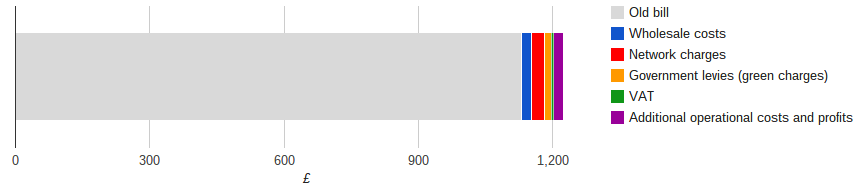
Image Credit : Carbon Brief


After Gordon Brown MP, the UK’s former Prime Minister, was involved in several diplomatic missions around the time of the oil price spike crisis in 2008, and the G20 group of countries went after fossil fuel subsidies (causing easily predictable civil disturbances in several parts of the world), it seemed to me to be obvious that energy price control would be a defining aspect of near-term global policy.

With the economy still in a contracted state (with perhaps further contraction to follow on), national interest for industrialised countries rests in maintaining domestic production and money flows – meaning that citizens should not face sharply-rising utility bills, so that they can remain active in the economy.

In the UK, those at the fringe of financial sustainability are notoriously having to face the decision about whether to Eat or Heat, and Food Banks are in the ascendance. Various charity campaigns have emphasised the importance of affordable energy at home, and the leader of the Labour Party, Ed Miliband MP has made an energy price freeze a potential plank of his policy ahead of the push for the next General Election.

The current Prime Minister, David Cameron MP has called this commitment a “con”, as his political counterpart cannot determine the wholesale price of gas (or power) in the future.

This debate comes at a crucial time in the passage of the UK Energy Bill, as the Electricity Market Reform (EMR), a key component of this legislation has weighty subsidies embedded in it for new nuclear power and renewable energy, and also backup plants (mostly Natural Gas-fired) for periods of high power demand, in what is called the “Capacity Market“. These subsidies will largely be paid for by increases in electricity bills, in one way or another.

The EMR hasn’t yet passed into the statute books, so the majority of “green energy taxes” haven’t yet coming into being – although letters of “comfort” may have been sent to to (one or more) companies seeking to invest in new nuclear power facilities, making clear the UK Government’s monetary commitment to fully supporting the atomic “renaissance”.

With a bucketload of chutzpah, Scottish and Southern Energy (SSE) and Electricite de France’s Vincent de Rivaz blamed green energy policies for contributing to past, current and future power price rises. Both of these companies stand to gain quite a lot from the EMR, so their blame-passing sounds rather hollow.

The Daily Mail and the Daily Telegraph have seemed to me to be incendiary regarding green energy subsidies, omitting to mention that whilst the trajectory of the cost of state support for renewable energy is easily calculated, volatility in global energy markets for gas and oil – and even coal – are indeterminable. Although “scandal-hugging” (sensation equals sales) columnists and editors at the newspapers don’t seem to have an appreciation of what’s really behind energy price rises, the Prime Minister – and Ed Davey MP – have got it – and squarely placed the responsibility for energy price rises on fossil fuels.

The price tag for “green energy policies” – even those being offered to (low carbon, but not “green”) nuclear power – should be considerably less than the total bill burden for energy, and hold out the promise of energy price stabilisation or even suppression in the medium- to long-term, which is why most political parties back them.

The agenda for new nuclear power appears to be floundering – it has been suggested by some that European and American nuclear power companies are not solvent enough to finance a new “fleet” of reactors. In the UK, the Government and its friends in the nuclear industry are planning to pull in east Asian investment (in exchange for large amounts of green energy subsidies, in effect). I suspect a legal challenge will be put forward should a trade agreement of this nature be signed, as soon as its contents are public knowledge.

The anger stirred up about green energy subsidies has had a reaction from David Cameron who has not dispensed with green energy policy, but declared that subsidies should not last longer than they are needed – probably pointing at the Germany experience of degressing the solar power Feed-in Tariff – although he hasn’t mentioned how nuclear subsidies could be ratcheted down, since the new nuclear programme will probably have to rely on state support for the whole of its lifecycle.

Meanwhile, in the Press, it seems that green energy doesn’t work, that green energy subsidies are the only reason for energy bill rises, we should drop the Climate Change Act, and John Prescott MP, and strangely, a woman called Susan Thomas, are pushing coal-fired power claiming it as the cheaper, surer – even cleaner – solution, and there is much scaremongering about blackouts.


https://www.mirror.co.uk/news/uk-news/john-prescott-its-coal-power-2366172

John Prescott on why it’s coal power to the people

12 Oct 2013

We can’t just stand back and give these energy companies money to burn.

It’s only 72 days until Christmas. But the greedy big six energy companies are giving themselves an early present. SSE has just announced an inflation-beating 8.2 per cent price rise on gas and electricity.

The other five will soon follow suit, no doubt doing their best to beat their combined profit from last year of £10billion.

Their excuse now is to blame climate change. SSE says it could cut bills by £110 if Government, not the Big Six, paid for green energy ­subsidies and other environmental costs, such as free loft insulation.

So your bill would look smaller but you’d pay for it with higher taxes. Talk about smoke and mirrors.

But Tory-led governments have always been hopeless at protecting the energy security of this country.

It’s almost 40 years since Britain was hit by blackouts when the Tories forced the UK into a three-day week to conserve energy supplies.

But Ofgem says the margin of ­security between energy demand and supply will drop from 14 per cent to 4 per cent by 2016. That’s because we’ve committed to closing nine oil and coal power stations to meet EU ­environmental law and emissions targets. These targets were meant to encourage the UK to move to cleaner sources of energy.

But this government drastically reduced subsidies for renewable energy such as wind and solar, let Tory energy ministers say “enough is enough” to onshore wind and failed to get agreement on replacing old
nuclear power stations.

On top of that, if we experience a particularly cold winter, we only have a reserve of 5 per cent.

But the Government is committed to hundreds of millions pounds of subsidies to pay the energy ­companies to mothball these oil and coal power stations. As someone who ­negotiated the first Kyoto agreement in 1997 and is involved in its replacement by 2015, it is clear European emissions targets will not be met in the short term by 2020.

So we have to be realistic and do what we can to keep the lights on, our people warm and our country running.

We should keep these oil and coal power stations open to reduce the risk of blackouts – not on stand-by or mothballed but working now.

The former Tory Energy minister John Hayes hinted at this but knew he couldn’t get it past his Lib Dem Energy Secretary boss Ed Davey. He bragged he’d put the coal in coalition. Instead he put the fire in fired.

We can’t just stand back and give these energy companies money to burn. The only energy security they’re interested in is securing profit and maximising taxpayer subsidies.

That’s why Ed Miliband’s right to say he’d freeze bills for 20 months and to call for more ­transparency.

We also need an integrated mixed energy policy – gas, oil, wind, nuclear and, yes, coal.


https://www.oxfordmail.co.uk/yoursay/letters/10722697.Bills_have_risen_to_pay_for_policy_changes/?ref=arc

Letters

Bills have risen to pay for policy changes

Tuesday 8th October 2013

in Letters

THE recent Labour Party pledge to freeze energy bills demonstrated how to have a political cake and eat it. The pledge is an attempt to rectify a heinous political mistake caused by political hubris and vanity.

In 2008, the then energy minister, Ed Miliband, vowed to enact the most stringent cuts in power emissions in the entire world to achieve an unrealistic 80 per cent cut in carbon emissions by closing down fully functioning coal power stations.

He was playing the role of climate saint to win popularity and votes.

I was a member when Ed Miliband spoke in Oxford Town Hall to loud cheers from numerous low-carbon businesses, who stood to profit from his legislation. I was concerned at the impact on the consumer, since it is widely known that coal power stations offer the cheapest energy to consumers compared to nuclear and wind.

So I wrote to Andrew Smith MP at great length and he passed on my concerns to the newly-formed Department of Energy and Climate Change that had replaced the previous Department of Energy and Business.

This new department sent me a lengthy reply, mapping out their plans for wind turbines at a projected cost to the consumer of £100bn to include new infrastructure and amendments to the National Grid. This cost would be added to consumer electricity bills via a hidden green policy tariff.
This has already happened and explains the rise in utility bills.

Some consumers are confused and wrongly believe that energy companies are ‘ripping them off’.

It was clearly stated on Channel 4 recently that energy bills have risen to pay for new policy changes. These policy changes were enacted by Ed Miliband in his popularity bid to play climate saviour in 2008. Energy bills have now rocketed. So Ed has cost every single consumer in the land several hundred pounds extra on their bills each year.

SUSAN THOMAS, Magdalen Road, Oxford


LETTERS
Daily Mail
14th October 2013

[ Turned off: Didcot power station’s closure could lead to power cuts. ]

Labour’s power failures will cost us all dear

THE Labour Party’s pledge to freeze energy bills is an attempt to rectify a horrible political mistake. But it might be too late to dig us out of the financial black hole caused by political vanity.

In 2008, then Energy Minister Ed Miliband vowed to enact the most stringent cuts in power emissions in the world to achieve an unrealistic 80 per cent cut in carbon emissions by closing down coal power stations. He was playing the role of climate saint to win votes.

I was in the audience in Oxford Town Hall that day and recall the loud cheers from numerous representatives of low-carbon businesses as his policies stood to make them all rather wealthy, albeit at the expense of every electricity consumer in the land.

I thought Ed had become entangled in a spider’s web.

I was concerned at the impact on the consumer as it’s widely known that coal power stations offer the cheapest energy to consumers.

I contacted the Department of Energy and Climate Change and it sent me a lengthy reply mapping out its plans for energy projects and wind turbines – at a projected cost to the consumer of £100 billion – including new infrastructure and national grid amendments.

It explained the cost would be added to consumer electricity bills via a ‘green policy’ tariff. This has now happened and explains the rise in utility bills.

Some consumers wrongly believe the energy companies are ripping them off. In fact, energy bills have risen to pay for policy changes.

The people to benefit from this are low-carbon venture capitalists and rich landowners who reap subsidy money (which ultimately comes from the hard-hit consumer) for having wind farms on their land.

Since Didcot power station closed I’ve suffered five power cuts in my Oxford home. If we have a cold winter, we now have a one-in-four chance of a power cut.

The 2008 legislation was a huge mistake. When power cuts happen, people will be forced to burn filthy coal and wood in their grates to keep warm, emitting cancer-causing particulates.

Didcot had already got rid of these asthma-causing particulates and smoke. It emitted mainly steam and carbon dioxide which aren’t harmful to our lungs. But the clean, non-toxic carbon dioxide emitted by Didcot was classified by Mr Miliband as a pollutant. We are heading into a public health and financial disaster.

SUSAN THOMAS, Oxford


https://www.europeanvoice.com/article/2013/october/ceos-demand-reform-of-eu-renewable-subsidies/78418.aspx

CEOs demand reform of EU renewable subsidies
By Dave Keating – 11.10.2013

Companies ask the EU to stop subsidising the renewable energy sector.

The CEOs of Europe’s ten biggest energy companies called for the European Union and member states to stop subsidising the renewable energy sector on Friday (11 October), saying that the priority access given to the sector could cause widespread blackouts in Europe over the winter.

At a press conference in Brussels, Paolo Scaroni, CEO of Italian oil and gas company ENI, said: “In the EU, companies pay three times the price of gas in America, twice the price of power. How can we dream of an industrial renaissance with such a differential?”

The CEOs said the low price of renewable energy as a result of government subsidies is causing it to flood the market. They called for an EU capacity mechanism that would pay utilities for keeping electric power-generating capacity on standby to remedy this problem.

They also complained that the low price of carbon in the EU’s emissions trading scheme (ETS) is exacerbating the problem…


https://www.dailymail.co.uk/debate/article-2458333/DAILY-MAIL-COMMENT-Press-freedom-life-death-matter.html

Well said, Sir Tim

Days after David Cameron orders a review of green taxes, which add £132 to power bills, the Lib Dem Energy Secretary vows to block any attempt to cut them.

Reaffirming his commitment to the levies, which will subsidise record numbers of inefficient wind farms approved this year, Ed Davey adds: ‘I think we will see more price rises.’

The Mail can do no better than quote lyricist Sir Tim Rice, who has declined more than £1million to allow a wind farm on his Scottish estate. ‘I don’t see why rich twits like me should be paid to put up everybody else’s bills,’ he says. ‘Especially for something that doesn’t work.’

Categories
Assets not Liabilities Bait & Switch Be Prepared Big Number Big Picture British Sea Power Change Management Delay and Deny Direction of Travel Disturbing Trends Divide & Rule Energy Autonomy Energy Change Energy Denial Energy Insecurity Energy Revival Extreme Weather Fossilised Fuels Green Power Growth Paradigm Hide the Incline Insulation National Energy National Power Optimistic Generation Policy Warfare Political Nightmare Realistic Models Renewable Resource The Data Unqualified Opinion Wind of Fortune

Wind Powers Electricity Security


Have the anti-wind power lobby struck again ? A seemingly turbulent researcher from Private Eye magazine rang me on Thursday evening to ask me to revise my interpretation of his “Keeping The Lights On” piece of a few weeks previously. His article seemed at first glance to be quite derogatory regarding the contribution of wind power to the UK’s electricity supply. If I were to look again, I would find out, he was sure, that I was wrong, and he was right.

So I have been re-reviewing the annual 2013 “Electricity Capacity Assessment Report” prepared by Ofgem, the UK Government’s Office of Gas and Electricity Markets, an independent National Regulatory Authority. I have tried to be as fair-minded and generous as possible to “Old Sparky” at Private Eye magazine, but a close re-reading of the Ofgem report suggests he is apparently mistaken – wind power is a boon, not a burden (as he seems to claim).

In the overview to the Ofgem report, they state, “our assessment suggests that the risks to electricity security of supply over the next six winters have increased since our last report in October 2012. This is due in particular to deterioration in the supply-side outlook. There is also uncertainty over projected reductions in demand.” Neither of these issues can be associated with wind power, which is being deployed at an accelerating rate and so is providing increasing amounts of electricity.

The report considers risks to security of the electricity supply, not an evaluation of the actual amounts of power that will be supplied. How are these risks to the security of supply quantified ? There are several metrics provided from Ofgem’s modelling, including :-

a. LOLE – Loss of Load Expectation – the average number of hours per year in which electricity supply does not meet electricity demand (if the grid System Operator does not take steps to balance it out).

(Note that Ofgem’s definition of LOLE is difference from other people’s “LOLE is often interpreted in the academic literature as representing the probability of disconnections after all mitigation actions available to the System Operator have been exhausted. We consider that a well functioning market should avoid using mitigation actions in [sic] regular basis and as such we interpret LOLE as the probability of having to implement mitigation actions.”)

b. EEU – Expected Energy Unserved (or “Un-served”) – the average amount of electricity demand that is not met in a year – a metric that combines both the likelihood and the size of any shortfall.

c. Frequency and Duration of Expected Outages – a measure of the risk that an electricity consumer faces of controlled disconnection because supply does not meet demand.

The first important thing to note is that the lights are very unlikely to go out. The highest value of LOLE, measured in hours per year is under 20. That’s 20 hours each year. Not 20 days. And this is not anticipated to be 20 days in a row, either. Section 1.11 says “LOLE, as interpreted in this report, is not a measure of the expected number of hours per year in which customers may be disconnected. For a given level of LOLE and EEU, results may come from a large number of small events where demand exceeds supply in principle but that can be managed by National Grid through a set of mitigation actions available to them as System Operator. […] Given the characteristics of the GB system, any shortfall is more likely to take the form of a large number of small events that would not have a direct impact on customers.”

Section 2.19 states, “The probabilistic measures of security of supply presented in this report are often misinterpreted. LOLE is the expected number of hours per year in which supply does not meet demand. This does not however mean that customers will be disconnected or that there will be blackouts for that number of hours a year. Most of the time, when available supply is not high enough to meet demand, National Grid may implement mitigation actions to solve the problem without disconnecting any customers. However, the system should be planned to avoid the use of mitigation actions and that is why we measure LOLE ahead of any mitigation actions being used”. And Section 2.20, “LOLE does not necessarily mean disconnections but they do remain a possibility. If the difference between available supply and demand is so large that the mitigation actions are not enough to meet demand then some customers have to be disconnected – this is the controlled disconnections step in Figure 14 above. In this case the [System Operator] SO will disconnect industrial demand before household demand.”

And in Section 2.21. “The model output numbers presented here refer to a loss of load of any kind. This could be the sum of several small events (controlled through mitigation actions) or a single large event. As a consequence of the mitigation actions available, the total period of disconnections for a customer will be lower than the value of LOLE.”

The report does anticipate that there are risks of large events where the lights could go out, even if only very briefly, for non-emergency customers : “The results may also come from a small number of large events (eg the supply deficit is more than 2 – 3 gigawatts (GW)) where controlled disconnections cannot be avoided.” But in this kind of scenario two very important things would happen. Those with electricity contracts with a clause permitting forced disconnection would lose power. And immediate backup power generation would be called upon to bridge the gap. There are many kinds of electricity generation that can be called on to start up in a supply crisis – some of them becoming operational in minutes, and others in hours.

As the report says in Section 2.24 “Each [Distribution Network Operator] DNO ensures it can provide a 20% reduction of its total system demand in four incremental stages (between 4% and 6%), which can be achieved at all times, with or without prior warning, and within 5 minutes of receipt of an instruction from the System Operator. The reduction of a further 20% (40% in total) can be achieved following issue of the appropriate GB System Warning by National Grid within agreed timescales”.

It’s all about the need for National Grid to balance the system. Section 2.9 says, “LOLE is not a measure of the expected number of hours per year in which customers may be disconnected. We define LOLE to indicate the number of hours in which the system may need to respond to tight conditions.”

The report also rules some potential sources of disruption of supply outside the remit of this particular analysis – see Section 3.17 “There are other reasons why electricity consumers might experience disruptions to supply, which are out of the scope of this assessment and thus not captured by this model, such as: Flexibility : The ability of generators to ramp up in response to rapid increases in demand or decreases in the output of other generators; Insufficient reserve : Unexpected increases in demand or decreases in available capacity in real time which must be managed by the System Operator through procurement and use of reserve capacity; Network outages : Failures on the electricity transmission or distribution networks; Fuel availability : The availability of the fuel used by generators. In particular the security of supplies of natural gas at times of peak electricity demand.”

Crucially, the report says there is much uncertainty in their modelling of LOLE and EEU. In Section 2.26, “The LOLE and EEU estimates are just an indication of risk. There is considerable uncertainty around the main variables in the calculation (eg demand, the behaviour of interconnectors etc.)”

(Note : interconnectors are electricity supply cables that join the UK to other countries such as Ireland and Holland).

Part of the reason for Ofgem’s caveat of uncertainty is the lack of appropriate data. Although they believe they have better modelling of wind power since their 2012 report (see Sections 3.39 to 3.50), there are data sets they believe should be improved. For example, data on Demand Side Response (DSR) – the ability of the National Grid and its larger or aggregated consumers to alter levels of demand on cue (see Sections 4.7 to 4.10 of the document detailing decisions about the methodology). A lack of data has led to certain assumptions being retained, for example, the assumption that there is no relationship between available wind power and periods of high demand – in the winter season (see Section 2.5 and Sections 4.11 to 4.17 of the methodology decisions document).

In addition to these uncertainties, the sensitivity cases used in the modelling are known to not accurately reflect the capability of management of the power grid. In the Executive Summary on page 4, the report says, “These sensitivities only illustrate changes in one variable at a time and so do not capture potential mitigating effects, for example of the supply side reacting to higher demand projections.” And in Section 2.16 it says, “Each sensitivity assumes a change in one variable from the Reference Scenario, with all other assumptions being held constant. The purpose of this is to assess the impact of the uncertainty related to each variable in isolation, on the risk measures. Our report is not using scenarios (ie a combination of changes in several variables to reflect alternative worlds or different futures), as this would not allow us to isolate the impact of each variable on the risk measures.”

Thus, the numbers that are output by the modelling are perforce illustrative, not definitive.

What “Old Sparky” at Private Eye was rattled by in his recent piece was the calculation of Equivalent Firm Capacity (EFC) in the Ofgem report.

On page 87, Section 3.55, the Ofgem report defines the “standard measure” EFC as “the amount of capacity that is required to replace the wind capacity to achieve the same level of LOLE”, meaning the amount of always-on generation capacity required to replace the wind capacity to achieve the same level of LOLE. Putting it another way on page 33, in the footnotes for Section 3.29, the report states, “The EFC is the quantity of firm capacity (ie always available) that can be replaced by a certain volume of wind generation to give the same level of security of supply, as measured by LOLE.”

Wind power is different from fossil fuel-powered generation as there is a lot of variability in output. Section 1.48 of the report says, “Wind generation capacity is analysed separately given that its outcome in terms of generation availability is much more variable and difficult to predict.” Several of the indicators calculated for the report are connected with the impact of wind on security of the power supply. However, variation in wind power is not the underlying reason for the necessity of this report. Other electricity generation plant has variation in output leading to questions of security of supply. In addition, besides planned plant closures and openings, there are as-yet-unknown factors that could impact overall generation capacity. Section 2.2 reads, “We use a probabilistic approach to assess the uncertainty related to short-term variations in demand and available conventional generation due to outages and wind generation. This is combined with sensitivity analysis to assess the uncertainty related to the evolution of electricity demand and supply due to investment and retirement decisions (ie mothballing, closures) and interconnector flows, among others.”

The report examines the possibility that wind power availability could be correlated to winter season peak demand, based on limited available data, and models a “Wind Generation Availability” sensitivity (see Section 3.94 to Section 3.98, especially Figure 64). In Section 3.42 the report says, “For the wind generation availability sensitivity we assume that wind availability decreases at time of high demand. In particular this sensitivity assumes a reduction in the available wind resource for demand levels higher than 92% of the ACS peak demand. The maximum reduction is assumed to be 50% for demand levels higher than 102% of ACS peak demand.” Bear in mind that this is only an assumption.

In Appendix 5 “Detailed results tables”, Table 34, Table 35 and Table 37 show how this modelling impacts the calculation of the indicative Equivalent Firm Capacity (EFC) of wind power.

In the 2018/2019 timeframe, when there is expected to be a combined wind power capacity of 8405 megawatts (MW) onshore plus 11705 MW offshore = 20110 MW, the EFC for wind power is calculated to be 2546 MW in the “Wind Generation Availability” sensitivity line, which works out at 12.66% of the nameplate capacity of the wind power. Note : 100 divided by 12.66 is 7.88, or a factor of roughly 8.

At the earlier 2013/2014 timeframe, when combined wind power capacity is expected to be 3970 + 6235 MW = 10205 MW, and the EFC is at 1624 MW or 15.91% for the “Wind Generation Sensitivity” line. Note : 100 divided by 15.91 = 6.285, or a factor of roughly 6.

“Old Sparky” is referring to these factor figures when he says in his piece (see below) :-

“[…] For every one megawatt of reliable capacity (eg a coal-fired power
station) that gets closed, Ofgem calculates Britain would need six to
eight
megawatts of windfarm capacity to achieve the original level of
reliability – and the multiple is rising all the time. Windfarms are
not of course being built at eight times the rate coal plants are
closing – hence the ever-increasing likelihood of blackouts. […]”

Yet he has ignored several caveats given in the report that place these factors in doubt. For example, the sensitivity analysis only varies one factor at a time and does not attempt to model correlated changes in other variables. He has also omitted to consider the relative impacts of change.

If he were to contrast his statement with the “Conventional Low Generation Availability” sensitivity line, where wind power EFC in the 2013/2014 timeframe is calculated as a healthy 26.59% or a factor of roughly 4; or 2018/2019 when wind EFC is 19.80% or a factor of roughly 5.

Note : The “Conventional Low Generation Availability” sensitivity is drawn from historical conventional generation operating data, as outlined in Sections 3.31 to 3.38. Section 3.36 states, “The Reference Scenario availability is defined as the mean availability of the seven winter estimates. The availability values used for the low (high) availability sensitivities are defined as the mean minus (plus) one standard deviation of the seven winter estimates.”

Table 30 and Table 31 show that low conventional generation availability will probably be the largest contribution to energy security uncertainty in the critical 2015/2016 timeframe.

The upshot of all of this modelling is that wind power is actually off the hook. Unforeseen alterations in conventional generation capacity are likely to have the largest impact. As the report says in Section 4.21 “The figures indicate that reasonably small changes in conventional generation availability have a material impact on the risk of supply shortfalls. This is most notable in 2015/16, where the estimated LOLE ranges from 0.2 hours per year in the high availability sensitivity to 16 hours per year in the low availability sensitivity, for the Reference Scenario is 2.9 hours per year.”

However, Section 1.19 is careful to remind us, “Wind generation, onshore and offshore, is expected to grow rapidly in the period of analysis and especially after 2015/16, rising from around 9GW of installed capacity now to more than 20GW by 2018/19. Given the variability of wind speeds, we estimate that only 17% of this capacity can be counted as firm (ie always available) for security of supply purposes by 2018/19.” This is in the Reference Scenario.

The sensitivities modelled in the report are a measure of risk, and do not provide absolute values for any of the output metrics, especially since the calculations are dependent on so many factors, including economic stimulus for the building of new generation plant.

Importantly, recent decisions by gas-fired power plant operators to “mothball”, or close down their generation capacity, are inevitably going to matter more than how much exactly we can rely on wind power.

Many commentators neglect to make the obvious point that wind power is not being used to replace conventional generation entirely, but to save fossil fuel by reducing the number of hours conventional generators have to run. This is contributing to energy security, by reducing the cost of fossil fuel that needs to be imported. However, the knock-on effect is this is having an impact on the economic viability of these plant because they are not always in use, and so the UK Government is putting in place the “Capacity Mechanism” to make sure that mothballed plant can be put back into use when required, during those becalmed, winter afternoons when power demand is at its peak.


Private Eye
Issue Number 1345
26th July 2013 – 8th August 2013

“Keeping the Lights On”
page 14
by “Old Sparky”

The report from energy regulator Ofgem that sparked headlines on
potential power cuts contains much new analysis highlighting the
uselessness of wind generation in contributing to security of
electricity supply, aka the problem of windfarm “intermittency”. But
the problem is being studiously ignored by the Department of Energy
and Climate Change (DECC).

As coal power stations shut down, windfarms are notionally replacing
them. If, say, only one windfarm were serving the grid, its inherent
unreliability could easily be compensated for. But if there were
[italics] only windfarms, and no reliable sources of electricity
available at all, security of supply would be hugely at risk. Thus the
more windfarms there are, the less they contribute to security.

For every one megawatt of reliable capacity (eg a coal-fired power
station) that gets closed, Ofgem calculates Britain would need six to
eight megawatts of windfarm capacity to achieve the original level of
reliability – and the multiple is rising all the time. Windfarms are
not of course being built at eight times the rate coal plants are
closing – hence the ever-increasing likelihood of blackouts.

[…]

In consequence windfarms are being featherbedded – not only with
lavish subsidies, but also by not being billed for the ever-increasing
trouble they cause. When the DECC was still operating Plan B, aka the
dash for gas ([Private] Eye [Issue] 1266), the cost of intermittency
was defined in terms of balancing the grid by using relatively clean
and cheap natural gas. Now that the department has been forced to
adopt emergency Plan C ([Private] Eye [Issue] 1344), backup for
intermittent windfarm output will increasingly be provided by dirty,
expensive diesel generators.


Private Eye
Issue 1344
12 – 25 July 2013

page 15
“Keeping the Lights On”

As pandemonium breaks out in newspapers at the prospect of electricity
blackouts, emergency measures are being cobbled together to ensure the
lights stay on. They will probably succeed – but at a cost.

Three years ago incoming coalition ministers were briefed that when
energy policy Plan A (windfarms, new nukes and pixie-dust) failed, Plan B
would be in place – a new dash for gas ([Private] Eye [Issue] 1266).

Civil servants then devised complex “energy market reforms” (EMR) to make
this happen. It is now clear that these, too, have failed. Coal-fired power
stations are closing quicker than new gas plants are being built. As energy
regulator Ofgem put it bluntly last week: “The EMR aims to incentivise
industry to address security of supply in the medium term, but is not able
to bring forward investment in new capacity in time.”

Practical people in the National Grid are now hatching emergency Plan C.
They will pay large electricity users to switch off when requested;
encourage industrial companies and even hospitals to generate their own
diesel-fired electricity (not a hard sell when the grid can’t be relied
on); hire diesel generators to make up for the intermittency of windfarms
([Private] Eye [Issue] 1322); and bribe electricity companies to bring
mothballed gas-fired plants back into service.

Some of these steps are based on techniques previously used in extreme
circumstances, and will probably keep most of the lights on. But this
should not obscure the fact that planning routine use of emergency
measures is an indictment of energy policy. And since diesel is much
more expensive and polluting than gas, electricity prices and CO2
emissions will be higher than if Plan B had worked.

[…]

‘Old Sparky’


Categories
Academic Freedom Alchemical Bait & Switch Be Prepared Big Picture Big Society Carbon Pricing Change Management Climate Change Climate Chaos Contraction & Convergence Deal Breakers Delay and Deny Demoticratica Design Matters Divide & Rule Energy Change Energy Denial Energy Insecurity Energy Revival Energy Socialism Evil Opposition Fair Balance Foreign Interference Fossilised Fuels Gamechanger Geogingerneering Green Investment Green Power Growth Paradigm Human Nurture Insulation Libertarian Liberalism Low Carbon Life Mass Propaganda Media Meltdown Methane Management Military Invention National Energy National Power Nudge & Budge Paradigm Shapeshifter Peace not War Peak Emissions Policy Warfare Political Nightmare Public Relations Regulatory Ultimatum Renewable Resource Revolving Door Science Rules Screaming Panic Social Capital Social Change Social Democracy Solution City Technological Sideshow The Power of Intention The Right Chemistry The War on Error Transport of Delight Unnatural Gas Western Hedge Zero Net

Ed Davey : Polish Barbecue


This week, both Caroline Flint MP and Ed Balls MP have publicly repeated the commitment by the UK’s Labour Party to a total decarbonisation of the power sector by 2030, should they become the governing political party. At PRASEG’s Annual Conference, Caroline Flint said “In around ten years time, a quarter of our power supply will be shut down. Decisions made in the next few years […] consequences will last for decades […] keeping the lights on, and [ensuring reasonably priced] energy bills, and preventing dangerous climate change. […] Labour will have as an election [promise] a legally binding target for 2030. […] This Government has no vision.”

And when I was in an informal conversation group with Ed Davey MP and Professor Mayer Hillman of the Policy Studies Institute at a drinks reception after the event hosted by PRASEG, the Secretary of State for Energy and Climate Change seemed to me to also be clear on his personal position backing the 2030 “decarb” target.

Ed Davey showed concern about the work necessary to get a Europe-wide commitment on Energy and Climate Change. He took Professor Hillman’s point that carbon dioxide emissions from the burning of fossil fuels are already causing dangerous climate change, and that the risks are increasing. However, he doubted that immediate responses can be made. He gave the impression that he singled out Poland of all the countries in the European Union to be an annoyance, standing in the way of success. He suggested that if Professor Hillman wanted to do something helpful, he could fly to Poland…at this point Professor Hillman interjected to say he hasn’t taken a flight in 70 years and doesn’t intend to now…and Ed Davey continued that if the Professor wanted to make a valuable contribution, he could travel to Poland, taking a train, or…”I don’t care how you get there”, but go to Poland and persuade the Poles to sign up to the 2030 ambition.

Clearly, machinations are already afoot. At the PRASEG Annual Conference were a number of communications professionals, tightly linked to the debate on the progress of national energy policy. Plus, one rather exceedingly highly-networked individual, David Andrews, the key driver behind the Claverton Energy Research Group forum, of which I am an occasional participant. He had ditched the normal navy blue polyester necktie and sombre suit for a shiveringly sharp and open-necked striped shirt, and was doing his best to look dapper, yet zoned. I found him talking to a communications professional, which didn’t surprise me. He asked how I was.

JA : “I think I need to find a new job.”
DA : “MI6 ?”
JA : “Too boring !”

What I really should have said was :-

JA : “Absolutely and seriously not ! Who’d want to keep State Secrets ? Too much travel and being nice to people who are nasty. And making unbelievable compromises. The excitement of privilege and access would wear off after about six minutes. Plus there’s the risk of ending up decomposing in something like a locked sports holdall in some strange bathroom in the semblance of a hostelry in a godforsaken infested hellhole in a desolate backwater like Cheltenham or Gloucester. Plus, I’d never keep track of all the narratives. Or the sliding door parallel lives. Besides, I’m a bit of a Marmite personality – you either like me or you really don’t : I respond poorly to orders, I’m not an arch-persuader and I’m not very diplomatic or patient (except with the genuinely unfortunate), and I’m well-known for leaping into spats. Call me awkward (and some do), but I think national security and genuine Zero Carbon prosperity can be assured by other means than dark arts and high stakes threats. I like the responsibility of deciding for myself what information should be broadcast in the better interests of the common good, and which held back for some time (for the truth will invariably out). And over and above all that, I’m a technologist, which means I prefer details over giving vague impressions. And I like genuine democratic processes, and am averse to social engineering. I am entirely unsuited to the work of a secret propaganda and diplomatic unit.”

I would be prepared to work for a UK or EU Parliamentary delegation to Poland, I guess, if I could be useful in assisting with dialogue, perhaps in the technical area. I do after all have several academic degrees pertinent to the questions of Energy and Climate Change.

But in a room full of politicians and communications experts, I felt a little like a fished fish. Here, then, is a demonstration. I was talking with Rhys Williams, the Coordinator of PRASEG, and telling him I’d met the wonderful Professor Geoff Williams, of Durham Univeristy, who has put together a system of organic light emitting diode (LED) lighting and a 3-D printed control unit, and, and, and Rhys actually yawned. He couldn’t contain it, it just kind of spilled out. I told myself : “It’s not me. It’s the subject matter”, and I promptly forgave him. Proof, though, of the threshold for things technical amongst Westminster fixers and shakers.

Poland. I mean, I know James Delingpole has been to Poland, and I thought at the time he was possibly going to interfere with the political process on climate change, or drum up support for shale gas. But I’m a Zero Carbon kind of actor. I don’t need to go far to start a dialogue with Poland by going to Poland – I have Poles living in my street, and I’m invited to all their barbecues. Maybe I should invite Professor Mayer Hillman to cycle over to Waltham Forest and address my near neighbours and their extended friendship circle on the importance of renewable energy and energy efficiency targets, and ask them to communicate with the folks back home with any form of influence.

Categories
Alchemical Assets not Liabilities Bad Science Be Prepared Change Management Climate Change Climate Chaos Climate Damages Conflict of Interest Cost Effective Deal Breakers Delay and Deny Demoticratica Divide & Rule Efficiency is King Emissions Impossible Evil Opposition Fair Balance Fossilised Fuels Freak Science Freemarketeering Green Investment Green Power Growth Paradigm Human Nurture Hydrocarbon Hegemony Insulation Low Carbon Life Mad Mad World Mass Propaganda Media Money Sings National Energy National Power Non-Science Nudge & Budge Orwells Paradigm Shapeshifter Pet Peeves Political Nightmare Public Relations Realistic Models Regulatory Ultimatum Revolving Door Science Rules Scientific Fallacy Social Change Social Chaos Social Democracy Stirring Stuff Sustainable Deferment The Data The Science of Communitagion Toxic Hazard Ungreen Development Unqualified Opinion

Battle of the Lords

I don’t quite know what powers Lord Deben, John Gummer, but he looks remarkably wired on it. At this week’s PRASEG Annual Conference, he positively glowed with fervour and gumption. He regaled us with tales of debate in the House of Lords, the UK’s parliamentary “senior” chamber. He is a known climate change science adherent, and in speaking to PRASEG, he was preaching to the choir, but boy, did he give a bone-rattling homily !

As Chairman of the Committee on Climate Change, he is fighting the good fight for carbon targets to be established in all areas of legislation, especially the in-progress Energy Bill. He makes the case that emissions restraint and constraint is now an international business value, and of importance to infrastructure investment :-

“The trouble with energy efficiency is that it’s not “boys’ toys” – there’s no “sex” in it. It is many small things put together to make a big thing. We won’t get to a point of decarbonisation unless we [continuously] make [the case for] [continuous] investment. […] GLOBE [of which I am a member] in a report – 33 major countries – doing so much. […] Look at what China is doing. Now a competitive world. If we want people to come here and invest, we need to have a carbon intensity target in 2030 [which will impact] [manufacturing] and the supply chain. [With the current strategy, the carbon targets are] put down in 2020 and picked up again in 2050. Too long a gap for business. They don’t know what happens in between. This is not all about climate change. It is about UK plc.”

To supplement this diet of upbeat encouragement, he added a good dose of scorn for fellow Lords of the House, the Lords Lawson (Nigel Lawson) and Lord Ridley (Matt Ridley) who, he seemed to be suggesting, clearly have not mastered the science of climate change, and who, I believe he imputed, have lost their marbles :-

“Apart from one or two necessary sideswipes, I agree with the previous speaker. There is no need for disagreement except for those who dismiss climate change. [I call them “dismissers” as we should not] dignify their position by calling them “sceptics”. We are the sceptics. We come to a conclusion based on science and we revisit it every time new science comes our way. They rifle through every [paper] to find every little bit that suppports their argument. I’ve listened to the interventions [in the House of Lords reading of and debate on the Energy Bill] of that group. Their line is the Earth is not [really] warming, so, it’s too expensive to do anything. This conflicts with today’s World Meteorological Organization measurements – that the last decade has been the warmest ever. I bet you that none of them [Lords] will stand up [in the House of Lords] and say “Sorry. We got it wrong.” They pick one set of statistics and ignore the rest. It is a concentrated effort to undermine by creating doubt. Our job is constantly to make it clear they we don’t need to argue the case – the very best science makes it certain [but never absolute]. You would be very foolish to ignore the consensus of view. […] In a serious grown-up world, we accept the best advice – always keeping an eye out for new information. Otherwise, [you would] make decisions on worst information – no sane person does that.”

He encouraged us to encourage the dissenters on climate change science to view the green economy as an insurance policy :-

“Is there a householder here who does not insure their houses against fire ? You have a 98% change of not having a fire. Yet you spend on average £140 a year on insurance. Because of the size of the disaster – the enormity of the [potential] loss. Basic life-supporting insurance. I’m asking for half of that. If only Lord Lawson would listen to the facts instead of that Doctor of Sports Science, Benny Peiser. Or Matt Ridley – an expert in the sexual habits of pheasants. If I want to know about pheasants, I will first ask Lord Ridley. Can he understand why I go to a climatologist first ? [To accept his view of the] risks effects of climate change means relying on the infallibility of Lord Lawson […]”

He spoke of cross-party unity over the signing into law of the Climate Change Act, and the strength of purpose within Parliament to do the right thing on carbon. He admitted that there were elements of the media and establishment who were belligerently or obfuscatingly opposing the right thing to do :-

“[We] can only win if the world outside has certainty about institutional government. This is a battle we have taken on and won’t stop till we win it. [The Lord Lawson and Lord Ridley and their position is] contrary to science, contrary to sense and contrary to the principle of insurance. They will not be listened to, not now, until UK has reduced level of carbon emissions, and we have [promised] our grandchildren they they are safe from climate change.”

Phew ! That was a war cry, if ever there was one ! We are clearly in the Salvation Army ! I noted the attendance list, that showed several Gentlemen and Ladies of the Press should have been present, and hope to read good reports, but know that in some parts of the Gutter, anti-science faecal detritus still swirls. We in One Birdcage Walk were the assembly of believers, but the general public conversation on carbon is poisoned with sulphurous intent.

Categories
Academic Freedom Acid Ocean Alchemical Animal Kingdoom Breathe Easy British Biogas Climate Change Energy Change Engineering Marvel Extreme Energy Fossilised Fuels Gas Storage Geogingerneering Global Heating Global Singeing Global Warming Hydrogen Economy Low Carbon Life Marvellous Wonderful Methane Management National Energy Realistic Models Renewable Gas Resource Wards Science Rules Solution City The Data The Right Chemistry

Hadeo- and Archaeo-Geobiology

What can deep time teach us ?

Whilst doing a little background research into biological routes to hydrogen production, I came across a scientific journal paper, I can’t recall which, that suggested that the geological evidence indicates that Earth’s second atmosphere not only had a high concentration of methane, but also high levels of hydrogen gas.

Previously, my understanding was that the development of microbiological life included a good number of methanogens (micro-life that produces methane as a waste product) and methanotrophs (those that “trough” on methane), but that hydrogenogen (“respiring” hydrogen gas) and hydrogenotroph (metabolising hydrogen) species were a minority, and that this was reflected in modern-day decomposition, such as the cultures used in biogas plants for anaerobic digestion.

If there were high densities of hydrogen cycle lifeforms in the early Earth, maybe there are remnants, descendants of this branch of the tree of life, optimal at producing hydrogen gas as a by-product, which could be employed for biohydrogen production, but which haven’t yet been scoped.

After all, it has only been very recently that psychrophiles have been added to the range of microorganisms that have been found useful in biogas production – cold-loving, permafrost-living bugs to complement the thermophile and mesophile species.

Since hydrogen and methane are both ideal gas fuels, for a variety of reasons, including gas storage, combustion profiles and simple chemistry, I decided I needed to learn a little more.

I have now read a plethora of new theories and several books about the formation of the Earth (and the Moon) in the Hadean Eon, the development of Earth’s atmosphere, the development of life in the Archaean Eon, and the evolution of life caused by climate change, and these developments in living beings causing climate change in their turn.

Most of this knowledge is mediated to us by geology, and geobiology. But right at its heart is catalytic chemistry, once again. Here’s Robert Hazen (Robert M. Hazen) from page 138 of “The Story of Earth” :-

“Amino acids, sugars, and the components of DNA and RNA adsorb onto all of Earth’s most common rock-forming minerals […] We concluded that wherever the prebiotic ocean contacted minerals, highly concentrated arrangements of life’s molecules are likely to have emerged from the formless broth […] Many other researchers have also settled on such a conclusion – indeed, more than a few prominent biologists have also gravitated to minerals, because origins-of-life scenarios that involve only oceans and atmosphere face insurmountable problems in accounting for efficient mechanisms of molecular selection and concentration. Solid minerals have an unmatched potential to select, concentrate, and organize molecules. So minerals much have played a central role in life’s origins. Biochemistry is complex, with interwoven cycles and networks of molecular reactions. For those intricately layered processes to work, molecules have to have just the right sizes and shapes. Molecular selection is the task of finding the best molecule for each biochemical job, and template-directed selection on mineral surfaces is now the leading candidate for how nature did it […] left- and right-handed molecules […] It turns out that life is incredibly picky : cells almost exclusively employ left-handed amino acids and right-handed sugars. Chirality matters […] Our recent experiments have explored the possibility that chiral mineral surfaces played the starring role in selecting handed molecules, and perhaps the origins of life as well. […] Our experiments showed that certain left-handed molecules can aggregate on one set of crystal surfaces, while the mirror image […] on other sets […] As handed molecules are separated and concentrated, each surface becomes a tiny experiment in molecular selection and organization. On its own, no such natural experiment with minerals and molecules is likely to have generated life. But take countless trillions of trillions of trillions of mineral surfaces, each bathed in molecule-rich organic broth […] The tiny fraction of all those molecular combinations that wound up displaying easier self-assembly, or developed a stronger binding to mineral surfaces […] survived […] possibly to learn new tricks.”

Categories
Academic Freedom Energy Autonomy Environmental Howzat Fossilised Fuels Gamechanger Hydrocarbon Hegemony Hydrogen Economy Incalculable Disaster Methane Management National Energy Paradigm Shapeshifter Peak Natural Gas Renewable Gas Unconventional Foul Unnatural Gas

Good Gas, Bad Gas

https://thinkprogress.org/climate/2013/07/07/1058051/must-see-gasland-part-ii-on-hbo-monday-natural-gas-once-a-bridge-now-a-gangplank/

That’s the bad gas. Now for the good gas – Renewable Gas :-

https://tribune.com.pk/story/573418/renewable-energy-kesc-aman-foundation-to-set-up-bio-gas-plant/

https://www.woodheadpublishing.com/en/book.aspx?bookID=2862

https://pubs.acs.org/doi/abs/10.1021/nl4016655

Joanna Kargul’s team :-
https://solar.biol.uw.edu.pl/index.php/lab-team
https://www.eera-set.eu/lw_resource/datapool/_items/item_795/ampea_2013_kargul.pdf

Slightly questionable gas (from a biosecurity point of view) :-

https://sb6.biobricks.org/poster/biohydrogen-production-in-e-coli-a-synthetic-biology-approach/

Categories
Bait & Switch Change Management Conflict of Interest Corporate Pressure Dead End Disturbing Trends Energy Insecurity Energy Nix Energy Revival Extreme Energy Financiers of the Apocalypse Foreign Interference Foreign Investment Fossilised Fuels Freemarketeering Gamechanger Growth Paradigm Hydrocarbon Hegemony Mad Mad World Mass Propaganda Money Sings National Energy Nudge & Budge Orwells Paradigm Shapeshifter Peak Natural Gas Peak Oil Policy Warfare Public Relations Realistic Models Resource Curse Shale Game Tarred Sands Technological Sideshow The Data The Power of Intention The War on Error Unconventional Foul Unnatural Gas Unsolicited Advice & Guidance Western Hedge

They Think It’s Not All Over


[ Image Credit : Lakeview Gusher : TotallyTopTen.com ]

So, the EIA say that the world has 10 years of shale oil resources which are technically recoverable. Woo hoo. We’ll pass over the question of why the American Department of Energy are guiding global energy policy, and why this glowing pronouncement looks just like the mass propaganda exercise for shale gas assessments that kicked off a few years ago, and move swiftly on to the numbers.

No, actually, not straight on to the numbers. It shouldn’t take a genius to work out the public relations strategy for promoting increasingly dirtier fossil fuels. First, they got us accustomed to the idea of shale gas, and claimed without much evidence, that it was as “clean” as Natural Gas, and far, far cleaner than coal. Data that challenges this myth continues to be collected. Meanwhile, now we are habituated to accepting without reason the risks of subsurface and ground water reservoir destruction by hydraulic fracturing, we should be pliable enough to accept the next step up – oil shale oil fracking. And then the sales team can move on to warm us up to cruddier unconventionals, like bitumen exhumed from tar sands, and mining unstable sub-sea clathrates.

Why do the oil and gas companies of the world and their trusted allies in the government energy departments so desperately want us to believe in the saving power of shale oil and gas ? Why is it necessary for them to pursue such an environmentally threatening course of product development ? Can it be that the leaders of the developed world and their industry experts recognise, but don’t want to admit to, Peak Oil, and its twin wraith, Peak Natural Gas, that will shadow it by about 10 to 15 years ?

A little local context – UK oil production is falling like a stoneover the whole North Sea area. Various efforts have been made to stimulate new investment in exploration and discovery. The overall plan for the UK Continental Shelf has included opening up prospects via licence to smaller players in the hope of getting them to bet the farm, and if they come up trumps, permitted the larger oil and gas companies to snaffle up the small fry.

But really, the flow of Brent crude oil is getting more expensive to guarantee. And it’s not just the North Sea – the inverse pyramid of the global oil futures market is teeteringly wobbly, even though Natural Gas Liquids (NGL) are now included in petroleum oil production figures. Cue panic stations at the Coalition (Oilition) Government offices – frantic rustling of review papers ahoy.

To help them believe it’s not all over, riding into view from the stables of Propaganda Central, come the Six Horsemen of Unconventional Fossil Fuels : Tar Sands, Shale Gas, Shale Oil (Oil Shale Oil), Underground Coal Gasification, Coalbed Methane and Methane Hydrates.

Shiny, happy projections of technically recoverable unconventional (night)mares are always lumped together, like we are able to suddenly open up the ground and it starts pouring out hydrocarbon goodies at industrial scale volumes. But no. All fossil fuel development is gradual – especially at the start of going after a particular resource. In the past, sometimes things started gushing or venting, but those days are gone. And any kind of natural pump out of the lithosphere is entirely absent for unconventional fossil fuels – it all takes energy and equipment to extract.

And so we can expect trickles, not floods. So, will this prevent field depletion in any region ? No. It’s not going to put off Peak Oil and Peak Natural Gas – it literally cannot be mined fast enough. Even if there are 10 years of current oil production volumes that can be exploited via mining oil shale, it will come in dribs and drabs, maybe over the course of 50 to 100 years. It might prolong the Peak Oil plateau by a year or so – that’s barely a ripple. Unconventional gas might be more useful, but even this cannot delay the inevitable. For example, despite the USA shale gas “miracle”, as the country continues to pour resources and effort into industrialising public lands, American Peak Natural Gas is still likely to be only 5 years, or possibly scraping 10 years, behind Global Peak Natural Gas which will bite at approximately 2030 or 2035-ish. I suspect this is why EIA charts of future gas production never go out beyond 2045 or so :-

Ask a mathematician to model growth in unconventional fossil fuels compared to the anticipated and actual decline in “traditional” fossil fuels, and ask if unconventionals will compensate. They will not.

The practice for oil and gas companies is to try to maintain shareholder confidence by making sure they have a minimum of 10 years of what is known as Reserves-to-Production ratio or R/P. By showing they have at least a decade of discovered resources, they can sell their business as a viable investment. Announcing that the world has 10 years of shale oil it can exploit sounds like a healthy R/P, but in actual fact, there is no way this can be recovered in that time window. The very way that this story has been packaged suggests that we are being encouraged to believe that the fossil fuel industry are a healthy economic sector. Yet it is so facile to debunk that perspective.

People, it’s time to divest your portfolios of oil and gas concerns. If they have to start selling us the wonders of bitumen and kerogen, the closing curtain cannot be far away from dropping.

They think it’s not all over, but it so clearly must be.

Categories
Academic Freedom Advertise Freely Assets not Liabilities Bait & Switch Be Prepared Big Picture Biofools Burning Money Carbon Capture Change Management Climate Change Climate Chaos Climate Damages Contraction & Convergence Corporate Pressure Cost Effective Delay and Deny Design Matters Direction of Travel Divide & Rule Drive Train Efficiency is King Emissions Impossible Energy Autonomy Energy Change Energy Denial Energy Disenfranchisement Energy Insecurity Engineering Marvel Environmental Howzat Financiers of the Apocalypse Fossilised Fuels Freemarketeering Fuel Poverty Green Investment Hydrocarbon Hegemony Hydrogen Economy Incalculable Disaster Low Carbon Life Major Shift Marine Gas Mass Propaganda Money Sings Near-Natural Disaster Neverending Disaster No Pressure Nudge & Budge Oil Change Paradigm Shapeshifter Peak Emissions Peak Energy Peak Natural Gas Peak Oil Petrolheads Protest & Survive Public Relations Pure Hollywood Renewable Gas Social Change Social Democracy Technofix Technological Sideshow The Science of Communitagion Toxic Hazard Unconventional Foul Ungreen Development Unnatural Gas

Carbon Bubble : Unburnable Assets


[ Image Credit : anonymous ]


Yet again, the fossil fuel companies think they can get away with uncommented public relations in my London neighbourhood. Previously, it was BP, touting its green credentials in selling biofuels, at the train station, ahead of the Olympic Games. For some reason, after I made some scathing remarks about it, the advertisement disappeared, and there was a white blank board there for weeks.

This time, it’s Esso, and they probably think they have more spine, as they’ve taken multiple billboard spots. In fact, the place is saturated with this advertisement. And my answer is – yes, fuel economy is important to me – that’s why I don’t have a car.

And if this district is anything to go by, Esso must be pouring money into this advertising campaign, and so my question is : why ? Why aren’t they pouring this money into biofuels research ? Answer : because that’s not working. So, why aren’t they putting this public relations money into renewable gas fuels instead, sustainable above-surface gas fuels that can be used in compressed gas cars or fuel cell vehicles ?

Are Esso retreating into their “core business” like BP, and Shell, concentrating on petroleum oil and Natural Gas, and thereby exposing all their shareholders to the risk of an implosion of the Carbon Bubble ? Or another Deepwater Horizon, Macondo-style blowout ?

Meanwhile, the movement for portfolio investors to divest from fossil fuel assets continues apace…

Categories
Academic Freedom Alchemical Assets not Liabilities Big Picture Big Society British Biogas Change Management Climate Change Conflict of Interest Design Matters Direction of Travel Emissions Impossible Energy Autonomy Energy Change Energy Insecurity Energy Revival Engineering Marvel Fossilised Fuels Green Investment Green Power Human Nurture Hydrocarbon Hegemony Hydrogen Economy Low Carbon Life Major Shift Marvellous Wonderful Media National Energy National Power Optimistic Generation Paradigm Shapeshifter Peak Coal Peak Emissions Peak Energy Peak Natural Gas Peak Oil Realistic Models Renewable Gas Renewable Resource Science Rules Shale Game Social Capital Social Change Solar Sunrise Solution City Stirring Stuff Technological Sideshow The Data The Power of Intention The Science of Communitagion Unconventional Foul Unnatural Gas Wind of Fortune Zero Net

Renewable Gas : Research Parameters

“So what do you do ?” is a question I quite frequently have to answer, as I meet a lot of new people, in a lot of new audiences and settings, on a regular basis, as an integral part of my personal process of discovery.

My internal autocue answer has modified, evolved, over the years, but currently sounds a lot like this, “I have a couple of part-time jobs, office administration, really. I do a spot of weblogging in my spare time. But I’m also doing some research into the potential for Renewable Gas.” I then pause for roughly two seconds. “Renewable Gas ?” comes back the question.

“Yes,” I affirm in the positive, “Industrial-scale chemistry to produce gas fuels not dug up out of the ground. It is useful to plug the gaps in Renewable Electricity when the sun isn’t shining and the wind isn’t blowing.”

It’s not exactly an elevator pitch – I’m not really selling anything except a slight shift in the paradigm here. Renewable Energy. Renewable Electricity. Renewable Gas. Power and gas. Gas and power. It’s logical to want both to be as renewable and sustainable and as low carbon as possible.

Wait another two seconds. “…What, you mean, like Biogas ?” comes the question. “Well, yes, and also high volumes of non-biological gas that’s produced above the ground instead of from fossil fuels.”

The introductory chat normally fades after this exchange, as my respondent usually doesn’t have the necessary knowledge architecture to be able to make any sense of what my words represent. I think it’s fair to say I don’t win many chummy friends paradigm-bumping in this way, and some probably think I’m off the deep end psychologically, but hey, evolutionaries don’t ever have it easy.

And I also find that it’s not easy to find a place in the hierarchy of established learning for my particular “research problem”. Which school could I possibly join ? Which research council would adopt me ?

The first barrier to academic inclusion is that my research interest is clearly motivated by my concern about the risks of Climate Change – the degradation in the Earth’s life support systems from pumping unnaturally high volumes of carbon dioxide into the air – and Peak Fossil Fuels – the risks to humanity from a failure to grow subsurface energy production.

My research is therefore “applied” research, according to the OECD definition (OECD, 2002). It’s not motivated simply by the desire to know new things – it is not “pure” research – it has an end game in mind. My research is being done in order to answer a practical problem – how to decarbonise gaseous, gas phase, energy fuel production.

The second barrier to the ivory tower world that I have is that I do not have a technological contribution to make with this research. I am not inventing a chemical process that can “revolutionise” low carbon energy production. (I don’t believe in “revolutions” anyway. Nothing good ever happens by violent overthrow.) My research is not at the workbench end of engineering, so I am not going to work amongst a team of industrial technicians, so I am not going to produce a patent for clean energy that could save the world (or the economy).

My research is more about observing and reporting the advances of others, and how these pieces add up to a journey of significant change in the energy sector. I want to join the dots from studies at the leading edge of research, showing how this demonstrates widespread aspiration for clean energy, and document instances of new energy technology, systems and infrastructure. I want to witness to the internal motivation of thousands of people working with the goal of clean energy across a very wide range of disciplines.

This is positively positive; positivity, but it’s not positivism – it’s not pure, basic research. This piece of research could well influence people and events – it’s certainly already influencing me. It’s not hands-off neutral science. It interacts with its subjects. It intentionally intervenes.

Since I don’t have an actual physical contribution or product to offer, and since I fully expect it to “interfere” with current dogma and political realities, what I am doing will be hard to acknowledge.

This is not a PhD. But it is still a piece of philosophy, the love of wisdom that comes from the acquisition of knowledge.

I have been clear for some time about what I should be studying. Call it “internal drive” if you like. The aim is to support the development of universal renewable energy as a response to the risks of climate change and peak fossil fuel energy production. That makes me automatically biased. I view my research subject through the prism of hope. But I would contend that this is a perfectly valid belief, as I already know some of what is possible. I’m not starting from a foundational blank slate – many Renewable Gas processes are already in use throughout industry and the energy sector. The fascinating part is watching these functions coalesce into a coherent alternative to the mining of fossil fuels. For the internal industry energy production conversation is changing its track, its tune.

For a while now, “alternative” energy has been a minor vibration, a harmonic, accentuating the fossil fuel melody. As soon as the mid-noughties economic difficulties began to bite, greenwash activities were ditched, as oil and gas companies resorted to their core business. But the “green shoots” of green energy are still there, and every now and then, it is possible to see them poking up above the oilspill-desecrated soil. My role is to count blades and project bushes. Therefore my research is interpretivist or constructivist, although it is documenting positivist engineering progress. That’s quite hard for me to agree with, even though I reasoned it myself. I can still resist being labelled “post-positivist”, though, because I’m still interpreting reality not relativisms.

So now, on from research paradigm to research methodologies. I was trained to be an experimentalist scientist, so this is a departure for me. In this case, I am not going to seek to make a physical contribution to the field by being actively involved as an engineer in a research programme, partly because from what I’ve read so far, most of the potential is already documented and scoped.

I am going to use sociological methods, combining observation and rapportage, to and from various organisations through various media. Since I am involved in the narrative through my interactions with others, and I influence the outcomes of my research, this is partly auto-narrative, autoethnographic, ethnographic. An apt form for the research documentation is a weblog, as it is a longitudinal study, so discrete reports at time intervals are appropriate. Social media will be useful for joining the research to a potential audience, and Twitter has the kind of immediacy I prefer.

My observation will therefore be akin to journalism – engineering journalism, where the term “engineering” covers both technological and sociological aspects of change. A kind of energy futures “travelogue”, an observer of an emerging reality.

My research methods will include reading the science and interacting with engineers. I hope to do a study trip (or two) as a way of embedding myself into the new energy sector, with the explicit intention of ensuring I am not purely a commentator-observer. My research documentation will include a slow collation of my sources and references – a literature review that evolves over time.

My personal contribution will be slight, but hopefully set archaic and inefficient proposals for energy development based on “traditional” answers (such as nuclear power, “unconventional” fossil fuel production and Carbon Capture and Storage for coal) in high relief.

My research choices as they currently stand :-

1. I do not think I want to join an academic group.

2. I do not think I want to work for an energy engineering company.

3. I do not want to claim a discovery in an experimental sense. Indeed, I do not need to, as I am documenting discoveries and experiments.

4. I want to be clear about my bias towards promoting 100% renewable energy, as a desirable ambition, in response to the risks posed by climate change and peak fossil fuel production.

5. I need to admit that my research may influence outcomes, and so is applied rather than basic (Roll-Hansen, 2009).

References

OECD, 2002. “Proposed Standard Practice for Surveys on Research and Experimental Development”, Frascati Manual :-
https://browse.oecdbookshop.org/oecd/pdfs/free/9202081e.pdf

Roll-Hansen, 2009. “Why the distinction between basic (theoretical) and applied (practical) research is important in the politics of science”, Nils Roll-Hansen, Centre for the Philosophy of Natural and Social Science Contingency and Dissent in Science, Technical Report 04/09 :-
https://www2.lse.ac.uk/CPNSS/projects/CoreResearchProjects/ContingencyDissentInScience/DP/DPRoll-HansenOnline0409.pdf

Categories
Climate Change Extreme Energy Fossilised Fuels Renewable Gas Science Rules

Renewable Gas : Elemental Fuels

It could be said that Climate Change science is an extreme sport – sojourns of several months in Antarctica to drill ancient ice pack, say, or collecting slices of deep sea and lake sediments. Recently, a Chinese team has taken three ice cores from Mount Everest, and a joint European and Japansese expedition have gone pond dipping in the Mariana Trench in the Pacific Ocean to try to better understand the global carbon cycle.

Geophysicists are clearly a hardy bunch, and persistent. Recently there has been a number of breakthroughs into extremely old water, such as a Siberian lake formed by a crater millions of years ago and covered by ice, and water perhaps billions of years old circulating in a Canadian copper mine, an environment that may be older than the development of the earliest lifeforms. A brief article in New Scientist magazine intrigued me – the description of the water which they are studying for signs of microbial activity – “it is packed with hydrogen and methane – chemicals that microbes love to eat […] perfect for life.”

It seems that science has still to uncover the full family of microbes and what they consume and what they produce. Many microbes manufacture hydrogen and methane, and some eat. The migration of microbial life into all parts of the Earth’s crust, including their reach to the bottom of the oceans, was responsible for altering atmospheric chemistry, which enabled the development of oxygen-breathing multicellular lifeforms to evolve. And yet methane and hydrogen have remained vital. These are some of the most energy-packed molecules and some of the most basic. I started to reflect. What struck me was the simplicity and universality of the early chemistry of Earth life, and how these elemental fuels that are good for micro-organisms are also good for humans too.

Methane is the major constitutent of Natural Gas. As one of the most common products of bacterial decomposition of ancient biomass, it is present in deposits of most fossil fuels, including coal seams. Most of this “Natural Methane” in the form of Natural Gas energy fuel produced today comes from fields where it is associated with petroleum oil. Natural Hydrogen is much less common, but research is showing that there could be significant resources in some places. Hydrogen is also a key component in some forms of biogas production – using the decomposing power of microbes to source environmentally clean fuel from harvested plant matter on the surface of the Earth.

Methane and hydrogen are involved in a range of chemistry. Chemical reactions with methane and hydrogen are relatively easy to reverse, because of their molecular simplicity. This makes them highly suited as energy vectors for storage, and the energy they give off when burned in oxygen makes them valuable for human industry, for domestic heating and in the power sector.

Although methane is widely used in energy systems, hydrogen has not been up until now, although there has been talk of a “Hydrogen Economy” eventually supplanting the use of hydrocarbon fuels. This is unlikely to come about in the very near future, although a transition away from fossil fuels is likely to be mediated through the use of Renewable Hydrogen from sustainable, aboveground resources. Why is hydrogen so important ? Because hydrogen chemistry can be used to recycle carbon gas – both carbon dioxide and carbon monoxide, making it a genuine possibility that one day carbon dioxide will be a vital component of energy systems, not a waste gas from combustion.

The most efficient way to use the energy in fossil fuels and biomass is to gasify them for use in combustion, and the common products of this “syngas” or synthesised, synthesis or synthetic gas are hydrogen and carbon monoxide. Convincing hydrogen and carbon-rich gas to become methane packs the chemical energy into a small space and easier and safer to store than hydrogen on its own. Burning methane in oxygen produces carbon dioxide, which, can be coaxed to combine with hydrogen to make more gas fuel.

So there we have it – Renewable Gas : methane, hydrogen, carbon monoxide and carbon dioxide. Using spare Renewable Electricity from our future abundance of solar and wind farms we can make useful gas fuels that can be stored to burn on demand when the air is calm and the sun is not shining. Renewable Gas can cover for the intermittency and variability of other forms of Renewable Energy. To develop Renewable Gas will take some investment, but it will not be an extreme sport like mining ever-more-inaccessible unconventional fossil fuels like shale gas, tar sands and deepwater Natural Gas.

Categories
Be Prepared Behaviour Changeling Big Number Big Picture Big Society Burning Money Coal Hell Delay and Deny Direction of Travel Disturbing Trends Efficiency is King Energy Autonomy Energy Change Energy Insecurity Energy Revival Fossilised Fuels Fuel Poverty Global Heating Global Warming Green Investment Green Power Growth Paradigm Health Impacts Insulation Low Carbon Life Methane Management National Energy National Power Nuclear Nuisance Nuclear Shambles Optimistic Generation Peak Coal Peak Energy Peak Natural Gas Policy Warfare Political Nightmare Price Control Realistic Models Renewable Resource Social Change Social Chaos Solar Sunrise Solution City The Data The Power of Intention The Price of Gas Wasted Resource Western Hedge Wind of Fortune

Natural Gas in the UK

The contribution of coal-fired power generation to the UK’s domestic electrical energy supply appears to have increased recently, according to the December 2012 “Energy Trends” released by the Department of Energy and Climate Change. This is most likely due to coal plants using up their remaining allotted operational hours until they need to retire.
It could also be due to a quirk of the international markets – coal availability has increased because of gas glut conditions in the USA leading to higher coal exports. Combatting the use of coal in power generation is a global struggle that still needs to be won, but in the UK, it is planned that low carbon generation will begin to gain ascendance.

The transition to lower carbon energy in Britain relies on getting the Natural Gas strategy right. With the imminent closure of coal-fired power plant, the probable decommissioning of several nuclear reactors, and the small tranche of overall supply coming from renewable resources, Natural Gas needs to be providing a greater overall percentage of electricity in the grid. But an increasing amount of this will be imported, since indigenous production is dropping, and this is putting the UK’s economy at risk of high prices and gas scarcity.

Demand for electricity for the most part changes by a few percentage points a year, but the overall trend is to creep upwards (see Chart 4, here). People have made changes to their lighting power consumption, but this has been compensated for by an increase in power used by “gadgets” (see Chart 4, here). There is not much that can be done to suppress power consumption. Since power generation must increasingly coming from renewable resources and Natural Gas combustion, this implies strong competition between the demand for gas for heating and the demand gas for electricity. Electricity generation is key to the economy, so the power sector will win any competition for gas supplies. If competition for Natural Gas is strong, and since we don’t have much national gas storage, we can expect higher seasonal imports and therefore, higher prices.

It is clear that improving building insulation across the board is critical in avoiding energy insecurity. I shall be checking the winter heat demand figures assiduously from now on, to determine if the Green Deal and related measures are working. If they don’t, the UK is in for heightened energy security risks, higher carbon emissions, and possibly much higher energy prices. The Green Deal simply has to work.

Categories
Academic Freedom Animal Kingdoom Be Prepared Big Number Big Picture Carbon Army Climate Change Climate Chaos Climate Damages Coal Hell Corporate Pressure Demoticratica Disturbing Trends Emissions Impossible Energy Change Firestorm Fossilised Fuels Global Heating Global Singeing Global Warming Heatwave Human Nurture Incalculable Disaster National Energy National Power Paradigm Shapeshifter Peak Coal Protest & Survive Resource Curse Screaming Panic Social Capital Social Change Social Democracy Toxic Hazard

How is your Australia ?

[ PLEASE NOTE : This post is not written by JOABBESS.COM, but by a contact in Australia, who was recently asked if they could send an update of the situation there, and contributed this piece. ]

John and Jono: Resistance to coal in heat-afflicted Australia
By Miriam Pepper, 24/1/13

It was predicted to be a hot summer in eastern Australia, with a return to dry El Nino conditions after two back-to-back wet La Nina years. And hot it has been indeed. Temperature records have tumbled across the country – including the hottest day, the longest heatwave, and the hottest four month period.

With heavy fuel loads heightening fire risks, bushfires have blazed across Tasmania, Victoria, NSW, South Australia and Queensland. The fires have wreaked devastation on communities, with homes, farmland and forest destroyed. Thankfully few human lives have been lost (unlike the Black Saturday bushfires of 2009), though many non-human neighbours were not so fortunate. Some 110,000 hectares burned and 130 houses were lost in the Tasmanian bushfires earlier this month, and fires still rage in Gippsland Victoria where over 60,000 hectares have burned so far. And we are only just over halfway through summer.

On January 12, the Australian Government-established Climate Commission released a short report entitled “Off the charts: Extreme Australian Summer heat”. The document concluded that:

“The length, extent and severity of this heatwave are unprecedented in the measurement record. Although Australia has always had heatwaves, hot days and bushfires, climate change has increased the risk of more intense heatwaves and extreme hot days, as well as exacerbated bushfire conditions. Scientists have concluded that climate change is making extreme hot days, heatwaves and bushfire weather worse.”

The Australian continent is one of climate change’s frontlines, and also a major source of its primary cause – fossil fuels.

While the mercury soared and the fires roared, a young translator from Newcastle called Jonathan Moylan issued a fake press release claiming that the ANZ bank, which is bankrolling a massive new coal project at Maules Creek in north western NSW, had withdrawn its loan. Whitehaven Coal’s share price plummeted temporarily before the hoax was uncovered, making national news.

This action did not come out of the blue, neither for Moylan personally nor for the various communities and groups that have for years been confronting (and been confronted by) the rapid expansion of coal and coal seam gas mining at sites across Australia.

The scale of fossil fuel expansion in Australia is astonishing. Already the world’s biggest coal exporter, planned mine expansion could see Australia double its output. The world’s largest coal port of Newcastle NSW has already doubled its capacity in the last 15 years and may now double it again. Mega-mines that are on the cards in the Galilee Basin in central Queensland would quintuple ship movements across the Great Barrier Reef, to 10,000 coal ships per year. If the proposed Galilee Basin mines were fully developed today, the annual carbon dioxide emissions caused by burning their coal alone would exceed those of the United Kingdom or of Canada. The implications of such unfettered expansion locally for farmland, forests, human health and aquatic life as well as globally for the climate are severe.

I have twice had the privilege of participating in a Christian affinity group with Moylan at coal protests. And at around the time of his ANZ stunt, John the Baptist’s ministry and the baptism of Jesus in the gospel of Luke were on the lectionary. For me, there have been some striking parallels between John and Jonathan (Jono).

John the Baptist lived in the wilderness. Jono the Activist has been camping for some time in Leard State Forest near Maules Creek, at a Front Line Action on Coal mine blockade.

John got himself locked up by criticising the behavior of Herod, the then ruler of Galilee (in what is now northern Israel). For making the announcement that ANZ should have made, Jono could now face a potential 10-year jail sentence or a fine of up to $500,000.

When followers suggested that John the Baptist might be the Messiah, he pointed away from himself and towards the Christ that was yet to come. When the spotlight has been shone onto Moylan, by the media and activists alike, he has repeatedly deflected the attention away from himself and towards the resistance of the Maules Creek community to the project and towards the impacts if the project goes ahead – the loss of farmland and critically endangered forest, the drawdown and potential contamination of the aquifer, the coal dust, the impacts on the global climate. And indeed, the way that Moylan has conducted himself in media interviews has I believe resulted in exposure about the Maules Creek project itself (which is currently under review by the federal Environment Minister) as well as some mainstream discussion about broader issues such as responding to the urgency of climate change, government planning laws and the rights of communities, and ethical investment.

In an opinion piece published today, Jono Moylan finishes by urging us to act:

“We are living in a dream world if we think that politicians and the business world are going to sort out the problem of coal expansion on their own. History shows us that when power relations are unevenly matched, change always comes from below. Every right we have has come from ordinary people doing extraordinary things and the time to act is rapidly running out.”

Whatever our age, ability or infirmity we can all play a part in such change from below.

Links

Climate Commission: https://climatecommission.gov.au
Frontline Action on Coal: https://frontlineaction.wordpress.com
Maules Creek Community Council: https://maulescreek.org
“Potential jailing not as scary as threat of Maules Creek mine”, opinion piece by Jonathan Moylan, 24/1/13: https://www.smh.com.au/opinion/politics/potential-jailing-not-as-scary-as-threat-of-maules-creek-mine-20130123-2d78s.html
Greenpeace climate change campaigns: https://www.greenpeace.org/australia/en/what-we-do/climate/
Australian Religious Response to Climate Change: https://www.arrcc.org.au
Uniting Earthweb: https://www.unitingearthweb.org.au

Categories
Academic Freedom Assets not Liabilities Be Prepared Big Picture Big Society Bioeffigy Biofools British Biogas Change Management Climate Change Conflict of Interest Demoticratica Direction of Travel Divide & Rule Economic Implosion Efficiency is King Electrificandum Energy Autonomy Energy Change Energy Denial Energy Disenfranchisement Energy Insecurity Energy Nix Energy Revival Energy Socialism Extreme Weather Feel Gooder Fossilised Fuels Fuel Poverty Global Heating Global Warming Green Investment Green Power Health Impacts Heatwave Hide the Incline Human Nurture Hydrocarbon Hegemony Incalculable Disaster Insulation Low Carbon Life Major Shift Mass Propaganda Media National Energy National Power National Socialism Optimistic Generation Paradigm Shapeshifter Peak Coal Peak Emissions Peak Energy Peak Natural Gas Peak Oil Petrolheads Policy Warfare Political Nightmare Regulatory Ultimatum Renewable Gas Renewable Resource Resource Curse Resource Wards Social Capital Social Change Social Chaos Social Democracy Solar Sunrise Solution City Stirring Stuff Sustainable Deferment Technological Fallacy The Data The Power of Intention Vote Loser Wasted Resource Western Hedge Wind of Fortune

A Referendum for Energy

As I dodged the perfunctory little spots of snow yesterday, on my way down to Highbury and Islington underground train station, I passed a man who appeared to have jerky muscle control attempting to punch numbers on the keypad of a cash machine in the wall. He was missing, but he was grinning. A personal joke, perhaps. The only way he could get his money out of the bank to buy a pint of milk and a sliced loaf for his tea was to accurately tap his PIN number. But he wasn’t certain his body would let him. I threw him an enquiring glance, but he seemed too involved in trying to get control of his arms and legs to think of accepting help.

This, I felt, was a metaphor for the state of energy policy and planning in the United Kingdom – everybody in the industry and public sector has focus, but nobody appears to have much in the way of overall control – or even, sometimes, direction. I attended two meetings today setting out to address very different parts of the energy agenda : the social provision of energy services to the fuel-poor, and the impact that administrative devolution may have on reaching Britain’s Renewable Energy targets.

At St Luke’s Centre in Central Street in Islington, I heard from the SHINE team on the progress they are making in providing integrated social interventions to improve the quality of life for those who suffer fuel poverty in winter, where they need to spend more than 10% of their income on energy, and are vulnerable to extreme temperatures in both summer heatwaves and winter cold snaps. The Seasonal Health Interventions Network was winning a Community Footprint award from the National Energy Action charity for success in their ability to reach at-risk people through referrals for a basket of social needs, including fuel poverty. It was pointed out that people who struggle to pay energy bills are more likely to suffer a range of poverty problems, and that by linking up the social services and other agencies, one referral could lead to multiple problem-solving.

In an economy that is suffering signs of contraction, and with austerity measures being imposed, and increasing unemployment, it is clear that social services are being stretched, and yet need is still great, and statutory responsibility for handling poverty is still mostly a publicly-funded matter. By offering a “one-stop shop”, SHINE is able to offer people a range of energy conservation and efficiency services alongside fire safety and benefits checks and other help to make sure those in need are protected at home and get what they are entitled to. With 1 in 5 households meeting the fuel poverty criteria, there is clearly a lot of work to do. Hackney and Islington feel that the SHINE model could be useful to other London Boroughs, particularly as the Local Authority borders are porous.

We had a presentation on the Cold Weather Plan from Carl Petrokovsky working for the Department of Health, explaining how national action on cold weather planning is being organised, using Met Office weather forecasts to generate appropriate alert levels, in a similar way to heatwave alerts in summer – warnings that I understand could become much more important in future owing to the possible range of outcomes from climate change.

By way of some explanation – more global warming could mean significant warming for the UK. More UK warming could mean longer and, or, more frequent heated periods in summer weather, perhaps with higher temperatures. More UK warming could also mean more disturbances in an effect known as “blocking” where weather systems lock into place, in any season, potentially pinning the UK under a very hot or very cold mass of air for weeks on end. In addition, more UK warming could mean more precipitation – which would mean more rain in summer and more snow in winter.

Essentially, extremes in weather are public health issues, and particularly in winter, more people are likely to suffer hospitalisation from the extreme cold, or falls, or poor air quality from boiler fumes – and maybe end up in residential care. Much of this expensive change of life is preventable, as are many of the excess winter deaths due to cold. The risks of increasing severity in adverse conditions due to climate change are appropriately dealt with by addressing the waste of energy at home – targeting social goals can in effect contribute to meeting wider adaptational goals in overall energy consumption.

If the UK were to be treated as a single system, and the exports and imports of the most significant value analysed, the increasing net import of energy – the yawning gap in the balance of trade – would be seen in its true light – the country is becoming impoverished. Domestic, indigenously produced sources of energy urgently need to be developed. Policy instruments and measured designed to reinvigorate oil and gas exploration in the North Sea and over the whole UKCS – UK Continental Shelf – are not showing signs of improving production significantly. European-level policy on biofuels did not revolutionise European agriculture as regards energy cropping – although it did contribute to decimating Indonesian and Malaysian rainforest. The obvious logical end point of this kind of thought process is that we need vast amounts of new Renewable Energy to retain a functioning economy, given global financial, and therefore, trade capacity, weakness.

Many groups, both with the remit for public service and private enterprise oppose the deployment of wind and solar power, and even energy conservation measures such as building wall cladding. Commentators with access to major media platforms spread disinformation about the ability of Renewable Energy technologies to add value. In England, in particular, debates rage, and many hurdles are encountered. Yet within the United Kingdom as a whole, there are real indicators of progressive change, particularly in Scotland and Wales.

I picked up the threads of some of these advances by attending a PRASEG meeting on “Delivering Renewable Energy Under Devolution”, held at the Institution of Mechanical Engineers in Westminster, London; a tour to back up the launch of a new academic report that analyses performance of the devolved administrations and their counterpart in the English Government in Westminster. The conclusions pointed to something that I think could be very useful – if Scotland takes the referendum decision for independence, and continues to show strong leadership and business and community engagement in Renewable Energy deployment, the original UK Renewable Energy targets could be surpassed.

I ended the afternoon exchanging some perceptions with an academic from Northern Ireland. We shared that Eire and Northern Ireland could become virtually energy-independent – what with the Renewable Electricity it is possible to generate on the West Coast, and the Renewable Gas it is possible to produce from the island’s grass (amongst other things). We also discussed the tendency of England to suck energy out of its neighbour territories. I suggested that England had appropriated Scottish hydrocarbon resources, literally draining the Scottish North Sea dry of fossil fuels in exchange for token payments to the Western Isles, and suchlike. If Scotland leads on Renewable Energy and becomes independent, I suggested, the country could finally make back the wealth it lost to England. We also shared our views about the Republic of Ireland and Northern Ireland being asked to wire all their new Renewable Electricity to England, an announcement that has been waiting to happen for some time. England could also bleed Wales of green power with the same lines being installed to import green juice from across the Irish Sea.

I doubt that politics will completely nix progress on Renewable Energy deployment – the economics are rapidly becoming clear that clean, green power and gas are essential for the future. However, I would suggest we could expect some turbulence in the political sphere, as the English have to learn the hard way that they have a responsibility to rapidly increase their production of low carbon energy.

Asking the English if they want to break ties with the European Union, as David Cameron has suggested with this week’s news on a Referendum, is the most unworkable idea, I think. England, and in fact, all the individual countries of the United Kingdom, need close participation in Europe, to join in with the development of new European energy networks, in order to overcome the risks of economic collapse. It may happen that Scotland, and perhaps Wales, even, separate themselves from any increasing English isolation and join the great pan-Europe energy projects in their own right. Their economies may stabilise and improve, while the fortunes of England may tumble, as those with decision-making powers, crony influence and web logs in the Daily Telegraph and Daily Mail, resist the net benefits of the low carbon energy revolution.

[ Many thanks to Simon and all at the Unity Kitchen at St Luke’s Centre, and the handsomely reviving Unity Latte, and a big hi to all the lunching ladies and gents with whom I shared opinions on the chunkiness of the soup of the day and the correct identification of the vegetables in it. ]

Other Snapshots of Yesterday #1 : Approached by short woman with a notebook in Parliament Square, pointing out to me a handwritten list that included the line “Big Ben”. I pointed at the clock tower and started to explain. The titchy tourist apologised for non-comprehension by saying, “French”, so then I explained the feature attraction to her in French, which I think quite surprised her. We are all European.

Other Snapshots of Yesterday #2 : Spoke with an Austrian academic by the fire for coffee at IMechE, One Birdcage Walk, about the odd attitudes as regards gun ownership in the United States, and the American tendency to collective, cohort behaviour. I suggested that this tendency could be useful, as the levels of progressive political thinking, for instance about drone warfare, could put an end to the practice. When aerial bombardment was first conducted, it should have been challenged in law at that point. We are all Europeans.

Other Snapshots of Yesterday #3 : Met a very creative Belgian from Gent, living in London. We are all European.

Other Snapshots of Yesterday #4 : We Europeans, we are all so civilised. We think that we need to heat venues for meetings, so that people feel comfortable. Levels of comfort are different for different people, but the lack of informed agreement means that the default setting for temperature always ends up being too high. The St Luke’s Centre meeting room was at roughly 23.5 degrees C when I arrived, and roughly 25 degrees C with all the visitors in the room. I shared with a co-attendee that my personal maximum operating temperature is around 19 degrees C. She thought that was fine for night-time. The IMechE venue on the 2nd floor was roughly 19 – 20 degrees C, but the basement was roughly 24 degrees C. Since one degree Celsius of temperature reduction can knock about 10% of the winter heating bill, why are public meetings about energy not more conscious of adjusting their surroundings ?

Categories
Academic Freedom Assets not Liabilities Big Society Burning Money Carbon Army Carbon Commodities Carbon Pricing Carbon Rationing Carbon Taxatious Climate Change Climate Damages Contraction & Convergence Efficiency is King Electrificandum Emissions Impossible Financiers of the Apocalypse Fossilised Fuels Gamechanger Green Investment Green Power Growth Paradigm Low Carbon Life National Power Optimistic Generation Paradigm Shapeshifter Policy Warfare Political Nightmare Solution City Technological Sideshow The Power of Intention The War on Error Ungreen Development Vain Hope Western Hedge

Futureproof Renewable Sustainable Energy #3

PRASEG Annual Conference 2012
https://www.praseg.org.uk/save-the-date-praseg-annual-conference/
“After EMR: What future for renewable and sustainable energy?”
31st October 2012
One Birdcage Walk, Westminster
Twitter hashtag : #PRASEG12

Addendum to Part 1 and Part 2

Dr Mayer Hillman of the Policy Studies Institute has contributed a summary of the questions that he raised at the PRASEG Annual Conference on Wednesday 31st October 2012, together with more background detail, and I am pleased to add this to the record of the day, and wish him a happy 82nd year !


PRASEG Conference 31 October 2012

Questions raised by Dr. Mayer Hillman (Policy Studies Institute) in the following sessions

The Future of Renewable and Sustainable Energy: Panel Session

I can only assume from the statements of each of the panellists of this session that their point of departure is that consumers have an inalienable right to engage in as much energy-intensive activity as they wish. Thereafter, it is the Government’s responsibility to aim to meet as much of the consequent demand as possible, subject only to doing so in the most cost-effective and least environmentally-damaging ways possible.

However as Laura Sandys pointed out in her introduction, “policy must reflect the realities of the world we live in”. The most fundamental of these realities is that the planet’s atmosphere only has a finite capacity to safely absorb further greenhouse gas emissions. Surely, that must be the point of departure for policy if we are to ensure a long-term future for life on earth. That future can only be assured by the adoption of zero-carbon lifestyles as soon as conceivably possible. Simply aiming to increase the contribution of the renewables and of the efficiency with which fossil fuels are used is clearly bound to prove inadequate as the process of climate change is already irreversible.

Demand side policy: The missing element?: Panel Session

Given that the process of climate change cannot now be reversed, at best only slowed down by our actions, continued development of means of matching the predicted huge increase in energy demand whilst minimising its contribution to climate change is seen to be the logical way forward. However, any burning of fossil fuels adds to the already excessive concentration of CO2 in the atmosphere.

The only solution now is the one advocated by the Global Commons Institute since 1996. The extent of GCI’s success, both national and international, is very apparent by looking at the Institute’s website https://www.gci.org.uk. Contraction and Convergence is the framework, that is the contraction of greenhouse gases to a safe level and their convergence to equal per capita shares across the world’s population.

Our chair for this session has been a supporter for several years. Why cannot the panellists see this to be the way ahead rather than taking small steps which, in aggregate, cannot conceivably prevent catastrophe in the longer term?

Keynote address by the Right Hon. Edward Davey, Secretary of State, DECC

The Secretary-of-State has just confirmed the fears that I expressed in the first session of this conference, namely that he sees it to be the Government’s responsibility, if not duty, to ensure that, if at all possible, the burgeoning growth in energy demand predicted for the future is met. To that end, he has just outlined stages of a strategy intended to enable comparisons to be made on “a level playing field” between different types of electricity generation as energy is increasingly likely to be supplied in the form of electricity. To do so, in his view, it is essential that a market price for the release of a tonne of CO2 emissions into the atmosphere is determined.

I have two great reservations about such a process. First, if the price is to cover all the costs incurred then, for instance, the real costs of large scale migration of vast populations fleeing the regions that will be rendered uninhabitable by climate change caused by the increase in the concentration of CO2 in the atmosphere (with more than 100 years continuous impacts) would have to be included. I fail to see how that could be realistically established, let alone its moral implications being acceptable.

Second, we know that we have already passed the stage that would have allowed us to reverse the process of global climate change – just consider the melting of the Arctic ice cap. That market price for the tonne of CO2 emissions, insofar as it could be determined, would have to rise exponentially owing to the planet’s non-negotiable capacity to safely absorb further emissions. Yet the market requires a fixed price to enable decisions affecting the future to be made.


Categories
Assets not Liabilities Big Picture Bioeffigy Biofools British Biogas British Sea Power Carbon Capture Carbon Commodities Change Management Coal Hell Dead End Direction of Travel Disturbing Trends Efficiency is King Electrificandum Energy Insecurity Forestkillers Fossilised Fuels Geogingerneering Green Power Low Carbon Life Mad Mad World National Energy National Power Renewable Gas Solar Sunrise Solution City Technofix Toxic Hazard Tree Family Ungreen Development Unutterably Useless Western Hedge Wind of Fortune

Herşeyi Yak : Burn Everything

There’s good renewable energy and poorly-choiced renewable energy. Converting coal-burning power stations to burn wood is Double Plus Bad – it’s genuiunely unsustainable in the long-term to plan to combust the Earth’s boreal forests just to generate electricity. This idea definitely needs incinerating.

Gaynor Hartnell, chief executive of the Renewable Energy Association recently said, “Right now the government seems to have an institutional bias against new biomass power projects.” And do you know, from my point of view, that’s a very fine thing.

Exactly how locally-sourced would the fuel be ? The now seemingly abandoned plan to put in place a number of new biomass burning plants would rely on wood chip from across the Atlantic Ocean. That’s a plan that has a number of holes in it from the point of view of the ability to sustain this operation into the future. Plus, it’s not very efficient to transport biomass halfway across the world.

And there’s more to the efficiency question. We shouldn’t be burning premium wood biomass. Trees should be left standing if at all possible – or used in permanent construction – or buried so that they don’t decompose – if new trees need to be grown. Rather than burning good wood that could have been used for carbon sequestration, it would be much better, if we have to resort to using wood as fuel, to gasify wood waste and other wood by-products in combination with other fuels, such as excavated landfill, food waste and old rubber tyres.

Co-gasifying of mixed fuels and waste would allow cheap Carbon Capture and Storage (CCS) or Carbon Capture and (Re)Utilisation (CCU) options – and so if we have to top up the gasifiers with coal sometimes, at least it wouldn’t be leaking greenhouse gas to the atmosphere.

No, we shouldn’t swap out burning coal for incinerating wood, either completely or co-firing with coal. We should build up different ways to produce Renewable Gas, including the gasification of mixed fuels and waste, if we need fuels to store for later combustion. Which we will, to back up Renewable Electricity from wind, solar, geothermal, hydropower and marine resources – and Renewable Gas will be exceptionally useful for making renewable vehicle fuels.

Bioenergy with Carbon Capture and Storage : the wrong way :-
https://www.biofuelwatch.org.uk/wp-content/uploads/BECCS-report.pdf

Bioenergy with Carbon Capture and Storage : the right way :-
https://www.ecolateral.org/Technology/gaseifcation/gasificationnnfc090609.pdf
“The potential ability of gasifiers to accept a wider range of biomass feedstocks than biological routes. Thermochemical routes can use lignocellulosic (woody) feedstocks, and wastes, which cannot be converted by current biofuel production technologies. The resource availability of these feedstocks is very large compared with potential resource for current biofuels feedstocks. Many of these feedstocks are also lower cost than current biofuel feedstocks, with some even having negative costs (gate fees) for their use…”
https://www.uhde.eu/fileadmin/documents/brochures/gasification_technologies.pdf
https://www.gl-group.com/pdf/BGL_Gasifier_DS.pdf
https://www.energy.siemens.com/fi/en/power-generation/power-plants/carbon-capture-solutions/pre-combustion-carbon-capture/pre-combustion-carbon-capture.htm

Categories
Academic Freedom Assets not Liabilities Big Picture Big Society Carbon Capture Climate Change Climate Chaos Climate Damages Corporate Pressure Delay and Deny Demoticratica Direction of Travel Divide & Rule Dreamworld Economics Efficiency is King Emissions Impossible Energy Autonomy Energy Change Energy Denial Energy Insecurity Energy Revival Energy Socialism Engineering Marvel Evil Opposition Fair Balance Financiers of the Apocalypse Fossilised Fuels Freemarketeering Gamechanger Geogingerneering Global Warming Green Investment Green Power Hide the Incline Human Nurture Hydrocarbon Hegemony Incalculable Disaster Insulation Low Carbon Life Major Shift Mass Propaganda Money Sings National Energy National Power Near-Natural Disaster Neverending Disaster Nuclear Nuisance Nuclear Shambles Oil Change Optimistic Generation Paradigm Shapeshifter Peace not War Peak Coal Peak Emissions Peak Energy Peak Natural Gas Peak Oil Policy Warfare Political Nightmare Protest & Survive Public Relations Pure Hollywood Regulatory Ultimatum Renewable Gas Science Rules Shale Game Social Change Social Democracy Solar Sunrise Solution City Stirring Stuff Sustainable Deferment Technofix Technological Fallacy The Data The Power of Intention The Science of Communitagion The War on Error Unconventional Foul Ungreen Development Unnatural Gas Wind of Fortune Zero Net

Cross-Motivation

A fully renewable energy future is not only possible, it is inevitable.

We need to maximise the roll out of wind and solar renewable electricity systems, and at the same time fully develop marine, geothermal and hydropower energy, and of course, energy storage.

We need strong energy conservation and energy efficiency directives to be enacted in every state, sector and region.

But we need to get from here to there. It requires the application of personal energy from all – from governments, from industry, from society.

In arguing for focus on the development of Renewable Gas, which I believe can and will be a bridge from here to a fully renewable energy future, I am making an appeal to those who view themselves as environmentalists, and also an appeal to those who view themselves as part of the energy industry.

Those who cast themselves as the “good guys”, those who want to protect the environment from the ravages of the energy industry, have for decades set themselves in opposition, politically and socially, to those in the energy production and supply sectors, and this has created a wall of negativity, a block to progress in many areas.

I would ask you to accept the situation we find ourselves in – even those who live off-grid and who have very low personal energy and material consumption – we are all dependent on the energy industry – we have a massive fossil fuel infrastructure, and companies that wield immense political power, and this cannot be changed overnight by some revolutionary activity, or by pulling public theatrical stunts.

It definitely cannot be changed by accusation, finger-pointing and blame. We are not going to wake up tomorrow in a zero carbon world. There needs to be a transition – there needs to be a vision and a will. Instead of a depressive, negative, cynical assessment of today that erects and maintains barriers to co-operation, we need optimistic, positive understanding.

In the past there has been naievety – and some environmentalists have been taken in by public relations greenwash. This is not that. The kind of propaganda used to maintain market share for the energy industry continues to prevent and poison good communications and trust. I no more believe in the magic snuff of the shale gas “game changer” than I believe in the existence of goblins and fairies. The shine on the nuclear “renaissance” wore off ever before it was buffed up. And the hopeless dream of Carbon Capture and Storage (CCS) becoming a global-scale solution for carbon emissions is about as realistic to me as the geoengineering described in Tolkein’s “The Lord of the Rings”.

Nuclear power and CCS are actually about mining and concrete construction – they’re not energy or climate solutions. I’m not taken in by token gestures of a small slice of wind or solar power or the promise of a segment of biofuels from large oil and gas companies. Public relations and lobbying are the lowest form of faked, usurping power – but simply attacking brands will fail to make real change. I think honesty, realism and pragmatism are the way forward – and there is nothing more practical than pushing for Renewable Gas to back up the accelerated deployment of renewable electricity to its fullest scale.

My appeal to those in control of energy provision is – to see through the fog to the unstoppable. State support, both political and financial, of new energy technologies and infrastructure has to be a short- to medium-term goal – because of the volatility of the economy, and the demands of your shareholders. The need to build public support for new energy means that we the citizens must all be offered the opportunity to own energy – and so that means building a common purpose between the energy sector and society – and that purpose must be Zero Carbon.

There is and will continue to be a porous border between the energy industry and governments – energy is a social utility of high political value. However, the privilege and access that this provides should not automatically mean that the energy industry can plunder public coffers for their own profit. What contribution can the energy industry make to society – apart from the provision of energy at cost – in addition to the subsidies ? Energy, being so vital to the economy, will mean that the energy sector will continue to survive, but it has to change its shape.

You can dance around the facts, but climate change is hitting home, and there is no point in continuing to be in denial about Peak Oil, Peak Coal and Peak Natural Gas. These are genuine risks, not only to the planet, or its people, but also your business plans. We need to be using less energy overall, and less carbon energy within the eventual envelope of energy consumption. So the energy sector needs to move away from maximising sales of energy to optimising sales of energy services and selling low carbon energy systems, power and fuels.

You would be wrong to dismiss me as an “eco warrior” – I’m an engineer – and I’ve always believed in co-operation, expertise, professionalism, technology and industrial prowess. What impresses me is low carbon energy deployment and zero carbon energy research. Progress is in evidence, and it is showing the way to the future. Realistically speaking, in 20 years’ time, nobody will be able to dismiss the risks and threats of climate change and energy insecurity – the evidence accumulates. We, the zero carbon visionaries, are not going to stop talking about this and acting on it – as time goes by, the reasons for all to engage with these issues will increase, regardless of efforts to distract.

Nothing is perfect. I no more believe in a green utopia than I do in unicorns. But without reacting to climate change and energy insecurity, the stock market will not carry you, even though the governments must for the mean time, until clean and green energy engineering and service organisations rise up to replace you. Lobbying for pretences will ultimately fail – fail not only governments or peoples, but you. You, the energy industry, must start acting for the long-term or you will be ousted. As your CEOs retire, younger heads will fill leadership shoes – and younger minds know and accept the perils of climate change and energy insecurity.

This is the evolution, not revolution. It is time to publicly admit that you do know that economically recoverable fossil fuels are limited, and that climate change is as dangerous to your business models as it is to human settlements and the biosphere. Admit it in a way that points to a sustainable future – for you and the climate. The pollution of economically borderline unconventional fuels is wrong and avoidable – what we need are renewable energies, energy conservation and energy efficiency. One without the others is not enough.

How can your business succeed ? In selling renewable energy, energy conservation and energy efficiency. You have to sell the management of energy. You have to be genuinely “world class” and show us how. No more spills, blowouts and emissions. No more tokenistic sponsorship of arts, culture and sports. The veneer of respectability is wearing thin.

As an engineer, I understand the problems of system management – all things within the boundary wall need to be considered and dealt with. One thing is certain, however. Everything is within the walls. And that means that all must change.


https://houstonfeldenkrais.com/tag/cross-motivation/ “…Of course, the money would be great. But adding in the reward/punishment dimension is a sure way to sabotage brilliant performance. Moshe Feldenkrais observed that when one is striving to meet an externally imposed goal, the spine shortens, muscles tense, and the body (and mind) actually works against itself. He called this “cross motivation,” and it occurs when one forsakes one’s internal truth to maintain external equilibrium. There are lots of examples of this: the child stops doing what she’s doing because of the fear of losing parental approval, love, protection. The employee cooks the books to keep his job. The candidate delivers the sound bite, and dies a little inside. Feldenkrais attributed most of our human mental and physical difficulties to the problem of cross motivation. If you watch Michael Phelps swim, you can’t help but notice that he makes it look easy. He is clearly strong and powerful, but all of his strength and power are focused on moving him through the water with the greatest speed and efficiency. There’s no wasted effort, no struggle, no straining. He is free of cross-motivation! Would straining make him faster? Of course not. Unnecessary muscular effort would make him less buoyant, less mobile, less flexible. Will dangling a million dollars at the finish line make him swim faster? Probably just the opposite, unless Michael Phelps has some great inner resources to draw upon. The young Mr. Phelps has already learned how to tune out a lot of the hype. He’ll need to rely on “the cultivation of detachment,” the ability to care without caring…”

Categories
Assets not Liabilities Big Picture Big Society Climate Change Climate Chaos Demoticratica Dreamworld Economics Energy Denial Energy Insecurity Fossilised Fuels Hydrocarbon Hegemony National Energy National Power Policy Warfare Political Nightmare Screaming Panic Social Democracy The Power of Intention The War on Error Vote Loser

Climate Change : Reality Report

You would have thought that people would be pulling together to get something done about Climate Change, but no. For example, whilst the UK Government Treasury and its Chancellor continue to fight a running battle with their Climate Change Department, the Prime Minister has just replaced a knowledgable Energy Minister (albeit with a Public Relations rather than an Engineering background) with somebody who seems to be against wind power – one of the only successfully deploying electricity technologies currently. And hired a relative of a rich and powerful Climate Change denier as Environment Minister.

Great.

Categories
Academic Freedom Assets not Liabilities Big Number Big Picture Big Society Climate Change Climate Chaos Climate Damages Corporate Pressure Delay and Deny Demoticratica Design Matters Direction of Travel Disturbing Trends Energy Autonomy Energy Change Energy Denial Energy Disenfranchisement Energy Insecurity Energy Revival Fair Balance Faithful God Feed the World Feel Gooder Fossilised Fuels Freemarketeering Gamechanger Human Nurture Major Shift Marvellous Wonderful Mass Propaganda Media Meltdown Neverending Disaster Optimistic Generation Paradigm Shapeshifter Peace not War Peak Coal Peak Emissions Peak Energy Peak Natural Gas Peak Oil Petrolheads Public Relations Pure Hollywood Realistic Models Renewable Resource Social Capital Social Change Solar Sunrise Solution City Stirring Stuff The Data The Power of Intention The War on Error Wind of Fortune Zero Net

Un égard, un regard, un certain regard

Whatever it is, it starts with attention, paying attention.

Attention to numbers, faces, needs, consideration of the rights and wrongs and probables.

Thinking things through, looking vulnerable children and aggressive control freaks directly in the eye, being truly brave enough to face both radiant beauty and unbelievable evil with equanimity.

To study. To look, and then look again.

To adopt a manner of seeing, and if you cannot see, to learn to truly absorb the soundscape of your world – to pick up the detail, to fully engage.

It is a way of filling up your soul with the new, the good, the amazing; and also the way to empty worthless vanity from your life.

Simone Weil expressed this truth in these words : “Toutes les fois qu’on fait vraiment attention, on détruit du mal en soi.” If you pay close attention, you learn what is truly of value, and you jettison incongruities and waywardness. She also pronounced that “L’attention est la forme la plus rare et la plus pure de la générosité.” And she is right. People feel truly valued if you gaze at them, and properly listen to them.

Those of us who have researched climate change and the limits to natural resources, those of us who have looked beyond the public relations of energy companies whose shares are traded on the stock markets – we are paying attention. We have been working hard to raise the issues for the attention of others, and sometimes this has depleted our personal energies, caused us sleepless nights, given us depression, fatalism, made us listless, aimless, frustrated.

Some of us turn to prayer or other forms of meditation. We are enabled to listen, to learn, to try again to communicate, to bridge divides, to empathise.

A transformation can take place. The person who pays close attention to others becomes trusted, attractive in a pure, transparent way. People know our hearts, they have confidence in us, when we give them our time and an open door.

Categories
Academic Freedom Assets not Liabilities Bad Science Bait & Switch Be Prepared Climate Change Climate Chaos Conflict of Interest Corporate Pressure Delay and Deny Disturbing Trends Divide & Rule Dreamworld Economics Economic Implosion Emissions Impossible Energy Change Energy Denial Energy Insecurity Energy Revival Fossilised Fuels Freshwater Stress Gamechanger Growth Paradigm Hydrocarbon Hegemony Major Shift Mass Propaganda Neverending Disaster Non-Science Nudge & Budge Paradigm Shapeshifter Peak Emissions Peak Energy Policy Warfare Political Nightmare Public Relations Realistic Models Regulatory Ultimatum Renewable Resource Resource Curse Science Rules Social Capital Social Change Sustainable Deferment The Data The Power of Intention The War on Error Voluntary Behaviour Change Wasted Resource

What is my agenda ?


Tamino’s Arctic Sea Ice Poll


For some time I have not felt a keen sense of “mission” – a direction for my climate change and energy activities. However, I am beginning to formulate a plan – or rather – I have one important item on my agenda. I am aware that perception can be fatal – and that people in many “camps” are going to dismiss me because of this.

Suddenly I don’t fit into anybody’s pigeonhole – so the needle on the dial will probably swing over to “dismiss”. However, I think it’s necessary to pursue this. I think I have to try.

I am prepared to hold several conflicting ideas in the balance at one time, and let the data add mass to one version of the truth or another.

I’m prepared to accept the possibility of low climate change sensitivity (the reaction of the Earth biosystem to global warming) – apart from the fact that the evidence is accumulating – pointing heavily towards rapid instabilities emerging on short timescales. I don’t think I ever really left behind the hope – and I’m crossing my fingers here – that some massive negative carbon feedback will arise, heroically, and stem the full vigour of climate chaos. But as time slips by, and the Arctic cryosphere continues to de-materialise before our very eyes, that hope is worn down to the barest of threads.

And on energy security, I am prepared to accept the reasoning behind the IEA, BP, Shell and other projections of increasing overall energy demand between now and 2035, and the percentage of fossil fuel use that will inevitably require – apart from the fact that some evidence points towards increasing uncertainties in energy provision – if we are relying on more complex and inaccessible resources, within the framework of an increasingly patchy global economy.

If access to energy becomes threatened for more people globally, and also if climate change becomes highly aggressive in terms of freshwater stress, then I doubt that human population growth can carry on the way it has been – and in addition the global economy may never recover – which means that overall energy demand will not grow in the way that oil and gas companies would like their shareholders to accept.

My impression is that energy producing companies and countries are not openly admitting the risks. If energy supply chaos sets in, then the political and governance ramifications will be enormous, especially since the energy industry is so embedded in administrations. It is time, in my view, that projections of world energy use to 2035 included error bars based on economic failure due to energy chaos.

What do I need to do – given these pragmatic positions ? I need to include realists in the crisis talks – pragmatic, flexible thinkers from the energy industry. Just as we are not going to solve climate change without addressing energy provision, we are not going to solve energy insecurity without addressing climate change impacts on energy infrastructure. And so I need to find the energy industry people, meet them and invite them to the discussions on the risks of chaos. I need people to take in the data. I need people to understand the problems with slipping back into “thinking as usual”.

As to the setting – whether I should be an employee or an independent advisor/adviser, consultant or a researcher, I don’t have any idea what would be best. Collaborators would be useful – as I am but one person with a track record of being rather awkward – despite trying to engage my best behaviour. But then, nobody’s perfect. In a sense it doesn’t matter who does the job, but we have to break the public relations-guided psychology of denial. People are not generally stupid, and many are snapping out of their drip-fed propaganda delusions. I wonder exactly how many other imperfect people are out there who are coming to the same conclusions ? And what will be the game changer ?

Categories
Academic Freedom Be Prepared Behaviour Changeling Big Picture Big Society Burning Money Carbon Commodities Carbon Pricing Carbon Taxatious Climate Change Climate Chaos Climate Damages Coal Hell Conflict of Interest Corporate Pressure Cost Effective Delay and Deny Demoticratica Design Matters Divide & Rule Dreamworld Economics Eating & Drinking Economic Implosion Efficiency is King Emissions Impossible Energy Autonomy Energy Change Energy Denial Energy Insecurity Energy Revival Environmental Howzat Evil Opposition Extreme Weather Faithful God Feed the World Feel Gooder Financiers of the Apocalypse Food Insecurity Fossilised Fuels Freemarketeering Fuel Poverty Global Heating Global Singeing Global Warming Green Investment Growth Paradigm Hide the Incline Human Nurture Hydrocarbon Hegemony Incalculable Disaster Low Carbon Life Mass Propaganda Media Money Sings National Energy Near-Natural Disaster No Pressure Not In My Name Nuclear Nuisance Nuclear Shambles Nudge & Budge Optimistic Generation Paradigm Shapeshifter Peace not War Peak Emissions Peak Oil Policy Warfare Political Nightmare Protest & Survive Public Relations Regulatory Ultimatum Renewable Resource Resource Curse Revolving Door Social Capital Social Change Social Democracy Solar Sunrise Solution City Stop War Technofix Technological Fallacy Technomess The Data The Power of Intention Unqualified Opinion Unsolicited Advice & Guidance Unutterably Useless Utter Futility Vain Hope Voluntary Behaviour Change Vote Loser Wasted Resource Western Hedge Wind of Fortune Zero Net

Obey the Future

Disobedience only gets you so far. Resistance can be fertile, but intellectual ghettos can be futile. The human tendency to generalise creates too much negativity and prevents us from being constructive. We complain about the “evil” oil and gas companies; the “greedy” coal merchants and their “lying” bankster financiers; but refuse to see the diamonds in the mud.

We should obey the future. In the future, all people will respect each other. There will no longer be war propaganda carried by the media, demonising leaders of foreign countries, or scorn for opposing political parties. In the future, human beings will respect and have regard for other human beings. So we should live that future, live that value, have care for one another. I don’t mean we are obliged to give money to charity to help needy people in poor countries. I don’t mean we should campaign for our government to commit funds to the Climate Finance initiatives, whose aim is to support adaptation to climate chaos in developing countries. No, charity is not enough, and never matches the need. Philanthropy will not answer climate change, and so solutions need to be built into the infrastructure of the global economy, sewn into the design, woven into the fabric. There should be no manufacture, no trade, no form of consumption that does not take account of the climate change impacts on the poor, and on the rich, on ecosystems, on ourselves.

Yes, it’s true that corporations are destroying the biosphere, but we cannot take a step back, grimace and point fingers of blame, for we are all involved in the eco-destructive economy. We are all hooked on dirty energy and polluting trade, and it’s hard to change this. It’s especially hard for oil, gas and coal companies to change track – they have investors and shareholders, and they are obliged to maintain the value in their business, and keep making profits. Yes, they should stop avoiding their responsibilities to the future. Yes, they should stop telling the rest of us to implement carbon taxation or carbon trading. They know that a comprehensive carbon price can never be established, that’s why they tell us to do it. It’s a technique of avoidance. But gathering climate storms, and accumulating unsolved climate damages, are leading the world’s energy corporations to think carefully of the risks of business as usual. How can the governments and society of the world help the energy companies to evolve ? Is more regulation needed ? And if so, what kind of political energy would be required to bring this about ? The United Nations climate change process is broken, there is no framework or treaty at hand, and the climate change social movement has stopped growing, so there is no longer any democratic pressure on the energy production companies and countries to change.

Many climate change activists talk of fear and frustration – the futility of their efforts. They are trapped into the analysis that teaches that greed and deceit are all around them. Yet change is inevitable, and the future is coming to us today, and all is quite possibly full of light. Where is this river of hope, this conduit of shining progress ? Where, this organised intention of good ?

We have to celebrate the dull. Change is frequently not very exciting. Behind the scenes, policy people, democratic leaders, social engineers, corporate managers, are pushing towards the Zero Carbon future reality. They push and pull in the areas open to them, appropriate to their roles, their paid functions. Whole rafts of national and regional policy is wedded to making better use of energy, using less energy overall, displacing carbon energy from all economic sectors.

And then there’s the progressive politics. Every leader who knows the shape of the future should strive to be a Van Jones, or a Jenny Jones, any green-tinged Jones you can think of. We should enquire of our political leaders and our public activists what flavour of environmental ecology they espouse. We should demand green policies in every party, expect clean energy support from every faction. We should not only vote progressive, we should promote future-thinking authority in all spheres of social management – a future of deeper mutual respect, of leaner economy, of cleaner energy.

The future will be tough. In fact, the future is flowing to us faster than ever, and we need resilience in the face of assured destructive change – in environment and in economy. To develop resilience we need to forgo negativity and embrace positivity. So I ask you – don’t just be anti-coal, be pro-wind, pro-solar and pro-energy conservation. Where leaders emerge from the companies and organisations that do so much harm, celebrate them and their vision of a brighter, better, lower carbon future. Where administrations take the trouble to manage their energy use, and improve their efficiency in the use of resources, applaud them, and load them with accolades. Awards may be trite, but praise can encourage better behaviour, create exemplars, inspire goodly competition. Let us encourage the people with good influence in every organisation, institution and corporation. Change is afoot, and people with genuine power are walking confidently to a more wholesome future.

Protect your soul. Don’t get locked into the rejection of evil, but hold fast to what is good. Do not conform to the patterns of this world, but be transformed by the renewing of your minds. Be strong for goodness, even as you turn your back on a life of grime.

Live the Zero Carbon future, and make it come as soon as it can.

Categories
Bait & Switch Big Picture Burning Money Carbon Commodities Carbon Pricing Carbon Taxatious Climate Change Conflict of Interest Corporate Pressure Delay and Deny Demoticratica Disturbing Trends Divide & Rule Dreamworld Economics Emissions Impossible Energy Insecurity Engineering Marvel Environmental Howzat Feed the World Financiers of the Apocalypse Food Insecurity Foreign Interference Foreign Investment Fossilised Fuels Freemarketeering Gamechanger Growth Paradigm Hydrocarbon Hegemony Landslide Mass Propaganda Media Near-Natural Disaster No Blood For Oil Not In My Name Nudge & Budge Obamawatch Paradigm Shapeshifter Peak Oil Policy Warfare Political Nightmare Price Control Public Relations Pure Hollywood Resource Wards Revolving Door Shale Game Sustainable Deferment Tarred Sands Technofix Technological Fallacy Technological Sideshow Technomess The Myth of Innovation The Power of Intention The Price of Oil Toxic Hazard Unconventional Foul Ungreen Development Unnatural Gas Vote Loser Water Wars Western Hedge

Tillerson Talks It Down

Rex Tillerson, Chief Executive Officer of ExxonMobil, was recently invited to talk to the Council on Foreign Relations in the United States of America, as part of their series on CEOs.

His “on the record” briefing was uploaded to YouTube almost immediately as he made a number of very interesting comments.

Reactions were mixed.

The thing most commented upon was his handwaving away the significance of climate change – a little change here, a little change over there and you could almost see the traditional magician’s fez here – shazam – nothing to worry about.

In amongst all the online furore about this, was discussion of his continued Membership of the Church of Oil Cornucopia – he must have mentioned the word “technology” about seventy-five times in fifteen minutes. He clearly believes, as do his shareholders and management board, that his oil company can continue to get progressively more of the black stuff out of tar sands, oil shales or oil-bearing shale sediments and ever-tighter locked-in not naturally outgassing “natural” gas out of gas shales. At least in Northern America.

As numerous commentators with a background in Economics have claimed, well, the price of oil is rising, and that creates a market for dirtier, harder-to-reach oil. Obviously. But missing from their Law of Supply and Demand is an analysis of how oil prices are actually determined in the real world. It’s certainly not a free market – there are numerous factors that control the price of the end-product, gasoline, not least state sponsorship of industries, either through direct subsidies, or through the support of dependent industries such as car manufacture. At least in North America.

In the background, there is ongoing shuttle diplomacy between the major western economies and the assortment of regimes in the Middle East and North Africa (MENA) who still have the world’s largest pool of cleaner-ish petroleum under their feet. That, naturally, has an impact on supply and pricing : even though the strength of this bonding is not as tight-fast as it historically was, there appears to have been more of it since around 2005. Or at least, that’s when I first started monitoring it consciously.

In addition to that, there are only a limited number of players in the oil industry. It is almost impossible to break into the sector without an obscene amount of capital, and exceedingly good buddy-type relationships with everybody else in the field – including sheikhs you formerly knew from when you attended specialty schools. So, no, the market in oil is not free in any sense. It is rigged – if you’ll excuse the pun.

And then there’s foundational reasons why oil prices are artificial – and may not cause a boom in the “unconventional” production that Rex Tillerson is so excited about (in a rancher-down-the-farm kind of way). Oil is still fundamental to the global economy. In fact, the price of oil underpins most business, as oil is still dominant in the transportation of goods and commodities. Despite all the techno-wizardry, it is fundamentally more costly to drill for fossil fuels in shale, than from pressure wells where oil just gloops out of the ground if you stick a pipe in.

It’s not the drilling that’s the major factor – so the technology is not the main driver of the cost. It’s the put-up, take-down costs – the costs of erecting the infrastructure for a well, or putting underground shale heating or fracturing equipment in place, and the cleaning up afterwards. Some of the technologies used to mine shales for oil use an incredible amount of water, and this all needs to be processed, unless you don’t mind desecrating large swathes of sub-tropical scenery. Or Canada.

The price of oil production has a knock-on effect, including on the very markets that underpin oil production – so increasing oil prices have a cyclic forcing effect – upwards. It also has an impact on the prices of other essential things, such as food. One can see a parallel rise in the price of oil and the price of staple crops in the last few years – and the spiralling cost of grain wheat, rice and corn maize is not all down to climate change.

Oil companies are in a quandary – they need to have higher oil prices to justify their unconventional oil operations – and they also need good relationships with governments, who know they cannot get re-elected if too many people blame them for rising costs of living. Plus, there’s the global security factor – several dozen countries already have economies close to bust because of the cost of oil imports. There are many reasons to keep oil prices depressed.

Let’s ask that subtle, delicate question : why did Rex Tillerson espouse the attitudes he did when asked to go on the record ? Why belittle the effects of climate change ? The answer is partly to soothe the minds of American investors, (and MENA investors in America). If such a powerful player in the energy sector believes “we can adapt to that” about climate change, clearly behind-the-scenes he will be lobbying against excessive carbon pricing or taxation with the American federal administration.

And why be so confident that technology can keep the oil flowing, and make up for the cracks appearing in conventional supply chains by a frenzy of shale works ? Well, logically, he’s got to encourage shareholder confidence, and also government confidence, that his industry can continue to deliver. But, let’s just surmise that before he was shunted onto the stage in June, he’d had a little pre-briefing with some government officials. They would be advising him to show high levels of satisfaction with unconventional oil production growth (in America) – after all, this would act against the rollercoaster of panic buying and panic selling in futures contracts that has hit the oil markets in recent months.

So Rex Tillerson is pushed awkwardly to centre stage. Global production of oil ? No problem ! It’s at record highs (if we massage the data), and likely to get even better. At least in America. For a while. But hey, there’s no chance of oil production declining – it’s important to stress that. If everyone can be convinced to believe that there’s a veritable river of oil, for the forseeable future, then oil prices will stay reasonable, and we can all carry on as we are. Nothing will crash or burn. Except the climate.

Rex Tillerson’s interview on global (American) oil production may have been used to achieve several propaganda aims – but the key one, it seems to me, was to talk down the price of oil. Of course, this will have a knock-on effect on how much unconventional oil is affordable and accessible, and maybe precipitate a real peak in oil production – just the thing he’s denying. But keeping the price of oil within a reasonable operating range is more important than Rex Tillerson’s impact on the American Presidential elections, or even Rex Tillerson’s legacy.

Categories
Academic Freedom Advertise Freely Bait & Switch Be Prepared Big Picture Big Society Carbon Army Carbon Capture Climate Change Conflict of Interest Contraction & Convergence Corporate Pressure Dead End Dead Zone Deal Breakers Delay and Deny Demoticratica Disturbing Trends Divide & Rule Dreamworld Economics Emissions Impossible Energy Change Energy Denial Energy Insecurity Energy Revival Financiers of the Apocalypse Fossilised Fuels Freemarketeering Gamechanger Global Warming Green Investment Growth Paradigm Human Nurture Hydrocarbon Hegemony Incalculable Disaster Landslide Libertarian Liberalism Low Carbon Life Major Shift Mass Propaganda Media National Energy National Power Neverending Disaster No Blood For Oil No Pressure Not In My Name Optimistic Generation Paradigm Shapeshifter Peak Emissions Peak Energy Peak Oil Petrolheads Policy Warfare Political Nightmare Protest & Survive Realistic Models Regulatory Ultimatum Renewable Resource Revolving Door Social Capital Social Change Social Chaos Solution City Stirring Stuff Sustainable Deferment The Data The Power of Intention The War on Error Wasted Resource Western Hedge

George Monbiot : Peak Agitation

My electronic mail inbox and Twitter “social media” timeline are full of people sparking and foaming about George Monbiot’s latest kow-tow to American academia. Apparently, he has discarded the evidence of many, many researchers, energy engineers and market players and poured luke-warm, regurgitated scorn on the evidence and inevitability of “Peak Oil”.

The level of agitation contradicting his stance has reached a new peak – in fact, I think I might claim this as “Peak Agitation”.

Here is just one example from Paul Mobbs, author of “Energy Beyond Oil”, and a multi-talented, multi-sectoral educator and researcher.

I initially read it in my inbox and nearly fell of my chair gobsmacked. When I had recovered from being astonished, and asked Mobbsey if I could quote him, perhaps anonymously, he wrote back :-

“No, you can quite clearly and boldly attach my name and email address to it ! And perhaps ask George for a response ?”

Sadly, George Monbiot appears to have jammed his thumbs in his ears as regards my commentary, so he is very unlikely to read this or become aware of the strength of opposition to his new positioning. But anyway – here’s for what’s it’s worth (and when it comes from Paul Mobbs, it’s worth a great deal) :-


Re: Peak oil – we were wrong. When the facts change we must change.

Hi all,

I’ve sat patiently through the various emails between you all — mainly to
take soundings of where you’re all at on this matter. In addition, over the
last few days I’ve separately received four dozen or so emails all asking
to “take on” Monbiot. I wasn’t going to reply because I’ve so many more
pressing matters to take care of, but given the weight of demands I can’t
avoid it.

I don’t see any point in “taking on” Monbiot; the points he raises, and the
debate that he has initiated, are so off beam compared to the basis of the
issues involved that it there’s no point proceeding along that line of
thought. You can’t answer a question if the question itself is not
understood!!

Let’s get one thing straight — present economic difficulties are not simply
to do with “oil”, but with the more general issue of “limits to growth”.
That’s a complex interaction of resource production, thermodynamics,
technology, and relating all of these together, economic theory. Reducing
this just to an issue of oil or carbon will fail to answer why the trends
we see emerging today are taking place. Instead we have to look towards a
process which sees energy, resources, technology and human economics as a
single system.

The problem with this whole debate is that those involved — Monbiot
included — only have the vaguest understanding of how resource depletion
interacts with the human economy. And in a similar way, the wider
environment movement has been wholly compromised by its failure to engage
with the debate over ecological limits as part of their promotion of
alternative lifestyles. Unless you are prepared to adapt to the reality of
what the “limits” issues portends for the human economy, you’re not going
to make any progress on this matter.

Monbiot’s greatest mistake is to try and associate peak oil and climate
change. They are wholly different issues. In fact, over the last few years,
one of the greatest mistakes by the environment movement generally (and
Monbiot is an exemplar of this) has been to reduce all issues to one
metric/indicator — carbon. This “carbonism” has distorted the nature of
the debate over human development/progress, and in the process the
“business as usual” fossil-fuelled supertanker has been allowed to thunder
on regardless because solving carbon emissions is a fundamentally different
type of problem to solving the issue of resource/energy depletion.

Carbon emissions are a secondary effect of economic activity. It is
incidental to the economic process, even when measures such as carbon
markets are applied. Provided we’re not worried about the cost, we can use
technological measures to abate emissions — and government/industry have
used this as a filibuster to market a technological agenda in response and
thus ignore the basic incompatibility of economic growth with the
ecological limits of the Earth’s biosphere. As far as I am concerned, many
in mainstream environmentalism have been complicit in that process; and
have failed to provide the example and leadership necessary to initiate a
debate on the true alternatives to yet more intense/complex
industrialisation and globalisation.

In contrast, physical energy supply is different because it’s a prerequisite
of economic growth — you can’t have economic activity without a
qualitatively sufficient energy supply (yes, the “quality” of the energy is
just as important as the physical scale of supply). About half of all
growth is the value of new energy supply added to the economy, and another
fifth is the result of energy efficiency — the traditional measures of
capital and labour respectively make up a tenth and fifth of growth. As yet
mainstream economic theory refuses to internalise the issue of energy
quality, and the effect of falling energy/resource returns, even though this
is demonstrably one of the failing aspects of our current economic model
(debt is the other, and that’s an even more complex matter to explore if
we’re looking at inter-generational effects).

The fact that all commodity prices have been rising along with growth for
the past decade — a phenomena directly related to the human system hitting
the “limits to growth” — is one of the major factors driving current
economic difficulties. Arguably we’ve been hitting the “limits” since the
late 70s. The difficulty in explaining that on a political stage is that
we’re talking about processes which operate over decades and centuries, not
over campaign cycles or political terms of office. As a result, due to the
impatience of the modern political/media agenda, the political debate over
limits has suffered because commentators always take too short-term a
viewpoint. Monbiot’s recent conversion on nuclear and peak oil is such an
example, and is at the heart of the report Monbiot cites in justification of
his views — a report, not coincidentally, written by a long-term opponent
of peak oil theory, working for lobby groups who promote business-as-usual
solutions to ecological issues.

Likewise, because the neo-classical economists who advise governments and
corporations don’t believe in the concept of “limits”, the measures they’ve
adopted to try and solve the problem (e.g. quantitative easing) are not
helping the problem, but merely forestall the inevitable collapse. For
example, we can’t borrow money today to spur a recovery if there will be
insufficient growth in the future to pay for that debt. Basically, whilst you
may theoretically borrow money from your grandchildren, you can’t borrow
the energy that future economic growth requires to generate that money if
it doesn’t exist to be used at that future date. Perhaps more perversely, a
large proportion of the economic actors who have expressed support for
limits are not advocating ecological solutions to the problem, they’re
cashing-in by trying to advise people how to make money out of economic
catastrophe.

Carbon emissions and resource depletion are a function of economic growth.
There is an absolute correlation between growth and carbon emissions. I
don’t just mean that emissions and the rate of depletion fall during
recessions — and thus “recessions are good for the environment”. If you
look at the rate of growth in emissions over the last 50 years, the change
in energy prices has a correlation to changes in carbon emissions as the
price of fuel influences economic activity. That’s why carbon emissions
broke with their historic trend, halving their previous growth rate, after
the oil crisis of the 1970s; and why they then rebounded as energy prices
fell during the 90s.

The idea that we can “decarbonise” the economy and continue just as before
is fundamentally flawed. I know some of you will scream and howl at this
idea, but if you look at the research on the interaction between energy and
economic productivity there is no other conclusion. Due to their high
energy density and relative ease of use, all fossil fuels have an economic
advantage over all the alternatives. That said, as conventional oil and gas
deplete, and “unconventional” sources with far lower energy returns are
brought into the market, that differential is decreasing — but we won’t
reach general parity with renewables for another decade or two.

Note also this has nothing to do with subsidies, or industrial power —
it’s a basic physical fact that the energy density of renewables is lower
than the historic value of fossil fuels. On a level playing field, renewable
energy costs more and has a lower return on investment than fossil fuels.

We do have the technology to develop a predominantly renewable human
economy, but the economic basis of such a system will be wholly different to
that we live within today. Unless you are prepared to reform the economic
process alongside changing the resource base of society, we’ll never
see any realistic change because all such “ecological” viewpoints are
inconsistent with the values at the heart of modern capitalism (that’s not
a political point either, it’s just a fact based upon how these systems
must operate). E.g., when the Mail/Telegraph trumpet that more wind power
will cost more and lower growth/competitiveness, they’re right — but the
issue here is not the facts about wind, it’s that the theory/expectation of
continued growth, which they are measuring the performance of wind against,
is itself no longer supported by the physical fundamentals of the human
economy.

The present problem is not simply “peak oil”. Even if volumetric production
remained constant, due to the falling level of energy return on investment
of all fossil fuels the effects of rising prices and falling systemic
efficiency will still disrupt the economic cycle (albeit at a slower rate
than when it is tied to a simultaneous volumetric reduction). Allied to the
problems with the supply of many industrial minerals, especially the
minerals which are key to the latest energy and industrial process/energy
technologies (e.g. rare earths, indium, gallium, etc.), what we have is a
recipe for a general systems failure in the operation of the human system.
And again, that’s not related to climate change, or simple lack of energy,
but because of the systemic complexity of modern human society, and what
happens to any complex system when it is perturbed by external factors.

The worst thing which can happen right now — even if it were possible,
which is entirely doubtful — would be a “return to growth”. The idea of
“green growth”, within the norms of neo-classical economics, is even more
fallacious due to the differing thermodynamic factors driving that system.
Instead what we have to concentrate upon is changing the political economy
of the human system to internalise the issue of limits. At present, apart
from a few scientists and green economists on the sidelines, no one is
seriously putting that point of view — not even the Green Party. And as I
perceive it from talking to people about this for the last 12 years, that’s
for a very simple reason… it’s not what people, especially the political
establishment, want to hear.

Rio+20 was an absolute failure. In fact what annoyed me the most was that
the media kept talking about the “second” Rio conference, when in fact it
was the third UNCED conference in the Stockholm conference in ’72. If you
contrast 1972 with 2012, the results of this years deliberations were worse
than the policies sketched out in the 70s ! Seriously, the environment
movement is being trounced, and as I see it that’s because they have lost
the intellectual and theoretical rigour that it possessed in the 70s and
80s. Rather than having a clear alternative vision, what they promote is
“the same but different”. Once environmentalism became a media campaign
about differing consumption options, rather than an absolute framework for
evaluating the effects of consumption, it lost its ability to dictate the
agenda — because its the ability to look forward and observe/anticipate
trends unfolding, however unwelcome those truths might be, which gives
groups political power.

Politicians have lost control of the economy because their materialist
ambitions no longer fit to the extant reality of the economic process. This
outcome was foreseen over 40 years ago by economists like Georgescu-Roegen
and Boulding but ignored, even amongst many liberals and especially the
left, for political reasons. These same principles, based around the issue
of limits, were also the founding reality of the modern environment
movement — but over the last 20 years the movement has lost this basic
grounding in physics and economics as it has moved towards an
aspirationally materialist agenda (green consumerism/sustainable
consumption, etc.).

Unless you’re prepared to talk about limits to growth, and the fact that
the economic theories developed over two centuries of unconstrained
expansion now have no relevance to a system constrained by physical limits,
then you will not solve this problem. Just as with Monbiot’s “change” on
the issue of nuclear, his failure is a matter of basic theory and
methodological frameworks, not of facts or data. Unfortunately people keep
throwing data at each other without considering that the framework within
which those facts are considered and understood has changed, and that
consequently their conclusions may not be correct; and until the movement
accepts that the rules governing the system have changed we’ll not make
progress in advancing viable solutions.

To conclude then, Monbiot’s mistake isn’t about peak oil, or climate
change, it’s a failure to internalise the physical realities of the
“limits” now driving the human system. Unless you consider the interaction
of energy, economics and pollution, any abstractions you draw about each of
those factors individually will fail to tell you how the system as a whole
is functioning. Those limits might dictate the end of “growth economics”,
but they DO NOT dictate the end of “human development”. There are many ways
we can address our present economic and environmental difficulties, but that
cannot take place unless we accept that changing our material ambitions is
a prerequisite of that process.

Let’s be clear here. The principles which drive the economy today would be
wholly alien to Adam Smith, John Stuart Mill and others who first laid down
the rules of the system two centuries ago. Likewise Marxism and similarly
derived ideas have no validity either because they were generated during an
era when there were no constraining limits. There is no “going back” to
previous theories/ideologies on this issue because we face a scenario today
which humans society — with the exception of those ancient societies who
experienced ecological overshoot (Rome, Mayans, Easter Islanders, etc.) —
have never had to face before.

We have to move forward, to evaluate and understand is the role of
ecological limits within the future human economic process and how this
changes our advocacy of “solutions”. That debate should be at the heart of
the environment movement, and the issue of limits should lead all
discussions about all environmental issues — not green/sustainable
consumerism and other measures which seek to reassure and pacify affluent
consumers. That said, especially given the demographic skew within
membership of the environment movement, we have to begin by being honest
with ourselves in accepting the “limits agenda” and what it means for the
make-up of our own lives.

In the final analysis, you cannot be an environmentalist unless you accept
and promote the idea of limits. That was at the heart of the movement from
the early 70s, and if we want to present a viable alternative to disaster
capitalism then that is once again what we must develop and promote as an
alternative.

Peace ‘n love ‘n’ home made hummus,

P.

.

“We are not for names, nor men, nor titles of Government,
nor are we for this party nor against the other but we are
for justice and mercy and truth and peace and true freedom,
that these may be exalted in our nation, and that goodness,
righteousness, meekness, temperance, peace and unity with
God, and with one another, that these things may abound.”
(Edward Burrough, 1659 – from ‘Quaker Faith and Practice’)

Paul’s book, “Energy Beyond Oil”, is out now!
For details see https://www.fraw.org.uk/mei/ebo/

Read my ‘essay’ weblog, “Ecolonomics”, at:
https://www.fraw.org.uk/mei/ecolonomics/

Paul Mobbs, Mobbs’ Environmental Investigations
email – mobbsey@gn.apc.org
website – https://www.fraw.org.uk/mei/index.shtml

Categories
Academic Freedom Assets not Liabilities Big Number Big Picture Big Society British Biogas Burning Money Carbon Capture Corporate Pressure Direction of Travel Dreamworld Economics Efficiency is King Electrificandum Emissions Impossible Energy Change Energy Insecurity Energy Revival Energy Socialism Foreign Interference Foreign Investment Fossilised Fuels Freemarketeering Green Investment Green Power Hydrocarbon Hegemony Insulation Low Carbon Life Marine Gas Methane Madness Methane Management Money Sings National Energy National Power Not In My Name Nuclear Nuisance Nuclear Shambles Optimistic Generation Paradigm Shapeshifter Peace not War Peak Coal Peak Emissions Peak Energy Peak Natural Gas Policy Warfare Political Nightmare Price Control Realistic Models Regulatory Ultimatum Renewable Gas Renewable Resource Resource Wards Shale Game Solution City Stop War The Power of Intention The Price of Gas Unconventional Foul Ungreen Development Unnatural Gas Wasted Resource Western Hedge Wind of Fortune Zero Net

Gas in the UK (3)

Bursting the Nuclear Bubble

The UK Government appear to have seen the light about their, frankly, rubbish plan to covertly invest in (by hidden subsidies) a spanking new fleet of nuclear power reactors.

Dogged by Electricite de France (EdF) as they have been, with Vincent de Rivaz continuing to proffer his begging bowl with outstretched pleading arms, it just might be that before the Energy Bill is finally announced –

when the Electricity Market Reform (EMR) dust has settled – that this new thinking will have become core solidity.

After all, there are plenty of reasons not to support new nuclear power – apart from the immense costs, the unclear costs, the lack of immediate power generation until at least a decade of concrete has been poured, and so on (and so forth).

Gas is Laughing

It appears that reality has bitten – and that the UK Government are pursuing gas. And they have decided not to hatch their eggs all in one basket. First of all, there’s a love-in with Statoil of Norway :-

https://www.decc.gov.uk/en/content/cms/news/pn12_072/pn12_072.aspx
https://www.telegraph.co.uk/finance/newsbysector/energy/9316935/French-president-Francois-Hollande-cuts-retirement-age.html
https://www.bbc.co.uk/news/uk-politics-18344831
https://www.independent.co.uk/news/uk/politics/david-cameron-praises-uknorway-energy-linkup-7826436.html
https://www.guardian.co.uk/environment/damian-carrington-blog/2012/jun/07/energy-uk-norway-oil-gas-renewables

Then, there’s the new “South Stream” commitment – the new Azerbaijan-European Union agreement, spelled out in a meeting of the European Centre for Energy and Resource Security (EUCERS) on 12th June at King’s College, London :-

https://www.eucers.eu/2012/06/07/5-eucers-energy-talk-the-southern-gas-corridor-at-the-home-stretch/
https://abc.az/eng/news/65475.html
https://oilprice.com/Energy/Natural-Gas/Azerbaijan-Turkey-Deepen-their-Energy-Ties.html
https://euobserver.com/19/116394
https://www.atimes.com/atimes/Central_Asia/NC23Ag02.html

Meanwhile, the “North Stream” gas pipeline is going to feed new Russian gas to Europe, too (since the old Siberian gas fields have become exhausted) :-

https://www.bbc.co.uk/news/world-europe-15637244
https://www.nord-stream.com/pipeline/
https://www.gazprom.com/about/production/projects/mega-yamal/
https://www.gpilondon.com/index.php?id=325

And then there’s the amazing new truth – Natural Gas is a “green” energy, according to the European Union :-

https://www.guardian.co.uk/environment/2012/may/29/gas-rebranded-green-energy-eu

The UK will still be importing Liquified Natural Gas (LNG) from our good old friends in Qatar. Never mind the political interference in the nearby region and the human rights abuses, although NATO could be asked to put a stop to that if Europe needed to bust the regime in order for their energy companies to take ownership of the lovely, lovely gas. I mean, that’s what happened in Iraq and Libya, didn’t it ?

A Fossilised Future

So, despite all the green noises from the UK Government, the underlying strategy for the future (having batted away the nuclear buzzing insects around the corpse of British energy policy), is as Steve Browning, formerly of National Grid says – “gas and air” – with Big Wind power being the commercialisable renewable technology of choice. But not too much wind power – after all, the grid could become unstable, couldn’t it, with too much wind ?

There are several problems with this. First, the commitment to fossil fuels – even Natural Gas with its half the emissions profile of coal – is a risky strategy, despite making sure that supplies are secure in the near term. The reasons for this are geological as well as geopolitical. Natural Gas will peak, and even the UK Government accepts that unconventional gas will not keep fossil gas going forever – even with the “18 years” ultimate recoverable from under Lancashire of shale gas (that’s “18 years” of current gas annual demand – but not all drilled at once – perhaps amounting to about 1.5% of current UK gas supply needs per year, stretched out over 40 years) , and the billion tonnes of coal that can be gasified from under the sea off the east coast of England. As long as Carbon Capture and Storage can work.

Not only will Natural Gas peak and start to decline in the UK, it will also peak and decline in the various other foreign resources the UK is promising to buy. By simple logic – if the North Sea gas began depletion after only 30 years – and this was a top quality concentrated resource – how soon will poorer quality gas fields start depleting ?

Whilst I recognise the sense in making Natural Gas the core strategy of UK energy provision over the next few decades, it can never be a final policy. First off, we need rather more in terms of realistic support for the deployment of renewable electricity. People complained about onshore wind turbines, so the UK Government got into offshore wind turbines, and now they’re complaining at how expensive they are. Then they botched solar photovoltaics policy. What a palaver !

Besides a much stronger direction for increasing renewable electricity, we need to recognise that renewable resources of gas need to be developed, starting now. We need to be ready to displace fossil gas as the fossil gas fields show signs of depletion and yet global demand and growth still show strength. We need to recognise that renewable gas development initiatives need consistent central government financial and enabling policy support. We need to recognise that even with the development of renewable gas, supplies of gas as a whole may yet peak – and so we need to acknowledge that we can never fully decarbonise the energy networks unless we find ways to apply energy conservation and energy efficiency into all energy use – and that this currently conflicts with the business model for most energy companies – to sell as much energy as possible. We need mandates for insulation, efficient fossil fuel use – such as Combined Heat and Power (CHP) and efficient grids, appliances and energy distribution. Since energy is mostly privately owned and privately administered, energy conservation is the hardest task of all, and this will take heroic efforts at all levels of society to implement.

Categories
Academic Freedom Alchemical Assets not Liabilities Be Prepared Big Number Big Picture British Biogas Burning Money Carbon Capture Carbon Pricing Carbon Taxatious Climate Change Corporate Pressure Design Matters Direction of Travel Dreamworld Economics Drive Train Efficiency is King Electrificandum Emissions Impossible Energy Autonomy Energy Insecurity Energy Revival Engineering Marvel Fossilised Fuels Freemarketeering Gamechanger Gas Storage Global Warming Green Investment Green Power Growth Paradigm Hydrocarbon Hegemony Hydrogen Economy Low Carbon Life Major Shift Methane Management Money Sings National Energy National Power Nuclear Nuisance Nuclear Shambles Nudge & Budge Optimistic Generation Paradigm Shapeshifter Peak Coal Policy Warfare Political Nightmare Price Control Realistic Models Regulatory Ultimatum Renewable Gas Shale Game Solution City Sustainable Deferment Technofix Technological Fallacy Technological Sideshow The Myth of Innovation The Power of Intention The Price of Gas The War on Error Unconventional Foul Unnatural Gas Utter Futility Vain Hope Voluntary Behaviour Change Wasted Resource Zero Net

Gas in the UK (2)

…Continued from https://www.joabbess.com/2012/06/12/gas-in-the-uk/

Questions from the floor

[Tony Glover]

…increasing electricification of heat and transport. I was interested in what Doug said about heat. [If energy conservation measures are significant and there is] a significant reduction in gas use for heat…interested in the Minister’s response.

[Terry ? (Member of PRASEG)]

I’m interested in gas that would need CCS [Carbon Capture and Storage] [in future] …[since there would be no restriction there would be an] incentive to build new gas in next few years away from CCS-usable infrastructure. Maybe encouraging gas stations over next few years to be built in view of CCS.

[ ? ]

[There have been mentions of the] Gas [generation] Strategy and gas storage. Is it your intention to have both in the Energy Bill ? [Need to improve investor confidence.]

[Charles Hendry MP] I’m more confident than Doug on CHP…[in respect of energy conservation we will begin to increase our use of] CHP [Combined Heat and Power], geothermal energy, don’t need District Heating. I think we’ll see more people switch to electric heating. The likely pricing on gas will mean people have to look at other sources – such as localised heat storage, intelligent ways to produce hot water and heat in their homes […for example, a technology to store heat for several days…] The first [new gas power] plants will be where they are already consented – where originally coal plants – need to have identified in advance – no new plant is consented unless…We’ve asked Ofgem to ask re securing gas supplies. If we can stretch out the tail of North Sea gas – can stretch it out 30 – 40 years […] technology […] Centrica / Norway […] develop contracts […] Is there a role for strategic storage [Centrica asking] […] Buying and selling at the wrong price (like the gold) [widespread chuckling in the room]. Some of it may not need legislation. Gas Strategy will be published before the Energy Bill.

[David Cox] Get very nervous about gas storage. Don’t think there’s a need to put financial incentives in place to increase gas storage. We think the hybrid gas market is successful – a market and regulatory framework – [gas storage incentives] could damage.

[Doug Parr] I’m not downbeat because I want to be downbeat on heat. [Of all the solutions proposed none of them show] scaleability, deliverability. I’d love that to come true – but will it ? […] Heat pumps ? Biogas is great but is it really going to replace all that gas ? If we’re going to be using gas we need to make the best use of it […] Issues around new plant / replacement – all about reducing risks no exposing ourselves to [it] – security of supply, climate risks, issues about placement [siting of new plant]. If CCS can really be made to work – it’s a no-brainer – do we want all that carbon dioxide in the atmosphere or … ? Our entire policy becomes dependent on a technology that hasn’t even been demonstrated. Other technologies that people thought were great – years later they still haven’t arrived [for example, rooftop wind turbines]. If we say CCS is the only way it’s going to work – what’s Plan B ? We are going to use [fossil fuels] – should not become wholly dependent on technology not yet demonstrated.

[Alan Whitehead] Perhaps people should be asked – which would you prefer – a CHP / DH [Combined Heat and Power / District Heating] plant in the valley here, or a couple of wind turbines on that hill ? That would [shake things up].

Questions from the floor

[ X ? ] See […] as the ultimate destination. Most important – gas can be made zero carbon – not pie in the sky. 1. Start contributions of carbon-neutral gas and 2. will need far less if [we act] like Japan – force installation of microCHP. Their aim is to do same as for washing machines [bring prices down – make widely available for the home]. MicroCHP [with] heat pumps – reduction as good as decarbonising gas or electricity. But can also decarbonise gas.

[ X ? ] The Minister mentioned the importance of CHP but recently dropped […] mandate. If CHP so important what measures is the Government taking to ensure its installation ?

[ X ? ] Electricity is a rubbish fuel for heating buildings – very peaky load – need something cheap to store, cheap to […]. Fits very well with forcing down demand. Where we’re getting our gas from. At the moment our waste is being incinerated. For a cheap additional cost, where currently incinerating we can do anaerobic digestion [AD], producing a fungible asset – the gas – can gradually decarbonise our grid.

[ Thomas Grier ? ] …a decision [?] of London – CHP in London over the next few years. If we want to use electricity for heat, we need to reinforce the electricity grid [by 60% to 90% ?] In rural situations – use electrical heating. In urban, use decarbonised energy. [This model projection] shows the gas grid disappearing – it will collapse at some point if all we have on the gas grid is cooking.

[ X ? ] …[encouraged CHP then a few days later] stood up then said all support [removed ?] for CHP next year. A Heat Strategy that said there is enormous [scope / potential] for CHP. We want to see gas, we want to see efficiency. Are we moving towards […] without it they won’t build it.

[David Cox] Microgeneration – couldn’t get it down economically. Reliability [issues]. Full supporter of biogas – AD got a contribution to make – but never more than 5% – no matter how much [we crack it]. Electricity is not very good for heating – but how to we decarbonise the heat sector ? Always been an advocate of CHP. Government need to do more incentivising of that.

[Charles Hendry MP] Innovation and invention […] Government can’t support all emerging technologies. Best brains around the world [are working on] how we move fundamentally in a low carbon direction. On the waste hierarchy – burning of waste should be the final stage – finding a better use for it. [I visited] the biggest AD plant in Europe in Manchester – biogas and electricity generation. We are seeing Local Authorities taking a more constructive long-term view on how to manage waste. CHP – we all want to see more of it – to what extent does it need support ? That depends on whether new build – building a community around it. [By comparison, urban retrofitting is probably too expensive] Iceland [took the decision and] retrofitted almost every home – I’m now more convinced than before. What is the right level of subsidy and what makes good economic case ?

[Doug] We do keep missing opportunities. [For example in Wales, Milford Haven, the new Combined Cycle Gas Turbine at the Liquified Natural Gas (LNG) refinery to process the gas] should have been CHP. I am enthusiastic about lots of heat technologies [but the same questions/issues apply] scaleability and deliverability. District heating [DH] – an infrastructure asset ! [Can change priorities about what gets built – for example in Denmark (?)] they’re building large-scale solar farms to top up the DH. In the Treasury’s infrastructure plan [see DH could be…] Heat is the poor relation in energy debate. Other networks have been identified in the National Policy Statements (NPS) – but not heat.

[ Leonie Green, Renewable Energy Association ] [I must] defend heat pumps. In Sweden 90% of new builds [hav e heat pumps ?] – heat pump efficiency is a function of the energy-efficiency of the building […] Just on AD – National Grid report said it could provide 50% [of the nation’s supply. Our members think] that’s a bit too high – we think 25%. My question is really about the benefits. We are hearing anxiety about costs, but it’s piecemeal on benefits. We’ve been strong on jobs, balance of trade, exports [all benefits of renewable energy investment and deployment]. Pleased to see DECC put out [report from] Oxford Economics [on the] wider economic benefits. How can we get more and more balance in reports. [An example] Deutsche Bank renewable generation opportunities.

[ ? ] We would also support more than 5% from renewable gas – also about hydrogen – we used to do it when it was town gas – why not again ? As regards injecting biomethane/biogas from AD into the National Grid [last year ? to this year ?] 130 enquiries to connect AD to our network – none have progressed. Please sort these [registrations] out.

[ ? ] Minister, we’re not expecting you to fund all technologies – we need some logic – especially with transport. The Government doesn’t recognise the difference between Renewable Natural Gas if used in transport and fossil fuels. Would be simple – a tax on gas if used in a vehicle. What’s the problem over […] ?

[Colin Snape, University of Nottingham] We are looking at reducing the costs of carbon capture – we have a section of PhDs… One other gas source not mentioned – gas from underground gasification of coal [UCG]. In UK […] 2 billion tonners of coal – slightly offshore – on the energy coast of the UK – where all the action is on CCS – obviously UCG needs to be coupled with CCS to be carbon neutral. Would [be operational] in a very short time period […incentives…]. Significant proportion of UK needs.

[ ? ] What is the purpose of the Gas Strategy ? Shale gas isn’t a miracle. The “Golden Age of Gas” [report by the International Energy Agency (IEA)] doesn’t mean cheap gas, because [it will be put to] lots of uses. Renewable electricity and nuclear are not going to come until the 2020s. How do we avoid building loads of gas generation that is not necessary after that time ? What’s the role of mothballing (relatively cheap to bring CCGT out of mothballs comparing to build new). No sign of reduction in electricity demand reduction – therefore there will be high gas use.

[ Doug Parr ] On UCG, the IEA had two scenarios in the “Golden Age of Gas” – both took us over 3.5 degrees Celsius [in additional global warming]. Even if there is unconventional gas sources, still a huge danger of going down the road of unrestrained gas use. What is the alternative ? We should not end up becoming dependent on gas. Should not build gas to fill a short-term hole – they will lobby for their own interests – to keep open.

[ David Cox ] CCGTs won’t be built without guarantees greater than 20 years. Also renewable energy might not provide in the way that we hope. The CCC report – what caused the rise in energy prices ? The wholesale gas price – not renewable energy, green policies. However, that was slightly dishonest – the counter-factual was […] renewable energy significantly still more expensive than fossil fuel there. Until we can get costs of renewable energy down to the prices of fossil fuels… [The industry] don’t give the impression [they will build] on the basis of short-term need. Gas isn’t clean, I admit that […] CCS – that will work.

[Charles Hendry MP] A lot comes back to a need for a balanced approach – carbon targets and security of supply. If you haven’t sorted out security of supply, the electorate will not give permission to go low carbon. Gas is a hedging fuel currently but don’t know where costs going over time. As a politician, I like pipelines – know where it’s going (not like LNG, where there was limited use of new LNG import plant). If we want Scandinavian gas, we need security of demand to build the new pipeline. How we deal with issues of biomethane – in 2 years – need to make more progress. Some of these [techologies] will be gamechangers – some, look back in a couple of years… [Need a] permissive framework to allow a lot of ideas and technologies. There is no source of energy that hasn’t required subsidy in early days. Fanciful to suggest new forms of energy can come through without support. The letters we get [from the public, from constituents] are on vehicle fuel costs, not how much their gas bill went up last winter…

Official end of meeting

A gaggle of people gathered in the hallway to discuss some items further.

The Electricity Market Reform (EMR) was generally criticised – as it contains measures likely to specifically benefit nuclear power. Electricite de France was identified as very involved. The Government had said “no nuclear subsidy”, but the EMR measures are equivalent to hidden subsidies.

The Levy Cap was criticised as it would disturb investor confidence – if several nuclear reactors came on-stream in 10 years time, in the same year, they would eat up the whole subsidy budget for that year – and other technologies would lose out. If was felt that a number of the EMR proposals were “blunt instruments”, not overcoming shortcomings of former levies and subsidies.

Although the EMR was designed to addressed economic fears, it wasn’t assisting with financing risks – if anything it was adding to them. Rates of return have to be guaranteed for loans to be made – chopping and changing subsidies doesn’t allow for that.

Leonie Green said that the REA members don’t like the Premium Feed-in-Tariff (FiT). She also said later that they were not pleased about the cuts in support for AD.

Since my personal interest is in using Renewable Gas of various sources (including Biomethane / Biogas) to displace Natural Gas from the gas grid, I spoke with various people about this informally (including a woman I met on the train on my way home – who really got the argument about decarbonising gas by developing Renewable Gas, and using that to store excess renewable electricity, and use it as backup for renewable electricity. Although she did say “it won’t be done if it won’t confer benefits”.). One of the key elements for developing Renewable Gas is to create a stream of Renewable Hydrogen, produced in a range of ways. Somebody asked me what the driver would be for progress in Renewable Hydrogen production ? I said the “pull” was supposed to be the fabled “Hydrogen Economy” for transport, but that this isn’t really happening. I said the need for increased sources of renewably-sourced gas will become progressively clear – perhaps within a decade.

One of the persons present talked about how they think the Government is now coming out of the nuclear dream world – how only a few of the proposed new reactors will get built in the next decade – and how the Government now need to come up with a more realistic scenario.

It was mentioned that is appears that the Biogas technologies are going to have the same treatment as solar photovoltaics – some sort of subsidies at the start – which get cut away far too early – before it can stand on its own two feet. This was said to be the result of an underlying theory that only a fixed amount of money should be used on launching each new technology – with no thought to continuity problems – especially as regards investment and loan structures.