Categories
Academic Freedom Be Prepared Big Number Big Picture British Biogas Burning Money Carbon Capture Carbon Pricing Carbon Taxatious Coal Hell Cost Effective Design Matters Drive Train Efficiency is King Electrificandum Emissions Impossible Energy Autonomy Energy Change Energy Insecurity Engineering Marvel Foreign Interference Fossilised Fuels Gamechanger Green Investment Green Power Growth Paradigm Hydrocarbon Hegemony Low Carbon Life Marvellous Wonderful Methane Management Money Sings National Energy National Power Nuclear Nuisance Nuclear Shambles Optimistic Generation Peak Coal Peak Emissions Policy Warfare Price Control Realistic Models Regulatory Ultimatum Renewable Gas Renewable Resource Shale Game Technofix Technological Fallacy Technological Sideshow The Price of Gas The War on Error Transport of Delight Unnatural Gas Wasted Resource Wind of Fortune Zero Net

Gas in the UK

“The role of gas in the UK’s energy mix” 12 June 2012 17:30 – 18:30, Committee Room 5, House of Commons with speakers Minister of State for Energy and Climate Change, Charles Hendry; David Cox, Managing Director of The Gas Forum and Dr Doug Parr, Chief Scientist of Greenpeace UK. Chaired by Dr Alan Whitehead MP, Chairman of PRASEG, the Parliamentary Renewable and Sustainable Energy Group, who called the seminar : https://www.praseg.org.uk/the-role-of-gas-in-the-uk-energy-mix/

UNVERIFIED COMMENTS : Please check with the speakers to confirm their statements and do not take this account as verbatim.

[Alan Whitehead MP] Questions about gas. Will it be business as usual ? If not – too “much” gas ? What does that mean for Climate Change targets ? New gas generation – about 11 gigawatts coming on-stream in the next 5 years – “grandfathered” (no obligations to control emissions with Carbon Capture and Storage (CCS)) throughout the life of the power plant – does produce questions about Climate Change targets – CCS may change that landscape in the medium-term future. Question about emergence of biogas into system [which would bring] a down-trend in emissions.

[David Cox] The wonderful future that gas offers us. Have to look at whole low carbon [framework] – gas has a place. Not a war [between gas and renewable energy technologies]. Both needed [in the advance towards carbon-free] energy. Without gas, not going to make it. Make sure we can afford it. Gas has a role. The recent [International Energy Agency] IEA report on the “Golden Age of Gas” – tight gas, shale gas – has doubled reserves. Nobody knows for sure – there’s so much there. Perhaps 250 years of gas – no shortage of gas [although some of it is in] sensitive areas. Getting it from those areas with political problems. [There are uncertainties about] unconventional gas. There is plenty around the world – “pretty good”. Gas is not at war with renewables. Gas isn’t just a transition fuel – it’s a destination fuel. Got to prove CCS technically. If we can do that gas becomes a destination fuel. Can decarbonise not only electricity. Heat. Heat pumps won’t do it on their own. Sorry. [Gas can help decarbonise] transport – electrify the transport system – that’s what we believe is possible. Hope the Government will support CCS.

[Doug Parr] First and foremost – we are not going to eliminate gas from energy systems any time soon – don’t think of gas as a destination – I would warn against policy that gas is allowed to become the default and become too dependent on gas. A lot of policy on gas – but only over part of the energy system [electricity]. Heat is going to rely on gas fo a long time. If follow the Committee on Climate Change (CCC) logic – [heat is a] strategic sector – to getting away from carbon emissions. If gas is going to be what gets us out of energy problems – the so-called “trilemma” of decarbonisation, security [of supply] and cost. [New gas power plants amount to] 11 gigawatts [GW] over the next 5 years – 120 TWh – a quarter of current gas [still in service] out to 2030. If one take CCC target of 50 gC / KWh (grammes of carbon per kilowatt hour). Look at CCGT [Combined Cycle Gas Turbine gas generation power plant in operation] – that target is a fraction of [current] unabated [CCGT] – not that great. Any substantial role of gas has to make some pretty strong assumptions about CCS. Remember, this is not yet working – let us not have a decarbonisation policy relying heavily on CCS when not at the first stage. The CCC have warned that grandfathering of the 11 GW new generation – emit without restrictions – and issue until 2045. Can’t say gas is somehow the answer to decarbonisation issues. In media – don’t [swallow] the media froth. [As for] security of supply – already going to be quite reliant on gas for heating for quite some time – hard to see [otherwise]. Heavily reliant on imports – around 80%. Where do we import our gas from ? Qatar and Norway mostly. The former head of the Navy argued [recently] changing gas prices is the single most significant factor. DECC [UK Government Department of Energy and Climate Change] recent report on price shock. REA [Renewable Energy Association] said that just by hitting renewables targets would displace £60 billion of imports. [As for] shale gas : both Ofgem research and Deutsche Bank reports that shale gas is very unlikely to help on security [of supply] issue. Citing American example [of shale gas exploitation] is just irrelevant. [So the UK Government must be] supporting gas because of costs ? The biggest rise in consumer bills is from fossil fuel [price increases]. Not renewable energy, not green energy [measures] – it’s the rise in the wholesale gas price. Is that going to stabilise and go down ? Not according to Merrill Lynch and DECC – [strong] prices for Liquid Natural Gas (LNG) and therefore for gas [as a whole, will stay]. Clearly we will be using gas – as [electricity grid load] balancing. What I’m railing about is that gas doesn’t get us out of our energy trilemma. Gas will not [save us]. We know we can deliver through renewable energy, wind – acceleration of new technologies [such as tidal] – perhaps CCS will work, who knows ? and efficient use for example Combined Heat and Power (CHP) on industrial scale. If we are using gas we are using at it’s most efficient.

[Alan Whitehead MP] [recounts tale of how he got into trouble with Twitter commentators when he insisted the recent rise in consumer energy bills was due to the rise in the cost of wholesale gas, not green energy measures] [To Charles Hendry] I’m sure you don’t Tweet.

[Charles Hendry MP] No. absolutely not. I have enough people telling me I’m wrong without… We have to look at the role of gas. It would a dereliction of Government not to look at the role of gas going forward. […mentions developments in gas production…] seismic profiling [enabling better understanding of gas fields] horizontal drilling [improving access to complex fields]. [As for] unconventional gas – the IEA “Golden Age of Gas” – but don’t assume [it’s that simple – supply may go up but] demand for gas is going to go up dramatically. Japan – major user of LNG and diesel. Consequence of Germany’s decision to close nuclear power plants – will use much more gas. China…India…growth rate – massive growth of demand. Anticipate new resources to be found – Iraq for example – but cannot assume [what has happened in the United States of America with the development of shale gas where gas prices are now] a quarter [of what they were] – a massive boost to America – will they allow this to be exported to Asia – or use cheap gas to [relocating] industry back to the USA ? Have to look at implications for us. Reasons why shale gas is different in Europe – legal [situation] – the mineral rights [in the US, these can be acquired from underneath a landowner]. Don’t have the same commercial drives as farmers in the US. The reason why gas prices collapsed in the US and not here – if we saw a price benefit here, it would go out through the [gas] interconnectors [to neighbouring countries]. For real practical reasons won’t see shal gas develop [significantly] here. [It is a] global gamechanger – but… The US is fundamentally shifting from coal to gas – with the implications for emissions. The change from coal to gas was a major driver in European control of emissions [in the 1990s] […] Investment…technology…practical constraints. EdF [Electricite de France] will go ahead with new nuclear [by the end of the year ?] but the plant will not come online until the end of the decade. Major renewable energy resources also in 2020s [not immediate] – the cost of offshore wind power is two times that of onshore. We’re saying to industry to reduce by 40% by the end of the decade – otherwise simply not affordable. Contributions from tidal, CCS ahead. It’s going to be very end of this decade to see if CCS can work. Worrying gap [in power generation between now and next decade]. Megawatts (MW) of coal being turned off in 2015. [Coal plants are] getting through their [legally permitted] generating hours too quickly. By 2023, the only nuclear plant still operational will be Sizewell B. We have to have more gas in the mix. As we look towards more intermittent resources (renewables), gas is an important source of backup. [Will have/need] a capacity mechanism to ensure [optimisation when] mismatch between supply and demand – auction to include gas – could be [North Sea] gas, gas from the interconnectors [from abroad] or demand side response [demand reduction] – a more sophisticated capacity mechanism than historical. I’m more optimistic about CCS [than Doug Parr]. CCS is a requirement. It is something we have to deliver – no scenario I’ve seen where we’re going [to be] using less coal, oil and gas than today. [Out to 2035] our basic needs [will still rely for a good percentage on] fossil fuels. Broadening CCS [demonstration competition] out to pre- and post-combustion on coal – [expand] to gas. Can be applied to gas as well as coal. I think CCS is a fundamentally critical part of this equation. If so, can see gas as a destination fuel. The GW of gas being built in the next few years [some questions] – currently gas is being mothballed [some plants being shut down effectively putting them into disuse] because of [fuel] prices. I consented more in gas and also wind on- and offshore last year. But that gas is not being built. If we want that gas built we need a more coherent strategy. Look at what is necessary to encourage that gas – and carbon emissions [reduction] alongside. EPS [Emissions Performance Standard] […] to stop unabated coal – limit 450 gC / kWh – significant proportion of plant would need CCS. But ddin’t want to disincentivise gas. Have also said a point where CCS on gas will be necessary. But if we had people building gas now and then 15, 20 years later they would have to fit very expensive [CCS] equipment… Volume of gas coming forward meets our supply issues. Over the next few years, grandfathering. If see enough gas coming through can change the mechanism in due course. [We will be] responding officially to the CCC in Autumn. Need to [fully] decarbonise electricity in the course of the 2030s if we want to meet out climate change objectives. I think that [the] reality [is that] gas and important element. Nuclear is important. Want to see significant amount of renewable energy and what Doug is calling for – significant commitment to [energy use] efficiency in the country. [We should concentrate particularly on] energy efficiency.

The meeting then opened up to questions from the floor… To Be Continued

Categories
Academic Freedom Assets not Liabilities Big Picture Big Society British Biogas Burning Money Carbon Capture Climate Change Coal Hell Conflict of Interest Corporate Pressure Demoticratica Emissions Impossible Energy Change Energy Insecurity Energy Revival Engineering Marvel Evil Opposition Fossilised Fuels Gamechanger Global Heating Green Investment Green Power Human Nurture Hydrocarbon Hegemony Low Carbon Life Major Shift National Energy National Power Nuclear Nuisance Nuclear Shambles Optimistic Generation Paradigm Shapeshifter Peace not War Peak Emissions Peak Natural Gas Realistic Models Renewable Gas Renewable Resource Resource Wards Social Capital Social Change Solution City Technofix Technological Sideshow The Power of Intention The Price of Gas The War on Error Wasted Resource Western Hedge Zero Net

It’s got to be gas

Public Enemy Number One in energy terms has got to be burning coal to generate electricity. Although the use of some coal for domestic heating to supplement varying supplies of biomass in home stoves is going to continue to be very useful, using coal for power production is wasteful, toxic and high carbon.

Public Enemy Number Two in energy terms is nuclear power – a weight round our collective neck. Costly to build, costly to underwrite, costly to decommission: although its proponents claim it as a low carbon solution, even they admit the management of nuclear power can be polluting, risky and wasteful.

Public Energy Number Three in energy terms has to be the incredible amount of water required to keep the first two enemies in operation. Climate change is already altering the patterns of rainfall, both in geographical areas and in seasons. Any energy solutions that don’t require water supplies will be preferable.

Many environmental researchers oppose a growing dependence on Natural Gas for power generation in industrialised countries – they claim it will lock in carbon emissions production without Carbon Capture and Storage (CCS). Carbon Capture and Storage is way off in the never-never land at present, so it should not be factored in to analyses of carbon management. Ignoring CCS, it can be seen that substituting in Natural Gas power generation where coal has been the principal fuel is in fact a very good way to lower greenhouse gas emissions in the near term.

Natural Gas is not forever, not even with environmentally-ensured unconventional production, such as shale gas. Yet the Natural Gas infrastructure is highly important for developed and some parts of developing countries too. If we can re-imagine the future of gas, making gas fuels renewable, the already existing distribution of gas and appliances and equipment that use it, become a valuable asset.

The climate change crisis is an energy crisis. My position is that we need three vital things to solve this energy crisis : rationalised energy, renewable electricity and Renewable Gas. My key projection is that a 100% renewable energy world is possible, and in fact, inevitable, and to get from here to there we need to use gas fuels, but they need to become progressively renewable in order to meet the climate change crisis.

Natural Gas can not only be a “bridge fuel”. Supporting its use now, on the understanding that it will be replaced by Renewable Gas in the medium term, will enable links to be made between society and the energy industry, and break down the barricades between those who are against high carbon energy and those who sell high carbon energy.

Categories
Academic Freedom Assets not Liabilities Bad Science Bait & Switch Behaviour Changeling Big Picture Big Society Carbon Commodities Carbon Pricing Carbon Taxatious Climate Change Conflict of Interest Corporate Pressure Cost Effective Delay and Deny Demoticratica Direction of Travel Divide & Rule Dreamworld Economics Emissions Impossible Energy Change Energy Insecurity Environmental Howzat Evil Opposition Financiers of the Apocalypse Fossilised Fuels Freak Science Global Heating Global Singeing Global Warming Human Nurture Hydrocarbon Hegemony Low Carbon Life Major Shift Mass Propaganda Money Sings No Pressure Non-Science Nuclear Nuisance Nuclear Shambles Nudge & Budge Paradigm Shapeshifter Peace not War Peak Emissions Policy Warfare Political Nightmare Protest & Survive Public Relations Pure Hollywood Regulatory Ultimatum Resource Curse Science Rules Scientific Fallacy Screaming Panic Social Capital Social Change Social Chaos Social Democracy Solution City Stirring Stuff Stop War Sustainable Deferment Technofix Technological Fallacy Technological Sideshow Technomess The Data The Myth of Innovation The Power of Intention The War on Error Toxic Hazard Voluntary Behaviour Change Wasted Resource

This Is My Thesis

I have recently been awarded a postgraduate Master of Science (MSc) degree, and several of my contacts suggested that I might consider studying for the academic qualification of Doctor of Philosophy (PhD). To be awarded a doctorate, I would need to make a valuable contribution to the body of knowledge and achievement in my chosen field. I do not think that paper-based research on its own would count as taking collective human understanding a step further, and so I must consider what forms of theorising, construction, engineering, creation, experimentation, configuration, data collection, analysis and argumentation I would need to make accomplishments in, in order to gain the good review of my peers, and the acceptance of my skill. It is not enough to love Wisdom, she has to be sought out, and introduced to your friends.

My first instinct is collaborative – how can I find a place where I can nurture my learning and strategy, in co-operation with others – where I can find a welcome, and make statements and discoveries that gain me a status, get me recognition ? I want to shine, in order to become useful, to serve my fellow woman and man. I don’t want to be competitive, winning out over others, but be part of a vanguard, a flight formation, spurring each other on to make progress together, striving as a group. I’m not ambitious, except for truth, beauty and good technology. I can share acclaim and I want to bring everybody with me. We can, standing elbow to elbow, vanquish destructive forces.

Yet, this proud, altruistic aim, to be part of the pack of pioneers, to offer something helpful, is marred by reality. Whilst I want to be constructive, others adopt divisiveness, in order to isolate outliers, and clamber over others to win the crown. I must not only reserve my right to speak against the herd, I must also wield it. I am relegated to the Zone of Insignificance, the people whose voices do not count because they articulate criticism. I do not want to join those who act as if they have the only viable formulation of reality – with their patronising stance – offering to host the public conversation, claiming they are at the centre of the debate, whilst at the same time undermining others with clever cynicism and sneering dismissal of those who will not join them.

I cannot be bought, and neither can I be seduced into a false alliance. I will not support meta-narrative, nor other contrivances. But this leaves me conflicted. One of the most significant problems with public discourse on science and technology in relation to resource limits and environmental damage is the persistence of the “anti” lobby – those people who feel bound to continue to be negative about things that have not yet been resolved. Many have been anti-nuclear, anti-fossil fuels, anti-coal, anti-energy companies, anti-Government policy, anti-hijacking of the United Nations process on climate change by economists. These voices, these positions, are important, but do not own the platform, and so they continue to rage. It is impossible to make progress without having something to rally around, to have a positive flag to muster under, but people with genuine influence continue to mis-step in their proposals and policies.

I want to bridge the gaps between the social groupings – I need to – in order to offer a way forward that can put some of the anti-thesis to bed, and galvanise efforts towards real, workable, cost-effective solutions. A genuine peoples movement for progress can accrete consensus, enormous non-hierarchical power, and can even draw in its detractors if it can be seen to be working. I am going to have to step out in faith, and at much risk – for I am going to attempt to join together the direction of the energy sector with the concerns of the environmentalists. I am not going to use a marketing strategy, nor sell a public relations pill to financiers and investment funds. I am not going to paint a green picture that has no details or exists only in a dream world. I am fairly certain that everybody is going to hate me, at least for a while, but in the end, I hope they will see that I am right, as I feel I am not generally mistaken.

Since I expect to be slighted and put down, and for people to work to marginalise me, I do not expect to be adopted by an academic institution or an energy or engineering company in the pursuit of my goals. In fact, I would resist such appropriation, for I am intellectually liberated. So, my work will not be accorded a standard accolade by a respectable institution or corporate body, and in fact, since that is the case, I can choose to work in any way that I see fit. Since, according to many scientists, we do not have much time to gain global assent for workable climate change solutions, as we must have a peak in greenhouse gas emissions in the near term, I cannot measure out five or seven years to complete a body of work which would then be reviewed. Instead, I shall publish in stages, and take peer review, including negative criticism, if any should be offered, as I go.

Although I wish to be practical rather than purely written, I shall not have much access to the funds, laboratories or engineering workshops where I could do the work myself. Instead, I shall have to ask questions of those who are already doing the work I am following, and try to ascertain their progress, and make my recommendations for their advancement. I seek to investigate live uses of the technology and systems I write about – as I expect them to be put to use before I have completed documenting them. My work will therefore be literature, but I want my intelligence to be fully accessible, so I will not use academic forms of composition. I shall write in what I hope is an easy, open way, and provide a mechanism for reply. I am going to offer my work by subscription, and I hope that those who register to receive my report in sections, will participate in making my work better.

The human race needs to be for something, not merely against, in all the myriad multitude of complaints that rise up like evaporating water, or steam from boiling pots, all and every day. However, a false unity, or a crooked one, cannot help us. We need to use what we’ve already got, and only imagine small gains in technological prowess. We should stop believing in public relations and advertising. We should stop being lulled into passivity by those glossing over our concerns, or those outspending logic. We should not give up in the face of overwhelming ineptitude and embedded vested interests. We cannot overhaul everything overnight, and somebody’s got to pay for change, and so they had better be the right changes. We need to be pragmatic, and not overreach, nor over-commit ourselves where technology could fail.

Categories
Be Prepared Big Number Big Picture Big Society Breathe Easy Carbon Commodities Carbon Pricing Carbon Taxatious Climate Change Corporate Pressure Delay and Deny Demoticratica Direction of Travel Dreamworld Economics Electrificandum Emissions Impossible Energy Change Energy Insecurity Energy Revival Financiers of the Apocalypse Fossilised Fuels Freemarketeering Gamechanger Global Heating Global Warming Green Investment Green Power Growth Paradigm Health Impacts Human Nurture Hydrocarbon Hegemony Incalculable Disaster Libertarian Liberalism Low Carbon Life Major Shift Mass Propaganda Media Military Invention Money Sings National Energy National Power No Blood For Oil No Pressure Not In My Name Nudge & Budge Optimistic Generation Paradigm Shapeshifter Peace not War Peak Coal Peak Emissions Peak Energy Peak Natural Gas Peak Oil Policy Warfare Political Nightmare Regulatory Ultimatum Social Capital Social Change Social Democracy Solution City Stop War The Power of Intention The Price of Oil Toxic Hazard

Moving towards a logical conclusion

Although I consider him to be an enemy of the people by being a key architect of the privatisation of the UK’s National Health Service (NHS), I was delighted to hear Andrew Lansley say this about tobacco sales : “We don’t work in partnership with the tobacco companies because we are trying to arrive at a point where they have no business in this country.” Finally, after over ten years of hard work by a rainbow coalition of healthcare providers, local government administration, campaigners, social activists, educators and charities, it is possible for the UK Secretary of State for Health to tell the tobacco industry their products are not wanted here.

The deep question is : why didn’t the UK Government just ban the tobacco companies outright at the start or tell them to diversify out of selling cancer sticks in order to keep their retail licences ? Well, the simple answer is that companies like British American Tobacco (BAT) are privately-owned capitalised companies, with many pension and other major funds heavily invested. The UK Department of Business, Trade, Enterprise, Industry, Information, Skills, Services and Manufacturing or whatever it’s been variously called over the last few decades, simply couldn’t tell shareholders to pull their investment out of death-by-inhalation stocks.

Everyone sees a return on investment in the industries of death generally, such as the arms trade, the junk food industry, and petrochemicals (ask yourself : how many people have suffered and died because of diesel particulate-provoked asthma ?) It takes a certain amount of time to reach the logical conclusion that wars do not need to be fought, making armaments redundant; for healthy food to become seen as essential to beat off diabetes and obesity epidemics; and for urban transport to be electrified to save lungs and hearts.

No, you just can’t ban an entire product range overnight because, finally, the science has broken through the doubt barrier and shown beyond reasonable scepticism that tobacco smoking causes cancer, emphysema and other serious and fatal conditions. No, you have to go at it step by painful step, reducing availability, changing the rules on presentation at the point of sale, putting up signs in public places.

And it all takes time, this gradualist approach. The tobacco industry may now wind down to a dribble in Britain (although it will continue to do well in Asia and Africa), and peoples’ savings for retirement will have soon all moved out of fag ends into something else.

Yet, we don’t have the luxury of time when it comes to the climate change and energy crisis. We simply don’t have the 25 to 50 years it could take to adopt a gradualist approach to energy sector change. Anything that takes longer than 10 years to begin to displace carbon out of the energy economy is too slow to be useful.

People are slowly beginning to wake up to the fact that their money is invested in climate change, and are making demands on their pension fund and bank account managers – but this is all happening too slowly – despite the keen interest in ethical investment.

The energy sector has got to change – and change fast. Changing the energy sector so radically and so quickly is not something that can be done by applying small changes to the costs of energy – particularly as the wider costs of energy are so volatile anyway. Gradually introducing renewable energy technologies with subsidies and grants and special tax breaks is not going to displace carbon fast enough.

Governments may not like the thought – but maybe they will consider starting to ban things – and not be shy about being explicit. However, this kind of action will generate significant resistance and dissent.

How then to rapidly alter the world’s entire energy sector ?

Start telling the truth about how the energy sector is scraping the bottom of the barrel in a number of fuels and fields ? Could this approach cause a run at the investment bank ? Could it tip the balance in energy systems deployment towards the less-intensive options – green energy – the only possible area of growth in the energy sector – which becomes the only possible logical conclusion ?

Categories
Academic Freedom Bad Science Bait & Switch Be Prepared Carbon Capture Climate Change Climate Chaos Conflict of Interest Corporate Pressure Deal Breakers Delay and Deny Demoticratica Direction of Travel Divide & Rule Economic Implosion Emissions Impossible Evil Opposition Fair Balance Foreign Interference Fossilised Fuels Freak Science Freemarketeering Global Heating Global Warming Growth Paradigm Hide the Incline Hydrocarbon Hegemony Libertarian Liberalism Major Shift Mass Propaganda Media Meltdown Military Invention Nudge & Budge Paradigm Shapeshifter Policy Warfare Political Nightmare Protest & Survive Public Relations Pure Hollywood Regulatory Ultimatum Revolving Door The War on Error Western Hedge

Psy Ops Gone Wrong


I’m not a conspiracy theorist, even though what I’m about to summarise may sound like I wear a tinfoil hat and don’t use wi-fi, but I assure you this is not true.

I would like you to consider the proposition that disbelief in climate change science is nothing more than an exercise in public mind-bending gone very, very wrong.

In the 1970s, climate change science began to accumulate some serious evidence and intelligent students. It became clear to a number of powerful players that the policy implications of global warming included a drastic reassessment of oil and gas dependence in the global economy.

Defence and national governance institutions all over the Free World, but most significantly in the United States of America, began to discuss the security implications of policy to combat global warming. The energy companies realised that the game was up if they didn’t act – they had their business profits to lose if carbon dioxide emissions became regulated.

Academics and researchers such as Naomi Oreskes and James Hoggan have documented what happened as a result – connivance from the oil, gas and coal companies to launch public relations exercises to qualm apocalyptic fear amongst the general population.

Certain scientists and engineers in the pay of the energy sector, and also close to the American federal administration, and some even in the US Department of Defense, took it as their personal mission to undermine confidence in climate change science, using tried-and-tested techniques from the public relations industry, sowing doubt in science.

Universities were targets for this psychological operation – the early versions of the Internet were ideal pathways for communicating the disinformation. Even very intelligent people became suspicious of climate change science, using the same route by which some environmentalists were invited to become suspicious of microwave ovens – but that’s a whole other story.

We all know what happened next – governments became shy of carbon policy : the result was a promotion of economic consumption at the expense of precaution. Developed economies around the world abandoned energy conservation for more extreme fossil fuel use.

An uneasy international balance was achieved by the USA devoting significant diplomatic effort to their relationship with Saudi Arabia, and protecting energy supplies by sending young white (and black) Christian martyrs into unholy wars on oil and gas producer nations.

It must be hard for some entrenched positions to hear that climate change is actually really serious, after all. We can end the conversation with these sceptics – there are other issues we need to focus on, such as the risks from the militarisation of the melting Arctic.

Climate change “dissenters”, “dismissers” and “deniers” might find it hard to listen to the US Department of Defense trying to be upbeat and re-capture the agenda and the platform. Here’s Leon Panetta outlining some of the new story :-

“Panetta: Environment Emerges as National Security Concern : By Nick Simeone : American Forces Press Service : Washington, May 3, 2012 : Climate and environmental change are emerging as national security threats that weigh heavily in the Pentagon’s new strategy, Defense Secretary Leon E. Panetta told an environmental group last night. “The area of climate change has a dramatic impact on national security,” Panetta said here at a reception hosted by the Environmental Defense Fund to honor the Defense Department in advancing clean energy initiatives. “Rising sea levels, severe droughts, the melting of the polar caps, the more frequent and devastating natural disasters all raise demand for humanitarian assistance and disaster relief,” Panetta said. Panetta cited the melting of Arctic ice in renewing a longstanding call for the Senate to ratify the United Nations Convention on Law of the Sea. More than 150 nations have accepted the treaty, which has been in force since the early 1990s, and a succession of U.S. government administrations have urged ratification. Among other things, the convention would guarantee various aspects of passage and overflight for the U.S. military. Panetta urged his audience to use their influence to push for treaty ratification. “We are the only industrialized nation that has not approved that treaty,” he said…”In the next fiscal year, we are going to be investing more than a billion dollars in more efficient aircraft and aircraft engines, in hybrid electric drives for our ships, in improved generators, in microgrids for combat bases and combat vehicle energy-efficient programs,” he said. “We are investing another billion dollars to make our installations here at home more energy-efficient, and we are using them as the test bed to demonstrate next-generation energy technologies.”

So, how will the international defence and intelligence communities take down the Frankenstein’s monster of opposition to climate change science that in effect they spawned themselves ? How are they going to bust the barricades of intransigent denial of the temperature and sea level gauges ?

You will find that the major meteorological research institutions in most developed countries are closely allied with their ministries of defence and intelligence. For example, the Met Office in the UK. There are competing issues at stake – the scientists cannot get too loud about climate change, because national security depends on economic stability – which rests partly on the profit and loss accounts of their energy sector businesses.

One or two scientists in the extended national security apparatus speak out – like James Hansen at NASA. But most people just keep their heads down.

This is where independent voices are so important to roll back the decades of climate change science scepticism. I hope knowledgable journalists and activists really rip to shreds the latest Heartland advertising campaign.

Categories
Climate Chaos Disturbing Trends Emissions Impossible Fossilised Fuels Freak Science Gamechanger Geogingerneering Global Singeing Hydrocarbon Hegemony Incalculable Disaster Major Shift Marine Gas Media Meltdown Methane Madness Methane Management Near-Natural Disaster Neverending Disaster Paradigm Shapeshifter Peak Emissions Science Rules Screaming Panic Unnatural Gas Western Hedge

Arctic Meltdown : Methane Alert

One of the key fears of cryosphere scientists, those who study the cold places on Earth, is a scenario where the permafrost and sub-sea continental shelves around the Arctic Ocean become unstable and start emitting uncontrollable quantities of methane into the atmosphere.

Methane is an important by-product of biological decomposition, and is also found in icy deposits known as clathrates – methane hydrates – estimated to be very widespread in marine and geological deposits.

Although it is short-lived, before breaking down or reacting with other molecules, methane is a powerful greenhouse gas, some 23 or 24 times more potent than carbon dioxide.

An ongoing unfreezing of the sub-zero “Northern Wastes” would set up a constant flow of biological methane into the Arctic sky and so the warming would be continuous – a major risk to attempts to limit climate change – because it could not be controlled by altering mankind’s economic and energy activities.

Reports of high levels of atmospheric methane in the Arctic region in the last few months have been mangled by the media headline generation machine to raise their urgency value – making them into “news” – and the reaction from most sensible academics and commentators is to downplay talk of a catastrophhic “Methane Burp”.

Yet the data is interesting enough to warrant continued monitoring and explanatory power – for the methane story is complex and shifting. It may be time for alarm bells to ring, however we’re not sure exactly how much data we need to see before we do so.
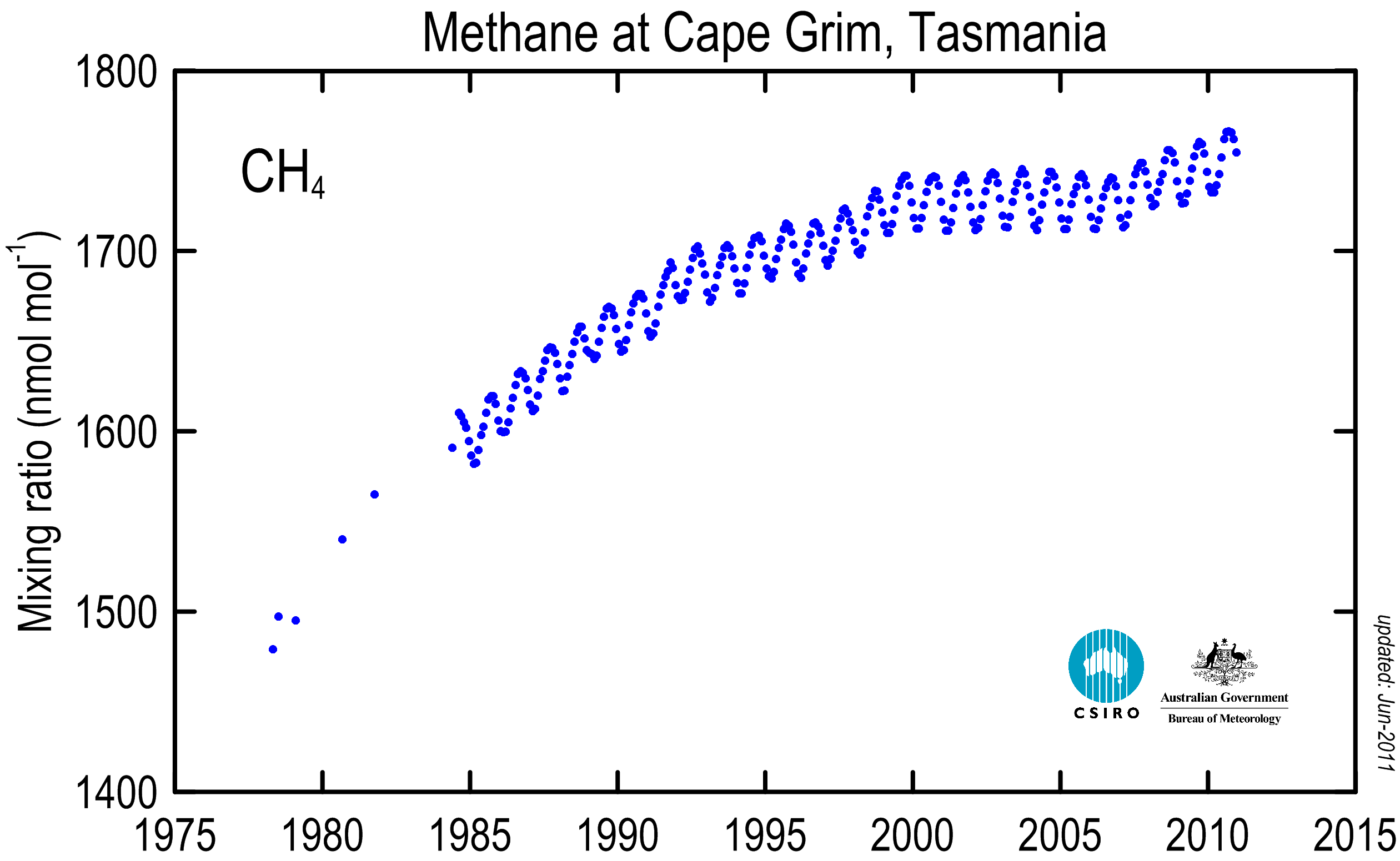
The long picture for methane in the air is one of hundreds of years of acceleration :-

In the last few decades however, atmospheric methane started to level off :-

However, since around 2007, methane concentrations have been rising once more :-

Following the recent headlines about high methane readings in the Arctic, there have been a number of online discsusions about what it could signify.

Tamino’s Open Mind doesn’t see a dangerous increase in emissions when looking at a seasonally-adjusted selection of data from the World Data Center for Greenhouse Gases and Earth System Research Laboratory (ESRL) flask measurements of methane concentrations at around surface level :-

I asked Giovanni to chart recent measurements from the AIRS project, the Atmospheric InfraRed Sounder on board NASA’s Aqua satellite spacecraft :-


The months December 2011 to January 2012 show a significant peak in methane concentrations in the area 60 degrees North to 90 degrees North.

This peak seen by satellite does not appear to be reflected in the surface measurement charts I asked the online ESRL tool to plot for me :-


What could be causing the satellite reading peaks to be so high relative to the changes in ground-based measurements ? What is happening in the different layers of the atmosphere ?

Has there been some kind of “detonation” of the chemistry of the air above the Arctic, causing peaks in methane concentrations at high altitudes not seen at ground level ?

Do the AIRS readings need adjustment because of unusual pressure and temperature gradients around the Arctic over the boreal (Northern Hemisphere) winter 2011 – 2012 ?

Has there been a rapid release of methane somewhere, such as from an oil and gas production field somewhere in the region ? Will the international greenhouse gas inventories compiled by the United Nations Framework Convention on Climate Change (UNFCCC) Kyoto Protocol nations reveal anything about this ?

What on Earth is going on ?


A few resources

The starting point for atmospheric methane science is the UNFCCC IPCC Fourth Assessment Report.

Some recent research papers on atmospheric methane science :-

SCHAEFER, K., ZHANG, T., BRUHWILER, L. and BARRETT, A. P. (2011), Amount and timing of permafrost carbon release in response to climate warming. Tellus B, 63: 165–180. doi: 10.1111/j.1600-0889.2011.00527.x

Seen from the journal page.

Dlugokencky, E. J., et al. (2009), Observational constraints on recent increases in the atmospheric CH4 burden, Geophys. Res. Lett., 36, L18803, doi:10.1029/2009GL039780

Seen from the journal page.

Bousquet, P., Ringeval, B., Pison, I., Dlugokencky, E. J., Brunke, E.-G., Carouge, C., Chevallier, F., Fortems-Cheiney, A., Frankenberg, C., Hauglustaine, D. A., Krummel, P. B., Langenfelds, R. L., Ramonet, M., Schmidt, M., Steele, L. P., Szopa, S., Yver, C., Viovy, N., and Ciais, P.: Source attribution of the changes in atmospheric methane for 2006–2008, Atmos. Chem. Phys., 11, 3689-3700, doi:10.5194/acp-11-3689-2011, 2011 (Discussion Paper)

Seen from the journal page.

The Arctic Ocean could be a major source of methane

Joining the oil and gas industry in drilling the Arctic for clues

Categories
Assets not Liabilities Burning Money Carbon Capture Carbon Pricing Direction of Travel Dreamworld Economics Electrificandum Energy Autonomy Energy Change Energy Insecurity Energy Revival Energy Socialism Fossilised Fuels Major Shift Nuclear Nuisance Nuclear Shambles Solar Sunrise

Solar FITs and Starts

The British Government’s solar power policy is not really going very well.

Ah well, at least the “nuclear power renaissance” is progressing…err, maybe not :-

“New nuclear electricity costs hit utility ratings – Moody’s : 27 Mar 2012

“Building a nuclear power plant is perceived as risky by credit rating agencies – and in some cases could lead to a ratings downgrade of the utility concerned, a senior analyst at US-based Moody’s told ICIS on Tuesday.”

“The analyst, who wished to remain anonymous, said an unfavourable attitude towards nuclear power stemmed largely from the scale of investment required, together with future uncertainties surrounding power prices.”

Categories
Academic Freedom Advertise Freely Bait & Switch Be Prepared Behaviour Changeling Big Picture Big Society British Biogas British Sea Power Climate Change Conflict of Interest Corporate Pressure Cost Effective Dead End Dead Zone Delay and Deny Demoticratica Design Matters Direction of Travel Divide & Rule Economic Implosion Energy Autonomy Energy Change Energy Revival Feel Gooder Fossilised Fuels Gamechanger Green Investment Green Power Hide the Incline Human Nurture Hydrocarbon Hegemony Low Carbon Life Major Shift Marvellous Wonderful Mass Propaganda Media Money Sings National Energy National Power Oil Change Optimistic Generation Paradigm Shapeshifter Petrolheads Policy Warfare Political Nightmare Protest & Survive Public Relations Regulatory Ultimatum Renewable Gas Renewable Resource Social Change Social Democracy Solar Sunrise Solution City Stirring Stuff Sustainable Deferment The Power of Intention Voluntary Behaviour Change Vote Loser Wasted Resource Wind of Fortune Zero Net

Apocalyptic Apoptosis

Image Credit : Carl-A. Fechner, fechnerMedia

The Evangelist : “Climate change is so serious, we need to tell everybody about it. Everybody needs to wake up about it.” The Audience “We have heard this all before. Do pipe down.”

The Social Engineer : “Everybody should be playing their part in acting on climate change.” The Audience : “This story is too heavy – you’re trying to make us feel guilty. You’re damaging your message by accusing people of being responsible for causing climate change.”

The Social Psychologist : “By making such a big deal out of climate change, by using Apocalyptic language, audiences feel there is no hope.” The Audience : “Climate change is clearly not a big deal, otherwise the newspapers and TV would be full of it all the time.”

The Post-Economist : “Climate change is caused by consumption. We need to reduce our consumption.” The Audience : “We don’t want to be told to live in cold caves, eating raw vegetables by candlelight, thanks.”

The Defeatist : “It’s already too late. There’s nothing we can do about it. All I can do is sit back and watch it happen.” The Audience : “Isn’t that being a little too negative ? If you think there’s nothing that can be done, what hope have we got ?”

The late, great Hermann Scheer said that “Today’s primary energy business will vanish – but it won’t give up without a fight…the greatest and the worst environmental pollution of all is when countless so-called energy experts keep on trying to talk society out of even contemplating this scenario [of 100% renewable energy] as a possibility for the near future – because that is what makes society apathetic and unmotivated…”

So who or what is making us passive and unmoved ?

Is climate change really our fault ? Or is it something we’ve inherited because of the irresponsible energy companies ?

Are we responsible for responding to climate change or is it somebody else’s responsibility ?

Categories
Advancing Africa Advertise Freely Assets not Liabilities Bait & Switch Be Prepared Big Number Big Picture Big Society Carbon Commodities Climate Change Conflict of Interest Contraction & Convergence Corporate Pressure Deal Breakers Delay and Deny Demoticratica Direction of Travel Disturbing Trends Divide & Rule Dreamworld Economics Economic Implosion Emissions Impossible Energy Autonomy Energy Denial Energy Disenfranchisement Energy Insecurity Energy Revival Energy Socialism Engineering Marvel Evil Opposition Feed the World Foreign Interference Foreign Investment Fossilised Fuels Freemarketeering Global Warming Green Investment Green Power Growth Paradigm Hide the Incline Hydrocarbon Hegemony Low Carbon Life Major Shift Marvellous Wonderful Mass Propaganda Media Military Invention National Energy National Power National Socialism No Blood For Oil Not In My Name Nuclear Nuisance Nuclear Shambles Obamawatch Oil Change Optimistic Generation Paradigm Shapeshifter Peace not War Peak Coal Peak Emissions Peak Energy Peak Natural Gas Peak Oil Petrolheads Policy Warfare Political Nightmare Public Relations Pure Hollywood Regulatory Ultimatum Renewable Gas Renewable Resource Resource Curse Resource Wards Revolving Door Social Capital Social Change Social Democracy Solar Sunrise Solution City Stirring Stuff Stop War Sustainable Deferment Technofix Technological Fallacy Technological Sideshow Technomess The Myth of Innovation The Power of Intention The War on Error Ungreen Development Voluntary Behaviour Change Wasted Resource Western Hedge Wind of Fortune Zero Net

Energy Independence : Scheer Truth

Image Credit : Carl-A. Fechner, fechnerMedia

Renewable energy pessimists are everywhere.

Some commentators, government leaders, energy companies and representatives of international institutions are keen to show that not only is the renewable energy deployment glass half empty, the water hasn’t even wet the bottom of the glass yet.

Yet there are renewable energy architects – developers, promoters, politicians, scientists, engineers and academics – who document the evidence of the rapid growth in zero carbon energy – who show us that the sustainable energy glass could be brimming over.

What do experts say ? Here’s the belated Hermann Scheer from the film “The 4th Revolution : Energy Autonomy” :-

Categories
Academic Freedom Advancing Africa Carbon Commodities Carbon Pricing Carbon Taxatious Climate Change Climate Damages Conflict of Interest Contraction & Convergence Corporate Pressure Demoticratica Dreamworld Economics Economic Implosion Efficiency is King Emissions Impossible Energy Change Energy Disenfranchisement Energy Insecurity Energy Revival Feel Gooder Fossilised Fuels Freemarketeering Gamechanger Global Warming Green Investment Green Power Growth Paradigm Health Impacts Hydrocarbon Hegemony Libertarian Liberalism Low Carbon Life Major Shift Money Sings National Energy National Power Nudge & Budge Oil Change Paradigm Shapeshifter Peak Emissions Policy Warfare Political Nightmare Price Control Regulatory Ultimatum Solar Sunrise Solution City The Power of Intention The War on Error Western Hedge Wind of Fortune

Academic Freedom #7 : Contraction & Convergence

I think that within a short space of time, it will become admitted, even by Friedman-onomists (and other assorted Freak-onomists) that marginal pricing strategies on high carbon energy are not producing a major shift to a low carbon energy economy.

Nobody wants to buy carbon permits, so they will all duck the quotas, and buck the system.

The prevailing economic conditions, caused by a collapse in wealth and the onset of both climate change and fossil fuel depletion, and their respective impacts on food and energy production, are creating a volatility in the costs of energy – mostly in the buoyancy direction. Which is fine for anybody trading in energy industry stock, but not for the rest of us, and is especially limiting for any attempts to price greenhouse gas emissions.

Policies to create a carbon “market” by implementing varieties of “Cap and Trade”, and the so-called Clean Development Mechanism – a “flexible” approach permitted under Article 12 of the Kyoto Protocol, are showing a residual inefficacy – that means they are failing – an inability to cause widespread change.

That would be OK if we only expect carbon markets to provide some equilibrium in disparate progress towards carbon emissions reduction. If carbon markets were recognised as only being able to enable a small tranche of the overall changes required.

Carbon trading can be a useful mechanism if it’s used as a vehicle for “technology transfer”. By that, I don’t mean selling shale gas technology to China, Oman or Saudi, but creating a flow of useful Renewable Energy technology from industrialised world to under-developed world.

Categories
Academic Freedom Assets not Liabilities Bait & Switch Behaviour Changeling Big Number Big Picture Big Society Carbon Commodities Carbon Pricing Carbon Taxatious Climate Change Climate Damages Coal Hell Conflict of Interest Corporate Pressure Cost Effective Deal Breakers Demoticratica Direction of Travel Divide & Rule Economic Implosion Efficiency is King Emissions Impossible Energy Change Energy Insecurity Energy Revival Engineering Marvel Fossilised Fuels Gamechanger Global Warming Green Investment Green Power Growth Paradigm Hydrocarbon Hegemony Low Carbon Life Major Shift Mass Propaganda Media National Energy National Power Nudge & Budge Oil Change Optimistic Generation Paradigm Shapeshifter Peak Coal Peak Natural Gas Peak Oil Policy Warfare Political Nightmare Price Control Protest & Survive Public Relations Regulatory Ultimatum Renewable Resource Science Rules Social Capital Social Change Social Democracy Solution City Sustainable Deferment Technofix Technological Fallacy Technological Sideshow The Data The Power of Intention The Price of Gas The Price of Oil The War on Error Ungreen Development Unqualified Opinion Unsolicited Advice & Guidance Unutterably Useless Utter Futility Vain Hope Voluntary Behaviour Change Vote Loser Zero Net

Academic Freedom #6 : Policy Levers

Image Credit : Taproot

Many scientists express that their aim in their work is to offer a good foundation for Government decision-making. Our gathering and processing of data and evidence is to be offered to the lawmakers to enable them to choose a way forward, and design a strategy to get there. This is a noble ambition – to be a useful servant of the facts (or at least a disciple of statistics with plus and minus margins of error).

However, science is not the only force at work in influencing Government decisions. For a start, Governments change through elections in democracies, and all debate about public policy passes through a narrow ideological gate – where people decide on a very small range of questions that concern them at the time. Election issues are almost always centred around tax and welfare, and elections are often called for the favourite politicians of the moment.

And then there’s the question of which organisations influence elected governments on a day-to-day basis – who has the ear of leaders and their senior staff ? The public relations budget lines of large companies and corporations can be kept trim and tidy – politicians are easy to get access to if you have a lot of capital to invest (or make out that you do).

Categories
Academic Freedom Alchemical Assets not Liabilities Bait & Switch Biofools British Biogas Burning Money Carbon Capture Carbon Commodities Carbon Pricing Carbon Taxatious Climate Change Conflict of Interest Corporate Pressure Delay and Deny Dreamworld Economics Emissions Impossible Energy Autonomy Energy Change Energy Denial Energy Insecurity Energy Revival Engineering Marvel Fossilised Fuels Geogingerneering Global Warming Green Investment Green Power Hydrocarbon Hegemony Hydrogen Economy Low Carbon Life Major Shift Marvellous Wonderful Mass Propaganda Methane Madness Methane Management National Energy National Power Oil Change Paradigm Shapeshifter Peak Emissions Peak Natural Gas Peak Oil Petrolheads Policy Warfare Political Nightmare Price Control Public Relations Renewable Gas Renewable Resource Sustainable Deferment Technofix The Power of Intention The War on Error Western Hedge Zero Net

Carbon Captured #2 : Socialising Cost, Privatising Profits


Image Credit : Michael Sterner

Carbon dioxide is a fuel. And I don’t mean plant food.

As petroleum oil and Natural Gas production hit peaks that cannot be surpassed, and the world begins to realise that depletion is inevitable, the world’s energy producers will turn to alternatives, including various forms of fuel and gas made from carbon dioxide, chemically adjusted with hydrogen derived from renewable resources.

It seems to me hypocritical for the large oil and gas companies to pitch for public funds to support their investment in Carbon Capture and Storage. Why ? Because this public funding will get converted into private profits the day they start to pump the carbon dioxide back out of storage to make Renewable Gas.

From a personal perspective, I find the argument for public financing of Carbon Capture and Storage particularly toxic when it is proposed to raise the revenue by placing an artificial price or tax on carbon. This would mean that the taxpaper-consumer pays for the emissions burden of hydrocarbon fossil fuel energy, and then gets to pay again for alternative energy, produced using the stored waste gases that they already paid for.

Charge energy customers twice. What a great bailout for fossil fuels !

I suspect that the only reason that Royal Dutch Shell and BP admit to climate change is so they can push their Carbon Capture and Storage schemes – bid tendering for public subsidy.

Forget the subsidies currently in place around the world for wind and solar power. Global carbon finance pushed at Carbon Capture and Storage will be of a much higher order of expenditure.

If the oil and gas companies want to build Carbon Capture and Storage facilities – let them pay for them themselves. After all, in many cases, they have been able to economically justify them by using carbon dioxide pumping to increase oil production – what’s known as Enhanced Oil Recovery.

Or if they insist on public finance for geo-sequestration of carbon dioxide in Carbon Capture and Storage projects, let them give us the carbon dioxide back for free when we need it for Renewable Gas production in the coming decades.

Categories
Academic Freedom Acid Ocean Advancing Africa Big Society Burning Money Carbon Capture Carbon Commodities Carbon Pricing Carbon Taxatious Climate Change Conflict of Interest Corporate Pressure Emissions Impossible Energy Change Energy Revival Financiers of the Apocalypse Foreign Investment Fossilised Fuels Freemarketeering Geogingerneering Hydrocarbon Hegemony Peak Natural Gas Peak Oil Public Relations Technofix Technological Sideshow

Carbon Captured : The Ultimate Bailout

Image Credit : SCCS

Carbon Capture and Storage (CCS) is a collection of actual and proposed technologies to return the carbon dioxide from fossil fuels back underground, or somewhere else where they can stop interfering with the global carbon cycle.

An excess of carbon dioxide in the atmosphere is causing a range of problems, including acid ocean and most seriously, climate change.

Carbon Capture and Storage, or Sequestration, was first seriously proposed back in the 1970s, by a range of scientists and engineers, including Cesare Marchetti, (“On Geoengineering and the CO2 problem”, Climatic Change, Volume 1, Number 1, Pages 59 – 68) who is reputed to have coined the term “geoengineering” (see “Geoengineering: Could or should we do it?”, Stephen H. Schneider, Climatic Change, Volume 33, Number 3, Pages 291 – 302).

Categories
Academic Freedom Assets not Liabilities Big Picture Big Society British Biogas Carbon Capture Demoticratica Design Matters Direction of Travel Emissions Impossible Energy Autonomy Energy Change Energy Insecurity Energy Revival Engineering Marvel Fossilised Fuels Gamechanger Gas Storage Green Investment Green Power Hydrocarbon Hegemony Low Carbon Life Major Shift National Energy National Power Paradigm Shapeshifter Peak Emissions Peak Natural Gas Peak Oil Policy Warfare Political Nightmare Protest & Survive Public Relations Realistic Models Regulatory Ultimatum Renewable Gas Social Capital Social Democracy The Power of Intention The Price of Gas

Academic Freedom #5 : More Natural Gas power stations is a Good Thing

Energy policy in the United Kingdom is a constant battle. A number of environmental commentators and campaign groups are up in arms about the Department of Energy and Climate Change (DECC). Again.

Somebody with influence should have a quiet word with DECC about their public relations – they seem intent on leading people a merry dance about their true policy intentions – and then blasting everybody with piecemeal pronouncements, without giving the concerned public the full picture.

Personally, I think the strategy of building new Natural Gas-fired power plants is rather good. Yes, I will explain why. But first I will cover some of the complaints.

Categories
Academic Freedom Bait & Switch Big Picture Big Society Carbon Commodities Carbon Pricing Carbon Taxatious Climate Change Conflict of Interest Corporate Pressure Cost Effective Demoticratica Direction of Travel Divide & Rule Dreamworld Economics Emissions Impossible Energy Autonomy Energy Change Energy Insecurity Engineering Marvel Financiers of the Apocalypse Fossilised Fuels Freemarketeering Fuel Poverty Green Investment Green Power Growth Paradigm Hydrocarbon Hegemony Low Carbon Life Major Shift National Energy National Power Nudge & Budge Oil Change Paradigm Shapeshifter Peak Emissions Petrolheads Policy Warfare Political Nightmare Price Control Regulatory Ultimatum Social Democracy Sustainable Deferment Technofix Technological Fallacy The Myth of Innovation The Price of Gas The Price of Oil The War on Error Vote Loser Wasted Resource Western Hedge

Academic Freedom #2 : The UN climate treaty needs energy producer obligations

Image Credit : Orin Langelle GJEP-GFC

The United Nations Framework Convention on Climate Change calls nations to attend regular gatherings of the signatories to the ratified convention – the Conference of the Parties.

The nations send delegations – hardly ever sending their premiers, presidents and primes. What bargaining powers do these delegations have ? They have the authority to offer small percentages in emissions reductions, just to show willing. They have the mandate to refuse policies their nations do not like.

The language is framed around energy consumption – most country delegations have been advised by their economists that increased efficiency in the use of energy means that the national energy use will decrease. O wondrous technology ! You allow us to cut our energy use – and therefore our carbon intensity.

These same economists advise that the Holy Ghost of Innovation will inspire Research and Development – which will mean that new technologies will curtail greenhouse gas emissions. We only have to invest in new engineering. This Cult of the New is the fable on which most advanced nations hang their hope.

Categories
Academic Freedom Bait & Switch Behaviour Changeling Big Picture Big Society Carbon Commodities Carbon Pricing Carbon Taxatious Climate Change Conflict of Interest Contraction & Convergence Corporate Pressure Demoticratica Direction of Travel Disturbing Trends Divide & Rule Dreamworld Economics Emissions Impossible Energy Change Energy Revival Environmental Howzat Fossilised Fuels Gamechanger Global Warming Hydrocarbon Hegemony Low Carbon Life National Energy Nudge & Budge Oil Change Paradigm Shapeshifter Policy Warfare Political Nightmare Protest & Survive Regulatory Ultimatum Resource Curse Social Chaos Social Democracy The War on Error Voluntary Behaviour Change Western Hedge

Academic Freedom #1 : The United Nations isn’t working

A lot of people are going to be distressed when I say this, and tell me I have no right to say it – but honestly guys and gals, it’s time to tell the patently obvious truth : the United Nations process on Climate Change isn’t working.

Even if there is a way to construct a treaty with wording that all the country delegations can agree to (or at least not bitterly fight tooth and nail to their early graves), the basic premise of the United Nations Framework Convention on Climate Change is faulty.

Those responsible for the production of fossil fuels should be made to accept responsibility for global warming pollution, and take on the mission of changing the way they make the energy they sell the world.

I’m not calling for environmental fines. Environmental fines don’t work. They don’t stop pollution, they don’t prevent polluting activities, and they don’t provide enough monetary resources to clean up pollution.

I’m not calling for carbon tax, or other forms of carbon pricing. Those responsible for selling polluting energy would never pay the full carbon price – they always delegate extra costs to their consumers.

Carbon pricing and carbon taxation can never provide an incentive for meaningful de-carbonisation of the energy supply that we need. Cap and Trade does not appear to have altered the course of any region’s energy infrastructure development. The price of carbon always remains too low to stimulate real change.

Categories
Advancing Africa Advertise Freely Alchemical Animal Kingdoom Bee Prepared Behaviour Changeling Big Picture Big Society Biofools Climate Damages Corporate Pressure Dead Zone Demoticratica Direction of Travel Droughtbowl Eating & Drinking Emissions Impossible Environmental Howzat Extreme Weather Faithful God Feed the World Feel Gooder Food Insecurity Foreign Investment Forestkillers Fossilised Fuels Freemarketeering Freshwater Stress Genetic Muddyfixation Geogingerneering Growth Paradigm Health Impacts Human Nurture Low Carbon Life Major Shift Marvellous Wonderful Media Nudge & Budge Oil Change Paradigm Shapeshifter Peak Emissions Peak Energy Peak Natural Gas Public Relations Social Change Solution City Sustainable Deferment Technological Fallacy Technological Sideshow Technomess Toxic Hazard Tree Family Ungreen Development Virtually Vegan Water Wars

Living Life and LOAFing It

CHRISTIAN ECOLOGY LINK
PRESS RELEASE

Living Life and LOAFing It – Green Christians ask churches to “Use your LOAF !” on sourcing sustainable food

In the run up to Easter, Christian Ecology Link is asking supporters to think and act on how they source food for their church communities, with the aim of reducing the impact of unsustainable agriculture on their local area, and the wider world.

CEL have launched a new colour leaflet on the LOAF programme principles in time for Shrove Tuesday (Mardi Gras), or Pancake Day, on 21st February 2012.

Categories
Assets not Liabilities Be Prepared Big Number Big Picture Burning Money Conflict of Interest Corporate Pressure Demoticratica Direction of Travel Disturbing Trends Divide & Rule Economic Implosion Electrificandum Energy Autonomy Energy Change Energy Insecurity Energy Revival Engineering Marvel Financiers of the Apocalypse Fossilised Fuels Fuel Poverty Green Investment Green Power Growth Paradigm Hydrocarbon Hegemony Incalculable Disaster Major Shift National Energy National Power Neverending Disaster Nuclear Nuisance Nuclear Shambles Optimistic Generation Paradigm Shapeshifter Peak Natural Gas Peak Oil Policy Warfare Political Nightmare Regulatory Ultimatum Renewable Resource Shale Game Social Democracy Solar Sunrise Solution City Sustainable Deferment Technological Fallacy Technological Sideshow The Myth of Innovation The Price of Gas The Price of Oil The War on Error Ungreen Development Unnatural Gas

The UK’s Energy Crisis

What annoys me most about the Solar Power Feed-in Tariff saga is not that the UK Government suddenly pulled the plug on the full rate for household-sized systems, or that they set the cut-off date before they finished their consultation, or even that that the Department of Energy and Climate Change (DECC) dragged out a legal appeal process.

Despite the truly pitiful sight of a Minister of State being sent out to bat with a miniaturised teaspoon to defend the indefensible decision, and despite the energy industry stooges that have placements inside DECC and are clearly affecting policy, no, the thing that really gets me is the focus on budgets instead of targets.

Here’s a summary from the Government’s own “long term trend” figures for energy consumption in Great Britain :-

Nobody can swear to me that the last few years are not just a glitch caused by economic instabilities, and that the re-localisation of manufacture in future in a recovering economy will not push this demand continually higher according to the trendline.

What are we using to supply this energy ? Here’s a summary :-

Despite the near exponential rise in renewable energy, it’s starting from a small base. The increase in energy consumption is being satisfied by a sharp rise in the supply of Natural Gas – something which the UK is producing increasingly less of these days. And for those who think that shale gas production would help, no, only a few percent of demand could be satisfied. This is an import-led energy supply, and the trend should ring alarm bells, but clearly doesn’t even tickle the ears of the average person in the street.

Electricity demand growth remains healthy, despite problems with unreliable supply from nuclear electricity (refered to as “outages” in the DECC Digest of UK Energy Statistics (DUKES) reports) :-

Now, in the future, with an envisioned massive rise in renewable energy, higher electricity use would be reasonable, as long as other energy consumption reduced. But the growth in electricity consumption charted here is not people driving more electric cars or using electric heating instead of Natural Gas-fired comfort. This is higher consumption, pure and simple, not “energy switching” over to electricity.

As an aside – the sum total of these figures indicates that the nation as a whole is not engaged in significant energy conservation, despite decades of campaigning.

All these trends add up to a very slight loss in dependency on fossil fuels for the UK’s energy :-

This is the critical trend. North Sea oil and Natural Gas production is falling like a large rock, and no amount of technological advancement and re-stimulating the drilling sector is turning this around. This means that without a rapid decrease in fossil fuel dependency, the United Kingdom is going to start haemorrhaging wealth.

Goodbye, First World.

This is why is it essential to ramp up renewable energy deployment by whatever means at our disposal.

Greg Barker MP bleating about keeping to budgets is not helping.

Categories
Advertise Freely Assets not Liabilities Be Prepared Behaviour Changeling Big Society Burning Money Carbon Army Contraction & Convergence Cost Effective Demoticratica Direction of Travel Eating & Drinking Efficiency is King Energy Autonomy Energy Change Faithful God Feel Gooder Fossilised Fuels Gamechanger Green Investment Human Nurture Low Carbon Life Major Shift Marvellous Wonderful Media Money Sings National Power Nudge & Budge Paradigm Shapeshifter Peak Emissions Peak Energy Price Control Public Relations Social Capital Solution City Stirring Stuff The Power of Intention Voluntary Behaviour Change Wasted Resource

Carbon Detox 2012

PRESS RELEASE

Carbon Detox 2012 : Shed Unwanted Pounds With Our Unique Formulation

George Marshall, well-known sustainable living guru, will be asking us to challenge ourselves, our routines and bad habits, and make a 2012 all-year resolution to shed the excess carbon from our lives.

On 21st January 2012 at a convenient central London location, he will ask us to take action to get control of our personal energy, and add vitality to our lives with new aims and goals.

The aim of the event is to help us acquire the psychological tools we need to lead slimmer, healthier and more ethically satisfying lifestyles.

Speaking from the experience gained from his decades of research and practice in the field, and giving tips and tricks from his bestseller “Carbon Detox“, George will be guiding us expertly through the carbon counting maze.

One of our leaner life activities group said : “Cutting down has been hard work, but has become much more fun now I am involved in my local group. I am looking forward to meeting my buddies on Saturday.”

Tony Emerson, the coordinator for the ecocell 2 programme said : “In three years our household has managed to halve the amount of greenhouse gases we produce – by topping up loft insulation, converting to double glazing, installing a wood stove and learning how to best use it, new heavier curtains, wall insulation, changing to a green electricity supplier, continued monitoring of timings and temperature of the central heating – and of course taking part in the ecocell 2 programme. However we still have further to go and I am looking forward to hear what George Marshall has to say. One way we are encouraging people in ecocell 2 is to have a buddy system, whereby people pair up, or group up, by phone, so that people with similar houses can support each other.”

To register for this free, all day event, including a selection of facilitated workshops and to receive your take-home worksheet pack, please email Tony at ecocell@christian-ecology.org.uk

For photographs of the day’s events, and feedback from the workshops, please contact Jo on 0845 45 98 46 0

ENDS


NOTES FOR EDITORS

a. Climate change activist and author George Marshall will be addressing green Christians during an all-day conference on Saturday 21st January 2012 in Central London.

b. The Christian Ecology Link ecocell project team will facilitate workshops on “living the truly sustainable life” at the Magdalen Centre, St Mary’s Church, Eversholt Street near Euston train station between 10.00 am and 5.00 pm [1]

c. George Marshall, author of the easy-to-read book “Carbon Detox : Your step-by-step guide to getting real about climate change” will be offering his fact-packed and lighthearted insights into action on climate change, drawn from his experience of over a decade of community and policy work. [2]

d. The event will be suitable for anybody already taking part in the ecocell project, or anybody interested in starting. The workshops on the day will be pitched at several levels.

e. The ecocell-1 workshop group will look at the introductory programme to help your family or church group take their first steps to reducing their impact on the environment. [3]

f. The ecocell-2 workshop will look at the more in-depth project, to provide mutual support for those who want to reduce their carbon emissions to sustainable levels within five years. [4]

REFERENCES

[1] The Magdalen Centre, St Mary’s Church, Eversholt Street, London NW1 1BN is located about 7 minutes’ walk north of Euston train station.

[2] https://www.carbondetox.org/

[3] https://www.greenchristian.org.uk/ecocell
https://www.greenchristian.org.uk/ecocell/ecocell-1

[4] https://www.greenchristian.org.uk/ecocell
https://www.greenchristian.org.uk/ecocell/ecocell-2
https://www.greenchristian.org.uk/ecocell/ecocell2-materials

[5] https://www.greenchristian.org.uk/archives/1537
https://www.christian-ecology.org.uk/ecocell-day-21-jan-2012.htm

CONTACT

For details of Christian Ecology Link, please phone Jo on 0845 45 98 46 0 or email info@christian-ecology.org.uk

Categories
Babykillers Climate Change Climate Damages Coal Hell Conflict of Interest Corporate Pressure Dead Zone Demoticratica Divide & Rule Dreamworld Economics Droughtbowl Eating & Drinking Emissions Impossible Energy Autonomy Energy Change Energy Denial Energy Insecurity Energy Revival Evil Opposition Extreme Weather Faithful God Feed the World Financiers of the Apocalypse Floodstorm Food Insecurity Fossilised Fuels Freemarketeering Human Nurture Hydrocarbon Hegemony Incalculable Disaster Major Shift Military Invention Money Sings National Energy National Power Neverending Disaster No Blood For Oil Not In My Name Paradigm Shapeshifter Peace not War Peak Coal Peak Emissions Peak Energy Peak Natural Gas Peak Oil Stop War Wasted Resource Western Hedge

The Last Battle

The “Statue of Liberty” or Saint John’s Lamb of God ?

Britain’s real enemy is not Iran.

The real enemy is the mismanagement of the Earth’s energy resources.

The last battle is to overcome the misdeeds of those who have commandeered and wasted the Earth’s energy resources – and that includes ourselves.

It should not be a violent dispute, for aggression and the use of weapons are morally unjustifiable. But all the same, it will be a genuine, Titanic, struggle.

As C. S. Lewis portrays with so much resonance, it matters little under which flag or title we serve or belong – what matters is our allegiance to the precepts of divine honour, holy devotion and right dealings with other people :-

“Why did the faithful Taarkan end up getting to come into Narnia ? Usually Lewis writes allegorically so is he trying to tell us something when a worshipper of Tash is allowed to enter the new Narnia ? Any thoughts ? …It wasn’t the name that mattered, but rather the conduct of the Taarkan and how he chose to see and do things. He didn’t believe in the cruelty and underhanded ways his countryman were doing things, but rather in honour and a code of conduct. So even though the Taarkan thought he was worshipping Tash, the whole time he was actually worshipping Aslan [Turkish for “Lion”] through his thoughts and deeds. So when the time came for the end of the world and judgement, he was placed where his heart had always led him.”

For those who recognise the twin threats from climate change and energy depletion, we realise that there is hard work ahead. Our natural aim is to protect ourselves; and the moral consequence is that we are obliged to protect the other – because both climate change and energy depletion are global problems.

Climate change hits the poorest the hardest – already, significant changes in rainfall and weather patterns have created long-term drought, encroaching coastal and inland inundation, crop losses and enforced migration. And it’s only going to get worse. It’s so terrible we could not even wish it on our enemies – it teaches us that nobody is an enemy.

To solve climate change, we need to change our energy systems. Some hail the depletion of hydrocarbon and coal energy resources as a gift that will help us resolve the emissions problem and prevent dangerous climate change, by making a virtue of necessity – but the situation is not that simple.

The reaction of the world’s authorities, wealth controllers and corporate proprietors to the winding down of fossil fuel energy resources has so far been complex, and there are many indications that warfare, both military and economic, has been conducted in order to secure access to energy.

This may be the way of the lion in us all, but it is not the way of The Lamb. The Lamb sacrifices all that others value so that he is qualified to bring about a new universal regime of peace and responsible autonomy – a kingdom of priests, pastors with mutual respect.

We are called to become good stewards of each other and the Earth. The gentle Lamb of God will judge our hearts.

The Book of the Revelation to Saint John the Divine, Chapter 4 :-

“…I looked and saw a door that opened into heaven. Then the voice that had spoken to me at first and that sounded like a trumpet said, “Come up here ! I will show you what must happen next.” Right then the Spirit took control of me, and there in heaven I saw a throne and someone sitting on it. The one who was sitting there sparkled like precious stones of jasper and carnelian. A rainbow that looked like an emerald surrounded the throne. Twenty-four other thrones were in a circle around that throne. And on each of these thrones there was an elder dressed in white clothes and wearing a gold crown. Flashes of lightning and roars of thunder came out from the throne in the center of the circle. Seven torches, which are the seven spirits of God, were burning in front of the throne. Also in front of the throne was something that looked like a glass sea, clear as crystal…And as they worshiped the one who lives forever, they placed their crowns in front of the throne and said, “Our Lord and God, you are worthy to receive glory, honour, and power. You created all things, and by your decision [and for your pleasure] they are and were created…”

The Book of the Revelation to Saint John the Devine, Chapter 5

“In the right hand of the one sitting on the throne I saw a scroll that had writing on the inside and on the outside. And it was sealed in seven places. I saw a mighty angel ask with a loud voice, “Who is worthy to open the scroll and break its seals ?” No one in heaven or on earth or under the earth was able to open the scroll or see inside it. I cried hard because no one was found worthy to open the scroll or see inside it. Then one of the elders said to me, “Stop crying and look ! The one who is called both the `Lion from the Tribe of Judah’ and `King David’s Great Descendant’ has won the victory. He will open the book and its seven seals.” Then I looked and saw a Lamb standing in the center of the throne…The Lamb looked as if it had once been killed. It had seven horns and seven eyes, which are the seven spirits of God, sent out to all the earth. The Lamb went over and took the scroll from the right hand of the one who sat on the throne. After he had taken it, the four living creatures and the twenty-four elders knelt down before him. Each of them had a harp and a gold bowl full of incense, which are the prayers of God’s people. Then they sang a new song, “You are worthy to receive the scroll and open its seals, because you were killed. And with your own blood you bought for God people from every tribe, language, nation, and race. You let them become kings and serve God as priests, and they will rule on earth.””

Leaders of the powerful nations – put aside your death-hastening technology.

Let there be a low carbon energy peace on a climate-stable Earth.


Additional Readings

https://www.biblegateway.com/passage/?search=Galatians%203:7-9&version=NIV

“…Understand, then, that those who have faith are children of Abraham. Scripture foresaw that God would justify the Gentiles [non-Jewish people] by faith, and announced the gospel [good news of God’s love and forgiveness] in advance to Abraham: “All nations will be blessed through you.” So those who rely on faith are blessed along with Abraham, the man of faith…”

https://www.biblegateway.com/passage/?search=Galatians%203:26-29&version=NIV

“So in Christ Jesus you are all children of God through faith, for all of you who were baptized [ritual bathing] into Christ have clothed yourselves with Christ. There is neither Jew nor Gentile [non-Jewish person], neither slave nor free, nor is there male and female, for you are all one in Christ Jesus. If you belong to Christ, then you are Abraham’s seed, and heirs according to the promise.”

https://en.wikipedia.org/wiki/Be_Thou_My_Vision

“Thy love in my soul and in my heart –
Grant this to me, O King of the seven heavens.

O King of the seven heavens grant me this –
Thy love to be in my heart and in my soul.”

https://en.wikipedia.org/wiki/Seven_Spirits_of_God

[ UPDATE : No, I have not taken leave of any of my senses. I was in church, All Saints in Highams Park, London E4, and many thoughts arose as I contemplated the stained glass window, with its Suffering Servant Messenger King/Lord/Master, rainbow, Alpha, Omega, Noah’s dove with the sprig of olive; and listened to the reading from Revelations 4; and sang “Be Thou My Vision” with the congregation; and considered what Epiphany the world needs at this time of intense war propaganda. There are those who declare themselves as Christian who claim that war with Iran is prophesied. This may be a fringe view, but the narrative infects major political discussion in the United States of America : “The problem, of course, is that rhetoric can have political effects that narrow the options available to decisionmakers. If you’ve publicly declared Iran’s nuclear program sufficiently threatening to warrant initiating a potentially catastrophic war and then sanctions fail to achieve their defined goal, you may have a hard time walking back from that threat.” ]

Categories
Bait & Switch Delay and Deny Disturbing Trends Divide & Rule Energy Autonomy Energy Disenfranchisement Energy Insecurity Evil Opposition Foreign Interference Foreign Investment Fossilised Fuels Hydrocarbon Hegemony Marine Gas Mass Propaganda Media Military Invention National Energy National Power No Blood For Oil Not In My Name Nuclear Nuisance Nuclear Shambles Obamawatch Peace not War Petrolheads Policy Warfare Political Nightmare Price Control Resource Curse Resource Wards Stop War The Price of Gas The Price of Oil Western Hedge

Energy Sovereignty for Iran

Here’s the prime time television where the U. S. Army chief admits that the American military know Iran is engineering at sea – although the General deliberately gets the purpose wrong.

[For an uncorrected transcript of the piece, see below at the end of this post].

He claims that Iran is going to use their engineering to shut the Strait of Hormuz, a major artery of oil transport from the Middle East to the world.

Whereas, in actual fact, Iran has been constructing facilities to mine marine, sub-sea Natural Gas in its territorial waters in the Persian Gulf, and wants to use it to generate electricity to export.

Iran is sitting on Natural Gas – a lot of Natural Gas. And a lot of it is at sea. There have been marine seismic surveys for sub-sea Natural Gas in the Persian Gulf over the last few years, and it seems, other countries have been spying on the Iranian offshore activities.

Clearly, with Iran’s intent to exploit its marine gas, there have been and will be construction ships and construction going on in the Persian Gulf and around the Strait of Hormuz, especially the islands of Kish and Qeshm. This should not be mistaken as a risk to oil shipping. It should not be claimed as indications of Iran seeking to close the Strait of Hormuz in retaliation for economic sanctions.

What is at stake here is no less than Iran’s energy sovereignty – its sovereign right to enjoy the wealth from exploiting its own energy resources.

The international pressure for an end to fossil fuel subsidies would hurt Iranian internal economic development (much like it’s hurting Nigeria, currently), and it would be forced to export oil and Natural Gas – no doubt at low market prices. Iran may end up no better off for trading.

The Iranians bought myths about nuclear power hook, line and sinker, and they believe they have a right to develop civilian atomic energy. Other countries, the United States of America in particular, keep pushing this button and claiming that Iran is heading for developing nuclear weapon capability. This is the most unbelievable accusation since…oh, I don’t know, since the USA accused Iran of a plot for a used car salesman and a Mexican, or something, to kill a Saudi ambassador, which was unadulterated nonsense.

America’s insistence that Iran is a threat because they claim that Iran is working towards constructing nuclear weapons, is so ridiculous, that few seem to have realised it is “deflection” – a propaganda technique to divert you from the real source of tension between the USA and Iran.

What America really doesn’t seem to like is countries like Iran (and Venezuela) making autonomous energy decisions, and creating their own wealth by using their own energy resources in their own way.

Maybe the American war hawks think “Why cannot Iran be more like Iraq, with western oil and Natural Gas companies with discount contracts, crawling over new resources and selling it all abroad ?”

Anyway, what is clear is that the spat between Iran and the USA has nothing to do with nuclear power or idle brinkmanship about controlling the flow of oil as a retaliation against economic sanctions.


NEWS BROADCAST TRANSCRIPT

https://www.bloomberg.com/video/83880880/

Bloomberg : 9 January 2012 : Lara Setrakian reports on the outlook for Iran to close the Strait of Hormuz as Europe prepares to follow tougher U. S. sanctions on the country over its nuclear program and the status of a pipeline that would allow oil from the United Arab Emirates to bypass the waterway. The pipeline has been delayed because of construction difficulties, two people with knowledge of the matter said. Setrakian speaks with Linzie Janis on Bloomberg Television’s “Countdown.”

[Ticker tape reads “AHMADINEJAD TURNS TO CHAVEZ FOR SUPPORT”]

[Linzie Janis] “The Persian Gulf could be closed off to ships altogether, that’s if tensions continue to escalate between Iran and the West. Iranian President Mahmoud Ahmadinejad is due to meet with Venezuelan leader Hugo Chavez later on today as part of a tour of Latin America. He is seeking s”upport” as Iran faces tighter U. S. sanctions over its nuclear program.

[Mahmoud Ahmadinejad in translation] We will discuss the intentions of the arrogant system interfering and having a military presence in other countries. We shall coordinate with our friends in Latin America to address this matter.

[Linzie Janis] Well with the very latest Lara Setrakian joins us with from Dubai

Lara itell it looks like the U. S. and Iran could be on a – – collision course here.

[Lara Setrakian] Well moving closer towards it, as Iran inches towards what the U. S. has called “two red lines” – advanced nuclear enrichment at the underground Fordow facility, and shutting the Strait of Hormuz – something that Iran told the A. P. [Associated Press] they’ll do if the E. U. oil embargo goes through later this month. The highest level U. S. assessment to date – that Iran could shut the Strait that would effectively trigger a military confrontation in the Persian Gulf.

General Martin Dempsey, American Department of Defense, United States Army Joint Chiefs of Staff Chairman] They’ve invested in capabilities that could [scratches nose – a classic sign of lying] in fact for a period of time block the Straits of Hormuz. We’ve invested in capabilities [rocking body slightly from side to side – a classic sign of swagger] to ensure that if that happens [giving a hard, fixed stare] we can, er, defeat that. [Looks down briefly – meaning that this information was a significant reveal] And so, the simple answer [shrugs shoulders to dimiss the concept] is yes, they can block it. Er… [ Looks down and to his right, our left, indicating a recall of something] And of course that is as well…[blinks to conceal the fact that he’s cut something out] we’ve described that as an intolerable act [shrugs shoulders as if to say, those Iranians have got it coming to them] and it’s not just intolerable for us [shakes head from side to side] it’s intolerable to the world [rubs one hand over another, which is a sign of nervousness]. But we would take action and re-open the Straits [shuts lips in beefburger bun clench and nodding as a sign that no more useful information will be forthcoming].

[ Ticker Tape reads : THREATS TO STRAIT OF HORMUZ SHIPPING ]

[Lara Setrakian] Meanwhile it could disrupt the biggest sea lane for the world’s shipped oil, what one analyst called “the ultimate fear in the oil market – it would spike prices”.

[Linzie Janis] So what kind of preparation are you seeing to counter that risk ?

[Lara Setrakian] Well, one of the biggest contigency plans so far has floundered – a pipeline here in the U. A. E. that would run from Abu Dhabi to the Port of Fujairah. It would avoid the Strait. It’s a $3.3 billion dollar project but it’s been delayed – not ready until April at the soonest. And it’s meant to move 1.5 million barrels per day, most of Abu Dhabi’s output, say two days at sea, but the pipeline has been delayed repeatedly by construction issues – one energy analyst Robin Mills pointing also to a pipeline in Saudi Arabia that’s meant to be another backup system [ Ticker Tape reads “FURTHER CONTINGENCY PIPELINES PLANNED”] that could take oil to the Red Sea after 5 million barrels of oil a day capacity and it could be expanded – again, all contigency planning – to keep oil free from any Iranian chokehold in the Persian Gulf.

Linzie.

[Linzie Janis] Lara, thank you very much.

Categories
Advancing Africa Assets not Liabilities Bad Science Bait & Switch Big Number Big Picture Big Society British Sea Power Burning Money Climate Change Coal Hell Delay and Deny Design Matters Direction of Travel Divide & Rule Efficiency is King Electrificandum Energy Change Energy Denial Energy Insecurity Energy Nix Energy Revival Energy Socialism Engineering Marvel Foreign Interference Fossilised Fuels Fuel Poverty Global Warming Green Investment Green Power Growth Paradigm Health Impacts Hide the Incline Human Nurture Hydrocarbon Hegemony Major Shift Money Sings National Energy National Power National Socialism No Blood For Oil Not In My Name Nuclear Nuisance Nuclear Shambles Oil Change Optimistic Generation Paradigm Shapeshifter Peace not War Peak Coal Peak Emissions Petrolheads Policy Warfare Political Nightmare Protest & Survive Renewable Resource Resource Wards Science Rules Social Capital Social Democracy Solar Sunrise Solution City Stirring Stuff Stop War Sustainable Deferment Technofix The Data The Power of Intention The War on Error Toxic Hazard Wasted Resource Western Hedge Wind of Fortune

Open Letter to Renewable Energy Deniers

To all Renewable Energy Deniers,

Things are getting so much better with renewable energy engineering and deployment – why do you continue to think it’s useless ?

We admit that, at the start, energy conversion efficiencies were low, wind turbine noise was significant, kit was expensive. Not now. Wind and solar farms have been built, data collected and research published. Design modifications have improved performance.

Modelling has helped integrate renewable energy into the grids. As renewable energy technologies have been deployed at scale, and improvements and adjustments have been made, and electricity grid networks have adapted to respond to the variable nature of the wind and the sunshine, we know, and we can show you, that renewable energy is working.

It’s not really clear what motivates you to dismiss renewable energy. Maybe it’s because you’re instinctively opposed to anything that looks like it comes from an “envionmentalist” perspective.

Maybe because renewable energy is mandated to mitigate against climate change, and you have a persistent view that climate change is a hoax. Why you mistrust the science on global warming when you accept the science on everything else is a continuing mystery to me.

But if that’s where you’re coming from when you scorn developments in renewable energy, you’re making a vital mistake. You see, renewable energy is sustainable energy. Despite any collapse in the globalised economy, or disruption to fossil fuel production, wind turbines will keep spinning, and solar panels will keep glowing.

Climate change has been hard to communicate effectively – it’s a huge volume of research, it frequently appears esoteric, or vague, or written by boffins with their heads in the clouds. Some very intelligent people are still not sure about the finer points of the effects of global warming, and so you’re keeping good company if you reserve judgement on some of the more fringe research.

But attacking renewable energy is your final stand. With evidence from the engineering, it is rapidly becoming clear that renewable energy works. The facts are proving you wrong.

And when people realise you’re wrong about renewable energy, they’ll never believe you again. They won’t listen to you when you express doubts about climate change, because you deny the facts of renewable energy.

Those poor fools who have been duped into thinking they are acting on behalf of the environment to campaign against wind farms ! Wind energy will be part of the backbone of the energy grids of the future.

We don’t want and we can’t afford the concrete bunkers of deadly radioactive kettles and their nasty waste. We don’t want and we can’t afford the slag heaps, dirty air and melting Arctic that comes from burning coal for power. We don’t want and we can’t afford to keep oil and Natural Gas producing countries sweet – or wage war against them to keep the taps open.

Instead we want tall and graceful spinners, their gentle arms waving electricity from the breeze. We want silent and dark photovoltaic cladding on every roof.

Burning things should only be done to cover for intermittency in wind and sunshine. Combustion is very inefficient, yet you support combustion when you oppose renewable energy.

We must fight waste in energy, and the rising cost of energy, and yet you don’t support the energy resources where there is no charge for fuel. Some would say that’s curmudgeonly.

When you oppose renewable energy, what is it you’re fighting for ? The old, inefficient and poisonous behemoths of coal hell ? We who support renewable, sustainable energy, we exchange clunky for sleek, toxic for clean. We provide light and comfort to all, rich and poor.

When you oppose renewable energy, you are being unbelievably gullible – you have swallowed an argument that can ruin our economy, by locking us into dependency on energy imports. You are passing up the chance to break our political obedience to other countries, all because wind turbines clutter up your panoramic view when you’re on holiday.

You can question the net energy gain from wind power, but the evidence shows you to be incorrect.

If you criticise the amount of investment and subsidy going into renewable energy, you clearly haven’t understood the net effect of incentivisation in new technology deployment.

Renewable energy has a positive Net Present Value. Wind turbines and solar panels are genuine assets, unlike the liabilities that are coal-fired power stations and nuclear reactors.

Renewable energy deployment will create meaningful, sustainable employment and is already creating wealth, not only in financial terms, but in social welfare terms too.

Renewable energy will save this country, so why do you knock it ?

Quizzically yours,

Categories
Big Number Big Picture China Syndrome Climate Change Climate Chaos Climate Damages Coal Hell Contraction & Convergence Cool Poverty Demoticratica Direction of Travel Disturbing Trends Emissions Impossible Fossilised Fuels Global Heating Global Warming Health Impacts Incalculable Disaster Meltdown Methane Madness Methane Management Nudge & Budge Paradigm Shapeshifter Peak Coal Peak Emissions Policy Warfare Political Nightmare Protest & Survive Realistic Models Science Rules Screaming Panic The Data Zero Net

Methane Concentrations : Losing Control

Every once in a while, it’s good to remind myself of the data – to help me focus once again on why I do what I do.

Yesterday evening, I decided to catch up on exactly how out of control atmospheric methane concentrations are in the region around the Arctic :-

https://www.esrl.noaa.gov

When reviewing the charts, the secondmost important thing to see is the high point measurements, the peaks, rising over time.

The most vital thing to observe, however, is the inexorable rise of the minimum measurements since around 2007 – which implies a higher overall background atmospheric methane concentration.

Much of this methane explosion can probably be blamed on global warming from excessive carbon dioxide emissions – which showed signs of coming under control between 1990 and 2000, but after that lifted off once more.

People dispute why carbon dioxide emissions have risen consistently and sharply since the turn of the millenium – but one of the answers is to be found in the rapid deployment of coal-burning for power generation. Stronger environmental controls on air quality have reduced the health impacts of coal-burning, but mean that the net effect is stronger global warming.

So much could be done to alleviate the strong warming of the Arctic, and prevent dangerous instabilities. It is time to say it – and keep on saying it – and not relent – every measure to keep the Arctic cool is urgent.

Categories
Assets not Liabilities Babykillers Burning Money Carbon Commodities Demoticratica Efficiency is King Emissions Impossible Energy Revival Engineering Marvel Environmental Howzat Evil Opposition Foreign Interference Fossilised Fuels Freshwater Stress Green Investment Green Power Human Nurture Hydrocarbon Hegemony Low Carbon Life Major Shift Military Invention National Energy National Power Not In My Name Optimistic Generation Peace not War Renewable Resource Resource Curse Resource Wards Solution City Stop War The Power of Intention Tree Family Ungreen Development Wasted Resource Water Wars Western Hedge

2012 : Greenier and Peace-ier

My dear family.

They think I’m an environmentalist, a bit radical, a bit confrontational.

So for a fun wintertime gift they bought me this lovely cloth tote(m) bag for grocery shopping.

I think I might have failed to communicate myself clearly enough.

Although I try to be frugal and efficient in my way of life, recycling is not my central agenda.

I studied physics, but I don’t have a laboratory. The things that I believe need to be developed are technologies in the field of clean, green energy. I am an engineer without a workshop – although my home is now a power station.

Recycling is important, but reducing the use of resource materials is far more important.

Recycling is important, but energy waste is far more important. Digging things out of the ground and burning them in order to keep civilisation moving is the ultimate misuse of natural resources.

Recycling is important, but so are international relations, especially around the sourcing of commodities such as fossil fuels, rare metals, timber and freshwater.

The world needs to work together – to make friends, not invent enemies – even more so when those so-called opponents sit on vital energy resources.

May you have a year that is greener and has more peace.

Categories
British Biogas British Sea Power Climate Chaos Corporate Pressure Dead End Emissions Impossible Energy Change Energy Revival Extreme Weather Financiers of the Apocalypse Fossilised Fuels Green Investment Hydrocarbon Hegemony National Energy National Power Solar Sunrise Solution City Wind of Fortune

First Arcticane of Wintertide

Image Credit : Copyright 2011 EUMETSAT

Something not completely dissimilar to a hurricane or a typhoon has been gusting at incredibly high speeds through the lowlands of Scotland today – and further afield.

Yet, regardless of whether this heralds the start of a proper snow-and-ice winter, it’s not likely to prevent 2011 being one of the hottest years ever.

July and August, worldwide, were nearly the hottest on record in 2011. Meanwhile, the Blob Chart tells the story in a way that nobody can deny.

Meanwhile, in Durban, South Africa, the world’s governments struggle to make sense. A healthy economy is a carbon-emitting economy – because industrial energy causes high carbon emissions. What needs to happen is that the energy production businesses start to diversify their portfolio – increasing the amount of energy they produce from renewable, sustainable low carbon resources, whilst decreasing the amount of fossil fuel energy they supply.

It can’t be left to individual “big hitters” to kick-start the renewable energy revolution – it requires transnational, international, multi-national and national energy companies to start to displace carbon from their products.

If they don’t, they will face mass disinvestment, as ethical concerns rise up the agenda of investor groups and funds. So, BP, Shell and Exxon Mobil – if you don’t start switching from selling us hydrocarbons to selling us renewable energy, your businesses will under-compete. You have been notified.