Categories
Academic Freedom Bad Science Bait & Switch Be Prepared Big Picture Biofools Climate Change Climate Chaos Climate Damages Coal Hell Corporate Pressure Delay and Deny Demoticratica Direction of Travel Divide & Rule Emissions Impossible Energy Change Energy Denial Energy Insecurity Evil Opposition Financiers of the Apocalypse Freak Science Freemarketeering Gamechanger Global Heating Global Singeing Global Warming Green Investment Growth Paradigm Hide the Incline Hydrocarbon Hegemony Incalculable Disaster Low Carbon Life Mad Mad World Major Shift Mass Propaganda Media Neverending Disaster No Blood For Oil Not In My Name Nudge & Budge Obamawatch Oil Change Paradigm Shapeshifter Peace not War Peak Natural Gas Peak Oil Policy Warfare Political Nightmare Protest & Survive Public Relations Regulatory Ultimatum Scientific Fallacy Social Capital Social Chaos Stop War Sustainable Deferment Tarred Sands Technological Sideshow The War on Error Toxic Hazard Unconventional Foul Unnatural Gas Unutterably Useless Utter Futility Vain Hope Western Hedge Zero Net

A Question of Resilience

Again, the evil and greedy oil, gas and mining companies have proved their wickedness by manipulating public opinion, by directly financing conspiracy theorists who deny climate change science. The irony is tangibly acidic. The paranoid have actually been duped by a genuine conspiracy. They have drunk the Kool Aid; they have believed the lies; they have continued to communicate doubt. They think they are challenging corruption in high places, but what they are really doing is reinforcing apathy in the face of genuine risk.

The questions posed so unrelentingly by the climate change deniers have sewn a patchwork tapestry of disinformation, which continues to poison genuine dialogue and is undermining political progress. We cannot take these people with us into constructive engagement, and ask them to help us forge a broad consensus. It is as if they exist in a parallel universe. Some of us will continue to attempt to conduct dialogue, but will end up wasting our time. The documentation by the media is faulty, and perpetuates the success of the denier strategy of divide and rule.

But hold on a minute. There are problems with the stance of climate change denial, but what about the positioning of climate change activists ? Let’s try that first paragraph one more time :-

[ Again, the “evil” and “greedy” oil, gas and mining companies have proved their “wickedness” by manipulating public opinion, by directly financing conspiracy theorists who deny climate change science. The irony is tangibly acidic. The paranoid have actually been duped by a genuine conspiracy. They have drunk the Kool Aid; they have believed the lies; they have continued to communicate doubt. They think they are challenging corruption in high places, but what they are really doing is reinforcing apathy in the face of genuine risk. ]

By casting the fossil fuel and mining corporations as wrongly motivated, by using negative emotive labels, the dominant narrative of political activists has failed, once again, to move us all forward. These kinds of revelations about underhand corporate public relations activities are by now unsurprising. The news cannot shock, although it may disgust. Yet, since nothing is offered to counter-balance or correct the inappropriate behaviour of the “fossil fuellers”, they win the game they invented, the game they wrote the rules for. Protesting at a petrol station achieves nothing of any note, not even when there’s a camera-friendly polar bear. We hear the message of pain, but there is no ointment. There is a disconnect between the gruesome discovery and any way out of this mess. The revelation of intent of the carbon dinosaurs, the recounting of the anti-democratic activities, does not result in change.

Environmental pollution is a “victimless” crime – no matter how much we sympathise or empathise with the plight of poisoned floating fish, dying bees, asthmatic kids, or cancer-laden people. Fines and taxes cannot rectify the scourge of environmental pollution, because there is no ultimate accountability. Regulation cannot be enforced. The misbehaviour just carries on, because there is systemic momentum. There is no legal redress (“due process” in Americanese) for those who are suffering the worsening effects of climate change, and there is no treaty that can be made to curb greenhouse gas emissions that anybody can be bound to by international sanctions.

And so when we hear the same old story – that the energy industry is propagandising – we cannot respond. We don’t know what we can do. We are paralysed. This narrative is so tired, it snores.

Truth may have been a victim, but the energy industry are also vulnerable – they are acting in self-defence mode. Let’s take the big vista in : there is stress in the global production of fossil fuel energy, and all routes to an easy fix, even if it’s only a short-term fix, are choked.

So let’s ask the question – why do the energy companies deceive ? Do they think they are being deceptive ? Why do fossil fuel miners seek to massage public opinion ? This is a question of resilience, of Darwinian survival – seeking advantage by altering policy by tampering with public assent. They believe in their product, they construct their mission – they are protecting their future profits, they’re making a living. They’re humans in human organisations. They’re not “evil”, “greedy” or “lying” – as a rule. There are no demons here, nor can we convincingly summon them.

Look at the activist game plan – we announce the deliberate actions of the fossil fuel companies to influence the political mandate. But these scandals are only ever voiced, never acted upon. They cannot be acted upon because those who care have no power, no agency, to correct or prevent the outcomes. And those who should care, do not care, because they themselves have rationalised the misdemeanours of the fossil fuellers. They too have drunk from the goblet of doubt. Amongst English-speaking politicians, I detect a good number who consider climate change to be a matter for wait-and-see rather than urgent measures. Besides those who continue to downplay the seriousness of climate change.

Look also at the difference between the covert nature of the support for climate change deniers, and the open public relations activities of the fossil fuel and mining companies. They speak in the right way for their audiences. That’s smart.

In time, the end of the fossil fuel age will become apparent, certain vague shapes on the horizon will come out of the blur and into sharp focus. But in the meantime, the carbon dinosaurs are taking action to secure market share, maintain the value of their stock, prop up the value of their shareholders’ assets. The action plan for survival of the oil, gas, coal and mining operations now includes the promotion of extreme energy – so-called unconventional fossil fuels, the once-dismissed lower quality resources such as tight gas, shale gas, shale oil and coalbed methane (coal seam methane). Why are the energy industry trying to gild the rotten lily ? Is the support for unconventional fossil fuels a move for certain countries, such as the United States of America, to develop more indigenous sources of energy – more homegrown energy to make them independent of foreign influence ? This could be the main factor – most of the public relations for shale gas, for example, seems to come from USA.

The answer could come by responding to another question. Could it be that the production of petroleum oil has in fact peaked – that decline has set in for good ? Could it be that the Saudis are not “turning off the taps” to force market prices, because in actual fact the taps are being turned off for them, by natural well depletion ? The Arab Spring is a marvellous distraction – the economic sanctions and military and democratic upheaval are excellent explanations for the plateau in global oil production.

It seems possible from what I have looked at that Peak Oil is a reality, that decline in the volumes of produced petroleum is inevitable. The fossil fuel producers, the international corporations who have their shareholders and stock prices to maintain, have been pushing the narrative that the exploitation of unconventional fossil fuels can replace lost conventional production. They have been painting a picture of the horn of plenty – a cornucopia of unconventional fossil fuels far exceeding conventional resources. To please their investors, the fossil fuel companies are lying about the future.

Sure, brute force and some new technology are opening up “unconventionals” but this will not herald the “golden age” of shale gas or oils from shale. Shale gas fields deplete rapidly, and tar sands production is hugely polluting and likely to be unsustainable in several ways because of that. There might be huge reserves – but who knows how quickly heavy oils can be produced ? And how much energy input is required to create output energy from other low grade fossil strata ? It is simply not possible to be certain that the volumes of unconventional fossil fuel production can match the decline in conventionals.

The facts of the matter need admitting – there is no expansion of sweet crude oil production possible. There’s no more crude – there’s only crud. And slow crud, at that.

Peak Oil is a geological fact, not a market artefact. The production levels of crude and condensate may not recover, even if military-backed diplomacy wins the day for the energy industry in the Middle East and North Africa.

Peak Oil has implications for resilience of the whole global economy – the conversion of social and trade systems to use new forms of energy will take some considerable time – and their integrity is at risk if Peak Oil cannot be navigated smoothly. Peak Oil is dangerous – it seems useful to deny it as long as possible.

It’s pretty clear that we’ve been handed lots of unreliable sops over the years. The energy industry promised us that biofuels could replace gasoline and diesel – but the realisation of this dream has been blocked at every turn by inconvenient failings. The energy industry has, to my mind, been deploying duds in order to build in a delay while they attempt to research and develop genuine alternatives to conventional fossil fuels – but they are failing. The dominant narrative of success is at risk – will all of this continue to hold together ? Can people continue to believe in the security of energy systems – the stability of trade and economic wealth creation ? Oh yes, people raise concerns – for example about disruption in the Middle East and North Africa, and then propose “solutions” – regime change, military support for opposition forces, non-invasive invasions. But overall, despite these all too evident skirmishes, the impression of resilience is left intact. The problem is being framed as one of “edge issues” – not systemic. It’s not clear how long they can keep up with this game.

The facade is cracking. The mask is slipping. BP and Centrica in a bout of hyper-realism have said that the development of shale gas in the UK will not be a “game changer”. It may be that their core reasoning is to drag down the market value of Cuadrilla, maybe in order to purchase it. But anyway, they have defied the American energy industry public relations – hurrah ! Shale gas is not the milk of a honey-worded mother goddess after all – but what’s their alternative story ? That previously under-developed gas in Iran and Iraq will be secured ? And what about petroleum ? Will the public relations bubble about that be punctured too ? Telling people about Peak Oil – how useful is that ? They won’t do it because it has to be kept unbelievable and unbelieved in order to save face and keep global order. Academics talk about Peak Oil, but it is not just a dry, technical question confined to ivory towers. Attention is diverted, but the issue remains. Looking at it doesn’t solve it, so we are encouraged not to look at it.

So, why do the energy industry purposely set out to manipulate public opinion ? Well, the reason for their open advertising strategy is clear – to convince investors, governments, customers, that all is well in oil and gas – that there is a “gas glut” – that the world is still awash in petroleum and Natural Gas – that the future will be even more providential than the past – that the only way is up. All the projections of the oil and gas industry and the national, regional and international agencies are that energy demand will continue to rise – the underlying impression you are intended to be left with is that, therefore, global energy supply will also continue to rise. Business has never been better, and it can only get more profitable. We will need to turn to unconventional resources, but hey, there’s so much of the stuff, we’ll be swimming in it.

But what is the purpose of the covert “public relations” of the energy industry ? Why do they seek to put out deception via secretly-funded groups ? When the truth emerges, as it always does in the end, the anger and indignation of the climate change activists is guaranteed. And angry and indignant activists can easily be ignored. So, the purpose in funding climate change deniers is to emotionally manipulate climate change activists – rattle their cages, shake their prison bars. Let them rail – it keeps the greens busy, too occupied with their emotional disturbance. By looking at these infractions in depth are we being distracted from the bigger picture ? Can we make any change in global governance by bringing energy industry deception to light ?

Even as commentators peddle conspiracy theories about the science and politics of a warming planet, the “leader of the free world” is inaugurated into a second term and announces action on climate change. Although progressives around the world applaud this, I’m not sure what concrete action the President and his elite colleague team of rich, mostly white, middle-aged men can take. I am listening to the heartbeat of the conversation, and my take away is this : by announcing action on climate change, Barack Obama is declaring war on the sovereignty of the oil and gas producing nations of the Middle East and North Africa.

You see, the Middle East and North Africa are awash in Natural Gas. Untapped Natural Gas. The seismic surveys are complete. The secret services have de-stabilised democracy in a number of countries now, and this “soft power” will assist in constructing a new narrative – that unruliness in the Middle East and North Africa is preventing progress – that the unstable countries are withholding Natural Gas from the world – the fossil fuel that can replace petroleum oil in vehicles when chemically processed, the fossil fuel that has half the carbon emissions of coal when generating electricity. Resources of Natural Gas need “protecting”, securing, “liberating”, to save the world’s economy from collapse.

Obama stands up and declares “war” on climate change. And all I hear is a klaxon alarm for military assault on Iran.

But even then, if the world turns to previously untapped Natural Gas, I believe this is only a short-term answer to Peak Oil. Because waiting in the wings, about ten years behind, is Peak Natural Gas. And there is no answer to Peak Natural Gas, unless it includes a genuine revolution in energy production away from what lies beneath. And that threatens the sustenance of the oil and gas industry.

No wonder, then, that those who fund climate change denial – who stand to profit from access to untapped fossil fuels, secured by military aggresssion in the Middle East and North Africa – also fund opposition to renewable energy. The full details of this are still emerging. Will we continue to express horror and distaste when the strategy becomes more transparent ? Will that achieve anything ? Or will we focus on ways to bring about the only possible future – a fossil-fuel-free energy economy ? This will always take more action than words, but messaging will remain key. The central message is one that will sound strange to most people, but it needs to be said : fossil fuels will not continue to sustain the global economy : all will change.

Funnily enough, that is exactly the summary of the statements from the World Economic Forum in Davos – only the world’s administration are still not admitting to Peak Fossil Fuels. Instead, they are using climate change as the rationale for purposeful decarbonisation.

Well, whichever way it comes, let’s welcome it – as long as it comes soon. It’s not just the survival of individual oil and gas companies that is at stake – the whole global economy is at risk from Peak Fossil Fuels – and climate change. I use the word “economy”, because that is the word used by MBAs. What I mean is, the whole of human civilisation and life on Earth is at risk from Peak Fossil Fuels and climate change. Unconventional fossil fuels are the most polluting answer to any question, and expansion of their use will undoubtedly set off “climate bombs“.

Don’t get me wrong – Natural Gas is a good bridge to the future, but it is only a transition fuel, not a destination. Please, can we not have war against Iran. Please let’s have some peaceful trade instead. And some public admissions of the seriousness of both Peak Fossil Fuels and climate change by all the key players in governance and energy.

Categories
Academic Freedom Assets not Liabilities Be Prepared Big Picture Big Society Bioeffigy Biofools British Biogas Change Management Climate Change Conflict of Interest Demoticratica Direction of Travel Divide & Rule Economic Implosion Efficiency is King Electrificandum Energy Autonomy Energy Change Energy Denial Energy Disenfranchisement Energy Insecurity Energy Nix Energy Revival Energy Socialism Extreme Weather Feel Gooder Fossilised Fuels Fuel Poverty Global Heating Global Warming Green Investment Green Power Health Impacts Heatwave Hide the Incline Human Nurture Hydrocarbon Hegemony Incalculable Disaster Insulation Low Carbon Life Major Shift Mass Propaganda Media National Energy National Power National Socialism Optimistic Generation Paradigm Shapeshifter Peak Coal Peak Emissions Peak Energy Peak Natural Gas Peak Oil Petrolheads Policy Warfare Political Nightmare Regulatory Ultimatum Renewable Gas Renewable Resource Resource Curse Resource Wards Social Capital Social Change Social Chaos Social Democracy Solar Sunrise Solution City Stirring Stuff Sustainable Deferment Technological Fallacy The Data The Power of Intention Vote Loser Wasted Resource Western Hedge Wind of Fortune

A Referendum for Energy

As I dodged the perfunctory little spots of snow yesterday, on my way down to Highbury and Islington underground train station, I passed a man who appeared to have jerky muscle control attempting to punch numbers on the keypad of a cash machine in the wall. He was missing, but he was grinning. A personal joke, perhaps. The only way he could get his money out of the bank to buy a pint of milk and a sliced loaf for his tea was to accurately tap his PIN number. But he wasn’t certain his body would let him. I threw him an enquiring glance, but he seemed too involved in trying to get control of his arms and legs to think of accepting help.

This, I felt, was a metaphor for the state of energy policy and planning in the United Kingdom – everybody in the industry and public sector has focus, but nobody appears to have much in the way of overall control – or even, sometimes, direction. I attended two meetings today setting out to address very different parts of the energy agenda : the social provision of energy services to the fuel-poor, and the impact that administrative devolution may have on reaching Britain’s Renewable Energy targets.

At St Luke’s Centre in Central Street in Islington, I heard from the SHINE team on the progress they are making in providing integrated social interventions to improve the quality of life for those who suffer fuel poverty in winter, where they need to spend more than 10% of their income on energy, and are vulnerable to extreme temperatures in both summer heatwaves and winter cold snaps. The Seasonal Health Interventions Network was winning a Community Footprint award from the National Energy Action charity for success in their ability to reach at-risk people through referrals for a basket of social needs, including fuel poverty. It was pointed out that people who struggle to pay energy bills are more likely to suffer a range of poverty problems, and that by linking up the social services and other agencies, one referral could lead to multiple problem-solving.

In an economy that is suffering signs of contraction, and with austerity measures being imposed, and increasing unemployment, it is clear that social services are being stretched, and yet need is still great, and statutory responsibility for handling poverty is still mostly a publicly-funded matter. By offering a “one-stop shop”, SHINE is able to offer people a range of energy conservation and efficiency services alongside fire safety and benefits checks and other help to make sure those in need are protected at home and get what they are entitled to. With 1 in 5 households meeting the fuel poverty criteria, there is clearly a lot of work to do. Hackney and Islington feel that the SHINE model could be useful to other London Boroughs, particularly as the Local Authority borders are porous.

We had a presentation on the Cold Weather Plan from Carl Petrokovsky working for the Department of Health, explaining how national action on cold weather planning is being organised, using Met Office weather forecasts to generate appropriate alert levels, in a similar way to heatwave alerts in summer – warnings that I understand could become much more important in future owing to the possible range of outcomes from climate change.

By way of some explanation – more global warming could mean significant warming for the UK. More UK warming could mean longer and, or, more frequent heated periods in summer weather, perhaps with higher temperatures. More UK warming could also mean more disturbances in an effect known as “blocking” where weather systems lock into place, in any season, potentially pinning the UK under a very hot or very cold mass of air for weeks on end. In addition, more UK warming could mean more precipitation – which would mean more rain in summer and more snow in winter.

Essentially, extremes in weather are public health issues, and particularly in winter, more people are likely to suffer hospitalisation from the extreme cold, or falls, or poor air quality from boiler fumes – and maybe end up in residential care. Much of this expensive change of life is preventable, as are many of the excess winter deaths due to cold. The risks of increasing severity in adverse conditions due to climate change are appropriately dealt with by addressing the waste of energy at home – targeting social goals can in effect contribute to meeting wider adaptational goals in overall energy consumption.

If the UK were to be treated as a single system, and the exports and imports of the most significant value analysed, the increasing net import of energy – the yawning gap in the balance of trade – would be seen in its true light – the country is becoming impoverished. Domestic, indigenously produced sources of energy urgently need to be developed. Policy instruments and measured designed to reinvigorate oil and gas exploration in the North Sea and over the whole UKCS – UK Continental Shelf – are not showing signs of improving production significantly. European-level policy on biofuels did not revolutionise European agriculture as regards energy cropping – although it did contribute to decimating Indonesian and Malaysian rainforest. The obvious logical end point of this kind of thought process is that we need vast amounts of new Renewable Energy to retain a functioning economy, given global financial, and therefore, trade capacity, weakness.

Many groups, both with the remit for public service and private enterprise oppose the deployment of wind and solar power, and even energy conservation measures such as building wall cladding. Commentators with access to major media platforms spread disinformation about the ability of Renewable Energy technologies to add value. In England, in particular, debates rage, and many hurdles are encountered. Yet within the United Kingdom as a whole, there are real indicators of progressive change, particularly in Scotland and Wales.

I picked up the threads of some of these advances by attending a PRASEG meeting on “Delivering Renewable Energy Under Devolution”, held at the Institution of Mechanical Engineers in Westminster, London; a tour to back up the launch of a new academic report that analyses performance of the devolved administrations and their counterpart in the English Government in Westminster. The conclusions pointed to something that I think could be very useful – if Scotland takes the referendum decision for independence, and continues to show strong leadership and business and community engagement in Renewable Energy deployment, the original UK Renewable Energy targets could be surpassed.

I ended the afternoon exchanging some perceptions with an academic from Northern Ireland. We shared that Eire and Northern Ireland could become virtually energy-independent – what with the Renewable Electricity it is possible to generate on the West Coast, and the Renewable Gas it is possible to produce from the island’s grass (amongst other things). We also discussed the tendency of England to suck energy out of its neighbour territories. I suggested that England had appropriated Scottish hydrocarbon resources, literally draining the Scottish North Sea dry of fossil fuels in exchange for token payments to the Western Isles, and suchlike. If Scotland leads on Renewable Energy and becomes independent, I suggested, the country could finally make back the wealth it lost to England. We also shared our views about the Republic of Ireland and Northern Ireland being asked to wire all their new Renewable Electricity to England, an announcement that has been waiting to happen for some time. England could also bleed Wales of green power with the same lines being installed to import green juice from across the Irish Sea.

I doubt that politics will completely nix progress on Renewable Energy deployment – the economics are rapidly becoming clear that clean, green power and gas are essential for the future. However, I would suggest we could expect some turbulence in the political sphere, as the English have to learn the hard way that they have a responsibility to rapidly increase their production of low carbon energy.

Asking the English if they want to break ties with the European Union, as David Cameron has suggested with this week’s news on a Referendum, is the most unworkable idea, I think. England, and in fact, all the individual countries of the United Kingdom, need close participation in Europe, to join in with the development of new European energy networks, in order to overcome the risks of economic collapse. It may happen that Scotland, and perhaps Wales, even, separate themselves from any increasing English isolation and join the great pan-Europe energy projects in their own right. Their economies may stabilise and improve, while the fortunes of England may tumble, as those with decision-making powers, crony influence and web logs in the Daily Telegraph and Daily Mail, resist the net benefits of the low carbon energy revolution.

[ Many thanks to Simon and all at the Unity Kitchen at St Luke’s Centre, and the handsomely reviving Unity Latte, and a big hi to all the lunching ladies and gents with whom I shared opinions on the chunkiness of the soup of the day and the correct identification of the vegetables in it. ]

Other Snapshots of Yesterday #1 : Approached by short woman with a notebook in Parliament Square, pointing out to me a handwritten list that included the line “Big Ben”. I pointed at the clock tower and started to explain. The titchy tourist apologised for non-comprehension by saying, “French”, so then I explained the feature attraction to her in French, which I think quite surprised her. We are all European.

Other Snapshots of Yesterday #2 : Spoke with an Austrian academic by the fire for coffee at IMechE, One Birdcage Walk, about the odd attitudes as regards gun ownership in the United States, and the American tendency to collective, cohort behaviour. I suggested that this tendency could be useful, as the levels of progressive political thinking, for instance about drone warfare, could put an end to the practice. When aerial bombardment was first conducted, it should have been challenged in law at that point. We are all Europeans.

Other Snapshots of Yesterday #3 : Met a very creative Belgian from Gent, living in London. We are all European.

Other Snapshots of Yesterday #4 : We Europeans, we are all so civilised. We think that we need to heat venues for meetings, so that people feel comfortable. Levels of comfort are different for different people, but the lack of informed agreement means that the default setting for temperature always ends up being too high. The St Luke’s Centre meeting room was at roughly 23.5 degrees C when I arrived, and roughly 25 degrees C with all the visitors in the room. I shared with a co-attendee that my personal maximum operating temperature is around 19 degrees C. She thought that was fine for night-time. The IMechE venue on the 2nd floor was roughly 19 – 20 degrees C, but the basement was roughly 24 degrees C. Since one degree Celsius of temperature reduction can knock about 10% of the winter heating bill, why are public meetings about energy not more conscious of adjusting their surroundings ?

Categories
Academic Freedom Be Prepared Big Picture Climate Change Climate Chaos Delay and Deny Direction of Travel Disturbing Trends Global Heating Global Warming Hide the Incline Paradigm Shapeshifter Realistic Models Science Rules Scientific Fallacy Social Chaos Sustainable Deferment The Data The Science of Communitagion The War on Error

Statistical Elephants Roam Chamber


Image Credit : appinsys.com

Somewhere on the Internet, as I write, somebody will be arguing about global warming – or rather, several somebodies, since disputes require multiple parties, and global warming is, as claimed by some, to be sufficiently contentious to have spawned ongoing vituperativeness. Many of the lines of reasoning will include references to the cyclic nature of Nature. Most of the data considered will be from measurements of “surface” temperatures – the temperature of the atmosphere near the land surface of the Earth, and the temperature of the oceans near the surface with the atmosphere.

These are of course, the easiest things to measure, as this is the part of the Earth system that people inhabit, and all kinds of surface temperature records, of varying validity and accuracy, have been recorded for millenia.

The lower reaches of the air and the upper waters of the oceans, are, however, prone to quite wide swings in temperatures, owing to the turbulent nature of heat, air and water transport in and around the surface of the Earth. And so, easily distracted creatures that we are, if we have any honour in our research into global warming, we consider this see-sawing surface temperature data, and we apply our best analysis techniques to try to comprehend its “walk” – the direction it is taking overall. And herein lies a faultline, that despite decades of obsession, is not easily vaulted. The use of statistical techniques to analyse surface temperature data suffers from two key problems :-

(a) An assumption that we can determine accurately the period of time over which we can confidently apply statistical analysis techniques in order to be able to determine trends in surface temperatures; and

(b) An assumption that surface temperatures can be treated with the usual statistical toolbox of techniques – that surface temperatures would, unless forced, fall into a distribution curve of random readings, spread like a bell curve around a central mean.

And so an army of inspectors applies probabilistic statistical methods to the Earth’s surface temperature data sets, and some say it comes up with more questions than answers. For example, there may, or may not be, evidence that trends can only be claimed over decadal, or multi-decadal, periods; that all the apparent warming can be put down to natural cycles of the oceans, so a cooling phase will be next; that no trend can be claimed in 50 years because of the wild swings in the data ; that all the data is confused with volcanic episodes; that lots of mini-cycles in the Earth system are confusing us. And so on.

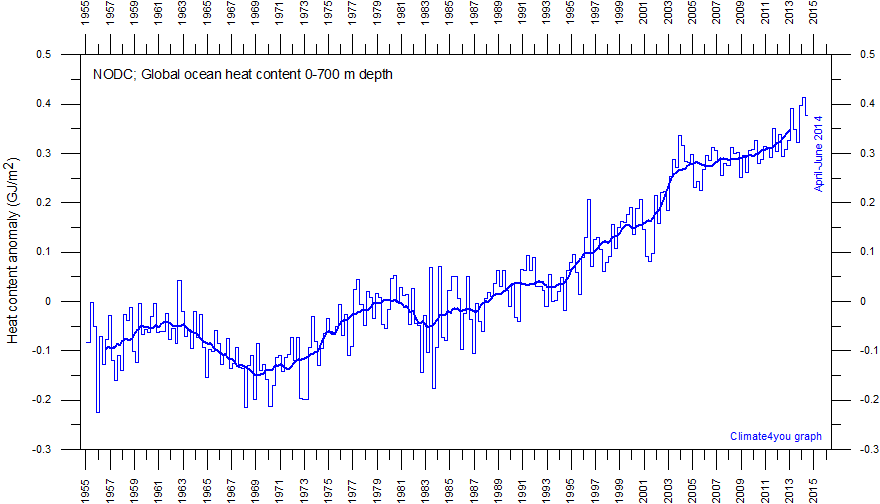
When I find people arguing about the surface temperature records, and whether a global warming trend can be picked out from them, I ask them if they’ve looked at the bigger picture : the global heat transport system. Water can retain heat better than air – a very large proportion of the heating caused by sunlight ends up in the oceans – at different places in the depths of the oceans. Over time, this heat is exchanged with the atmosphere, rather like global Gas Central Heating, but a lot of it stays down there – so if there is a trend for global warming, it’s probably best to look in the oceans for it.

And when we do, all the arguments about statistical analysis of surface atmospheric temperatures vapourise into meaninglessness, almost. The trend of ocean warming is so clear, you don’t need to apply any kind of statistical methods (apart from a couple of years of averaging) :-


Image Credit : Climate4You

Actually, the trend of atmospheric warming is also clear, if you take the long view :-


Image Credit : NASA GISS

Anybody who is still arguing about the periodicity of surface temperatures, as if natural cycles could explain global warming, should think again.

Surface temperature cycles are perhaps able to explain whether the next 10 years or so will see more or less global warming – but they cannot explain away the 100 year trend in global warming.

And when people have come to terms that statistics cannot wipe away the reality of global warming, then comes the sting in the tail. Because the ocean is exchanging heat with the atmosphere over time, this creates a time lag – between the heat being generated in the oceans, and surface temperatures rising as a result.

We ain’t seen nothing, yet.


18th January 2013
Twitterverse

—————————————-

@joabbess

@richardabetts Think focus on air temps waste of time: most heat ends up in oceans https://www.climate4you.com/images/NODC%20GlobalOceanicHeatContent0-700mSince1955%20With37monthRunningAverage.gif … @lucialiljegren @nmrqip @ed_hawkins

@richardabetts Number of reasons why air temps bounce around making short-term interpretation difficult @lucialiljegren @nmrqip @ed_hawkins

@richardabetts …but oceans temps could well continue a solid upwards gradient over next decades @lucialiljegren @nmrqip @ed_hawkins

@richardabetts If oceans continue recent warming gradient, will drag air temps on average up with them @lucialiljegren @nmrqip @ed_hawkins

@richardabetts If ENSO taking new shape/profile/cycle, this could obscure some of atmospheric temp rise @lucialiljegren @nmrqip @ed_hawkins

@richardabetts Even ENSO obfuscation can’t put off ~1.2degC warming next 30 years https://www.joabbess.com/2010/07/19/simple-integration/ … @lucialiljegren @nmrqip @ed_hawkins

—-

@ClimateOfGavin Sometimes distrust obsession re atmospheric temps: look at ocean warming @lucialiljegren @ed_hawkins @richardabetts @nmrqip

@ClimateOfGavin However much @lucialiljegren obsesses on air temperatures I only care about ocean warming @ed_hawkins @richardabetts @nmrqip

@ClimateOfGavin Lower atmosphere temperatures flip-flop all kinds of reasons: not oceans @lucialiljegren @ed_hawkins @richardabetts @nmrqip

@ClimateOfGavin Thermal capacity of oceans means they should show more reliable trend ? @lucialiljegren @ed_hawkins @richardabetts @nmrqip

————————————————————

@ed_hawkins

@joabbess @ClimateOfGavin Probably, but we only have good enough sub-surface observations of past ~50 years or so.

————————————————————

@joabbess

@ed_hawkins Yet since oceans good heat retainer even mediocre records of past relevant 4 comparison eg https://www.livescience.com/19414-oceans-warming-135-years.html … @ClimateOfGavin

@ed_hawkins We should definitely use what we know about thermal capacity of oceans to accept ships etc historical records @ClimateOfGavin

@ed_hawkins Ocean records of last 50 years allow for calibration between surface and depths, & with historical records too @ClimateOfGavin

—————————————————–

@ed_hawkins

@joabbess @ClimateOfGavin Of course – deep ocean observations are very relevant, but not the only type of measurement that are useful!

—————————————————–

@joabbess

@ed_hawkins I’m sure there must be mines data going back several hundreds of years, doing same trick for mass earth temps @ClimateOfGavin

——————————————————

@JohnRussell40 :-

@joabbess Surely mines data will be swamped by core heat? V. hot down there. @ed_hawkins @ClimateOfGavin

——————————————————

@ClimateOfGavin (Gavin Schmidt)

@JohnRussell40 @joabbess @ed_hawkins borehole temperatures can in fact be deconvolved to show widespread recent warming Henry Pollack et al

——————————————————

@joabbess

@ClimateOfGavin I assume you mean this https://www.ncdc.noaa.gov/paleo/borehole/core.html … https://www.ncdc.noaa.gov/paleo/globalwarming/pollack.html … Think that’s pretty clear ! @JohnRussell40 @ed_hawkins

@ClimateOfGavin Interestingly reflects surface up-blip in 1940s, which Phil Jones et al keep trying to smooth @JohnRussell40 @ed_hawkins
@ClimateOfGavin That up-blip in 1940s was what got us all started looking for historical marine records: v useful @JohnRussell40 @ed_hawkins

@ed_hawkins I’m trying to hint that endless debates about cyclicity/statistics of air temps = time-wasting & not productive @ClimateOfGavin

@ed_hawkins If read 1 more mangled media article about statistical trends of air temperatures, going to scream & jump about @ClimateOfGavin

@ed_hawkins The overall graph speaks for itself – or it should – louder than anything https://www.columbia.edu/~jeh1/mailings/2013/20130115_Temperature2012.pdf … Fig. 1 @ClimateOfGavin

———————————————

Categories
Assets not Liabilities Big Picture Bioeffigy Biofools British Biogas British Sea Power Carbon Capture Carbon Commodities Change Management Coal Hell Dead End Direction of Travel Disturbing Trends Efficiency is King Electrificandum Energy Insecurity Forestkillers Fossilised Fuels Geogingerneering Green Power Low Carbon Life Mad Mad World National Energy National Power Renewable Gas Solar Sunrise Solution City Technofix Toxic Hazard Tree Family Ungreen Development Unutterably Useless Western Hedge Wind of Fortune

HerĹźeyi Yak : Burn Everything

There’s good renewable energy and poorly-choiced renewable energy. Converting coal-burning power stations to burn wood is Double Plus Bad – it’s genuiunely unsustainable in the long-term to plan to combust the Earth’s boreal forests just to generate electricity. This idea definitely needs incinerating.

Gaynor Hartnell, chief executive of the Renewable Energy Association recently said, “Right now the government seems to have an institutional bias against new biomass power projects.” And do you know, from my point of view, that’s a very fine thing.

Exactly how locally-sourced would the fuel be ? The now seemingly abandoned plan to put in place a number of new biomass burning plants would rely on wood chip from across the Atlantic Ocean. That’s a plan that has a number of holes in it from the point of view of the ability to sustain this operation into the future. Plus, it’s not very efficient to transport biomass halfway across the world.

And there’s more to the efficiency question. We shouldn’t be burning premium wood biomass. Trees should be left standing if at all possible – or used in permanent construction – or buried so that they don’t decompose – if new trees need to be grown. Rather than burning good wood that could have been used for carbon sequestration, it would be much better, if we have to resort to using wood as fuel, to gasify wood waste and other wood by-products in combination with other fuels, such as excavated landfill, food waste and old rubber tyres.

Co-gasifying of mixed fuels and waste would allow cheap Carbon Capture and Storage (CCS) or Carbon Capture and (Re)Utilisation (CCU) options – and so if we have to top up the gasifiers with coal sometimes, at least it wouldn’t be leaking greenhouse gas to the atmosphere.

No, we shouldn’t swap out burning coal for incinerating wood, either completely or co-firing with coal. We should build up different ways to produce Renewable Gas, including the gasification of mixed fuels and waste, if we need fuels to store for later combustion. Which we will, to back up Renewable Electricity from wind, solar, geothermal, hydropower and marine resources – and Renewable Gas will be exceptionally useful for making renewable vehicle fuels.

Bioenergy with Carbon Capture and Storage : the wrong way :-
https://www.biofuelwatch.org.uk/wp-content/uploads/BECCS-report.pdf

Bioenergy with Carbon Capture and Storage : the right way :-
https://www.ecolateral.org/Technology/gaseifcation/gasificationnnfc090609.pdf
“The potential ability of gasifiers to accept a wider range of biomass feedstocks than biological routes. Thermochemical routes can use lignocellulosic (woody) feedstocks, and wastes, which cannot be converted by current biofuel production technologies. The resource availability of these feedstocks is very large compared with potential resource for current biofuels feedstocks. Many of these feedstocks are also lower cost than current biofuel feedstocks, with some even having negative costs (gate fees) for their use…”
https://www.uhde.eu/fileadmin/documents/brochures/gasification_technologies.pdf
https://www.gl-group.com/pdf/BGL_Gasifier_DS.pdf
https://www.energy.siemens.com/fi/en/power-generation/power-plants/carbon-capture-solutions/pre-combustion-carbon-capture/pre-combustion-carbon-capture.htm

Categories
Academic Freedom Bait & Switch Be Prepared Behaviour Changeling Big Society Change Management Climate Change Climate Chaos Conflict of Interest Corporate Pressure Cost Effective Dead End Dead Zone Demoticratica Design Matters Direction of Travel Disturbing Trends Divide & Rule Efficiency is King Electrificandum Energy Autonomy Energy Change Energy Denial Energy Insecurity Energy Revival Engineering Marvel Evil Opposition Freemarketeering Gamechanger Global Warming Green Investment Green Power Human Nurture Hydrocarbon Hegemony Insulation Low Carbon Life Major Shift Mass Propaganda National Energy National Power No Pressure Not In My Name Nudge & Budge Paradigm Shapeshifter Policy Warfare Political Nightmare Public Relations Pure Hollywood Realistic Models Regulatory Ultimatum Resource Curse Resource Wards Revolving Door Smokestorm Social Capital Social Change Social Chaos Social Democracy Solution City Stirring Stuff Sustainable Deferment Technofix Technological Fallacy Technological Sideshow Technomess The Power of Intention The Science of Communitagion The War on Error Unqualified Opinion Unsolicited Advice & Guidance Unutterably Useless Utter Futility Vain Hope Voluntary Behaviour Change Vote Loser Wasted Resource Western Hedge

The Art of Non-Persuasion

I could never be in sales and marketing. I have a strong negative reaction to public relations, propaganda and the sticky, inauthentic charm of personal persuasion.

Lead a horse to water, show them how lovely and sparkling it is, talk them through their appreciation of water, how it could benefit their lives, make them thirsty, stand by and observe as they start to lap it up.

One of the mnemonics of marketing is AIDA, which stands for Attention, Interest, Desire, Action, leading a “client” through the process, guiding a sale. Seize Attention. Create Interest. Inspire Desire. Precipitate Action. Some mindbenders insert the letter C for Commitment – hoping to be sure that Desire has turned into certain decision before permitting, allowing, enabling, contracting or encouraging the Action stage.

You won’t get that kind of psychological plasticity nonsense from me. Right is right, and wrong is wrong, and ethics should be applied to every conversion of intent. In fact, the architect of a change of mind should be the mind who is changing – the marketeer or sales person should not proselytise, evangelise, lie, cheat, sneak, creep and massage until they have control.

I refuse to do “Suggestive Sell”. I only do “Show and Tell”.

I am quite observant, and so in interpersonal interactions I am very sensitive to rejection, the “no” forming in the mind of the other. I can sense when somebody is turned off by an idea or a proposal, sometimes even before they know it clearly themselves. I am habituated to detecting disinclination, and I am resigned to it. There is no bridge over the chasm of “no”. I know that marketing people are trained to not accept negative reactions they perceive – to keep pursuing the sale. But I don’t want to. I want to admit, permit, allow my correspondent to say “no” and mean “no”, and not be harrassed, deceived or cajoled to change it to a “yes”.

I have been accused of being on the dark side – in my attempts to show and tell on climate change and renewable energy. Some assume that because I am part of the “communications team”, I am conducting a sales job. I’m not. My discovery becomes your discovery, but it’s not a constructed irreality. For many, it’s true that they believe they need to follow the path of public relations – deploying the “information deficit model” of communication – hierarchically patronising. Me, expert. You, poor unknowing punter. Me, inform you. You, believe, repent, be cleaned and change your ways. In this sense, communications experts have made climate change a religious cult.

In energy futures, I meet so many who are wild-eyed, desperate to make a sale – those who have genuine knowledge of their subject – and who realise that their pitch is not strong enough in the eyes of others. It’s not just a question of money or funding. The engineers, often in large corporations, trying to make an impression on politicians. The consultants who are trying to influence companies and civil servants. The independent professionals trying to exert the wisdom of pragmatism and negotiated co-operation. The establishment trying to sell technical services. Those organisations and institutions playing with people – playing with belonging, with reputation, marketing outdated narratives. People who are in. People who are hands-off. People who are tipped and ditched. Those with connections who give the disconnected a small rocky platform. The awkwardness of invested power contending with radical outsiders. Denial of changing realities. The dearth of ready alternatives. Are you ready to be captured, used and discarded ? Chase government research and development grants. Steal your way into consultations. Play the game. Sell yourself. Dissociate and sell your soul.

I have to face the fact that I do need to sell myself. I have to do it in a way which remains open and honest. To sell myself and my conceptual framework, my proposals for ways forward on energy and climate change, I need a product. My person is often not enough of a product to sell – I am neuro-atypical. My Curriculum Vitae CV in resume is not enough of a product to sell me. My performance in interviews and meetings is often not enough of a product. My weblog has never been a vehicle for sales. I didn’t want it to be – or to be seen as that – as I try to avoid deceit in communications.

Change requires facilitation. You can’t just walk away when the non-persuasional communications dialogue challenge gets speared with distrust and dismissal. Somehow there has to be a way to present direction and decisions in a way that doesn’t have a shadow of evil hovering in the wings.

“A moment to change it all, is all it takes to start anew.
To the other side.”


Why do I need to “sell” myself ? Why do I need to develop a product – a vehicle with which to sell myself ?

1. In order to be recognised, in order to be welcomed, invited to make a contribution to the development of low carbon energy, the optimisation of the use of energy, and effective climate change policy.

2. In order to put my internal motivations and drive to some practical use. To employ my human energy in the service of the future of energy engineering and energy systems.


Categories
Academic Freedom Assets not Liabilities Big Picture Big Society Carbon Capture Climate Change Climate Chaos Climate Damages Corporate Pressure Delay and Deny Demoticratica Direction of Travel Divide & Rule Dreamworld Economics Efficiency is King Emissions Impossible Energy Autonomy Energy Change Energy Denial Energy Insecurity Energy Revival Energy Socialism Engineering Marvel Evil Opposition Fair Balance Financiers of the Apocalypse Fossilised Fuels Freemarketeering Gamechanger Geogingerneering Global Warming Green Investment Green Power Hide the Incline Human Nurture Hydrocarbon Hegemony Incalculable Disaster Insulation Low Carbon Life Major Shift Mass Propaganda Money Sings National Energy National Power Near-Natural Disaster Neverending Disaster Nuclear Nuisance Nuclear Shambles Oil Change Optimistic Generation Paradigm Shapeshifter Peace not War Peak Coal Peak Emissions Peak Energy Peak Natural Gas Peak Oil Policy Warfare Political Nightmare Protest & Survive Public Relations Pure Hollywood Regulatory Ultimatum Renewable Gas Science Rules Shale Game Social Change Social Democracy Solar Sunrise Solution City Stirring Stuff Sustainable Deferment Technofix Technological Fallacy The Data The Power of Intention The Science of Communitagion The War on Error Unconventional Foul Ungreen Development Unnatural Gas Wind of Fortune Zero Net

Cross-Motivation

A fully renewable energy future is not only possible, it is inevitable.

We need to maximise the roll out of wind and solar renewable electricity systems, and at the same time fully develop marine, geothermal and hydropower energy, and of course, energy storage.

We need strong energy conservation and energy efficiency directives to be enacted in every state, sector and region.

But we need to get from here to there. It requires the application of personal energy from all – from governments, from industry, from society.

In arguing for focus on the development of Renewable Gas, which I believe can and will be a bridge from here to a fully renewable energy future, I am making an appeal to those who view themselves as environmentalists, and also an appeal to those who view themselves as part of the energy industry.

Those who cast themselves as the “good guys”, those who want to protect the environment from the ravages of the energy industry, have for decades set themselves in opposition, politically and socially, to those in the energy production and supply sectors, and this has created a wall of negativity, a block to progress in many areas.

I would ask you to accept the situation we find ourselves in – even those who live off-grid and who have very low personal energy and material consumption – we are all dependent on the energy industry – we have a massive fossil fuel infrastructure, and companies that wield immense political power, and this cannot be changed overnight by some revolutionary activity, or by pulling public theatrical stunts.

It definitely cannot be changed by accusation, finger-pointing and blame. We are not going to wake up tomorrow in a zero carbon world. There needs to be a transition – there needs to be a vision and a will. Instead of a depressive, negative, cynical assessment of today that erects and maintains barriers to co-operation, we need optimistic, positive understanding.

In the past there has been naievety – and some environmentalists have been taken in by public relations greenwash. This is not that. The kind of propaganda used to maintain market share for the energy industry continues to prevent and poison good communications and trust. I no more believe in the magic snuff of the shale gas “game changer” than I believe in the existence of goblins and fairies. The shine on the nuclear “renaissance” wore off ever before it was buffed up. And the hopeless dream of Carbon Capture and Storage (CCS) becoming a global-scale solution for carbon emissions is about as realistic to me as the geoengineering described in Tolkein’s “The Lord of the Rings”.

Nuclear power and CCS are actually about mining and concrete construction – they’re not energy or climate solutions. I’m not taken in by token gestures of a small slice of wind or solar power or the promise of a segment of biofuels from large oil and gas companies. Public relations and lobbying are the lowest form of faked, usurping power – but simply attacking brands will fail to make real change. I think honesty, realism and pragmatism are the way forward – and there is nothing more practical than pushing for Renewable Gas to back up the accelerated deployment of renewable electricity to its fullest scale.

My appeal to those in control of energy provision is – to see through the fog to the unstoppable. State support, both political and financial, of new energy technologies and infrastructure has to be a short- to medium-term goal – because of the volatility of the economy, and the demands of your shareholders. The need to build public support for new energy means that we the citizens must all be offered the opportunity to own energy – and so that means building a common purpose between the energy sector and society – and that purpose must be Zero Carbon.

There is and will continue to be a porous border between the energy industry and governments – energy is a social utility of high political value. However, the privilege and access that this provides should not automatically mean that the energy industry can plunder public coffers for their own profit. What contribution can the energy industry make to society – apart from the provision of energy at cost – in addition to the subsidies ? Energy, being so vital to the economy, will mean that the energy sector will continue to survive, but it has to change its shape.

You can dance around the facts, but climate change is hitting home, and there is no point in continuing to be in denial about Peak Oil, Peak Coal and Peak Natural Gas. These are genuine risks, not only to the planet, or its people, but also your business plans. We need to be using less energy overall, and less carbon energy within the eventual envelope of energy consumption. So the energy sector needs to move away from maximising sales of energy to optimising sales of energy services and selling low carbon energy systems, power and fuels.

You would be wrong to dismiss me as an “eco warrior” – I’m an engineer – and I’ve always believed in co-operation, expertise, professionalism, technology and industrial prowess. What impresses me is low carbon energy deployment and zero carbon energy research. Progress is in evidence, and it is showing the way to the future. Realistically speaking, in 20 years’ time, nobody will be able to dismiss the risks and threats of climate change and energy insecurity – the evidence accumulates. We, the zero carbon visionaries, are not going to stop talking about this and acting on it – as time goes by, the reasons for all to engage with these issues will increase, regardless of efforts to distract.

Nothing is perfect. I no more believe in a green utopia than I do in unicorns. But without reacting to climate change and energy insecurity, the stock market will not carry you, even though the governments must for the mean time, until clean and green energy engineering and service organisations rise up to replace you. Lobbying for pretences will ultimately fail – fail not only governments or peoples, but you. You, the energy industry, must start acting for the long-term or you will be ousted. As your CEOs retire, younger heads will fill leadership shoes – and younger minds know and accept the perils of climate change and energy insecurity.

This is the evolution, not revolution. It is time to publicly admit that you do know that economically recoverable fossil fuels are limited, and that climate change is as dangerous to your business models as it is to human settlements and the biosphere. Admit it in a way that points to a sustainable future – for you and the climate. The pollution of economically borderline unconventional fuels is wrong and avoidable – what we need are renewable energies, energy conservation and energy efficiency. One without the others is not enough.

How can your business succeed ? In selling renewable energy, energy conservation and energy efficiency. You have to sell the management of energy. You have to be genuinely “world class” and show us how. No more spills, blowouts and emissions. No more tokenistic sponsorship of arts, culture and sports. The veneer of respectability is wearing thin.

As an engineer, I understand the problems of system management – all things within the boundary wall need to be considered and dealt with. One thing is certain, however. Everything is within the walls. And that means that all must change.


https://houstonfeldenkrais.com/tag/cross-motivation/ “…Of course, the money would be great. But adding in the reward/punishment dimension is a sure way to sabotage brilliant performance. Moshe Feldenkrais observed that when one is striving to meet an externally imposed goal, the spine shortens, muscles tense, and the body (and mind) actually works against itself. He called this “cross motivation,” and it occurs when one forsakes one’s internal truth to maintain external equilibrium. There are lots of examples of this: the child stops doing what she’s doing because of the fear of losing parental approval, love, protection. The employee cooks the books to keep his job. The candidate delivers the sound bite, and dies a little inside. Feldenkrais attributed most of our human mental and physical difficulties to the problem of cross motivation. If you watch Michael Phelps swim, you can’t help but notice that he makes it look easy. He is clearly strong and powerful, but all of his strength and power are focused on moving him through the water with the greatest speed and efficiency. There’s no wasted effort, no struggle, no straining. He is free of cross-motivation! Would straining make him faster? Of course not. Unnecessary muscular effort would make him less buoyant, less mobile, less flexible. Will dangling a million dollars at the finish line make him swim faster? Probably just the opposite, unless Michael Phelps has some great inner resources to draw upon. The young Mr. Phelps has already learned how to tune out a lot of the hype. He’ll need to rely on “the cultivation of detachment,” the ability to care without caring…”

Categories
Assets not Liabilities Cost Effective Design Matters Direction of Travel Energy Autonomy Energy Change Energy Insecurity Energy Revival Engineering Marvel Gamechanger Gas Storage Green Investment Green Power Hydrogen Economy Major Shift Marvellous Wonderful National Energy National Power Optimistic Generation Paradigm Shapeshifter Price Control Renewable Gas Renewable Resource Solution City Western Hedge Wind of Fortune

Greenpeace Windgas : Renewable Hydrogen

https://www.lngworldnews.com/gasunie-greenpeace-energy-choose-suderburg-as-windgas-location-germany/
https://www.greenpeace-energy.de/presse/pressedetails/article/neuer-schwung-fuer-die-energiewende-windgas-made-in-suderburg.html
https://www.greenpeace-energy.de/windgas.html
https://vimeo.com/44094925

Categories
Academic Freedom Big Number Big Picture Climate Change Climate Chaos Cool Poverty Delay and Deny Direction of Travel Disturbing Trends Extreme Weather Gamechanger Global Heating Global Warming Growth Paradigm Heatwave Hide the Incline Human Nurture Incalculable Disaster Insulation Major Shift Media Meltdown Near-Natural Disaster Neverending Disaster Nudge & Budge Paradigm Shapeshifter Public Relations Realistic Models Science Rules Screaming Panic Sustainable Deferment The Data The Science of Communitagion The War on Error Vain Hope

No Cause for Alarm

Categories
Climate Change Climate Chaos Climate Damages Direction of Travel Disturbing Trends Extreme Weather Floodstorm Human Nurture Incalculable Disaster Paradigm Shapeshifter Rainstorm

Forgive Us Our Stupidity

There are some things we can do nothing about. Forgive us our stupidity.

Supertyphoon Sanba is heading Japan and South Korea’s way.

Categories
Academic Freedom Breathe Easy Burning Money Corporate Pressure Demoticratica Direction of Travel Disturbing Trends Drive Train Emissions Impossible Extreme Weather Freshwater Stress Gamechanger Hydrocarbon Hegemony Major Shift Neverending Disaster Optimistic Generation Paradigm Shapeshifter Petrolheads Policy Warfare Political Nightmare Regulatory Ultimatum Social Capital Stirring Stuff Technomess The Data The Power of Intention Toxic Hazard Transport of Delight Tree Family Ungreen Development Water Wars

London Skies

Image Credit : epeigne37

Yesterday evening, I was caught by the intensity of the London Sky – there was little air movement in most of the lower summer-heat space above the city, and virtually no cloud except very high strands and sprurls and bones and smears.

Most of the cloud was clearly the result of aeroplane contrails – numerable to small children and their educational grandparents on various buses.

As the sun began to set, or rather, as the Earth rolled to curve away from facing the sun, the sky took on the colour of bright duck egg blue with a hint of pale green, and the sprays of high contrail-cloud took on a glorious orange-fuchsia colour with flashes of gold, bronze and vanadium reds, fading slowly to chromium reds as twilight approached.

At a certain moment, I understood something – as I watched an aeroplane high up, make its way west to Heathrow, the angle of the sunset showed its contrail as a murky ink, messing up the rest of the clouds as it brushstroked its way along, with its slate and muddy hues. As I watched, other parts of the clouds began to appear brown and grey, and since I knew that most of the cloud was jet engine exhaust that hadn’t moved because of the lack of high winds, I finally realised I was watching dirt, high up in the troposphere – careless, unthinking toxic waste.

Categories
Academic Freedom Coal Hell Contraction & Convergence Corporate Pressure Design Matters Direction of Travel Regulatory Ultimatum Renewable Gas

Here comes… Renewable Gas


[ I know, I know, this song is actually about gasoline… ]
For the delight and edification of my dedicated followers, I present some more evidence to back up my claims that the future will be… Renewable Gas.

Of course the story starts with the old guard : Natural Gas, and the comfort that various governments are offering to the oil and gas industry in general over the securing of their future business.

As usual. As expected. In fact, as it should be. The developed world is still highly dependent on hydrocarbon fuels, and fossil gas is a good option, for the meantime.

Here’s the UK Government working on their “Gas Strategy” consultation :-

UK Government Department of Energy and Climate Change (DECC) : 17 March 2012 : DAVEY SETS OUT MEASURES TO PROVIDE CERTAINTY TO GAS INVESTORS”
UK Government Department of Energy and Climate Change (DECC) : 2 May 2012 : “A CALL FOR EVIDENCE ON THE ROLE OF GAS IN THE ELECTRICITY MARKET”

I did ask some colleagues if they wanted to join me in responding to this consultation, but there was no serious energy for it in my networks, so I didn’t do anything, because I prefer collaboration on this kind of thing, otherwise I work too hard and fail to make an impact too often.

But anyway, now that things seem to be clear that the Nuclear Power confidence bubble has properly burst, the default gas strategy that has been brewing for a while is now gaining ascendance, including the ambitious plans of the gas operators and the deals the UK Government are striking to keep gas imports topped up.

Categories
Academic Freedom Assets not Liabilities Be Prepared Big Number Big Picture British Biogas British Sea Power Carbon Capture Carbon Commodities Carbon Pricing Carbon Taxatious Demoticratica Design Matters Direction of Travel Efficiency is King Energy Change Energy Revival Feel Gooder Gamechanger Gas Storage Geogingerneering Green Investment Green Power Low Carbon Life Major Shift National Energy National Power Nuclear Nuisance Nuclear Shambles Optimistic Generation Paradigm Shapeshifter Policy Warfare Political Nightmare Realistic Models Renewable Gas Renewable Resource Solar Sunrise Solution City Stirring Stuff Technofix The Power of Intention The Price of Gas The Price of Oil Wind of Fortune

Energy Together : I’m just getting warmed up

The human race – we have to solve energy together. And to do that, we need to harness all our personal, purposeful, positive energies, and let me tell you, personally, I feel electric – and I’m only just getting warmed up.

So let’s hear less of the nonsense from authoritatively-accredited people who want to put a dampener on green energy, who say that saving energy cannot, simply cannot be done, sigh, sigh, sigh, collective groan. We have so much energy together, we can do this.

We have the will power, the staying power, the investment power, and we will navigate the obstacles in our path.

Let’s not waste any more time on expensive trinkets, and iddy-biddy fancies with high unit costs and low compatibility to the future. Yes, I’m talking nuclear power. I’m talking the nobody-really-wants-to-do-it-and-nobody-thinks-it-can-be-cheap-enough-to-work-at-scale Carbon Capture and Storage. And yes, I’m talking carbon markets – tell me again, where are they now ? Oh yes, still in the starting blocks.

And don’t even start to talk about pricing carbon to me – in this world of rollercoaster, highly volatile energy prices, what on Earth could costing or taxing carbon actually achieve ? And fusion power ? Nah, mate, forget it. It’s been 50 years away for the last 50 years.

Shale gas, oil from shales, tar sands, coal bed methane collection and underground coal gasification are once-abandoned messy ideas from way back. They’re still messy, and they’re still retro, and they’re not going to get us anywhere. If the United States of America want to completely ruin their lithosphere, well, that’s up to them, but don’t come around here toxifying our aquifers and poisoning our European trees !

What we need is marine energy, geothermal energy, hydropower, solar power, wind power, and Renewable Gas, because gaseous fuels are so flexible and store-able and can come from many, many processes. And we need the next optimistic generation of leaders to push through the administration ceiling and get green energy policy really rolling, attracting all the green investment will.

If I were a power plant, I would be cranking out the current and making everything shine very, very brightly just now.

Categories
Academic Freedom Assets not Liabilities Big Number Big Picture Big Society Climate Change Climate Chaos Climate Damages Corporate Pressure Delay and Deny Demoticratica Design Matters Direction of Travel Disturbing Trends Energy Autonomy Energy Change Energy Denial Energy Disenfranchisement Energy Insecurity Energy Revival Fair Balance Faithful God Feed the World Feel Gooder Fossilised Fuels Freemarketeering Gamechanger Human Nurture Major Shift Marvellous Wonderful Mass Propaganda Media Meltdown Neverending Disaster Optimistic Generation Paradigm Shapeshifter Peace not War Peak Coal Peak Emissions Peak Energy Peak Natural Gas Peak Oil Petrolheads Public Relations Pure Hollywood Realistic Models Renewable Resource Social Capital Social Change Solar Sunrise Solution City Stirring Stuff The Data The Power of Intention The War on Error Wind of Fortune Zero Net

Un égard, un regard, un certain regard

Whatever it is, it starts with attention, paying attention.

Attention to numbers, faces, needs, consideration of the rights and wrongs and probables.

Thinking things through, looking vulnerable children and aggressive control freaks directly in the eye, being truly brave enough to face both radiant beauty and unbelievable evil with equanimity.

To study. To look, and then look again.

To adopt a manner of seeing, and if you cannot see, to learn to truly absorb the soundscape of your world – to pick up the detail, to fully engage.

It is a way of filling up your soul with the new, the good, the amazing; and also the way to empty worthless vanity from your life.

Simone Weil expressed this truth in these words : “Toutes les fois qu’on fait vraiment attention, on dĂ©truit du mal en soi.” If you pay close attention, you learn what is truly of value, and you jettison incongruities and waywardness. She also pronounced that “L’attention est la forme la plus rare et la plus pure de la gĂ©nĂ©rositĂ©.” And she is right. People feel truly valued if you gaze at them, and properly listen to them.

Those of us who have researched climate change and the limits to natural resources, those of us who have looked beyond the public relations of energy companies whose shares are traded on the stock markets – we are paying attention. We have been working hard to raise the issues for the attention of others, and sometimes this has depleted our personal energies, caused us sleepless nights, given us depression, fatalism, made us listless, aimless, frustrated.

Some of us turn to prayer or other forms of meditation. We are enabled to listen, to learn, to try again to communicate, to bridge divides, to empathise.

A transformation can take place. The person who pays close attention to others becomes trusted, attractive in a pure, transparent way. People know our hearts, they have confidence in us, when we give them our time and an open door.

Categories
Babykillers Big Society Carbon Army Carbon Capture Corporate Pressure Demoticratica Direction of Travel Disturbing Trends Energy Autonomy Energy Disenfranchisement Energy Insecurity Evil Opposition Foreign Interference Foreign Investment Incalculable Disaster Mass Propaganda Media Military Invention Money Sings National Energy No Blood For Oil Not In My Name Obamawatch Peace not War Peak Oil Policy Warfare Resource Curse Resource Wards Screaming Panic Stop War The Power of Intention The Price of Gas The Price of Oil The War on Error Western Hedge

We Need To Talk About Syria

Kofi Annan has thrown up his hands and backed away from his role as UN-Arab League special envoy to Syria tasked with a peace mission. In one sense it is all too predictable. The United Nations Security Council is divided, reflecting deep faultlines in the policy positions of the main body of the UN.

It is probably too early in the evolution of global human governance to expect military violence to be declared illegal, but at least there are voices starting to speak up demanding that there be no armed foreign intervention in Syria. The trouble is that although warfare by foreign parties in Syria has not been publicly declared, there are, by many accounts, military and security operatives of a number of external country administrations already in play inside its borders. Foreign ministers in several major countries have pledged support to either the Syrian “regime” – you know – its “ruling government”, or to the “opposition” “rebels” – otherwise known as gangs of armed thugs. Or quite possibly people from a nebulous ill-defined shadowy organisation known as “Al-Qaeda”.

There are some reports that foreign involvement was behind the bombing of members of President Bashar al-Assad’s government in July, a near “decapitation” – as Assad himself could have been easily killed in the incident, and that a reprisal attack took place several days later – possibly severely injuring or even killing Prince Bandar, newly recruited chief of intelligence in the Kingdom of Saudi Arabia – recently drafted in – apparently with a mission to topple Syria’s “regime” – you know, Syria’s “legitimate administration” – a former ambassador to the United States of America. Although this is not yet confirmed. Or denied.

Despite conciliatory moves, countries of stern influence in the United Nations continue to call for Assad to quit, for reasons that nobody really delves into. Oh yes, as a mild-mannered London-trained ex-ophthalmologist, he’s supposed to be some kind of Hitler character, killing thousands of “his own people”. This story clearly doesn’t stick very well to the man, particularly since this narrative was also recently falsely used against the former leader of Libya. Another story that hasn’t been washing is that the Syrian “regime”, you know, the “proper authorities of administration”, has been responsible for starting all the violence in Syria – but there is now plenty of evidence to the contrary. So why has it been necessary to demonise Assad ? Why has it been that – allegedly – various governments have decided to get dirty hands and stir up violence in Syria in means overt and covert ?

And with the risks to global oil supply, why has it been necessary for the United States of America and the European Union to implement and enforce an oil embargo on Syria ? I mean, you would have thought it would be in everybody’s best interests to keep the oil flowing from every source possible. But no, sanctions it is, and Syria’s had to give up a considerable amount of their production. I know, I know, before the embargo Syria’s output was only 10% of Iran’s current production (see below), but it has meant a lot for Syria’s trade balance. According to the CIA Factbook on Syria (under “Economy”), nearly three quarters of all oil produced has been for export (although it was consuming more Natural Gas than it could produce – presumably for power generation). Plus, it’s national debt put it in the bottom ranks of the world’s countries meaning it can ill-afford to become more impoverished.

So remind me again, what was the oil embargo for ? To depose Assad by making him unpopular because of a nosediving economy ? And why does Assad need to go, actually ? Nobody’s saying that the country has been run perfectly. Gruesome tales have been told of what can happen in Syria – but then, horrible things happen in every country, including in the United States of America, and yet the United Nations is not insisting that Barack Obama stand aside.

Several key cities in Syria have existed in tolerant civilisation for thousands of years. Why does war have to come to Syria ? Why is there civil war being conducted in Damascus ? Even stoics are finding this hard to bear. Wikipedia notes despairingly and ungrammatically “In the second decade of the 21th century Damascus was damaged from the ongoing Syrian Civil War”.

The more I think about it, the more I come circling back to the same theory – that the economic attack on Syria, and the now almost indisputable accounts of outside meddling that is provoking the conflict (and may have even instigated it in the first place), is simply part of a plan to make the oil and gas resources of all Middle Eastern countries available to global markets at reasonable prices. I mean, look at Iraq, whose oil production was severely hit as a result of military destruction by the international warfare community, but which is now making a splendid recovery (see below) and most of the profits are pouring into the coffers of the multinational oil and gas companies, and diesel and petrol stay relatively inexpensive. Or not, as the case may be. The plan for countries across the Middle East is probably the along the same general line – first accuse the country’s government of heinous crimes, then apply economic sanctions or energy sanctions of some kind, then apply diplomatic and media pressure, (and then, these days, send in the spooks to kick up an “Arab Spring”) and then send in the gunships or gunchoppers – attack helicopters. This narrative has been successfully applied to bring Iraq to heel, and then Libya, and now it seems Syria is being talked down the same blood-paved road, and Iran is being pushed along a parallel track.

Iran. Now there’s an interesting case. Iran is not a pushover. It has taken nearly seven years of manoeuvring to make the completely unfounded case that Iran is building (or planning to build) nuclear weapons. Iran has been enriching uranium for its stated aim of developing a civilian nuclear power program, and this has been used as the justification to impose sanctions against Iran, including an oil embargo, which is having an impact on their production (see below). Besides painting the leader of Iran as an evil dictator, the propagandists of this world also seem to be trying to wield a new stick to beat Iran with – in the form of the call to end fossil fuel subsidies. Billed as a climate change policy by the G20, it is more a punitive measure against developing countries who have been using fossil fuel subsidies to make sure their citizens can get cheap energy. If Iran is no longer permitted to subsidise energy for citizens it will be forced to sell the oil and gas abroad – a buyer’s market only too pleased to suck dry the world’s second largest oil and Natural Gas producer. That volume of oil and gas being made available on the world’s markets would definitely keep global prices of oil and gas as low as possible.

Anyway, back to Syria. Clearly, there are problems, although reports of enormous and desperate increases in violence are probably not accurate. Painting the story as increasingly agitated is a common media device to engage the readers with the situation – but if it gets too sensationalised the narrative could start to affect decisionmakers, and may lead to illegitimate and inappropriate influence being exerted from abroad. Instead of William Hague MP, British Foreign Secretary for the United Kingdom, offering tactical support to the Syrian “rebels”, he should announce an immediate diplomatic mission to the Syrian government, and the various rebel groups, offering the undoubted skills of his secret service personnel in mediating a ceasefire between the authorities and the opposition. Otherwise we could end up with NATO committing to tens of thousands of weaponised air sorties over Syria and destroying a large part of this ancient culture, just as they did with Libya. All economic and energy sanctions and embargoes against Syria should be dropped, as they are aggravating the conflict. If the international community uses the language and action of peace, then perhaps Syria can be encouraged back to the ways of peace.

In the words of Russian Foreign Minister Sergey Lavrov, “Regime change is not our profession.”


Categories
Bait & Switch Behaviour Changeling Big Picture Big Society Carbon Capture Climate Change Climate Chaos Corporate Pressure Deal Breakers Demoticratica Direction of Travel Divide & Rule Dreamworld Economics Energy Change Evil Opposition Financiers of the Apocalypse Freemarketeering Green Investment Green Power Human Nurture Hydrocarbon Hegemony Libertarian Liberalism Mass Propaganda Media Nudge & Budge Paradigm Shapeshifter Policy Warfare Political Nightmare Protest & Survive Public Relations Regulatory Ultimatum Social Capital Social Change Sustainable Deferment The Myth of Innovation The Power of Intention The War on Error Unqualified Opinion Unsolicited Advice & Guidance Voluntary Behaviour Change Vote Loser

We Don’t Got No Revolution

After addressing the Stop Climate Chaos coalition Annual General Meeting on Friday 20th July 2012, Tony Juniper, sustainability consultant, and Colin Butfield of WWF, responded to questions from the audience. There was a sense of unease in the room, dissatisfaction with the UK Coalition Government appearing to roll back commitment to the Climate Change Act, and their failure to enact their manifesto declaration of being “the greenest government ever”.

People expressed doubts about the design of climate change communications, about collaboration with companies over climate change action, and what would be suitable campaign actions for protest groups and charities. Several groups found their ongoing campaigns disparaged, in effect, by dismissive comments from others. It wasn’t altogether a pleasant experience. Here are just a few paragraphs attempting to summarise the question-and-answer session from brief notes made at the time.

One of the attendees proposed that climate change communications going forward should make use of the fact that people are questioning the legitimacy of the current economic system, and said that there was a failure to offer a programmatic response. He said that if people were given a systemic critique, they would “get it” – and that the Green New Deal formulation was ideal. He projected that if climate change communications campaigns don’t go against the corporations, that it will be less and less likely in future that governments will respond to corporate abuse of the environment.

Tony Juniper responded by saying that he didn’t see the backing for that level of challenge to the current system. He said that even though there is an economic meltdown in progress – it’s been shown that “a pack of bankers are nicking the peoples’ money” – there has been no revolution. The Non-Governmental Organisations have carried on as normal. At the General Election, people voted for the party of the financial system. The Green New Deal, he said, simply hasn’t got the backing it should have. It suffers from the same lack of attention that faces any different economic formulation that is put in front of people. Time is so short that we have to have something more pragmatic – plausible decisions about realistic proposals. He said it was down to the NGOs to formulate this – and that emphasising jobs was essential.

Another questioner put it to the speakers that the cost of deploying wind turbines was cheaper than not doing it and that contrary to the myths they were actually rather beautiful – and that even the pylons carrying new power lines to connect new wind generation to the grid could be made to be beautiful too. New technology is something to embrace rather than fear.

Tony Juniper replied that a small minority of people have managed to poison the debate on wind power, and that they are part of the Conservative Party core backing. He said that there is lots of support for renewable energy, and that this needs to be reflected back to the media. He said that the media is “pretty poisoned”, too – the Daily Telegraph for example, although The Guardian and The Independent were more open. He suggested that industry players start talking more to the Government and get more organised. He said that Government Ministers find it easier to deal with the nuclear lobby as they have one [professional] body and one message. After the failure of Copenhagen – where the Government predicted they would come away with a successful, positive outcome and didn’t – the atmosphere as a whole has been poisonous. The NGOs didn’t react to this disappointment.

Phil Thornhill, the National Co-ordinator of the Campaign against Climate Change, criticised the NGOs who he said have stopped focusing on climate change. He said it hard to find the next “really sharp point” – the really unifying thing – the way we did with the Climate Change Act. He said that action had to be more than just signing the odd letter, and questioned the approach where action has been fixed to a time or an event – with the obvious risk of collapse. He suggested that climate action should be a continuning goal.

Colin Butfield of WWF responded to the questions – he said that the problem with promoting renewable energy was the peril of ignoring NIMBYism – people may be generally positive about wind farms, but not want one in their own back yard. He said people wanted a genuine local conversation about renewable energy development. He said that on economic proposals, that people need to be presented with solutions they can easily adopt. He suggested one call to action that could easily draw people would be to ask “do you want your pension going into that ridiculous investment ?”, and then asking people to choose more sustainable investments and funds. He said that “normal” people are a “bit terrified” by the idea of collapse of the current economic system [and so may not react well or buy into the ideas]. He said that many pensions were a “climate bad”. He said that in the current economic situation, people could be brought to think about the link between the way banks invest money and climate change – as people are very unhappy with the existing system – “a blindside force for bad”. He said that an example of positive change had been in the campaign to demand buisiness carbon reporting.

Herbert Williams, Chief Executive Officer of A Rocha UK, holding up a credit card, said that positive investment change in the economy was unlikely to form a groundswell as people are in thrall to the current financial system, and that most public communications were advertising to direct the flow of money. He said that there was a danger in repeating the styles and actions of the past.

Peter Robinson of the Climate Alliance said that people are very demoralised about the economic situation – and that climate change arguments have to be involved in any policy proposals.

Tony Juniper said that a suitable goal for campaigning would be shifting anger about the economic situation to a call for green jobs. He asked whether this would still require “grassroots” activism and answer this with a qualified “yes”, because he said it would require different strategies. He said that the key requirement was to work out how to engage people and get them involved. He said that a different body of expertise would be needed in these campaigns. He mentioned that he has been considering employing psychologists – people from public relations companies – and said “we need to get some of these helping us.” He asked how many people would be a significant number to sign up to a campaign. He mentioned that the Climate Change Act campaign had got 200,000 people to urge their MPs to sign the Early Day Motion in Parliament, but that it was only successful because there had been more political jigsaw pieces in place. The 200,000 would not be enough to move to the next phase. To get real action on the Climate Change Act he suggested that the campaign would need to broaden the base – and that would need more people than just those from campaign organisations to be involved. He said that he was still seeing a lot of the same faces – even though it was “lovely to see you all”, but that the campaign needs to go wider. He said that there are difficulties with anything that involves infrastructure, as the Government has just ripped up the planning system in Local Authorities – 50 years of accumulated wisdom on how to do development.

Phil Thornhill said that Martin Luther King didn’t have a communications expert or a consultant psychologist. He had passion to get his views across. Climate change is perhaps less tangible that civil rights – therefore needs more passion. The idea that psychologists or public relations techniques can give you a shortcut to understanding your audience better was not helpful. Advertising and public relations are mostly about selling things to people. Climate change communications have been shown to not be getting through to people – the message to change can be unappetising.

It was asked if it is possible to hold together progressive politics and the traditional NGO approach.

It was noted that the think tank battle is very important – and their public relations. This style was planted 60 years ago – fundamentally anti-state – based on the Austrian school of economics – it’s very easy for them to point at any efforts by governments and claim “the faceless state is coming to take your money”.

Colin Butfield answered to a question about social media – could we get millions of young people to join in ? He said you can’t, but that we’d nearly got there with the Green Deal on loans. In regards to the 200,000 mentioned for the Climate Change Act he said that in the current less urgent political atmosphere, those numbers are always going to be ignored. By contrast, he’d had millions of people on the Facebook page for Earth Hour – and that was sufficient to get David Cameron to talk about it.

A questioner raised issues about coopting NGOs and the social movements to enact policy goals. Energy goals can’t be simply about deploying renewable energy, but must also answer questions on access to energy, land rights, food versus fuel, fuel versus forests. You cannot leave questions of justice aside.

Tony Juniper, in replying to a warning that it is important to keep vigilant about the dubious underbelly of corporate public relations agendas, said that although one could damage their brands for a while, and companies and campaigns could have battles to capture each others’ agendas, that we are not going to get anywhere without all sorts of compromise – finding shared values.

Later, over a spiffing Marks & Spencer buffet outside in the Westminster School walled garden, I spoke with a campaigner about the rationale and purpose of campaigning. I asked whether it could be seen as rather patronising to assume that we are the ones with the better ideas and information, and that we have to “engage” other people with a view to them adopting our position and taking our recommended actions. The campaigner asked what we would do if we didn’t do campaigns – how would we involve people in these issues ?

I thought to myself – therein lies the problem. A campaign should not be about keeping people running around like headless chickens trying to put across messaging and persuading other people to take action. Keeping concerned people busy with communications tasks is not a genuine achievement, I would suggest. It certainly doesn’t appear to be resulting in genuine, widescale political, economic and social change. There was a brief flicker of purpose when the previous Labour Government had promoted climate change communications (although they alienated a good portion of the population with their strategy and messaging), but now there’s no political lever.

We don’t got no revolution, and a new round of consultation with communications specialists is not going to change that.

Categories
Advertise Freely Be Prepared Behaviour Changeling Big Number Big Picture Big Society Burning Money Carbon Army Carbon Commodities Carbon Pricing Carbon Taxatious Conflict of Interest Corporate Pressure Cost Effective Dead End Deal Breakers Delay and Deny Demoticratica Direction of Travel Disturbing Trends Divide & Rule Efficiency is King Emissions Impossible Energy Autonomy Energy Change Energy Disenfranchisement Energy Insecurity Energy Nix Energy Revival Energy Socialism Feel Gooder Financiers of the Apocalypse Freemarketeering Fuel Poverty Gamechanger Green Investment Growth Paradigm Human Nurture Hydrocarbon Hegemony Insulation Low Carbon Life Major Shift Mass Propaganda Media Money Sings National Energy National Power No Pressure Nudge & Budge Optimistic Generation Paradigm Shapeshifter Peak Emissions Peak Energy Policy Warfare Political Nightmare Price Control Public Relations Realistic Models Regulatory Ultimatum Social Capital Social Change Social Chaos Social Democracy Solution City Sustainable Deferment Technofix Technomess The Power of Intention Voluntary Behaviour Change Vote Loser Wasted Resource

Will the Green Deal Deliver ? (2)

Here is the second part of the transcription from the notes I took this morning in a seminar in the UK House of Commons. The meeting was convened by PRASEG, the Parliamentary Renewable and Sustainable Energy Group.

This transcription is based on an unverified long-hand paper-based recording of the words spoken. Items in quotation marks are fairly accurate verbatim quotations. Items in square brackets are interpolation, or explanation, and not the exact language the person used to present their thoughts.

Here are the papers supplied at the start of the meeting :  A B C D E F

CONTINUED…

[AW] How it [the Green Deal] hits the ground matters…

[Joanne Wade, Independent Consultant, UKERC]
The Green Deal is a very useful framework – a move to encourage people to pay for their own energy efficiency. The finance offering may be interesting to some. The quality [of the workmanship ? Guarantees under the Green Deal ?] is “utterly vital”. I don’t think it’s quite there. Outlining four areas (1) How the Green Deal engages (2) The low cost finance (3) Generally mainstreaming energy efficiency in peoples’ minds and (4) Fuel Poverty.

(1) Most people don’t care if they have energy efficiency [in their homes]. If we were really serious about this [our appeal would be along the lines of] you can’t sell a car with brakes that don’t work, but you can sell a house that kills you. [I just wanted to get that in up-front]. Nobody’s really cracked this yet [the messaging] is [still only] “reaching the usual suspects”. Trust is vital. Salience is key. We want people to understand this is not an add-on to all the other things they do. Community-based organisations fit the bill [we tend to trust these groups as members]. [We need to be asking] how does the Green Deal work with that ? The Green Deal providers – small to medium sized enterprises (SMEs) want to use their own brand – they are very good at marketing [and will be good at marketing the Green Deal as well]. But will that be enough to convince people ? The Assessments [that people will get at the start of the Green Deal process] will be detailed on what they can do. Some people are concerned about how much energy they use. Is that enough to go from a standing start to […] ? Are enough people going to be committed enough by the time [Green Deal is available] ? What I think we need – to prime people to be ready to accept [the Green Deal]. [The message would be] appropriate to come from local community groups. The Government is hoping for it – but no real drivers. There are examples – but how are they going to be copied ? The CERT / CES(P) results show that Local Authorities are key. Now that National Indicators 186 and 187 [From the Performance Framework – annual reporting requirements of direct and indirect emissions as a result of Local Authority operations] have been cut – there is no driver. The amount of attention has dropped. [Local Authorities are facing other problems] reducing staff and budgets.

(2) Access to low-cost finance. [The work to make this available from the Green Investment Bank is going ahead but] what about other soruces – for example mortgage providers ? In Switzerland for example, they are lending 114 billion euro every year to homeowners at low interest rates. We need to look at how to convince people. In Switzerland, people will pay more for energy efficient homes. The Green Deal needs to accept alternative forms of finance. Need to be able to access ECO [Energy Company Obligation – part of the Energy Bill – obligation energy suppliers to supply not only energy, but energy services such as energy efficiency and energy conservation] providers. We don’t know if the market will deliver [there are already grants/finance in this sector that people are not using].

(3) Can’t see the Green Deal mainstreaming. My builder – I did an [extension] and asked for 50% extra insulation and LED [Light Emitting Diodes – a very energy efficient form of lighting] – he thought I was slightly mad but now recommends LED lighting on all builds. Here’s the Green Deal. He would say – “Why should I tell people about that ?” Typical small builder. It should be that whenever anyone is doing a refurbishment they should just do it [extra insulation etc] – and so we’re back to [the big R] – regulation. [But look at the public outcry when the media considered] consequential improvements [the “Conservatory Tax”]. [Energy efficiency] “We need to make it the thing that people do.”

(4) Fuel Poverty. The money that can be coming through the ECO is ÂŁ 350 million per year (before VAT). Let’s not kid ourselves – the householders in fuel poverty are not going to take Green Deal finance. [The Climate Change Committee says] ÂŁ4 billion a year is what we need to tackle fuel poverty. The Government needs to make sure that Green Deal finance is available the fuel poor (in an appropriate form) (overcoming the small potential).

[Alan Whitehead MP] How to address the LED enthusiast who isn’t a Green Deal enthusiast ? Helping “Jeff” [representative small builder in a sketch by the Secretary of State ?] getting sorted out – taking him from a sceptic to an advocate.

[Nigel Banks, Head of Energy and Sustainable Solutions, Keepmoat]

There are glass half empty people and glass half full. How can we be filling the glass ? Retrofitting communities via the Green Deal ? We do a lot of community regeneration – we’ve build [some of the] Zero Carbon homes. We renovate rather than demolish and rebuild. We get through to RP [registered providers of social housing] and Local Authorities. There has been the “boom and bust” of FiT [solar photovoltaic feed-in tariff] – Local Authorities are reticent to get involved [with the Green Deal].

With solid wall insulation [SW] we need to take up a gap. Currently, 80,000 per year are being driven by CES(P) – 94% of these are external wall. Under the Green Deal only 10,000 are projected next year – major concern.

How many measures meet the Green Deal ? The Golden Rule [the rule o Green Deal finance that the loans should come at no extra cost to the householder because the repayments are balanced by energy savings] ? [With some solid wall insulation, meeting the Golden Rule is easy, but…]

Problems with the Green Deal include : [no Green Deal finance generally available ?]. The cooling off period of 20 – 28 days. People now expect their insulation for free. How many [of the institutions of surveyors including] RICS [will value] properties with Green Deal ?

ECO is a big target – at least ÂŁ540 million per year for affordable warmth. [However, this does not compare with what we have been able to offer up to now] – entire streets – entire communities [upgraded] for free at the moment – easier than under the Green Deal.

The ÂŁ200 million cashback [is welcome]. Some of the Green Deal pilot schemes have been positive. It should be able to unlock private landlords [to making energy efficiency retrofits].

The Green Deal [is currently appropriate only to] a small proportion of society – it is vital to apply through communities – churches and so on – and it can tackle long-term unemployment problems.

The Green Deal [is not going to achieve major change] on its own.

[David Robson, Managing Director, InstaGroup] We do insulation, represent over 100 SMEs. How can we make the Green Deal work ? Provide employment in local communities ? 15 years of history of energy efficiency : in the early 1990s – no funding – we were doing 300,000 installs a year. Now we are doing 500,000 this year. “If anyone says subsidies haven’t worked, it’s not true.” It has got money out onto the ground quickly. The Green Deal has huge potential – removes capital barriers pre- energy efficiency [measures] – ome of the more expensive things are covered – anyone can access low cost finance – as long as it [the Green Deal] is given an opportunity to work. It also creates a framework to cover the non-domestic sector – and [landlord-owned] private domestic sector also. The Government…. [the Green Deal is] not ready. “Whatever any politician says, the legal framework is not in place until January next year.” The insulation installers and other companies are feeling they are being told “if you want to lead on the Green Deal, take it on your [own] balance sheet.” Everyone wants the Green Deal to work. We’ve invested. Our system is in place. The work we put into Green Deal finance – low cost – we think it’s important – the lower we can keep the costs of it. “If we can’t keep it [the Green Deal finance loan interest rate] below 6% we as an industry have failed.” The Green Deal is going to take time to build. Solid wall insulation – takes time to develop this industry. Hugely innovative concept. The man on the street will take some convincing “Will I be able to sell my house ?” [But] we can’t even give away insulation at the moment – then convincing people to borrow… 2013 is a real issue – how you bridge that cliff edge. Could [limit] the Green Deal getting off the ground. “For the Green Deal to be effective it needs to take the [energy efficiency] industry with it.” Small businesses are looking to us to guide them through the Green Deal. They can’t survive 6 months of losing money. Need to have some more continuity. The Green Deal does need something to help it through the transition process. How is the Green Deal good ? A robust framework. Belief in the Golden Rule – sacrosanct. Trying to sell the Green Deal will be a challenge for all of us. The Green Deal is very much underpinned by the ECO – but if the ECO is the only thing pushing, the Green Deal won’t work – constrained by the amount of money available. Regulation is key. If consumers are given sufficient time to do things it’s OK. Low cost finance is key. Access to low rates has to be competitive or the biggest players will take all the low cost finance. I’m concerned about a continuing level of political will. Generally the media are coming on-side over the Green Deal – but you only need to look at the media coverage of “consequential improvements”… It’s important that the Government recognise concerns about the Green Deal – [coming] from people who do want it to work.

[Alan Whitehead MP] Nice chance – ought to look at carbon taxes for the future – declaring part of that “tax foregone” and use that for the Carbon Reduction Commitment [CRC] : taking from the EU ETS [European Union Emissions Trading Scheme revenue] and the carbon floor price and using that to underpin the Green Deal – get that finance interest level down – a proper green tax – taxing bads and rewarding goods. “There can be no more good than making sure that everyone’s house is energy efficient” That’s all solved.

QUESTIONS FROM THE FLOOR

[Terry ? David Hunt, Eco Environments] Concerned that microgeneration is not to benefit. Concerned about companies self-marketing – as there have been misleading advertising (such as solar photovoltaic [PV] installers advertising old FiT rates). They should not mislead the public. Regulation – compared to the MCS scheme [all solar PV installers have to be registered for MCS] but still seen some awful installs. As soon as things get sold and are bad – this leads to media stories and a loss of confidence.

[Tim ? Tony Smith, Pilkington Glass] The statutory instrument that relates to double glazing and other measures – I’m looking for sunshine on a very gloomy day – double glazing in [some cases] will get no help from the Golden Rule [some discussion about the ratings of windows and replacement windows] – reduces the attraction to our industry in terms of reducing carbon emissions.

[ X from “London Doctoral Training Centre”] Homeowners… [The success of the Green Deal is] down to how people use their homes. No-one’s talked about education and how installers talk to householders…

[ X from Association for the Conservation of Energy] I’d like to hear the panel’s views on DG TAX [the European Commission Directorate Generale on Tax matters for the European Union] that the 5% VAT rate under the Green Deal is not compliant.

[Tracy Vegro] For the 5% VAT rate, “we are ready to defend that” – as it impacts on our ability to offer other options. It’s weird since we’ve just signed a very strong [European Community] Energy Efficiency Directive. Behaviour change – that’s vital. The [Green Deal loan] Assessment will require heating controls turned down and relevant behaviour. Effectively, you’re not going to pay the interest on the loan if you change your behaviour and you will see the savings increase over time. The “conversion rate” [from Green Deal pilot schemes] was 98% “saved more than I thought” – community projects. The Ombudsman will be able to strike off poor installers. “The Consumer Protection on the Green Deal is the highest in the market.” Stringent. “If it’s proved we’re too draconian, it will come down.” [Re the question from Pilkington] You are slightly misinterpreting – this is not a barrier to that [kind of upgrade to windows] – it depends on the state of the property [for example the carbon saved is less if going from an F to and E than…] It may just be your interpretation – happy to go over that with you.

[David Robson] The MCS based accreditation is only checked once a year – a real issue. The hardest thing about MCS is – is your paperwork in order ? Not if you can do the job…

[Joanne Wade] The conversation about energy use – how to get people involved. We need more messaging – this is what this really is. If all levels of government [do the messaging] more effective.

[John Sinfield] The Minister mentioned turning up the heating and hoovering [vacuuming] in your underpants. The industry is responsible to [address that in the] owner’s manual. This is how you need to treat your house differently. The tax issue – madness. If the HMRC can’t do it [convince the EC/EU] then ignore them.

[Nigel Banks] Behaviour change is vital. The Green Deal providers who don’t put that in their package will come unstuck. Not as confident about carding [system of accreditation based on individual trades persons by trade] [not relevant to your particular skill] [skill specific ?]

[Alan Whitehead] I assume the Minister meant thermal underwear.

[Colin Hines, Green New Deal Group] Trust [is important] when the finance people are having fits over FiTs. What [are you] trying to do to the market ? Is the Green Investment Bank going to kick up some money for the Green Deal ? What about the drop in the Impact Assessment from ÂŁ10 billion to ÂŁ 5 billion for the Green Deal [some confusion about what this refers to]

[Roger Webb, The Heating and Hotwater Industry Council] How do we bring “Jeff” to the party ? We are keen to see heating as part of the Green Deal. There are 90,000 small tradesmen working for 60,000 small companies. Will they think the Green Deal is rubbish ? They are the leads for the Green Deal – they need training. We need to incentivise them. A voucher scheme ? Use a little of the ÂŁ200 million… I really welcome the work and [interest in] bringing microgeneration [?] business into the scheme.

[Neil Marshall, National Insulation Association] Regarding solid wall insulation – the IWI / CWI confusion [Internal Wall Insulation, Cavity Wall Insulation] – what solution is proposed for hard-to-treat cavities ? The hard-to-treats we are not able to do for another year. Need to drive more cavities and lofts. The Committee on Climate Change [CCC] have reported on a need for additional incentives outside the Green Deal – driving the uptake of the Green Deal – talk of incentives and fiscals. Gap-filling. The Green Deal [should be able to cover] able-to-pay loft insulation installations, able-to-pay cavity wall insulation, hard-to-treat cavities and solid wall insulation. If we are doing 1 million in 2012 under CERT / CES(P)…if there is no Green Deal finance we can’t sell anything [after 2012]. “There is a critical need for a transitional arrangement.” We have had high level discussions with DECC that have been very useful…

[ X from Honeywell ? ] The in-situ factors. [For example, father [in law] isn’t going to replace his boiler because the payback will be after he’s dead]. Multiple length of payback [period] for any measure that’s put in – old antiquated evaluation tool. The householder asks what’s in it for them [what they can put some energy into doing] – is the longer payback [period] less attractive ?

[ X from “Shah” ? ] Not much on solar / microgeneration. [Will the Green Deal become certified ?]

[Nigel Banks] How do we do Green Deal for a boiler ? On 3rd January [2013] will the big energy companies do it themselves ? Some measures won’t perform as predicted.

[John Sinfield] “If the Green Investment Bank doesn’t provide finance for the Green Deal we are in a world of hurt”. We need to engage with “Jeff” the trusted installed. The Government needs to drive consequential improvements through – if you have a new boiler, you will have wall insulation [crazy otherwise, as all that heat will be lost through the walls]. Not seeing where my ÂŁ 1 million invested in solid wall solutions is going now. The job is not done [cavities and lofts].

[Tracy Vegro] A lot of Local Authorities don’t distinguish between good debt and bad – money is there for them – but they aren’t borrowing to invest. We are retaining HECA [Home Energy Conservation Act]. [Mentions poor opinion about the Green Investment Bank] – talking the “jib” [GIB] down. The biggest risk is the lack of confidence in the Green Deal. [Working on the terms of the] Green Deal Finance Companies [GDFC] – still see if…. [Important to take the attitude of] not talking it down. If another equity slice [is added…] We are a broad church – open to new entrants. Most work will be done [under the Green Deal] – most retrofits. [With the ActonCO2 and other Government paid communications campaigns on climate change and energy efficiency] We didn’t really get the message across – our millions spent [on advertising and public relations]. [We will] do better – more and more things will meet the Golden Rule. Come and meet our scientists.

[David Robson] Heating – a huge opportunity – not a loan with British Gas – the boiler you want – add on solar [with a Green Deal loan] linking creatively.

[ X from ? ] [Brings up the thorny problem of which technologies and measures are possible under the Green Deal’s Golden Rule] 45 points [of requirements] to meet criteria. In the future, what technologies will be viable ?

[Tracy Vegro] The RHI [Renewable Heat Incentive] is not eligible – does not meet the [Golden] Rule.

[Further exchanges – becoming somewhat stressed]

[Alan Whitehead MP] Just as things were getting exciting…[we have to close] an interesting period over the next 18 months.

Categories
Be Prepared Behaviour Changeling Big Society Burning Money Carbon Army Carbon Commodities Carbon Pricing Carbon Taxatious Conflict of Interest Corporate Pressure Cost Effective Demoticratica Design Matters Direction of Travel Economic Implosion Efficiency is King Emissions Impossible Energy Socialism Financiers of the Apocalypse Foreign Investment Freemarketeering Fuel Poverty Global Heating Green Investment Green Power Growth Paradigm Human Nurture Hydrocarbon Hegemony Insulation Low Carbon Life Major Shift National Energy Optimistic Generation Peak Emissions Policy Warfare Political Nightmare Price Control Realistic Models Regulatory Ultimatum Revolving Door Social Capital Social Change Social Chaos Social Democracy Solution City The Data The Power of Intention Voluntary Behaviour Change

Will the Green Deal Deliver ?

Here is a transcription of part of the notes I took this morning in a seminar in the UK House of Commons. The meeting was convened by PRASEG, the Parliamentary Renewable and Sustainable Energy Group.

This transcription is based on an unverified long-hand paper-based recording of the words spoken. Items in quotation marks are fairly accurate verbatim quotations. Items in square brackets are interpolation, and not the exact language the person used to present their thoughts.

[Alan Whitehead MP]
Will the Green Deal deliver ? In the last few days, in 140 character statements [Twitter], the Government have been telling has “all the hurdles have now been overcome.” But “is it really all systems go ?” What effect do we think the Green Deal will have on sustainability ? On carbon reduction goals ? Tracy Vegro from the Department of Energy and Climate Change (DECC) has been key in setting up the Green Deal.

[Tracy Vegro, DECC, Director, Green Deal]
“It’s been a busy old time for us.” We are in the final stages of passing the framework [of the Green Deal]. Just have the laws now [the legislation that is needed]. Those orders will come into force in October [2012]. There will be some parallel working – not a switch to the Green Deal all at once. I think it will open up a wider market in energy efficiency. We’ve been getting out and about [for the consultation process] – a women’s panel, an industry panel. We did it with an awful lot of help. “We’ve got to get energy efficiency moving in this country.” The CERT [Carbon Emissions Reduction Target – an energy supplier obligation] at the end of this year there will be “not an unlagged loft” [internal roof insulation over the top of ceilings]. There have been some gaps – with solid wall insulation numbers for example. “Whole swathes got nothing under CERT.” We have to to start delivering. I hope the Green Deal will drive it – with many more entrants into the [energy efficiency] market. Our roadshows with small businesses were encouraging. Beyond the framework we are trying to ensure a lot of choice. The Green Deal is going to have accredited goods and services in the whole thing. The [Office of Fair Trading] has been doing research to ensure [quality and competence] – “because at the end of the day it’s the bill payer who’s paying”. There’s a new oversight body. There will be a lot more data [coming back]. You know under the CERT, 300 million energy efficient lightbulbs were distributed [and we don’t know where they all went and whether they were all used]. We need to build confidence. Have the Local Authorities get behind the Green Deal assessments [process], and [capitalised on] community aspects. [We hope/aim to] see the market grow much faster. So far we can see that a lot of cavities got filled but [that’s only the beginning]. [We hope/aim that the Green Deal will be] driving demand. People will see their neighbours do this [and want to do it for themselves.] There’s the ÂŁ200 million incentive scheme – that’s money in the bank. [Need to drive] confidence [not having people saying it’s just the] new FiT [Feed-in Tariff scheme – intended to drive solar photovoltaic uptake, but poorly managed]. The Green Deal is going to be conditional on minimum energy efficiency standards being undertaken [by those taking up the offer]. [This will determine] the order in which you do these [energy efficiency] technologies – “we need to get energy efficiency into peoples’ heads” – [where they may have been deterred previously by] mostly upfront capital. We have a new helpline. We need to make it a “no-brainer solution”. How are we going to ensure training ? People will be coming out of loft and cavity wall insulation into a new sector. These are asset skills, and a lot of money is committed. to funding [re]training and assessors. There are implications on people in existing roles – but “this is a finite market”. We’re confident in this business model – for the first time there will be competition – not just the Big 6 [energy companies : British Gas, Electricite de France (EdF), E.On, npower, Scottish Power (Business), Scottish & Southern (SSE) – companies that collectively supply 99% of the UK’s heating and lighting] delivering. It is slightly easier to explain [than other schemes]. We do need an awareness campaign – people in the industry don’t want this – they want to do their own communications to customers – to ensure demand is right. The [big] energy companies are to be mandated a lot. If the scheme is ECO (Energy Company Obligation) only – it would only guarantee a steady state [no growth in uptake of energy efficiency products]. The Impact Assessment has only been done for pure Green Deal.

[John Sinfield, Managing Director, Knauf Insulation]
CERT helped, but there is still a huge amount to deliver – need to approach the market in a different way. The deep retrofit of our housing stock – the only way to deal with Fuel Poverty and other problems. My early reaction to the Green Deal was hope, excitement, and confusion, followed by more confusion. It could deliver what no scheme has done before to 14 million homes [untouched so far]. We have to deal with the fabric [of the building] first – then deal with the occupant. The occupant is sometimes the barrier to energy efficiency. Could we use private money to leverage 20 times the amount put forward [for the Green Deal and Green Investment Bank] ? We could stop shifting 40 billion euro to the Middle East (and elsewhere) for our energy. Can we create ethical investment for pension funds ? Then I got to depression and confusion. In the draft Impact Asssessment, there would be a 93% drop in loft insulation installations and 73% drop in cavity wall insulations from Day One of the Green Deal. What’s going to happen to existing companies ? [I obviously have an interest here] I’ve invested in four factories. But it’s not only me, the Climate Change Committee (CCC) wrote to Government on the trajectory resulting not meeting our carbon cap. It’s not just insulation manufacturers and installers. I’m trying to understand where the policy’s going. Why are DECC against cheaper measures ? The Minister says that the “loft job” is nearly done. But DECC themselves say that 9 million lofts have inadequte insulation. Frankly, I doubt I’ll see that by the the end of the year. There are 7.5 million cavities to fill. The consultation on the Green Deal came back with good changes – but little to address the cliff edge – the significant drop in lofts and cavities [at the changeover to the Green Deal]. I’m veering between hope and despair. I hope the Government, deep down, really want this. They need to do more to drive this programme. I wouldn’t invest money if I didn’t think [they were really behind this.] What about other options ? Stamp Duty [on sale of properties], a carbon tax, a Local Authority mandate ? If the Government can drive the value of the Green Deal up – it makes it more attractive [to engage in the sector]. My hope is balanced off by a sense of despair – the mechanism will not be ready in time. The so-called “soft launch” of the Green Deal [is inadequate] – really has to be up and running by 1st January [2013]. The Green Deal loans have to have affordable interest rates. The Green Deal finance company is 9 months away from offering comprehensive finance – and how are they going to receive the money from the Green Investment Bank ? If the interest rate of the Green Deal loans are 7.5% (6% – 8%) then only 7% of the population will take them up. Where’s the market ? What’s going to drive the market ? Where we are challenged – the Green Deal doesn’t feel ready. The environment to work within – sorted. But the mechanism – for example the Green Deal finance – not ready. Need to bridge the gap. Do we need to extend the CERT / CES(P) (Community Energy Saving Programme) ? A bridge until a competitive rate of interest is available. If the Government is going to drive the deep retrofit, it needs to drive the take up. Putting in place the framework is not going to sell this scheme. Some [companies] here are ready to market this scheme – but all parts need to be there. If the Green Deal is not ready – when ?

Alan Whitehead MP
“So, an amber light there…”

Categories
Academic Freedom Assets not Liabilities Big Number Big Picture Big Society British Biogas Burning Money Carbon Capture Corporate Pressure Direction of Travel Dreamworld Economics Efficiency is King Electrificandum Emissions Impossible Energy Change Energy Insecurity Energy Revival Energy Socialism Foreign Interference Foreign Investment Fossilised Fuels Freemarketeering Green Investment Green Power Hydrocarbon Hegemony Insulation Low Carbon Life Marine Gas Methane Madness Methane Management Money Sings National Energy National Power Not In My Name Nuclear Nuisance Nuclear Shambles Optimistic Generation Paradigm Shapeshifter Peace not War Peak Coal Peak Emissions Peak Energy Peak Natural Gas Policy Warfare Political Nightmare Price Control Realistic Models Regulatory Ultimatum Renewable Gas Renewable Resource Resource Wards Shale Game Solution City Stop War The Power of Intention The Price of Gas Unconventional Foul Ungreen Development Unnatural Gas Wasted Resource Western Hedge Wind of Fortune Zero Net

Gas in the UK (3)

Bursting the Nuclear Bubble

The UK Government appear to have seen the light about their, frankly, rubbish plan to covertly invest in (by hidden subsidies) a spanking new fleet of nuclear power reactors.

Dogged by Electricite de France (EdF) as they have been, with Vincent de Rivaz continuing to proffer his begging bowl with outstretched pleading arms, it just might be that before the Energy Bill is finally announced –

when the Electricity Market Reform (EMR) dust has settled – that this new thinking will have become core solidity.

After all, there are plenty of reasons not to support new nuclear power – apart from the immense costs, the unclear costs, the lack of immediate power generation until at least a decade of concrete has been poured, and so on (and so forth).

Gas is Laughing

It appears that reality has bitten – and that the UK Government are pursuing gas. And they have decided not to hatch their eggs all in one basket. First of all, there’s a love-in with Statoil of Norway :-

https://www.decc.gov.uk/en/content/cms/news/pn12_072/pn12_072.aspx
https://www.telegraph.co.uk/finance/newsbysector/energy/9316935/French-president-Francois-Hollande-cuts-retirement-age.html
https://www.bbc.co.uk/news/uk-politics-18344831
https://www.independent.co.uk/news/uk/politics/david-cameron-praises-uknorway-energy-linkup-7826436.html
https://www.guardian.co.uk/environment/damian-carrington-blog/2012/jun/07/energy-uk-norway-oil-gas-renewables

Then, there’s the new “South Stream” commitment – the new Azerbaijan-European Union agreement, spelled out in a meeting of the European Centre for Energy and Resource Security (EUCERS) on 12th June at King’s College, London :-

https://www.eucers.eu/2012/06/07/5-eucers-energy-talk-the-southern-gas-corridor-at-the-home-stretch/
https://abc.az/eng/news/65475.html
https://oilprice.com/Energy/Natural-Gas/Azerbaijan-Turkey-Deepen-their-Energy-Ties.html
https://euobserver.com/19/116394
https://www.atimes.com/atimes/Central_Asia/NC23Ag02.html

Meanwhile, the “North Stream” gas pipeline is going to feed new Russian gas to Europe, too (since the old Siberian gas fields have become exhausted) :-

https://www.bbc.co.uk/news/world-europe-15637244
https://www.nord-stream.com/pipeline/
https://www.gazprom.com/about/production/projects/mega-yamal/
https://www.gpilondon.com/index.php?id=325

And then there’s the amazing new truth – Natural Gas is a “green” energy, according to the European Union :-

https://www.guardian.co.uk/environment/2012/may/29/gas-rebranded-green-energy-eu

The UK will still be importing Liquified Natural Gas (LNG) from our good old friends in Qatar. Never mind the political interference in the nearby region and the human rights abuses, although NATO could be asked to put a stop to that if Europe needed to bust the regime in order for their energy companies to take ownership of the lovely, lovely gas. I mean, that’s what happened in Iraq and Libya, didn’t it ?

A Fossilised Future

So, despite all the green noises from the UK Government, the underlying strategy for the future (having batted away the nuclear buzzing insects around the corpse of British energy policy), is as Steve Browning, formerly of National Grid says – “gas and air” – with Big Wind power being the commercialisable renewable technology of choice. But not too much wind power – after all, the grid could become unstable, couldn’t it, with too much wind ?

There are several problems with this. First, the commitment to fossil fuels – even Natural Gas with its half the emissions profile of coal – is a risky strategy, despite making sure that supplies are secure in the near term. The reasons for this are geological as well as geopolitical. Natural Gas will peak, and even the UK Government accepts that unconventional gas will not keep fossil gas going forever – even with the “18 years” ultimate recoverable from under Lancashire of shale gas (that’s “18 years” of current gas annual demand – but not all drilled at once – perhaps amounting to about 1.5% of current UK gas supply needs per year, stretched out over 40 years) , and the billion tonnes of coal that can be gasified from under the sea off the east coast of England. As long as Carbon Capture and Storage can work.

Not only will Natural Gas peak and start to decline in the UK, it will also peak and decline in the various other foreign resources the UK is promising to buy. By simple logic – if the North Sea gas began depletion after only 30 years – and this was a top quality concentrated resource – how soon will poorer quality gas fields start depleting ?

Whilst I recognise the sense in making Natural Gas the core strategy of UK energy provision over the next few decades, it can never be a final policy. First off, we need rather more in terms of realistic support for the deployment of renewable electricity. People complained about onshore wind turbines, so the UK Government got into offshore wind turbines, and now they’re complaining at how expensive they are. Then they botched solar photovoltaics policy. What a palaver !

Besides a much stronger direction for increasing renewable electricity, we need to recognise that renewable resources of gas need to be developed, starting now. We need to be ready to displace fossil gas as the fossil gas fields show signs of depletion and yet global demand and growth still show strength. We need to recognise that renewable gas development initiatives need consistent central government financial and enabling policy support. We need to recognise that even with the development of renewable gas, supplies of gas as a whole may yet peak – and so we need to acknowledge that we can never fully decarbonise the energy networks unless we find ways to apply energy conservation and energy efficiency into all energy use – and that this currently conflicts with the business model for most energy companies – to sell as much energy as possible. We need mandates for insulation, efficient fossil fuel use – such as Combined Heat and Power (CHP) and efficient grids, appliances and energy distribution. Since energy is mostly privately owned and privately administered, energy conservation is the hardest task of all, and this will take heroic efforts at all levels of society to implement.

Categories
Academic Freedom Alchemical Assets not Liabilities Be Prepared Big Number Big Picture British Biogas Burning Money Carbon Capture Carbon Pricing Carbon Taxatious Climate Change Corporate Pressure Design Matters Direction of Travel Dreamworld Economics Drive Train Efficiency is King Electrificandum Emissions Impossible Energy Autonomy Energy Insecurity Energy Revival Engineering Marvel Fossilised Fuels Freemarketeering Gamechanger Gas Storage Global Warming Green Investment Green Power Growth Paradigm Hydrocarbon Hegemony Hydrogen Economy Low Carbon Life Major Shift Methane Management Money Sings National Energy National Power Nuclear Nuisance Nuclear Shambles Nudge & Budge Optimistic Generation Paradigm Shapeshifter Peak Coal Policy Warfare Political Nightmare Price Control Realistic Models Regulatory Ultimatum Renewable Gas Shale Game Solution City Sustainable Deferment Technofix Technological Fallacy Technological Sideshow The Myth of Innovation The Power of Intention The Price of Gas The War on Error Unconventional Foul Unnatural Gas Utter Futility Vain Hope Voluntary Behaviour Change Wasted Resource Zero Net

Gas in the UK (2)

…Continued from https://www.joabbess.com/2012/06/12/gas-in-the-uk/

Questions from the floor

[Tony Glover]

…increasing electricification of heat and transport. I was interested in what Doug said about heat. [If energy conservation measures are significant and there is] a significant reduction in gas use for heat…interested in the Minister’s response.

[Terry ? (Member of PRASEG)]

I’m interested in gas that would need CCS [Carbon Capture and Storage] [in future] …[since there would be no restriction there would be an] incentive to build new gas in next few years away from CCS-usable infrastructure. Maybe encouraging gas stations over next few years to be built in view of CCS.

[ ? ]

[There have been mentions of the] Gas [generation] Strategy and gas storage. Is it your intention to have both in the Energy Bill ? [Need to improve investor confidence.]

[Charles Hendry MP] I’m more confident than Doug on CHP…[in respect of energy conservation we will begin to increase our use of] CHP [Combined Heat and Power], geothermal energy, don’t need District Heating. I think we’ll see more people switch to electric heating. The likely pricing on gas will mean people have to look at other sources – such as localised heat storage, intelligent ways to produce hot water and heat in their homes […for example, a technology to store heat for several days…] The first [new gas power] plants will be where they are already consented – where originally coal plants – need to have identified in advance – no new plant is consented unless…We’ve asked Ofgem to ask re securing gas supplies. If we can stretch out the tail of North Sea gas – can stretch it out 30 – 40 years […] technology […] Centrica / Norway […] develop contracts […] Is there a role for strategic storage [Centrica asking] […] Buying and selling at the wrong price (like the gold) [widespread chuckling in the room]. Some of it may not need legislation. Gas Strategy will be published before the Energy Bill.

[David Cox] Get very nervous about gas storage. Don’t think there’s a need to put financial incentives in place to increase gas storage. We think the hybrid gas market is successful – a market and regulatory framework – [gas storage incentives] could damage.

[Doug Parr] I’m not downbeat because I want to be downbeat on heat. [Of all the solutions proposed none of them show] scaleability, deliverability. I’d love that to come true – but will it ? […] Heat pumps ? Biogas is great but is it really going to replace all that gas ? If we’re going to be using gas we need to make the best use of it […] Issues around new plant / replacement – all about reducing risks no exposing ourselves to [it] – security of supply, climate risks, issues about placement [siting of new plant]. If CCS can really be made to work – it’s a no-brainer – do we want all that carbon dioxide in the atmosphere or … ? Our entire policy becomes dependent on a technology that hasn’t even been demonstrated. Other technologies that people thought were great – years later they still haven’t arrived [for example, rooftop wind turbines]. If we say CCS is the only way it’s going to work – what’s Plan B ? We are going to use [fossil fuels] – should not become wholly dependent on technology not yet demonstrated.

[Alan Whitehead] Perhaps people should be asked – which would you prefer – a CHP / DH [Combined Heat and Power / District Heating] plant in the valley here, or a couple of wind turbines on that hill ? That would [shake things up].

Questions from the floor

[ X ? ] See […] as the ultimate destination. Most important – gas can be made zero carbon – not pie in the sky. 1. Start contributions of carbon-neutral gas and 2. will need far less if [we act] like Japan – force installation of microCHP. Their aim is to do same as for washing machines [bring prices down – make widely available for the home]. MicroCHP [with] heat pumps – reduction as good as decarbonising gas or electricity. But can also decarbonise gas.

[ X ? ] The Minister mentioned the importance of CHP but recently dropped […] mandate. If CHP so important what measures is the Government taking to ensure its installation ?

[ X ? ] Electricity is a rubbish fuel for heating buildings – very peaky load – need something cheap to store, cheap to […]. Fits very well with forcing down demand. Where we’re getting our gas from. At the moment our waste is being incinerated. For a cheap additional cost, where currently incinerating we can do anaerobic digestion [AD], producing a fungible asset – the gas – can gradually decarbonise our grid.

[ Thomas Grier ? ] …a decision [?] of London – CHP in London over the next few years. If we want to use electricity for heat, we need to reinforce the electricity grid [by 60% to 90% ?] In rural situations – use electrical heating. In urban, use decarbonised energy. [This model projection] shows the gas grid disappearing – it will collapse at some point if all we have on the gas grid is cooking.

[ X ? ] …[encouraged CHP then a few days later] stood up then said all support [removed ?] for CHP next year. A Heat Strategy that said there is enormous [scope / potential] for CHP. We want to see gas, we want to see efficiency. Are we moving towards […] without it they won’t build it.

[David Cox] Microgeneration – couldn’t get it down economically. Reliability [issues]. Full supporter of biogas – AD got a contribution to make – but never more than 5% – no matter how much [we crack it]. Electricity is not very good for heating – but how to we decarbonise the heat sector ? Always been an advocate of CHP. Government need to do more incentivising of that.

[Charles Hendry MP] Innovation and invention […] Government can’t support all emerging technologies. Best brains around the world [are working on] how we move fundamentally in a low carbon direction. On the waste hierarchy – burning of waste should be the final stage – finding a better use for it. [I visited] the biggest AD plant in Europe in Manchester – biogas and electricity generation. We are seeing Local Authorities taking a more constructive long-term view on how to manage waste. CHP – we all want to see more of it – to what extent does it need support ? That depends on whether new build – building a community around it. [By comparison, urban retrofitting is probably too expensive] Iceland [took the decision and] retrofitted almost every home – I’m now more convinced than before. What is the right level of subsidy and what makes good economic case ?

[Doug] We do keep missing opportunities. [For example in Wales, Milford Haven, the new Combined Cycle Gas Turbine at the Liquified Natural Gas (LNG) refinery to process the gas] should have been CHP. I am enthusiastic about lots of heat technologies [but the same questions/issues apply] scaleability and deliverability. District heating [DH] – an infrastructure asset ! [Can change priorities about what gets built – for example in Denmark (?)] they’re building large-scale solar farms to top up the DH. In the Treasury’s infrastructure plan [see DH could be…] Heat is the poor relation in energy debate. Other networks have been identified in the National Policy Statements (NPS) – but not heat.

[ Leonie Green, Renewable Energy Association ] [I must] defend heat pumps. In Sweden 90% of new builds [hav e heat pumps ?] – heat pump efficiency is a function of the energy-efficiency of the building […] Just on AD – National Grid report said it could provide 50% [of the nation’s supply. Our members think] that’s a bit too high – we think 25%. My question is really about the benefits. We are hearing anxiety about costs, but it’s piecemeal on benefits. We’ve been strong on jobs, balance of trade, exports [all benefits of renewable energy investment and deployment]. Pleased to see DECC put out [report from] Oxford Economics [on the] wider economic benefits. How can we get more and more balance in reports. [An example] Deutsche Bank renewable generation opportunities.

[ ? ] We would also support more than 5% from renewable gas – also about hydrogen – we used to do it when it was town gas – why not again ? As regards injecting biomethane/biogas from AD into the National Grid [last year ? to this year ?] 130 enquiries to connect AD to our network – none have progressed. Please sort these [registrations] out.

[ ? ] Minister, we’re not expecting you to fund all technologies – we need some logic – especially with transport. The Government doesn’t recognise the difference between Renewable Natural Gas if used in transport and fossil fuels. Would be simple – a tax on gas if used in a vehicle. What’s the problem over […] ?

[Colin Snape, University of Nottingham] We are looking at reducing the costs of carbon capture – we have a section of PhDs… One other gas source not mentioned – gas from underground gasification of coal [UCG]. In UK […] 2 billion tonners of coal – slightly offshore – on the energy coast of the UK – where all the action is on CCS – obviously UCG needs to be coupled with CCS to be carbon neutral. Would [be operational] in a very short time period […incentives…]. Significant proportion of UK needs.

[ ? ] What is the purpose of the Gas Strategy ? Shale gas isn’t a miracle. The “Golden Age of Gas” [report by the International Energy Agency (IEA)] doesn’t mean cheap gas, because [it will be put to] lots of uses. Renewable electricity and nuclear are not going to come until the 2020s. How do we avoid building loads of gas generation that is not necessary after that time ? What’s the role of mothballing (relatively cheap to bring CCGT out of mothballs comparing to build new). No sign of reduction in electricity demand reduction – therefore there will be high gas use.

[ Doug Parr ] On UCG, the IEA had two scenarios in the “Golden Age of Gas” – both took us over 3.5 degrees Celsius [in additional global warming]. Even if there is unconventional gas sources, still a huge danger of going down the road of unrestrained gas use. What is the alternative ? We should not end up becoming dependent on gas. Should not build gas to fill a short-term hole – they will lobby for their own interests – to keep open.

[ David Cox ] CCGTs won’t be built without guarantees greater than 20 years. Also renewable energy might not provide in the way that we hope. The CCC report – what caused the rise in energy prices ? The wholesale gas price – not renewable energy, green policies. However, that was slightly dishonest – the counter-factual was […] renewable energy significantly still more expensive than fossil fuel there. Until we can get costs of renewable energy down to the prices of fossil fuels… [The industry] don’t give the impression [they will build] on the basis of short-term need. Gas isn’t clean, I admit that […] CCS – that will work.

[Charles Hendry MP] A lot comes back to a need for a balanced approach – carbon targets and security of supply. If you haven’t sorted out security of supply, the electorate will not give permission to go low carbon. Gas is a hedging fuel currently but don’t know where costs going over time. As a politician, I like pipelines – know where it’s going (not like LNG, where there was limited use of new LNG import plant). If we want Scandinavian gas, we need security of demand to build the new pipeline. How we deal with issues of biomethane – in 2 years – need to make more progress. Some of these [techologies] will be gamechangers – some, look back in a couple of years… [Need a] permissive framework to allow a lot of ideas and technologies. There is no source of energy that hasn’t required subsidy in early days. Fanciful to suggest new forms of energy can come through without support. The letters we get [from the public, from constituents] are on vehicle fuel costs, not how much their gas bill went up last winter…

Official end of meeting

A gaggle of people gathered in the hallway to discuss some items further.

The Electricity Market Reform (EMR) was generally criticised – as it contains measures likely to specifically benefit nuclear power. Electricite de France was identified as very involved. The Government had said “no nuclear subsidy”, but the EMR measures are equivalent to hidden subsidies.

The Levy Cap was criticised as it would disturb investor confidence – if several nuclear reactors came on-stream in 10 years time, in the same year, they would eat up the whole subsidy budget for that year – and other technologies would lose out. If was felt that a number of the EMR proposals were “blunt instruments”, not overcoming shortcomings of former levies and subsidies.

Although the EMR was designed to addressed economic fears, it wasn’t assisting with financing risks – if anything it was adding to them. Rates of return have to be guaranteed for loans to be made – chopping and changing subsidies doesn’t allow for that.

Leonie Green said that the REA members don’t like the Premium Feed-in-Tariff (FiT). She also said later that they were not pleased about the cuts in support for AD.

Since my personal interest is in using Renewable Gas of various sources (including Biomethane / Biogas) to displace Natural Gas from the gas grid, I spoke with various people about this informally (including a woman I met on the train on my way home – who really got the argument about decarbonising gas by developing Renewable Gas, and using that to store excess renewable electricity, and use it as backup for renewable electricity. Although she did say “it won’t be done if it won’t confer benefits”.). One of the key elements for developing Renewable Gas is to create a stream of Renewable Hydrogen, produced in a range of ways. Somebody asked me what the driver would be for progress in Renewable Hydrogen production ? I said the “pull” was supposed to be the fabled “Hydrogen Economy” for transport, but that this isn’t really happening. I said the need for increased sources of renewably-sourced gas will become progressively clear – perhaps within a decade.

One of the persons present talked about how they think the Government is now coming out of the nuclear dream world – how only a few of the proposed new reactors will get built in the next decade – and how the Government now need to come up with a more realistic scenario.

It was mentioned that is appears that the Biogas technologies are going to have the same treatment as solar photovoltaics – some sort of subsidies at the start – which get cut away far too early – before it can stand on its own two feet. This was said to be the result of an underlying theory that only a fixed amount of money should be used on launching each new technology – with no thought to continuity problems – especially as regards investment and loan structures.

Categories
Academic Freedom Assets not Liabilities Bad Science Bait & Switch Behaviour Changeling Big Picture Big Society Carbon Commodities Carbon Pricing Carbon Taxatious Climate Change Conflict of Interest Corporate Pressure Cost Effective Delay and Deny Demoticratica Direction of Travel Divide & Rule Dreamworld Economics Emissions Impossible Energy Change Energy Insecurity Environmental Howzat Evil Opposition Financiers of the Apocalypse Fossilised Fuels Freak Science Global Heating Global Singeing Global Warming Human Nurture Hydrocarbon Hegemony Low Carbon Life Major Shift Mass Propaganda Money Sings No Pressure Non-Science Nuclear Nuisance Nuclear Shambles Nudge & Budge Paradigm Shapeshifter Peace not War Peak Emissions Policy Warfare Political Nightmare Protest & Survive Public Relations Pure Hollywood Regulatory Ultimatum Resource Curse Science Rules Scientific Fallacy Screaming Panic Social Capital Social Change Social Chaos Social Democracy Solution City Stirring Stuff Stop War Sustainable Deferment Technofix Technological Fallacy Technological Sideshow Technomess The Data The Myth of Innovation The Power of Intention The War on Error Toxic Hazard Voluntary Behaviour Change Wasted Resource

This Is My Thesis

I have recently been awarded a postgraduate Master of Science (MSc) degree, and several of my contacts suggested that I might consider studying for the academic qualification of Doctor of Philosophy (PhD). To be awarded a doctorate, I would need to make a valuable contribution to the body of knowledge and achievement in my chosen field. I do not think that paper-based research on its own would count as taking collective human understanding a step further, and so I must consider what forms of theorising, construction, engineering, creation, experimentation, configuration, data collection, analysis and argumentation I would need to make accomplishments in, in order to gain the good review of my peers, and the acceptance of my skill. It is not enough to love Wisdom, she has to be sought out, and introduced to your friends.

My first instinct is collaborative – how can I find a place where I can nurture my learning and strategy, in co-operation with others – where I can find a welcome, and make statements and discoveries that gain me a status, get me recognition ? I want to shine, in order to become useful, to serve my fellow woman and man. I don’t want to be competitive, winning out over others, but be part of a vanguard, a flight formation, spurring each other on to make progress together, striving as a group. I’m not ambitious, except for truth, beauty and good technology. I can share acclaim and I want to bring everybody with me. We can, standing elbow to elbow, vanquish destructive forces.

Yet, this proud, altruistic aim, to be part of the pack of pioneers, to offer something helpful, is marred by reality. Whilst I want to be constructive, others adopt divisiveness, in order to isolate outliers, and clamber over others to win the crown. I must not only reserve my right to speak against the herd, I must also wield it. I am relegated to the Zone of Insignificance, the people whose voices do not count because they articulate criticism. I do not want to join those who act as if they have the only viable formulation of reality – with their patronising stance – offering to host the public conversation, claiming they are at the centre of the debate, whilst at the same time undermining others with clever cynicism and sneering dismissal of those who will not join them.

I cannot be bought, and neither can I be seduced into a false alliance. I will not support meta-narrative, nor other contrivances. But this leaves me conflicted. One of the most significant problems with public discourse on science and technology in relation to resource limits and environmental damage is the persistence of the “anti” lobby – those people who feel bound to continue to be negative about things that have not yet been resolved. Many have been anti-nuclear, anti-fossil fuels, anti-coal, anti-energy companies, anti-Government policy, anti-hijacking of the United Nations process on climate change by economists. These voices, these positions, are important, but do not own the platform, and so they continue to rage. It is impossible to make progress without having something to rally around, to have a positive flag to muster under, but people with genuine influence continue to mis-step in their proposals and policies.

I want to bridge the gaps between the social groupings – I need to – in order to offer a way forward that can put some of the anti-thesis to bed, and galvanise efforts towards real, workable, cost-effective solutions. A genuine peoples movement for progress can accrete consensus, enormous non-hierarchical power, and can even draw in its detractors if it can be seen to be working. I am going to have to step out in faith, and at much risk – for I am going to attempt to join together the direction of the energy sector with the concerns of the environmentalists. I am not going to use a marketing strategy, nor sell a public relations pill to financiers and investment funds. I am not going to paint a green picture that has no details or exists only in a dream world. I am fairly certain that everybody is going to hate me, at least for a while, but in the end, I hope they will see that I am right, as I feel I am not generally mistaken.

Since I expect to be slighted and put down, and for people to work to marginalise me, I do not expect to be adopted by an academic institution or an energy or engineering company in the pursuit of my goals. In fact, I would resist such appropriation, for I am intellectually liberated. So, my work will not be accorded a standard accolade by a respectable institution or corporate body, and in fact, since that is the case, I can choose to work in any way that I see fit. Since, according to many scientists, we do not have much time to gain global assent for workable climate change solutions, as we must have a peak in greenhouse gas emissions in the near term, I cannot measure out five or seven years to complete a body of work which would then be reviewed. Instead, I shall publish in stages, and take peer review, including negative criticism, if any should be offered, as I go.

Although I wish to be practical rather than purely written, I shall not have much access to the funds, laboratories or engineering workshops where I could do the work myself. Instead, I shall have to ask questions of those who are already doing the work I am following, and try to ascertain their progress, and make my recommendations for their advancement. I seek to investigate live uses of the technology and systems I write about – as I expect them to be put to use before I have completed documenting them. My work will therefore be literature, but I want my intelligence to be fully accessible, so I will not use academic forms of composition. I shall write in what I hope is an easy, open way, and provide a mechanism for reply. I am going to offer my work by subscription, and I hope that those who register to receive my report in sections, will participate in making my work better.

The human race needs to be for something, not merely against, in all the myriad multitude of complaints that rise up like evaporating water, or steam from boiling pots, all and every day. However, a false unity, or a crooked one, cannot help us. We need to use what we’ve already got, and only imagine small gains in technological prowess. We should stop believing in public relations and advertising. We should stop being lulled into passivity by those glossing over our concerns, or those outspending logic. We should not give up in the face of overwhelming ineptitude and embedded vested interests. We cannot overhaul everything overnight, and somebody’s got to pay for change, and so they had better be the right changes. We need to be pragmatic, and not overreach, nor over-commit ourselves where technology could fail.

Categories
Academic Freedom Assets not Liabilities Bad Science Bait & Switch Big Society Climate Change Climate Chaos Conflict of Interest Corporate Pressure Dead End Dead Zone Deal Breakers Delay and Deny Demoticratica Direction of Travel Disturbing Trends Divide & Rule Evil Opposition Fair Balance Freak Science Gamechanger Global Heating Global Singeing Global Warming Hide the Incline Human Nurture Hydrocarbon Hegemony Incalculable Disaster Libertarian Liberalism Major Shift Mass Propaganda Media Money Sings Near-Natural Disaster Neverending Disaster No Pressure Non-Science Paradigm Shapeshifter Petrolheads Policy Warfare Political Nightmare Public Relations Regulatory Ultimatum Revolving Door Science Rules Scientific Fallacy Social Capital Social Change Social Chaos Sustainable Deferment The Myth of Innovation The Power of Intention The War on Error Toxic Hazard Unconventional Foul Ungreen Development Unnatural Gas Unqualified Opinion Unsolicited Advice & Guidance Unutterably Useless Utter Futility Vote Loser

The Really Inconvenient Truth For The GWPF – Debunking GWPF Briefing Paper No1

This article was written by M. A. Rodger and was originally posted at DeSmogBlog and is syndicated by an informal agreement and with the express permission of both the author and DeSmogBlog, without payment or charge.

This is the sixth post in a series examining the UK-registered educational charity and climate denial 'think-tank' Global Warming Policy Foundation (GWPF). Previous posts (1, 2, 3, 4, 5) have identified very serious shortcomings and it is now make-or-break time for the GWPF's reputation.

GWPF Briefing Paper No1 – The Really Inconvenient Truth' will be a good test for this because “the GWPF is proud to publish this dispassionate but devastating critique of UK climate change policies, and of the alleged basis on which those policies rest.”

So says the foreword written by Lord Lawson of Blaby, the founder of the GWPF. Such a statement pretty much overrules the disclaimer that appears on the cover of these Briefing Papers (that views expressed are those of the author not the GWPF).

So will GWPF pride come before a fall?

REALLY INCONVENIENT AND REALLY TRUE?

The author of Briefing Paper No1 is Lord Andrew Turnbull, a retired senior civil servant and a GWPF Trustee. Turnbull has a “unique authority” for the task according to Lord Lawson. But a “unique authority” may not be adequate because the subject of Briefing Paper No1 encompasses not just UK climate change policy, but also the entirety of the work of the UN IPCC. Now that is a whole lot of subject-matter!

The Really Inconvenient Truth which Turnbull attempts to convey is that the basis for UK climate policy is shaky because it rests solely on the IPCC's findings. “The propositions of the IPCC do not bear the weight of certainty with which they are expressed,” he says.

However Turnbull is at pains to describe what he is attempting in Briefing Paper No1. He wishes only to point out the doubts and flawed procedures that exist. He does not seek to “replace“ the IPCC “propositions” with alternative propositions.

That is what he says. But what does he then do?

The gargantuan task Turnbull tackles in Briefing Paper No1 requires a seriously focused analysis but there is none of that here. Briefing Paper No1 is a sweeping account of the subject that strongly advances alternative “propositions.

In essence, Turnbull's message is that “the IPCC view is a narrowly-based and over-simplified one … downplaying the role of natural forces.” The alternative view he advances sees a less dramatic climate change that would allow the world to adapt without reducing greenhouse gas emissions. Turnbull concludes (quoting the GWPF's inaugural lecture) that the IPCC view “is impossible to accept.”
Logic dictates this is a call for its “replacement.

As already mentioned, Briefing Paper No1 analyses IPCC work in its entirety. It thus covers the science, the climatic impacts and the policy responses.

These will be examined here in reverse order – kind of upside-down.

1 POLICY RESPONSES

Turnbull argues at some length for what he calls “no regret” mitigation policies to reduce CO2 emissions, policies which would not impact greatly on the UK economy. Yet Turnbull is entirely disinterested in the CO2 reductions that such minimal policies would achieve. It really does beg the question why he argues for any mitigation policies at all.

Indeed he talks briefly of preferring “adaptation” policies, pointing to the Institute of Civil Engineers who allegedly think that too little attention is paid to “adaptation.” Confusingly, Turnbull gives no source for this allegation. So is he referring to the UK's Institute of Civil Engineers? It is strange if he is. Their policy statements on climate change are unequivocal and wholly opposite to Turnbull's allegation. This is true even in their 2008 statement Adapting the UK to Climate Change (whose title may have given rise to Turnbull's confusion, perhaps a new take on 'judging a book by its cover.').

2 CLIMATIC IMPACTS

Turnbull deals quickly with the IPCC work on climatic impacts. He calls it shabby and quotes twice the Inter Academy Council (IAC) Report 2010 on the IPCC. This time Turnbull's source is referenced so there is no mistaking Turnbull's misinterpretations.

Turnbull makes here two accusations.

Firstly he says the IAC strongly criticise the IPCC WG2 for using non-peer-reviewed material. On this Turnbull is wrong. The IAC say using such “gray” literature is “relevant and appropriate” and is only criticising particulars of how it is used!

Turnbull's second quote (from the IAC Executive Summary) is about the IPCC's use of unsupported or unclear probability assessments within the WG2 Summary for Policy Makers. Any reader of this WG2 Summary will see it is only a summary. It's probability statements are shoddy work but not the shabby underhand work of deception that Turnbull describes.

This second IAC quote is used to back up Turnbull's otherwise unsupported accusations of “a consistent pattern of cherry-picking, exaggeration, highlighting extremes and failure to acknowledge beneficial effects.” Here Turnbull is entirely at odds with the IAC report which never makes any such comment or anything remotely in this vein.

Indeed the IAC begins its conclusions “The Committee concludes that the IPCC assessment process has been successful overall and has served society well” showing Turbull's intemperate tirade against the IPCC WG2 is entirely preposterous!

3 THE SCIENCE

On the science, Turnbull concludes that the IPCC “sees calamity just around the corner, producing calls for dramatic and early CO2 reduction.” This is a blunt but fair assessment.

Yet Turnbull goes on to make many strong but largely unsupported accusations against the IPCC science. He says it ignores 'huge controversy', relies on 'unproven assumptions' since it ' ignored' certain possibilities. He says its findings have been 'strongly challenged' and cites “some scientists … many scientists” who hold alternative views. And for good measure Turnbull also rounds on the Hockey Stick curve, as did GWPF Briefing Paper No3.

None of this has any substance to it. The “many scientists” (in fact one misguided scientist working outside his specialism) was debunked  in Part 5 of this series.

As for the “some scientists,” again only one of these is named – climate 'skeptic' Professor Richard Lindzen (who is a member of the GWPF's Academic Advisory Council). It is difficult to support the idea that Lindzen's work has been ignored by the IPCC. Lindzen's work contributed to the 2007 IPCC report within two different chapters and he was even a Lead Author in the 2001 IPCC report on the very chapter relevant to Turnbull's comments.

While Turnbull makes no reference to any particular piece of work by Lindzen (and there continues to be a lot of that), it is safe to say that the available work relevant to Turnbull's discussion had been already shown as entirely flawed scientifically well before Briefing paper No1 was published.
 

THE REALY INCONVENIENT TRUTH FOR TURNBULL & THE G.W.P.F.

Be it in the science, the climate impacts or the policy responses, there is but one good word that can be said about GWPF Briefing Paper No1 – it is consistent.

It is consistent in being always wrong!

The same appears to be the case generally with GWPF Briefing Papers which have all now been reviewed by this series – consistently wrong and entirely flawed.

The 'debunking' process could be continued to other GWPF publications, searching for the merest hint of some improvement in its reporting, some publications that might show at least some merit. But enough is enough.

GWPF is a UK-registered charity. If a UK charity uses controversial materialsuch material must be factually accurate and have a well-founded evidence base” (emphasis added). Yet all GWPF Briefing Papers have been shown to be riven with controversial material that is in no way factual or well-founded in evidence.

This is made worse because the charitable “purpose” of the GWPF is to “advance the public understanding of global warming and of its possible consequences, and also of the measures taken or proposed to be taken in response to such warming” (emphasis added).

For an educational charity to be spreading so much untruth and error is surely unacceptable, even scandalous. It is evidently a significant non-compliance that impacts on the public trust in UK charities generally. On this basis, a formal complaint will now be made and pursued with the UK Charity Commission.

There does also remain one as-yet unasked question.

Why would a bunch of respected and otherwise sensible people make such fools of themselves in this manner?

Categories
Be Prepared Big Number Big Picture Big Society Breathe Easy Carbon Commodities Carbon Pricing Carbon Taxatious Climate Change Corporate Pressure Delay and Deny Demoticratica Direction of Travel Dreamworld Economics Electrificandum Emissions Impossible Energy Change Energy Insecurity Energy Revival Financiers of the Apocalypse Fossilised Fuels Freemarketeering Gamechanger Global Heating Global Warming Green Investment Green Power Growth Paradigm Health Impacts Human Nurture Hydrocarbon Hegemony Incalculable Disaster Libertarian Liberalism Low Carbon Life Major Shift Mass Propaganda Media Military Invention Money Sings National Energy National Power No Blood For Oil No Pressure Not In My Name Nudge & Budge Optimistic Generation Paradigm Shapeshifter Peace not War Peak Coal Peak Emissions Peak Energy Peak Natural Gas Peak Oil Policy Warfare Political Nightmare Regulatory Ultimatum Social Capital Social Change Social Democracy Solution City Stop War The Power of Intention The Price of Oil Toxic Hazard

Moving towards a logical conclusion

Although I consider him to be an enemy of the people by being a key architect of the privatisation of the UK’s National Health Service (NHS), I was delighted to hear Andrew Lansley say this about tobacco sales : “We don’t work in partnership with the tobacco companies because we are trying to arrive at a point where they have no business in this country.” Finally, after over ten years of hard work by a rainbow coalition of healthcare providers, local government administration, campaigners, social activists, educators and charities, it is possible for the UK Secretary of State for Health to tell the tobacco industry their products are not wanted here.

The deep question is : why didn’t the UK Government just ban the tobacco companies outright at the start or tell them to diversify out of selling cancer sticks in order to keep their retail licences ? Well, the simple answer is that companies like British American Tobacco (BAT) are privately-owned capitalised companies, with many pension and other major funds heavily invested. The UK Department of Business, Trade, Enterprise, Industry, Information, Skills, Services and Manufacturing or whatever it’s been variously called over the last few decades, simply couldn’t tell shareholders to pull their investment out of death-by-inhalation stocks.

Everyone sees a return on investment in the industries of death generally, such as the arms trade, the junk food industry, and petrochemicals (ask yourself : how many people have suffered and died because of diesel particulate-provoked asthma ?) It takes a certain amount of time to reach the logical conclusion that wars do not need to be fought, making armaments redundant; for healthy food to become seen as essential to beat off diabetes and obesity epidemics; and for urban transport to be electrified to save lungs and hearts.

No, you just can’t ban an entire product range overnight because, finally, the science has broken through the doubt barrier and shown beyond reasonable scepticism that tobacco smoking causes cancer, emphysema and other serious and fatal conditions. No, you have to go at it step by painful step, reducing availability, changing the rules on presentation at the point of sale, putting up signs in public places.

And it all takes time, this gradualist approach. The tobacco industry may now wind down to a dribble in Britain (although it will continue to do well in Asia and Africa), and peoples’ savings for retirement will have soon all moved out of fag ends into something else.

Yet, we don’t have the luxury of time when it comes to the climate change and energy crisis. We simply don’t have the 25 to 50 years it could take to adopt a gradualist approach to energy sector change. Anything that takes longer than 10 years to begin to displace carbon out of the energy economy is too slow to be useful.

People are slowly beginning to wake up to the fact that their money is invested in climate change, and are making demands on their pension fund and bank account managers – but this is all happening too slowly – despite the keen interest in ethical investment.

The energy sector has got to change – and change fast. Changing the energy sector so radically and so quickly is not something that can be done by applying small changes to the costs of energy – particularly as the wider costs of energy are so volatile anyway. Gradually introducing renewable energy technologies with subsidies and grants and special tax breaks is not going to displace carbon fast enough.

Governments may not like the thought – but maybe they will consider starting to ban things – and not be shy about being explicit. However, this kind of action will generate significant resistance and dissent.

How then to rapidly alter the world’s entire energy sector ?

Start telling the truth about how the energy sector is scraping the bottom of the barrel in a number of fuels and fields ? Could this approach cause a run at the investment bank ? Could it tip the balance in energy systems deployment towards the less-intensive options – green energy – the only possible area of growth in the energy sector – which becomes the only possible logical conclusion ?

Categories
Academic Freedom Bad Science Bait & Switch Be Prepared Carbon Capture Climate Change Climate Chaos Conflict of Interest Corporate Pressure Deal Breakers Delay and Deny Demoticratica Direction of Travel Divide & Rule Economic Implosion Emissions Impossible Evil Opposition Fair Balance Foreign Interference Fossilised Fuels Freak Science Freemarketeering Global Heating Global Warming Growth Paradigm Hide the Incline Hydrocarbon Hegemony Libertarian Liberalism Major Shift Mass Propaganda Media Meltdown Military Invention Nudge & Budge Paradigm Shapeshifter Policy Warfare Political Nightmare Protest & Survive Public Relations Pure Hollywood Regulatory Ultimatum Revolving Door The War on Error Western Hedge

Psy Ops Gone Wrong


I’m not a conspiracy theorist, even though what I’m about to summarise may sound like I wear a tinfoil hat and don’t use wi-fi, but I assure you this is not true.

I would like you to consider the proposition that disbelief in climate change science is nothing more than an exercise in public mind-bending gone very, very wrong.

In the 1970s, climate change science began to accumulate some serious evidence and intelligent students. It became clear to a number of powerful players that the policy implications of global warming included a drastic reassessment of oil and gas dependence in the global economy.

Defence and national governance institutions all over the Free World, but most significantly in the United States of America, began to discuss the security implications of policy to combat global warming. The energy companies realised that the game was up if they didn’t act – they had their business profits to lose if carbon dioxide emissions became regulated.

Academics and researchers such as Naomi Oreskes and James Hoggan have documented what happened as a result – connivance from the oil, gas and coal companies to launch public relations exercises to qualm apocalyptic fear amongst the general population.

Certain scientists and engineers in the pay of the energy sector, and also close to the American federal administration, and some even in the US Department of Defense, took it as their personal mission to undermine confidence in climate change science, using tried-and-tested techniques from the public relations industry, sowing doubt in science.

Universities were targets for this psychological operation – the early versions of the Internet were ideal pathways for communicating the disinformation. Even very intelligent people became suspicious of climate change science, using the same route by which some environmentalists were invited to become suspicious of microwave ovens – but that’s a whole other story.

We all know what happened next – governments became shy of carbon policy : the result was a promotion of economic consumption at the expense of precaution. Developed economies around the world abandoned energy conservation for more extreme fossil fuel use.

An uneasy international balance was achieved by the USA devoting significant diplomatic effort to their relationship with Saudi Arabia, and protecting energy supplies by sending young white (and black) Christian martyrs into unholy wars on oil and gas producer nations.

It must be hard for some entrenched positions to hear that climate change is actually really serious, after all. We can end the conversation with these sceptics – there are other issues we need to focus on, such as the risks from the militarisation of the melting Arctic.

Climate change “dissenters”, “dismissers” and “deniers” might find it hard to listen to the US Department of Defense trying to be upbeat and re-capture the agenda and the platform. Here’s Leon Panetta outlining some of the new story :-

“Panetta: Environment Emerges as National Security Concern : By Nick Simeone : American Forces Press Service : Washington, May 3, 2012 : Climate and environmental change are emerging as national security threats that weigh heavily in the Pentagon’s new strategy, Defense Secretary Leon E. Panetta told an environmental group last night. “The area of climate change has a dramatic impact on national security,” Panetta said here at a reception hosted by the Environmental Defense Fund to honor the Defense Department in advancing clean energy initiatives. “Rising sea levels, severe droughts, the melting of the polar caps, the more frequent and devastating natural disasters all raise demand for humanitarian assistance and disaster relief,” Panetta said. Panetta cited the melting of Arctic ice in renewing a longstanding call for the Senate to ratify the United Nations Convention on Law of the Sea. More than 150 nations have accepted the treaty, which has been in force since the early 1990s, and a succession of U.S. government administrations have urged ratification. Among other things, the convention would guarantee various aspects of passage and overflight for the U.S. military. Panetta urged his audience to use their influence to push for treaty ratification. “We are the only industrialized nation that has not approved that treaty,” he said…”In the next fiscal year, we are going to be investing more than a billion dollars in more efficient aircraft and aircraft engines, in hybrid electric drives for our ships, in improved generators, in microgrids for combat bases and combat vehicle energy-efficient programs,” he said. “We are investing another billion dollars to make our installations here at home more energy-efficient, and we are using them as the test bed to demonstrate next-generation energy technologies.”

So, how will the international defence and intelligence communities take down the Frankenstein’s monster of opposition to climate change science that in effect they spawned themselves ? How are they going to bust the barricades of intransigent denial of the temperature and sea level gauges ?

You will find that the major meteorological research institutions in most developed countries are closely allied with their ministries of defence and intelligence. For example, the Met Office in the UK. There are competing issues at stake – the scientists cannot get too loud about climate change, because national security depends on economic stability – which rests partly on the profit and loss accounts of their energy sector businesses.

One or two scientists in the extended national security apparatus speak out – like James Hansen at NASA. But most people just keep their heads down.

This is where independent voices are so important to roll back the decades of climate change science scepticism. I hope knowledgable journalists and activists really rip to shreds the latest Heartland advertising campaign.

Categories
Academic Freedom Acid Ocean Big Number Carbon Capture Climate Change Direction of Travel Disturbing Trends Emissions Impossible Extreme Weather Freshwater Stress Geogingerneering Global Heating Global Warming Hide the Incline Hydrocarbon Hegemony No Pressure Optimistic Generation Paradigm Shapeshifter Realistic Models Science Rules Screaming Panic Stirring Stuff Water Wars Western Hedge Wind of Fortune

Ocean Warming : False Security

The human race has been treating the World Ocean as a dumping ground for global warming and excess carbon dioxide emissions.

It’s where most of the heat ends up, and almost half the anthropogenic carbon dioxide emissions as well.

Research shows that as humanity pours more carbon into the sky, the oceans are able to react by taking up more of it.

The Southern Ocean in particular is showing a healthy response, pulling more and more of our emissions down from the atmosphere.

On the face of it, the oceans are increasing their capacity to suck carbon out of the air, either by biological means or through simply mixing with the air, so some argue that we should relax and rely on these carbon sinks to avert dangerous warming of the ground level atmosphere – maintaining a healthy atmosphere for all land-based life.

However, this net reduction in atmospheric carbon dioxide due to this increased ocean carbon pump is masking the effects of global warming – for the time being. The oceans are warming, and this combined with increased overturning is resulting in the oceans giving up more carbon dioxide from their depths as a result.

For now, the ocean carbon sink is holding up and compensating for some global warming, but there are concerns should the carbon pump fail, or the effects of global warming overtake it.

The very latest research into changes in the World Ocean show clear trends in salinity – how fresh or how salty seawater is. These changes are associated with the higher energy in the Earth system : more heat captured by the ocean is making wind patterns more powerful, which makes ocean overturning stronger.

Of special concern is the effect this could have on the Southern Ocean. A stronger overturning would increase the upwelling of deep ocean water, which would draw long-sequestered carbon-rich gases from the deeps to the surface of the sea, where it would outgas to the atmosphere.

This is the scenario recently suggested to explain part of the process of how the Earth came out of the last glacial period over 15,000 years ago (“What causes the CO2 rise?”)

The biological productivity of the oceans, the levels of greenhouse gases in ocean water, and the strength of the carbon sinks will continue to be of intense concern as time passes.

Categories
Academic Freedom Carbon Capture Carbon Commodities Carbon Pricing Carbon Rationing Climate Change Contraction & Convergence Direction of Travel Dreamworld Economics Efficiency is King Emissions Impossible Geogingerneering Global Warming Green Investment Green Power Media Nuclear Nuisance Nuclear Shambles Paradigm Shapeshifter Peak Emissions Policy Warfare Political Nightmare Price Control Realistic Models Regulatory Ultimatum Renewable Gas Solar Sunrise Technofix Technological Sideshow The Power of Intention Unqualified Opinion Unsolicited Advice & Guidance Wind of Fortune

On Being Climate Pragmatic


When it comes to proposals for climate change policy, most studies indicate technological efforts : some, fiscal measures.

Few, if any, really consider the pragmatic likelihood of their proposals being taken up.

I’d like to offer the first in a series of totally made-up statistics to show my view on the likelihood of some of these proposals being implementable (or is that “implementible” ?) and efficacious (effective).

I honestly don’t know why the media continue to discuss and discuss the merits and/or disbenefits of new nuclear power and geoengineering (which includes Carbon Capture and Storage or CCS).

They are not likely to be able to help in the next few decades, and so they might as well not be on the proposals table or board.