![]() | |
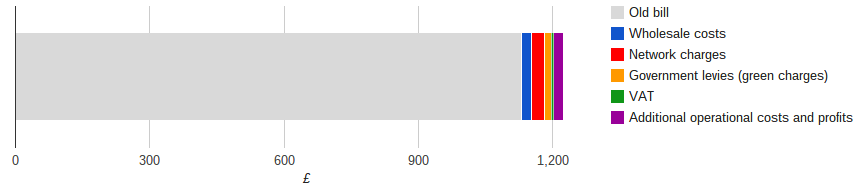
Image Credit : Carbon Brief After Gordon Brown MP, the UK’s former Prime Minister, was involved in several diplomatic missions around the time of the oil price spike crisis in 2008, and the G20 group of countries went after fossil fuel subsidies (causing easily predictable civil disturbances in several parts of the world), it seemed to me to be obvious that energy price control would be a defining aspect of near-term global policy. With the economy still in a contracted state (with perhaps further contraction to follow on), national interest for industrialised countries rests in maintaining domestic production and money flows – meaning that citizens should not face sharply-rising utility bills, so that they can remain active in the economy. In the UK, those at the fringe of financial sustainability are notoriously having to face the decision about whether to Eat or Heat, and Food Banks are in the ascendance. Various charity campaigns have emphasised the importance of affordable energy at home, and the leader of the Labour Party, Ed Miliband MP has made an energy price freeze a potential plank of his policy ahead of the push for the next General Election. The current Prime Minister, David Cameron MP has called this commitment a “con”, as his political counterpart cannot determine the wholesale price of gas (or power) in the future. This debate comes at a crucial time in the passage of the UK Energy Bill, as the Electricity Market Reform (EMR), a key component of this legislation has weighty subsidies embedded in it for new nuclear power and renewable energy, and also backup plants (mostly Natural Gas-fired) for periods of high power demand, in what is called the “Capacity Market“. These subsidies will largely be paid for by increases in electricity bills, in one way or another. The EMR hasn’t yet passed into the statute books, so the majority of “green energy taxes” haven’t yet coming into being – although letters of “comfort” may have been sent to to (one or more) companies seeking to invest in new nuclear power facilities, making clear the UK Government’s monetary commitment to fully supporting the atomic “renaissance”. With a bucketload of chutzpah, Scottish and Southern Energy (SSE) and Electricite de France’s Vincent de Rivaz blamed green energy policies for contributing to past, current and future power price rises. Both of these companies stand to gain quite a lot from the EMR, so their blame-passing sounds rather hollow. The Daily Mail and the Daily Telegraph have seemed to me to be incendiary regarding green energy subsidies, omitting to mention that whilst the trajectory of the cost of state support for renewable energy is easily calculated, volatility in global energy markets for gas and oil – and even coal – are indeterminable. Although “scandal-hugging” (sensation equals sales) columnists and editors at the newspapers don’t seem to have an appreciation of what’s really behind energy price rises, the Prime Minister – and Ed Davey MP – have got it – and squarely placed the responsibility for energy price rises on fossil fuels. The price tag for “green energy policies” – even those being offered to (low carbon, but not “green”) nuclear power – should be considerably less than the total bill burden for energy, and hold out the promise of energy price stabilisation or even suppression in the medium- to long-term, which is why most political parties back them. The agenda for new nuclear power appears to be floundering – it has been suggested by some that European and American nuclear power companies are not solvent enough to finance a new “fleet” of reactors. In the UK, the Government and its friends in the nuclear industry are planning to pull in east Asian investment (in exchange for large amounts of green energy subsidies, in effect). I suspect a legal challenge will be put forward should a trade agreement of this nature be signed, as soon as its contents are public knowledge. The anger stirred up about green energy subsidies has had a reaction from David Cameron who has not dispensed with green energy policy, but declared that subsidies should not last longer than they are needed – probably pointing at the Germany experience of degressing the solar power Feed-in Tariff – although he hasn’t mentioned how nuclear subsidies could be ratcheted down, since the new nuclear programme will probably have to rely on state support for the whole of its lifecycle. Meanwhile, in the Press, it seems that green energy doesn’t work, that green energy subsidies are the only reason for energy bill rises, we should drop the Climate Change Act, and John Prescott MP, and strangely, a woman called Susan Thomas, are pushing coal-fired power claiming it as the cheaper, surer – even cleaner – solution, and there is much scaremongering about blackouts. https://www.mirror.co.uk/news/uk-news/john-prescott-its-coal-power-2366172 John Prescott on why it’s coal power to the people 12 Oct 2013 We can’t just stand back and give these energy companies money to burn. It’s only 72 days until Christmas. But the greedy big six energy companies are giving themselves an early present. SSE has just announced an inflation-beating 8.2 per cent price rise on gas and electricity. The other five will soon follow suit, no doubt doing their best to beat their combined profit from last year of £10billion. Their excuse now is to blame climate change. SSE says it could cut bills by £110 if Government, not the Big Six, paid for green energy subsidies and other environmental costs, such as free loft insulation. So your bill would look smaller but you’d pay for it with higher taxes. Talk about smoke and mirrors. But Tory-led governments have always been hopeless at protecting the energy security of this country. It’s almost 40 years since Britain was hit by blackouts when the Tories forced the UK into a three-day week to conserve energy supplies. But Ofgem says the margin of security between energy demand and supply will drop from 14 per cent to 4 per cent by 2016. That’s because we’ve committed to closing nine oil and coal power stations to meet EU environmental law and emissions targets. These targets were meant to encourage the UK to move to cleaner sources of energy. But this government drastically reduced subsidies for renewable energy such as wind and solar, let Tory energy ministers say “enough is enough” to onshore wind and failed to get agreement on replacing old On top of that, if we experience a particularly cold winter, we only have a reserve of 5 per cent. But the Government is committed to hundreds of millions pounds of subsidies to pay the energy companies to mothball these oil and coal power stations. As someone who negotiated the first Kyoto agreement in 1997 and is involved in its replacement by 2015, it is clear European emissions targets will not be met in the short term by 2020. So we have to be realistic and do what we can to keep the lights on, our people warm and our country running. We should keep these oil and coal power stations open to reduce the risk of blackouts – not on stand-by or mothballed but working now. The former Tory Energy minister John Hayes hinted at this but knew he couldn’t get it past his Lib Dem Energy Secretary boss Ed Davey. He bragged he’d put the coal in coalition. Instead he put the fire in fired. We can’t just stand back and give these energy companies money to burn. The only energy security they’re interested in is securing profit and maximising taxpayer subsidies. That’s why Ed Miliband’s right to say he’d freeze bills for 20 months and to call for more transparency. We also need an integrated mixed energy policy – gas, oil, wind, nuclear and, yes, coal. Letters Bills have risen to pay for policy changes Tuesday 8th October 2013 in Letters THE recent Labour Party pledge to freeze energy bills demonstrated how to have a political cake and eat it. The pledge is an attempt to rectify a heinous political mistake caused by political hubris and vanity. In 2008, the then energy minister, Ed Miliband, vowed to enact the most stringent cuts in power emissions in the entire world to achieve an unrealistic 80 per cent cut in carbon emissions by closing down fully functioning coal power stations. He was playing the role of climate saint to win popularity and votes. I was a member when Ed Miliband spoke in Oxford Town Hall to loud cheers from numerous low-carbon businesses, who stood to profit from his legislation. I was concerned at the impact on the consumer, since it is widely known that coal power stations offer the cheapest energy to consumers compared to nuclear and wind. So I wrote to Andrew Smith MP at great length and he passed on my concerns to the newly-formed Department of Energy and Climate Change that had replaced the previous Department of Energy and Business. This new department sent me a lengthy reply, mapping out their plans for wind turbines at a projected cost to the consumer of £100bn to include new infrastructure and amendments to the National Grid. This cost would be added to consumer electricity bills via a hidden green policy tariff. Some consumers are confused and wrongly believe that energy companies are ‘ripping them off’. It was clearly stated on Channel 4 recently that energy bills have risen to pay for new policy changes. These policy changes were enacted by Ed Miliband in his popularity bid to play climate saviour in 2008. Energy bills have now rocketed. So Ed has cost every single consumer in the land several hundred pounds extra on their bills each year. SUSAN THOMAS, Magdalen Road, Oxford LETTERS [ Turned off: Didcot power station’s closure could lead to power cuts. ] Labour’s power failures will cost us all dear THE Labour Party’s pledge to freeze energy bills is an attempt to rectify a horrible political mistake. But it might be too late to dig us out of the financial black hole caused by political vanity. In 2008, then Energy Minister Ed Miliband vowed to enact the most stringent cuts in power emissions in the world to achieve an unrealistic 80 per cent cut in carbon emissions by closing down coal power stations. He was playing the role of climate saint to win votes. I was in the audience in Oxford Town Hall that day and recall the loud cheers from numerous representatives of low-carbon businesses as his policies stood to make them all rather wealthy, albeit at the expense of every electricity consumer in the land. I thought Ed had become entangled in a spider’s web. I was concerned at the impact on the consumer as it’s widely known that coal power stations offer the cheapest energy to consumers. I contacted the Department of Energy and Climate Change and it sent me a lengthy reply mapping out its plans for energy projects and wind turbines – at a projected cost to the consumer of £100 billion – including new infrastructure and national grid amendments. It explained the cost would be added to consumer electricity bills via a ‘green policy’ tariff. This has now happened and explains the rise in utility bills. Some consumers wrongly believe the energy companies are ripping them off. In fact, energy bills have risen to pay for policy changes. The people to benefit from this are low-carbon venture capitalists and rich landowners who reap subsidy money (which ultimately comes from the hard-hit consumer) for having wind farms on their land. Since Didcot power station closed I’ve suffered five power cuts in my Oxford home. If we have a cold winter, we now have a one-in-four chance of a power cut. The 2008 legislation was a huge mistake. When power cuts happen, people will be forced to burn filthy coal and wood in their grates to keep warm, emitting cancer-causing particulates. Didcot had already got rid of these asthma-causing particulates and smoke. It emitted mainly steam and carbon dioxide which aren’t harmful to our lungs. But the clean, non-toxic carbon dioxide emitted by Didcot was classified by Mr Miliband as a pollutant. We are heading into a public health and financial disaster. SUSAN THOMAS, Oxford CEOs demand reform of EU renewable subsidies Companies ask the EU to stop subsidising the renewable energy sector. The CEOs of Europe’s ten biggest energy companies called for the European Union and member states to stop subsidising the renewable energy sector on Friday (11 October), saying that the priority access given to the sector could cause widespread blackouts in Europe over the winter. At a press conference in Brussels, Paolo Scaroni, CEO of Italian oil and gas company ENI, said: “In the EU, companies pay three times the price of gas in America, twice the price of power. How can we dream of an industrial renaissance with such a differential?” The CEOs said the low price of renewable energy as a result of government subsidies is causing it to flood the market. They called for an EU capacity mechanism that would pay utilities for keeping electric power-generating capacity on standby to remedy this problem. They also complained that the low price of carbon in the EU’s emissions trading scheme (ETS) is exacerbating the problem… Well said, Sir Tim Days after David Cameron orders a review of green taxes, which add £132 to power bills, the Lib Dem Energy Secretary vows to block any attempt to cut them. Reaffirming his commitment to the levies, which will subsidise record numbers of inefficient wind farms approved this year, Ed Davey adds: ‘I think we will see more price rises.’ The Mail can do no better than quote lyricist Sir Tim Rice, who has declined more than £1million to allow a wind farm on his Scottish estate. ‘I don’t see why rich twits like me should be paid to put up everybody else’s bills,’ he says. ‘Especially for something that doesn’t work.’ | |
Category: Design Matters
Keith MacLean : Big Choices
At last week’s 2013 Annual Conference for PRASEG, the UK parliamentary sustainable energy group, Keith MacLean from Scottish and Southern Energy outlined (see below) the major pathways for domestic (residential) energy, currently dependent on both a gas grid and a power grid.
He said that decarbonising heat requires significant, strategic infrastructure decisions on the various proposals and technology choices put forward, as “these options are incompatible”. He said that the UK “need to facilitate more towards ONE of those scenarios/configurations [for provision for heating at home] as they are mutually exclusive”.
There has been a commitment from Central Government in the UK to the concept of electrification of the energy requirements of both the transport and heat sectors, and Keith MacLean painted a scenario that could see the nation’s households ditching their gas central heating boilers for heat pumps in accord with that vision. Next, “the District Heating (DH) movement could take off, [where you stop using your heat pump and take local piped heat from a Combined Heat and Power (CHP) plant] until there is no spare market capacity. Then [big utilities] could start pumping biogas and hydrogen into the gas grid, and you get your boiler back !”
Since I view gas grid injection of Renewable Gas feedstocks as a potential way to easily decarbonise the gas supply, and as Keith MacLean said in his panel presentation, “The real opportunity to make a difference in our domestic [residential] energy consumption is in heat rather than power”, I sought him out during the drinks reception after the event, to compare notes.
I explained that I appreciate the awkward problem he posed, and that my continuing research interest is in Renewable Gas, which includes Renewable Hydrogen, BioHydrogen and BioMethane. I said I had been reading up on and speaking with some of those doing Hydrogen injection into the gas grid, and it looks like a useful way to decarbonise gas.
I said that if we could get 5% of the gas grid supply replaced with hydrogen…”Yes”, said Keith, “we wouldn’t even need to change appliances at those levels”… and then top up with biogas and other industrial gas streams, we could decarbonise the grid by around 20% without breaking into a sweat. At this point, Keith MacLean started nodding healhily, and a woman from a communications company standing near us started to zone out, so I figured this was getting really interesting. “And that would be significant”, I accented, but by this time she was almost asleep on her feet.
With such important decisions ahead of us, it seems that people could be paying a bit more attention to these questions. These are, after all, big choices.
What did Keith mean by “The District Heating movement” ? Well, Dave Andrews of Clean Power (Finning Power Systems), had offered to give a very short presentation at the event. Here was his proposed title :-
https://uk.groups.yahoo.com/group/Claverton/message/12361
“Indicative costs of decarbonizing European city heating with electrical distribution compared to district heating pipe distribution of large scale wind energy and with particular attention to transition to the above methods and energy storage costs to address intermittency and variability of wind power.”
This would have been an assessment of the relative costs of decarbonising European city heating with either :-
Strategy 1)
“Gas-fired Combined Cycle Gas Turbine (CCGT) generation plant plus domestic (residential sector) electric heat pumps as the transition solution; and in the long term, large scale wind energy replacing the CCGT – which is retained as back up for low wind situations; and with pumped hydro electrical storage to deal with intermittency /variability of wind energy and to reduce back up fuel usage.”
or
Strategy 2)
“CCGT Combined Heat and Power (CHP) plus district heat (DH) as the transition solution; and in the long term, large scale wind energy replacing the CCGT CHP heat but with the CCGT retained as back up for low wind situations and with hot water energy storage to deal with intermittency / variability and to reduce back up fuel usage.”
With “the impact of [a programme of building retrofits for] insulation on each strategy is also assessed.”
Dave’s European research background is of relevance here, as co-author of a 215-pager SETIS programme paper complete with pretty diagrams :-
https://setis.ec.europa.eu/system/files/1.DHCpotentials.pdf
Although Dave Andrews was also at the PRASEG drinks reception, he didn’t get the opportunity to address the conference. Which was a shame as his shirt was electric.
PRASEG 2013
10 July 2013
“Keeping the Lights on: At What Cost?”
Parliamentary Renewable and Sustainable Energy Group
Annual Conference
Second Panel Discussion
Chaired by Baroness Maddock
“Negawatts: Decentralising and reducing demand – essential or ephemeral ?”
[Note : The term “negawatt” denotes a negative watt hour – produced by a reduction in power or gas demand. ]
[…]
Keith MacLean, Scottish and Southern Energy
Decentralisation and Demand Reduction [should only be done where] it makes sense. Answers [to the question of negawatts] are very different if looking at Heat and Power. Heat is something far more readily stored that electricity is. Can be used to help balance [the electricity demand profile]. And heat is already very localised [therefore adding to optimising local response]. Some are going in the other direction – looking at district [scale] heating (DH) [using the more efficient system of Combined Heat and Power (CHP)]. Never forget the option to convert from electricity to heat and back to electricity to balance [the grid]. Average household uses 3 MWh (megawatt hours) of electricity [per year] and 15 MWh of heat. The real opportunity is heat. New homes reduce this to about 1 [MWh]. Those built to the new 2016 housing regulations on Zero Carbon Homes, should use around zero. The real opportunity to make a difference in our domestic [residential] energy consumption is in heat rather than power. Reducing consumption not always the right solution. With intermittents [renewable energy] want to switch ON at some times [to soak up cheap wind power in windy conditions]. [A lot of talk about National Grid having to do load] balancing [on the scale of] seconds, minutes and hours. Far more fundamental is the overall system adequacy – a bigger challenge – the long-term needs of the consumer. Keeping the lights from going out by telling people to turn off the lights is not a good way of doing it. There is justifiable demand [for a range of energy services]. […] I don’t think we’re politically brave enough to vary the [electricity] prices enough to make changes. We need to look at ways of aggregating and automating Demand Side Response. Need to be prepared to legislate and regulate if that is the right solution.
[…]
Questions from the Floor
Question from John Gibbons of the University of Edinburgh
The decarbonisation of heat. Will we be successful any time soon ?
Answer from Keith MacLean
[…] Decarbonising heat – [strategic] infrastructure decisions. For example, [we could go down the route of ditching Natural Gas central heating] boilers for heat pumps [as the UK Government and National Grid have modelled and projected]. Then the District Heating (DH) movement could take off [and you ditch your heat pump at home], until there is no spare market capacity. Then [big utilities] could start pumping biogas and hydrogen into the gas grid, and you get your boiler back ! Need to facilitate more towards ONE of those scenarios/configurations [for provision for heating at home] as mutually exclusive. Need to address in terms of infrastructure since these options are incompatible.
Answer from Dave Openshaw, Future Networks, UK Power Network
Lifestyle decision – scope for [action on] heat more than for electricity. Demand Management – managing that Demand Side Reduction and Demand Reduction when need it. Bringing forward use of electricity [in variety of new applications] when know over-supply [from renewable energy, supplied at negative cost].
[…]
James Delingpole : Worsely Wronger
I wonder to myself – how wrong can James Delingpole get ? He, and Christopher Booker and Richard North, have recently attempted to describe something very, very simple in the National Grid’s plans to keep the lights on. And have failed, in my view. Utterly. In my humble opinion, it’s a crying shame that they appear to influence others.
“Dellingpole” (sic) in the Daily Mail, claims that the STOR – the Short Term Operating Reserve (not “Operational” as “Dellingpole” writes) is “secret”, for “that significant period when the wind turbines are not working”, and that “benefits of the supposedly ‘clean’ energy produced by wind turbines are likely to be more than offset by the dirty and inefficient energy produced by their essential diesel back-up”, all of which are outrageously deliberate misinterpretations of the facts :-
https://www.dailymail.co.uk/news/article-2362762/The-dirty-secret-Britains-power-madness-Polluting-diesel-generators-built-secret-foreign-companies-kick-theres-wind-turbines–insane-true-eco-scandals.html
“The dirty secret of Britain’s power madness: Polluting diesel generators built in secret by foreign companies to kick in when there’s no wind for turbines – and other insane but true eco-scandals : By James Dellingpole : PUBLISHED: 00:27, 14 July 2013”
If “Dellingpole” and his compadre in what appear to be slurs, Richard North, were to ever do any proper research into the workings of the National Grid, they would easily uncover that the STOR is a very much transparent, publicly-declared utility :-
https://www.nationalgrid.com/uk/Electricity/Balancing/services/balanceserv/reserve_serv/stor/
STOR is not news. Neither is the need for it to be beefed up. The National Grid will lose a number of electricity generation facilities over the next few years, and because of the general state of the economy (and resistance to wind power and solar power from unhelpful folk like “Dellingpole”) investment in true renewables will not entirely cover this shortfall.
Renewable energy is intermittent and variable. If an anticyclone high pressure weather system sits over Britain, there could be little wind. And if the sky is cloudy, there could be much less sun than normal. More renewable power feeding the grid means more opportunities when these breaks in service amount to something serious.
Plus, the age of other electricity generation plants means that the risk of “unplanned outage”, from a nuclear reactor, say, is getting higher. There is a higher probability of sudden step changes in power available from any generator.
The gap between maximum power demand and guaranteed maximum power generation is narrowing. In addition, the threat of sudden changes in output supply is increasing.
With more generation being directly dependent on weather conditions and the time of day, and with fears about the reliability of ageing infrastructure, there is a need for more very short term immediate generation backup to take up the slack. This is where STOR comes in.
Why does STOR need to exist ? The answer’s in the name – for short term balancing issues in the grid. Diesel generation is certainly not intended for use for long periods. Because of air quality issues. Because of climate change issues. Because of cost.
If the Meteorological Office were to forecast a period of low wind and low incident solar radiation, or a nuclear reactor started to dip in power output, then the National Grid could take an old gas plant (or even an old coal plant) out of mothballs, pull off the dust sheets and crank it into action for a couple of days. That wouldn’t happen very often, and there would be time to notify and react.
But if a windfarm suddenly went into the doldrums, or a nuclear reactor had to do an emergency shutdown, there would be few power stations on standby that could respond immediately, because it takes a lot of money to keep a power plant “spinning”, ready to use at a moment’s notice.
So, Delingpole, there’s no conspiracy. There’s engagement with generators to set up a “first responder” network of extra generation capacity for the grid. This is an entirely public process. It’s intended for short bursts of immediately-required power because you can’t seem to turn your air conditioner off. The cost and emissions will be kept to a minimum. You’re wrong. You’re just full of a lot of hot air.
Ed Davey : Polish Barbecue
![]() | This week, both Caroline Flint MP and Ed Balls MP have publicly repeated the commitment by the UK’s Labour Party to a total decarbonisation of the power sector by 2030, should they become the governing political party. At PRASEG’s Annual Conference, Caroline Flint said “In around ten years time, a quarter of our power supply will be shut down. Decisions made in the next few years […] consequences will last for decades […] keeping the lights on, and [ensuring reasonably priced] energy bills, and preventing dangerous climate change. […] Labour will have as an election [promise] a legally binding target for 2030. […] This Government has no vision.” |
|
And when I was in an informal conversation group with Ed Davey MP and Professor Mayer Hillman of the Policy Studies Institute at a drinks reception after the event hosted by PRASEG, the Secretary of State for Energy and Climate Change seemed to me to also be clear on his personal position backing the 2030 “decarb” target. Ed Davey showed concern about the work necessary to get a Europe-wide commitment on Energy and Climate Change. He took Professor Hillman’s point that carbon dioxide emissions from the burning of fossil fuels are already causing dangerous climate change, and that the risks are increasing. However, he doubted that immediate responses can be made. He gave the impression that he singled out Poland of all the countries in the European Union to be an annoyance, standing in the way of success. He suggested that if Professor Hillman wanted to do something helpful, he could fly to Poland…at this point Professor Hillman interjected to say he hasn’t taken a flight in 70 years and doesn’t intend to now…and Ed Davey continued that if the Professor wanted to make a valuable contribution, he could travel to Poland, taking a train, or…”I don’t care how you get there”, but go to Poland and persuade the Poles to sign up to the 2030 ambition. Clearly, machinations are already afoot. At the PRASEG Annual Conference were a number of communications professionals, tightly linked to the debate on the progress of national energy policy. Plus, one rather exceedingly highly-networked individual, David Andrews, the key driver behind the Claverton Energy Research Group forum, of which I am an occasional participant. He had ditched the normal navy blue polyester necktie and sombre suit for a shiveringly sharp and open-necked striped shirt, and was doing his best to look dapper, yet zoned. I found him talking to a communications professional, which didn’t surprise me. He asked how I was. JA : “I think I need to find a new job.” What I really should have said was :- JA : “Absolutely and seriously not ! Who’d want to keep State Secrets ? Too much travel and being nice to people who are nasty. And making unbelievable compromises. The excitement of privilege and access would wear off after about six minutes. Plus there’s the risk of ending up decomposing in something like a locked sports holdall in some strange bathroom in the semblance of a hostelry in a godforsaken infested hellhole in a desolate backwater like Cheltenham or Gloucester. Plus, I’d never keep track of all the narratives. Or the sliding door parallel lives. Besides, I’m a bit of a Marmite personality – you either like me or you really don’t : I respond poorly to orders, I’m not an arch-persuader and I’m not very diplomatic or patient (except with the genuinely unfortunate), and I’m well-known for leaping into spats. Call me awkward (and some do), but I think national security and genuine Zero Carbon prosperity can be assured by other means than dark arts and high stakes threats. I like the responsibility of deciding for myself what information should be broadcast in the better interests of the common good, and which held back for some time (for the truth will invariably out). And over and above all that, I’m a technologist, which means I prefer details over giving vague impressions. And I like genuine democratic processes, and am averse to social engineering. I am entirely unsuited to the work of a secret propaganda and diplomatic unit.” I would be prepared to work for a UK or EU Parliamentary delegation to Poland, I guess, if I could be useful in assisting with dialogue, perhaps in the technical area. I do after all have several academic degrees pertinent to the questions of Energy and Climate Change. But in a room full of politicians and communications experts, I felt a little like a fished fish. Here, then, is a demonstration. I was talking with Rhys Williams, the Coordinator of PRASEG, and telling him I’d met the wonderful Professor Geoff Williams, of Durham Univeristy, who has put together a system of organic light emitting diode (LED) lighting and a 3-D printed control unit, and, and, and Rhys actually yawned. He couldn’t contain it, it just kind of spilled out. I told myself : “It’s not me. It’s the subject matter”, and I promptly forgave him. Proof, though, of the threshold for things technical amongst Westminster fixers and shakers. Poland. I mean, I know James Delingpole has been to Poland, and I thought at the time he was possibly going to interfere with the political process on climate change, or drum up support for shale gas. But I’m a Zero Carbon kind of actor. I don’t need to go far to start a dialogue with Poland by going to Poland – I have Poles living in my street, and I’m invited to all their barbecues. Maybe I should invite Professor Mayer Hillman to cycle over to Waltham Forest and address my near neighbours and their extended friendship circle on the importance of renewable energy and energy efficiency targets, and ask them to communicate with the folks back home with any form of influence. | |
Carbon Bubble : Unburnable Assets
![]() [ Image Credit : anonymous ] | Yet again, the fossil fuel companies think they can get away with uncommented public relations in my London neighbourhood. Previously, it was BP, touting its green credentials in selling biofuels, at the train station, ahead of the Olympic Games. For some reason, after I made some scathing remarks about it, the advertisement disappeared, and there was a white blank board there for weeks. |
This time, it’s Esso, and they probably think they have more spine, as they’ve taken multiple billboard spots. In fact, the place is saturated with this advertisement. And my answer is – yes, fuel economy is important to me – that’s why I don’t have a car. And if this district is anything to go by, Esso must be pouring money into this advertising campaign, and so my question is : why ? Why aren’t they pouring this money into biofuels research ? Answer : because that’s not working. So, why aren’t they putting this public relations money into renewable gas fuels instead, sustainable above-surface gas fuels that can be used in compressed gas cars or fuel cell vehicles ? Are Esso retreating into their “core business” like BP, and Shell, concentrating on petroleum oil and Natural Gas, and thereby exposing all their shareholders to the risk of an implosion of the Carbon Bubble ? Or another Deepwater Horizon, Macondo-style blowout ? Meanwhile, the movement for portfolio investors to divest from fossil fuel assets continues apace… | |
Renewable Gas : Research Parameters
“So what do you do ?” is a question I quite frequently have to answer, as I meet a lot of new people, in a lot of new audiences and settings, on a regular basis, as an integral part of my personal process of discovery.
My internal autocue answer has modified, evolved, over the years, but currently sounds a lot like this, “I have a couple of part-time jobs, office administration, really. I do a spot of weblogging in my spare time. But I’m also doing some research into the potential for Renewable Gas.” I then pause for roughly two seconds. “Renewable Gas ?” comes back the question.
“Yes,” I affirm in the positive, “Industrial-scale chemistry to produce gas fuels not dug up out of the ground. It is useful to plug the gaps in Renewable Electricity when the sun isn’t shining and the wind isn’t blowing.”
It’s not exactly an elevator pitch – I’m not really selling anything except a slight shift in the paradigm here. Renewable Energy. Renewable Electricity. Renewable Gas. Power and gas. Gas and power. It’s logical to want both to be as renewable and sustainable and as low carbon as possible.
Wait another two seconds. “…What, you mean, like Biogas ?” comes the question. “Well, yes, and also high volumes of non-biological gas that’s produced above the ground instead of from fossil fuels.”
The introductory chat normally fades after this exchange, as my respondent usually doesn’t have the necessary knowledge architecture to be able to make any sense of what my words represent. I think it’s fair to say I don’t win many chummy friends paradigm-bumping in this way, and some probably think I’m off the deep end psychologically, but hey, evolutionaries don’t ever have it easy.
And I also find that it’s not easy to find a place in the hierarchy of established learning for my particular “research problem”. Which school could I possibly join ? Which research council would adopt me ?
The first barrier to academic inclusion is that my research interest is clearly motivated by my concern about the risks of Climate Change – the degradation in the Earth’s life support systems from pumping unnaturally high volumes of carbon dioxide into the air – and Peak Fossil Fuels – the risks to humanity from a failure to grow subsurface energy production.
My research is therefore “applied” research, according to the OECD definition (OECD, 2002). It’s not motivated simply by the desire to know new things – it is not “pure” research – it has an end game in mind. My research is being done in order to answer a practical problem – how to decarbonise gaseous, gas phase, energy fuel production.
The second barrier to the ivory tower world that I have is that I do not have a technological contribution to make with this research. I am not inventing a chemical process that can “revolutionise” low carbon energy production. (I don’t believe in “revolutions” anyway. Nothing good ever happens by violent overthrow.) My research is not at the workbench end of engineering, so I am not going to work amongst a team of industrial technicians, so I am not going to produce a patent for clean energy that could save the world (or the economy).
My research is more about observing and reporting the advances of others, and how these pieces add up to a journey of significant change in the energy sector. I want to join the dots from studies at the leading edge of research, showing how this demonstrates widespread aspiration for clean energy, and document instances of new energy technology, systems and infrastructure. I want to witness to the internal motivation of thousands of people working with the goal of clean energy across a very wide range of disciplines.
This is positively positive; positivity, but it’s not positivism – it’s not pure, basic research. This piece of research could well influence people and events – it’s certainly already influencing me. It’s not hands-off neutral science. It interacts with its subjects. It intentionally intervenes.
Since I don’t have an actual physical contribution or product to offer, and since I fully expect it to “interfere” with current dogma and political realities, what I am doing will be hard to acknowledge.
This is not a PhD. But it is still a piece of philosophy, the love of wisdom that comes from the acquisition of knowledge.
I have been clear for some time about what I should be studying. Call it “internal drive” if you like. The aim is to support the development of universal renewable energy as a response to the risks of climate change and peak fossil fuel energy production. That makes me automatically biased. I view my research subject through the prism of hope. But I would contend that this is a perfectly valid belief, as I already know some of what is possible. I’m not starting from a foundational blank slate – many Renewable Gas processes are already in use throughout industry and the energy sector. The fascinating part is watching these functions coalesce into a coherent alternative to the mining of fossil fuels. For the internal industry energy production conversation is changing its track, its tune.
For a while now, “alternative” energy has been a minor vibration, a harmonic, accentuating the fossil fuel melody. As soon as the mid-noughties economic difficulties began to bite, greenwash activities were ditched, as oil and gas companies resorted to their core business. But the “green shoots” of green energy are still there, and every now and then, it is possible to see them poking up above the oilspill-desecrated soil. My role is to count blades and project bushes. Therefore my research is interpretivist or constructivist, although it is documenting positivist engineering progress. That’s quite hard for me to agree with, even though I reasoned it myself. I can still resist being labelled “post-positivist”, though, because I’m still interpreting reality not relativisms.
So now, on from research paradigm to research methodologies. I was trained to be an experimentalist scientist, so this is a departure for me. In this case, I am not going to seek to make a physical contribution to the field by being actively involved as an engineer in a research programme, partly because from what I’ve read so far, most of the potential is already documented and scoped.
I am going to use sociological methods, combining observation and rapportage, to and from various organisations through various media. Since I am involved in the narrative through my interactions with others, and I influence the outcomes of my research, this is partly auto-narrative, autoethnographic, ethnographic. An apt form for the research documentation is a weblog, as it is a longitudinal study, so discrete reports at time intervals are appropriate. Social media will be useful for joining the research to a potential audience, and Twitter has the kind of immediacy I prefer.
My observation will therefore be akin to journalism – engineering journalism, where the term “engineering” covers both technological and sociological aspects of change. A kind of energy futures “travelogue”, an observer of an emerging reality.
My research methods will include reading the science and interacting with engineers. I hope to do a study trip (or two) as a way of embedding myself into the new energy sector, with the explicit intention of ensuring I am not purely a commentator-observer. My research documentation will include a slow collation of my sources and references – a literature review that evolves over time.
My personal contribution will be slight, but hopefully set archaic and inefficient proposals for energy development based on “traditional” answers (such as nuclear power, “unconventional” fossil fuel production and Carbon Capture and Storage for coal) in high relief.
My research choices as they currently stand :-
1. I do not think I want to join an academic group.
2. I do not think I want to work for an energy engineering company.
3. I do not want to claim a discovery in an experimental sense. Indeed, I do not need to, as I am documenting discoveries and experiments.
4. I want to be clear about my bias towards promoting 100% renewable energy, as a desirable ambition, in response to the risks posed by climate change and peak fossil fuel production.
5. I need to admit that my research may influence outcomes, and so is applied rather than basic (Roll-Hansen, 2009).
References
OECD, 2002. “Proposed Standard Practice for Surveys on Research and Experimental Development”, Frascati Manual :-
https://browse.oecdbookshop.org/oecd/pdfs/free/9202081e.pdf
Roll-Hansen, 2009. “Why the distinction between basic (theoretical) and applied (practical) research is important in the politics of science”, Nils Roll-Hansen, Centre for the Philosophy of Natural and Social Science Contingency and Dissent in Science, Technical Report 04/09 :-
https://www2.lse.ac.uk/CPNSS/projects/CoreResearchProjects/ContingencyDissentInScience/DP/DPRoll-HansenOnline0409.pdf
New Nuclear : Credibility Strained
![]() | As rumours and genuine information leak from central sources about the policy instruments and fiscal measures that will be signed into the United Kingdom’s Energy Bill, the subsidy support likely to be made available to new nuclear power is really straining credibility from my point of view. I am even more on the “incredulous” end of the spectrum of faith in the UK Government’s Energy Policy than I ever was before. |
The national demand for electrical power is pretty constant, with annual variations of only a few percent. It was therefore easy to project that there could be a “power cliff” when supply would be curtailed from coal-fired generation under European legislation :- https://www.gov.uk/government/organisations/department-of-energy-climate-change/series/energy-trends https://www.bbc.co.uk/news/business-21501878 The pat answer to how we should “Keep the Lights On” has been to wave the new nuclear fission reactor card. Look ! Shiny new toys. Keep us in power for yonks ! And hidden a little behind this fan of aces and jokers, a get-out-of-jail free card from the Coal monopoly – Carbon Capture and Storage or CCS. Buy into this, and we could have hundreds more years of clean power from coal, by pumping nasty carbon dioxide under the sea bed. Now, here’s where the answers are just plain wrong : new nuclear power cannot be brought into the National Grid before the early 2020s at the very earliest. And options for CCS are still in the balance, being weighed and vetted, and very unlikely to clean up much of the black stuff until well past 2025. When put through my best onboard guesstimiser, I came up with the above little graph in answer to the question : how soon can the UK build new power generation ? Since our “energy cliff” is likely to be in one of the winters of 2015 or 2016, and we’re not sure other countries we import from will have spare capacity, we have little option but to increase Natural Gas-fired power generation and go hell-for-leather with the wind and solar power deployment. So no – it’s of no use promising to pay the new nuclear reactor bearer the sum of 40 or more years of subsidy in the form of guaranteed price for power under the scheme known as Contracts for Difference – they still won’t be delivering anything to cope with the “power drain” of the next few years. If this is written into the Electricity Market Reform, we could justifiably say this would destroy competition, and destroy any market, too, and be “central planning” by any other name – this level of subsidy is not exactly “technology-neutral” ! https://www.guardian.co.uk/business/2013/feb/19/edf-40-year-contract-nuclear-plant And offering the so-called Capacity Mechanism – a kind of top-up payment to keep old nuclear reactors running, warts and all – when really they should be decommissioned as they are reaching the end of their safe lives, is not a good option, in my book. Offering the Capacity Mechanism to those who build new gas-fired power plant does make sense, however. If offshore wind power continues with its current trajectory and hits the big time in the next few years, and people want the cheap wind power instead of the gas, and the gas stations will be feeling they can’t run all the time, then the Capacity Mechanism will be vital to make sure the gas plant does get built to back up the wind power, and stays available to use on cold, still nights in February. https://www.gov.uk/government/uploads/system/uploads/attachment_data/file/66039/7103-energy-bill-capacity-market-impact-assessment.pdf Oh, people may complain about the idea of new “unabated” gas power plants, and insist they should be fitted with carbon capture, but new gas plants won’t run all the time in future, because renewable electricity generation will be cheaper, so forcing gas plant owners to pay for CCS seems like overkill to me. And, anyway, we will be decarbonising the gas supply, as we develop supplies of Renewable Gas. I say forget the nuclear option – build the gas ! | |
The Art of Non-Persuasion
|
I could never be in sales and marketing. I have a strong negative reaction to public relations, propaganda and the sticky, inauthentic charm of personal persuasion. Lead a horse to water, show them how lovely and sparkling it is, talk them through their appreciation of water, how it could benefit their lives, make them thirsty, stand by and observe as they start to lap it up. | |
|
One of the mnemonics of marketing is AIDA, which stands for Attention, Interest, Desire, Action, leading a “client” through the process, guiding a sale. Seize Attention. Create Interest. Inspire Desire. Precipitate Action. Some mindbenders insert the letter C for Commitment – hoping to be sure that Desire has turned into certain decision before permitting, allowing, enabling, contracting or encouraging the Action stage. You won’t get that kind of psychological plasticity nonsense from me. Right is right, and wrong is wrong, and ethics should be applied to every conversion of intent. In fact, the architect of a change of mind should be the mind who is changing – the marketeer or sales person should not proselytise, evangelise, lie, cheat, sneak, creep and massage until they have control. I refuse to do “Suggestive Sell”. I only do “Show and Tell”. I am quite observant, and so in interpersonal interactions I am very sensitive to rejection, the “no” forming in the mind of the other. I can sense when somebody is turned off by an idea or a proposal, sometimes even before they know it clearly themselves. I am habituated to detecting disinclination, and I am resigned to it. There is no bridge over the chasm of “no”. I know that marketing people are trained to not accept negative reactions they perceive – to keep pursuing the sale. But I don’t want to. I want to admit, permit, allow my correspondent to say “no” and mean “no”, and not be harrassed, deceived or cajoled to change it to a “yes”. I have been accused of being on the dark side – in my attempts to show and tell on climate change and renewable energy. Some assume that because I am part of the “communications team”, I am conducting a sales job. I’m not. My discovery becomes your discovery, but it’s not a constructed irreality. For many, it’s true that they believe they need to follow the path of public relations – deploying the “information deficit model” of communication – hierarchically patronising. Me, expert. You, poor unknowing punter. Me, inform you. You, believe, repent, be cleaned and change your ways. In this sense, communications experts have made climate change a religious cult. In energy futures, I meet so many who are wild-eyed, desperate to make a sale – those who have genuine knowledge of their subject – and who realise that their pitch is not strong enough in the eyes of others. It’s not just a question of money or funding. The engineers, often in large corporations, trying to make an impression on politicians. The consultants who are trying to influence companies and civil servants. The independent professionals trying to exert the wisdom of pragmatism and negotiated co-operation. The establishment trying to sell technical services. Those organisations and institutions playing with people – playing with belonging, with reputation, marketing outdated narratives. People who are in. People who are hands-off. People who are tipped and ditched. Those with connections who give the disconnected a small rocky platform. The awkwardness of invested power contending with radical outsiders. Denial of changing realities. The dearth of ready alternatives. Are you ready to be captured, used and discarded ? Chase government research and development grants. Steal your way into consultations. Play the game. Sell yourself. Dissociate and sell your soul. I have to face the fact that I do need to sell myself. I have to do it in a way which remains open and honest. To sell myself and my conceptual framework, my proposals for ways forward on energy and climate change, I need a product. My person is often not enough of a product to sell – I am neuro-atypical. My Curriculum Vitae CV in resume is not enough of a product to sell me. My performance in interviews and meetings is often not enough of a product. My weblog has never been a vehicle for sales. I didn’t want it to be – or to be seen as that – as I try to avoid deceit in communications. Change requires facilitation. You can’t just walk away when the non-persuasional communications dialogue challenge gets speared with distrust and dismissal. Somehow there has to be a way to present direction and decisions in a way that doesn’t have a shadow of evil hovering in the wings. “A moment to change it all, is all it takes to start anew. Why do I need to “sell” myself ? Why do I need to develop a product – a vehicle with which to sell myself ? 1. In order to be recognised, in order to be welcomed, invited to make a contribution to the development of low carbon energy, the optimisation of the use of energy, and effective climate change policy. 2. In order to put my internal motivations and drive to some practical use. To employ my human energy in the service of the future of energy engineering and energy systems. | |
Greenpeace Windgas : Renewable Hydrogen
https://www.lngworldnews.com/gasunie-greenpeace-energy-choose-suderburg-as-windgas-location-germany/
https://www.greenpeace-energy.de/presse/pressedetails/article/neuer-schwung-fuer-die-energiewende-windgas-made-in-suderburg.html
https://www.greenpeace-energy.de/windgas.html
https://vimeo.com/44094925
Enron, Fudging and the Magic Flute
![]() | Allegedly, the United Kingdom is about to break free from the Dark Ages of subsidies, and enter the glorious light of a free and light-touch regulated, competitive electricity market.
The Electricity Market Reform is being sold to us as the way to create a level playing field between low carbon electricity generation technologies, whether they be established or new, baseload or variable, costly-up-front or cheap-and-quick-to-grid. |
Personally, I do not accept the mythology of the Free Market. I do not accept that a fully competitive, privatised energy sector can be delivered, regardless of the mechanisms proposed. The Electricity Market Reform is less Englightenment and more Obscurantism, in my view – the call of the Magic Flute is going to fall on deaf ears. Who will play the pipe ? Who will call the tune ? Who will be the Counterparty ? The shadow cast by the nuclear industry After the National Grid meeting, I went to an EcoConnect meeting, where Eric Machiels of Infinis said, in reference to the strong influence of EdF (Electricite de France) in proposing new nuclear reactors in the UK, “The EMR was set up to meet two requirements. [First] to justify incredibly high investments. [And] nuclear – if you need to invest £10 billion or more, 10 years away, you need regulatory certainty…[But you have to know, decisions on nuclear development] will rely on decisions made in the Elysee Palace and not in Number 10.” Well, it seems clear that the steer is still towards the UK taxpayers and billpayers stumping up to support the ailing French atomic power fleet. A bit of a big fudge At the EcoConnect meeting, Diane Dowdell of Tradelink Solutions warned of the risks of going back to the kind of electricity markets of former decades, “Unless you worked under the Pool, you wouldn’t know how it works. It is a derivative…DECC need to look at Ireland – their Pool system has been utterly destroyed. Please don’t follow in the footsteps of Ireland – get the balancing right.” The big issue is the macroeconomic need to incentivise investment in new electricity generation plant and infrastructure – something that will not be achieved by flipping microeconomic market trading conditions to benefit low carbon generators. How can new low carbon generators come onto the grid ? By placing focus on investment decisions. New generation has to clear a higher hurdle than how much it can sell green power for on the half-hourly market. Funds and financing are not going to be directed to choose low carbon investment just because marginal costs (the Carbon Floor Price and the European Union Emissions Trading Scheme) are applied to high carbon players already in the market. The guarantees of profits into the future from the institution of Contracts for Difference (Feed in Tariff) and the Capacity Mechanism will maybe trigger a slice of investment in new nuclear power, but it won’t ensure that new gas-fired power plants are built with Carbon Capture and Storage. At the EcoConnect meeting later on, another DECC man reported back on the UK Government’s call for evidence on the EMR. DECC’s Matt Coyne said that amongst the conclusions from the consultation with industry there were concerns about the conditions for Power Purchase Agreements (PPAs) under the EMR. (Securing a PPA is the guarantee that investors need to be able to commit to backing new electricity generation capacity). He said that developers are finding it hard to secure finance for new generation investment and that it was a widely-held view that the EMR would not improve that, although he said that “it is our view that the Contracts for Difference will improve things.” Other people at the meeting were not so sure. Diane Dowdell said, “I desperately hope the EMR works. It’s got to work. [Conditions] seem to be edging out the small- and mid-sized players.” Eric Machiels said, “The Big Six vertically integrated energy suppliers are in the best position to retain their position.” In my notes, I scribbled that Michael Ware, a dealmaking matchmaker for renewable energy projects, offered the view that “Government does resemble toddlers driving a steam train – there are lots of buttons to push…[The UK is] just a rainy little island at the edge of Europe. Capital is truly international. It all feels much easier to do business elsewhere. [The EMR looks] almost designed to turn off investors.” There were several calls to retain the Renewables Obligation – to oblige energy suppliers to keep signing up new clean power from smaller players if they couldn’t make it themselves. | |
[ I know, I know, this song is actually about gasoline… ] |
For the delight and edification of my dedicated followers, I present some more evidence to back up my claims that the future will be… Renewable Gas.
Of course the story starts with the old guard : Natural Gas, and the comfort that various governments are offering to the oil and gas industry in general over the securing of their future business. As usual. As expected. In fact, as it should be. The developed world is still highly dependent on hydrocarbon fuels, and fossil gas is a good option, for the meantime. |
|
Here’s the UK Government working on their “Gas Strategy” consultation :- UK Government Department of Energy and Climate Change (DECC) : 17 March 2012 : DAVEY SETS OUT MEASURES TO PROVIDE CERTAINTY TO GAS INVESTORS” I did ask some colleagues if they wanted to join me in responding to this consultation, but there was no serious energy for it in my networks, so I didn’t do anything, because I prefer collaboration on this kind of thing, otherwise I work too hard and fail to make an impact too often. But anyway, now that things seem to be clear that the Nuclear Power confidence bubble has properly burst, the default gas strategy that has been brewing for a while is now gaining ascendance, including the ambitious plans of the gas operators and the deals the UK Government are striking to keep gas imports topped up. |
|
Energy Together : I’m just getting warmed up
| The human race – we have to solve energy together. And to do that, we need to harness all our personal, purposeful, positive energies, and let me tell you, personally, I feel electric – and I’m only just getting warmed up.
So let’s hear less of the nonsense from authoritatively-accredited people who want to put a dampener on green energy, who say that saving energy cannot, simply cannot be done, sigh, sigh, sigh, collective groan. We have so much energy together, we can do this. | |
|
We have the will power, the staying power, the investment power, and we will navigate the obstacles in our path. Let’s not waste any more time on expensive trinkets, and iddy-biddy fancies with high unit costs and low compatibility to the future. Yes, I’m talking nuclear power. I’m talking the nobody-really-wants-to-do-it-and-nobody-thinks-it-can-be-cheap-enough-to-work-at-scale Carbon Capture and Storage. And yes, I’m talking carbon markets – tell me again, where are they now ? Oh yes, still in the starting blocks. And don’t even start to talk about pricing carbon to me – in this world of rollercoaster, highly volatile energy prices, what on Earth could costing or taxing carbon actually achieve ? And fusion power ? Nah, mate, forget it. It’s been 50 years away for the last 50 years. Shale gas, oil from shales, tar sands, coal bed methane collection and underground coal gasification are once-abandoned messy ideas from way back. They’re still messy, and they’re still retro, and they’re not going to get us anywhere. If the United States of America want to completely ruin their lithosphere, well, that’s up to them, but don’t come around here toxifying our aquifers and poisoning our European trees ! What we need is marine energy, geothermal energy, hydropower, solar power, wind power, and Renewable Gas, because gaseous fuels are so flexible and store-able and can come from many, many processes. And we need the next optimistic generation of leaders to push through the administration ceiling and get green energy policy really rolling, attracting all the green investment will. If I were a power plant, I would be cranking out the current and making everything shine very, very brightly just now. | |
Un égard, un regard, un certain regard
|
Whatever it is, it starts with attention, paying attention. Attention to numbers, faces, needs, consideration of the rights and wrongs and probables. Thinking things through, looking vulnerable children and aggressive control freaks directly in the eye, being truly brave enough to face both radiant beauty and unbelievable evil with equanimity. |
|
| To study. To look, and then look again.
To adopt a manner of seeing, and if you cannot see, to learn to truly absorb the soundscape of your world – to pick up the detail, to fully engage. It is a way of filling up your soul with the new, the good, the amazing; and also the way to empty worthless vanity from your life. Simone Weil expressed this truth in these words : “Toutes les fois qu’on fait vraiment attention, on détruit du mal en soi.” If you pay close attention, you learn what is truly of value, and you jettison incongruities and waywardness. She also pronounced that “L’attention est la forme la plus rare et la plus pure de la générosité.” And she is right. People feel truly valued if you gaze at them, and properly listen to them. Those of us who have researched climate change and the limits to natural resources, those of us who have looked beyond the public relations of energy companies whose shares are traded on the stock markets – we are paying attention. We have been working hard to raise the issues for the attention of others, and sometimes this has depleted our personal energies, caused us sleepless nights, given us depression, fatalism, made us listless, aimless, frustrated. Some of us turn to prayer or other forms of meditation. We are enabled to listen, to learn, to try again to communicate, to bridge divides, to empathise. A transformation can take place. The person who pays close attention to others becomes trusted, attractive in a pure, transparent way. People know our hearts, they have confidence in us, when we give them our time and an open door. |
|
Will the Green Deal Deliver ?
Here is a transcription of part of the notes I took this morning in a seminar in the UK House of Commons. The meeting was convened by PRASEG, the Parliamentary Renewable and Sustainable Energy Group.
This transcription is based on an unverified long-hand paper-based recording of the words spoken. Items in quotation marks are fairly accurate verbatim quotations. Items in square brackets are interpolation, and not the exact language the person used to present their thoughts.
[Alan Whitehead MP]
Will the Green Deal deliver ? In the last few days, in 140 character statements [Twitter], the Government have been telling has “all the hurdles have now been overcome.” But “is it really all systems go ?” What effect do we think the Green Deal will have on sustainability ? On carbon reduction goals ? Tracy Vegro from the Department of Energy and Climate Change (DECC) has been key in setting up the Green Deal.
[Tracy Vegro, DECC, Director, Green Deal]
“It’s been a busy old time for us.” We are in the final stages of passing the framework [of the Green Deal]. Just have the laws now [the legislation that is needed]. Those orders will come into force in October [2012]. There will be some parallel working – not a switch to the Green Deal all at once. I think it will open up a wider market in energy efficiency. We’ve been getting out and about [for the consultation process] – a women’s panel, an industry panel. We did it with an awful lot of help. “We’ve got to get energy efficiency moving in this country.” The CERT [Carbon Emissions Reduction Target – an energy supplier obligation] at the end of this year there will be “not an unlagged loft” [internal roof insulation over the top of ceilings]. There have been some gaps – with solid wall insulation numbers for example. “Whole swathes got nothing under CERT.” We have to to start delivering. I hope the Green Deal will drive it – with many more entrants into the [energy efficiency] market. Our roadshows with small businesses were encouraging. Beyond the framework we are trying to ensure a lot of choice. The Green Deal is going to have accredited goods and services in the whole thing. The [Office of Fair Trading] has been doing research to ensure [quality and competence] – “because at the end of the day it’s the bill payer who’s paying”. There’s a new oversight body. There will be a lot more data [coming back]. You know under the CERT, 300 million energy efficient lightbulbs were distributed [and we don’t know where they all went and whether they were all used]. We need to build confidence. Have the Local Authorities get behind the Green Deal assessments [process], and [capitalised on] community aspects. [We hope/aim to] see the market grow much faster. So far we can see that a lot of cavities got filled but [that’s only the beginning]. [We hope/aim that the Green Deal will be] driving demand. People will see their neighbours do this [and want to do it for themselves.] There’s the £200 million incentive scheme – that’s money in the bank. [Need to drive] confidence [not having people saying it’s just the] new FiT [Feed-in Tariff scheme – intended to drive solar photovoltaic uptake, but poorly managed]. The Green Deal is going to be conditional on minimum energy efficiency standards being undertaken [by those taking up the offer]. [This will determine] the order in which you do these [energy efficiency] technologies – “we need to get energy efficiency into peoples’ heads” – [where they may have been deterred previously by] mostly upfront capital. We have a new helpline. We need to make it a “no-brainer solution”. How are we going to ensure training ? People will be coming out of loft and cavity wall insulation into a new sector. These are asset skills, and a lot of money is committed. to funding [re]training and assessors. There are implications on people in existing roles – but “this is a finite market”. We’re confident in this business model – for the first time there will be competition – not just the Big 6 [energy companies : British Gas, Electricite de France (EdF), E.On, npower, Scottish Power (Business), Scottish & Southern (SSE) – companies that collectively supply 99% of the UK’s heating and lighting] delivering. It is slightly easier to explain [than other schemes]. We do need an awareness campaign – people in the industry don’t want this – they want to do their own communications to customers – to ensure demand is right. The [big] energy companies are to be mandated a lot. If the scheme is ECO (Energy Company Obligation) only – it would only guarantee a steady state [no growth in uptake of energy efficiency products]. The Impact Assessment has only been done for pure Green Deal.
[John Sinfield, Managing Director, Knauf Insulation]
CERT helped, but there is still a huge amount to deliver – need to approach the market in a different way. The deep retrofit of our housing stock – the only way to deal with Fuel Poverty and other problems. My early reaction to the Green Deal was hope, excitement, and confusion, followed by more confusion. It could deliver what no scheme has done before to 14 million homes [untouched so far]. We have to deal with the fabric [of the building] first – then deal with the occupant. The occupant is sometimes the barrier to energy efficiency. Could we use private money to leverage 20 times the amount put forward [for the Green Deal and Green Investment Bank] ? We could stop shifting 40 billion euro to the Middle East (and elsewhere) for our energy. Can we create ethical investment for pension funds ? Then I got to depression and confusion. In the draft Impact Asssessment, there would be a 93% drop in loft insulation installations and 73% drop in cavity wall insulations from Day One of the Green Deal. What’s going to happen to existing companies ? [I obviously have an interest here] I’ve invested in four factories. But it’s not only me, the Climate Change Committee (CCC) wrote to Government on the trajectory resulting not meeting our carbon cap. It’s not just insulation manufacturers and installers. I’m trying to understand where the policy’s going. Why are DECC against cheaper measures ? The Minister says that the “loft job” is nearly done. But DECC themselves say that 9 million lofts have inadequte insulation. Frankly, I doubt I’ll see that by the the end of the year. There are 7.5 million cavities to fill. The consultation on the Green Deal came back with good changes – but little to address the cliff edge – the significant drop in lofts and cavities [at the changeover to the Green Deal]. I’m veering between hope and despair. I hope the Government, deep down, really want this. They need to do more to drive this programme. I wouldn’t invest money if I didn’t think [they were really behind this.] What about other options ? Stamp Duty [on sale of properties], a carbon tax, a Local Authority mandate ? If the Government can drive the value of the Green Deal up – it makes it more attractive [to engage in the sector]. My hope is balanced off by a sense of despair – the mechanism will not be ready in time. The so-called “soft launch” of the Green Deal [is inadequate] – really has to be up and running by 1st January [2013]. The Green Deal loans have to have affordable interest rates. The Green Deal finance company is 9 months away from offering comprehensive finance – and how are they going to receive the money from the Green Investment Bank ? If the interest rate of the Green Deal loans are 7.5% (6% – 8%) then only 7% of the population will take them up. Where’s the market ? What’s going to drive the market ? Where we are challenged – the Green Deal doesn’t feel ready. The environment to work within – sorted. But the mechanism – for example the Green Deal finance – not ready. Need to bridge the gap. Do we need to extend the CERT / CES(P) (Community Energy Saving Programme) ? A bridge until a competitive rate of interest is available. If the Government is going to drive the deep retrofit, it needs to drive the take up. Putting in place the framework is not going to sell this scheme. Some [companies] here are ready to market this scheme – but all parts need to be there. If the Green Deal is not ready – when ?
Alan Whitehead MP
“So, an amber light there…”
Gas in the UK (2)
…Continued from https://www.joabbess.com/2012/06/12/gas-in-the-uk/
Questions from the floor
[Tony Glover]
…increasing electricification of heat and transport. I was interested in what Doug said about heat. [If energy conservation measures are significant and there is] a significant reduction in gas use for heat…interested in the Minister’s response.
[Terry ? (Member of PRASEG)]
I’m interested in gas that would need CCS [Carbon Capture and Storage] [in future] …[since there would be no restriction there would be an] incentive to build new gas in next few years away from CCS-usable infrastructure. Maybe encouraging gas stations over next few years to be built in view of CCS.
[ ? ]
[There have been mentions of the] Gas [generation] Strategy and gas storage. Is it your intention to have both in the Energy Bill ? [Need to improve investor confidence.]
[Charles Hendry MP] I’m more confident than Doug on CHP…[in respect of energy conservation we will begin to increase our use of] CHP [Combined Heat and Power], geothermal energy, don’t need District Heating. I think we’ll see more people switch to electric heating. The likely pricing on gas will mean people have to look at other sources – such as localised heat storage, intelligent ways to produce hot water and heat in their homes […for example, a technology to store heat for several days…] The first [new gas power] plants will be where they are already consented – where originally coal plants – need to have identified in advance – no new plant is consented unless…We’ve asked Ofgem to ask re securing gas supplies. If we can stretch out the tail of North Sea gas – can stretch it out 30 – 40 years […] technology […] Centrica / Norway […] develop contracts […] Is there a role for strategic storage [Centrica asking] […] Buying and selling at the wrong price (like the gold) [widespread chuckling in the room]. Some of it may not need legislation. Gas Strategy will be published before the Energy Bill.
[David Cox] Get very nervous about gas storage. Don’t think there’s a need to put financial incentives in place to increase gas storage. We think the hybrid gas market is successful – a market and regulatory framework – [gas storage incentives] could damage.
[Doug Parr] I’m not downbeat because I want to be downbeat on heat. [Of all the solutions proposed none of them show] scaleability, deliverability. I’d love that to come true – but will it ? […] Heat pumps ? Biogas is great but is it really going to replace all that gas ? If we’re going to be using gas we need to make the best use of it […] Issues around new plant / replacement – all about reducing risks no exposing ourselves to [it] – security of supply, climate risks, issues about placement [siting of new plant]. If CCS can really be made to work – it’s a no-brainer – do we want all that carbon dioxide in the atmosphere or … ? Our entire policy becomes dependent on a technology that hasn’t even been demonstrated. Other technologies that people thought were great – years later they still haven’t arrived [for example, rooftop wind turbines]. If we say CCS is the only way it’s going to work – what’s Plan B ? We are going to use [fossil fuels] – should not become wholly dependent on technology not yet demonstrated.
[Alan Whitehead] Perhaps people should be asked – which would you prefer – a CHP / DH [Combined Heat and Power / District Heating] plant in the valley here, or a couple of wind turbines on that hill ? That would [shake things up].
Questions from the floor
[ X ? ] See […] as the ultimate destination. Most important – gas can be made zero carbon – not pie in the sky. 1. Start contributions of carbon-neutral gas and 2. will need far less if [we act] like Japan – force installation of microCHP. Their aim is to do same as for washing machines [bring prices down – make widely available for the home]. MicroCHP [with] heat pumps – reduction as good as decarbonising gas or electricity. But can also decarbonise gas.
[ X ? ] The Minister mentioned the importance of CHP but recently dropped […] mandate. If CHP so important what measures is the Government taking to ensure its installation ?
[ X ? ] Electricity is a rubbish fuel for heating buildings – very peaky load – need something cheap to store, cheap to […]. Fits very well with forcing down demand. Where we’re getting our gas from. At the moment our waste is being incinerated. For a cheap additional cost, where currently incinerating we can do anaerobic digestion [AD], producing a fungible asset – the gas – can gradually decarbonise our grid.
[ Thomas Grier ? ] …a decision [?] of London – CHP in London over the next few years. If we want to use electricity for heat, we need to reinforce the electricity grid [by 60% to 90% ?] In rural situations – use electrical heating. In urban, use decarbonised energy. [This model projection] shows the gas grid disappearing – it will collapse at some point if all we have on the gas grid is cooking.
[ X ? ] …[encouraged CHP then a few days later] stood up then said all support [removed ?] for CHP next year. A Heat Strategy that said there is enormous [scope / potential] for CHP. We want to see gas, we want to see efficiency. Are we moving towards […] without it they won’t build it.
[David Cox] Microgeneration – couldn’t get it down economically. Reliability [issues]. Full supporter of biogas – AD got a contribution to make – but never more than 5% – no matter how much [we crack it]. Electricity is not very good for heating – but how to we decarbonise the heat sector ? Always been an advocate of CHP. Government need to do more incentivising of that.
[Charles Hendry MP] Innovation and invention […] Government can’t support all emerging technologies. Best brains around the world [are working on] how we move fundamentally in a low carbon direction. On the waste hierarchy – burning of waste should be the final stage – finding a better use for it. [I visited] the biggest AD plant in Europe in Manchester – biogas and electricity generation. We are seeing Local Authorities taking a more constructive long-term view on how to manage waste. CHP – we all want to see more of it – to what extent does it need support ? That depends on whether new build – building a community around it. [By comparison, urban retrofitting is probably too expensive] Iceland [took the decision and] retrofitted almost every home – I’m now more convinced than before. What is the right level of subsidy and what makes good economic case ?
[Doug] We do keep missing opportunities. [For example in Wales, Milford Haven, the new Combined Cycle Gas Turbine at the Liquified Natural Gas (LNG) refinery to process the gas] should have been CHP. I am enthusiastic about lots of heat technologies [but the same questions/issues apply] scaleability and deliverability. District heating [DH] – an infrastructure asset ! [Can change priorities about what gets built – for example in Denmark (?)] they’re building large-scale solar farms to top up the DH. In the Treasury’s infrastructure plan [see DH could be…] Heat is the poor relation in energy debate. Other networks have been identified in the National Policy Statements (NPS) – but not heat.
[ Leonie Green, Renewable Energy Association ] [I must] defend heat pumps. In Sweden 90% of new builds [hav e heat pumps ?] – heat pump efficiency is a function of the energy-efficiency of the building […] Just on AD – National Grid report said it could provide 50% [of the nation’s supply. Our members think] that’s a bit too high – we think 25%. My question is really about the benefits. We are hearing anxiety about costs, but it’s piecemeal on benefits. We’ve been strong on jobs, balance of trade, exports [all benefits of renewable energy investment and deployment]. Pleased to see DECC put out [report from] Oxford Economics [on the] wider economic benefits. How can we get more and more balance in reports. [An example] Deutsche Bank renewable generation opportunities.
[ ? ] We would also support more than 5% from renewable gas – also about hydrogen – we used to do it when it was town gas – why not again ? As regards injecting biomethane/biogas from AD into the National Grid [last year ? to this year ?] 130 enquiries to connect AD to our network – none have progressed. Please sort these [registrations] out.
[ ? ] Minister, we’re not expecting you to fund all technologies – we need some logic – especially with transport. The Government doesn’t recognise the difference between Renewable Natural Gas if used in transport and fossil fuels. Would be simple – a tax on gas if used in a vehicle. What’s the problem over […] ?
[Colin Snape, University of Nottingham] We are looking at reducing the costs of carbon capture – we have a section of PhDs… One other gas source not mentioned – gas from underground gasification of coal [UCG]. In UK […] 2 billion tonners of coal – slightly offshore – on the energy coast of the UK – where all the action is on CCS – obviously UCG needs to be coupled with CCS to be carbon neutral. Would [be operational] in a very short time period […incentives…]. Significant proportion of UK needs.
[ ? ] What is the purpose of the Gas Strategy ? Shale gas isn’t a miracle. The “Golden Age of Gas” [report by the International Energy Agency (IEA)] doesn’t mean cheap gas, because [it will be put to] lots of uses. Renewable electricity and nuclear are not going to come until the 2020s. How do we avoid building loads of gas generation that is not necessary after that time ? What’s the role of mothballing (relatively cheap to bring CCGT out of mothballs comparing to build new). No sign of reduction in electricity demand reduction – therefore there will be high gas use.
[ Doug Parr ] On UCG, the IEA had two scenarios in the “Golden Age of Gas” – both took us over 3.5 degrees Celsius [in additional global warming]. Even if there is unconventional gas sources, still a huge danger of going down the road of unrestrained gas use. What is the alternative ? We should not end up becoming dependent on gas. Should not build gas to fill a short-term hole – they will lobby for their own interests – to keep open.
[ David Cox ] CCGTs won’t be built without guarantees greater than 20 years. Also renewable energy might not provide in the way that we hope. The CCC report – what caused the rise in energy prices ? The wholesale gas price – not renewable energy, green policies. However, that was slightly dishonest – the counter-factual was […] renewable energy significantly still more expensive than fossil fuel there. Until we can get costs of renewable energy down to the prices of fossil fuels… [The industry] don’t give the impression [they will build] on the basis of short-term need. Gas isn’t clean, I admit that […] CCS – that will work.
[Charles Hendry MP] A lot comes back to a need for a balanced approach – carbon targets and security of supply. If you haven’t sorted out security of supply, the electorate will not give permission to go low carbon. Gas is a hedging fuel currently but don’t know where costs going over time. As a politician, I like pipelines – know where it’s going (not like LNG, where there was limited use of new LNG import plant). If we want Scandinavian gas, we need security of demand to build the new pipeline. How we deal with issues of biomethane – in 2 years – need to make more progress. Some of these [techologies] will be gamechangers – some, look back in a couple of years… [Need a] permissive framework to allow a lot of ideas and technologies. There is no source of energy that hasn’t required subsidy in early days. Fanciful to suggest new forms of energy can come through without support. The letters we get [from the public, from constituents] are on vehicle fuel costs, not how much their gas bill went up last winter…
Official end of meeting
A gaggle of people gathered in the hallway to discuss some items further.
The Electricity Market Reform (EMR) was generally criticised – as it contains measures likely to specifically benefit nuclear power. Electricite de France was identified as very involved. The Government had said “no nuclear subsidy”, but the EMR measures are equivalent to hidden subsidies.
The Levy Cap was criticised as it would disturb investor confidence – if several nuclear reactors came on-stream in 10 years time, in the same year, they would eat up the whole subsidy budget for that year – and other technologies would lose out. If was felt that a number of the EMR proposals were “blunt instruments”, not overcoming shortcomings of former levies and subsidies.
Although the EMR was designed to addressed economic fears, it wasn’t assisting with financing risks – if anything it was adding to them. Rates of return have to be guaranteed for loans to be made – chopping and changing subsidies doesn’t allow for that.
Leonie Green said that the REA members don’t like the Premium Feed-in-Tariff (FiT). She also said later that they were not pleased about the cuts in support for AD.
Since my personal interest is in using Renewable Gas of various sources (including Biomethane / Biogas) to displace Natural Gas from the gas grid, I spoke with various people about this informally (including a woman I met on the train on my way home – who really got the argument about decarbonising gas by developing Renewable Gas, and using that to store excess renewable electricity, and use it as backup for renewable electricity. Although she did say “it won’t be done if it won’t confer benefits”.). One of the key elements for developing Renewable Gas is to create a stream of Renewable Hydrogen, produced in a range of ways. Somebody asked me what the driver would be for progress in Renewable Hydrogen production ? I said the “pull” was supposed to be the fabled “Hydrogen Economy” for transport, but that this isn’t really happening. I said the need for increased sources of renewably-sourced gas will become progressively clear – perhaps within a decade.
One of the persons present talked about how they think the Government is now coming out of the nuclear dream world – how only a few of the proposed new reactors will get built in the next decade – and how the Government now need to come up with a more realistic scenario.
It was mentioned that is appears that the Biogas technologies are going to have the same treatment as solar photovoltaics – some sort of subsidies at the start – which get cut away far too early – before it can stand on its own two feet. This was said to be the result of an underlying theory that only a fixed amount of money should be used on launching each new technology – with no thought to continuity problems – especially as regards investment and loan structures.
Gas in the UK
“The role of gas in the UK’s energy mix” 12 June 2012 17:30 – 18:30, Committee Room 5, House of Commons with speakers Minister of State for Energy and Climate Change, Charles Hendry; David Cox, Managing Director of The Gas Forum and Dr Doug Parr, Chief Scientist of Greenpeace UK. Chaired by Dr Alan Whitehead MP, Chairman of PRASEG, the Parliamentary Renewable and Sustainable Energy Group, who called the seminar : https://www.praseg.org.uk/the-role-of-gas-in-the-uk-energy-mix/
UNVERIFIED COMMENTS : Please check with the speakers to confirm their statements and do not take this account as verbatim.
[Alan Whitehead MP] Questions about gas. Will it be business as usual ? If not – too “much” gas ? What does that mean for Climate Change targets ? New gas generation – about 11 gigawatts coming on-stream in the next 5 years – “grandfathered” (no obligations to control emissions with Carbon Capture and Storage (CCS)) throughout the life of the power plant – does produce questions about Climate Change targets – CCS may change that landscape in the medium-term future. Question about emergence of biogas into system [which would bring] a down-trend in emissions.
[David Cox] The wonderful future that gas offers us. Have to look at whole low carbon [framework] – gas has a place. Not a war [between gas and renewable energy technologies]. Both needed [in the advance towards carbon-free] energy. Without gas, not going to make it. Make sure we can afford it. Gas has a role. The recent [International Energy Agency] IEA report on the “Golden Age of Gas” – tight gas, shale gas – has doubled reserves. Nobody knows for sure – there’s so much there. Perhaps 250 years of gas – no shortage of gas [although some of it is in] sensitive areas. Getting it from those areas with political problems. [There are uncertainties about] unconventional gas. There is plenty around the world – “pretty good”. Gas is not at war with renewables. Gas isn’t just a transition fuel – it’s a destination fuel. Got to prove CCS technically. If we can do that gas becomes a destination fuel. Can decarbonise not only electricity. Heat. Heat pumps won’t do it on their own. Sorry. [Gas can help decarbonise] transport – electrify the transport system – that’s what we believe is possible. Hope the Government will support CCS.
[Doug Parr] First and foremost – we are not going to eliminate gas from energy systems any time soon – don’t think of gas as a destination – I would warn against policy that gas is allowed to become the default and become too dependent on gas. A lot of policy on gas – but only over part of the energy system [electricity]. Heat is going to rely on gas fo a long time. If follow the Committee on Climate Change (CCC) logic – [heat is a] strategic sector – to getting away from carbon emissions. If gas is going to be what gets us out of energy problems – the so-called “trilemma” of decarbonisation, security [of supply] and cost. [New gas power plants amount to] 11 gigawatts [GW] over the next 5 years – 120 TWh – a quarter of current gas [still in service] out to 2030. If one take CCC target of 50 gC / KWh (grammes of carbon per kilowatt hour). Look at CCGT [Combined Cycle Gas Turbine gas generation power plant in operation] – that target is a fraction of [current] unabated [CCGT] – not that great. Any substantial role of gas has to make some pretty strong assumptions about CCS. Remember, this is not yet working – let us not have a decarbonisation policy relying heavily on CCS when not at the first stage. The CCC have warned that grandfathering of the 11 GW new generation – emit without restrictions – and issue until 2045. Can’t say gas is somehow the answer to decarbonisation issues. In media – don’t [swallow] the media froth. [As for] security of supply – already going to be quite reliant on gas for heating for quite some time – hard to see [otherwise]. Heavily reliant on imports – around 80%. Where do we import our gas from ? Qatar and Norway mostly. The former head of the Navy argued [recently] changing gas prices is the single most significant factor. DECC [UK Government Department of Energy and Climate Change] recent report on price shock. REA [Renewable Energy Association] said that just by hitting renewables targets would displace £60 billion of imports. [As for] shale gas : both Ofgem research and Deutsche Bank reports that shale gas is very unlikely to help on security [of supply] issue. Citing American example [of shale gas exploitation] is just irrelevant. [So the UK Government must be] supporting gas because of costs ? The biggest rise in consumer bills is from fossil fuel [price increases]. Not renewable energy, not green energy [measures] – it’s the rise in the wholesale gas price. Is that going to stabilise and go down ? Not according to Merrill Lynch and DECC – [strong] prices for Liquid Natural Gas (LNG) and therefore for gas [as a whole, will stay]. Clearly we will be using gas – as [electricity grid load] balancing. What I’m railing about is that gas doesn’t get us out of our energy trilemma. Gas will not [save us]. We know we can deliver through renewable energy, wind – acceleration of new technologies [such as tidal] – perhaps CCS will work, who knows ? and efficient use for example Combined Heat and Power (CHP) on industrial scale. If we are using gas we are using at it’s most efficient.
[Alan Whitehead MP] [recounts tale of how he got into trouble with Twitter commentators when he insisted the recent rise in consumer energy bills was due to the rise in the cost of wholesale gas, not green energy measures] [To Charles Hendry] I’m sure you don’t Tweet.
[Charles Hendry MP] No. absolutely not. I have enough people telling me I’m wrong without… We have to look at the role of gas. It would a dereliction of Government not to look at the role of gas going forward. […mentions developments in gas production…] seismic profiling [enabling better understanding of gas fields] horizontal drilling [improving access to complex fields]. [As for] unconventional gas – the IEA “Golden Age of Gas” – but don’t assume [it’s that simple – supply may go up but] demand for gas is going to go up dramatically. Japan – major user of LNG and diesel. Consequence of Germany’s decision to close nuclear power plants – will use much more gas. China…India…growth rate – massive growth of demand. Anticipate new resources to be found – Iraq for example – but cannot assume [what has happened in the United States of America with the development of shale gas where gas prices are now] a quarter [of what they were] – a massive boost to America – will they allow this to be exported to Asia – or use cheap gas to [relocating] industry back to the USA ? Have to look at implications for us. Reasons why shale gas is different in Europe – legal [situation] – the mineral rights [in the US, these can be acquired from underneath a landowner]. Don’t have the same commercial drives as farmers in the US. The reason why gas prices collapsed in the US and not here – if we saw a price benefit here, it would go out through the [gas] interconnectors [to neighbouring countries]. For real practical reasons won’t see shal gas develop [significantly] here. [It is a] global gamechanger – but… The US is fundamentally shifting from coal to gas – with the implications for emissions. The change from coal to gas was a major driver in European control of emissions [in the 1990s] […] Investment…technology…practical constraints. EdF [Electricite de France] will go ahead with new nuclear [by the end of the year ?] but the plant will not come online until the end of the decade. Major renewable energy resources also in 2020s [not immediate] – the cost of offshore wind power is two times that of onshore. We’re saying to industry to reduce by 40% by the end of the decade – otherwise simply not affordable. Contributions from tidal, CCS ahead. It’s going to be very end of this decade to see if CCS can work. Worrying gap [in power generation between now and next decade]. Megawatts (MW) of coal being turned off in 2015. [Coal plants are] getting through their [legally permitted] generating hours too quickly. By 2023, the only nuclear plant still operational will be Sizewell B. We have to have more gas in the mix. As we look towards more intermittent resources (renewables), gas is an important source of backup. [Will have/need] a capacity mechanism to ensure [optimisation when] mismatch between supply and demand – auction to include gas – could be [North Sea] gas, gas from the interconnectors [from abroad] or demand side response [demand reduction] – a more sophisticated capacity mechanism than historical. I’m more optimistic about CCS [than Doug Parr]. CCS is a requirement. It is something we have to deliver – no scenario I’ve seen where we’re going [to be] using less coal, oil and gas than today. [Out to 2035] our basic needs [will still rely for a good percentage on] fossil fuels. Broadening CCS [demonstration competition] out to pre- and post-combustion on coal – [expand] to gas. Can be applied to gas as well as coal. I think CCS is a fundamentally critical part of this equation. If so, can see gas as a destination fuel. The GW of gas being built in the next few years [some questions] – currently gas is being mothballed [some plants being shut down effectively putting them into disuse] because of [fuel] prices. I consented more in gas and also wind on- and offshore last year. But that gas is not being built. If we want that gas built we need a more coherent strategy. Look at what is necessary to encourage that gas – and carbon emissions [reduction] alongside. EPS [Emissions Performance Standard] […] to stop unabated coal – limit 450 gC / kWh – significant proportion of plant would need CCS. But ddin’t want to disincentivise gas. Have also said a point where CCS on gas will be necessary. But if we had people building gas now and then 15, 20 years later they would have to fit very expensive [CCS] equipment… Volume of gas coming forward meets our supply issues. Over the next few years, grandfathering. If see enough gas coming through can change the mechanism in due course. [We will be] responding officially to the CCC in Autumn. Need to [fully] decarbonise electricity in the course of the 2030s if we want to meet out climate change objectives. I think that [the] reality [is that] gas and important element. Nuclear is important. Want to see significant amount of renewable energy and what Doug is calling for – significant commitment to [energy use] efficiency in the country. [We should concentrate particularly on] energy efficiency.
The meeting then opened up to questions from the floor… To Be Continued
Somebody Else’s Problem
|
Some people appear to be incensed that Thames Water have declared a drought in the South East of England and called for a hosepipe ban.
Others, more pragmatic. There are still commentators who are convinced that the drought problem should be addressed by Thames Water – that the problem would be solved if Thames Water fixed leaking mains water pipes. Most people, however, appear to accept that the low water availability is being caused by factors beyond the control of Thames Water. |
| Thames Water appear to be acting, and they are asking their consumers to act as well.
This is a situation that appears to be in deep contrast to the climate change issue. All the public information leads to calls for action directed towards the ordinary citizen householder, and there is no call for a word of commitment from the major energy producers. When governments and campaigners call on ordinary energy billpayers to “cut the carbon”, the energy industry just made climate change Somebody Else’s Problem. Let’s try to gauge the emotional reaction to this evasion of responsibility by looking at a couple of advertisements from London Transport. |
|
Academic Freedom #5 : More Natural Gas power stations is a Good Thing
![]() | Throughout 2011, I changed a number of things in my domestic arrangements in order to reduce energy consumption at home.
I have been working with an ecocell small study and action group in North London – each member of whom has an interesting story to tell of their own eco-pilgrimage. What I found was that in order to make progress I needed to measure more things and be more organised. I also needed to acquire more equipment. | |||||||||||||||||||||||||||||||||||||||
| This is rather ironic, since there are embedded emissions in all manufactured products. However, with careful use and maintenance, they should last a long time.
The daily electricity and gas consumption I was personally responsible for at home dropped fairly significantly (approximate figures) :-
Based on the average of the monthly daily averages, I should have consumed 766 Btu (8,094 kWh) of Natural Gas over the whole year, and 1,065 kWh of electricity for 2011. However, due to dropping demand, I actually used only 433 Btu (4,572 kWh) of Natural Gas and 1,034 kWh of electricity. This compares to Ofgem’s analysis of medium household consumption figures of 16,500 kWh of Natural Gas and 3,300 kWh of electricity. This puts my consumption at 28% of the medium in Natural Gas and 31% in electricity. It’s going to be hard to reduce both of these figures. I came up with a number of personal solutions for reducing space heating in 2011, which enabled the use of Natural Gas to drop. I had already come up with a number of changes in power consumption in 2010, which explains why the electricity use did not drop so fast or so far in 2011. However, I’m still working on cutting my domestic power consumption. One of those ways is trying to adopt a more vegetarian diet. You see, when you eat vegan or virtually vegan, you don’t need so much refrigeration. Frequently over the last year the only things in the fridge have been milk, spread, yoghurt and green vegetables (plus a couple of half-used jars of pesto or mayonnaise, the regulation bottle of lemon juice and a jar of Marmite). The freezer has been off for months. So I thought to myself, after checking the power consumption of the fridge – does the house need a smaller fridge ? I mean, the large fridge is useful when there are guests or someone throws a party, but it’s not fully used all the time. I could keep the green vegetables in the coldest, unheated room of the house, and buy fresh more regularly. What if I get hold of a mini fridge to use on a day-to-day basis ? And so, into my life has come the Mobicool W35. Technically, it’s not a refrigerator – it’s a “cooler box”. A thermolectric one. And despite the E energy rating on the packaging – at 290 kWh a year, it will have less than half the power consumption of the Big Fridge. Plus, since I don’t need to run it all the time, I can cut power use further by only having it on 18 hours a day (or less, as dictated by the weather), controlled by a timer. The next adaptations to my energy use will entail significant expense. Here are some options :- a. Upgrading the windows I will need to save up to replace the windows completely, so I am looking for intermediate solutions. For the biomass option, I have found a tree surgeon in North East London with whom a win-win arrangement could be developed – with me offering to take unseasoned wood from the loads of sawn waste that otherwise would cost money to dispose of. In the meantime, I need to address draughtproofing. The sudden cold spell has shown me that there are still opportunities in this regard. | ||||||||||||||||||||||||||||||||||||||||
Feet in first
![]() | My lovely friends.
I received a wonderful gift over Christmas – bamboo socks. The gift of socks is a massive present cliche – often a “faux pas”. Describing a gift of foot socks as a “faux pas” is highly amusing, because that expression is French for “false step(s)”. |
| But this particular present of footwear was not embarrassing or laughable in the slightest.
It was extremely well thought out – inspiring, Zeitgeistian, educational, novel and fun – it even came in a bright orange pouch. In Summer, by chance I was at an event where I heard the outlines and some conclusions of Lucy Siegle’s research into clothing fabrics. Essentially, cotton is under threat worldwide – if you buy anything made from cotton, you should perhaps consider it an investment and hold onto it as long as you can. It could become quite irreplaceable. There are solutions, even in a climate changed world – bamboo and hemp being two avenues for sourcing sustainable clothing fibres. Fabric made from bamboo is soft and comforting, and in this particular case, quite, quite funky. I have the obvious criticism of the use of retail – that we cannot expect to green up our lives purely through shopping – because consumerism is part of the climate change and energy crisis. But I think that something functional like organic and recycled clothing can come into the category of truly green spending – after all, we do need to replace our clothes from time to time. To cap it all, the socks had green stripes ! So top marks to my clever friend for cracking a superb seasonal joke and demonstrating the future of fabrics at the same time. Raising a toast to a Sustainable 2012. | |
Alchemic for the people
| I was less than a metre above current sea level, rooting about in the holy bookshelves of my Evangelical host, searching for a suitable title.
I pulled out “Who Made God ?” from underneath a pile of books on their sides, letting the column slump downwards, alerting my companions to the fact that I had definitively made my choice for the evening’s reading. We were treated to gentle Christmassy music for an hour or so as we all gave up talking to read by candlelight and compact fluorescent. | |
| I didn’t read fast, as at first I didn’t have my newly-necessary reading glasses, and when I was encouraged to fetch them, the light was too dim to make reading easy. Those fashionable uplighters.
I read into the second part, and I had already formed in my mind several disagreements with the author, Professor Edgar Andrews, despite him having taken several good lines of reasoning and made some humourous points which I had duly responded to with a slight audible giggle. I instinctively didn’t like his pitch about the impossibility of organic chemistry and I froze a little : personally I see no need for God’s personal, literal, physical intervention to make the ladders and spirals of genes – the DNA and RNA forming from the appropriate nucleotide bases – A, T, G, C. And then the book’s author blew away his credibility, for me, at least, by getting bogged down in the absolutes of Physics, and ignoring Chemistry. He quoted the Laws of Thermodynamics, and claimed Entropy as proof that God doesn’t play dice because he’s in the garage playing mechanic. The direction of the universe, the arrow of time, plays towards randomness, the author of the book proclaimed. Order cannot come from inorganic matter – Life is the organising force. At this, I took several forms of dispute, and immediately found in my mind the perfect counter-example – the formation of crystals from saturated solution – the building of the stalgamite and stalagtite from the sedimentary filtering of rainwater. Another example, I think, is chiral forms of molecular compounds – some chemicals behave in different ways if formed lefthandedly or righthandedly. The different forms behave predictably and consistently and this is an ordered behaviour that I believe – without the necessary university instruction in Chemistry – is an imposed denial of chaos. In fact, the whole of Chemistry, its world of wonder in alchemy, I think points to a kind of natural negation of the Laws of Physics. There is the Micro World, where Newton, and more introspectively, Einstein, are correct in their theoretical pragmas. But in the Macro World, there is Chemistry, and there are precursor compounds to organic essentials. Life forms itself from dead stone. For a Physicist this is “just not cricket”, it is a whole new universe. Why can Aluminium be used for containers in microwave ovens, but steel cannot ? And why is Aluminium so light ? Why does water expand when it freezes ? Here the Physicists can help out. But they cannot, when it comes to explaining, or even accurately predicting, all the chemical properties of alloys and compounds. I have been pondering, in a crude, uneducated way, about industrial chemistry for the last couple of months. How large volume reactions are encouraged, catalysed. How fluids work. How gases breathe. My conclusion is that most chemical engineering is a bit brutish, like the workings of the internal combustion engine. Things are a tad forced. It is probably not possible for chemical engineers to replicate photosynthesis entirely – it’s too dainty for them. But that is the kind of chemistry we need to overcome our climate and energy problems. We may not be able to match the leaves on the trees, but we can do gas chemistry and electricity and semiconductor physics, and it is gas chemistry and electricity and semiconductor physics that will save the planet. Electricity to replace much fuel. Semiconductor physics to bypass photosynthesis. And Renewable Gas chemistry – engineering the chemical building blocks of the future and providing backup to the other green energies. | |