As you are, I’m sure, aware, context is everything.
I was so sure we’d escaped the clutches of the “Thorium Activist Trolls” a few years ago, but no, here they are in resurgence again, and this time they’ve sucked in George Monbiot, Mark Lynas and Stephen Tinsdale, all apparently gullible enough to believe the newly resurrected Generation IV hype campaign.
They should have first done their research on the old Gen IV hype campaign that withered alongside the “Hemp will Save the World, No Really” campaign and the “Biodiesel will Save the World, AND You Can Make it at Home” brigade. Oh, and the Zero Point Energy people.
I was, I admit, quite encouraged by both the Hemp and Biodiesel drives, until I realised they were a deliberate distraction from the Big Picture – how to cope with the necessity of creating an integrated system of truly sustainable energy for the future.
Hemp and Biodiesel became Internet virally transmitted memes around the same time as the Thorium concept, but where did they come from ?
Where does the Thorium meme originate from this time round ? I found some people took to it at The Register, where they spin against Climate Change science a lot – watch the clipped video :-
I would suggest that there are connections between the Thorium campaign and the anti-Climate Change science campaign, and I have some evidence, but I’m too busy to research more in-depth just now, so I’m not going to write it all up yet.
The key issues with all energy options is TIME TO DELIVERY and SCALEABILITY, and I think the option presented by the Thorium fuel cycle fails on both counts.
Yeah, sure, some rich people can devote their life savings to it, and some Departments of Defense (yes, Americans) and their corporate hangers-on can try selling ANOTHER dud technology to China (which is the basis of some Internet energy memes in my view).
Remember Carbon Capture and Storage ? The British Government were very keen on making a Big Thing about CCS – in order to sell it to the miscreant Chinese because (WARNING : CHINA MYTH) China builds 2 !! coal-fired !! power stations a week/day/month !!
THORIUM – A Brief Analysis TIME TO DELIVERY – 20 to 50 years SCALEABILITY – unknown USEFULNESS ASSESSMENT – virtually zero, although it could keep some people on the gravy train, and suck in some Chinese dough
The Tyndall Centre say that global emissions of greenhouse gases have to peak AT THE LATEST by 2020. We should be thinking about rolling out the technology WE ALREADY HAVE to meet that end.
Don’t believe the hype,
jo.
PS What other evidence do we have that the Thorium meme is most likely just a propaganda campaign ? Nick Griffin of the British National Party backs it, and the BNP are widely alleged to promote divisiveness…
Thank you for the asthma, the mercury, the mountain top removal, the birth defects, the mine fatalities, the grossly inefficient electricity networks, the lack of investment in electricity networks, the smog, the heat, and above all, thank you for giving us Glenn Beck, on a platter – this is so much fun to watch !
[ UPDATE : SKEPTICALSCIENCE HAVE DEBUNKED STEVE McINTYRE. ]
Steve McIntyre, probably the only person on the planet who might grumble about the cost of Barack Obama’s suit rather than his all-American wars, has suddenly become an expert energy engineer, it seems.
This month, he’s taking aim at the Intergovernmental Panel on Climate Change, or IPCC, regarding their special report on Renewable Energy, questioning the contributions of an engineer, Sven Teske, and basing his objections on the fact that Teske works for Greenpeace :-
Flinging any kind of pseudo-mud he can construe at the IPCC is not Steve’s newest of tricks, but it still seems to be effective, going by the dance of the close cohort of the very few remaining loyal climate change “sceptics” who get published in widely-read media :-
Steve McIntyre is playing out the “Princess and the Pea” narrative, complaining about a few wrunkles in a process of international collaboration, and distracting us from looking at the actual report, which I would encourage you most warmly to do :-
It is full of the most incredible case studies and intriguing engineering discoveries. It makes cautious, conservative calculations, and looks at conditions and caveats in a very transparent manner. For a work that relied on the contributions of over 120 people and managed to compose a document so helpful and illuminating, I’d say it’s a work of profound achievement, and should be read in every school and university. Four scenarios from a collection of 164 are studied in depth to compare their strengths and weaknesses – and the conclusion of the SRREN team is that :-
“Close to 80 percent of the world‘s energy supply could be met by renewables by mid-century if backed by the right enabling public policies…”
Somehow, though, Steve McIntyre believes otherwise. I suppose it’s not completely fair to berate him, because he might be suffering from a delusion, given that he seems to believe his opinion trumps that of over a hundred of the world’s authorities on what is possible in Renewable Energy technologies; and I’m the last person who would criticise somebody for having a mental illness.
I’m wondering, however, since he often sticks his nose up at IPCC matters, and since the world is suffering from stress in the supply of fossil fuels, whether he has a “Plan Beak” for the world’s energy crisis ?
Come on Steve McIntyre, tell us what your plan is to provide energy for humanity. Don’t tell me you believe that Nuclear Power is the way forward. I just won’t believe you, and a large number of the citizens of the UK, France, Germany, Japan, Italy and help us all, even Switzerland, would share my doubts.
As everybody can clearly see from the Columbia University graph at the top of this post, the IPCC are right about emissions, and the global warming data shows they’re right about that too. Why should they be wrong about Renewable Energy ?
I mean, I detect there are a few issues with the way the IPCC organises itself, and the style of its reports, but hey, where’s the viable alternative ? I don’t see one, anywhere. And don’t go pointing me to groups with pretensions.
We may just have to get used to complex international bodies, formed of complex, intelligent people, and learn how to read their complex, intricate reports with care and attention. And not get distracted by grumpy semi-retired mining consultants.
Intelligent commentators, authors and policy people are often suspicious of campaign groups. At the back of their minds they are drawing on a cultural discourse, primarily conducted in the media, that equates campaigners with mini-Hitlers – spreading disinformation and cult behaviour.
It is true that – as Mein Kampf reveals – the National Socialists in Germany used the latest communications tools to coerce and channel the energy of democracy towards their goals.
Some of the Nazi ambition was for democratic engagement, involvement in the process of rebuilding the country. Yet some of the methods were perverse, and caused an inexorable descent into the abuse of power.
When people like Mark Lynas accuse Greenpeace and other green campaign organisations of failings, there is any underlying theme – accusations of manipulation – both of facts and people. The sub-text harks back to the combat against fascism and Nazism in Europe.
We’re never going to make any progress on climate change if those advocating for energy change are equated to early 20th Century dictators and totalitarians.
Energy is a Social Good
I recently wrote an essay called “Energy for Democracy” making a first attempt at connecting the dots on grassroots democratic mobilisation and energy change. The subject set was in the field of “Environmental Communication”, and so I went back and looked at the development of mass media, advertising and public persuasion. I then went on to think about how propaganda and governance are interrelated. And I also looked at philosophy, and politics. I looked at the early 20th Century ideological splits in Europe, and the part that industrial development played. I looked at how democratic and other forms of socialism dealt with the problem of energy.
I posited that, since energy is produced for the Common Good, it should be subject to democratic management. I found myself “channelling” the spirit of Ramsay Macdonald, and going back to the questions of society and the integration of new industries that were pervasive before the two so-called “World Wars”.
Energy Of A Similar Wavelength
And today I find this very theme picked up by Ulrich Beck in The Guardian newspaper, along with the expression “energy change”, which is a term I am using increasingly to encapsulate the pivotal and essential response to climate change :-
“Germany is right to opt out of nuclear”, he headlines, “The rejection of nuclear power is a result not of German angst but of economic thinking. We must invest in renewable energy”.
I was gladdened when he stepped from economics to democratics :-
“…Ultimately, the rejection of nuclear is not a result of German angst but of economic thinking. In the long run, nuclear power will become more expensive, while renewable energy will become cheaper. But the key point is that those who continue to leave all options open will not invest…People everywhere are proclaiming and mourning the death of politics. Paradoxically, the cultural perception of the danger may well usher in the very opposite: the end of the end of politics…what is denounced by many as a hysterical over-reaction to the “risks” of nuclear energy is in fact a vital step towards ensuring that a turning point in energy generation becomes a step towards greater democracy…The novel coalition between the state and social movements of the kind we currently see at work in Germany now has a historic opportunity. Even in terms of power politics, this change of policy makes sense…”
The British are stumbling towards democracy, too, but they keep tripping over old divisiveness, and create new divisions too, just to complicate matters.
People Power – Not Potty Nor Puny
The Climate Camp has just been a baby step on the pathway to democratic movement on energy. Camping in coal trucks and dropping banners from power station cooling stacks has been a sign that democracy has been ailing – if there were genuine engagement between the governments, private enterprises and “campaign” groups over the future scenarios for energy, then people wouldn’t need to camp outside banks and coal-fired power plants.
As a consumer of mainstream media, all you see is the blockade of a Biofuel refinery, or people gluing themselves to the entrance of the Royal Bank of Scotland, or the occupation of a plant nursery at the site of a proposed runway. If you think “what a ramshackle bunch of unwashed hippies, straining the last of their voices, railing at the State, in a vain attempt to roll back the tide of industry, progress and Thorium reactors”, then you haven’t understood the bigger picture.
People want to be engaged in the decisions made about energy in this country – properly engaged. People want to use their knowledge to influence decisions. If the only means they have of expressing their democratic will and their opposition to hydraulic fracturing is to D-lock themselves to Shale Gas drilling equipment, then perhaps they might just do that. This might happen in Poland too. The alternative would be a proper discussion between the people groups and the governments. Where’s the European Union environmental legislature while all of this is happening ? Shale Gas could destroy Poland.
Energy Collectives – Expressing Collective Democratic Will
Groups like Fair Pensions are building momentum between people groups and investing institutions – raising the flag for clean energy. This isn’t about fighting – let’s drop the battlefield language, including that word “campaign”, which is so often used in a derogatory, dismissive, belittling way. This is about getting people working together on a new, sustainable future, and it requires all the righteous anger rising up to be channelled into a positive, productive movement, fully expressing the will of the people.
Consultations and placard-waving demonstration protests are not the way forward – we need energy change, and that’s going to require a whole lot more democratic energy. People don’t want dirty energy, and they don’t want nuclear power. Dirty energy should be asked to leave the building, nicely, politely. Firm but fair.
Group Thinking – Democratic Intelligence
Investment in renewable and sustainable energy is creating long-lasting assets for the UK and other countries. We don’t need and we don’t want dirty, radioactive energy any more. A thousand cheers for German democracy !
from : Jo Abbess
to : Mark Lynas
cc : George Monbiot
date : Thu, Jun 16, 2011 at 8:07 PM
subject : You may not have properly understood Germany’s energy plan
Dear Mark,
From where I’m sitting, you appear not to have understood Germany’s energy plan, which centres on ramping up and rolling out as much renewable energy as possible.
“If the German greens really took climate change seriously, they would instead be pushing for a phase-out of coal – which generates by far the largest proportion of the country’s power and consequent carbon emissions – from Germany’s electricity grid. Instead, the new nuclear phase-out plan will see a hefty 11GW of new coal plants built in years to come, with an additional 5GW of new gas. The only way emissions from these plants could be controlled would be through “carbon capture and storage” (CCS) – yet Greenpeace in Germany has already mounted a successful scaremongering campaign against this new technology, helping to ensure that future fossil emissions will go into the atmosphere unabated.”
How does having strong renewable energy ambition sit with commissioning new coal power plants ?
Well, as you probably know, the wind does not always blow and the sun does not always shine – hence back up is required. Nuclear power cannot back up wind power or solar power because it is not very flexible.
Coal and gas are easily stored, and coal and gas power plants can be kept awaiting use as and when required by renewable lulls.
There is no point in fitting Carbon Capture (and eventually Storage) to coal fired power plants if they’re only going to be used for occasional wind back up – too expensive. And the tests are showing problems. And even though it’s claimed that CCS can take away 90% of the emissions, it’s more like 85% because CCS uses more coal fuel.
It would be better if Germany opted totally for new gas plant for their wind back up, but they appear to not want to be big importers of fossil fuels, so they’ve gone mostly for coal which they can mine, at a pinch, at home. In the UK we’re going for gas, because we believe in continued good relations with Qatar (via the House of Saud ?) and Russia (via BP ?)
The amount of time that coal and gas plants will be in use when renewable energy is fully developed in Gemany will be days per year in total. So in 20 years time when they’ve built all their wind and solar, they get to meet their carbon targets and still have operational coal and gas plant for when necessary.
How is it that you’ve missed this central plank of their policy ?
On the one hand, I could be asked to excuse this lapse of reasoning on your part – as far as I know you haven’t trained as an energy engineer, so how could you be expected to understand load balancing and load following in the real world ?
On the other hand, you’ve just written a book extolling the virtue of nuclear engineering, in effect dismissing the sensible decisions that Germany and other countries have taken, so I cannot let this pass by without commenting.
Sorry to report it, but you’ve just made it into my Little Book of The World’s Most Annoying Men because you appear to have no idea about the pitfalls of nuclear power, you do not seem to understand other approaches to the energy crisis; and in addition, you have built a generalist argument concocted from stereotypes to make the green movement the punch bag for your position. When I read a similar irrational rant in Anthony Giddens’ book “The Politics of Climate Change”, I became so angry, my reptile-inherited brain took over, and I threw the book across the room.
Why, I ask myself, are you following in Giddens’ footsteps and becoming so reactionary ? Are you adopting the position of George Monbiot, who seems to be evolving into a curmudgeon ?
I shall not be buying your new book, because your arguments are, to my mind, faulty.
Mark Lynas may call himself a “green”, and be a clean-shaven, respectable, politely-spoken Oxford academic type but he appears to be mutating into something very unappealing indeed. He’s written some good books on climate change – every schoolroom and university module should have one – but on energy, he is deep in the political woods, without even a wind-up flashlight.
His latest stunt is to join in with accusations from Steve McIntyre of Climate Audit that the IPCC’s report on Renewable Energy has been partly crafted by people without appropriate independence or expertise. Here, from Andrew Revkin :-
“The IPCC must urgently review its policies for hiring lead authors – and I would have thought that not only should biased ‘grey literature’ be rejected, but campaigners from NGOs should not be allowed to join the lead author group and thereby review their own work.”
And who is this nefarious untalented Non-Governmental Organisation ? Greenpeace, it appears, according to Mark Lynas, is not capable of writing about the future of energy (or even the current situation).
Daniel Kammen has weighed in and The Revkin has updated his post :-
“There is no Himalaya-gate here at all. While there are some issues with individual chapters, there is no ‘Greenpeace Scenario.’ The 77% carbon free by 2050 is actually more conservative than some cases. The European Climate Foundation, for example has a 100% carbon neutral scenario and Price Waterhouse has a very low carbon one for North Africa. Further, while the IPCC works from published cases, the scenarios are evaluated and assessed by a team.”
There have been a number of reports written in the last year that back the viability of Renewable Energy technologies in replacing the world’s fossil fuel and nuclear energy systems. Not all of them were crafted by Greenpeace researchers. In fact, virtually none of them. Nuclear…yes…maybe it’s that little word “nuclear” that’s the root cause of Mark Lynas’ problem with Greenpeace.
“Many ‘green’ campaigns, like those against nuclear power and GM crops, are not actually scientifically defensible…”
And that’s where you are so wrong, Mark Lynas with the book coming out soon that you seem so desperate to publicise by saying things you know people will find annoying. Nuclear power is a TECHNOLOGY, not a SCIENCE. This is the same basic category error made by Dick Taverne and a number of other public commentators who don’t appear to have an engineering background.
TECHNOLOGY is where people decide that their designs to make something look like they’ll work, build them and don’t foresee flaws with them. SCIENCE is where people study the technology that they’ve built and research the flaws that appear and report on them. Science is what has shown the limitations with the original boasts about genetically modified crops. It turns out that GMOs are a ruse to sell chemicals. And on nuclear fission – the science is in and on the front of your daily newspaper : nuclear power plants pose a number of risks. The advice of the reputable scientists and engineers – old fission nuclear power plants should be withdrawn.
But returning to Renewable Energy, a number of organisations now believe that the demise of fossil fuels needn’t stop humanity from accessing abundant energy. Here is just a very short compilation :-
But oh, no, we can’t quote the last one because Greenpeace researchers were involved, and Mark Lynas wouldn’t approve of that. Mark Lynas appears to be living in a world where Greenpeace people can’t have engineering research skills because they have ideals, working for a world that uses safe, clean energy.
Much as I respect turtles, I have to say it – Mark Lynas, you’re a turtle – slow-moving and easy to catch out and turn into soup. You should know by now not to get sucked in by spurious non-arguments from Steve McIntyre. The “cleantech” industry that’s ramping up to provide the world with green energy is worth billions, soon to be trillions of dollars worldwide, and this fact appears to have completely passed you by. The only future for energy is sustainable, renewable, non-nuclear, clean, quiet and safe. There is no other viable, liveable, option.
[ UPDATE : In the Independent newspaper, Mark Lynas is quoted as remarking “Campaigners should not be employed as lead authors in IPCC reports”. So, Mark, it’s really fine for employees of the major oil, gas and mining companies to take a leading role on major IPCC reports; but it’s not fine, according to you, that somebody working for much less money and much higher principles than mere corporate profit should contribute ? Denigrating somebody for being a “campaigner” is a stereotypical insult. Everybody’s got an agenda, campaigners included. What’s your agenda, Mark ? Selling your new book ? Don’t be dismissive about Greenpeace researchers. They may have ideals, but they’re not naive – they also have brains – and with their declared position on getting at the truth they can be trusted to be direct, decent and honest. Where’s your ethical compass, Mark ? ]
James Delingpole hardly ever sets his delicate foot in Wales, the country he archaically refers to as “the Principality”, apart from, ooh, about ten days a year when he holidays there, but nonetheless, feels he has some kind of inherited ex-colonial right to be affronted that large electricity generation and transmission infrastructure are going to be built there :-
He gets top marks for being rather offensive himself – achingly rude, in fact, about the Welsh Assembly, besides his getting untethered about the wind farms and pylons for the transmission cables :-
“…The wind farms are bad enough on their own. But to make matters far worse […], in order for these bird-crunching, bat-chomping, view-blighting, rent-seeking monstrosities to be connected to the grid a huge 400kv power line is going to be constructed all the way from Montgomeryshire through some of Britain’s most spectacular scenery to the equally beauteous Shropshire…”
I receive another letter from Iain Duncan Smith MP on vellum yellow with sickly pale green type. “Dear Mrs [sic] Abbess”, the letter reads, “Further to our previous correspondence regarding Stop Climate Chaos Big [sic] campaign, please find enclosed a reply from Chris Huhne, the Energy Secretary.” I asked Iain Duncan Smith in person for his own and personal support for a strong Energy Bill. What did he do ? Pass my letter on to the Department of Energy and Climate Change (DECC). I would have prefered a personal commitment to the issue, but, sadly, it was not to be.
The Rt Hon continued, “I hope you find his letter reassuring…” Reassuring ? What ? Am I some kind of emotionally incontinent complainant ? “…and helpful. However, please don’t hesitate to contact me again if I can be of further assistance.”
Although variability in Renewable Electricity generation is a real issue, it’s not a huge one, according to recent reports, that from the International Energy Agency (IEA) “Harnessing Variable Renewables” among them :-
Even so, there is a need to improve cheap methods of energy storage – and one of the simplest ways to increase capacity in this area is to produce Renewable Gas – which can be stored as easily as Natural Gas.
I was encouraged to take in the audiovisual presentation of “All Watched Over by Machines of Loving Grace”, wherein Adam Curtis demonstrates what appears to be a lack of understanding regarding failure in the financial markets. Most foundational year ecologists can tell you that systems are self-correcting, that virtual bubbles get popped, that hubris gets torn down, that over-population gets underfed. Rabbits and foxes. Owls and mice. George Monbiot’s “War On Slugs” because of missing hedgehogs and thrushes. It all depends on the natural resources available to feed the participants in the game. The global economy can only accelerate growth so much before it implodes. There are Limits to Growth. Curtis could be said to be expressing his suspicions that the fake “Knowledge Economy”, the Asian “Shock Doctrine” and the Property Crash were an artefact of a secret evil cabal formed from the vaguely impressed followers of Ayn Rand – but the rest of us all know that’s silly. She was a lovely, sensitive, principled woman, although she could have done with a little more kindness in her life to inspire altruism in her worldview.
We are stardust ? Well, not quite. As carbon-based lifeforms we’re actually the offspring of a young sun, composed of the lighter elements, with a low concentration of a few transition metals essential for our health and vitality. Irn Bru, anyone ?
The actual products of exploding old stars that got lodged in the crusty skin of the accreting Earth are often quite toxic to us. Over millions of years, heavy and radioactive elements, being of no use to the ecosystem, have been deposited at the bottom of lakes, seabeds, and ended up lodged in seams of coal, and caverns of petroleum oil and Natural Gas. Uranium ores and other nasties have been overlain by forests and deserts, and only rarely vent, like radon, from Vulcan’s infernal lairs.
And what do humans do ? We dig this stuff up to burn or fission for energy, and when we do it creates toxic waste, that hurts us, and the life around us. Why are we surprised that mercury from the coal power industry is killing fish and harming children ? Why is it a shock that the tailing ponds from mining tar and oil sands are devastating pristine wilderness and waterways ?
[ 02 JUNE 2011 : THIS POST HAS ALWAYS AND WILL ALWAYS FULLY RESPECT BP COMPANY CONFIDENTIALITY, AND HAS NOT AND WILL NOT INCLUDE THE REPRODUCED TEXT CONTENT OF E-MAILS FROM BP, ARISING FROM AN E-MAIL EXCHANGE WTIH JOABBESS.COM. NOTWITHSTANDING THIS CLEAR ATTEMPT ON THE PART OF JOABBESS.COM TO CONSERVE THE FULNESS AND THE ESSENCE OF COMPANY CONDIENTIALITY, IT HAS BEEN DRAWN TO THE ATTENTION OF JOABBESS.COM THAT EVEN JUST MENTIONING THE NAME OF THE CORRESPONDENT AND THE DATES OF THE EXCHANGE MAY TECHNICALLY CONSTITUTE A BREACH OF BP COMPANY CONFIDENTIALITY. SO, TO ENSURE THAT NO ACCUSATION OR COMPLAINT OF BREACH OF COMPANY CONFIDENTIALITY COULD EVER BE MADE, AND TO ENSURE THE PROTECTION OF THE CORRESPONDENT, THE NAME OF THE CORRESPONDENT AND THE DATES OF THE EXCHANGE HAVE BEEN REDACTED AND REMOVED AS OF TODAY. IT CAN STILL BE DEDUCED FROM THIS POST THAT AN E-MAIL EXCHANGE TOOK PLACE. THAT FACT, I THINK, IS NOT COMPANY CONFIDENTIAL, ALTHOUGH I EXPECT BP ARE WITHIN THEIR RIGHTS TO TELL ME IF THEY BELIEVE OTHERWISE, AND OPEN UP A PERSON TO PERSON CONVERSATION ABOUT THE BEST COURSE OF ACTION. THEY KNOW MY TELEPHONE NUMBER. IT’S AT THE TOP OF THE POST. WHERE IT’S ALWAYS BEEN. ]
From: jo abbess
To: XXXXXXXXXXXXXXXXXXXXXXXXXX, BP
Date: XXXXXXXXXXXXXXXXXXXXXXX
Dear XXXXXXXXXXXXXXXXXXXXXXX,
Thank you for your time on the phone earlier this week.
Last year in February, I was part of a small group of students that were grateful to have the benefit of an interview with XXXXXXXXXXXXXXXXXXXXX at BP, then XXXXXXXXXXXXXXXXXXXXXXXXXXXX.
I am taking my research into the energy sector further for my MSc dissertation, and I would be grateful if I could have an interview with somebody in an engineering department who has an overview of the energy sector.
It doesn’t need to be a face to face interview, as I am quite willing to telephone people. It only needs to be 20 minutes in duration.
I have prepared a short list of open questions that I am considering would be suitable for my enquiry into the future of energy resources and technologies (see below).
I hope that you can point me in the direction of somebody within BP who would like to offer their thoughts.
Thank you.
…
Questions with a UK focus
1. What do you think have been the best developments in the energy sector in the last 20 years ?
(What do you think are the most significant developments in the energy sector in the last 20 years ?)
2. What positive or negative changes in energy production and supply will take place over the next 2 decades ?
(What do you think will be the most important developments in the energy sector in the next 20 years ?)
3. Which energy resources and technologies look the most troubled ?
4. Which energy resources and technologies look the most promising ?
5. Does the UK face an energy supply gap ? Can we keep the lights on ?
From: jo abbess
To: XXXXXXXXXXXXXXXXXXXXXXXXXXXXXXX
Date: XXXXXXXXXXXXXXXXXXXXXx
Hi XXXXXXXXXXXXXXXXXXXXXXXXXXXXXX,
Thank you for your helpful reply.
What I am trying to achieve is a real conversation with somebody within BP who has a general overview of the energy industry – sadly, the annual Statistical Review and company report do not answer the scoping questions I have.
I am offering an opportunity for BP to voice a vision, on record, of how the company intend to navigate future change, using parameters that are not generally the basis of shareholder reports.
I am sure that somebody in the organisation has a view on the onset of Peak Oil and Peak Natural Gas – from conventional resources, and that there must be aims and objectives for BP to manage this issue.
I am convinced that BP has planned for a range of policy scenarios concerning climate change – both mitigation and adaptation measures.
I am also sure that somebody in BP has a plan for navigating political problems, such as the probability of continued unrest in the Middle East, with the accompanying likelihood of compromised oil and gas production.
In addition, I am sure that somebody from BP can speak on the company’s behalf about how it will deal with the threats of economic turbulence and still be able to meet the needs of shareholders.
Some sample questions that could take in part of this landscape :-
1. Do you think that we are heading for a period of global energy insecurity ? What are the factors that could cause this ? What are the timelines ? Who are the key players ?
2. What is aiding or blocking the transition from fossil fuels to clean energy ? What technologies look promising ? What technologies are stuck in the lab ?
3.. How do you think we will manage the transition to clean energy ? How will the economic actors be able to diversify out of fossil fuels and still retain balance in the world markets – and not disappoint their investors ?
4. Do you think that people generally are aware of the issues of energy security ?
It would be excellent if you could find somebody to speak to these or similar questions in a short interview with me. I can do interviews by telephone at very low cost, and I would e-mail the transcript for verification before using in my research report.
My central question is “are we ready for energy change ?” – major transition in the resourcing and use of energy – and I am seeking a full range of opinion on that question.
If you could point me towards somebody who is willing and able to speak for 20 minutes on the phone on energy security issues, I would be highly grateful.
Solar photovoltaic cells based on semiconductor transistor junctions are becoming cheaper, more efficient and more widely relied upon. Mankind can thrive, drinking in the sunshine.
Yet, the solar power technology of today could still become a minor footnote if there is a revolution in Physics or Chemistry :-
“Solar Power Discovery Dims Future of Photovoltaic Cells : Posted by Francis Rey on April 18, 2011 : University of Michigan researchers made a breakthrough discovery on the behavior of light, which could alter solar technology from now on. Professor Stephen Rand, Departments of Electrical Engineering and Computer Science, Physics and Applied Physics, and William Fisher, an Applied Physics doctoral student, found out that light, when traveling [sic] through a nonconductive material, such as glass, at the right intensity can produce magnetic fields 100 million times stronger than previously deemed possible. During these conditions, the magnetic field has enough strength to equal a strong electric effect, producing an “optical battery” that leads to “a new kind of solar cell without semiconductors and without absorption to produce charge separation”, Rand said…”
“Draft of national climate change policy finalised : Noor Aftab : Monday, February 21, 2011 : Islamabad : The draft of National Climate Change Policy has been finalised after two years of deliberations and now the Environment Ministry would present it to the federal cabinet for final approval, the sources told The News here on Sunday. The sources said the recommendations in the draft would certainly test the government’s commitment as it has been proposed to go for alternative energy resources instead of using fossil fuel, considered one of the major reasons for environmental degradation. The sources said the draft recommendations prepared by a core group of the Environment Ministry mainly focuses on two areas including adaptation and mitigation with an aim to enable the country to cope with fast increasing environmental challenges. One of the top officials of the Environment Ministry told this correspondent that continuity of casual approach towards environmental sector has now made economic managers and policy makers feel the heat as environmental degradation has started costing five per cent of gross domestic product (GDP) in Pakistan…”
“Sunday, February 20, 2011 : UK to keep helping Pakistan’s flood victims: Sayeeda Warsi : LAHORE: Baroness Sayeeda Warsi, a British cabinet minister of Pakistani-origin, said on Saturday that the United Kingdom would continue supporting Pakistan in the post-flood operations. “Today I have been heartened to see and hear how the UK is helping millions of people in Pakistan rebuild their lives, but there is much more to do, with widespread malnutrition and the risk of disease outbreaks,” Warsi said while talking to reporters in Islamabad. The primary purpose of Warsi’s visit to Pakistan is to learn how the country is recovering, what more needs to be done, and to see how more than Rs 27.7 billion from British people is supporting the flood victims. “When I was here exactly six months ago in August at the peak of the floods with the UK International Development Secretary Andrew Mitchell I saw scenes of devastation,” the British lawmaker recalled. She said that some areas of Sindh were still under water, adding that reconstruction of millions of houses, bridges and schools that were destroyed would take years…”
Ambient, sustainable energy is all around us, and sooner or
later we will find the ways to make use of it for the good of all.
The following is an appropriately edited transcript of a
conversation on the Claverton Energy Research Group
forum online, and was written by Nick Balmer, a consultant
in renewable energy.
__________________________________________________________
…The huge scale of the possible changes for all concerned is
causing all of the current Titans in the [energy] industry to deploy
the full force of the media [and their] PR [public relations] in an
attempt to manipulate the public and policy towards their own way
of thinking, or in such a way as to protect their own vested interests.
The great thing is that these issues are being aired out in the open,
and groups like [Claverton Energy Research Group forum] allow
people with knowledge of these affairs to debate these issues openly.
The big problem is that each of us has only a very detailed
understanding of some small fraction of the total issue.
Most of the public and government only has a very slight knowledge
of the total issue, and has had only limited access to ways to find out
in detail what is going on.
As Egypt is demonstrating today, everybody now has a voice and as
Wikileaks shows, sooner or later everything will come out into the
open.
All of us are struggling to come to terms with this explosion of
access to knowledge.
It is quite clear that lots of bubbles are being burst as a result of
the Global Financial implosion and the huge expansion in available
knowledge.
Just as banking and property has been shown to be an unaffordable
Ponzi scheme and to be vastly over-inflated, UK energy policy is now
coming under huge scrutiny.
We can now compare our energy systems with other countries.
Due to the huge geological accident of fate, since the 1700’s in coal,
and 1970’s in oil and gas, we have been extremely fortunate in being
able to live way beyond the lifestyle standards of most of the World.
We have not had to adapt.
Other countries that didn’t have this advantage had to change over
recent decades.
Places like Denmark, Austria, Germany [and so on] have made huge
changes because they had less energy from fossil resources.
Now we have reached the peak or crunch point, we find ourselves well
behind those countries that had to adapt earlier.
Everybody is concentrating on the Capital cost of deploying per
MW [megawatt] and overlooks the cost of fuels.
The cost of fuels over time is massively more important than the
CAPEX [capital expenditure on investment].
So even if windfarms cost 20 times per MW or GW [gigawatt] more to
build than nuclear or coal or gas, in the scheme of things,
[wind power] is always going to win, because the fuel is free and
unlimited for centuries to come.
Similarly [solar power technologies], or even more effective,
household insulation and cutting energy use.
And yet the media and government are blinded by the barrage of PR
and media from the energy vested interests who are working with
every muscle to stop this coming out into the open.
I often meet financiers in my work trying to promote and support AD
[anaerobic digestion of biological waste for the production of
renewable methane], biomass, solar and wind projects.
I am always struggling to prove to them that I have an offtake [return
on investment] and the fuel supply. This is often really hard to do
[but] I only have to do this for seven to 12 years to make my business
cases stack up.
I was really depressed at the end of one such presentation and
discussion, when one broadly sympathetic banker who had turned me
down said that he was having even worse problems with largescale
energy projects.
How do you predict the price and supply of coal forward for 25 years
or more ?
It has jumped 17% in recent months.
How do you prove that you are going to have offtake for huge power
stations in future years ?
Demand dropped 8% in 2009.
How do you raise the equity or debt for a billion [pound] project when
banks don’t want to lend more than £30 million each ? Imagine how
many banks that would take ?
We have reached a tipping point in our economy, sustainability and
future outlook.
Yes, the existing mega-power companies are fighting as hard as
Mubarak today to hold onto power, but they represent the past just
as surely as he does.
Those companies can rejuvenate themselves, unlike the Egyptian
President.
If they don’t, there are an increasingly large number of smaller and
more active players coming into the market.
The average household pays somewhere around £1,300 a year for
its heating and lighting.
The companies that come forward with a way to do that for £1,000 is
going to capture the market very quickly.
I have friends in Austria who only pay 65 Euros for services that I
pay £1,400 for.
They do this through insulation, triple glazing, solar and biomass energy.
Most [UK] households have less than £400 per year discretionary
disposable income. This prevents them making changes to their houses
they desperately want and know they need to make. This can
drop their energy demands hugely.
If somebody can unlock that Gordian Knot the benefits would be
enormous as there are something like 27 million households.
At a time when household debt is at an all-time high, incomes are
shrinking, and 40% live on ether government salaries, state
pensions or benefits.
Energy is a very high part of these households’ outgoings – if you
pay £1,300 a year and your house only brings in £11,000 to £20,000
per year.
A 50% increase in the £1,300 could bring great distress, and
possibly even civil unrest here.
The increases fossil power [companies] need to make their systems
bankable will increase energy bills. This will feed straight through into
government liabilities because 40% of us live on government payouts.
If government can drop the cost of heating and lighting quite easily
by £100 to £500 per household per year while at the same time
provide employment for hundreds of thousands of White Van men
cutting energy uses, doesn’t this make far more sense than building
unsustainable power stations that will have to be [bankrolled] by the
government, who will then have to buy back electricity at a price our
communities cannot stand ?
Project a similar calculation onto transport fuels and you get even
greater problems.
At $80 a barrel [of oil] industry is shrinking and relatively few
renewable fuel business cases work. At $100 a barrel most renewable
fuels can compete.
At $120 a barrel almost any alternative beats oil, and that is before
you start to look at issues like fuel security and the environment.
Although the battle is one of David and Goliath, or the Dinosaur and
those early mammals, between the new energy industries and the
existing vested energy industries, [it] has only one outcome.
It is only a matter of the co-lateral damage along the way.
Like Mubarak, it is clear they must go. Are they going to go
gracefully, or are they going to smash the place up first ?
Creating a level playing field for Renewable Energy by removing Fossil Fuel subsidies is an excellent idea, as mooted by the International Energy Agency :-
“IEA reveals fossil fuel subsidies top $550bn : Report warns kick-backs for fossil fuels are skewing energy markets and holding back renewables investment : By Andrew Donoghue 08 June 2010 : The global fossil fuel industry currently enjoys subsidies worth more than $550bn (£382bn) a year, according to a major new report from the International Energy Agency (IEA) that will increase pressure on world leaders to phase out fossil fuel subsidies ahead of a crucial meeting of the G20 group of nations later this month. The research, which was released at a meeting of G20 finance ministers in Busan, South Korea over the weekend, reveals fossil fuel subsidies amounted to $557bn in 2008 – up from $342bn in 2007. Enormous subsidies are skewing energy markets and inhibiting the uptake of more sustainable energy sources, the IEA warned. “The IEA analysis highlights that the price signal from subsidy phase-out would provide an incentive to use energy more efficiently, and trigger switching from fossil fuels to other fuels that emit fewer GHGs,” the report said…”
“Fossil Fuel Subsidies Are 12 Times Support for Renewables, Study Shows : By Alex Morales – 29 July 2010 : Global subsidies for fossil fuels dwarf support given to renewable energy sources such as wind and solar power and biofuels, Bloomberg New Energy Finance said. Governments last year gave $43 billion to $46 billion of support to renewable energy through tax credits, guaranteed electricity prices known as feed-in tariffs and alternative energy credits, the London-based research group said today in a statement. That compares with the $557 billion that the International Energy Agency last month said was spent to subsidize fossil fuels in 2008. “One of the reasons the clean energy sector is starved of funding is because mainstream investors worry that renewable energy only works with direct government support,” said Michael Liebreich, chief executive of New Energy Finance. “This analysis shows that the global direct subsidy for fossil fuels is around ten times the subsidy for renewables.”…”
“G20 agrees on phase-out of fossil fuel subsidies : 25 September 2009 : The world’s largest economies agreed on Friday to phase out subsidies for oil and other carbon dioxide-spewing fossil fuels in the “medium term” as part of efforts to combat global warming. But Group of 20 leaders at a two-day summit meeting here did not advance discussions about financial aid for developing nations dealing with climate change, exacerbating concerns that U.N. talks to form a new climate pact are in peril. Some $300 billion a year is spent worldwide to subsidize fuel prices, boosting demand in many nations by keeping prices artificially low and, thus, leading to more emissions. The agreement — backed by all of the G20 including Russia, India and China — was a victory for U.S. President Barack Obama, whose credentials for fighting climate change have been marred by dimming prospects that the U.S. Senate will pass a bill to reduce emissions before the December U.N. meeting…”
Seems like it’s a done deal…apart from an issue that should never be forgotten in all global negotiations : economic development.
India, for example, has a policy to keep down the price of diesel fuel – a strategy to promote economic development. They won’t be ready to cut subsidies :-
“Diesel subsidy withdrawal unaffordable, says minister : 04 February 2011 : New Delhi: India cannot afford to withdraw the subsidy on diesel and it has to continue till poverty disappears from the country, union Minister for New and Renewable Energy Farooq Abdullah said on Friday. Speaking at the Delhi Sustainable Development Summit here, Abdullah said India gives a lot of subsidy on diesel and, if withdrawn, it will only increase inflation. ‘Diesel subsidy has to continue till poverty disappears from the country,’ he said while reacting to Canadian parliamentarian Stephane Dion’s appeal to phase out diesel subsidy…”
The Americans and the Europeans calling for an end to fossil fuel subsidies could be interpreted as a lever to block the economic development of the Global South – as much of the price-fixing is conducted by developing nations.
It could be argued that the United States and “her allies” want to retain economic dominance – what better way than blocking economic progress in the Global South and making it appear to be a Climate Change measure ?
In addition, much of the financial support for energy projects in the Global South is indirectly awarded to the fossil fuel industry via the international aid cash coming from developed nations and the international agencies. And the fossil fuel producers and engineering companies are not going to be willing to let that source of revenue dry up.
If international aid for energy projects gets stopped, so does a lot of economic development until “technology transfer” of Renewable Energy can be ramped up :-
Before they came to power in the United Kingdom, the Conservative Party were strongly behind the proposals to stop international development loans going on dirty energy projects :-
“23 November 2009 : Andrew Mitchell: Ending Labour’s support for polluting energy projects : …we must end the use of the Export Credit Guarantee Department to promote ‘dirty’ fossil fuel power stations around the world, and instead make it a champion of green technology…”
“Lord Green told: Britain’s exports must stop harming people and planet : 24 January 2011 : New report details string of ‘dodgy deals’ at export support body : As new Trade Minister Stephen Green embarks on a national tour to promote British exports, Jubilee Debt Campaign warns that Britain’s export support body is not up to the job : A report released by the organisation today exposes a history of backing projects by large corporations in a handful of controversial sectors. The projects have led to human rights abuses, environmental destruction and corruption in the developing world, and often failed to deliver even on their stated aims. Britain’s export promotion body, the Export Credits Guarantee Department (ECGD), has also undermined Britain’s international development goals by leaving countries like Kenya, Vietnam, Indonesia and Pakistan with £2 billion of debts from failed export deals – 96% of Third World Debt ‘owed’ to the UK today…The Coalition government has failed to act on its pledge to end fossil fuel subsidies through the ECGD, despite taking action to beef up the Department’s role…”
The key global development question remains – is cutting fossil fuel subsidies yet another (underhand) way of reducing international aid budgets ?
To deflect criticism, the spotlight will probably be turned on countries like Iran :-
“Getting the Prices Right – Cutting Subsidies Could Save Billions : 8 June 2010 : Global fossil fuel consumption subsidies in 2008 were much higher than previously estimated and totalled USD557 billion, according to IEA analysis…The IEA has undertaken an extensive survey to identify countries that offer subsidies that reduce prices of fossil fuels below levels that would prevail in an undistorted market, thus leading to higher levels of consumption than would occur in their absence. The survey identified 37 countries and it is estimated that these represent over 95% of global subsidized fossil‐fuel consumption…The IEA analysis has revealed that fossil fuel consumption subsidies amounted to $557 bn in 2008. This represents a big increase from $342 bn in 2007…Since 2008, a number of countries – including China, Russia, India and Indonesia – have made notable reforms to bring their domestic energy prices in line with world prices…The country with the highest subsidies in 2008 was Iran at $101 billion, or around a third of the country’s annual central budget. Chronic under‐pricing of domestic energy in Iran has resulted in enormous subsidies and a major burden on the economy that is forcing reliance on imports of refined products. Iran’s leadership came to agreement in 2010 on a sweeping plan for energy subsidy reform; however, steep economic, political and social hurdles will need to be overcome if Iran is to realize lasting reform…”
Obama says we have to drop fossil fuel subsidies. The next thing you know, the inaccuracies start flying :-
“Manchin claims coal “doesn’t get a penny of subsidies” : In fact, the industry gets trillions of pennies : 4 February 2011 : Senator Joe Manchin (D-WV), the newest member of the Senate Energy and Natural Resources Committee, claimed today that the coal industry doesn’t receive any government subsidies, unlike every other form of energy. Brad Johnson debunks this absurd claim…”
The Conservative and Liberal Democrat Coalition Government in the United Kingdom have several competing interests to juggle when it comes to the electricity generation industry.
Any proposed tinkering in the electricity market will need to show it still promotes competition (even though new entrants will probably complain they can’t compete in auctions), even as it guarantees safe and stable power supplies, even as it needs to make sure consumers don’t get ripped off.
The Department of Energy and Climate Change have published a clearly-written consultation document on their proposals for an Electricity Market Reform (EMR), detailing various methods of intervening to ensure long-term objectives on carbon emissions and energy security :-
So far, my conclusion is that the net effect of these proposals will be to make the electricity generators feel secure about future earnings.
I’m not convinced that anything I’ve read so far will help energy supply companies feel willing to leap the expensive investment hurdle to ensure the UK gets new low carbon power plants.
I’m not even sure if the carbon and power pricing described will deter companies from dirty power generation and direct them towards new low carbon investment.
When I happened on the levelised cost of power in the main DECC analysis document, I came to a very pragmatic conclusion :-
Figure 2 (see top) shows that FOAK (first of a kind) new nuclear reactor plant designs (which is what we are told we will be getting in the UK) are probably going to yield similar unit electricity price values to Onshore Wind Power and Combined Cycle Gas Turbine (CCGT) plant using Natural Gas feedstock.
My question is : why do we need to intervene with the electricity market to incentivise low carbon generation if the cheapest technologies are the low carbon options anyway ? (Yes, I’ve deliberately forgotten to discuss Carbon Capture and Storage).
My second question is : are the financial instruments proposed for the electricity market simply a sop to the electricity generators to leverage investment in new and efficient low carbon power stations ? Come and invest in new power generation in Great Britain and see your earnings stable (or rising) !
And my third question is this : don’t the NIMBY campaigns against Onshore Wind Power realise their success means that the overall cost of electricity to the consumers will rise significantly as wind power has to move offshore ?
My conclusion is : it would be far cheaper simply to instruct the largely publicly owned banks to make investment finance available, but only for low carbon technologies and forget about trying to maintain the facade of a free market.
Power supply is virtually a monopoly – and the State is bound to maintain supply – DECC have even got proposals on the table in their main Energy Bill to buy up any power companies that fail…yet another bailout !
The key question tonight in Queensland is : how safe can we make the house before morning ?
The second key question that should tonight be asked in Queensland Australia is : are the damages from Climate Change likely to be more expensive than changing our energy sources to stop it ?
“27 January 2011 : Australia floods: PM Julia Gillard unveils new tax : Julia Gillard announces the details of the new tax : Australia’s Prime Minister Julia Gillard has announced a new tax to help pay for devastating floods that she says will cost A$5.6bn ($5.6bn; £3.5bn) in reconstruction. Ms Gillard said the 12-month tax, starting from 1 July, would be levied on those earning A$50,000 or more, and those affected by floods would not pay. “We should not put off to tomorrow what we are able to do today,” she said…”
“Gillard warms to permanent disaster fund : Phillip Coorey : February 1, 2011 : THE Prime Minister, Julia Gillard, is prepared to entertain the idea of a permanent natural disaster fund if it helps win the support of key independents in both houses. But she is not prepared to bend on the details of her one-off $1.8 billion levy to help with flood reparations in Queensland. As negotiations began with independents yesterday before the legislation for the flood measures is tabled in Parliament next week, Ms Gillard would not rule out a permanent fund. ”We’re happy to have a conversation about the longer term,” she said. But the floods, she said, were ”an extraordinary circumstance which requires a response in the short term”…”
My print copy of New Scientist magazine slithers through the letterbox in its biodegradable plastic sheath and plops weightily on the doormat. Hours later I pick it up, and it crinkles with the promise of lots of juicy new information. What I’m not prepared for is the disappointment of the sell-out on the inside of the front cover :-
“Win a trip to the high Arctic and the deep sea : Ever wanted to see polar bears and whales in their natural habitats ? Or how about visiting the sea floor ? Here’s your chance : New Scientist has teamed up with Statoil, the global energy company, to offer one lucky winner and a guest the trip of a lifetime – to sail around the Svalbard archipelago inside the Arctic Circle, home to polar bears and whales, and to fly to the giant Troll platform, where you will visit the bottom of the North Sea. To win this amazing prize all you have to do is tell us, in no more than 100 words, which engineering project you think will have the greatest impact on human life in the next 30 years, and why. To find out more and to enter the competition go to www.newscientist.com/engineeringgreats. The closing date for entries is 2 March 2011.”
A large part of the page is taken up with a photograph of a polar bear, a poster child for Climate Change.
The implication-by-association is that Statoil want to protect the environment. But what’s their real business ? Shipping large quantities of Natural Gas – not exactly zero carbon fuel.
Not only that, but pages 10 and 11 of the magazine are an “advertising feature” on behalf of Statoil. The infommercial is in exactly the same style and typeface as the rest of the magazine, which I think is plain deceptive. Perhaps it is there to make sure that people entering the prize competition nominate Statoil’s technology as the “engineering great” for the future. That’s a bit rich. In one fell swoop the global energy industry have co-opted not only polar bears but the New Scientist magazine into the bargain !
The “advertising feature” features Carbon Capture and Storage (CCS), which is what Statoil is famous for with their Sleipner facility, where they inject excess Carbon Dioxide (CO2) from Natural Gas back into the field to store it. The “advertising feature” attempts to sell the “good idea” of CCS, but cleverly injects a bit of “balance” to take the reader along with it.
“…The conclusion so far is that the CO2 is safely stored…It’s not possible to be 100 per cent certain about this…”
I would have thought that if it’s not 100% locked down that some people might be quite unsure about relying on it. But anyway. It appears that the European Union and several other key players really believe in CCS technology, and are willing to put public funds into it :-
The only way that any business would buy into CCS would be if there is a carbon price differential implemented – as CCS adds costs to everything :-
“…Statoil made the choice to lock up the field’s CO2 for good business reasons: the Norwegian government would have levied a tax of $50 for every tonne of CO2 it emitted…”
But fitting CCS to power plants is going to be a lot different than the Sleipner project :-
“…Then there is the question of whether the technique can be extended to CO2 produced by combustion, in particular from fossil-fuel power stations…handling flue gases from power plants is going to require significant extra cost…”
So what kind of carbon price would support Carbon Capture and Storage ? $80 per tonne ? $120 per tonne ? That’s the kind of money our leaders are willing to shell out from tax revenues to support the continued burning of coal to make electricity. Wouldn’t it be better, more cost effective, to put the money into Renewable Energy technologies and just stop burning coal ? After all, coal could get a lot more pricey in the next few years :-
If I were in charge, I would recommend that nobody builds any new coal-fired power stations, and that we start a phase of withdrawal from coal-burning for power generation, forget about Carbon Capture and Storage and put the public money into financing the development of Biogas, BioSyngas and Renewable Hydrogen – zero carbon gas products that could replace Natural Gas and coal entirely.
In conversation yesterday evening somebody summarised the behaviour of banks and the energy industry as “greedy”, but I simply could not agree.
“It’s not greed”, I said, “most people are just trying to make a living.”
The corporations have an obligation to make profits for their shareholders, business managers have to be pragmatic, governments have to negotiate compromises and consumers are just looking to make the best use of their cash.
This is how we find ourselves locked into a vicious cycle of energy waste, through the production and use of cheap fossil fuels.
Fossil fuels are so cheap, nobody can spare the investment budget to make vehicles and power generation more efficient. Natural Gas is so relatively inexpensive that it’s cheaper to heat leaky homes than insulate them. Petroleum is so cheap (even with the rising global trade price and proposed increased taxes in the UK) that a high proportion of its energy value is wasted.
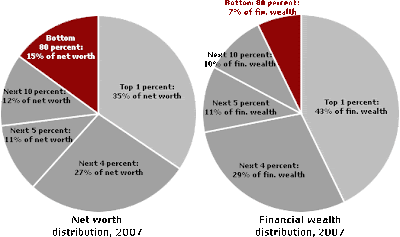
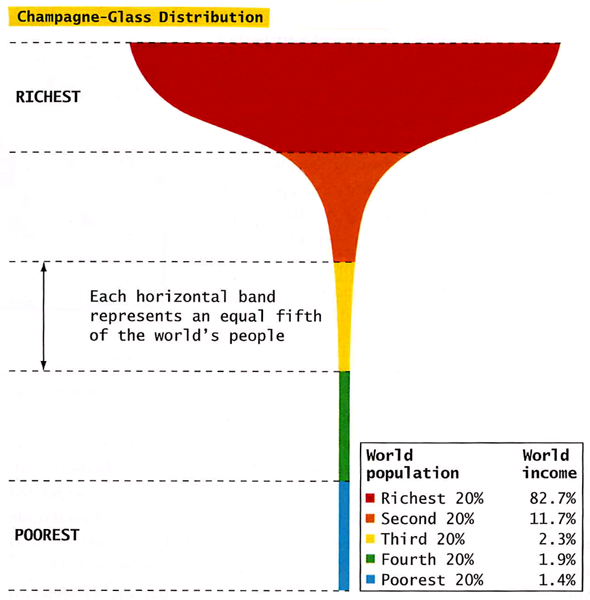
“It’s not greed,” I said, “look at who owns the wealth. The overwhelming proportion of people don’t have any control. They’re just trying to get by.”
To talk of “greed” anthropomorphises the machine of the economy, imbues it with a human emotion where it has none. To say that bankers are “greedy”, or that corporations and their Chief Executive Officers are “evil” entirely misses the point. Almost everybody is employed by somebody else, and has to follow instructions.
Even High Net Worth Individuals are under pressure to respond to their “electorates”, those who consume their intellectual property rights.
However, “just following orders” is no excuse to let people off the hook when it comes to carbon emissions, just like it is no excuse for war crimes.
But it’s not “greed”.
That would imply guilt, but guilt is not a lever that can be used successfully to correct excess carbon emissions.
Very long-lived trees tell the story of the last 5,000 years or so.
The gradual cooling of the Holocene interglacial is overtaken by a truly anomalous warming over the last few hundred years.
How unusual have conditions been in the last few hundred years ? The carbon 13 isotope can give us one point of view [ Boehm et al. (2002) ] :-
And the oxygen 18 isotope can add detail about climatic changes not readily apparent from the carbon isotope record [ Berkelhammer and Stott (2008) ] :-
The balance of oxygen isotopes in plants in this study provide some perspective on rainfall and storm patterns, which appear to have started changing before significant temperature changes came into view.
Depletion of oxygen from the atmosphere provides evidence that the accumulation of carbon dioxide is from the oxidation (burning) of fossil fuels :-
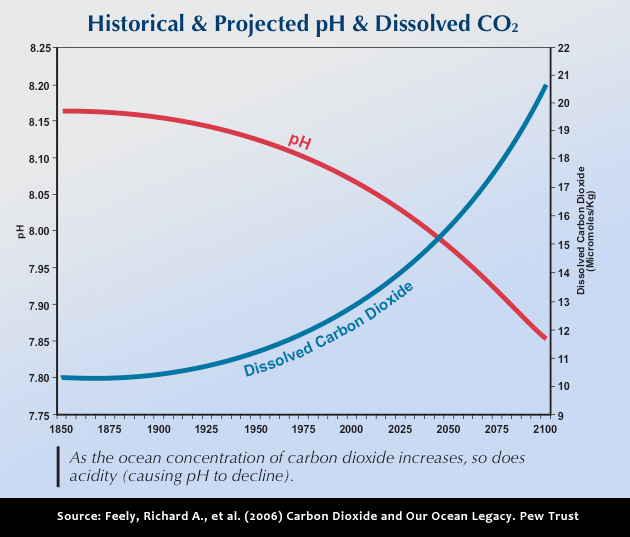
But we’re going to have a carbon crisis in the oceans from a combination of acidification and thermal stress, long before we have an oceanic oxygen crisis :-