Categories
Behaviour Changeling Big Picture British Sea Power Climate Change Climate Chaos Climate Damages Delay and Deny Demoticratica Disturbing Trends Divide & Rule Droughtbowl Economic Implosion Emissions Impossible Energy Change Energy Insecurity Energy Nix Energy Revival Energy Socialism Engineering Marvel Environmental Howzat Fossilised Fuels Green Investment Green Power Heatwave Low Carbon Life Major Shift Marvellous Wonderful National Energy Nuclear Nuisance Nuclear Shambles Optimistic Generation Peak Emissions Policy Warfare Political Nightmare Protest & Survive Regulatory Ultimatum Renewable Resource Social Change Social Chaos Solution City The Power of Intention Voluntary Behaviour Change Western Hedge Wind of Fortune

James Delingpole : Going Underground

James Delingpole hardly ever sets his delicate foot in Wales, the country he archaically refers to as “the Principality”, apart from, ooh, about ten days a year when he holidays there, but nonetheless, feels he has some kind of inherited ex-colonial right to be affronted that large electricity generation and transmission infrastructure are going to be built there :-

https://blogs.telegraph.co.uk/news/jamesdelingpole/100088906/wales-is-in-danger-why-isnt-the-prince-of-wales-saving-it/

He gets top marks for being rather offensive himself – achingly rude, in fact, about the Welsh Assembly, besides his getting untethered about the wind farms and pylons for the transmission cables :-

“…The wind farms are bad enough on their own. But to make matters far worse […], in order for these bird-crunching, bat-chomping, view-blighting, rent-seeking monstrosities to be connected to the grid a huge 400kv power line is going to be constructed all the way from Montgomeryshire through some of Britain’s most spectacular scenery to the equally beauteous Shropshire…”

Categories
Demoticratica Energy Insecurity Energy Revival Energy Socialism Nuclear Nuisance Nuclear Shambles Social Change Technological Fallacy Technomess

Adam Curtis : Nuclear Hero

Despite Adam Curtis’ curious views about ecology and democracy, and his enduring confusions between science and technology, (and between technology and industry), I must remind my readers that in one area he has been a keenly perceptive and accurate observer – in his 1992 “Pandora’s Box” research into the history of nuclear power “A is for Atom” :-

https://www.youtube.com/watch?v=7jUELZAdh_w
https://www.youtube.com/watch?v=iT6uDjwkeBw
https://www.youtube.com/watch?v=D_8h_twNP_0
https://www.youtube.com/watch?v=KAFZEp7cwgU
https://www.youtube.com/watch?v=UwB6QAa2yww

Curtis correctly identifies mismanagement as being the root cause of problems in the nuclear power industry – a mismanagement of information, dismissiveness of whistleblowing, and a dangerous overreach of technological ambition.

Categories
Big Number Big Picture British Biogas Direction of Travel Energy Change Energy Insecurity Energy Nix Energy Revival Gamechanger Green Investment Green Power Growth Paradigm Low Carbon Life Major Shift Marvellous Wonderful Methane Management National Energy Nuclear Nuisance Nuclear Shambles Optimistic Generation Realistic Models Renewable Gas Renewable Resource Technofix The Power of Intention

Renewable Gas in the UK

Although variability in Renewable Electricity generation is a real issue, it’s not a huge one, according to recent reports, that from the International Energy Agency (IEA) “Harnessing Variable Renewables” among them :-

https://www.energymatters.com.au/index.php?main_page=news_article&article_id=1533
https://www.iea.org/Textbase/nptoc/Harness_Renewables2011TOC.pdf
https://www.iea.org/Textbase/npsum/Harness_Renewables2011SUM.pdf

Even so, there is a need to improve cheap methods of energy storage – and one of the simplest ways to increase capacity in this area is to produce Renewable Gas – which can be stored as easily as Natural Gas.

Categories
Big Number Carbon Capture Coal Hell Design Matters Direction of Travel Emissions Impossible Energy Change Energy Insecurity Energy Revival Fossilised Fuels Green Power Growth Paradigm Low Carbon Life Methane Management Nuclear Nuisance Nuclear Shambles Optimistic Generation Peak Emissions Policy Warfare Realistic Models Regulatory Ultimatum Renewable Gas Renewable Resource Resource Wards Technological Fallacy Technological Sideshow The Power of Intention Unnatural Gas Wind of Fortune

George Monbiot : Wrong Choice

Data Source : IEA via ESDS

This chart shows why George Monbiot, Mark Lynas and Stephen Tinsdale have all plumped for the wrong choice – new Nuclear Power cannot deliver more electricity or reduce carbon dioxide emissions for us at the time when we need it most – the next few years :-

0. Massive energy conservation drives – for demand management – are clearly essential, given the reduction in UK generation.

1. It is impossible to increase new Nuclear Power capacity in less than ten years, but total UK generation is falling now, so now and in the next few years is the timeframe in which to add capacity. We cannot go on relying on Nuclear Power imports from France – especially given the rate of power outages there.

2. The fastest growing generation sources over the next few years will be Wind Power, Solar Power and Renewable Gas – if we set the right policies at the government and regulator levels.

Categories
Babykillers Carbon Army Carbon Capture Coal Hell Dead End Dead Zone Disturbing Trends Emissions Impossible Energy Change Energy Insecurity Energy Revival Environmental Howzat Evil Opposition Fossilised Fuels Gamechanger Genetic Modification Geogingerneering Human Nurture Hydrocarbon Hegemony Incalculable Disaster Major Shift Military Invention No Blood For Oil Not In My Name Nuclear Nuisance Nuclear Shambles Oil Change Peace not War Peak Energy Resource Curse Resource Wards Tarred Sands Technomess Toxic Hazard Unconventional Foul Unnatural Gas Western Hedge

The toxic legacy of mined energy

We are stardust ? Well, not quite. As carbon-based lifeforms we’re actually the offspring of a young sun, composed of the lighter elements, with a low concentration of a few transition metals essential for our health and vitality. Irn Bru, anyone ?

The actual products of exploding old stars that got lodged in the crusty skin of the accreting Earth are often quite toxic to us. Over millions of years, heavy and radioactive elements, being of no use to the ecosystem, have been deposited at the bottom of lakes, seabeds, and ended up lodged in seams of coal, and caverns of petroleum oil and Natural Gas. Uranium ores and other nasties have been overlain by forests and deserts, and only rarely vent, like radon, from Vulcan’s infernal lairs.

And what do humans do ? We dig this stuff up to burn or fission for energy, and when we do it creates toxic waste, that hurts us, and the life around us. Why are we surprised that mercury from the coal power industry is killing fish and harming children ? Why is it a shock that the tailing ponds from mining tar and oil sands are devastating pristine wilderness and waterways ?

Categories
Energy Revival Nuclear Nuisance Nuclear Shambles

George Monbiot : Nuclear Failure

The more I read George Monbiot these days, the more I think he’s descending, morphing into a reactionary waxwork automaton of his former radical, analytical, reasonable self. His recent web log posting on the Guardian Eco site hasn’t attracted many comments, compared to some articles of yore, but people seem to think, judging by Twitter chatter that getting equal numbers of critics from anti- and pro-nuclear commentators means that he is beating a middle-of-the-road and reasonable track through the thorny-hedged path to lower carbon energy. Just setting people up for a fight doesn’t appear to me to be making genuine headway. Seems to be more about ratings. And anyway, there are a number of assumptions and assertions he makes I simply cannot agree with. And here is a brief and non-complete run down.

Categories
Bait & Switch Carbon Commodities Carbon Taxatious Climate Damages Conflict of Interest Contraction & Convergence Corporate Pressure Cost Effective Dead End Divide & Rule Economic Implosion Emissions Impossible Energy Change Energy Disenfranchisement Energy Revival Energy Socialism Financiers of the Apocalypse Fuel Poverty Global Warming Growth Paradigm Hydrocarbon Hegemony Tarred Sands Unqualified Opinion Unsolicited Advice & Guidance Unutterably Useless Utter Futility Vain Hope Wasted Resource

Carbon Dioxide – a virtual, negative commodity

https://www.cato.org/event.php?eventid=7999

I found this excellent little CATO Institute debate somewhere in my Twitter stream, and I watched the whole of it, despite the annoying accents and speaking styles of the speakers, and the insider economics references to Pigou and Coase (they’re only theorems, you know).

I thought that Kate Gordon made some excellent rebuttals to Andrew Morriss’ whining, pedantic free marketeering, and I was with her right up until the last few frames when she said that the Center for American Progress, of course, supports a carbon tax, as this is, of course, the best way to prevent Carbon Dioxide emissions.

Such disappointment ! To find that somebody so intelligent cannot see the limitations of carbon pricing is a real let down. I tend to find that American “progressives” on the whole are rather wedded to this notion of environmental taxation, “internalising the externalities” – adding the damages from industrial activities into the cost of the industrial products. I do not see any analysis of the serious flaws in this idea. Just what are they drinking ? What’s in the Kool-Aid ?

Categories
Climate Change Emissions Impossible Energy Change Energy Revival Engineering Marvel Global Warming

Thanks, The Energy Collective, but no thanks

I cannot waste my time counting how many cut-and-paste e-mails I receive, and usually I just junk them, but I thought this one seemed sufficiently personalised to actually respond to it.


from Energy Collective
to jo abbess
date Fri, May 27, 2011 at 2:29 AM
subject You Are Invited! Blog With The Energy Collective

Dear Ms. Abbess:

…I am…at The Energy Collective (TEC). TEC is a pragmatic anti-carbon, tech-agnostic blog that aims to stoke the discussion on climate and energy solutions by bringing together the smartest climate and energy bloggers on the planet. We are at about 70k hits per month, and growing quickly. Our users are smart, engaged, energy professionals located all over the world, but concentrated in the US.

I stumbled over your blog, I think through Twitter, and am delighted by it. I like your straight-forward, unflinching writing style, as well as your lack of tolerance for climate deniers. I would like to invite you to blog with us at The Energy Collective. The deal here is a trade: you grant TEC permission to syndicate selected posts from your RSS for free, and we post, promote and leverage your content to get it in front of as many eyes as possible. We strive to create as much value as possible for our bloggers, and often offer contract writing opportunities, chances to participate as experts in our webinars, free or discount conference access, professional connections, and more.

Categories
Energy Change Energy Insecurity Energy Revival Nuclear Nuisance Nuclear Shambles Technofix Technological Fallacy Technological Sideshow Technomess The War on Error

Nuclear power price fudge

[ UPDATE : E-MAIL FROM THE COMMITTEE ON CLIMATE CHANGE POINTS TO THE SECOND DOCUMENT – AND IT’S DEFINITELY A FUDGE ON “CAPEX” – SEE PAGE viii FOR EXAMPLE ]

Today’s publication of the UK Government Committee on Climate Change’s “The Renewable Energy Review” report seems to me to contain some fudge on the cost of nuclear power.

Almost everybody agrees that the current cost of generating nuclear power from existing reactors and plant is reasonable. There are questions about how much, exactly, it’s going to cost to decommission ageing reactors as they become dangerous, and there are also questions about how much it’s really, really going to cost to safely “dispose” of the radioactive waste from over 50 years of nuclear electrical generation. Even so, the operations and maintenance costs, the “O&M” costs of keeping nuclear power stations ticking over is fairly reasonable – unless there are unplanned “outages”, or radioactive accidents, or problems with the price of uranium fuel…happily, these added burdens can be kept off the balance sheets for the most part.

However, it is in projecting the real costs of new nuclear power, from shiny, spanking, new glistening, glowing concrete reactors, that deep and discomforting questions arise, and the CCC report, I think, I’m sorry to say, fudges the issue.

Categories
Be Prepared Big Picture Direction of Travel Energy Change Energy Insecurity Energy Revival Financiers of the Apocalypse Fossilised Fuels Hydrocarbon Hegemony Major Shift Obamawatch Oil Change Peak Emissions Peak Energy Peak Oil Technofix Technological Fallacy Technological Sideshow Technomess Unnatural Gas

BP : Politely Requesting an Interview

[ 02 JUNE 2011 : THIS POST HAS ALWAYS AND WILL ALWAYS FULLY RESPECT BP COMPANY CONFIDENTIALITY, AND HAS NOT AND WILL NOT INCLUDE THE REPRODUCED TEXT CONTENT OF E-MAILS FROM BP, ARISING FROM AN E-MAIL EXCHANGE WTIH JOABBESS.COM. NOTWITHSTANDING THIS CLEAR ATTEMPT ON THE PART OF JOABBESS.COM TO CONSERVE THE FULNESS AND THE ESSENCE OF COMPANY CONDIENTIALITY, IT HAS BEEN DRAWN TO THE ATTENTION OF JOABBESS.COM THAT EVEN JUST MENTIONING THE NAME OF THE CORRESPONDENT AND THE DATES OF THE EXCHANGE MAY TECHNICALLY CONSTITUTE A BREACH OF BP COMPANY CONFIDENTIALITY. SO, TO ENSURE THAT NO ACCUSATION OR COMPLAINT OF BREACH OF COMPANY CONFIDENTIALITY COULD EVER BE MADE, AND TO ENSURE THE PROTECTION OF THE CORRESPONDENT, THE NAME OF THE CORRESPONDENT AND THE DATES OF THE EXCHANGE HAVE BEEN REDACTED AND REMOVED AS OF TODAY. IT CAN STILL BE DEDUCED FROM THIS POST THAT AN E-MAIL EXCHANGE TOOK PLACE. THAT FACT, I THINK, IS NOT COMPANY CONFIDENTIAL, ALTHOUGH I EXPECT BP ARE WITHIN THEIR RIGHTS TO TELL ME IF THEY BELIEVE OTHERWISE, AND OPEN UP A PERSON TO PERSON CONVERSATION ABOUT THE BEST COURSE OF ACTION. THEY KNOW MY TELEPHONE NUMBER. IT’S AT THE TOP OF THE POST. WHERE IT’S ALWAYS BEEN. ]

From: jo abbess
To: XXXXXXXXXXXXXXXXXXXXXXXXXX, BP
Date: XXXXXXXXXXXXXXXXXXXXXXX

Dear XXXXXXXXXXXXXXXXXXXXXXX,

Thank you for your time on the phone earlier this week.

Last year in February, I was part of a small group of students that were grateful to have the benefit of an interview with XXXXXXXXXXXXXXXXXXXXX at BP, then XXXXXXXXXXXXXXXXXXXXXXXXXXXX.

I am taking my research into the energy sector further for my MSc dissertation, and I would be grateful if I could have an interview with somebody in an engineering department who has an overview of the energy sector.

It doesn’t need to be a face to face interview, as I am quite willing to telephone people. It only needs to be 20 minutes in duration.

I have prepared a short list of open questions that I am considering would be suitable for my enquiry into the future of energy resources and technologies (see below).

I hope that you can point me in the direction of somebody within BP who would like to offer their thoughts.

Thank you.

Questions with a UK focus

1. What do you think have been the best developments in the energy sector in the last 20 years ?

(What do you think are the most significant developments in the energy sector in the last 20 years ?)

2. What positive or negative changes in energy production and supply will take place over the next 2 decades ?

(What do you think will be the most important developments in the energy sector in the next 20 years ?)

3. Which energy resources and technologies look the most troubled ?

4. Which energy resources and technologies look the most promising ?

5. Does the UK face an energy supply gap ? Can we keep the lights on ?


From: jo abbess
To: XXXXXXXXXXXXXXXXXXXXXXXXXXXXXXX
Date: XXXXXXXXXXXXXXXXXXXXXx

Hi XXXXXXXXXXXXXXXXXXXXXXXXXXXXXX,

Thank you for your helpful reply.

What I am trying to achieve is a real conversation with somebody within BP who has a general overview of the energy industry – sadly, the annual Statistical Review and company report do not answer the scoping questions I have.

I am offering an opportunity for BP to voice a vision, on record, of how the company intend to navigate future change, using parameters that are not generally the basis of shareholder reports.

I am sure that somebody in the organisation has a view on the onset of Peak Oil and Peak Natural Gas – from conventional resources, and that there must be aims and objectives for BP to manage this issue.

I am convinced that BP has planned for a range of policy scenarios concerning climate change – both mitigation and adaptation measures.

I am also sure that somebody in BP has a plan for navigating political problems, such as the probability of continued unrest in the Middle East, with the accompanying likelihood of compromised oil and gas production.

In addition, I am sure that somebody from BP can speak on the company’s behalf about how it will deal with the threats of economic turbulence and still be able to meet the needs of shareholders.

Some sample questions that could take in part of this landscape :-

1. Do you think that we are heading for a period of global energy insecurity ? What are the factors that could cause this ? What are the timelines ? Who are the key players ?

2. What is aiding or blocking the transition from fossil fuels to clean energy ? What technologies look promising ? What technologies are stuck in the lab ?

3.. How do you think we will manage the transition to clean energy ? How will the economic actors be able to diversify out of fossil fuels and still retain balance in the world markets – and not disappoint their investors ?

4. Do you think that people generally are aware of the issues of energy security ?

It would be excellent if you could find somebody to speak to these or similar questions in a short interview with me. I can do interviews by telephone at very low cost, and I would e-mail the transcript for verification before using in my research report.

My central question is “are we ready for energy change ?” – major transition in the resourcing and use of energy – and I am seeking a full range of opinion on that question.

If you could point me towards somebody who is willing and able to speak for 20 minutes on the phone on energy security issues, I would be highly grateful.

Thank you.


Categories
Energy Change Energy Insecurity Energy Revival Energy Socialism Engineering Marvel Neverending Disaster Nuclear Nuisance Nuclear Shambles Technological Fallacy Technological Sideshow Technomess

Remember Chernobyl

[ UPDATE : Further embarrassing TEPCO revelations and Russia’s Medvedev calls for new world safety rules. ]

Image Credit : Tricon

Twenty-five years ago today, Reactor Four at the Chernobyl Nuclear Power Plant ruptured, and explosions sent highly toxic and radioactive material up into the atmosphere.

We still live in the fallout plume of Chernobyl, a shadow that haunts us with future risk if the new Shelter Implementation Plan programme is not financed :-

https://www.iaea.org/newscenter/features/chernobyl-15/shelter-fund.pdf

In the light of the Fukushima Dai-ichi Multiple Nuclear Accident in Japan, and the setting of an official exclusion zone, it is important to re-consider whether the low-risk-of-high-damage nuclear power technology should continue to be used in action taken against low-risk-of-high-damage Climate Change.

Governments and other institutions have been checking and re-checking nuclear power facilities and holding talks :-

https://www.guardian.co.uk/environment/2011/mar/15/european-union-stress-test-nuclear
https://www.dnaindia.com/mumbai/report_nuclear-power-the-missing-safety-audits_1536223
https://www.newschannel9.com/news/nuclear-1000446-commission-watts.html
https://www.inewsone.com/2011/04/22/france-to-check-security-of-n-plants/45173

The central lesson of both Chernobyl and Fukushima is that over time, engineering systems degrade, constructions rust and crumble, human operations become slack, and small chances can add up to have big consequences.

Public information has been created to help the newsreading public get to grips with the new reality of nuclear power. We cannot rely on nuclear power. Nuclear power stations break down, sometimes without warning. Nuclear power always poses a risk. Sometimes there are spills, leaks and emissions of dangerous gas – sometimes there are fires or explosions – and there is always the danger that somebody might misuse the fuel or waste :-

https://www.physorg.com/news/2011-04-google-earth-populations-nuclear.html
https://www.bbc.co.uk/news/world-13159407

The Japanese Government and nuclear power industry did not respond to the warnings issued in 2007 in Japan after an earthquake caused a radioactive leak at a nuclear power plant :-

https://www.telegraph.co.uk/news/worldnews/asia/japan/8392730/Japan-nuclear-crisis-tsunami-study-showed-Fukushima-plant-was-at-risk.html
https://www.ens-newswire.com/ens/jul2007/2007-07-16-04.html

Neither do they appear to have responded adequately to warnings of cracks in reactors, which have been known about for a long time. It is possible that reactor cracking, or other neutron damage, may have played a part in the release of radioactive chemicals still ongoing at Fukushima Dai-ichi. Only careful study will confirm or deny this, but engineers may not be able to get close enough to find out for some time as the radiation levels are so high :-

https://nuclearhistory.wordpress.com/2011/03/11/japan-nuclear-reactors-coverup-of-cracked-reactors-2002/
https://www.greenpeace.org/international/en/news/Blogs/nuclear-reaction/hamaoka-reading-the-news-and-things-to-come/blog/11303
https://weblog.greenpeace.org/nuclear-reaction/2010/04/nuclear_history_repeating.html
https://goliath.ecnext.com/coms2/gi_0199-2195746/METI-warns-TEPCO-over-damage.html
https://pqasb.pqarchiver.com/latimes/
https://factsanddetails.com/japan.php?itemid=845&catid=23&subcatid=152

Can the United Kingdom now listen to warnings about cracked nuclear power reactors at home ? :-

https://www.guardian.co.uk/environment/2004/dec/02/energy.nuclearindustry
“Cracked reactors may force closure of nuclear plants : Terry Macalister : The Guardian, Thursday 2 December 2004”
https://www.guardian.co.uk/science/2006/jul/05/energy.frontpagenews
“Documents reveal hidden fears over Britain’s nuclear plants : Unexplained cracks in reactor cores increase likelihood of accident, say government inspectors : John Vidal and Ian Sample, The Guardian, Wednesday 5 July 2006”
https://www.guardian.co.uk/politics/2006/jul/06/nuclear.freedomofinformation?INTCMP=ILCNETTXT3487
“More checks on reactors ordered after cracks found : John Vidal and Ian Sample, The Guardian, Thursday 6 July 2006”
https://news.bbc.co.uk/1/hi/uk/5149650.stm

It is being admitted that not enough is known about the effects of radioactive fallout from nuclear power plant accidents. Let us only hope that our governments feel it necessary to spend the money to find out :-

https://www.guardian.co.uk/environment/2011/apr/26/chernobyl-lessons-missed-research-gaps

Remember Chernobyl.

Categories
Burning Money Carbon Army Conflict of Interest Dead End Disturbing Trends Eating & Drinking Economic Implosion Energy Revival Financiers of the Apocalypse Green Investment Growth Paradigm National Socialism Political Nightmare Protest & Survive Regulatory Ultimatum Social Capital Social Change Social Chaos Vote Loser

The “red tape” challenge

So, I’m sitting in my local cafe at lunchtime talking to my local property developer-landlord. So, I ask him, do you think there will be worsening economic conditions this year ? And will there be more unemployment ?

He takes a pretty dismal line – things are becoming more and more squeezed – landlords are finding that their properties are unoccupied, or the rents are being forced downwards, and there is no spare finance capacity to do renovations, the banks won’t lend, and there’s no certainty of being able to sell properties if the business becomes uneconomic. He’s had to sack people he was formerly able to employ.

Categories
Cost Effective Direction of Travel Energy Change Energy Revival Engineering Marvel Feel Gooder Freak Science Green Power Major Shift Money Sings Renewable Resource Science Rules Solar Sunrise

Sunshine power

Solar photovoltaic cells based on semiconductor transistor junctions are becoming cheaper, more efficient and more widely relied upon. Mankind can thrive, drinking in the sunshine.

Yet, the solar power technology of today could still become a minor footnote if there is a revolution in Physics or Chemistry :-

https://socialbarrel.com/solar-power-discovery-dims-future-of-photovoltaic-cells/6382/

“Solar Power Discovery Dims Future of Photovoltaic Cells : Posted by Francis Rey on April 18, 2011 : University of Michigan researchers made a breakthrough discovery on the behavior of light, which could alter solar technology from now on. Professor Stephen Rand, Departments of Electrical Engineering and Computer Science, Physics and Applied Physics, and William Fisher, an Applied Physics doctoral student, found out that light, when traveling [sic] through a nonconductive material, such as glass, at the right intensity can produce magnetic fields 100 million times stronger than previously deemed possible. During these conditions, the magnetic field has enough strength to equal a strong electric effect, producing an “optical battery” that leads to “a new kind of solar cell without semiconductors and without absorption to produce charge separation”, Rand said…”

https://detroit.cbslocal.com/2011/04/13/um-says-solar-power-without-solar-cells-is-possible/

https://solar.calfinder.com/blog/solar-research/harnessing-solar-power-without-cells/

Mmm, love that solar radiation !

Categories
Big Number Big Picture Design Matters Energy Change Energy Revival Feel Gooder Green Power Major Shift Marvellous Wonderful Optimistic Generation Peace not War Renewable Resource Solution City Stirring Stuff The Power of Intention Wind of Fortune

The answer, my friend

Curiouser and curiouser…

Categories
Energy Change Energy Revival Green Investment Green Power Growth Paradigm Major Shift Oil Change Optimistic Generation Peak Energy Peak Oil Renewable Resource Technofix Technological Sideshow

Energy Matrix #1 : Are We Ready for Energy Change ?

What is this survey ? This survey is about your views on the future of energy, and the changes that will take place. Why take part in this survey ? If you spend 15 to 20 minutes to give your opinion of the 30 statements in this survey, you will be contributing to an ambitious university study.

Please give yourself 15 to 20 minutes to complete the survey. With each statement, please click the option that best matches your view. Please don’t forget to answer the general questions at the end, which will help with making the final report.

NUCLEAR POWER

OIL (TRANSPORT)

RENEWABLE ENERGY

NATURAL GAS

COAL POWER

Background Information Please give a few brief details about what kind of person you are, to help us check that a representative sample of people have answered the survey.

What region are you living in ?
How old are you ?
What gender are you ?
How do you prefer to keep up to date with science ?

Is Climate Change really happening ?
Is Peak Oil really happening ?
Do you know a lot about energy  ?
Enter your e-mail address if you want the final results

General Questions This is your chance to explain in more detail what you think, and add any comments you would like to make. For starters, here are some sample questions you might have ideas about :-
1. In your view, what will be the most major change in energy systems in the next 20 years ?
2. Who is responsible for making significant change to the energy systems ?
3. How will the major changes in energy systems be paid for ?

Categories
Advancing Africa Emissions Impossible Energy Change Energy Insecurity Energy Revival Feed the World Feel Gooder Fossilised Fuels Green Investment Green Power Nuclear Nuisance Nuclear Shambles Peace not War Peak Energy Peak Oil Renewable Resource Resource Curse

Libya Futures

Outside the usual political and media circles, questions are being asked. Why has the United Nations sanctioned military engagement in Libya in the form of UN Security Council Resolution 1973 ? Why the heavy firepower here, in Libya, when the ostensible rationale for intervention was only to implement a No-Fly Zone ? Why not gloibal military action elsewhere in the Middle East North Africa (MENA) arena where there are other despots making life unpleasant or endable for their citizens ?

I present to you two possible futures for Libya, both of which will require extensive cooperation with foreign corporate and political players, something that Muammar Abu Minyar al-Gaddafi (or Qaddafi) threatens, or rather, depending on various news reports, “threatened”.

1. The Dash for African and Arabic Natural Gas (and Oil)

In a carbon-constrained world Natural Gas is a boon – it has roughly half the carbon dioxide emissions of coal when burned to produce steam to generate electricity. Any country that’s got Natural Gas, especially good quality Natural Gas that doesn’t have to be hydraulically “fractured” from rock strata, is a country we will learn to love and trade on significantly generous terms with.

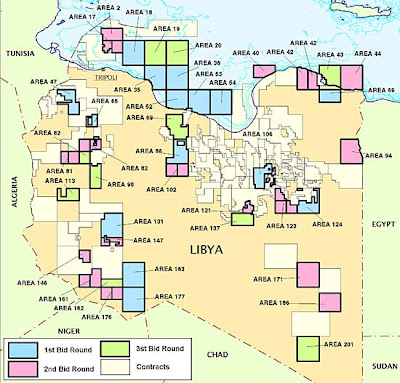
There has been extensive surveying of Libya, and the whole of North Africa’s Maghreb region, including the type of offshore seismic surveying that found extensive gas fields in the Eastern Mediterranean that Israel is now laying claim to (and preventing Gaza from exploiting). This has led to quite a lot of excitement in the fossil fuel energy industry, so, reading between the lines of the conference agendas, there is high dollar value under Libya’s maritime territory :-

https://www.geolsoc.org.uk/gsl/site/GSL/lang/en/page7792.html
https://www.geolibya.org/evdetails.asp?Myval=36

In addition to Natural Gas there may well be high levels of top quality oil – and keeping up the flow of crude oil, as we all know, is crucial to the health of the world’s economy. Threats of re-nationalising the Libyan fossil fuel resources therefore caused corporate shock :-

https://www.ft.com/cms/s/0/67d1d02a-5314-11e0-86e6-00144feab49a.html#axzz1HKdP1z5V

“Oil companies fear nationalisation in Libya : By Sylvia Pfeifer and Javier Blas in London : Published: March 20 2011 : Western oil companies operating in Libya have privately warned that their operations in the country may be nationalised if Colonel Muammer Gaddafi’s regime prevails. Executives, speaking on condition of anonymity because of the rapidly moving situation, believe their companies could be targeted, especially if their home countries are taking part in air strikes against Mr Gaddafi. Allied forces from France, the UK and the US on Saturday unleashed a series of strikes against military targets in Libya. “It is certainly a concern. There are good reserves there,” said one executive at a western oil company with operations in Libya. “We have lost some of our production [because all operations have stopped] but our bigger concern is what will happen to the exploratory work as that gives you a future rather than the immediate impact,” he added. Most of the world’s large international oil companies have producing assets in Libya, including Spain’s Repsol, France’s Total, and Italy’s Eni, which is the largest single investor there. Germany’s Winstershall – a unit of BASF – and OMV of Austria are also present. The country is the world’s 12th largest oil exporter, and the escalating violence there has triggered a jump in prices to nearly $120 a barrel. More than half of Libya’s oil was exported to Italy, Germany and France last year…”

BP had to evacuate its staff, and extend a favour to some British citizens, during the recent uprising :-
https://www.telegraph.co.uk/news/worldnews/africaandindianocean/libya/8344391/Libya-Britain-borrows-BP-jet-to-evacuate-citizens.html

Production in the country has taken a hit due to the fighting, but order should soon be restored. Clearly, long-term stability in Libya, with unhindered, inexpensive access to the country’s oil and gas resources is an important part of the national security interests of many Western democracies.

2. Solar Libya

https://www.desertec.org/en/global-mission/milestones/

The DESERTEC project of the European Union seeks to roll out solar power in the desert sands of North Africa, and makes the promise of economic and social development of the countries that take part, although that dream has been questioned :-

https://www.ceu.hu/theses/1/2010/the-desertec-project-a-new-resource-curse-for-countries-in-north-africa-and-the-middle

Let’s face the facts here – massive new energy projects in North Africa will be financed and developed through large multinational, transnational corporations, companies who have contributed to the economic slavery of Africa for, let’s approximate here, centuries.

What guarantees can the Maghreb have that this is not a further land grab on Africa’s potential ?

In addition, the recent social and political volatility in the Middle East North Africa region could jeopardise the noble plans of the European Union to reach out in energy partnership.

Hang on. Wait a minute. Is the wave of uprisings across the Middle East and North Africa connected in any way to the interests of oil and gas companies who want Future #1 to prevail for the whole region, not just Libya ?

American companies have been so keen to sell nuclear electricity projects to Saudi Arabia and others around the Arabian Gulf – but has this been encouraged from the high-ups to keep the Arabs off the scent of Renewable Energy ? Forget nuclear power – it’s expensive and awkward. Iran only pursues civilian nuclear power to irritate the United States Government. A solar Arabia could give the Middle East and North Africa a second generation of being the energy princes of the world. I suspect they will go for this in a big way very shortly, uprisings or no uprisings. Why ? Two little words – Fukushima Daiichi.

So there we have it – two entirely probable, slightly competing, futures being mapped out for Libya by the big guns of NATO (a euphemism for the USA). If Libya is split into two countries, the fossil fuel Future #1 will be likely applied to East Libya, and the desert solar Future #2 will be foisted on West Libya.

Continued interference in the country is a certainty.

Categories
Coal Hell Energy Change Energy Revival

Energy Poll #1 : Coal

Question 1 Do you think that capture of carbon dioxide emissions from coal burning power stations will be widespread before 2030 ?


Question 2 Is burning coal to make electricity just a stop-gap until renewable energy is widely available ?


Question 3 Do you think that “clean coal” is possible ?


Question 4 To protect future electricity supply we should be technology neutral.


Question 5 We should stop burning coal and concentrate on capturing emissions from Natural Gas power plants.


Background Information : please give a few brief details about what kind of person you are, to help us check that a representative sample of people have answered the survey.
What region are you living in ?
How old are you ?
What gender are you ?
Is Climate Change really happening ?
Do you know a lot about energy technologies ?
Please enter your e-mail address if you want to hear the final results


Categories
Energy Change Energy Revival

Are We Ready for Energy Change ? Survey Results #1

The survey “Are We Ready for Energy Change ?” has been running for roughly two weeks now, and so it’s time to announce some preliminary results.

For the complete survey “Are We Ready for Energy Change ?”, please click here.

Categories
Be Prepared Climate Change Climate Chaos Climate Damages Energy Change Energy Revival Environmental Howzat Extreme Weather Floodstorm Fossilised Fuels Global Singeing Global Warming Green Investment Green Power Health Impacts Incalculable Disaster Major Shift Marvellous Wonderful Near-Natural Disaster Neverending Disaster Political Nightmare Rainstorm Regulatory Ultimatum Screaming Panic Social Change Social Chaos The Power of Intention

Pakistan : Inundation Nation

[ UPDATE : Don’t tell me. I know the images are mostly from India, but the music is Punjabi… ]

https://www.thenews.com.pk/TodaysPrintDetail.aspx?ID=32170&Cat=6&dt=2/21/2011

“Draft of national climate change policy finalised : Noor Aftab : Monday, February 21, 2011 : Islamabad : The draft of National Climate Change Policy has been finalised after two years of deliberations and now the Environment Ministry would present it to the federal cabinet for final approval, the sources told The News here on Sunday. The sources said the recommendations in the draft would certainly test the government’s commitment as it has been proposed to go for alternative energy resources instead of using fossil fuel, considered one of the major reasons for environmental degradation. The sources said the draft recommendations prepared by a core group of the Environment Ministry mainly focuses on two areas including adaptation and mitigation with an aim to enable the country to cope with fast increasing environmental challenges. One of the top officials of the Environment Ministry told this correspondent that continuity of casual approach towards environmental sector has now made economic managers and policy makers feel the heat as environmental degradation has started costing five per cent of gross domestic product (GDP) in Pakistan…”

“Sunday, February 20, 2011 : UK to keep helping Pakistan’s flood victims: Sayeeda Warsi : LAHORE: Baroness Sayeeda Warsi, a British cabinet minister of Pakistani-origin, said on Saturday that the United Kingdom would continue supporting Pakistan in the post-flood operations. “Today I have been heartened to see and hear how the UK is helping millions of people in Pakistan rebuild their lives, but there is much more to do, with widespread malnutrition and the risk of disease outbreaks,” Warsi said while talking to reporters in Islamabad. The primary purpose of Warsi’s visit to Pakistan is to learn how the country is recovering, what more needs to be done, and to see how more than Rs 27.7 billion from British people is supporting the flood victims. “When I was here exactly six months ago in August at the peak of the floods with the UK International Development Secretary Andrew Mitchell I saw scenes of devastation,” the British lawmaker recalled. She said that some areas of Sindh were still under water, adding that reconstruction of millions of houses, bridges and schools that were destroyed would take years…”

Categories
Energy Change Energy Revival

Are We Ready for Energy Change ?

Quite a number of visitors at this web log are sceptical of Climate Change Science, and are probably not very convinced by Renewable Energy Technologies, either.

However, to show I’m fair-minded, I’m giving you all the chance to take part in a research survey on the changes we can expect to see in energy in the United Kingdom in the next 20 years :-

https://energy.changecollege.org.uk?WEB

Please keep your comments civil, or they will be deleted from the database and won’t count in the statistical analysis !

Categories
Energy Change Energy Insecurity Energy Revival

Carbon Nation

“Green, baby – it’s the new red, white and blue.”

Categories
Be Prepared Big Picture Energy Change Energy Revival

Future Energy Tipping Points

Chart Credit : Jo Abbess

Making some very basic first order assumptions about liquid transport fuels, it becomes clear that a choke or tipping point will occur at around 2030.

The majority of the world’s road transport, and air and ocean-going freight will still be using liquid fuels, and the overwhelming majority of these will be hydrocarbons.

Around about 2030, a quarter of the world’s liquid transport fuel supplies will have evaporated, barring some miraculous new discoveries.

Even with some of the world’s Natural Gas and Coal supplies converted to liquid fuels, this point will still be reached at around the same time.

The world systems of trade will be severely affected, and that includes food imports and exports.

Chart Credit : Jo Abbess

The next breaking point will come in around 2040 (after Natural Gas has peaked on 2030) when BioMethane can no longer top up supply.

The depletion decline will be rapid.

This will affect electricity supplies and agricultural chemicals most of all. People will be able to get by without so much heating or hot water.

However, if a significant number of vehicles are running on compressed methane gas, they would be competing with food supplies.

Chart Credit : Jo Abbess

The generation of electricity could become the thing that tips the system back again – if the solar revolution kicks off seriously in around 2040.

However, for this to work, a lot of transport will need to become electric, as will space heating in homes and offices. Plus, increasing amounts of methane gases will have to be reserved for agricultural purposes, unless we can convert the entire world to organic farming.

Given the “battery problem”, a lot of transport will be public transport, running on rails with wires, not as electric cars – since batteries are heavy and require rare elements to make.

The world would have the most juice in the wires it will ever have in around 2060 – the right kind of decade for building everything we need to make our future totally renewable.

Note : pessimistic assumptions have been made about the amount of Carbon Capture and Storage that can be developed, given that coal consumption is very high. Pessimistic assumptions have also been made about nuclear power, as fuel supply is the main limitation. Extreme pessimism is on display as regards shale gas and the development of previously unworked Middle East oil fields.

Caveat Emptor : these charts were composed from a very basic modelling tool and are based on a number of assumptions that some people could dispute.

Note : If the flaring or emissions of Natural Gas from oil fields around the world were capped and piped to consumers, this would keep Natural Gas production higher for longer – but it would still peak before around 2050.

Note : The figure for Natural Gas Liquids is probably too high – the reality is that the deeper an oil field has been sequestered, the more Natural Gas there is in it compared to hydrocarbon liquids.

Note : There is actually a potential for a substantial quantity of Anaerobically Digested BioMethane, but the infrastructure needs building first…that includes all the sewage and water treatment plants around the world, all major animal farms, food waste disposal systems, all communal eating places and all major food manufacturing plants.

Categories
Acid Ocean Energy Change Energy Revival Environmental Howzat Unconventional Foul Unnatural Gas

Shale Gas : Travelling Circus

Image Credit : Jacques del Conte

Flushing gas from sandy mud-rock, deep underground. Hmmm. Bet that’s energy- and resource-efficient. Not.

So…the whole caravan comes to town, builds the rig, pipes in water, pumps in chemicals, filters off the gas, pipes out the poisoned water somewhere unquantified, and then packs everything up after a few months because there’s no more gas coming up, leaving the area looking like a moon crater :-

So how carbon-intensive is this kind of operation ? It’s a bit like chopping down Indonesian and Malaysian tropical rainforest to grow oil palm and then burning dirty bunker fuel to ship it all the way to Europe to make “cleaner burning” biodiesel. In fact, it could be worse than that – it could be dirtier than coal :-

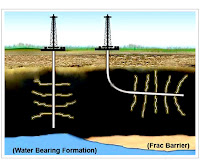
And what’s all this business about chemical adulteration of groundwater ? That could be to do with the “hydraulic fracturing” process from horizontal drilling :-

It’s true that the business needn’t resemble a travelling circus when there’s a large “play” of shale and horizontal drilling is used, but what about the possible side effects of chemical leakage into bodies of water and seismic activity, which doesn’t seem to get mentioned very often ? :-

There is some concern that shale gas is being promoted as a new “cure-all” for the energy industry, as gas is believed to be a cleaner source of fuel than coal, and gas shale is much, much cheaper than the proposed carbon capture projects and new nuclear power stations, which will only be developed with substantial tax breaks or subsidies or grants. (I mean, can you see a carbon price being set high enough to pay to make it worthwhile to fit Carbon Capture to every coal plant in the world ?) :-

https://www.chathamhouse.org.uk/files/17317_r_0910stevens.pdf

“The recent ‘shale gas revolution’ in the United States has created huge uncertainties for international gas markets that are likely to inhibit investment in gas – both conventional and unconventional – and in many renewables. If the revolution continues in the US and extends to the rest of the world, energy consumers can anticipate a future dominated by cheap gas. However, if it falters and the current hype about shale gas proves an illusion, the world will face serious gas shortages in the medium term”

A Carbon Capture and Storage (CCS) fan wrote to me, linking to the CCS industry :-

https://www.captureready.com/EN/Channels/News/showDetail.asp?objID=1972&isNew

“A British study indicates that cheap low-emission shale gas, with double the global reserves of conventional sources, will discourage investment in nuclear reactors and carbon storage. “In a world where there is the serious possibility of cheap, relatively clean gas, who will commit large sums of money to expensive pieces of equipment to lower carbon emissions?” Paul Stevens, senior research fellow at Chatham House, a London-based institute for the study of international affairs, wrote in the report published today.”

This is what the CCS fan had to add :-

“What this important article from the ‘CaptureReady’ international CCS news website fails to pick up (although other authors have) is that these prices will have an equal dampening effect on all renewables projects as well, […] never mind offshore wind power costs, while easily meeting all conceivable carbon dioxide reduction targets out to beyond 2050 and delivering reliable, dispatchable power, with none of the unreliability/unpredictability ‘down-sides’ of variable wind output. ‘I know which I’d pick’ as a power company today, especially given the low investment cost per kW […]. Looks like it may be ‘gas forever’ for at least the next couple of decades, so we need to lobby very hard for CCS from the start on every new gas powerplant and large industrial plant, followed by a big programme of properly-subsidised CCS retrofits, if that’s where the real industrial world is going…the quoted US conventional gas number is just plain wrong (far too high!), and the Shale gas price is very geology/location and project-scale-dependent (that is, variable), so that price in Texas does not mean similarly low shale gas prices everywhere – meaning the total resource quoted is certainly not available at that sort of low price. As with all resources, there’s actually a ‘staircase’ of amount versus price. Shale gas exploitation is ‘inherently costly’ (capital-intensive) due to the relatively larger number of wells needed, the poor permeability and the considerable cost of the ‘fracking’ operation itself. The poor inherent permeability inevitably means that the production rate will decline more steeply and quickly than conventional gas wells, meaning that costly multiple repeat fracking may be necessary, adding to costs.”

And as a summary of the shale gas downsides :-

=x=x=x=x=x=x=x=x=x=x=

Main conclusions [on shale gas] :

1. Huge levels of uncertainly on total reserves and future production rates, even in the USA.

2. Not at all certain that the large-scale US shale gas experience can be replicated in Europe/Rest of the World at all – environmental issues/local NIMBY [Not In My Back Yard] may stop it in its tracks.

3. Said huge uncertainties, on top of the recent recession, is significantly increasing commercial risk factors and inhibiting new production investment in all types of energy supply. Possibility of resulting very steep multi-year price rises, if shale gas ‘fails to deliver’, as demand rises and exceeds current supply, due to investment cycle time lag.

4. Particular over-supply problems in the LNG [Liquid Natural Gas – mostly from the Middle East] sector which should keep the cost of UK imported LNG low for a considerable time.

5.The EU has shown itself unable/unwilling to invest state funds in new gas production/transport projects of all types.”

=x=x=x=x=x=x=x=x=x=x=x=

Forget about price just for a moment…remind me again…where does all that fracking water, with all those toxic chemicals in it, end up ?

Categories
Advertise Freely Energy Change Energy Revival

Smart Grids : American Cheese

ULTRA-BRIGHT CHEESE WARNING !

(a tip of the hat to Peter Sinclair)

Categories
Energy Change Energy Revival Solar Sunrise The Power of Intention

Shallow Waters versus SunShot

https://www.sustainablebusiness.com/index.cfm/go/news.display/id/21827

“07 February 2011 : Energy Department Launches SunShot Initiative for Solar Power : The U.S. Department of Energy announced an initiative that aims to reduce the total costs of photovoltaic solar energy systems by about 75% over the next decade.”

“If successful, the so-called SunShot initiative would help make large scale solar cost-competitive with other forms of energy – without subsidies – by 2020.”

“…The SunShot program builds on the legacy of President Kennedy’s 1960s “moon shot” goal, which laid out a plan to regain the country’s lead in the space race and land a man on the moon. The program aims to aggressively drive innovations in the ways that solar systems are conceived, designed, manufactured and installed.”

“”America is in a world race to produce cost-effective, quality photovoltaics. The SunShot initiative will spur American innovations to reduce the costs of solar energy and re-establish U.S. global leadership in this growing industry,” said Energy Secretary Steven Chu…”