
| Something bizarre is happening in the sky, 4,000 metres above our heads. It’s getting unusually warm.
While we’ve been busy thanking Gaia that the surface temperatures in Greenland have dropped to ice-sustaining levels, we’ve taken our eyes off the rest of the Earth system. |
| Cold ground. But hot sky.
I suppose the key question is whether this heat burden will be circulated back around to ground level before the depths of Winter – in which case, it might defer the re-formation of the Arctic Sea Ice. Is it possible that at the same time as the Arctic Ocean is free of sea ice in Summer, that it’s significantly curtailed in Winter, too ? Is this the onset of a “new climate state” ?
| |
Category: Academic Freedom

Categories
Renewable Gas 20120924
 | The Danes have got it. The Germans, the Dutch, the Irish and possibly even the Belgians have got it, too. So why does the UK not get Renewable Gas ? |
| Do I really have to ascribe it to the fact that most of the Civil Service and the UK Government haven’t had a scientific or engineering education ? And the fact they don’t seem to listen to their engineering advisers ?
Or do I need to assume that the major energy companies, who have good access to Government, don’t want to talk about Renewable Gas because that might interfere with their fossil fuel ambitions ? | |
[ Peter Sinclair brought this to my attention. Thanks, Green Man. ]
Categories
Renewable Gas 20120913
 |
Things I’m learning today about Renewable Gas and Gas-to-Liquids include Renewable Methanol, Renewable Gasoline and Renewable DME. Many green fuel research and engineering projects have the aim of using hydrogen to power vehicles. Whilst I think that there will be some uses for hydrogen locomotion, such as for large vehicles in urban areas where airborne particulates must be reduced, the big win with hydrogen will come from its use in power generation – in combination with other gases. |
Categories
Academic Freedom Breathe Easy Burning Money Corporate Pressure Demoticratica Direction of Travel Disturbing Trends Drive Train Emissions Impossible Extreme Weather Freshwater Stress Gamechanger Hydrocarbon Hegemony Major Shift Neverending Disaster Optimistic Generation Paradigm Shapeshifter Petrolheads Policy Warfare Political Nightmare Regulatory Ultimatum Social Capital Stirring Stuff Technomess The Data The Power of Intention Toxic Hazard Transport of Delight Tree Family Ungreen Development Water Wars
London Skies

Image Credit : epeigne37 |
Yesterday evening, I was caught by the intensity of the London Sky – there was little air movement in most of the lower summer-heat space above the city, and virtually no cloud except very high strands and sprurls and bones and smears. Most of the cloud was clearly the result of aeroplane contrails – numerable to small children and their educational grandparents on various buses. |
| As the sun began to set, or rather, as the Earth rolled to curve away from facing the sun, the sky took on the colour of bright duck egg blue with a hint of pale green, and the sprays of high contrail-cloud took on a glorious orange-fuchsia colour with flashes of gold, bronze and vanadium reds, fading slowly to chromium reds as twilight approached.
At a certain moment, I understood something – as I watched an aeroplane high up, make its way west to Heathrow, the angle of the sunset showed its contrail as a murky ink, messing up the rest of the clouds as it brushstroked its way along, with its slate and muddy hues. As I watched, other parts of the clouds began to appear brown and grey, and since I knew that most of the cloud was jet engine exhaust that hadn’t moved because of the lack of high winds, I finally realised I was watching dirt, high up in the troposphere – careless, unthinking toxic waste. |
|
The world is on course for two degrees, but I already have two degrees – yes, you can from henceforward refer to me as Ms J. Abbess MSc. And here is a carefully edited part of my dissertation “Are We Ready for Energy Change ?”. My conclusion ? In summary : “No, we’re not.” Next steps ? More focus.
[ I know, I know, this song is actually about gasoline… ] |
For the delight and edification of my dedicated followers, I present some more evidence to back up my claims that the future will be… Renewable Gas.
Of course the story starts with the old guard : Natural Gas, and the comfort that various governments are offering to the oil and gas industry in general over the securing of their future business. As usual. As expected. In fact, as it should be. The developed world is still highly dependent on hydrocarbon fuels, and fossil gas is a good option, for the meantime. |
|
Here’s the UK Government working on their “Gas Strategy” consultation :- UK Government Department of Energy and Climate Change (DECC) : 17 March 2012 : DAVEY SETS OUT MEASURES TO PROVIDE CERTAINTY TO GAS INVESTORS” I did ask some colleagues if they wanted to join me in responding to this consultation, but there was no serious energy for it in my networks, so I didn’t do anything, because I prefer collaboration on this kind of thing, otherwise I work too hard and fail to make an impact too often. But anyway, now that things seem to be clear that the Nuclear Power confidence bubble has properly burst, the default gas strategy that has been brewing for a while is now gaining ascendance, including the ambitious plans of the gas operators and the deals the UK Government are striking to keep gas imports topped up. |
|
Categories
Academic Freedom Assets not Liabilities Be Prepared Big Number Big Picture British Biogas British Sea Power Carbon Capture Carbon Commodities Carbon Pricing Carbon Taxatious Demoticratica Design Matters Direction of Travel Efficiency is King Energy Change Energy Revival Feel Gooder Gamechanger Gas Storage Geogingerneering Green Investment Green Power Low Carbon Life Major Shift National Energy National Power Nuclear Nuisance Nuclear Shambles Optimistic Generation Paradigm Shapeshifter Policy Warfare Political Nightmare Realistic Models Renewable Gas Renewable Resource Solar Sunrise Solution City Stirring Stuff Technofix The Power of Intention The Price of Gas The Price of Oil Wind of Fortune
Energy Together : I’m just getting warmed up
| The human race – we have to solve energy together. And to do that, we need to harness all our personal, purposeful, positive energies, and let me tell you, personally, I feel electric – and I’m only just getting warmed up.
So let’s hear less of the nonsense from authoritatively-accredited people who want to put a dampener on green energy, who say that saving energy cannot, simply cannot be done, sigh, sigh, sigh, collective groan. We have so much energy together, we can do this. | |
|
We have the will power, the staying power, the investment power, and we will navigate the obstacles in our path. Let’s not waste any more time on expensive trinkets, and iddy-biddy fancies with high unit costs and low compatibility to the future. Yes, I’m talking nuclear power. I’m talking the nobody-really-wants-to-do-it-and-nobody-thinks-it-can-be-cheap-enough-to-work-at-scale Carbon Capture and Storage. And yes, I’m talking carbon markets – tell me again, where are they now ? Oh yes, still in the starting blocks. And don’t even start to talk about pricing carbon to me – in this world of rollercoaster, highly volatile energy prices, what on Earth could costing or taxing carbon actually achieve ? And fusion power ? Nah, mate, forget it. It’s been 50 years away for the last 50 years. Shale gas, oil from shales, tar sands, coal bed methane collection and underground coal gasification are once-abandoned messy ideas from way back. They’re still messy, and they’re still retro, and they’re not going to get us anywhere. If the United States of America want to completely ruin their lithosphere, well, that’s up to them, but don’t come around here toxifying our aquifers and poisoning our European trees ! What we need is marine energy, geothermal energy, hydropower, solar power, wind power, and Renewable Gas, because gaseous fuels are so flexible and store-able and can come from many, many processes. And we need the next optimistic generation of leaders to push through the administration ceiling and get green energy policy really rolling, attracting all the green investment will. If I were a power plant, I would be cranking out the current and making everything shine very, very brightly just now. | |
Categories
Academic Freedom Assets not Liabilities Big Number Big Picture Big Society Climate Change Climate Chaos Climate Damages Corporate Pressure Delay and Deny Demoticratica Design Matters Direction of Travel Disturbing Trends Energy Autonomy Energy Change Energy Denial Energy Disenfranchisement Energy Insecurity Energy Revival Fair Balance Faithful God Feed the World Feel Gooder Fossilised Fuels Freemarketeering Gamechanger Human Nurture Major Shift Marvellous Wonderful Mass Propaganda Media Meltdown Neverending Disaster Optimistic Generation Paradigm Shapeshifter Peace not War Peak Coal Peak Emissions Peak Energy Peak Natural Gas Peak Oil Petrolheads Public Relations Pure Hollywood Realistic Models Renewable Resource Social Capital Social Change Solar Sunrise Solution City Stirring Stuff The Data The Power of Intention The War on Error Wind of Fortune Zero Net
Un égard, un regard, un certain regard
|
Whatever it is, it starts with attention, paying attention. Attention to numbers, faces, needs, consideration of the rights and wrongs and probables. Thinking things through, looking vulnerable children and aggressive control freaks directly in the eye, being truly brave enough to face both radiant beauty and unbelievable evil with equanimity. |
|
| To study. To look, and then look again.
To adopt a manner of seeing, and if you cannot see, to learn to truly absorb the soundscape of your world – to pick up the detail, to fully engage. It is a way of filling up your soul with the new, the good, the amazing; and also the way to empty worthless vanity from your life. Simone Weil expressed this truth in these words : “Toutes les fois qu’on fait vraiment attention, on détruit du mal en soi.” If you pay close attention, you learn what is truly of value, and you jettison incongruities and waywardness. She also pronounced that “L’attention est la forme la plus rare et la plus pure de la générosité.” And she is right. People feel truly valued if you gaze at them, and properly listen to them. Those of us who have researched climate change and the limits to natural resources, those of us who have looked beyond the public relations of energy companies whose shares are traded on the stock markets – we are paying attention. We have been working hard to raise the issues for the attention of others, and sometimes this has depleted our personal energies, caused us sleepless nights, given us depression, fatalism, made us listless, aimless, frustrated. Some of us turn to prayer or other forms of meditation. We are enabled to listen, to learn, to try again to communicate, to bridge divides, to empathise. A transformation can take place. The person who pays close attention to others becomes trusted, attractive in a pure, transparent way. People know our hearts, they have confidence in us, when we give them our time and an open door. |
|
 [ NOTE : You may find you need to enlarge the page on clicking through to the slideshow. ] | All the world’s petrogeologists agree – there’s plenty of gas in them there rocks, sands and shales (and muds !) But is it worth digging for, when we could be producing Renewable Gas on the Earth’s surface instead ? Questions, questions. The answer still includes energy mining – as we need somewhere to store Renewable Gas – a much better use for emptied sub-sea hydrocarbon caverns than locking away very useful Carbon Dioxide…What ? Carbon Dioxide is “useful”, you say ? Yes, I do say. Very important in balancing gas composition and the combustion properties of Renewable Gas. Click on the slide for an outline… |
Categories
Academic Freedom Assets not Liabilities Bad Science Bait & Switch Be Prepared Climate Change Climate Chaos Conflict of Interest Corporate Pressure Delay and Deny Disturbing Trends Divide & Rule Dreamworld Economics Economic Implosion Emissions Impossible Energy Change Energy Denial Energy Insecurity Energy Revival Fossilised Fuels Freshwater Stress Gamechanger Growth Paradigm Hydrocarbon Hegemony Major Shift Mass Propaganda Neverending Disaster Non-Science Nudge & Budge Paradigm Shapeshifter Peak Emissions Peak Energy Policy Warfare Political Nightmare Public Relations Realistic Models Regulatory Ultimatum Renewable Resource Resource Curse Science Rules Social Capital Social Change Sustainable Deferment The Data The Power of Intention The War on Error Voluntary Behaviour Change Wasted Resource
What is my agenda ?
 |
For some time I have not felt a keen sense of “mission” – a direction for my climate change and energy activities. However, I am beginning to formulate a plan – or rather – I have one important item on my agenda. I am aware that perception can be fatal – and that people in many “camps” are going to dismiss me because of this. |
| Suddenly I don’t fit into anybody’s pigeonhole – so the needle on the dial will probably swing over to “dismiss”. However, I think it’s necessary to pursue this. I think I have to try.
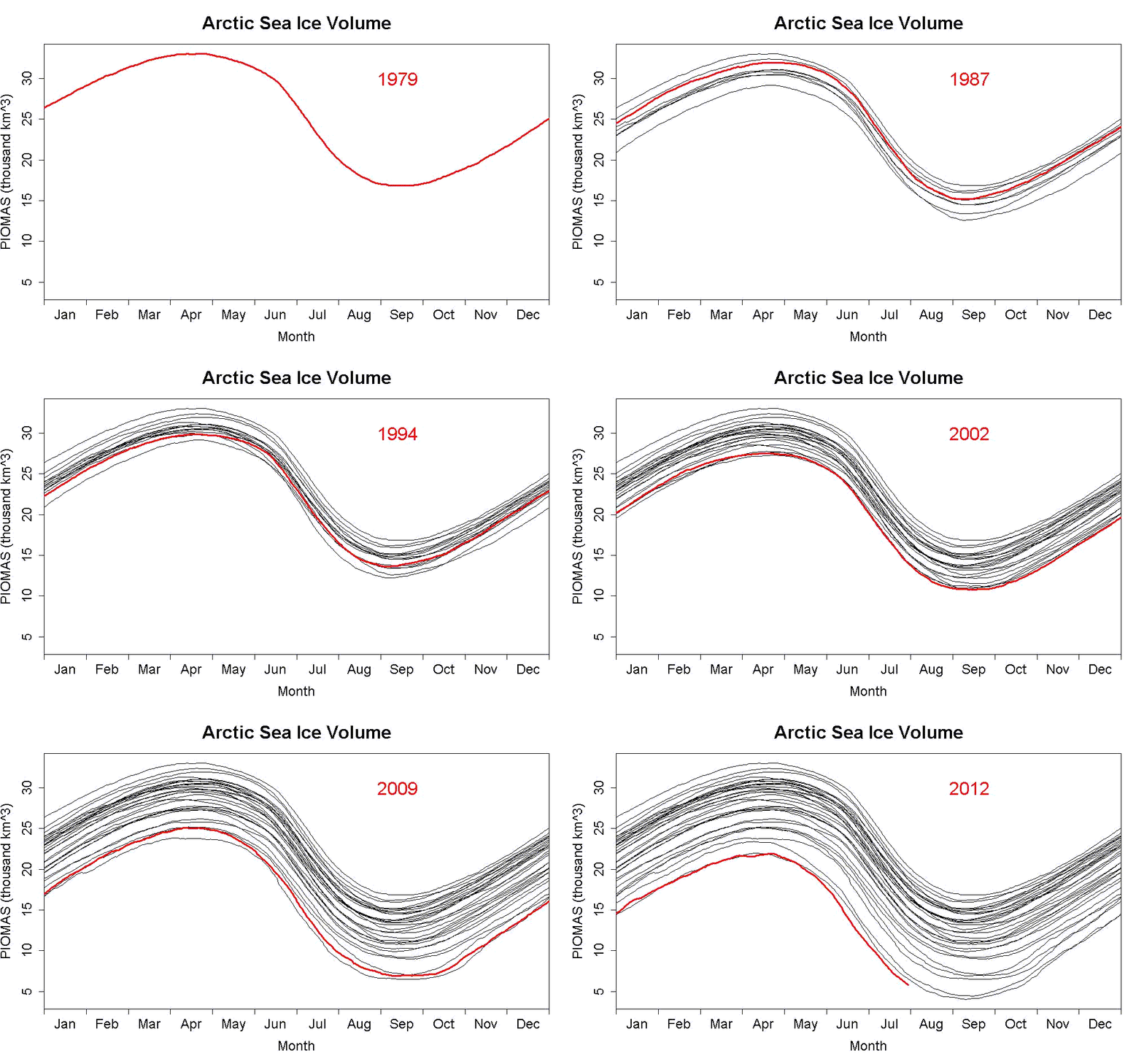
I am prepared to hold several conflicting ideas in the balance at one time, and let the data add mass to one version of the truth or another. I’m prepared to accept the possibility of low climate change sensitivity (the reaction of the Earth biosystem to global warming) – apart from the fact that the evidence is accumulating – pointing heavily towards rapid instabilities emerging on short timescales. I don’t think I ever really left behind the hope – and I’m crossing my fingers here – that some massive negative carbon feedback will arise, heroically, and stem the full vigour of climate chaos. But as time slips by, and the Arctic cryosphere continues to de-materialise before our very eyes, that hope is worn down to the barest of threads. And on energy security, I am prepared to accept the reasoning behind the IEA, BP, Shell and other projections of increasing overall energy demand between now and 2035, and the percentage of fossil fuel use that will inevitably require – apart from the fact that some evidence points towards increasing uncertainties in energy provision – if we are relying on more complex and inaccessible resources, within the framework of an increasingly patchy global economy. If access to energy becomes threatened for more people globally, and also if climate change becomes highly aggressive in terms of freshwater stress, then I doubt that human population growth can carry on the way it has been – and in addition the global economy may never recover – which means that overall energy demand will not grow in the way that oil and gas companies would like their shareholders to accept. My impression is that energy producing companies and countries are not openly admitting the risks. If energy supply chaos sets in, then the political and governance ramifications will be enormous, especially since the energy industry is so embedded in administrations. It is time, in my view, that projections of world energy use to 2035 included error bars based on economic failure due to energy chaos. What do I need to do – given these pragmatic positions ? I need to include realists in the crisis talks – pragmatic, flexible thinkers from the energy industry. Just as we are not going to solve climate change without addressing energy provision, we are not going to solve energy insecurity without addressing climate change impacts on energy infrastructure. And so I need to find the energy industry people, meet them and invite them to the discussions on the risks of chaos. I need people to take in the data. I need people to understand the problems with slipping back into “thinking as usual”. As to the setting – whether I should be an employee or an independent advisor/adviser, consultant or a researcher, I don’t have any idea what would be best. Collaborators would be useful – as I am but one person with a track record of being rather awkward – despite trying to engage my best behaviour. But then, nobody’s perfect. In a sense it doesn’t matter who does the job, but we have to break the public relations-guided psychology of denial. People are not generally stupid, and many are snapping out of their drip-fed propaganda delusions. I wonder exactly how many other imperfect people are out there who are coming to the same conclusions ? And what will be the game changer ? | |


Categories
Academic Freedom Advertise Freely Bait & Switch Be Prepared Big Picture Big Society Carbon Army Carbon Capture Climate Change Conflict of Interest Contraction & Convergence Corporate Pressure Dead End Dead Zone Deal Breakers Delay and Deny Demoticratica Disturbing Trends Divide & Rule Dreamworld Economics Emissions Impossible Energy Change Energy Denial Energy Insecurity Energy Revival Financiers of the Apocalypse Fossilised Fuels Freemarketeering Gamechanger Global Warming Green Investment Growth Paradigm Human Nurture Hydrocarbon Hegemony Incalculable Disaster Landslide Libertarian Liberalism Low Carbon Life Major Shift Mass Propaganda Media National Energy National Power Neverending Disaster No Blood For Oil No Pressure Not In My Name Optimistic Generation Paradigm Shapeshifter Peak Emissions Peak Energy Peak Oil Petrolheads Policy Warfare Political Nightmare Protest & Survive Realistic Models Regulatory Ultimatum Renewable Resource Revolving Door Social Capital Social Change Social Chaos Solution City Stirring Stuff Sustainable Deferment The Data The Power of Intention The War on Error Wasted Resource Western Hedge
George Monbiot : Peak Agitation
My electronic mail inbox and Twitter “social media” timeline are full of people sparking and foaming about George Monbiot’s latest kow-tow to American academia. Apparently, he has discarded the evidence of many, many researchers, energy engineers and market players and poured luke-warm, regurgitated scorn on the evidence and inevitability of “Peak Oil”.
The level of agitation contradicting his stance has reached a new peak – in fact, I think I might claim this as “Peak Agitation”.
Here is just one example from Paul Mobbs, author of “Energy Beyond Oil”, and a multi-talented, multi-sectoral educator and researcher.
I initially read it in my inbox and nearly fell of my chair gobsmacked. When I had recovered from being astonished, and asked Mobbsey if I could quote him, perhaps anonymously, he wrote back :-
“No, you can quite clearly and boldly attach my name and email address to it ! And perhaps ask George for a response ?”
Sadly, George Monbiot appears to have jammed his thumbs in his ears as regards my commentary, so he is very unlikely to read this or become aware of the strength of opposition to his new positioning. But anyway – here’s for what’s it’s worth (and when it comes from Paul Mobbs, it’s worth a great deal) :-
Re: Peak oil – we were wrong. When the facts change we must change.
Hi all,
I’ve sat patiently through the various emails between you all — mainly to
take soundings of where you’re all at on this matter. In addition, over the
last few days I’ve separately received four dozen or so emails all asking
to “take on” Monbiot. I wasn’t going to reply because I’ve so many more
pressing matters to take care of, but given the weight of demands I can’t
avoid it.
I don’t see any point in “taking on” Monbiot; the points he raises, and the
debate that he has initiated, are so off beam compared to the basis of the
issues involved that it there’s no point proceeding along that line of
thought. You can’t answer a question if the question itself is not
understood!!
Let’s get one thing straight — present economic difficulties are not simply
to do with “oil”, but with the more general issue of “limits to growth”.
That’s a complex interaction of resource production, thermodynamics,
technology, and relating all of these together, economic theory. Reducing
this just to an issue of oil or carbon will fail to answer why the trends
we see emerging today are taking place. Instead we have to look towards a
process which sees energy, resources, technology and human economics as a
single system.
The problem with this whole debate is that those involved — Monbiot
included — only have the vaguest understanding of how resource depletion
interacts with the human economy. And in a similar way, the wider
environment movement has been wholly compromised by its failure to engage
with the debate over ecological limits as part of their promotion of
alternative lifestyles. Unless you are prepared to adapt to the reality of
what the “limits” issues portends for the human economy, you’re not going
to make any progress on this matter.
Monbiot’s greatest mistake is to try and associate peak oil and climate
change. They are wholly different issues. In fact, over the last few years,
one of the greatest mistakes by the environment movement generally (and
Monbiot is an exemplar of this) has been to reduce all issues to one
metric/indicator — carbon. This “carbonism” has distorted the nature of
the debate over human development/progress, and in the process the
“business as usual” fossil-fuelled supertanker has been allowed to thunder
on regardless because solving carbon emissions is a fundamentally different
type of problem to solving the issue of resource/energy depletion.
Carbon emissions are a secondary effect of economic activity. It is
incidental to the economic process, even when measures such as carbon
markets are applied. Provided we’re not worried about the cost, we can use
technological measures to abate emissions — and government/industry have
used this as a filibuster to market a technological agenda in response and
thus ignore the basic incompatibility of economic growth with the
ecological limits of the Earth’s biosphere. As far as I am concerned, many
in mainstream environmentalism have been complicit in that process; and
have failed to provide the example and leadership necessary to initiate a
debate on the true alternatives to yet more intense/complex
industrialisation and globalisation.
In contrast, physical energy supply is different because it’s a prerequisite
of economic growth — you can’t have economic activity without a
qualitatively sufficient energy supply (yes, the “quality” of the energy is
just as important as the physical scale of supply). About half of all
growth is the value of new energy supply added to the economy, and another
fifth is the result of energy efficiency — the traditional measures of
capital and labour respectively make up a tenth and fifth of growth. As yet
mainstream economic theory refuses to internalise the issue of energy
quality, and the effect of falling energy/resource returns, even though this
is demonstrably one of the failing aspects of our current economic model
(debt is the other, and that’s an even more complex matter to explore if
we’re looking at inter-generational effects).
The fact that all commodity prices have been rising along with growth for
the past decade — a phenomena directly related to the human system hitting
the “limits to growth” — is one of the major factors driving current
economic difficulties. Arguably we’ve been hitting the “limits” since the
late 70s. The difficulty in explaining that on a political stage is that
we’re talking about processes which operate over decades and centuries, not
over campaign cycles or political terms of office. As a result, due to the
impatience of the modern political/media agenda, the political debate over
limits has suffered because commentators always take too short-term a
viewpoint. Monbiot’s recent conversion on nuclear and peak oil is such an
example, and is at the heart of the report Monbiot cites in justification of
his views — a report, not coincidentally, written by a long-term opponent
of peak oil theory, working for lobby groups who promote business-as-usual
solutions to ecological issues.
Likewise, because the neo-classical economists who advise governments and
corporations don’t believe in the concept of “limits”, the measures they’ve
adopted to try and solve the problem (e.g. quantitative easing) are not
helping the problem, but merely forestall the inevitable collapse. For
example, we can’t borrow money today to spur a recovery if there will be
insufficient growth in the future to pay for that debt. Basically, whilst you
may theoretically borrow money from your grandchildren, you can’t borrow
the energy that future economic growth requires to generate that money if
it doesn’t exist to be used at that future date. Perhaps more perversely, a
large proportion of the economic actors who have expressed support for
limits are not advocating ecological solutions to the problem, they’re
cashing-in by trying to advise people how to make money out of economic
catastrophe.
Carbon emissions and resource depletion are a function of economic growth.
There is an absolute correlation between growth and carbon emissions. I
don’t just mean that emissions and the rate of depletion fall during
recessions — and thus “recessions are good for the environment”. If you
look at the rate of growth in emissions over the last 50 years, the change
in energy prices has a correlation to changes in carbon emissions as the
price of fuel influences economic activity. That’s why carbon emissions
broke with their historic trend, halving their previous growth rate, after
the oil crisis of the 1970s; and why they then rebounded as energy prices
fell during the 90s.
The idea that we can “decarbonise” the economy and continue just as before
is fundamentally flawed. I know some of you will scream and howl at this
idea, but if you look at the research on the interaction between energy and
economic productivity there is no other conclusion. Due to their high
energy density and relative ease of use, all fossil fuels have an economic
advantage over all the alternatives. That said, as conventional oil and gas
deplete, and “unconventional” sources with far lower energy returns are
brought into the market, that differential is decreasing — but we won’t
reach general parity with renewables for another decade or two.
Note also this has nothing to do with subsidies, or industrial power —
it’s a basic physical fact that the energy density of renewables is lower
than the historic value of fossil fuels. On a level playing field, renewable
energy costs more and has a lower return on investment than fossil fuels.
We do have the technology to develop a predominantly renewable human
economy, but the economic basis of such a system will be wholly different to
that we live within today. Unless you are prepared to reform the economic
process alongside changing the resource base of society, we’ll never
see any realistic change because all such “ecological” viewpoints are
inconsistent with the values at the heart of modern capitalism (that’s not
a political point either, it’s just a fact based upon how these systems
must operate). E.g., when the Mail/Telegraph trumpet that more wind power
will cost more and lower growth/competitiveness, they’re right — but the
issue here is not the facts about wind, it’s that the theory/expectation of
continued growth, which they are measuring the performance of wind against,
is itself no longer supported by the physical fundamentals of the human
economy.
The present problem is not simply “peak oil”. Even if volumetric production
remained constant, due to the falling level of energy return on investment
of all fossil fuels the effects of rising prices and falling systemic
efficiency will still disrupt the economic cycle (albeit at a slower rate
than when it is tied to a simultaneous volumetric reduction). Allied to the
problems with the supply of many industrial minerals, especially the
minerals which are key to the latest energy and industrial process/energy
technologies (e.g. rare earths, indium, gallium, etc.), what we have is a
recipe for a general systems failure in the operation of the human system.
And again, that’s not related to climate change, or simple lack of energy,
but because of the systemic complexity of modern human society, and what
happens to any complex system when it is perturbed by external factors.
The worst thing which can happen right now — even if it were possible,
which is entirely doubtful — would be a “return to growth”. The idea of
“green growth”, within the norms of neo-classical economics, is even more
fallacious due to the differing thermodynamic factors driving that system.
Instead what we have to concentrate upon is changing the political economy
of the human system to internalise the issue of limits. At present, apart
from a few scientists and green economists on the sidelines, no one is
seriously putting that point of view — not even the Green Party. And as I
perceive it from talking to people about this for the last 12 years, that’s
for a very simple reason… it’s not what people, especially the political
establishment, want to hear.
Rio+20 was an absolute failure. In fact what annoyed me the most was that
the media kept talking about the “second” Rio conference, when in fact it
was the third UNCED conference in the Stockholm conference in ’72. If you
contrast 1972 with 2012, the results of this years deliberations were worse
than the policies sketched out in the 70s ! Seriously, the environment
movement is being trounced, and as I see it that’s because they have lost
the intellectual and theoretical rigour that it possessed in the 70s and
80s. Rather than having a clear alternative vision, what they promote is
“the same but different”. Once environmentalism became a media campaign
about differing consumption options, rather than an absolute framework for
evaluating the effects of consumption, it lost its ability to dictate the
agenda — because its the ability to look forward and observe/anticipate
trends unfolding, however unwelcome those truths might be, which gives
groups political power.
Politicians have lost control of the economy because their materialist
ambitions no longer fit to the extant reality of the economic process. This
outcome was foreseen over 40 years ago by economists like Georgescu-Roegen
and Boulding but ignored, even amongst many liberals and especially the
left, for political reasons. These same principles, based around the issue
of limits, were also the founding reality of the modern environment
movement — but over the last 20 years the movement has lost this basic
grounding in physics and economics as it has moved towards an
aspirationally materialist agenda (green consumerism/sustainable
consumption, etc.).
Unless you’re prepared to talk about limits to growth, and the fact that
the economic theories developed over two centuries of unconstrained
expansion now have no relevance to a system constrained by physical limits,
then you will not solve this problem. Just as with Monbiot’s “change” on
the issue of nuclear, his failure is a matter of basic theory and
methodological frameworks, not of facts or data. Unfortunately people keep
throwing data at each other without considering that the framework within
which those facts are considered and understood has changed, and that
consequently their conclusions may not be correct; and until the movement
accepts that the rules governing the system have changed we’ll not make
progress in advancing viable solutions.
To conclude then, Monbiot’s mistake isn’t about peak oil, or climate
change, it’s a failure to internalise the physical realities of the
“limits” now driving the human system. Unless you consider the interaction
of energy, economics and pollution, any abstractions you draw about each of
those factors individually will fail to tell you how the system as a whole
is functioning. Those limits might dictate the end of “growth economics”,
but they DO NOT dictate the end of “human development”. There are many ways
we can address our present economic and environmental difficulties, but that
cannot take place unless we accept that changing our material ambitions is
a prerequisite of that process.
Let’s be clear here. The principles which drive the economy today would be
wholly alien to Adam Smith, John Stuart Mill and others who first laid down
the rules of the system two centuries ago. Likewise Marxism and similarly
derived ideas have no validity either because they were generated during an
era when there were no constraining limits. There is no “going back” to
previous theories/ideologies on this issue because we face a scenario today
which humans society — with the exception of those ancient societies who
experienced ecological overshoot (Rome, Mayans, Easter Islanders, etc.) —
have never had to face before.
We have to move forward, to evaluate and understand is the role of
ecological limits within the future human economic process and how this
changes our advocacy of “solutions”. That debate should be at the heart of
the environment movement, and the issue of limits should lead all
discussions about all environmental issues — not green/sustainable
consumerism and other measures which seek to reassure and pacify affluent
consumers. That said, especially given the demographic skew within
membership of the environment movement, we have to begin by being honest
with ourselves in accepting the “limits agenda” and what it means for the
make-up of our own lives.
In the final analysis, you cannot be an environmentalist unless you accept
and promote the idea of limits. That was at the heart of the movement from
the early 70s, and if we want to present a viable alternative to disaster
capitalism then that is once again what we must develop and promote as an
alternative.
Peace ‘n love ‘n’ home made hummus,
P.
—
.
“We are not for names, nor men, nor titles of Government,
nor are we for this party nor against the other but we are
for justice and mercy and truth and peace and true freedom,
that these may be exalted in our nation, and that goodness,
righteousness, meekness, temperance, peace and unity with
God, and with one another, that these things may abound.”
(Edward Burrough, 1659 – from ‘Quaker Faith and Practice’)
Paul’s book, “Energy Beyond Oil”, is out now!
For details see https://www.fraw.org.uk/mei/ebo/
Read my ‘essay’ weblog, “Ecolonomics”, at:
https://www.fraw.org.uk/mei/ecolonomics/
Paul Mobbs, Mobbs’ Environmental Investigations
email – mobbsey@gn.apc.org
website – https://www.fraw.org.uk/mei/index.shtml
Categories
Academic Freedom Bioeffigy Biofools Carbon Commodities Corporate Pressure Feed the World Food Insecurity Foreign Investment Forestkillers Freshwater Stress Genetic Modification Genetic Muddyfixation Green Investment Green Power Mass Propaganda Media Near-Natural Disaster Public Relations Pure Hollywood Social Capital Social Change Social Chaos Solution City Technofix Technomess The Myth of Innovation The War on Error Toxic Hazard Tree Family Unconventional Foul Ungreen Development Unutterably Useless Utter Futility Vain Hope Water Wars Western Hedge
BP Biofuels : Murders & Acquisitions ?

[ The empty billboard at Highams Park train station, that had previously boasted an advertisement for BP’s Olympic public relations mission, after I complained about it. ] | I can see it now – a shimmering summer London afternoon – the heat radiating from the newly constructed sports track, and all television eyes on the shiny BP Biofuels filling station.
Oh, you’ll have choice. Which “green” fuel shall we choose for the Olympic village van ? Bioethanol, biodiesel or biobutanol ? The bright white and metal filling station will be glowing like an saving angel in a storm, with the friendly, homely green and yellow BP star flower tattooed across it. |
| But while you’re drinking in the public relations, “Oh look ! BP goes green !”, you will be living a distraction, like a child hypnotised by glinting gemstones. You will not be looking further than the pump station podium, to the full context, where lies a narrative rich in troubling complexity, harrowing tales that somehow never quite make it to the bread-and-circus mainstream media.
1. BP Biofuels is growing by acquisition, not in-house development It is clear from the outset that BP Biofuels is a greenwash mirage – the “world class” fossil fuel oil and gas company are not tending to dirty their engineers’ hands with actually making biofuels themselves. What BP Biofuels has been doing is leveraging their ecological reputation by making purchases of already-existing companies – for example, Tropical Bioenergia in Brazil. Where they have entered into a more joint venture, things are a bit rocky, for example, at Vivergo Fuels in Hull, England, which was due to open in early 2012, no, I mean “late spring”, no actually “later in the year”. And where they have been unable to acquire or merger, they’ve been taking to the law courts to suppress the competition, as with Gevo in Minnesota in the United States of America. 2. Land grabbing in the Brazilian Cerrado and the socioeconomic fallout Although BP Biofuels are claiming that they are developing advanced biofuels with due care for sustainability, there are continuing problems with land use change in the Brazilian Cerrado, which is documented as displacing indigenous people, and perhaps even partly behind the murder of social activists in the region. BP Biofuels is making use of the highly unequal Brazilian economy by using low-skilled or unskilled landless people in the area. As usual, the BP company reports focus on the safety of their employees – they claim that mechanisation of sugarcane harvesting is improving the wellbeing of their workers – but they are not addressing the economic disadvantage that forces people to work for extremely low wages in this business. 3. Ecosystem destruction by agrifuel/agrofuel farming Sugarcane plantations have been highlighted as causing detrimental effects to soils, even causing stress on local water supplies. 4. The GM crop menace At least one company specialising in the sale of agrochemicals, I mean genetically modified crops adapted for use with patented agrochemicals, is active alongside the BP Biofuels concerns. It is possible that there will be extensive crossover between the energy and GM crops companies – not only in the ownership of the genome of energy crops such as GM sugarcane, but also GM trees – to be used to build carbon credits for the large international companies growing plantations in Brazil. 5. Buggy biofuels will remain a niche in the vehicle fuel market Biofuels made by any process that involves microorganisms suffer from one unique problem – speed – or rather, lack of it. There does not appear to be much evidence that any bio-activated production of biofuels – whether it be fermentation for ethanol, or algae grown for oil – can be sped up. This indicates that biofuels grown from bugs are likely to remain relatively small-scale in the global fuels markets – adding weight to the arguments from companies such as BP for drilling for fossil fuels in the Arctic Ocean and offshore in Africa, South America and Asia. [ NOTE WELL : Before you mentino it, yes, this post does not have much in the way of links, in fact, none at all. That’s because I’m still compiling sources on this subject and hope to write it up properly later on. If you’re keen to find out more, Google knows everything, just about. ] | |
Categories
Academic Freedom Assets not Liabilities Big Number Big Picture Big Society British Biogas Burning Money Carbon Capture Corporate Pressure Direction of Travel Dreamworld Economics Efficiency is King Electrificandum Emissions Impossible Energy Change Energy Insecurity Energy Revival Energy Socialism Foreign Interference Foreign Investment Fossilised Fuels Freemarketeering Green Investment Green Power Hydrocarbon Hegemony Insulation Low Carbon Life Marine Gas Methane Madness Methane Management Money Sings National Energy National Power Not In My Name Nuclear Nuisance Nuclear Shambles Optimistic Generation Paradigm Shapeshifter Peace not War Peak Coal Peak Emissions Peak Energy Peak Natural Gas Policy Warfare Political Nightmare Price Control Realistic Models Regulatory Ultimatum Renewable Gas Renewable Resource Resource Wards Shale Game Solution City Stop War The Power of Intention The Price of Gas Unconventional Foul Ungreen Development Unnatural Gas Wasted Resource Western Hedge Wind of Fortune Zero Net
Gas in the UK (3)
 | Bursting the Nuclear Bubble
The UK Government appear to have seen the light about their, frankly, rubbish plan to covertly invest in (by hidden subsidies) a spanking new fleet of nuclear power reactors. Dogged by Electricite de France (EdF) as they have been, with Vincent de Rivaz continuing to proffer his begging bowl with outstretched pleading arms, it just might be that before the Energy Bill is finally announced – |
| when the Electricity Market Reform (EMR) dust has settled – that this new thinking will have become core solidity.
After all, there are plenty of reasons not to support new nuclear power – apart from the immense costs, the unclear costs, the lack of immediate power generation until at least a decade of concrete has been poured, and so on (and so forth). Gas is Laughing It appears that reality has bitten – and that the UK Government are pursuing gas. And they have decided not to hatch their eggs all in one basket. First of all, there’s a love-in with Statoil of Norway :- https://www.decc.gov.uk/en/content/cms/news/pn12_072/pn12_072.aspx Then, there’s the new “South Stream” commitment – the new Azerbaijan-European Union agreement, spelled out in a meeting of the European Centre for Energy and Resource Security (EUCERS) on 12th June at King’s College, London :- https://www.eucers.eu/2012/06/07/5-eucers-energy-talk-the-southern-gas-corridor-at-the-home-stretch/ Meanwhile, the “North Stream” gas pipeline is going to feed new Russian gas to Europe, too (since the old Siberian gas fields have become exhausted) :- https://www.bbc.co.uk/news/world-europe-15637244 And then there’s the amazing new truth – Natural Gas is a “green” energy, according to the European Union :- https://www.guardian.co.uk/environment/2012/may/29/gas-rebranded-green-energy-eu The UK will still be importing Liquified Natural Gas (LNG) from our good old friends in Qatar. Never mind the political interference in the nearby region and the human rights abuses, although NATO could be asked to put a stop to that if Europe needed to bust the regime in order for their energy companies to take ownership of the lovely, lovely gas. I mean, that’s what happened in Iraq and Libya, didn’t it ? A Fossilised Future So, despite all the green noises from the UK Government, the underlying strategy for the future (having batted away the nuclear buzzing insects around the corpse of British energy policy), is as Steve Browning, formerly of National Grid says – “gas and air” – with Big Wind power being the commercialisable renewable technology of choice. But not too much wind power – after all, the grid could become unstable, couldn’t it, with too much wind ? There are several problems with this. First, the commitment to fossil fuels – even Natural Gas with its half the emissions profile of coal – is a risky strategy, despite making sure that supplies are secure in the near term. The reasons for this are geological as well as geopolitical. Natural Gas will peak, and even the UK Government accepts that unconventional gas will not keep fossil gas going forever – even with the “18 years” ultimate recoverable from under Lancashire of shale gas (that’s “18 years” of current gas annual demand – but not all drilled at once – perhaps amounting to about 1.5% of current UK gas supply needs per year, stretched out over 40 years) , and the billion tonnes of coal that can be gasified from under the sea off the east coast of England. As long as Carbon Capture and Storage can work. Not only will Natural Gas peak and start to decline in the UK, it will also peak and decline in the various other foreign resources the UK is promising to buy. By simple logic – if the North Sea gas began depletion after only 30 years – and this was a top quality concentrated resource – how soon will poorer quality gas fields start depleting ? Whilst I recognise the sense in making Natural Gas the core strategy of UK energy provision over the next few decades, it can never be a final policy. First off, we need rather more in terms of realistic support for the deployment of renewable electricity. People complained about onshore wind turbines, so the UK Government got into offshore wind turbines, and now they’re complaining at how expensive they are. Then they botched solar photovoltaics policy. What a palaver ! Besides a much stronger direction for increasing renewable electricity, we need to recognise that renewable resources of gas need to be developed, starting now. We need to be ready to displace fossil gas as the fossil gas fields show signs of depletion and yet global demand and growth still show strength. We need to recognise that renewable gas development initiatives need consistent central government financial and enabling policy support. We need to recognise that even with the development of renewable gas, supplies of gas as a whole may yet peak – and so we need to acknowledge that we can never fully decarbonise the energy networks unless we find ways to apply energy conservation and energy efficiency into all energy use – and that this currently conflicts with the business model for most energy companies – to sell as much energy as possible. We need mandates for insulation, efficient fossil fuel use – such as Combined Heat and Power (CHP) and efficient grids, appliances and energy distribution. Since energy is mostly privately owned and privately administered, energy conservation is the hardest task of all, and this will take heroic efforts at all levels of society to implement. | |
Categories
Academic Freedom Alchemical Assets not Liabilities Be Prepared Big Number Big Picture British Biogas Burning Money Carbon Capture Carbon Pricing Carbon Taxatious Climate Change Corporate Pressure Design Matters Direction of Travel Dreamworld Economics Drive Train Efficiency is King Electrificandum Emissions Impossible Energy Autonomy Energy Insecurity Energy Revival Engineering Marvel Fossilised Fuels Freemarketeering Gamechanger Gas Storage Global Warming Green Investment Green Power Growth Paradigm Hydrocarbon Hegemony Hydrogen Economy Low Carbon Life Major Shift Methane Management Money Sings National Energy National Power Nuclear Nuisance Nuclear Shambles Nudge & Budge Optimistic Generation Paradigm Shapeshifter Peak Coal Policy Warfare Political Nightmare Price Control Realistic Models Regulatory Ultimatum Renewable Gas Shale Game Solution City Sustainable Deferment Technofix Technological Fallacy Technological Sideshow The Myth of Innovation The Power of Intention The Price of Gas The War on Error Unconventional Foul Unnatural Gas Utter Futility Vain Hope Voluntary Behaviour Change Wasted Resource Zero Net
Gas in the UK (2)
…Continued from https://www.joabbess.com/2012/06/12/gas-in-the-uk/
Questions from the floor
[Tony Glover]
…increasing electricification of heat and transport. I was interested in what Doug said about heat. [If energy conservation measures are significant and there is] a significant reduction in gas use for heat…interested in the Minister’s response.
[Terry ? (Member of PRASEG)]
I’m interested in gas that would need CCS [Carbon Capture and Storage] [in future] …[since there would be no restriction there would be an] incentive to build new gas in next few years away from CCS-usable infrastructure. Maybe encouraging gas stations over next few years to be built in view of CCS.
[ ? ]
[There have been mentions of the] Gas [generation] Strategy and gas storage. Is it your intention to have both in the Energy Bill ? [Need to improve investor confidence.]
[Charles Hendry MP] I’m more confident than Doug on CHP…[in respect of energy conservation we will begin to increase our use of] CHP [Combined Heat and Power], geothermal energy, don’t need District Heating. I think we’ll see more people switch to electric heating. The likely pricing on gas will mean people have to look at other sources – such as localised heat storage, intelligent ways to produce hot water and heat in their homes […for example, a technology to store heat for several days…] The first [new gas power] plants will be where they are already consented – where originally coal plants – need to have identified in advance – no new plant is consented unless…We’ve asked Ofgem to ask re securing gas supplies. If we can stretch out the tail of North Sea gas – can stretch it out 30 – 40 years […] technology […] Centrica / Norway […] develop contracts […] Is there a role for strategic storage [Centrica asking] […] Buying and selling at the wrong price (like the gold) [widespread chuckling in the room]. Some of it may not need legislation. Gas Strategy will be published before the Energy Bill.
[David Cox] Get very nervous about gas storage. Don’t think there’s a need to put financial incentives in place to increase gas storage. We think the hybrid gas market is successful – a market and regulatory framework – [gas storage incentives] could damage.
[Doug Parr] I’m not downbeat because I want to be downbeat on heat. [Of all the solutions proposed none of them show] scaleability, deliverability. I’d love that to come true – but will it ? […] Heat pumps ? Biogas is great but is it really going to replace all that gas ? If we’re going to be using gas we need to make the best use of it […] Issues around new plant / replacement – all about reducing risks no exposing ourselves to [it] – security of supply, climate risks, issues about placement [siting of new plant]. If CCS can really be made to work – it’s a no-brainer – do we want all that carbon dioxide in the atmosphere or … ? Our entire policy becomes dependent on a technology that hasn’t even been demonstrated. Other technologies that people thought were great – years later they still haven’t arrived [for example, rooftop wind turbines]. If we say CCS is the only way it’s going to work – what’s Plan B ? We are going to use [fossil fuels] – should not become wholly dependent on technology not yet demonstrated.
[Alan Whitehead] Perhaps people should be asked – which would you prefer – a CHP / DH [Combined Heat and Power / District Heating] plant in the valley here, or a couple of wind turbines on that hill ? That would [shake things up].
Questions from the floor
[ X ? ] See […] as the ultimate destination. Most important – gas can be made zero carbon – not pie in the sky. 1. Start contributions of carbon-neutral gas and 2. will need far less if [we act] like Japan – force installation of microCHP. Their aim is to do same as for washing machines [bring prices down – make widely available for the home]. MicroCHP [with] heat pumps – reduction as good as decarbonising gas or electricity. But can also decarbonise gas.
[ X ? ] The Minister mentioned the importance of CHP but recently dropped […] mandate. If CHP so important what measures is the Government taking to ensure its installation ?
[ X ? ] Electricity is a rubbish fuel for heating buildings – very peaky load – need something cheap to store, cheap to […]. Fits very well with forcing down demand. Where we’re getting our gas from. At the moment our waste is being incinerated. For a cheap additional cost, where currently incinerating we can do anaerobic digestion [AD], producing a fungible asset – the gas – can gradually decarbonise our grid.
[ Thomas Grier ? ] …a decision [?] of London – CHP in London over the next few years. If we want to use electricity for heat, we need to reinforce the electricity grid [by 60% to 90% ?] In rural situations – use electrical heating. In urban, use decarbonised energy. [This model projection] shows the gas grid disappearing – it will collapse at some point if all we have on the gas grid is cooking.
[ X ? ] …[encouraged CHP then a few days later] stood up then said all support [removed ?] for CHP next year. A Heat Strategy that said there is enormous [scope / potential] for CHP. We want to see gas, we want to see efficiency. Are we moving towards […] without it they won’t build it.
[David Cox] Microgeneration – couldn’t get it down economically. Reliability [issues]. Full supporter of biogas – AD got a contribution to make – but never more than 5% – no matter how much [we crack it]. Electricity is not very good for heating – but how to we decarbonise the heat sector ? Always been an advocate of CHP. Government need to do more incentivising of that.
[Charles Hendry MP] Innovation and invention […] Government can’t support all emerging technologies. Best brains around the world [are working on] how we move fundamentally in a low carbon direction. On the waste hierarchy – burning of waste should be the final stage – finding a better use for it. [I visited] the biggest AD plant in Europe in Manchester – biogas and electricity generation. We are seeing Local Authorities taking a more constructive long-term view on how to manage waste. CHP – we all want to see more of it – to what extent does it need support ? That depends on whether new build – building a community around it. [By comparison, urban retrofitting is probably too expensive] Iceland [took the decision and] retrofitted almost every home – I’m now more convinced than before. What is the right level of subsidy and what makes good economic case ?
[Doug] We do keep missing opportunities. [For example in Wales, Milford Haven, the new Combined Cycle Gas Turbine at the Liquified Natural Gas (LNG) refinery to process the gas] should have been CHP. I am enthusiastic about lots of heat technologies [but the same questions/issues apply] scaleability and deliverability. District heating [DH] – an infrastructure asset ! [Can change priorities about what gets built – for example in Denmark (?)] they’re building large-scale solar farms to top up the DH. In the Treasury’s infrastructure plan [see DH could be…] Heat is the poor relation in energy debate. Other networks have been identified in the National Policy Statements (NPS) – but not heat.
[ Leonie Green, Renewable Energy Association ] [I must] defend heat pumps. In Sweden 90% of new builds [hav e heat pumps ?] – heat pump efficiency is a function of the energy-efficiency of the building […] Just on AD – National Grid report said it could provide 50% [of the nation’s supply. Our members think] that’s a bit too high – we think 25%. My question is really about the benefits. We are hearing anxiety about costs, but it’s piecemeal on benefits. We’ve been strong on jobs, balance of trade, exports [all benefits of renewable energy investment and deployment]. Pleased to see DECC put out [report from] Oxford Economics [on the] wider economic benefits. How can we get more and more balance in reports. [An example] Deutsche Bank renewable generation opportunities.
[ ? ] We would also support more than 5% from renewable gas – also about hydrogen – we used to do it when it was town gas – why not again ? As regards injecting biomethane/biogas from AD into the National Grid [last year ? to this year ?] 130 enquiries to connect AD to our network – none have progressed. Please sort these [registrations] out.
[ ? ] Minister, we’re not expecting you to fund all technologies – we need some logic – especially with transport. The Government doesn’t recognise the difference between Renewable Natural Gas if used in transport and fossil fuels. Would be simple – a tax on gas if used in a vehicle. What’s the problem over […] ?
[Colin Snape, University of Nottingham] We are looking at reducing the costs of carbon capture – we have a section of PhDs… One other gas source not mentioned – gas from underground gasification of coal [UCG]. In UK […] 2 billion tonners of coal – slightly offshore – on the energy coast of the UK – where all the action is on CCS – obviously UCG needs to be coupled with CCS to be carbon neutral. Would [be operational] in a very short time period […incentives…]. Significant proportion of UK needs.
[ ? ] What is the purpose of the Gas Strategy ? Shale gas isn’t a miracle. The “Golden Age of Gas” [report by the International Energy Agency (IEA)] doesn’t mean cheap gas, because [it will be put to] lots of uses. Renewable electricity and nuclear are not going to come until the 2020s. How do we avoid building loads of gas generation that is not necessary after that time ? What’s the role of mothballing (relatively cheap to bring CCGT out of mothballs comparing to build new). No sign of reduction in electricity demand reduction – therefore there will be high gas use.
[ Doug Parr ] On UCG, the IEA had two scenarios in the “Golden Age of Gas” – both took us over 3.5 degrees Celsius [in additional global warming]. Even if there is unconventional gas sources, still a huge danger of going down the road of unrestrained gas use. What is the alternative ? We should not end up becoming dependent on gas. Should not build gas to fill a short-term hole – they will lobby for their own interests – to keep open.
[ David Cox ] CCGTs won’t be built without guarantees greater than 20 years. Also renewable energy might not provide in the way that we hope. The CCC report – what caused the rise in energy prices ? The wholesale gas price – not renewable energy, green policies. However, that was slightly dishonest – the counter-factual was […] renewable energy significantly still more expensive than fossil fuel there. Until we can get costs of renewable energy down to the prices of fossil fuels… [The industry] don’t give the impression [they will build] on the basis of short-term need. Gas isn’t clean, I admit that […] CCS – that will work.
[Charles Hendry MP] A lot comes back to a need for a balanced approach – carbon targets and security of supply. If you haven’t sorted out security of supply, the electorate will not give permission to go low carbon. Gas is a hedging fuel currently but don’t know where costs going over time. As a politician, I like pipelines – know where it’s going (not like LNG, where there was limited use of new LNG import plant). If we want Scandinavian gas, we need security of demand to build the new pipeline. How we deal with issues of biomethane – in 2 years – need to make more progress. Some of these [techologies] will be gamechangers – some, look back in a couple of years… [Need a] permissive framework to allow a lot of ideas and technologies. There is no source of energy that hasn’t required subsidy in early days. Fanciful to suggest new forms of energy can come through without support. The letters we get [from the public, from constituents] are on vehicle fuel costs, not how much their gas bill went up last winter…
Official end of meeting
A gaggle of people gathered in the hallway to discuss some items further.
The Electricity Market Reform (EMR) was generally criticised – as it contains measures likely to specifically benefit nuclear power. Electricite de France was identified as very involved. The Government had said “no nuclear subsidy”, but the EMR measures are equivalent to hidden subsidies.
The Levy Cap was criticised as it would disturb investor confidence – if several nuclear reactors came on-stream in 10 years time, in the same year, they would eat up the whole subsidy budget for that year – and other technologies would lose out. If was felt that a number of the EMR proposals were “blunt instruments”, not overcoming shortcomings of former levies and subsidies.
Although the EMR was designed to addressed economic fears, it wasn’t assisting with financing risks – if anything it was adding to them. Rates of return have to be guaranteed for loans to be made – chopping and changing subsidies doesn’t allow for that.
Leonie Green said that the REA members don’t like the Premium Feed-in-Tariff (FiT). She also said later that they were not pleased about the cuts in support for AD.
Since my personal interest is in using Renewable Gas of various sources (including Biomethane / Biogas) to displace Natural Gas from the gas grid, I spoke with various people about this informally (including a woman I met on the train on my way home – who really got the argument about decarbonising gas by developing Renewable Gas, and using that to store excess renewable electricity, and use it as backup for renewable electricity. Although she did say “it won’t be done if it won’t confer benefits”.). One of the key elements for developing Renewable Gas is to create a stream of Renewable Hydrogen, produced in a range of ways. Somebody asked me what the driver would be for progress in Renewable Hydrogen production ? I said the “pull” was supposed to be the fabled “Hydrogen Economy” for transport, but that this isn’t really happening. I said the need for increased sources of renewably-sourced gas will become progressively clear – perhaps within a decade.
One of the persons present talked about how they think the Government is now coming out of the nuclear dream world – how only a few of the proposed new reactors will get built in the next decade – and how the Government now need to come up with a more realistic scenario.
It was mentioned that is appears that the Biogas technologies are going to have the same treatment as solar photovoltaics – some sort of subsidies at the start – which get cut away far too early – before it can stand on its own two feet. This was said to be the result of an underlying theory that only a fixed amount of money should be used on launching each new technology – with no thought to continuity problems – especially as regards investment and loan structures.
Categories
Academic Freedom Be Prepared Big Number Big Picture British Biogas Burning Money Carbon Capture Carbon Pricing Carbon Taxatious Coal Hell Cost Effective Design Matters Drive Train Efficiency is King Electrificandum Emissions Impossible Energy Autonomy Energy Change Energy Insecurity Engineering Marvel Foreign Interference Fossilised Fuels Gamechanger Green Investment Green Power Growth Paradigm Hydrocarbon Hegemony Low Carbon Life Marvellous Wonderful Methane Management Money Sings National Energy National Power Nuclear Nuisance Nuclear Shambles Optimistic Generation Peak Coal Peak Emissions Policy Warfare Price Control Realistic Models Regulatory Ultimatum Renewable Gas Renewable Resource Shale Game Technofix Technological Fallacy Technological Sideshow The Price of Gas The War on Error Transport of Delight Unnatural Gas Wasted Resource Wind of Fortune Zero Net
Gas in the UK
“The role of gas in the UK’s energy mix” 12 June 2012 17:30 – 18:30, Committee Room 5, House of Commons with speakers Minister of State for Energy and Climate Change, Charles Hendry; David Cox, Managing Director of The Gas Forum and Dr Doug Parr, Chief Scientist of Greenpeace UK. Chaired by Dr Alan Whitehead MP, Chairman of PRASEG, the Parliamentary Renewable and Sustainable Energy Group, who called the seminar : https://www.praseg.org.uk/the-role-of-gas-in-the-uk-energy-mix/
UNVERIFIED COMMENTS : Please check with the speakers to confirm their statements and do not take this account as verbatim.
[Alan Whitehead MP] Questions about gas. Will it be business as usual ? If not – too “much” gas ? What does that mean for Climate Change targets ? New gas generation – about 11 gigawatts coming on-stream in the next 5 years – “grandfathered” (no obligations to control emissions with Carbon Capture and Storage (CCS)) throughout the life of the power plant – does produce questions about Climate Change targets – CCS may change that landscape in the medium-term future. Question about emergence of biogas into system [which would bring] a down-trend in emissions.
[David Cox] The wonderful future that gas offers us. Have to look at whole low carbon [framework] – gas has a place. Not a war [between gas and renewable energy technologies]. Both needed [in the advance towards carbon-free] energy. Without gas, not going to make it. Make sure we can afford it. Gas has a role. The recent [International Energy Agency] IEA report on the “Golden Age of Gas” – tight gas, shale gas – has doubled reserves. Nobody knows for sure – there’s so much there. Perhaps 250 years of gas – no shortage of gas [although some of it is in] sensitive areas. Getting it from those areas with political problems. [There are uncertainties about] unconventional gas. There is plenty around the world – “pretty good”. Gas is not at war with renewables. Gas isn’t just a transition fuel – it’s a destination fuel. Got to prove CCS technically. If we can do that gas becomes a destination fuel. Can decarbonise not only electricity. Heat. Heat pumps won’t do it on their own. Sorry. [Gas can help decarbonise] transport – electrify the transport system – that’s what we believe is possible. Hope the Government will support CCS.
[Doug Parr] First and foremost – we are not going to eliminate gas from energy systems any time soon – don’t think of gas as a destination – I would warn against policy that gas is allowed to become the default and become too dependent on gas. A lot of policy on gas – but only over part of the energy system [electricity]. Heat is going to rely on gas fo a long time. If follow the Committee on Climate Change (CCC) logic – [heat is a] strategic sector – to getting away from carbon emissions. If gas is going to be what gets us out of energy problems – the so-called “trilemma” of decarbonisation, security [of supply] and cost. [New gas power plants amount to] 11 gigawatts [GW] over the next 5 years – 120 TWh – a quarter of current gas [still in service] out to 2030. If one take CCC target of 50 gC / KWh (grammes of carbon per kilowatt hour). Look at CCGT [Combined Cycle Gas Turbine gas generation power plant in operation] – that target is a fraction of [current] unabated [CCGT] – not that great. Any substantial role of gas has to make some pretty strong assumptions about CCS. Remember, this is not yet working – let us not have a decarbonisation policy relying heavily on CCS when not at the first stage. The CCC have warned that grandfathering of the 11 GW new generation – emit without restrictions – and issue until 2045. Can’t say gas is somehow the answer to decarbonisation issues. In media – don’t [swallow] the media froth. [As for] security of supply – already going to be quite reliant on gas for heating for quite some time – hard to see [otherwise]. Heavily reliant on imports – around 80%. Where do we import our gas from ? Qatar and Norway mostly. The former head of the Navy argued [recently] changing gas prices is the single most significant factor. DECC [UK Government Department of Energy and Climate Change] recent report on price shock. REA [Renewable Energy Association] said that just by hitting renewables targets would displace £60 billion of imports. [As for] shale gas : both Ofgem research and Deutsche Bank reports that shale gas is very unlikely to help on security [of supply] issue. Citing American example [of shale gas exploitation] is just irrelevant. [So the UK Government must be] supporting gas because of costs ? The biggest rise in consumer bills is from fossil fuel [price increases]. Not renewable energy, not green energy [measures] – it’s the rise in the wholesale gas price. Is that going to stabilise and go down ? Not according to Merrill Lynch and DECC – [strong] prices for Liquid Natural Gas (LNG) and therefore for gas [as a whole, will stay]. Clearly we will be using gas – as [electricity grid load] balancing. What I’m railing about is that gas doesn’t get us out of our energy trilemma. Gas will not [save us]. We know we can deliver through renewable energy, wind – acceleration of new technologies [such as tidal] – perhaps CCS will work, who knows ? and efficient use for example Combined Heat and Power (CHP) on industrial scale. If we are using gas we are using at it’s most efficient.
[Alan Whitehead MP] [recounts tale of how he got into trouble with Twitter commentators when he insisted the recent rise in consumer energy bills was due to the rise in the cost of wholesale gas, not green energy measures] [To Charles Hendry] I’m sure you don’t Tweet.
[Charles Hendry MP] No. absolutely not. I have enough people telling me I’m wrong without… We have to look at the role of gas. It would a dereliction of Government not to look at the role of gas going forward. […mentions developments in gas production…] seismic profiling [enabling better understanding of gas fields] horizontal drilling [improving access to complex fields]. [As for] unconventional gas – the IEA “Golden Age of Gas” – but don’t assume [it’s that simple – supply may go up but] demand for gas is going to go up dramatically. Japan – major user of LNG and diesel. Consequence of Germany’s decision to close nuclear power plants – will use much more gas. China…India…growth rate – massive growth of demand. Anticipate new resources to be found – Iraq for example – but cannot assume [what has happened in the United States of America with the development of shale gas where gas prices are now] a quarter [of what they were] – a massive boost to America – will they allow this to be exported to Asia – or use cheap gas to [relocating] industry back to the USA ? Have to look at implications for us. Reasons why shale gas is different in Europe – legal [situation] – the mineral rights [in the US, these can be acquired from underneath a landowner]. Don’t have the same commercial drives as farmers in the US. The reason why gas prices collapsed in the US and not here – if we saw a price benefit here, it would go out through the [gas] interconnectors [to neighbouring countries]. For real practical reasons won’t see shal gas develop [significantly] here. [It is a] global gamechanger – but… The US is fundamentally shifting from coal to gas – with the implications for emissions. The change from coal to gas was a major driver in European control of emissions [in the 1990s] […] Investment…technology…practical constraints. EdF [Electricite de France] will go ahead with new nuclear [by the end of the year ?] but the plant will not come online until the end of the decade. Major renewable energy resources also in 2020s [not immediate] – the cost of offshore wind power is two times that of onshore. We’re saying to industry to reduce by 40% by the end of the decade – otherwise simply not affordable. Contributions from tidal, CCS ahead. It’s going to be very end of this decade to see if CCS can work. Worrying gap [in power generation between now and next decade]. Megawatts (MW) of coal being turned off in 2015. [Coal plants are] getting through their [legally permitted] generating hours too quickly. By 2023, the only nuclear plant still operational will be Sizewell B. We have to have more gas in the mix. As we look towards more intermittent resources (renewables), gas is an important source of backup. [Will have/need] a capacity mechanism to ensure [optimisation when] mismatch between supply and demand – auction to include gas – could be [North Sea] gas, gas from the interconnectors [from abroad] or demand side response [demand reduction] – a more sophisticated capacity mechanism than historical. I’m more optimistic about CCS [than Doug Parr]. CCS is a requirement. It is something we have to deliver – no scenario I’ve seen where we’re going [to be] using less coal, oil and gas than today. [Out to 2035] our basic needs [will still rely for a good percentage on] fossil fuels. Broadening CCS [demonstration competition] out to pre- and post-combustion on coal – [expand] to gas. Can be applied to gas as well as coal. I think CCS is a fundamentally critical part of this equation. If so, can see gas as a destination fuel. The GW of gas being built in the next few years [some questions] – currently gas is being mothballed [some plants being shut down effectively putting them into disuse] because of [fuel] prices. I consented more in gas and also wind on- and offshore last year. But that gas is not being built. If we want that gas built we need a more coherent strategy. Look at what is necessary to encourage that gas – and carbon emissions [reduction] alongside. EPS [Emissions Performance Standard] […] to stop unabated coal – limit 450 gC / kWh – significant proportion of plant would need CCS. But ddin’t want to disincentivise gas. Have also said a point where CCS on gas will be necessary. But if we had people building gas now and then 15, 20 years later they would have to fit very expensive [CCS] equipment… Volume of gas coming forward meets our supply issues. Over the next few years, grandfathering. If see enough gas coming through can change the mechanism in due course. [We will be] responding officially to the CCC in Autumn. Need to [fully] decarbonise electricity in the course of the 2030s if we want to meet out climate change objectives. I think that [the] reality [is that] gas and important element. Nuclear is important. Want to see significant amount of renewable energy and what Doug is calling for – significant commitment to [energy use] efficiency in the country. [We should concentrate particularly on] energy efficiency.
The meeting then opened up to questions from the floor… To Be Continued
 | You’ve had all my thoughts on Renewable Gas for free and without effort so far, but now for something you have to work for !
If you want to read an unreferenced version of my outline to Renewable Gas, you will need to email me, and commit to writing a short review of what I have written. You can leave me your genuine email address by commenting on this post – click the post title to show the comments box at the bottom of the post page. I can guarantee not to share your email address with any third party. Unless you want me to. Or unless you say something illegal or hateful. |
 Image shows capped Victorian gas light wall fitting next to a modern electric standard lamp. | Gas fuels are, and will continue to be, important in global energy, despite the projected exponential rise in renewable electricity generation from solar and wind power. Natural Gas has a far lower carbon dioxide emissions profile than coal or oil, and is providing increasing amounts of heat, light and power to industrialised countries. Gas may be regarded as competition to renewable energy, but in fact, gas of different kinds will be an enabler of the renewable energy future, filling in the sawtooth gaps in variable renewable electricity generation, and providing essential transport fuels. |
| Traditional methods of producing energy gas include mining and pumping the Earth’s fossil fuel resources. The good quality, easily accessible gas is coming to an end, and so-called “unconventional” sources are beginning to be exploited – gas locked in dense sediment and strata, in shales, coal seams and deepwater seabeds. To make energy takes energy, and unconventional gas fuels are becoming more costly to produce. Since the expense of going after poorer density, more inaccessible resources could become prohibitive, exploitation of gas from under the ground will most likely gradually be usurped by methods of making gas fuels above ground. These will need to be from sustainable resources, and so lighter-than-air fuels of the future will be Renewable Gas.
To dig deeper into how important gas is, here’s a little data disclosure on my personal home energy consumption, leaving out food, goods and transport – much of which is virtually Zero Carbon :- May 2012 Household Domestic Utility Energy Consumption May 2012 Household Domestic Utility Energy Production For the first time since having the solar electricity panels fitted, my house has become a net energy producer. The house was already producing more electricity than it used in March 2012, but the thing that kept it a net energy consumer was Natural Gas consumption – mostly used for space heating. The house used less than half the Natural Gas in March than it did in February or January, but the solar power generated was much less then than it is now – owing to the season – and so did not overtake gas demand. Hopefully now, the house will remain a net energy producer until November. Two things can be drawn from looking at all the data – first that energy consumption swings can be significant from season to season – and secondly that Natural Gas use is by far the largest part of energy consumption for most of the year. In fact, Natural Gas use is an order of magnitude larger than electricity in winter, even when some of the localised space heating is electrical. I have taken measures to reduce my space heating needs, such as only using the gas central heating when critical, and keeping the thermostat at 17 degrees C when it’s on, and installing various kinds of insulation and draught exclusion. Thermal adjustment of the home is an ongoing process of improvement, but despite all my efforts, gas use is still ten times higher in the cold months than all the power consumption. On the other hand, in the warm months, I sometimes use less gas energy than electricity. I aim to change some of the home gas appliances to electrical power, in order to further reduce my dependence on gas. However, even though I have a green electricity account, some of my power will still be coming from gas-fired power stations. Plus, it could be argued that my burning gas to heat water is more efficient than using electricity, because of the losses of conversion in the power supply grid system. Heating by electricity is almost certainly less efficient – which is why I must continue to insulate my home further. Of note, my domestic production of energy will not ever match winter consumption without utilising a new resource, as solar insolation is at its ebb then, and so moving away from gas to power will perhaps take me farther away from an overall balance between energy supply and demand. Until the United Kingdom is powered entirely by green electricity and given comfort by insulation and green heating and cooling, we will continue to be dependent on gas fuels, not just because of the variable nature of renewable energy, which gas backs up, but because it will take time to convert everything that can be converted from gas to power. This is especially important in the field of transport, where the first conversion will need to be from oil-refined fuels to gas-refined fuels as a first stage – as replacing all the vehicles with electric drive models will take a gargantuan effort, and much economic turnover. The importance of gas fuels in the next few decades during the green energy transition means that it is worthwhile to develop sustainable Renewable Gas supplies, particularly considering that once developed they can continue to be of use long into the future. | |
Categories
Academic Freedom Assets not Liabilities Big Picture Big Society British Biogas Burning Money Carbon Capture Climate Change Coal Hell Conflict of Interest Corporate Pressure Demoticratica Emissions Impossible Energy Change Energy Insecurity Energy Revival Engineering Marvel Evil Opposition Fossilised Fuels Gamechanger Global Heating Green Investment Green Power Human Nurture Hydrocarbon Hegemony Low Carbon Life Major Shift National Energy National Power Nuclear Nuisance Nuclear Shambles Optimistic Generation Paradigm Shapeshifter Peace not War Peak Emissions Peak Natural Gas Realistic Models Renewable Gas Renewable Resource Resource Wards Social Capital Social Change Solution City Technofix Technological Sideshow The Power of Intention The Price of Gas The War on Error Wasted Resource Western Hedge Zero Net
It’s got to be gas
Public Enemy Number One in energy terms has got to be burning coal to generate electricity. Although the use of some coal for domestic heating to supplement varying supplies of biomass in home stoves is going to continue to be very useful, using coal for power production is wasteful, toxic and high carbon.
Public Enemy Number Two in energy terms is nuclear power – a weight round our collective neck. Costly to build, costly to underwrite, costly to decommission: although its proponents claim it as a low carbon solution, even they admit the management of nuclear power can be polluting, risky and wasteful.
Public Energy Number Three in energy terms has to be the incredible amount of water required to keep the first two enemies in operation. Climate change is already altering the patterns of rainfall, both in geographical areas and in seasons. Any energy solutions that don’t require water supplies will be preferable.
Many environmental researchers oppose a growing dependence on Natural Gas for power generation in industrialised countries – they claim it will lock in carbon emissions production without Carbon Capture and Storage (CCS). Carbon Capture and Storage is way off in the never-never land at present, so it should not be factored in to analyses of carbon management. Ignoring CCS, it can be seen that substituting in Natural Gas power generation where coal has been the principal fuel is in fact a very good way to lower greenhouse gas emissions in the near term.
Natural Gas is not forever, not even with environmentally-ensured unconventional production, such as shale gas. Yet the Natural Gas infrastructure is highly important for developed and some parts of developing countries too. If we can re-imagine the future of gas, making gas fuels renewable, the already existing distribution of gas and appliances and equipment that use it, become a valuable asset.
The climate change crisis is an energy crisis. My position is that we need three vital things to solve this energy crisis : rationalised energy, renewable electricity and Renewable Gas. My key projection is that a 100% renewable energy world is possible, and in fact, inevitable, and to get from here to there we need to use gas fuels, but they need to become progressively renewable in order to meet the climate change crisis.
Natural Gas can not only be a “bridge fuel”. Supporting its use now, on the understanding that it will be replaced by Renewable Gas in the medium term, will enable links to be made between society and the energy industry, and break down the barricades between those who are against high carbon energy and those who sell high carbon energy.
Categories
Academic Freedom Assets not Liabilities Bad Science Bait & Switch Behaviour Changeling Big Picture Big Society Carbon Commodities Carbon Pricing Carbon Taxatious Climate Change Conflict of Interest Corporate Pressure Cost Effective Delay and Deny Demoticratica Direction of Travel Divide & Rule Dreamworld Economics Emissions Impossible Energy Change Energy Insecurity Environmental Howzat Evil Opposition Financiers of the Apocalypse Fossilised Fuels Freak Science Global Heating Global Singeing Global Warming Human Nurture Hydrocarbon Hegemony Low Carbon Life Major Shift Mass Propaganda Money Sings No Pressure Non-Science Nuclear Nuisance Nuclear Shambles Nudge & Budge Paradigm Shapeshifter Peace not War Peak Emissions Policy Warfare Political Nightmare Protest & Survive Public Relations Pure Hollywood Regulatory Ultimatum Resource Curse Science Rules Scientific Fallacy Screaming Panic Social Capital Social Change Social Chaos Social Democracy Solution City Stirring Stuff Stop War Sustainable Deferment Technofix Technological Fallacy Technological Sideshow Technomess The Data The Myth of Innovation The Power of Intention The War on Error Toxic Hazard Voluntary Behaviour Change Wasted Resource
This Is My Thesis
I have recently been awarded a postgraduate Master of Science (MSc) degree, and several of my contacts suggested that I might consider studying for the academic qualification of Doctor of Philosophy (PhD). To be awarded a doctorate, I would need to make a valuable contribution to the body of knowledge and achievement in my chosen field. I do not think that paper-based research on its own would count as taking collective human understanding a step further, and so I must consider what forms of theorising, construction, engineering, creation, experimentation, configuration, data collection, analysis and argumentation I would need to make accomplishments in, in order to gain the good review of my peers, and the acceptance of my skill. It is not enough to love Wisdom, she has to be sought out, and introduced to your friends.
My first instinct is collaborative – how can I find a place where I can nurture my learning and strategy, in co-operation with others – where I can find a welcome, and make statements and discoveries that gain me a status, get me recognition ? I want to shine, in order to become useful, to serve my fellow woman and man. I don’t want to be competitive, winning out over others, but be part of a vanguard, a flight formation, spurring each other on to make progress together, striving as a group. I’m not ambitious, except for truth, beauty and good technology. I can share acclaim and I want to bring everybody with me. We can, standing elbow to elbow, vanquish destructive forces.
Yet, this proud, altruistic aim, to be part of the pack of pioneers, to offer something helpful, is marred by reality. Whilst I want to be constructive, others adopt divisiveness, in order to isolate outliers, and clamber over others to win the crown. I must not only reserve my right to speak against the herd, I must also wield it. I am relegated to the Zone of Insignificance, the people whose voices do not count because they articulate criticism. I do not want to join those who act as if they have the only viable formulation of reality – with their patronising stance – offering to host the public conversation, claiming they are at the centre of the debate, whilst at the same time undermining others with clever cynicism and sneering dismissal of those who will not join them.
I cannot be bought, and neither can I be seduced into a false alliance. I will not support meta-narrative, nor other contrivances. But this leaves me conflicted. One of the most significant problems with public discourse on science and technology in relation to resource limits and environmental damage is the persistence of the “anti” lobby – those people who feel bound to continue to be negative about things that have not yet been resolved. Many have been anti-nuclear, anti-fossil fuels, anti-coal, anti-energy companies, anti-Government policy, anti-hijacking of the United Nations process on climate change by economists. These voices, these positions, are important, but do not own the platform, and so they continue to rage. It is impossible to make progress without having something to rally around, to have a positive flag to muster under, but people with genuine influence continue to mis-step in their proposals and policies.
I want to bridge the gaps between the social groupings – I need to – in order to offer a way forward that can put some of the anti-thesis to bed, and galvanise efforts towards real, workable, cost-effective solutions. A genuine peoples movement for progress can accrete consensus, enormous non-hierarchical power, and can even draw in its detractors if it can be seen to be working. I am going to have to step out in faith, and at much risk – for I am going to attempt to join together the direction of the energy sector with the concerns of the environmentalists. I am not going to use a marketing strategy, nor sell a public relations pill to financiers and investment funds. I am not going to paint a green picture that has no details or exists only in a dream world. I am fairly certain that everybody is going to hate me, at least for a while, but in the end, I hope they will see that I am right, as I feel I am not generally mistaken.
Since I expect to be slighted and put down, and for people to work to marginalise me, I do not expect to be adopted by an academic institution or an energy or engineering company in the pursuit of my goals. In fact, I would resist such appropriation, for I am intellectually liberated. So, my work will not be accorded a standard accolade by a respectable institution or corporate body, and in fact, since that is the case, I can choose to work in any way that I see fit. Since, according to many scientists, we do not have much time to gain global assent for workable climate change solutions, as we must have a peak in greenhouse gas emissions in the near term, I cannot measure out five or seven years to complete a body of work which would then be reviewed. Instead, I shall publish in stages, and take peer review, including negative criticism, if any should be offered, as I go.
Although I wish to be practical rather than purely written, I shall not have much access to the funds, laboratories or engineering workshops where I could do the work myself. Instead, I shall have to ask questions of those who are already doing the work I am following, and try to ascertain their progress, and make my recommendations for their advancement. I seek to investigate live uses of the technology and systems I write about – as I expect them to be put to use before I have completed documenting them. My work will therefore be literature, but I want my intelligence to be fully accessible, so I will not use academic forms of composition. I shall write in what I hope is an easy, open way, and provide a mechanism for reply. I am going to offer my work by subscription, and I hope that those who register to receive my report in sections, will participate in making my work better.
The human race needs to be for something, not merely against, in all the myriad multitude of complaints that rise up like evaporating water, or steam from boiling pots, all and every day. However, a false unity, or a crooked one, cannot help us. We need to use what we’ve already got, and only imagine small gains in technological prowess. We should stop believing in public relations and advertising. We should stop being lulled into passivity by those glossing over our concerns, or those outspending logic. We should not give up in the face of overwhelming ineptitude and embedded vested interests. We cannot overhaul everything overnight, and somebody’s got to pay for change, and so they had better be the right changes. We need to be pragmatic, and not overreach, nor over-commit ourselves where technology could fail.
I received what at first glance looked like an innocent-looking email from somebody I think is doing a pretty good job in deconstructing the appalling media treatment of science and technology :-
“Jo, Could you edit your comment down this morning so it’s significantly shorter? […] If you’re not up for shrinking it, I’ll shorten it myself this afternoon, and I probably won’t do as good a job in relation to what you are trying to get across. Thanks, […]”
Unfortunately, I do not like being warned that my comments will be edited, and possibly become less clear than the way I originally wrote them. I particularly don’t like the implication that my argument could become corrupted by somebody else editing my ideas.
My summary : open debate is being stifled.
To protest, I removed my entire comment.
Here are my original comments in full :-
=x=x=x=x=x=x=x=x=x=x=x=x=
I have to ask the question – what kind of a geek is Mark Henderson ? A former science editor of The Times, maybe, but what is his personal geek rating in science, technology and engineering ? He admits he doesn’t have a science degree, so how can he speak on behalf of science geeks ?
I listened to his interview with The Guardian’s Martin Robbins and all I picked up was static – I didn’t hear him talk about real science or real technology. However, he was careful to put in the “good box” what I call the “Mark Lynas dud duo” – the two technologies that it seems most people object to – nuclear power and GM crops. He therefore gets a first propaganda strike from me.
If I’m not mistaken, he does not have a science or research background himself, so he is unable to determine that his claim that the UEA scientists had a “culture of non-disclosure” was a myth, generated by the climate change denial echo chamber.
There were, and continue to be, reasons why researchers are not permitted to publish certain information, including the fact that data may come from other research units who cannot give authority to publish data for a variety of reasons – for example, data obtained by a country’s military services.
What this myth glosses over is the truth – there have been several decades of work by the scientific community themselves to make data collection and databases more transparent and available. Climate change scientists have in particular been working across the international borders to attempt to link data sources in a coherent way to substantiate global reporting. They’re not hiding data, they are actively working together to liberate it. Henderson needs to research this apparently glib assertion, made apparently without checking the facts. He therefore gets a second propaganda strike from me for this.
I am not surprised that Henderson aims for the jugular of the “green movement” as you report. This is a common easy target – this straw man. There is no such thing as a coherent “green movement” who have uniform beliefs and common exposure to science and research. Strike three.
It is true that there are some people who consider themselves green environmentalists who have a deep-seated distaste for nuclear power and GM crops, but who have only the barest acquaintance with the scientific knowledge of atomic energy engineering or biotechnology.
However there are a good number of very well-educated scientists who are against the exploitation of nuclear fission for energy and genetically modified plants for food and energy. The reasons that scientists oppose nuclear energy and biotechnology may not always be the same reasons that so-called environmentalists oppose atomic power and GM crops, but that doesn’t mean that the environmentalists have unfounded concerns. It is simply a category error to say that all those who oppose nuclear power and GM crops are being unscientific, or are not scientists. Strike four.
It is also a category error to equate non-governmental organisations “NGOs” with “environmentalists”, or attempt to claim the high intellectual ground as a “geek” in support of nuclear power and GM crops. Strike five and six.
The most deceptive category error of all is to claim that nuclear power and biotechnology are “science”. They are not. They are “technologies” – and technologies can go wrong – as nuclear power has spectacularly done. Strike seven.
Dick Taverne seems to have been confusing “technology” with “science” for some time now, with his group “vaingloriously” (?) named “Sense about Science”. Does he really believe that only people that think like he does are showing any sense about science ?
What happens when countries are persuaded to permit GM crop technologies, and they are universally grown – and the science actually begins, and 20 or 25 years later scientific research shows that there are significant problems ? Will we be able to say, it’s all OK, GM crops are scientific, so they must be fine, even though they cause major problems ?
Mark Henderson therefore gets seven counts of propaganda against him in my view. I therefore would humbly suggest – in the terms of Simon Singh – that his position is “bogus”.
You quote Alice Bell saying about the “tension at the heart of green NGOs” – “Too quick to reject science (GMOs) whilst, at the same time, too keen to claim scientists know the incontrovertible truth when it suits their campaigns (climate change).”
There are multiple problems with her statement from my point of view. First of all, people in “green NGOs” are not necessarily untrained in science and technology, as is hinted at by her construction.
Second, “green NGOs” are not “too quick to reject” nuclear power and GM crops – they have been rejecting the social, economic, investment and environmental risks of nuclear power and GM crops for many years.
Her implication is that there is a kneejerk, ideological response against these technologies, whereas, in fact, the “green NGOs” are often raising scientific research as the basis of their aversion to these technologies.
Third, she is surprised that “green NGOs” accept climate change science. She doesn’t seem to realise that “green NGOs” are basing their position on climate change on science in exactly the same way that they are basing their position on nuclear power and GM crops on science.
What would perhaps make her head spin is to find out that a number of “green NGOs” are against some of the proposed technological “solutions” for climate change – including Carbon Capture and Storage (too uncertain, too expensive, too fuel-hungry, not answering coal pollution in general).
She would perhaps look at the opening of the recent CCS research station in Mongstad in Norway, and believe that CCS is a valuable technology because people are doing engineering experiments for CCS. She will then perhaps be ready to accept that CCS is a science, and therefore a good thing. She will have been spun.
How many times do we need to unpack the public relations surrounding a technology to demonstrate that not all technologies are useful, not all technologies are good, and that not all technologies have been subjected to sufficient scientific research before being launched ?
=x=x=x=x=x=x=x=x=x=x=x=
I tweeted a little :-
=x=x=x=x=x=x=x=x=x=x=x=
@alicebell I have been somewhat chiding towards you here in comments https://www.carbonbrief.org/blog/2012/05/book-review-the-geek-manifesto Please do disagree if you wish
@markgfh I have been somewhat uncomplimentary towards you here in comments : https://www.carbonbrief.org/blog/2012/05/book-review-the-geek-manifesto Feel free to dispute my position
@SLSingh I have appropriated a term of yours here in comments https://www.carbonbrief.org/blog/2012/05/book-review-the-geek-manifesto Feel free to utter witheringness
@carbonbrief I am somewhat churlish in comments under Robin Webster’s piece here : https://www.carbonbrief.org/blog/2012/05/book-review-the-geek-manifesto Feel free to castigate/moderate
@senseaboutsci I am somewhat less that congratulatory about Dick Taverne here in comments : https://www.carbonbrief.org/blog/2012/05/book-review-the-geek-manifesto Please do contradict me
I wonder if @mark_lynas will ever notice my coinage here in comments ? https://www.carbonbrief.org/blog/2012/05/book-review-the-geek-manifesto Or feel stung enough to blat one back ?
@mjrobbins I complained about your Mark Henderson interview here in comments : https://www.carbonbrief.org/blog/2012/05/book-review-the-geek-manifesto Wondering if you sense my drift
=x=x=x=x=x=x=x=
Replies from Martin Robbins :-
=x=x=x=x=x=x=x=
@mjrobbins
@joabbess I’m a pragmatist: my view is that opposing nuclear power or GM aren’t coherent positions, so I’m much more in the Lynas camp.
@mjrobbins
@joabbess I’d say more broadly that Mark has an extremely expert understanding of policy issues, which many greens are naive about, hence
@mjrobbins
@joabbess support for e.g. nukes isn’t an implication that they’re necessarily perfect, but an understanding that the alternative was coal.
=x=x=x=x=x=x=x=x=
My replies to Martin Robbins :-
=x=x=x=x=x=x=x=x=
@mjrobbins Hmm. I do not see opposition to nuclear power as incoherent. As an industry, it’s opposing itself quite coherently, without help.
@mjrobbins Throughout development of GM crops and GMOs there have been spectacular failings – again – an industry that’s bad for itself.
@mjrobbins To my mind pretty logical, coherent & pragmatic 2 B opposed to the waste of public funds on new nuclear power – subsidy essential
@mjrobbins Who told U (& Y did U believe) “alternative [to nuclear power] was coal” ? Bypass for both is solar, wind power & Renewable Gas
@mjrobbins I would say many “greens” quite clued up about policy – particularly its failings. Despite Climate Change Act, no big picture
@mjrobbins Unlike Mark Lynas, I am not an environmentalist. Am physicist, engineer, computer programmer & now climate change degree. Geek ?
@mjrobbins I’m a pragmatist too, which is why I say we should not fritter away our time on unproven technologies with 20 year timeframes
@mjrobbins I’m a pragmatist too, which is why I say we should avoid locking ourselves into nuclear power with decommissioning “long tails”
@mjrobbins I’m a pragmatist too which is why I say we should avoid locking energy systems into coal, oil & fossil gas supply/cost volatility
=x=x=x=x=x=x=x=x=
A reply from Simon Singh :-
=x=x=x=x=x=x=x=x=
@SLSingh
@joabbess Use bogus, but no need to use my name. IMHO yr 1st para is wrong. As Times science correspondent for a decade, Mark is qualified.
=x=x=x=x=x=x=x=x=
My replies to Simon Singh :-
=x=x=x=x=x=x=x=x=
@SLSingh I question Mark Henderson’s conceptual framework : his approach to science, scientists & technologies, despite his media experience
@SLSingh Apologies if using your name as reference offended you. I felt justified in using word as you had fought successfully to use it.
=x=x=x=x=x=x=x=x=
I complained to Carbon Brief :-
=x=x=x=x=x=x=x=x=
@joabbess
Just received email “Would you mind awfully editing your comments? If not, we’ll do it for you, and it may not read the same as you want it”
@joabbess
& who is it demanding I edit my comments or that they will be edited for me, perhaps losing their meaning? @carbonbrief https://www.carbonbrief.org/blog/2012/05/book-review-the-geek-manifesto
@carbonbrief Your email reads like “…if you don’t edit your comment, we’ll do it for you”, so I had to delete it https://www.carbonbrief.org/blog/2012/05/book-review-the-geek-manifesto
@carbonbrief You are clearly seriously interested in open debate – demanding me to edit my comment https://www.carbonbrief.org/blog/2012/05/book-review-the-geek-manifesto
@carbonbrief Although you hold the ultimate right to moderate comments, you do not have the right to edit my ideas https://www.carbonbrief.org/blog/2012/05/book-review-the-geek-manifesto
@carbonbrief I consider your project a failure because you are not open to free debate https://www.carbonbrief.org/blog/2012/05/book-review-the-geek-manifesto
@carbonbrief This is how to stifle dissent, send an email asking if I wouldn’t mind cutting down my comment length, or allowing you to do it
@carbonbrief It is not reasonable to demand that somebody edits their comments, when the only other option is that you will do it for them
@carbonbrief When you open up the floor to debate on science and technology, be aware that engineers have mature opinions about reality
@carbonbrief I will not contribute to your project if you demand that unless I edit my ideas, you will do it for me https://www.carbonbrief.org/blog/2012/05/book-review-the-geek-manifesto
@carbonbrief If you want an open debate about science and technology, you need to be prepared for some people to have well-developed ideas
@carbonbrief If you’re editing me how many other people are you editing? Are they as unhappy as I am with this demand? https://www.carbonbrief.org/blog/2012/05/book-review-the-geek-manifesto
@carbonbrief In meantime you can always call me & apologise for offering to adjust my views in comment I left on your website. Censorial!
@chr1stianh So, how do you explain sending me an email offering to edit my remarks to a state of confusion unless I edit them myself ?
=x=x=x=x=x=x=x=
Now it appears that there is a “launch” for Mark Henderson’s book “Geek Manifesto”. Simon Singh tweeted :-
@SLSingh
Send Geek Manifesto by @markgfh to every MP https://bit.ly/Jr9pf5 pledge page
@SLSingh
https://geekmanifesto.wordpress.com/ RT @kriswager: At #6wsc12 you wore a geek badge & you referred to a book – what was the title?
I replied :-
@SLSingh No I won’t pledge to send a copy of @markgfh Geek Manifesto to every MP. I think his intellectual framework is based on falsehoods
Carbon Brief tweeted :-
@carbonbrief
The revolt of the Geeks – a book review https://bit.ly/JCqnoH #geekmanifesto
=x=x=x=x=x=x=x=x=
And why is this discussion so relevant ? Well, the organisation “Sense” about Science, that Simon Singh is a part of, has been pushing the protection of an open field trial of GM wheat.
They’re currently taking the pouty-pouty flouncy approach over an alleged break-in by a “protester” who may have damaged the plants.
It’s science, right, so we must protect it ? Or is is just technology, and the science says that we should be highly cautious in deploying biotechnology ?
It’s too easy to get people to cluster around a bad idea.
Simon Singh tweeted :-
@SLSingh
Depressing RT @BBCBreaking: GM wheat trial has been vandalised causing “significant” damage to crops https://bbc.in/JfHASc #Rothamsted
I replied :-
@SLSingh Unless there is proper discourse in public arena about biotechnology & who pays for research & why, it will continue to be opposed
Other Tweets :-
@NicholasCollins
Breaking – #Rothamsted GM wheat trial to go ahead despite break-in yesterday as experiment was not significantly disrupted
@adamvaughan_uk
Attack on Rothamstead: Man arrested after break-in at GM wheat trial site https://tgr.ph/JJWTY2
@NicholasCollins
Breaking – a 50-year-old man has been charged with criminal damage after being arrested at #Rothamsted site yesterday, police confirm
@sallylepage
Panic over-the wheat is fine and the intruder has been arrested. Take note protesters:it’s illegal https://bit.ly/Krsbwk #dontdestroyresearch
@johanntasker
GM crop trial latest: Police confirm 50-year-old man in custody after being arrested on suspicion of criminal damage https://tgr.ph/Jv4FyG
@nick9000
@senseaboutsci Assuming the GM wheat trial is a success how will it be commercialised? Will the UK tax payer benefit? #dontdestroyresearch
@senseaboutsci
We’ll answer this question in Q&A w @Rothamsted & @TheSainsburyLab today 4:30 https://bit.ly/KuGcJS #dontdestroyresearch Send us your Qs now!
@ticobas
Check that moronic TtFB comment in last paragraph “Man arrested after break-in at GM wheat trial site” via @Telegraph https://soc.li/S1cxKzL
“A spokesman for Take The Flour Back said: “We have no information about this incident, but are relieved if the quantity of GM pollen released from the trial has been reduced.””
@BBCRBlack
‘Vandalism’ of UK GM wheat trial – man charged https://bbc.in/Ma8zAq
@loubgray
‘Vandalism’ of UK GM wheat trial – man charged @BBSRC statement on damage @Rothamsted – https://bit.ly/JJsgA9 from @dbkell
@NicholasCollins
My new take on Rothamsted break-in: trial to continue despite alleged vandalism https://tinyurl.com/7jbt4xg
The Rothamsted research station has been playing public relations too :-
@Rothamsted
An intruder attempted to break into our trial on Sunday. They caused damage but failed to disrupt the experiment https://bit.ly/Krsbwk
I commented :-
@joabbess
@Rothamsted Seriously, what do you expect when people are aggrieved by your apparently careless approach to gene management ?
@joabbess
@Rothamsted Technologies are not always useful & science not always good. The world learned much through Nazi medical experimentation but…
@joabbess
@Rothamsted Sorry, but I don’t believe you. Even if I read of a drone flying over test site spraying Ready Roundup, I shall not believe it
The main BBSRC body also got in on the act :-
@BBSRC
BBSRC statement on damage to @Rothamsted Research #GM field trial https://ht.ly/b2rHm
My response :-
@joabbess
And so the shiny public relations begin “@BBSRC statement on damage to @Rothamsted Research #GM field trial https://ht.ly/b2rHm” @BBSRC
Leo Hickman was dubious of the inflation of the Rothamsted break-in story :-
@leohickman
“GM protestor charged” is now second lead story on BBC News website https://www.bbc.co.uk/news/science-environment-18140957 >>Interesting, but slightly OTT?
I replied :-
@leohickman Of course it’s over the top – the fluffing up of this event, whatever it really was, is designed to support cause of GM science
@leohickman We’re scientists and we’re peeved because somebody smashed our test tubes. You’ve got to love us. We want to sell you GM wheat
Let’s just remind ourselves of the general context of GM crop commercialisation :-
It’s all about the agrochemical sales…
GM crops are ruining economies and societies…
And let’s just remind ourselves of the general context of nuclear power too :-
@chr1stianh
More on nuclear costs from Reuters. https://reut.rs/KBW12N
@kevinmeyerson
StarTelegram: #Omaha #nuclear plant is “appalling indictment of a culture of open disregard for safety recommendations” https://bit.ly/KiMG3Q
Is Fukushima Dai-ichi Unit 4 really safe ?
The Fukushima Dai-ichi multiple nuclear accident has still not been cleaned up, but then, neither is Chernobyl.
Anybody who adopts the “environmentalists are stupid” and “nuclear fuel and waste radioactivity isn’t that bad” line of reasoning, such as George Monbiot, and seemingly Mark Lynas and Mark Henderson, are in effect supporting sub-standard industry regulations, and are leaving the door wide open to further, possibly much more serous, nuclear power accidents.
And anyone who uses the position “environmentalists are stupid” to support the development of genetically modified crops, trees and other bioenergy plants, has really not thought through the problems that could be caused by genetic contamination of the world’s major crops, and the possiblity that food speculation and carbon credit trading could trigger mass land grabs in Africa and Asia by those who own the GM energy and food crops, making conditions so much worse for the world’s poor.
GM crops may be sold to us as solving pest problems by using less fertilised, pesticides, herbicides or fungicides, or being climate change and drought tolerant, to help feed the world, but in all likelihood, GM crops will be used to dominate agricultural profits by continued use of high levels of agrochemicals, and dominate the food markets by those who own the genomes.