Categories
Academic Freedom Bait & Switch Big Picture Big Society Carbon Commodities Carbon Pricing Carbon Taxatious Climate Change Conflict of Interest Corporate Pressure Cost Effective Demoticratica Direction of Travel Divide & Rule Dreamworld Economics Emissions Impossible Energy Autonomy Energy Change Energy Insecurity Engineering Marvel Financiers of the Apocalypse Fossilised Fuels Freemarketeering Fuel Poverty Green Investment Green Power Growth Paradigm Hydrocarbon Hegemony Low Carbon Life Major Shift National Energy National Power Nudge & Budge Oil Change Paradigm Shapeshifter Peak Emissions Petrolheads Policy Warfare Political Nightmare Price Control Regulatory Ultimatum Social Democracy Sustainable Deferment Technofix Technological Fallacy The Myth of Innovation The Price of Gas The Price of Oil The War on Error Vote Loser Wasted Resource Western Hedge

Academic Freedom #2 : The UN climate treaty needs energy producer obligations

Image Credit : Orin Langelle GJEP-GFC

The United Nations Framework Convention on Climate Change calls nations to attend regular gatherings of the signatories to the ratified convention – the Conference of the Parties.

The nations send delegations – hardly ever sending their premiers, presidents and primes. What bargaining powers do these delegations have ? They have the authority to offer small percentages in emissions reductions, just to show willing. They have the mandate to refuse policies their nations do not like.

The language is framed around energy consumption – most country delegations have been advised by their economists that increased efficiency in the use of energy means that the national energy use will decrease. O wondrous technology ! You allow us to cut our energy use – and therefore our carbon intensity.

These same economists advise that the Holy Ghost of Innovation will inspire Research and Development – which will mean that new technologies will curtail greenhouse gas emissions. We only have to invest in new engineering. This Cult of the New is the fable on which most advanced nations hang their hope.

Categories
Academic Freedom Bait & Switch Behaviour Changeling Big Picture Big Society Carbon Commodities Carbon Pricing Carbon Taxatious Climate Change Conflict of Interest Contraction & Convergence Corporate Pressure Demoticratica Direction of Travel Disturbing Trends Divide & Rule Dreamworld Economics Emissions Impossible Energy Change Energy Revival Environmental Howzat Fossilised Fuels Gamechanger Global Warming Hydrocarbon Hegemony Low Carbon Life National Energy Nudge & Budge Oil Change Paradigm Shapeshifter Policy Warfare Political Nightmare Protest & Survive Regulatory Ultimatum Resource Curse Social Chaos Social Democracy The War on Error Voluntary Behaviour Change Western Hedge

Academic Freedom #1 : The United Nations isn’t working

A lot of people are going to be distressed when I say this, and tell me I have no right to say it – but honestly guys and gals, it’s time to tell the patently obvious truth : the United Nations process on Climate Change isn’t working.

Even if there is a way to construct a treaty with wording that all the country delegations can agree to (or at least not bitterly fight tooth and nail to their early graves), the basic premise of the United Nations Framework Convention on Climate Change is faulty.

Those responsible for the production of fossil fuels should be made to accept responsibility for global warming pollution, and take on the mission of changing the way they make the energy they sell the world.

I’m not calling for environmental fines. Environmental fines don’t work. They don’t stop pollution, they don’t prevent polluting activities, and they don’t provide enough monetary resources to clean up pollution.

I’m not calling for carbon tax, or other forms of carbon pricing. Those responsible for selling polluting energy would never pay the full carbon price – they always delegate extra costs to their consumers.

Carbon pricing and carbon taxation can never provide an incentive for meaningful de-carbonisation of the energy supply that we need. Cap and Trade does not appear to have altered the course of any region’s energy infrastructure development. The price of carbon always remains too low to stimulate real change.

Categories
Advancing Africa Bad Science Bait & Switch Big Picture Climate Change Climate Chaos Climate Damages Dead End Dead Zone Delay and Deny Disturbing Trends Divide & Rule Droughtbowl Emissions Impossible Environmental Howzat Extreme Weather Fair Balance Feel Gooder Forestkillers Freak Science Freshwater Stress Global Heating Global Singeing Global Warming Hide the Incline Incalculable Disaster Mass Propaganda Media Non-Science Paradigm Shapeshifter Policy Warfare Political Nightmare Public Relations Realistic Models Science Rules Scientific Fallacy Sustainable Deferment The Data The War on Error Tree Family Unqualified Opinion Water Wars

Debunking the GWPF Briefing Paper No2 – The Sahel Is Greening


Image Credit : Global Warming Policy Foundation

This article was written by M. A. Rodger and was originally posted at DeSmogBlog and is syndicated by an informal agreement and with the express permission of both the author and DeSmogBlog, without payment or charge.
This is the second in a series of posts on the educational charity and climate sceptic “think-tank” Global Warming Policy Foundation (GWPF). The first post examined GWPF”s organisation and its principles (or lack of them). Here we examine GWPF”s Briefing Paper No2 – The Sahel Is Greening by Philipp Mueller who is the Assistant Director of the GWPF. Coverage of the greening Sahel has been in the media for a decade now, so this cannot be too controversial a subject, can it?

GWPF BRIEFING PAPER No2 – SIGNIFICANCE OF THE SUBJECT
Mueller explains what this Briefing Paper No2 is about in the first three sentences.

“Global warming has both positive and negative impacts. However, very often only the negative consequences are reported and the positive ones omitted. This article will show an example of a positive effect of warming.” 

Mueller then sets out to show how the Sahel is enjoying a “positive impact” of global warming.

Yet already here is a glaring omission. Despite this being an ideal opportunity to list out all the other “positive impacts”, Mueller fails even to hint at what any of the others might be. Never mind. We still have the Sahel. Or do we?

THE GREENING OF THE SAHEL – MUELLER”S VERSION
Mueller”s account can be summarised thus:

Between the 1950s and 1980s reducing rainfalls across the Sahel (the region of Africa immediately South of the Sahara Desert) caused severe drought and famine. But, according to Mueller, since the early 1980s this process has gone into reverse with the Sahel greening, harvests more plentiful and the Sahara shrinking.

The reason for this improvement is more than simply increasing rainfall. The climate of the Sahel region is delicate. Additional rainfall results in higher levels of vegetation. This induces yet more rain while reducing soil erosion. However, there is more at work than just this one “feedback” mechanism. Mueller says the extra factor that might be responsible is “the rise of atmospheric CO2 levels.” It seems the elevated levels of atmospheric CO2 let plants grow better, especially in arid regions. Clever stuff, that!

Mueller does not leave it there. He discusses the cause of the underlying increase in rainfall citing papers that suggest the rainfall was due to a warmer climate in the Sahara or a warmer North Atlantic, a process “partially caused by greenhouse gas emissions.”

Mueller”s shrinking Sahara is not unprecedented. In the past the Sahara, far from being a desert, was once a grass-covered savannah. This was over 6,000 years ago during the Holocene Climate Optimum (when temperatures were 2-5 deg C hotter than now according to Mueller but not according to others) and also during two other times in last 120,000 years.

Mueller says the future isn”t certain. The Sahel may become wetter or it may become drier. But, he concludes, today the Sahel is undoubtedly wetter and suddenly Mueller becomes far more certain about those speculative causes of the greening of the Sahel.  “The increase in rainfall, which was probably caused by rising temperatures, and rising CO2 concentrations, might even – if sustained for a few more decades – green the Sahara. This would be a truly tremendous prospect.”

This account makes bold statements but can it all be true?

DO PIGS FLY?
Mueller”s account contains many omissions and misrepresentations. The list is so long that the full account of Mueller”s errors are appended to the bottom of this post and just a summary is presented here.

After droughts end, things grow greener. That is natural. The Sahel has a delicate climate and research shows that increased human emissions were more likely the cause of the initial drought rather than the cause of the re-greening. The recovery is also very patchy. Drought and famine, declining crops as well as encroaching deserts continue to plague parts of the Sahel, to the point that the description “greening” remains a subject for debate. Mueller”s rosy account fails to tell us any of this.

It is wild speculation to assert that any recovery in the Sahel is a result of global warming and to dangle the prospect of a future green Sahara is the exact opposite of the message provided by Mueller”s reference on the matter. However welcome the re-greening of parts of the Sahel, it cannot be relied on.

Mueller does mention this in passing but he fails to mention the confident scientific finding that any re-greening will eventually be reversed in the future. So if this greening of the Sahel is the prime example of the “positive impacts” of global warming, it is no surprise that Mueller fails to list any of the others.

CONCLUSION
GWPF Briefing paper No2 is an entirely flawed document. The views it expresses are those of the author (as the disclaimer on the cover says), not those views of the GWPF. Yet the author works with a “distinguished team of GWPF Academic Advisors.” Further, it remains a wonder that a registered charity whose task is to educate the public on global warming could ever put its name on such a report. If this is representative of GWPF Briefing Papers as a whole, it would be a cause of grave concern.

A second GWPF Briefing Paper will be the subject of the next post in this series. Hopefully it will prove to be more factual in nature than Briefing Paper No2.

APPENDIX – Details of Omissions & Misrepresentations within Mueller”s paper.

A1 – OMISSION
Mueller”s account began with mention of a drought between the 1950s & 1980s. This drought requires greater consideration than just a mention. Would we not expect a region to become greener in the period following a drought? Strangely, while Mueller discusses theories for the greening, he fails to mention the causes of the initial drought and its continuing legacy. This is not some minor event. The drought has been described as “…among the most undisputed and largest recent climate changes recognized by the climate research community.”

The causes of the drought have slowly become better understood. Rising population and over-grazing by livestock was the first theory but studies now show the drought resulted from changes in ocean surface temperatures Folland et al (1986) Giannini et al (2003)which are likely due in part to the sulphate aerosol pollution of Europe and North America Rotstayn & Lohmann (2002) Biasutti & Gainnini (2006) and thus it is the cleaning of emissions from power stations that has likely allowed the rains to return.

Mueller remains entirely silent about the potential role of sulphate aerosols in causing the drought and the subsequent greening. It is difficult to understand his silence as these findings are well known. Perhaps the potential role of human pollution in causing a “devastating drought” sits too uncomfortably with the intended message of “positive impacts” from global warming.

A2 – OMISSION
To emphasis his “positive impact”, Mueller tells us the greening is “a very welcome and very beneficial development for the people living in the Sahel.” What Mueller omits to tell us is that conditions have yet to return to the levels seen in the 1950s and that drought and famine still stalk the Sahel. His rosy reporting is even used by one sceptical commentator as proof that the continuing drought in the Sahel is but a “pseudo-catastrophe.”

Climatology may not provide the best reports of the events but the Sahel drought is reported in newspapers and the humanitarian aid networks. “In 2005, drought and famine hit the Sahel, claiming many lives. The pattern was repeated in 2010 with the crisis most acute in Niger. And now the early warning signs are there for problems again in 2012.” For Mueller to entirely miss such prominent reporting in the age of the internet is truly remarkable!

A3 – OMISSION
It is also remarkable how Mueller writes of improving agricultural outputs across the Sahel. Mueller cites the findings of Chris Reij in a small region of Burkina Faso and also Olsson (2008), from where he quotes half a sentence about improved agricultural output in Burkina Faso and Mali.

What Mueller totally misses in Olsson”s paper is the preceding sentence and the following half sentence which says – “After many years of dwindling food production in the Sahel, only two countries show signs of improved agricultural performance. …while the other Sahelian countries show decreases in their production.” So Mueller omits to mention the situation in the other nine countries of the Sahel, instead concentrating on the two countries where the evidence doesn”t directly contradict his theorizing.

A4 – MISREPRESENTATION
To reinforce his greening Sahel message Mueller strays geographically. He embellishes part of a Heartland Institute report that quotes a second-hand report from geologist Stephan Kropelin.

This concerns greening within the deserts of Western Sahara, a much-troubled country that is in Africa but definitely not part of the Sahel! It is from the same Heartland report that Mueller times the start of the greening as “since the early 1980s” when if he had read the other more reliable references he cited he would have known the greening began in 1994.

The entirety of the Sahel is not greening as Mueller would have us believe. It is patchy and there remains enough areas still suffering encroaching desert to make the term "greening" debatable. Somehow Mueller fails to notice.

A5 – MISREPRESENTATION
Mueller does manage to notice that there are signs of greening even in some areas where rainfall is still decreasing. Mueller asserts this might well be due to increased levels of atmospheric CO2. To support his CO2 claim Muller cites Sherwood Idso who has long espoused such theories and claims certain forest studies show evidence of it

But when it comes to the greening of the Sahel, Idso makes clear the CO2 link is only speculation and makes do with pointing out where researchers fail to mention his brave theorising.
There is one logical problem with Mueller”s claim which may be why Idso does not pursue a similar argument. It is difficult to reconcile patchy Sahel greening with a widespread (indeed worldwide) phenomenon like rising CO2 levels. The most likely reason for patchy greening (other than patchy rainfall) is very, very, widely discussed and observed on the ground. It is farmers changing their methods of cultivation, something Mueller fails to even mention, preferring instead to advance his ridiculous CO2 claim

A6 – MISREPRESENTATION
The prehistoric green Sahara of the mid-Holocene with its lakes and rivers is used by Mueller to reinforce his argument that global warming may trigger a return to such conditions and so provide a truly tremendous “positive impact” from global warming. Again he manages to misrepresent the words of others. On this matter Mueller concludes “(Professor Martin) Claussen has considered the likelihood of a greening of the Sahara due to global warming and concluded that an expansion of vegetation into today”s Sahara is possible as a consequence of CO2 emissions.”

This is an exceedingly bizarre interpretation of the source document! Claussen”s quote actually says “some expansion of vegetation into today”s Sahara is theoretically possible”,(end quote, emphasis added) words too pessimistic for Mueller so he changed them.

Not only does Mueller misquote Claussen, he wholly ignores the explicit warning that Claussen makes against any belief in a future green Sahara. “But he(Claussen) warns against believing the mid-Holocene climate optimum will be recreated.” This source document continues by pointing to the continuing tree-loss in the Sahel and the shrinkage of Lake Chad; this despite the improved levels of rainfall.

Indeed, Claussen is not alone in dismissing a green Sahara.  Yet Mueller”s report concludes that a green Sahara is a distinct possibility, the exact opposite of the very authority that he claims is supporting his conclusions.

A7 – OMISSION
Finally, Mueller is silent about one “negative impact” of a greening Sahel. He intimates that any greening due to global warming will be permanent but this is incorrect. Climatology shows that the Sahel has a very sensitive climate such that it can be stated “with confidence” that “any greening of the Sahel and Sahara in the near future will eventually be reversed.”  The greening is unreliable. It is thus hardly an encouraging example of a “positive impact” from global warming.


Categories
Climate Change Global Warming The Data The War on Error

Tee-Shirt Thursday

So, as I’m sitting on the train, a man called Mick from my local London village gets on.

We’ve both been out, enjoying “Tee-Shirt Thursday”, a day of warming, bright sunshine and Spring-like temperatures – in the middle of Winter.

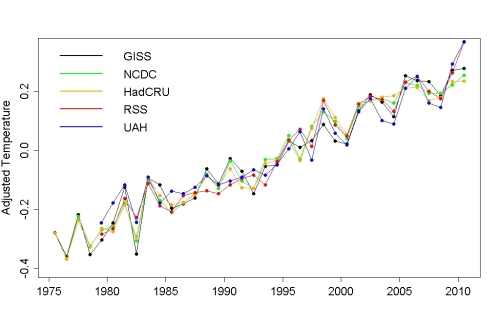
“This is highly unusual”, I say, “it is unseasonably warm.” Mick agrees.I say, “You know what this means, don’t you ? I mean, globally, January was the 19th warmest January since records began, and February is going to turn out to be a warm one too.”

“What about Eastern Europe ?”, he asked, “They’ve had incredibly cold and snowy weather.” “I know. You get these cold snaps”, I agreed, “Hundreds of people have died. But this is what you should expect with climate change, all the normal weather patterns have been disturbed.”

“It’s not a snap”, Mick said, “it’s been going on for weeks.” “Yes”, I said, “these areas of high and low temperatures have been locking into place. It’s all because of global warming.”

“But there hasn’t been any global warming for fifteen years”, said Mick. “Which newspaper do you read ?” I asked him, taken aback. “I don’t read any newspapers”, he clarified, “I read it in the library, somewhere.”

Categories
Bad Science Bait & Switch Climate Chaos Conflict of Interest Corporate Pressure Delay and Deny Divide & Rule Evil Opposition Fair Balance Freak Science Global Singeing Global Warming Hide the Incline Human Nurture Libertarian Liberalism Mass Propaganda Media Non-Science Paradigm Shapeshifter Policy Warfare Public Relations Scientific Fallacy Social Chaos Sustainable Deferment The War on Error Unqualified Opinion

What Does GWPF Really Stand For ?

Image Credit : Global Warming Policy Foundation

This article was written by M. A. Rodger and was originally posted at DeSmogBlog and is syndicated by an informal agreement and with the express permission of both the author and DeSmogBlog, without payment or charge. The author’s original artwork here was not initially included over at DeSmogBlog.
The Global Warming Policy Foundation (GWPF) is a UK-based climate-sceptic think-tank founded in November 2009 by Lord Lawson. Within two years of its launch, a survey of scepticism in the global media by Oxford University’s RISJ had added a final chapter showing the GWPF had gained success in “inserting itself into the (UK) national discourse” and that its founder and its director had become “the two most quoted sceptics by far” within the UK national press.

The GWPF believes it has made a difference, saying of itself “The key to the success of the GWPF is the trust and credibility that we have earned in the eyes of a growing number of policy makers, journalists and the interested public.” Yet the GWPF has also been criticised for being secretive, misinformed, wrong and perverse.

Categories
Assets not Liabilities Be Prepared Big Number Big Picture Burning Money Conflict of Interest Corporate Pressure Demoticratica Direction of Travel Disturbing Trends Divide & Rule Economic Implosion Electrificandum Energy Autonomy Energy Change Energy Insecurity Energy Revival Engineering Marvel Financiers of the Apocalypse Fossilised Fuels Fuel Poverty Green Investment Green Power Growth Paradigm Hydrocarbon Hegemony Incalculable Disaster Major Shift National Energy National Power Neverending Disaster Nuclear Nuisance Nuclear Shambles Optimistic Generation Paradigm Shapeshifter Peak Natural Gas Peak Oil Policy Warfare Political Nightmare Regulatory Ultimatum Renewable Resource Shale Game Social Democracy Solar Sunrise Solution City Sustainable Deferment Technological Fallacy Technological Sideshow The Myth of Innovation The Price of Gas The Price of Oil The War on Error Ungreen Development Unnatural Gas

The UK’s Energy Crisis

What annoys me most about the Solar Power Feed-in Tariff saga is not that the UK Government suddenly pulled the plug on the full rate for household-sized systems, or that they set the cut-off date before they finished their consultation, or even that that the Department of Energy and Climate Change (DECC) dragged out a legal appeal process.

Despite the truly pitiful sight of a Minister of State being sent out to bat with a miniaturised teaspoon to defend the indefensible decision, and despite the energy industry stooges that have placements inside DECC and are clearly affecting policy, no, the thing that really gets me is the focus on budgets instead of targets.

Here’s a summary from the Government’s own “long term trend” figures for energy consumption in Great Britain :-

Nobody can swear to me that the last few years are not just a glitch caused by economic instabilities, and that the re-localisation of manufacture in future in a recovering economy will not push this demand continually higher according to the trendline.

What are we using to supply this energy ? Here’s a summary :-

Despite the near exponential rise in renewable energy, it’s starting from a small base. The increase in energy consumption is being satisfied by a sharp rise in the supply of Natural Gas – something which the UK is producing increasingly less of these days. And for those who think that shale gas production would help, no, only a few percent of demand could be satisfied. This is an import-led energy supply, and the trend should ring alarm bells, but clearly doesn’t even tickle the ears of the average person in the street.

Electricity demand growth remains healthy, despite problems with unreliable supply from nuclear electricity (refered to as “outages” in the DECC Digest of UK Energy Statistics (DUKES) reports) :-

Now, in the future, with an envisioned massive rise in renewable energy, higher electricity use would be reasonable, as long as other energy consumption reduced. But the growth in electricity consumption charted here is not people driving more electric cars or using electric heating instead of Natural Gas-fired comfort. This is higher consumption, pure and simple, not “energy switching” over to electricity.

As an aside – the sum total of these figures indicates that the nation as a whole is not engaged in significant energy conservation, despite decades of campaigning.

All these trends add up to a very slight loss in dependency on fossil fuels for the UK’s energy :-

This is the critical trend. North Sea oil and Natural Gas production is falling like a large rock, and no amount of technological advancement and re-stimulating the drilling sector is turning this around. This means that without a rapid decrease in fossil fuel dependency, the United Kingdom is going to start haemorrhaging wealth.

Goodbye, First World.

This is why is it essential to ramp up renewable energy deployment by whatever means at our disposal.

Greg Barker MP bleating about keeping to budgets is not helping.

Categories
Assets not Liabilities Bad Science Bait & Switch Big Number Climate Change Conflict of Interest Corporate Pressure Cost Effective Delay and Deny Divide & Rule Dreamworld Economics Efficiency is King Energy Change Energy Denial Energy Insecurity Energy Revival Engineering Marvel Financiers of the Apocalypse Freak Science Green Investment Green Power Growth Paradigm Hydrocarbon Hegemony Libertarian Liberalism Major Shift Mass Propaganda Media Money Sings National Energy National Power Non-Science Optimistic Generation Paradigm Shapeshifter Peak Energy Policy Warfare Political Nightmare Price Control Public Relations Science Rules Scientific Fallacy Solution City Sustainable Deferment Technological Fallacy The Data The War on Error Unqualified Opinion Wind of Fortune

Wind Powers #1 : Civitas Fictitious ?

[ An extract from the online Christian Ecology Link discussion forum : 11th January 2012 ]

The Civitas report on wind farms.

A couple of days ago, Civitas published a report entitled, “Electricity costs: the folly of wind-power” : https://www.civitas.org.uk/press/prleaelectricityprices.htm [ Download report PDF ]

This report was produced by the Civitas economist, Ruth Lea. The report attracted a fair bit of publicity and even more antagonism from those within the renewables industry. Sadly, as usual the media have done rather less research than they should have; in particular they failed to check the background of the authorities quoted, though the Guardian did point to Lea’s views on climate change.

The following YouTube link leads to Ruth Lea denying the significance of anthropogenic climate change and the ‘flaws’ in Britain’s expensive climate change legislation. She uses all the same sad old errors and, in so doing, limits her credibility as an effective researcher : https://www.youtube.com/watch?v=UvmgUYGgqwU https://www.youtube.com/watch?v=qcFfxUIRbyo

Her comments seem to be straight out of the Chicago School mythology that economics overrides nature – the view of many scientifically illiterates.

But it gets better, she quotes, as an authority, Dr Kees le Pair, but fails to mention that he is a member of the ‘Committee of Recommendation’ of the Fusion Energy Foundation. The development of nuclear fusion, if it happens, will require very significant investment, investment that could, perhaps, otherwise be made in wind farms and other renewables so there is an important conflict of interest that has been wholly ignored : https://www.fusionenergyfoundation.org/about-us

This matters to all of us because it shows the dangerous level of uncritical evaluation that is made of so called scientific reports and information sources. I still remember the days past when research involved trips to libraries and hours of reading and, unless, the library had an academic connection, new information would not have been easily available.

Perhaps it was the more difficult nature of research that made the media, and much of its audience, that much more careful. The advent of the Internet has provided for rapid transmission of information, straight to your computer or even your smartphone, but apparently at the cost of critical evaluation. So much information is available that even report writers seem to fail to check the background of their sources or the veracity of the information given by that source. Yet, that same Internet provides the means of checking and it’s far less tedious than back in the days of library visits.

Careful use of a search engine can throw up evidence of partiality and YouTube can often confirm background beliefs that have overridden scientific evidence if not common sense. It’s not just
in reports such as this one from Civitas but also within so many anti this, that and the other environmental groups that plague the Internet.

Look carefully at Occupy, for example, and dig deeply enough, you will find some truly amazing YouTube material on the way in which the City of London is a part of worldwide Zionism that is somehow linked with the Vatican and Knights Templar ! Did you know that the Bank of England is owned by the Rothschilds ? The Internet, as well as giving freer voice to information also gives voice to conspiracy theorists and to the murk of prejudice. Just as it is both wrong and dangerous to spread unfounded rumours so it is to spread disinformation, so please use your search engine, take a little time and then critically assess whether this information that you have been given is likely to be both accurate and honest.

RT

Categories
Advancing Africa Assets not Liabilities Bad Science Bait & Switch Big Number Big Picture Big Society British Sea Power Burning Money Climate Change Coal Hell Delay and Deny Design Matters Direction of Travel Divide & Rule Efficiency is King Electrificandum Energy Change Energy Denial Energy Insecurity Energy Nix Energy Revival Energy Socialism Engineering Marvel Foreign Interference Fossilised Fuels Fuel Poverty Global Warming Green Investment Green Power Growth Paradigm Health Impacts Hide the Incline Human Nurture Hydrocarbon Hegemony Major Shift Money Sings National Energy National Power National Socialism No Blood For Oil Not In My Name Nuclear Nuisance Nuclear Shambles Oil Change Optimistic Generation Paradigm Shapeshifter Peace not War Peak Coal Peak Emissions Petrolheads Policy Warfare Political Nightmare Protest & Survive Renewable Resource Resource Wards Science Rules Social Capital Social Democracy Solar Sunrise Solution City Stirring Stuff Stop War Sustainable Deferment Technofix The Data The Power of Intention The War on Error Toxic Hazard Wasted Resource Western Hedge Wind of Fortune

Open Letter to Renewable Energy Deniers

To all Renewable Energy Deniers,

Things are getting so much better with renewable energy engineering and deployment – why do you continue to think it’s useless ?

We admit that, at the start, energy conversion efficiencies were low, wind turbine noise was significant, kit was expensive. Not now. Wind and solar farms have been built, data collected and research published. Design modifications have improved performance.

Modelling has helped integrate renewable energy into the grids. As renewable energy technologies have been deployed at scale, and improvements and adjustments have been made, and electricity grid networks have adapted to respond to the variable nature of the wind and the sunshine, we know, and we can show you, that renewable energy is working.

It’s not really clear what motivates you to dismiss renewable energy. Maybe it’s because you’re instinctively opposed to anything that looks like it comes from an “envionmentalist” perspective.

Maybe because renewable energy is mandated to mitigate against climate change, and you have a persistent view that climate change is a hoax. Why you mistrust the science on global warming when you accept the science on everything else is a continuing mystery to me.

But if that’s where you’re coming from when you scorn developments in renewable energy, you’re making a vital mistake. You see, renewable energy is sustainable energy. Despite any collapse in the globalised economy, or disruption to fossil fuel production, wind turbines will keep spinning, and solar panels will keep glowing.

Climate change has been hard to communicate effectively – it’s a huge volume of research, it frequently appears esoteric, or vague, or written by boffins with their heads in the clouds. Some very intelligent people are still not sure about the finer points of the effects of global warming, and so you’re keeping good company if you reserve judgement on some of the more fringe research.

But attacking renewable energy is your final stand. With evidence from the engineering, it is rapidly becoming clear that renewable energy works. The facts are proving you wrong.

And when people realise you’re wrong about renewable energy, they’ll never believe you again. They won’t listen to you when you express doubts about climate change, because you deny the facts of renewable energy.

Those poor fools who have been duped into thinking they are acting on behalf of the environment to campaign against wind farms ! Wind energy will be part of the backbone of the energy grids of the future.

We don’t want and we can’t afford the concrete bunkers of deadly radioactive kettles and their nasty waste. We don’t want and we can’t afford the slag heaps, dirty air and melting Arctic that comes from burning coal for power. We don’t want and we can’t afford to keep oil and Natural Gas producing countries sweet – or wage war against them to keep the taps open.

Instead we want tall and graceful spinners, their gentle arms waving electricity from the breeze. We want silent and dark photovoltaic cladding on every roof.

Burning things should only be done to cover for intermittency in wind and sunshine. Combustion is very inefficient, yet you support combustion when you oppose renewable energy.

We must fight waste in energy, and the rising cost of energy, and yet you don’t support the energy resources where there is no charge for fuel. Some would say that’s curmudgeonly.

When you oppose renewable energy, what is it you’re fighting for ? The old, inefficient and poisonous behemoths of coal hell ? We who support renewable, sustainable energy, we exchange clunky for sleek, toxic for clean. We provide light and comfort to all, rich and poor.

When you oppose renewable energy, you are being unbelievably gullible – you have swallowed an argument that can ruin our economy, by locking us into dependency on energy imports. You are passing up the chance to break our political obedience to other countries, all because wind turbines clutter up your panoramic view when you’re on holiday.

You can question the net energy gain from wind power, but the evidence shows you to be incorrect.

If you criticise the amount of investment and subsidy going into renewable energy, you clearly haven’t understood the net effect of incentivisation in new technology deployment.

Renewable energy has a positive Net Present Value. Wind turbines and solar panels are genuine assets, unlike the liabilities that are coal-fired power stations and nuclear reactors.

Renewable energy deployment will create meaningful, sustainable employment and is already creating wealth, not only in financial terms, but in social welfare terms too.

Renewable energy will save this country, so why do you knock it ?

Quizzically yours,

Categories
Advancing Africa Bioeffigy Biofools Breathe Easy Burning Money Coal Hell Corporate Pressure Cost Effective Demoticratica Direction of Travel Disturbing Trends Divide & Rule Eating & Drinking Efficiency is King Electrificandum Energy Insecurity Feed the World Food Insecurity Foreign Interference Foreign Investment Forestkillers Freemarketeering Green Power Health Impacts Money Sings National Energy National Power Policy Warfare Political Nightmare Protest & Survive The War on Error Tree Family Wasted Resource

Biomassacre : Agrofuels Aggro

Stop Biomassacre Subsidies from You and I Films on Vimeo.

The UK Government has a neat plan – meet a considerable proportion of the nation’s electricity needs by burning biomass and biofuels : wood, waste wood, agricultural residues, palm oil, maize ethanol and such-like.

They are even considering setting up a generous subsidy, the kind of subsidy that would encourage massive imports of biomass and bioliquids.

Without care and regulatory checks and balances, the net effect will almost certainly be rainforest deforestation, land grabbing in under-developed nations, and economic problems for the growing biomass heat movement in the UK.

Most people probably think burning wood, wood waste and plant-derived fuels to make power sounds like a good energy idea – stop burning coal and start burning trees – has to be better for the planet, surely ?

There are a number of really deep problems with this agenda. Almuth Ernsting of Biofuelwatch told me this weekend that burning biomass for electricity generation is incredibly inefficient.

She said the UK Government has apparently heard concerns about the burning of bioliquids such as the biofuel bioethanol for power generation, and it shouldn’t be included in the subsidy arrangement.

However, biomass-fired power generation is still set to receive support – although it is still being depicted as making use of agroforestry residues, and all sourced within the country – judging by a recent permission for a biomass burning plant in Yorkshire.

Generous subsidies for burning biofuels to generate electricity will encourage the combustion of food-quality oils, imported from across the world, exacerbating the existing problems with the destruction of tropical rainforest for commercial gain.

Offering significant subsidies for burning biomass for power generation will most probably trigger further logging of virgin rainforest, as it would be cheap to produce and export to Britain.

Even if biomass were sourced in the United Kingdom – with restrictions on imports from areas of the world where there is extensive land grabbing and deforestation occurring – the subsidy would encourage the burning of wood products for generating power instead of being used in the most efficient way – to heat homes.

Almuth Ernsting said, “the big energy companies are going to burn that much wood, small heat providers won’t be able to compete.” The same would be true of street-scale biomass combined heat and power (CHP) proposals.

Almuth Ernsting and others have pointed out that the UK Government public consultation on the subsidy ends on 12th January 2012, but that even after that date, people are being encouraged to write to their Member of Parliament to express views.

Another group, nope, is also calling for citizen action :-

https://nope.org.uk/

In an e-mail to joabbess.com, Almuth Ernsting offered extra resources :-

“All the materials related to our campaign against subsidies for biomass and biofuel electricity can be found here :-”

https://www.biofuelwatch.org.uk/uk-campaign/rocs_overview/

“A briefing about the impacts of ROCs for biomass, biofuels and waste incineration :-”
https://www.biofuelwatch.org.uk/2011/rocs_impacts/

“A briefing to hand or send to MPs :-”
https://www.biofuelwatch.org.uk/2011/rocs_mps/

“A guide to lobbying MPs on this :-” https://www.biofuelwatch.org.uk/2011/mp_guidance_rocs/

“We have got two email alerts on one page just now (https://www.biofuelwatch.org.uk/2011/rocs-alerts/), though we will take down the one to respond to the DECC Consultation when that closes next Thursday, while keeping the one to MPs. However, we very much encourage people to write personal letters or, even better, visit their MPs, which will have much more impact than taking part in a standard email alert.”

Categories
Advancing Africa Big Number Big Picture Burning Money China Syndrome Conflict of Interest Corporate Pressure Cost Effective Deal Breakers Delay and Deny Demoticratica Direction of Travel Disturbing Trends Divide & Rule Economic Implosion Efficiency is King Energy Change Energy Insecurity Energy Revival Energy Socialism Financiers of the Apocalypse Foreign Investment Freemarketeering Green Investment Green Power Growth Paradigm Hydrocarbon Hegemony Low Carbon Life Major Shift Money Sings National Energy National Power National Socialism Paradigm Shapeshifter Peak Natural Gas Peak Oil Policy Warfare Political Nightmare Price Control Regulatory Ultimatum Renewable Resource Resource Wards Solar Sunrise Solution City Sustainable Deferment The Power of Intention The Price of Gas The Price of Oil The War on Error Transport of Delight Wind of Fortune

Eco-Socialism #1 : Public Service, Private Profit

Public infrastructure and utilities are the skeleton of the national economy; the spokes of the wheel; the walls of the house.

Private corporations can in many cases put muscle on the body, a tyre on the bike, and furnish the rooms, but without the basic public provision, private enterprise cannot thrive.

Without taxes being raised – asking everybody for their appropriate contribution – there would be no guaranteed health service, education system, roads, water supplies, power networks.

Federal or central government spending is essential, and often goes without question or inspection – including subsidies, cheap government loans, tax breaks and even rule-bending and regulatory exemption for specific sectors of the economy. This policy lenience also applies to private companies that take on the provision of public utilities.

This explicit, but often glossed-over, support for public services means that private business can rely on this national infrastructure. Small businesses can rely on a power supply and waste disposal services, for example. Large businesses can rely on a functioning postal service and road network.

It is questionable whether for-profit enterprise would be able to survive without the basic taxation-funded provision of public services and utilities.

I can understand why governments feel the need to get public spending off the balance sheet, and outsource public utilities to the private sector.

There is a lingering belief that private enterprise makes public services more efficient; makes manufacturing more reliable; makes construction better quality.

In some cases, this belief in privatisation is justified. Where companies can genuinely compete with each other, there can be efficiencies at scale. However, the success of privatisation is not universal.

Many parts of a developed economy are monolithic – there is no real competition possible. You get electricity through your power socket from a variety of production companies – you cannot choose. The road between your house and your office is always the same road – you don’t choose between different tarmac suppliers. Your local hospital is your local hospital, regardless of who owns and runs it – you have no choice about who that is – and the government contract tendering process is not something open to a public vote.

Added to this lack of competition, in some cases, it is impossible to make a profit by operating a public service by a private concern.

There should be no rock under which private business can hide when it claims to be operating profitable train and bus services – without public subsidies, public transport cannot be run at a profit.

Liability for daily operations may have been outsourced to the British private train companies, but not the full cost of the services. Costs for locally-sourced services cannot be driven down because they cannot be made fully open to global competition.

By contrast, the globalisation of labour has been making manufacturing industry significantly cheaper for decades.

In order for globalised trade to work, finance has to be liberated from its nation-bound shackles, and so along with the globalisation of labour to nations where it’s cheapest, there has been the globalisation of finance, to the tax regimes less punitive.

The globalisation of trade is a two-way bargain between those that want to see the development of primitive economies and those who want to create wealth for their companies and their shareholders.

Globalisation has created a booming China, for example, and filled the pockets of any Western company that imports from China.

However, the tide of globalisation has reached the shore, and the power of the waves is being stilled by solid earth realities. Labour costs in previously under-developed economies are starting to rise significantly, as those economies start to operate internal markets as well as maintain export-led growth.

It could soon be cheaper to have manufacturing labour in the United States of America than China. But when that happens a curious problem will arise. Manufacturing industry has been closed down in the so-called industrialised countries – as companies have taken their factories to the places with the cheapest labour and the most lax tax.

Wealth creation potential in developed countries has been destroyed. And it is for this reason that Western governments feel the urgent need to privatise everything, because their economies are collapsing internally, and public budgets may no longer be able to sustain current government spending.

However, privatisation doesn’t work for everything. It doesn’t work for health, education, water, public transport. The European Common Agricultural Policy (CAP) is a vehicle to compensate for agricultural sectors than cannot make a profit. I would contend privatisation doesn’t work for the energy supply and distribution sector either – but for a special reason.

Normally, it is possible to run energy stations at a profit. The privatised sector inherited power stations and grid networks that were fully functioning, and the sales of power and Natural Gas were almost pure profit.

However, much energy plant needs to be lifecycled after decades of use – replacements are in order, and this demands heavy public investment, in the form of subsidies, or pricing controls, or tax breaks or some such financial aid, in order to avoid crippling the private companies.

Like the rail network, there is direct public investment in the power grids. This is to support new access for new energy plant. However, I think this doesn’t go far enough. I would argue that much more public tax-and-spend is required in the energy sector.

In future, most electricity generation needs to become low carbon and indigenous. The primary reason for this is the volatility of the globalised economy – it will no longer be possible to assume that imports of coal, Natural Gas and oil for power station combustion can be afforded – especially in economies like the United Kingdom, where much wealth creation has been destroyed by de-industrialisation.

It used to be easy to ignore this – as the North Sea was so productive in oil and Natural Gas that the UK was a net energy exporter. This is no longer the case.

To avoid the risk of national impoverishment, energy independence is dictated, spelled out by a deflating British economy and by the depleting North Sea reserves.

The easiest and fastest way to a power supply that is low carbon is by healthy investment in wind power and solar power. Yet with the turbulence in the global economy, spending on renewable energy has also been rocky.

Now is the time for the UK Government to stop tickling corporate underbellies to get them to invest in British energy, and to start collected tax revenues to spend explicitly on the energy revival.

It can be “matched” funding – the Renewables Obligation, for example, has drawn in massive levels of private investment into wind power. And the feed-in tariff scheme for solar photovoltaics had, until recently, been pulling in high levels of personal individual and private company investment.

This is the kind of public-private financing that works – create a slightly tilted playing field to tip the flow of money towards new energy investment, and watch the river flow.

Without public money ploughed into public infrastructure in non-profitable areas such as public transport and energy, private enterprise will not be able to make a contribution – they would quickly bankrupt themselves.

The result of capping public subsidies for renewable energy is a halt to renewable energy deployment. Those who resist wind farms are in effect destroying the country. Those who cap public subsidies for solar power want to break the nation.

We need socalist financing of new energy technology deployment, for the future wealth of our country.

Categories
Acid Ocean Be Prepared Big Number Big Picture Big Society British Sea Power Climate Change Climate Chaos Climate Damages Dead End Design Matters Disturbing Trends Eating & Drinking Energy Change Energy Revival Energy Socialism Engineering Marvel Extreme Weather Floodstorm Food Insecurity Freak Science Freshwater Stress Geogingerneering Global Warming Hide the Incline Human Nurture Incalculable Disaster Major Shift Near-Natural Disaster Neverending Disaster Paradigm Shapeshifter Rainstorm Realistic Models Science Rules Screaming Panic Solar Sunrise Solution City The War on Error Water Wars Wind of Fortune

The Storm

On my Christmas journey, on the train from Brussels, Belgium, to the Dutch border, besides the wind turbines, I counted the number of solar electric rooftop installations I could see. My estimate was that roughly 300 kilowatts of solar could be seen from the track.

There has been an explosion of deployment. The renewable energy policies that are behind this tide of photovoltaics in Flanders seem to be working, or have been until recently.

On my journey back from Holland to England, I pondered about the polders and the low-lying landscape around me. I don’t know what river it was we crossed, but the river was only held in place by narrow banks or dikes, as it was higher than the farmland around it – waterlogged fields in some places – where parcels of land were divided by stillwater ditches instead of hedges or fences.

“Oh no, we don’t have “Mary Poppins” on Dutch TV any more at Christmas every year like we used to. We’re going to see the film “The Storm”…” said my host. Curiouser and curiouser. “De Storm” is a film that harks back to an actual historical event, the major North Sea flooding in 1953. “I remember what it was like afterwards,” says an older English relative, “I visited Belgium and Holland with my aunt and uncle just after the flooding – he wanted to visit the family war graves. We stayed in Middelburg. You could see how high the water reached. There were tide marks this high on the side of the houses, and whelks left stuck on the walls.”

The film attempts to nail down the coffin casket lid of bad weather history. By telling the narrative of major, fearful floods of the past, people are distracted from the possibility that it may happen again. History is history, and the story tells the ending, and that’s a finish to it.

However, for some people, those people who know something of the progress of the science of global warming, this film is like a beacon – a flare on a rocky landing strip – lighting the way to the future crash of the climate and the rising of sea levels, which will bring havoc to The Netherlands, Dutch engineers or no Dutch engineers.

We have to be prepared for change, major change. If you or anyone you know has Dutch relatives and friends, think about whether you can invite them to live with you in future if things get really bad. One or two really bad storms combined with excessive tides and a few centimetres of sea level rise could be all it takes to wreck the country’s ability to organise water and destroy a significant amount of agricultural land.

“I’ve been studying Climate Change science”, I told another host. “You believe in Climate Change ?”, he asked, somewhat incredulously. “It’s 200 years of science”, I replied, smiling, “but we probably shouldn’t discuss it. I don’t think it would be very productive.”

Categories
Advertise Freely Bad Science Bait & Switch Big Picture Big Society Climate Change Climate Chaos Conflict of Interest Corporate Pressure Dead End Delay and Deny Demoticratica Direction of Travel Disturbing Trends Divide & Rule Drive Train Emissions Impossible Energy Disenfranchisement Energy Insecurity Energy Nix Energy Revival Engineering Marvel Evil Opposition Fair Balance Freemarketeering Global Warming Hide the Incline Human Nurture Incalculable Disaster Landslide Major Shift Mass Propaganda Media Money Sings Mudslide No Pressure Non-Science Nudge & Budge Paradigm Shapeshifter Public Relations Realistic Models Science Rules Scientific Fallacy Social Capital Social Change Social Chaos Social Democracy Solution City Sustainable Deferment Technofix Technological Fallacy Technological Sideshow The Data The Myth of Innovation The Power of Intention The War on Error

Clicking with Climate

Image Credit : University of California at Berkeley

Human beings have two brains. The first is a self-centred workhorse of pragmatic decision-making, interested in social engagement in order to further individual interests – whether those interests are purely for personal enrichment or for the reward of the social group more widely.

The second human brain is a relativistic engine, constantly comparing, reflecting, analysing. We are concerned about other peoples’ emotional response, wondering what other people think about us, responding to peer group pressure.

Are we more successful, popular than others ? Do people listen to us more than others ? We know we’re right, but do they ? We need to pitch ourselves in the right way. We jostle for pole position, for a place on the platform, hoping not to make too many opponents, whilst making more converts to our point of view.

Personally, I don’t listen to my second brain very often. As a social animal, I hope I’m tolerant, and my priorities in interpersonal engagement are mutual empowerment, transparent collaboration and inclusion. In my public projection, I’m not trying to vaunt myself over others, or massage my image for approval, or put up a fake facade. You get me, you get direct.

But I can’t avoid the second human brain entirely – as it is the reason for a lot of fuzziness in our view of the world around us. It’s too easy to stir doubt, falsehoods and bad ideas into the collective cake mix of society, where it fizzes into a bubbling mess. In matters of climate change science and energy engineering, there are no grey areas for me. But for a number of people I know, these are subjects of much confusion, denial and disinformation.

People hold on to the totem of what other people think. And so you have even very intelligent social commentators reciting from paid-for public relations by companies and business pressure groups. Journalists often do not appear to understand the difference between pseudo-science and real live science. There are too many people selling unrealistic, unworkable technological “solutions”, particularly in energy, so it’s hard to know what to accept and what to dismiss.

Yet it is critical to know what rock, what branch to keep a hold of in the flood of information that could sweep us away. The social construction of climate change is an important edifice, a safe house in an information world at war with itself. What high wind can sweep away the grubby pages of non-science from the Daily Mail ? What rising sea can cleanse the Daily Telegraph of its climate change denial columnists ? What can stop the so-called Global Warming Policy Foundation from infecting the Internet with their contrarian position ? What can make us accept the reality and urgency of global warming ? How can we learn to click with climate change ?

Three significant academic thinkers on the social significance of climate change are launching new works at the British Library in London, on 16th January 2012. The British Sociological Association have invited Mike Hulme, John Urry and Gordon Walker to discuss chapters from their recent books which address the question – where next for society and climate change ?

In the words of Chris Shaw at the University of Sussex, “they pull no punches in their analyses, and their approach is based on years of research into the social dimensions of the climate change debate. This is an essential opportunity for all those interested in bringing climate change into the democratic sphere, to help understand the issues involved in such a transition. It is also a chance to discuss the ideas with the authors and other delegates.”

For more information, see here and here.

Categories
Big Society Climate Change Climate Chaos Climate Damages Demoticratica Disturbing Trends Divide & Rule Economic Implosion Financiers of the Apocalypse Global Warming Hide the Incline Human Nurture Media Optimistic Generation Political Nightmare Realistic Models Social Capital Social Change Social Chaos The Data The War on Error

Daily Mail : Editorial Schizophrenia

I was in my local cafe diner, screening for neighbourhood gossip and genning up on the Daily Mail’s latest scandal and outrage. Several stories were told from different angles throughout the grubby pages of the well-thumbed copy I was sifting through. “You know”, I mused, “I think they might actually want their readers to become schizophrenic.”

On the front page the headline “RESTORE ELITISM TO OUR SCHOOLS“. The editorial line seemed to be aimed at persuading the readers to find Michael Gove’s speech just as “extraordinary” as the writer did – “extraordinary” as in “bad”. This, after all, is a newspaper that often seems to want to portray itself as succour for the common man.

On page 7, however, the same story took on a nanny-ish tone “We must demand more of our teachers… and our children : And here’s why it matters: for the first time 1m [million] youngsters are not in work or education.” So, presumably, the writer of this piece was having a dig at teachers and their performance. Plus it was also having a swipe at out-of-work out-of-the-classroom “scrounger” teenagers.

Where, I asked myself, was the analysis of why so many young people were without a role in life, without prospects ? Where are the jobs, work placements and apprenticeships for “youngsters” ? The statistics show that there are not enough openings for every NEET.

Categories
Bait & Switch Big Picture Big Society Burning Money Carbon Commodities Carbon Pricing Carbon Taxatious Cool Poverty Corporate Pressure Cost Effective Demoticratica Direction of Travel Divide & Rule Efficiency is King Emissions Impossible Energy Change Energy Disenfranchisement Fair Balance Fuel Poverty Green Investment Green Power Hydrocarbon Hegemony Low Carbon Life Major Shift Mass Propaganda Media Money Sings National Energy National Power Nudge & Budge Optimistic Generation Policy Warfare Political Nightmare Price Control Regulatory Ultimatum Solar Sunrise The Data The War on Error Vote Loser Wind of Fortune

Dances With Energy Bills

After the recent notorious Panorama programme on energy prices, and yesterday evening’s debate on renewable energy and the costs of green energy policy, in the House of Commons, a number of people have commented that Members of Parliament and Ministers of the UK Government appear to know very few facts – and those they can remember they seem to quote in the wrong context.

This state of affairs is disgraceful, and allows mendacious narratives to persist in the mainstream media.

RenewableUK contacted me and asked me to embed a YouTube offering some corrective information. I was very pleased to do so. I can assure my readers that I have not and will not be paid for doing so.

The key problem is not the cost to energy bill payers from direct subsidies such as the solar photovoltaic feed in tariff. The contribution from this is minor. The largest effect on energy bills is likely to come from two sources – the Energy Company Obligation and the plans for Carbon Pricing and other measures in the Electricity Market Reform.

Categories
Bad Science Bait & Switch Conflict of Interest Delay and Deny Disturbing Trends Divide & Rule Energy Insecurity Energy Revival Engineering Marvel Feel Gooder Fossilised Fuels Freak Science Freshwater Stress Gamechanger Geogingerneering Growth Paradigm Hydrocarbon Hegemony Marvellous Wonderful Methane Madness Money Sings National Energy National Power Non-Science Not In My Name Peak Natural Gas Policy Warfare Political Nightmare Resource Curse Resource Wards Science Rules Scientific Fallacy Shale Game Stirring Stuff Sustainable Deferment Technofix Technological Fallacy Technological Sideshow Technomess The Myth of Innovation The Price of Gas The War on Error Toxic Hazard Unnatural Gas Unqualified Opinion

Another Meeting I Will Not Be Attending

What appears to be a serious event is due to take place at the Energy Institute in London on 6th December 2011, “Peak Oil – assessing the economic impact on global oil supply“.

Dr Roger Bentley, author of a seminal 2002 paper on the subject, research that spawned hundreds of related learned articles, will be speaking.

But the event organisers have also invited one Dr Matt Ridley, the self-styled “rational optimist”, and member of the Global Warming Policy Foundation, and this, I’m afraid, prevents me from attending.


Ridley projects a view that many probably find comforting – as his headline in The Times of 1st October 2011 summarises – “Cheer up. The world’s not going to the dogs”.

He has been captured speaking at a TEDx event pouring scorn on “environmental” scare stories of the past, but not bothering to delve or dig into how mankind has actually gone out of its way to act on past crises and prevent catastrophes.

And now he’s thrown in his lot with the shale gas miracle men, writing a report with a foreword by Freeman Dyson, one of the world’s most balanced individuals.

How much uncorroborated optimism can one man contain ?

Categories
Bad Science Bait & Switch Conflict of Interest Cost Effective Dead End Delay and Deny Demoticratica Direction of Travel Disturbing Trends Divide & Rule Fair Balance Freak Science Global Heating Global Singeing Global Warming Human Nurture Libertarian Liberalism Mass Propaganda Media Money Sings Non-Science Nudge & Budge Policy Warfare Political Nightmare Public Relations Pure Hollywood Science Rules Scientific Fallacy Social Capital Social Change Social Chaos Sustainable Deferment The Data The War on Error Unqualified Opinion

Everyone’s Entitled to their Opinion

Yes, indeed they are. Everyone is entitled to hold their own particular opinion. In this democracy of ideas, every longshot, wingnut, bonehead, rogue, charlatan, conspiracy theorist, crank, crony and astroturfer should be permitted access to the microphone on the stage. If we hold a public meeting about immigration, we should, of course, invite a white supremicist, a member of the British National Party, and a Daily Mail journalist to offer us their wise words. If we hold a sociological symposium on the Second World War, we should of course invite a Holocaust-denier. If an engineering conference, a cold fusion-in-a-test-tube enthusiast. Of course we should provide balance, as much balance as possible, and offer wisdom, insight and rant from all ends of all spectra. It’s only reasonable.

It therefore goes without question that somebody from the Global Warming Policy Foundation “think tank”, so copiously and generously sponsored by a person or persons unknown, should be invited to speak on the platform, or in a panel, at a well-funded quasi-establishment meeting on Climate Change. Regardless of a complete lack of training in atmospheric physics, or even knowledge of the span of the last five years in the science of global warming, naturally, a GWPF man must be invited by GovToday to a presitigious conference to be held on 29th November 2011 in the City of London grandly entitled “2011 Carbon Reduction : The Transition to a Low Carbon Economy”.

Categories
Advancing Africa Be Prepared Big Number Big Society Burning Money Carbon Commodities Carbon Taxatious Climate Change Climate Chaos Climate Damages Coal Hell Conflict of Interest Corporate Pressure Dead End Deal Breakers Delay and Deny Demoticratica Direction of Travel Disturbing Trends Divide & Rule Emissions Impossible Energy Change Energy Insecurity Energy Revival Financiers of the Apocalypse Fossilised Fuels Freemarketeering Global Heating Global Singeing Global Warming Green Investment Green Power Hide the Incline Hydrocarbon Hegemony Libertarian Liberalism Mass Propaganda Media Money Sings National Energy National Power Optimistic Generation Peak Coal Peak Emissions Peak Energy Peak Natural Gas Peak Oil Petrolheads Policy Warfare Political Nightmare Public Relations Regulatory Ultimatum Scientific Fallacy Sustainable Deferment Technofix Technological Fallacy Technomess The War on Error Vote Loser Western Hedge

Tom Heap : Panoramic Nonsensity

Date: 9 November 2011
From: tim b
To: jo abbess

Hi Jo,

Just picked up on your blog following leads on Tom Heap – I’m writing a piece for my website (www.biggreenbang.co.uk) on the panorama / KPMG saga – just wanted to say what a great blog it is~!! Don’t find so many to-the-point sites in the UK – have picked up on guys like Joe Romm in the States but you seem to have your finger right on the pulse in the UK!

…Should explain that my site has been initiated by a load of IT techie nerds who are already working in telecoms and are about to launch a zero carbon mobile phone company (by a combination of using low carbon technology, buying into renewable power and carbon offsetting) They are committed to putting part of their profits into green projects and are setting up BGB in the hopes that it will be a vehicle for making sustainability issues available to a wider public – they have ambitions to develop it as a community resource too – They obviously hope to get spin-off business for their mobile phone network but I believe their motives are genuinely good and they seem to be giving me a fairly free rein!

look forward to hearing from you

=x=x=x=x=x=x=x=x=x=x=x=x=x=x=x=x=x=x=x=

Date: 10 November 2011
From: jo abbess
To: tim b

Hi Tim,

Good luck with the Panorama research.

Another person to follow on this is Christian Hunt at Carbon Brief :-

https://www.carbonbrief.org/blog/2011/11/looking-into-panoramas-sources
https://www.carbonbrief.org/blog/2011/11/kpmg-not-sure-if-written-report
https://www.carbonbrief.org/blog/2011/11/another-correction-from-the-mail-group-on-energy-bills

…Keep the green flag flying !

Categories
Babykillers Be Prepared Big Number Big Picture Biofools British Biogas British Sea Power Carbon Capture Climate Change Climate Damages Corporate Pressure Cost Effective Delay and Deny Demoticratica Direction of Travel Energy Change Energy Insecurity Energy Revival Foreign Interference Fossilised Fuels Geogingerneering Green Investment Green Power Hydrocarbon Hegemony Incalculable Disaster National Energy National Power No Blood For Oil Not In My Name Nuclear Nuisance Nuclear Shambles Oil Change Peace not War Peak Energy Peak Oil Petrolheads Policy Warfare Political Nightmare Regulatory Ultimatum Renewable Gas Renewable Resource Resource Curse Resource Wards Solar Sunrise Solution City Stop War Sustainable Deferment Technofix Technological Fallacy Technological Sideshow The Power of Intention The War on Error Transport of Delight Unnatural Gas Western Hedge

Solar FIT to Bust #5

Germany can do it, but not the British. The Collected Republic of the People can install solar power with great will and nerve, but not Johnny English.

Let’s be clear here – the people in Scotland have a vision for future Renewable Energy, and so do many people in Wales and Ireland, but it appears English governance listens to fuddy duddy landowners too readily, and remains wedded to the fossil fuel industry and major construction projects like nuclear power, and carbon capture and storage.

What precisely is wrong with the heads of policy travel in Westminster ? Do they not understand the inevitable future of “conventional” energy – of decline, decimation and fall ?

It really is of no use putting off investment in truly sustainable and renewable power and gas. There are only two paths we can take in the next few decades, and their destination is the same.

Here’s how it goes. Path A will take the United Kingdom into continued dodgy skirmishes in the Middle East and North Africa. Oil production will dance like a man with a stubbed toe, but then show its true gradient of decline. Once everybody gets over the panic of the impending lack of vehicle fuel, and the failure of alternatives like algal biodiesel, and the impacts of a vastly contracted liquid fuel supply on globalised trade, then we shall move on to the second phase – the exploitation of gas. At first, it will be Natural Gas. But that too will decline. And then it will be truly natural gases. As gas is exploited for vehicles, electricity will have to come from coal. But coal, too, is suffering a precipitous decline. So renewable energy will be our salvation. By the year 2100, the world will run on renewable electricity and renewable gas, or not at all.

Categories
Bait & Switch Big Picture Biofools British Biogas British Sea Power Conflict of Interest Corporate Pressure Delay and Deny Demoticratica Direction of Travel Divide & Rule Drive Train Electrificandum Energy Change Energy Revival Engineering Marvel Environmental Howzat Feel Gooder Financiers of the Apocalypse Fossilised Fuels Gamechanger Gas Storage Green Investment Green Power Hydrocarbon Hegemony Hydrogen Economy Major Shift Marvellous Wonderful Mass Propaganda Media Methane Management National Energy National Power Not In My Name Nuclear Nuisance Nuclear Shambles Oil Change Optimistic Generation Peak Emissions Peak Energy Peak Oil Policy Warfare Political Nightmare Public Relations Regulatory Ultimatum Renewable Gas Renewable Resource Resource Wards Shale Game Social Capital Social Change Solar Sunrise Solution City Stirring Stuff The Power of Intention The War on Error Toxic Hazard Transport of Delight Wind of Fortune Zero Net

Renewable Gas : Balanced Power

People who know very little about renewable and sustainable energy continue to buzz like flies in the popular media. They don’t believe wind power economics can work. They don’t believe solar power can provide a genuine contribution to grid capacity. They don’t think marine power can achieve. They would rather have nuclear power. They would rather have environmentally-destructive new oil and gas drilling. They have friends and influence in Government. They have financial clout that enables them to keep disseminating their inaccuracies.

It’s time to ditch the pundits, innuendo artists and insinuators and consult the engineers.

Renewable Gas can stand in the gap – when the wind doesn’t blow or the sun doesn’t shine and the grid is not sufficiently widespread and interconnected enough to be able to call on other wind or solar elsewhere.

Renewable Gas is the storing of biologically-derived and renewably-created gases, and the improving of the gases, so that they can be used on-demand in a number of applications.

This field of chemical engineering is so old, yet so new, it doesn’t have a fixed language yet.

However, the basic chemistry, apart from dealing with contaminants, is very straight-forward.

When demand for grid electricity is low, renewable electricity can be used to make renewable hydrogen, from water via electrolysis, and in other ways. Underused grid capacity can also be used to methanate carbon-rich biologically-derived gas feedstocks – raising its stored energy.

Then when demand for grid electricity is high, renewable gas can be used to generate power, to fill the gap. And the flue gases from this combustion can be fed back into the gas storage.

Renewable gas can also be biorefined into vehicle fuels and other useful chemicals. This application is likely to be the most important in the short term.

In the medium-term, the power generation balance that renewable gas can offer is likely to be the most important application.

Researchers are working on optimising all aspects of renewable gas and biorefinery, and businesses are already starting to push towards production.

We can have a fully renewable energy future, and we will.

Categories
Advancing Africa Be Prepared Big Picture Big Society Corporate Pressure Demoticratica Direction of Travel Energy Change Energy Revival Energy Socialism Feel Gooder Gamechanger Green Investment Green Power Major Shift Media National Energy National Power National Socialism Oil Change Optimistic Generation Social Capital Social Change Solar Sunrise Solution City Stirring Stuff Sustainable Deferment The Power of Intention The War on Error Western Hedge Wind of Fortune

The Revolution Is Here

Sorry to say, but I think the people camping on the streets at @OccupyLSX and other places are not the real revolution. The real revolution is in energy. Democratisation of energy is the future – distributed, multi-level production systems, integrated pan-continental networks.

What ? Power to the people ? This is why the energy companies don’t like it so much, and why the corporate masters of the developed countries, and their shareholders, don’t want to have people believe in renewable and sustainable energy.

This is why the newspapers are full of people disparaging renewable energy – journalists and commentators who know nothing about energy, who are not engineers and who don’t know who thought their ideas for them first. Wake up, media people, the future of energy will be zero carbon and fully of the people.

A little unauthrorised translation of what I could pick up from the trailer of a 2010 film (sorry, my German listening comprehension is very rusty) : “We are awash in energy. We are dependent on energy. How much energy is left for us ? Have we enough energy for a revolution ? How much must we pay for power ? Why must California nearly use as much electrical power as Africa ? (French) “We have this enormous potential – with the youth, the riches of Nature, the trees, the biomass, agriculture…but there is no progress…the catalyst is not there. And that’s electricity”. Do we need the big energy companies ? (German) “…energy concerns will become democratic…” The fourth revolution. Energy Autonomy.”


Categories
Behaviour Changeling Big Society Climate Change Demoticratica Divide & Rule Economic Implosion Extreme Weather Faithful God Financiers of the Apocalypse Foreign Interference Global Heating Global Singeing Global Warming Libertarian Liberalism Mass Propaganda Media Military Invention Near-Natural Disaster Neverending Disaster No Blood For Oil Nudge & Budge Peace not War Policy Warfare Political Nightmare Protest & Survive Public Relations Social Capital Social Change The Power of Intention The War on Error Unutterably Useless Utter Futility Western Hedge

Occupy your mind #7

Image Credit : The Diocese of London

So, after rumours and quashings of rumours, Giles Fraser has resigned as canon chancellor of St Paul’s Cathedral, “resigned in protest at plans to forcibly remove demonstrators from its steps, saying he could not support the possibility of “violence in the name of the church”…Fraser, a leading leftwing voice in the Church of England, would resign because he could not sanction the use of police or bailiffs against the hundreds of activists who have set up camp in the grounds of the cathedral in the last fortnight.”

But just why did Giles Fraser resign ? What has it achieved ? What could it possibly achieve ? Now he’s no longer in the Cathedral organisation he cannot influence what happens. What pressures has he had to endure behind the scenes that gave him no option but to jump ?

Somebody I know has been praying that there would be heavy rain in London, just so the conditions would be impossible for the Occupyer camp to continue; that they would have to pack up and go home.

What on Earth is this @OccupyLSX protest for ? A camp of principle, to defend the right to protest ? A camp of demands, pursuing a just economics and a just society ? A camp of non-violence, when it deliberately provokes a stand-off between demonstrators and police forces ? How can the Occupyers claim to be peaceful when they know their actions have a fragmentation bomb-like effect on the society around them ? How can the Cathedral Campers evidence their intentions for a juster, saner, economic system, when the net effect of their actions is likely to be a huge law court struggle at taxpayer expense ? It’s not a revolution, it’s an irritation – or at least that is the way that it will continue to be viewed by the governing authorities.

Somebody on the inside track of campaigning in London has told me that the Occupy protest is destined to transmogrify into a Climate Refugee tent city in late November, early December. If it survives that long, then at least it can claim to be a piece of living art reflecting what is happening around the world because of climate change disasters.

Unless and until the Occupyers can take on relevance, everybody with even just a slightly-left-of-centre agenda will attempt to co-opt the Occupy London camp for their own purposes.

Remember, dear Occupyers, you are not “rising up” like the people in Libya – they were supplied with arms from around the world, forces overt and covert from Qatar, Europe and quite possibly America, and fed into a huge psychological operations narrative, ably supported by the media.

The Libyan conflict wasn’t about Colonel Muammar Gaddafi, may he rest in peace. The information management of the North African and Middle Eastern unrest shows that mass propaganda still works, and that media consumers continue to fall for the same fabrications, time after time.

Categories
Climate Change Conflict of Interest Corporate Pressure Deal Breakers Demoticratica Disturbing Trends Divide & Rule Energy Change Energy Insecurity Energy Revival Fair Balance Fossilised Fuels Green Investment Green Power Growth Paradigm Landslide Mass Propaganda Media Money Sings National Energy National Power Peak Energy Peak Oil Petrolheads Policy Warfare Political Nightmare Protest & Survive Public Relations Regulatory Ultimatum Social Capital Social Change Solution City Stirring Stuff Sustainable Deferment The War on Error Vote Loser

The European Union Question #2

Image Credit : Debbie Portwood

Unbelievably, yesterday, people in the British Government sacrificed their careers rather than vote with David Cameron’s three line whip against a Referendum on the UK’s membership of the European Union. I say “unbelievably”, but I know full well why it happened. Democracy is broken in Britain, and there is every reason to point the finger of blame and accusation at the media, for their continued massacre of the issues in political debate. They should be observers and reporters; but instead they are influencers and arbiters.

Here’s how it goes : the Daily Mail, to take just one example, raises the outrage level, and repeats arguments that have little substance. People act on the basis of what they read in the papers and see on TV, and they develop poor reasoning, and do things like sign an ePetition. The thing gets publicly debated, partly in the media of course. And then finally the democratic representatives, the Members of Parliament, have to make a choice to stand with the stirred-up outrage or instead, vote with sanity.

A vote on Europe would be a disaster. The wording would be over-simplistic and hide the true agenda. It would be too easy to sway people to vote for the worst option.

Categories
Advancing Africa Bad Science Bait & Switch Be Prepared Behaviour Changeling Big Picture Burning Money Carbon Army Carbon Capture Carbon Commodities Carbon Taxatious Climate Change Conflict of Interest Corporate Pressure Cost Effective Delay and Deny Demoticratica Direction of Travel Droughtbowl Eating & Drinking Economic Implosion Efficiency is King Emissions Impossible Energy Change Energy Insecurity Evil Opposition Faithful God Feed the World Financiers of the Apocalypse Food Insecurity Foreign Interference Foreign Investment Fossilised Fuels Freak Science Freemarketeering Geogingerneering Global Warming Green Investment Human Nurture Hydrocarbon Hegemony Low Carbon Life Major Shift Mass Propaganda Media Military Invention Money Sings Neverending Disaster No Blood For Oil Non-Science Not In My Name Nudge & Budge Oil Change Peace not War Peak Emissions Peak Energy Peak Oil Petrolheads Policy Warfare Political Nightmare Public Relations Realistic Models Regulatory Ultimatum Science Rules Scientific Fallacy Social Capital Social Change Solution City Stop War Sustainable Deferment Technofix Technological Fallacy Technological Sideshow Technomess The Data The Myth of Innovation The War on Error Unqualified Opinion Unsolicited Advice & Guidance Unutterably Useless Utter Futility Vain Hope Voluntary Behaviour Change Wasted Resource

The Problem of Powerlessness #2

On Wednesday, I received a telephone call from an Information Technology recruitment consultancy. They wanted to know if I would be prepared to provide computer systems programming services for NATO.

Detecting that I was speaking with a native French-speaker, I slipped into my rather unpracticed second language to explain that I could not countenance working with the militaries, because I disagree with their strategy of repeated aggression.

I explained I was critical of the possibility that the air strikes in Libya were being conducted in order to establish an occupation of North Africa by Western forces, to protect oil and gas interests in the region. The recruitment agent agreed with me that the Americans were the driving force behind NATO, and that they were being too warlike.

Whoops, there goes another great opportunity to make a huge pile of cash, contracting for warmongers ! Sometimes you just have to kiss a career goodbye. IT consultancy has many ethical pitfalls. Time to reinvent myself.

I’ve been “back to school” for the second university degree, and now I’m supposed to submit myself to the “third degree” – go out and get me a job. The paucity of available positions due to the poor economic climate notwithstanding, the possibility of ending up in an unsuitable role fills me with dread. One of these days I might try to write about my experiences of having to endure several kinds of abuse whilst engaged in paid employment : suffice it to say, workplace inhumanity can be unbearable, some people don’t know what ethical behaviour means, and Human Resources departments always take sides, especially with vindictive, manipulative, micro-managers. I know what it’s like to be powerless.

Categories
Mass Propaganda Media Peace not War The Power of Intention The War on Error

The Problem of Powerlessness

Yesterday, after months of being hounded, both literally and politically, an elderly statesman in North Africa was cornered, cowering in a concrete drain, and executed.

Somebody, somewhere, in the global authority structure that we have, decided that he had to go, and pursued him through the world’s media channels, and armed his opponents, after arming his regime, provoking a civil war, with inevitable, almost scripted, results.

Cast as a bad person, a mad person, Colonel Muammar Gaddafi’s views and opinions were made to have no value – he was as much a victim of propaganda as weaponry.

The war hawks, the warmongers, the people who use violence to control us, and call it warfare – they’ve achieved their mission aims once more. They have their Christ. And they have their crucifixion. It’s like the massacre of Osama bin Laden all over again. And overall, the narrative was more cruci-fiction than cruci-fact.

It’s not a War on Terror any more, it’s a War on Tenure. If you’re a national leader, anywhere in the world, who doesn’t do what the global expropriation community want you to do, well, then, you should expect to be drubbed, dissed, dismissed, debunked, ducked, and quite possibly murdered. The so-called West want to continue to have cheap commodities, cheap manufactured goods, low cost minerals and low cost energy, and if you block that agenda, you stand to lose a fight you didn’t start.

Categories
Advancing Africa Babykillers Bait & Switch Big Picture Big Society Conflict of Interest Demoticratica Energy Insecurity Evil Opposition Fair Balance Feel Gooder Financiers of the Apocalypse Foreign Interference Foreign Investment Fossilised Fuels Mass Propaganda Media Military Invention Money Sings Near-Natural Disaster Neverending Disaster No Blood For Oil Not In My Name Oil Change Peace not War Petrolheads Policy Warfare Political Nightmare Protest & Survive Public Relations Social Capital Social Change Stop War The Power of Intention The War on Error Western Hedge

War in the Media

Some people may wonder why this YouTube starts halfway through a panel discussion from the Rebellious Media Conference at the weekend.

I certainly did. So I dug deep down in my appallingly scratchy notes and typed up a paraphrase of what Mark Curtis had said – the first speaker on the panel.

Warning – it’s not verbatim – it is interpolated from my illegible handwriting.

“War and the Media” : Panel Discussion : Rebellious Media Conference
8 – 9 October 2011 : Mark Curtis, Greg Philo, John Pilger
[Comments from Mark Curtis roughly reconstructed from jotted notes]

[…Tests the audience’s general knowledge about the world’s longest serving dictators…] It’s “Our Man in Oman”, Sultan Qaboos bin Said Al-Said.

We don’t hear much about Oman. Why is that ? Let’s make two assumptions, first, that journalists can read, and second that they are following government sources.

For the UK Government, foreign policy is increasingly about oil. UK has been developing relationships with the Gulf States. There is a policy of deepening support for the most undemocratic states in the region.

Britain continues to project military power. You can see this in a hundred years of UK foreign policy – just read a few speeches.

This is not what we are being told in the media. Was this a war for oil ? Is the Pope a Catholic ?

In the media, the view [expressed] is that Britain is about supporting democracy in the Middle East.

This country has two special relationships. The special relationship with the United States [of America] is about consumerism and investment.

The other special relationship is much less [publicly] known [communicated]. Saudi Arabia since 1973 […]

A problem – Saudi Arabia is funding radical Islam.

And when Cameron […] in Bahrain…I wonder what they were talking about ?

When Britain provides arms, the media reports that it contradicts our policy of promoting democracy – to maintain them in power. We don’t have a policy of upholding democracy. They are our allies. We don’t want them to fall.