People who know very little about renewable and sustainable energy continue to buzz like flies in the popular media. They don’t believe wind power economics can work. They don’t believe solar power can provide a genuine contribution to grid capacity. They don’t think marine power can achieve. They would rather have nuclear power. They would rather have environmentally-destructive new oil and gas drilling. They have friends and influence in Government. They have financial clout that enables them to keep disseminating their inaccuracies.
It’s time to ditch the pundits, innuendo artists and insinuators and consult the engineers.
Renewable Gas can stand in the gap – when the wind doesn’t blow or the sun doesn’t shine and the grid is not sufficiently widespread and interconnected enough to be able to call on other wind or solar elsewhere.
Renewable Gas is the storing of biologically-derived and renewably-created gases, and the improving of the gases, so that they can be used on-demand in a number of applications.
This field of chemical engineering is so old, yet so new, it doesn’t have a fixed language yet.
However, the basic chemistry, apart from dealing with contaminants, is very straight-forward.
When demand for grid electricity is low, renewable electricity can be used to make renewable hydrogen, from water via electrolysis, and in other ways. Underused grid capacity can also be used to methanate carbon-rich biologically-derived gas feedstocks – raising its stored energy.
Then when demand for grid electricity is high, renewable gas can be used to generate power, to fill the gap. And the flue gases from this combustion can be fed back into the gas storage.
Renewable gas can also be biorefined into vehicle fuels and other useful chemicals. This application is likely to be the most important in the short term.
In the medium-term, the power generation balance that renewable gas can offer is likely to be the most important application.
Researchers are working on optimising all aspects of renewable gas and biorefinery, and businesses are already starting to push towards production.
We can have a fully renewable energy future, and we will.
With almost daily updates on the climate change and energy crises, it seems like we should convert all our power generation and fuel systems to renewable resources. As of yesterday.
It would seem that sooner rather than later is the best timeframe for any adjustment and renovation of energy systems.
The current debate in the United Kingdom about state subsidies to solar photovoltaic electricity generation systems is strongly focused on financial aspects, but really should be centred on pragmatism.
Privatisation of electricity generation has resulted in decades of under-investment. Many power stations and grid components needs updating or replacing. This needs to be done soon, as the Regulator Ofgem has reported in their “Project Discovery”.
With such a short time to renew electricity generation, it would seem wise to adopt both a top-down and bottom-up approach, by investing in a range of electricity production systems of all scales.
Yet there is a remarkable intransigence in the power industry. Those players with the access to credit and the capital that have the capacity to invest in new installations are simply not budging.
Sorry to say, but I think the people camping on the streets at @OccupyLSX and other places are not the real revolution. The real revolution is in energy. Democratisation of energy is the future – distributed, multi-level production systems, integrated pan-continental networks.
What ? Power to the people ? This is why the energy companies don’t like it so much, and why the corporate masters of the developed countries, and their shareholders, don’t want to have people believe in renewable and sustainable energy.
This is why the newspapers are full of people disparaging renewable energy – journalists and commentators who know nothing about energy, who are not engineers and who don’t know who thought their ideas for them first. Wake up, media people, the future of energy will be zero carbon and fully of the people.
A little unauthrorised translation of what I could pick up from the trailer of a 2010 film (sorry, my German listening comprehension is very rusty) : “We are awash in energy. We are dependent on energy. How much energy is left for us ? Have we enough energy for a revolution ? How much must we pay for power ? Why must California nearly use as much electrical power as Africa ? (French) “We have this enormous potential – with the youth, the riches of Nature, the trees, the biomass, agriculture…but there is no progress…the catalyst is not there. And that’s electricity”. Do we need the big energy companies ? (German) “…energy concerns will become democratic…” The fourth revolution. Energy Autonomy.”
I was speaking to a nuclear power “waverer” the other day. They said that George Monbiot or Mark Lynas was saying that since Germany has cancelled its nuclear power programme, Germany’s Carbon Dioxide emissions will increase, because they will be using coal and Natural Gas power stations :-
I explained that this was a common misconception, and that Germany is still planning to meet their carbon targets, and that it can be done even with coal and gas power plants because in a few decades’ time the coal and Natural Gas power plants will only be used a couple of weeks a year in total to back up all the renewables, such as wind power and solar power, that Germany is building.
Recently, pro-nuclear, anti-wind powerclimate change-sceptic and early publisher of Resurgence magazine, Hugh Sharman, announced to the Claverton Energy Research Group forum that he had been published in European Energy Review. “The clock is ticking”, reads the headline, “Energy policy has become a hotly debated topic in the UK. No country in Europe has more ambitious climate change goals. But the UK has taken few concrete steps yet. It is estimated that £200 billion is required until 2020 to start the UK on the its energy transformation. […] Energy Secretary Chris Huhne is expected to come out with a White Paper setting out the framework that should persuade utilities and investors to sign on to the government’s vision. Will it work? Energy consultant Hugh Sharman has grave doubts. With some like-minded specialists, he has started a website bringing together people who are alarmed at the UK’s energy situation. He […] sketches a sombre perspective…”
While everybody’s busy discussing ethics in the media, today’s been a great day to bury bad news – the shelving of the Energy Bill – and with it the Green Deal, the only hope Britain had left of economic recovery in the short-term.
And what of the Electricity Market Reform white paper and the National Policy Statements on energy ? Into the round wastepaper-bin-shaped recycling receptacle, possibly.
What next ? The revocation of the Climate Change Act and the dissolution of the Committee on Climate Change ?
I don’t know whether I should make overt political statements, but I think this news sugar ices the brioche, so I will : David Cameron’s “greenest government ever” has failed.
It is a newer, clearer tone that George Monbiot uses in his piece “The nuclear industry stinks. But that is not a reason to ditch nuclear power“. He seems to have lost his dirty annoyance with filthy anti-nuclear activists and moved onto a higher plane of moral certitude, where the air is cleaner and more refined.
He is pro-technology, but anti-industry. For him, the privately owned enterprises of atomic energy are the central problem that has led to accidents both of a radioactive and an accountancy nature. “Corporate power ?”, he asks, “No thanks.” The trouble is, you can’t really separate the failings of nuclear power from the failings of human power. It’s such a large, complex and dangerous enterprise that inevitably, human power systems compromise the use of the technology, regardless of whether they are publicly or privately owned. For a small amount of evidence, just look at the history of publicly-managed nuclear power in the United Kingdom. Not exactly peachy. And as for those who claimed that a “free” market approach to managing nuclear power would improve matters – how wrong they were. In my view, on the basis of the evidence so far, nobody can claim that nuclear power can be run as an efficient, safe, profit-making venture.
As you are, I’m sure, aware, context is everything.
I was so sure we’d escaped the clutches of the “Thorium Activist Trolls” a few years ago, but no, here they are in resurgence again, and this time they’ve sucked in George Monbiot, Mark Lynas and Stephen Tinsdale, all apparently gullible enough to believe the newly resurrected Generation IV hype campaign.
They should have first done their research on the old Gen IV hype campaign that withered alongside the “Hemp will Save the World, No Really” campaign and the “Biodiesel will Save the World, AND You Can Make it at Home” brigade. Oh, and the Zero Point Energy people.
I was, I admit, quite encouraged by both the Hemp and Biodiesel drives, until I realised they were a deliberate distraction from the Big Picture – how to cope with the necessity of creating an integrated system of truly sustainable energy for the future.
Hemp and Biodiesel became Internet virally transmitted memes around the same time as the Thorium concept, but where did they come from ?
Where does the Thorium meme originate from this time round ? I found some people took to it at The Register, where they spin against Climate Change science a lot – watch the clipped video :-
I would suggest that there are connections between the Thorium campaign and the anti-Climate Change science campaign, and I have some evidence, but I’m too busy to research more in-depth just now, so I’m not going to write it all up yet.
The key issues with all energy options is TIME TO DELIVERY and SCALEABILITY, and I think the option presented by the Thorium fuel cycle fails on both counts.
Yeah, sure, some rich people can devote their life savings to it, and some Departments of Defense (yes, Americans) and their corporate hangers-on can try selling ANOTHER dud technology to China (which is the basis of some Internet energy memes in my view).
Remember Carbon Capture and Storage ? The British Government were very keen on making a Big Thing about CCS – in order to sell it to the miscreant Chinese because (WARNING : CHINA MYTH) China builds 2 !! coal-fired !! power stations a week/day/month !!
THORIUM – A Brief Analysis TIME TO DELIVERY – 20 to 50 years SCALEABILITY – unknown USEFULNESS ASSESSMENT – virtually zero, although it could keep some people on the gravy train, and suck in some Chinese dough
The Tyndall Centre say that global emissions of greenhouse gases have to peak AT THE LATEST by 2020. We should be thinking about rolling out the technology WE ALREADY HAVE to meet that end.
Don’t believe the hype,
jo.
PS What other evidence do we have that the Thorium meme is most likely just a propaganda campaign ? Nick Griffin of the British National Party backs it, and the BNP are widely alleged to promote divisiveness…
When people talk about “energy efficiency”, they usually mean “end use energy efficiency” – how many miles to the gallon or watts to the lumen. They also sometimes mean “end use energy thrift”, meaning they pay more attention to their energy use, and keep it pared down.
However, the largest source of energy inefficiency is systemic, for example, the losses in the electricity generation sector. Let’s just dip into the figures to check. The sources of energy data about the United Kingdom that I make use of most frequently are the Energy Trends quarterly report from the Department of Energy and Climate Change (DECC), and the annual DECC Digest of United Kingdom Energy Statistics (DUKES).
From the 2010 DUKES report, the “Electricity flow chart 2009 (TWh)” in Chapter 5 shows that Coal used in power stations was 288.6 Terawatt hours (TWh) for 2009, and Natural Gas fed into the electricity generation system was 356.2 TWh. The “Conversion, Transmission & Distribution Losses” amounted to 565.9 TWh.
From Chapter 2 of the 2010 DUKES report, the “Coal flow chart 2009 (millions of tonnes of coal)” showed that 40.1 million tonnes of coal were fed into the power stations in 2009, so that equates to the 288.6 TWh from Chapter 5. This chart also shows that imports of coal amounted to 38.2 million tonnes, by deduction therefore, equivalent to 274.9 TWh.
In Chapter 4, the “Natural gas flow chart 2009 (TWh)” shows that 355.7 TWh of Natural Gas went to the power stations, and that imports of Natural Gas were 455.8 TWh.
A simple calculation shows that the combined total of the imported Coal and Natural Gas in 2009 was 730.7 TWh, and the losses from the entire electricity generation system was 565.9 TWh, which was 77% of the imported amount.
So, let’s put that another way – over three quarters of the energy that we imported in the form of Coal and Natural Gas to keep our electricity generation system running was wasted. That’s right – wasted. That means that the efficiency of using imported Coal and Natural Gas to make electricity is only 23%.
Now, compare this to the efficiency of energy conversion in wind turbines, I beg you, and decide for yourself which offers the better deal. The free range wind, of course, is and will remain, free of charge.
With a coal- and Natural Gas-fired power generation system this inefficient, the UK is highly dependent on imports of primary energy. Yet asking domestic and corporate consumers to change their behaviour by conserving energy is not going to solve this root problem. I am of the view that asking people to change their energy habits just deflects attention away from the changes that are necessary in the basic power production system.
One of the reasons this state of affairs is accepted is because of the historical development of electricity generation – a long chain of decisions has led to a situation where the consistency of the supply and its quantity are more important than making its production more efficient. Inefficiency is accepted in order to guarantee delivery of a high quality, versatile energy – but it could be so much better.
Intelligent commentators, authors and policy people are often suspicious of campaign groups. At the back of their minds they are drawing on a cultural discourse, primarily conducted in the media, that equates campaigners with mini-Hitlers – spreading disinformation and cult behaviour.
It is true that – as Mein Kampf reveals – the National Socialists in Germany used the latest communications tools to coerce and channel the energy of democracy towards their goals.
Some of the Nazi ambition was for democratic engagement, involvement in the process of rebuilding the country. Yet some of the methods were perverse, and caused an inexorable descent into the abuse of power.
When people like Mark Lynas accuse Greenpeace and other green campaign organisations of failings, there is any underlying theme – accusations of manipulation – both of facts and people. The sub-text harks back to the combat against fascism and Nazism in Europe.
We’re never going to make any progress on climate change if those advocating for energy change are equated to early 20th Century dictators and totalitarians.
Energy is a Social Good
I recently wrote an essay called “Energy for Democracy” making a first attempt at connecting the dots on grassroots democratic mobilisation and energy change. The subject set was in the field of “Environmental Communication”, and so I went back and looked at the development of mass media, advertising and public persuasion. I then went on to think about how propaganda and governance are interrelated. And I also looked at philosophy, and politics. I looked at the early 20th Century ideological splits in Europe, and the part that industrial development played. I looked at how democratic and other forms of socialism dealt with the problem of energy.
I posited that, since energy is produced for the Common Good, it should be subject to democratic management. I found myself “channelling” the spirit of Ramsay Macdonald, and going back to the questions of society and the integration of new industries that were pervasive before the two so-called “World Wars”.
Energy Of A Similar Wavelength
And today I find this very theme picked up by Ulrich Beck in The Guardian newspaper, along with the expression “energy change”, which is a term I am using increasingly to encapsulate the pivotal and essential response to climate change :-
“Germany is right to opt out of nuclear”, he headlines, “The rejection of nuclear power is a result not of German angst but of economic thinking. We must invest in renewable energy”.
I was gladdened when he stepped from economics to democratics :-
“…Ultimately, the rejection of nuclear is not a result of German angst but of economic thinking. In the long run, nuclear power will become more expensive, while renewable energy will become cheaper. But the key point is that those who continue to leave all options open will not invest…People everywhere are proclaiming and mourning the death of politics. Paradoxically, the cultural perception of the danger may well usher in the very opposite: the end of the end of politics…what is denounced by many as a hysterical over-reaction to the “risks” of nuclear energy is in fact a vital step towards ensuring that a turning point in energy generation becomes a step towards greater democracy…The novel coalition between the state and social movements of the kind we currently see at work in Germany now has a historic opportunity. Even in terms of power politics, this change of policy makes sense…”
The British are stumbling towards democracy, too, but they keep tripping over old divisiveness, and create new divisions too, just to complicate matters.
People Power – Not Potty Nor Puny
The Climate Camp has just been a baby step on the pathway to democratic movement on energy. Camping in coal trucks and dropping banners from power station cooling stacks has been a sign that democracy has been ailing – if there were genuine engagement between the governments, private enterprises and “campaign” groups over the future scenarios for energy, then people wouldn’t need to camp outside banks and coal-fired power plants.
As a consumer of mainstream media, all you see is the blockade of a Biofuel refinery, or people gluing themselves to the entrance of the Royal Bank of Scotland, or the occupation of a plant nursery at the site of a proposed runway. If you think “what a ramshackle bunch of unwashed hippies, straining the last of their voices, railing at the State, in a vain attempt to roll back the tide of industry, progress and Thorium reactors”, then you haven’t understood the bigger picture.
People want to be engaged in the decisions made about energy in this country – properly engaged. People want to use their knowledge to influence decisions. If the only means they have of expressing their democratic will and their opposition to hydraulic fracturing is to D-lock themselves to Shale Gas drilling equipment, then perhaps they might just do that. This might happen in Poland too. The alternative would be a proper discussion between the people groups and the governments. Where’s the European Union environmental legislature while all of this is happening ? Shale Gas could destroy Poland.
Energy Collectives – Expressing Collective Democratic Will
Groups like Fair Pensions are building momentum between people groups and investing institutions – raising the flag for clean energy. This isn’t about fighting – let’s drop the battlefield language, including that word “campaign”, which is so often used in a derogatory, dismissive, belittling way. This is about getting people working together on a new, sustainable future, and it requires all the righteous anger rising up to be channelled into a positive, productive movement, fully expressing the will of the people.
Consultations and placard-waving demonstration protests are not the way forward – we need energy change, and that’s going to require a whole lot more democratic energy. People don’t want dirty energy, and they don’t want nuclear power. Dirty energy should be asked to leave the building, nicely, politely. Firm but fair.
Group Thinking – Democratic Intelligence
Investment in renewable and sustainable energy is creating long-lasting assets for the UK and other countries. We don’t need and we don’t want dirty, radioactive energy any more. A thousand cheers for German democracy !
from : Jo Abbess
to : Mark Lynas
cc : George Monbiot
date : Thu, Jun 16, 2011 at 8:07 PM
subject : You may not have properly understood Germany’s energy plan
Dear Mark,
From where I’m sitting, you appear not to have understood Germany’s energy plan, which centres on ramping up and rolling out as much renewable energy as possible.
“If the German greens really took climate change seriously, they would instead be pushing for a phase-out of coal – which generates by far the largest proportion of the country’s power and consequent carbon emissions – from Germany’s electricity grid. Instead, the new nuclear phase-out plan will see a hefty 11GW of new coal plants built in years to come, with an additional 5GW of new gas. The only way emissions from these plants could be controlled would be through “carbon capture and storage” (CCS) – yet Greenpeace in Germany has already mounted a successful scaremongering campaign against this new technology, helping to ensure that future fossil emissions will go into the atmosphere unabated.”
How does having strong renewable energy ambition sit with commissioning new coal power plants ?
Well, as you probably know, the wind does not always blow and the sun does not always shine – hence back up is required. Nuclear power cannot back up wind power or solar power because it is not very flexible.
Coal and gas are easily stored, and coal and gas power plants can be kept awaiting use as and when required by renewable lulls.
There is no point in fitting Carbon Capture (and eventually Storage) to coal fired power plants if they’re only going to be used for occasional wind back up – too expensive. And the tests are showing problems. And even though it’s claimed that CCS can take away 90% of the emissions, it’s more like 85% because CCS uses more coal fuel.
It would be better if Germany opted totally for new gas plant for their wind back up, but they appear to not want to be big importers of fossil fuels, so they’ve gone mostly for coal which they can mine, at a pinch, at home. In the UK we’re going for gas, because we believe in continued good relations with Qatar (via the House of Saud ?) and Russia (via BP ?)
The amount of time that coal and gas plants will be in use when renewable energy is fully developed in Gemany will be days per year in total. So in 20 years time when they’ve built all their wind and solar, they get to meet their carbon targets and still have operational coal and gas plant for when necessary.
How is it that you’ve missed this central plank of their policy ?
On the one hand, I could be asked to excuse this lapse of reasoning on your part – as far as I know you haven’t trained as an energy engineer, so how could you be expected to understand load balancing and load following in the real world ?
On the other hand, you’ve just written a book extolling the virtue of nuclear engineering, in effect dismissing the sensible decisions that Germany and other countries have taken, so I cannot let this pass by without commenting.
Sorry to report it, but you’ve just made it into my Little Book of The World’s Most Annoying Men because you appear to have no idea about the pitfalls of nuclear power, you do not seem to understand other approaches to the energy crisis; and in addition, you have built a generalist argument concocted from stereotypes to make the green movement the punch bag for your position. When I read a similar irrational rant in Anthony Giddens’ book “The Politics of Climate Change”, I became so angry, my reptile-inherited brain took over, and I threw the book across the room.
Why, I ask myself, are you following in Giddens’ footsteps and becoming so reactionary ? Are you adopting the position of George Monbiot, who seems to be evolving into a curmudgeon ?
I shall not be buying your new book, because your arguments are, to my mind, faulty.
Mark Lynas may call himself a “green”, and be a clean-shaven, respectable, politely-spoken Oxford academic type but he appears to be mutating into something very unappealing indeed. He’s written some good books on climate change – every schoolroom and university module should have one – but on energy, he is deep in the political woods, without even a wind-up flashlight.
His latest stunt is to join in with accusations from Steve McIntyre of Climate Audit that the IPCC’s report on Renewable Energy has been partly crafted by people without appropriate independence or expertise. Here, from Andrew Revkin :-
“The IPCC must urgently review its policies for hiring lead authors – and I would have thought that not only should biased ‘grey literature’ be rejected, but campaigners from NGOs should not be allowed to join the lead author group and thereby review their own work.”
And who is this nefarious untalented Non-Governmental Organisation ? Greenpeace, it appears, according to Mark Lynas, is not capable of writing about the future of energy (or even the current situation).
Daniel Kammen has weighed in and The Revkin has updated his post :-
“There is no Himalaya-gate here at all. While there are some issues with individual chapters, there is no ‘Greenpeace Scenario.’ The 77% carbon free by 2050 is actually more conservative than some cases. The European Climate Foundation, for example has a 100% carbon neutral scenario and Price Waterhouse has a very low carbon one for North Africa. Further, while the IPCC works from published cases, the scenarios are evaluated and assessed by a team.”
There have been a number of reports written in the last year that back the viability of Renewable Energy technologies in replacing the world’s fossil fuel and nuclear energy systems. Not all of them were crafted by Greenpeace researchers. In fact, virtually none of them. Nuclear…yes…maybe it’s that little word “nuclear” that’s the root cause of Mark Lynas’ problem with Greenpeace.
“Many ‘green’ campaigns, like those against nuclear power and GM crops, are not actually scientifically defensible…”
And that’s where you are so wrong, Mark Lynas with the book coming out soon that you seem so desperate to publicise by saying things you know people will find annoying. Nuclear power is a TECHNOLOGY, not a SCIENCE. This is the same basic category error made by Dick Taverne and a number of other public commentators who don’t appear to have an engineering background.
TECHNOLOGY is where people decide that their designs to make something look like they’ll work, build them and don’t foresee flaws with them. SCIENCE is where people study the technology that they’ve built and research the flaws that appear and report on them. Science is what has shown the limitations with the original boasts about genetically modified crops. It turns out that GMOs are a ruse to sell chemicals. And on nuclear fission – the science is in and on the front of your daily newspaper : nuclear power plants pose a number of risks. The advice of the reputable scientists and engineers – old fission nuclear power plants should be withdrawn.
But returning to Renewable Energy, a number of organisations now believe that the demise of fossil fuels needn’t stop humanity from accessing abundant energy. Here is just a very short compilation :-
But oh, no, we can’t quote the last one because Greenpeace researchers were involved, and Mark Lynas wouldn’t approve of that. Mark Lynas appears to be living in a world where Greenpeace people can’t have engineering research skills because they have ideals, working for a world that uses safe, clean energy.
Much as I respect turtles, I have to say it – Mark Lynas, you’re a turtle – slow-moving and easy to catch out and turn into soup. You should know by now not to get sucked in by spurious non-arguments from Steve McIntyre. The “cleantech” industry that’s ramping up to provide the world with green energy is worth billions, soon to be trillions of dollars worldwide, and this fact appears to have completely passed you by. The only future for energy is sustainable, renewable, non-nuclear, clean, quiet and safe. There is no other viable, liveable, option.
[ UPDATE : In the Independent newspaper, Mark Lynas is quoted as remarking “Campaigners should not be employed as lead authors in IPCC reports”. So, Mark, it’s really fine for employees of the major oil, gas and mining companies to take a leading role on major IPCC reports; but it’s not fine, according to you, that somebody working for much less money and much higher principles than mere corporate profit should contribute ? Denigrating somebody for being a “campaigner” is a stereotypical insult. Everybody’s got an agenda, campaigners included. What’s your agenda, Mark ? Selling your new book ? Don’t be dismissive about Greenpeace researchers. They may have ideals, but they’re not naive – they also have brains – and with their declared position on getting at the truth they can be trusted to be direct, decent and honest. Where’s your ethical compass, Mark ? ]
James Delingpole hardly ever sets his delicate foot in Wales, the country he archaically refers to as “the Principality”, apart from, ooh, about ten days a year when he holidays there, but nonetheless, feels he has some kind of inherited ex-colonial right to be affronted that large electricity generation and transmission infrastructure are going to be built there :-
He gets top marks for being rather offensive himself – achingly rude, in fact, about the Welsh Assembly, besides his getting untethered about the wind farms and pylons for the transmission cables :-
“…The wind farms are bad enough on their own. But to make matters far worse […], in order for these bird-crunching, bat-chomping, view-blighting, rent-seeking monstrosities to be connected to the grid a huge 400kv power line is going to be constructed all the way from Montgomeryshire through some of Britain’s most spectacular scenery to the equally beauteous Shropshire…”
I’m looking quizzical, rubbing my chin. Adam Curtis appears to have lost control of his mind, or at the very least, is showing signs of unhealthy self contradiction. Where are the checks and balances ?
At the start of Part 2 of “All Watched Over by Machines of Loving Grace”, he unpicks, and, I would suggest, stamps on, the idea that ecosystems are networks of feedback loops, tending to re-balance. And then at the end of the same presentation, he asserts that human revolutions fail, and society folds in on itself and returns to the state of power and control it was in before. Now which is it to be, Adam Curtis ? Self-correcting stability or non-correcting ebbs, flows and shifting sands ?
Although variability in Renewable Electricity generation is a real issue, it’s not a huge one, according to recent reports, that from the International Energy Agency (IEA) “Harnessing Variable Renewables” among them :-
Even so, there is a need to improve cheap methods of energy storage – and one of the simplest ways to increase capacity in this area is to produce Renewable Gas – which can be stored as easily as Natural Gas.
This chart shows why George Monbiot, Mark Lynas and Stephen Tinsdale have all plumped for the wrong choice – new Nuclear Power cannot deliver more electricity or reduce carbon dioxide emissions for us at the time when we need it most – the next few years :-
0. Massive energy conservation drives – for demand management – are clearly essential, given the reduction in UK generation.
1. It is impossible to increase new Nuclear Power capacity in less than ten years, but total UK generation is falling now, so now and in the next few years is the timeframe in which to add capacity. We cannot go on relying on Nuclear Power imports from France – especially given the rate of power outages there.
2. The fastest growing generation sources over the next few years will be Wind Power, Solar Power and Renewable Gas – if we set the right policies at the government and regulator levels.
I was encouraged to take in the audiovisual presentation of “All Watched Over by Machines of Loving Grace”, wherein Adam Curtis demonstrates what appears to be a lack of understanding regarding failure in the financial markets. Most foundational year ecologists can tell you that systems are self-correcting, that virtual bubbles get popped, that hubris gets torn down, that over-population gets underfed. Rabbits and foxes. Owls and mice. George Monbiot’s “War On Slugs” because of missing hedgehogs and thrushes. It all depends on the natural resources available to feed the participants in the game. The global economy can only accelerate growth so much before it implodes. There are Limits to Growth. Curtis could be said to be expressing his suspicions that the fake “Knowledge Economy”, the Asian “Shock Doctrine” and the Property Crash were an artefact of a secret evil cabal formed from the vaguely impressed followers of Ayn Rand – but the rest of us all know that’s silly. She was a lovely, sensitive, principled woman, although she could have done with a little more kindness in her life to inspire altruism in her worldview.
Ambient, sustainable energy is all around us, and sooner or
later we will find the ways to make use of it for the good of all.
The following is an appropriately edited transcript of a
conversation on the Claverton Energy Research Group
forum online, and was written by Nick Balmer, a consultant
in renewable energy.
__________________________________________________________
…The huge scale of the possible changes for all concerned is
causing all of the current Titans in the [energy] industry to deploy
the full force of the media [and their] PR [public relations] in an
attempt to manipulate the public and policy towards their own way
of thinking, or in such a way as to protect their own vested interests.
The great thing is that these issues are being aired out in the open,
and groups like [Claverton Energy Research Group forum] allow
people with knowledge of these affairs to debate these issues openly.
The big problem is that each of us has only a very detailed
understanding of some small fraction of the total issue.
Most of the public and government only has a very slight knowledge
of the total issue, and has had only limited access to ways to find out
in detail what is going on.
As Egypt is demonstrating today, everybody now has a voice and as
Wikileaks shows, sooner or later everything will come out into the
open.
All of us are struggling to come to terms with this explosion of
access to knowledge.
It is quite clear that lots of bubbles are being burst as a result of
the Global Financial implosion and the huge expansion in available
knowledge.
Just as banking and property has been shown to be an unaffordable
Ponzi scheme and to be vastly over-inflated, UK energy policy is now
coming under huge scrutiny.
We can now compare our energy systems with other countries.
Due to the huge geological accident of fate, since the 1700’s in coal,
and 1970’s in oil and gas, we have been extremely fortunate in being
able to live way beyond the lifestyle standards of most of the World.
We have not had to adapt.
Other countries that didn’t have this advantage had to change over
recent decades.
Places like Denmark, Austria, Germany [and so on] have made huge
changes because they had less energy from fossil resources.
Now we have reached the peak or crunch point, we find ourselves well
behind those countries that had to adapt earlier.
Everybody is concentrating on the Capital cost of deploying per
MW [megawatt] and overlooks the cost of fuels.
The cost of fuels over time is massively more important than the
CAPEX [capital expenditure on investment].
So even if windfarms cost 20 times per MW or GW [gigawatt] more to
build than nuclear or coal or gas, in the scheme of things,
[wind power] is always going to win, because the fuel is free and
unlimited for centuries to come.
Similarly [solar power technologies], or even more effective,
household insulation and cutting energy use.
And yet the media and government are blinded by the barrage of PR
and media from the energy vested interests who are working with
every muscle to stop this coming out into the open.
I often meet financiers in my work trying to promote and support AD
[anaerobic digestion of biological waste for the production of
renewable methane], biomass, solar and wind projects.
I am always struggling to prove to them that I have an offtake [return
on investment] and the fuel supply. This is often really hard to do
[but] I only have to do this for seven to 12 years to make my business
cases stack up.
I was really depressed at the end of one such presentation and
discussion, when one broadly sympathetic banker who had turned me
down said that he was having even worse problems with largescale
energy projects.
How do you predict the price and supply of coal forward for 25 years
or more ?
It has jumped 17% in recent months.
How do you prove that you are going to have offtake for huge power
stations in future years ?
Demand dropped 8% in 2009.
How do you raise the equity or debt for a billion [pound] project when
banks don’t want to lend more than £30 million each ? Imagine how
many banks that would take ?
We have reached a tipping point in our economy, sustainability and
future outlook.
Yes, the existing mega-power companies are fighting as hard as
Mubarak today to hold onto power, but they represent the past just
as surely as he does.
Those companies can rejuvenate themselves, unlike the Egyptian
President.
If they don’t, there are an increasingly large number of smaller and
more active players coming into the market.
The average household pays somewhere around £1,300 a year for
its heating and lighting.
The companies that come forward with a way to do that for £1,000 is
going to capture the market very quickly.
I have friends in Austria who only pay 65 Euros for services that I
pay £1,400 for.
They do this through insulation, triple glazing, solar and biomass energy.
Most [UK] households have less than £400 per year discretionary
disposable income. This prevents them making changes to their houses
they desperately want and know they need to make. This can
drop their energy demands hugely.
If somebody can unlock that Gordian Knot the benefits would be
enormous as there are something like 27 million households.
At a time when household debt is at an all-time high, incomes are
shrinking, and 40% live on ether government salaries, state
pensions or benefits.
Energy is a very high part of these households’ outgoings – if you
pay £1,300 a year and your house only brings in £11,000 to £20,000
per year.
A 50% increase in the £1,300 could bring great distress, and
possibly even civil unrest here.
The increases fossil power [companies] need to make their systems
bankable will increase energy bills. This will feed straight through into
government liabilities because 40% of us live on government payouts.
If government can drop the cost of heating and lighting quite easily
by £100 to £500 per household per year while at the same time
provide employment for hundreds of thousands of White Van men
cutting energy uses, doesn’t this make far more sense than building
unsustainable power stations that will have to be [bankrolled] by the
government, who will then have to buy back electricity at a price our
communities cannot stand ?
Project a similar calculation onto transport fuels and you get even
greater problems.
At $80 a barrel [of oil] industry is shrinking and relatively few
renewable fuel business cases work. At $100 a barrel most renewable
fuels can compete.
At $120 a barrel almost any alternative beats oil, and that is before
you start to look at issues like fuel security and the environment.
Although the battle is one of David and Goliath, or the Dinosaur and
those early mammals, between the new energy industries and the
existing vested energy industries, [it] has only one outcome.
It is only a matter of the co-lateral damage along the way.
Like Mubarak, it is clear they must go. Are they going to go
gracefully, or are they going to smash the place up first ?
In conversation yesterday evening somebody summarised the behaviour of banks and the energy industry as “greedy”, but I simply could not agree.
“It’s not greed”, I said, “most people are just trying to make a living.”
The corporations have an obligation to make profits for their shareholders, business managers have to be pragmatic, governments have to negotiate compromises and consumers are just looking to make the best use of their cash.
This is how we find ourselves locked into a vicious cycle of energy waste, through the production and use of cheap fossil fuels.
Fossil fuels are so cheap, nobody can spare the investment budget to make vehicles and power generation more efficient. Natural Gas is so relatively inexpensive that it’s cheaper to heat leaky homes than insulate them. Petroleum is so cheap (even with the rising global trade price and proposed increased taxes in the UK) that a high proportion of its energy value is wasted.
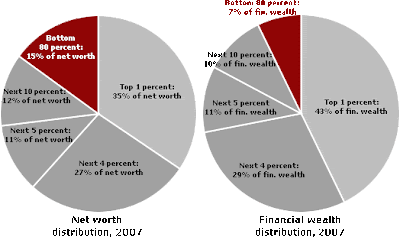
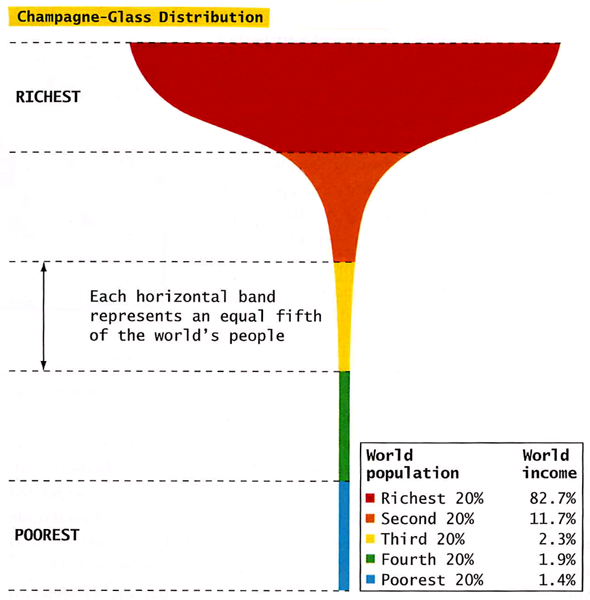
“It’s not greed,” I said, “look at who owns the wealth. The overwhelming proportion of people don’t have any control. They’re just trying to get by.”
To talk of “greed” anthropomorphises the machine of the economy, imbues it with a human emotion where it has none. To say that bankers are “greedy”, or that corporations and their Chief Executive Officers are “evil” entirely misses the point. Almost everybody is employed by somebody else, and has to follow instructions.
Even High Net Worth Individuals are under pressure to respond to their “electorates”, those who consume their intellectual property rights.
However, “just following orders” is no excuse to let people off the hook when it comes to carbon emissions, just like it is no excuse for war crimes.
But it’s not “greed”.
That would imply guilt, but guilt is not a lever that can be used successfully to correct excess carbon emissions.
Forget Nigel Lawson and his struggle to keep the British energy system in the privatised 1980s by denying the realities of Climate Change.
The lords (and sadly, some of the ladies) of this land want to stay rich from their shares in fossil fuels and mining. They’ll say anything to protect the value of their holdings.
But where’s your new North Sea Oil and Gas, Nigel ? Do you want to bankrupt this country by forcing us to ramp up our imports of energy as the North Sea production falls away ?
The chief executives of the “traditional” energy companies of these islands are just trying to keep themselves in a job when they decry wind power, biogas, marine energy projects.
No, Vincent de Rivaz of EdF, we don’t want expensive, inflexible and toxic Nuclear Power. No, Dorothy Thompson of Drax, we don’t want dirty coal continuing to heat up the world, poison fish and raise coughing kids. No, Rupert Soames of Aggreko, we must maintain the Renewable Energy obligations we have agreed at the European level, and raise the bar even higher, to protect the economy going into an uncertain future, by having homegrown energy.
We need an energy evolution in this country.
And so, what is needed is a social movement – involving ordinary, working people, unions, communities, academics, trained professionals from the engineering trades, local political activists and faith communities.
it was hoped that the Church of England investment portfolio would continue to be “cleaned up”. But there appears to be a long way to travel.
The Anglican Communion worldwide includes environmental protection as its “Fifth Mark of Mission”, and the Church of England is part of the international interfaith “seven year plans” :-
but the Church Commissioners report in the last year has confirmed that the Church of England still holds shares in companies such as BP, responsible for ecological devastation of the Gulf of Mexico :-
Groups such as the Alliance of Religions and Conservation, the Ecumenical Council for Corporate Responsibility and National Ethical Investment Week are all active in encouraging communities to put their money where their mouth is – and the faith communities have a very large amount to play with :-
With the launch of the Green Investment Bank – even though severely under-capitalised – there is a chance to tie up the questions to the answers.
If every consumer choice were a green choice, there would be no environmental problem. The only way to reach that point is for every contract, every stock and share, every procurement order, every transport vehicle, every energy source and every material resource to be green.
The choices that companies make in the business they conduct is based on the premise that people want what they sell so much they are prepared to invest directly in them as well as buy their products.
There are several levers for change here. Investment, such as pension funds, if moved in bulk, can have a de-securitisation effect on unsustainable business models. Not so much a “boycott” as a “landslide” of change.
The faith communities have already proved that they can change international commerce with the Fair Trade movement. Now it’s time for the Green Investment movement.