|
| Last year I was watching a couple of TEDs, and I came across this one given by Richard Sears, former Vice President of Royal Dutch Shell.
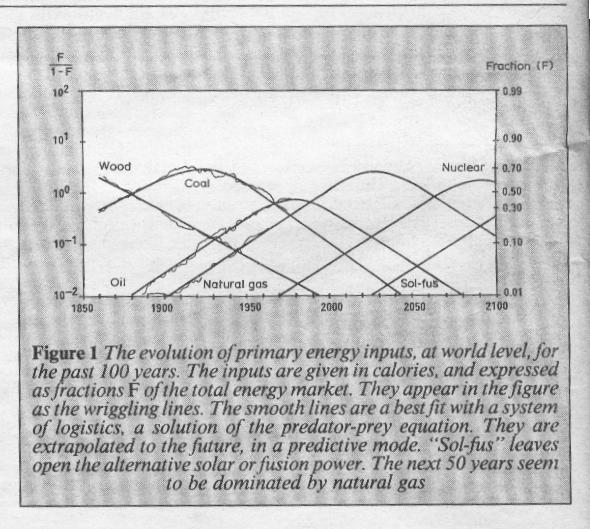
When he showed a chart of depletion curves for various energy resources, I thought to myself “I’ve seen this somewhere before”. As indeed I had. Nearly 30 years ago. How time flies. |
|
Memory is a patchy thing – the past is a set of blurred images of places, people, things – snapshots and summaries, little stories that we retell ourselves to encapsulate the moment. Things people said. I seem to recall emotional responses with the most clarity, so I cast myself back, trawling through my internal notebook for clues, hooks on which to recall. This may be a false memory, but it may not be, considering it allowed me to research the past. There I was, in the University Library, with all its institutional glass windows, and the sun beating down. It was too hot to think. In my hands I had an article from my undergraduate Physics degree reading list, probably provided by the Engineering Department for our study module on Energy. I recall that for some reason it was a translation. And had some complex formulae. My head buzzed. I couldn’t quite take it in. It didn’t take much Googling to remind me : Marchetti.
Back in the 1970s, engineers were promising a hydrogen economy for the 21st century, and Cesare Marchetti was optimistic about Carbon Capture and Storage. How little progress has been made since the First Oil Shock of 1973. | |
Category: Engineering Marvel

Categories
Assets not Liabilities Be Prepared Big Number Big Picture Burning Money Conflict of Interest Corporate Pressure Demoticratica Direction of Travel Disturbing Trends Divide & Rule Economic Implosion Electrificandum Energy Autonomy Energy Change Energy Insecurity Energy Revival Engineering Marvel Financiers of the Apocalypse Fossilised Fuels Fuel Poverty Green Investment Green Power Growth Paradigm Hydrocarbon Hegemony Incalculable Disaster Major Shift National Energy National Power Neverending Disaster Nuclear Nuisance Nuclear Shambles Optimistic Generation Paradigm Shapeshifter Peak Natural Gas Peak Oil Policy Warfare Political Nightmare Regulatory Ultimatum Renewable Resource Shale Game Social Democracy Solar Sunrise Solution City Sustainable Deferment Technological Fallacy Technological Sideshow The Myth of Innovation The Price of Gas The Price of Oil The War on Error Ungreen Development Unnatural Gas
The UK’s Energy Crisis
What annoys me most about the Solar Power Feed-in Tariff saga is not that the UK Government suddenly pulled the plug on the full rate for household-sized systems, or that they set the cut-off date before they finished their consultation, or even that that the Department of Energy and Climate Change (DECC) dragged out a legal appeal process.
Despite the truly pitiful sight of a Minister of State being sent out to bat with a miniaturised teaspoon to defend the indefensible decision, and despite the energy industry stooges that have placements inside DECC and are clearly affecting policy, no, the thing that really gets me is the focus on budgets instead of targets.
Here’s a summary from the Government’s own “long term trend” figures for energy consumption in Great Britain :-

Nobody can swear to me that the last few years are not just a glitch caused by economic instabilities, and that the re-localisation of manufacture in future in a recovering economy will not push this demand continually higher according to the trendline.
What are we using to supply this energy ? Here’s a summary :-

Despite the near exponential rise in renewable energy, it’s starting from a small base. The increase in energy consumption is being satisfied by a sharp rise in the supply of Natural Gas – something which the UK is producing increasingly less of these days. And for those who think that shale gas production would help, no, only a few percent of demand could be satisfied. This is an import-led energy supply, and the trend should ring alarm bells, but clearly doesn’t even tickle the ears of the average person in the street.
Electricity demand growth remains healthy, despite problems with unreliable supply from nuclear electricity (refered to as “outages” in the DECC Digest of UK Energy Statistics (DUKES) reports) :-

Now, in the future, with an envisioned massive rise in renewable energy, higher electricity use would be reasonable, as long as other energy consumption reduced. But the growth in electricity consumption charted here is not people driving more electric cars or using electric heating instead of Natural Gas-fired comfort. This is higher consumption, pure and simple, not “energy switching” over to electricity.
As an aside – the sum total of these figures indicates that the nation as a whole is not engaged in significant energy conservation, despite decades of campaigning.
All these trends add up to a very slight loss in dependency on fossil fuels for the UK’s energy :-

This is the critical trend. North Sea oil and Natural Gas production is falling like a large rock, and no amount of technological advancement and re-stimulating the drilling sector is turning this around. This means that without a rapid decrease in fossil fuel dependency, the United Kingdom is going to start haemorrhaging wealth.
Goodbye, First World.
This is why is it essential to ramp up renewable energy deployment by whatever means at our disposal.
Greg Barker MP bleating about keeping to budgets is not helping.
Categories
Assets not Liabilities Bad Science Bait & Switch Big Number Climate Change Conflict of Interest Corporate Pressure Cost Effective Delay and Deny Divide & Rule Dreamworld Economics Efficiency is King Energy Change Energy Denial Energy Insecurity Energy Revival Engineering Marvel Financiers of the Apocalypse Freak Science Green Investment Green Power Growth Paradigm Hydrocarbon Hegemony Libertarian Liberalism Major Shift Mass Propaganda Media Money Sings National Energy National Power Non-Science Optimistic Generation Paradigm Shapeshifter Peak Energy Policy Warfare Political Nightmare Price Control Public Relations Science Rules Scientific Fallacy Solution City Sustainable Deferment Technological Fallacy The Data The War on Error Unqualified Opinion Wind of Fortune
Wind Powers #1 : Civitas Fictitious ?
[ An extract from the online Christian Ecology Link discussion forum : 11th January 2012 ]
The Civitas report on wind farms.
A couple of days ago, Civitas published a report entitled, “Electricity costs: the folly of wind-power” : https://www.civitas.org.uk/press/prleaelectricityprices.htm [ Download report PDF ]
This report was produced by the Civitas economist, Ruth Lea. The report attracted a fair bit of publicity and even more antagonism from those within the renewables industry. Sadly, as usual the media have done rather less research than they should have; in particular they failed to check the background of the authorities quoted, though the Guardian did point to Lea’s views on climate change.
The following YouTube link leads to Ruth Lea denying the significance of anthropogenic climate change and the ‘flaws’ in Britain’s expensive climate change legislation. She uses all the same sad old errors and, in so doing, limits her credibility as an effective researcher : https://www.youtube.com/watch?v=UvmgUYGgqwU https://www.youtube.com/watch?v=qcFfxUIRbyo
Her comments seem to be straight out of the Chicago School mythology that economics overrides nature – the view of many scientifically illiterates.
But it gets better, she quotes, as an authority, Dr Kees le Pair, but fails to mention that he is a member of the ‘Committee of Recommendation’ of the Fusion Energy Foundation. The development of nuclear fusion, if it happens, will require very significant investment, investment that could, perhaps, otherwise be made in wind farms and other renewables so there is an important conflict of interest that has been wholly ignored : https://www.fusionenergyfoundation.org/about-us
This matters to all of us because it shows the dangerous level of uncritical evaluation that is made of so called scientific reports and information sources. I still remember the days past when research involved trips to libraries and hours of reading and, unless, the library had an academic connection, new information would not have been easily available.
Perhaps it was the more difficult nature of research that made the media, and much of its audience, that much more careful. The advent of the Internet has provided for rapid transmission of information, straight to your computer or even your smartphone, but apparently at the cost of critical evaluation. So much information is available that even report writers seem to fail to check the background of their sources or the veracity of the information given by that source. Yet, that same Internet provides the means of checking and it’s far less tedious than back in the days of library visits.
Careful use of a search engine can throw up evidence of partiality and YouTube can often confirm background beliefs that have overridden scientific evidence if not common sense. It’s not just
in reports such as this one from Civitas but also within so many anti this, that and the other environmental groups that plague the Internet.
Look carefully at Occupy, for example, and dig deeply enough, you will find some truly amazing YouTube material on the way in which the City of London is a part of worldwide Zionism that is somehow linked with the Vatican and Knights Templar ! Did you know that the Bank of England is owned by the Rothschilds ? The Internet, as well as giving freer voice to information also gives voice to conspiracy theorists and to the murk of prejudice. Just as it is both wrong and dangerous to spread unfounded rumours so it is to spread disinformation, so please use your search engine, take a little time and then critically assess whether this information that you have been given is likely to be both accurate and honest.
RT
Categories
Acid Ocean Alchemical British Biogas Design Matters Electrificandum Energy Change Energy Revival Engineering Marvel Faithful God Freak Science Green Power Major Shift Marvellous Wonderful Non-Science Optimistic Generation Paradigm Shapeshifter Realistic Models Renewable Gas Renewable Resource Science Rules Solar Sunrise Solution City Technofix The Data The Price of Gas The Price of Oil Toxic Hazard Unqualified Opinion Wind of Fortune
Alchemic for the people
| I was less than a metre above current sea level, rooting about in the holy bookshelves of my Evangelical host, searching for a suitable title.
I pulled out “Who Made God ?” from underneath a pile of books on their sides, letting the column slump downwards, alerting my companions to the fact that I had definitively made my choice for the evening’s reading. We were treated to gentle Christmassy music for an hour or so as we all gave up talking to read by candlelight and compact fluorescent. | |
| I didn’t read fast, as at first I didn’t have my newly-necessary reading glasses, and when I was encouraged to fetch them, the light was too dim to make reading easy. Those fashionable uplighters.
I read into the second part, and I had already formed in my mind several disagreements with the author, Professor Edgar Andrews, despite him having taken several good lines of reasoning and made some humourous points which I had duly responded to with a slight audible giggle. I instinctively didn’t like his pitch about the impossibility of organic chemistry and I froze a little : personally I see no need for God’s personal, literal, physical intervention to make the ladders and spirals of genes – the DNA and RNA forming from the appropriate nucleotide bases – A, T, G, C. And then the book’s author blew away his credibility, for me, at least, by getting bogged down in the absolutes of Physics, and ignoring Chemistry. He quoted the Laws of Thermodynamics, and claimed Entropy as proof that God doesn’t play dice because he’s in the garage playing mechanic. The direction of the universe, the arrow of time, plays towards randomness, the author of the book proclaimed. Order cannot come from inorganic matter – Life is the organising force. At this, I took several forms of dispute, and immediately found in my mind the perfect counter-example – the formation of crystals from saturated solution – the building of the stalgamite and stalagtite from the sedimentary filtering of rainwater. Another example, I think, is chiral forms of molecular compounds – some chemicals behave in different ways if formed lefthandedly or righthandedly. The different forms behave predictably and consistently and this is an ordered behaviour that I believe – without the necessary university instruction in Chemistry – is an imposed denial of chaos. In fact, the whole of Chemistry, its world of wonder in alchemy, I think points to a kind of natural negation of the Laws of Physics. There is the Micro World, where Newton, and more introspectively, Einstein, are correct in their theoretical pragmas. But in the Macro World, there is Chemistry, and there are precursor compounds to organic essentials. Life forms itself from dead stone. For a Physicist this is “just not cricket”, it is a whole new universe. Why can Aluminium be used for containers in microwave ovens, but steel cannot ? And why is Aluminium so light ? Why does water expand when it freezes ? Here the Physicists can help out. But they cannot, when it comes to explaining, or even accurately predicting, all the chemical properties of alloys and compounds. I have been pondering, in a crude, uneducated way, about industrial chemistry for the last couple of months. How large volume reactions are encouraged, catalysed. How fluids work. How gases breathe. My conclusion is that most chemical engineering is a bit brutish, like the workings of the internal combustion engine. Things are a tad forced. It is probably not possible for chemical engineers to replicate photosynthesis entirely – it’s too dainty for them. But that is the kind of chemistry we need to overcome our climate and energy problems. We may not be able to match the leaves on the trees, but we can do gas chemistry and electricity and semiconductor physics, and it is gas chemistry and electricity and semiconductor physics that will save the planet. Electricity to replace much fuel. Semiconductor physics to bypass photosynthesis. And Renewable Gas chemistry – engineering the chemical building blocks of the future and providing backup to the other green energies. | |
Categories
Assets not Liabilities Babykillers Burning Money Carbon Commodities Demoticratica Efficiency is King Emissions Impossible Energy Revival Engineering Marvel Environmental Howzat Evil Opposition Foreign Interference Fossilised Fuels Freshwater Stress Green Investment Green Power Human Nurture Hydrocarbon Hegemony Low Carbon Life Major Shift Military Invention National Energy National Power Not In My Name Optimistic Generation Peace not War Renewable Resource Resource Curse Resource Wards Solution City Stop War The Power of Intention Tree Family Ungreen Development Wasted Resource Water Wars Western Hedge
2012 : Greenier and Peace-ier
 | My dear family.
They think I’m an environmentalist, a bit radical, a bit confrontational. So for a fun wintertime gift they bought me this lovely cloth tote(m) bag for grocery shopping. I think I might have failed to communicate myself clearly enough. Although I try to be frugal and efficient in my way of life, recycling is not my central agenda. |
|
I studied physics, but I don’t have a laboratory. The things that I believe need to be developed are technologies in the field of clean, green energy. I am an engineer without a workshop – although my home is now a power station. Recycling is important, but reducing the use of resource materials is far more important. Recycling is important, but energy waste is far more important. Digging things out of the ground and burning them in order to keep civilisation moving is the ultimate misuse of natural resources. Recycling is important, but so are international relations, especially around the sourcing of commodities such as fossil fuels, rare metals, timber and freshwater. The world needs to work together – to make friends, not invent enemies – even more so when those so-called opponents sit on vital energy resources. May you have a year that is greener and has more peace. | |


Categories
Bad Science Bait & Switch Conflict of Interest Delay and Deny Disturbing Trends Divide & Rule Energy Insecurity Energy Revival Engineering Marvel Feel Gooder Fossilised Fuels Freak Science Freshwater Stress Gamechanger Geogingerneering Growth Paradigm Hydrocarbon Hegemony Marvellous Wonderful Methane Madness Money Sings National Energy National Power Non-Science Not In My Name Peak Natural Gas Policy Warfare Political Nightmare Resource Curse Resource Wards Science Rules Scientific Fallacy Shale Game Stirring Stuff Sustainable Deferment Technofix Technological Fallacy Technological Sideshow Technomess The Myth of Innovation The Price of Gas The War on Error Toxic Hazard Unnatural Gas Unqualified Opinion
Another Meeting I Will Not Be Attending
 | What appears to be a serious event is due to take place at the Energy Institute in London on 6th December 2011, “Peak Oil – assessing the economic impact on global oil supply“.
Dr Roger Bentley, author of a seminal 2002 paper on the subject, research that spawned hundreds of related learned articles, will be speaking. But the event organisers have also invited one Dr Matt Ridley, the self-styled “rational optimist”, and member of the Global Warming Policy Foundation, and this, I’m afraid, prevents me from attending. |
Ridley projects a view that many probably find comforting – as his headline in The Times of 1st October 2011 summarises – “Cheer up. The world’s not going to the dogs”. He has been captured speaking at a TEDx event pouring scorn on “environmental” scare stories of the past, but not bothering to delve or dig into how mankind has actually gone out of its way to act on past crises and prevent catastrophes. And now he’s thrown in his lot with the shale gas miracle men, writing a report with a foreword by Freeman Dyson, one of the world’s most balanced individuals. How much uncorroborated optimism can one man contain ? | |
Categories
Bait & Switch British Biogas Carbon Capture Energy Insecurity Engineering Marvel Fossilised Fuels Freemarketeering Gas Storage Geogingerneering Hydrocarbon Hegemony Hydrogen Economy Major Shift Money Sings Peak Energy Peak Natural Gas Peak Oil Policy Warfare Political Nightmare Realistic Models Renewable Gas Renewable Resource Resource Wards Technofix Unnatural Gas Wasted Resource
Carbon Capture and Syngas

Back in the 1970s they were expecting global cooling – of the economy. There were oil shocks and shocking prices, and petrochemists beavered away, sweating over test tubes the size of football fields, whisking up synthetic fuels.
It was not the first time that the world had tried to synthesise liquid vehicle fuel. Hitler famously did it during the Second World War, and had it not been for Bergius and Fischer-Tropsch, Nazi Germany would have collapsed much sooner under the anvil of global economic sanctions. I mean, the history books insist the multi-pronged military assault was responsible for the Victory in Europe, but the final push would never have succeeded without the suspension of energy trade.
Various syngas and synfuel projects have continued in various places, mostly America, and although the first plants used coal and Natural Gas to make other things, these days the emphasis is on biomass.
We can expect to see a dramatic rise in the amount of Biogas and Bio-syngas produced over the next few decades, along with renewably-sourced hydrogen. It will all get fed into the global syngas refineries, and out will pop power, vehicle fuel and chemistry.
Categories
Bait & Switch Big Picture Biofools British Biogas British Sea Power Conflict of Interest Corporate Pressure Delay and Deny Demoticratica Direction of Travel Divide & Rule Drive Train Electrificandum Energy Change Energy Revival Engineering Marvel Environmental Howzat Feel Gooder Financiers of the Apocalypse Fossilised Fuels Gamechanger Gas Storage Green Investment Green Power Hydrocarbon Hegemony Hydrogen Economy Major Shift Marvellous Wonderful Mass Propaganda Media Methane Management National Energy National Power Not In My Name Nuclear Nuisance Nuclear Shambles Oil Change Optimistic Generation Peak Emissions Peak Energy Peak Oil Policy Warfare Political Nightmare Public Relations Regulatory Ultimatum Renewable Gas Renewable Resource Resource Wards Shale Game Social Capital Social Change Solar Sunrise Solution City Stirring Stuff The Power of Intention The War on Error Toxic Hazard Transport of Delight Wind of Fortune Zero Net
Renewable Gas : Balanced Power

People who know very little about renewable and sustainable energy continue to buzz like flies in the popular media. They don’t believe wind power economics can work. They don’t believe solar power can provide a genuine contribution to grid capacity. They don’t think marine power can achieve. They would rather have nuclear power. They would rather have environmentally-destructive new oil and gas drilling. They have friends and influence in Government. They have financial clout that enables them to keep disseminating their inaccuracies.
It’s time to ditch the pundits, innuendo artists and insinuators and consult the engineers.
Renewable Gas can stand in the gap – when the wind doesn’t blow or the sun doesn’t shine and the grid is not sufficiently widespread and interconnected enough to be able to call on other wind or solar elsewhere.
Renewable Gas is the storing of biologically-derived and renewably-created gases, and the improving of the gases, so that they can be used on-demand in a number of applications.
This field of chemical engineering is so old, yet so new, it doesn’t have a fixed language yet.
However, the basic chemistry, apart from dealing with contaminants, is very straight-forward.
When demand for grid electricity is low, renewable electricity can be used to make renewable hydrogen, from water via electrolysis, and in other ways. Underused grid capacity can also be used to methanate carbon-rich biologically-derived gas feedstocks – raising its stored energy.
Then when demand for grid electricity is high, renewable gas can be used to generate power, to fill the gap. And the flue gases from this combustion can be fed back into the gas storage.
Renewable gas can also be biorefined into vehicle fuels and other useful chemicals. This application is likely to be the most important in the short term.
In the medium-term, the power generation balance that renewable gas can offer is likely to be the most important application.
Researchers are working on optimising all aspects of renewable gas and biorefinery, and businesses are already starting to push towards production.
We can have a fully renewable energy future, and we will.
Categories
Big Society Carbon Capture Carbon Commodities Carbon Taxatious China Syndrome Climate Change Climate Damages Engineering Marvel Evil Opposition Feel Gooder Foreign Interference Mass Propaganda Military Invention Money Sings National Socialism Nuclear Nuisance Nuclear Shambles Peace not War Pure Hollywood Science Rules Stirring Stuff The War on Error Wasted Resource
China Launches : Space Republic
China has launched Tiangong-1, the “Heavenly Palace“, and demonstrated an international co-operative republic of space in the making. Many technologists, scientists, engineers and military personnel in the major economies will have taken part in the coordination of this project.
Three things come to mind. First of all, China are going to experience a massive drain on domestic economic and social development in pursuit of its programme to set up a space station. Some could say this is deliberate, and that China has been convinced to spend on space to keep them from world economic dominance.
Next, the Chinese are obviously going to set up Earth monitoring systems, and are going to find out that everything the Americans have said about environment and climate, based on the data from the NASA, NOAA and UAH satellites and space occupation, is accurate; and wonder why they were convinced of the possibility of the alternative, and the necessity of going up there to find out for themselves.
And thirdly, the Chinese are going to find that they are drawn into the American and United Nations economic and military security programmes, monitoring common “enemies” – such as those breaking carbon treaties and constructing disallowed nuclear power stations.
So, not a space republic – not even a space race. More, a space replication, repeating what’s already been done before. A giant public works project that should keep the hardworking Chinese people proud for a moment.
Happy Birthday, China !
Categories
Bait & Switch Big Picture Carbon Capture Conflict of Interest Corporate Pressure Cost Effective Dead End Demoticratica Disturbing Trends Earthquake Energy Change Energy Insecurity Engineering Marvel Environmental Howzat Foreign Investment Fossilised Fuels Freshwater Stress Gamechanger Geogingerneering Hydrocarbon Hegemony Incalculable Disaster Landslide Mass Propaganda Methane Management National Energy Peak Emissions Peak Energy Policy Warfare Political Nightmare Protest & Survive Public Relations Realistic Models Regulatory Ultimatum Screaming Panic Technological Fallacy Technomess Toxic Hazard Tsunami Unconventional Foul Unnatural Gas Western Hedge
Camp Frack : Who’s afraid of hydraulic fracturing ?

When do micro-seismic events add up to earthquakes ? Landslips ? Tsunamis ? Who really knows ? These are just a few questions amongst many about underground mining techniques that will probably never be properly answered. Several mini-quakes were suggested to be responsible for the shutdown of Cuadrilla’s activities in Blackpool, north west England early in 2011, and there have been unconfirmed links between tremors and fracking in the United States of America, where unconventional gas is heavily mined.
It is perhaps too easy to sow doubt about the disbenefits of exploding rock formations by pressure injection to release valuable energy gases – many legislative and public consultation hurdles have been knocked down by the merest flick of the public relations wrist of the unconventional fossil gas industry (and its academic and consultancy friends).
The potential to damage the structure of the Earth’s crust may be the least attributable and least accountable of hydraulic fracturing’s suspected disadvantages, but it could be the most significant in the long run. Science being conducted into the impact on crust stability from fracking and other well injection techniques could rule out a wide range of geoengineering on safety grounds, such as Carbon Capture and Storage proposals. If we can’t safely pump carbon dioxide underground, we should really revise our projections on emissions reductions from carbon capture.
[ Camp Frack is under canvas in Lancashire protesting about the imposition of hydraulic fracturing on the United Kingdom. ]
Categories
Corporate Pressure Dead End Delay and Deny Direction of Travel Disturbing Trends Emissions Impossible Energy Change Energy Insecurity Engineering Marvel Environmental Howzat Financiers of the Apocalypse Fossilised Fuels Fuel Poverty Gamechanger Hydrocarbon Hegemony Marine Gas Peak Energy Peak Oil Policy Warfare Resource Curse Sustainable Deferment Tarred Sands Technological Sideshow Technomess Toxic Hazard Unconventional Foul Unnatural Gas Western Hedge
Energy Poll #7 : Unconventional Fossil Fuels
Categories
Big Number Big Picture Biofools British Biogas Carbon Capture Coal Hell Design Matters Direction of Travel Drive Train Energy Change Energy Revival Engineering Marvel Fossilised Fuels Fuel Poverty Green Investment Green Power Hydrocarbon Hegemony Major Shift Marvellous Wonderful National Energy National Power Nuclear Nuisance Nuclear Shambles Optimistic Generation Peak Emissions Policy Warfare Realistic Models Renewable Gas Renewable Resource Solar Sunrise Solution City The War on Error Tree Family Unnatural Gas Wasted Resource Wind of Fortune
Renewable Gas #5 : Beyond Biogas

I was speaking to a nuclear power “waverer” the other day. They said that George Monbiot or Mark Lynas was saying that since Germany has cancelled its nuclear power programme, Germany’s Carbon Dioxide emissions will increase, because they will be using coal and Natural Gas power stations :-
https://www.davidstrahan.com/blog/?p=1130
https://www.newscientist.com/article/dn20665-germany-will-use-fossil-fuels-to-plug-nuclear-gap.html
https://www.marklynas.org/2011/06/germany-italy-greens-nukes-and-climate-change/
https://www.guardian.co.uk/environment/blog/2011/jun/15/italy-nuclear-referendum
https://www.guardian.co.uk/commentisfree/2011/jul/04/nuclear-industry-stinks-cleaner-energy
https://www.monbiot.com/2011/07/04/corporate-power-no-thanks/
I explained that this was a common misconception, and that Germany is still planning to meet their carbon targets, and that it can be done even with coal and gas power plants because in a few decades’ time the coal and Natural Gas power plants will only be used a couple of weeks a year in total to back up all the renewables, such as wind power and solar power, that Germany is building.
This is not the end of the story, however.
Categories
Bait & Switch Big Picture Biofools British Biogas Conflict of Interest Corporate Pressure Dead End Design Matters Direction of Travel Drive Train Efficiency is King Energy Change Energy Insecurity Energy Revival Energy Socialism Engineering Marvel Freemarketeering Human Nurture Incalculable Disaster Libertarian Liberalism Low Carbon Life Major Shift Mass Propaganda National Energy Neverending Disaster Non-Science Nuclear Nuisance Nuclear Shambles Nudge & Budge Oil Change Optimistic Generation Policy Warfare Political Nightmare Public Relations Realistic Models Renewable Gas Science Rules Scientific Fallacy Social Change Solar Sunrise Technofix Technological Fallacy Technological Sideshow Technomess The Myth of Innovation The Power of Intention The War on Error Transport of Delight Unutterably Useless Utter Futility Vain Hope Vote Loser Wind of Fortune
George Monbiot : New Clear

It is a newer, clearer tone that George Monbiot uses in his piece “The nuclear industry stinks. But that is not a reason to ditch nuclear power“. He seems to have lost his dirty annoyance with filthy anti-nuclear activists and moved onto a higher plane of moral certitude, where the air is cleaner and more refined.
He is pro-technology, but anti-industry. For him, the privately owned enterprises of atomic energy are the central problem that has led to accidents both of a radioactive and an accountancy nature. “Corporate power ?”, he asks, “No thanks.” The trouble is, you can’t really separate the failings of nuclear power from the failings of human power. It’s such a large, complex and dangerous enterprise that inevitably, human power systems compromise the use of the technology, regardless of whether they are publicly or privately owned. For a small amount of evidence, just look at the history of publicly-managed nuclear power in the United Kingdom. Not exactly peachy. And as for those who claimed that a “free” market approach to managing nuclear power would improve matters – how wrong they were. In my view, on the basis of the evidence so far, nobody can claim that nuclear power can be run as an efficient, safe, profit-making venture.
Categories
Bad Science Bait & Switch Big Picture Biofools Burning Money Carbon Capture China Syndrome Climate Change Conflict of Interest Dead End Delay and Deny Demoticratica Disturbing Trends Divide & Rule Energy Change Energy Insecurity Energy Revival Engineering Marvel Freak Science Freemarketeering Gamechanger Green Investment Green Power Major Shift Mass Propaganda Military Invention Money Sings No Blood For Oil Not In My Name Nuclear Nuisance Nuclear Shambles Oil Change Optimistic Generation Peace not War Peak Emissions Peak Energy Peak Oil Policy Warfare Public Relations Pure Hollywood Scientific Fallacy Stop War Sustainable Deferment Technofix Technological Fallacy Technological Sideshow Technomess Toxic Hazard Unutterably Useless Utter Futility Vain Hope
Selling Thorium to China
Kirk Sorensen, formerly of Teledyne Brown Engineering, now of Flibe Energy
To: Claverton Energy Research Group
From: Jo Abbess
Date: 24 June 2011
Subject: “Don’t believe the spin on thorium being a ‘greener’ nuclear option”
Hi Clavertonians,
As you are, I’m sure, aware, context is everything.
I was so sure we’d escaped the clutches of the “Thorium Activist Trolls” a few years ago, but no, here they are in resurgence again, and this time they’ve sucked in George Monbiot, Mark Lynas and Stephen Tinsdale, all apparently gullible enough to believe the newly resurrected Generation IV hype campaign.
They should have first done their research on the old Gen IV hype campaign that withered alongside the “Hemp will Save the World, No Really” campaign and the “Biodiesel will Save the World, AND You Can Make it at Home” brigade. Oh, and the Zero Point Energy people.
I was, I admit, quite encouraged by both the Hemp and Biodiesel drives, until I realised they were a deliberate distraction from the Big Picture – how to cope with the necessity of creating an integrated system of truly sustainable energy for the future.
Hemp and Biodiesel became Internet virally transmitted memes around the same time as the Thorium concept, but where did they come from ?
Where does the Thorium meme originate from this time round ? I found some people took to it at The Register, where they spin against Climate Change science a lot – watch the clipped video :-
https://www.theregister.co.uk/2011/02/01/china_thorium_bet/
I would suggest that there are connections between the Thorium campaign and the anti-Climate Change science campaign, and I have some evidence, but I’m too busy to research more in-depth just now, so I’m not going to write it all up yet.
The key issues with all energy options is TIME TO DELIVERY and SCALEABILITY, and I think the option presented by the Thorium fuel cycle fails on both counts.
Yeah, sure, some rich people can devote their life savings to it, and some Departments of Defense (yes, Americans) and their corporate hangers-on can try selling ANOTHER dud technology to China (which is the basis of some Internet energy memes in my view).
Remember Carbon Capture and Storage ? The British Government were very keen on making a Big Thing about CCS – in order to sell it to the miscreant Chinese because (WARNING : CHINA MYTH) China builds 2 !! coal-fired !! power stations a week/day/month !!
THORIUM – A Brief Analysis
TIME TO DELIVERY – 20 to 50 years
SCALEABILITY – unknown
USEFULNESS ASSESSMENT – virtually zero, although it could keep some people on the gravy train, and suck in some Chinese dough
The Tyndall Centre say that global emissions of greenhouse gases have to peak AT THE LATEST by 2020. We should be thinking about rolling out the technology WE ALREADY HAVE to meet that end.
Don’t believe the hype,
jo.
PS What other evidence do we have that the Thorium meme is most likely just a propaganda campaign ? Nick Griffin of the British National Party backs it, and the BNP are widely alleged to promote divisiveness…
Categories
Bait & Switch Behaviour Changeling Big Picture Breathe Easy Coal Hell Corporate Pressure Delay and Deny Demoticratica Divide & Rule Economic Implosion Energy Change Energy Insecurity Energy Socialism Engineering Marvel Fossilised Fuels Gamechanger Green Power Growth Paradigm Hydrocarbon Hegemony Major Shift Mass Propaganda Media Money Sings National Energy Nuclear Nuisance Nuclear Shambles Nudge & Budge Obamawatch Oil Change Peak Oil Petrolheads Policy Warfare Political Nightmare Public Relations Pure Hollywood Regulatory Ultimatum Solar Sunrise Sustainable Deferment Tarred Sands Technofix Technological Fallacy Technological Sideshow Technomess The Myth of Innovation The War on Error Toxic Hazard Unconventional Foul Unnatural Gas Voluntary Behaviour Change Vote Loser Wind of Fortune
Glenn Beck : “Dangerous and Evil”
https://www.foxnews.com/on-air/glenn-beck/transcript/beck-americas-energy-under-attack
Thank you, Coal.
Thank you for the asthma, the mercury, the mountain top removal, the birth defects, the mine fatalities, the grossly inefficient electricity networks, the lack of investment in electricity networks, the smog, the heat, and above all, thank you for giving us Glenn Beck, on a platter – this is so much fun to watch !

Mark Lynas’ increasingly entangled, highly chained argument about the Intergovernmental Panel on Climate Change, or IPCC, is beginning to look like it could be one big prank to me. Either that or he’s hiding inside a very large turtleneck and hasn’t had much air lately.
https://www.marklynas.org/2011/06/the-ipcc-renewables-controversy-where-have-we-got-to/
“Some green-tinged commentators, in trying to protect the IPCC from any criticism – legitimate or illegitimate – are now seeking to deflect attention by putting blame elsewhere. Carbon Brief, a sort of PR rapid-response service which takes on climate sceptics (and which has former Greenpeace campaigner Christian Hunt as its main press contact), admitted that there were “legitimate issues with the organisation’s communications” – but tried to pin the blame on the media…”
So…let’s get this straight – according to Mark Lynas – Christian Hunt, who used to work with the Public Interest Research Centre, and helped edit the first Centre for Alternative Technology report “Zero Carbon Britain“, which PIRC published, is now a mere ideologue ? You mean he is incapable of reporting accurately on the work of thousands of British and international renewable energy engineers because he used to work for Greenpeace ?
Sorry. That argument doesn’t hold. Why does Christian Hunt now have to be in the “bad boy” box ?
Previously, Mark Lynas was confident of a renewable energy future for Britain, but was “agnostic” about Nuclear Power :-
https://www.heatmyhome.co.uk/solar-panels/is-a-zero-carbon-britain-possible/336
““Localism will become the buzzword,” says Mark Lynas, the environmentalist and author of Six Degrees: Our Future on a Hotter Planet. “It is technically possible to achieve a zero-carbon Britain by 2050 as we are blessed with abundant renewable resources, especially off-shore wind in the shallow North Sea – although it will be a harder task without nuclear, on which I am agnostic. This largely covers electricity generation, but weaning ourselves off fossil fuels for our transport needs is much harder to achieve.”
Now, it appears, he’s in love with the dreamlike future of Nuclear Power :-
https://www.scotsrenewables.com/blog/book-reviews/the-god-species-review/
“Lynas belives we can now claw our way back below the 350ppm CO2 boundary – and that we can do it without cutting consumption or radically changing our habits. Nuclear-charged electric cars, biofuelled jets and continuing economic growth mean it will be business as usual in the low carbon future he envisages.”
What changed ? Fukushima Daiichi happened, or rather, started happening and got progressively worse, halfway through writing his new book, but that didn’t put him off the atomic power trail. He’s on a very lonely island. Perhaps he’s there with David MacKay, the author of the book “Sustainable Energy Without The Hot Air” which I think has some pretty unrealistic visioning about harvesting uranium from seawater. Have they both drunk the Kool Aid ? I can see no other reason for their unsuppressed belief in the March of Nuclear Progress, unless they’ve spent too long talking to Matt Ridley, who could probably even be optimistic about Fukushima Daiichi…Oh…wait… He has been ! But I digress.
Mark Lynas believes in the power of Renewable Energy, even though he’s been snared in the cult of Atomkraft :-
“Personally I think that 80% of the world’s energy probably could be met by renewables by mid-century – but the IPCC’s renewables report singularly fails to demonstrate that. (So I’m not a clean energy ‘unbeliever’ – denier? – even by [Greenpeace’s Sven] Teske’s standard above.) Instead, the figure comes from one of 167 [no, 164, actually] different energy scenarios, none of which are assessed in terms of their likelihood or feasibility. They are just ‘scenarios’, not plans, strategies or even projections.”
An international group of experts have put together a collection of 164 potential pathways, but how can Mark Lynas possibly know which is the most likely ? Which is the best ? Which the most optimal ? Who better than the people on the IPCC to assess the best options ?
A lot of our energy future rests on choice – the choices that governments, companies and people make – about the best energy technologies to invest in, about the regulations for environmental protection, and about how best to match and marry energy resources.
Without care and composure and strategic policy, these choices will probably be made on a step-by-step basis, with limited systems thinking. This has been the way throughout the development of the use of fossil fuels and uranium, and we have ended up with heinously wasteful power generation networks, and rapacious resource scavenging around the world.
It’s right that we give priority not to particular, favourite technologies, but to packages of options that fit well together and have synergistic effects on resource optimisation, environmental protection and climate safety.
Many groups are working on this very problem, and not just the non-governmental organisations. We now have government departments, engineering companies and energy systems analysts around the world looking at economy-wide responses to climate change, and how to effect the changes in the energy systems that can meet the challenge.
There are many experts out there. Many of them resist new Nuclear Power as costly, dangerous and defunct, and propose strategies similar to the Greenpeace [r]Evolution, which, as Sven Teske explains, was written by an alliance that spanned industry as well as Civil Society.
What gives Mark Lynas (and his New Best Friend, Steve McIntyre), the authority to say that Sven Teske’s judgement on the best way forward is wrong ? And why shouldn’t the IPCC prefer a scenario similar to the one proposed by Greenpeace ?
Nuclear Power is not a very pragmatic choice. It’s lumpy, costly, unreliable, risky and lots of the expenses are stacked up towards the end of a reactor’s life. It’s part of the dying paradigm of centrally-provided electricity generation. It’s proved it’s uselessness. Let’s move on from Nuclear Power.
Categories
Big Picture Coal Hell Direction of Travel Divide & Rule Emissions Impossible Energy Insecurity Energy Revival Engineering Marvel Foreign Interference Fossilised Fuels Green Investment Green Power Hydrocarbon Hegemony Major Shift Media National Energy Nuclear Nuisance Nuclear Shambles Optimistic Generation Peak Emissions Policy Warfare Realistic Models Regulatory Ultimatum Renewable Resource Solar Sunrise Solution City Technological Fallacy Technological Sideshow The War on Error Unqualified Opinion Western Hedge Wind of Fortune
Mark Lynas : Turn Turtle

from : Jo Abbess
to : Mark Lynas
cc : George Monbiot
date : Thu, Jun 16, 2011 at 8:07 PM
subject : You may not have properly understood Germany’s energy plan
Dear Mark,
From where I’m sitting, you appear not to have understood Germany’s energy plan, which centres on ramping up and rolling out as much renewable energy as possible.
You are quoted, and write :-
https://us.arevablog.com/2011/06/16/quote-of-the-day-42/
https://www.guardian.co.uk/environment/blog/2011/jun/15/italy-nuclear-referendum
“If the German greens really took climate change seriously, they would instead be pushing for a phase-out of coal – which generates by far the largest proportion of the country’s power and consequent carbon emissions – from Germany’s electricity grid. Instead, the new nuclear phase-out plan will see a hefty 11GW of new coal plants built in years to come, with an additional 5GW of new gas. The only way emissions from these plants could be controlled would be through “carbon capture and storage” (CCS) – yet Greenpeace in Germany has already mounted a successful scaremongering campaign against this new technology, helping to ensure that future fossil emissions will go into the atmosphere unabated.”
How does having strong renewable energy ambition sit with commissioning new coal power plants ?
Well, as you probably know, the wind does not always blow and the sun does not always shine – hence back up is required. Nuclear power cannot back up wind power or solar power because it is not very flexible.
Coal and gas are easily stored, and coal and gas power plants can be kept awaiting use as and when required by renewable lulls.
There is no point in fitting Carbon Capture (and eventually Storage) to coal fired power plants if they’re only going to be used for occasional wind back up – too expensive. And the tests are showing problems. And even though it’s claimed that CCS can take away 90% of the emissions, it’s more like 85% because CCS uses more coal fuel.
It would be better if Germany opted totally for new gas plant for their wind back up, but they appear to not want to be big importers of fossil fuels, so they’ve gone mostly for coal which they can mine, at a pinch, at home. In the UK we’re going for gas, because we believe in continued good relations with Qatar (via the House of Saud ?) and Russia (via BP ?)
The amount of time that coal and gas plants will be in use when renewable energy is fully developed in Gemany will be days per year in total. So in 20 years time when they’ve built all their wind and solar, they get to meet their carbon targets and still have operational coal and gas plant for when necessary.
How is it that you’ve missed this central plank of their policy ?
On the one hand, I could be asked to excuse this lapse of reasoning on your part – as far as I know you haven’t trained as an energy engineer, so how could you be expected to understand load balancing and load following in the real world ?
On the other hand, you’ve just written a book extolling the virtue of nuclear engineering, in effect dismissing the sensible decisions that Germany and other countries have taken, so I cannot let this pass by without commenting.
Sorry to report it, but you’ve just made it into my Little Book of The World’s Most Annoying Men because you appear to have no idea about the pitfalls of nuclear power, you do not seem to understand other approaches to the energy crisis; and in addition, you have built a generalist argument concocted from stereotypes to make the green movement the punch bag for your position. When I read a similar irrational rant in Anthony Giddens’ book “The Politics of Climate Change”, I became so angry, my reptile-inherited brain took over, and I threw the book across the room.
Why, I ask myself, are you following in Giddens’ footsteps and becoming so reactionary ? Are you adopting the position of George Monbiot, who seems to be evolving into a curmudgeon ?
I shall not be buying your new book, because your arguments are, to my mind, faulty.
Regards,
jo.
Categories
Bad Science Bait & Switch Climate Change Corporate Pressure Divide & Rule Energy Change Energy Insecurity Energy Revival Engineering Marvel Fossilised Fuels Freak Science Genetic Modification Genetic Muddyfixation Green Investment Hydrocarbon Hegemony Major Shift Mass Propaganda Media Non-Science Nuclear Nuisance Nuclear Shambles Oil Change Optimistic Generation Peak Emissions Peak Energy Policy Warfare Political Nightmare Protest & Survive Realistic Models Renewable Resource Science Rules Scientific Fallacy Technofix Technological Fallacy Technological Sideshow Technomess The Data The War on Error Unqualified Opinion
Mark Lynas : Mutant Ninja

Mark Lynas may call himself a “green”, and be a clean-shaven, respectable, politely-spoken Oxford academic type but he appears to be mutating into something very unappealing indeed. He’s written some good books on climate change – every schoolroom and university module should have one – but on energy, he is deep in the political woods, without even a wind-up flashlight.
His latest stunt is to join in with accusations from Steve McIntyre of Climate Audit that the IPCC’s report on Renewable Energy has been partly crafted by people without appropriate independence or expertise. Here, from Andrew Revkin :-
“The IPCC must urgently review its policies for hiring lead authors – and I would have thought that not only should biased ‘grey literature’ be rejected, but campaigners from NGOs should not be allowed to join the lead author group and thereby review their own work.”
And who is this nefarious untalented Non-Governmental Organisation ? Greenpeace, it appears, according to Mark Lynas, is not capable of writing about the future of energy (or even the current situation).
Daniel Kammen has weighed in and The Revkin has updated his post :-
“There is no Himalaya-gate here at all. While there are some issues with individual chapters, there is no ‘Greenpeace Scenario.’ The 77% carbon free by 2050 is actually more conservative than some cases. The European Climate Foundation, for example has a 100% carbon neutral scenario and Price Waterhouse has a very low carbon one for North Africa. Further, while the IPCC works from published cases, the scenarios are evaluated and assessed by a team.”
There have been a number of reports written in the last year that back the viability of Renewable Energy technologies in replacing the world’s fossil fuel and nuclear energy systems. Not all of them were crafted by Greenpeace researchers. In fact, virtually none of them. Nuclear…yes…maybe it’s that little word “nuclear” that’s the root cause of Mark Lynas’ problem with Greenpeace.
In the Guardian, he is quoted as saying :-
https://www.guardian.co.uk/environment/blog/2011/jun/15/italy-nuclear-referendum
https://www.guardian.co.uk/environment/2011/jun/13/greenpeace-foe-charles-secrett-criticism
“Many ‘green’ campaigns, like those against nuclear power and GM crops, are not actually scientifically defensible…”
And that’s where you are so wrong, Mark Lynas with the book coming out soon that you seem so desperate to publicise by saying things you know people will find annoying. Nuclear power is a TECHNOLOGY, not a SCIENCE. This is the same basic category error made by Dick Taverne and a number of other public commentators who don’t appear to have an engineering background.
TECHNOLOGY is where people decide that their designs to make something look like they’ll work, build them and don’t foresee flaws with them. SCIENCE is where people study the technology that they’ve built and research the flaws that appear and report on them. Science is what has shown the limitations with the original boasts about genetically modified crops. It turns out that GMOs are a ruse to sell chemicals. And on nuclear fission – the science is in and on the front of your daily newspaper : nuclear power plants pose a number of risks. The advice of the reputable scientists and engineers – old fission nuclear power plants should be withdrawn.
But returning to Renewable Energy, a number of organisations now believe that the demise of fossil fuels needn’t stop humanity from accessing abundant energy. Here is just a very short compilation :-
The Two Marks : Mark A. Delucchi and Mark Z. Jacobson :-
https://www.peopleandplace.net/on_the_wire/2011/2/5/mark_jacobson_and_mark_delucchi_wind_water_and_solar
PriceWaterhouseCooper :-
https://www.pwc.co.uk/eng/publications/100_percent_renewable_electricity.html
CAT Zero Carbon Britain 2030 :-
https://www.zerocarbonbritain.com/
Roadmap 2050 :-
https://www.roadmap2050.eu/
European Renewable Energy Council R[e]volution :-
https://www.erec.org/media/publications/energy-revolution-2010.html
But oh, no, we can’t quote the last one because Greenpeace researchers were involved, and Mark Lynas wouldn’t approve of that. Mark Lynas appears to be living in a world where Greenpeace people can’t have engineering research skills because they have ideals, working for a world that uses safe, clean energy.
The IPCC report on Renewable Energy is here :-
https://srren.ipcc-wg3.de/
Much as I respect turtles, I have to say it – Mark Lynas, you’re a turtle – slow-moving and easy to catch out and turn into soup. You should know by now not to get sucked in by spurious non-arguments from Steve McIntyre. The “cleantech” industry that’s ramping up to provide the world with green energy is worth billions, soon to be trillions of dollars worldwide, and this fact appears to have completely passed you by. The only future for energy is sustainable, renewable, non-nuclear, clean, quiet and safe. There is no other viable, liveable, option.
[ UPDATE : In the Independent newspaper, Mark Lynas is quoted as remarking “Campaigners should not be employed as lead authors in IPCC reports”. So, Mark, it’s really fine for employees of the major oil, gas and mining companies to take a leading role on major IPCC reports; but it’s not fine, according to you, that somebody working for much less money and much higher principles than mere corporate profit should contribute ? Denigrating somebody for being a “campaigner” is a stereotypical insult. Everybody’s got an agenda, campaigners included. What’s your agenda, Mark ? Selling your new book ? Don’t be dismissive about Greenpeace researchers. They may have ideals, but they’re not naive – they also have brains – and with their declared position on getting at the truth they can be trusted to be direct, decent and honest. Where’s your ethical compass, Mark ? ]
Viva Italia !
Categories
Advancing Africa Animal Kingdoom Bad Science Bait & Switch Big Society Dead End Demoticratica Design Matters Divide & Rule Engineering Marvel Environmental Howzat Evil Opposition Foreign Interference Foreign Investment Freak Science Genetic Modification Human Nurture Libertarian Liberalism Mass Propaganda Media Non-Science Pure Hollywood Resource Curse Scientific Fallacy The War on Error Unqualified Opinion Unutterably Useless Utter Futility
Adam Curtis : Daft Punk
[ UPDATE : BRILLIANT DECONSTRUCTION OF ADAM CURTIS’ WORK FROM BEN WOODHAMS ]
The final part (I really hope it is the final part) of Adam Curtis’ trilogy on “Evil” Computers and “Devillish” Enviromentalists – “All Watched Over By Machines of Loving Grace” – a title drawn from a poem written by what would appear to be a madman – has now been uploaded to YouTube, allowing me to view it without taking part in the memory-eating public monitoring disappointment that is BBC iPlayer :-
Adam Curtis certainly reveals himself as a little monkeyish in this episode, throwing overarm and underhand javelins at “liberals” of all hues and cries, particularly environmental ones; and throwing in liberal references to primates wherever he can, seemingly to suggest that mankind has un- or de-evolved by adopting computing tools and studying the natural world.
Categories
Behaviour Changeling Big Picture British Sea Power Climate Change Climate Chaos Climate Damages Delay and Deny Demoticratica Disturbing Trends Divide & Rule Droughtbowl Economic Implosion Emissions Impossible Energy Change Energy Insecurity Energy Nix Energy Revival Energy Socialism Engineering Marvel Environmental Howzat Fossilised Fuels Green Investment Green Power Heatwave Low Carbon Life Major Shift Marvellous Wonderful National Energy Nuclear Nuisance Nuclear Shambles Optimistic Generation Peak Emissions Policy Warfare Political Nightmare Protest & Survive Regulatory Ultimatum Renewable Resource Social Change Social Chaos Solution City The Power of Intention Voluntary Behaviour Change Western Hedge Wind of Fortune
James Delingpole : Going Underground

James Delingpole hardly ever sets his delicate foot in Wales, the country he archaically refers to as “the Principality”, apart from, ooh, about ten days a year when he holidays there, but nonetheless, feels he has some kind of inherited ex-colonial right to be affronted that large electricity generation and transmission infrastructure are going to be built there :-
He gets top marks for being rather offensive himself – achingly rude, in fact, about the Welsh Assembly, besides his getting untethered about the wind farms and pylons for the transmission cables :-
“…The wind farms are bad enough on their own. But to make matters far worse […], in order for these bird-crunching, bat-chomping, view-blighting, rent-seeking monstrosities to be connected to the grid a huge 400kv power line is going to be constructed all the way from Montgomeryshire through some of Britain’s most spectacular scenery to the equally beauteous Shropshire…”
I cannot waste my time counting how many cut-and-paste e-mails I receive, and usually I just junk them, but I thought this one seemed sufficiently personalised to actually respond to it.
from Energy Collective
to jo abbess
date Fri, May 27, 2011 at 2:29 AM
subject You Are Invited! Blog With The Energy Collective
Dear Ms. Abbess:
…I am…at The Energy Collective (TEC). TEC is a pragmatic anti-carbon, tech-agnostic blog that aims to stoke the discussion on climate and energy solutions by bringing together the smartest climate and energy bloggers on the planet. We are at about 70k hits per month, and growing quickly. Our users are smart, engaged, energy professionals located all over the world, but concentrated in the US.
I stumbled over your blog, I think through Twitter, and am delighted by it. I like your straight-forward, unflinching writing style, as well as your lack of tolerance for climate deniers. I would like to invite you to blog with us at The Energy Collective. The deal here is a trade: you grant TEC permission to syndicate selected posts from your RSS for free, and we post, promote and leverage your content to get it in front of as many eyes as possible. We strive to create as much value as possible for our bloggers, and often offer contract writing opportunities, chances to participate as experts in our webinars, free or discount conference access, professional connections, and more.