On Wednesday, I received a telephone call from an Information Technology recruitment consultancy. They wanted to know if I would be prepared to provide computer systems programming services for NATO.
Detecting that I was speaking with a native French-speaker, I slipped into my rather unpracticed second language to explain that I could not countenance working with the militaries, because I disagree with their strategy of repeated aggression.
I explained I was critical of the possibility that the air strikes in Libya were being conducted in order to establish an occupation of North Africa by Western forces, to protect oil and gas interests in the region. The recruitment agent agreed with me that the Americans were the driving force behind NATO, and that they were being too warlike.
Whoops, there goes another great opportunity to make a huge pile of cash, contracting for warmongers ! Sometimes you just have to kiss a career goodbye. IT consultancy has many ethical pitfalls. Time to reinvent myself.
I’ve been “back to school” for the second university degree, and now I’m supposed to submit myself to the “third degree” – go out and get me a job. The paucity of available positions due to the poor economic climate notwithstanding, the possibility of ending up in an unsuitable role fills me with dread. One of these days I might try to write about my experiences of having to endure several kinds of abuse whilst engaged in paid employment : suffice it to say, workplace inhumanity can be unbearable, some people don’t know what ethical behaviour means, and Human Resources departments always take sides, especially with vindictive, manipulative, micro-managers. I know what it’s like to be powerless.
The New Scientist magazine must be hard up. They’ve already bowed to economic pressure and taken the “king’s shilling” from the oil and gas industry by running Statoil advertisements, at least one made to look like a normal New Scientist article, giving Natural Gas a makeover as desirable as washing powder – all clean and reliable and loved by obsessives everywhere. Now they appear to have lost their power for critical reasoning and sunk to being suckers as billboards for BP spin, taking a front cover foldout for biofuels, with what I think is a completely deceitful portrayal of BP’s business.
Browsing at a newsagent on a mainline railway station…
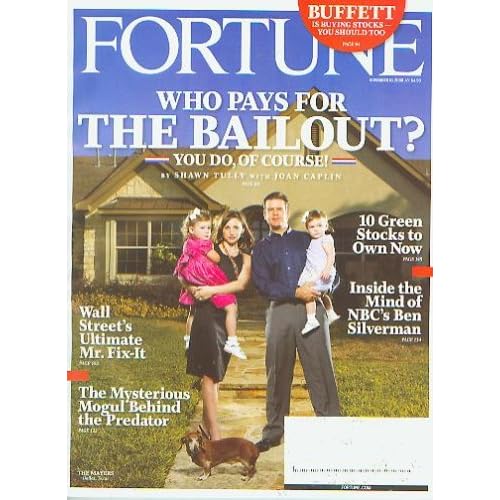
The question on the front cover of Fortune magazine, Europe edition Number 20, November 2008, already on the stands is “Who Pays for The Bailout ? You do, of course”. Of course, as this Credit Crunch means Bailout argument plays out, the issue of Energy and Climate Change is lost. But the question should be all about how to create a new green economy. Who pays for the re-powering ?
A sign of the greening times – another story teaser on the Fortune magazine advises “10 Green Stocks to Own Now”, and the front of the Independent on Sunday quotes Obama claiming that Energy is his “number one priority” in his bid for presidential election, with his “Apollo” project :-
“Obama’s green jobs revolution : Democrat will lead effort to curb world’s dependence on oil; Plans to create five million new posts in clean energy projects : By Geoffrey Lean in San Francisco and Leonard Doyle in Washington : Sunday, 2 November 2008 : Obama has pledged to create five million new ‘green collar jobs’ if elected : Barack Obama is promising a $150 billion “Apollo project” to bring jobs and energy security to the US through a new alternative energy economy, if his final push for votes brings victory in the presidential election on Tuesday. “That’s going to be my number one priority when I get into office,” Mr Obama has said of his “green recovery” plans. Making his arguments in a radio address yesterday, the Democratic favourite promised: “If you give me your vote on Tuesday, we won’t just win this election. Together, we will change this country and change the world.”…”
“Gulf petrodollars help UK go green : Brown calls for Saudis to give more cash to IMF : Gaby Hinsliff, political editor : The Observer, Sunday 2 November 2008 : The fight against climate change will get an unexpected boost today from oil-rich Gulf states which will pledge to invest some of their petrodollar profits in British green energy projects. The surging oil price over the past year has left parts of the Middle East awash with cash as the rest of the world is squeezed by the credit crunch, making Arab royals some of the few active investors worldwide. The Gulf states have enjoyed a $1.4 trillion windfall from higher oil prices since 2003. Ed Miliband, the Climate Change Secretary, arrived in Saudi Arabia yesterday with Gordon Brown at the start of a tour of the region. He said some of that cash would now ‘help our firms reap the rewards from going low carbon and providing green energy to thousands of families’ under a so-called ‘green Gulf deal’ to be announced today…”
“Gordon Brown in the Middle East : Brown hopeful of Saudi cash for IMF : Allegra Stratton in Riyadh, guardian.co.uk, Sunday 2 November 2008 15.30 GMT : Gordon Brown said today he was hopeful of success in his attempts to persuade dollar-rich Gulf states to prop up ailing national economies through a massive injection of capital into the International Monetary Fund (IMF). The prime minister spent three hours in one-to-one talks with Saudi Arabia’s King Abdullah, trying to persuade the monarch to invest in a revamped IMF. On the first leg of a four-day visit to the Middle East, and aiming to secure hundreds of billions of dollars for the fund, Brown called off a planned dinner with business leaders accompanying him so as to allow maximum negotiating time with the Saudi king. The IMF currently has around $250 billion in its emergency reserves but there are fears that, with Hungary, Iceland and Ukraine having already sought assistance and more nations expected to follow, the sum might not be sufficient. Brown hopes to persuade Gulf leaders to use some of the estimated $1 trillion they have made from high oil prices in the last few years to boost the reserves, indicating that he would like to see the current sum increased by “hundreds of billions” of dollars. The prime minister said following the talks that he was hopeful of having secured Saudi backing…”
“…Brown, who is accompanied by a high-level trade delegation seeking Gulf investment, including the CEOs of BP and Shell…”
What on earth are BP (formerly British Petroleum) and (Royal Dutch) Shell doing in a delegation to the Arab states begging for the IMF charity fund and green energy investment ? Is it that BP and Shell won’t pay for green energy and it’s too hard to ask the British people to pay extra tax, so they’re coming to the Arab countries for a green energy bail-in ? What is going on here ? If OPEC countries are all in the “Axis of Evil”, and no foreign oil and gas companies can get a toehold, why are BP and Shell in the government delegation to Saudi ?
Paying for new energy systems can be expensive. The European Union Emisssions Trading Scheme is saying they want 100% of carbon emissions auctioned by 2013 to pay for larger projects – Carbon Capture and Storage and new Nuclear Power. However, the costly deadweight “white elephant in the room” is not nuclear power, but dead wells.
Are they all talking about Peak Oil in the OPEC Gulf, and proposing business opportunities to the King of the House of Saud to offset the Middle East’s future total loss of business as the wells empty – offering them compensation in the form of green investment deals ? Asking the Saudis to join the green energy race now and get ahead ?
BP and Shell have benefited from the recent rise in the price of oil, profiting even as the oil price has hit millions and created impoverishment. But they’re going to have to spend a very large amount on exploration for new oil and gas from now on. So why is there still resistance to spending more on renewables ? Can BP and Shell ever be convinced to go green ? Would a barrel load of toxic news work ? No. BP and Shell can’t pay for green energy because they have to maintain the profits of their shareholders. Pensions are going to be bad enough without forcing major “British” oil companies to pay for such things as bioethanol, algae biodiesel, solar panels and wind farms.
Action to tackle climate change must be a “tight shadow” on Peak Oil and its fall – tighter than the 9.1% depletion of the largest wells projected by the International Energy Agency (IEA) To reverse the oil decline, and more so to take action on climate change, investment is required. Banks are becoming owned by oil-rich nations, but this is simply a natural outcome of poor financial regulation that led to the Credit Crunch. However, it doesn’t mean that the future will be oil and gas necessarily. This new layer of ownership of financial bodies is not significant, as it will not seriously impact the greening of energy, if people are serious about it.
What is of value here is not banking but energy itself, which underpins the entire economy. The scenario is this : Saudi Arabia will not admit in public that it’s going down because of “Peak Oil”. They would prefer to keep up the revenue, but they’re not “engineering” a reduction of supply. It’s reducing anyway.
From their perspective, allowing supplies to weaken, by not doing any new investment into raising production, would be protecting their reserves to sell in future. A good strategy – even more so as prices rise against losses of supply but strong demand (even despite the blooming recession).
I figure that what BP and Shell are doing in the Middle East is making the case to the major oil-producing states to keep on pumping.
I guess that what Gordon Brown is doing is making the Saudis an offer they can’t refuse – either the major western states will implement measures to control oil prices which would make OPEC lose revenue, or the Saudis can underwrite the global bailout.
This mission is not about green energy investment. It’s about keeping the oil flowing.
[ UPDATE : SKEPTICALSCIENCE HAVE DEBUNKED STEVE McINTYRE. ]
Steve McIntyre, probably the only person on the planet who might grumble about the cost of Barack Obama’s suit rather than his all-American wars, has suddenly become an expert energy engineer, it seems.
This month, he’s taking aim at the Intergovernmental Panel on Climate Change, or IPCC, regarding their special report on Renewable Energy, questioning the contributions of an engineer, Sven Teske, and basing his objections on the fact that Teske works for Greenpeace :-
Flinging any kind of pseudo-mud he can construe at the IPCC is not Steve’s newest of tricks, but it still seems to be effective, going by the dance of the close cohort of the very few remaining loyal climate change “sceptics” who get published in widely-read media :-
Steve McIntyre is playing out the “Princess and the Pea” narrative, complaining about a few wrunkles in a process of international collaboration, and distracting us from looking at the actual report, which I would encourage you most warmly to do :-
It is full of the most incredible case studies and intriguing engineering discoveries. It makes cautious, conservative calculations, and looks at conditions and caveats in a very transparent manner. For a work that relied on the contributions of over 120 people and managed to compose a document so helpful and illuminating, I’d say it’s a work of profound achievement, and should be read in every school and university. Four scenarios from a collection of 164 are studied in depth to compare their strengths and weaknesses – and the conclusion of the SRREN team is that :-
“Close to 80 percent of the world‘s energy supply could be met by renewables by mid-century if backed by the right enabling public policies…”
Somehow, though, Steve McIntyre believes otherwise. I suppose it’s not completely fair to berate him, because he might be suffering from a delusion, given that he seems to believe his opinion trumps that of over a hundred of the world’s authorities on what is possible in Renewable Energy technologies; and I’m the last person who would criticise somebody for having a mental illness.
I’m wondering, however, since he often sticks his nose up at IPCC matters, and since the world is suffering from stress in the supply of fossil fuels, whether he has a “Plan Beak” for the world’s energy crisis ?
Come on Steve McIntyre, tell us what your plan is to provide energy for humanity. Don’t tell me you believe that Nuclear Power is the way forward. I just won’t believe you, and a large number of the citizens of the UK, France, Germany, Japan, Italy and help us all, even Switzerland, would share my doubts.
As everybody can clearly see from the Columbia University graph at the top of this post, the IPCC are right about emissions, and the global warming data shows they’re right about that too. Why should they be wrong about Renewable Energy ?
I mean, I detect there are a few issues with the way the IPCC organises itself, and the style of its reports, but hey, where’s the viable alternative ? I don’t see one, anywhere. And don’t go pointing me to groups with pretensions.
We may just have to get used to complex international bodies, formed of complex, intelligent people, and learn how to read their complex, intricate reports with care and attention. And not get distracted by grumpy semi-retired mining consultants.
The design of the UK Department of Energy and Climate Change “Energy Infrastructure” website shows what appears to be an robotic, alien figure in a green and pleasant land under a wind turbine. It must be a trick of the light, but I’m sure you can see the join between its head and its body, and added to that, there’s an unearthly glow around its helmet :-
But what intrigues me more than the choice of photographs to adorn this website, and the curious, 1940’s style graphic of an electricity pylon used as a logo, is the mention of the recent permission granted to an CCGT/OCGT power station planning proposal at RWE npower Willington C in Derbyshire :-
“On 24 September 2010 the Company formally requested if section 36 consent was granted that it could be on the basis of a phased development, that is the construction of the open cycle gas turbine generating station, followed by the combined cycle gas turbine generating station once development consent for the natural gas pipeline had been obtained. The Company has explained that the open cycle turbines can be operated on distillate oil and would be used only for periods to meet peak demand or in response to intermittency in renewable generation”
But I’m asking myself, has no progress been made in energy policy ? Are we going to carry on burning oil refinery residue at times of peak demand ? The people and many of the Parliamentarians have shown their resistance to new coal-fired power stations, and there does appear to be a moratorium on new coal, kind of. But do people realise that some of the new “peaker plants” that are believed to be necessary will be burning fuel oil ? You see, Willington C is not alone :-
“In June 2011 we announced that we are investigating the possibility of developing a new distillate oil-fired open cycle gas turbine (OCGT) plant at our Fawley site. For more information about the proposals…” :-
So you see, people, if you refuse wind farms, you get Civil Service non-engineers agreeing RWE npower can carry on burning toxic oil refinery waste to provide your electricity. Great choice, Britain !
from : Jo Abbess
to : Mark Lynas
cc : George Monbiot
date : Thu, Jun 16, 2011 at 8:07 PM
subject : You may not have properly understood Germany’s energy plan
Dear Mark,
From where I’m sitting, you appear not to have understood Germany’s energy plan, which centres on ramping up and rolling out as much renewable energy as possible.
“If the German greens really took climate change seriously, they would instead be pushing for a phase-out of coal – which generates by far the largest proportion of the country’s power and consequent carbon emissions – from Germany’s electricity grid. Instead, the new nuclear phase-out plan will see a hefty 11GW of new coal plants built in years to come, with an additional 5GW of new gas. The only way emissions from these plants could be controlled would be through “carbon capture and storage” (CCS) – yet Greenpeace in Germany has already mounted a successful scaremongering campaign against this new technology, helping to ensure that future fossil emissions will go into the atmosphere unabated.”
How does having strong renewable energy ambition sit with commissioning new coal power plants ?
Well, as you probably know, the wind does not always blow and the sun does not always shine – hence back up is required. Nuclear power cannot back up wind power or solar power because it is not very flexible.
Coal and gas are easily stored, and coal and gas power plants can be kept awaiting use as and when required by renewable lulls.
There is no point in fitting Carbon Capture (and eventually Storage) to coal fired power plants if they’re only going to be used for occasional wind back up – too expensive. And the tests are showing problems. And even though it’s claimed that CCS can take away 90% of the emissions, it’s more like 85% because CCS uses more coal fuel.
It would be better if Germany opted totally for new gas plant for their wind back up, but they appear to not want to be big importers of fossil fuels, so they’ve gone mostly for coal which they can mine, at a pinch, at home. In the UK we’re going for gas, because we believe in continued good relations with Qatar (via the House of Saud ?) and Russia (via BP ?)
The amount of time that coal and gas plants will be in use when renewable energy is fully developed in Gemany will be days per year in total. So in 20 years time when they’ve built all their wind and solar, they get to meet their carbon targets and still have operational coal and gas plant for when necessary.
How is it that you’ve missed this central plank of their policy ?
On the one hand, I could be asked to excuse this lapse of reasoning on your part – as far as I know you haven’t trained as an energy engineer, so how could you be expected to understand load balancing and load following in the real world ?
On the other hand, you’ve just written a book extolling the virtue of nuclear engineering, in effect dismissing the sensible decisions that Germany and other countries have taken, so I cannot let this pass by without commenting.
Sorry to report it, but you’ve just made it into my Little Book of The World’s Most Annoying Men because you appear to have no idea about the pitfalls of nuclear power, you do not seem to understand other approaches to the energy crisis; and in addition, you have built a generalist argument concocted from stereotypes to make the green movement the punch bag for your position. When I read a similar irrational rant in Anthony Giddens’ book “The Politics of Climate Change”, I became so angry, my reptile-inherited brain took over, and I threw the book across the room.
Why, I ask myself, are you following in Giddens’ footsteps and becoming so reactionary ? Are you adopting the position of George Monbiot, who seems to be evolving into a curmudgeon ?
I shall not be buying your new book, because your arguments are, to my mind, faulty.
James Delingpole hardly ever sets his delicate foot in Wales, the country he archaically refers to as “the Principality”, apart from, ooh, about ten days a year when he holidays there, but nonetheless, feels he has some kind of inherited ex-colonial right to be affronted that large electricity generation and transmission infrastructure are going to be built there :-
He gets top marks for being rather offensive himself – achingly rude, in fact, about the Welsh Assembly, besides his getting untethered about the wind farms and pylons for the transmission cables :-
“…The wind farms are bad enough on their own. But to make matters far worse […], in order for these bird-crunching, bat-chomping, view-blighting, rent-seeking monstrosities to be connected to the grid a huge 400kv power line is going to be constructed all the way from Montgomeryshire through some of Britain’s most spectacular scenery to the equally beauteous Shropshire…”
I receive another letter from Iain Duncan Smith MP on vellum yellow with sickly pale green type. “Dear Mrs [sic] Abbess”, the letter reads, “Further to our previous correspondence regarding Stop Climate Chaos Big [sic] campaign, please find enclosed a reply from Chris Huhne, the Energy Secretary.” I asked Iain Duncan Smith in person for his own and personal support for a strong Energy Bill. What did he do ? Pass my letter on to the Department of Energy and Climate Change (DECC). I would have prefered a personal commitment to the issue, but, sadly, it was not to be.
The Rt Hon continued, “I hope you find his letter reassuring…” Reassuring ? What ? Am I some kind of emotionally incontinent complainant ? “…and helpful. However, please don’t hesitate to contact me again if I can be of further assistance.”
This chart shows why George Monbiot, Mark Lynas and Stephen Tinsdale have all plumped for the wrong choice – new Nuclear Power cannot deliver more electricity or reduce carbon dioxide emissions for us at the time when we need it most – the next few years :-
0. Massive energy conservation drives – for demand management – are clearly essential, given the reduction in UK generation.
1. It is impossible to increase new Nuclear Power capacity in less than ten years, but total UK generation is falling now, so now and in the next few years is the timeframe in which to add capacity. We cannot go on relying on Nuclear Power imports from France – especially given the rate of power outages there.
2. The fastest growing generation sources over the next few years will be Wind Power, Solar Power and Renewable Gas – if we set the right policies at the government and regulator levels.
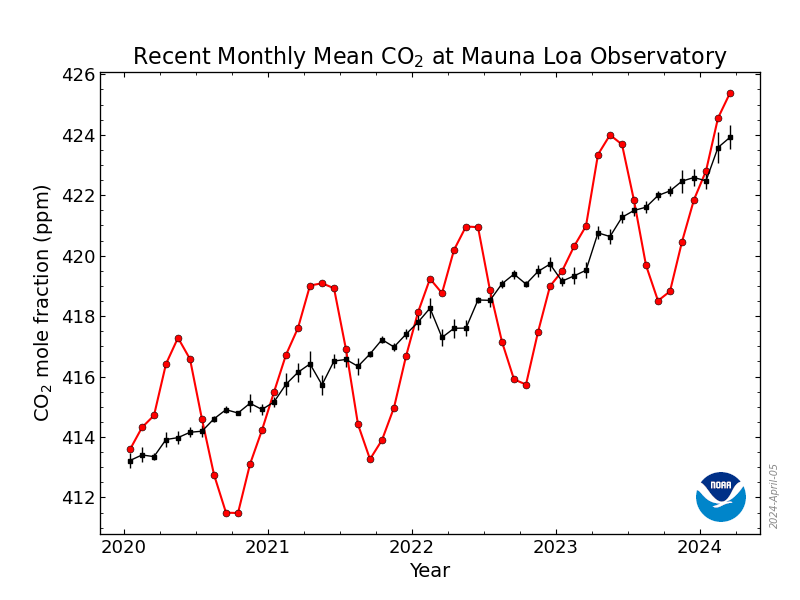
From the consistent and unrelenting rise in global carbon dioxide emissions, you would never have guessed that there’d been a downturn. But that’s because energy is cheap, and easily substitutes for economic production, labour and resources – within limits.
Fiona Harvey has gathered and presents some astonishing admissions from various key speakers on the issue of emissions, ahead of the annual mid-year United Nations climate change talks in Bonn :-
“Worst ever carbon emissions leave climate on the brink : Exclusive: Record rise, despite recession, means 2C target almost out of reach : Fiona Harvey, Environment correspondent, guardian.co.uk, Sunday 29 May 2011 : Greenhouse gas emissions increased by a record amount last year, to the highest carbon output in history, putting hopes of holding global warming to safe levels all but out of reach, according to unpublished estimates from the International Energy Agency. The shock rise means the goal of preventing a temperature rise of more than 2 degrees Celsius – which scientists say is the threshold for potentially “dangerous climate change” – is likely to be just “a nice Utopia”, according to Fatih Birol, chief economist of the IEA. It also shows the most serious global recession for 80 years has had only a minimal effect on emissions, contrary to some predictions…”
We are stardust ? Well, not quite. As carbon-based lifeforms we’re actually the offspring of a young sun, composed of the lighter elements, with a low concentration of a few transition metals essential for our health and vitality. Irn Bru, anyone ?
The actual products of exploding old stars that got lodged in the crusty skin of the accreting Earth are often quite toxic to us. Over millions of years, heavy and radioactive elements, being of no use to the ecosystem, have been deposited at the bottom of lakes, seabeds, and ended up lodged in seams of coal, and caverns of petroleum oil and Natural Gas. Uranium ores and other nasties have been overlain by forests and deserts, and only rarely vent, like radon, from Vulcan’s infernal lairs.
And what do humans do ? We dig this stuff up to burn or fission for energy, and when we do it creates toxic waste, that hurts us, and the life around us. Why are we surprised that mercury from the coal power industry is killing fish and harming children ? Why is it a shock that the tailing ponds from mining tar and oil sands are devastating pristine wilderness and waterways ?
I found this excellent little CATO Institute debate somewhere in my Twitter stream, and I watched the whole of it, despite the annoying accents and speaking styles of the speakers, and the insider economics references to Pigou and Coase (they’re only theorems, you know).
I thought that Kate Gordon made some excellent rebuttals to Andrew Morriss’ whining, pedantic free marketeering, and I was with her right up until the last few frames when she said that the Center for American Progress, of course, supports a carbon tax, as this is, of course, the best way to prevent Carbon Dioxide emissions.
Such disappointment ! To find that somebody so intelligent cannot see the limitations of carbon pricing is a real let down. I tend to find that American “progressives” on the whole are rather wedded to this notion of environmental taxation, “internalising the externalities” – adding the damages from industrial activities into the cost of the industrial products. I do not see any analysis of the serious flaws in this idea. Just what are they drinking ? What’s in the Kool-Aid ?
I cannot waste my time counting how many cut-and-paste e-mails I receive, and usually I just junk them, but I thought this one seemed sufficiently personalised to actually respond to it.
from Energy Collective
to jo abbess
date Fri, May 27, 2011 at 2:29 AM
subject You Are Invited! Blog With The Energy Collective
Dear Ms. Abbess:
…I am…at The Energy Collective (TEC). TEC is a pragmatic anti-carbon, tech-agnostic blog that aims to stoke the discussion on climate and energy solutions by bringing together the smartest climate and energy bloggers on the planet. We are at about 70k hits per month, and growing quickly. Our users are smart, engaged, energy professionals located all over the world, but concentrated in the US.
I stumbled over your blog, I think through Twitter, and am delighted by it. I like your straight-forward, unflinching writing style, as well as your lack of tolerance for climate deniers. I would like to invite you to blog with us at The Energy Collective. The deal here is a trade: you grant TEC permission to syndicate selected posts from your RSS for free, and we post, promote and leverage your content to get it in front of as many eyes as possible. We strive to create as much value as possible for our bloggers, and often offer contract writing opportunities, chances to participate as experts in our webinars, free or discount conference access, professional connections, and more.
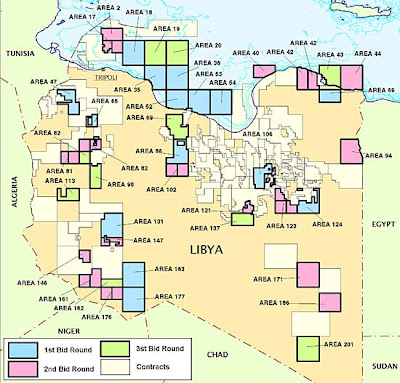
Outside the usual political and media circles, questions are being asked. Why has the United Nations sanctioned military engagement in Libya in the form of UN Security Council Resolution 1973 ? Why the heavy firepower here, in Libya, when the ostensible rationale for intervention was only to implement a No-Fly Zone ? Why not gloibal military action elsewhere in the Middle East North Africa (MENA) arena where there are other despots making life unpleasant or endable for their citizens ?
I present to you two possible futures for Libya, both of which will require extensive cooperation with foreign corporate and political players, something that Muammar Abu Minyar al-Gaddafi (or Qaddafi) threatens, or rather, depending on various news reports, “threatened”.
1. The Dash for African and Arabic Natural Gas (and Oil)
In a carbon-constrained world Natural Gas is a boon – it has roughly half the carbon dioxide emissions of coal when burned to produce steam to generate electricity. Any country that’s got Natural Gas, especially good quality Natural Gas that doesn’t have to be hydraulically “fractured” from rock strata, is a country we will learn to love and trade on significantly generous terms with.
There has been extensive surveying of Libya, and the whole of North Africa’s Maghreb region, including the type of offshore seismic surveying that found extensive gas fields in the Eastern Mediterranean that Israel is now laying claim to (and preventing Gaza from exploiting). This has led to quite a lot of excitement in the fossil fuel energy industry, so, reading between the lines of the conference agendas, there is high dollar value under Libya’s maritime territory :-
In addition to Natural Gas there may well be high levels of top quality oil – and keeping up the flow of crude oil, as we all know, is crucial to the health of the world’s economy. Threats of re-nationalising the Libyan fossil fuel resources therefore caused corporate shock :-
“Oil companies fear nationalisation in Libya : By Sylvia Pfeifer and Javier Blas in London : Published: March 20 2011 : Western oil companies operating in Libya have privately warned that their operations in the country may be nationalised if Colonel Muammer Gaddafi’s regime prevails. Executives, speaking on condition of anonymity because of the rapidly moving situation, believe their companies could be targeted, especially if their home countries are taking part in air strikes against Mr Gaddafi. Allied forces from France, the UK and the US on Saturday unleashed a series of strikes against military targets in Libya. “It is certainly a concern. There are good reserves there,” said one executive at a western oil company with operations in Libya. “We have lost some of our production [because all operations have stopped] but our bigger concern is what will happen to the exploratory work as that gives you a future rather than the immediate impact,” he added. Most of the world’s large international oil companies have producing assets in Libya, including Spain’s Repsol, France’s Total, and Italy’s Eni, which is the largest single investor there. Germany’s Winstershall – a unit of BASF – and OMV of Austria are also present. The country is the world’s 12th largest oil exporter, and the escalating violence there has triggered a jump in prices to nearly $120 a barrel. More than half of Libya’s oil was exported to Italy, Germany and France last year…”
Production in the country has taken a hit due to the fighting, but order should soon be restored. Clearly, long-term stability in Libya, with unhindered, inexpensive access to the country’s oil and gas resources is an important part of the national security interests of many Western democracies.
The DESERTEC project of the European Union seeks to roll out solar power in the desert sands of North Africa, and makes the promise of economic and social development of the countries that take part, although that dream has been questioned :-
Let’s face the facts here – massive new energy projects in North Africa will be financed and developed through large multinational, transnational corporations, companies who have contributed to the economic slavery of Africa for, let’s approximate here, centuries.
What guarantees can the Maghreb have that this is not a further land grab on Africa’s potential ?
In addition, the recent social and political volatility in the Middle East North Africa region could jeopardise the noble plans of the European Union to reach out in energy partnership.
Hang on. Wait a minute. Is the wave of uprisings across the Middle East and North Africa connected in any way to the interests of oil and gas companies who want Future #1 to prevail for the whole region, not just Libya ?
American companies have been so keen to sell nuclear electricity projects to Saudi Arabia and others around the Arabian Gulf – but has this been encouraged from the high-ups to keep the Arabs off the scent of Renewable Energy ? Forget nuclear power – it’s expensive and awkward. Iran only pursues civilian nuclear power to irritate the United States Government. A solar Arabia could give the Middle East and North Africa a second generation of being the energy princes of the world. I suspect they will go for this in a big way very shortly, uprisings or no uprisings. Why ? Two little words – Fukushima Daiichi.
So there we have it – two entirely probable, slightly competing, futures being mapped out for Libya by the big guns of NATO (a euphemism for the USA). If Libya is split into two countries, the fossil fuel Future #1 will be likely applied to East Libya, and the desert solar Future #2 will be foisted on West Libya.
Continued interference in the country is a certainty.
Ambient, sustainable energy is all around us, and sooner or
later we will find the ways to make use of it for the good of all.
The following is an appropriately edited transcript of a
conversation on the Claverton Energy Research Group
forum online, and was written by Nick Balmer, a consultant
in renewable energy.
__________________________________________________________
…The huge scale of the possible changes for all concerned is
causing all of the current Titans in the [energy] industry to deploy
the full force of the media [and their] PR [public relations] in an
attempt to manipulate the public and policy towards their own way
of thinking, or in such a way as to protect their own vested interests.
The great thing is that these issues are being aired out in the open,
and groups like [Claverton Energy Research Group forum] allow
people with knowledge of these affairs to debate these issues openly.
The big problem is that each of us has only a very detailed
understanding of some small fraction of the total issue.
Most of the public and government only has a very slight knowledge
of the total issue, and has had only limited access to ways to find out
in detail what is going on.
As Egypt is demonstrating today, everybody now has a voice and as
Wikileaks shows, sooner or later everything will come out into the
open.
All of us are struggling to come to terms with this explosion of
access to knowledge.
It is quite clear that lots of bubbles are being burst as a result of
the Global Financial implosion and the huge expansion in available
knowledge.
Just as banking and property has been shown to be an unaffordable
Ponzi scheme and to be vastly over-inflated, UK energy policy is now
coming under huge scrutiny.
We can now compare our energy systems with other countries.
Due to the huge geological accident of fate, since the 1700’s in coal,
and 1970’s in oil and gas, we have been extremely fortunate in being
able to live way beyond the lifestyle standards of most of the World.
We have not had to adapt.
Other countries that didn’t have this advantage had to change over
recent decades.
Places like Denmark, Austria, Germany [and so on] have made huge
changes because they had less energy from fossil resources.
Now we have reached the peak or crunch point, we find ourselves well
behind those countries that had to adapt earlier.
Everybody is concentrating on the Capital cost of deploying per
MW [megawatt] and overlooks the cost of fuels.
The cost of fuels over time is massively more important than the
CAPEX [capital expenditure on investment].
So even if windfarms cost 20 times per MW or GW [gigawatt] more to
build than nuclear or coal or gas, in the scheme of things,
[wind power] is always going to win, because the fuel is free and
unlimited for centuries to come.
Similarly [solar power technologies], or even more effective,
household insulation and cutting energy use.
And yet the media and government are blinded by the barrage of PR
and media from the energy vested interests who are working with
every muscle to stop this coming out into the open.
I often meet financiers in my work trying to promote and support AD
[anaerobic digestion of biological waste for the production of
renewable methane], biomass, solar and wind projects.
I am always struggling to prove to them that I have an offtake [return
on investment] and the fuel supply. This is often really hard to do
[but] I only have to do this for seven to 12 years to make my business
cases stack up.
I was really depressed at the end of one such presentation and
discussion, when one broadly sympathetic banker who had turned me
down said that he was having even worse problems with largescale
energy projects.
How do you predict the price and supply of coal forward for 25 years
or more ?
It has jumped 17% in recent months.
How do you prove that you are going to have offtake for huge power
stations in future years ?
Demand dropped 8% in 2009.
How do you raise the equity or debt for a billion [pound] project when
banks don’t want to lend more than £30 million each ? Imagine how
many banks that would take ?
We have reached a tipping point in our economy, sustainability and
future outlook.
Yes, the existing mega-power companies are fighting as hard as
Mubarak today to hold onto power, but they represent the past just
as surely as he does.
Those companies can rejuvenate themselves, unlike the Egyptian
President.
If they don’t, there are an increasingly large number of smaller and
more active players coming into the market.
The average household pays somewhere around £1,300 a year for
its heating and lighting.
The companies that come forward with a way to do that for £1,000 is
going to capture the market very quickly.
I have friends in Austria who only pay 65 Euros for services that I
pay £1,400 for.
They do this through insulation, triple glazing, solar and biomass energy.
Most [UK] households have less than £400 per year discretionary
disposable income. This prevents them making changes to their houses
they desperately want and know they need to make. This can
drop their energy demands hugely.
If somebody can unlock that Gordian Knot the benefits would be
enormous as there are something like 27 million households.
At a time when household debt is at an all-time high, incomes are
shrinking, and 40% live on ether government salaries, state
pensions or benefits.
Energy is a very high part of these households’ outgoings – if you
pay £1,300 a year and your house only brings in £11,000 to £20,000
per year.
A 50% increase in the £1,300 could bring great distress, and
possibly even civil unrest here.
The increases fossil power [companies] need to make their systems
bankable will increase energy bills. This will feed straight through into
government liabilities because 40% of us live on government payouts.
If government can drop the cost of heating and lighting quite easily
by £100 to £500 per household per year while at the same time
provide employment for hundreds of thousands of White Van men
cutting energy uses, doesn’t this make far more sense than building
unsustainable power stations that will have to be [bankrolled] by the
government, who will then have to buy back electricity at a price our
communities cannot stand ?
Project a similar calculation onto transport fuels and you get even
greater problems.
At $80 a barrel [of oil] industry is shrinking and relatively few
renewable fuel business cases work. At $100 a barrel most renewable
fuels can compete.
At $120 a barrel almost any alternative beats oil, and that is before
you start to look at issues like fuel security and the environment.
Although the battle is one of David and Goliath, or the Dinosaur and
those early mammals, between the new energy industries and the
existing vested energy industries, [it] has only one outcome.
It is only a matter of the co-lateral damage along the way.
Like Mubarak, it is clear they must go. Are they going to go
gracefully, or are they going to smash the place up first ?
The documentary evidence shows that America’s business interests often outweigh its political progress. Yet it’s perhaps more concerning that, increasingly, corporate America is at risk of damaging good environmental governance.
With all the talk of free markets in international trade, the Coalition Government in the United Kingdom has felt the pressure to open up the back door to American energy businesses, whose highly-paid sales representatives in slick suits want us to buy their dirty energy projects – just take a look at the upcoming UK Energy Bill and its proposals for Electricity Market Reform.
American companies seem poised to sweep in and take all our public non-subsidy “support” for building new nuclear power plants. Viewers of a sensitive political disposition should look away now as this is a Wikileak :-
The country that brought you the engineering industry that brought you the giant Gulf of Mexico giant oil spill now wants to bring you unsafe deepwater drilling in Britain’s Continental Shelf – and the UK’s new Energy Bill would let them do that without demonstrating any learning from the BP April 2010 fiasco :-
There’s lots of talk in the energy sector and the financial markets about the American shale gas miracle “gamechanger” and how it can be replicated in Europe and across the world, and not enough discussion about the environmental dangers :-
It’s good to talk about local environmental damage from “unconventional” gas, but what’s not being discussed so widely is that these “new” resources of Natural Gas aren’t really very green, and neither are the “traditional” resources – in some cases they’re not much better than coal :-
We know that the Americans always seek to protect the interests of American-owned businesses – and we know they do that for the best of intentions – to keep America wealthy (except it’s really only a few people in America that have any wealth, but anyway…)
Yet I think there should be a limit to how far we have to bend over backwards to accommodate their needs for economic recovery.
To export all their dirty energy technology to Europe is just not helpful, and I think we should say no, no, no.
Christopher Booker and James Delingpole made common cause this weekend in opposition to the BBC 2 Horizon documentary “Science under Attack” that featured Paul Nurse :-
The Daily Telegraph commentators appear not to understand the Global Carbon Cycle, and how this has been disturbed by mankind’s activities – principally burning fossil fuels and cutting down trees.
There is ongoing exchange between the soil and the air and the plants and the air, and the seas and the air, and so on; but the key Carbon Dioxide fact is that it is building up in the sky.
It’s not the gross figures that count, it’s the net.
The net is the amount that gets left in the air when all the absorption and emissions processes from the Carbon Sinks and the Carbon Sources have nearly cancelled each other out :-
In the Horizon programme the observation is made that mankind’s Carbon Dioxide emission production comes to around 7 gigatonnes a year. By contrast, volcanoes “popping off” and the oceans contribute only about 1 gigatonne – obviously, that’s net, not gross.
The amount of Carbon Dioxide exchanged in both directions between air and seas is much larger :-
Booker claims that the programme was a “misrepresentation”. Delingpole claims that Paul Nurse has demonstrated “really basic, idiot’s-level mistakes about “climate science””.
Amusingly for me, neither of them appear to suspect they could be barking up the wrong creek with the wrong paddle.
We already have all the Renewable Energy technologies we need to power the whole world without a single molecule of carbon dioxide being pumped into the warming sky.
The wildcat growth in clean energy is exploding out of the record books, and we can reach and easily surpass our tough greenhouse targets, all by 2030.
As an experiment with the notion of “common values”, I recently sat in a cinema with a bunch of my fellow citizens and inhaled the film “The King’s Speech”.
They laughed with the jokes (as in fact I did, right on cue), mourned with the pain (which gave me cause for reflection, too); and gave a huge round of applause at the end.
And you know what, I could have been swept along and joined them, apart from one observation.
The triumph of the central character over his physical disability, the applause he received, both at the time and in the cinema, this was all whilst giving a message that the country was about to commence widescale violence towards another country – the declaration of war.
Everybody was cheering for war. I couldn’t join in.
It is to the good memory of David Fleming that I recommend you read his last published work, co-written with Transition Towns’ Shaun Chamberlin, “Tradable Energy Quotas : A Policy Framework for Peak Oil and Climate Change” :-
Amidst all the psycho-sociological arguments being waged by political theorists and campaigny people about changing peoples’ values, and whether that’s right/useful or not, one plain fact should emerge like a tree to clutch in a flash flood – people respond to rules.
If the rules of the game are that we should reduce our carbon dioxide emissions by 80% by 2050, and everybody, including the energy production companies, are required to play a significant role, this fact alone establishes “common cause” and creates a framework for action.
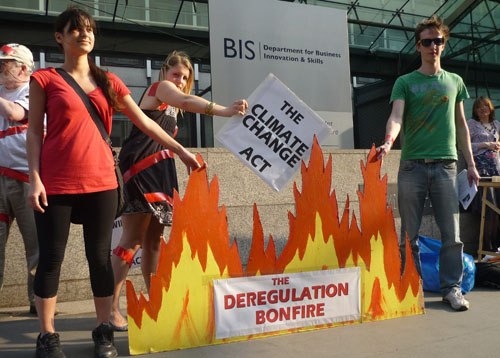
Although the Climate Change Act is the law – a piece of legislation – it has yet to be fleshed out. Until it becomes clear what the exact policies, measures and instruments will be, agreed and implemented, there will continue to be massive amounts of flailing and flapping about, scepticism, recalcitrance, dogma and complaining.
When it becomes clear what the framework for the energy industry, big business and social provision will be, then people will knuckle down and accept the inevitable.
I’m not arguing for eco-fascism – far from it. Mistakes in policy are all too possible, and so strong engagement is required, far beyond the token democracy we are currently permitted to take part in. Taking part in a government consultation on energy and carbon emissions is about as effective as waving a placard in the direction of Downing Street, except you don’t run the risk of getting arrested for it.
The only thing the public are currently permitted to do is cut their own domestic emissions. They’re not allowed to have a say about what business or government do about emissions.
Yet despite this complete absence of public involvement, there are signs of progress. Once we have managed to fight our way through the windstorm of nonsensical technological “fixes” that are worse than useless; once we have some educated people in the Government and the Civil Service – education on matters of engineering rather than humanities; then we can start to see sense from the top.
Urgent request from the floor : please can the Government and industry please stop alienating people with calls for consumers to change their behaviour. It’s producing resistance, and that is a threat to progress on reducing emissions.
What do I think about changing values ? I don’t believe “we” should try to change values or behaviour. That amounts to manipulation in my view.
“…Low Carbon London would provide the vital information link, matching models of the electricity distribution network of the future with real customer behaviour, and finding the best ways of empowering customers to reduce their electricity consumption and carbon emissions. Working directly with London communities and businesses, EDF Energy Networks would seek to help them learn how to manage their electricity demand…”
So…what precisely is EdF going to do to lower their own carbon emissions, and stop burning coal ?
And why do we continue to allow the coal-burning power companies to tell us to cut our carbon emissions ?
“Singing in the Rain : 26 January 2011 : In the past 2 – 3 weels I received a deluge of nasty-language messages saying that I should be fired, deported, run over, etc. Such a sudden burst of malice seems unlikely to be spontaneous.”
“Perhaps recent articles and internet stories provided stimulation, e.g., an article by Pat Michaels in the Washington Times and a statement by Richard S. Courtney on a blog. Michaels distorts the facts and uses quotes out of context. The Courtney statement […] mischaracterizes my testimony.”
“…The essence of my testimony, in both trials, was that the evidence for human-caused climate change is clear. I emphasized that the UK government, the fossil fuel industry, and the utility EON were aware of the effect of continued coal-burning on the future of young people. But instead of addressing the problem effectively, they engaged in greenwash…”
Over at MediaLens, the two (three) Davids are blanking the “every little bit helps” approach :-
Asking the general public to kindly remember to switch off their lights has had about as much impact as a light dusting of sugar. Looks pretty, but causes coughing fits when eating the cake.
I can’t wait for their comments on Climate Week :-
rippon asks on the MediaLens Message Board, “Is the problem, then, that mainstream media are so deeply embedded with capitalism that this simple argument becomes impossible to digest, let alone relay to viewers/readers? And is another problem that the public is so deeply indoctrinated by consumerism that they, similarly, find it impossible to digest the message (from, say, Annie Leonard, ‘The Story of Stuff’)?: stop buying stuff…Isn’t the problem that people very much define their purpose and identity through what they buy and how much money they’re making. Then the environmentalists come along and basically say to them: actually, your life has no purpose and is meaningless (because all you do is shop). Therefore, wouldn’t any self-respecting shopper decide: okay, even if what those sandal-wearing greens are saying about my fashionable stilletos is true, I’m having none of it! How dare they say they’re better than me! I say, ‘Live fast, die young.’…”
I think that everyone should be free to do exactly as they please.
I also believe that all the options available to people should be green.
So if people want to wear damaging stilettos and travel abroad for their holidays, they can do so. Except the shoes won’t be made my starving children in Vietnam and the transport won’t be aeroplanes.
My colleague’s neighbour will never, even be told to cut down his energy consumption. He will continue to burn fuel to keep the house tropical, drive his classic cars for hundreds of miles around the regions at the weekend and leave all the lights on at home.
However, if all those behaviours are low carbon, what’s the problem ?
The problem is not consumption, per se. Oops. Jargon. The problem is not consumption in itself. The problem is carbon consumption.
If all the electricity companies sell green power, and all the gas in the grid is BioMethane, then you can switch on and burn up all you want.
In conversation yesterday evening somebody summarised the behaviour of banks and the energy industry as “greedy”, but I simply could not agree.
“It’s not greed”, I said, “most people are just trying to make a living.”
The corporations have an obligation to make profits for their shareholders, business managers have to be pragmatic, governments have to negotiate compromises and consumers are just looking to make the best use of their cash.
This is how we find ourselves locked into a vicious cycle of energy waste, through the production and use of cheap fossil fuels.
Fossil fuels are so cheap, nobody can spare the investment budget to make vehicles and power generation more efficient. Natural Gas is so relatively inexpensive that it’s cheaper to heat leaky homes than insulate them. Petroleum is so cheap (even with the rising global trade price and proposed increased taxes in the UK) that a high proportion of its energy value is wasted.
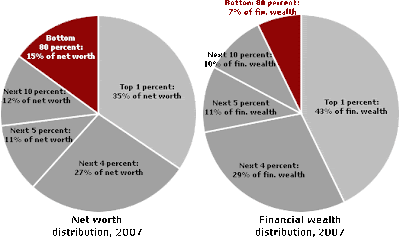
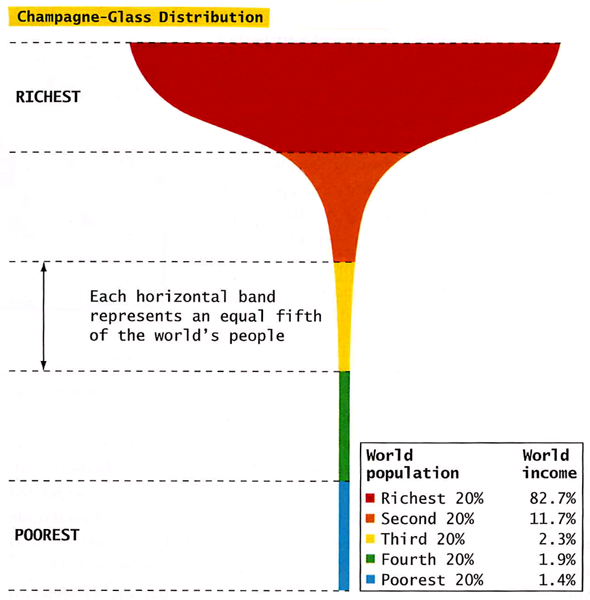
“It’s not greed,” I said, “look at who owns the wealth. The overwhelming proportion of people don’t have any control. They’re just trying to get by.”
To talk of “greed” anthropomorphises the machine of the economy, imbues it with a human emotion where it has none. To say that bankers are “greedy”, or that corporations and their Chief Executive Officers are “evil” entirely misses the point. Almost everybody is employed by somebody else, and has to follow instructions.
Even High Net Worth Individuals are under pressure to respond to their “electorates”, those who consume their intellectual property rights.
However, “just following orders” is no excuse to let people off the hook when it comes to carbon emissions, just like it is no excuse for war crimes.
But it’s not “greed”.
That would imply guilt, but guilt is not a lever that can be used successfully to correct excess carbon emissions.