![]() | |
| Although I consider him to be an enemy of the people by being a key architect of the privatisation of the UK’s National Health Service (NHS), I was delighted to hear Andrew Lansley say this about tobacco sales : “We don’t work in partnership with the tobacco companies because we are trying to arrive at a point where they have no business in this country.” Finally, after over ten years of hard work by a rainbow coalition of healthcare providers, local government administration, campaigners, social activists, educators and charities, it is possible for the UK Secretary of State for Health to tell the tobacco industry their products are not wanted here.
The deep question is : why didn’t the UK Government just ban the tobacco companies outright at the start or tell them to diversify out of selling cancer sticks in order to keep their retail licences ? Well, the simple answer is that companies like British American Tobacco (BAT) are privately-owned capitalised companies, with many pension and other major funds heavily invested. The UK Department of Business, Trade, Enterprise, Industry, Information, Skills, Services and Manufacturing or whatever it’s been variously called over the last few decades, simply couldn’t tell shareholders to pull their investment out of death-by-inhalation stocks. Everyone sees a return on investment in the industries of death generally, such as the arms trade, the junk food industry, and petrochemicals (ask yourself : how many people have suffered and died because of diesel particulate-provoked asthma ?) It takes a certain amount of time to reach the logical conclusion that wars do not need to be fought, making armaments redundant; for healthy food to become seen as essential to beat off diabetes and obesity epidemics; and for urban transport to be electrified to save lungs and hearts. No, you just can’t ban an entire product range overnight because, finally, the science has broken through the doubt barrier and shown beyond reasonable scepticism that tobacco smoking causes cancer, emphysema and other serious and fatal conditions. No, you have to go at it step by painful step, reducing availability, changing the rules on presentation at the point of sale, putting up signs in public places. And it all takes time, this gradualist approach. The tobacco industry may now wind down to a dribble in Britain (although it will continue to do well in Asia and Africa), and peoples’ savings for retirement will have soon all moved out of fag ends into something else. Yet, we don’t have the luxury of time when it comes to the climate change and energy crisis. We simply don’t have the 25 to 50 years it could take to adopt a gradualist approach to energy sector change. Anything that takes longer than 10 years to begin to displace carbon out of the energy economy is too slow to be useful. People are slowly beginning to wake up to the fact that their money is invested in climate change, and are making demands on their pension fund and bank account managers – but this is all happening too slowly – despite the keen interest in ethical investment. The energy sector has got to change – and change fast. Changing the energy sector so radically and so quickly is not something that can be done by applying small changes to the costs of energy – particularly as the wider costs of energy are so volatile anyway. Gradually introducing renewable energy technologies with subsidies and grants and special tax breaks is not going to displace carbon fast enough. Governments may not like the thought – but maybe they will consider starting to ban things – and not be shy about being explicit. However, this kind of action will generate significant resistance and dissent. How then to rapidly alter the world’s entire energy sector ? Start telling the truth about how the energy sector is scraping the bottom of the barrel in a number of fuels and fields ? Could this approach cause a run at the investment bank ? Could it tip the balance in energy systems deployment towards the less-intensive options – green energy – the only possible area of growth in the energy sector – which becomes the only possible logical conclusion ? | |
Category: Emissions Impossible
On Being Climate Pragmatic
Arctic Meltdown : Methane Alert
| One of the key fears of cryosphere scientists, those who study the cold places on Earth, is a scenario where the permafrost and sub-sea continental shelves around the Arctic Ocean become unstable and start emitting uncontrollable quantities of methane into the atmosphere.
Methane is an important by-product of biological decomposition, and is also found in icy deposits known as clathrates – methane hydrates – estimated to be very widespread in marine and geological deposits. | |
| Although it is short-lived, before breaking down or reacting with other molecules, methane is a powerful greenhouse gas, some 23 or 24 times more potent than carbon dioxide.
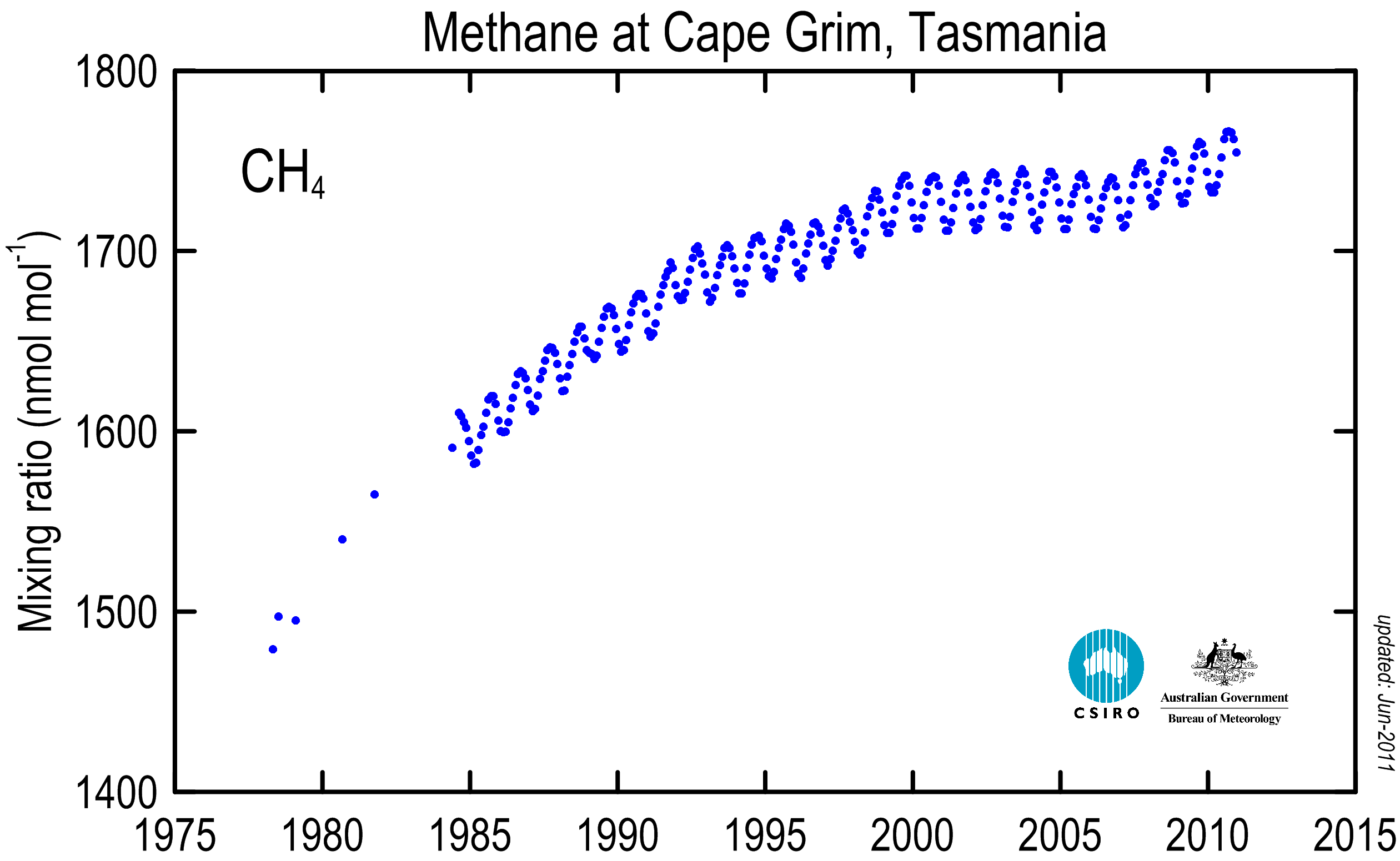
An ongoing unfreezing of the sub-zero “Northern Wastes” would set up a constant flow of biological methane into the Arctic sky and so the warming would be continuous – a major risk to attempts to limit climate change – because it could not be controlled by altering mankind’s economic and energy activities. Reports of high levels of atmospheric methane in the Arctic region in the last few months have been mangled by the media headline generation machine to raise their urgency value – making them into “news” – and the reaction from most sensible academics and commentators is to downplay talk of a catastrophhic “Methane Burp”. Yet the data is interesting enough to warrant continued monitoring and explanatory power – for the methane story is complex and shifting. It may be time for alarm bells to ring, however we’re not sure exactly how much data we need to see before we do so. The long picture for methane in the air is one of hundreds of years of acceleration :- In the last few decades however, atmospheric methane started to level off :- However, since around 2007, methane concentrations have been rising once more :- Following the recent headlines about high methane readings in the Arctic, there have been a number of online discsusions about what it could signify. Tamino’s Open Mind doesn’t see a dangerous increase in emissions when looking at a seasonally-adjusted selection of data from the World Data Center for Greenhouse Gases and Earth System Research Laboratory (ESRL) flask measurements of methane concentrations at around surface level :- I asked Giovanni to chart recent measurements from the AIRS project, the Atmospheric InfraRed Sounder on board NASA’s Aqua satellite spacecraft :- The months December 2011 to January 2012 show a significant peak in methane concentrations in the area 60 degrees North to 90 degrees North. This peak seen by satellite does not appear to be reflected in the surface measurement charts I asked the online ESRL tool to plot for me :- What could be causing the satellite reading peaks to be so high relative to the changes in ground-based measurements ? What is happening in the different layers of the atmosphere ? Has there been some kind of “detonation” of the chemistry of the air above the Arctic, causing peaks in methane concentrations at high altitudes not seen at ground level ? Do the AIRS readings need adjustment because of unusual pressure and temperature gradients around the Arctic over the boreal (Northern Hemisphere) winter 2011 – 2012 ? Has there been a rapid release of methane somewhere, such as from an oil and gas production field somewhere in the region ? Will the international greenhouse gas inventories compiled by the United Nations Framework Convention on Climate Change (UNFCCC) Kyoto Protocol nations reveal anything about this ? What on Earth is going on ? A few resources The starting point for atmospheric methane science is the UNFCCC IPCC Fourth Assessment Report. Some recent research papers on atmospheric methane science :- Seen from the journal page. Seen from the journal page. Seen from the journal page. The Arctic Ocean could be a major source of methane Joining the oil and gas industry in drilling the Arctic for clues | |
Academic Freedom #7 : Contraction & Convergence
Academic Freedom #6 : Policy Levers
Carbon Captured #2 : Socialising Cost, Privatising Profits
Carbon Captured : The Ultimate Bailout
Academic Freedom #5 : More Natural Gas power stations is a Good Thing
Academic Freedom #2 : The UN climate treaty needs energy producer obligations
| The United Nations Framework Convention on Climate Change calls nations to attend regular gatherings of the signatories to the ratified convention – the Conference of the Parties.
The nations send delegations – hardly ever sending their premiers, presidents and primes. What bargaining powers do these delegations have ? They have the authority to offer small percentages in emissions reductions, just to show willing. They have the mandate to refuse policies their nations do not like. |
|
| The language is framed around energy consumption – most country delegations have been advised by their economists that increased efficiency in the use of energy means that the national energy use will decrease. O wondrous technology ! You allow us to cut our energy use – and therefore our carbon intensity.
These same economists advise that the Holy Ghost of Innovation will inspire Research and Development – which will mean that new technologies will curtail greenhouse gas emissions. We only have to invest in new engineering. This Cult of the New is the fable on which most advanced nations hang their hope. |
|
Academic Freedom #1 : The United Nations isn’t working
Living Life and LOAFing It
![]() |
CHRISTIAN ECOLOGY LINK PRESS RELEASE Living Life and LOAFing It – Green Christians ask churches to “Use your LOAF !” on sourcing sustainable food In the run up to Easter, Christian Ecology Link is asking supporters to think and act on how they source food for their church communities, with the aim of reducing the impact of unsustainable agriculture on their local area, and the wider world. |
| CEL have launched a new colour leaflet on the LOAF programme principles in time for Shrove Tuesday (Mardi Gras), or Pancake Day, on 21st February 2012. | |
The Last Battle
The “Statue of Liberty” or Saint John’s Lamb of God ? | Britain’s real enemy is not Iran.
The real enemy is the mismanagement of the Earth’s energy resources. The last battle is to overcome the misdeeds of those who have commandeered and wasted the Earth’s energy resources – and that includes ourselves. It should not be a violent dispute, for aggression and the use of weapons are morally unjustifiable. But all the same, it will be a genuine, Titanic, struggle. |
| As C. S. Lewis portrays with so much resonance, it matters little under which flag or title we serve or belong – what matters is our allegiance to the precepts of divine honour, holy devotion and right dealings with other people :-
“Why did the faithful Taarkan end up getting to come into Narnia ? Usually Lewis writes allegorically so is he trying to tell us something when a worshipper of Tash is allowed to enter the new Narnia ? Any thoughts ? …It wasn’t the name that mattered, but rather the conduct of the Taarkan and how he chose to see and do things. He didn’t believe in the cruelty and underhanded ways his countryman were doing things, but rather in honour and a code of conduct. So even though the Taarkan thought he was worshipping Tash, the whole time he was actually worshipping Aslan [Turkish for “Lion”] through his thoughts and deeds. So when the time came for the end of the world and judgement, he was placed where his heart had always led him.” For those who recognise the twin threats from climate change and energy depletion, we realise that there is hard work ahead. Our natural aim is to protect ourselves; and the moral consequence is that we are obliged to protect the other – because both climate change and energy depletion are global problems. Climate change hits the poorest the hardest – already, significant changes in rainfall and weather patterns have created long-term drought, encroaching coastal and inland inundation, crop losses and enforced migration. And it’s only going to get worse. It’s so terrible we could not even wish it on our enemies – it teaches us that nobody is an enemy. To solve climate change, we need to change our energy systems. Some hail the depletion of hydrocarbon and coal energy resources as a gift that will help us resolve the emissions problem and prevent dangerous climate change, by making a virtue of necessity – but the situation is not that simple. The reaction of the world’s authorities, wealth controllers and corporate proprietors to the winding down of fossil fuel energy resources has so far been complex, and there are many indications that warfare, both military and economic, has been conducted in order to secure access to energy. This may be the way of the lion in us all, but it is not the way of The Lamb. The Lamb sacrifices all that others value so that he is qualified to bring about a new universal regime of peace and responsible autonomy – a kingdom of priests, pastors with mutual respect. We are called to become good stewards of each other and the Earth. The gentle Lamb of God will judge our hearts. The Book of the Revelation to Saint John the Divine, Chapter 4 :- “…I looked and saw a door that opened into heaven. Then the voice that had spoken to me at first and that sounded like a trumpet said, “Come up here ! I will show you what must happen next.” Right then the Spirit took control of me, and there in heaven I saw a throne and someone sitting on it. The one who was sitting there sparkled like precious stones of jasper and carnelian. A rainbow that looked like an emerald surrounded the throne. Twenty-four other thrones were in a circle around that throne. And on each of these thrones there was an elder dressed in white clothes and wearing a gold crown. Flashes of lightning and roars of thunder came out from the throne in the center of the circle. Seven torches, which are the seven spirits of God, were burning in front of the throne. Also in front of the throne was something that looked like a glass sea, clear as crystal…And as they worshiped the one who lives forever, they placed their crowns in front of the throne and said, “Our Lord and God, you are worthy to receive glory, honour, and power. You created all things, and by your decision [and for your pleasure] they are and were created…” The Book of the Revelation to Saint John the Devine, Chapter 5 “In the right hand of the one sitting on the throne I saw a scroll that had writing on the inside and on the outside. And it was sealed in seven places. I saw a mighty angel ask with a loud voice, “Who is worthy to open the scroll and break its seals ?” No one in heaven or on earth or under the earth was able to open the scroll or see inside it. I cried hard because no one was found worthy to open the scroll or see inside it. Then one of the elders said to me, “Stop crying and look ! The one who is called both the `Lion from the Tribe of Judah’ and `King David’s Great Descendant’ has won the victory. He will open the book and its seven seals.” Then I looked and saw a Lamb standing in the center of the throne…The Lamb looked as if it had once been killed. It had seven horns and seven eyes, which are the seven spirits of God, sent out to all the earth. The Lamb went over and took the scroll from the right hand of the one who sat on the throne. After he had taken it, the four living creatures and the twenty-four elders knelt down before him. Each of them had a harp and a gold bowl full of incense, which are the prayers of God’s people. Then they sang a new song, “You are worthy to receive the scroll and open its seals, because you were killed. And with your own blood you bought for God people from every tribe, language, nation, and race. You let them become kings and serve God as priests, and they will rule on earth.”” Leaders of the powerful nations – put aside your death-hastening technology. Let there be a low carbon energy peace on a climate-stable Earth. Additional Readings https://www.biblegateway.com/passage/?search=Galatians%203:7-9&version=NIV “…Understand, then, that those who have faith are children of Abraham. Scripture foresaw that God would justify the Gentiles [non-Jewish people] by faith, and announced the gospel [good news of God’s love and forgiveness] in advance to Abraham: “All nations will be blessed through you.” So those who rely on faith are blessed along with Abraham, the man of faith…” https://www.biblegateway.com/passage/?search=Galatians%203:26-29&version=NIV “So in Christ Jesus you are all children of God through faith, for all of you who were baptized [ritual bathing] into Christ have clothed yourselves with Christ. There is neither Jew nor Gentile [non-Jewish person], neither slave nor free, nor is there male and female, for you are all one in Christ Jesus. If you belong to Christ, then you are Abraham’s seed, and heirs according to the promise.” https://en.wikipedia.org/wiki/Be_Thou_My_Vision “Thy love in my soul and in my heart – O King of the seven heavens grant me this – https://en.wikipedia.org/wiki/Seven_Spirits_of_God [ UPDATE : No, I have not taken leave of any of my senses. I was in church, All Saints in Highams Park, London E4, and many thoughts arose as I contemplated the stained glass window, with its Suffering Servant Messenger King/Lord/Master, rainbow, Alpha, Omega, Noah’s dove with the sprig of olive; and listened to the reading from Revelations 4; and sang “Be Thou My Vision” with the congregation; and considered what Epiphany the world needs at this time of intense war propaganda. There are those who declare themselves as Christian who claim that war with Iran is prophesied. This may be a fringe view, but the narrative infects major political discussion in the United States of America : “The problem, of course, is that rhetoric can have political effects that narrow the options available to decisionmakers. If you’ve publicly declared Iran’s nuclear program sufficiently threatening to warrant initiating a potentially catastrophic war and then sanctions fail to achieve their defined goal, you may have a hard time walking back from that threat.” ] | |
Methane Concentrations : Losing Control
| Every once in a while, it’s good to remind myself of the data – to help me focus once again on why I do what I do.
Yesterday evening, I decided to catch up on exactly how out of control atmospheric methane concentrations are in the region around the Arctic :- When reviewing the charts, the secondmost important thing to see is the high point measurements, the peaks, rising over time. | |
| The most vital thing to observe, however, is the inexorable rise of the minimum measurements since around 2007 – which implies a higher overall background atmospheric methane concentration.
Much of this methane explosion can probably be blamed on global warming from excessive carbon dioxide emissions – which showed signs of coming under control between 1990 and 2000, but after that lifted off once more. People dispute why carbon dioxide emissions have risen consistently and sharply since the turn of the millenium – but one of the answers is to be found in the rapid deployment of coal-burning for power generation. Stronger environmental controls on air quality have reduced the health impacts of coal-burning, but mean that the net effect is stronger global warming. So much could be done to alleviate the strong warming of the Arctic, and prevent dangerous instabilities. It is time to say it – and keep on saying it – and not relent – every measure to keep the Arctic cool is urgent. | |
![]() | Throughout 2011, I changed a number of things in my domestic arrangements in order to reduce energy consumption at home.
I have been working with an ecocell small study and action group in North London – each member of whom has an interesting story to tell of their own eco-pilgrimage. What I found was that in order to make progress I needed to measure more things and be more organised. I also needed to acquire more equipment. | |||||||||||||||||||||||||||||||||||||||
| This is rather ironic, since there are embedded emissions in all manufactured products. However, with careful use and maintenance, they should last a long time.
The daily electricity and gas consumption I was personally responsible for at home dropped fairly significantly (approximate figures) :-
Based on the average of the monthly daily averages, I should have consumed 766 Btu (8,094 kWh) of Natural Gas over the whole year, and 1,065 kWh of electricity for 2011. However, due to dropping demand, I actually used only 433 Btu (4,572 kWh) of Natural Gas and 1,034 kWh of electricity. This compares to Ofgem’s analysis of medium household consumption figures of 16,500 kWh of Natural Gas and 3,300 kWh of electricity. This puts my consumption at 28% of the medium in Natural Gas and 31% in electricity. It’s going to be hard to reduce both of these figures. I came up with a number of personal solutions for reducing space heating in 2011, which enabled the use of Natural Gas to drop. I had already come up with a number of changes in power consumption in 2010, which explains why the electricity use did not drop so fast or so far in 2011. However, I’m still working on cutting my domestic power consumption. One of those ways is trying to adopt a more vegetarian diet. You see, when you eat vegan or virtually vegan, you don’t need so much refrigeration. Frequently over the last year the only things in the fridge have been milk, spread, yoghurt and green vegetables (plus a couple of half-used jars of pesto or mayonnaise, the regulation bottle of lemon juice and a jar of Marmite). The freezer has been off for months. So I thought to myself, after checking the power consumption of the fridge – does the house need a smaller fridge ? I mean, the large fridge is useful when there are guests or someone throws a party, but it’s not fully used all the time. I could keep the green vegetables in the coldest, unheated room of the house, and buy fresh more regularly. What if I get hold of a mini fridge to use on a day-to-day basis ? And so, into my life has come the Mobicool W35. Technically, it’s not a refrigerator – it’s a “cooler box”. A thermolectric one. And despite the E energy rating on the packaging – at 290 kWh a year, it will have less than half the power consumption of the Big Fridge. Plus, since I don’t need to run it all the time, I can cut power use further by only having it on 18 hours a day (or less, as dictated by the weather), controlled by a timer. The next adaptations to my energy use will entail significant expense. Here are some options :- a. Upgrading the windows I will need to save up to replace the windows completely, so I am looking for intermediate solutions. For the biomass option, I have found a tree surgeon in North East London with whom a win-win arrangement could be developed – with me offering to take unseasoned wood from the loads of sawn waste that otherwise would cost money to dispose of. In the meantime, I need to address draughtproofing. The sudden cold spell has shown me that there are still opportunities in this regard. | ||||||||||||||||||||||||||||||||||||||||
2012 : Greenier and Peace-ier
Urbanity, Durbanity
| People working for non-governmental, and governmental, organisations can be rather defensive when I criticise the United Nations Framework Convention on Climate Change or UNFCCC. What ? I don’t back the international process ? Climate change, after all, is a borderless crime, and will take global policing. Well, I back negotiations for a global treaty in principle, but not in practice. | |
The annual wearisome jousting and filibustering events just before Christmas do not constitute for me a healthy, realistic programme of engagement, imbued with the full authority and support of global leadership structures and civil society. People can try to spin it and claim success, but that’s just whitewash on an ungildable tomb. The Climate Change talks that have just taken place in Durban, South Africa, were exemplary of a peculiar kind of collective madness that has resulted from trying to navigate and massage endless special interests, national jostling, brinkmanship, unworkable and inappropriate proposals from economists, communications failures and corporate interference in governance. The right people with real decisionmaking powers are not at the negotiating table. The organisations with most to contribute are still acting in opposition – that’s the energy industry, to be explicit. And the individual national governments are still not concerned enough about climate change, even though it impacts strongly on the things they do consider to be priorities – economic health, trade and political superiority. Over 20 years ago, the debate on what to do to tackle global warming and still maintain good international relations was already won, by the commonsense approach of Contraction and Convergence – fair shares for all. Each country should count on their fair share of carbon emissions based on their population – and we would get there by starting from where we are now and agreeing mutual cuts. The big emitters would agree to steeper cuts than the lower emitters – and after some time, everybody in the world would have the same, safe emissions rights. What has prevented this logical approach from being implemented ? Well, we have had the so-called “flexible mechanisms” pushed on us – such as the Clean Development Mechanism which essentially boils down to the idea that the richer high-emitting countries can offset their carbon by paying for poorer low emissions countries to cut their carbon instead. Some have been attempting to make the CDM carbon credits into a commercial product for the Carbon Trading market. Some may contest it, but the CDM and carbon trading haven’t really been working very well, and anyway, the CDM doesn’t aim for emissions reductions, just offsets. Other carbon trade has been implemented, such as the European Union Emissions Trading Scheme (EU ETS), which doesn’t appear to have caused high emissions industries to diversify out of carbon, or created a viable price for carbon dioxide, so its usefulness is questionable. Many people have put forward the idea of straight carbon pricing, mostly by taxation. The trouble with this idea should be obvious, but rarely is. Over four-fifths of the world’s energy is fossil fuel based. Taxing carbon emissions from the burning of fossil fuels would just make everything, everywhere, more expensive. It wouldn’t necessarily create new lower carbon energy resources, as the taxes would probably be put into a giant climate change adaptation fund – a financial institution proposed by several people including Oliver Tickell and Nicholas Stern, although in Stern’s case, he is calling for direct grants from countries to keep the fund topped up. On the policy front, there has been a continuing, futile attempt to force the historially high-emitting countries to accept very radical carbon cuts, as a sign of accountability. This “grandfathering” of emissions responsibilities is something that no sane person in government in the richer nations could ever agree with, not even when being smothered with ethical guilt. One of the forms of this proposal is “Greenhouse Development Rights“, essentially allowing countries like China to continue growing their emissions in order to grow their economies to guarantee development. The emissions cuts required by countries like the United States of America would be impossible to achieve, not even if their economy completely toppled. Sadly, a number of charities, aid and development agencies and other non-governmental organisations with concern for the world’s poor, have signed up to Greenhouse Development Rights not realising it is completely untenable. The only approach that can work, that both high- and low-emitting countries can ever possibly be made to agree on, is a system of population-proportional shares of the global carbon pie. And the way to get there has to be based on relative current emissions, ignoring the emissions of the past – your cuts should be larger if your current emissions are large. And it should be based on the relative size of the population, and their individual emissions rates, rather than taking a country as a whole. Yes, there will be room for a little carbon trade between nations, to enable the transfer of low carbon technologies from wealthy nations to un-resourced nations. Yes, there will be space for enterprise, as corporations have to face regulation to cut emissions, and will need innovation in technology to divest themselves of fossil fuel production and consumption. This is Contraction and Convergence – and you ignore it at our peril. A few suggestions for further reading :- “Contraction and Convergence The Global Solution to Climate Change” by Aubrey Meyer. Schumacher Briefings, Green Books, December 2000. ISBN-13: 978-1870098946 The Greenhouse Effect : Science and Policy” by Professor Stephen H. Schneider, Science, Volume 243, Issue 4892, Pages 771 – 781, DOI: 10.1126/science.243.4892.771, 10 February 1989. “Climate Change : Science and Policy“, edited by Stephen H. Schneider, Armin Rosencranz, Michael D. Mastrandea and Kristin Kuntz-Duriseti. Island Press, 10 February 2010. ISBN-13: 978-1597265669 “The Greenhouse Effect : Negotiating Targets” by Professor Michael Grubb, published by the Royal Institute of International Affairs (RIIA) in London, 1990. “Equity, Greenhouse Gas Emissions, and Global Common Resources” by Paul Baer, Chapter 15 in “Climate Change Policy : A Survey” by Stephen H. Schneider, Armin Rosencranz and John O. Niles, Island Press, 2002. ISBN-10: 1-55963-881-8 (Paper), ISBN-13: 978-1-55963-881-4 (Paper) “Kyoto 2 : How to Manage the Global Greenhouse” by Oliver Tickell, ISBN-13: 978-1848130258, Zed Books Ltd, 25 July 2008 | |
First Arcticane of Wintertide
| Something not completely dissimilar to a hurricane or a typhoon has been gusting at incredibly high speeds through the lowlands of Scotland today – and further afield.
Yet, regardless of whether this heralds the start of a proper snow-and-ice winter, it’s not likely to prevent 2011 being one of the hottest years ever. July and August, worldwide, were nearly the hottest on record in 2011. Meanwhile, the Blob Chart tells the story in a way that nobody can deny. |
| Meanwhile, in Durban, South Africa, the world’s governments struggle to make sense. A healthy economy is a carbon-emitting economy – because industrial energy causes high carbon emissions. What needs to happen is that the energy production businesses start to diversify their portfolio – increasing the amount of energy they produce from renewable, sustainable low carbon resources, whilst decreasing the amount of fossil fuel energy they supply.
It can’t be left to individual “big hitters” to kick-start the renewable energy revolution – it requires transnational, international, multi-national and national energy companies to start to displace carbon from their products. If they don’t, they will face mass disinvestment, as ethical concerns rise up the agenda of investor groups and funds. So, BP, Shell and Exxon Mobil – if you don’t start switching from selling us hydrocarbons to selling us renewable energy, your businesses will under-compete. You have been notified. | |
Dances With Energy Bills
| After the recent notorious Panorama programme on energy prices, and yesterday evening’s debate on renewable energy and the costs of green energy policy, in the House of Commons, a number of people have commented that Members of Parliament and Ministers of the UK Government appear to know very few facts – and those they can remember they seem to quote in the wrong context.
This state of affairs is disgraceful, and allows mendacious narratives to persist in the mainstream media. |
|
| RenewableUK contacted me and asked me to embed a YouTube offering some corrective information. I was very pleased to do so. I can assure my readers that I have not and will not be paid for doing so.
The key problem is not the cost to energy bill payers from direct subsidies such as the solar photovoltaic feed in tariff. The contribution from this is minor. The largest effect on energy bills is likely to come from two sources – the Energy Company Obligation and the plans for Carbon Pricing and other measures in the Electricity Market Reform. |
|