They’ve never had it so cold. The British have just shivered through another long, centrally heated winter, and people are receiving enormous gas bills. Social campaigners and parliamentarians are rightly concerned that a clutch of harsher winters and rising energy costs could reverse gains made in tackling fuel poverty. The UK Government’s recent Budget announcement to reduce fuel poverty assistance payments is another blow to maintaining decent and warm homes for the vulnerable, the elderly and children. Proposals to cap the amount that energy companies can charge people in their bills is welcomed by some, but feared by others – as it could jeopardise energy company funding for the Green Deal – a free-to-the-consumer loan scheme for insulation and renewable energy installation. And there’s another problem waiting in the wings. Unlike the United States and Australia, the average British home doesn’t have air conditioning, and it costs real money to install it. If outsized summer heatwaves continue to pop up more frequently in Europe, UK households will face “cool poverty” in summer – a lack of cooling.
Author: Jo
The “red tape” challenge
So, I’m sitting in my local cafe at lunchtime talking to my local property developer-landlord. So, I ask him, do you think there will be worsening economic conditions this year ? And will there be more unemployment ?
He takes a pretty dismal line – things are becoming more and more squeezed – landlords are finding that their properties are unoccupied, or the rents are being forced downwards, and there is no spare finance capacity to do renovations, the banks won’t lend, and there’s no certainty of being able to sell properties if the business becomes uneconomic. He’s had to sack people he was formerly able to employ.
Click here for the Weekly ENSO advisory.
It seems possible that the Pacific is returning to neutral El Nino conditions, or possibly a full-blown El Nino. If total solar irradiance is increasing due to a renewed sun cycle, an emerging El Nino this Northern Hemisphere summer could make for scorching temperatures.
To add to the aggravation, the Earth’s energy imbalance is leading to higher surface temperatures still, despite ocean cycling of heat to the depths and atmospheric aerosol effects on radiation equilibrium.
James Hansen of NASA and his colleagues are arguing for better measurements of the effect that airborne particulates are having, and sounding the warning siren yet again about Global Warming and the time delay between increased radiative forcing and increased surface warming.
The globe is warming. It hasn’t stopped, and it isn’t getting any cooler. As time goes by, the science becomes ever more verified :-
https://www.columbia.edu/~jeh1/mailings/2011/20110415_EnergyImbalancePaper.pdf
Solar photovoltaic cells based on semiconductor transistor junctions are becoming cheaper, more efficient and more widely relied upon. Mankind can thrive, drinking in the sunshine.
Yet, the solar power technology of today could still become a minor footnote if there is a revolution in Physics or Chemistry :-
https://socialbarrel.com/solar-power-discovery-dims-future-of-photovoltaic-cells/6382/
“Solar Power Discovery Dims Future of Photovoltaic Cells : Posted by Francis Rey on April 18, 2011 : University of Michigan researchers made a breakthrough discovery on the behavior of light, which could alter solar technology from now on. Professor Stephen Rand, Departments of Electrical Engineering and Computer Science, Physics and Applied Physics, and William Fisher, an Applied Physics doctoral student, found out that light, when traveling [sic] through a nonconductive material, such as glass, at the right intensity can produce magnetic fields 100 million times stronger than previously deemed possible. During these conditions, the magnetic field has enough strength to equal a strong electric effect, producing an “optical battery” that leads to “a new kind of solar cell without semiconductors and without absorption to produce charge separation”, Rand said…”
https://detroit.cbslocal.com/2011/04/13/um-says-solar-power-without-solar-cells-is-possible/
https://solar.calfinder.com/blog/solar-research/harnessing-solar-power-without-cells/
Mmm, love that solar radiation !
If we take TEPCO at their word, either Units 1, 2, 3 emitted Chernobyl-scale radioactive Iodine gas on explosion (that somehow fell through the roof of Unit 4), or there’s been a fission reaction in Unit 4 fuel pond – neither of which is an entertaining, uplifting prospect.
Peter Sinclair at Climate Crocks is keeping tabs on all things Fukushima :-
The spoils of war
See the rest of Gaddafi’s speech to the United Nations here
When did Colonel Muammar Gaddafi learn of threats from the world’s major oil consumer countries against his rule ? Was it in early 2011 ? Or was it several years earlier ? On the public stage, he has been deliberately reduced to a figure of fun, and his message advising non-aggression and protection from aggression is being lost. He is now a desperate man :-
What have we learned about Nuclear Power in the last month or so ?
That freak weather events can knock out plants :-
https://www.guardian.co.uk/world/2011/apr/18/us-tornadoes-shutdown-nuclear-reactors
That, even if the weather stays clement, that Nuclear Power plants can experience unplanned outage :-
https://www.nuclearcounterfeit.com/?p=4181
https://www.xe.com/news/2011-01-24%2012:56:00.0/1655653.htm
https://www.scotland.gov.uk/Topics/Statistics/Browse/Environment/TrendElectricity
Curiouser and curiouser…
[ UPDATE : The windfall tax on the oil and gas companies is going to amount to £2 billion, not £10 billion – and George Osborne is going to watch them “like a hawk” to make sure there’s “no funny business” and that they don’t pass on the cost of the tax to their vehicle fuel customers. Yeah, right. Like, when are people going to wake up and realise market tinkering won’t help ? We need “big number” public investment in sustainable fuels and sustainable vehicle technologies, not efforts to massage fuel duty to appease vocal petrolheads. ]
Let’s see now…how’s the price of a gallon of fuel today ?
Well, the fuel duty escalator has been scrapped for the rest of this UK Parliament.
Plus, fuel duty has been decreased by 1 pence per litre.
This will gladden the hearts of many who have campaigned against the scorching taxes on fuel costs to motorists.
But Value Added Tax for fuel hasn’t been brought down – because the UK Government said it would be illegal under EU law to cut VAT specifically for fuel.
None of these measures announced in today’s UK Budget will stop the price of vehicle fuel from rising further with the markets, unfortunately, so nobody who depends on their personal vehicle should be rejoicing.
The £10 billion or so that will be extracted from the North Sea oil industry via a raise in production tax (apparently to pay for cancelling the fuel duty increase) will no doubt be charged back out to vehicle fuel customers one way or another…the price of ICE Brent Crude for forwards contracts dipped a little today, but the average has shot up over the last 3 months.
Minor adjustments to the price of vehicle fuel will not resolve the fundamentals driving crude oil price changes – and hence the price of diesel and petrol and the pump.
The major shake-up in the price of crude oil shows that suggestions to tinker with taxes or levies to try to adjust consumption for environmental reasons will be a totally failed strategy even before it begins.
So why oh why has George Osborne instituted a Carbon Price Floor for electricity emissions in the power generation sector ? The “price signal” this is supposed to give, an “incentive” to reduce high carbon generation and invest in low carbon generation, will be totally lost amongst the increasing operating costs for electricity production – not least because nuclear power is about to get much, much more expensive because of the response to safety concerns raised by the Fukushima Daiichi Japan Nuclear Accident.
It is time to admit that green taxation doesn’t change behaviour because it is always small compared to other price effects.
It is also time to recognise that proactive investment in such things as low carbon fuels, vehicle fuel efficiency and small electric vehicles, small fuel cell vehicles, more public transport, lower driving speeds, fully inflated tyres, de-centralisation of employment and re-localisation of public services are key to tackling Climate Change for the transport sector.
So…how’s the Green Investment Bank shaping up, then, George Osborne ?
America’s hooked on oil, but more drilling in the Gulf of Mexico won’t drive fuel prices back down, as Republican political activists try to claim :-
https://thehill.com/blogs/e2-wire/677-e2-wire/150003-top-house-republican-to-introduce-drilling-bill
https://moratorium.offshoremarine.org/omsa/
US production is only a small percentage of world supplies – and this won’t increase significantly even with more homeland drilling.
Gasoline prices are going to remain vulnerable to global events, global markets and global nerves.
The oil production companies that operate in the American market are quite happy to maintain higher prices for fuels. Think about it.
If the Americans want to fill up their tanks less expensively, what’s really needed is to consume less oil – and that means using smaller, lighter cars with higher fuel efficiency.
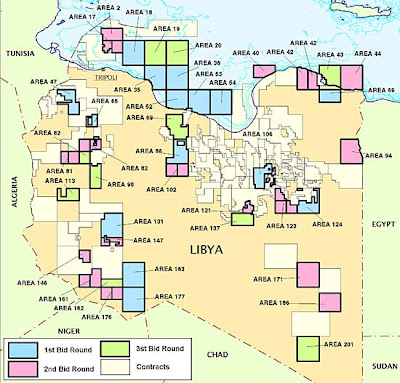
Outside the usual political and media circles, questions are being asked. Why has the United Nations sanctioned military engagement in Libya in the form of UN Security Council Resolution 1973 ? Why the heavy firepower here, in Libya, when the ostensible rationale for intervention was only to implement a No-Fly Zone ? Why not gloibal military action elsewhere in the Middle East North Africa (MENA) arena where there are other despots making life unpleasant or endable for their citizens ?
I present to you two possible futures for Libya, both of which will require extensive cooperation with foreign corporate and political players, something that Muammar Abu Minyar al-Gaddafi (or Qaddafi) threatens, or rather, depending on various news reports, “threatened”.
1. The Dash for African and Arabic Natural Gas (and Oil)
In a carbon-constrained world Natural Gas is a boon – it has roughly half the carbon dioxide emissions of coal when burned to produce steam to generate electricity. Any country that’s got Natural Gas, especially good quality Natural Gas that doesn’t have to be hydraulically “fractured” from rock strata, is a country we will learn to love and trade on significantly generous terms with.
There has been extensive surveying of Libya, and the whole of North Africa’s Maghreb region, including the type of offshore seismic surveying that found extensive gas fields in the Eastern Mediterranean that Israel is now laying claim to (and preventing Gaza from exploiting). This has led to quite a lot of excitement in the fossil fuel energy industry, so, reading between the lines of the conference agendas, there is high dollar value under Libya’s maritime territory :-
https://www.geolsoc.org.uk/gsl/site/GSL/lang/en/page7792.html
https://www.geolibya.org/evdetails.asp?Myval=36
In addition to Natural Gas there may well be high levels of top quality oil – and keeping up the flow of crude oil, as we all know, is crucial to the health of the world’s economy. Threats of re-nationalising the Libyan fossil fuel resources therefore caused corporate shock :-
https://www.ft.com/cms/s/0/67d1d02a-5314-11e0-86e6-00144feab49a.html#axzz1HKdP1z5V
“Oil companies fear nationalisation in Libya : By Sylvia Pfeifer and Javier Blas in London : Published: March 20 2011 : Western oil companies operating in Libya have privately warned that their operations in the country may be nationalised if Colonel Muammer Gaddafi’s regime prevails. Executives, speaking on condition of anonymity because of the rapidly moving situation, believe their companies could be targeted, especially if their home countries are taking part in air strikes against Mr Gaddafi. Allied forces from France, the UK and the US on Saturday unleashed a series of strikes against military targets in Libya. “It is certainly a concern. There are good reserves there,” said one executive at a western oil company with operations in Libya. “We have lost some of our production [because all operations have stopped] but our bigger concern is what will happen to the exploratory work as that gives you a future rather than the immediate impact,” he added. Most of the world’s large international oil companies have producing assets in Libya, including Spain’s Repsol, France’s Total, and Italy’s Eni, which is the largest single investor there. Germany’s Winstershall – a unit of BASF – and OMV of Austria are also present. The country is the world’s 12th largest oil exporter, and the escalating violence there has triggered a jump in prices to nearly $120 a barrel. More than half of Libya’s oil was exported to Italy, Germany and France last year…”
BP had to evacuate its staff, and extend a favour to some British citizens, during the recent uprising :-
https://www.telegraph.co.uk/news/worldnews/africaandindianocean/libya/8344391/Libya-Britain-borrows-BP-jet-to-evacuate-citizens.html
Production in the country has taken a hit due to the fighting, but order should soon be restored. Clearly, long-term stability in Libya, with unhindered, inexpensive access to the country’s oil and gas resources is an important part of the national security interests of many Western democracies.
2. Solar Libya
https://www.desertec.org/en/global-mission/milestones/
The DESERTEC project of the European Union seeks to roll out solar power in the desert sands of North Africa, and makes the promise of economic and social development of the countries that take part, although that dream has been questioned :-
Let’s face the facts here – massive new energy projects in North Africa will be financed and developed through large multinational, transnational corporations, companies who have contributed to the economic slavery of Africa for, let’s approximate here, centuries.
What guarantees can the Maghreb have that this is not a further land grab on Africa’s potential ?
In addition, the recent social and political volatility in the Middle East North Africa region could jeopardise the noble plans of the European Union to reach out in energy partnership.
Hang on. Wait a minute. Is the wave of uprisings across the Middle East and North Africa connected in any way to the interests of oil and gas companies who want Future #1 to prevail for the whole region, not just Libya ?
American companies have been so keen to sell nuclear electricity projects to Saudi Arabia and others around the Arabian Gulf – but has this been encouraged from the high-ups to keep the Arabs off the scent of Renewable Energy ? Forget nuclear power – it’s expensive and awkward. Iran only pursues civilian nuclear power to irritate the United States Government. A solar Arabia could give the Middle East and North Africa a second generation of being the energy princes of the world. I suspect they will go for this in a big way very shortly, uprisings or no uprisings. Why ? Two little words – Fukushima Daiichi.
So there we have it – two entirely probable, slightly competing, futures being mapped out for Libya by the big guns of NATO (a euphemism for the USA). If Libya is split into two countries, the fossil fuel Future #1 will be likely applied to East Libya, and the desert solar Future #2 will be foisted on West Libya.
Continued interference in the country is a certainty.
…giving Climate Change action “Earth Hour” a professional, clean-shaven edge.
February 2011
“Premature Deterioration Detected in GE Hitachi Control Rod Blades at Nuclear Plants : Nuclear Street News Team Fri, Feb 18 2011 : GE Hitachi has discovered unexpected cracking and material distortion in some of the companies’ control-rod blades, according to a report made public Wednesday by the Nuclear Regulatory Commission. GE Hitachi reported to the NRC that the problems could present a safety hazard, and the design life of the companies’ Marathon Blades may be reduced. Malfunction of control rods can limit operators’ ability to control the nuclear reaction within a reactor. “A recent inspection of near ‘end-of-life’ Marathon Control Rod Blades (CRB) at an international BWR/6 has revealed crack indications…”
“Report hints at problems with nuclear plant control rods at Monticello : Posted on: Fri, 18 Feb 2011 : Minneapolis-based Xcel Energy will replace four control rod blades at its Monticello Nuclear Power Plant next month after a major nuclear industry manufacturer reported a potential “substantial safety hazard” with control rods at more than two dozen nuclear reactors around the country. GE Hitachi Nuclear Energy sent the warning Tuesday to all the affected plants, including Monticello…The cracking and distortion could prevent the cross-shaped rod blades, which typically are 12 feet to 14 feet long, from inserting into the core when plant operators want to reduce power or shut down a plant, said Ken Riemer, chief of reactor programs for the Nuclear Regulatory Commission regional office outside Chicago. “They may get stuck and not move in and out of the core,” he said…”
March 2011
https://minnetonka.patch.com/articles/minnesota-nuclear-reactor-safe
“Minnesota Nuclear Reactor—Safe : As a meltdown seems almost certain at a boiling water plant in Japan, Xcel Energy, which operates two similar plants in Minnesota, is watching—closely. By Mike Schoemer : March 14, 2011 : The situation is worsening at the three nuclear reactors at the Fukushima Daiichi nuclear plant in quake-ravaged Japan. At last estimates, Japan has evacuated more than 150,000 people from a 30-mile radius around the plant. Meanwhile, nuclear administrators and workers at the local Monticello Nuclear Generating Plant, less than 40 miles from Minnetonka, are watching with vested interest. And an uneasy local public wonders, “Could it happen here?” The short answer is probably not – the two plants in this state aren’t anywhere near a major fault line and a tsunami risk is virtually nil. But the long answer to a deadly one-two punch scenario like the one that hit Japan is, simply, unknown…”
https://climateprogress.org/2011/03/17/nuclear-energy-reactors-safe-the-onion/
Meanwhile, the Daily Mail allows us to be concerned about the things that really, really matter :-
https://www.dailymail.co.uk/money/article-1366875/How-Japan-crisis-affect-money.html
“How will Japan crisis affect your money?”
Everything seems a bit gloomy for financial whizzkids :-
https://www.reuters.com/article/2011/03/16/us-japan-quake-idUSTRE72A0SS20110316?pageNumber=1
“Japan scrambles to avert nuclear disaster, global fears mount…A stream of gloomy warnings and reports on the Japan crisis from experts and officials around the world triggered something of a meltdown in U.S. markets on Wednesday, with the Japanese yen surging to a record high against the dollar and all three major stock indexes slumping on fears of slower worldwide growth. European markets fared similarly. Traders were glued to their screens, hitting the sell button every time officials gave ever bleaker assessments of the situation on the ground in Japan…”
The survey “Are We Ready for Energy Change ?” has been running for roughly two weeks now, and so it’s time to announce some preliminary results.
For the complete survey “Are We Ready for Energy Change ?”, please click here.
Pakistan : Inundation Nation
[ UPDATE : Don’t tell me. I know the images are mostly from India, but the music is Punjabi… ]
https://www.thenews.com.pk/TodaysPrintDetail.aspx?ID=32170&Cat=6&dt=2/21/2011
“Draft of national climate change policy finalised : Noor Aftab : Monday, February 21, 2011 : Islamabad : The draft of National Climate Change Policy has been finalised after two years of deliberations and now the Environment Ministry would present it to the federal cabinet for final approval, the sources told The News here on Sunday. The sources said the recommendations in the draft would certainly test the government’s commitment as it has been proposed to go for alternative energy resources instead of using fossil fuel, considered one of the major reasons for environmental degradation. The sources said the draft recommendations prepared by a core group of the Environment Ministry mainly focuses on two areas including adaptation and mitigation with an aim to enable the country to cope with fast increasing environmental challenges. One of the top officials of the Environment Ministry told this correspondent that continuity of casual approach towards environmental sector has now made economic managers and policy makers feel the heat as environmental degradation has started costing five per cent of gross domestic product (GDP) in Pakistan…”
“Sunday, February 20, 2011 : UK to keep helping Pakistan’s flood victims: Sayeeda Warsi : LAHORE: Baroness Sayeeda Warsi, a British cabinet minister of Pakistani-origin, said on Saturday that the United Kingdom would continue supporting Pakistan in the post-flood operations. “Today I have been heartened to see and hear how the UK is helping millions of people in Pakistan rebuild their lives, but there is much more to do, with widespread malnutrition and the risk of disease outbreaks,” Warsi said while talking to reporters in Islamabad. The primary purpose of Warsi’s visit to Pakistan is to learn how the country is recovering, what more needs to be done, and to see how more than Rs 27.7 billion from British people is supporting the flood victims. “When I was here exactly six months ago in August at the peak of the floods with the UK International Development Secretary Andrew Mitchell I saw scenes of devastation,” the British lawmaker recalled. She said that some areas of Sindh were still under water, adding that reconstruction of millions of houses, bridges and schools that were destroyed would take years…”
| Quite a number of visitors at this web log are sceptical of Climate Change Science, and are probably not very convinced by Renewable Energy Technologies, either.
However, to show I’m fair-minded, I’m giving you all the chance to take part in a research survey on the changes we can expect to see in energy in the United Kingdom in the next 20 years :- https://energy.changecollege.org.uk?WEB Please keep your comments civil, or they will be deleted from the database and won’t count in the statistical analysis ! |
The programme for the ‘End of the Age of Thorns’ features a wide range of talks and workshops asking questions about the ecology of money and life after mass marketing. What are the green shoots nurturing a new economics? Is there prosperity without growth? And can society grow up and leave consumerism behind?
“Christians ought to be distinctive as consumers. Our shopping bags should reflect our values.” (Professor Tim Cooper)
Sustainability expert Professor Tim Cooper will lead a group learning the fundamentals of Green Economics; Ashley Ralston will guide a process looking at shopping as if the planet mattered; and Ruth Jarman will host a workshop on greening up the day-to-day life of church communities.
“The church needs to consider why its members so readily succumb to high street temptations despite clear Biblical warnings about materialism. We cannot expect Christians to be immune from the psychological and socio-cultural pressures that lead to excessive consumption.” (Professor Tim Cooper)
___________________________________________________________
END OF THE AGE OF THORNS : SURVIVING CONSUMERISM
Christian Ecology Link Conference: Saturday 5 March 2011, 11am to 5pm, St John’s Church, Waterloo Road, London SE1 8TY (opposite the entrance to Waterloo station)
Come and explore spiritual roots for a new economics, for our own humanity and all life on Earth. Engage with Peter Owen-Jones on a new relationship with money and how we can challenge the consumerist age we live in.
“Christians are not prepared to tolerate economic injustice, and work hard to make the system better. But there is an elephant in the room. We take endless economic growth of the system for granted. And we wonder why we are failing to stem the extinction of fifty species every day, greenhouse gas emissions are out of control, and our children have becomes pawns of the market. Economic growth has become a cancer on the earth, and an abuse of the image of God in us.” (CEL Chairman, Paul Bodenham)
“God did not create a world with infinite resources for humankind to plunder. He created a world with finite resources for us to nurture. Some people argue that technological advance will enable consumerism to persist. We would do well to note that God also created people with finite minds. Perhaps people will not work out solutions in time. What then? We must address people’s values, not just their minds.” (Professor Tim Cooper)
More information
https://www.christian-ecology.org.uk/thorns
https://www.christian-ecology.org.uk/thorns.pdf
https://www.christian-ecology.org.uk/thorns-booking.pdf
Ticket prices vary
Non-CEL members £20
CEL members £15
£5 for the first 20 students aged under 25
Booking forms
https://www.christian-ecology.org.uk/thorns-booking.pdf
Telephone
0845 45 98 46 0
E-mail
bookings@christian-ecology.org.uk
info@christian-ecology.org.uk
Speaker biographies
Peter Owen-Jones is a long-time supporter of CEL and a popular speaker. You will probably have seen at least one of his fascinating BBC TV series: ‘How to live a simple life’, ‘Around the World in 80 Faiths’, and ‘Extreme Pilgrim’.
He is a Church of England vicar in a parish near Lewes in East Sussex; writer of several books including Letters from an Extreme Pilgrim (2010) and Psalm: The World’s Finest Soul Poetry in a Contemporary Idiom (2009); and founder of the Arbory Trust, the first Christian woodland burial site.
Tim Cooper is Professor of Sustainable Design and Consumption at Nottingham Trent University, a founder member of CEL and former CEL Chairman. He is author of “Longer lasting products; alternatives to the throwaway society” (2010) and “Green Christianity” (1990).
Workshop details
“Green Economics” : Tim Cooper will run two different sessions combining input and discussion. Both sessions will be self-contained so you can go to both, or just one.
“Shopping as if the planet mattered” : Bring your own ideas to share, led by Ashley Ralston, CEL trustee and a director of Better Tomorrows.
“Greening the church in daily life” : Eco-congregations are not just for Sundays. They should give every member the chance to change their life. Come and discuss ideas and experiences that can help people start on a journey of a lifetime, including CEL’s ecocell programme, led by Ruth Jarman, CEL trustee and climate change campaigner.
“We should be no less distinctive in our consumption ethics as in our sexual ethics. Christianity is as much about showing distinctive love to third world suppliers by insisting on ‘fair trade’ goods as it is about showing distinctive love to our husbands and wives by being faithful.” (Professor Tim Cooper)
“Jesus was forthright about the ‘deceit of wealth’, and yet we’ve fallen for this one big time. There is an alternative, but like any therapy, the treatment will be painful. A lot of people want to be the place where that healing makes a start, but don’t know how. That is why we have launched ‘ecocell’, to bring people together to make a journey in discipleship to find freedom, for themselves, for society and, we hope, for the earth.” (CEL Chairman, Paul Bodenham)
“Green, baby – it’s the new red, white and blue.”

Chart Credit : Jo Abbess
Making some very basic first order assumptions about liquid transport fuels, it becomes clear that a choke or tipping point will occur at around 2030.
The majority of the world’s road transport, and air and ocean-going freight will still be using liquid fuels, and the overwhelming majority of these will be hydrocarbons.
Around about 2030, a quarter of the world’s liquid transport fuel supplies will have evaporated, barring some miraculous new discoveries.
Even with some of the world’s Natural Gas and Coal supplies converted to liquid fuels, this point will still be reached at around the same time.
The world systems of trade will be severely affected, and that includes food imports and exports.

Chart Credit : Jo Abbess
The next breaking point will come in around 2040 (after Natural Gas has peaked on 2030) when BioMethane can no longer top up supply.
The depletion decline will be rapid.
This will affect electricity supplies and agricultural chemicals most of all. People will be able to get by without so much heating or hot water.
However, if a significant number of vehicles are running on compressed methane gas, they would be competing with food supplies.

Chart Credit : Jo Abbess
The generation of electricity could become the thing that tips the system back again – if the solar revolution kicks off seriously in around 2040.
However, for this to work, a lot of transport will need to become electric, as will space heating in homes and offices. Plus, increasing amounts of methane gases will have to be reserved for agricultural purposes, unless we can convert the entire world to organic farming.
Given the “battery problem”, a lot of transport will be public transport, running on rails with wires, not as electric cars – since batteries are heavy and require rare elements to make.
The world would have the most juice in the wires it will ever have in around 2060 – the right kind of decade for building everything we need to make our future totally renewable.
Note : pessimistic assumptions have been made about the amount of Carbon Capture and Storage that can be developed, given that coal consumption is very high. Pessimistic assumptions have also been made about nuclear power, as fuel supply is the main limitation. Extreme pessimism is on display as regards shale gas and the development of previously unworked Middle East oil fields.
Caveat Emptor : these charts were composed from a very basic modelling tool and are based on a number of assumptions that some people could dispute.
Note : If the flaring or emissions of Natural Gas from oil fields around the world were capped and piped to consumers, this would keep Natural Gas production higher for longer – but it would still peak before around 2050.
Note : The figure for Natural Gas Liquids is probably too high – the reality is that the deeper an oil field has been sequestered, the more Natural Gas there is in it compared to hydrocarbon liquids.
Note : There is actually a potential for a substantial quantity of Anaerobically Digested BioMethane, but the infrastructure needs building first…that includes all the sewage and water treatment plants around the world, all major animal farms, food waste disposal systems, all communal eating places and all major food manufacturing plants.
Well, Mubarak’s made an exit – and real Egyptian democracy can begin – as long as the army don’t get crowd control ideas above their station and the old elites don’t interfere with the process of free and fair elections.
But democracy is not going to solve the problem of the price of bread.
https://www.newscientist.com/article/dn20082-can-complexity-theory-explain-egypts-crisis.html
https://climateprogress.org/2011/02/09/un-food-agency-severe-drought-threatens-wheat-crop-china-food-security/
https://www.guardian.co.uk/environment/damian-carrington-blog/2011/jan/28/climate-change-food-bubble
https://climateprogress.org/2011/02/07/economist-krugman-high-cost-of-food-extreme-weather-climate-change-tunisia-egypt/
https://climateprogress.org/2011/02/04/contribution-of-high-food-prices-to-mideast-unrest/
Climate Change plays a part in creating scarcity and irregularity in crop production :-
https://www.usda.gov/oce/commodity/wasde/latest.pdf
But it’s what happens next that’s the killer :-
https://www.wdm.org.uk/stop-bankers-betting-food/what-problem
“Food Speculation : What is the problem? : Banks, hedge funds and pension funds are betting on food prices in the financial markets, causing drastic price swings in staple foods such as wheat, maize and soy…”
“By now, you probably think your opinion of Goldman Sachs and its swarm of Wall Street allies has rock-bottomed at raw loathing. You’re wrong. There’s more. It turns out that the most destructive of all their recent acts has barely been discussed at all. Here’s the rest. This is the story of how some of the richest people in the world – Goldman, Deutsche Bank, the traders at Merrill Lynch, and more – have caused the starvation of some of the poorest people in the world. It starts with an apparent mystery. At the end of 2006, food prices across the world started to rise, suddenly and stratospherically. Within a year, the price of wheat had shot up by 80 per cent, maize by 90 per cent, rice by 320 per cent. In a global jolt of hunger, 200 million people – mostly children – couldn’t afford to get food any more, and sank into malnutrition or starvation. There were riots in more than 30 countries, and at least one government was violently overthrown. Then, in spring 2008, prices just as mysteriously fell back to their previous level…”
“The hedge fund guy sitting beside me was asked about his next plan for global domination. He’d done houses and gold – what was the new new thing? “Food,” he said between mouthfuls of lobster. “We’re piling into food. Weather’s getting weird, so there’ll be crop failures. There won’t be enough to go around.”…”
Many blessings for your newly-born democracy, Egypt, and we hope you can win the fight to secure affordable food, too.
Image Credit : Jacques del Conte
Flushing gas from sandy mud-rock, deep underground. Hmmm. Bet that’s energy- and resource-efficient. Not.
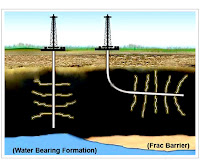
So…the whole caravan comes to town, builds the rig, pipes in water, pumps in chemicals, filters off the gas, pipes out the poisoned water somewhere unquantified, and then packs everything up after a few months because there’s no more gas coming up, leaving the area looking like a moon crater :-
So how carbon-intensive is this kind of operation ? It’s a bit like chopping down Indonesian and Malaysian tropical rainforest to grow oil palm and then burning dirty bunker fuel to ship it all the way to Europe to make “cleaner burning” biodiesel. In fact, it could be worse than that – it could be dirtier than coal :-
And what’s all this business about chemical adulteration of groundwater ? That could be to do with the “hydraulic fracturing” process from horizontal drilling :-
It’s true that the business needn’t resemble a travelling circus when there’s a large “play” of shale and horizontal drilling is used, but what about the possible side effects of chemical leakage into bodies of water and seismic activity, which doesn’t seem to get mentioned very often ? :-
There is some concern that shale gas is being promoted as a new “cure-all” for the energy industry, as gas is believed to be a cleaner source of fuel than coal, and gas shale is much, much cheaper than the proposed carbon capture projects and new nuclear power stations, which will only be developed with substantial tax breaks or subsidies or grants. (I mean, can you see a carbon price being set high enough to pay to make it worthwhile to fit Carbon Capture to every coal plant in the world ?) :-
https://www.chathamhouse.org.uk/files/17317_r_0910stevens.pdf
“The recent ‘shale gas revolution’ in the United States has created huge uncertainties for international gas markets that are likely to inhibit investment in gas – both conventional and unconventional – and in many renewables. If the revolution continues in the US and extends to the rest of the world, energy consumers can anticipate a future dominated by cheap gas. However, if it falters and the current hype about shale gas proves an illusion, the world will face serious gas shortages in the medium term”
A Carbon Capture and Storage (CCS) fan wrote to me, linking to the CCS industry :-
https://www.captureready.com/EN/Channels/News/showDetail.asp?objID=1972&isNew
“A British study indicates that cheap low-emission shale gas, with double the global reserves of conventional sources, will discourage investment in nuclear reactors and carbon storage. “In a world where there is the serious possibility of cheap, relatively clean gas, who will commit large sums of money to expensive pieces of equipment to lower carbon emissions?” Paul Stevens, senior research fellow at Chatham House, a London-based institute for the study of international affairs, wrote in the report published today.”
This is what the CCS fan had to add :-
“What this important article from the ‘CaptureReady’ international CCS news website fails to pick up (although other authors have) is that these prices will have an equal dampening effect on all renewables projects as well, […] never mind offshore wind power costs, while easily meeting all conceivable carbon dioxide reduction targets out to beyond 2050 and delivering reliable, dispatchable power, with none of the unreliability/unpredictability ‘down-sides’ of variable wind output. ‘I know which I’d pick’ as a power company today, especially given the low investment cost per kW […]. Looks like it may be ‘gas forever’ for at least the next couple of decades, so we need to lobby very hard for CCS from the start on every new gas powerplant and large industrial plant, followed by a big programme of properly-subsidised CCS retrofits, if that’s where the real industrial world is going…the quoted US conventional gas number is just plain wrong (far too high!), and the Shale gas price is very geology/location and project-scale-dependent (that is, variable), so that price in Texas does not mean similarly low shale gas prices everywhere – meaning the total resource quoted is certainly not available at that sort of low price. As with all resources, there’s actually a ‘staircase’ of amount versus price. Shale gas exploitation is ‘inherently costly’ (capital-intensive) due to the relatively larger number of wells needed, the poor permeability and the considerable cost of the ‘fracking’ operation itself. The poor inherent permeability inevitably means that the production rate will decline more steeply and quickly than conventional gas wells, meaning that costly multiple repeat fracking may be necessary, adding to costs.”
And as a summary of the shale gas downsides :-
=x=x=x=x=x=x=x=x=x=x=
Main conclusions [on shale gas] :
1. Huge levels of uncertainly on total reserves and future production rates, even in the USA.
2. Not at all certain that the large-scale US shale gas experience can be replicated in Europe/Rest of the World at all – environmental issues/local NIMBY [Not In My Back Yard] may stop it in its tracks.
3. Said huge uncertainties, on top of the recent recession, is significantly increasing commercial risk factors and inhibiting new production investment in all types of energy supply. Possibility of resulting very steep multi-year price rises, if shale gas ‘fails to deliver’, as demand rises and exceeds current supply, due to investment cycle time lag.
4. Particular over-supply problems in the LNG [Liquid Natural Gas – mostly from the Middle East] sector which should keep the cost of UK imported LNG low for a considerable time.
5.The EU has shown itself unable/unwilling to invest state funds in new gas production/transport projects of all types.”
=x=x=x=x=x=x=x=x=x=x=x=
Forget about price just for a moment…remind me again…where does all that fracking water, with all those toxic chemicals in it, end up ?
ULTRA-BRIGHT CHEESE WARNING !
(a tip of the hat to Peter Sinclair)
[ UPDATE : Hot on the heels of the e-mail from Biteback Publishing (now, there’s a coincidence, not) I got an e-mail from the Daily Mail, explaining why they will not make further corrections to the excerpt they published from Peter Sissons’ book, apart from the goodwill gesture they first made to remove my name… They appear to have failed to understand the irony. Roger Harrabin insists that my complaint didn’t influence him to change his 2008 article. And now the Daily Mail are insisting that my complaint will not influence them to change their article. This shows quite conclusively that journalists are resistant to complaints; evidence which completely undermines the “contrived” claim by Peter Sissons that my complaint influenced Roger Harrabin… ]
Peter Sissons wrote a book, but since I don’t watch TV, I didn’t see him popping up on various programmes to talk about his new publication.
First I knew, excerpts from the book were serialised in a couple of newspapers – including the Daily Mail. It was only when I questioned the account in the Daily Mail, that I found out that I’d been written about by Peter Sissons in a printed book.
Yet Peter Sissons never contacted me to confirm details in researching his narrative, and he didn’t acknowledge that the version of the story he used had been contested publicly by Roger Harrabin, the BBC journalist.
I have attempted to get a correction from Biteback Publishing, but it appears that so far I have been unsuccessful, and it seems unlikely that my complaint will get recognition. Here is the e-mail trail :-
___________________________________________________________
From: jo abbess
To: info, Biteback Publishing
Subject: Request for clarification regarding Peter Sissons’ publication
Date: Fri, 4 Feb 2011 09:26:41 +0000
Dear Biteback,
According to an e-mail from the Daily Mail’s Assistant Editor that I received yesterday, I have been mentioned by Peter Sissons in one of your publications.
The Daily Mail published an article by Peter Sissons online on 25th January, and I have been told that this was an excerpt from his recent book.
I’m wondering if you could do me the highest favour and clarify for me what exactly may or may not have been put into print by Peter Sissons about me.
I questioned the accuracy of the piece by the Daily Mail, and asked them to consider amendments, but unfortunately, before they could respond, the article was cut and pasted across the Internet, along with my name.
This means that even if my name has been removed from any published version, it would still be easy to find out who the unconfirmed story refers to.
Peter Sissons did not approach me regarding the story he recounted in the Daily Mail to verify details, and does not seem to have taken account of BBC journalist Roger Harrabin’s version of events. The story was therefore incompletely researched, and should not in my view be put into print.
It would be unhelpful if the same incorrect story were to have been printed in Peter Sissons’s book, and I would welcome feedback from you on measures that could be taken to remove the unsound narrative from the public domain if it has appeared in one of your publications.
I am not interested in pursuing legal redress if a false account has been published, but I would like you to provide a remedy to clear my name, actions and character if they have been inaccurately described.
Yours sincerely,
Ms J. Abbess
__________________________________________________________
From: jo abbess
Sent: 04 February 2011 09:41
To: James Stephens, Biteback Publishing
Subject: FW: Request for clarification regarding Peter Sissons’ publication
Dear James,
It was very reassuring to talk to you just now.
As you requested, I’m forwarding the e-mail that I sent this morning to the general info address.
Thank you for your attention to this matter.
Regards,
jo.
__________________________________________________________
Subject: FW: Request for clarification regarding Peter Sissons’ publication
Date: Tue, 8 Feb 2011 10:00:53 +0000
From: James Stephens, Biteback Publishing
To: jo abbess
Dear Jo,
Many thanks for contacting me on Friday with reference When One Door Closes, the recently published autobiography of Peter Sissons. The book does indeed make mention of you in three paragraphs on page 299, which I have attached here for your convenience.
For clarification, I should make clear that we can see absolutely no reason to withdraw the book – nor to include an erratum notice, nor to issue some manner of correctional statement.
With reference to the e-mail exchange between Roger Harrabin and yourself referred to in the text where Peter uses your words he repeats verbatim what has already appeared elsewhere in the public domain. In terms of events it seems to me that he is factually correct. In terms of Peter’s own interpretation of those facts, we feel that it is the writer’s prerogative – especially in a memoir – to put down his own reflections on and personal interpretation of events.
Again, I thank you for bringing your concern to my attention. However, I hope that once you have had a chance to look at the text you will not feel you have been inaccurately described.
Best regards
James Stephens
__________________________________________________________
From: jo abbess
Sent: 08 February 2011 13:45:15
To: James Stephens, Biteback Publishing
Dear James,
Thank you for the clarification and the PDF of the page of Peter Sissons’ book where my name is mentioned in connection with Roger Harrabin and an e-mail exchange that Roger and I had in 2008.
I agree that Peter Sissons should be free to have his own opinions about what took place, but it appears to me that he has not given an accurate description of the factual events, and so I would question the validity of his summary.
I am unhappy that Peter Sissons published this account without verifying the factual details with me. I am also not happy to have a negative judgement of my character and behaviour appearing in print when this opinion is based on an incomplete account of the factual events.
In addition, it appears that Peter Sissons has ignored the account of the factual events as given by Roger Harrabin back in 2008, which has been repeated several times in several arenas since. In my view, Peter Sissons has come to an inaccurate conclusion based on faulty information.
The account by Peter Sissons seems to me to be lacking in a good deal of context. Were he to have fully researched what happened, and understood what actually took place, I am sure that he could see why I think that his position on this incident is uninformed and faulty.
Roger Harrabin and I made several attempts to get the Climate Change sceptic account of what took place corrected at the time, but it appears that these corrections were not heeded, and it seems possible that the inaccurate narrative will come back again and again to haunt us, if the usual pattern of Climate Change sceptic muck-raking behaviour is to continue.
It would be a really helpful thing if you could send me a letter confirming that you recognise my complaint and that I have challenged the accuracy of Peter Sissons’ account. This I could then use to wave in front of people who seem to be adamant in bringing this long-dead non-scandal back to life.
There is no dirt in what took place, and it should not be dug up repeatedly in my opinion, and I would appreciate your help in deflecting false accusations from third parties in future.
I need to have my voice heard and my position acknowledged on this matter.
Thank you,
jo.
__________________________________________________________