Categories
Academic Freedom Alchemical Assets not Liabilities Be Prepared Big Number Big Picture British Biogas Burning Money Carbon Capture Carbon Pricing Carbon Taxatious Climate Change Corporate Pressure Design Matters Direction of Travel Dreamworld Economics Drive Train Efficiency is King Electrificandum Emissions Impossible Energy Autonomy Energy Insecurity Energy Revival Engineering Marvel Fossilised Fuels Freemarketeering Gamechanger Gas Storage Global Warming Green Investment Green Power Growth Paradigm Hydrocarbon Hegemony Hydrogen Economy Low Carbon Life Major Shift Methane Management Money Sings National Energy National Power Nuclear Nuisance Nuclear Shambles Nudge & Budge Optimistic Generation Paradigm Shapeshifter Peak Coal Policy Warfare Political Nightmare Price Control Realistic Models Regulatory Ultimatum Renewable Gas Shale Game Solution City Sustainable Deferment Technofix Technological Fallacy Technological Sideshow The Myth of Innovation The Power of Intention The Price of Gas The War on Error Unconventional Foul Unnatural Gas Utter Futility Vain Hope Voluntary Behaviour Change Wasted Resource Zero Net

Gas in the UK (2)

…Continued from https://www.joabbess.com/2012/06/12/gas-in-the-uk/

Questions from the floor

[Tony Glover]

…increasing electricification of heat and transport. I was interested in what Doug said about heat. [If energy conservation measures are significant and there is] a significant reduction in gas use for heat…interested in the Minister’s response.

[Terry ? (Member of PRASEG)]

I’m interested in gas that would need CCS [Carbon Capture and Storage] [in future] …[since there would be no restriction there would be an] incentive to build new gas in next few years away from CCS-usable infrastructure. Maybe encouraging gas stations over next few years to be built in view of CCS.

[ ? ]

[There have been mentions of the] Gas [generation] Strategy and gas storage. Is it your intention to have both in the Energy Bill ? [Need to improve investor confidence.]

[Charles Hendry MP] I’m more confident than Doug on CHP…[in respect of energy conservation we will begin to increase our use of] CHP [Combined Heat and Power], geothermal energy, don’t need District Heating. I think we’ll see more people switch to electric heating. The likely pricing on gas will mean people have to look at other sources – such as localised heat storage, intelligent ways to produce hot water and heat in their homes […for example, a technology to store heat for several days…] The first [new gas power] plants will be where they are already consented – where originally coal plants – need to have identified in advance – no new plant is consented unless…We’ve asked Ofgem to ask re securing gas supplies. If we can stretch out the tail of North Sea gas – can stretch it out 30 – 40 years […] technology […] Centrica / Norway […] develop contracts […] Is there a role for strategic storage [Centrica asking] […] Buying and selling at the wrong price (like the gold) [widespread chuckling in the room]. Some of it may not need legislation. Gas Strategy will be published before the Energy Bill.

[David Cox] Get very nervous about gas storage. Don’t think there’s a need to put financial incentives in place to increase gas storage. We think the hybrid gas market is successful – a market and regulatory framework – [gas storage incentives] could damage.

[Doug Parr] I’m not downbeat because I want to be downbeat on heat. [Of all the solutions proposed none of them show] scaleability, deliverability. I’d love that to come true – but will it ? […] Heat pumps ? Biogas is great but is it really going to replace all that gas ? If we’re going to be using gas we need to make the best use of it […] Issues around new plant / replacement – all about reducing risks no exposing ourselves to [it] – security of supply, climate risks, issues about placement [siting of new plant]. If CCS can really be made to work – it’s a no-brainer – do we want all that carbon dioxide in the atmosphere or … ? Our entire policy becomes dependent on a technology that hasn’t even been demonstrated. Other technologies that people thought were great – years later they still haven’t arrived [for example, rooftop wind turbines]. If we say CCS is the only way it’s going to work – what’s Plan B ? We are going to use [fossil fuels] – should not become wholly dependent on technology not yet demonstrated.

[Alan Whitehead] Perhaps people should be asked – which would you prefer – a CHP / DH [Combined Heat and Power / District Heating] plant in the valley here, or a couple of wind turbines on that hill ? That would [shake things up].

Questions from the floor

[ X ? ] See […] as the ultimate destination. Most important – gas can be made zero carbon – not pie in the sky. 1. Start contributions of carbon-neutral gas and 2. will need far less if [we act] like Japan – force installation of microCHP. Their aim is to do same as for washing machines [bring prices down – make widely available for the home]. MicroCHP [with] heat pumps – reduction as good as decarbonising gas or electricity. But can also decarbonise gas.

[ X ? ] The Minister mentioned the importance of CHP but recently dropped […] mandate. If CHP so important what measures is the Government taking to ensure its installation ?

[ X ? ] Electricity is a rubbish fuel for heating buildings – very peaky load – need something cheap to store, cheap to […]. Fits very well with forcing down demand. Where we’re getting our gas from. At the moment our waste is being incinerated. For a cheap additional cost, where currently incinerating we can do anaerobic digestion [AD], producing a fungible asset – the gas – can gradually decarbonise our grid.

[ Thomas Grier ? ] …a decision [?] of London – CHP in London over the next few years. If we want to use electricity for heat, we need to reinforce the electricity grid [by 60% to 90% ?] In rural situations – use electrical heating. In urban, use decarbonised energy. [This model projection] shows the gas grid disappearing – it will collapse at some point if all we have on the gas grid is cooking.

[ X ? ] …[encouraged CHP then a few days later] stood up then said all support [removed ?] for CHP next year. A Heat Strategy that said there is enormous [scope / potential] for CHP. We want to see gas, we want to see efficiency. Are we moving towards […] without it they won’t build it.

[David Cox] Microgeneration – couldn’t get it down economically. Reliability [issues]. Full supporter of biogas – AD got a contribution to make – but never more than 5% – no matter how much [we crack it]. Electricity is not very good for heating – but how to we decarbonise the heat sector ? Always been an advocate of CHP. Government need to do more incentivising of that.

[Charles Hendry MP] Innovation and invention […] Government can’t support all emerging technologies. Best brains around the world [are working on] how we move fundamentally in a low carbon direction. On the waste hierarchy – burning of waste should be the final stage – finding a better use for it. [I visited] the biggest AD plant in Europe in Manchester – biogas and electricity generation. We are seeing Local Authorities taking a more constructive long-term view on how to manage waste. CHP – we all want to see more of it – to what extent does it need support ? That depends on whether new build – building a community around it. [By comparison, urban retrofitting is probably too expensive] Iceland [took the decision and] retrofitted almost every home – I’m now more convinced than before. What is the right level of subsidy and what makes good economic case ?

[Doug] We do keep missing opportunities. [For example in Wales, Milford Haven, the new Combined Cycle Gas Turbine at the Liquified Natural Gas (LNG) refinery to process the gas] should have been CHP. I am enthusiastic about lots of heat technologies [but the same questions/issues apply] scaleability and deliverability. District heating [DH] – an infrastructure asset ! [Can change priorities about what gets built – for example in Denmark (?)] they’re building large-scale solar farms to top up the DH. In the Treasury’s infrastructure plan [see DH could be…] Heat is the poor relation in energy debate. Other networks have been identified in the National Policy Statements (NPS) – but not heat.

[ Leonie Green, Renewable Energy Association ] [I must] defend heat pumps. In Sweden 90% of new builds [hav e heat pumps ?] – heat pump efficiency is a function of the energy-efficiency of the building […] Just on AD – National Grid report said it could provide 50% [of the nation’s supply. Our members think] that’s a bit too high – we think 25%. My question is really about the benefits. We are hearing anxiety about costs, but it’s piecemeal on benefits. We’ve been strong on jobs, balance of trade, exports [all benefits of renewable energy investment and deployment]. Pleased to see DECC put out [report from] Oxford Economics [on the] wider economic benefits. How can we get more and more balance in reports. [An example] Deutsche Bank renewable generation opportunities.

[ ? ] We would also support more than 5% from renewable gas – also about hydrogen – we used to do it when it was town gas – why not again ? As regards injecting biomethane/biogas from AD into the National Grid [last year ? to this year ?] 130 enquiries to connect AD to our network – none have progressed. Please sort these [registrations] out.

[ ? ] Minister, we’re not expecting you to fund all technologies – we need some logic – especially with transport. The Government doesn’t recognise the difference between Renewable Natural Gas if used in transport and fossil fuels. Would be simple – a tax on gas if used in a vehicle. What’s the problem over […] ?

[Colin Snape, University of Nottingham] We are looking at reducing the costs of carbon capture – we have a section of PhDs… One other gas source not mentioned – gas from underground gasification of coal [UCG]. In UK […] 2 billion tonners of coal – slightly offshore – on the energy coast of the UK – where all the action is on CCS – obviously UCG needs to be coupled with CCS to be carbon neutral. Would [be operational] in a very short time period […incentives…]. Significant proportion of UK needs.

[ ? ] What is the purpose of the Gas Strategy ? Shale gas isn’t a miracle. The “Golden Age of Gas” [report by the International Energy Agency (IEA)] doesn’t mean cheap gas, because [it will be put to] lots of uses. Renewable electricity and nuclear are not going to come until the 2020s. How do we avoid building loads of gas generation that is not necessary after that time ? What’s the role of mothballing (relatively cheap to bring CCGT out of mothballs comparing to build new). No sign of reduction in electricity demand reduction – therefore there will be high gas use.

[ Doug Parr ] On UCG, the IEA had two scenarios in the “Golden Age of Gas” – both took us over 3.5 degrees Celsius [in additional global warming]. Even if there is unconventional gas sources, still a huge danger of going down the road of unrestrained gas use. What is the alternative ? We should not end up becoming dependent on gas. Should not build gas to fill a short-term hole – they will lobby for their own interests – to keep open.

[ David Cox ] CCGTs won’t be built without guarantees greater than 20 years. Also renewable energy might not provide in the way that we hope. The CCC report – what caused the rise in energy prices ? The wholesale gas price – not renewable energy, green policies. However, that was slightly dishonest – the counter-factual was […] renewable energy significantly still more expensive than fossil fuel there. Until we can get costs of renewable energy down to the prices of fossil fuels… [The industry] don’t give the impression [they will build] on the basis of short-term need. Gas isn’t clean, I admit that […] CCS – that will work.

[Charles Hendry MP] A lot comes back to a need for a balanced approach – carbon targets and security of supply. If you haven’t sorted out security of supply, the electorate will not give permission to go low carbon. Gas is a hedging fuel currently but don’t know where costs going over time. As a politician, I like pipelines – know where it’s going (not like LNG, where there was limited use of new LNG import plant). If we want Scandinavian gas, we need security of demand to build the new pipeline. How we deal with issues of biomethane – in 2 years – need to make more progress. Some of these [techologies] will be gamechangers – some, look back in a couple of years… [Need a] permissive framework to allow a lot of ideas and technologies. There is no source of energy that hasn’t required subsidy in early days. Fanciful to suggest new forms of energy can come through without support. The letters we get [from the public, from constituents] are on vehicle fuel costs, not how much their gas bill went up last winter…

Official end of meeting

A gaggle of people gathered in the hallway to discuss some items further.

The Electricity Market Reform (EMR) was generally criticised – as it contains measures likely to specifically benefit nuclear power. Electricite de France was identified as very involved. The Government had said “no nuclear subsidy”, but the EMR measures are equivalent to hidden subsidies.

The Levy Cap was criticised as it would disturb investor confidence – if several nuclear reactors came on-stream in 10 years time, in the same year, they would eat up the whole subsidy budget for that year – and other technologies would lose out. If was felt that a number of the EMR proposals were “blunt instruments”, not overcoming shortcomings of former levies and subsidies.

Although the EMR was designed to addressed economic fears, it wasn’t assisting with financing risks – if anything it was adding to them. Rates of return have to be guaranteed for loans to be made – chopping and changing subsidies doesn’t allow for that.

Leonie Green said that the REA members don’t like the Premium Feed-in-Tariff (FiT). She also said later that they were not pleased about the cuts in support for AD.

Since my personal interest is in using Renewable Gas of various sources (including Biomethane / Biogas) to displace Natural Gas from the gas grid, I spoke with various people about this informally (including a woman I met on the train on my way home – who really got the argument about decarbonising gas by developing Renewable Gas, and using that to store excess renewable electricity, and use it as backup for renewable electricity. Although she did say “it won’t be done if it won’t confer benefits”.). One of the key elements for developing Renewable Gas is to create a stream of Renewable Hydrogen, produced in a range of ways. Somebody asked me what the driver would be for progress in Renewable Hydrogen production ? I said the “pull” was supposed to be the fabled “Hydrogen Economy” for transport, but that this isn’t really happening. I said the need for increased sources of renewably-sourced gas will become progressively clear – perhaps within a decade.

One of the persons present talked about how they think the Government is now coming out of the nuclear dream world – how only a few of the proposed new reactors will get built in the next decade – and how the Government now need to come up with a more realistic scenario.

It was mentioned that is appears that the Biogas technologies are going to have the same treatment as solar photovoltaics – some sort of subsidies at the start – which get cut away far too early – before it can stand on its own two feet. This was said to be the result of an underlying theory that only a fixed amount of money should be used on launching each new technology – with no thought to continuity problems – especially as regards investment and loan structures.


Categories
Academic Freedom Be Prepared Big Number Big Picture British Biogas Burning Money Carbon Capture Carbon Pricing Carbon Taxatious Coal Hell Cost Effective Design Matters Drive Train Efficiency is King Electrificandum Emissions Impossible Energy Autonomy Energy Change Energy Insecurity Engineering Marvel Foreign Interference Fossilised Fuels Gamechanger Green Investment Green Power Growth Paradigm Hydrocarbon Hegemony Low Carbon Life Marvellous Wonderful Methane Management Money Sings National Energy National Power Nuclear Nuisance Nuclear Shambles Optimistic Generation Peak Coal Peak Emissions Policy Warfare Price Control Realistic Models Regulatory Ultimatum Renewable Gas Renewable Resource Shale Game Technofix Technological Fallacy Technological Sideshow The Price of Gas The War on Error Transport of Delight Unnatural Gas Wasted Resource Wind of Fortune Zero Net

Gas in the UK

“The role of gas in the UK’s energy mix” 12 June 2012 17:30 – 18:30, Committee Room 5, House of Commons with speakers Minister of State for Energy and Climate Change, Charles Hendry; David Cox, Managing Director of The Gas Forum and Dr Doug Parr, Chief Scientist of Greenpeace UK. Chaired by Dr Alan Whitehead MP, Chairman of PRASEG, the Parliamentary Renewable and Sustainable Energy Group, who called the seminar : https://www.praseg.org.uk/the-role-of-gas-in-the-uk-energy-mix/

UNVERIFIED COMMENTS : Please check with the speakers to confirm their statements and do not take this account as verbatim.

[Alan Whitehead MP] Questions about gas. Will it be business as usual ? If not – too “much” gas ? What does that mean for Climate Change targets ? New gas generation – about 11 gigawatts coming on-stream in the next 5 years – “grandfathered” (no obligations to control emissions with Carbon Capture and Storage (CCS)) throughout the life of the power plant – does produce questions about Climate Change targets – CCS may change that landscape in the medium-term future. Question about emergence of biogas into system [which would bring] a down-trend in emissions.

[David Cox] The wonderful future that gas offers us. Have to look at whole low carbon [framework] – gas has a place. Not a war [between gas and renewable energy technologies]. Both needed [in the advance towards carbon-free] energy. Without gas, not going to make it. Make sure we can afford it. Gas has a role. The recent [International Energy Agency] IEA report on the “Golden Age of Gas” – tight gas, shale gas – has doubled reserves. Nobody knows for sure – there’s so much there. Perhaps 250 years of gas – no shortage of gas [although some of it is in] sensitive areas. Getting it from those areas with political problems. [There are uncertainties about] unconventional gas. There is plenty around the world – “pretty good”. Gas is not at war with renewables. Gas isn’t just a transition fuel – it’s a destination fuel. Got to prove CCS technically. If we can do that gas becomes a destination fuel. Can decarbonise not only electricity. Heat. Heat pumps won’t do it on their own. Sorry. [Gas can help decarbonise] transport – electrify the transport system – that’s what we believe is possible. Hope the Government will support CCS.

[Doug Parr] First and foremost – we are not going to eliminate gas from energy systems any time soon – don’t think of gas as a destination – I would warn against policy that gas is allowed to become the default and become too dependent on gas. A lot of policy on gas – but only over part of the energy system [electricity]. Heat is going to rely on gas fo a long time. If follow the Committee on Climate Change (CCC) logic – [heat is a] strategic sector – to getting away from carbon emissions. If gas is going to be what gets us out of energy problems – the so-called “trilemma” of decarbonisation, security [of supply] and cost. [New gas power plants amount to] 11 gigawatts [GW] over the next 5 years – 120 TWh – a quarter of current gas [still in service] out to 2030. If one take CCC target of 50 gC / KWh (grammes of carbon per kilowatt hour). Look at CCGT [Combined Cycle Gas Turbine gas generation power plant in operation] – that target is a fraction of [current] unabated [CCGT] – not that great. Any substantial role of gas has to make some pretty strong assumptions about CCS. Remember, this is not yet working – let us not have a decarbonisation policy relying heavily on CCS when not at the first stage. The CCC have warned that grandfathering of the 11 GW new generation – emit without restrictions – and issue until 2045. Can’t say gas is somehow the answer to decarbonisation issues. In media – don’t [swallow] the media froth. [As for] security of supply – already going to be quite reliant on gas for heating for quite some time – hard to see [otherwise]. Heavily reliant on imports – around 80%. Where do we import our gas from ? Qatar and Norway mostly. The former head of the Navy argued [recently] changing gas prices is the single most significant factor. DECC [UK Government Department of Energy and Climate Change] recent report on price shock. REA [Renewable Energy Association] said that just by hitting renewables targets would displace £60 billion of imports. [As for] shale gas : both Ofgem research and Deutsche Bank reports that shale gas is very unlikely to help on security [of supply] issue. Citing American example [of shale gas exploitation] is just irrelevant. [So the UK Government must be] supporting gas because of costs ? The biggest rise in consumer bills is from fossil fuel [price increases]. Not renewable energy, not green energy [measures] – it’s the rise in the wholesale gas price. Is that going to stabilise and go down ? Not according to Merrill Lynch and DECC – [strong] prices for Liquid Natural Gas (LNG) and therefore for gas [as a whole, will stay]. Clearly we will be using gas – as [electricity grid load] balancing. What I’m railing about is that gas doesn’t get us out of our energy trilemma. Gas will not [save us]. We know we can deliver through renewable energy, wind – acceleration of new technologies [such as tidal] – perhaps CCS will work, who knows ? and efficient use for example Combined Heat and Power (CHP) on industrial scale. If we are using gas we are using at it’s most efficient.

[Alan Whitehead MP] [recounts tale of how he got into trouble with Twitter commentators when he insisted the recent rise in consumer energy bills was due to the rise in the cost of wholesale gas, not green energy measures] [To Charles Hendry] I’m sure you don’t Tweet.

[Charles Hendry MP] No. absolutely not. I have enough people telling me I’m wrong without… We have to look at the role of gas. It would a dereliction of Government not to look at the role of gas going forward. […mentions developments in gas production…] seismic profiling [enabling better understanding of gas fields] horizontal drilling [improving access to complex fields]. [As for] unconventional gas – the IEA “Golden Age of Gas” – but don’t assume [it’s that simple – supply may go up but] demand for gas is going to go up dramatically. Japan – major user of LNG and diesel. Consequence of Germany’s decision to close nuclear power plants – will use much more gas. China…India…growth rate – massive growth of demand. Anticipate new resources to be found – Iraq for example – but cannot assume [what has happened in the United States of America with the development of shale gas where gas prices are now] a quarter [of what they were] – a massive boost to America – will they allow this to be exported to Asia – or use cheap gas to [relocating] industry back to the USA ? Have to look at implications for us. Reasons why shale gas is different in Europe – legal [situation] – the mineral rights [in the US, these can be acquired from underneath a landowner]. Don’t have the same commercial drives as farmers in the US. The reason why gas prices collapsed in the US and not here – if we saw a price benefit here, it would go out through the [gas] interconnectors [to neighbouring countries]. For real practical reasons won’t see shal gas develop [significantly] here. [It is a] global gamechanger – but… The US is fundamentally shifting from coal to gas – with the implications for emissions. The change from coal to gas was a major driver in European control of emissions [in the 1990s] […] Investment…technology…practical constraints. EdF [Electricite de France] will go ahead with new nuclear [by the end of the year ?] but the plant will not come online until the end of the decade. Major renewable energy resources also in 2020s [not immediate] – the cost of offshore wind power is two times that of onshore. We’re saying to industry to reduce by 40% by the end of the decade – otherwise simply not affordable. Contributions from tidal, CCS ahead. It’s going to be very end of this decade to see if CCS can work. Worrying gap [in power generation between now and next decade]. Megawatts (MW) of coal being turned off in 2015. [Coal plants are] getting through their [legally permitted] generating hours too quickly. By 2023, the only nuclear plant still operational will be Sizewell B. We have to have more gas in the mix. As we look towards more intermittent resources (renewables), gas is an important source of backup. [Will have/need] a capacity mechanism to ensure [optimisation when] mismatch between supply and demand – auction to include gas – could be [North Sea] gas, gas from the interconnectors [from abroad] or demand side response [demand reduction] – a more sophisticated capacity mechanism than historical. I’m more optimistic about CCS [than Doug Parr]. CCS is a requirement. It is something we have to deliver – no scenario I’ve seen where we’re going [to be] using less coal, oil and gas than today. [Out to 2035] our basic needs [will still rely for a good percentage on] fossil fuels. Broadening CCS [demonstration competition] out to pre- and post-combustion on coal – [expand] to gas. Can be applied to gas as well as coal. I think CCS is a fundamentally critical part of this equation. If so, can see gas as a destination fuel. The GW of gas being built in the next few years [some questions] – currently gas is being mothballed [some plants being shut down effectively putting them into disuse] because of [fuel] prices. I consented more in gas and also wind on- and offshore last year. But that gas is not being built. If we want that gas built we need a more coherent strategy. Look at what is necessary to encourage that gas – and carbon emissions [reduction] alongside. EPS [Emissions Performance Standard] […] to stop unabated coal – limit 450 gC / kWh – significant proportion of plant would need CCS. But ddin’t want to disincentivise gas. Have also said a point where CCS on gas will be necessary. But if we had people building gas now and then 15, 20 years later they would have to fit very expensive [CCS] equipment… Volume of gas coming forward meets our supply issues. Over the next few years, grandfathering. If see enough gas coming through can change the mechanism in due course. [We will be] responding officially to the CCC in Autumn. Need to [fully] decarbonise electricity in the course of the 2030s if we want to meet out climate change objectives. I think that [the] reality [is that] gas and important element. Nuclear is important. Want to see significant amount of renewable energy and what Doug is calling for – significant commitment to [energy use] efficiency in the country. [We should concentrate particularly on] energy efficiency.

The meeting then opened up to questions from the floor… To Be Continued

Categories
Be Prepared Big Number Big Picture Big Society Breathe Easy Carbon Commodities Carbon Pricing Carbon Taxatious Climate Change Corporate Pressure Delay and Deny Demoticratica Direction of Travel Dreamworld Economics Electrificandum Emissions Impossible Energy Change Energy Insecurity Energy Revival Financiers of the Apocalypse Fossilised Fuels Freemarketeering Gamechanger Global Heating Global Warming Green Investment Green Power Growth Paradigm Health Impacts Human Nurture Hydrocarbon Hegemony Incalculable Disaster Libertarian Liberalism Low Carbon Life Major Shift Mass Propaganda Media Military Invention Money Sings National Energy National Power No Blood For Oil No Pressure Not In My Name Nudge & Budge Optimistic Generation Paradigm Shapeshifter Peace not War Peak Coal Peak Emissions Peak Energy Peak Natural Gas Peak Oil Policy Warfare Political Nightmare Regulatory Ultimatum Social Capital Social Change Social Democracy Solution City Stop War The Power of Intention The Price of Oil Toxic Hazard

Moving towards a logical conclusion

Although I consider him to be an enemy of the people by being a key architect of the privatisation of the UK’s National Health Service (NHS), I was delighted to hear Andrew Lansley say this about tobacco sales : “We don’t work in partnership with the tobacco companies because we are trying to arrive at a point where they have no business in this country.” Finally, after over ten years of hard work by a rainbow coalition of healthcare providers, local government administration, campaigners, social activists, educators and charities, it is possible for the UK Secretary of State for Health to tell the tobacco industry their products are not wanted here.

The deep question is : why didn’t the UK Government just ban the tobacco companies outright at the start or tell them to diversify out of selling cancer sticks in order to keep their retail licences ? Well, the simple answer is that companies like British American Tobacco (BAT) are privately-owned capitalised companies, with many pension and other major funds heavily invested. The UK Department of Business, Trade, Enterprise, Industry, Information, Skills, Services and Manufacturing or whatever it’s been variously called over the last few decades, simply couldn’t tell shareholders to pull their investment out of death-by-inhalation stocks.

Everyone sees a return on investment in the industries of death generally, such as the arms trade, the junk food industry, and petrochemicals (ask yourself : how many people have suffered and died because of diesel particulate-provoked asthma ?) It takes a certain amount of time to reach the logical conclusion that wars do not need to be fought, making armaments redundant; for healthy food to become seen as essential to beat off diabetes and obesity epidemics; and for urban transport to be electrified to save lungs and hearts.

No, you just can’t ban an entire product range overnight because, finally, the science has broken through the doubt barrier and shown beyond reasonable scepticism that tobacco smoking causes cancer, emphysema and other serious and fatal conditions. No, you have to go at it step by painful step, reducing availability, changing the rules on presentation at the point of sale, putting up signs in public places.

And it all takes time, this gradualist approach. The tobacco industry may now wind down to a dribble in Britain (although it will continue to do well in Asia and Africa), and peoples’ savings for retirement will have soon all moved out of fag ends into something else.

Yet, we don’t have the luxury of time when it comes to the climate change and energy crisis. We simply don’t have the 25 to 50 years it could take to adopt a gradualist approach to energy sector change. Anything that takes longer than 10 years to begin to displace carbon out of the energy economy is too slow to be useful.

People are slowly beginning to wake up to the fact that their money is invested in climate change, and are making demands on their pension fund and bank account managers – but this is all happening too slowly – despite the keen interest in ethical investment.

The energy sector has got to change – and change fast. Changing the energy sector so radically and so quickly is not something that can be done by applying small changes to the costs of energy – particularly as the wider costs of energy are so volatile anyway. Gradually introducing renewable energy technologies with subsidies and grants and special tax breaks is not going to displace carbon fast enough.

Governments may not like the thought – but maybe they will consider starting to ban things – and not be shy about being explicit. However, this kind of action will generate significant resistance and dissent.

How then to rapidly alter the world’s entire energy sector ?

Start telling the truth about how the energy sector is scraping the bottom of the barrel in a number of fuels and fields ? Could this approach cause a run at the investment bank ? Could it tip the balance in energy systems deployment towards the less-intensive options – green energy – the only possible area of growth in the energy sector – which becomes the only possible logical conclusion ?

Categories
Academic Freedom Bad Science Bait & Switch Be Prepared Carbon Capture Climate Change Climate Chaos Conflict of Interest Corporate Pressure Deal Breakers Delay and Deny Demoticratica Direction of Travel Divide & Rule Economic Implosion Emissions Impossible Evil Opposition Fair Balance Foreign Interference Fossilised Fuels Freak Science Freemarketeering Global Heating Global Warming Growth Paradigm Hide the Incline Hydrocarbon Hegemony Libertarian Liberalism Major Shift Mass Propaganda Media Meltdown Military Invention Nudge & Budge Paradigm Shapeshifter Policy Warfare Political Nightmare Protest & Survive Public Relations Pure Hollywood Regulatory Ultimatum Revolving Door The War on Error Western Hedge

Psy Ops Gone Wrong


I’m not a conspiracy theorist, even though what I’m about to summarise may sound like I wear a tinfoil hat and don’t use wi-fi, but I assure you this is not true.

I would like you to consider the proposition that disbelief in climate change science is nothing more than an exercise in public mind-bending gone very, very wrong.

In the 1970s, climate change science began to accumulate some serious evidence and intelligent students. It became clear to a number of powerful players that the policy implications of global warming included a drastic reassessment of oil and gas dependence in the global economy.

Defence and national governance institutions all over the Free World, but most significantly in the United States of America, began to discuss the security implications of policy to combat global warming. The energy companies realised that the game was up if they didn’t act – they had their business profits to lose if carbon dioxide emissions became regulated.

Academics and researchers such as Naomi Oreskes and James Hoggan have documented what happened as a result – connivance from the oil, gas and coal companies to launch public relations exercises to qualm apocalyptic fear amongst the general population.

Certain scientists and engineers in the pay of the energy sector, and also close to the American federal administration, and some even in the US Department of Defense, took it as their personal mission to undermine confidence in climate change science, using tried-and-tested techniques from the public relations industry, sowing doubt in science.

Universities were targets for this psychological operation – the early versions of the Internet were ideal pathways for communicating the disinformation. Even very intelligent people became suspicious of climate change science, using the same route by which some environmentalists were invited to become suspicious of microwave ovens – but that’s a whole other story.

We all know what happened next – governments became shy of carbon policy : the result was a promotion of economic consumption at the expense of precaution. Developed economies around the world abandoned energy conservation for more extreme fossil fuel use.

An uneasy international balance was achieved by the USA devoting significant diplomatic effort to their relationship with Saudi Arabia, and protecting energy supplies by sending young white (and black) Christian martyrs into unholy wars on oil and gas producer nations.

It must be hard for some entrenched positions to hear that climate change is actually really serious, after all. We can end the conversation with these sceptics – there are other issues we need to focus on, such as the risks from the militarisation of the melting Arctic.

Climate change “dissenters”, “dismissers” and “deniers” might find it hard to listen to the US Department of Defense trying to be upbeat and re-capture the agenda and the platform. Here’s Leon Panetta outlining some of the new story :-

“Panetta: Environment Emerges as National Security Concern : By Nick Simeone : American Forces Press Service : Washington, May 3, 2012 : Climate and environmental change are emerging as national security threats that weigh heavily in the Pentagon’s new strategy, Defense Secretary Leon E. Panetta told an environmental group last night. “The area of climate change has a dramatic impact on national security,” Panetta said here at a reception hosted by the Environmental Defense Fund to honor the Defense Department in advancing clean energy initiatives. “Rising sea levels, severe droughts, the melting of the polar caps, the more frequent and devastating natural disasters all raise demand for humanitarian assistance and disaster relief,” Panetta said. Panetta cited the melting of Arctic ice in renewing a longstanding call for the Senate to ratify the United Nations Convention on Law of the Sea. More than 150 nations have accepted the treaty, which has been in force since the early 1990s, and a succession of U.S. government administrations have urged ratification. Among other things, the convention would guarantee various aspects of passage and overflight for the U.S. military. Panetta urged his audience to use their influence to push for treaty ratification. “We are the only industrialized nation that has not approved that treaty,” he said…”In the next fiscal year, we are going to be investing more than a billion dollars in more efficient aircraft and aircraft engines, in hybrid electric drives for our ships, in improved generators, in microgrids for combat bases and combat vehicle energy-efficient programs,” he said. “We are investing another billion dollars to make our installations here at home more energy-efficient, and we are using them as the test bed to demonstrate next-generation energy technologies.”

So, how will the international defence and intelligence communities take down the Frankenstein’s monster of opposition to climate change science that in effect they spawned themselves ? How are they going to bust the barricades of intransigent denial of the temperature and sea level gauges ?

You will find that the major meteorological research institutions in most developed countries are closely allied with their ministries of defence and intelligence. For example, the Met Office in the UK. There are competing issues at stake – the scientists cannot get too loud about climate change, because national security depends on economic stability – which rests partly on the profit and loss accounts of their energy sector businesses.

One or two scientists in the extended national security apparatus speak out – like James Hansen at NASA. But most people just keep their heads down.

This is where independent voices are so important to roll back the decades of climate change science scepticism. I hope knowledgable journalists and activists really rip to shreds the latest Heartland advertising campaign.

Categories
Academic Freedom Big Picture Global Heating Global Warming Growth Paradigm Hide the Incline Science Rules Sea Level Risk The Data The War on Error

What’s Up ? Answer : Everything #3

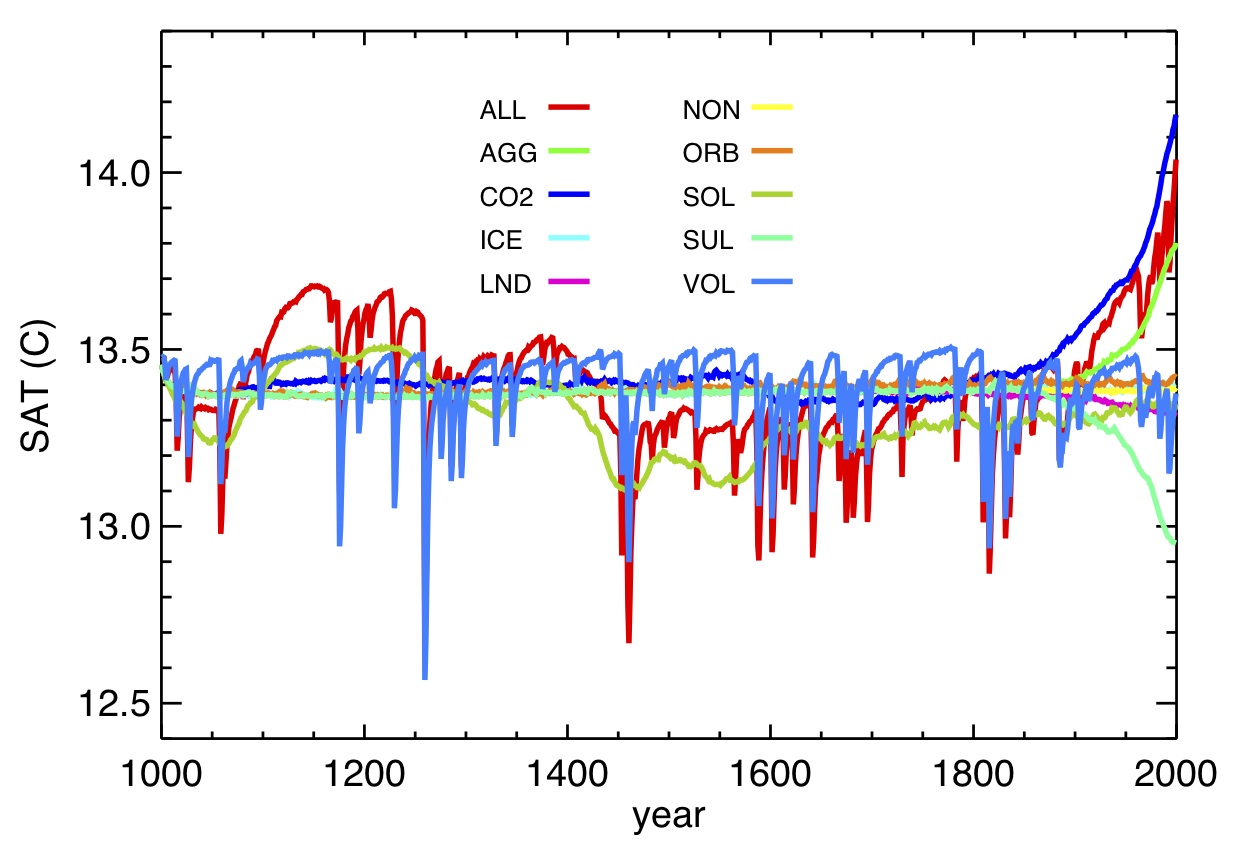
Having found data that supports the argument that there is an acceleration in sea level rise, ocean heat uptake and atmospheric greenhouse gas concentrations, I have now turned my attention to global warming – the warming of the close-to-ground (“near surface”) air and upper ocean water temperatures.
I’m still waiting to see the data for the new HadCRUT4 adjustments, so in the meantime, I have taken a look at the work of NASA GISS, and the international team who have agreed historical global warming influences – known as “radiative forcings”. Here’s the overall picture :-

Categories
Academic Freedom Big Number Direction of Travel Disturbing Trends Emissions Impossible Global Heating Global Warming Growth Paradigm Hide the Incline Major Shift Paradigm Shapeshifter Realistic Models Science Rules Sea Level Risk The Data The War on Error

What’s Up ? Answer : Everything #2

Image Credit : Santer et al. (2011)

The El Nino Southern Oscillation is a flip-flop pattern, throwing wind and ocean currents periodically into reverse along the line of the Equator in the Pacific Ocean.

When it’s in the La Nina configuration, cold water from the ocean depths is cycled up to the surface, causing a massive plume of cooler-than-average temperatures. When the winds start looping in the other direction, a spear of warmer-than-average water spreads out across the ocean.

To even the most casual observer of global ocean and land temperatures, this see-saw is clearly a major influence on the data measurements – temperatures go up and down in a very regular fashion at decadal scale.

The size of the temperature swing has caused many to doubt or ignore the underlying global warming signal – but the instrumental record of temperatures is now long enough to reveal that despite the ENSO swings, temperatures as a whole are creeping upward.

Categories
Academic Freedom Be Prepared Big Number Big Picture Climate Change Direction of Travel Disturbing Trends Global Heating Global Warming Growth Paradigm Hide the Incline Science Rules Screaming Panic Sea Level Risk The Data

What’s Up ? Answer : Everything

Image Credit : CSIRO State of the Climate 2012

I get up in the morning and everything looks fine. The Earth is still spinning on its axis, still wobbling around it’s axis, and still encircling, or rather enellipsoiding, the Sun. Birds tweet, the grass rises, and there’s the usual random selection of weather.

But, almost invisible, there’s a climate emergency, an ongoing and grinding crisis happening right here, right now, demanding my attention.

Despite what some would have me believe, climate change is not a low-level, marginal effect. Although it seems at the moment that we have plenty of time to adapt to changing circumstances, the problems are mounting up.

You see, climate change is not happening in a steady, measured manner. There are some climate indicators that are not only rising, but accelerating. The pace of change is racing ahead. Climate change is already having a significant effect, and as change speeds up, these effects will become dangerous.

Some people are not aware of these dangers in the Earth’s climate system, but it doesn’t make them any less real or any less serious. It’s time that people in general had better access to the facts.

Categories
Advancing Africa Advertise Freely Assets not Liabilities Bait & Switch Be Prepared Big Number Big Picture Big Society Carbon Commodities Climate Change Conflict of Interest Contraction & Convergence Corporate Pressure Deal Breakers Delay and Deny Demoticratica Direction of Travel Disturbing Trends Divide & Rule Dreamworld Economics Economic Implosion Emissions Impossible Energy Autonomy Energy Denial Energy Disenfranchisement Energy Insecurity Energy Revival Energy Socialism Engineering Marvel Evil Opposition Feed the World Foreign Interference Foreign Investment Fossilised Fuels Freemarketeering Global Warming Green Investment Green Power Growth Paradigm Hide the Incline Hydrocarbon Hegemony Low Carbon Life Major Shift Marvellous Wonderful Mass Propaganda Media Military Invention National Energy National Power National Socialism No Blood For Oil Not In My Name Nuclear Nuisance Nuclear Shambles Obamawatch Oil Change Optimistic Generation Paradigm Shapeshifter Peace not War Peak Coal Peak Emissions Peak Energy Peak Natural Gas Peak Oil Petrolheads Policy Warfare Political Nightmare Public Relations Pure Hollywood Regulatory Ultimatum Renewable Gas Renewable Resource Resource Curse Resource Wards Revolving Door Social Capital Social Change Social Democracy Solar Sunrise Solution City Stirring Stuff Stop War Sustainable Deferment Technofix Technological Fallacy Technological Sideshow Technomess The Myth of Innovation The Power of Intention The War on Error Ungreen Development Voluntary Behaviour Change Wasted Resource Western Hedge Wind of Fortune Zero Net

Energy Independence : Scheer Truth

Image Credit : Carl-A. Fechner, fechnerMedia

Renewable energy pessimists are everywhere.

Some commentators, government leaders, energy companies and representatives of international institutions are keen to show that not only is the renewable energy deployment glass half empty, the water hasn’t even wet the bottom of the glass yet.

Yet there are renewable energy architects – developers, promoters, politicians, scientists, engineers and academics – who document the evidence of the rapid growth in zero carbon energy – who show us that the sustainable energy glass could be brimming over.

What do experts say ? Here’s the belated Hermann Scheer from the film “The 4th Revolution : Energy Autonomy” :-

Categories
Academic Freedom Advancing Africa Carbon Commodities Carbon Pricing Carbon Taxatious Climate Change Climate Damages Conflict of Interest Contraction & Convergence Corporate Pressure Demoticratica Dreamworld Economics Economic Implosion Efficiency is King Emissions Impossible Energy Change Energy Disenfranchisement Energy Insecurity Energy Revival Feel Gooder Fossilised Fuels Freemarketeering Gamechanger Global Warming Green Investment Green Power Growth Paradigm Health Impacts Hydrocarbon Hegemony Libertarian Liberalism Low Carbon Life Major Shift Money Sings National Energy National Power Nudge & Budge Oil Change Paradigm Shapeshifter Peak Emissions Policy Warfare Political Nightmare Price Control Regulatory Ultimatum Solar Sunrise Solution City The Power of Intention The War on Error Western Hedge Wind of Fortune

Academic Freedom #7 : Contraction & Convergence

I think that within a short space of time, it will become admitted, even by Friedman-onomists (and other assorted Freak-onomists) that marginal pricing strategies on high carbon energy are not producing a major shift to a low carbon energy economy.

Nobody wants to buy carbon permits, so they will all duck the quotas, and buck the system.

The prevailing economic conditions, caused by a collapse in wealth and the onset of both climate change and fossil fuel depletion, and their respective impacts on food and energy production, are creating a volatility in the costs of energy – mostly in the buoyancy direction. Which is fine for anybody trading in energy industry stock, but not for the rest of us, and is especially limiting for any attempts to price greenhouse gas emissions.

Policies to create a carbon “market” by implementing varieties of “Cap and Trade”, and the so-called Clean Development Mechanism – a “flexible” approach permitted under Article 12 of the Kyoto Protocol, are showing a residual inefficacy – that means they are failing – an inability to cause widespread change.

That would be OK if we only expect carbon markets to provide some equilibrium in disparate progress towards carbon emissions reduction. If carbon markets were recognised as only being able to enable a small tranche of the overall changes required.

Carbon trading can be a useful mechanism if it’s used as a vehicle for “technology transfer”. By that, I don’t mean selling shale gas technology to China, Oman or Saudi, but creating a flow of useful Renewable Energy technology from industrialised world to under-developed world.

Categories
Academic Freedom Assets not Liabilities Bait & Switch Behaviour Changeling Big Number Big Picture Big Society Carbon Commodities Carbon Pricing Carbon Taxatious Climate Change Climate Damages Coal Hell Conflict of Interest Corporate Pressure Cost Effective Deal Breakers Demoticratica Direction of Travel Divide & Rule Economic Implosion Efficiency is King Emissions Impossible Energy Change Energy Insecurity Energy Revival Engineering Marvel Fossilised Fuels Gamechanger Global Warming Green Investment Green Power Growth Paradigm Hydrocarbon Hegemony Low Carbon Life Major Shift Mass Propaganda Media National Energy National Power Nudge & Budge Oil Change Optimistic Generation Paradigm Shapeshifter Peak Coal Peak Natural Gas Peak Oil Policy Warfare Political Nightmare Price Control Protest & Survive Public Relations Regulatory Ultimatum Renewable Resource Science Rules Social Capital Social Change Social Democracy Solution City Sustainable Deferment Technofix Technological Fallacy Technological Sideshow The Data The Power of Intention The Price of Gas The Price of Oil The War on Error Ungreen Development Unqualified Opinion Unsolicited Advice & Guidance Unutterably Useless Utter Futility Vain Hope Voluntary Behaviour Change Vote Loser Zero Net

Academic Freedom #6 : Policy Levers

Image Credit : Taproot

Many scientists express that their aim in their work is to offer a good foundation for Government decision-making. Our gathering and processing of data and evidence is to be offered to the lawmakers to enable them to choose a way forward, and design a strategy to get there. This is a noble ambition – to be a useful servant of the facts (or at least a disciple of statistics with plus and minus margins of error).

However, science is not the only force at work in influencing Government decisions. For a start, Governments change through elections in democracies, and all debate about public policy passes through a narrow ideological gate – where people decide on a very small range of questions that concern them at the time. Election issues are almost always centred around tax and welfare, and elections are often called for the favourite politicians of the moment.

And then there’s the question of which organisations influence elected governments on a day-to-day basis – who has the ear of leaders and their senior staff ? The public relations budget lines of large companies and corporations can be kept trim and tidy – politicians are easy to get access to if you have a lot of capital to invest (or make out that you do).

Categories
Academic Freedom Bait & Switch Big Picture Big Society Carbon Commodities Carbon Pricing Carbon Taxatious Climate Change Conflict of Interest Corporate Pressure Cost Effective Demoticratica Direction of Travel Divide & Rule Dreamworld Economics Emissions Impossible Energy Autonomy Energy Change Energy Insecurity Engineering Marvel Financiers of the Apocalypse Fossilised Fuels Freemarketeering Fuel Poverty Green Investment Green Power Growth Paradigm Hydrocarbon Hegemony Low Carbon Life Major Shift National Energy National Power Nudge & Budge Oil Change Paradigm Shapeshifter Peak Emissions Petrolheads Policy Warfare Political Nightmare Price Control Regulatory Ultimatum Social Democracy Sustainable Deferment Technofix Technological Fallacy The Myth of Innovation The Price of Gas The Price of Oil The War on Error Vote Loser Wasted Resource Western Hedge

Academic Freedom #2 : The UN climate treaty needs energy producer obligations

Image Credit : Orin Langelle GJEP-GFC

The United Nations Framework Convention on Climate Change calls nations to attend regular gatherings of the signatories to the ratified convention – the Conference of the Parties.

The nations send delegations – hardly ever sending their premiers, presidents and primes. What bargaining powers do these delegations have ? They have the authority to offer small percentages in emissions reductions, just to show willing. They have the mandate to refuse policies their nations do not like.

The language is framed around energy consumption – most country delegations have been advised by their economists that increased efficiency in the use of energy means that the national energy use will decrease. O wondrous technology ! You allow us to cut our energy use – and therefore our carbon intensity.

These same economists advise that the Holy Ghost of Innovation will inspire Research and Development – which will mean that new technologies will curtail greenhouse gas emissions. We only have to invest in new engineering. This Cult of the New is the fable on which most advanced nations hang their hope.

Categories
Advancing Africa Advertise Freely Alchemical Animal Kingdoom Bee Prepared Behaviour Changeling Big Picture Big Society Biofools Climate Damages Corporate Pressure Dead Zone Demoticratica Direction of Travel Droughtbowl Eating & Drinking Emissions Impossible Environmental Howzat Extreme Weather Faithful God Feed the World Feel Gooder Food Insecurity Foreign Investment Forestkillers Fossilised Fuels Freemarketeering Freshwater Stress Genetic Muddyfixation Geogingerneering Growth Paradigm Health Impacts Human Nurture Low Carbon Life Major Shift Marvellous Wonderful Media Nudge & Budge Oil Change Paradigm Shapeshifter Peak Emissions Peak Energy Peak Natural Gas Public Relations Social Change Solution City Sustainable Deferment Technological Fallacy Technological Sideshow Technomess Toxic Hazard Tree Family Ungreen Development Virtually Vegan Water Wars

Living Life and LOAFing It

CHRISTIAN ECOLOGY LINK
PRESS RELEASE

Living Life and LOAFing It – Green Christians ask churches to “Use your LOAF !” on sourcing sustainable food

In the run up to Easter, Christian Ecology Link is asking supporters to think and act on how they source food for their church communities, with the aim of reducing the impact of unsustainable agriculture on their local area, and the wider world.

CEL have launched a new colour leaflet on the LOAF programme principles in time for Shrove Tuesday (Mardi Gras), or Pancake Day, on 21st February 2012.

Categories
Assets not Liabilities Be Prepared Big Number Big Picture Burning Money Conflict of Interest Corporate Pressure Demoticratica Direction of Travel Disturbing Trends Divide & Rule Economic Implosion Electrificandum Energy Autonomy Energy Change Energy Insecurity Energy Revival Engineering Marvel Financiers of the Apocalypse Fossilised Fuels Fuel Poverty Green Investment Green Power Growth Paradigm Hydrocarbon Hegemony Incalculable Disaster Major Shift National Energy National Power Neverending Disaster Nuclear Nuisance Nuclear Shambles Optimistic Generation Paradigm Shapeshifter Peak Natural Gas Peak Oil Policy Warfare Political Nightmare Regulatory Ultimatum Renewable Resource Shale Game Social Democracy Solar Sunrise Solution City Sustainable Deferment Technological Fallacy Technological Sideshow The Myth of Innovation The Price of Gas The Price of Oil The War on Error Ungreen Development Unnatural Gas

The UK’s Energy Crisis

What annoys me most about the Solar Power Feed-in Tariff saga is not that the UK Government suddenly pulled the plug on the full rate for household-sized systems, or that they set the cut-off date before they finished their consultation, or even that that the Department of Energy and Climate Change (DECC) dragged out a legal appeal process.

Despite the truly pitiful sight of a Minister of State being sent out to bat with a miniaturised teaspoon to defend the indefensible decision, and despite the energy industry stooges that have placements inside DECC and are clearly affecting policy, no, the thing that really gets me is the focus on budgets instead of targets.

Here’s a summary from the Government’s own “long term trend” figures for energy consumption in Great Britain :-

Nobody can swear to me that the last few years are not just a glitch caused by economic instabilities, and that the re-localisation of manufacture in future in a recovering economy will not push this demand continually higher according to the trendline.

What are we using to supply this energy ? Here’s a summary :-

Despite the near exponential rise in renewable energy, it’s starting from a small base. The increase in energy consumption is being satisfied by a sharp rise in the supply of Natural Gas – something which the UK is producing increasingly less of these days. And for those who think that shale gas production would help, no, only a few percent of demand could be satisfied. This is an import-led energy supply, and the trend should ring alarm bells, but clearly doesn’t even tickle the ears of the average person in the street.

Electricity demand growth remains healthy, despite problems with unreliable supply from nuclear electricity (refered to as “outages” in the DECC Digest of UK Energy Statistics (DUKES) reports) :-

Now, in the future, with an envisioned massive rise in renewable energy, higher electricity use would be reasonable, as long as other energy consumption reduced. But the growth in electricity consumption charted here is not people driving more electric cars or using electric heating instead of Natural Gas-fired comfort. This is higher consumption, pure and simple, not “energy switching” over to electricity.

As an aside – the sum total of these figures indicates that the nation as a whole is not engaged in significant energy conservation, despite decades of campaigning.

All these trends add up to a very slight loss in dependency on fossil fuels for the UK’s energy :-

This is the critical trend. North Sea oil and Natural Gas production is falling like a large rock, and no amount of technological advancement and re-stimulating the drilling sector is turning this around. This means that without a rapid decrease in fossil fuel dependency, the United Kingdom is going to start haemorrhaging wealth.

Goodbye, First World.

This is why is it essential to ramp up renewable energy deployment by whatever means at our disposal.

Greg Barker MP bleating about keeping to budgets is not helping.

Categories
Assets not Liabilities Bad Science Bait & Switch Big Number Climate Change Conflict of Interest Corporate Pressure Cost Effective Delay and Deny Divide & Rule Dreamworld Economics Efficiency is King Energy Change Energy Denial Energy Insecurity Energy Revival Engineering Marvel Financiers of the Apocalypse Freak Science Green Investment Green Power Growth Paradigm Hydrocarbon Hegemony Libertarian Liberalism Major Shift Mass Propaganda Media Money Sings National Energy National Power Non-Science Optimistic Generation Paradigm Shapeshifter Peak Energy Policy Warfare Political Nightmare Price Control Public Relations Science Rules Scientific Fallacy Solution City Sustainable Deferment Technological Fallacy The Data The War on Error Unqualified Opinion Wind of Fortune

Wind Powers #1 : Civitas Fictitious ?

[ An extract from the online Christian Ecology Link discussion forum : 11th January 2012 ]

The Civitas report on wind farms.

A couple of days ago, Civitas published a report entitled, “Electricity costs: the folly of wind-power” : https://www.civitas.org.uk/press/prleaelectricityprices.htm [ Download report PDF ]

This report was produced by the Civitas economist, Ruth Lea. The report attracted a fair bit of publicity and even more antagonism from those within the renewables industry. Sadly, as usual the media have done rather less research than they should have; in particular they failed to check the background of the authorities quoted, though the Guardian did point to Lea’s views on climate change.

The following YouTube link leads to Ruth Lea denying the significance of anthropogenic climate change and the ‘flaws’ in Britain’s expensive climate change legislation. She uses all the same sad old errors and, in so doing, limits her credibility as an effective researcher : https://www.youtube.com/watch?v=UvmgUYGgqwU https://www.youtube.com/watch?v=qcFfxUIRbyo

Her comments seem to be straight out of the Chicago School mythology that economics overrides nature – the view of many scientifically illiterates.

But it gets better, she quotes, as an authority, Dr Kees le Pair, but fails to mention that he is a member of the ‘Committee of Recommendation’ of the Fusion Energy Foundation. The development of nuclear fusion, if it happens, will require very significant investment, investment that could, perhaps, otherwise be made in wind farms and other renewables so there is an important conflict of interest that has been wholly ignored : https://www.fusionenergyfoundation.org/about-us

This matters to all of us because it shows the dangerous level of uncritical evaluation that is made of so called scientific reports and information sources. I still remember the days past when research involved trips to libraries and hours of reading and, unless, the library had an academic connection, new information would not have been easily available.

Perhaps it was the more difficult nature of research that made the media, and much of its audience, that much more careful. The advent of the Internet has provided for rapid transmission of information, straight to your computer or even your smartphone, but apparently at the cost of critical evaluation. So much information is available that even report writers seem to fail to check the background of their sources or the veracity of the information given by that source. Yet, that same Internet provides the means of checking and it’s far less tedious than back in the days of library visits.

Careful use of a search engine can throw up evidence of partiality and YouTube can often confirm background beliefs that have overridden scientific evidence if not common sense. It’s not just
in reports such as this one from Civitas but also within so many anti this, that and the other environmental groups that plague the Internet.

Look carefully at Occupy, for example, and dig deeply enough, you will find some truly amazing YouTube material on the way in which the City of London is a part of worldwide Zionism that is somehow linked with the Vatican and Knights Templar ! Did you know that the Bank of England is owned by the Rothschilds ? The Internet, as well as giving freer voice to information also gives voice to conspiracy theorists and to the murk of prejudice. Just as it is both wrong and dangerous to spread unfounded rumours so it is to spread disinformation, so please use your search engine, take a little time and then critically assess whether this information that you have been given is likely to be both accurate and honest.

RT

Categories
Advancing Africa Assets not Liabilities Bad Science Bait & Switch Big Number Big Picture Big Society British Sea Power Burning Money Climate Change Coal Hell Delay and Deny Design Matters Direction of Travel Divide & Rule Efficiency is King Electrificandum Energy Change Energy Denial Energy Insecurity Energy Nix Energy Revival Energy Socialism Engineering Marvel Foreign Interference Fossilised Fuels Fuel Poverty Global Warming Green Investment Green Power Growth Paradigm Health Impacts Hide the Incline Human Nurture Hydrocarbon Hegemony Major Shift Money Sings National Energy National Power National Socialism No Blood For Oil Not In My Name Nuclear Nuisance Nuclear Shambles Oil Change Optimistic Generation Paradigm Shapeshifter Peace not War Peak Coal Peak Emissions Petrolheads Policy Warfare Political Nightmare Protest & Survive Renewable Resource Resource Wards Science Rules Social Capital Social Democracy Solar Sunrise Solution City Stirring Stuff Stop War Sustainable Deferment Technofix The Data The Power of Intention The War on Error Toxic Hazard Wasted Resource Western Hedge Wind of Fortune

Open Letter to Renewable Energy Deniers

To all Renewable Energy Deniers,

Things are getting so much better with renewable energy engineering and deployment – why do you continue to think it’s useless ?

We admit that, at the start, energy conversion efficiencies were low, wind turbine noise was significant, kit was expensive. Not now. Wind and solar farms have been built, data collected and research published. Design modifications have improved performance.

Modelling has helped integrate renewable energy into the grids. As renewable energy technologies have been deployed at scale, and improvements and adjustments have been made, and electricity grid networks have adapted to respond to the variable nature of the wind and the sunshine, we know, and we can show you, that renewable energy is working.

It’s not really clear what motivates you to dismiss renewable energy. Maybe it’s because you’re instinctively opposed to anything that looks like it comes from an “envionmentalist” perspective.

Maybe because renewable energy is mandated to mitigate against climate change, and you have a persistent view that climate change is a hoax. Why you mistrust the science on global warming when you accept the science on everything else is a continuing mystery to me.

But if that’s where you’re coming from when you scorn developments in renewable energy, you’re making a vital mistake. You see, renewable energy is sustainable energy. Despite any collapse in the globalised economy, or disruption to fossil fuel production, wind turbines will keep spinning, and solar panels will keep glowing.

Climate change has been hard to communicate effectively – it’s a huge volume of research, it frequently appears esoteric, or vague, or written by boffins with their heads in the clouds. Some very intelligent people are still not sure about the finer points of the effects of global warming, and so you’re keeping good company if you reserve judgement on some of the more fringe research.

But attacking renewable energy is your final stand. With evidence from the engineering, it is rapidly becoming clear that renewable energy works. The facts are proving you wrong.

And when people realise you’re wrong about renewable energy, they’ll never believe you again. They won’t listen to you when you express doubts about climate change, because you deny the facts of renewable energy.

Those poor fools who have been duped into thinking they are acting on behalf of the environment to campaign against wind farms ! Wind energy will be part of the backbone of the energy grids of the future.

We don’t want and we can’t afford the concrete bunkers of deadly radioactive kettles and their nasty waste. We don’t want and we can’t afford the slag heaps, dirty air and melting Arctic that comes from burning coal for power. We don’t want and we can’t afford to keep oil and Natural Gas producing countries sweet – or wage war against them to keep the taps open.

Instead we want tall and graceful spinners, their gentle arms waving electricity from the breeze. We want silent and dark photovoltaic cladding on every roof.

Burning things should only be done to cover for intermittency in wind and sunshine. Combustion is very inefficient, yet you support combustion when you oppose renewable energy.

We must fight waste in energy, and the rising cost of energy, and yet you don’t support the energy resources where there is no charge for fuel. Some would say that’s curmudgeonly.

When you oppose renewable energy, what is it you’re fighting for ? The old, inefficient and poisonous behemoths of coal hell ? We who support renewable, sustainable energy, we exchange clunky for sleek, toxic for clean. We provide light and comfort to all, rich and poor.

When you oppose renewable energy, you are being unbelievably gullible – you have swallowed an argument that can ruin our economy, by locking us into dependency on energy imports. You are passing up the chance to break our political obedience to other countries, all because wind turbines clutter up your panoramic view when you’re on holiday.

You can question the net energy gain from wind power, but the evidence shows you to be incorrect.

If you criticise the amount of investment and subsidy going into renewable energy, you clearly haven’t understood the net effect of incentivisation in new technology deployment.

Renewable energy has a positive Net Present Value. Wind turbines and solar panels are genuine assets, unlike the liabilities that are coal-fired power stations and nuclear reactors.

Renewable energy deployment will create meaningful, sustainable employment and is already creating wealth, not only in financial terms, but in social welfare terms too.

Renewable energy will save this country, so why do you knock it ?

Quizzically yours,

Categories
Advancing Africa Big Number Big Picture Burning Money China Syndrome Conflict of Interest Corporate Pressure Cost Effective Deal Breakers Delay and Deny Demoticratica Direction of Travel Disturbing Trends Divide & Rule Economic Implosion Efficiency is King Energy Change Energy Insecurity Energy Revival Energy Socialism Financiers of the Apocalypse Foreign Investment Freemarketeering Green Investment Green Power Growth Paradigm Hydrocarbon Hegemony Low Carbon Life Major Shift Money Sings National Energy National Power National Socialism Paradigm Shapeshifter Peak Natural Gas Peak Oil Policy Warfare Political Nightmare Price Control Regulatory Ultimatum Renewable Resource Resource Wards Solar Sunrise Solution City Sustainable Deferment The Power of Intention The Price of Gas The Price of Oil The War on Error Transport of Delight Wind of Fortune

Eco-Socialism #1 : Public Service, Private Profit

Public infrastructure and utilities are the skeleton of the national economy; the spokes of the wheel; the walls of the house.

Private corporations can in many cases put muscle on the body, a tyre on the bike, and furnish the rooms, but without the basic public provision, private enterprise cannot thrive.

Without taxes being raised – asking everybody for their appropriate contribution – there would be no guaranteed health service, education system, roads, water supplies, power networks.

Federal or central government spending is essential, and often goes without question or inspection – including subsidies, cheap government loans, tax breaks and even rule-bending and regulatory exemption for specific sectors of the economy. This policy lenience also applies to private companies that take on the provision of public utilities.

This explicit, but often glossed-over, support for public services means that private business can rely on this national infrastructure. Small businesses can rely on a power supply and waste disposal services, for example. Large businesses can rely on a functioning postal service and road network.

It is questionable whether for-profit enterprise would be able to survive without the basic taxation-funded provision of public services and utilities.

I can understand why governments feel the need to get public spending off the balance sheet, and outsource public utilities to the private sector.

There is a lingering belief that private enterprise makes public services more efficient; makes manufacturing more reliable; makes construction better quality.

In some cases, this belief in privatisation is justified. Where companies can genuinely compete with each other, there can be efficiencies at scale. However, the success of privatisation is not universal.

Many parts of a developed economy are monolithic – there is no real competition possible. You get electricity through your power socket from a variety of production companies – you cannot choose. The road between your house and your office is always the same road – you don’t choose between different tarmac suppliers. Your local hospital is your local hospital, regardless of who owns and runs it – you have no choice about who that is – and the government contract tendering process is not something open to a public vote.

Added to this lack of competition, in some cases, it is impossible to make a profit by operating a public service by a private concern.

There should be no rock under which private business can hide when it claims to be operating profitable train and bus services – without public subsidies, public transport cannot be run at a profit.

Liability for daily operations may have been outsourced to the British private train companies, but not the full cost of the services. Costs for locally-sourced services cannot be driven down because they cannot be made fully open to global competition.

By contrast, the globalisation of labour has been making manufacturing industry significantly cheaper for decades.

In order for globalised trade to work, finance has to be liberated from its nation-bound shackles, and so along with the globalisation of labour to nations where it’s cheapest, there has been the globalisation of finance, to the tax regimes less punitive.

The globalisation of trade is a two-way bargain between those that want to see the development of primitive economies and those who want to create wealth for their companies and their shareholders.

Globalisation has created a booming China, for example, and filled the pockets of any Western company that imports from China.

However, the tide of globalisation has reached the shore, and the power of the waves is being stilled by solid earth realities. Labour costs in previously under-developed economies are starting to rise significantly, as those economies start to operate internal markets as well as maintain export-led growth.

It could soon be cheaper to have manufacturing labour in the United States of America than China. But when that happens a curious problem will arise. Manufacturing industry has been closed down in the so-called industrialised countries – as companies have taken their factories to the places with the cheapest labour and the most lax tax.

Wealth creation potential in developed countries has been destroyed. And it is for this reason that Western governments feel the urgent need to privatise everything, because their economies are collapsing internally, and public budgets may no longer be able to sustain current government spending.

However, privatisation doesn’t work for everything. It doesn’t work for health, education, water, public transport. The European Common Agricultural Policy (CAP) is a vehicle to compensate for agricultural sectors than cannot make a profit. I would contend privatisation doesn’t work for the energy supply and distribution sector either – but for a special reason.

Normally, it is possible to run energy stations at a profit. The privatised sector inherited power stations and grid networks that were fully functioning, and the sales of power and Natural Gas were almost pure profit.

However, much energy plant needs to be lifecycled after decades of use – replacements are in order, and this demands heavy public investment, in the form of subsidies, or pricing controls, or tax breaks or some such financial aid, in order to avoid crippling the private companies.

Like the rail network, there is direct public investment in the power grids. This is to support new access for new energy plant. However, I think this doesn’t go far enough. I would argue that much more public tax-and-spend is required in the energy sector.

In future, most electricity generation needs to become low carbon and indigenous. The primary reason for this is the volatility of the globalised economy – it will no longer be possible to assume that imports of coal, Natural Gas and oil for power station combustion can be afforded – especially in economies like the United Kingdom, where much wealth creation has been destroyed by de-industrialisation.

It used to be easy to ignore this – as the North Sea was so productive in oil and Natural Gas that the UK was a net energy exporter. This is no longer the case.

To avoid the risk of national impoverishment, energy independence is dictated, spelled out by a deflating British economy and by the depleting North Sea reserves.

The easiest and fastest way to a power supply that is low carbon is by healthy investment in wind power and solar power. Yet with the turbulence in the global economy, spending on renewable energy has also been rocky.

Now is the time for the UK Government to stop tickling corporate underbellies to get them to invest in British energy, and to start collected tax revenues to spend explicitly on the energy revival.

It can be “matched” funding – the Renewables Obligation, for example, has drawn in massive levels of private investment into wind power. And the feed-in tariff scheme for solar photovoltaics had, until recently, been pulling in high levels of personal individual and private company investment.

This is the kind of public-private financing that works – create a slightly tilted playing field to tip the flow of money towards new energy investment, and watch the river flow.

Without public money ploughed into public infrastructure in non-profitable areas such as public transport and energy, private enterprise will not be able to make a contribution – they would quickly bankrupt themselves.

The result of capping public subsidies for renewable energy is a halt to renewable energy deployment. Those who resist wind farms are in effect destroying the country. Those who cap public subsidies for solar power want to break the nation.

We need socalist financing of new energy technology deployment, for the future wealth of our country.

Categories
Advancing Africa Contraction & Convergence Corporate Pressure Deal Breakers Delay and Deny Demoticratica Direction of Travel Economic Implosion Emissions Impossible Energy Change Energy Revival Fair Balance Financiers of the Apocalypse Foreign Investment Freemarketeering Geogingerneering Global Warming Green Investment Growth Paradigm Hydrocarbon Hegemony Marvellous Wonderful Peak Emissions Policy Warfare Political Nightmare Realistic Models Regulatory Ultimatum Renewable Resource Solution City Sustainable Deferment Ungreen Development Unutterably Useless Utter Futility Vain Hope Vote Loser Western Hedge Zero Net

Urbanity, Durbanity

People working for non-governmental, and governmental, organisations can be rather defensive when I criticise the United Nations Framework Convention on Climate Change or UNFCCC. What ? I don’t back the international process ? Climate change, after all, is a borderless crime, and will take global policing. Well, I back negotiations for a global treaty in principle, but not in practice.

The annual wearisome jousting and filibustering events just before Christmas do not constitute for me a healthy, realistic programme of engagement, imbued with the full authority and support of global leadership structures and civil society. People can try to spin it and claim success, but that’s just whitewash on an ungildable tomb.

The Climate Change talks that have just taken place in Durban, South Africa, were exemplary of a peculiar kind of collective madness that has resulted from trying to navigate and massage endless special interests, national jostling, brinkmanship, unworkable and inappropriate proposals from economists, communications failures and corporate interference in governance.

The right people with real decisionmaking powers are not at the negotiating table. The organisations with most to contribute are still acting in opposition – that’s the energy industry, to be explicit. And the individual national governments are still not concerned enough about climate change, even though it impacts strongly on the things they do consider to be priorities – economic health, trade and political superiority.

Over 20 years ago, the debate on what to do to tackle global warming and still maintain good international relations was already won, by the commonsense approach of Contraction and Convergence – fair shares for all. Each country should count on their fair share of carbon emissions based on their population – and we would get there by starting from where we are now and agreeing mutual cuts. The big emitters would agree to steeper cuts than the lower emitters – and after some time, everybody in the world would have the same, safe emissions rights.

What has prevented this logical approach from being implemented ? Well, we have had the so-called “flexible mechanisms” pushed on us – such as the Clean Development Mechanism which essentially boils down to the idea that the richer high-emitting countries can offset their carbon by paying for poorer low emissions countries to cut their carbon instead. Some have been attempting to make the CDM carbon credits into a commercial product for the Carbon Trading market. Some may contest it, but the CDM and carbon trading haven’t really been working very well, and anyway, the CDM doesn’t aim for emissions reductions, just offsets.

Other carbon trade has been implemented, such as the European Union Emissions Trading Scheme (EU ETS), which doesn’t appear to have caused high emissions industries to diversify out of carbon, or created a viable price for carbon dioxide, so its usefulness is questionable.

Many people have put forward the idea of straight carbon pricing, mostly by taxation. The trouble with this idea should be obvious, but rarely is. Over four-fifths of the world’s energy is fossil fuel based. Taxing carbon emissions from the burning of fossil fuels would just make everything, everywhere, more expensive. It wouldn’t necessarily create new lower carbon energy resources, as the taxes would probably be put into a giant climate change adaptation fund – a financial institution proposed by several people including Oliver Tickell and Nicholas Stern, although in Stern’s case, he is calling for direct grants from countries to keep the fund topped up.

On the policy front, there has been a continuing, futile attempt to force the historially high-emitting countries to accept very radical carbon cuts, as a sign of accountability. This “grandfathering” of emissions responsibilities is something that no sane person in government in the richer nations could ever agree with, not even when being smothered with ethical guilt. One of the forms of this proposal is “Greenhouse Development Rights“, essentially allowing countries like China to continue growing their emissions in order to grow their economies to guarantee development. The emissions cuts required by countries like the United States of America would be impossible to achieve, not even if their economy completely toppled.

Sadly, a number of charities, aid and development agencies and other non-governmental organisations with concern for the world’s poor, have signed up to Greenhouse Development Rights not realising it is completely untenable.

The only approach that can work, that both high- and low-emitting countries can ever possibly be made to agree on, is a system of population-proportional shares of the global carbon pie. And the way to get there has to be based on relative current emissions, ignoring the emissions of the past – your cuts should be larger if your current emissions are large. And it should be based on the relative size of the population, and their individual emissions rates, rather than taking a country as a whole. Yes, there will be room for a little carbon trade between nations, to enable the transfer of low carbon technologies from wealthy nations to un-resourced nations. Yes, there will be space for enterprise, as corporations have to face regulation to cut emissions, and will need innovation in technology to divest themselves of fossil fuel production and consumption.

This is Contraction and Convergence – and you ignore it at our peril.

A few suggestions for further reading :-

Contraction and Convergence The Global Solution to Climate Change” by Aubrey Meyer. Schumacher Briefings, Green Books, December 2000. ISBN-13: 978-1870098946

The Greenhouse Effect : Science and Policy” by Professor Stephen H. Schneider, Science, Volume 243, Issue 4892, Pages 771 – 781, DOI: 10.1126/science.243.4892.771, 10 February 1989.
https://www.sciencemag.org/content/243/4892/771.abstract
https://stephenschneider.stanford.edu/Publications/PDF_Papers/
https://stephenschneider.stanford.edu/Publications/Publications.html

“Climate Change : Science and Policy“, edited by Stephen H. Schneider, Armin Rosencranz, Michael D. Mastrandea and Kristin Kuntz-Duriseti. Island Press, 10 February 2010. ISBN-13: 978-1597265669

“The Greenhouse Effect : Negotiating Targets” by Professor Michael Grubb, published by the Royal Institute of International Affairs (RIIA) in London, 1990.

“Equity, Greenhouse Gas Emissions, and Global Common Resources” by Paul Baer, Chapter 15 in “Climate Change Policy : A Survey” by Stephen H. Schneider, Armin Rosencranz and John O. Niles, Island Press, 2002. ISBN-10: 1-55963-881-8 (Paper), ISBN-13: 978-1-55963-881-4 (Paper)

Kyoto 2 : How to Manage the Global Greenhouse” by Oliver Tickell, ISBN-13: 978-1848130258, Zed Books Ltd, 25 July 2008
https://www.kyoto2.org/
https://www.kyoto2.org/docs/the_land_1.pdf

Categories
Assets not Liabilities Big Society Conflict of Interest Corporate Pressure Demoticratica Direction of Travel Disturbing Trends Economic Implosion Energy Insecurity Financiers of the Apocalypse Fuel Poverty Green Investment Growth Paradigm Incalculable Disaster Libertarian Liberalism Social Capital Social Democracy Solar Sunrise Solution City Sustainable Deferment The Price of Oil Transport of Delight Ungreen Development Unutterably Useless Utter Futility Vote Loser Western Hedge Wind of Fortune

Sadly, concrete always seems to win

I had no intention of actually dirtying my hands by buying The Times of London to read today, but I scanned its headline on the display. “Search for growth lifts estuary airport hopes”, it proudly announced.

And that’s when I realised, that, sadly, even after the lessons of decades of poorly planned infrastructure development, concrete still always seems to win over common sense.

Some people may be most concerned at the Chancellor or the Exchequer’s diktat on freezing public sector pay, just to “put the boot in” conveniently ahead of a national one day strike over worsening pensions management.

But I’m more concerned about his sudden conversion to Keynesianism. He seems to want to create lots of construction jobs, widening roads and motorways, laying foundations for nuclear power reactors, and perhaps throwing Portland cement over large parts of the Essex coast for a new “hub” airport.

Yes, this would create economic growth of a kind. Productivity would rise, employment would rise, income tax revenue would rise. But it would be the equivalent of sending a team of workpeople to dig a trench for no reason whatsoever, and sending another team to fill it in the next day.

What this country needs is assets, not liabilities. We need to build infrastructure that will enable economic productivity and social wellbeing and not place a long-term drain on society and the public purse. Roads, nuclear power plants and airports are all potential liabilities. Here’s just a few reasons why :-

Categories
Bad Science Bait & Switch Conflict of Interest Delay and Deny Disturbing Trends Divide & Rule Energy Insecurity Energy Revival Engineering Marvel Feel Gooder Fossilised Fuels Freak Science Freshwater Stress Gamechanger Geogingerneering Growth Paradigm Hydrocarbon Hegemony Marvellous Wonderful Methane Madness Money Sings National Energy National Power Non-Science Not In My Name Peak Natural Gas Policy Warfare Political Nightmare Resource Curse Resource Wards Science Rules Scientific Fallacy Shale Game Stirring Stuff Sustainable Deferment Technofix Technological Fallacy Technological Sideshow Technomess The Myth of Innovation The Price of Gas The War on Error Toxic Hazard Unnatural Gas Unqualified Opinion

Another Meeting I Will Not Be Attending

What appears to be a serious event is due to take place at the Energy Institute in London on 6th December 2011, “Peak Oil – assessing the economic impact on global oil supply“.

Dr Roger Bentley, author of a seminal 2002 paper on the subject, research that spawned hundreds of related learned articles, will be speaking.

But the event organisers have also invited one Dr Matt Ridley, the self-styled “rational optimist”, and member of the Global Warming Policy Foundation, and this, I’m afraid, prevents me from attending.


Ridley projects a view that many probably find comforting – as his headline in The Times of 1st October 2011 summarises – “Cheer up. The world’s not going to the dogs”.

He has been captured speaking at a TEDx event pouring scorn on “environmental” scare stories of the past, but not bothering to delve or dig into how mankind has actually gone out of its way to act on past crises and prevent catastrophes.

And now he’s thrown in his lot with the shale gas miracle men, writing a report with a foreword by Freeman Dyson, one of the world’s most balanced individuals.

How much uncorroborated optimism can one man contain ?

Categories
Carbon Capture Green Investment Green Power Growth Paradigm Nuclear Nuisance Nuclear Shambles Solar Sunrise Solution City Wind of Fortune

Solar FIT to Bust #2

Conversations about small scale solar photovoltaic panel electricity generation continue on the Claverton Energy Research Group online forum.

You have to be prepared to dodge flying nuclear trolls, but apart from that you too can contribute, as long as you have an in-depth knowledge of the price of everything in the UK electricity generation network.

Dear XXXXXXXXXXXXXXXXXX,

Do you think it’s possible that nobody is immune to emotional reactions to the fate of the solar power industry ? For example, you say, “I find it most frustrating that others do not even attempt to contest the factual statements or assertions I make on the basis of evidence, but simply revert to the emotive and subjective.” And yet in the very preceding paragraph you say, “…the religious diatribe of the PV industry”, which some could validly claim is an emotive and subjective statement.

You seem to be quite married to the idea that the sole focus of assessing the solar PV industry should be the differential pricing between installed cost and module cost. I’m not going to argue numbers with you, but let’s take a look at money questions, if that is your sole concern.

You do not appear to take into account peripheral costs, such as the cost of the electronics necessary to hook a home solar system into the grid, nor the employment costs, nor practical details such as the cost of scaffolding.

Categories
Climate Change Conflict of Interest Corporate Pressure Deal Breakers Demoticratica Disturbing Trends Divide & Rule Energy Change Energy Insecurity Energy Revival Fair Balance Fossilised Fuels Green Investment Green Power Growth Paradigm Landslide Mass Propaganda Media Money Sings National Energy National Power Peak Energy Peak Oil Petrolheads Policy Warfare Political Nightmare Protest & Survive Public Relations Regulatory Ultimatum Social Capital Social Change Solution City Stirring Stuff Sustainable Deferment The War on Error Vote Loser

The European Union Question #2

Image Credit : Debbie Portwood

Unbelievably, yesterday, people in the British Government sacrificed their careers rather than vote with David Cameron’s three line whip against a Referendum on the UK’s membership of the European Union. I say “unbelievably”, but I know full well why it happened. Democracy is broken in Britain, and there is every reason to point the finger of blame and accusation at the media, for their continued massacre of the issues in political debate. They should be observers and reporters; but instead they are influencers and arbiters.

Here’s how it goes : the Daily Mail, to take just one example, raises the outrage level, and repeats arguments that have little substance. People act on the basis of what they read in the papers and see on TV, and they develop poor reasoning, and do things like sign an ePetition. The thing gets publicly debated, partly in the media of course. And then finally the democratic representatives, the Members of Parliament, have to make a choice to stand with the stirred-up outrage or instead, vote with sanity.

A vote on Europe would be a disaster. The wording would be over-simplistic and hide the true agenda. It would be too easy to sway people to vote for the worst option.

Categories
Be Prepared Big Picture Biofools Burning Money Cost Effective Deal Breakers Delay and Deny Demoticratica Direction of Travel Economic Implosion Efficiency is King Energy Change Energy Insecurity Energy Revival Financiers of the Apocalypse Fossilised Fuels Freemarketeering Green Investment Green Power Growth Paradigm Major Shift Media Money Sings National Energy National Power Peak Energy Peak Oil Policy Warfare Political Nightmare Social Capital Social Change Social Chaos Western Hedge Wind of Fortune

The European Union Question

David Cameron was on one screen, and CBeebies was on another. I was on the treadmill at the gym, interval training, pacing at the same rhythm as the blaring RnB, and reading the teletext translation of the Parliamentary debate.

I smiled at Ed Miliband’s nasally-charged bluster. I rolled my eyes at the interventions from the Conservative dinosaurs.

The Tories are the living example of the Bad Apple Theory, I thought to myself. One bad apple, or in their case, a clutch of Eurosceptics, spoils the crop.

The Conservative Party of the United Kingdom harbours a number of corporatists and the stooge friends of corporatists, and this is their basic argument – deregulate and private companies will be more productive and save the economy from implosion. It’s the same argument that nursed the financial services market that went ahead and created derivatives of risk, and produced toxic credit progeny in abundance and caused the collapse of the banks which caused the current economic doldrums. Great job !

We’ve got the Coalition Government’s Red Tape (Cutting Of) initiative in full-swing, as well as the Eurosceptics. Their argument is – the European Union is a hyperquagmire and over-regulates and stifles business and innovation, so the United Kingdom should secede. What they fail to acknowledge is that European Union legislation and regulation have created excellent conditions for trade, unifying the standards of production across the Common Market, and drawing on skillsets and technologies from across the region, has advanced productivity and standards of living for all.

Categories
Be Prepared Big Picture Big Society Dead End Deal Breakers Demoticratica Economic Implosion Efficiency is King Energy Change Energy Disenfranchisement Energy Insecurity Energy Revival Fossilised Fuels Fuel Poverty Green Investment Green Power Growth Paradigm Human Nurture Hydrocarbon Hegemony Low Carbon Life Major Shift Media National Energy Oil Change Optimistic Generation Political Nightmare Regulatory Ultimatum Renewable Resource Social Change Social Chaos Solar Sunrise Solution City Stirring Stuff Sustainable Deferment Unutterably Useless Utter Futility Vain Hope Vote Loser Wind of Fortune

The Dearth of Sense

While everybody’s busy discussing ethics in the media, today’s been a great day to bury bad news – the shelving of the Energy Bill – and with it the Green Deal, the only hope Britain had left of economic recovery in the short-term.

And what of the Electricity Market Reform white paper and the National Policy Statements on energy ? Into the round wastepaper-bin-shaped recycling receptacle, possibly.

What next ? The revocation of the Climate Change Act and the dissolution of the Committee on Climate Change ?

I don’t know whether I should make overt political statements, but I think this news sugar ices the brioche, so I will : David Cameron’s “greenest government ever” has failed.

We need Van Jones, right here, right now.

Categories
Be Prepared Big Picture Burning Money Cool Poverty Demoticratica Energy Change Energy Insecurity Energy Revival Fossilised Fuels Freemarketeering Fuel Poverty Growth Paradigm Hydrocarbon Hegemony Low Carbon Life Major Shift Money Sings Optimistic Generation Solution City The Data The Power of Intention

Energy Poll #2 : Prices

Question 1    Do you follow stories in the media about energy prices ?


Question 2    Do you think that we may have to get used to higher energy prices ?


Question 3    Would you be happy to pay more for energy ?


Question 4    Will you make plans to change the way you use energy in response to any price changes ?


Question 5    Do you think that energy can be kept affordable ?


Background Information : please give a few brief details about what kind of person you are, to help us check that a representative sample of people have answered the survey.

What region are you living in ?
How old are you ?
What gender are you ?
How do you prefer to keep up to date with science ?

Is Climate Change really happening ?
Is Peak Oil really happening ?
Do you know a lot about energy  ?
Enter your e-mail address if you want the final results


Categories
Advancing Africa Bad Science Bait & Switch Be Prepared Bee Prepared Big Picture Climate Change Climate Damages Conflict of Interest Corporate Pressure Dead End Disturbing Trends Divide & Rule Droughtbowl Eating & Drinking Environmental Howzat Feed the World Food Insecurity Foreign Interference Foreign Investment Freak Science Freshwater Stress Genetic Modification Genetic Muddyfixation Growth Paradigm Mass Propaganda Media Money Sings Non-Science Peak Energy Peak Oil Science Rules Scientific Fallacy Technofix Technological Fallacy Technological Sideshow Technomess The Myth of Innovation The War on Error Toxic Hazard Unutterably Useless Utter Futility Vain Hope Water Wars

Mark Lynas : Oxford Ragwort

Image Credit : Mark Holderness

Mark Lynas betrayed more of his intellectual influences this week, when he tweeted as @mark_lynas “Colony collapse disorder – honeybees – not quite the environmental story it seemed:
https://breakthroughjournal.org/content/authors/hannah-nordhaus/an-environmental-journalists-l.shtml

Hmmm. That’s a piece from a new generation of Nordhaus-es, Hannah, writing for the Breakthrough Institute, founded by Ted Nordhaus and Michael Shellenberger, authors of “The Death of Environmentalism“, a document I truly regret wasting the paper to print. As I read it, I started scratching hot red comments in the margins, so many, that in the end the pages were more red than black-and-white.

Hannah’s piece, like her book, “The Beekeeper’s Lament“, is more delicate and considered, I think, but still shreds decades of environmental thought and much science, without any justification in my view.

She writes, “…very quickly, many journalists settled on neonicotinoids — pesticides that are applied to more than 140 different crops — as the likely culprit. It seemed a familiar story of human greed and
shortsightedness. With their callous disregard for nature, big chemical companies and big agriculture were killing the bees — and threatening our own survival. The honey bee’s recent problems have occasioned a similar rush to judgment. Before any studies had been conducted on the causes of CCD, three books and countless articles came out touting pesticides as the malady’s cause. Had I been able to turn a book around quickly, I might have leapt to the same conclusions. But I was late to the party, and as more studies came out and I came to better understand the science, I became less and less convinced that pesticides provided a convincing explanation for beekeepers’ losses…”

Her argument appears to be that pesticides are bad for other pollinators, not bees; but that this makes life harder for the bees, who then have to do all that pollination instead :-

https://naturebeebookclub.wordpress.com/2011/05/02/the-beekeepers-lament-nordhaus-hannah/

“In steps John Miller, a boundingly energetic and charismatic beekeeper, who tasks himself with the care and the sustainable keeping of honeybees. He is descended from America’s first migratory beekeeper, N.E. Miller, who, at the beginning of the 20th century, transported thousands of hives from one crop to another, working the Idahoan clover in summer and the Californian almonds in winter. Back then beekeepers used to pay farmers to keep a few dozen hives on their land. But now farmers pay beekeepers millions of dollars to have their crops pollinated by upwards of ten thousand hives. With the rise of the monocrop and increasingly efficient pesticides, there are simply not enough natural pollinators to complete the massive task of sexing-up millions of acres of almond groves.”

This kind of writing seems to me like a lot of anti-green writing, where a straw man is set up, only to bow down and worship it. The central framework of fallacy appears to be :-

a. Environmentalists are zealous, and therefore crazy.
b. They believe pesticides are dangerous to bees.
c. They must be wrong, and pesticides can’t be all that bad for bees.

Let’s just read a little around that idea, shall we ? Let’s start with Wikipedia, just to make it easy :-

https://en.wikipedia.org/wiki/Pesticide_toxicity_to_bees

“For the majority of pesticides that are registered in the United States, EPA only requires a short-term contact toxicity test on adult honeybees. In some cases, the agency also receives short-term oral toxicity tests, which are required in Europe. EPA’s testing requirements do not account for sub-lethal effects to bees or effects on brood or larvae. Their testing requirements are also not designed to determine effects in bees from exposure to systemic pesticides. With Colony Collapse Disorder, whole hive tests in the field are needed in order to determine the effects of a pesticide on bee colonies. To date, there are very few scientifically valid whole hive studies that can be used to determine the effects of pesticides on bee colonies.”

Actually, it’s not just “mad environmentalists” who are concerned about the effect of pesticides on honeybees. Here’s just one scholarly paper :-

https://www.plosone.org/article/info%3Adoi%2F10.1371%2Fjournal.pone.0009754
“High Levels of Miticides and Agrochemicals in North American Apiaries: Implications for Honey Bee Health”, Mullin et el., 2010.

What has this got to do with Climate Change. I can hear you asking ?

Well, it’s like this – in order to do intensive farming, agricultural chemicals are used on crops. Specialised herbicides, pesticides and fungicides are used on genetically modified crops, along with chemical fertilisers.

In order to convince people to accept Genetically Modified food, they’ve got to be encouraged to believe that pesticides, herbicides and fungicides are really alright.

Hence, pesticides cannot be fingered as a problem for bees, otherwise people might not accept GM crops…

Yes, it’s coming back round to tampering with our food genes. And it’s being sold to us as a cure for Climate Change.

At the bottom of this page there’s a transcript of a snippet from a television programme I was unlucky and incensed enough to have viewed yesterday. Called “The Wonder of Weeds”, it took us through the basic logic of modern-day plant breeding, including the role for genetic modification of plants – without once mentioning the words “life sciences”, “bioengineering”, “biotechnology” or even “genetic modification”.

The GM crops are presented as being the saviour of humanity, without once mentioning why conditions in the world may be damaging crops in new ways in the future, a lot of which will be due to climate change.

There was the usual category error – of confusing science with technology. Let’s repeat that one again. Technology is when you play with the genes of a crucial staple crop like wheat. Science is when you discover, maybe 25 years later, that it has had knock-on effects in the food chain. Oh dear. Too late for remorse – the genetically modified genome is now globally distributed.

The presenter of the programme, Chris Collins, didn’t even spot the cognitive dissonance of his own script. In the first part of the programme he talks about common weeds that are foreign invaders in the UK and cause untold trouble. In the second part of the programme he doesn’t even blink when he talks about modifying crops at the genetic level – not questioning that introducing foreign genes into vital crops might have detrimental, unforeseen impacts – rather like a microscopic version of the imported “plant pariahs”, Buddleia davidii, Rhododendron ponticum and Japanese knotweed. Oh yes, Oxford Ragwort, another introduction to the UK, is not such a hazard, but you can’t guarantee what happens when you get plant invaders.

I find it astonishing that such obvious propaganda on behalf of corporate plans to modify crops for their own private market profit is allowed into BBC television programming.

Climate Change is being used as the Trojan Horse rationale in which to bring GM crops to the UK, and elsewhere, as part of international agricultural development programmes. This is the ideological equivalent of a rogue gene inserted into the DNA of science. I find this an outrage.

I recommend you check the work of GM Freeze to counter this braintwisting manipulation.

And if you want a little bit more of an insider on what Dr Alison Smith, featured in the BBC show, is actually doing with her amazing knowledge of plants – it seems her work encompasses improving the production of alcoholic beverages, not feeding the world. I kid you not :-

https://www.foodsecurity.ac.uk/news-events/news/2011/110615-pr-improved-crops-food-security.html
“Glucosidase inhibitors: new approaches to malting efficiency : Alison Smith, John Innes Centre : Improving the efficiency with which barley grain is converted into beer and whisky would reduce waste and energy consumption in the brewing industry, as well as ensuring profitability. This project aims to improve the efficiency of malting, the first stage in beer and whisky production, by building on new discoveries about how barley grains convert starch to sugars when they germinate.”

What is the BBSRC ? This is a research programme that’s “infested” with corporate people – whose agenda is money-making, not philanthropy.

And what’s genetic modification of crops got to do with Mark Lynas ? Well, just read his new book, “The God Species“, and you’ll find out.

The plain fact in my view is that we do not need genetically modified crops in Europe. In Africa, they’re too poor to afford the chemicals to use with the GM seeds. And in the not-too-distant future, the price of the chemicals will shoot up because of Peak Oil and Peak Natural Gas, making GM crops inaccessible to those North Americans who currently use it. So this particular technology takes us nowhere forward at all. We need to manage water and the root causes of poverty rather than tamper with genes.


https://www.bbc.co.uk/iplayer/episode/b01224kv/hd/The_Wonder_of_Weeds/

BBC 4 TV
Saturday 25 June 2011

“The Wonder of Weeds”

“Travelling around the UK and meeting experts in botanical history, genetics, pharmaceuticals and wild food, Chris Collins tells the story behind the plants most people call weeds.”

45 minutes 20 seconds

…And the massive irony of all this is that the very crop that has become a monoculture at the expense of weeds, wheat, was once a weed itself…

Plant scientist Professor Nick Harberd of Oxford University has researched the moment a weed became wheat.

Nick : “About half a million years ago, there was spontaneously, in the wild, nothing to do with human beings, a cross-hybridisation, a cross-pollination if you like, between two wild grass species…”

“…So one can imagine that humans were cultivating this wheat [10,000 to 12,000 years ago] in a field and then by chance a weed was growing within that field. And there was again a spontaneous hydridisation event beteen the cultivated wheat and this wild grass that was growing in that imaginary field.”

“The whole process made a plant that was bigger and more vigorous. And as a result of this we ended up with the wheat crop we all grow and feed off today.”

Nick can exactly recreate exactly how wheat and weeds crossbred in a lab today…

47 minutes 40 seconds

Weeds helped us out millenia ago and now scientists in the 21st Century have turned to weeds once again for one of the most important discoveries in plant biology ever.

It could save lives by creating a super wheat.

It all took place here, at the John Innes Institute in Norwich.

Alison : “So come on in Chris. You need to sterilise your feet here…”

Chris : “So this means we’re not bringing in anything nasty from outside…”

Alison : “That’s right. No thrips or viruses or anything else that might come in.”

Dr Alison Smith is head of Metabolic Biology here.

Chris : “This is the first time I’ve ever dressed up to go and see a weed.”

Alison : “We look after our weeds very carefully here.”

Alison’s team have been studying a small common weed called Arabidopsis [thaliana] or Thale Cress, which is now used as the model to map the DNA of all plants on the planet.

Alison : “Well this weed is incredibly easy for us to work on. And all plant scientists almost in the world take information from this weed. And many plant scientists only work on this little weed.”

“The reason why it’s really useful is that like a lot of weeds it goes from seed to seed really quickly, so we can get through lots and lots of generations, and that makes it easy for us to do genetic studies to understand how the weed behaves and what all of its genes are doing.”

“But also, about 20 years ago, plant scientists got together. And at that time they were working on lots and lots of different plants. And they decided, let’s work on one plant together that can become the model from which we can develop our understanding of plants.”

“So about the same time as we were sequencing the human genome, we started to sequence the genome of this little weed. So in 2000 we got the entire gene sequence of this weed, all of the genes are known, the same time as we understood the human genome.”

Chris : “So really then, this small weed is a blueprint for all plants ?”

Alison : “This is the model for all plant life, that’s right.”

But the sequencing of the Arabidopsis genome is not just for the sake of it. Alison and her 600 colleagues are unlocking the secrets of the plant’s success, like its speedy growth rate and its hardiness, and are transfering those abilities to the crops that matter to us, like wheat.

This is one of the most important discoveries in plant biology ever, where one of the humblest weeds could save millions of lives around the world.

Chris : “Now we’ve seen our magic weed and you’ve got this genetic blueprint. How do you take that blueprint and apply it to arable crops like this wheat ?”

Alison : “Well we can start to tackle, using this blueprint, some of the real problems that we have with our crops like disease, for example. Our crops are quite susceptible to some diseases. We’ve been able to breed for that, but we haven’t known what genes we’re breeding for.”

“In Arabidopsis, Arabidopsis gets diseases as well, we can understand exactly how it’s resistant to those diseases. We know what genes it needs. And we can say right, where are those genes in wheat ? Can we make sure that our new wheats have the genes that make them resistant to disease ?”

“Another example would be how the wheat exactly makes its seeds. Obviously, this is the really important bit of wheat. This is what we eat. This is human food. We understand a bit about the process of about how these little seeds are formed, but in Arabidopsis we understand in absolute molecular detail how those seeds are made, and that helps us to understand how we make to make better seeds, bigger seeds, more nutritious seeds in wheat. We can apply that knowlege in wheat.”

Well, I know scientists don’t like to be too dramatic, but I’m going to be, because of simply what I’ve found out. Weeds can play a big role in arable crops like wheat, or even maybe the future of humanity.

Alison : “I think it was the starting point for what has to be a revolution in our crops, a revolution in understanding how they work and making them work better and doing that fast.”

“It’s taken our ancestors, you know, millenia, to get to this point. We can’t afford to take the next step in millenia. We have to take it in tens of years or less. And in order to do that, you’re absolutely right, the information from Arabidopsis has been the key to pushing us forward.”

It’s the resilience of weeds and the insights they give us into helping crops survive that makes them amongst the most useful plants on the planet…