Categories
Be Prepared Behaviour Changeling Big Society Burning Money Carbon Army Carbon Commodities Carbon Pricing Carbon Taxatious Conflict of Interest Corporate Pressure Cost Effective Demoticratica Design Matters Direction of Travel Economic Implosion Efficiency is King Emissions Impossible Energy Socialism Financiers of the Apocalypse Foreign Investment Freemarketeering Fuel Poverty Global Heating Green Investment Green Power Growth Paradigm Human Nurture Hydrocarbon Hegemony Insulation Low Carbon Life Major Shift National Energy Optimistic Generation Peak Emissions Policy Warfare Political Nightmare Price Control Realistic Models Regulatory Ultimatum Revolving Door Social Capital Social Change Social Chaos Social Democracy Solution City The Data The Power of Intention Voluntary Behaviour Change

Will the Green Deal Deliver ?

Here is a transcription of part of the notes I took this morning in a seminar in the UK House of Commons. The meeting was convened by PRASEG, the Parliamentary Renewable and Sustainable Energy Group.

This transcription is based on an unverified long-hand paper-based recording of the words spoken. Items in quotation marks are fairly accurate verbatim quotations. Items in square brackets are interpolation, and not the exact language the person used to present their thoughts.

[Alan Whitehead MP]
Will the Green Deal deliver ? In the last few days, in 140 character statements [Twitter], the Government have been telling has “all the hurdles have now been overcome.” But “is it really all systems go ?” What effect do we think the Green Deal will have on sustainability ? On carbon reduction goals ? Tracy Vegro from the Department of Energy and Climate Change (DECC) has been key in setting up the Green Deal.

[Tracy Vegro, DECC, Director, Green Deal]
“It’s been a busy old time for us.” We are in the final stages of passing the framework [of the Green Deal]. Just have the laws now [the legislation that is needed]. Those orders will come into force in October [2012]. There will be some parallel working – not a switch to the Green Deal all at once. I think it will open up a wider market in energy efficiency. We’ve been getting out and about [for the consultation process] – a women’s panel, an industry panel. We did it with an awful lot of help. “We’ve got to get energy efficiency moving in this country.” The CERT [Carbon Emissions Reduction Target – an energy supplier obligation] at the end of this year there will be “not an unlagged loft” [internal roof insulation over the top of ceilings]. There have been some gaps – with solid wall insulation numbers for example. “Whole swathes got nothing under CERT.” We have to to start delivering. I hope the Green Deal will drive it – with many more entrants into the [energy efficiency] market. Our roadshows with small businesses were encouraging. Beyond the framework we are trying to ensure a lot of choice. The Green Deal is going to have accredited goods and services in the whole thing. The [Office of Fair Trading] has been doing research to ensure [quality and competence] – “because at the end of the day it’s the bill payer who’s paying”. There’s a new oversight body. There will be a lot more data [coming back]. You know under the CERT, 300 million energy efficient lightbulbs were distributed [and we don’t know where they all went and whether they were all used]. We need to build confidence. Have the Local Authorities get behind the Green Deal assessments [process], and [capitalised on] community aspects. [We hope/aim to] see the market grow much faster. So far we can see that a lot of cavities got filled but [that’s only the beginning]. [We hope/aim that the Green Deal will be] driving demand. People will see their neighbours do this [and want to do it for themselves.] There’s the £200 million incentive scheme – that’s money in the bank. [Need to drive] confidence [not having people saying it’s just the] new FiT [Feed-in Tariff scheme – intended to drive solar photovoltaic uptake, but poorly managed]. The Green Deal is going to be conditional on minimum energy efficiency standards being undertaken [by those taking up the offer]. [This will determine] the order in which you do these [energy efficiency] technologies – “we need to get energy efficiency into peoples’ heads” – [where they may have been deterred previously by] mostly upfront capital. We have a new helpline. We need to make it a “no-brainer solution”. How are we going to ensure training ? People will be coming out of loft and cavity wall insulation into a new sector. These are asset skills, and a lot of money is committed. to funding [re]training and assessors. There are implications on people in existing roles – but “this is a finite market”. We’re confident in this business model – for the first time there will be competition – not just the Big 6 [energy companies : British Gas, Electricite de France (EdF), E.On, npower, Scottish Power (Business), Scottish & Southern (SSE) – companies that collectively supply 99% of the UK’s heating and lighting] delivering. It is slightly easier to explain [than other schemes]. We do need an awareness campaign – people in the industry don’t want this – they want to do their own communications to customers – to ensure demand is right. The [big] energy companies are to be mandated a lot. If the scheme is ECO (Energy Company Obligation) only – it would only guarantee a steady state [no growth in uptake of energy efficiency products]. The Impact Assessment has only been done for pure Green Deal.

[John Sinfield, Managing Director, Knauf Insulation]
CERT helped, but there is still a huge amount to deliver – need to approach the market in a different way. The deep retrofit of our housing stock – the only way to deal with Fuel Poverty and other problems. My early reaction to the Green Deal was hope, excitement, and confusion, followed by more confusion. It could deliver what no scheme has done before to 14 million homes [untouched so far]. We have to deal with the fabric [of the building] first – then deal with the occupant. The occupant is sometimes the barrier to energy efficiency. Could we use private money to leverage 20 times the amount put forward [for the Green Deal and Green Investment Bank] ? We could stop shifting 40 billion euro to the Middle East (and elsewhere) for our energy. Can we create ethical investment for pension funds ? Then I got to depression and confusion. In the draft Impact Asssessment, there would be a 93% drop in loft insulation installations and 73% drop in cavity wall insulations from Day One of the Green Deal. What’s going to happen to existing companies ? [I obviously have an interest here] I’ve invested in four factories. But it’s not only me, the Climate Change Committee (CCC) wrote to Government on the trajectory resulting not meeting our carbon cap. It’s not just insulation manufacturers and installers. I’m trying to understand where the policy’s going. Why are DECC against cheaper measures ? The Minister says that the “loft job” is nearly done. But DECC themselves say that 9 million lofts have inadequte insulation. Frankly, I doubt I’ll see that by the the end of the year. There are 7.5 million cavities to fill. The consultation on the Green Deal came back with good changes – but little to address the cliff edge – the significant drop in lofts and cavities [at the changeover to the Green Deal]. I’m veering between hope and despair. I hope the Government, deep down, really want this. They need to do more to drive this programme. I wouldn’t invest money if I didn’t think [they were really behind this.] What about other options ? Stamp Duty [on sale of properties], a carbon tax, a Local Authority mandate ? If the Government can drive the value of the Green Deal up – it makes it more attractive [to engage in the sector]. My hope is balanced off by a sense of despair – the mechanism will not be ready in time. The so-called “soft launch” of the Green Deal [is inadequate] – really has to be up and running by 1st January [2013]. The Green Deal loans have to have affordable interest rates. The Green Deal finance company is 9 months away from offering comprehensive finance – and how are they going to receive the money from the Green Investment Bank ? If the interest rate of the Green Deal loans are 7.5% (6% – 8%) then only 7% of the population will take them up. Where’s the market ? What’s going to drive the market ? Where we are challenged – the Green Deal doesn’t feel ready. The environment to work within – sorted. But the mechanism – for example the Green Deal finance – not ready. Need to bridge the gap. Do we need to extend the CERT / CES(P) (Community Energy Saving Programme) ? A bridge until a competitive rate of interest is available. If the Government is going to drive the deep retrofit, it needs to drive the take up. Putting in place the framework is not going to sell this scheme. Some [companies] here are ready to market this scheme – but all parts need to be there. If the Green Deal is not ready – when ?

Alan Whitehead MP
“So, an amber light there…”

Categories
Academic Freedom Assets not Liabilities Bad Science Bait & Switch Behaviour Changeling Big Picture Big Society Carbon Commodities Carbon Pricing Carbon Taxatious Climate Change Conflict of Interest Corporate Pressure Cost Effective Delay and Deny Demoticratica Direction of Travel Divide & Rule Dreamworld Economics Emissions Impossible Energy Change Energy Insecurity Environmental Howzat Evil Opposition Financiers of the Apocalypse Fossilised Fuels Freak Science Global Heating Global Singeing Global Warming Human Nurture Hydrocarbon Hegemony Low Carbon Life Major Shift Mass Propaganda Money Sings No Pressure Non-Science Nuclear Nuisance Nuclear Shambles Nudge & Budge Paradigm Shapeshifter Peace not War Peak Emissions Policy Warfare Political Nightmare Protest & Survive Public Relations Pure Hollywood Regulatory Ultimatum Resource Curse Science Rules Scientific Fallacy Screaming Panic Social Capital Social Change Social Chaos Social Democracy Solution City Stirring Stuff Stop War Sustainable Deferment Technofix Technological Fallacy Technological Sideshow Technomess The Data The Myth of Innovation The Power of Intention The War on Error Toxic Hazard Voluntary Behaviour Change Wasted Resource

This Is My Thesis

I have recently been awarded a postgraduate Master of Science (MSc) degree, and several of my contacts suggested that I might consider studying for the academic qualification of Doctor of Philosophy (PhD). To be awarded a doctorate, I would need to make a valuable contribution to the body of knowledge and achievement in my chosen field. I do not think that paper-based research on its own would count as taking collective human understanding a step further, and so I must consider what forms of theorising, construction, engineering, creation, experimentation, configuration, data collection, analysis and argumentation I would need to make accomplishments in, in order to gain the good review of my peers, and the acceptance of my skill. It is not enough to love Wisdom, she has to be sought out, and introduced to your friends.

My first instinct is collaborative – how can I find a place where I can nurture my learning and strategy, in co-operation with others – where I can find a welcome, and make statements and discoveries that gain me a status, get me recognition ? I want to shine, in order to become useful, to serve my fellow woman and man. I don’t want to be competitive, winning out over others, but be part of a vanguard, a flight formation, spurring each other on to make progress together, striving as a group. I’m not ambitious, except for truth, beauty and good technology. I can share acclaim and I want to bring everybody with me. We can, standing elbow to elbow, vanquish destructive forces.

Yet, this proud, altruistic aim, to be part of the pack of pioneers, to offer something helpful, is marred by reality. Whilst I want to be constructive, others adopt divisiveness, in order to isolate outliers, and clamber over others to win the crown. I must not only reserve my right to speak against the herd, I must also wield it. I am relegated to the Zone of Insignificance, the people whose voices do not count because they articulate criticism. I do not want to join those who act as if they have the only viable formulation of reality – with their patronising stance – offering to host the public conversation, claiming they are at the centre of the debate, whilst at the same time undermining others with clever cynicism and sneering dismissal of those who will not join them.

I cannot be bought, and neither can I be seduced into a false alliance. I will not support meta-narrative, nor other contrivances. But this leaves me conflicted. One of the most significant problems with public discourse on science and technology in relation to resource limits and environmental damage is the persistence of the “anti” lobby – those people who feel bound to continue to be negative about things that have not yet been resolved. Many have been anti-nuclear, anti-fossil fuels, anti-coal, anti-energy companies, anti-Government policy, anti-hijacking of the United Nations process on climate change by economists. These voices, these positions, are important, but do not own the platform, and so they continue to rage. It is impossible to make progress without having something to rally around, to have a positive flag to muster under, but people with genuine influence continue to mis-step in their proposals and policies.

I want to bridge the gaps between the social groupings – I need to – in order to offer a way forward that can put some of the anti-thesis to bed, and galvanise efforts towards real, workable, cost-effective solutions. A genuine peoples movement for progress can accrete consensus, enormous non-hierarchical power, and can even draw in its detractors if it can be seen to be working. I am going to have to step out in faith, and at much risk – for I am going to attempt to join together the direction of the energy sector with the concerns of the environmentalists. I am not going to use a marketing strategy, nor sell a public relations pill to financiers and investment funds. I am not going to paint a green picture that has no details or exists only in a dream world. I am fairly certain that everybody is going to hate me, at least for a while, but in the end, I hope they will see that I am right, as I feel I am not generally mistaken.

Since I expect to be slighted and put down, and for people to work to marginalise me, I do not expect to be adopted by an academic institution or an energy or engineering company in the pursuit of my goals. In fact, I would resist such appropriation, for I am intellectually liberated. So, my work will not be accorded a standard accolade by a respectable institution or corporate body, and in fact, since that is the case, I can choose to work in any way that I see fit. Since, according to many scientists, we do not have much time to gain global assent for workable climate change solutions, as we must have a peak in greenhouse gas emissions in the near term, I cannot measure out five or seven years to complete a body of work which would then be reviewed. Instead, I shall publish in stages, and take peer review, including negative criticism, if any should be offered, as I go.

Although I wish to be practical rather than purely written, I shall not have much access to the funds, laboratories or engineering workshops where I could do the work myself. Instead, I shall have to ask questions of those who are already doing the work I am following, and try to ascertain their progress, and make my recommendations for their advancement. I seek to investigate live uses of the technology and systems I write about – as I expect them to be put to use before I have completed documenting them. My work will therefore be literature, but I want my intelligence to be fully accessible, so I will not use academic forms of composition. I shall write in what I hope is an easy, open way, and provide a mechanism for reply. I am going to offer my work by subscription, and I hope that those who register to receive my report in sections, will participate in making my work better.

The human race needs to be for something, not merely against, in all the myriad multitude of complaints that rise up like evaporating water, or steam from boiling pots, all and every day. However, a false unity, or a crooked one, cannot help us. We need to use what we’ve already got, and only imagine small gains in technological prowess. We should stop believing in public relations and advertising. We should stop being lulled into passivity by those glossing over our concerns, or those outspending logic. We should not give up in the face of overwhelming ineptitude and embedded vested interests. We cannot overhaul everything overnight, and somebody’s got to pay for change, and so they had better be the right changes. We need to be pragmatic, and not overreach, nor over-commit ourselves where technology could fail.

Categories
Big Picture Big Society Climate Change Climate Damages Cost Effective Disturbing Trends Droughtbowl Extreme Weather Floodstorm Freshwater Stress Global Warming Hide the Incline Human Nurture Paradigm Shapeshifter Policy Warfare Rainstorm Realistic Models Science Rules Sea Level Risk Social Capital Social Change Social Chaos Solution City The Data Water Wars

Climate Change : No Guarantee

Image Credit : Eliasson Family

Walking out to buy a few household essentials from the corner shop, I ran into somebody I’ve known since my childhood, practically, returning from the drycleaners with two trailing kids in tow.

“Happy Spring !” I said, and smiled, and pointed out the lovely blossom on the urban street tree. Eldest child grumbled about hayfever. Parent mentioned April Showers.

“It’s been the wettest drought, ever !”, proclaimed eldest child, who I noticed was wearing a Team GB tracksuit and therefore probably up to speed with current events. “It has been rather damp”, I admitted, “and yet the drought’s not over yet. If you look at the Met Office records, you can see we’re still not up to normal levels of rainfall. And it was like this last year.” “And the year before that”, added parent, “although I expect for this month it might show we’ve had quite a lot more than normal.” (Select “Rainfall”)

Categories
Academic Freedom Bad Science Bait & Switch Behaviour Changeling Big Society Climate Change Climate Chaos Climate Damages Conflict of Interest Dead End Dead Zone Deal Breakers Delay and Deny Demoticratica Disturbing Trends Divide & Rule Energy Denial Freak Science Global Heating Global Warming Hide the Incline Human Nurture Mass Propaganda Media Neverending Disaster Non-Science Paradigm Shapeshifter Policy Warfare Political Nightmare Protest & Survive Public Relations Realistic Models Regulatory Ultimatum Science Rules Scientific Fallacy Screaming Panic Social Capital Social Change Social Chaos Social Democracy Sustainable Deferment The Data The War on Error Unutterably Useless Utter Futility Vain Hope Voluntary Behaviour Change

Engagement Can Be Tiring

Image Credit : Skeptical Science

This is a record of a short email exchange.

I feel it encapsulates some of the difficulties of communicating climate change science when there are a large number of people in the conversation who have a destructive agenda.

They may have different reasons for attacking the process of science learning by the general population, but they unite on strategies that belittle people and spread doubt.

At the same time, there are people with accurate knowledge who take different positions about how much emphasis they should place on the risks posed by climate change.

We need to get our act together and form a united front, surely ?

Categories
Academic Freedom Global Heating Global Warming Science Rules The Data The War on Error

Met Office Data Uncertainties

Image Credit : Met Office

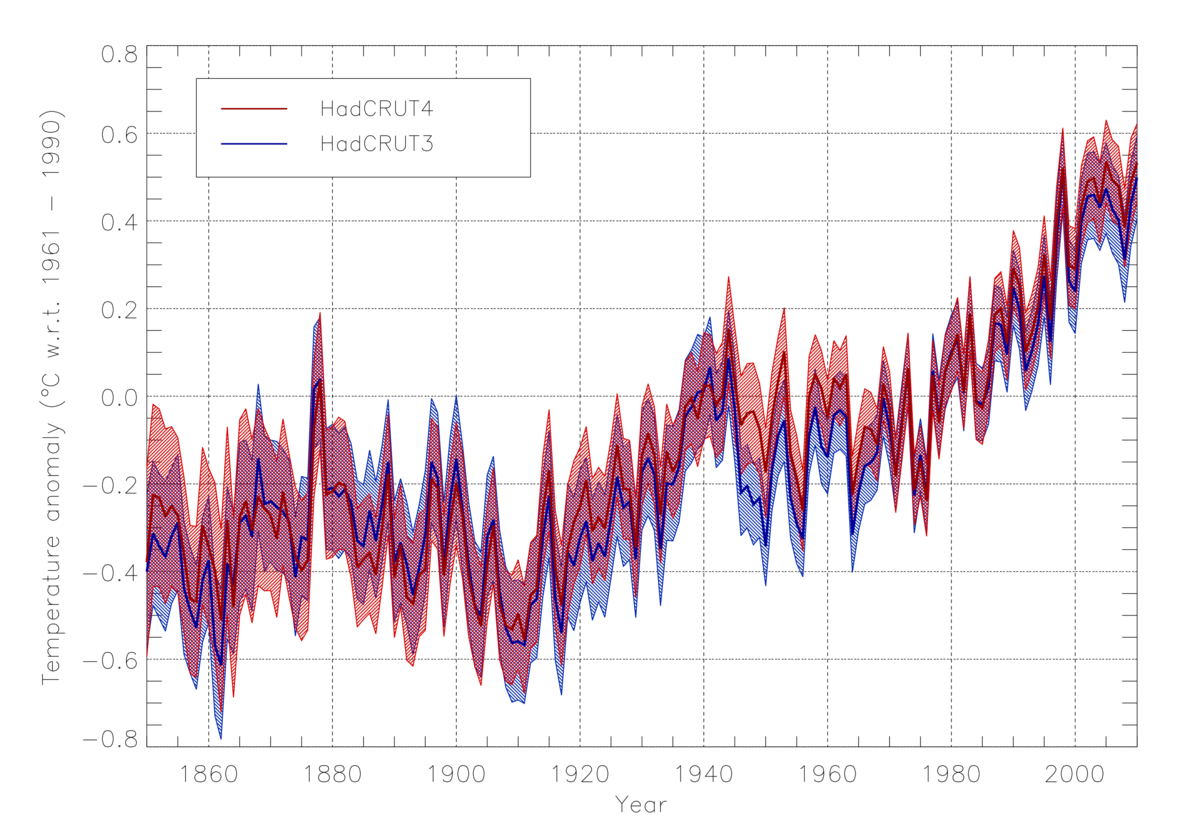
And the people cried “Let my data go !” And lo, it came to pass, that the time came for the UK’s Met Office’s Hadley Centre’s new HadCRUT4 near surface temperature analysis data set to be born online.

And across the land, the people wielded Excel spreadsheets and the like in the quest for visual engagement with the hot new numbers.

And it was seen that the year 2010 was hotter than 1998, and a number of other years in between were similarly warmer than 1998, and many climate change sceptics who had been so withering in their blanket denial of global warming quaked in their doubtful boots.

Interestingly, trends could be seen in the global averages, and so a linear trendline was plotted :-

Categories
Academic Freedom Big Picture Global Heating Global Warming Growth Paradigm Hide the Incline Science Rules Sea Level Risk The Data The War on Error

What’s Up ? Answer : Everything #3

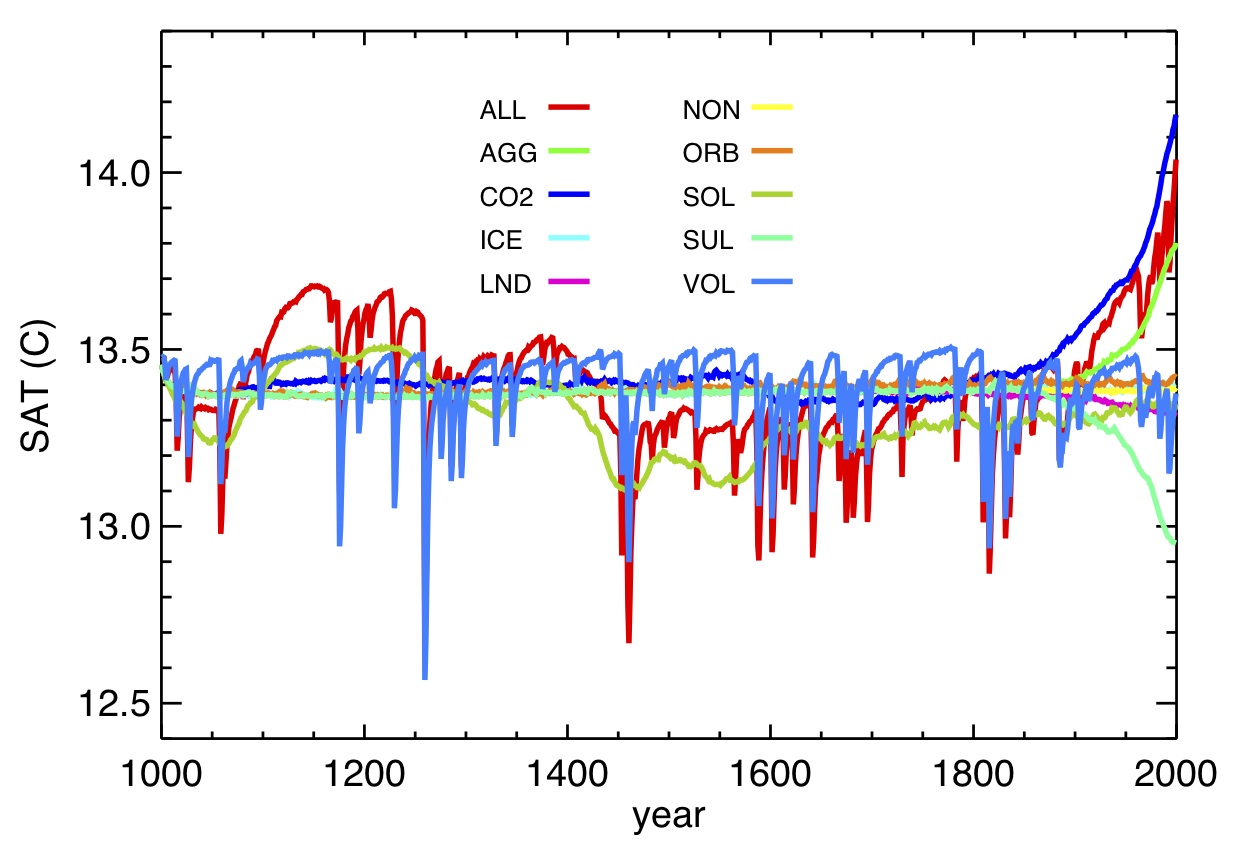
Having found data that supports the argument that there is an acceleration in sea level rise, ocean heat uptake and atmospheric greenhouse gas concentrations, I have now turned my attention to global warming – the warming of the close-to-ground (“near surface”) air and upper ocean water temperatures.
I’m still waiting to see the data for the new HadCRUT4 adjustments, so in the meantime, I have taken a look at the work of NASA GISS, and the international team who have agreed historical global warming influences – known as “radiative forcings”. Here’s the overall picture :-

Categories
Academic Freedom Big Number Direction of Travel Disturbing Trends Emissions Impossible Global Heating Global Warming Growth Paradigm Hide the Incline Major Shift Paradigm Shapeshifter Realistic Models Science Rules Sea Level Risk The Data The War on Error

What’s Up ? Answer : Everything #2

Image Credit : Santer et al. (2011)

The El Nino Southern Oscillation is a flip-flop pattern, throwing wind and ocean currents periodically into reverse along the line of the Equator in the Pacific Ocean.

When it’s in the La Nina configuration, cold water from the ocean depths is cycled up to the surface, causing a massive plume of cooler-than-average temperatures. When the winds start looping in the other direction, a spear of warmer-than-average water spreads out across the ocean.

To even the most casual observer of global ocean and land temperatures, this see-saw is clearly a major influence on the data measurements – temperatures go up and down in a very regular fashion at decadal scale.

The size of the temperature swing has caused many to doubt or ignore the underlying global warming signal – but the instrumental record of temperatures is now long enough to reveal that despite the ENSO swings, temperatures as a whole are creeping upward.

Categories
Academic Freedom Bad Science Bait & Switch Delay and Deny Global Warming Hide the Incline Non-Science Pet Peeves Scientific Fallacy The Data The War on Error Unqualified Opinion Unutterably Useless Utter Futility

Bishop Hill : Wrong Conclusions


Today, another lesson in why I refuse to take climate change “sceptic” web logs seriously.

Willis Eschenbach has written a post for Anthony Watts on the “Watts Up With That” weblog, which has been dutifully echoed over at Andrew Montford’s “Bishop Hill” weblog.

The self-styled climate change “sceptics” are claiming that extra carbon dioxide in the atmosphere over the last five millenia has precipitated a decline in global temperatures.

Yet again, they don’t appear to have seen the broad picture.

Categories
Academic Freedom Be Prepared Big Number Big Picture Climate Change Direction of Travel Disturbing Trends Global Heating Global Warming Growth Paradigm Hide the Incline Science Rules Screaming Panic Sea Level Risk The Data

What’s Up ? Answer : Everything

Image Credit : CSIRO State of the Climate 2012

I get up in the morning and everything looks fine. The Earth is still spinning on its axis, still wobbling around it’s axis, and still encircling, or rather enellipsoiding, the Sun. Birds tweet, the grass rises, and there’s the usual random selection of weather.

But, almost invisible, there’s a climate emergency, an ongoing and grinding crisis happening right here, right now, demanding my attention.

Despite what some would have me believe, climate change is not a low-level, marginal effect. Although it seems at the moment that we have plenty of time to adapt to changing circumstances, the problems are mounting up.

You see, climate change is not happening in a steady, measured manner. There are some climate indicators that are not only rising, but accelerating. The pace of change is racing ahead. Climate change is already having a significant effect, and as change speeds up, these effects will become dangerous.

Some people are not aware of these dangers in the Earth’s climate system, but it doesn’t make them any less real or any less serious. It’s time that people in general had better access to the facts.

Categories
Academic Freedom Bad Science Bait & Switch Climate Change Delay and Deny Divide & Rule Fair Balance Freak Science Global Warming Hide the Incline Mass Propaganda Non-Science Nudge & Budge Paradigm Shapeshifter Policy Warfare Protest & Survive Public Relations Science Rules Scientific Fallacy Social Change Sustainable Deferment The Data The War on Error Unqualified Opinion Unutterably Useless Utter Futility Zero Net

GWPF & The Hockey Stick Curve

Image Credit : Global Warming Policy Foundation

This article was written by M. A. Rodger and was originally posted at DeSmogBlog and is syndicated by an informal agreement and with the express permission of both the author and DeSmogBlog, without payment or charge.
The previous post in this series examined the Global Warming Policy Foundation (GWPF) Briefing Paper No3 “The Truth About Greenhouse Gases“. Despite its title, Briefing Paper No3 said very little about such gases. Yet one subject (not directly to do with greenhouse gases) was discussed at some length within the paper. As it is also discussed in other GWPF papers, the subject will be examined in this fourth post of the series.

AN IMPOSSIBLE HOCKEY STICK AVERSION

In Briefing Paper No3, perhaps the strongest accusation made by the author Professor William Happer concerns the IPCC who allegedly “rewrote the climate history” by deleting the Medieval Warm Period and Little Ice Age (MWP & LIA) from the climate record.

Happer tells us that both MWP & LIA were “clearly shown in the 1990first IPCC report. Then eleven years later, according to Happer, they were both simply expunged from the climate record for no valid reason.

Indeed, within the 2001 third IPCC report, the MWP & LIA are entirely absent from the graph that according to Happer is “not supported by observational data”. This is the dreaded “Hockey Stick” curve.

Can the IPCC really be responsible for such skullduggery ?

Categories
Academic Freedom Bad Science Be Prepared Climate Change Climate Chaos Climate Damages Conflict of Interest Delay and Deny Demoticratica Droughtbowl Extreme Weather Fair Balance Floodstorm Freak Science Global Heating Global Singeing Global Warming Hide the Incline Media Non-Science Rainstorm Realistic Models Science Rules Scientific Fallacy Sea Level Risk The Data The War on Error Unqualified Opinion

The Truth Is Relative

Image Credit : BBC

Many ordinary people, when asked about global warming and climate change, offer views they’ve read or heard somewhere, often using the word “could”, because that word appears a huge lot in public communications and media, especially television. “The world could warm by as much as four degrees by the end of the Century.” “Rain-fed agriculture in southern Europe could be gone by 2050”. “Thames Water could end up having to buy water from Scotland”. That kind of thing.
However, when asked about their own personal views, people often show reluctance to commit. And so it appears that the one thing they really believe is that truth about global warming and climate change is relative.

So, for many people, the truth is relative. And why should that be ? Maybe people don’t want to be known to have an actual opinion because they fear that if they show commitment to one view or other, they might cause an argument because other people around them think differently. After all, it’s hard to know which people are climate change “accepters”, and which people are strongly against the facts emerging from the science of atmospheric physics.

So people, when surveyed, will not state their own views on what they think is a hot button topic. They will cite public scientists, and other well-known public figures – regardless of their actual knowledge. By deferring to the opinions of others, people delegate the matter of deciding where they themselves stand. People often admit that they themselves don’t know the truth, but somebody else, surely, does.

Categories
Academic Freedom Assets not Liabilities Bait & Switch Behaviour Changeling Big Number Big Picture Big Society Carbon Commodities Carbon Pricing Carbon Taxatious Climate Change Climate Damages Coal Hell Conflict of Interest Corporate Pressure Cost Effective Deal Breakers Demoticratica Direction of Travel Divide & Rule Economic Implosion Efficiency is King Emissions Impossible Energy Change Energy Insecurity Energy Revival Engineering Marvel Fossilised Fuels Gamechanger Global Warming Green Investment Green Power Growth Paradigm Hydrocarbon Hegemony Low Carbon Life Major Shift Mass Propaganda Media National Energy National Power Nudge & Budge Oil Change Optimistic Generation Paradigm Shapeshifter Peak Coal Peak Natural Gas Peak Oil Policy Warfare Political Nightmare Price Control Protest & Survive Public Relations Regulatory Ultimatum Renewable Resource Science Rules Social Capital Social Change Social Democracy Solution City Sustainable Deferment Technofix Technological Fallacy Technological Sideshow The Data The Power of Intention The Price of Gas The Price of Oil The War on Error Ungreen Development Unqualified Opinion Unsolicited Advice & Guidance Unutterably Useless Utter Futility Vain Hope Voluntary Behaviour Change Vote Loser Zero Net

Academic Freedom #6 : Policy Levers

Image Credit : Taproot

Many scientists express that their aim in their work is to offer a good foundation for Government decision-making. Our gathering and processing of data and evidence is to be offered to the lawmakers to enable them to choose a way forward, and design a strategy to get there. This is a noble ambition – to be a useful servant of the facts (or at least a disciple of statistics with plus and minus margins of error).

However, science is not the only force at work in influencing Government decisions. For a start, Governments change through elections in democracies, and all debate about public policy passes through a narrow ideological gate – where people decide on a very small range of questions that concern them at the time. Election issues are almost always centred around tax and welfare, and elections are often called for the favourite politicians of the moment.

And then there’s the question of which organisations influence elected governments on a day-to-day basis – who has the ear of leaders and their senior staff ? The public relations budget lines of large companies and corporations can be kept trim and tidy – politicians are easy to get access to if you have a lot of capital to invest (or make out that you do).

Categories
Advancing Africa Bad Science Bait & Switch Big Picture Climate Change Climate Chaos Climate Damages Dead End Dead Zone Delay and Deny Disturbing Trends Divide & Rule Droughtbowl Emissions Impossible Environmental Howzat Extreme Weather Fair Balance Feel Gooder Forestkillers Freak Science Freshwater Stress Global Heating Global Singeing Global Warming Hide the Incline Incalculable Disaster Mass Propaganda Media Non-Science Paradigm Shapeshifter Policy Warfare Political Nightmare Public Relations Realistic Models Science Rules Scientific Fallacy Sustainable Deferment The Data The War on Error Tree Family Unqualified Opinion Water Wars

Debunking the GWPF Briefing Paper No2 – The Sahel Is Greening


Image Credit : Global Warming Policy Foundation

This article was written by M. A. Rodger and was originally posted at DeSmogBlog and is syndicated by an informal agreement and with the express permission of both the author and DeSmogBlog, without payment or charge.
This is the second in a series of posts on the educational charity and climate sceptic “think-tank” Global Warming Policy Foundation (GWPF). The first post examined GWPF”s organisation and its principles (or lack of them). Here we examine GWPF”s Briefing Paper No2 – The Sahel Is Greening by Philipp Mueller who is the Assistant Director of the GWPF. Coverage of the greening Sahel has been in the media for a decade now, so this cannot be too controversial a subject, can it?

GWPF BRIEFING PAPER No2 – SIGNIFICANCE OF THE SUBJECT
Mueller explains what this Briefing Paper No2 is about in the first three sentences.

“Global warming has both positive and negative impacts. However, very often only the negative consequences are reported and the positive ones omitted. This article will show an example of a positive effect of warming.” 

Mueller then sets out to show how the Sahel is enjoying a “positive impact” of global warming.

Yet already here is a glaring omission. Despite this being an ideal opportunity to list out all the other “positive impacts”, Mueller fails even to hint at what any of the others might be. Never mind. We still have the Sahel. Or do we?

THE GREENING OF THE SAHEL – MUELLER”S VERSION
Mueller”s account can be summarised thus:

Between the 1950s and 1980s reducing rainfalls across the Sahel (the region of Africa immediately South of the Sahara Desert) caused severe drought and famine. But, according to Mueller, since the early 1980s this process has gone into reverse with the Sahel greening, harvests more plentiful and the Sahara shrinking.

The reason for this improvement is more than simply increasing rainfall. The climate of the Sahel region is delicate. Additional rainfall results in higher levels of vegetation. This induces yet more rain while reducing soil erosion. However, there is more at work than just this one “feedback” mechanism. Mueller says the extra factor that might be responsible is “the rise of atmospheric CO2 levels.” It seems the elevated levels of atmospheric CO2 let plants grow better, especially in arid regions. Clever stuff, that!

Mueller does not leave it there. He discusses the cause of the underlying increase in rainfall citing papers that suggest the rainfall was due to a warmer climate in the Sahara or a warmer North Atlantic, a process “partially caused by greenhouse gas emissions.”

Mueller”s shrinking Sahara is not unprecedented. In the past the Sahara, far from being a desert, was once a grass-covered savannah. This was over 6,000 years ago during the Holocene Climate Optimum (when temperatures were 2-5 deg C hotter than now according to Mueller but not according to others) and also during two other times in last 120,000 years.

Mueller says the future isn”t certain. The Sahel may become wetter or it may become drier. But, he concludes, today the Sahel is undoubtedly wetter and suddenly Mueller becomes far more certain about those speculative causes of the greening of the Sahel.  “The increase in rainfall, which was probably caused by rising temperatures, and rising CO2 concentrations, might even – if sustained for a few more decades – green the Sahara. This would be a truly tremendous prospect.”

This account makes bold statements but can it all be true?

DO PIGS FLY?
Mueller”s account contains many omissions and misrepresentations. The list is so long that the full account of Mueller”s errors are appended to the bottom of this post and just a summary is presented here.

After droughts end, things grow greener. That is natural. The Sahel has a delicate climate and research shows that increased human emissions were more likely the cause of the initial drought rather than the cause of the re-greening. The recovery is also very patchy. Drought and famine, declining crops as well as encroaching deserts continue to plague parts of the Sahel, to the point that the description “greening” remains a subject for debate. Mueller”s rosy account fails to tell us any of this.

It is wild speculation to assert that any recovery in the Sahel is a result of global warming and to dangle the prospect of a future green Sahara is the exact opposite of the message provided by Mueller”s reference on the matter. However welcome the re-greening of parts of the Sahel, it cannot be relied on.

Mueller does mention this in passing but he fails to mention the confident scientific finding that any re-greening will eventually be reversed in the future. So if this greening of the Sahel is the prime example of the “positive impacts” of global warming, it is no surprise that Mueller fails to list any of the others.

CONCLUSION
GWPF Briefing paper No2 is an entirely flawed document. The views it expresses are those of the author (as the disclaimer on the cover says), not those views of the GWPF. Yet the author works with a “distinguished team of GWPF Academic Advisors.” Further, it remains a wonder that a registered charity whose task is to educate the public on global warming could ever put its name on such a report. If this is representative of GWPF Briefing Papers as a whole, it would be a cause of grave concern.

A second GWPF Briefing Paper will be the subject of the next post in this series. Hopefully it will prove to be more factual in nature than Briefing Paper No2.

APPENDIX – Details of Omissions & Misrepresentations within Mueller”s paper.

A1 – OMISSION
Mueller”s account began with mention of a drought between the 1950s & 1980s. This drought requires greater consideration than just a mention. Would we not expect a region to become greener in the period following a drought? Strangely, while Mueller discusses theories for the greening, he fails to mention the causes of the initial drought and its continuing legacy. This is not some minor event. The drought has been described as “…among the most undisputed and largest recent climate changes recognized by the climate research community.”

The causes of the drought have slowly become better understood. Rising population and over-grazing by livestock was the first theory but studies now show the drought resulted from changes in ocean surface temperatures Folland et al (1986) Giannini et al (2003)which are likely due in part to the sulphate aerosol pollution of Europe and North America Rotstayn & Lohmann (2002) Biasutti & Gainnini (2006) and thus it is the cleaning of emissions from power stations that has likely allowed the rains to return.

Mueller remains entirely silent about the potential role of sulphate aerosols in causing the drought and the subsequent greening. It is difficult to understand his silence as these findings are well known. Perhaps the potential role of human pollution in causing a “devastating drought” sits too uncomfortably with the intended message of “positive impacts” from global warming.

A2 – OMISSION
To emphasis his “positive impact”, Mueller tells us the greening is “a very welcome and very beneficial development for the people living in the Sahel.” What Mueller omits to tell us is that conditions have yet to return to the levels seen in the 1950s and that drought and famine still stalk the Sahel. His rosy reporting is even used by one sceptical commentator as proof that the continuing drought in the Sahel is but a “pseudo-catastrophe.”

Climatology may not provide the best reports of the events but the Sahel drought is reported in newspapers and the humanitarian aid networks. “In 2005, drought and famine hit the Sahel, claiming many lives. The pattern was repeated in 2010 with the crisis most acute in Niger. And now the early warning signs are there for problems again in 2012.” For Mueller to entirely miss such prominent reporting in the age of the internet is truly remarkable!

A3 – OMISSION
It is also remarkable how Mueller writes of improving agricultural outputs across the Sahel. Mueller cites the findings of Chris Reij in a small region of Burkina Faso and also Olsson (2008), from where he quotes half a sentence about improved agricultural output in Burkina Faso and Mali.

What Mueller totally misses in Olsson”s paper is the preceding sentence and the following half sentence which says – “After many years of dwindling food production in the Sahel, only two countries show signs of improved agricultural performance. …while the other Sahelian countries show decreases in their production.” So Mueller omits to mention the situation in the other nine countries of the Sahel, instead concentrating on the two countries where the evidence doesn”t directly contradict his theorizing.

A4 – MISREPRESENTATION
To reinforce his greening Sahel message Mueller strays geographically. He embellishes part of a Heartland Institute report that quotes a second-hand report from geologist Stephan Kropelin.

This concerns greening within the deserts of Western Sahara, a much-troubled country that is in Africa but definitely not part of the Sahel! It is from the same Heartland report that Mueller times the start of the greening as “since the early 1980s” when if he had read the other more reliable references he cited he would have known the greening began in 1994.

The entirety of the Sahel is not greening as Mueller would have us believe. It is patchy and there remains enough areas still suffering encroaching desert to make the term "greening" debatable. Somehow Mueller fails to notice.

A5 – MISREPRESENTATION
Mueller does manage to notice that there are signs of greening even in some areas where rainfall is still decreasing. Mueller asserts this might well be due to increased levels of atmospheric CO2. To support his CO2 claim Muller cites Sherwood Idso who has long espoused such theories and claims certain forest studies show evidence of it

But when it comes to the greening of the Sahel, Idso makes clear the CO2 link is only speculation and makes do with pointing out where researchers fail to mention his brave theorising.
There is one logical problem with Mueller”s claim which may be why Idso does not pursue a similar argument. It is difficult to reconcile patchy Sahel greening with a widespread (indeed worldwide) phenomenon like rising CO2 levels. The most likely reason for patchy greening (other than patchy rainfall) is very, very, widely discussed and observed on the ground. It is farmers changing their methods of cultivation, something Mueller fails to even mention, preferring instead to advance his ridiculous CO2 claim

A6 – MISREPRESENTATION
The prehistoric green Sahara of the mid-Holocene with its lakes and rivers is used by Mueller to reinforce his argument that global warming may trigger a return to such conditions and so provide a truly tremendous “positive impact” from global warming. Again he manages to misrepresent the words of others. On this matter Mueller concludes “(Professor Martin) Claussen has considered the likelihood of a greening of the Sahara due to global warming and concluded that an expansion of vegetation into today”s Sahara is possible as a consequence of CO2 emissions.”

This is an exceedingly bizarre interpretation of the source document! Claussen”s quote actually says “some expansion of vegetation into today”s Sahara is theoretically possible”,(end quote, emphasis added) words too pessimistic for Mueller so he changed them.

Not only does Mueller misquote Claussen, he wholly ignores the explicit warning that Claussen makes against any belief in a future green Sahara. “But he(Claussen) warns against believing the mid-Holocene climate optimum will be recreated.” This source document continues by pointing to the continuing tree-loss in the Sahel and the shrinkage of Lake Chad; this despite the improved levels of rainfall.

Indeed, Claussen is not alone in dismissing a green Sahara.  Yet Mueller”s report concludes that a green Sahara is a distinct possibility, the exact opposite of the very authority that he claims is supporting his conclusions.

A7 – OMISSION
Finally, Mueller is silent about one “negative impact” of a greening Sahel. He intimates that any greening due to global warming will be permanent but this is incorrect. Climatology shows that the Sahel has a very sensitive climate such that it can be stated “with confidence” that “any greening of the Sahel and Sahara in the near future will eventually be reversed.”  The greening is unreliable. It is thus hardly an encouraging example of a “positive impact” from global warming.


Categories
Climate Change Global Warming The Data The War on Error

Tee-Shirt Thursday

So, as I’m sitting on the train, a man called Mick from my local London village gets on.

We’ve both been out, enjoying “Tee-Shirt Thursday”, a day of warming, bright sunshine and Spring-like temperatures – in the middle of Winter.

“This is highly unusual”, I say, “it is unseasonably warm.” Mick agrees.I say, “You know what this means, don’t you ? I mean, globally, January was the 19th warmest January since records began, and February is going to turn out to be a warm one too.”

“What about Eastern Europe ?”, he asked, “They’ve had incredibly cold and snowy weather.” “I know. You get these cold snaps”, I agreed, “Hundreds of people have died. But this is what you should expect with climate change, all the normal weather patterns have been disturbed.”

“It’s not a snap”, Mick said, “it’s been going on for weeks.” “Yes”, I said, “these areas of high and low temperatures have been locking into place. It’s all because of global warming.”

“But there hasn’t been any global warming for fifteen years”, said Mick. “Which newspaper do you read ?” I asked him, taken aback. “I don’t read any newspapers”, he clarified, “I read it in the library, somewhere.”

Categories
Assets not Liabilities Bad Science Bait & Switch Big Number Climate Change Conflict of Interest Corporate Pressure Cost Effective Delay and Deny Divide & Rule Dreamworld Economics Efficiency is King Energy Change Energy Denial Energy Insecurity Energy Revival Engineering Marvel Financiers of the Apocalypse Freak Science Green Investment Green Power Growth Paradigm Hydrocarbon Hegemony Libertarian Liberalism Major Shift Mass Propaganda Media Money Sings National Energy National Power Non-Science Optimistic Generation Paradigm Shapeshifter Peak Energy Policy Warfare Political Nightmare Price Control Public Relations Science Rules Scientific Fallacy Solution City Sustainable Deferment Technological Fallacy The Data The War on Error Unqualified Opinion Wind of Fortune

Wind Powers #1 : Civitas Fictitious ?

[ An extract from the online Christian Ecology Link discussion forum : 11th January 2012 ]

The Civitas report on wind farms.

A couple of days ago, Civitas published a report entitled, “Electricity costs: the folly of wind-power” : https://www.civitas.org.uk/press/prleaelectricityprices.htm [ Download report PDF ]

This report was produced by the Civitas economist, Ruth Lea. The report attracted a fair bit of publicity and even more antagonism from those within the renewables industry. Sadly, as usual the media have done rather less research than they should have; in particular they failed to check the background of the authorities quoted, though the Guardian did point to Lea’s views on climate change.

The following YouTube link leads to Ruth Lea denying the significance of anthropogenic climate change and the ‘flaws’ in Britain’s expensive climate change legislation. She uses all the same sad old errors and, in so doing, limits her credibility as an effective researcher : https://www.youtube.com/watch?v=UvmgUYGgqwU https://www.youtube.com/watch?v=qcFfxUIRbyo

Her comments seem to be straight out of the Chicago School mythology that economics overrides nature – the view of many scientifically illiterates.

But it gets better, she quotes, as an authority, Dr Kees le Pair, but fails to mention that he is a member of the ‘Committee of Recommendation’ of the Fusion Energy Foundation. The development of nuclear fusion, if it happens, will require very significant investment, investment that could, perhaps, otherwise be made in wind farms and other renewables so there is an important conflict of interest that has been wholly ignored : https://www.fusionenergyfoundation.org/about-us

This matters to all of us because it shows the dangerous level of uncritical evaluation that is made of so called scientific reports and information sources. I still remember the days past when research involved trips to libraries and hours of reading and, unless, the library had an academic connection, new information would not have been easily available.

Perhaps it was the more difficult nature of research that made the media, and much of its audience, that much more careful. The advent of the Internet has provided for rapid transmission of information, straight to your computer or even your smartphone, but apparently at the cost of critical evaluation. So much information is available that even report writers seem to fail to check the background of their sources or the veracity of the information given by that source. Yet, that same Internet provides the means of checking and it’s far less tedious than back in the days of library visits.

Careful use of a search engine can throw up evidence of partiality and YouTube can often confirm background beliefs that have overridden scientific evidence if not common sense. It’s not just
in reports such as this one from Civitas but also within so many anti this, that and the other environmental groups that plague the Internet.

Look carefully at Occupy, for example, and dig deeply enough, you will find some truly amazing YouTube material on the way in which the City of London is a part of worldwide Zionism that is somehow linked with the Vatican and Knights Templar ! Did you know that the Bank of England is owned by the Rothschilds ? The Internet, as well as giving freer voice to information also gives voice to conspiracy theorists and to the murk of prejudice. Just as it is both wrong and dangerous to spread unfounded rumours so it is to spread disinformation, so please use your search engine, take a little time and then critically assess whether this information that you have been given is likely to be both accurate and honest.

RT

Categories
Advancing Africa Assets not Liabilities Bad Science Bait & Switch Big Number Big Picture Big Society British Sea Power Burning Money Climate Change Coal Hell Delay and Deny Design Matters Direction of Travel Divide & Rule Efficiency is King Electrificandum Energy Change Energy Denial Energy Insecurity Energy Nix Energy Revival Energy Socialism Engineering Marvel Foreign Interference Fossilised Fuels Fuel Poverty Global Warming Green Investment Green Power Growth Paradigm Health Impacts Hide the Incline Human Nurture Hydrocarbon Hegemony Major Shift Money Sings National Energy National Power National Socialism No Blood For Oil Not In My Name Nuclear Nuisance Nuclear Shambles Oil Change Optimistic Generation Paradigm Shapeshifter Peace not War Peak Coal Peak Emissions Petrolheads Policy Warfare Political Nightmare Protest & Survive Renewable Resource Resource Wards Science Rules Social Capital Social Democracy Solar Sunrise Solution City Stirring Stuff Stop War Sustainable Deferment Technofix The Data The Power of Intention The War on Error Toxic Hazard Wasted Resource Western Hedge Wind of Fortune

Open Letter to Renewable Energy Deniers

To all Renewable Energy Deniers,

Things are getting so much better with renewable energy engineering and deployment – why do you continue to think it’s useless ?

We admit that, at the start, energy conversion efficiencies were low, wind turbine noise was significant, kit was expensive. Not now. Wind and solar farms have been built, data collected and research published. Design modifications have improved performance.

Modelling has helped integrate renewable energy into the grids. As renewable energy technologies have been deployed at scale, and improvements and adjustments have been made, and electricity grid networks have adapted to respond to the variable nature of the wind and the sunshine, we know, and we can show you, that renewable energy is working.

It’s not really clear what motivates you to dismiss renewable energy. Maybe it’s because you’re instinctively opposed to anything that looks like it comes from an “envionmentalist” perspective.

Maybe because renewable energy is mandated to mitigate against climate change, and you have a persistent view that climate change is a hoax. Why you mistrust the science on global warming when you accept the science on everything else is a continuing mystery to me.

But if that’s where you’re coming from when you scorn developments in renewable energy, you’re making a vital mistake. You see, renewable energy is sustainable energy. Despite any collapse in the globalised economy, or disruption to fossil fuel production, wind turbines will keep spinning, and solar panels will keep glowing.

Climate change has been hard to communicate effectively – it’s a huge volume of research, it frequently appears esoteric, or vague, or written by boffins with their heads in the clouds. Some very intelligent people are still not sure about the finer points of the effects of global warming, and so you’re keeping good company if you reserve judgement on some of the more fringe research.

But attacking renewable energy is your final stand. With evidence from the engineering, it is rapidly becoming clear that renewable energy works. The facts are proving you wrong.

And when people realise you’re wrong about renewable energy, they’ll never believe you again. They won’t listen to you when you express doubts about climate change, because you deny the facts of renewable energy.

Those poor fools who have been duped into thinking they are acting on behalf of the environment to campaign against wind farms ! Wind energy will be part of the backbone of the energy grids of the future.

We don’t want and we can’t afford the concrete bunkers of deadly radioactive kettles and their nasty waste. We don’t want and we can’t afford the slag heaps, dirty air and melting Arctic that comes from burning coal for power. We don’t want and we can’t afford to keep oil and Natural Gas producing countries sweet – or wage war against them to keep the taps open.

Instead we want tall and graceful spinners, their gentle arms waving electricity from the breeze. We want silent and dark photovoltaic cladding on every roof.

Burning things should only be done to cover for intermittency in wind and sunshine. Combustion is very inefficient, yet you support combustion when you oppose renewable energy.

We must fight waste in energy, and the rising cost of energy, and yet you don’t support the energy resources where there is no charge for fuel. Some would say that’s curmudgeonly.

When you oppose renewable energy, what is it you’re fighting for ? The old, inefficient and poisonous behemoths of coal hell ? We who support renewable, sustainable energy, we exchange clunky for sleek, toxic for clean. We provide light and comfort to all, rich and poor.

When you oppose renewable energy, you are being unbelievably gullible – you have swallowed an argument that can ruin our economy, by locking us into dependency on energy imports. You are passing up the chance to break our political obedience to other countries, all because wind turbines clutter up your panoramic view when you’re on holiday.

You can question the net energy gain from wind power, but the evidence shows you to be incorrect.

If you criticise the amount of investment and subsidy going into renewable energy, you clearly haven’t understood the net effect of incentivisation in new technology deployment.

Renewable energy has a positive Net Present Value. Wind turbines and solar panels are genuine assets, unlike the liabilities that are coal-fired power stations and nuclear reactors.

Renewable energy deployment will create meaningful, sustainable employment and is already creating wealth, not only in financial terms, but in social welfare terms too.

Renewable energy will save this country, so why do you knock it ?

Quizzically yours,

Categories
Big Number Big Picture China Syndrome Climate Change Climate Chaos Climate Damages Coal Hell Contraction & Convergence Cool Poverty Demoticratica Direction of Travel Disturbing Trends Emissions Impossible Fossilised Fuels Global Heating Global Warming Health Impacts Incalculable Disaster Meltdown Methane Madness Methane Management Nudge & Budge Paradigm Shapeshifter Peak Coal Peak Emissions Policy Warfare Political Nightmare Protest & Survive Realistic Models Science Rules Screaming Panic The Data Zero Net

Methane Concentrations : Losing Control

Every once in a while, it’s good to remind myself of the data – to help me focus once again on why I do what I do.

Yesterday evening, I decided to catch up on exactly how out of control atmospheric methane concentrations are in the region around the Arctic :-

https://www.esrl.noaa.gov

When reviewing the charts, the secondmost important thing to see is the high point measurements, the peaks, rising over time.

The most vital thing to observe, however, is the inexorable rise of the minimum measurements since around 2007 – which implies a higher overall background atmospheric methane concentration.

Much of this methane explosion can probably be blamed on global warming from excessive carbon dioxide emissions – which showed signs of coming under control between 1990 and 2000, but after that lifted off once more.

People dispute why carbon dioxide emissions have risen consistently and sharply since the turn of the millenium – but one of the answers is to be found in the rapid deployment of coal-burning for power generation. Stronger environmental controls on air quality have reduced the health impacts of coal-burning, but mean that the net effect is stronger global warming.

So much could be done to alleviate the strong warming of the Arctic, and prevent dangerous instabilities. It is time to say it – and keep on saying it – and not relent – every measure to keep the Arctic cool is urgent.

Categories
Burning Money Carbon Rationing Cost Effective Design Matters Direction of Travel Eating & Drinking Emissions Impossible Low Carbon Life Nudge & Budge The Data Virtually Vegan Voluntary Behaviour Change

Whittling away at energy consumption

Throughout 2011, I changed a number of things in my domestic arrangements in order to reduce energy consumption at home.

I have been working with an ecocell small study and action group in North London – each member of whom has an interesting story to tell of their own eco-pilgrimage.

What I found was that in order to make progress I needed to measure more things and be more organised. I also needed to acquire more equipment.

This is rather ironic, since there are embedded emissions in all manufactured products. However, with careful use and maintenance, they should last a long time.

The daily electricity and gas consumption I was personally responsible for at home dropped fairly significantly (approximate figures) :-

Natural Gas use per day (Btu)Electricity use per day (kWh)
January 20115.003.00
February 20114.212.94
March 20113.653.15
April 20111.933.11
May 20111.692.98
June 20111.602.95
July 20111.422.84
August 20111.262.82
September 20111.142.81
October 20111.042.76
November 20111.072.84
December 20111.182.83

Based on the average of the monthly daily averages, I should have consumed 766 Btu (8,094 kWh) of Natural Gas over the whole year, and 1,065 kWh of electricity for 2011. However, due to dropping demand, I actually used only 433 Btu (4,572 kWh) of Natural Gas and 1,034 kWh of electricity.

This compares to Ofgem’s analysis of medium household consumption figures of 16,500 kWh of Natural Gas and 3,300 kWh of electricity.

This puts my consumption at 28% of the medium in Natural Gas and 31% in electricity. It’s going to be hard to reduce both of these figures.

I came up with a number of personal solutions for reducing space heating in 2011, which enabled the use of Natural Gas to drop.

I had already come up with a number of changes in power consumption in 2010, which explains why the electricity use did not drop so fast or so far in 2011.

However, I’m still working on cutting my domestic power consumption.

One of those ways is trying to adopt a more vegetarian diet. You see, when you eat vegan or virtually vegan, you don’t need so much refrigeration. Frequently over the last year the only things in the fridge have been milk, spread, yoghurt and green vegetables (plus a couple of half-used jars of pesto or mayonnaise, the regulation bottle of lemon juice and a jar of Marmite). The freezer has been off for months.

So I thought to myself, after checking the power consumption of the fridge – does the house need a smaller fridge ? I mean, the large fridge is useful when there are guests or someone throws a party, but it’s not fully used all the time. I could keep the green vegetables in the coldest, unheated room of the house, and buy fresh more regularly. What if I get hold of a mini fridge to use on a day-to-day basis ? And so, into my life has come the Mobicool W35.

Technically, it’s not a refrigerator – it’s a “cooler box”. A thermolectric one. And despite the E energy rating on the packaging – at 290 kWh a year, it will have less than half the power consumption of the Big Fridge. Plus, since I don’t need to run it all the time, I can cut power use further by only having it on 18 hours a day (or less, as dictated by the weather), controlled by a timer.

The next adaptations to my energy use will entail significant expense. Here are some options :-

a. Upgrading the windows
b. Installing a biomass burner (and optionally a boiler)
c. Cladding the external walls

I will need to save up to replace the windows completely, so I am looking for intermediate solutions.

For the biomass option, I have found a tree surgeon in North East London with whom a win-win arrangement could be developed – with me offering to take unseasoned wood from the loads of sawn waste that otherwise would cost money to dispose of.

In the meantime, I need to address draughtproofing. The sudden cold spell has shown me that there are still opportunities in this regard.

Categories
Acid Ocean Alchemical British Biogas Design Matters Electrificandum Energy Change Energy Revival Engineering Marvel Faithful God Freak Science Green Power Major Shift Marvellous Wonderful Non-Science Optimistic Generation Paradigm Shapeshifter Realistic Models Renewable Gas Renewable Resource Science Rules Solar Sunrise Solution City Technofix The Data The Price of Gas The Price of Oil Toxic Hazard Unqualified Opinion Wind of Fortune

Alchemic for the people

I was less than a metre above current sea level, rooting about in the holy bookshelves of my Evangelical host, searching for a suitable title.

I pulled out “Who Made God ?” from underneath a pile of books on their sides, letting the column slump downwards, alerting my companions to the fact that I had definitively made my choice for the evening’s reading.

We were treated to gentle Christmassy music for an hour or so as we all gave up talking to read by candlelight and compact fluorescent.

I didn’t read fast, as at first I didn’t have my newly-necessary reading glasses, and when I was encouraged to fetch them, the light was too dim to make reading easy. Those fashionable uplighters.

I read into the second part, and I had already formed in my mind several disagreements with the author, Professor Edgar Andrews, despite him having taken several good lines of reasoning and made some humourous points which I had duly responded to with a slight audible giggle.

I instinctively didn’t like his pitch about the impossibility of organic chemistry and I froze a little : personally I see no need for God’s personal, literal, physical intervention to make the ladders and spirals of genes – the DNA and RNA forming from the appropriate nucleotide bases – A, T, G, C.

And then the book’s author blew away his credibility, for me, at least, by getting bogged down in the absolutes of Physics, and ignoring Chemistry. He quoted the Laws of Thermodynamics, and claimed Entropy as proof that God doesn’t play dice because he’s in the garage playing mechanic. The direction of the universe, the arrow of time, plays towards randomness, the author of the book proclaimed. Order cannot come from inorganic matter – Life is the organising force.

At this, I took several forms of dispute, and immediately found in my mind the perfect counter-example – the formation of crystals from saturated solution – the building of the stalgamite and stalagtite from the sedimentary filtering of rainwater. Another example, I think, is chiral forms of molecular compounds – some chemicals behave in different ways if formed lefthandedly or righthandedly. The different forms behave predictably and consistently and this is an ordered behaviour that I believe – without the necessary university instruction in Chemistry – is an imposed denial of chaos.

In fact, the whole of Chemistry, its world of wonder in alchemy, I think points to a kind of natural negation of the Laws of Physics. There is the Micro World, where Newton, and more introspectively, Einstein, are correct in their theoretical pragmas. But in the Macro World, there is Chemistry, and there are precursor compounds to organic essentials. Life forms itself from dead stone. For a Physicist this is “just not cricket”, it is a whole new universe.

Why can Aluminium be used for containers in microwave ovens, but steel cannot ? And why is Aluminium so light ? Why does water expand when it freezes ? Here the Physicists can help out. But they cannot, when it comes to explaining, or even accurately predicting, all the chemical properties of alloys and compounds.

I have been pondering, in a crude, uneducated way, about industrial chemistry for the last couple of months. How large volume reactions are encouraged, catalysed. How fluids work. How gases breathe. My conclusion is that most chemical engineering is a bit brutish, like the workings of the internal combustion engine. Things are a tad forced. It is probably not possible for chemical engineers to replicate photosynthesis entirely – it’s too dainty for them. But that is the kind of chemistry we need to overcome our climate and energy problems.

We may not be able to match the leaves on the trees, but we can do gas chemistry and electricity and semiconductor physics, and it is gas chemistry and electricity and semiconductor physics that will save the planet. Electricity to replace much fuel. Semiconductor physics to bypass photosynthesis. And Renewable Gas chemistry – engineering the chemical building blocks of the future and providing backup to the other green energies.

Categories
Advertise Freely Bad Science Bait & Switch Big Picture Big Society Climate Change Climate Chaos Conflict of Interest Corporate Pressure Dead End Delay and Deny Demoticratica Direction of Travel Disturbing Trends Divide & Rule Drive Train Emissions Impossible Energy Disenfranchisement Energy Insecurity Energy Nix Energy Revival Engineering Marvel Evil Opposition Fair Balance Freemarketeering Global Warming Hide the Incline Human Nurture Incalculable Disaster Landslide Major Shift Mass Propaganda Media Money Sings Mudslide No Pressure Non-Science Nudge & Budge Paradigm Shapeshifter Public Relations Realistic Models Science Rules Scientific Fallacy Social Capital Social Change Social Chaos Social Democracy Solution City Sustainable Deferment Technofix Technological Fallacy Technological Sideshow The Data The Myth of Innovation The Power of Intention The War on Error

Clicking with Climate

Image Credit : University of California at Berkeley

Human beings have two brains. The first is a self-centred workhorse of pragmatic decision-making, interested in social engagement in order to further individual interests – whether those interests are purely for personal enrichment or for the reward of the social group more widely.

The second human brain is a relativistic engine, constantly comparing, reflecting, analysing. We are concerned about other peoples’ emotional response, wondering what other people think about us, responding to peer group pressure.

Are we more successful, popular than others ? Do people listen to us more than others ? We know we’re right, but do they ? We need to pitch ourselves in the right way. We jostle for pole position, for a place on the platform, hoping not to make too many opponents, whilst making more converts to our point of view.

Personally, I don’t listen to my second brain very often. As a social animal, I hope I’m tolerant, and my priorities in interpersonal engagement are mutual empowerment, transparent collaboration and inclusion. In my public projection, I’m not trying to vaunt myself over others, or massage my image for approval, or put up a fake facade. You get me, you get direct.

But I can’t avoid the second human brain entirely – as it is the reason for a lot of fuzziness in our view of the world around us. It’s too easy to stir doubt, falsehoods and bad ideas into the collective cake mix of society, where it fizzes into a bubbling mess. In matters of climate change science and energy engineering, there are no grey areas for me. But for a number of people I know, these are subjects of much confusion, denial and disinformation.

People hold on to the totem of what other people think. And so you have even very intelligent social commentators reciting from paid-for public relations by companies and business pressure groups. Journalists often do not appear to understand the difference between pseudo-science and real live science. There are too many people selling unrealistic, unworkable technological “solutions”, particularly in energy, so it’s hard to know what to accept and what to dismiss.

Yet it is critical to know what rock, what branch to keep a hold of in the flood of information that could sweep us away. The social construction of climate change is an important edifice, a safe house in an information world at war with itself. What high wind can sweep away the grubby pages of non-science from the Daily Mail ? What rising sea can cleanse the Daily Telegraph of its climate change denial columnists ? What can stop the so-called Global Warming Policy Foundation from infecting the Internet with their contrarian position ? What can make us accept the reality and urgency of global warming ? How can we learn to click with climate change ?

Three significant academic thinkers on the social significance of climate change are launching new works at the British Library in London, on 16th January 2012. The British Sociological Association have invited Mike Hulme, John Urry and Gordon Walker to discuss chapters from their recent books which address the question – where next for society and climate change ?

In the words of Chris Shaw at the University of Sussex, “they pull no punches in their analyses, and their approach is based on years of research into the social dimensions of the climate change debate. This is an essential opportunity for all those interested in bringing climate change into the democratic sphere, to help understand the issues involved in such a transition. It is also a chance to discuss the ideas with the authors and other delegates.”

For more information, see here and here.

Categories
Big Society Climate Change Climate Chaos Climate Damages Demoticratica Disturbing Trends Divide & Rule Economic Implosion Financiers of the Apocalypse Global Warming Hide the Incline Human Nurture Media Optimistic Generation Political Nightmare Realistic Models Social Capital Social Change Social Chaos The Data The War on Error

Daily Mail : Editorial Schizophrenia

I was in my local cafe diner, screening for neighbourhood gossip and genning up on the Daily Mail’s latest scandal and outrage. Several stories were told from different angles throughout the grubby pages of the well-thumbed copy I was sifting through. “You know”, I mused, “I think they might actually want their readers to become schizophrenic.”

On the front page the headline “RESTORE ELITISM TO OUR SCHOOLS“. The editorial line seemed to be aimed at persuading the readers to find Michael Gove’s speech just as “extraordinary” as the writer did – “extraordinary” as in “bad”. This, after all, is a newspaper that often seems to want to portray itself as succour for the common man.

On page 7, however, the same story took on a nanny-ish tone “We must demand more of our teachers… and our children : And here’s why it matters: for the first time 1m [million] youngsters are not in work or education.” So, presumably, the writer of this piece was having a dig at teachers and their performance. Plus it was also having a swipe at out-of-work out-of-the-classroom “scrounger” teenagers.

Where, I asked myself, was the analysis of why so many young people were without a role in life, without prospects ? Where are the jobs, work placements and apprenticeships for “youngsters” ? The statistics show that there are not enough openings for every NEET.

Categories
Bait & Switch Big Picture Big Society Burning Money Carbon Commodities Carbon Pricing Carbon Taxatious Cool Poverty Corporate Pressure Cost Effective Demoticratica Direction of Travel Divide & Rule Efficiency is King Emissions Impossible Energy Change Energy Disenfranchisement Fair Balance Fuel Poverty Green Investment Green Power Hydrocarbon Hegemony Low Carbon Life Major Shift Mass Propaganda Media Money Sings National Energy National Power Nudge & Budge Optimistic Generation Policy Warfare Political Nightmare Price Control Regulatory Ultimatum Solar Sunrise The Data The War on Error Vote Loser Wind of Fortune

Dances With Energy Bills

After the recent notorious Panorama programme on energy prices, and yesterday evening’s debate on renewable energy and the costs of green energy policy, in the House of Commons, a number of people have commented that Members of Parliament and Ministers of the UK Government appear to know very few facts – and those they can remember they seem to quote in the wrong context.

This state of affairs is disgraceful, and allows mendacious narratives to persist in the mainstream media.

RenewableUK contacted me and asked me to embed a YouTube offering some corrective information. I was very pleased to do so. I can assure my readers that I have not and will not be paid for doing so.

The key problem is not the cost to energy bill payers from direct subsidies such as the solar photovoltaic feed in tariff. The contribution from this is minor. The largest effect on energy bills is likely to come from two sources – the Energy Company Obligation and the plans for Carbon Pricing and other measures in the Electricity Market Reform.

Categories
Bad Science Bait & Switch Conflict of Interest Cost Effective Dead End Delay and Deny Demoticratica Direction of Travel Disturbing Trends Divide & Rule Fair Balance Freak Science Global Heating Global Singeing Global Warming Human Nurture Libertarian Liberalism Mass Propaganda Media Money Sings Non-Science Nudge & Budge Policy Warfare Political Nightmare Public Relations Pure Hollywood Science Rules Scientific Fallacy Social Capital Social Change Social Chaos Sustainable Deferment The Data The War on Error Unqualified Opinion

Everyone’s Entitled to their Opinion

Yes, indeed they are. Everyone is entitled to hold their own particular opinion. In this democracy of ideas, every longshot, wingnut, bonehead, rogue, charlatan, conspiracy theorist, crank, crony and astroturfer should be permitted access to the microphone on the stage. If we hold a public meeting about immigration, we should, of course, invite a white supremicist, a member of the British National Party, and a Daily Mail journalist to offer us their wise words. If we hold a sociological symposium on the Second World War, we should of course invite a Holocaust-denier. If an engineering conference, a cold fusion-in-a-test-tube enthusiast. Of course we should provide balance, as much balance as possible, and offer wisdom, insight and rant from all ends of all spectra. It’s only reasonable.

It therefore goes without question that somebody from the Global Warming Policy Foundation “think tank”, so copiously and generously sponsored by a person or persons unknown, should be invited to speak on the platform, or in a panel, at a well-funded quasi-establishment meeting on Climate Change. Regardless of a complete lack of training in atmospheric physics, or even knowledge of the span of the last five years in the science of global warming, naturally, a GWPF man must be invited by GovToday to a presitigious conference to be held on 29th November 2011 in the City of London grandly entitled “2011 Carbon Reduction : The Transition to a Low Carbon Economy”.

Categories
Advancing Africa Bad Science Bait & Switch Be Prepared Behaviour Changeling Big Picture Burning Money Carbon Army Carbon Capture Carbon Commodities Carbon Taxatious Climate Change Conflict of Interest Corporate Pressure Cost Effective Delay and Deny Demoticratica Direction of Travel Droughtbowl Eating & Drinking Economic Implosion Efficiency is King Emissions Impossible Energy Change Energy Insecurity Evil Opposition Faithful God Feed the World Financiers of the Apocalypse Food Insecurity Foreign Interference Foreign Investment Fossilised Fuels Freak Science Freemarketeering Geogingerneering Global Warming Green Investment Human Nurture Hydrocarbon Hegemony Low Carbon Life Major Shift Mass Propaganda Media Military Invention Money Sings Neverending Disaster No Blood For Oil Non-Science Not In My Name Nudge & Budge Oil Change Peace not War Peak Emissions Peak Energy Peak Oil Petrolheads Policy Warfare Political Nightmare Public Relations Realistic Models Regulatory Ultimatum Science Rules Scientific Fallacy Social Capital Social Change Solution City Stop War Sustainable Deferment Technofix Technological Fallacy Technological Sideshow Technomess The Data The Myth of Innovation The War on Error Unqualified Opinion Unsolicited Advice & Guidance Unutterably Useless Utter Futility Vain Hope Voluntary Behaviour Change Wasted Resource

The Problem of Powerlessness #2

On Wednesday, I received a telephone call from an Information Technology recruitment consultancy. They wanted to know if I would be prepared to provide computer systems programming services for NATO.

Detecting that I was speaking with a native French-speaker, I slipped into my rather unpracticed second language to explain that I could not countenance working with the militaries, because I disagree with their strategy of repeated aggression.

I explained I was critical of the possibility that the air strikes in Libya were being conducted in order to establish an occupation of North Africa by Western forces, to protect oil and gas interests in the region. The recruitment agent agreed with me that the Americans were the driving force behind NATO, and that they were being too warlike.

Whoops, there goes another great opportunity to make a huge pile of cash, contracting for warmongers ! Sometimes you just have to kiss a career goodbye. IT consultancy has many ethical pitfalls. Time to reinvent myself.

I’ve been “back to school” for the second university degree, and now I’m supposed to submit myself to the “third degree” – go out and get me a job. The paucity of available positions due to the poor economic climate notwithstanding, the possibility of ending up in an unsuitable role fills me with dread. One of these days I might try to write about my experiences of having to endure several kinds of abuse whilst engaged in paid employment : suffice it to say, workplace inhumanity can be unbearable, some people don’t know what ethical behaviour means, and Human Resources departments always take sides, especially with vindictive, manipulative, micro-managers. I know what it’s like to be powerless.

Categories
Be Prepared Big Picture Burning Money Cool Poverty Demoticratica Energy Change Energy Insecurity Energy Revival Fossilised Fuels Freemarketeering Fuel Poverty Growth Paradigm Hydrocarbon Hegemony Low Carbon Life Major Shift Money Sings Optimistic Generation Solution City The Data The Power of Intention

Energy Poll #2 : Prices

Question 1    Do you follow stories in the media about energy prices ?


Question 2    Do you think that we may have to get used to higher energy prices ?


Question 3    Would you be happy to pay more for energy ?


Question 4    Will you make plans to change the way you use energy in response to any price changes ?


Question 5    Do you think that energy can be kept affordable ?


Background Information : please give a few brief details about what kind of person you are, to help us check that a representative sample of people have answered the survey.

What region are you living in ?
How old are you ?
What gender are you ?
How do you prefer to keep up to date with science ?

Is Climate Change really happening ?
Is Peak Oil really happening ?
Do you know a lot about energy  ?
Enter your e-mail address if you want the final results