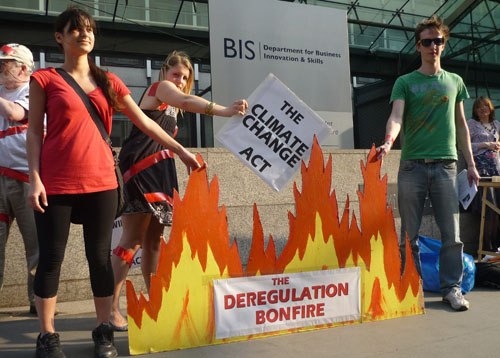
After the recent notorious Panorama programme on energy prices, and yesterday evening’s debate on renewable energy and the costs of green energy policy, in the House of Commons, a number of people have commented that Members of Parliament and Ministers of the UK Government appear to know very few facts – and those they can remember they seem to quote in the wrong context.
This state of affairs is disgraceful, and allows mendacious narratives to persist in the mainstream media.
RenewableUK contacted me and asked me to embed a YouTube offering some corrective information. I was very pleased to do so. I can assure my readers that I have not and will not be paid for doing so.
The key problem is not the cost to energy bill payers from direct subsidies such as the solar photovoltaic feed in tariff. The contribution from this is minor. The largest effect on energy bills is likely to come from two sources – the Energy Company Obligation and the plans for Carbon Pricing and other measures in the Electricity Market Reform.
Poor dear Greg Barker MP. As he attempted to answer questions in the House of Commons today on his disastrous decision to cut the solar photovoltaic feed in tariff, his face became progressively redder. His temper clearly became frayed as he got quite cross, and asked female Labour Members of Parliament to calm down, and even asserted that one question from a female opposition MP was “hysterical”, which I think was borderline sexist.
For some reason, nobody asked the Department of Energy and Climate the basic question – why don’t you increase the Feed in Tariff budget, instead of trying to whittle down the pence paid per kilowatt hour produced ? The Feed-in-Tariff scheme is working really well at the moment. It’s preventing the country having to subsidise the construction of several new power stations, and it has been providing, until now that is, new jobs and economic productivity.
On Wednesday, I received a telephone call from an Information Technology recruitment consultancy. They wanted to know if I would be prepared to provide computer systems programming services for NATO.
Detecting that I was speaking with a native French-speaker, I slipped into my rather unpracticed second language to explain that I could not countenance working with the militaries, because I disagree with their strategy of repeated aggression.
I explained I was critical of the possibility that the air strikes in Libya were being conducted in order to establish an occupation of North Africa by Western forces, to protect oil and gas interests in the region. The recruitment agent agreed with me that the Americans were the driving force behind NATO, and that they were being too warlike.
Whoops, there goes another great opportunity to make a huge pile of cash, contracting for warmongers ! Sometimes you just have to kiss a career goodbye. IT consultancy has many ethical pitfalls. Time to reinvent myself.
I’ve been “back to school” for the second university degree, and now I’m supposed to submit myself to the “third degree” – go out and get me a job. The paucity of available positions due to the poor economic climate notwithstanding, the possibility of ending up in an unsuitable role fills me with dread. One of these days I might try to write about my experiences of having to endure several kinds of abuse whilst engaged in paid employment : suffice it to say, workplace inhumanity can be unbearable, some people don’t know what ethical behaviour means, and Human Resources departments always take sides, especially with vindictive, manipulative, micro-managers. I know what it’s like to be powerless.
Once again, the BBC has allowed to pass unchallenged the impression that green power policy and renewable energy investment are behind the dramatic rise in British domestic energy prices.
Disappointingly, this has come from John Craven, whose accuracy is renowned.
However, on this occasion, he has allowed a blooper meme to consolidate in the public mind.
[ Countryfile, BBC One, 16 October 2011, 18:25. Part way through recording, starting at approximately 20 minutes 32 seconds. ]
[ Ellie Harrison ] Earlier in the programme we were looking at the expected huge rise in wind power across the UK. But in the race to create more of our energy this way, who will win and who is set to lose out ? Here’s John again.
[ John Craven ] Earlier, I discovered how the plan to put wind power at the heart of our future energy supply is creating a building boom in wind farms, both on land and out at sea. With billions being poured into wind power, and with it being at the centre of the Government’s strategy on renewables, the future seems certain. So who will the losers and winners be in this wind revolution ? The most obvious winner is the environment as less fossil fuels are burnt. But who else benefits ? Well, another clear winner is big business. Companies building the wind farms get a generous price for the electricity they produce. […]
The New Scientist magazine must be hard up. They’ve already bowed to economic pressure and taken the “king’s shilling” from the oil and gas industry by running Statoil advertisements, at least one made to look like a normal New Scientist article, giving Natural Gas a makeover as desirable as washing powder – all clean and reliable and loved by obsessives everywhere. Now they appear to have lost their power for critical reasoning and sunk to being suckers as billboards for BP spin, taking a front cover foldout for biofuels, with what I think is a completely deceitful portrayal of BP’s business.
Recently, pro-nuclear, anti-wind powerclimate change-sceptic and early publisher of Resurgence magazine, Hugh Sharman, announced to the Claverton Energy Research Group forum that he had been published in European Energy Review. “The clock is ticking”, reads the headline, “Energy policy has become a hotly debated topic in the UK. No country in Europe has more ambitious climate change goals. But the UK has taken few concrete steps yet. It is estimated that £200 billion is required until 2020 to start the UK on the its energy transformation. […] Energy Secretary Chris Huhne is expected to come out with a White Paper setting out the framework that should persuade utilities and investors to sign on to the government’s vision. Will it work? Energy consultant Hugh Sharman has grave doubts. With some like-minded specialists, he has started a website bringing together people who are alarmed at the UK’s energy situation. He […] sketches a sombre perspective…”
While everybody’s busy discussing ethics in the media, today’s been a great day to bury bad news – the shelving of the Energy Bill – and with it the Green Deal, the only hope Britain had left of economic recovery in the short-term.
And what of the Electricity Market Reform white paper and the National Policy Statements on energy ? Into the round wastepaper-bin-shaped recycling receptacle, possibly.
What next ? The revocation of the Climate Change Act and the dissolution of the Committee on Climate Change ?
I don’t know whether I should make overt political statements, but I think this news sugar ices the brioche, so I will : David Cameron’s “greenest government ever” has failed.
It is a newer, clearer tone that George Monbiot uses in his piece “The nuclear industry stinks. But that is not a reason to ditch nuclear power“. He seems to have lost his dirty annoyance with filthy anti-nuclear activists and moved onto a higher plane of moral certitude, where the air is cleaner and more refined.
He is pro-technology, but anti-industry. For him, the privately owned enterprises of atomic energy are the central problem that has led to accidents both of a radioactive and an accountancy nature. “Corporate power ?”, he asks, “No thanks.” The trouble is, you can’t really separate the failings of nuclear power from the failings of human power. It’s such a large, complex and dangerous enterprise that inevitably, human power systems compromise the use of the technology, regardless of whether they are publicly or privately owned. For a small amount of evidence, just look at the history of publicly-managed nuclear power in the United Kingdom. Not exactly peachy. And as for those who claimed that a “free” market approach to managing nuclear power would improve matters – how wrong they were. In my view, on the basis of the evidence so far, nobody can claim that nuclear power can be run as an efficient, safe, profit-making venture.
James Delingpole hardly ever sets his delicate foot in Wales, the country he archaically refers to as “the Principality”, apart from, ooh, about ten days a year when he holidays there, but nonetheless, feels he has some kind of inherited ex-colonial right to be affronted that large electricity generation and transmission infrastructure are going to be built there :-
He gets top marks for being rather offensive himself – achingly rude, in fact, about the Welsh Assembly, besides his getting untethered about the wind farms and pylons for the transmission cables :-
“…The wind farms are bad enough on their own. But to make matters far worse […], in order for these bird-crunching, bat-chomping, view-blighting, rent-seeking monstrosities to be connected to the grid a huge 400kv power line is going to be constructed all the way from Montgomeryshire through some of Britain’s most spectacular scenery to the equally beauteous Shropshire…”
I receive another letter from Iain Duncan Smith MP on vellum yellow with sickly pale green type. “Dear Mrs [sic] Abbess”, the letter reads, “Further to our previous correspondence regarding Stop Climate Chaos Big [sic] campaign, please find enclosed a reply from Chris Huhne, the Energy Secretary.” I asked Iain Duncan Smith in person for his own and personal support for a strong Energy Bill. What did he do ? Pass my letter on to the Department of Energy and Climate Change (DECC). I would have prefered a personal commitment to the issue, but, sadly, it was not to be.
The Rt Hon continued, “I hope you find his letter reassuring…” Reassuring ? What ? Am I some kind of emotionally incontinent complainant ? “…and helpful. However, please don’t hesitate to contact me again if I can be of further assistance.”
Although variability in Renewable Electricity generation is a real issue, it’s not a huge one, according to recent reports, that from the International Energy Agency (IEA) “Harnessing Variable Renewables” among them :-
Even so, there is a need to improve cheap methods of energy storage – and one of the simplest ways to increase capacity in this area is to produce Renewable Gas – which can be stored as easily as Natural Gas.
This chart shows why George Monbiot, Mark Lynas and Stephen Tinsdale have all plumped for the wrong choice – new Nuclear Power cannot deliver more electricity or reduce carbon dioxide emissions for us at the time when we need it most – the next few years :-
0. Massive energy conservation drives – for demand management – are clearly essential, given the reduction in UK generation.
1. It is impossible to increase new Nuclear Power capacity in less than ten years, but total UK generation is falling now, so now and in the next few years is the timeframe in which to add capacity. We cannot go on relying on Nuclear Power imports from France – especially given the rate of power outages there.
2. The fastest growing generation sources over the next few years will be Wind Power, Solar Power and Renewable Gas – if we set the right policies at the government and regulator levels.
Carbon dioxide is not the only greenhouse gas, although it’s the one most scientists worry about on the long term scale. Its diversion out of deep storage into the active global carbon cycle is causing global warming, and that, the evidence strongly shows, is causing widespread and disruptive climate change.
But in short timeframes, methane is the gas on everybody’s worried lips. The sources of methane are affected by global warming, and methane emissions cause strong global warming in the short term, so it’s a positively augmenting feedback, self-amplifying, and causing grave concern in many environmental policy seminars.
People often point the finger at the digestive systems of ruminant livestock when they want to pinpoint a scapegoat for rising methane emissions, but they should perhaps look closer to their own bathrooms and kitchens and their underfloor gas pipelines.
They’ve never had it so cold. The British have just shivered through another long, centrally heated winter, and people are receiving enormous gas bills. Social campaigners and parliamentarians are rightly concerned that a clutch of harsher winters and risingenergy costs could reverse gains made in tackling fuel poverty. The UK Government’s recent Budget announcement to reduce fuel poverty assistance payments is another blow to maintaining decent and warm homes for the vulnerable, the elderly and children. Proposals to cap the amount that energy companies can charge people in their bills is welcomed by some, but feared by others – as it could jeopardise energy company funding for the Green Deal – a free-to-the-consumer loan scheme for insulation and renewable energy installation. And there’s another problem waiting in the wings. Unlike the United States and Australia, the average British home doesn’t have air conditioning, and it costs real money to install it. If outsized summer heatwaves continue to pop up more frequently in Europe, UK households will face “cool poverty” in summer – a lack of cooling.
Let’s see now…how’s the price of a gallon of fuel today ?
Well, the fuel duty escalator has been scrapped for the rest of this UK Parliament.
Plus, fuel duty has been decreased by 1 pence per litre.
This will gladden the hearts of many who have campaigned against the scorching taxes on fuel costs to motorists.
But Value Added Tax for fuel hasn’t been brought down – because the UK Government said it would be illegal under EU law to cut VAT specifically for fuel.
None of these measures announced in today’s UK Budget will stop the price of vehicle fuel from rising further with the markets, unfortunately, so nobody who depends on their personal vehicle should be rejoicing.
The £10 billion or so that will be extracted from the North Sea oil industry via a raise in production tax (apparently to pay for cancelling the fuel duty increase) will no doubt be charged back out to vehicle fuel customers one way or another…the price of ICE Brent Crude for forwards contracts dipped a little today, but the average has shot up over the last 3 months.
Minor adjustments to the price of vehicle fuel will not resolve the fundamentals driving crude oil price changes – and hence the price of diesel and petrol and the pump.
The major shake-up in the price of crude oil shows that suggestions to tinker with taxes or levies to try to adjust consumption for environmental reasons will be a totally failed strategy even before it begins.
So why oh why has George Osborne instituted a Carbon Price Floor for electricity emissions in the power generation sector ? The “price signal” this is supposed to give, an “incentive” to reduce high carbon generation and invest in low carbon generation, will be totally lost amongst the increasing operating costs for electricity production – not least because nuclear power is about to get much, much more expensive because of the response to safety concerns raised by the Fukushima Daiichi Japan Nuclear Accident.
It is time to admit that green taxation doesn’t change behaviour because it is always small compared to other price effects.
It is also time to recognise that proactive investment in such things as low carbon fuels, vehicle fuel efficiency and small electric vehicles, small fuel cell vehicles, more public transport, lower driving speeds, fully inflated tyres, de-centralisation of employment and re-localisation of public services are key to tackling Climate Change for the transport sector.
So…how’s the Green Investment Bank shaping up, then, George Osborne ?
PRESS RELEASE : TV ECO CHAPLAIN TUMBLES HOUSE OF CREDIT CARDS
The Revd Peter Owen-Jones, the whole nation’s media chaplain, will be sharing from the heart at a Green Christian London conference ‘End of the Age of Thorns’ on 5th March 2011.
He will be opening up about a new relationship with money, and how we can survive the credit, jobs and services crunch by digging for our spiritual roots.
In his BBC TV odyssey, Britain’s favourite vicar tried living without his cheque book in the series ‘How to live a simple life’, and travelled the world to peer into the human soul in the fascinating ‘Around the World in 80 Faiths’.
Now he comes back down to Earth in central London, bringing his unique, accessible style of presentation, to share the good news of life after moneymaking, in an all-day conference organised by Christian Ecology Link.
The programme for the ‘End of the Age of Thorns’ features a wide range of talks and workshops asking questions about the ecology of money and life after mass marketing. What are the green shoots nurturing a new economics? Is there prosperity without growth? And can society grow up and leave consumerism behind?
“Christians ought to be distinctive as consumers. Our shopping bags should reflect our values.” (Professor Tim Cooper)
Sustainability expert Professor Tim Cooper will lead a group learning the fundamentals of Green Economics; Ashley Ralston will guide a process looking at shopping as if the planet mattered; and Ruth Jarman will host a workshop on greening up the day-to-day life of church communities.
“The church needs to consider why its members so readily succumb to high street temptations despite clear Biblical warnings about materialism. We cannot expect Christians to be immune from the psychological and socio-cultural pressures that lead to excessive consumption.” (Professor Tim Cooper)
___________________________________________________________
END OF THE AGE OF THORNS : SURVIVING CONSUMERISM
Christian Ecology Link Conference: Saturday 5 March 2011, 11am to 5pm, St John’s Church, Waterloo Road, London SE1 8TY (opposite the entrance to Waterloo station)
Come and explore spiritual roots for a new economics, for our own humanity and all life on Earth. Engage with Peter Owen-Jones on a new relationship with money and how we can challenge the consumerist age we live in.
“Christians are not prepared to tolerate economic injustice, and work hard to make the system better. But there is an elephant in the room. We take endless economic growth of the system for granted. And we wonder why we are failing to stem the extinction of fifty species every day, greenhouse gas emissions are out of control, and our children have becomes pawns of the market. Economic growth has become a cancer on the earth, and an abuse of the image of God in us.” (CEL Chairman, Paul Bodenham)
“God did not create a world with infinite resources for humankind to plunder. He created a world with finite resources for us to nurture. Some people argue that technological advance will enable consumerism to persist. We would do well to note that God also created people with finite minds. Perhaps people will not work out solutions in time. What then? We must address people’s values, not just their minds.” (Professor Tim Cooper)
Peter Owen-Jones is a long-time supporter of CEL and a popular speaker. You will probably have seen at least one of his fascinating BBC TV series: ‘How to live a simple life’, ‘Around the World in 80 Faiths’, and ‘Extreme Pilgrim’.
He is a Church of England vicar in a parish near Lewes in East Sussex; writer of several books including Letters from an Extreme Pilgrim (2010) and Psalm: The World’s Finest Soul Poetry in a Contemporary Idiom (2009); and founder of the Arbory Trust, the first Christian woodland burial site.
Tim Cooper is Professor of Sustainable Design and Consumption at Nottingham Trent University, a founder member of CEL and former CEL Chairman. He is author of “Longer lasting products; alternatives to the throwaway society” (2010) and “Green Christianity” (1990).
Workshop details
“Green Economics” : Tim Cooper will run two different sessions combining input and discussion. Both sessions will be self-contained so you can go to both, or just one.
“Shopping as if the planet mattered” : Bring your own ideas to share, led by Ashley Ralston, CEL trustee and a director of Better Tomorrows.
“Greening the church in daily life” : Eco-congregations are not just for Sundays. They should give every member the chance to change their life. Come and discuss ideas and experiences that can help people start on a journey of a lifetime, including CEL’s ecocell programme, led by Ruth Jarman, CEL trustee and climate change campaigner.
“We should be no less distinctive in our consumption ethics as in our sexual ethics. Christianity is as much about showing distinctive love to third world suppliers by insisting on ‘fair trade’ goods as it is about showing distinctive love to our husbands and wives by being faithful.” (Professor Tim Cooper)
“Jesus was forthright about the ‘deceit of wealth’, and yet we’ve fallen for this one big time. There is an alternative, but like any therapy, the treatment will be painful. A lot of people want to be the place where that healing makes a start, but don’t know how. That is why we have launched ‘ecocell’, to bring people together to make a journey in discipleship to find freedom, for themselves, for society and, we hope, for the earth.” (CEL Chairman, Paul Bodenham)
Ambient, sustainable energy is all around us, and sooner or
later we will find the ways to make use of it for the good of all.
The following is an appropriately edited transcript of a
conversation on the Claverton Energy Research Group
forum online, and was written by Nick Balmer, a consultant
in renewable energy.
__________________________________________________________
…The huge scale of the possible changes for all concerned is
causing all of the current Titans in the [energy] industry to deploy
the full force of the media [and their] PR [public relations] in an
attempt to manipulate the public and policy towards their own way
of thinking, or in such a way as to protect their own vested interests.
The great thing is that these issues are being aired out in the open,
and groups like [Claverton Energy Research Group forum] allow
people with knowledge of these affairs to debate these issues openly.
The big problem is that each of us has only a very detailed
understanding of some small fraction of the total issue.
Most of the public and government only has a very slight knowledge
of the total issue, and has had only limited access to ways to find out
in detail what is going on.
As Egypt is demonstrating today, everybody now has a voice and as
Wikileaks shows, sooner or later everything will come out into the
open.
All of us are struggling to come to terms with this explosion of
access to knowledge.
It is quite clear that lots of bubbles are being burst as a result of
the Global Financial implosion and the huge expansion in available
knowledge.
Just as banking and property has been shown to be an unaffordable
Ponzi scheme and to be vastly over-inflated, UK energy policy is now
coming under huge scrutiny.
We can now compare our energy systems with other countries.
Due to the huge geological accident of fate, since the 1700’s in coal,
and 1970’s in oil and gas, we have been extremely fortunate in being
able to live way beyond the lifestyle standards of most of the World.
We have not had to adapt.
Other countries that didn’t have this advantage had to change over
recent decades.
Places like Denmark, Austria, Germany [and so on] have made huge
changes because they had less energy from fossil resources.
Now we have reached the peak or crunch point, we find ourselves well
behind those countries that had to adapt earlier.
Everybody is concentrating on the Capital cost of deploying per
MW [megawatt] and overlooks the cost of fuels.
The cost of fuels over time is massively more important than the
CAPEX [capital expenditure on investment].
So even if windfarms cost 20 times per MW or GW [gigawatt] more to
build than nuclear or coal or gas, in the scheme of things,
[wind power] is always going to win, because the fuel is free and
unlimited for centuries to come.
Similarly [solar power technologies], or even more effective,
household insulation and cutting energy use.
And yet the media and government are blinded by the barrage of PR
and media from the energy vested interests who are working with
every muscle to stop this coming out into the open.
I often meet financiers in my work trying to promote and support AD
[anaerobic digestion of biological waste for the production of
renewable methane], biomass, solar and wind projects.
I am always struggling to prove to them that I have an offtake [return
on investment] and the fuel supply. This is often really hard to do
[but] I only have to do this for seven to 12 years to make my business
cases stack up.
I was really depressed at the end of one such presentation and
discussion, when one broadly sympathetic banker who had turned me
down said that he was having even worse problems with largescale
energy projects.
How do you predict the price and supply of coal forward for 25 years
or more ?
It has jumped 17% in recent months.
How do you prove that you are going to have offtake for huge power
stations in future years ?
Demand dropped 8% in 2009.
How do you raise the equity or debt for a billion [pound] project when
banks don’t want to lend more than £30 million each ? Imagine how
many banks that would take ?
We have reached a tipping point in our economy, sustainability and
future outlook.
Yes, the existing mega-power companies are fighting as hard as
Mubarak today to hold onto power, but they represent the past just
as surely as he does.
Those companies can rejuvenate themselves, unlike the Egyptian
President.
If they don’t, there are an increasingly large number of smaller and
more active players coming into the market.
The average household pays somewhere around £1,300 a year for
its heating and lighting.
The companies that come forward with a way to do that for £1,000 is
going to capture the market very quickly.
I have friends in Austria who only pay 65 Euros for services that I
pay £1,400 for.
They do this through insulation, triple glazing, solar and biomass energy.
Most [UK] households have less than £400 per year discretionary
disposable income. This prevents them making changes to their houses
they desperately want and know they need to make. This can
drop their energy demands hugely.
If somebody can unlock that Gordian Knot the benefits would be
enormous as there are something like 27 million households.
At a time when household debt is at an all-time high, incomes are
shrinking, and 40% live on ether government salaries, state
pensions or benefits.
Energy is a very high part of these households’ outgoings – if you
pay £1,300 a year and your house only brings in £11,000 to £20,000
per year.
A 50% increase in the £1,300 could bring great distress, and
possibly even civil unrest here.
The increases fossil power [companies] need to make their systems
bankable will increase energy bills. This will feed straight through into
government liabilities because 40% of us live on government payouts.
If government can drop the cost of heating and lighting quite easily
by £100 to £500 per household per year while at the same time
provide employment for hundreds of thousands of White Van men
cutting energy uses, doesn’t this make far more sense than building
unsustainable power stations that will have to be [bankrolled] by the
government, who will then have to buy back electricity at a price our
communities cannot stand ?
Project a similar calculation onto transport fuels and you get even
greater problems.
At $80 a barrel [of oil] industry is shrinking and relatively few
renewable fuel business cases work. At $100 a barrel most renewable
fuels can compete.
At $120 a barrel almost any alternative beats oil, and that is before
you start to look at issues like fuel security and the environment.
Although the battle is one of David and Goliath, or the Dinosaur and
those early mammals, between the new energy industries and the
existing vested energy industries, [it] has only one outcome.
It is only a matter of the co-lateral damage along the way.
Like Mubarak, it is clear they must go. Are they going to go
gracefully, or are they going to smash the place up first ?
The Conservative and Liberal Democrat Coalition Government in the United Kingdom have several competing interests to juggle when it comes to the electricity generation industry.
Any proposed tinkering in the electricity market will need to show it still promotes competition (even though new entrants will probably complain they can’t compete in auctions), even as it guarantees safe and stable power supplies, even as it needs to make sure consumers don’t get ripped off.
The Department of Energy and Climate Change have published a clearly-written consultation document on their proposals for an Electricity Market Reform (EMR), detailing various methods of intervening to ensure long-term objectives on carbon emissions and energy security :-
So far, my conclusion is that the net effect of these proposals will be to make the electricity generators feel secure about future earnings.
I’m not convinced that anything I’ve read so far will help energy supply companies feel willing to leap the expensive investment hurdle to ensure the UK gets new low carbon power plants.
I’m not even sure if the carbon and power pricing described will deter companies from dirty power generation and direct them towards new low carbon investment.
When I happened on the levelised cost of power in the main DECC analysis document, I came to a very pragmatic conclusion :-
Figure 2 (see top) shows that FOAK (first of a kind) new nuclear reactor plant designs (which is what we are told we will be getting in the UK) are probably going to yield similar unit electricity price values to Onshore Wind Power and Combined Cycle Gas Turbine (CCGT) plant using Natural Gas feedstock.
My question is : why do we need to intervene with the electricity market to incentivise low carbon generation if the cheapest technologies are the low carbon options anyway ? (Yes, I’ve deliberately forgotten to discuss Carbon Capture and Storage).
My second question is : are the financial instruments proposed for the electricity market simply a sop to the electricity generators to leverage investment in new and efficient low carbon power stations ? Come and invest in new power generation in Great Britain and see your earnings stable (or rising) !
And my third question is this : don’t the NIMBY campaigns against Onshore Wind Power realise their success means that the overall cost of electricity to the consumers will rise significantly as wind power has to move offshore ?
My conclusion is : it would be far cheaper simply to instruct the largely publicly owned banks to make investment finance available, but only for low carbon technologies and forget about trying to maintain the facade of a free market.
Power supply is virtually a monopoly – and the State is bound to maintain supply – DECC have even got proposals on the table in their main Energy Bill to buy up any power companies that fail…yet another bailout !
I learned about various views on social and positive impact investment, and about elements of the Coalition Government’s “Big Society” and the proposed Green Investment Bank.
Ethical Investment appears to have come a long way since I put some money into a Fair Trade company many moons ago, where I knew I would never see a dividend, or even be able to sell the shares at some point.
Grown up people in sharp suits and big name frocks now do moral banking, and often reap a healthy return on their investment – “doing well” as well as “doing good”, as Adam Ognall of UK Sustainable Investment and Finance says.
I was challenged to think about what faith communities do with their money around a month ago, all precipitated by a conversation I had with Martin Palmer of the Alliance of Conservation and Religions, and then I heard something at a recent meeting that caused me to investigate a little…
Peace would be truly green – besides eliminating a vast source of greenhouse emissions and environmental toxicity, the end to extensively militarised conflict would no doubt singlehandedly rescue the world’s major economies from the “double dip” or “permanent implosion”.
Thousands of marchers in London, England today repeated the public demands to de-escalate the “war on terror” :-
it was hoped that the Church of England investment portfolio would continue to be “cleaned up”. But there appears to be a long way to travel.
The Anglican Communion worldwide includes environmental protection as its “Fifth Mark of Mission”, and the Church of England is part of the international interfaith “seven year plans” :-
but the Church Commissioners report in the last year has confirmed that the Church of England still holds shares in companies such as BP, responsible for ecological devastation of the Gulf of Mexico :-
Groups such as the Alliance of Religions and Conservation, the Ecumenical Council for Corporate Responsibility and National Ethical Investment Week are all active in encouraging communities to put their money where their mouth is – and the faith communities have a very large amount to play with :-
With the launch of the Green Investment Bank – even though severely under-capitalised – there is a chance to tie up the questions to the answers.
If every consumer choice were a green choice, there would be no environmental problem. The only way to reach that point is for every contract, every stock and share, every procurement order, every transport vehicle, every energy source and every material resource to be green.
The choices that companies make in the business they conduct is based on the premise that people want what they sell so much they are prepared to invest directly in them as well as buy their products.
There are several levers for change here. Investment, such as pension funds, if moved in bulk, can have a de-securitisation effect on unsustainable business models. Not so much a “boycott” as a “landslide” of change.
The faith communities have already proved that they can change international commerce with the Fair Trade movement. Now it’s time for the Green Investment movement.
Scientists are proverbially poor at communication, but we will eventually be able to explain to you what is happening to the Earth in a way that you will understand.
You need to give some time to the data, to the arguments. You need to read the significant research papers, learn how to read graphs, learn the acronyms, abbreviations, technical terms.
You will need to be able to weigh in your mind the significance of probabilities, the risks of extremes, the trends, the changing patterns.
After a while, you will start to reappraise the evidence, and start looking into the data and see the conclusions for yourself.
You will begin to appreciate the strong line of reasoning, and come to be in awe of the minds of many who work on Climate Change.
I’ve become impressed by the body of scientific evidence, that’s why I will always be aligned with the Climate Change science community.
We’re not going anywhere. We’re here, and we’re right. There has already been significant change in the Earth’s climate due to humankind’s mining-to-burn activities, and the projections are for further, possibly very dangerous change.
The scientists know what the problems are, and what the engineering solutions are. Some companies/corporations, economists and politicans and sadly even some compromised “environmentalists” promote non-solutions like carbon pricing, Carbon Taxation, Carbon Trading, Carbon Capture (and Storage), GM Crops, Nuclear Power, geoengineering – but the academies of scientists are telling you they won’t work, or won’t solve all the problems.
What is needed is wholesale removal of Fossil Fuels from the global economy in order to prevent further deterioration and disruption in the global climatic conditions. Either BP, Shell, Chevron and ExxonMobil hang up their boots forever, or they need to embrace new clean energies (not Nuclear Power) to stay in business.
Oil, gas and coal depletion in the production facilities of those countries that are national players will mean that they will go bust, because a consistently high price for Fossil Fuels is not supportable, because the global economy is so Fossil Fuel-dependent currently. This is both a buyer’s market and a seller’s market, so the price will be governed by the operation of this two-sided cartel, not by the theories of “scarcity economics”.
Either Saudi Arabia, Iraq, Iran, China, Venezuela and so on are on their way to extreme poverty, or they will embrace new clean energies (not Nuclear Power) to stay economically developed.
Meanwhile, the project of empirical scientific enquiry continues apace, and even though rich fossil fuel businesses are financing doubt, even though people with pension funds in mining pour scorn on Climate Change science, and even though the mainstream media can’t recognise uneducated propaganda when they meet it; you need to trust the intellectual community of Climate Change science researchers.
Stop listening to accusations of malpractice, dodgy data, weak methods, poor models. Do you really know what you are talking about when you pass judgement on the scientific community ? Who told you that scientists were wrong ? Can you really trust the people who tell you not to trust the scientific community ? Do you have the right or the authority to lay somebody else’s fabricated blame at the door of those whose whole lives are devoted to discovering the truth ?
Why don’t you do an integrity check on your sources, before replicating myths ?
Read the science journals and not the newspapers, is my advice.
And when it comes to the Internet, search wisely. You can’t believe every website you come across – there are some web loggers who are misled, and there are others seeking to mislead.
If you want to filter out the nonsense, try this :-
But you never reckoned a Conservative (if Coalition) Government would do it.
Everybody knew that the Carbon Reduction Commitment was going to reduce some people to tears. Something so labyrinthine was never going to work. But now it appears that this New Labour “challenge” is going to morph into a Carbon Tax.
The basic idea behind the New Labour Carbon Reduction Commitment or CRC was to encourage medium-sized businesses to lower their Carbon Dioxide emissions.
Everybody was to fully disclose their emissions the first year, and then make a report on their emissions in the following years.
At the start, they were told they would be judged on a “league table” of performance. At the start of a measuring period they would pay into a common pot according to their emissions levels, and then if they performed better than other companies in reducing emissions, they would get money back out of the pot.
But George Osborne has just waved the “league table” magically away, it seems. All revenues from the CRC will be considered as public money.
OK, OK, so all firms using more than 6000 megawatthours of power a year would be forced to take part, and maybe large companies do need a negative incentive to seriously consider how to keep their electricity use down – they seem to waste a lot, after all.
But what about those companies and organisations that don’t qualify for the CRC because they are already part of the European Emissions Trading Scheme (EU ETS) ?
Any player that’s large enough to be under the EU ETS scheme gets their Carbon permits for free, and can trade them for cash if they use less than their entitlement.
OK, so in 2013 EU ETS Carbon permits will be under an auction scheme, but between now and then there is a huge disparity in the way that medium- and large-sized companies will be treated.
In ETS ? Free permits until 2013.
In CRC ? Obliged to pay a Carbon Tax.
“…John Alker, director of policy and communications at the UK Green Business Council, spoke for many across the low carbon economy when he said he was surprised by the decision. “The announcement that government is keeping the money from Carbon Reduction Commitment allowance sales has come out of the blue,” he said. “It may make the scheme simpler but this is something you’ve got to consult with industry on before plunging into.” Speaking to BusinessGreen.com, Climate Minister Greg Barker said the decision had not been taken lightly and had been made as a result of the ” catastrophic” deficit inherited from the labour government. He admitted that the changes would increase costs for businesses, but argued that the structure of the CRC meant that “progressive businesses that act to improve energy efficiency will be able to minimise their exposure”. Harry Manisty, environmental tax specialist at PwC, said businesses would effectively view the change as an additional tax, which may cause carbon price discrepancies with the EU emissions trading scheme…”
My guess is that this ploy is the opening salvo in a game of political ping pong that will ultimately destroy implementation of the CRC.
Already there have been wars and rumours of wars that people won’t play this particular emissions cutting game. For example, the start date of various parts of the scheme have been set back, and there are reports that organisations have over-assessed their Carbon Dioxide emissions now so they can look good later when they “cut” them.
George Osborne has served the first (wrecking) ball. What will the response of business be ?