
|
I get up in the morning and everything looks fine. The Earth is still spinning on its axis, still wobbling around it’s axis, and still encircling, or rather enellipsoiding, the Sun. Birds tweet, the grass rises, and there’s the usual random selection of weather.
But, almost invisible, there’s a climate emergency, an ongoing and grinding crisis happening right here, right now, demanding my attention. |
| Despite what some would have me believe, climate change is not a low-level, marginal effect. Although it seems at the moment that we have plenty of time to adapt to changing circumstances, the problems are mounting up.
You see, climate change is not happening in a steady, measured manner. There are some climate indicators that are not only rising, but accelerating. The pace of change is racing ahead. Climate change is already having a significant effect, and as change speeds up, these effects will become dangerous. Some people are not aware of these dangers in the Earth’s climate system, but it doesn’t make them any less real or any less serious. It’s time that people in general had better access to the facts. |
|
Author: Jo

Categories
Respect, George


|
Panic buying of vehicle fuel in the United Kingdom before a possible Easter weekend tanker driver strike has commenced. The Coalition Government appears to be fanning the flames of anxiety, perhaps glad to deflect media attention from sliding-overturned-tanker type Hollywood crash scenes from their special version of crony capitalism. “You mean to say that business people can pay money to have dinner with the leaders of the Conservative Party ?Well, strike a light !” |
|
| https://www.scotsman.com/news/tanker-drivers-strike-plan-for-fuel-shortages-downing-street-says-1-2198355 “…Asked whether motorists would be well-advised to rush to the petrol stations and fill up their tanks in the wake of last night’s vote for industrial action, a Number 10 spokeswoman said: “I think people should draw their own conclusions.”…She added: “Businesses and those who rely on vehicles for their work should ensure contingency plans are in place. It is always prudent.” …” For me, the fuel strike of 2000 was spectator sport, as I was Working In Mainland Europe at the time. I was told it was Apocalyptic, in the nicest, visionary sense of the word – a reminder of how quiet roadways used to be and could be again, but also, how scary it was for the house-bound who rely on social services. Supermarkets, naturally, became emptied. We were three meals from anarchy. I would have thought it would be in everybody’s best interest to calm things down, sort out a deal with the people threatening strike action, but no, the Government appear to be bowling blindly on, perhaps incompetently provoking a massive traffic crisis by giving advice about stockpiling petrol and diesel. |
|
Categories
Advertise Freely Babykillers Bait & Switch Behaviour Changeling Big Society Climate Change Climate Chaos Climate Damages Conflict of Interest Corporate Pressure Demoticratica Design Matters Disturbing Trends Divide & Rule Evil Opposition Fair Balance Freemarketeering Gamechanger Global Warming Green Investment Green Power Human Nurture Hydrocarbon Hegemony Incalculable Disaster Libertarian Liberalism Low Carbon Life Major Shift Mass Propaganda Media Neverending Disaster Nudge & Budge Protest & Survive Public Relations Pure Hollywood Regulatory Ultimatum Social Capital Social Change Social Chaos Social Democracy Solar Sunrise Solution City Sustainable Deferment The War on Error Unutterably Useless Utter Futility Vain Hope Voluntary Behaviour Change Wind of Fortune
Somebody Else’s Problem

|
Some people appear to be incensed that Thames Water have declared a drought in the South East of England and called for a hosepipe ban.
Others, more pragmatic. There are still commentators who are convinced that the drought problem should be addressed by Thames Water – that the problem would be solved if Thames Water fixed leaking mains water pipes. Most people, however, appear to accept that the low water availability is being caused by factors beyond the control of Thames Water. |
| Thames Water appear to be acting, and they are asking their consumers to act as well.
This is a situation that appears to be in deep contrast to the climate change issue. All the public information leads to calls for action directed towards the ordinary citizen householder, and there is no call for a word of commitment from the major energy producers. When governments and campaigners call on ordinary energy billpayers to “cut the carbon”, the energy industry just made climate change Somebody Else’s Problem. Let’s try to gauge the emotional reaction to this evasion of responsibility by looking at a couple of advertisements from London Transport. |
|


Categories
Academic Freedom Advancing Africa Carbon Commodities Carbon Pricing Carbon Taxatious Climate Change Climate Damages Conflict of Interest Contraction & Convergence Corporate Pressure Demoticratica Dreamworld Economics Economic Implosion Efficiency is King Emissions Impossible Energy Change Energy Disenfranchisement Energy Insecurity Energy Revival Feel Gooder Fossilised Fuels Freemarketeering Gamechanger Global Warming Green Investment Green Power Growth Paradigm Health Impacts Hydrocarbon Hegemony Libertarian Liberalism Low Carbon Life Major Shift Money Sings National Energy National Power Nudge & Budge Oil Change Paradigm Shapeshifter Peak Emissions Policy Warfare Political Nightmare Price Control Regulatory Ultimatum Solar Sunrise Solution City The Power of Intention The War on Error Western Hedge Wind of Fortune
Academic Freedom #7 : Contraction & Convergence
 |
I think that within a short space of time, it will become admitted, even by Friedman-onomists (and other assorted Freak-onomists) that marginal pricing strategies on high carbon energy are not producing a major shift to a low carbon energy economy. Nobody wants to buy carbon permits, so they will all duck the quotas, and buck the system. |
|
The prevailing economic conditions, caused by a collapse in wealth and the onset of both climate change and fossil fuel depletion, and their respective impacts on food and energy production, are creating a volatility in the costs of energy – mostly in the buoyancy direction. Which is fine for anybody trading in energy industry stock, but not for the rest of us, and is especially limiting for any attempts to price greenhouse gas emissions.
Policies to create a carbon “market” by implementing varieties of “Cap and Trade”, and the so-called Clean Development Mechanism – a “flexible” approach permitted under Article 12 of the Kyoto Protocol, are showing a residual inefficacy – that means they are failing – an inability to cause widespread change. That would be OK if we only expect carbon markets to provide some equilibrium in disparate progress towards carbon emissions reduction. If carbon markets were recognised as only being able to enable a small tranche of the overall changes required. Carbon trading can be a useful mechanism if it’s used as a vehicle for “technology transfer”. By that, I don’t mean selling shale gas technology to China, Oman or Saudi, but creating a flow of useful Renewable Energy technology from industrialised world to under-developed world. |
|
Categories
Academic Freedom Assets not Liabilities Bait & Switch Behaviour Changeling Big Number Big Picture Big Society Carbon Commodities Carbon Pricing Carbon Taxatious Climate Change Climate Damages Coal Hell Conflict of Interest Corporate Pressure Cost Effective Deal Breakers Demoticratica Direction of Travel Divide & Rule Economic Implosion Efficiency is King Emissions Impossible Energy Change Energy Insecurity Energy Revival Engineering Marvel Fossilised Fuels Gamechanger Global Warming Green Investment Green Power Growth Paradigm Hydrocarbon Hegemony Low Carbon Life Major Shift Mass Propaganda Media National Energy National Power Nudge & Budge Oil Change Optimistic Generation Paradigm Shapeshifter Peak Coal Peak Natural Gas Peak Oil Policy Warfare Political Nightmare Price Control Protest & Survive Public Relations Regulatory Ultimatum Renewable Resource Science Rules Social Capital Social Change Social Democracy Solution City Sustainable Deferment Technofix Technological Fallacy Technological Sideshow The Data The Power of Intention The Price of Gas The Price of Oil The War on Error Ungreen Development Unqualified Opinion Unsolicited Advice & Guidance Unutterably Useless Utter Futility Vain Hope Voluntary Behaviour Change Vote Loser Zero Net
Academic Freedom #6 : Policy Levers

|
Many scientists express that their aim in their work is to offer a good foundation for Government decision-making. Our gathering and processing of data and evidence is to be offered to the lawmakers to enable them to choose a way forward, and design a strategy to get there. This is a noble ambition – to be a useful servant of the facts (or at least a disciple of statistics with plus and minus margins of error). |
| However, science is not the only force at work in influencing Government decisions. For a start, Governments change through elections in democracies, and all debate about public policy passes through a narrow ideological gate – where people decide on a very small range of questions that concern them at the time. Election issues are almost always centred around tax and welfare, and elections are often called for the favourite politicians of the moment.
And then there’s the question of which organisations influence elected governments on a day-to-day basis – who has the ear of leaders and their senior staff ? The public relations budget lines of large companies and corporations can be kept trim and tidy – politicians are easy to get access to if you have a lot of capital to invest (or make out that you do). |
|
Categories
Academic Freedom Alchemical Assets not Liabilities Bait & Switch Biofools British Biogas Burning Money Carbon Capture Carbon Commodities Carbon Pricing Carbon Taxatious Climate Change Conflict of Interest Corporate Pressure Delay and Deny Dreamworld Economics Emissions Impossible Energy Autonomy Energy Change Energy Denial Energy Insecurity Energy Revival Engineering Marvel Fossilised Fuels Geogingerneering Global Warming Green Investment Green Power Hydrocarbon Hegemony Hydrogen Economy Low Carbon Life Major Shift Marvellous Wonderful Mass Propaganda Methane Madness Methane Management National Energy National Power Oil Change Paradigm Shapeshifter Peak Emissions Peak Natural Gas Peak Oil Petrolheads Policy Warfare Political Nightmare Price Control Public Relations Renewable Gas Renewable Resource Sustainable Deferment Technofix The Power of Intention The War on Error Western Hedge Zero Net
Carbon Captured #2 : Socialising Cost, Privatising Profits
 |
Carbon dioxide is a fuel. And I don’t mean plant food. As petroleum oil and Natural Gas production hit peaks that cannot be surpassed, and the world begins to realise that depletion is inevitable, the world’s energy producers will turn to alternatives, including various forms of fuel and gas made from carbon dioxide, chemically adjusted with hydrogen derived from renewable resources. |
| It seems to me hypocritical for the large oil and gas companies to pitch for public funds to support their investment in Carbon Capture and Storage. Why ? Because this public funding will get converted into private profits the day they start to pump the carbon dioxide back out of storage to make Renewable Gas.
From a personal perspective, I find the argument for public financing of Carbon Capture and Storage particularly toxic when it is proposed to raise the revenue by placing an artificial price or tax on carbon. This would mean that the taxpaper-consumer pays for the emissions burden of hydrocarbon fossil fuel energy, and then gets to pay again for alternative energy, produced using the stored waste gases that they already paid for. Charge energy customers twice. What a great bailout for fossil fuels ! I suspect that the only reason that Royal Dutch Shell and BP admit to climate change is so they can push their Carbon Capture and Storage schemes – bid tendering for public subsidy. Forget the subsidies currently in place around the world for wind and solar power. Global carbon finance pushed at Carbon Capture and Storage will be of a much higher order of expenditure. If the oil and gas companies want to build Carbon Capture and Storage facilities – let them pay for them themselves. After all, in many cases, they have been able to economically justify them by using carbon dioxide pumping to increase oil production – what’s known as Enhanced Oil Recovery. Or if they insist on public finance for geo-sequestration of carbon dioxide in Carbon Capture and Storage projects, let them give us the carbon dioxide back for free when we need it for Renewable Gas production in the coming decades. | |
Categories
We Are In Drought
 | Travelling around London, it’s not hard to see the dark, bleak advertisements from Thames Water : “WE ARE IN DROUGHT”, they read, and they’re everywhere.
Life continues on as normal, however, road traffic swirling past the depictions of scorched, cracked earth displayed in bus shelters. Only those who already know will care. |
| Only those who already know about the severe drought in South East England and care about it will bother to read the posters.
Why did Thames Water bother to print them ? Are they trying to get us used to solemn negative public pronouncements ? Is this war – Nature versus humanity ? | |

|
This article was written by M. A. Rodger and was originally posted at DeSmogBlog and is syndicated by an informal agreement and with the express permission of both the author and DeSmogBlog, without payment or charge. |
| This post is part 3 of a series examining the UK-registered educational charity the Global Warming Policy Foundation (GWPF) and the work it allegedly does explaining global warming to the public.
In part 1 the GWPF and its principles (or lack of them) were examined. In part 2 the many serious and fundamental flaws in GWPF Briefing Paper No2 were laid bare. So it will be good if we can find something positive to say about the GWPF here in part 3. The GWPF Briefing Paper No3 The Truth About Greenhouse Gases examined here is a longer document (all 5,500 words of it) written by "a working scientist" (a physicist to be exact) who tells us he has "a better background than most in the physics of climate." This sounds good as there is much physics involved in the subject of greenhouse gases, things like the EM spectrum and climate forcings. So on face value, this GWPF Briefing Paper No3 should be a worthwhile read. |
|
Categories
Academic Freedom Acid Ocean Advancing Africa Big Society Burning Money Carbon Capture Carbon Commodities Carbon Pricing Carbon Taxatious Climate Change Conflict of Interest Corporate Pressure Emissions Impossible Energy Change Energy Revival Financiers of the Apocalypse Foreign Investment Fossilised Fuels Freemarketeering Geogingerneering Hydrocarbon Hegemony Peak Natural Gas Peak Oil Public Relations Technofix Technological Sideshow
Carbon Captured : The Ultimate Bailout

|
Carbon Capture and Storage (CCS) is a collection of actual and proposed technologies to return the carbon dioxide from fossil fuels back underground, or somewhere else where they can stop interfering with the global carbon cycle. An excess of carbon dioxide in the atmosphere is causing a range of problems, including acid ocean and most seriously, climate change. |
| Carbon Capture and Storage, or Sequestration, was first seriously proposed back in the 1970s, by a range of scientists and engineers, including Cesare Marchetti, (“On Geoengineering and the CO2 problem”, Climatic Change, Volume 1, Number 1, Pages 59 – 68) who is reputed to have coined the term “geoengineering” (see “Geoengineering: Could or should we do it?”, Stephen H. Schneider, Climatic Change, Volume 33, Number 3, Pages 291 – 302). | |
Categories
Academic Freedom Assets not Liabilities Big Picture Big Society British Biogas Carbon Capture Demoticratica Design Matters Direction of Travel Emissions Impossible Energy Autonomy Energy Change Energy Insecurity Energy Revival Engineering Marvel Fossilised Fuels Gamechanger Gas Storage Green Investment Green Power Hydrocarbon Hegemony Low Carbon Life Major Shift National Energy National Power Paradigm Shapeshifter Peak Emissions Peak Natural Gas Peak Oil Policy Warfare Political Nightmare Protest & Survive Public Relations Realistic Models Regulatory Ultimatum Renewable Gas Social Capital Social Democracy The Power of Intention The Price of Gas
Academic Freedom #5 : More Natural Gas power stations is a Good Thing
 |
Energy policy in the United Kingdom is a constant battle. A number of environmental commentators and campaign groups are up in arms about the Department of Energy and Climate Change (DECC). Again. |
| Somebody with influence should have a quiet word with DECC about their public relations – they seem intent on leading people a merry dance about their true policy intentions – and then blasting everybody with piecemeal pronouncements, without giving the concerned public the full picture.
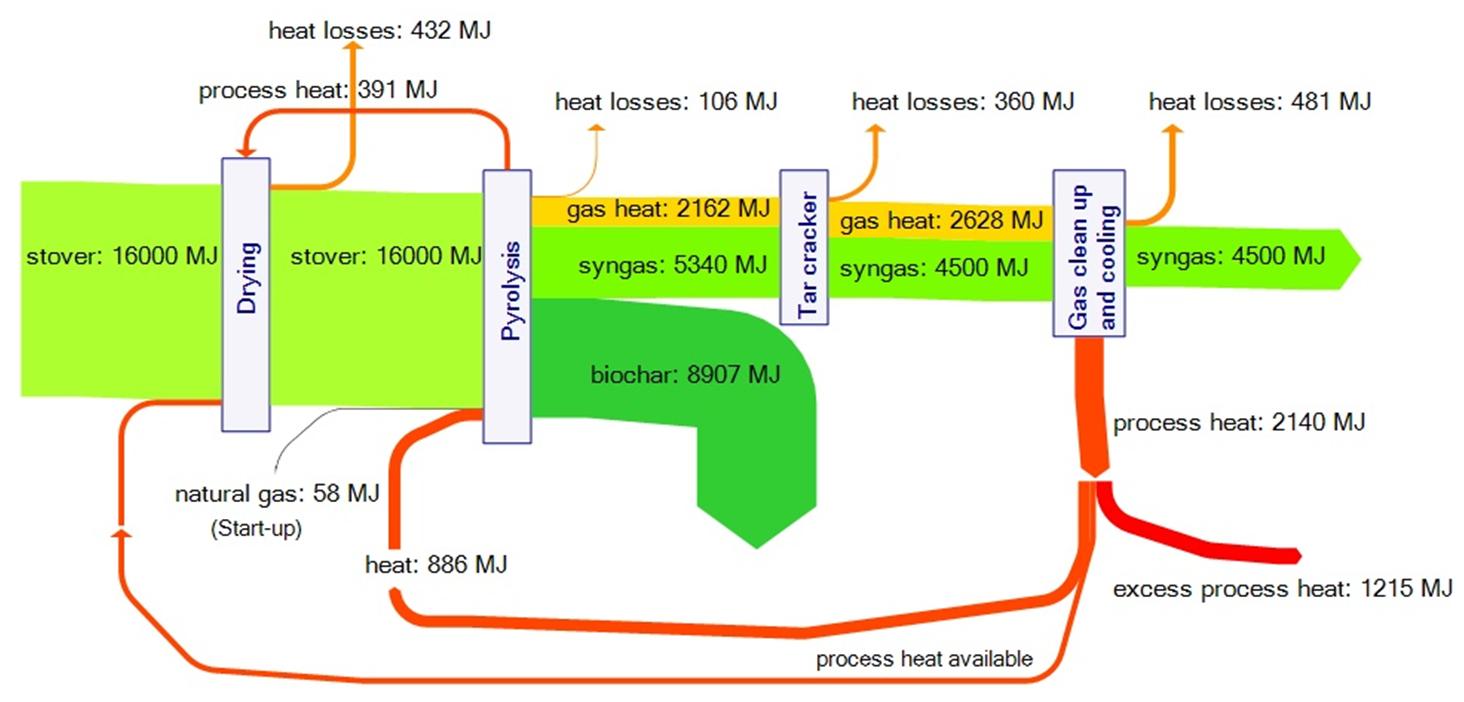
Personally, I think the strategy of building new Natural Gas-fired power plants is rather good. Yes, I will explain why. But first I will cover some of the complaints. |
|
|
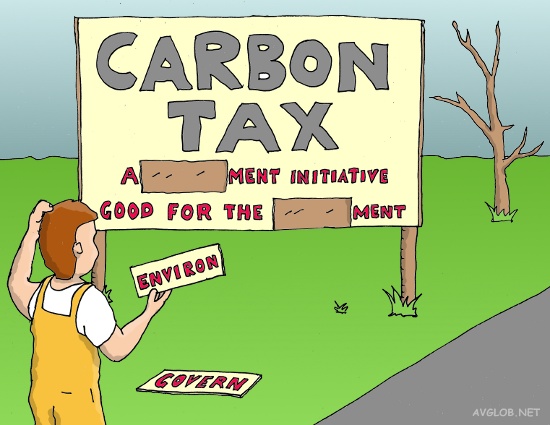
Carbon pricing is the ultimate antisocial policy. The trouble with carbon pricing or taxation is there’s nowhere really that consumer spending can fly to to avoid carbon pricing. In the United Kingdom, for example, around 90% of the country’s energy is derived from fossil fuels. A carbon price will make everything more expensive – mostly for consumers. |
| Despite the phenomenal, almost exponential, growth in renewable energy deployment, not everybody can choose to use green energy – there simply isn’t enough to go round.
The theoretical basis for carbon pricing, taxation, and quota markets (as known as cap and trade, or cap-and-something) is that the polluter should pay. The thing is, it’s not clear in the theory whether the polluter is the energy company who produces dirty energy, or the consumer of the dirty energy (who doesn’t have a choice about the carbon content of the energy they use). Let’s be honest here – pricing high carbon energy is not a cost that’s going to be paid by energy producers – they are simply going to pass the costs on to their consumers. |
|
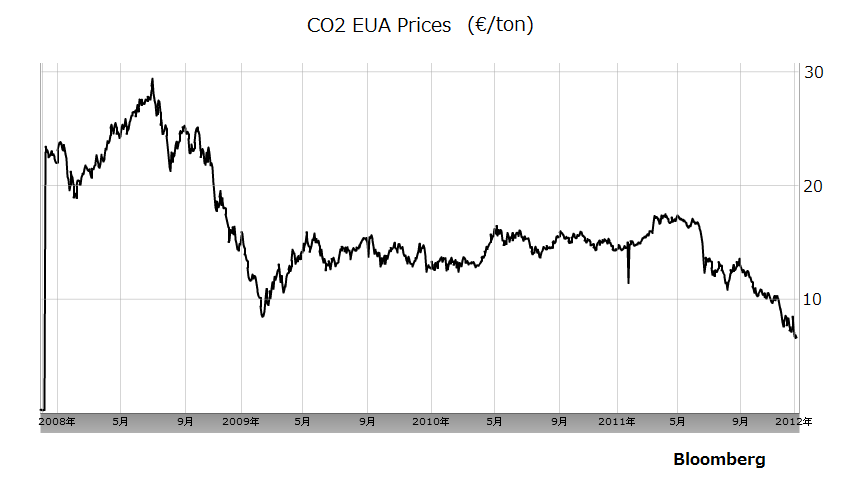 |
From what I have read, I have concluded that economists live in a dream world, divorced from logic and reality.
Most economists appear happy to live with, and base their work upon, huge assumptions, apart from some branches of the discipline such as the behavioural economists. |
| Standard economists assume that all actors in a trading, free, market always make a rational, selfish decision at each point of sale. One can question whether all purchasing decisions are made solely on a Darwinian-survival, or Dawkins-selfish basis. One can also question if all purchasing decisions are rational.
My main doubt is whether consumers actually have any choice in their purchasing decisions. I would say that the majority of markets have narrow scope – that not all the products that could come to market are permitted to come to market. My experience suggests that markets are rarely free – some product sellers have restricted, limited access to markets, either because others have cornered the market through some artificial competitive advantage, or through having undue power within the market. There are also the advantages conferred by time in the marketplace – the grandfather winner-takes-all syndrome. And on top of that, there are the markets that start to resemble cartel operations, or even quasi-monopolies. |
|
Categories
Academic Freedom Bait & Switch Big Picture Big Society Carbon Commodities Carbon Pricing Carbon Taxatious Climate Change Conflict of Interest Corporate Pressure Cost Effective Demoticratica Direction of Travel Divide & Rule Dreamworld Economics Emissions Impossible Energy Autonomy Energy Change Energy Insecurity Engineering Marvel Financiers of the Apocalypse Fossilised Fuels Freemarketeering Fuel Poverty Green Investment Green Power Growth Paradigm Hydrocarbon Hegemony Low Carbon Life Major Shift National Energy National Power Nudge & Budge Oil Change Paradigm Shapeshifter Peak Emissions Petrolheads Policy Warfare Political Nightmare Price Control Regulatory Ultimatum Social Democracy Sustainable Deferment Technofix Technological Fallacy The Myth of Innovation The Price of Gas The Price of Oil The War on Error Vote Loser Wasted Resource Western Hedge
Academic Freedom #2 : The UN climate treaty needs energy producer obligations
|
|
The United Nations Framework Convention on Climate Change calls nations to attend regular gatherings of the signatories to the ratified convention – the Conference of the Parties.
The nations send delegations – hardly ever sending their premiers, presidents and primes. What bargaining powers do these delegations have ? They have the authority to offer small percentages in emissions reductions, just to show willing. They have the mandate to refuse policies their nations do not like. |
| The language is framed around energy consumption – most country delegations have been advised by their economists that increased efficiency in the use of energy means that the national energy use will decrease. O wondrous technology ! You allow us to cut our energy use – and therefore our carbon intensity.
These same economists advise that the Holy Ghost of Innovation will inspire Research and Development – which will mean that new technologies will curtail greenhouse gas emissions. We only have to invest in new engineering. This Cult of the New is the fable on which most advanced nations hang their hope. |
|

Categories
Academic Freedom Bait & Switch Behaviour Changeling Big Picture Big Society Carbon Commodities Carbon Pricing Carbon Taxatious Climate Change Conflict of Interest Contraction & Convergence Corporate Pressure Demoticratica Direction of Travel Disturbing Trends Divide & Rule Dreamworld Economics Emissions Impossible Energy Change Energy Revival Environmental Howzat Fossilised Fuels Gamechanger Global Warming Hydrocarbon Hegemony Low Carbon Life National Energy Nudge & Budge Oil Change Paradigm Shapeshifter Policy Warfare Political Nightmare Protest & Survive Regulatory Ultimatum Resource Curse Social Chaos Social Democracy The War on Error Voluntary Behaviour Change Western Hedge
Academic Freedom #1 : The United Nations isn’t working
 |
A lot of people are going to be distressed when I say this, and tell me I have no right to say it – but honestly guys and gals, it’s time to tell the patently obvious truth : the United Nations process on Climate Change isn’t working.
Even if there is a way to construct a treaty with wording that all the country delegations can agree to (or at least not bitterly fight tooth and nail to their early graves), the basic premise of the United Nations Framework Convention on Climate Change is faulty. |
| Those responsible for the production of fossil fuels should be made to accept responsibility for global warming pollution, and take on the mission of changing the way they make the energy they sell the world.
I’m not calling for environmental fines. Environmental fines don’t work. They don’t stop pollution, they don’t prevent polluting activities, and they don’t provide enough monetary resources to clean up pollution. I’m not calling for carbon tax, or other forms of carbon pricing. Those responsible for selling polluting energy would never pay the full carbon price – they always delegate extra costs to their consumers. Carbon pricing and carbon taxation can never provide an incentive for meaningful de-carbonisation of the energy supply that we need. Cap and Trade does not appear to have altered the course of any region’s energy infrastructure development. The price of carbon always remains too low to stimulate real change. |
|


|
| Last year I was watching a couple of TEDs, and I came across this one given by Richard Sears, former Vice President of Royal Dutch Shell.
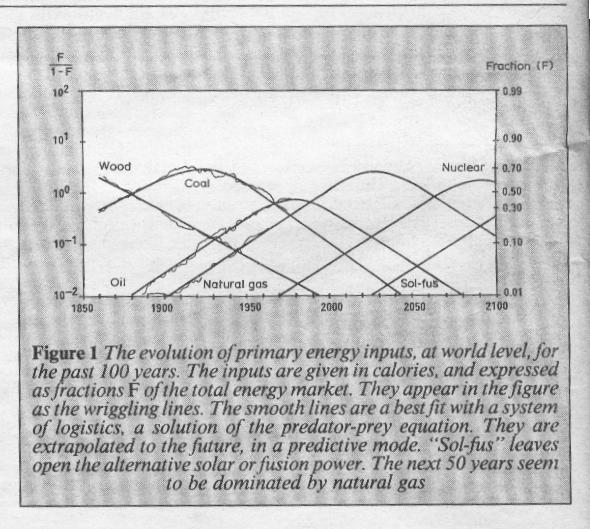
When he showed a chart of depletion curves for various energy resources, I thought to myself “I’ve seen this somewhere before”. As indeed I had. Nearly 30 years ago. How time flies. |
|
Memory is a patchy thing – the past is a set of blurred images of places, people, things – snapshots and summaries, little stories that we retell ourselves to encapsulate the moment. Things people said. I seem to recall emotional responses with the most clarity, so I cast myself back, trawling through my internal notebook for clues, hooks on which to recall. This may be a false memory, but it may not be, considering it allowed me to research the past. There I was, in the University Library, with all its institutional glass windows, and the sun beating down. It was too hot to think. In my hands I had an article from my undergraduate Physics degree reading list, probably provided by the Engineering Department for our study module on Energy. I recall that for some reason it was a translation. And had some complex formulae. My head buzzed. I couldn’t quite take it in. It didn’t take much Googling to remind me : Marchetti.
Back in the 1970s, engineers were promising a hydrogen economy for the 21st century, and Cesare Marchetti was optimistic about Carbon Capture and Storage. How little progress has been made since the First Oil Shock of 1973. | |

 | There are two general forces in the universe – things tend towards either order or disorder – and in some cases it is close to impossible to roll back disaggregated order.
We use that saying “it’s no use crying over spilt milk” to indicate that some things cannot be undone, and that is pointless to attempt to do so. Yet even in the category of things we cannot undo, there is a spectrum of feasibility with a range of outcomes. |
| The complexity of getting a red wine stain out of white woollen carpet requires far more effort, chemistry and the acceptance of permanent damage than it does to wipe up now undrinkable spilt milk from a linoleum floor.
For many reasons, the human race set ourselves worthless mopping up tasks. National and international courts fine oil and gas companies and order environmental remediation, not necessarily in the belief that environmental fines and community service can put back the clock and undo the effects of a leak or a spill, but in the hope that energy corporations would learn the long-lasting lessons of pollution, and change their practices to prevent further disorder. The Japanese Government and the agents and employees of the TEPCO company have found that the obligation to clean radioactive isotopes from dusty soil is an impossible curse. The efforts to extract nuclear reactor pollution from the lives of the victims of Fukushima 311 is an order of difficulty higher than Chevron being ordered to clean up in Ecuador, and Shell being fined for their despoilation of the Niger Delta. Many commentators continue to assure us that nuclear power is safe, even as Europe is struggling to come up with the finance for a permanent shelter for Chernobyl, as design flaws mean that American atomic reactors are subject to regulatory modification, and there is still no timeline for bringing the rolling disaster at Fukushima Dai-ichi under control. People claim that since tsunamis cannot occur inland, that landlocked nuclear plants are protected from inundation, but climate change is bringing drought and flood, both of which could alter hazard ratings for reactors sited on rivers and lakes rather than coasts. For those nuclear plants actually on the coast, the risks of wider storm extremes and rising sea levels from climate change add to normal risk levels. In addition, research is showing that the Japan earthquake and aftershocks were also implicated in some of the reactor damage; and many nuclear power reactors are in range of a fault in the Earth’s crust. What was euphemistically called an “accident” in Japan, a year ago, was entirely predictable with sufficient knowledge of the range of natural hazards that nuclear plants face. Even more so, given the poor record of maintenance at many nuclear power facilities, and flaws in reactor components that mount up over time. The probabilities of serious calamity at atomic energy sites are low, but with apocalyptic potential consequences. And the longer reactors stay in operation, the more their safety will be compromised. Fukushima 311 could have been – and nearly was – so much worse. Claiming that nobody has been killed as a result of the disaster is trite : many people have been evacuated; land, property, agricultural and community infrastructure have been lost; and farm produce will continue to be suspect. Today we remember all those who did lose their lives and their way of life and all their property due to the tsunami – and we pray that people may never lose everything to a nuclear power catastrophe. Industry-funded lobbyists continue to peddle damaged and uncertain nuclear power technologies, even trying to claim that next-generation reactors are “renewable” as, if they work, they could be able to eat up the dangerous radioactive waste from the last 50 years of nuclear power. But judging by the history of the nuclear industry, new atomic energy designs will be not only expensive, and require massive state financial support, they will be unreliable, or even not function at all, and will remain potentially ruinous. Nuclear power is capricious and should be wound down, in the hope of preventing the low risk of exceptionally high disorder, defusing the risks of environmental radioactive chaos. | |

| Christian Ecology Link 30th Annual Conference Bristol, 10 March 2012 Media Release 11 March 2012 All quotations should be checked against transcription. “We need growth that doesn’t destroy the Earth” The current push for economic growth by politicians and financial institutions was questioned by environmentalist Jonathon Porritt at Christian Ecology Link’s 30th anniversary conference on 10 March. |
| “Economic growth is kept at the heart of our model of progress despite plenty of scientific evidence about the scale of environmental problems”, said the keynote speaker, “and many believe so firmly that technology will one day solve these problems that the growth paradigm goes unchallenged”.
The packed audience of around 150 Christian environmental activists was urged to re-examine the notion of ‘wealth’ as meaning ‘wellness’ and challenge politicians and others who take it to mean ‘money’. “After 100 years of suicidal growth it is still possible to change our dire situation”, he said, “but we need to strain each sinew to do so – and call in aid every spiritual resource”.
Porritt, a Christian Ecology Link patron and Director of Forum for the Future, was speaking at St. Michael’s Church in Bristol to the theme, ‘Treasure in the field : spiritual capital and sustainable living’. He told the audience “this community of action and reflection is very important to me as a source of inspiration”, and indeed Forum for the Future’s publication ‘Moving Mountains’ has drawn on Christian Ecology Link material. In his book ‘Capitalism as if the world matters’, Porritt identified that besides financial capital, there is the natural capital of the mineral and biosystem resources of the earth, plus the capital of human skills and social organisation, together with the built environment, infrastructure and technology – ‘manufactured capital’. He also suggested a further crucial resource – ‘spiritual capital’, suggesting that ‘spiritual capital’ developed through a spiritual ‘renaissance’ can help achieve true sustainability. “Today’s so-called ‘ecological crisis’ is in essence a crisis of the human spirit” he has said, “for as we have degraded the earth, so we corrupted our souls, caught up in a frenzy of suicidal consumerism”. Noting the social activism that some church people undertake, Porritt also suggested that social justice is the real test for sustainability. However, he also suggested that churches on the whole were too ‘other-worldly’ and failed to engage with environmental realities. “I don’t put much store in treasure in heaven” he said; “if more Christians focused on the treasure in the field rather than treasure in heaven then we would live in a very different world today”. He did single out Anglican bishop James Jones, author of ‘Jesus and the Earth’ as somebody he greatly admired. In two responses, Tim Gorringe, Professor of Theological Studies at Exeter University endorsed the contradiction of infinite growth on a finite planet and suggested that the transition movement offered a striking alternative. He said people of faith cannot be relegated to a ‘spiritual realm’ for the whole of reality is a gift of God and there is an imperative to promote sustainable living. Paul Bodenham, Chair of Christian Ecology Link, highlighted the way people’s desires are manipulated by the context of the society in which we live and ‘green’ Christians play an important role in helping communities reflect on sustainable development for themselves and the wider society. While Porritt left the gathering at lunchtime to join protestors at Hinkley Point nuclear power station in Somerset to mark the first anniversary of the Fukushima disaster – and to call for a halt to the development of Hinkley C, a new pressurised water reactor, afternoon workshops at the conference explored alternative ways of living leading to a sustainable future. Chris Sunderland from EarthAbbey reflected on the contemplative heart of environmental activism. Jeremy Williams from Breathe suggested a radical change in our consumerist culture is vital to any hope of a sustainable future. Theologian and gardener Edward Echlin argued that small scale, biodiverse, organic food production is not only the best way food growing preserves soil and stabilises climate but is also the most productive. Mark Letcher of Climate Works explored low-carbon living in an overall context of faith. Jonathan Essex of the Greenhouse think tank asked if representative democracy could deliver sustainability. ENDS Contact: Paul Bodenham, Chair of Christian Ecology Link, tel 07825 928400 Photos available at https://www.freerangephotography.co.uk/D1209/index.html https://www.christian-ecology.org.uk
| |


