Categories
Academic Freedom Alchemical Assets not Liabilities Big Picture Big Society British Biogas Change Management Climate Change Conflict of Interest Design Matters Direction of Travel Emissions Impossible Energy Autonomy Energy Change Energy Insecurity Energy Revival Engineering Marvel Fossilised Fuels Green Investment Green Power Human Nurture Hydrocarbon Hegemony Hydrogen Economy Low Carbon Life Major Shift Marvellous Wonderful Media National Energy National Power Optimistic Generation Paradigm Shapeshifter Peak Coal Peak Emissions Peak Energy Peak Natural Gas Peak Oil Realistic Models Renewable Gas Renewable Resource Science Rules Shale Game Social Capital Social Change Solar Sunrise Solution City Stirring Stuff Technological Sideshow The Data The Power of Intention The Science of Communitagion Unconventional Foul Unnatural Gas Wind of Fortune Zero Net

Renewable Gas : Research Parameters

“So what do you do ?” is a question I quite frequently have to answer, as I meet a lot of new people, in a lot of new audiences and settings, on a regular basis, as an integral part of my personal process of discovery.

My internal autocue answer has modified, evolved, over the years, but currently sounds a lot like this, “I have a couple of part-time jobs, office administration, really. I do a spot of weblogging in my spare time. But I’m also doing some research into the potential for Renewable Gas.” I then pause for roughly two seconds. “Renewable Gas ?” comes back the question.

“Yes,” I affirm in the positive, “Industrial-scale chemistry to produce gas fuels not dug up out of the ground. It is useful to plug the gaps in Renewable Electricity when the sun isn’t shining and the wind isn’t blowing.”

It’s not exactly an elevator pitch – I’m not really selling anything except a slight shift in the paradigm here. Renewable Energy. Renewable Electricity. Renewable Gas. Power and gas. Gas and power. It’s logical to want both to be as renewable and sustainable and as low carbon as possible.

Wait another two seconds. “…What, you mean, like Biogas ?” comes the question. “Well, yes, and also high volumes of non-biological gas that’s produced above the ground instead of from fossil fuels.”

The introductory chat normally fades after this exchange, as my respondent usually doesn’t have the necessary knowledge architecture to be able to make any sense of what my words represent. I think it’s fair to say I don’t win many chummy friends paradigm-bumping in this way, and some probably think I’m off the deep end psychologically, but hey, evolutionaries don’t ever have it easy.

And I also find that it’s not easy to find a place in the hierarchy of established learning for my particular “research problem”. Which school could I possibly join ? Which research council would adopt me ?

The first barrier to academic inclusion is that my research interest is clearly motivated by my concern about the risks of Climate Change – the degradation in the Earth’s life support systems from pumping unnaturally high volumes of carbon dioxide into the air – and Peak Fossil Fuels – the risks to humanity from a failure to grow subsurface energy production.

My research is therefore “applied” research, according to the OECD definition (OECD, 2002). It’s not motivated simply by the desire to know new things – it is not “pure” research – it has an end game in mind. My research is being done in order to answer a practical problem – how to decarbonise gaseous, gas phase, energy fuel production.

The second barrier to the ivory tower world that I have is that I do not have a technological contribution to make with this research. I am not inventing a chemical process that can “revolutionise” low carbon energy production. (I don’t believe in “revolutions” anyway. Nothing good ever happens by violent overthrow.) My research is not at the workbench end of engineering, so I am not going to work amongst a team of industrial technicians, so I am not going to produce a patent for clean energy that could save the world (or the economy).

My research is more about observing and reporting the advances of others, and how these pieces add up to a journey of significant change in the energy sector. I want to join the dots from studies at the leading edge of research, showing how this demonstrates widespread aspiration for clean energy, and document instances of new energy technology, systems and infrastructure. I want to witness to the internal motivation of thousands of people working with the goal of clean energy across a very wide range of disciplines.

This is positively positive; positivity, but it’s not positivism – it’s not pure, basic research. This piece of research could well influence people and events – it’s certainly already influencing me. It’s not hands-off neutral science. It interacts with its subjects. It intentionally intervenes.

Since I don’t have an actual physical contribution or product to offer, and since I fully expect it to “interfere” with current dogma and political realities, what I am doing will be hard to acknowledge.

This is not a PhD. But it is still a piece of philosophy, the love of wisdom that comes from the acquisition of knowledge.

I have been clear for some time about what I should be studying. Call it “internal drive” if you like. The aim is to support the development of universal renewable energy as a response to the risks of climate change and peak fossil fuel energy production. That makes me automatically biased. I view my research subject through the prism of hope. But I would contend that this is a perfectly valid belief, as I already know some of what is possible. I’m not starting from a foundational blank slate – many Renewable Gas processes are already in use throughout industry and the energy sector. The fascinating part is watching these functions coalesce into a coherent alternative to the mining of fossil fuels. For the internal industry energy production conversation is changing its track, its tune.

For a while now, “alternative” energy has been a minor vibration, a harmonic, accentuating the fossil fuel melody. As soon as the mid-noughties economic difficulties began to bite, greenwash activities were ditched, as oil and gas companies resorted to their core business. But the “green shoots” of green energy are still there, and every now and then, it is possible to see them poking up above the oilspill-desecrated soil. My role is to count blades and project bushes. Therefore my research is interpretivist or constructivist, although it is documenting positivist engineering progress. That’s quite hard for me to agree with, even though I reasoned it myself. I can still resist being labelled “post-positivist”, though, because I’m still interpreting reality not relativisms.

So now, on from research paradigm to research methodologies. I was trained to be an experimentalist scientist, so this is a departure for me. In this case, I am not going to seek to make a physical contribution to the field by being actively involved as an engineer in a research programme, partly because from what I’ve read so far, most of the potential is already documented and scoped.

I am going to use sociological methods, combining observation and rapportage, to and from various organisations through various media. Since I am involved in the narrative through my interactions with others, and I influence the outcomes of my research, this is partly auto-narrative, autoethnographic, ethnographic. An apt form for the research documentation is a weblog, as it is a longitudinal study, so discrete reports at time intervals are appropriate. Social media will be useful for joining the research to a potential audience, and Twitter has the kind of immediacy I prefer.

My observation will therefore be akin to journalism – engineering journalism, where the term “engineering” covers both technological and sociological aspects of change. A kind of energy futures “travelogue”, an observer of an emerging reality.

My research methods will include reading the science and interacting with engineers. I hope to do a study trip (or two) as a way of embedding myself into the new energy sector, with the explicit intention of ensuring I am not purely a commentator-observer. My research documentation will include a slow collation of my sources and references – a literature review that evolves over time.

My personal contribution will be slight, but hopefully set archaic and inefficient proposals for energy development based on “traditional” answers (such as nuclear power, “unconventional” fossil fuel production and Carbon Capture and Storage for coal) in high relief.

My research choices as they currently stand :-

1. I do not think I want to join an academic group.

2. I do not think I want to work for an energy engineering company.

3. I do not want to claim a discovery in an experimental sense. Indeed, I do not need to, as I am documenting discoveries and experiments.

4. I want to be clear about my bias towards promoting 100% renewable energy, as a desirable ambition, in response to the risks posed by climate change and peak fossil fuel production.

5. I need to admit that my research may influence outcomes, and so is applied rather than basic (Roll-Hansen, 2009).

References

OECD, 2002. “Proposed Standard Practice for Surveys on Research and Experimental Development”, Frascati Manual :-
https://browse.oecdbookshop.org/oecd/pdfs/free/9202081e.pdf

Roll-Hansen, 2009. “Why the distinction between basic (theoretical) and applied (practical) research is important in the politics of science”, Nils Roll-Hansen, Centre for the Philosophy of Natural and Social Science Contingency and Dissent in Science, Technical Report 04/09 :-
https://www2.lse.ac.uk/CPNSS/projects/CoreResearchProjects/ContingencyDissentInScience/DP/DPRoll-HansenOnline0409.pdf

Categories
Be Prepared Big Society Climate Change Climate Chaos Disturbing Trends Extreme Weather Firestorm Global Singeing Hide the Incline Human Nurture Incalculable Disaster Nudge & Budge Paradigm Shapeshifter Pure Hollywood Rainstorm Screaming Panic Social Chaos Stirring Stuff The Science of Communitagion Wildfire

A Report from Tasmania

During the worst of the austral summer in Tasmania at the start of 2013, an Austrian friend of mine was travelling through the region, and sent back the following report.


“We arrived in Tassie [Tasmania] on the 6th of January 2013. When I looked outside the window of the plane I saw many burning fields and a lot of black smoke was in the air.”

“We picked up our luggage and went to the car rental counter. Actually we were lucky to catch the last rental car, as most of the cars were stuck in the Peninsula at Port Arthur and people couldn’t drive them back as all roads were blocked already.

There were over 40 bush-fires in the area and most of the people have been evacuated either by sailboats and ships, as the whole island (Peninsula) Dunally was on fire.

We drove directly up to the northern part of Tasmania away from the bush-fires.

On the radio we heard many additional fire-warnings and had to take another highway in order to reach the Cradle Mountain National Park.

The air was filled with smoke and the smell was terrible. As we arrived in the National Park all of a sudden it started to rain and didn’t stop for the rest of the day. The next day also…rain, rain, rain.

250km south of Tassie bush-fires and here we are and felt like we were swept away by the strong winds and rainfalls in the middle of Tassie. 🙂 It has been also really cold. Strange feeling to experience such a different weather-condition within only one day.”


Video which describes it best:
https://www.youtube.com/watch?v=Qxz9x7HYIHo

Arnie speaking German in front of students in Vienna on the 31st of January:
https://www.youtube.com/watch?v=3AyEjgs-Bc0
https://europa.eu/rapid/press-release_SPEECH-13-89_de.htm?locale=en
https://www.r20vienna.org/


“Let’s keep in touch. We have to step out of the comfort zone into the smoking zone in order to reach people for the “truth” about climate change. :)”

Categories
Academic Freedom Be Prepared Big Picture Climate Change Climate Chaos Delay and Deny Direction of Travel Disturbing Trends Global Heating Global Warming Hide the Incline Paradigm Shapeshifter Realistic Models Science Rules Scientific Fallacy Social Chaos Sustainable Deferment The Data The Science of Communitagion The War on Error

Statistical Elephants Roam Chamber


Image Credit : appinsys.com

Somewhere on the Internet, as I write, somebody will be arguing about global warming – or rather, several somebodies, since disputes require multiple parties, and global warming is, as claimed by some, to be sufficiently contentious to have spawned ongoing vituperativeness. Many of the lines of reasoning will include references to the cyclic nature of Nature. Most of the data considered will be from measurements of “surface” temperatures – the temperature of the atmosphere near the land surface of the Earth, and the temperature of the oceans near the surface with the atmosphere.

These are of course, the easiest things to measure, as this is the part of the Earth system that people inhabit, and all kinds of surface temperature records, of varying validity and accuracy, have been recorded for millenia.

The lower reaches of the air and the upper waters of the oceans, are, however, prone to quite wide swings in temperatures, owing to the turbulent nature of heat, air and water transport in and around the surface of the Earth. And so, easily distracted creatures that we are, if we have any honour in our research into global warming, we consider this see-sawing surface temperature data, and we apply our best analysis techniques to try to comprehend its “walk” – the direction it is taking overall. And herein lies a faultline, that despite decades of obsession, is not easily vaulted. The use of statistical techniques to analyse surface temperature data suffers from two key problems :-

(a) An assumption that we can determine accurately the period of time over which we can confidently apply statistical analysis techniques in order to be able to determine trends in surface temperatures; and

(b) An assumption that surface temperatures can be treated with the usual statistical toolbox of techniques – that surface temperatures would, unless forced, fall into a distribution curve of random readings, spread like a bell curve around a central mean.

And so an army of inspectors applies probabilistic statistical methods to the Earth’s surface temperature data sets, and some say it comes up with more questions than answers. For example, there may, or may not be, evidence that trends can only be claimed over decadal, or multi-decadal, periods; that all the apparent warming can be put down to natural cycles of the oceans, so a cooling phase will be next; that no trend can be claimed in 50 years because of the wild swings in the data ; that all the data is confused with volcanic episodes; that lots of mini-cycles in the Earth system are confusing us. And so on.

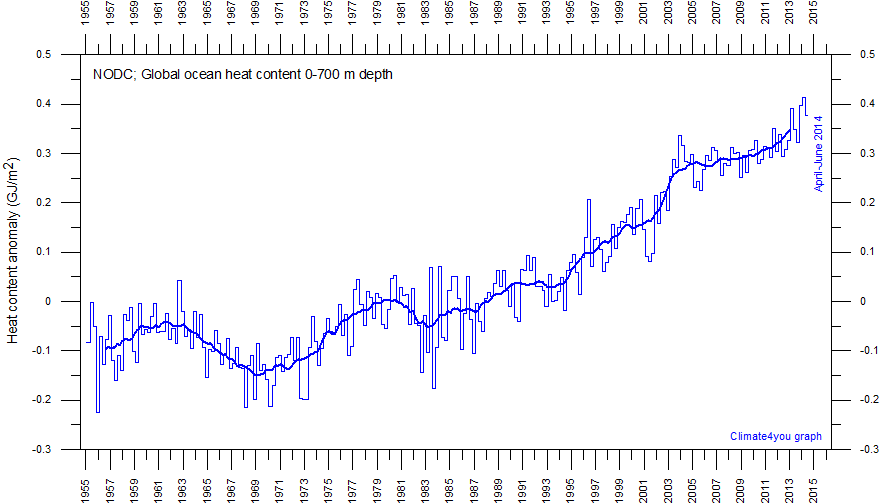
When I find people arguing about the surface temperature records, and whether a global warming trend can be picked out from them, I ask them if they’ve looked at the bigger picture : the global heat transport system. Water can retain heat better than air – a very large proportion of the heating caused by sunlight ends up in the oceans – at different places in the depths of the oceans. Over time, this heat is exchanged with the atmosphere, rather like global Gas Central Heating, but a lot of it stays down there – so if there is a trend for global warming, it’s probably best to look in the oceans for it.

And when we do, all the arguments about statistical analysis of surface atmospheric temperatures vapourise into meaninglessness, almost. The trend of ocean warming is so clear, you don’t need to apply any kind of statistical methods (apart from a couple of years of averaging) :-


Image Credit : Climate4You

Actually, the trend of atmospheric warming is also clear, if you take the long view :-


Image Credit : NASA GISS

Anybody who is still arguing about the periodicity of surface temperatures, as if natural cycles could explain global warming, should think again.

Surface temperature cycles are perhaps able to explain whether the next 10 years or so will see more or less global warming – but they cannot explain away the 100 year trend in global warming.

And when people have come to terms that statistics cannot wipe away the reality of global warming, then comes the sting in the tail. Because the ocean is exchanging heat with the atmosphere over time, this creates a time lag – between the heat being generated in the oceans, and surface temperatures rising as a result.

We ain’t seen nothing, yet.


18th January 2013
Twitterverse

—————————————-

@joabbess

@richardabetts Think focus on air temps waste of time: most heat ends up in oceans https://www.climate4you.com/images/NODC%20GlobalOceanicHeatContent0-700mSince1955%20With37monthRunningAverage.gif … @lucialiljegren @nmrqip @ed_hawkins

@richardabetts Number of reasons why air temps bounce around making short-term interpretation difficult @lucialiljegren @nmrqip @ed_hawkins

@richardabetts …but oceans temps could well continue a solid upwards gradient over next decades @lucialiljegren @nmrqip @ed_hawkins

@richardabetts If oceans continue recent warming gradient, will drag air temps on average up with them @lucialiljegren @nmrqip @ed_hawkins

@richardabetts If ENSO taking new shape/profile/cycle, this could obscure some of atmospheric temp rise @lucialiljegren @nmrqip @ed_hawkins

@richardabetts Even ENSO obfuscation can’t put off ~1.2degC warming next 30 years https://www.joabbess.com/2010/07/19/simple-integration/ … @lucialiljegren @nmrqip @ed_hawkins

—-

@ClimateOfGavin Sometimes distrust obsession re atmospheric temps: look at ocean warming @lucialiljegren @ed_hawkins @richardabetts @nmrqip

@ClimateOfGavin However much @lucialiljegren obsesses on air temperatures I only care about ocean warming @ed_hawkins @richardabetts @nmrqip

@ClimateOfGavin Lower atmosphere temperatures flip-flop all kinds of reasons: not oceans @lucialiljegren @ed_hawkins @richardabetts @nmrqip

@ClimateOfGavin Thermal capacity of oceans means they should show more reliable trend ? @lucialiljegren @ed_hawkins @richardabetts @nmrqip

————————————————————

@ed_hawkins

@joabbess @ClimateOfGavin Probably, but we only have good enough sub-surface observations of past ~50 years or so.

————————————————————

@joabbess

@ed_hawkins Yet since oceans good heat retainer even mediocre records of past relevant 4 comparison eg https://www.livescience.com/19414-oceans-warming-135-years.html … @ClimateOfGavin

@ed_hawkins We should definitely use what we know about thermal capacity of oceans to accept ships etc historical records @ClimateOfGavin

@ed_hawkins Ocean records of last 50 years allow for calibration between surface and depths, & with historical records too @ClimateOfGavin

—————————————————–

@ed_hawkins

@joabbess @ClimateOfGavin Of course – deep ocean observations are very relevant, but not the only type of measurement that are useful!

—————————————————–

@joabbess

@ed_hawkins I’m sure there must be mines data going back several hundreds of years, doing same trick for mass earth temps @ClimateOfGavin

——————————————————

@JohnRussell40 :-

@joabbess Surely mines data will be swamped by core heat? V. hot down there. @ed_hawkins @ClimateOfGavin

——————————————————

@ClimateOfGavin (Gavin Schmidt)

@JohnRussell40 @joabbess @ed_hawkins borehole temperatures can in fact be deconvolved to show widespread recent warming Henry Pollack et al

——————————————————

@joabbess

@ClimateOfGavin I assume you mean this https://www.ncdc.noaa.gov/paleo/borehole/core.html … https://www.ncdc.noaa.gov/paleo/globalwarming/pollack.html … Think that’s pretty clear ! @JohnRussell40 @ed_hawkins

@ClimateOfGavin Interestingly reflects surface up-blip in 1940s, which Phil Jones et al keep trying to smooth @JohnRussell40 @ed_hawkins
@ClimateOfGavin That up-blip in 1940s was what got us all started looking for historical marine records: v useful @JohnRussell40 @ed_hawkins

@ed_hawkins I’m trying to hint that endless debates about cyclicity/statistics of air temps = time-wasting & not productive @ClimateOfGavin

@ed_hawkins If read 1 more mangled media article about statistical trends of air temperatures, going to scream & jump about @ClimateOfGavin

@ed_hawkins The overall graph speaks for itself – or it should – louder than anything https://www.columbia.edu/~jeh1/mailings/2013/20130115_Temperature2012.pdf … Fig. 1 @ClimateOfGavin

———————————————

Categories
Academic Freedom Bait & Switch Be Prepared Behaviour Changeling Big Society Change Management Climate Change Climate Chaos Conflict of Interest Corporate Pressure Cost Effective Dead End Dead Zone Demoticratica Design Matters Direction of Travel Disturbing Trends Divide & Rule Efficiency is King Electrificandum Energy Autonomy Energy Change Energy Denial Energy Insecurity Energy Revival Engineering Marvel Evil Opposition Freemarketeering Gamechanger Global Warming Green Investment Green Power Human Nurture Hydrocarbon Hegemony Insulation Low Carbon Life Major Shift Mass Propaganda National Energy National Power No Pressure Not In My Name Nudge & Budge Paradigm Shapeshifter Policy Warfare Political Nightmare Public Relations Pure Hollywood Realistic Models Regulatory Ultimatum Resource Curse Resource Wards Revolving Door Smokestorm Social Capital Social Change Social Chaos Social Democracy Solution City Stirring Stuff Sustainable Deferment Technofix Technological Fallacy Technological Sideshow Technomess The Power of Intention The Science of Communitagion The War on Error Unqualified Opinion Unsolicited Advice & Guidance Unutterably Useless Utter Futility Vain Hope Voluntary Behaviour Change Vote Loser Wasted Resource Western Hedge

The Art of Non-Persuasion

I could never be in sales and marketing. I have a strong negative reaction to public relations, propaganda and the sticky, inauthentic charm of personal persuasion.

Lead a horse to water, show them how lovely and sparkling it is, talk them through their appreciation of water, how it could benefit their lives, make them thirsty, stand by and observe as they start to lap it up.

One of the mnemonics of marketing is AIDA, which stands for Attention, Interest, Desire, Action, leading a “client” through the process, guiding a sale. Seize Attention. Create Interest. Inspire Desire. Precipitate Action. Some mindbenders insert the letter C for Commitment – hoping to be sure that Desire has turned into certain decision before permitting, allowing, enabling, contracting or encouraging the Action stage.

You won’t get that kind of psychological plasticity nonsense from me. Right is right, and wrong is wrong, and ethics should be applied to every conversion of intent. In fact, the architect of a change of mind should be the mind who is changing – the marketeer or sales person should not proselytise, evangelise, lie, cheat, sneak, creep and massage until they have control.

I refuse to do “Suggestive Sell”. I only do “Show and Tell”.

I am quite observant, and so in interpersonal interactions I am very sensitive to rejection, the “no” forming in the mind of the other. I can sense when somebody is turned off by an idea or a proposal, sometimes even before they know it clearly themselves. I am habituated to detecting disinclination, and I am resigned to it. There is no bridge over the chasm of “no”. I know that marketing people are trained to not accept negative reactions they perceive – to keep pursuing the sale. But I don’t want to. I want to admit, permit, allow my correspondent to say “no” and mean “no”, and not be harrassed, deceived or cajoled to change it to a “yes”.

I have been accused of being on the dark side – in my attempts to show and tell on climate change and renewable energy. Some assume that because I am part of the “communications team”, I am conducting a sales job. I’m not. My discovery becomes your discovery, but it’s not a constructed irreality. For many, it’s true that they believe they need to follow the path of public relations – deploying the “information deficit model” of communication – hierarchically patronising. Me, expert. You, poor unknowing punter. Me, inform you. You, believe, repent, be cleaned and change your ways. In this sense, communications experts have made climate change a religious cult.

In energy futures, I meet so many who are wild-eyed, desperate to make a sale – those who have genuine knowledge of their subject – and who realise that their pitch is not strong enough in the eyes of others. It’s not just a question of money or funding. The engineers, often in large corporations, trying to make an impression on politicians. The consultants who are trying to influence companies and civil servants. The independent professionals trying to exert the wisdom of pragmatism and negotiated co-operation. The establishment trying to sell technical services. Those organisations and institutions playing with people – playing with belonging, with reputation, marketing outdated narratives. People who are in. People who are hands-off. People who are tipped and ditched. Those with connections who give the disconnected a small rocky platform. The awkwardness of invested power contending with radical outsiders. Denial of changing realities. The dearth of ready alternatives. Are you ready to be captured, used and discarded ? Chase government research and development grants. Steal your way into consultations. Play the game. Sell yourself. Dissociate and sell your soul.

I have to face the fact that I do need to sell myself. I have to do it in a way which remains open and honest. To sell myself and my conceptual framework, my proposals for ways forward on energy and climate change, I need a product. My person is often not enough of a product to sell – I am neuro-atypical. My Curriculum Vitae CV in resume is not enough of a product to sell me. My performance in interviews and meetings is often not enough of a product. My weblog has never been a vehicle for sales. I didn’t want it to be – or to be seen as that – as I try to avoid deceit in communications.

Change requires facilitation. You can’t just walk away when the non-persuasional communications dialogue challenge gets speared with distrust and dismissal. Somehow there has to be a way to present direction and decisions in a way that doesn’t have a shadow of evil hovering in the wings.

“A moment to change it all, is all it takes to start anew.
To the other side.”


Why do I need to “sell” myself ? Why do I need to develop a product – a vehicle with which to sell myself ?

1. In order to be recognised, in order to be welcomed, invited to make a contribution to the development of low carbon energy, the optimisation of the use of energy, and effective climate change policy.

2. In order to put my internal motivations and drive to some practical use. To employ my human energy in the service of the future of energy engineering and energy systems.


Categories
Academic Freedom Assets not Liabilities Big Picture Big Society Carbon Capture Climate Change Climate Chaos Climate Damages Corporate Pressure Delay and Deny Demoticratica Direction of Travel Divide & Rule Dreamworld Economics Efficiency is King Emissions Impossible Energy Autonomy Energy Change Energy Denial Energy Insecurity Energy Revival Energy Socialism Engineering Marvel Evil Opposition Fair Balance Financiers of the Apocalypse Fossilised Fuels Freemarketeering Gamechanger Geogingerneering Global Warming Green Investment Green Power Hide the Incline Human Nurture Hydrocarbon Hegemony Incalculable Disaster Insulation Low Carbon Life Major Shift Mass Propaganda Money Sings National Energy National Power Near-Natural Disaster Neverending Disaster Nuclear Nuisance Nuclear Shambles Oil Change Optimistic Generation Paradigm Shapeshifter Peace not War Peak Coal Peak Emissions Peak Energy Peak Natural Gas Peak Oil Policy Warfare Political Nightmare Protest & Survive Public Relations Pure Hollywood Regulatory Ultimatum Renewable Gas Science Rules Shale Game Social Change Social Democracy Solar Sunrise Solution City Stirring Stuff Sustainable Deferment Technofix Technological Fallacy The Data The Power of Intention The Science of Communitagion The War on Error Unconventional Foul Ungreen Development Unnatural Gas Wind of Fortune Zero Net

Cross-Motivation

A fully renewable energy future is not only possible, it is inevitable.

We need to maximise the roll out of wind and solar renewable electricity systems, and at the same time fully develop marine, geothermal and hydropower energy, and of course, energy storage.

We need strong energy conservation and energy efficiency directives to be enacted in every state, sector and region.

But we need to get from here to there. It requires the application of personal energy from all – from governments, from industry, from society.

In arguing for focus on the development of Renewable Gas, which I believe can and will be a bridge from here to a fully renewable energy future, I am making an appeal to those who view themselves as environmentalists, and also an appeal to those who view themselves as part of the energy industry.

Those who cast themselves as the “good guys”, those who want to protect the environment from the ravages of the energy industry, have for decades set themselves in opposition, politically and socially, to those in the energy production and supply sectors, and this has created a wall of negativity, a block to progress in many areas.

I would ask you to accept the situation we find ourselves in – even those who live off-grid and who have very low personal energy and material consumption – we are all dependent on the energy industry – we have a massive fossil fuel infrastructure, and companies that wield immense political power, and this cannot be changed overnight by some revolutionary activity, or by pulling public theatrical stunts.

It definitely cannot be changed by accusation, finger-pointing and blame. We are not going to wake up tomorrow in a zero carbon world. There needs to be a transition – there needs to be a vision and a will. Instead of a depressive, negative, cynical assessment of today that erects and maintains barriers to co-operation, we need optimistic, positive understanding.

In the past there has been naievety – and some environmentalists have been taken in by public relations greenwash. This is not that. The kind of propaganda used to maintain market share for the energy industry continues to prevent and poison good communications and trust. I no more believe in the magic snuff of the shale gas “game changer” than I believe in the existence of goblins and fairies. The shine on the nuclear “renaissance” wore off ever before it was buffed up. And the hopeless dream of Carbon Capture and Storage (CCS) becoming a global-scale solution for carbon emissions is about as realistic to me as the geoengineering described in Tolkein’s “The Lord of the Rings”.

Nuclear power and CCS are actually about mining and concrete construction – they’re not energy or climate solutions. I’m not taken in by token gestures of a small slice of wind or solar power or the promise of a segment of biofuels from large oil and gas companies. Public relations and lobbying are the lowest form of faked, usurping power – but simply attacking brands will fail to make real change. I think honesty, realism and pragmatism are the way forward – and there is nothing more practical than pushing for Renewable Gas to back up the accelerated deployment of renewable electricity to its fullest scale.

My appeal to those in control of energy provision is – to see through the fog to the unstoppable. State support, both political and financial, of new energy technologies and infrastructure has to be a short- to medium-term goal – because of the volatility of the economy, and the demands of your shareholders. The need to build public support for new energy means that we the citizens must all be offered the opportunity to own energy – and so that means building a common purpose between the energy sector and society – and that purpose must be Zero Carbon.

There is and will continue to be a porous border between the energy industry and governments – energy is a social utility of high political value. However, the privilege and access that this provides should not automatically mean that the energy industry can plunder public coffers for their own profit. What contribution can the energy industry make to society – apart from the provision of energy at cost – in addition to the subsidies ? Energy, being so vital to the economy, will mean that the energy sector will continue to survive, but it has to change its shape.

You can dance around the facts, but climate change is hitting home, and there is no point in continuing to be in denial about Peak Oil, Peak Coal and Peak Natural Gas. These are genuine risks, not only to the planet, or its people, but also your business plans. We need to be using less energy overall, and less carbon energy within the eventual envelope of energy consumption. So the energy sector needs to move away from maximising sales of energy to optimising sales of energy services and selling low carbon energy systems, power and fuels.

You would be wrong to dismiss me as an “eco warrior” – I’m an engineer – and I’ve always believed in co-operation, expertise, professionalism, technology and industrial prowess. What impresses me is low carbon energy deployment and zero carbon energy research. Progress is in evidence, and it is showing the way to the future. Realistically speaking, in 20 years’ time, nobody will be able to dismiss the risks and threats of climate change and energy insecurity – the evidence accumulates. We, the zero carbon visionaries, are not going to stop talking about this and acting on it – as time goes by, the reasons for all to engage with these issues will increase, regardless of efforts to distract.

Nothing is perfect. I no more believe in a green utopia than I do in unicorns. But without reacting to climate change and energy insecurity, the stock market will not carry you, even though the governments must for the mean time, until clean and green energy engineering and service organisations rise up to replace you. Lobbying for pretences will ultimately fail – fail not only governments or peoples, but you. You, the energy industry, must start acting for the long-term or you will be ousted. As your CEOs retire, younger heads will fill leadership shoes – and younger minds know and accept the perils of climate change and energy insecurity.

This is the evolution, not revolution. It is time to publicly admit that you do know that economically recoverable fossil fuels are limited, and that climate change is as dangerous to your business models as it is to human settlements and the biosphere. Admit it in a way that points to a sustainable future – for you and the climate. The pollution of economically borderline unconventional fuels is wrong and avoidable – what we need are renewable energies, energy conservation and energy efficiency. One without the others is not enough.

How can your business succeed ? In selling renewable energy, energy conservation and energy efficiency. You have to sell the management of energy. You have to be genuinely “world class” and show us how. No more spills, blowouts and emissions. No more tokenistic sponsorship of arts, culture and sports. The veneer of respectability is wearing thin.

As an engineer, I understand the problems of system management – all things within the boundary wall need to be considered and dealt with. One thing is certain, however. Everything is within the walls. And that means that all must change.


https://houstonfeldenkrais.com/tag/cross-motivation/ “…Of course, the money would be great. But adding in the reward/punishment dimension is a sure way to sabotage brilliant performance. Moshe Feldenkrais observed that when one is striving to meet an externally imposed goal, the spine shortens, muscles tense, and the body (and mind) actually works against itself. He called this “cross motivation,” and it occurs when one forsakes one’s internal truth to maintain external equilibrium. There are lots of examples of this: the child stops doing what she’s doing because of the fear of losing parental approval, love, protection. The employee cooks the books to keep his job. The candidate delivers the sound bite, and dies a little inside. Feldenkrais attributed most of our human mental and physical difficulties to the problem of cross motivation. If you watch Michael Phelps swim, you can’t help but notice that he makes it look easy. He is clearly strong and powerful, but all of his strength and power are focused on moving him through the water with the greatest speed and efficiency. There’s no wasted effort, no struggle, no straining. He is free of cross-motivation! Would straining make him faster? Of course not. Unnecessary muscular effort would make him less buoyant, less mobile, less flexible. Will dangling a million dollars at the finish line make him swim faster? Probably just the opposite, unless Michael Phelps has some great inner resources to draw upon. The young Mr. Phelps has already learned how to tune out a lot of the hype. He’ll need to rely on “the cultivation of detachment,” the ability to care without caring…”

Categories
Academic Freedom Big Number Big Picture Climate Change Climate Chaos Cool Poverty Delay and Deny Direction of Travel Disturbing Trends Extreme Weather Gamechanger Global Heating Global Warming Growth Paradigm Heatwave Hide the Incline Human Nurture Incalculable Disaster Insulation Major Shift Media Meltdown Near-Natural Disaster Neverending Disaster Nudge & Budge Paradigm Shapeshifter Public Relations Realistic Models Science Rules Screaming Panic Sustainable Deferment The Data The Science of Communitagion The War on Error Vain Hope

No Cause for Alarm

Categories
Climate Change Climate Chaos Climate Damages Global Warming Meltdown Science Rules Screaming Panic The Data The Science of Communitagion The War on Error

Odds in the Arctic

[ UPDATE : The images and charts are current – meaning that the situation has changed since the post was written on 14 September 2012. Thus, if you try to tie the diagrams in with the text, it won’t make much sense. Apologies. ]

It’s about this time of year that bleak-humoured atmospheric scientists and statisticians all over the world start to place bets on the low point of the volume (or area, or extent, or thickness) of Arctic Sea Ice.

The rumour yesterday was that the low point was going to be called for today. But…there are some odd things going on in the Arctic, and that could shift the odds.

Categories
Academic Freedom Climate Change Climate Chaos Climate Damages The Science of Communitagion

Multimessaging


[ Peter Sinclair brought this to my attention. Thanks, Green Man. ]