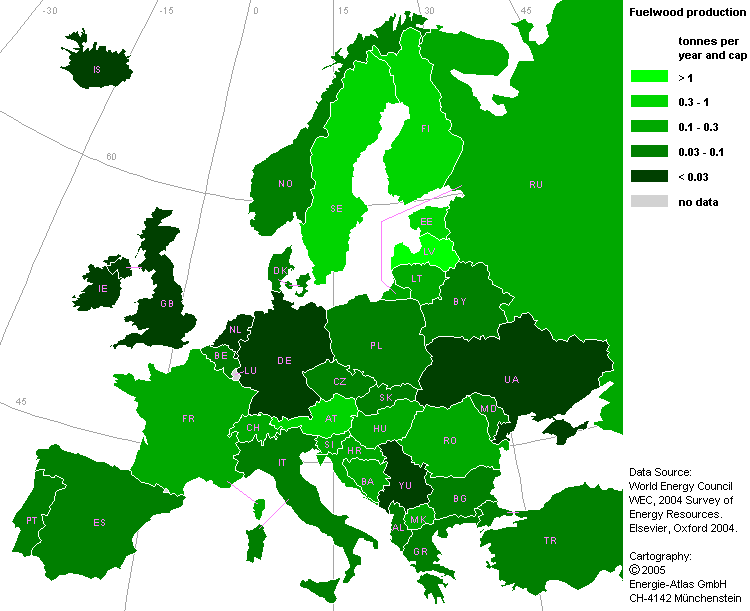
| The UK Government has a neat plan – meet a considerable proportion of the nation’s electricity needs by burning biomass and biofuels : wood, waste wood, agricultural residues, palm oil, maize ethanol and such-like.
They are even considering setting up a generous subsidy, the kind of subsidy that would encourage massive imports of biomass and bioliquids. | |
| Without care and regulatory checks and balances, the net effect will almost certainly be rainforest deforestation, land grabbing in under-developed nations, and economic problems for the growing biomass heat movement in the UK.
Most people probably think burning wood, wood waste and plant-derived fuels to make power sounds like a good energy idea – stop burning coal and start burning trees – has to be better for the planet, surely ? There are a number of really deep problems with this agenda. Almuth Ernsting of Biofuelwatch told me this weekend that burning biomass for electricity generation is incredibly inefficient. She said the UK Government has apparently heard concerns about the burning of bioliquids such as the biofuel bioethanol for power generation, and it shouldn’t be included in the subsidy arrangement. However, biomass-fired power generation is still set to receive support – although it is still being depicted as making use of agroforestry residues, and all sourced within the country – judging by a recent permission for a biomass burning plant in Yorkshire. Generous subsidies for burning biofuels to generate electricity will encourage the combustion of food-quality oils, imported from across the world, exacerbating the existing problems with the destruction of tropical rainforest for commercial gain. Offering significant subsidies for burning biomass for power generation will most probably trigger further logging of virgin rainforest, as it would be cheap to produce and export to Britain. Even if biomass were sourced in the United Kingdom – with restrictions on imports from areas of the world where there is extensive land grabbing and deforestation occurring – the subsidy would encourage the burning of wood products for generating power instead of being used in the most efficient way – to heat homes. Almuth Ernsting said, “the big energy companies are going to burn that much wood, small heat providers won’t be able to compete.” The same would be true of street-scale biomass combined heat and power (CHP) proposals. Almuth Ernsting and others have pointed out that the UK Government public consultation on the subsidy ends on 12th January 2012, but that even after that date, people are being encouraged to write to their Member of Parliament to express views. Another group, nope, is also calling for citizen action :- In an e-mail to joabbess.com, Almuth Ernsting offered extra resources :- “All the materials related to our campaign against subsidies for biomass and biofuel electricity can be found here :-” https://www.biofuelwatch.org.uk/uk-campaign/rocs_overview/” “A briefing about the impacts of ROCs for biomass, biofuels and waste incineration :-” “A briefing to hand or send to MPs :-” “A guide to lobbying MPs on this :-” https://www.biofuelwatch.org.uk/2011/mp_guidance_rocs/ “We have got two email alerts on one page just now (https://www.biofuelwatch.org.uk/2011/rocs-alerts/), though we will take down the one to respond to the DECC Consultation when that closes next Thursday, while keeping the one to MPs. However, we very much encourage people to write personal letters or, even better, visit their MPs, which will have much more impact than taking part in a standard email alert.” | |
Category: National Power
Eco-Socialism #1 : Public Service, Private Profit
Public infrastructure and utilities are the skeleton of the national economy; the spokes of the wheel; the walls of the house.
Private corporations can in many cases put muscle on the body, a tyre on the bike, and furnish the rooms, but without the basic public provision, private enterprise cannot thrive.
Without taxes being raised – asking everybody for their appropriate contribution – there would be no guaranteed health service, education system, roads, water supplies, power networks.
Federal or central government spending is essential, and often goes without question or inspection – including subsidies, cheap government loans, tax breaks and even rule-bending and regulatory exemption for specific sectors of the economy. This policy lenience also applies to private companies that take on the provision of public utilities.
This explicit, but often glossed-over, support for public services means that private business can rely on this national infrastructure. Small businesses can rely on a power supply and waste disposal services, for example. Large businesses can rely on a functioning postal service and road network.
It is questionable whether for-profit enterprise would be able to survive without the basic taxation-funded provision of public services and utilities.
I can understand why governments feel the need to get public spending off the balance sheet, and outsource public utilities to the private sector.
There is a lingering belief that private enterprise makes public services more efficient; makes manufacturing more reliable; makes construction better quality.
In some cases, this belief in privatisation is justified. Where companies can genuinely compete with each other, there can be efficiencies at scale. However, the success of privatisation is not universal.
Many parts of a developed economy are monolithic – there is no real competition possible. You get electricity through your power socket from a variety of production companies – you cannot choose. The road between your house and your office is always the same road – you don’t choose between different tarmac suppliers. Your local hospital is your local hospital, regardless of who owns and runs it – you have no choice about who that is – and the government contract tendering process is not something open to a public vote.
Added to this lack of competition, in some cases, it is impossible to make a profit by operating a public service by a private concern.
There should be no rock under which private business can hide when it claims to be operating profitable train and bus services – without public subsidies, public transport cannot be run at a profit.
Liability for daily operations may have been outsourced to the British private train companies, but not the full cost of the services. Costs for locally-sourced services cannot be driven down because they cannot be made fully open to global competition.
By contrast, the globalisation of labour has been making manufacturing industry significantly cheaper for decades.
In order for globalised trade to work, finance has to be liberated from its nation-bound shackles, and so along with the globalisation of labour to nations where it’s cheapest, there has been the globalisation of finance, to the tax regimes less punitive.
The globalisation of trade is a two-way bargain between those that want to see the development of primitive economies and those who want to create wealth for their companies and their shareholders.
Globalisation has created a booming China, for example, and filled the pockets of any Western company that imports from China.
However, the tide of globalisation has reached the shore, and the power of the waves is being stilled by solid earth realities. Labour costs in previously under-developed economies are starting to rise significantly, as those economies start to operate internal markets as well as maintain export-led growth.
It could soon be cheaper to have manufacturing labour in the United States of America than China. But when that happens a curious problem will arise. Manufacturing industry has been closed down in the so-called industrialised countries – as companies have taken their factories to the places with the cheapest labour and the most lax tax.
Wealth creation potential in developed countries has been destroyed. And it is for this reason that Western governments feel the urgent need to privatise everything, because their economies are collapsing internally, and public budgets may no longer be able to sustain current government spending.
However, privatisation doesn’t work for everything. It doesn’t work for health, education, water, public transport. The European Common Agricultural Policy (CAP) is a vehicle to compensate for agricultural sectors than cannot make a profit. I would contend privatisation doesn’t work for the energy supply and distribution sector either – but for a special reason.
Normally, it is possible to run energy stations at a profit. The privatised sector inherited power stations and grid networks that were fully functioning, and the sales of power and Natural Gas were almost pure profit.
However, much energy plant needs to be lifecycled after decades of use – replacements are in order, and this demands heavy public investment, in the form of subsidies, or pricing controls, or tax breaks or some such financial aid, in order to avoid crippling the private companies.
Like the rail network, there is direct public investment in the power grids. This is to support new access for new energy plant. However, I think this doesn’t go far enough. I would argue that much more public tax-and-spend is required in the energy sector.
In future, most electricity generation needs to become low carbon and indigenous. The primary reason for this is the volatility of the globalised economy – it will no longer be possible to assume that imports of coal, Natural Gas and oil for power station combustion can be afforded – especially in economies like the United Kingdom, where much wealth creation has been destroyed by de-industrialisation.
It used to be easy to ignore this – as the North Sea was so productive in oil and Natural Gas that the UK was a net energy exporter. This is no longer the case.
To avoid the risk of national impoverishment, energy independence is dictated, spelled out by a deflating British economy and by the depleting North Sea reserves.
The easiest and fastest way to a power supply that is low carbon is by healthy investment in wind power and solar power. Yet with the turbulence in the global economy, spending on renewable energy has also been rocky.
Now is the time for the UK Government to stop tickling corporate underbellies to get them to invest in British energy, and to start collected tax revenues to spend explicitly on the energy revival.
It can be “matched” funding – the Renewables Obligation, for example, has drawn in massive levels of private investment into wind power. And the feed-in tariff scheme for solar photovoltaics had, until recently, been pulling in high levels of personal individual and private company investment.
This is the kind of public-private financing that works – create a slightly tilted playing field to tip the flow of money towards new energy investment, and watch the river flow.
Without public money ploughed into public infrastructure in non-profitable areas such as public transport and energy, private enterprise will not be able to make a contribution – they would quickly bankrupt themselves.
The result of capping public subsidies for renewable energy is a halt to renewable energy deployment. Those who resist wind farms are in effect destroying the country. Those who cap public subsidies for solar power want to break the nation.
We need socalist financing of new energy technology deployment, for the future wealth of our country.
2012 : Greenier and Peace-ier
First Arcticane of Wintertide
| Something not completely dissimilar to a hurricane or a typhoon has been gusting at incredibly high speeds through the lowlands of Scotland today – and further afield.
Yet, regardless of whether this heralds the start of a proper snow-and-ice winter, it’s not likely to prevent 2011 being one of the hottest years ever. July and August, worldwide, were nearly the hottest on record in 2011. Meanwhile, the Blob Chart tells the story in a way that nobody can deny. |
| Meanwhile, in Durban, South Africa, the world’s governments struggle to make sense. A healthy economy is a carbon-emitting economy – because industrial energy causes high carbon emissions. What needs to happen is that the energy production businesses start to diversify their portfolio – increasing the amount of energy they produce from renewable, sustainable low carbon resources, whilst decreasing the amount of fossil fuel energy they supply.
It can’t be left to individual “big hitters” to kick-start the renewable energy revolution – it requires transnational, international, multi-national and national energy companies to start to displace carbon from their products. If they don’t, they will face mass disinvestment, as ethical concerns rise up the agenda of investor groups and funds. So, BP, Shell and Exxon Mobil – if you don’t start switching from selling us hydrocarbons to selling us renewable energy, your businesses will under-compete. You have been notified. | |
Dances With Energy Bills
| After the recent notorious Panorama programme on energy prices, and yesterday evening’s debate on renewable energy and the costs of green energy policy, in the House of Commons, a number of people have commented that Members of Parliament and Ministers of the UK Government appear to know very few facts – and those they can remember they seem to quote in the wrong context.
This state of affairs is disgraceful, and allows mendacious narratives to persist in the mainstream media. |
|
| RenewableUK contacted me and asked me to embed a YouTube offering some corrective information. I was very pleased to do so. I can assure my readers that I have not and will not be paid for doing so.
The key problem is not the cost to energy bill payers from direct subsidies such as the solar photovoltaic feed in tariff. The contribution from this is minor. The largest effect on energy bills is likely to come from two sources – the Energy Company Obligation and the plans for Carbon Pricing and other measures in the Electricity Market Reform. |
|
Another Meeting I Will Not Be Attending
![]() | What appears to be a serious event is due to take place at the Energy Institute in London on 6th December 2011, “Peak Oil – assessing the economic impact on global oil supply“.
Dr Roger Bentley, author of a seminal 2002 paper on the subject, research that spawned hundreds of related learned articles, will be speaking. But the event organisers have also invited one Dr Matt Ridley, the self-styled “rational optimist”, and member of the Global Warming Policy Foundation, and this, I’m afraid, prevents me from attending. |
Ridley projects a view that many probably find comforting – as his headline in The Times of 1st October 2011 summarises – “Cheer up. The world’s not going to the dogs”. He has been captured speaking at a TEDx event pouring scorn on “environmental” scare stories of the past, but not bothering to delve or dig into how mankind has actually gone out of its way to act on past crises and prevent catastrophes. And now he’s thrown in his lot with the shale gas miracle men, writing a report with a foreword by Freeman Dyson, one of the world’s most balanced individuals. How much uncorroborated optimism can one man contain ? | |
Solar FIT to Bust #5
| Germany can do it, but not the British. The Collected Republic of the People can install solar power with great will and nerve, but not Johnny English.
Let’s be clear here – the people in Scotland have a vision for future Renewable Energy, and so do many people in Wales and Ireland, but it appears English governance listens to fuddy duddy landowners too readily, and remains wedded to the fossil fuel industry and major construction projects like nuclear power, and carbon capture and storage. |
|
| What precisely is wrong with the heads of policy travel in Westminster ? Do they not understand the inevitable future of “conventional” energy – of decline, decimation and fall ?
It really is of no use putting off investment in truly sustainable and renewable power and gas. There are only two paths we can take in the next few decades, and their destination is the same. Here’s how it goes. Path A will take the United Kingdom into continued dodgy skirmishes in the Middle East and North Africa. Oil production will dance like a man with a stubbed toe, but then show its true gradient of decline. Once everybody gets over the panic of the impending lack of vehicle fuel, and the failure of alternatives like algal biodiesel, and the impacts of a vastly contracted liquid fuel supply on globalised trade, then we shall move on to the second phase – the exploitation of gas. At first, it will be Natural Gas. But that too will decline. And then it will be truly natural gases. As gas is exploited for vehicles, electricity will have to come from coal. But coal, too, is suffering a precipitous decline. So renewable energy will be our salvation. By the year 2100, the world will run on renewable electricity and renewable gas, or not at all. |
|
Rooftop Solar : Summer Highs
Renewable Gas : Balanced Power
People who know very little about renewable and sustainable energy continue to buzz like flies in the popular media. They don’t believe wind power economics can work. They don’t believe solar power can provide a genuine contribution to grid capacity. They don’t think marine power can achieve. They would rather have nuclear power. They would rather have environmentally-destructive new oil and gas drilling. They have friends and influence in Government. They have financial clout that enables them to keep disseminating their inaccuracies.
It’s time to ditch the pundits, innuendo artists and insinuators and consult the engineers.
Renewable Gas can stand in the gap – when the wind doesn’t blow or the sun doesn’t shine and the grid is not sufficiently widespread and interconnected enough to be able to call on other wind or solar elsewhere.
Renewable Gas is the storing of biologically-derived and renewably-created gases, and the improving of the gases, so that they can be used on-demand in a number of applications.
This field of chemical engineering is so old, yet so new, it doesn’t have a fixed language yet.
However, the basic chemistry, apart from dealing with contaminants, is very straight-forward.
When demand for grid electricity is low, renewable electricity can be used to make renewable hydrogen, from water via electrolysis, and in other ways. Underused grid capacity can also be used to methanate carbon-rich biologically-derived gas feedstocks – raising its stored energy.
Then when demand for grid electricity is high, renewable gas can be used to generate power, to fill the gap. And the flue gases from this combustion can be fed back into the gas storage.
Renewable gas can also be biorefined into vehicle fuels and other useful chemicals. This application is likely to be the most important in the short term.
In the medium-term, the power generation balance that renewable gas can offer is likely to be the most important application.
Researchers are working on optimising all aspects of renewable gas and biorefinery, and businesses are already starting to push towards production.
We can have a fully renewable energy future, and we will.
![]() |
Poor dear Greg Barker MP. As he attempted to answer questions in the House of Commons today on his disastrous decision to cut the solar photovoltaic feed in tariff, his face became progressively redder. His temper clearly became frayed as he got quite cross, and asked female Labour Members of Parliament to calm down, and even asserted that one question from a female opposition MP was “hysterical”, which I think was borderline sexist. |
| For some reason, nobody asked the Department of Energy and Climate the basic question – why don’t you increase the Feed in Tariff budget, instead of trying to whittle down the pence paid per kilowatt hour produced ? The Feed-in-Tariff scheme is working really well at the moment. It’s preventing the country having to subsidise the construction of several new power stations, and it has been providing, until now that is, new jobs and economic productivity. | |
The Revolution Is Here
| Sorry to say, but I think the people camping on the streets at @OccupyLSX and other places are not the real revolution. The real revolution is in energy. Democratisation of energy is the future – distributed, multi-level production systems, integrated pan-continental networks.
What ? Power to the people ? This is why the energy companies don’t like it so much, and why the corporate masters of the developed countries, and their shareholders, don’t want to have people believe in renewable and sustainable energy. | |
| This is why the newspapers are full of people disparaging renewable energy – journalists and commentators who know nothing about energy, who are not engineers and who don’t know who thought their ideas for them first. Wake up, media people, the future of energy will be zero carbon and fully of the people.
A little unauthrorised translation of what I could pick up from the trailer of a 2010 film (sorry, my German listening comprehension is very rusty) : “We are awash in energy. We are dependent on energy. How much energy is left for us ? Have we enough energy for a revolution ? How much must we pay for power ? Why must California nearly use as much electrical power as Africa ? (French) “We have this enormous potential – with the youth, the riches of Nature, the trees, the biomass, agriculture…but there is no progress…the catalyst is not there. And that’s electricity”. Do we need the big energy companies ? (German) “…energy concerns will become democratic…” The fourth revolution. Energy Autonomy.”
| |
The European Union Question #2
The European Union Question
BBC : Craven Power Muddle
| Once again, the BBC has allowed to pass unchallenged the impression that green power policy and renewable energy investment are behind the dramatic rise in British domestic energy prices.
Disappointingly, this has come from John Craven, whose accuracy is renowned. However, on this occasion, he has allowed a blooper meme to consolidate in the public mind. |
|
|
Here’s how Countryfile went yesterday evening :-
[ Countryfile, BBC One, 16 October 2011, 18:25. Part way through recording, starting at approximately 20 minutes 32 seconds. ] [ Ellie Harrison ] Earlier in the programme we were looking at the expected huge rise in wind power across the UK. But in the race to create more of our energy this way, who will win and who is set to lose out ? Here’s John again. [ John Craven ] Earlier, I discovered how the plan to put wind power at the heart of our future energy supply is creating a building boom in wind farms, both on land and out at sea. With billions being poured into wind power, and with it being at the centre of the Government’s strategy on renewables, the future seems certain. So who will the losers and winners be in this wind revolution ? The most obvious winner is the environment as less fossil fuels are burnt. But who else benefits ? Well, another clear winner is big business. Companies building the wind farms get a generous price for the electricity they produce. […] |
|
Ed Miliband : Squeezed Middle
Renewable Gas #5 : Beyond Biogas
I was speaking to a nuclear power “waverer” the other day. They said that George Monbiot or Mark Lynas was saying that since Germany has cancelled its nuclear power programme, Germany’s Carbon Dioxide emissions will increase, because they will be using coal and Natural Gas power stations :-
https://www.davidstrahan.com/blog/?p=1130
https://www.newscientist.com/article/dn20665-germany-will-use-fossil-fuels-to-plug-nuclear-gap.html
https://www.marklynas.org/2011/06/germany-italy-greens-nukes-and-climate-change/
https://www.guardian.co.uk/environment/blog/2011/jun/15/italy-nuclear-referendum
https://www.guardian.co.uk/commentisfree/2011/jul/04/nuclear-industry-stinks-cleaner-energy
https://www.monbiot.com/2011/07/04/corporate-power-no-thanks/
I explained that this was a common misconception, and that Germany is still planning to meet their carbon targets, and that it can be done even with coal and gas power plants because in a few decades’ time the coal and Natural Gas power plants will only be used a couple of weeks a year in total to back up all the renewables, such as wind power and solar power, that Germany is building.
This is not the end of the story, however.
What I Do, I Do For My Country
Recently, pro-nuclear, anti-wind power climate change-sceptic and early publisher of Resurgence magazine, Hugh Sharman, announced to the Claverton Energy Research Group forum that he had been published in European Energy Review. “The clock is ticking”, reads the headline, “Energy policy has become a hotly debated topic in the UK. No country in Europe has more ambitious climate change goals. But the UK has taken few concrete steps yet. It is estimated that £200 billion is required until 2020 to start the UK on the its energy transformation. […] Energy Secretary Chris Huhne is expected to come out with a White Paper setting out the framework that should persuade utilities and investors to sign on to the government’s vision. Will it work? Energy consultant Hugh Sharman has grave doubts. With some like-minded specialists, he has started a website bringing together people who are alarmed at the UK’s energy situation. He […] sketches a sombre perspective…”