Categories
Climate Change Delay and Deny Media

How Would You Have Phrased It ?

Media Lens Message Board

=x=x=x=x=x=x=x=x=x=x=x=x=

Posted by jo abbess on January 25, 2011, 5:51 pm

Complaint to the Daily Mail

https://www.joabbess.com/2011/01/25/whine-to-the-daily-mail/

https://www.joabbess.com

=x=x=x=x=x=x=x=x=x=x=x=x=x=

Re: Complaint to the Daily Mail
Posted by JMC on January 26, 2011, 4:45 am, in reply to “Complaint to the Daily Mail”

Hi Jo
You don’t actually state in specific terms what it is you object to in his piece or what you actually want them to correct. You mention in general terms that he has not consulted you on your motivations, your memory of events is somewhat different and he attributed motivations to you that were not accurate, but in asking for a correction, you don’t actually tell them what specifically they got wrong and what you want corrected. What do you expect them to say in a correction – Jo Abbess disagrees with what we said about her (but we aren’t sure which bits or what exactly we got wrong)? Just wondering if maybe including more specifics might have had a better chance of actually getting the correction. I know if I had received that letter I would be wondering what exactly your complaint was and what specifically you wanted corrected (just my impression from reading your letter). Cheers J

=x=x=x=x=x=x=x=x=x=x=x=x=x=

Posted by jo abbess on January 26, 2011, 11:15 am, in reply to “Re: Complaint to the Daily Mail”

I decided to try opening up a dialogue by asking if they would consider a correction, but…

…since I haven’t heard anything in response, I guess they don’t want to talk about it.

Maybe I should hire Max Clifford.

Except I can’t afford to (all senses of the word).

And anyway, I’m not trying to be confrontational here, just pointing out that I have been reported without being interviewed or researched, so it’s rather unfair.

Anybody with significant social status would never be treated like that.

Except they are, regularly (Caroline Lucas for example in the same piece).

Just crucify a random protester. Always works a treat. Keeps the rabble fairly quiet…

And besides all of that, I have agreed with Roger Harrabin and Richard Black that I won’t rake over the incident again and again as it detracts from the progress we are all making (optimistic tone).

That doesn’t mean I won’t be critical of their work, which I regularly am, it just means that going over and over a “sordid” incident in 2008 won’t get anyone anywhere. It won’t even sell copy.

Except it did for the Daily Mail.

If the Daily Mail were hoping for juicy snippets about a long-dead non-issue, with extremely dodgy “facts” having been spread about, they won’t get any. Particularly not in an opening gambit type e-mail.

In fact, that’s probably the “news” here, if anyone wanted to use that – “Roger Harrabin and eco-fascist agree not to tussle over trivia – for the sake of The Cause”.

jo.

=x=x=x=x=x=x=x=x=x=x=x=x=x=x=

Posted by JMC on January 26, 2011, 11:52 am, in reply to “I decided to try opening up a dialogue by asking if they would consider a correction, but…”

Re: I decided to try opening up a dialogue by asking if they would consider a correction, but…

Fair enough. Just thought I’d mention that on reading the letter it didn’t really come through to me exactly what you were asking for (whether that was engagement or a right of reply, or a written correction etc). Can understand you not wanting to rehash the whole thing again, despite the fact that it has all just been brought up again for you without you having any opportunity to put your side. But then, the piece that it was in didn’t strike me as having any attempt at balance – just read like one person’s opinionated rant to me.

=x=x=x=x=x=x=x=x=x=x=x=x=x=

Posted by jo abbess on January 26, 2011, 9:50 pm, in reply to “Re: I decided to try opening up a dialogue by asking if they would consider a correction, but…”

Some people appear to have taken the Daily Mail article factually….

…or at least significant enough for them to reproduce liberally all over the Internet. It doesn’t seem to matter to them if the piece was balanced or not. It also doesn’t appear to matter to them if the piece was factual or not.

The Daily Mail article contained a rationale for my behaviour that I believe is unsubstantiated. It also contains details of my behaviour that do not accord with my recollection of my behaviour at the time, and those unproven claims are now being propagated widely and could possibly cause a backlash against me. It was nasty enough in 2008. I kept details of the hate e-mails and threats and so on, just in case I needed to use them in a legal setting. I really don’t want a repeat.

Are the Daily Mail inciting hatred towards me ? Can the Daily Mail be held accountable for the propagation of a negative character judgement and poor re-interpretation of the facts ?

And do I want to use up precious time and energy in pursuing the channels which exist to rectify what I consider to be errors ?

Thanks for offering your opinion that you didn’t understand what I was asking for in my e-mail. I can’t really go back in time and edit the e-mail, but I shall try to stay aware that my clarity may need to sharpen up.

How would you have phrased it ?

Muchas.

=x=x=x=x=x=x=x=x=x=x=x=x=x=x=

Categories
Corporate Pressure Emissions Impossible

Freedom for All

Image Credit : Alburt’s Blog : Hole in my Pocket

MediaLens ask “In the media’s coverage of climate change, are we really still stuck on square one of some ghastly board game?” (The Empty Press Room – How Corporate Journalism Happily Lost Interest in Climate Change, 26 January 2011).

rippon asks on the MediaLens Message Board, “Is the problem, then, that mainstream media are so deeply embedded with capitalism that this simple argument becomes impossible to digest, let alone relay to viewers/readers? And is another problem that the public is so deeply indoctrinated by consumerism that they, similarly, find it impossible to digest the message (from, say, Annie Leonard, ‘The Story of Stuff’)?: stop buying stuff…Isn’t the problem that people very much define their purpose and identity through what they buy and how much money they’re making. Then the environmentalists come along and basically say to them: actually, your life has no purpose and is meaningless (because all you do is shop). Therefore, wouldn’t any self-respecting shopper decide: okay, even if what those sandal-wearing greens are saying about my fashionable stilletos is true, I’m having none of it! How dare they say they’re better than me! I say, ‘Live fast, die young.’…”

I think that everyone should be free to do exactly as they please.

I also believe that all the options available to people should be green.

So if people want to wear damaging stilettos and travel abroad for their holidays, they can do so. Except the shoes won’t be made my starving children in Vietnam and the transport won’t be aeroplanes.

My colleague’s neighbour will never, even be told to cut down his energy consumption. He will continue to burn fuel to keep the house tropical, drive his classic cars for hundreds of miles around the regions at the weekend and leave all the lights on at home.

However, if all those behaviours are low carbon, what’s the problem ?

The problem is not consumption, per se. Oops. Jargon. The problem is not consumption in itself. The problem is carbon consumption.

If all the electricity companies sell green power, and all the gas in the grid is BioMethane, then you can switch on and burn up all you want.

If you can afford it.

Categories
Be Prepared Social Change

On Bees and Compromise (2)

This follows on from the first post On Bees and Compromise.

It’s much less about bees this time, and more about compromise, or rather, avoiding compromise.

__________________________________________________________

From: JDA

Like RT, on my smaller canvas, I have found it valuable to link with contacts in many fields, some of which don’t usually come together.

I have found fruitful connexions between Rotary and renewables; Friends of the Earth and the church; The Royal Society for the Encouragement of Arts. Manufactures and Commerce and Fairtrade; and Starbucks and Nestle with Fairtade.

Whatever circles we move in, they need, like the symbol of the Olympics, to be interlinked for the strenthening of all.

Like RT I will talk to anyone and build on the best I find. Jesus surely showed us that. Joy and justice.

____________________________________________________________

From: jo abbess

What you say resonates with my experience, also : ” I have found it valuable to link with contacts in many fields, some of which don’t usually come together.”

I, too, agree with RT’s central line of argument, that we should talk to everyone, in whichever circumstances we find them : “Like RT I will talk to anyone and build on the best I find.”

In addition, I think it is important that we are clear that we do not want compromise in terms of the ultimate aims and objectives that we believe in.

For example, 99.99% (rough guess) of people want a peaceful, stable society. There should be no compromise on that goal.

And the Climate Change Act is a serious affirmation that we should be cutting carbon dioxide emissions in this country by 80% by 2050 – or more, according to advice from the Climate Change Committee.

How will that 80% (90%) cut be achieved ? By not compromising. We need to have the building insulation, and we need to have the lights switched off. That is the responsibility of the consumers. However, we also need the energy supply companies to drop the use of fossil fuels.

Currently there is less happening in this realm than some observers think there should be. If you are invited to take part in a branded event sponsored by a coal-burning energy company, I would suggest you ask the question if the event will be asking you to change or asking the energy company to change.

If a fossil fuel burning energy company asks you as a consumer-citizen to change your energy consumption habits, then surely we should be asking them to change their fossil fuel burning habits ?

I’m quite sick of hearing ordinary people being asked to change their ways by large energy supply companies who are not changing theirs. I’ll talk to anyone, but I won’t restrict myself to their frame of reference.

____________________________________________________________

Dear Jo,

I, too, have had problems accepting that I would have to deal with organisations and even individuals whose apparent raison d’etre seemed entirely opposed to mine. Back in ’79 I was peripherally involved in the early Viet Namese refugee reception, working for a peace organisation. The Home Secretary’s policy was to spread resettlement and to use voluntary groups to support. I soon found that this didn’t work – only by directly working with members of that new community, so I spoke, first, to the refugee charities and to the voluntary groups aiding the new refugees. I was politely told to go away. This was Thatcher’s Government and talking to them was anathema to very many. I had recently joined the voluntary sector, as a paid employee, and I really didn’t know what to do, so I pestered my employers and was told to write a reasoned report stating why the Government resettlement wasn’t and couldn’t work. That I did, I got my report to the then Home Secretary and was then summoned to the Home Office where I was polite and friendly, though it hurt, and, as a result, the Viet Namese were resettled in clusters, that were the foundations of community, and the Government increased the resettlement budget in order to pay full time field workers. My job was funded by a Home Office grant which, a few months later, was withdrawn. It was still very much worth it.

A few years later a similar problem arose in vocational training; in this case there was no budget for what was then termed ESL or English as a Second Language teaching so many young people and adults from refugee and immigrant communities could not get training. I certainly didn’t invent linked skills training, this had been done by, among others, the Manpower Services Commission in the North East, but the concept appeared to be unknown elsewhere in Britain. This time I took on Lord Young, then Secretary of State for Employment, but I did so with courtesy and with sound evidence.

This took several months of letters and the use of Telecom Gold; eventually I received a phonecall from the MSC’s head of vocational training who came to London, from Sheffield, to see Prince Charles in the morning and the Director General of the CBI in the afternoon. I fitted in during lunch. Again, a budget was dramatically increased and linked skills courses started across the UK. I then spent a few years attending MSC conferences as their ‘expert’ on ESL.

I do not mention this out of pride, I was in the right place at the right time doing, I believe, what God wanted me to do. I was entirely opposed to that Government: I had chosen to live and work among the poor and in minority communities, and that Government’s rationale was yet another attack on the ‘shiftless’ unemployed. Later I initiated and ran other campaigns in vocational training provision but, by then I had learnt the benefits of networking.

All of this was conducted without marches or protests and what was achieved was done by straightforward communication, often with people that none of us wanted to talk to. In the event I discovered that organisations are people and that God speaks to them as much as he did to me, though many would not recognise the process. And I found nice people, too, among my ‘enemies’.

I would probably draw [the] line somewhere before British American Tobacco or the arms trade but I trust that there are other Christians establishing dialogue there, too. In my experience, protest changes little but dialogue can help to establish change.

Many companies have investigated climate change and now species loss and resource depletion. Not surprisingly they have found major threats to their future operations. Of course there are some that are deaf but we have to help them to hear.

It is an unfortunate human characteristic that when we feel attacked we are likely to strike back. That can translate into strengthened resistance to change. So, I have no time for the brutality of police but I have not a great deal of respect for the Climate Camps, either. I recall the reporting of the refusal of protesters to meet with RBS in Scotland last summer.

Of course, greenwash hasn’t gone away but I believe that we need to encourage positive efforts rather than simply confront and it’s not easy, up front, to discern what is truly positive. It is always possible to condemn later and negative media coverage often reduces profitability whilst unnecessarily condemning an activity before it starts is more likely to delay or prevent future action.

The Ecumenical Council for Corporate Responsibility does, indeed, have a grown up approach to asking for responsible behaviour but Climate Week is likely to reach out to far more ordinary people than the former. When I was working with the Viet Namese community, some of the most useful help that I received was from Business in the Community. I wrote to the then Archbishop of Canterbury and mentioned the newly emerging percent club concept, also referring to two leading companies that were headed by Anglicans.

The letter bounced all the way to the desk of the Director of BitC, then Stephen O’Brien, a deacon in the C of E, and we struck up a very useful relationship that came in useful again when I was working in vocational training.

I have very big concerns with EDF but, last week at an Aldersgate reception at the House of Commons, Chris Huhne was challenged on the Coalition’s support for renewables. The complaint was that continuing support for fossil fuels makes a mockery of the limited support being given to wind and wave. He was lost for a response to a serious question raised by a major companies executive. That may give him some cause to reflect but, again, it’s about communication. If we don’t talk to them how can we change them?

Finally, I have never spoken to an institution but to people working within them. I try to find a point of common interest and then to talk about what they are doing and how they could, perhaps, improve on that. That seems to me to be a very minor and modest reflection on what Jesus did: condemn the sin and not the sinner.

____________________________________________________________

From: jo abbess

I think what you have done is simply amazing and proves that if somebody is in a difficult situation at the right time with the right information and the right attitude, then things can change for the better. Naturally, divine intervention is crucial !

In my 21 years of working in the Information Technology industry, I worked in a very wide range of companies and organisations, and I met and worked with a very diverse group of people of all ranks and status. I understand how to manage complex project situations, and the kind of patience and commitment needed to see the job done properly.

In the last ten years I have been attempting to learn about how to facilitate open discussions and debates using techniques of non-violent communication, and I have met and worked with a wider variety of people than ever before.

Some people ask me if I’m scared by some of the people in the environmental movement and I have to laugh ! Most of the greenies have a strong sense of autonomy – of doing what they want to. But true freedom carries obligation – of responsibility to others. Most eco-activists I have met are strongly self-censoring in their behaviour, and work hard to be at peace with others, and are highly cooperative and willing to learn and tolerate.

Some climate activists do not want to talk with any of the authorities – this month’s revelations about police infiltration and personal betrayal show that sometimes the authorities cannot be trusted. I am not concerned by this issue – I am entirely free to engage with anybody from any organisation, and hope to have constructive dialogue. I take care not to do anything that may break the law so that I can have a platform of integrity. I’m not perfect, but I try to be a good citizen.

I don’t believe that there are any enemies. I know there are many people in many corporations and companies that know what the Climate Change problem is and are trying in their roles to do something about it. I know and respect people at different levels of authority and jurisdiction who are pushing environmental change up the agenda.

The “enemy” is poor thinking, in my view. Poor thinking can come from any quarter, so I’m not singling anybody out. The problem of democracy is that there is too little, and too much, all at the same time. Protests, marches, demonstrations, rallies – they have limited political impact, I agree with you, but it’s necessary to try to engage the people in doing something with their political drive. The reason that protest happens is because the democratic channels are rather poor – so the energy has to channel its way somehow into something, and that something is protest.

I do entirely agree with you when you say, “If we don’t talk to them how can we change them? …I have never spoken to an institution but to people working within them. I try to find a point of common interest and then to talk about what they are doing and how they could, perhaps, improve on that. That seems to me to be a very minor and modest reflection on what Jesus did: condemn the sin and not the sinner.”

What often happens is that the communication is poorly conducted, with ultimatums and restrictions, as happened between RBS and the Climate Campers last year (and between the police and the Climate Campers all the time). The people from the activist movement do want to talk, but on equal terms, without pre-conditions, and I think that demand should be honoured.

You say, “Many companies have investigated climate change and now species loss and resource depletion. Not surprisingly they have found major threats to their future operations. Of course there are some that are deaf but we have to help them to hear.”

I would like to know how you would consider helping BP (for example) hear that their business model is dead in the water because of peak oil, and the likely introduction of carbon pricing in the next five years ?

The continued extraction and burning of fossil fuels is a major problem that is the responsibility of everyone and every company – it’s not just a consumption issue, it’s a production issue too.

I hold strong views about what needs to happen – but that doesn’t prevent me from dialogue. I talk with everybody I meet on the subjects of Energy and Climate Change, if they are willing to discuss them, because I know they are very important, and that there are many pitfalls in the public dialogue.

___________________________________________________________

From: RT

Thanks, Jo, I think that we largely agree and I’m sure that the rest of […] do, too. But I would suggest that the larger part of the problem lies with governments and with carbon pricing.

The founding purpose of the Aldersgate Group was to lobby for more effective environmental legislation such that those companies who act in an environmentally responsible manner are not disadvantaged by those who refuse to do so.

Electricity generation and distribution is a special case as a major generator which decided to change completely to renewables could find themselves at a strong economic disadvantage. We need our Government and those of our European neighbours to make the path of transition easy.

One of the very basic findings of Tim Jackson’s Resolve unit at Surrey University is that externalities usually have a greater effect than good intentions; make it easy and people will follow.

That is not to say that I let EDF off the hook, I don’t but not, primarily as fossil fuel burners. They operate Europe wide and in 2003 74.5% of their generating capacity was reported to be nuclear with only 10.2% derived from fossil fuels.

The Polish Government has today said that it will have nuclear generation by 2020; another country that will produce more fissile waste in a far from stable world and high grade uranium ore is depleting rapidly.

Our commitment to implementing renewable energy has been lacklustre and there has now been voiced a fear that the Government intends to allow Green Investment Bank money to be invested in nuclear – so, subsidies after all.

Of course this means less to be invested in wind, wave and the necessary high voltage pan European distribution grids that we need.

And that is another good reason for Aldersgate and for bodies like it.

It took me many many months to get biodiversity on the agenda and I’ve taken even longer to try to get membership for the Claverton Energy Group – a discussion group on energy issues, primarily made up of scientists and engineers to which both Jo and I belong.

Last year I pressed Chris Huhne to get his civil servants to listen to this body of considerable expertise but Clavertonians expressed a desire to not talk to politicians! Perhaps you can understand my frustration?

On a somewhat different but linked front, some media attention has been given to Boris’ latest folly, a floating walkway that follows the north bank of the Thames from Tower Pier to the vicinity of St Paul’s Cathedral. That could effectively block riverside access to the Thames and it could prevent the operation of Walbrook Wharf, a safeguarded wharf that is used for transporting City of London refuse. It would also prevent the River from being used for construction waste and building materials delivery.

Apparently, Boris has presented an award to the architects, Gensler’s who came up with the bright idea. I made a few, I thought, helpful comments on the appropriate page on GenslerOn website and received an invitation to talk to the lead architect. Now, I did this as a director of a new Thames environmental protection and access trust and it’s the trust that the architect wants to talk to. So I alerted the other directors and the first response I received was along the lines of ‘we can’t talk to them, they don’t understand the river and they are only out to exploit it’. I managed to persuade him otherwise, eventually! It probably won’t happen but I still want to take the opportunity to talk to them and, hopefully, to help them understand the nature and uses of this great River. One small point: close down the wharf and the City’s waste all gets moved by lorry thus adding to the City’s air pollution.

Talk first, try to persuade and then confront only when the conversation has failed.

Categories
Bad Science Biofools Conflict of Interest Disturbing Trends Energy Change Energy Revival Food Insecurity Genetic Modification Genetic Muddyfixation Green Investment Technofix Technological Fallacy Technomess

Algae BioDiesel Report Card : Fail

The New York Times blog asks, plaintively, when algae biofuels will be economically viable :-

https://green.blogs.nytimes.com/2011/01/25/the-future-of-algae-fuels-is-when/

“January 25, 2011 ; The Future of Algae Fuels Is … When? : By TOM ZELLER JR. : As I write in Tuesday’s Times, a new study from the Rand Corporation, the global policy think tank based in Santa Monica, Calif., and formed more than 60 years ago to advise the American government on military issues, suggests that Department of Defense is wasting its time exploring alternative fuels. It raised particular questions about the near-term viability of algae-based fuels, which the study’s authors considered to be more or less laboratory-level stuff — and certainly not likely to scale up to any significant extent in the next 10 years. Given that the military has gone to great lengths to publicize its ongoing efforts to go green, and in particular, algae-green, the report did not sit well with with everyone…”

The eagerness around algae biodiesel seems to stem largely from those who want something to invest in, now that fossil fuels are starting to look like a liability :-

“…Certainly a number of investors continue to bet on the promise of squeezing oil from algae in amounts substantial enough to put a dent in the use of petroleum-based fuels. And dozens of companies and academic labs are busy chasing that dream. Despite all this, the Rand study’s lead author, Jim Bartis, remained steadfastly skeptical that the technology would be ready for prime time within the next decade — and certainly not ready for widespread military use…”

Highly crucially, hypothetical research has shown that the return on investment may not be very high :-

https://environmentalresearchweb.org/blog/2011/01/the-eroi-of-algae-biofuels.html

“…What Colin discovered was that the EROI of the Reduced Case and Literature Model were 0.13 and 0.57, respectively. This shows that we have much to learn for the potential of making viable liquid fuels. Additionally, Colin’s calculations for the experimental setup (and Reduced Case analysis) show that 97% of the energy output resides in the biomass, not the bio-oil For his idealized Literature Model, 82% of the energy output was in the biomass. While these results seem discouraging, we do not have much ability to put these results into context of the rate of development of other alternative technologies and biofuels. How long did it take to get photovoltaic panels with EROI > 1 from the first working prototype in a lab? We have somewhat of an idea that it took one or two decades for the Brazilians to get reasonable EROI > 1 from using sugar cane for biomass and biofuel production (Brazilian sugar cane grown and processed in Sao Paulo is estimated near EROI = 8)…”

Can it be that venture capital is chasing an imaginary rabbit down a virtual warren ?

For just $250 (ker-ching !) you can purchase a copy of an informative report, that just might explain it all :-

https://www.oilgae.com/ref/report/digest/digest.html

Interestingly, it is noted, “The yields of oil and fuels from algae are much higher (10-25 times) than competing energy crops”. Those “energy crops” would be the genetically modified food crops that are intended for the BioEnergy agri-industry, then.

And what at the food crops that the GM scientists want to splice with ?

I think we need to understand who has intentions for which crops :-

https://greenbio.checkbiotech.org/news/gene_stack_increases_biofuel_crop_productivity

“Gene stack increases biofuel crop productivity : Thursday, January 20, 2011 : By Jim Lane : In Illinois, Chromatin announced the successful first demonstration that genes can be assembled, stacked, and expressed in sugarcane using the company’s mini-chromosome technology…Developers, however, want to insert genes that offer improvements in multiple traits – when an organism has more than one gene inserted in this process – for example, for disease resistance, insect resistance, herbicide resistance – this is called a gene stack. In 2007, for example, Monsanto and Dow introduced an eight-gene stack (SmartStax) that contained eight herbicide tolerance and insect-protection genes, including Dow’s Herculex I and Herculex RW; Monsanto’s YieldGard VT Rootworm/RR2 and YieldGard VT PRO, Roundup Ready and Liberty Link tolerance genes. Gene stacking, thereby, is foundational in the drive for higher productivity from land crops…”

“…Not every plant genome is stable enough to support extensive cross-breeding in order to introduce desired genes. One of those is sugar cane. So, let’s say you wanted to introduce several genes, not just one – for example, insect resistance, herbicide resistance, disease resistance, higher sugar concentrations, and enzymes to enable better bagasse digestion. If you could do it at all in cane – and it would be a monumental, unprecedented achievement in cross-breeding, it would take, say 13 years or so to accomplish it. It has made changes at this level uneconomical. So that’s what the Chromatin breakthrough is all about. Creating a method to bring the sort of possibilities that have materially advanced yields in, say, corn and soy, to a whole new array of energy and food crops. Opening up the door for more rapid improvement of the underlying per-acre yields. Thereby reducing the amount of acreage needed to support, say, a cellulosic ethanol or renewable diesel processing technology. Increasing thereby the radius over which biomass can be transported at economically viable rates. Making the processing plants larger, and more cost effective. Speeding up the point at which a given technology can achieve parity with fossil oil. Pushing us faster towards the scaling of energy crops and biofuels…”

“Sugarcane and other feedstocks : Chromatin has wrapped itself into a worldwide exclusive with Syngenta in sugarcane – so, for improvements in the sugarcane genome, that’s where they will come from in so far as this technology is concerned. Meanwhile, Chromatin is pretty well wrapped up in terms of licenses for its technology in corn, soy, canola and cotton. And, Chromatin said last year that it would pursue opportunities in sorghum as a developer. But there are the energy canes, and the energy grasses like switchgrass and miscanthus. Or the woods like eucalyptus or poplar. Or the aquatic species, like algae. For those platforms, this is a licensable technology…”

Tampering with the genes of some of the most important crops in the world. That’s bold. Will we accept that ?

Syngenta are going to mess with sugarcane, all in the name of Climate Change alleviation.

And where will this sugarcane be grown ? In Brazil.

And who will be farming this sugarcane for BioEthanol use ? Dirt-poor people from the landless underclass, just as now.

So, corrupting the gene pool of one of the world’s most important food crops for some dubious possible gains in energy productivity, and still not resolving the human rights issues of how this is farmed.

What a revolution !

Categories
Advertise Freely Economic Implosion Social Change

Britain’s Favourite TV Vicar Spills Happy News

Image Copyright : Christian Ecology Link

Intimate and life-changing revelations are anticipated with baited breath at the Green Christian London conference “End of the Age of Thorns” on 5th March 2011.

The Revd Peter Owen-Jones, the whole nation’s media chaplain, will be sharing from the heart, opening up about a new relationship with money, and how we can survive the credit, jobs and services crunch by digging for our spiritual roots.

In his BBC TV odyssey, Britain’s favourite vicar tried living without his cheque book in the series “How to live a simple life”, and travelled the world to peer into the human soul in the fascinating “Around the World in 80 Faiths”.

Now he comes back down to Earth in central London, bringing his unique, accessible style of presentation, to share the good news of life after moneymaking, in an all-day conference organised by Christian Ecology Link.

The programme for the “End of the Age of Thorns” features a wide range of talks and workshops asking questions about the ecology of money and life after mass marketing. What are the green shoots nurturing a new economics ? Is there prosperity without growth ? And can society grow up and leave consumerism behind ?

Sustainability expert Professor Tim Cooper will lead a group learning the fundamentals of Green Economics; Ashley Ralston will guide a process looking at shopping as if the planet mattered; and Ruth Jarman will host a workshop on greening up the day-to-day life of church communities.

___________________________________________________________

PRESS RELEASE

END OF THE AGE OF THORNS: SURVIVING CONSUMERISM

Christian Ecology Link Conference: Saturday 5 March 2011, 11am to 5pm, St John’s Church, Waterloo Road, London SE1 8TY (opposite the entrance to Waterloo station)

More information
https://www.christian-ecology.org.uk/thorns
https://www.christian-ecology.org.uk/thorns.pdf
https://www.christian-ecology.org.uk/thorns-booking.pdf

Come and explore spiritual roots for a new economics, for our own humanity and all life on Earth. Engage with Peter Owen-Jones on a new relationship with money and how we can challenge the consumerist age we live in.

Ticket prices vary
Non-CEL members £20
CEL members £15
£5 for the first 20 students aged under 25

Booking forms
https://www.christian-ecology.org.uk/thorns-booking.pdf

Telephone
0845 45 98 46 0

E-mail
bookings@christian-ecology.org.uk
info@christian-ecology.org.uk

Speaker biographies

Peter Owen-Jones is a long-time supporter of CEL and a popular speaker. You will probably have seen at least one of his fascinating BBC series: ‘How to live a simple life’, ‘Around the World in 80 Faiths’, and ‘Extreme Pilgrim’.

He is a Church of England vicar in a parish near Lewes in East Sussex; writer of several books including Letters from an Extreme Pilgrim (2010) and Psalm: The World’s Finest Soul Poetry in a Contemporary Idiom (2009); and founder of the Arbory Trust, the first Christian woodland burial site.

Tim Cooper is Professor of Sustainable Design and Consumption at Nottingham Trent University, a founder member of CEL and former CEL Chair. He is author of “Longer lasting products; alternative to the throwaway society” (2010) and “Green Christianity” (1990).

Workshop details

“Green Economics” : Tim Cooper will run two different sessions combining input and discussion. Both sessions will be self-contained so you can go to both, or just one.

“Shopping as if the planet mattered” : Bring your own ideas to share, led by Ashley Ralston, CEL trustee and a director of Better Tomorrows.

“Greening the church in daily life” : Eco-congregations are not just for Sundays. They should give every member the chance to change their life. Come and discuss ideas and experiences that can help people start on a journey of a lifetime, including CEL’s ecocell programme, led by Ruth Jarman, CEL trustee and climate change campaigner.

Categories
Media

Whine to the Daily Mail

Subject: Request for a minor correction

Dear Daily Mail online,

I wonder if you could do me a top favour and post a tiny correction about a piece I found on your deliciously cheeky website, that, to my utter surprise, mentioned little old me :-

https://www.dailymail.co.uk/news/article-1350206/BBC-propaganda-
machine-climate-change-says-Peter-Sissons.html

“The BBC became a propaganda machine for climate change zealots, says Peter Sissons… and I was treated as a lunatic for daring to dissent”

“…A damaging episode illustrating the BBC’s supine attitude came in 2008, when the BBC’s ‘environment analyst’, Roger Harrabin, wrote a piece on the BBC website reporting some work by the World Meteorological Organization that questioned whether global warming was going to continue at the rate projected by the UN panel.”

“A green activist, Jo Abbess, emailed him to complain. Harrabin at first resisted. Then she berated him: ‘It would be better if you did not quote the sceptics’ – something Harrabin had not actually done – ‘Please reserve the main BBC online channel for emerging truth. Otherwise I would have to conclude that you are insufficiently educated to be able to know when you have been psychologically manipulated.’”

“Did Harrabin tell her to get lost? He tweaked the story – albeit not as radically as she demanded – and emailed back: ‘Have a look and tell me you are happier.’”

“This exchange went round the world in no time, spread by a jubilant Abbess. Later, Harrabin defended himself, saying they were only minor changes – but the sense of the changes, as specifically sought by Ms Abbess, was plainly to harden the piece against the sceptics. Many people wouldn’t call that minor, but Harrabin’s BBC bosses accepted his explanation.”

In my view, and of course, this is only my humble opinion, so you will probably feel entitled to discount it in the grand scheme of things, what is written about me seems to me quite unresearched.

I wince when I say that, because I know Peter Sissons is a great and towering tower of journalism, and we all love him and respect his output.

I’m afraid to say it, but the reasons and rationales given for my words and behaviour are somewhat contrary to the way I felt and acted at the time, and the interpretation of the events and those taking part is not really exactly as I remember them. Sorry. Sorry for being such a moaning little whinger, but I’m sure you agree with me that it’s important to get matters straight.

Would you be so good and kind as to issue a statement of correction on this section of the piece ? It is hard looking back on historical events and getting them accurate, but Peter Sissons has never asked me about what happened, so I’m sure you can understand why I could be justified in feeling a little peeved about his interpretation.

If Roger Harrabin is willing, I would be happy to work with him on writing something about the current state of global warming evidence for you, and I have a sneaky suspicion that that would be more appetising to your readers than what looks like a raking up of poorly reported muck from the past.

Yours in earnest, mildly-mannered sincerity,

Jo Abbess

Categories
Bad Science Conflict of Interest Corporate Pressure Genetic Modification Genetic Muddyfixation Science Rules Scientific Fallacy Technofix Technological Fallacy Technological Sideshow

Work with me, James Delingpole

To: James Delingpole
Date: 25th January 2011
Subject: Dodgy science on the telly

Dear James,

Like you, I felt somewhat intellectually “tampered with” by Paul Nurse (“Science under Attack”, Horizon BBC 2, 24th January 2011), and I wondered if we should make some sort of common cause against the domination of faulty thinking of the scientific elite in the media.

As you know, I’m a fan of Climate Change Science, and everything I see, read and hear confirms the projections. In the end, you will come to believe, but the evidence for manmade Global Warming is not the source of my contention with the BBC today.

I disliked the incredibly scornful tone of the Genetically Modified research technologist, who when interviewed avoided the broader picture of the imposition of GM crops against the will of the people. He asked a question something like “…if GM crops are so bad, then why have millions of American farmers planted them ?…” and naturally, because you are a smart chap, you and I both know the real answer to that question.

It’s not the quality of the products that keep farmers hooked on GM, it’s the power of the sales force and the exclusivity contracts people sign up to. What people are really buying is not the GM seed but the herbicides, and Paul Nurse didn’t even touch on that subject (but if he had, he might have “interfered with” that, too).

Why is it that Paul Nurse could not distinguish between technology and science ? What blinkered him from separating the brute force of invention from the laboured acquisition of rigorous knowledge ?

Several top science advisers and commentators have made this mistake in the past, including John Beddington and Dick Taverne :-

https://www.telegraph.co.uk/earth/agriculture/geneticmodification/8278241/GM-food-what-are-the-rules.html

https://www.whale.to/a/lord_dick_taverne.html

So, James, can we stand shoulder-to-shoulder on opposing untested technologies ? Can we walk together under the same banner, protesting Frankenstein biofuels and gene poisoning ?

Can we find something to agree on, something to work together for ?

With my finest regards,

Jo Abbess

Categories
Conflict of Interest Feed the World Genetic Modification Genetic Muddyfixation Scientific Fallacy Technofix Technological Fallacy Technomess

Words fail me

It’s not quite accurate to say that language has entirely failed me, in fact, I am as loquacious as ever, but for a few minutes back there, whilst watching Paul Nurse present the Horizon “Science under Attack” show on iPlayer, I was definitely gobsmacked :-

https://www.bbc.co.uk/iplayer/episode/b00y4yql/Horizon_20102011_Science_Under_Attack/ (UK TV Licence Payers only. Sorry. I don’t make the rules.)

How is it that even Paul Nurse has entirely missed the key point about why people resent and resist genetic modification of crops and animals ?

There is a very clear dividing line between technology and science. Just because you can engineer something with technology, doesn’t mean you should do it. And it doesn’t mean it’s scientifically sound.

The results are not in from GM crop testing, and in some cases, GM crops are being deployed without the full long-term testing that everybody would expect.

This is worse than the presumptions of the pharmaceutical industry, pumping out Thalidomide and then having to say sorry (or not) to a generation of people born without limbs.

The reason we, the vast majority of people, don’t want genetically modified foods and fuels, is because the science is not complete. We don’t actually know yet the full scale of the impacts of GMOs on ecology, wildlife and human beings.

Technology is building the atom bomb and dropping it. Science is following up the cancer distribution in the Japanese population and making recommendations that this kind of weapon should never, ever be used again, as its effects have profound genetic implications.

Genetically modifying organisms is technology. It’s not science, and we shouldn’t have to accept it if we don’t want to.

It’s instructive to look at the research that is being done into “biosciences” (one of a bunch of phrases used to cover the practices of genetic modification of plants and animals). In the UK, the BBSRC is a prime example of the cooperation between technology and industry, where undercover of some pretty decent research, gene splicing carries on. If only people outside the research establishments knew more about this. Remember, it’s all about increasing the sales of herbicides :-

https://www.bbsrc.ac.uk/news/food-security/2010/100602-pr-helping-plants-to-help-themselves.aspx

“…Development of resistant crops could provide a good way forward. If the genes responsible for resistance to pests could be identified, they could be bred into specially selected crops by either conventional or GM methods. GM crops that are resistant to pests have already been proven to be an important tool in developing sustainable alternatives to chemical pesticides. GM is not the only option we have available for crop protection, but given the challenges we face in securing future food supplies all technologies need to be considered, keeping possible social, economic and policy implications in mind…”

https://www.ucsusa.org/food_and_agriculture/science_and_impacts/impacts_genetic_engineering/roundup-ready-soybeans.html

“…Herbicide-tolerant crops are engineered to enable crops to withstand doses of herbicides that would otherwise kill them. These crops are generally developed by the manufacturers of the herbicide with the hope of increasing the sale of that herbicide. Roundup ReadyTM crops, for example, are produced by the Monsanto company, the producer of the herbicide Roundup, a billion-dollar product that generates about 40 percent of the company’s annual revenue…”

https://www.telegraph.co.uk/foodanddrink/8277851/Britons-must-swallow-fear-of-GM-crops-to-feed-world.html

In the United States, John Podesta, formerly somebody I considered one of the good guys, has joined Joule Unlimited to make fuel from genetically modified microorganisms. Tell me this is a good idea, and I’ll tell you that it could be decades after the technology is implemented before the full facts of contamination of the environment with gene fragments is in the scientific literature :-

https://www.rawstory.com/rs/2011/01/biotech-firm-promising-liquid-fuels-solar-energy-lands-podesta-board-directors/

Later that same day…

Having watched the BBC broadcast in detail, I have to answer the question posed by the good gene technology scientist. He asks something along the lines of “…if the GM technology has failed, why have millions and millions of farmers planted millions and millions of acres of GM crops ?…”

The answer is, of course, the salesmanship of the agricultural chemical companies in selling their herbicide-tolerant, GM crops.

It has nothing to do with the validity of the product, or even its viability. It has everything to do with the sales of chemicals.

Paul Nurse asks for scientists to be more present in the media and make their evidence more widely available.

So, Paul, where are the publicly available copies of all the GM crop science then ? Or is that too commercially sensitive as “intellectual property” to be shared with us ?

https://www.scientificamerican.com/podcast/episode.cfm?id=can-genetically-modified-crops-feed-09-04-16

“Can Genetically Modified Crops Feed the World? : Genetic modification has been touted as a solution to hunger, but does it really boost yields? David Biello reports : April 16, 2009 : Humans have been genetically modifying crops for millenia the old-fashioned way – selective breeding. But new techniques that insert foreign genetic material, say bacterial genes to produce insecticide in a corn plant, have raised health and environmental concerns. And that has prompted European countries, most recently Germany, to ban genetically modified, or GM, crops.”

“Proponents argue that GM crops can help feed the world. And given ever increasing demands for food, animal feed, fiber and now even biofuels, the world needs all the help it can get. Unfortunately, it looks like GM corn and soybeans won’t help, after all. A study from the Union of Concerned Scientists shows that genetically engineered crops do not produce larger harvests.”

“Crop yield increases in recent years have almost entirely been due to improved farming or traditional plant breeding, despite more than 3,000 field trials of GM crops. Of course, farmers have typically planted, say, GM corn, because it can tolerate high doses of weed-killer. And the Biotechnology Industry Organization argues that GM crops can boost yields in developing countries where there are limited resources for pesticides. But it appears that, to date, traditional plant breeding boosts crop yields better than genetic modification. Those old farmers were on to something.”

Categories
Global Warming Science Rules The Data

Revealing the Global Warming Signal

Revealing the Global Warming Signal
Jo Abbess
06 January 2011


1. The statistical meaninglessness of the global average temperature

Analysis of datasets of Earth surface temperatures from instrumental records and reconstructions from proxies should take into account vital metadata, measured knowledge about cyclic influences, annotations of overall climatic regimes and unique short-term events, that can enable informed analysis. “The climate system…has multiple components with physically distinct characteristics…basic physical considerations argue strongly against the notion that the global average surface temperature has a single characteristic time scale, or time constant.” (Foster et al., 2008). Discussion of uncontextualised curves can be counter-productive (BBC, 2010), as the appliance of inferential statistics and other numerical techniques has been contested as inappropriate (Kelly and Jones, 1996; Mann et al. 1998; Rahmstorf, 2006; von Storch et al., 2004, Wahl et al. 2006), given that variables forcing the thermal response of the climate cannot be assumed to behave in a Gaussian probabilistic fashion, be unmodulating over time, be independent of each other or be guaranteed to have linear effects. Much is now known about internal cyclic variability, and unrepeatable influences such as random volcanicity, the time parabola of industrial aerosol ejection, major fire seasons and the profiles of short-lived “climate shift” re-organisations (Miller et al., 1994), so it can be claimed that the climate system is no longer a black box, and should not be mathematically treated as such. A reasonable axiomatic assertion can be made that the rapid accumulation of greenhouse gases in the atmosphere is causing a regular time-varying response, but that this can only be revealed by systematically deducting the impact of other well-studied signals. As the climate system is composed of ongoing and random events, and suffers episodes of localised non-linearity, with suggestions of chaotic bifurcation thresholds and hints of multiple stable states, this is not facile. The development of a standardised “resolved” global temperature dataset with less noise would be a useful communication tool. Published and tracked over time, it could give a clear visual signal of whether the thermal response is departing from the projected pathway – a useful policy tool. The detection and attribution of global warming using datasets of real world observations that are filtered for known effects is a valuable exercise that corroborates modelling of the radiative forcing on the climate system. One representative study of this kind has resolved the underlying global warming trend as continuously and consistently rising. “Global-mean surface temperature is affected by both natural variability and anthropogenic forcing…identifying and removing from global-mean temperatures the signatures of natural climate variability over the period January 1900 [to] March 2009…filtered from the record, the residual time series reveals a nearly monotonic global warming pattern since [about] 1950.” (Thompson et al., 2009).

As part of a fully comprehensive method, in order to be confident that millenial-, age- or even epoch-scale changes are not influencing current temperature evolution, it is first necessary to consider our place in geological time by summarising the outcomes of paleoclimatological research. Then, it is necessary to consider all the lines of evidence that parametrise modern era climatic influences, developing indices (indexes) of their magnitude and duration, enabling their effects to be deducted from the total at all points, to reveal the underlying global warming signal. It is also necessary to isolate and remove errors in instrumentation, which may result from changes in instrument choice or method, or bias owing to the distribution of measurements, or other features of data collection. Only when the residual anomalies are revealed is it appropriate to discuss statistical analysis of the radiative forcing of global temperatures.


2. Our place in geological time

2.1 The 6 billion year time scale

This time period includes the accretion of the Earth. The carbon dioxide concentration in the Earth’s early atmosphere was very high, and this was only significantly reduced and replaced with atmospheric oxygen when life forms emerged that respired oxygen, and minerals became oxygen-saturated, starting some time after 2.5 billion years ago (Anbar et al., 2007; Bolin et al., 1979). Evidence suggesting the sequestration of carbon dioxide by the “biological pump” and weathering can be seen in the “descending stairway” glacial periods of the Vostok ice core record of the last 800,000 years (Jouzel et al., 2007). Aside from periodic interglacials, major volcanism and extinction events (Ward, 2006), the tendency has been towards less carbon dioxide in the atmosphere, and less greenhouse effect on global temperatures.

Current trend of surface temperatures on this timescale : gradual cooling.
2.2 The 500 million year timescale (Phanerozoic)

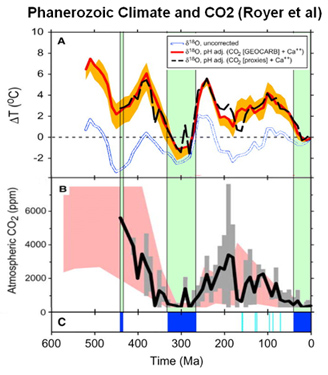
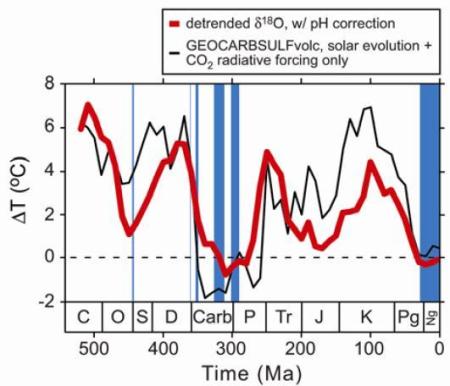
The GEOCARB III project and other research into deep time proxies from the emergence of multicellular life, show that over the last 500 million years the Earth has cycled between an “ice house” and a “greenhouse”, and that we are currently experiencing the low point of a Great Ice Age, with significant glaciation of the polar regions (Royer et al., 2004). Evidence from the previous cold state, the “Permo-Carboniferous”, which had a similar continental layout on the Earth’s surface as today, and could be analogous, shows continued glaciation for around 50 million years. The current Quaternary “ice house” has been running for less than 50 million years and so could be expected to continue.

Current trend of surface temperatures on this timescale : overall cooling since around 250 million years ago (Royer et al., 2004, Figure 4), and currently stable in the low temperature range.

2.3 The 65 million year timescale

The permanent glaciation of Antarctica occurred around 34 million years ago (DeConto and Pollard, 2003, Figure 2c). Commencement of episodic glaciation of the Northern Hemisphere is thought to have been possible since around 25 million years ago (DeConto et al., 2008), and extensive glaciation of the North Pole region occurred around 3 million years ago (Lunt et al., 2008). There is evidence of several major spikes and optima in temperature including the Palaeocene–Eocene Thermal Maximum (PETM) at 55 million years ago (Bloom, 2010; Zachos et al. 2008 Figure 2). These have been attributed to various external forcings such as large volcanic or mantle plume emissions of carbon dioxide and methane from the Earth’s interior, or changes in the deep ocean currents or sea level, causing the sudden release of methane from subsea hydrate provinces (Davy et al., 2010; Bice and Marotzke, 2002). Overall, however, the general trend has been a reduction in temperatures.

Current trend of surface temperatures on this timescale : generally falling.

2.4 The 5 million year timescale

This timescale features climate cycles that change in phase from shorter to longer over the period (Lisiecki and Raymo, 2005, Figure 4, LR04 oxygen 18 isotope proxy for average global ocean temperature). Whilst the most recent cycle peaks are roughly as warm as those at the start of the period, the cycle troughs are cooler. There was near monotonic cooling of the envelope over this timeframe, not perturbed by the onset of permanent Northern Hemisphere glaciation.

Current trend of surface temperatures in this timescale : cooling.

2.5 The 1 million year timescale

Ice cores range back to around 800,000 years, revealing the onset of 9 interglacials (Luthi et al., 2008, Figure 2). Each interglacial period shows relatively sharp warming over a period of several thousands of years, followed by a slow decline in temperatures over the next tens of thousands of years, until conditions cross a threshold and a glacial period begins. Each glacial period is punctuated by multiple relatively rapid and short-lived warmings (interstadials), which are thought to portray roughly 1,470 year cycles of Dansgaard-Oeschger events in Bond cycles, interspersed with Heinrich events (Alley, 2000b, Figure 12.4; Bond and Lotti, 1995; Bond et al., 1997; Bond et al., 2001; Debret et al., 2007; Fluckiger et al, 2006; McInnes, 2008).

The last glacial period began around 116,000 years ago, and terminated around 11,000 to 12,000 years ago, and had around 25 Dansgaard-Oeschger cycles in that period (NGRIP, 2004, Figure 4). The current interglacial, which began roughly 12,000 years ago appears to be more uniform than previous interglacial periods, and has shown a gradual decline in overall temperatures, as do previous interglacial periods.

Current trend of surface temperatures in this timescale : cooling.

2.6 The 20,000 year timescale

The Earth’s climate experienced its Last Glacial Maximum at around 20,000 years ago, with deglaciation tracking the solar forcing (Clark et al., 2009) into the cooler Older Dryas period (that included Heinrich Event H1) starting 18,000 years ago (Shakun and Carlson, 2010). Bolling-Allerod warming starting around 14,500 years ago (Liu et al., 2009), followed by the sharp Northern Hemisphere-focussed cooling of the Younger Dryas period at 12,900 years ago (Broecker, 2006; Murton et al., 2010), and a sharp warming again at around 11,700 years ago (Steffensen et al. 2008, Figure 2), the Termination 1 that heralded the Holocene era. This start to the current interglacial has been compared to Termination 5 which had a similar start-stop-start (“AMOC hysterisis” – Liu et al., 2009) behaviour (Marine Isotope Stage 11 (MIS 11)).

Since the start of the current interglacial period beginning at Termination 1, there have been several cooler periods (stadials), including what is termed the 8.2 kiloyear event (Carlson et al., 2009). The current interglacial period has been characterised by several periods of slightly warmer temperatures, at both millenial and centennial scales, but for the past 6,000 years, temperatures have generally been on the decline. The current interglacial period is expected to last for some time longer – 50,000 years (Berger and Loutre, 2002).

Current trend of surface temperatures in this timescale : cooling.
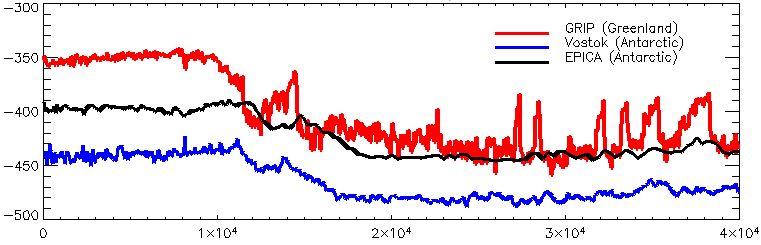
2.7 The last 8,000 years

Within the 8,000 year timescale, there were several significant cooling and warming events identifiable in the Arctic region of the of Late Holocene, under an overall cooling arc, according to data available from the Greenland Ice Sheet Project (GISP 2) (Figure 1). Since approximately 3,500 years BP but prior to the 20th Century, there were four warmer than average centennial-scale periods, with successively lower peaks (Figure 2). Over the 8,000 year timeframe there were approximately 10 cooling-warming cycles, with most periodicities between 500 and 800 years (Kaufman, 2009; Turney, 2005, Figure 5 for one proxy). These are variously considered to be driven by solar cycles (Jiang et al., 2005; Ogurtsov, 2010) or oceanic seesawing (Barker et al., 2009; Maslin et al., 2001; Maslin and Smart, 2009; Seidov et al., 2001; Severinghaus, 2009; Stocker and Johnsen, 2003; Swingedouw et al., 2008). Northern Hemisphere temperatures as a whole do not show the same signature of the Greenland variations in reconstructions (Christiansen and Ljungqvist 2010; Jones and Mann, 2004; Ljungqvist, 2010; Mann et al., 2008, Seppa et al., 2009), and so the underlying causes of Greenland temperature cyclicity cannot be invoked to explain anomalous global warmth in the 20th and 21st Centuries.

Temperatures in Antarctica were more stable, reflecting its climatic isolation, and experienced an overall cooling arc from about 6,000 years BP, having recovered from the 8.2 kiloyear cooling event, which shows a correlate in the Northern Hemisphere record, and can therefore be taken as global in scope. The ice core from EPICA Community at Dronning Maud Land in Antarctica published in 2006 (EDML) shows this clearly (Figure 5), and the EPICA Dome C data also indicates a similar shift (Figure 4). Studies of solar forcing suggest that the cooling trend could continue for another 23,000 years (Imbrie and Imbrie, 1980).

Current trend of surface temperatures on this timescale : cooling.

2.8 The 150 year timeframe

This has been the period of the instrumental record, and has shown rapid warming consistently throughout, which appears to be unprecedented. Although there is evidence of abrupt climate change in recent millenia, these events appear to have been generally sub-decadal, probably associated with changes in oceanic circulation that seem to cross some threshold (Alley, 2003; Alley, 2007; Bond et al., 1999; Broecker, 1997; Broecker, 1999), concentrated (at commencement) or localised in a particular region (Grachev and Severinghaus, 2004; Kobashi et al., 2008; Murton et al. 2010), and if there was a warming, a cooling generally came first (Steffensen et al., 2008). The last 150 years do not resemble this scenario. There appears to have been a departure from cooling trends at around 1880 (indicators point to a range between 1850 to 1910) AD, and a decadal rate of warming that appears significant on a centennial timescale.

Ocean waters in the Arctic and North Atlantic have recently been freshening (Peterson et al., 2006), but it is uncertain if this threatens a collapse of the North Atlantic Meridional Overturning Circulation (AMOC) (Bryden et al., 2005; Garzoli et al., 2010 Section 5 “Fresh Water Balance”, Holmes et al., 2010, Page 2). It seems that the Atlantic circulation has changed its pattern since the advent of the Holocene era (Negre et al., 2010), so may not be subject to the same kind of abrupt climate changes as previously, although this doesn’t rule out rapid swings in future (Alley et al., 2003; Gregory et al., 2005; Lisiecki et al., 2008).

Temporally microfine “abrupt” salinity and temperature anomaly events in the Arctic relate to the natural internal variation of the Northern Atlantic Oscillation (Golubeva and Platov, 2009; Golubeva, 2010; Sundby and Drinkwater 2007), fresh water-induced, “cropped” quasi-Heinrich surges (Ziegler, 2009, pages 16, 98), which may be able to compensate for some of the land surface global warming anomaly by hemispheric oceanic thermal reorganisation (Thompson et al., 2010, Figure 1 “NH – SH”), “pumping” in phased steps driven by threshold conditions, but this periodic “negative feedback” has not interrupted the overall climb in global temperatures (Hansen et al., 2010).

Current trend of surface temperatures on this timescale : warming.


3. Current climatological influences

The current trend for surface temperatures is warming. The principal theory to explain this is additional Greenhouse Effect from mankind’s activities – the Theory of Anthropogenic Global Warming. The IPCC’s Fourth Assessment Report confirms that the core elements of this theory are robust (IPCC, 2007c, Section TS.6 “Robust findings”). Although the theory has been verified in many respects, there are also clear uncertainties, particularly in the area of the Earth’s transient and equilibrium climate change response. The key question is whether the Earth, in responding to the global warming signal, can re-adjust its climate, via a set of negative (dampening) feedbacks, leading to little or no overall temperature change.

3.1 The Burden of Proof

In order to provide evidence of a causative relationship between mankind’s disturbance of the Global Carbon Cycle and putative global warming, certain things have had to be established :-

3.1.1 That the near surface atmosphere and upper ocean temperatures on Earth have been rising.

3.1.2 That so-called Greenhouse Gases cause the Greenhouse Effect, and that increasing Greenhouse Gas concentrations in the atmosphere can cause added Greenhouse Effect.

3.1.3 That concentrations of Greenhouse Gases in the atmosphere are rising.

3.1.4 That mankind’s activities are responsible for increasing levels of Greenhouse Gases in the atmosphere (“fingerprinting” from detection and attribution studies).

3.1.5 That there are no tertiary factors that could be causing any similar magnitude of observed global warming.

3.1.6 That there are no cyclic internal variations in the Earth system that could account for any similar temporary or sustained magnitude of observed global warming.

3.1.7 That the data are accurate.

3.1.8 That climate change (in response to global warming) is not causing negative feedbacks to counteract global warming.

3.1.9 That changes in the Global Carbon Cycle (in response to global warming) do not counteract global warming.

3.2 The Evidence

3.2.1 Global Warming is happening

Robust findings from the IPCC Fourth Assessment Report Working Group 1 established a consensus on the evidence of global warming (IPCC, 2007c, Section TS6.2.1). More detailed understanding continues to be developed, such as the effect of stratospheric water vapour on tropospheric temperatures (Solomon et al., 2010), the irreversibility of warming because of ocean heat content (Solomon et al., 2009); confirmation of strong and continuing ocean heat content (Domingues et al., 2008; Ishii and Kimoto, 2009; Levitus et al., 2009; Lyman et al., 2010) and the string of warming records being broken in the major data sets (including NASA GISS (including “Warm Stations”), NOAA NCDC, Met Office HadCRUT3, RSS and UAH).

Measures have been taken to address the lack of temperature records and proxy temperature data in the Southern Hemisphere, such as the deployment of the ARGO network of ocean monitoring buoys. However the paucity of Southern Hemisphere data does not significantly alter the conclusion that this half of the Earth’s surface is also warming, in step although not in gradient, with the Northern Hemisphere (NASA GISS, 2010).

Differences between the major temperature records have been potentially ascribed to either the way that data is collectively treated and summarised (gridded) or differences in how temperatures are interpolated in the Arctic region from sparse monitoring. Despite this ongoing discussion, it is clear that all the major sources of data show synchronous regional and overall global warming of similar magnitude.

3.2.2 Greenhouse Gases cause the Greenhouse Effect

That Greenhouse Gases can absorb sunlight and re-radiate infrared (the “warming” part of the electromagnetic spectrum) is science that is roughly 150 old (Arrhenius, 1896). It’s basic Physics. Barring some entirely new postulated quantum effect from a particular species of gas or particulate matter found to form part of the atmosphere, or some previously undiscovered property of the Oceans or the solid matter that forms the Earth’s crust, it can be safely asserted that molecular gases with asymmetrical oscillatory modes are the cause of the Greenhouse Effect, keeping the Earth’s surface warmer by around 30 degrees Celsius (IPCC, 2007e, p. 97) than it would be without an atmosphere; as they have a warming effect on their surroundings in the presence of sunlight, through their behaviour in relation to electromagnetic radiation.

3.2.3 Greenhouse Gas Concentrations rising in the atmosphere

The data work on atmospheric species (NOAA, 2010) confirms unambiguously that concentrations of carbon dioxide and other Greenhouse Gases are rising in the Earth’s atmosphere. Methane concentration growth slowed (IPCC, 2007a, p. 7 (135) ), but since 2007 growth in its atmospheric concentration has restarted (Rigby et al., 2008). The oxidation of methane (Boucher et al. 2009) has likely led to an increase in stratospheric water vapour (IPCC, 2007a, p. 24 (152); Myhre et al., 2007). Ozone levels in the troposphere respond to methane concentrations (Fiore et al., 2008), and have also been rising (IPCC, 2007a, p. 3 (131) ). Modifications to the Montreal Protocol contributed to restraining growth in halocarbons, chemistry with high Global Warming Potential.

3.2.4 Fingerprinting Humankind

In detection and attribution studies, progress has been made in clearly “fingerprinting” humankind’s activities as the cause of rising concentrations of atmospheric Greenhouse Gases. The work on the ratios of carbon isotope species has shown that fossil fuel-derived carbon is increasing in the atmosphere. When fossil fuels are burned, they oxidate, and a clear signal of oxygen depletion in the atmosphere has been detected (IPCC, 2007a, Figure 2.3), which outstrips possible effects from deforestation, or the any mass death of photosynthetic life on land, or in the oceans, due to acidification from increased atmospheric carbon dioxide.

3.2.5 Significant External Forcings

In any empirical research that seeks establish the cause or causes of an effect, it is always necessary to consider tertiary factors to the hypothesis – other possible causes that may better explain the outcome. Also, it is necessary to consider indirect causation – that there is a precursor, a factor that causes the cause being considered.

Some influences on temperature in the Earth system are considered to be “external” to the normal climate cycles, and some as inherent “internal” variation (see further down).

3.2.5.1 Radiative Forcing

As a measure of the warming effect at the Earth’s surface, radiative forcing is more “readily calculable” (IPCC, 2007a, p. 5 (133) ) than overall climate sensitivity. The “forces for warming” arise from the composition of the atmosphere, influences from the chemical species, chemical reactions and airborne particulate matter (aerosols) such as dust and ash (Lohmann et al. 2010). There is discussion about whether some effects should be considered feedbacks or primary forcings (IPCC, 2007a, p. 153). There are also complex discussions about the sign of the influence, whether warming or cooling, at different heights in the atmosphere and various regional locations (Alterskaer et al., 2010). One of thorniest issues appears to be whether the forcings should be calculated in a way that discounts (Alterskjaer, 2010) or accounts (Hansen et al., 2005) for the short-term stratospheric response.

There is much agreement that the rapid increase in carbon dioxide in the atmosphere acts as a pulse, an almost instantaneous (in geological timescales) compositional change in the atmosphere and is modelled as such (IPCC, 2007d). There are still some areas of “low” scientific understanding (IPCC, 2007a, Executive Summary), but aside from studies on clouds, these are for chemistry where influence on warming is anticipated to be minor.

One key area of study is the various effects of industrial aerosols, particulate matter and chemical species produced by humankind’s activities such as burning fossil fuels for transport, electricity generation and manufacturing; which go on to reside and react at various regions and levels of the atmosphere (Hansen et al., 2005, p. 35), with various warming or cooling impacts. An example is the direct aerosol effect, the scattering and absorption of incoming solar electromagnetic radiation by airborne particulate matter. Scattering leads to less sunlight reaching the surface of the Earth, and is the key factor in what has been named “Global Dimming”, an effect that has protected the Earth from some global warming (Ramanathan and Feng, 2009). Dust has apparently been identified as a coolant (Mahowald et al., 2010), or has a mixed effect (Kok, 2010). The differences in the temperature records of the Northern and Southern Hemisphere can be partly explained by such studies.

High levels of aerosol in both the stratosphere and the troposphere are the major factors in the net negative radiative forcing at the surface of the Earth (IPCC, 2007a, p. 132, Executive Summary, p. 208, Section 2.9.5), however, the evidence is that Earth is as a whole still warming (IPCC, 2007b, Sections 3.2, 3.8), perhaps exponentially (IPCC, 2007b, Tables 3.2 and 3.3), which must be attributable to the tropospheric radiative forcings summing to a positive, warming value (IPCC, 2007a, p. 205, Section 2.9.2).

If the atmosphere, and the oceans, with which it interacts, were not in constant motion, and if the climate response didn’t include some additional warming (cooling) as positive (negative) feedback, the radiative forcing calculations could lead to straight-forward projections of global warming, but the real world is more complicated than just considering a simple well-mixed atmosphere in stasis on a non-rotating Earth. However, radiative forcing of atmospheric components, expressed in Watts per square metre, helps tease out the relative strength of various unknowns, such as the correct magnitude and sign of the warming influence of solar irradiance change in various parts of the electromagnetic radiation spectrum (Hansen et al., 2005 paragraph 8; Haigh et al., 2010).

3.2.5.2 Volcanic Eruptions

The Mount Pinatubo volcanic eruption in June 1991 afforded a prime opportunity to study the effects of volcanic aerosols in the atmosphere. The analysis showed an intense, but short-lived (less than 5 years), global cooling effect (IPCC, 2007a, pp. 132, 137, 142, 193). Regular volcanic activity does emit carbon dioxide (and methane too by disruption of sequestrated fossilised organic matter) into the atmosphere from the Earth’s crust (Hards, 2005), but measurements of carbon dioxide levels after eruptions do not show any great rise in atmospheric concentrations (NOAA, 2010). So, recent global warming cannot be attributed to volcanism.

3.2.5.3 Solar Irradiance Change

Obviously, the Sun is the primary cause of keeping the Earth’s surface warm, but the rate of recent rise in Earth’s surface temperature does not correlate significantly with changes in solar irradiance output (Lockwood and Frohlich, 2008). Changes in solar activity are considered to account for a small proportion of measured global warming over the last 100 years, but their contribution to global warming of the past 20 – 50 years is vanishing (Ammann et al., 2007; Duffy et al., 2009; Meehl et al., 2004, Lean, 2010; Lockwood, 2010). Solar side-effects such as the solar wind, and its effects on cosmic rays, and their purported effects on the atmosphere and its clouds have not been shown to have any significant effect (Skeptical Science, 2010). There is strong evidence from paleoclimatology that change in solar insolation due to the precession and tilt of the Earth’s axis, and its orbital progression around the Sun have strongly influenced climate cycles in the deep past (see Section 2). But then, as now, change in solar output and insolation have been cyclic or periodic, with quasi-sinusoidal change, whereas current global warming appears to be exponential and unidirectional. Episodic alterations in the spectral distribution of solar output during its short-term 11-year cycles may play a part in variations of the temperature of the near-surface Earth (Haigh et al., 2010), but again, these would be expected to crest and dip on the whole, whereas current global warming appears to be a sustained positive phase change.

3.2.5.4 Land Use Change

Deforestation is said to account for something in the region of 15% of net anthropogenic Greenhouse Gas emissions to air (van der Werf et al., 2009), and so, although it will have long-term, possibly permanent, effects on Earth’s climate, it cannot account for the bulk of recent warming. Nitrous Oxide is a Greenhouse Gas whose rising emissions are attributable to changes in agriculture (IPCC, 2007a), but it has only roughly a third of the effect of methane (IPCC, 2007a, Fig 2.21). Soil erosion and desiccation from agricultural intensification has led to a breakdown in the carbon cycle – less carbon dioxide is sequestered in soils, but the scale of emissions increase cannot account for the levels of warming being measured.

Widescale deforestation and the development of agriculture have been suggested to explain the extremely unusual and stable nature of the Holocene era (Ruddiman et al., 2010), in that the temperatures have not reduced rapidly after the warming spike at the end of the Last Glacial Maximum as they did in previous glacial Terminations, as seen in the ice core records (see Section 2). Global warming has reversed the general cooling trend of the last 6,000 years in the last 150 years or so, which just happens to coincide with vast increases in agricultural production and the exploitation of timber, aided by the use of fossil fuels for energy; but the fossil fuel emissions are by far the largest factor.

3.2.5.5 Rapid warming – alternative mechanisms

There have been several alternative mechanisms proposed for periods of rapid global warming in Earth history, one of which being the mass emission of carbon dioxide and methane during the collision of tectonic plates, triggering ocean anoxia and emissions of warming hydrogen sulphide and mass extinction (Ward, 2006). While there is evidence of anoxic events taking place currently, these seem to be associated with run-off from agricultural and toxic waste into the oceans. There is no evidence of the “ocean conveyor belt” (Lozier, 2010) undergoing major alterations which could allow explanations of large quantities of heat or methane being released to the atmosphere from ocean depths. Although there is evidence of rising methane concentrations in the atmosphere, and methane emissions are causing concern in the melting permafrost and tundra of the Arctic region, these are considered to be an effect of global warming rather than a cause, unlike ancient events (see Section 2).

The current warming can be attributed with high levels of confidence to radiative forcing. Confirmation comes from a wide variety of sources, for example, consideration of the Diurnal Temperature Range, stratospheric cooling, hemispheric and zonal differences in warming, and analysis of extremes and frequencies of extremes in weather.

3.2.6 Significant Internal Variability

The magnitude of the swings in internal variability in the climate can sometimes overwhelm the signal from global warming. However, variability cannot be equated with a trend. The aim of studies into variation must be to establish whether the changes are a result of global warming, or a cause. Here, the most significant internal variability factors are considered.

3.2.6.1 Oscillations – Climate Cycles

The air pressure oscillations and their climatic teleconnections are a significant feature of the Earth system, and it is important to be clear that recent global warming is not merely an upswing in one or more of these climate cycles. There is evidence of multi-decadal waves patterns, but oscillations would need to have a centennial-scale long cycle, or longer, to explain the current warming period.

When analysing climate oscillations it is important not to be misled by anomalies in the data series, which may be due to unrelated factors, or even instrument errors (see “Data Correction” section below). For example, the cooling phase between the late 1960s and early 1970s has been associated with a “Great Salinity Anomaly” in the North Atlantic – which could have been caused by meltdown in the polar region (Peterson et al., 2006, Figure 4; Thompson et al., 2010). Ongoing changes in Arctic precipitation and ice pack could be responsible for future short-term cooling episodes (Dickson et al., 2000, Figure 7; Miller et al., 2010, p. 21 (1699); NSIDC, 2008; Seo et al., 2010).

There is evidence of change in the climate oscillations as measured by their indices over timescales of decades – the patterns of the anomalies have changed as well as the trends (Hurrell et al, 2003, NCAR, 2010; NOAA Data, 2010). This suggests the climate oscillations are being altered by global warming.

There is an inherent problem in trying to assess the indices of the oscillations, as the “base” period on which the calculations of anomalies in the wave patterns are made may not represent a time of stability, as is suggested by the indices datasets themselves (Hurrell and Deser, 2009; NCAR, 2010). The mean of a moving target may not represent a suitable measure from which to judge movement overall.

The underlying trends for oscillations seen in the 1980s to 1990s have not persisted (Osborn, 2010), so some multi-decadal cyclicity could be a component of what is happening, or other factors may be coming into play, such as one-way-only threshold-reliant readjustment of the vertical layers of the atmosphere, or the transport between ocean basins. The evolution of the ENSO could corroborate this (Ashok et al., 2007).

Transformation arithmetic is used to calculate the “normal” patterns of oscillation in the climate of the ocean basins (Empirical Orthogonal Functions (EOF) or Principal Components Analysis (PCA)), and the reported indices are therefore modulation anomalies from these “carrier” wave patterns. However, if the basic modality of the oscillations are themselves subject to change, the approach breaks down at the first assumption (Kellie-Smith, 2010, 4.5 “Conclusion”). New ways to subtract the ENSO signal from global temperatures are being developed (Chen et al., 2008a, p. 5 “contaminates”, Chen et al. 2008b).

At present there is no contender for an oscillation that correlates either its positive or negative phase index, or both, with the global warming trend. A case in point is the Arctic Oscillation (AO), which showed a positive trend in its index throughout several decades, and suggested a correlation with global warming, but has now gone into a severe negative phase, even as 2010 is expected to be the warmest year in the instrumental record.

Combining the indices of the oscillations does not show a general trend, as they are all, to some extent, co-varying with time lags, which would tend to cancel them out. However, the ENSO oscillation, and polar modes including the North Atlantic Oscillation (NAO) seem to lead or greatly influence the others, and could be considered real internal variation.

3.2.6.2 Circulations

There has been some evidence that the ocean circulation patterns are changing in response to global warming (Sherwood et al., 2011; Williams and Grottoli, 2010). However, although highly variable, the strength of the Atlantic Meridional Overturning Circulation (AMOC) does not appear to be suffering significant reduction (RAPID-WATCH, 2010).

As regards air mass circulation, coincident with unusually low indices in the Arctic Oscillation (AO) in recent years, displacement of the jet streams have been implicated in “blocking” events, preventing the usual waves of propagation of anti-cyclones in the Northern Hemisphere (see “Mixed Layers” section below; WMO, 2010). Impacts cited in the popular press included the severe winter of 2009/2010, the extreme heat in Russia in summer 2010 and catastrophic flooding in Pakistan in the same season (Woollings et al., 2010). The IPCC Fourth Assessment states that blocking is trending in step with global warming, but only in the North Pacific in connection with La Nina (IPCC, 2007b, Section 3.5.4 “Blocking”). Recent events suggest it could become more general.

3.2.6.3 Mixed Layers

There is evidence that the tropopause has changed its height (Santer et al., 2003; Schmidt et al., 2008), most likely as a result of global warming, and clearly has implications for planetary waves at the troposphere-stratosphere boundary, jet streams and the annular modes of oscillation at the poles (IPCC, 2007b, Section 3.5.6).

The mixed layer between the atmosphere and the ocean has been showing the effects of ocean warming (Domingues, 2008), and the intensity of tropical hurricanes and other storms near the Equator has been shown to have increased owing to higher sea surface temperatures (Elsner et al. 2008).

These changes all have implications for the near-Earth surface temperatures, but it is determined that they are feedbacks, not causes.

3.2.7 Data Correction

Problems with global temperature data sets relate to a number of issues, including changes in technology, instrument bias and alteration in human systems of data collection. Anyone attempting to perform statistical modelling of climate systems based on the data sets will need to first iron out the data wrinkles, or else their analysis risks being unsound. One example is that of an apparent abrupt dip in sea surface temperatures in the period between 1940 and 1950, which it turns out can be explained as a data problem (Thompson et al., 2008). By using a simple arithmetic technique of subtracting oscillation anomalies (indices) and other well-known factors from the overall temperature records, it has been shown that the effect can be attributed to more measurements being done with one method than another. Another example of data correction is when Dr John Christy and Dr Roy Spencer famously had to retract claims regarding global warming when it was discovered that there were bias errors in satellite monitoring data, when in fact there are no significant difference between the major data sets when adjusted (Thorne et al., 2010).

3.2.8 Climate Feedbacks

There is ongoing research into cooling (negative) feedbacks in the climate system, and whether they could constrain the warming effect of increased concentrations of atmospheric greenhouse gases. If these effects are temporary, they could only offer a short-term reprieve. There has been much discussion around the “fertilisation effect” of increased atmospheric carbon dioxide, and evidence has been found to support that (Lewis et al., 2009), although this could be overwhelmed by future climate changes, including in rainfall patterns and drought (Dai, 2010).

There is some suggestion that global warming, since it leads to a higher level of water vapour sustainable in the atmosphere, could lead to enhanced cloud cover of forms that show increased cooling albedo – as long as this compensates for their added Greenhouse Effect. There remain considerable uncertainties about the role of clouds under current conditions of sharp global warming (IPCC, 2007c, Section TS6.2.1; IPCC, 2007b, Section 3 3.4).

Most feedbacks are found to be positive (warming), enhancing and amplifying global warming. The sensitivity of the climate – the exact level of the full-term warming response to the changes in atmospheric composition – remains uncertain, but is known to be significant (IPCC, 2007d).

3.2.9 Carbon Cycle Feedbacks and consideration of Paleo-Analogies

Given that Anthropogenic Global Warming, as proposed, would disturb the Global Carbon Cycle, possible responses have been assessed to see if they could counteract the warming by increasing the carbon pump or carbon sink effect.

3.2.9.1 Evidence of current Global Carbon Cycle change

There are uncertainties in how the Carbon Cycle will respond (IPCC, 2007f, Section 7.3; IPCC, 2007d, Section 10.4). There are some indications that the “biological pump” of the ocean that draws carbon dioxide down from the atmosphere may be compromised (Boyce et al., 2010). However, it is also possible that for now, the oceans and land plants (although not the soils, perhaps) are taking up the same fraction of carbon dioxide from the atmosphere as ever, meaning more carbon dioxide poached from the air in total (Knorr, 2009; Sarmiento and Gruber, 2002, Figure 3). These changes are best explained as being caused by global warming. Changes in the slow geological sequestration components of the Carbon Cycle are probably not measurable.

3.2.9.2 Paleo-Analogies

It is instructive to look back into the deep past to try to establish how the Global Carbon Cycle initially adjusted to, and then re-adjusted atmospheric carbon dioxide levels. These include the sharp warming occurred at the boundary of the Paleocene and Eocene geological eras (PETM) (Kopp et al., 2007), the mid-Eocene (Bijl et al., 2010), Termination V, MIS 11 (Bowen, 2010) and the mid-Pliocene (Ravelo et al., 2009). None of the periods so far considered can be a perfect analogy, because unfolding conditions are highly anomalous, including a very high rate of atmospheric carbon dioxide accumulation.

4. Conclusions

Recent global warming is a real effect (Thorne et al., 2010), and the only significant correlating relationship is with anthropogenic alteration of the atmosphere, as none of the alternative hypotheses could provide the magnitude or signature of the changes observed. The net emissions to air of greenhouse gases from anthropogenic sources, the side-effects of which include the ejection of aerosols, are altering the net radiative forcing. Having established confidently this is the reason for sustained and increasing global warming, it becomes justifiable to deduct the effects of internal variability and episodic external forcings such as volcanic eruptions from the temperature record in order to reveal the global warming trend. Correcting for data problems, compensating for volcanic episodes and deducting the indices of the major climate oscillations from the temperature record, the largest instantaneous modulations, vastly improves perception of the underlying warming signal (Thompson et al., 2009, Figure 12).

Further work on quantifying the change in climate oscillations could lead to new indices that could be applied to further smooth out the saw tooth nature of the progression of the temperature sensitivity of the climate. It remains for the climate change research community to collectively agree how the “resolved” datasets should be produced and published, showing the “smoother” baseline global warming pulse for public and policy use.

Figures

Figure 1
GISP2 Greenland Ice Sheet Project 2 Ice Core Data (Alley, 2000a; Alley, 2004; Cuffey and Clow, 1997).

Raw data points with a second order polynomial trend line added by Excel, covering data from approximately 12,000 years before present up until approximately 200 years before present to prevent the inclusion of the anomalously warm recent period. The second order polynomial trend line has been added automatically, merely to indicate the most likely point of temperature maximum but does not represent any precision in calculation.

Figure 2
GISP2 Greenland Ice Sheet Project 2 Ice Core Data (Alley, 2000a; Alley, 2004; Cuffey and Clow, 1997).

Raw data points with a second order polynomial trend line added by Excel, covering data from approximately 10,500 years before present up until approximately 200 years before present to prevent the inclusion of the anomalously warm recent period. The second order polynomial trend line has been added automatically, merely to indicate the most likely point of temperature maximum but does not represent any precision in calculation.

Figure 3
Lake Vostok Ice Core Data (Jouzel et al., 1987; Jouzel et al., 1993; Jouzel et al., 1996; Petit et al., 1999).

Raw data points with a second order polynomial trend line added by Excel, covering data from approximately 13,500 years before present up until approximately 200 years before present to prevent the inclusion of the anomalously warm recent period. The second order polynomial trend line has been added automatically, merely to indicate the most likely point of temperature maximum but does not represent any precision in calculation.

Figure 4
EPICA Community Dome C Ice Core Data (Jouzel et al., 2007).

Raw data points with a second order polynomial trend line added by Excel, covering data from approximately 13,000 years before present up until approximately 200 years before present to prevent the inclusion of the anomalously warm recent period. The second order polynomial trend line has been added automatically, merely to indicate the most likely point of temperature maximum but does not represent any precision in calculation.

Figure 5
EPICA Community Dronning Maud Land Ice Core Data (EPICA Community, 2006).

Raw data points with a second order polynomial trend line added by Excel, covering data from approximately 12,500 years before present up until approximately 200 years before present to prevent the inclusion of the anomalously warm recent period. The second order polynomial trend line has been added automatically, merely to indicate the most likely point of temperature maximum but does not represent any precision in calculation.

Abbreviations
ya = years ago, relative to 1950
BP = Before Present, relative to 1950
IPCC = Intergovernmental Panel on Climate Change
AR4 = IPCC Fourth Assessment Report
WG1 = IPCC Working Group 1

Glossary
LLGHG = Long-Lived Greenhouse Gas
ENSO = El Nino Southern Oscillation

References

Categories
Bait & Switch Political Nightmare Social Change

Ra-Ra Cheerleading Democracy

Hi MX,

A few words of insider insight from you could really help me decide how much energy I can personally justify putting in to the Stop Climate Chaos activities this year. In addition, it would colour the replies I give to my colleagues […] who are asking about how much we try to get behind and support and promote Stop Climate Chaos.

The [SCC] coalition meeting audience on Wednesday was assured that if we mobilised and made demands that we, by our efforts, could make the Green Deal strong/effective, that we could “win”. But this could seem a ridiculous waste of time, as the Energy Bill is already very clear about what the Government wants in the Green Deal. What is it that we are fighting for in that case ? Nobody introducing the campaigning plan outline had produced a layman’s guide to the components of the Energy Bill for us to try to digest – no points that we were encouraged to contest.

I discussed this situation with a co-worker of mine and his expression was to call Stop Climate Chaos a “Government chihuahua”. From his analysis, Stop Climate Chaos members are not being asked to “fight” a “campaign” – we are being asked to support what the Government is already intending to do. The top political negotiators are trying to sell us the narrative of “effective campaigning”, but just as in all […] campaigns, there’s nothing to struggle for, only things to assent to. This is just the same as back in the days of Gordon Brown when a fix had already been done at the political level for Make Poverty History, and the masses were invited to come out and wave flags for it. It’s so obviously saccharine, what’s the point of being involved ? And how do I get the energy together to sell engagement to other people ?

I and my colleagues are pleased to offer polite support, and we will even come and wave flags, but where’s the chewy centre ?

As for the summer “challenge” to the energy industries, Greenpeace, as usual, will probably soak up a lot of creative and hormonal energy from those who believe they need to be assertive and proactive, and who feel angry, but again as usual, Greenpeace will be pretty much dismissed by the general public (and given a very long leash by the Government). Is it all about keeping potential troublemakers busy (like the NASA Space Program) ? Quite a number of people I come into contact with prefer to take action outside of the recognised organisations for this very reason.

The basic problem of energy has to be approached in terms of systems – holistic strategies for future low carbon energy provision. This is not going to be addressed by going after individual energy technologies as Greenpeace seem to feel they have to. Where is the generic critique of “technofixes” and the analysis of the likely failings of a number of the components of the current UK energy “plan” ? Where, for example, is Carbon Capture just now ? Is it ever likely to succeed (without the EU and national subsidies proposed) ? I don’t know if I can ask my colleagues to support a technology crucifiction without offering a positive alternative.

I guess I’m ready to stop playing the “campaigning” game. I never believed in it, as a matter of fact. It’s completely artificial, and the drawing together of large, broad consensus, such as Stop Climate Chaos, shows up the failings in the “campaign” language and the theories of social engagement in democracy. I don’t believe that people can be “mobilised” around issues, except maybe at the grassroots, local level. Oh yes, I’ve filled in my fair share of campaign postcards, signed petitions, written e-mails, joined marches, but I can no longer sell this model of political interaction since I am discovering how it’s treated with such patronising attitudes by those who actually make decisions. As long as I am considered a “campaigner” or “environmentalist”, I shall continue to be ignored. I am really neither. I am a systems engineer with a background in electronics engineering and IT.

I don’t think my “democratic” representative gives any consideration to things that truly concern me and that I try to communicate. I don’t think any of the “campaigns” have a clue about what is really needed to solve the Climate Change or Energy emergencies, and they are often dismissive about engineering and systems work that can point the way. Those in the campaign groups that have dialogue with the political system don’t have the bandwidth to really listen to those working on the ground on local issues. There’s an awful lot of listening not going on.

Really, is there any point putting any energy into Stop Climate Chaos ?

___________________________________________________________

Hi Jo

I enjoyed working with you over the weekend – thanks for your useful and enthusiastic contributions. And your observations in your email about the effectiveness or otherwise of campaigning are highly relevant to our next session(s).

I should say that my (heavy) involvement with SCC came to an end c. 2 years ago so I am not that au fait with it now. Let’s discuss this next time we meet in more detail but I would argue that it is worth maintaining membership of SCC (I can’t see that adding your organisation’s name to it can cause any harm […]) whilst carrying out some kind of ‘cost-benefit analysis’ with colleagues (as you have begun to do) so as to decide how much time and money [they want] to devote to supporting its campaigns. I do think the nature of a Coalition Government (with a leader of the opposition who genuinely cares about this stuff) does potentially provide some political leverage which well focussed and run campaigns might capitalise on – and to a large degree the Climate Change Act did come about as a result of a FoE/SCC campaign.

And is it worth [your organisation] considering [signing] up in some way with 38 Degrees and Avaaz?

__________________________________________________________

Hi MX,

It was a fun weekend, was it not ? Our group is a great crowd, and the members have these amazing social roles and incredible in-depth experience, so there’s a wide variety of skill sets and personalities. We could go far.

I do appreciate the time and energy you devoted to the block conference days, and I hope I showed you that I enjoyed the learning and exercises and and your out-there honesty and clearly genuine passion for this work.

I’ve decided that what I really don’t like in campaigning is the promise of political engagement but the complete absence of any real influence.

The way all campaigns seem to be run is that the leaders try and shake everyone’s trees to “come on down, get involved, you can take part, we can win”, but the net result is mere flag waving. We are the sheeple.

It is a lie at the core of the machine, and people back away from that cognitive dissonance even if they don’t recognise it. If it’s numbers you want, you won’t get that by selling the myth of political engagement. Only the lead political negotiators in a campaign organisation stand a chance of real dialogue with those who make the decisions. Everybody else only has the kind of access that allows flag waving.

So campaigning shouldn’t be sold as a dialogue but a tick-the-box petition, maybe. Maybe it should be made more clear that there are skilled elites, and the rest of us are just nay-sayers or yay-nodders. 38 degrees and Avaaz are great examples of just that. That’s fine as long as there’s no sales pitch that suggests otherwise.

Of course [we] are going to stay signed-up to SCC – it’s a very Japanese politeness that insists that we all publicly support each other in the campaigns movement. Solidarity can be highly important – especially over complex issues – as long as they are well-defined.

The question is : is it worth us trying to use the SCC machine to try to launch our own messaging within the channels that exist there ? Is it possible ? The [SCC] coalition “planning” meetings always feel like we are allowed to speak, but not permitted to influence what SCC come up with. It is this entirely contrived “consultation” process that really gets my mountain-roaming bearded farm animal.

Since the ConDems do have some people who care about these issues, and the Civil Service does have some people that actually care about these issues, then why does SCC need to exist ? Does the Government really need flag-waving for its plans ? I doubt it. No “mandate from the people” required. Why do we need to march and protest and demonstrate ? And more importantly, why do we waste everyone’s time asking them to march, protest and demonstrate ?

It’s so much more efficient for me to sell the simple and quick ePetitions to [our] Members. […] They don’t want to be asked to march/protest etc, although some of us do.

Come on – let’s be honest – exactly how much of the work leading up to the Climate Change Act was guided by public pressure ? The NGO political elites handled most of the conversation, and key individuals were involved in promoting public and media debates, and more importantly, there was a lot of synergy because government types had begun to read the EU briefings and could see the way the land lay.

Is it efficient to ask for public input on strategy ? If a government has good advice from real experts, why does the public need to be consulted ? The public often get things wrong technically – the classic example being the completely irrational fear over mobile phone masts, and the fabled cancer dangers of mobile phones, which Caroline Lucas erroneously attached her name to. So, if the public are wrong, why are they told they need to take part in a token form of ra-ra cheerleading democracy ?

It makes my blood boil, etc

__________________________________________________________

Categories
Bait & Switch

Crossing Negativity Event Horizons

https://www.precious-friends.com/

Some days are better than others. Now, ain’t that the truth ?

One of the draining things about the environmental movement over the decades has been the pervasive negativity. It’s almost like it’s deliberate, that somebody somewhere has said to themselves, “let’s try and make the Greens as ineffective as possible by keeping them depressed and obsessed about negatives.”

Well, I stand against that ideology ! Like it says in the Good Book, “Brothers and Sisters, whatever is true, whatever is noble, whatever is right, whatever is pure, whatever is lovely, whatever is admirable – if anything is excellent or praiseworthy – think about such things.”

It’s true that to be true you have to look at the bad stuff. You have to dig into unpleasant histories and unsavoury practices. Corporate polluters have to be exposed. Lies have to be unravelled. Economic ideologies have to be challenged. Energy myths have to be debunked.

But, at the end of the dark tunnel, you need a little lightening up.

Take up your attitude of gratitude – we have concentrated solar power plants. Holy goodness be thanked – we have wind turbines and hydropower (on a suitable scale) and the prospect of oceans of truly natural biogas, and efficiency savings, and low carbon housing and cross-modal transport options and photovoltaics printed on bioplastic and natural ventilation, and woodburning stoves, and, and, the list is genuinely endless…

All these solutions !

Negativity erodes your soul, like flying too close to a black hole. Stay opposed to something for too long and you get pulled over the event horizon into a very dark, pressured place. Hatred ruins the hater.

Let’s hear it for the things we want : cleaner, greener, keener.

What’s the positive direction ?

Categories
Bad Science Science Rules

On Bees and Compromise

From: Avaaz.org
Subject: Bee Safe

Bees are dying off worldwide and our entire food chain is in peril. Scientists blame toxic pesticides and four European governments have already banned them. If we get the US and the EU to join the ban, other governments across the world could follow, and save bees from extinction. Sign the petition and forward this urgent appeal : https://secure.avaaz.org/en/save_the_bees/?cl=895516794&v=8114
_______________________________________________________

From: RT

Scientific research does NOT fault one group of toxic pesticides as the primary cause of colony collapse. Most recently published research into the demise of US bumblebee species, for example, suggests that the varroa mite may be the primary cause – species that harbour the mite are declining and those which don’t are not. The introduction of the varroa mite has certainly aided the spread of viral disease and, whilst insecticide use further weakens bee colonies, the major voice suggesting insecticides as the primary cause is not science nor beekeepers but environmental groups. The Bumble Bee Conservation Trust (BBCT) has asked Avaaz to change their campaign but Avaaz declines to respond. I commented to Avaaz that many of us agree that reducing agricultural insecticide use, generally, would be of great benefit to biodiversity but falsely blaming insecticide use [for] colony collapse will damage our hopes of identifying the real causes and, perhaps, focus action in the wrong direction. BBCT are concerned that another primary cause is habitat loss. Avaaz have done themselves a great disservice, not so much in backing the wrong campaign, but by not bothering to check what research has indicated and by not answering critics.
_______________________________________________________

From: jo abbess

In reply to RT’s helpful and well-informed message from a few days ago, I must add that it is becoming clear to me that opinions differ about pesticide safety in relation to bees – and that’s scientific opinion, not just “campaigning” opinion. For example :-

https://www.naturalnews.com/030921_EPA_pesticides.html

“Leaked document: EPA knowingly approved bee-killing pesticide : Wednesday, January 05, 2011 by: Ethan A. Huff, staff writer : A Colorado beekeeper recently obtained a leaked document revealing that the U.S. Environmental Protection Agency (EPA) knows a popular crop pesticide is killing off honey bees, but has allowed its continued approval anyway. Despite opposition from its own scientists, EPA officials first gave the a-okay to Bayer CropScience’s toxic pesticide clothianidin in 1993 based on the company’s own flawed safety studies. But now it has been revealed that the EPA knew all along about the dangers of clothianidin and decided to just ignore them…”

So, is there a hidden depth to this issue ? Are the various pathogens and parasites in bee populations the only reason for Colony Collapse Disorder ? Or are there other factors ? Is it that the industrial farming of hives – transporting them around the country (in the USA) is damaging their immune response, or is the combination of monoculture agriculture, pesticides and GM crops compromising bee survival ?
_______________________________________________________

From: BM

Buglife is asking you to please write to your local MP to raise awareness of neonicotinoid pesticides, their effects on pollinators and to ask him/her to encourage Lord Henley to act on the Buglife Asks. Please feel free to use the draft letter below. You can find your MP’s address using the following link https://www.parliament.uk/mps-lords-and-offices/mps/

Dear ……,

RE: UK pollinator declines and neonicotinoid pesticides

I would like to draw to your attention a recently leaked memo from a US government agency the Environment Protection Agency, whose scientists warn that bees and other non-target invertebrates are at risk from a new neonicotinoid pesticide and that tests in the approval process are unable to detect environmental damage.

Neonicotinoids are highly toxic to bees and other non-target insects, the biggest concerns are that, being systemic they end up in the pollen and nectar in the flowers of treated crops, and hence could poison pollinators, and that being persistent they could wash into streams, ponds and rivers and destroy aquatic life…
_______________________________________________________

From: RT

Thanks, Jo, but of all the potential causes that you indicated, currently there is little evidence to indicate GM crops as a primary causal agent. Certainly there is evidence that there have been bee population collapses in the past but none, of which we are aware, that matches the current problem in the scale of it’s extent and damage.

My complaint against the Avaaz campaign is that there is a widespread agreement within the scientific community that is studying CCD that there is probably not a single cause, but many that appear to act together.

As I commented, earlier, reducing the use of pesticides is entirely to be recommended – but we should note the evidence suggesting that banning DDT has lead to a resurgence of malaria [SEE NOTE AT BOTTOM OF PAGE]. However, blaming one cause could lead to the others being ignored and we urgently need to stop CCD. Research has suggested that insecticide residue patterns do not suggest that any one pesticide or group is the primary cause. Some very interesting research that was published last year indicate the Israel acute paralysis virus as commonly found in hives that have experienced CCD. Research into the causes of CCD are taking place in the USA and the UK: in the USA, go to the Mid Atlantic Apiculture Research and Extension Consortium at:
https://agdev.anr.udel.edu/maarec/category/ccd/
In the UK, go the Insect Pollinators Initiative at:
https://www.bbsrc.ac.uk/pollinators/
Also keep an eye on the work of Prof Francis Ratnieks at Sussex University:
https://www.sussex.ac.uk/biology/profile128567.html
_______________________________________________________

From: jo abbess

In response to one of RT’s links to the Biotechnology and Biological Sciences Research Council (BBSRC) […], I’d like to point out a few links to the page he mentions :-

https://www.bbsrc.ac.uk/pollinators/

Peer review panel membership :-

Professor John Coggins – University of Glasgow (Chair)
Dr David Aston – BBKA
Professor Tim Benton – University of Leeds
Dr Peter Campbell – Syngenta
Professor Angela Douglas – Cornell University
Dr Jeff Pettis – USDA
Professor Ingemar Fries – Swedish University of Agricultural Sciences
Dr Jane Hill – The University of York
Professor Graham Medley – The University of Warwick
Professor Stuart Reynolds – University of Bath
Dr Susanna Sansone – EBI
Professor Robert Smith – University of Huddersfield (Retired)
Professor Mark Tatchell – Independent

So what are these organisations known only by acronyms ?

The BBKA – British Beekeeping Association is sponsored by pesticide manufacturers
https://www.independent.co.uk/environment/nature/beekeepers-fume-at-associations-endorsement-of-fatal-insecticides-2182243.html
“…The British Beekeepers’ Association has been selling its logo to four European pesticide producers and is believed to have received about £175,000 in return. The active ingredient chemicals in the four pesticides the beekeepers endorsed are synthetic pyrethroids, which are among the most powerful of modern insect-killers…”

Syngenta – a manufacturer of pesticides and GM crops.

The EBI – who do they work for ? The companies include Bayer and Syngenta – both manufacturers of pesticides and GM crops :-
https://www.ebi.ac.uk/industry/ind-prog-index.html

Interestingly, the USDA bee projects are fairly clear about the role that a certain group of pesticides plays in damaging bees :-
https://www.ars.usda.gov/research/projects/projects.htm?accn_no=416636
“Bee Research…Objective: To investigate the effects of several insecticides, primarily but not exclusively neonicotinoids, on honey bee mortality, foraging behavior, and overwintering success…to study the effects of neonicotinoids, a class of pesticides which disrupts foraging behavior and increases mortality of honey bees.”

So, do we believe that the BBSRC work on bee research is entirely neutral ?

When it’s being funded by companies who make pesticides and the companies that work for companies that make pesticides, I would say we could well be dubious.
______________________________________________________

From: TH

Hi Jo,

I don’t think the Independent article is very fair to the BBKA, I guess that’s journalism for you! The BBKAs official position is reasonably clear:
https://www.britishbee.org.uk/news/statements/bbka-strategic-review-the-plant-protection-industr.shtml

Certainly the BBKAs working with industry (which started a quarter of a century ago) does appear to have been effective in reducing colony losses from the applications of the older classes of insecticide. The four products which were endorsed are, Decis (Bayer, deltamethrin), Contest [Fastac] (BASF, alpha-cypermethrin), Hallmark (Syngenta, lambda-cyhalothrin) and Fury (Belchim, zeta-cypermethrin) which are all synthetic pyrethroids, not the neonics currently under suspicion.

Consequently I don’t think your listing of the BBKA among the bad guys is fair. No organisation is perfect, but broadly speaking the BBKA has been in the business of protecting & defending bees for a very long time. Its also a reasonably democratic organisation, which debates issues like this as they evolve.
______________________________________________________

From PDK

Someone from church has got excited about ‘Climate Week’.
https://www.climateweek.com/about-us/
Does anyone know anything about this? It feels a bit greenwashy to me.
______________________________________________________

From: RT

I was at the [Climate Week] launch and faith groups were well represented. It attempts to be an act of refocussing attention and of bringing together those engaged in positive action. I wonder why you feel that it is “a bit greenwashy”?
______________________________________________________

From: RJ

[The] steering committee had a long discussion about this and decided to purposefully not support [Climate Week]. We felt we couldn’t join up with the likes of RBS and EDF to do anything with any integrity.

On the other hand, where awareness is raised, we should make the most of it and have something to say! I’m thinking of writing my march parish magazine article about climate week and haven’t yet decided what to say!….anyone out there want to have a go?!
______________________________________________________

From: PDK

I worried about the messages on their website – it seemed like patting people on the back for doing very small actions that don’t really make a difference (on the homepage it actually talks about ‘doing your bit’). And I was suspicious about the corporate involvement. There is a huge Tesco logo on the homepage – these are the people promoting the message that if you cut down on plastic bags you can save the planet (the poster outside my local branch actually says this). I’m also inclined to agree with the steering committee about RBS and EDF. Still, they’ve got a good range of organisations backing it. (Eat your heart out, Climate Alliance!). If they can mobilise people good luck to them – maybe it needs that kind of mainstream approach. But I probably won’t be getting involved.
______________________________________________________

From: EP

https://www.independent.co.uk/environment/nature/exclusive-bees-facing-a-poisoned-spring-2189267.html

“Exclusive: Bees facing a poisoned spring : New kind of pesticide, widely used in UK, may be helping to kill off the world’s honeybees : By Michael McCarthy, Environment Editor : Thursday, 20 January 2011 : A new generation of pesticides is making honeybees far more susceptible to disease, even at tiny doses, and may be a clue to the mysterious colony collapse disorder that has devastated bees across the world, the US government’s leading bee researcher has found. Yet the discovery has remained unpublished for nearly two years since it was made by the US Department of Agriculture’s Bee Research Laboratory. The release of such a finding from the American government’s own bee lab would put a major question mark over the use of neonicotinoid insecticides – relatively new compounds which mimic the insect-killing properties of nicotine, and which are increasingly used on crops in the US, Britain and around the world. Bayer, the German chemicals giant which developed the insecticides and makes most of them, insists that they are safe for bees if used properly, but they have already been widely linked to bee mortality. The US findings raise questions about the substance used in the bee lab’s experiment, imidacloprid, which was Bayer’s top-selling insecticide in 2009, earning the company £510m. The worry is that neonicotinoids, which are neurotoxins – that is, they attack the central nervous system – are also “systemic”, meaning they are taken up into every part of the plant which is treated with them, including the pollen and nectar. This means that bees and other pollinating insects can absorb them and carry them back to their hives or nests – even if they are not the insecticide’s target species. In Britain, more than 1.4 million acres were treated with the chemical in 2008, as part of total neonicotinoid use of more than 2.5 million acres – about a quarter of Britain’s arable cropland…”

My letter from MAFF 17.1.1989 “All insecticides by their very nature are active against living organisms and therefore pose a risk to both human health and the environment”

______________________________________________________

From: RT

Earlier this week I was present at the first directors meeting of a new trust that was established to preserve access to the River Thames and to protect its ecology. One of the other founders expressed the hope that we could keep our integrity by avoiding companies and organisations that perform acts that are antithetical to the new trust’s aims. I observed that we can only make change by establishing dialogue with those whom we would seek to change and a majority of those present agreed.

This has been a major problem within the environmental movement, perhaps even more generally within the voluntary sector. I have heard people talk of purity but not of change and that, I believe, is fruitless.

The recent comments on bees and on Climate Week both refer to companies which should be avoided, but how then do we change them? Breaking the windows of RBS offices in Scotland may make some people feel good but it hasn’t changed their policies.

I’m sure that I have mentioned on this list before that I am a member of the Aldersgate Group. This came about, in Aldersgate’s early days, because I was able to introduce a think tank to the group and to provide a small link with the Church of England. I remained one of a small number of individual members and have seen the group grow very considerably in membership and influence.

I should explain that Aldersgate is a company and NGO led environmental lobbying organisation which seeks more and more effective environmental legislation. It’s a slow process: about nine months ago I first raised the issue of biodiversity, in two weeks we will have our first roundtable and a working group will begin to consider what we should say both to companies and to government.

Last week we had one of our receptions, in the House of Commons, and listened to Chris Huhne talking about where the Government hopes to go, following Cancun. He didn’t get an easy ride, neither did some of his colleagues, late last year, at another reception at Bank of America to discuss the Green Investment Bank.

There are two points that I think derive from this, the first is that Governments tend to listen to major companies, the second is that many companies are beginning to take a strong stance on environmental protection.

I have the good fortune of regularly meeting with senior representatives of major companies and I generally, but not always, find a depth of understanding and concern on environmental matters. I also find people who are active Christians and many others who retain respect for the Church.

Over the past four or five years I have got some respect, probably unwarranted, for being a little acerbic when it comes to getting the science right! Aldersgate is now being flooded by requests for membership and we are being careful to impose limits so that no sector is over represented. We require that members sign up to our five principles which commence with: “Our long-term economic success depends on a healthy environment and the sustainable use of natural resources.”
https://www.aldersgategroup.org.uk/home

It’s not perfect but it’s a good start and the way in which the group supported my request for taking up biodiversity is, I believe, evidence of good intent. I asked the Natural History Museum team which headed the UK International Year of Biodiversity to advise us and that has been welcomed by Aldersgate and by the NHM. Greenwash still exists but real changes are being made.

Surely, though, there is another point that is wholly relevant to us, Jesus engaged with sinners, even with members of the Roman army of occupation and the hated tax gatherers. Much of his ire is recorded as being directed at the ‘righteous’, at those who had regard for their visible place in society.

I do not have any great regard for Tesco, EDF or RBS – or, indeed, for pesticide manufacturers – but I will talk to them, if I’m given the opportunity. The next Aldersgate event will be hosted by RBS, they are not members and I will take every opportunity to sign them up. I’m still working on HSBC; their head of climate change is an active Anglican.

I do not point to this involvement with any sense of pride: according to Richard Dawkin it is simply down to coincidence, having made a friend in the Compass think tank executive shortly before discovering Aldersgate. I like to think that it is yet another of the wonderful opportunities that God has given me. The most significant point is that other Aldersgate members have proven to be good, concerned people who also want to make change.
______________________________________________________

From: RS

Perhaps different people need to pursue what is good in different ways. I would not feel able to participate in an environmental initiative which included, for instance, RBS, while RBS is a major funder not only of coal developments but of the mining company Vedanta, which is guilty of criminal and abusive behaviour in India (see https://londonminingnetwork.org/tag/vedanta/ ).

If your involvement in such initiatives enables you to put pressure on them to change, then by all means use the opportunity. It’s not something I could do myself.

The extent to which people enter into discussion with companies is a matter of discussion within London Mining Network, for which I work, and different groups take different stances. When the matter involves the rights of communities in the face of large corporations, I think it is essential that their views be taken into account and that we do not attempt to speak on their behalf without their permission, or pronounce as acceptable projects against which communities are fighting.

Jesus engaged with all sorts of individual people as individual people, and always with respect. He did not necessarily therefore accept as legitimate what the institutions for which they worked were doing.
_______________________________________________________

From: RJ

RT, I think it’s fantastic what you’ve done with aldersgate. It did take a while for [us] to come to the [Climate Week] decision we did – personally I flip-flopped from one to the other! But I came to the conclusion that although I totally agree we need to engage with these “sinners”, we shouldn’t do so at the expense of helping their PR unless we think it is worth it. And it is a matter of keeping ourselves from evil. Jesus ate with sinners, but he didn’t get involved in their tax collecting. It’s a hard one though,
_______________________________________________________

From: BM

I am not sure you can change people, unless they want to change. I remember when trade with China started we were all told it would change the Chinese way of doing things and help human rights. I think the jury is still out on this one.

I do think people pressure is having an effect on big companies, and if this in turn has an effect on politicisations, all the better. (maybe science is having an effect on big companies as well).

Jesus was killed for all those things he did, and, although he has put light in many hearts to change their ways, there are still plenty of people out there who would do the same again.

good luck [to] RT
_______________________________________________________

From: jo abbess

I think that cooperation is vital across all sectors.

However, I do not like having my involvement co-opted for somebody’s profit-making agenda.

If I discuss a matter with somebody from the Government or business, I try to ensure that the dialogue is genuine, and that I am talking to the person rather than the organisation. It is only with true and careful human contact that any progress in understanding and commitment can take place.

My pointing out the corporate involvement of the members of the BBSRC research establishment is to highlight the unfortunate possibility of conflict of interest.

We all know that compromise is possible and ubiquitous. The question is, should we welcome people being in a position where they may be coerced into a compromise position ?

I would rather that the bee research is not conducted by scientists who are employed by the pesticide companies. It could put them in a corner at some point.

Plus, I was unhappy about the police mismanagement of the 1st April 2009 Climate Camp in the financial district in London. Kettling people put pressure on the volatile minority. I left the Climate Camp on that day when I saw that the police people had been beating up protestors, and found out that some rather excited persons had broken windows – their passions probably having been roused by the caging of protesters – called “kettling”.

I am very unhappy about the advertising rewards that companies will get from sponsoring Climate Week – such a cheap way to sharpen their brand image ! They don’t have to actually cut corporate emissions, they can just attach their name to the event.

I’m not denigrating real efforts on behalf of companies who are making real changes – for example the Carbon Disclosure Project, the supply chain PAS2050 initiative, and the work of the Carbon Trust has had and will continue to have a major impact on carbon control.

The central problem is compromise. Not all corporate initiatives have value, and we need to keep companies accountable by a variety of means.

For this reason, I applaud the work of organisations such as the Ecumenical Council on Corporate Responsiblity – a grown up approach to asking for responsible behaviour. This is leagues beyond Climate Week in looking towards genuine, lasting, significant outcomes.

_______________________________________________________

NOTE ON DDT AND THE RESURGENCE OF MALARIA

https://en.wikipedia.org/wiki/DDT

“…WHO’s anti-malaria campaign of the 1950s and 1960s relied heavily on DDT and the results were promising, though temporary. Experts tie the resurgence of malaria to multiple factors, including poor leadership, management and funding of malaria control programs; poverty; civil unrest; and increased irrigation. The evolution of resistance to first-generation drugs (e.g. chloroquine) and to insecticides exacerbated the situation. Resistance was largely fueled by often unrestricted agricultural use. Resistance and the harm both to humans and the environment led many governments to restrict or curtail the use of DDT in vector control as well as agriculture…”

Categories
Be Prepared

Humble Compassion : Phil Kingston

https://ignitebristol.net/2010/11/phil-kingston-global-resources/

Categories
Bait & Switch Media Social Change

James Delingpole’s Lying Teeth

[ IRONY ALERT : WARNING ! THIS POST CONTAINS AN ATTEMPT AT HUMOUR. IF YOU TAKE IT SERIOUSLY, YOU ARE IN A BAD PLACE AND NEED TO HAVE A LITTLE LIE DOWN. I THINK THAT JAMES DELINGPOLE IS REPEATING INACCURACIES IN HIS WRITING ON CLIMATE CHANGE, AND HE APPEARS TO BE UNAWARE OF WHAT’S REALLY GOING ON. HE SEEMS TO CRASH FROM BLUNDER TO BLUNDER, BUT NOBODY APPEARS TO BE ALLOWED TO TELL HIM TO STOP, OR GUIDE HIM GENTLY INTO THE LIGHT. NOTHING IN THIS POST IS INTENDED TO BESMIRCH JAMES DELINGPOLE’S CHARACTER, AND I’M SURE HE HAS LOTS OF FRIENDS AND I TRUST HIS WIFE STILL LIKES HIM. WHAT I AM ATTEMPTING TO COMMENT ON IS THE FACT THAT HE HAS MISSED THE FINDINGS FROM SCIENCE, AND APPEARS TO BE SIMPLY REPEATING WHAT HE’S FOUND OUT FROM BIASED SOURCES. I HOPE HIS TEETH ARE NOT AS CROOKED AS THE IMAGE DEPICTS. I’M SURE HE HAS THE WEALTH TO ACCESS A QUALITY, PRIVATE DENTIST, EVEN AS THE REST OF THE NATION’S FANGS GO TO POT THROUGH LACK OF SOCIAL FACILITIES. SMILE. ]

I understand that James Delingpole has not been exposed to the lexicon of science, and so I would hazard to suggest that he is, perhaps, entirely unconscious of the depth, extent, range and expertise of the scientific community, and the strong consensus on matters global warming.

So I must assume that it is not him, but his teeth, that are lying when his web log on the otherwise commendable Daily Telegraph website utters things like this :-

https://blogs.telegraph.co.uk/news/jamesdelingpole/100073116/oh-no-not-another-unbiased-bbc-documentary-about-climate-change/

“…Nurse’s analogy is shabby, dishonest and patently false. The “consensus” on Climate Change; and the “consensus” on medical care bear no similarity whatsoever…The “consensus” on ‘Climate Change’, by contrast, is a figment of Al Gore’s – and, I’m sorry to say, Sir Paul Nurse’s – imagination. It exaggerates the number of scientists who believe in Man Made Global Warming and it grotesquely underestimates the number who have many good reasons for suspecting that there is far, far more to “Climate Change” than anthropogenic CO2. What’s more such “consensus” as there is is an artificial construct. It has not been subjected to the rigour of an open or even semi-open market. It is the creation, almost entirely, of politically-driven funding from US government, from various UN bodies, from the EU, from left-leaning charitable foundations on a scale unprecedented in the history of science…”

James Delingpole’s teeth believe they can pronounce what they like without any validity whatsoever, with no comeback or rebuttal. He has not been orthodontically corrected because people with science degrees tend to ignore James Delingpole – his teeth have the wrong evidential, educational and technical roots, so their enamel is rotten.

Most people with any knowledge, reason, sense, decorum and evidence refuse to waste their good time in contradicting James Delingpole’s artful gnashers, and I must say I too am tempted to laugh and turn the page. What nonsense his teeth are masticating ! They don’t even have the ring of toothiness…sorry “truthiness”.

But just because very few people come back and contest James Delingpole’s teeth’s outrageous and completely unsubstantiated fabrications doesn’t mean his teeth are right. In fact, it means his dental organs are inconsequential uneducated thorns in the flesh.

James Delingpole should take control of his toothy dissemblers, and send them to college, where they can learn the truth about global climate chaos, and stop chattering inanity and falsehood.

Oh, the shame ! To have teeth so polished, yet so unlearned !

Categories
Bait & Switch Energy Change Energy Revival

All You Need Is Plans

Image Credit : Profbrainstorm

Trying to take part in the national debate on future energy technologies is like wandering around the house in the dark – you frequently graze your knees and stub your toes on big things deliberately placed there to get in your way.

Some very well-financed people have been promoting dead duck technological options as if they hold some merit. Plucking a few examples out the air – a new fleet of nuclear power plants (with the risk of leaks and spiralling costs) and a network of carbon capture burial sites (with the risk of leaks and spiralling costs).

You would have thought that now would be a good idea to hatch a plan – an overall Energy policy, a strategy for the implementation of workable and reasonably-priced options that complement each other.

This would show up the uselessness of the engineering dodos such as new nuclear power and carbon capture and storage. To combat non-solutions, all we need is plans.

Well, there’s some movement from the UK Government, as one example, but it’s patchy. As for the social movements – well, that’s another story.

Quite a number of the activist communities still continue to adhere to the model of negative protest against big, old, dirty technology. Every time a piece of news arrives about a technology they don’t like, the “campaign” organisations react critically, defensively.

Every public event and “direct action” centres around things that people don’t want and don’t like. It’s never very happy. Civil society never gets around to forming a concrete positive proposal for how energy should be managed going forward.

To shine a light on this a little – Bill McKibben is just about to waste a whole bunch of his and other peoples’ time and energy on a schedule of “civil disobedience”, but this is likely to have little lasting impact on those who actually make decisions about the production and exploitation of energy resources :-

https://www.christiancentury.org/article/2010-12/disobedience

“Disobedience : Direct action on global warming : Dec 27, 2010 by Bill McKibben : If there was ever an issue about which civil disobedience should not be required, global warming is it…Global warming shouldn’t be a moral question, but because of our inaction it’s become the greatest moral challenge of our time.”

Couched in moral imperatives, Bill McKibben appears to be suggesting that the very best thing we should all do is to go and idle about outside a coal power station, or the like, and risk getting watercannoned, beat up or arrested. As if that helps – which it doesn’t.

There are some engineering people working to propose pragmatic, low cost strategies for implementing significant improvements in energy provision, but their work is not always read properly by the non-governmental organisations and independent groups.

If you’re not an engineer, your eyes tend to glaze over when you see a technical report. You don’t take it in, so you don’t understand the plan. Many social activists regard engineering reports as being simply “vision” and don’t understand the real proposals they contain.

Because activists regularly don’t understand positive proposals for changes in the energy systems, they can’t “get behind” them. So, without a plan, a plan for positive action, the default activist position is negatively opposing bad, old fossil fuel energies.

Struggling against fossil fuel energies and nuclear power is like trying to scramble up a scree slope while its experiencing an avalanche. By being continuously negative, activists don’t get anywhere fast.

Don’t get me wrong – it has been very necessary to follow through on resisting the negative aspects of energy for several years. People have had iconic photo opportunities camped outside massive, sinful coal power plants, or kneeling on an aeroplane runway. The “no” has been witnessed. And I have been a part of that witness.

But now we need to get on to the “yes”.

What is it that we are assenting to ? What changes do we think are practical, pragmatic to implement to drastically reduce carbon dioxide emissions in the United Kingdom.

Here’s just a couple of numbers :-

Biogas (from rotting sewage/food/plants) could provide somewhere between 20% and 50% of our current grid gas needs.
Insulating and draught-proofing buildings could cut Natural Gas use by something of the order of 30%.
Wind power could provide 45% of our electricity.

These are very Big Numbers.

Who says there is no “silver bullet” to fix the energy system ?

Several groups have a good idea on how these and other technologies can be implemented, and they have not been offhandedly ignored or dismissed by those that have the job of administering the country.

So what is it that we want ? And when are we going to have a wind turbine hugging event ? Or a Woodstock at a hydropower lake ?

Love your green energy. Go bless it with incense, chanting and soul.

Categories
Bait & Switch

My Watermelon Moment

Balancing the Books
Arguing for the Big State to solve Climate Change

After three decades of believing that the country can sustain a huge public debt, some credit must be given to the Conservative Liberal-Democrat Coalition for accepting that the public books must become more balanced.

The economic outlook is that, while steep inflation is likely, real productivity and wealth generation in the United Kingdom are unlikely to re-appear. Revenues from North Sea Natural Gas and Oil are long gone. Our national financial position would be broken if the Common Agricultural Policy were ditched tomorrow. The responsible thing, the right thing, is to make sure that the public budget is not tainted with debt. The State and its essential functions must survive.

Offloading assets from the books, whilst not helping with the overall balance of payments, does minimise risk to the future management of the State’s accounts. Outsourcing public services makes eminent sense, as nobody in Government office wants to have the State burdened by enormous pension obligations, or unshakeable employment costs.

It’s easy to understand this “small state” mentality. What is not so easy to understand is how the ConDems are prepared to sacrifice ordinary social securities in order to secure the economic condition of the Government.

What is the real function of the State if not to serve the people ? And how can the State serve the people if there is no common fund that’s generally accessible ? How do we get education for all done with limited central financing, grants and bursaries ? How do we guarantee dignity in care for the elderly and infirm without a large publicly employed workforce ? Are we permitted to justify cutting off the ropes of the safety net for the poor, the children and the vulnerable in order to protect the health of the State pocketbook ?

I think that all political thinkers who value social provision should consider where they pitch their tent. Do they advocate the building up of a Big State that can provide for those who cannot provide for themselves ? Can we build a platform on the idea of the Common Good of taxation and public sector jobs ? Do we want to undercut deprivation by building masses of zero carbon new social housing ? Do we want to preserve the systems of public health and education with adequate funding and staffing ? Do we want to continue to train people, particularly for new technical green jobs ?

Are you a community-minded person ? Will you declare yourself in favour of a truly socialist State ? Are you in favour of re-nationalising energy, water and transport in order to implement the low carbon energy revolution through the most efficient means – centralised publicly funded employment, public ownership of energy, and social provision of insulation ?

Why does the ConDem “Green Deal” smell so bad ? What has crawled into the Energy Bill, died and rotted ? Is it purely compromise ? Or is it the inability of a privatised energy industry to be capable of making the infrastructure and plant changes to de-carbonise the UK ?

Categories
Global Warming Science Rules

Bob Ward Gets Stroppy

LSE’s Bob Ward has had his fill of Climate Change denial already this year, and it’s not even February yet.

I’m on some mailing list or other, to which he sent a copy of his strop directed at the poorly-equipped Global Warming Policy Foundation :-

______________________________________________________________________

Re: Global Warming Policy Foundation donor funding levels revealed…
From: Bob Ward

I am copying below the text of my e-mail, mentioned in […] Guardian article as a letter, to Benny Peiser and David Whitehouse of the Global Warming Policy Foundation. I have, as yet, not received any reply. Please feel free to pass on the e-mail message to anybody who might be interested.

Here is my message to Peiser and Whitehouse:

______________________________________________________________________

From: Bob Ward
Sent: 13 January 2011 11:13
To: ‘benny.peiser@thegwpf.org’; ‘david.whitehouse@thegwpf.org’
Subject: Inaccurate and misleading information on GWPF website

Dear Dr Peiser and Dr Whitehouse,

I am writing to draw your attention to seriously misleading and inaccurate information about global temperature trends which riddles the website of the Global Warming Policy Foundation.

Your website features a page on ‘2010 – An Unexceptional El Nino [sic] Year’, dated 3 December and apparently written by Dr Whitehouse:
https://www.thegwpf.org/the-observatory/1973-2010-an-unexceptional-el-nino-year.html

This webpage bears a number of significant errors, which I invite you to correct as soon as possible.

It states: “2010 will be remembered for just two warm months, attributable to the El Nino [sic] effect, with the rest of the year being nothing but average, or less than average temperature”. This is entirely false. Here is a link to the monthly HadCRUT3 dataset, compiled by the UK Met Office and the University of East Anglia’s Climatic Research Unit, which provides the global average temperature anomaly compared with the 1961-1990 average:
https://hadobs.metoffice.com/hadcrut3/diagnostics/global/nh+sh/
https://hadobs.metoffice.com/hadcrut3/diagnostics/global/nh+sh/monthly

This shows clearly that every month of 2010 (with the data for December not yet published) has been well above average, and indeed each month of 2010 has been one of the ten warmest on record for that month. As you know, El Niño typically recurs every two to seven years, so it cannot be responsible wholly, or even mostly, for the temperature in 2010 being amongst the highest since records began in the 19th century.

[Your] webpage also states “the UK Met Office estimates the temperature anomaly (with respect to the end of the 19th century) for 2010 so far as 0.756 deg C”. This is also inaccurate. Firstly, the Met Office’s HadCRUT3 database expresses the temperature anomaly relative to the 1961-1990 average (not the “end of the 19th century”). Secondly the anomaly for the first 10 months of the year was 0.499°C, not 0.756ºC.

[Your] webpage then purports to provide a breakdown month by month of global average temperature (presumably based on HadCRUT3). However, this breakdown appears to be based on the CRUTEM3 dataset (to which you provide a link) compiled by the University of East Anglia’s Climatic Research Unit (which you do not acknowledge):
https://www.cru.uea.ac.uk/cru/data/temperature/#datdow
https://www.cru.uea.ac.uk/cru/data/temperature/crutem3gl.txt

It seems that you are unaware that CRUTEM3 provides surface temperature land measurements only i.e. it contains no data about the 65.7% of the Earth’s surface which is covered by ocean. If you compare HadCRUT3 with CRUTEM3 you can see that the magnitude of the monthly anomalies are very different, although both still show that 2010 was an exceptionally warm year.

Your website then compounds these serious errors with another webpage, headed ‘2010: An Even More Unexceptional Year’, dated 8 December and also apparently written by Dr Whitehouse: https://www.thegwpf.org/the-observatory/2006-2010-an-even-more-unexceptional-year.html

It too contains multiple serious errors which I invite you to correct.

This page begins by providing a link to the webpage on ‘2010 – An Unexceptional El Nino [sic] Year’ and describing it as an “analysis of 2010 based on Met Office temperature data”. I do not know whether these persistently inaccurate references to your source is the result of gross sloppiness or a deliberate attempt to avoid giving credit to the University of East Anglia’s Climatic Research Unit.

This webpage purports to compare your analysis of CRUTEM3 with “other global temperature data sets that are more comprehensive”. It then claims to present an analysis “from the UK Met Office”. But your analysis does not match the HadCRUT3 data and, incredibly, this page provides a link to the CRUTEM3 dataset again. It seems that you are thoroughly confused about the differences between the datasets compiled by the Met Office and the University of East Anglia’s Climatic Research Unit.

The webpage then presents a monthly breakdown of the global temperature data compiled by the National Climatic Data Center of the National Oceanic and Atmospheric Administration. However, your analysis contains numerous errors, for instance claiming that May 2010 was cooler than May 1998 when in fact the temperature was statistically tied as the warmest on record, and claiming that June 2010 was cooler than June 1998 when it was in fact warmer and tied with June 2005 for the warmest on record.

The webpage also states that for the NCDC database “it is possible that 2010 will tie with 1998, or possible [sic] exceed it”. This is misleading as it implies that 1998 was the warmest year, when in fact 2005 was according to this record. The webpage then makes the inaccurate statement that if 2010 is warmer than 1998 “it would be due to the warm months March-June due to El Nino [sic] and not the sign of AGW”. In fact, again, as El Niño recurs on average every 2 to 7 years, it cannot be wholly or even mostly responsible for the fact that 2010 tied with 2005 as the warmest year since the NCDC record began in 1880.

The webpage also presents a monthly breakdown of the global temperature data compiled by the NASA Goddard Institute for Space Studies. However, your analysis contains numerous errors, for instance claiming that June 2010 was cooler than June 2006 when it they recorded the same temperatures, and claiming that July 2010 was cooler than May 2003 when in fact it was warmer.

You also claim that the NASA-GISS record showed that the average temperature for the 11 months to the end of November 2010 was lower than for the comparable period in 2007 and 2005. This is also completely wrong, as this period in 2010 was the warmest on record according to NASA-GISS, as this media release makes clear:
https://data.giss.nasa.gov/gistemp/2010november/

Furthermore, the home page of your website features a graph with the title ’21st Century Global Mean Temperature’. As Dr Peiser confirmed in an e-mail to me on 1 December 2009, this graph is supposed to represent the HadCRUT3 dataset. As I have pointed out on many previous occasions, your graph does not correspond to the HadCRUT3 dataset on the Met Office’s website, particularly by wrongly showing 2009 as cooler than both 2006 and 2007:
https://hadobs.metoffice.com/hadcrut3/diagnostics/global/nh+sh/
https://hadobs.metoffice.com/hadcrut3/diagnostics/global/nh+sh/annual

Despite my requests you have so far refused to correct the graph. I expect that you will update your graph when the HadCRUT3 dataset is updated with the figure for 2010. I suggest you also use that as an opportunity to correct the other mistakes in the graph.

In addition, the choice of 2001 as the starting point for your graph, as I am sure you are aware, hides the significant and unequivocal rise in global average temperature that occurred during the 20th century. As you choose to ignore the temperature record prior to 2001, visitors to your website cannot appreciate that 9 of the 10 warmest years on record have all occurred since 2000. Perhaps when you update your graph you could also make it less misleading in this respect?

Given these multiple and systematic inaccuracies in your presentation of data relating to global average temperatures, it is surprising that some journalists have been citing your information in their reports as if it was reliable. I am also surprised that the Foundation continues to claim to be an educational charity when you are disseminating such inaccurate information through your website. Or perhaps your secret sponsors are funding you to mislead the public and the media?

Yours sincerely,

Bob Ward

Policy and Communications Director
Grantham Research Institute on Climate Change and the Environment
London School of Economics and Political Science
Houghton Street
London WC2A 2AE
https://www.lse.ac.uk/grantham

______________________________________________________________________

Categories
Bait & Switch Behaviour Changeling Burning Money Corporate Pressure Delay and Deny Divide & Rule Economic Implosion Emissions Impossible Energy Change Energy Revival Green Investment Growth Paradigm Major Shift Optimistic Generation Peak Emissions Protest & Survive Public Relations Regulatory Ultimatum Resource Curse Voluntary Behaviour Change Wasted Resource

It’s not greed…

Image Credit : G. William Domhoff

In conversation yesterday evening somebody summarised the behaviour of banks and the energy industry as “greedy”, but I simply could not agree.

“It’s not greed”, I said, “most people are just trying to make a living.”

The corporations have an obligation to make profits for their shareholders, business managers have to be pragmatic, governments have to negotiate compromises and consumers are just looking to make the best use of their cash.

This is how we find ourselves locked into a vicious cycle of energy waste, through the production and use of cheap fossil fuels.

Fossil fuels are so cheap, nobody can spare the investment budget to make vehicles and power generation more efficient. Natural Gas is so relatively inexpensive that it’s cheaper to heat leaky homes than insulate them. Petroleum is so cheap (even with the rising global trade price and proposed increased taxes in the UK) that a high proportion of its energy value is wasted.

“It’s not greed,” I said, “look at who owns the wealth. The overwhelming proportion of people don’t have any control. They’re just trying to get by.”

To talk of “greed” anthropomorphises the machine of the economy, imbues it with a human emotion where it has none. To say that bankers are “greedy”, or that corporations and their Chief Executive Officers are “evil” entirely misses the point. Almost everybody is employed by somebody else, and has to follow instructions.

Even High Net Worth Individuals are under pressure to respond to their “electorates”, those who consume their intellectual property rights.

However, “just following orders” is no excuse to let people off the hook when it comes to carbon emissions, just like it is no excuse for war crimes.

But it’s not “greed”.

That would imply guilt, but guilt is not a lever that can be used successfully to correct excess carbon emissions.

Image Credit : Make Wealth History

Categories
Big Picture Dead End Energy Change Energy Revival Engineering Marvel Environmental Howzat Fossilised Fuels Incalculable Disaster Nuclear Nuisance Nuclear Shambles Oil Change Protest & Survive Regulatory Ultimatum Resource Curse Technological Sideshow Toxic Hazard Unconventional Foul Unnatural Gas

The Gamechanger

Gasland at the ICA London : 17 – 27 Jan, 4 – 6, 11 – 13, 16 – 17, 19, 26 – 27 Feb 2011

The public propaganda budget for most energy and mining companies is eensy weensy compared to the profits they can make by polluting and stealing.

Are you ready for another American energy myth ? Yes, the country with the energy production “community” that brought you the Gulf of Mexico spill disaster of April 2010, is now threatening groundwater pollution and seismic shocks at a county near you in the United Kingdom.

A glimpse of the public relations that have led up to this can be seen very easily by using an Internet Search Engine using an Internet Browser (like Google running on Google Chrome, for example), using the search term : “shale gas gamechanger”.

That little word “gamechanger” has been soaking through the business, engineering and financial press in relation to “unconventional” gas for at least six months. Everybody digests this word in connection with information touting the magical promise of virtually free gas in the rocks beneath our feet. And then they repeat the concept and this little sales word to others. It’s gone completely viral.

Roger Harrabin of the BBC (thanks, Roger) brings word that the Tyndall Centre for Climate Change Research has recommended a moratorium on shale gas operations until more science is known about the results of the engineering :-

https://www.bbc.co.uk/news/science-environment-12190810

“…”We are aware that there have been reports from US of issues linked to some shale gas projects,” a spokesman for the Department of Energy and Climate Change (Decc) told BBC News. “However, we understand that these are only in a few cases and that Cuadrilla (the firm testing for shale gas in Lancashire) has made it clear that there is no likelihood of environmental damage and that it is applying technical expertise and exercising the utmost care as it takes drilling and testing forward.”…”

So who is this company “Cuadrilla” ?

It is an entity formed from one Australian engineering giant and one American financial giant, seeking to propagate the American way of life of developing “new” energy resources :-

https://www.mining-reporter.com/index.php/component/content/article/653-lucas/2867-riverstone-llc-invests-us58-million-in-cuadrilla-resources-

“…Lucas announced that the Riverstone/Carlyle Global Energy and Power Funds, a group of energy-focused private equity funds managed by Riverstone Holdings LLC, has committed to subscribe US$58.0 million for equity in Cuadrilla Resources Holding Ltd, the holding company established by Lucas to hold its investment for unconventional hydrocarbons exploration and development in Europe.”

“Lucas was a founding shareholder in Cuadrilla and has supported the management team since the company’s inception. Lucas’ total investment as of today’s date amounts to A$52.4 million.
Cuadrilla has applied for, and in some cases been granted, exploration licences totalling in excess of 1.5 million acres in the UK, Holland, Spain and Poland. In addition, Cuadrilla has designed, overseen the manufacture of and delivered state of the art cementing and fracture stimulation equipment and is soon to take delivery of a DrillMec HH220 top drive rig.”

So, does this technology actually work safely ?

Nobody really knows, is the short answer.

https://www.tyndall.ac.uk/shalegasreport

“…Funded by the Cooperative, the Tyndall report demonstrates how the extraction of shale gas risks seriously contaminating ground and surface waters. In this regard alone, there should be a moratorium on shale gas development until a there is a much more thorough understanding of the extraction process…”

Why do we continue to have American companies imprinting their business models on the UK ? We have to have their “independent” nuclear deterrent, their behemoth nuclear reactor construction companies, their health insurance companies, their failed genetically modified crops, their privatised prison and school and health centre management policies, their tax concepts, their social control policies, even their zeal for state terrorism…sorry…”The War against Terror”. And nobody seeks to question why we have to copycat everything the Americans do, even when it goes badly wrong.

Why can’t we have a War against Error ?

We need a real “regime change” here – we need to say a big no to American energy policy. And that starts with asking a few questions about the way American companies do business.

Here’s just one example of the sort of practice that the people behind Cuadrilla get up to :-

https://en.wikipedia.org/wiki/Carlyle_Group

“In 2000, Carlyle entered into a joint venture with Riverstone Holdings, an energy and power focused private equity firm founded by former Goldman Sachs investment bankers. In March 2009, New York State and federal authorities began an investigation into payments made by Carlyle and Riverstone to placement agents allegedly made in exchange for investments from the New York State Common Retirement System, the state’s pension fund. It was alleged that these payments were in fact bribes or kickbacks, made to pension officials who have been under investigation by New York State Attorney General, Andrew Cuomo. In May 2009, Carlyle agreed to pay $20 million in a settlement with Cuomo and accepted changes to its fundraising practices.”

And you trust these people with the right motives when agreeing to finance shale gas exploitation in Europe ?

A. J. Lucas Group is the engineering partner in this enterprise :-

https://markets.ft.com/tearsheets/businessProfile.asp?s=AJL:ASX

“The Company’s Oil and Gas segment is engaged in the exploration for and commercialization of hydrocarbons in Australia, Canada, United States and Europe. As of June 30, 2010, the Company held 56.95% interest in Cuadrilla Resources Corporation Limited (Cuadrilla).”

Starting with Blackpool’s Pleasure Beach, they appear to want to dig up the whole of Lancashire :-

https://www.channel4.com/news/shale-gas-striking-gold-in-blackpool

“Mr Cornelius said Cuadrilla would begin the extraction process in early January and would hope to have its first flare – gas burning at the surface – by early February.”

“If successful, the find would be extremely significant given Britain’s dwindling energy resources and our increasing reliance on imported gas. Cuadrilla had previously said the amount of shale gas in the Bowland site could meet as much as 5 to 10 per cent of Britain’s energy resources.”

“Now, after the first samples have been analysed, the suspicion is that the Lancashire fields could hold a lot more.”

“Now one site has been explored, the drilling rig will be moved to another site on the Bowland Shale to assess the size of the gas field overall. If those explorations also prove successful, then Cuadrilla will look to sell the entire operation to a large exploration company, like Shell, to carry out the expensive and time-consuming production process.”

Somebody has to say no to this. That somebody could be you.

What does shale gas “fracking” do to land, peoples and communities ?

Come and find out :-

https://www.culturecritic.co.uk/competitions/win-a-pair-of-tickets-to-the-premiere-of-gasland/

“GASLAND : Opening 17 January 2011 : Winner – Special Jury Prize – Sundance Film Festival 2010 : Nominated – Grand Jury Prize – Sundance film Festival 2010 : A frightening documentary that follows director Josh Fox as he attempts to uncover the truth about Halliburton-developed procedures for drilling for natural gas (known as hydraulic fracturing, or ‘fracking’). When Fox is offered $100,000 for drilling rights to land he owns in Pennsylvania, his subsequent cross-country investigative odyssey lands him in communities contaminated by chemical waste caused by ‘fracking’ (the residents of one town are able to light their drinking water on fire). Another in a long line of essential environmental documentaries – each of which seems to be more alarming and compelling than the last…”

Come along and watch your own hellish future if you are unlucky enough to sit on top of gas-bearing rock formations :-

https://www.ica.org.uk/?lid=27269

“Gasland
17 – 27 Jan, 4 – 6, 11 – 13, 16 – 17, 19, 26 – 27 Feb 2011
A frightening documentary that follows director Josh Fox as he attempts to uncover the truth about Halliburton-developed procedures for drilling for natural gas (known as hydraulic fracturing, or ‘fracking’). When Fox is offered $100,000 for drilling rights to land he owns in Pennsylvania, his subsequent cross-country investigative odyssey lands him in communities contaminated by chemical waste caused by ‘fracking’ (the residents of one town are able to light their drinking water on fire). Director Q&A plus panel discussion : After the premiere on 17 January there will be a discussion panel afterwards comprising the director Josh Fox, along with representatives from The Co-operative and WWF.”…”

Here’s just a few links to peoples groups opposed to the engineering of unconventional gas :-
https://nofracking.com/
https://durangoherald.com/article/20110116/NEWS01/701169903/-1/s
https://www.marcellusprotest.org/
https://www.atlantic.sierraclub.ca/en/we-are-fracking-out
https://dearsusquehanna.blogspot.com/2011/01/fracking-to-pollute-water-air.html

It’s time our authorities read between the lines and regulated this practice away from Europe.

If we had a sparsely populated continent with lots of unused land, then maybe it might be OK. But with the risks still fully unquantified, we should keep this engineering out of well-populated and ecologically sensitive areas, particularly areas with water courses and farmland.

Categories
Climate Change Climate Chaos Global Warming

It’s just La Nina #2

Data Credit : NASA GISS

As I said, the current year of unceasing rain is nothing to worry about – it’s just La Nina (according to the Independent’s Steve Connor, anyway) :-

https://www.independent.co.uk/news/world/australasia/this-isnt-about-climate-change-ndash-but-it-may-be-the-face-of-the-future-2185153.html

“Scientists have emphasised that none of the three extreme weather events occurring now can be linked directly to global warming. Two of them, the floods in Australia and Sri Lanka, may be connected with a naturally occurring climatic phenomenon in the Pacific Ocean, called La Niña, whereas the landslides in Brazil are the result of heavy, localised downpours falling on badly constructed homes built precariously on steep hillsides.”

“It is almost certain that La Niña is behind the Queensland floods. La Niña, which means “little girl”, is a change in the Pacific Ocean where a body of relatively cold water wells up over the equatorial region, causing a corresponding build-up of warm water in the western regions near Indonesia and Australia.”

“This warm water usually dissipates to the east in non-La Niña years. This year, however, is the strongest La Niña since 1974, and the warm water around Australia and Indonesia, with nowhere to escape, has generated heavy rain clouds that have burst over Queensland.”

“In 1974, when Queensland also suffered heavy flooding, La Niña was stronger then than at any time on record. Sri Lanka remained dry that time, but this time there is evidence that some of the warm moist air has blown further west, just nudging Sri Lanka into torrential downpours, according to Adam Scaife, head of long-range forecasting at the Met Office.”

“”Rainfall is expected to increase in a warmer world but in this case it’s linked with the La Niña cycle. It’s a natural cycle and we don’t expect it to change in the future. This is not a climate-change issue, it’s La Niña, and it’s happened before and will happen again,” Dr Scaife said.”

So, no discussion of how the El Niño Southern Oscillation (ENSO) is changing ?

It’s the overall ENSO pattern that counts. It shows both El Niño phases and La Niña phases, and it appears to be changing :-

https://www.cgd.ucar.edu/cas/catalog/climind/TNI_N34/index.html

https://www.azimuthproject.org/azimuth/show/ENSO

Just a few references :-

Matei et al. (2008). “Subtropical Forcing of Tropical Pacific Climate and Decadal ENSO Modulation”. Journal of Climate, DOI: 10.1175/2008JCLI2075.1

Ashok et al. (2007). “El Niño Modoki and its possible teleconnection”. Journal of Geophysical Research, 2007, vol. 112, no. C11″

And some notes :-

https://onlinelibrary.wiley.com/doi/10.1002/hyp.7200/abstract

https://www.skepticalscience.com/el-nino-southern-oscillation.htm

https://www.realclimate.org/index.php/archives/2008/07/global-trends-and-enso/

https://www.azimuthproject.org/azimuth/show/ENSO

https://sites.google.com/site/whythe2009winterissocold/

Categories
Climate Change Climate Chaos Extreme Weather Floodstorm Incalculable Disaster Landslide Mudslide Rainstorm The Data

It’s just La Nina #1

Categories
Climate Change Climate Chaos Energy Change Energy Revival Global Warming Meltdown Social Change

Tears like rain


OceanLab – Miracle (Official Music Video)

Oceanlab | Myspace Music Videos

Categories
Global Singeing Global Warming Regulatory Ultimatum

December was cold

December 2010 was cold, wasn’t it ? Until then it looked like we were heading for some sort of record global temperature average…We did ? You mean to say 2010 as a whole tied for the hottest ever year ever in recorded instrumental data on Earth, ever ?

What about all those Internet posts about the global temperature cooling since 1998, or 2001 ? They can’t all be wrong, can they ? It’s so easy to fabricate with statistics – line graphs can be misleading. What does the Blob Chart say ? :-

No, it’s data from a Government Agency. We can’t trust data from a Government Agency, can we ? We all know the NASA Space Program was about keeping brilliant people occupied with national vanity projects. All that head spinning. We can’t believe anything they say, surely ? Somebody must have messed up here – somebody must be lying or fiddling the figures ?

I mean, if the global temperatures were really this high, and rising so consistently, the governments of the world would be taking serious measures to keep the planet cool, wouldn’t they ? Oh, but we can’t trust the governments, can we ?

We can probably take the following message home : the planet’s frying, but nobody’s organised enough to put out the fire.

Questions of the day : when does “soft” power on Climate Change get converted to “hard” power ? When do trade agreements get swapped for trade wars ? When do voluntary measures become mandatory dictates ? Which multinational fossil fuel energy company starts squirming as they realise their business domination is about to be terminated by geophysical realities ? Which OPEC country first issues a statement on future renewable energy directions ? Which nation or international organisation is most likely to start setting the rules and regulations on carbon dioxide emissions ? And how will they keep us all on the straight and narrow ? Will China really set emissions limits at home ? And which NASA satellites will be used to check that they mean what they say ?

Categories
Climate Change Climate Chaos Floodstorm Rainstorm

The Year of Unceasing Rain #5

On average, 2010 seems to have been as hot as 2005, which was probably the hottest year ever recorded, according to NOAA :-

https://www.noaanews.noaa.gov/stories2011/20110112_globalstats.html

Whatever the other datasets show, 2010 was certainly one unusually warm year, definitely in the warmest. Yet what interests me more is that it was also the wettest.

Rain got dumped around the world, in large, emptying-the-bath type events. The heavens really opened. Sheets of rain fell suddenly out of the skies.

One report of serious rainfall and flooding (or storms and flooding) was followed by another, and another. It was subjectively a year of unceasing rain, even before the objective records were counted.

There was Central America of course. And parts of deep Europe. Then Pakistan, which nobody could have missed. There were major Typhoons causing untold havoc in East Asia. The Caribbean was not spared. Parts of the United States of America became swampland.

Even though the BBC have only just woken up to the fact that the East Coast of Australia is suffering unusually high levels of precipitation, torrential rain and flooding have been going on there for at least a month :-

https://www.smh.com.au/environment/weather/hundreds-cut-off-by-deadly-floods-20101208-18pxi.html

It’s so significant, it’s even got its own Wikipedia page :-

https://en.wikipedia.org/wiki/2010%E2%80%932011_Queensland_floods

https://www.bbc.co.uk/news/world-asia-pacific-12173846

The BBC TV News anchormen and anchorwomen think that we can all breath a sigh of relief because the peak of the Brisbane flood wasn’t as bad as had been feared, but seriously, it’s laughable to try to find something positive about what’s happening.

Unfortunately, things could still continue to get worse, even in Brisbane.

Check the live satellite :-

Wake up, Ms and Mr BBC news correspondent ! This is a major, persisting crisis, and it’s not over yet.

Categories
Energy Change Energy Revival Social Change

What are we fighting for ?

Climate Change activists are often portrayed as being highly negative. A commonly-utilised media construct is that we must be mad because we’re against everything. Environmentalists have blocked the development of the Severn Barrage which would have produced 5% of the UK’s power. Excuse me ? Do you want renewable power, or don’t you ?

2011 will be a good year to explain what we are actually fighting for.

We must continue to struggle against self-defeating technologies that don’t fulfil their promises – like vehicle Biofuels, pipedreams like Algae BioDiesel, military exercises like Nuclear Power, flat-out failures like Carbon Capture, and yes, the limitations of some of the Severn Barrage schemes. But we also need to get loud about truly Green Energy.

We’re not just fighting for a kind of unrealistic Utopia, self-sufficiency on a vegan farm, knitting our own flat caps, making solar power with mirrors and duct tape, and learning how to press our own tofu.

No matter how cool it is to be off-grid and downshifted, not everybody can aspire to that kind of lifestyle. Not everybody has the skills, health or monetary resources to build their own wind turbine and wattle-and-daub hut.

We need environmental socialism – we need collectively organised Renewable Energy networks.

I cannot see the current large energy companies wanting to take on the complete makeover of energy production that is required, so I expect national publicly-financed projects will become essential to get this job done.

I also expect some of the energy companies will continue kicking and screaming about this re-nationalisation of energy. But you have to be aware of something rather important – in the medium term, the Great Energy Revival is inevitable. And if BP, Shell, ExxonMobil, Chevron, E.On, RWE npower, EdF and the rest don’t want to pay up to de-carbonise, then these corporate entities will have passed their useful shelf life.

Most of the fossil fuel energy companies will need to adapt to survive, and if you or anybody you know has money invested in fossil fuel energy companies, you and they need to think carefully about what could possibly happen to these holdings.

As for energy-producing countries such as the members of OPEC, they will experience increasing reasons to diversify out of fossil fuels. The rest of the world will gradually lose its ability to pay for their petroleum and Natural Gas, either through further economic collapse or carbon pricing. Added to that, their fields will continue to deplete and run dry.

Solar power is the future wealth of countries like Saudi Arabia, just as it is for many other countries, but this will require a huge shift in vision and engineering focus.

This changeover in energy could be very destabilising, and this is where Climate Change activists have a Big Goal :-

1. The peaceful and just transition of all energy systems to provide non-polluting, zero carbon resources.

We want stability and non-violent change, no matter what environmental demonstrators are accused of, repeatedly, in all forms of mass media. This revolution will have no weapons.

With time, large components of the current energy system will begin to crumble, partly for want of new investment in infrastructure by privately-owned enterprises. For example, it costs a lot to build a new power station, and most companies won’t do it without state support of one kind or another, and they call themselves free marketeers !

Operational and maintenance cost-shaving is already leading to increasing levels of accidents, spills, explosions, leaks and corrosions.

This doesn’t happen because of evil or greed – it’s simply a natural consequence of the legal obligation of energy companies to make as much profit as they can for their shareholders.

Many people do not understand the parlous state of the current energy systems, and haven’t yet realised that the health of the general Economy is tightly coupled to energy, so this is Big Aim Number 2 :-

2. The education of the populations and their governments about the risks of the current energy systems – Climate Change, environmental pollution, health risks, economic risks, social deprivation and social collapse.

Most activists are highly individual people and keen to maintain their personal freedoms – there’s not much distance between Anarchy and “Conservative” Libertarianism after all – yet, even so, activists generally accept that collective action and social responsibility for energy are necessary.

The changes that are needed in the energy systems are huge :-

https://climateprogress.org/2011/01/10/the-full-global-warming-solution-how-the-world-can-stabilize-at-350-to-450-ppm/

and this will come about either through a series of crises, or through a structured comprehensive strategy. Announcing new nuclear power stations which just replace those that are going to be closed doesn’t really meet this requirement.

Where, I ask you, is the Grand Plan for Energy ?

This is another Big Objective :-

3. A comprehensive social contract between governments, enterprise and the people to exchange carbon energy systems for zero carbon energy systems.

Energy companies need to satisfy the will of the people and the dictates of the Low Carbon Transition – not the directive of profit-making.

This will be a big change in the way things currently are, but it is inevitable that public utilities – energy, water and transport, will once more become publicly managed.

Everybody has to work for this project – and there has to be a strategy to make sure that happens, which means it has to be driven by public policy. It entails Green Jobs, legally binding Green Procurement for all public and private contracts, Green Enterprise Management and Green Government.

What would a Big Plan for Energy Revival look like ? We already have answers :-

Zero Carbon Britain has been adopted by the newly-formed Climate Alliance.

Mark Jacobson and Mark Delucchi are two American academics who have proposed a complete exchange of the energy sytems.

M. Z. Jacobson and M. A. Delucchi, “Evaluating the Feasibility of Meeting All Global Energy Needs with Wind, Water, and Solar Power, Part I: Technologies, Energy Resources, Quantities and Areas of Infrastructure, and Materials,” /Energy Policy/, doi:10.1016/j.enpol.2010.11.040 (2010).

M. A. Delucchi and M. Z. Jacobson, “Evaluating the Feasibility of Meeting All Global Energy Needs with Wind, Water, and Solar Power, Part II: Reliability, System and Transmission Costs, and Policies,” /Energy Policy/, doi:10.1016/j.enpol.2010.11.045 (2010).

And finally, just to repeat the link, Joseph Romm of Climate Progress has consistently promoted the “wedges” approach of Professors Socolow and Pacala :-

https://cmi.princeton.edu/wedges/game.php

Yes, funded by BP, of all the ironies in all the world.